Front matter (continued 2)
Reading edition
A few yards to their front the rift made one of the sudden bends that formed such strange features of its course. It struck to the right at a sharp angle, so that the wall which had been on their left hand became almost perpendicular to their line of march. On its smooth rocky face, some eighteen or twenty feet above the ground, an extraordinary procession was moving across their line of vision from right to left, like shadows cast faintly upon a screen. The leading figure was that of a skeleton, clothed about with a misty body shaped like a man in tourist costume: a tall frame, the bones standing out in black relief from the midst of a faint penumbra. Behind this trotted the skeleton forms of a number of almost naked dwarfs, no more than four feet in height, each bearing a spear upon his shoulder. At the rear came a second full-sized figure, taking long strides, like a schoolmaster at the tail of a line of boys. The shadowy surround of his skeleton widened towards the bottom like an academic gown. The watchers held their breath, amazed at the weirdness of the dim shapes, and still more at the manner of their progress. There were no steps to be seen in the face of the cliff, yet the gait of the procession was unmistakably that of men descending a steep stairway. Foot by foot they moved downwards on their diagonal path; one by one they reached the floor of the rift; then, instead of walking along it towards the spectators, they seemed to descend into the earth, and in a few moments disappeared from view. Not a sound had accompanied them; no tramp of footsteps, no clash of weapons.
Drawing a long breath, the white men, tense and watchful, waited a little for some sign of their reappearance, but nothing more was seen. If the strange people had observed the group of onlookers, they had paid no heed to them. At last, Mackenzie hurried forward to search for the steps and the subterranean passage to which they gave access. The rest of the party followed him, save Hamid Gul, who remained as one transfixed, shivering with awe.
When they came to the wall they were thrown into a state of utter consternation. The surface of the rock was wholly unbroken; there was neither stairway nor passage into the ground--the cliff was as smooth as polished granite. They looked upwards, to the right along the rift; they passed their hands over the face of the rock, struck it here and there, probed with their rifles the floor--all was apparently solid. An uncomfortable feeling of creepiness stole over them. What mysterious secret lurked in this gloomy cleft in the mountain?
None of them had yet uttered a word. When Forrester spoke, it was in a whisper.
"Were they shadows?" he asked.
They turned about and looked back along the rift. There was no light between the walls. Far above, the sunlight illumined their summits, a bright streak in the gloom. But no shadow could have been cast so low.
"Och!" exclaimed Mackenzie, shaking himself. "We cannot get to the bottom of yon. Come away!"
Every man of them, without confessing it to the others, was thinking of the singular things they had heard in the forest village. Their minds were oppressed by the villagers' superstitious dread; it required an effort to proceed with the march, leaving this uncanny incident unexplained. But they braced themselves at Mackenzie's words. Whatever the explanation of the procession might be, it argued the presence of beings other than themselves in the cleft or its neighbourhood; and the remembrance of their errand nerved them to go on. If Captain Redfern's unfortunate companion were indeed held captive in this mysterious region, it appeared that they must look forward to something more than a straight fight; but they could not allow themselves to be daunted by apparitions, which, after all, might have a simple explanation.
When they resumed their march it was with more caution than before. Despite themselves, they had a sense of being watched, of something impending, almost of helplessness, strange though this sensation was to their robust Western minds. Almost unconsciously they kept closer together, holding their rifles ready in one hand, and unbuttoning their revolvers with the other. Only Hamid Gul walked alone. He followed with trembling knees some yards in the rear, wishing that he had courage enough to run back to the entrance, where there were at least space and air.
They turned to the right with the rift. Soon the walls began to converge, and the twilight grew dimmer and dimmer. At one spot the passage was scarcely eight feet wide. Beyond this it broadened again, and the light improved. Then, with startling suddenness, the silence behind them was broken by a harsh sound that caused them to jump round in a tingle of apprehension. It was like the rattling of heavy chains, followed by a loud grating squeak, and a second or two later by a metallic clang that echoed ominously in the narrow rift. The echoes died away; all was again silent.
Mackenzie had already started back, a vague inkling of what had happened freezing him to the marrow. In the semi-darkness he collided with Hamid Gul, who let out a yell and dropped his rifle, which fell with resounding crash on the ground. The others hurried close on Mackenzie's heels. He reached the narrow passage recently left, and here, in the greater obscurity, he came full tilt against an obstacle that barred the way. His rifle clashed against it, and when his friends joined him they found that their escape was cut off by a huge iron shutter that filled the whole width of the passage.
Mackenzie struck a match, and held it aloft. To their dismay they saw that the shutter was at least twenty feet high. It fitted into grooves on either side and in the floor beneath, which the darkness had not allowed them to see when they passed a few minutes before. Its surface was decorated with an elaborate and fantastic design, the prevailing note of which was a monstrous eye, which glared with a singularly sinister effect in several parts of the pattern. The upper part of the shutter was attached to two heavy chain cables, one on each side of the rift. These cables seemed to disappear into the walls another twenty feet or so above; but from the position of the trapped party, with the poor aid of match-light, it was impossible to see beyond the points at which the chains appeared to enter the rock. Lighting several matches together, however, Mackenzie held them high above his head, and the flame glinted for a moment upon a dark face peering down upon them over the top of the shutter. It was visible only for an instant, then it was gone; but in that instant the three men felt the culminating shock of amazement. In those features--the high cheekbones, the slanting eyes, the long, thin, grey moustache--they thought they recognised the countenance of the elder of the two Chinamen who had been the companions of their march--the man whom the bemused lad had called Wen Shih.
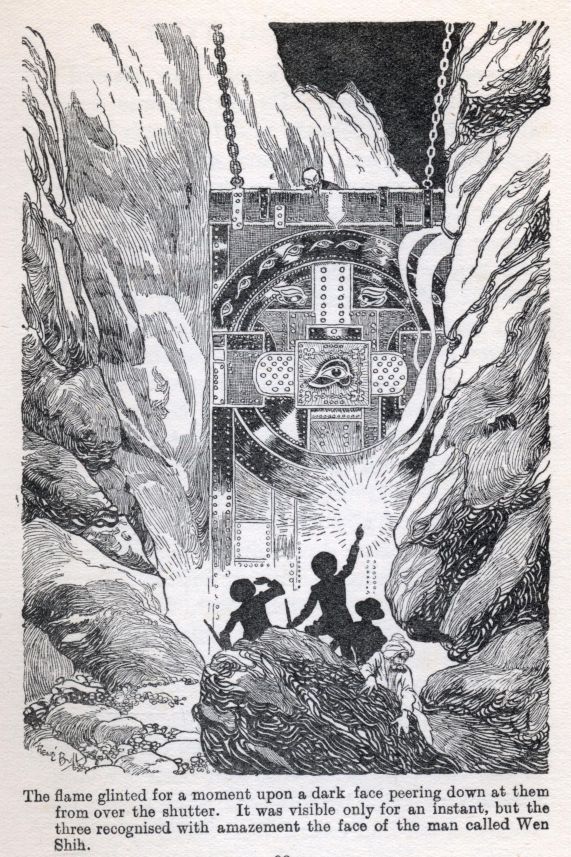
The flame glinted for a moment upon a dark face peering down at them from over the shutter. It was visible only for an instant, but the three recognized with amazement the face of the man called Wen Shih.
CHAPTER VII
EUTHANASIA
"Did you see yon?" cried Mackenzie, turning to the others.
"The Chinky!" gasped Jackson, under his breath.
"Och, man! there's no need to moderate your voice. We've no hobgoblins or supernatural beings of any kind whatever to deal with, but just that ruffian of a fellow I've had my suspicions about all along. That's an established fact."
Mackenzie spoke loudly and emphatically; he was indeed a little sore at the recollection of his own uneasiness. To his practical mind the secret stairway and the mysterious procession counted for nothing against the solid fact that here was the Chinaman whom he had mistrusted.
"He has shut us in," he added. "Well, he may be sorry for it yet. We'll just gang on, my laddies."
"But how about getting back?" asked Jackson.
"Eh, now! That's not a practical question. The shutter is a sort of portcullis, you may say, defending a sort of castle. Well, we will assume that this Beresford man is a prisoner in the castle. To get him out, the first thing was to get in ourselves. That we have done. What's more, we can't get out just at present, and, speaking for myself, I'll not go out without Beresford, if he's alive."
"I'm with you, Mac," said Forrester. "But, after all, we don't know that Beresford is here."
"We don't know, but there's good warrant for the suspicion. D'ye ken what I've been thinking? Beresford and the other man happened upon some secret here about, and the inhabitants--Chinese, by the look of it--collared them to prevent the secret getting abroad. That ruffian guessed from our line of march that we were coming here, just out of curiosity, maybe, for he couldn't have known anything about Beresford----"
"Unless he was here at the time, and left after Redfern's escape," Forrester suggested.
"Ah! That didn't occur to me. Anyway, he gave us the slip in the scrub back yonder just to prepare for our reception if we came along, and I acknowledge that the nature of our reception is a disagreeable surprise."
"Whatever the motive for detaining Beresford may be, it applies to us, too," said Forrester.
"True, and therefore we'll have to watch out. It's a difficult situation."
"They might starve us, or murder us, or anything," said Jackson, somewhat nervously.
"There's just one thing against that," returned Mackenzie, "and that's the fact that our carriers are not with us. The Chinky knows that; he'll guess, or discover, that they're waiting for us in the village away yonder, and fear that if we don't return they'll hie back to Dibrugarh, and give the alarm."
"What do you think he'll do, then?" Forrester asked.
"Keep us here until we're starved or cowed into submission, and then let us go under a vow to say nothing at all. But it's no good speculating. We're in the castle; the first thing is to explore it. Come away!"
There seemed nothing better to be done. The party turned their backs on the shutter, and once more marched along the rift. The events of the last half-hour had made Mackenzie more uneasy than he cared to admit; but as the most level-headed of the party he felt the necessity of keeping up the spirits of his companions, and resolutely tried to conquer his misgivings.
They pushed on through the rift, searching the wall on either side for signs of an outlet; but the rock was still as smooth as heretofore. At last a couple of unusually sharp bends brought them to another constricted passage, which, like the one behind them, was closed by an iron shutter. Checked by this, they stood for a few moments in absolute silence, looking at one another without any attempt to disguise their alarm. The distance between the two shutters was, perhaps, 120 yards. On each side rose an unscalable wall. They were prisoners, as it were, at the bottom of a well.
The silence was broken by a wail from Hamid Gul. It served to brace up the white men.
"Whisht!" exclaimed Mackenzie. "Wait while I strike a light."
He kindled a match, and raised it above his head.
"This shutter is not so high as the other," he said. "We've just got to climb over it."
"How?" asked Forrester. "It's twelve or fourteen feet high, and as smooth as a board. There's nothing to stand on."
"Except our shoulders," Mackenzie retorted. "Here, Sher Jang, you're the broadest of us. Come and stand just here. I'll mount you; then, Bob, you're the slimmest, you swarm up. On my shoulders you'll be able to see over. Take the matches. Keep a look-out, Dick, and if you see anyone above threaten mischief, just fire off your revolver--not to hit him, you understand. Diplomacy comes before war."
Sher Jang stooped while Mackenzie mounted his back, then slowly rose to his full height. Mackenzie rested his hands on the shutter, and Jackson clambered up the human pedestal, and grasped the top of the iron gate.
Next moment he fell back with a stifled cry. Mackenzie caught him in his arms; but his weight was too much for the stability of the column. It tottered, and all three men fell sprawling on the ground.
"The top was red hot!" cried Jackson, lifting himself and rubbing his elbow.
"Hold up your hands, man!" cried Mackenzie, picking up the fallen box of matches. He struck a light and examined Jackson's palms. "Your nerves are all to pieces," he added. "Yon's no red hot, or your hands would be blistered and branded red. There's something in it, though. Look here, Dick!"
They saw a faint purple streak about an inch wide across the middle of the fingers of each hand.
"Any pain now?" asked Forrester.
"No; only a sort of tingle," Jackson replied, feeling a little ashamed of himself. "I was taken by surprise, but it really is hot."
"I'll have a try," said Forrester. "Get up again, Mac."
Once more Mackenzie stood on the shikari's shoulders, and Forrester clambered up as Jackson had done. Forewarned, he did not start back and upset the balance when he touched the top of the shutter; but he removed his fingers from it quickly, and called out that it was certainly very hot--too hot to grasp while he hauled himself over. He slid down, Mackenzie leapt to the ground, and they looked at one another in a sort of despair.
"Can't we blow down the shutter with our cartridges?" Forrester at length suggested.
"We might not succeed, and, anyway, it would be a loss of ammunition we may badly need before long," replied Mackenzie.
"What in the world are we to do?" muttered Jackson, peering about him anxiously.
"The fact is----" Forrester was beginning; but at this moment they were all startled, and yet relieved, at hearing a human cry from above them.
"Who's that?" Mackenzie called, lifting a lighted match above his head. For a moment they searched the face of the rock in vain; but then the light struck dimly upon a head, projecting, as it were, out of the solid wall thirty feet above them. They could distinguish neither shape nor feature, but before the match went out they saw a second head projecting, like a gargoyle from a Gothic wall, close beside the first.
"Who's that?" Mackenzie called again.
"Gentlemen!"
The word floated down eerily; it was as though a gargoyle were speaking; and the voice was that of the younger Chinaman whom they knew--high pitched, yet low in tone, hardly more than a whisper.
"Gentlemen," he said, "the August and Venerable welcomes you to his sanctuary. Uninvited you come, but none the less are you welcome. The August and Venerable will extend to you such hospitality as lies within his means. But it is not meet that armed parties should enter the holy precincts. Be content, therefore; withdraw to the lower gate, and leave your weapons there. When you return, this upper gate will be opened to you, and I shall have the honour and privilege of introducing you to the Presence."
This speech was delivered in the dull, dreamy, expressionless tone which had characterised all the young man's utterances, except in those few tense minutes succeeding his rescue from the elephant--the monotonous sing-song of a child nervously reciting a lesson.
"The 'Presence' is that one-armed rascal beside him, I suppose," whispered Forrester. "The poor weed says what he is told to say. What's our answer?"
"We're in an awkward fix," Jackson began, but Mackenzie cut him short.
"Things aren't so hopeless as that," he said, quickly. "We'll not part with our arms--our only protection. We don't know when we may need them. I'll answer the fellow." Raising his voice, he said: "We refuse to lay down our arms. We have no hostile intentions--we're as meek as lambs--but the shutting of the gates is a dashed unfriendly act, and makes us mighty doubtful about our welcome. Lift this gate, and lead us to the presence of the August and Venerable. We demand an audience with him."
His comrades thought that a more conciliatory manner and more formal phrases might have served them better, but they said nothing. There was no reply from above; they supposed that the young Chinaman was translating to his master, though they heard no sound. It was too dark to see the heads without artificial light; and after a minute or two had passed in silence Mackenzie struck a match, and held it so that its light would fall on the spot where the shapes had been seen. But the wall was blank; the gargoyles had disappeared.
"What's going on now?" Forrester murmured.
"Maybe they're sending someone to work the machinery," answered Mackenzie.
They waited silently, expecting every moment to hear the harsh grating of the rising shutter, and the rattle of the chains. But minutes passed, and there was no sound except the hard panting breaths of Hamid Gul. Gradually, however, they became conscious of a strange feeling of oppression. The mustiness of the air, which they had felt ever since they entered the rift, became impregnated with a subtle new odour. At first they paid little attention to it, merely remarking on it one to another. But presently Jackson began to sway on his feet.
"I feel funny," he said, slowly. "Getting--awfully--sleepy."
"Hold up, man!" said Mackenzie, sharply, as Jackson staggered against him. "Dick, take him by the arm; we'll walk him about."
"If I can," returned Forrester. "I feel uncommonly drowsy, too."
They took Jackson by the arms, and led him down the rift in the direction of the first shutter. A few yards away they passed Hamid Gul, lying with relaxed limbs on the ground. With growing alarm Mackenzie tried to hurry the pace, but his companions became moment by moment heavier on his hands. After a minute or two he let Jackson's arm go without knowing it. In a few seconds more his grip of Forrester loosened, and he walked on two or three paces alone. Then he, too, fell a prey to the overmastering influence of the atmosphere.
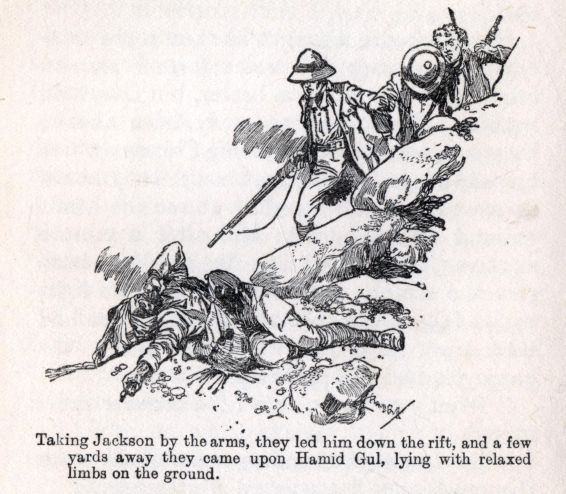
Taking Jackson by the arms, they led him down the rift, and a few yards away, they came upon Hamid Gul, lying with relaxed limbs on the ground.
"Hold up, I'm telling you!" he muttered, staggering and reaching out with his hands.
Next moment, without volition of his own, he sat down on the ground, striving, like a man half drunk, to keep himself erect, and declaring to himself that he was "quite all right." But his hands fell limply to his sides, his body swayed gently, his head nodded, and in a few seconds he, like the rest, was prone in unconsciousness.
CHAPTER VIII
THE LAW OF THE EYE
Some two hours later, Mackenzie awoke, heaving a great sigh.
"Hech! But I've a sore head the morn," he murmured, rubbing his eyes drowsily as he looked around him. The sight of bare blank walls instead of the walls of his bungalow, decorated with colour plates from the illustrated papers, caused him to sit up suddenly and rub his eyes again. It was a minute or two before full consciousness and the recollection of recent incidents returned to him. Then he remembered that his last waking moments had been spent in the rift; but he had awaked in a stone-walled, stone-floored cell, cubical in shape, and ten feet in each dimension.
His comrades, still asleep, lay at full stretch on the floor, on either side of him.
"Eh, Dick! Bob! waken yourselves," he called.
There was no response.
He got up, moved, somewhat totteringly, to Forrester, and prodded him in the ribs.
"Waken!" he called again. "Man, what's wrong with you?"
He gazed anxiously into his friend's face as Forrester slowly opened his eyes. Turning away, he hastened to Jackson, poked him, bawled in his ear, felt his pulse; then, assured that he was not dead, as he had begun to fear, raised him in his arms and shook him vigorously.
"Haven't got the ball, you ass!" Jackson spluttered.
"This isn't rugger, old man," said Forrester with a light laugh, coming to his side. "Wake up and see where the beggars have carried us."
Jackson recovered his wits more tardily than the others.
"His face is green," Forrester whispered uneasily.
"So is yours," said Mackenzie.
"And yours too, by Jove!" cried Forrester, after a good look at him. "What the mischief have they been doing to us?"
"I cannot say. I know that my head is sore."
"I've a headache, if that's what you mean," said Forrester.
"So have I, splitting," added Jackson, sitting up, but still resting his hands on the floor. "By Jinks, the stone is warm!"
"It is that," said Mackenzie, feeling it. "They're wishful we shan't take a chill, by the look of it."
They gazed around their narrow chamber. Walls and floor appeared to be of solid rock. In the centre of one wall was a door of stout timber, without lock or handle. High in another was an opening, like the arrow slits in medieval castles, through which a white light filtered.
"Get on my back, Dick, and keek out," said Mackenzie.
In a moment Forrester was mounted.
"I see nothing but a blank wall twenty feet away," he called down. "And not much of that. It looks like the wall of the rift. I tell you what: this room must be cut out of the wall this side. When you called it a castle, you spoke better than you knew, Mac."
"Ay, so it seems," Mackenzie replied, as Forrester sprang down. "But I'm fair flummoxed. The room's perfectly light, though yon slit isn't more than twelve by two. Where does the light come from? It's greenish, too, which accounts for our delicate complexions. And look! you see that?"
He pointed to the faint shadow of a fourth human figure that passed across the wall opposite to the window. It flitted through their own shadows, and disappeared.
A moment's glance assured them that it had not been cast from without; yet the wall appeared solid, in no degree transparent.
There was no furniture in the room. Silently they sat upon the floor, watching the wall nervously for a return of the mysterious inexplicable shadow. But it did not reappear. The strange light, the stranger apparition, brought back upon them redoubled the uneasiness they had felt ever since they entered the rift, and especially after seeing the ghostly procession on the wall. At that moment they could have believed that they lay in the haunt of some necromancer, whose magic art might manifest itself in terrors unconceived.
"They must have hocussed us," murmured Forrester at length, his thoughts reverting to his last conscious moments in the rift.
"Ay, put us to sleep with some narcotic gas," said Mackenzie. "What'll they do next?"
"What have they done with our men?" said Jackson.
"Separated the goats from the sheep," replied Mackenzie sardonically. "They are evidently respecters of persons!"
"But----"
Forrester's voice ceased. The door had swung open, and there entered two small black men, almost wholly naked, with the uncouth bodies, hideous features, and coarse woolly hair of the wild pigmy races. Each carried a large bowl, one containing water, the other a sticky mess resembling porridge, and three spoons. Through the open doorway, in a brighter greenish light, the prisoners descried a group of similar negroes, armed with short spears and knives, like the dwarfs of the procession. The two food-bearers laid down the bowls and went out silently, the door swung to, a bolt grated in its sockets, and the prisoners were again alone.
Forrester bent over the larger bowl, smelling its contents.
"D'you think it's poisoned?" he asked.
"No, no," replied Mackenzie. "They wouldn't keep us alive to poison us out of hand. I'm for having a go. We've had nothing to eat since noon."
He spooned up a quantity of the stuff and tasted it.
"Sticky but not bad: would be the better of a pinch of salt. Hunger is the best condiment; dip your spoons."
By the time they had finished their meal and emptied both the bowls the daylight had faded, and the window slit was black. Yet the greenish rays that pervaded the room were as strong as ever. They sat discussing the strange phenomenon. Mackenzie advanced the theory that the rock was phosphorescent, and Jackson claimed that he had disproved it when, after rubbing his hand on the warm floor, there was no emanation of light from his fingers. Presently, tired out, and lulled by the warm close air, they fell asleep.
They were awakened by finding themselves gently shaken. The door had been silently opened, and two visitors were in the room. The prisoners recognised them at once. They were the two Chinamen with whom they had unforgettable links.
"Arise!" said the lad in his hushed faltering tone. "Arise! The August and Venerable commands you to his presence."
"The August and Venerable isn't this one-armed villain after all," whispered Forrester. "We must go with them: there's no help for it."
They noticed that the one-armed man had changed his dress. He wore now a long, white, full-sleeved garment with a green girdle about his waist. He signed to them to precede him through the open doorway. On passing out into a vaulted corridor, which, like their room, seemed to have been hewn out of the solid rock, they found awaiting them an escort of a dozen little black men like those they had already seen, and similarly armed. They followed them through corridor after corridor, the floors of which sloped gradually upward, then into a kind of ante-chamber, and finally into a huge rectangular hall. The greenish light had grown stronger and stronger as they proceeded, and the hall was brilliantly illuminated, though the illumination had no visible source. Like diffused daylight, when the sun has gone down, it came apparently from no definite direction: it was everywhere.
At first the three white men took in no details of the scene before them. They were dazzled by the brightness, oppressed with a sense of mystery, an apprehension of they knew not what, the dead silence that prevailed. But when their first sensations had passed, they gazed about them with a tingling curiosity. The walls, glowing with the all-pervading greenish light, were decorated with Chinese designs. The predominant feature of the scheme was a figure which at first sight might have been mistaken for the conventional Chinese dragon; but, on closer examination, it seemed to the spectators to resemble more nearly the reconstruction of some prehistoric sea-monster, such as European zoologists have attempted on the basis of fossil discoveries. The figures were arranged in a regular order. Some were large, some small, but all were of the same type, and they were rendered more life-like, and at the same time more hideous, by the fact that their eyes glowed with a green light much more intense than the light that filled the hall itself.
Silent though it was, the hall was not unpeopled. Drawn up in two crescent ranks stood, motionless as statues, perhaps two hundred Chinamen, young and old. The cheeks of all alike were clean shaven, but there were differences between the first two ranks. The heads of those in the first were absolutely hairless: their scalps shone like balls of old polished ivory. They were clad in long sleeveless robes resembling ecclesiastical copes, white with an edging of gold, and a large blue monster, like those on the walls, ramping across the middle of the back. The men in the second row were moustachioed, and had a topknot of hair. Their principal garment was a full-sleeved tunic, white also, but without embroidery of any kind. It was among these that Wen Shih, the one-armed Chinaman, placed himself after leaving his young compatriot and the three Englishmen with their escort just inside the doorway.
The silent assembly faced a huge dais or throne at the farther end of the hall, rising six or eight feet from the floor. It was of Chinese design; the material of which it was made shone like gold; and its surface was marked with images of the symbolic monster, sculptured in high relief.
The Englishmen noticed that, immediately opposite the throne, there was a gap in the ranks of the company, eight or ten paces wide. Beyond this gap--that is, nearer to the end of the hall at which they had entered--stood a low pedestal, like the pedestal of a statue. But there was no statue upon it. Nor was the throne occupied. The eyes of the silent throng, indeed, appeared to be fixed on a doorway in the wall behind and above the throne. It was covered with a cream-coloured hanging of some rich material, ornamented with monsters embroidered in gold. From it to the rear of the throne a broad stairway led.
The hush of expectancy which brooded over the whole assembly seized upon the three strangers. Their fascinated eyes were drawn as by some magnetic attraction to the curtained doorway. Not one of them was tempted to speak: they were possessed by awe the same in kind as that which holds the worshippers in some vast cathedral.
Presently they became aware of a trembling in the air immediately above the throne, like that which is sometimes seen above the funnel of a locomotive engine at rest. By degrees a screen of mist, delicate as muslin, formed itself in front of the throne, the outlines of which became blurred and were finally blotted out altogether. There was a momentary rustle, like the breaking of surf upon a long shore; then the same deathly stillness; the Chinamen had bent forward simultaneously with the precision of trained soldiers, until their brows touched the floor. Of all the men in the hall, only the three Englishmen at the end stood upright upon their feet.
They gazed in mute amazement, tensely awaiting the explanation of this extraordinary scene. Presently they caught the gleam of gold through the shimmering screen; the mist slowly dispersed; the outlines of the throne were once more clear and distinct; and they thrilled as with an electric shock when they beheld, seated motionless upon the throne, a remarkable figure.
It was the figure of an old, old man, low in stature, bent and frail, but indued with a certain impressiveness and majesty. A long ivory-hued cope, stiff with gold, and emblazoned with purple monsters, descended to his feet, concealing a frame which the three spectators divined to be spare and emaciated. His head was covered with a towering head-dress like a bishop's mitre, but loftier, fantastically shaped, and gleaming with gold and jewels.
But the eyes of the beholders were drawn away from his gorgeous trappings to his countenance. Ivory pale, lined and wizened with great age, it was rendered strangely impressive by the eyes, which beamed with the lustre and brilliance of youth. His glance passed over the prostrate forms of the assembly, and fastened for one brief moment on the three straight figures at the end of the hall. Then in a clear bell-like voice, surprising in so old a man, he uttered one word. The men prostrate below him rose to their feet; there was a brief pause; then for the space of several minutes a sort of litany was chanted, the old man reciting a sentence, the others making responses in monotone. There was no gesture, no movement save the motions of their lips.
When the litany came to an end, at a word from the old man Wen Shih left his place in the second rank, and approached the Englishmen. He made them understand by signs that they were to accompany him to the foot of the throne. Moving as under a spell, they passed through the gap, scarcely conscious of the eyes of the men around, and halted a few paces from the seated patriarch. Wen Shih returned to his place. All was silent as the grave.
The old man gazed fixedly at them for a moment, and his searching look, bright as an eagle's, yet cold and paralysing, filled them with a chill foreboding. His lips moved, and in spite of themselves they started in amazement as they heard the first words that fell.
"What brings you striplings here?"
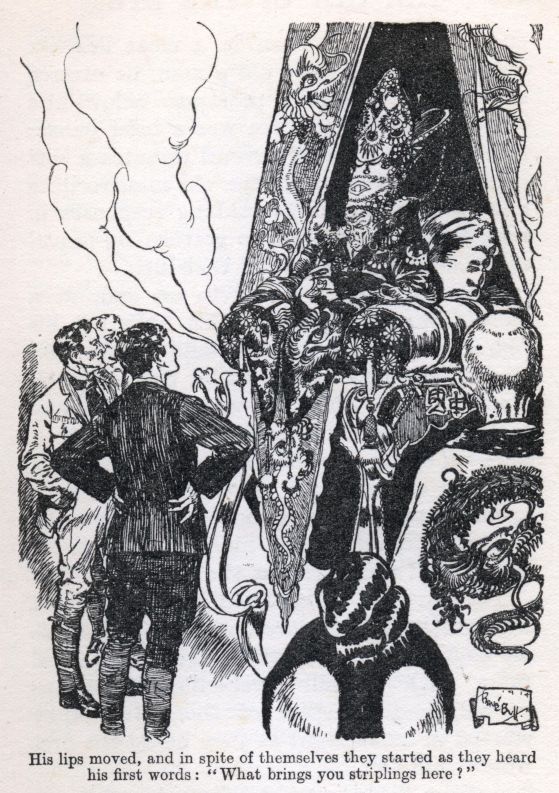
His lips moved, and in spite of themselves they started as they heard his first words: "What brings you striplings here?"
The face was Chinese, beyond possibility of error; but the words were English, slowly spoken, with only a faint trace of a foreign accent. The tone was authoritative, compelling, that of one who would not be gainsaid. Forrester, always the readiest of the three, felt instinctively that no prevarication would avail, that the best chance of coming safely through whatever ordeal was before them lay in perfect frankness. Steadying his voice, and looking up into the old man's face, he explained, so rapidly that his words as it were tumbled over one another, that he had come with his comrades for the purpose of liberating a fellow countryman whom they believed to be held captive in this region, and he begged that the prisoner might be surrendered, and that all might be suffered to depart in peace.
The old man's countenance was utterly expressionless. It gave as little sign as a mask of what was passing through his mind. Forrester having ended, somewhat breathlessly, the low mellow voice spoke again.
"All are welcome to the Temple of the Eye. I repel none, I invite none. Those who come by their own choice, or are led hither by the hand of Fate, must abide by their choice, or by Fate's decree. The rest of their lives hereafter must they spend in the service of the Temple, fulfilling such offices as they may be best fitted to undertake. That is the Law of the Eye."
His utterance was slow and deliberate, like that of a man searching for words at one time familiar, but now half forgotten. The cold dispassionate tones struck a chill upon the listeners' hearts. They had in them the ring of finality, of inexorableness: the old man might have been the very mouthpiece of Fate pronouncing doom.
The three men felt the utter hopelessness of argument or protest. Their spirits, under the spell of that calm silvery voice, died within them. When Wen Shih came again to them to lead them back to their former station, they accompanied him with the tranced meekness of men drugged for the gallows.
A few moments after they reached the end of the hall they were roused from their stupor by the appearance of a small black man, led between two bald white-clad Chinamen like those in the first rank. His limbs were quivering, his teeth chattered; his staring eyes regarded the awful Presence on the throne with the same helpless terror as a bird fascinated by the baleful eye of a snake. The priests of the Eye lifted him on to the pedestal in a line with the gap, and fastened his collapsing form upright to a light framework which they slid up from the base. Then they placed themselves on either side, and made three low obeisances to the venerable figure on the throne.
The man on the left uttered a few sentences in Chinese, and bowed again. His fellow followed with a word or two. It seemed to the Englishmen that they were giving testimony against the quivering figure on the pedestal above them. The second man ceased, and made his obeisance; then both took places quietly at the ends of the front row near the gap.
The Englishmen expected that the criminal, if such he was, would be called on for his answer to the charges made against him. But the old man said never a word. Amid a breathless stillness he arose slowly and majestically to his feet. Was he about to pronounce judgment? The Englishmen wondered what the punishment was to be. Recollections of the horrors of Chinese torture made them quake; but there was no sign of instruments of torture, no movement in the silent ranks, except that they turned and faced the victim. Their garments rustled, then all was still as before.
The old man moved his head from side to side, the movements being so slight that they might have passed unnoticed by any one observing him less closely than the three Englishmen. Presently all motion ceased. The silence seemed even deeper than before. Then, with startling suddenness, from a point in the old man's head-dress, immediately above the centre of his brow, a swift thin beam of bright green light flashed along the hall, over the gap, past the pedestal, and on to the wall. It was gone in a moment. A low sound like the indrawing of breath ran through the assembly. A flicker of emotion stirred the stolid faces of the Chinamen; a look of horror distorted the more expressive faces of the negrito guards. And the Englishmen were suddenly aware that the pedestal was vacant. The limp shrinking form had vanished; only a little dust hung in the air.
While the Englishmen were still in their amazement, the ranks faced about again, and the two priests who had led the victim to the spot drew near to it with the solemn gait of acolytes. One carried a golden trowel, the other a small gold-handled brush. Standing on either side of the pedestal, the one swept a quantity of dust on its surface into the trowel held by the other. The latter, holding the trowel at arm's length in front of him, bore it slowly towards the throne, and after a profound obeisance offered it to the old man, and withdrew. Lifting his skinny right arm, the old man extended the trowel towards the assembled priests, moved it from side to side, lightly sprinkling the dust on the floor, and in his cold clear voice spoke with impressive deliberateness a single sentence. Once more the assembly fell prostrate, the air above the throne quivered, and the mist gradually rose before it, blotting it and its motionless occupant from sight.
CHAPTER IX
THE MONSTER ON THE WALL
The three friends scarcely noticed what followed on the disappearance of the old man. The priests filed out quietly, each rank by a separate door. Only Wen Shih remained. He came slowly to the end of the hall, threw a contemptuous glance on the young lad his late companion, who had fallen swooning to the floor, and signed to the Englishmen to follow him. Accompanied by the negrito guards, they quitted the hall, and marched back through the vaulted corridors. They were not, however, taken to the room which they had lately left. Mackenzie was led off by himself to a somewhat smaller cell, and locked in there, Jackson and Forrester being left, meanwhile, under charge of the guards. They in their turn were separately incarcerated. None of them knew anything of the fate of Sher Jang and Hamid Gul. The scene which they had just witnessed, the climax of the series of mysterious happenings of the past few hours, had completely overwhelmed them. They were incapable of resistance, of protest, even of thought: everything was subdued to a shuddering horror.
Mackenzie found himself in a chamber differing from that which all three had previously occupied in two respects: its size, and the ornamentation of one of its walls. At first he was hardly aware of this; but recovering his composure by and by in the quiet of his solitary cell, he noticed that the wall opposite the window slit bore a representation of the strange monster which was depicted on the walls of the hall. But here again there was a difference. The hideous creature had, in addition to two eyes normally placed, a third, in the centre of the forehead, in the same position as the spot on the old man's head-dress from which the annihilating beam of light had sped. The cell was dimly illuminated by the mysterious green light, but the monster's third eye glowed brilliantly, a lozenge of vivid green.
Here, at last, Mackenzie thought, was the explanation, or rather the confirmation, of the villagers' vague statements about the Eye. It was a symbol of the power presiding over this mountain community. He remembered having noticed a lozenge-shaped ornament on the head-dress of the Old Man of the Mountain; it was from this ornament that the beam of light had appeared to shoot. But what was the origin of this mysterious light? What was the secret of its tremendous devastating force, which in a single moment had shattered the little black man into a few handfuls of dust?
Mackenzie shuddered as he recalled the scene. This wizened old man, who appeared in a mist, and into a mist vanished, who was revered as a deity, who was judge and executioner in one--who was he? The sound of his clear silvery voice rang still in Mackenzie's ears. He remembered the cold remorseless words of his speech. All who came to the Temple of the Eye were doomed to spend the rest of their lives in its service! What did that mean? What service was exacted of the hapless wretches enthralled to such a master?
He remembered too that the Old Man had wholly ignored Forrester's reference to the Englishman who, it was suggested, had fallen into his hands. Had the dust of Beresford's destroyed body been already scattered on the floor of this horrible temple, or had he too been preserved for a lifelong servitude? Was he perhaps at this moment lying in a cell, alone, crushed in spirit, asking himself the same unanswerable questions?
Agitated beyond endurance, Mackenzie got up and paced the floor. As he walked, he found himself glancing more and more frequently, and each time for a longer period, at the monster's green eye. It exercised a basilisk attraction: by and by he was unable to withdraw his gaze from it. He tried to look elsewhere, to think of other things; but always his eyes wandered back to the one spot. It glowed upon him with a sort of hypnotic fascination, leering, as it seemed, mocking him, a mute unwinking witness of his despair. Unable to endure the torment, he turned his back upon it, threw himself on the floor, and buried his face in his folded arms. And there at last, worn out in body and mind, he fell into a sleep broken by frightful dreams.
When he awoke his hand moved by force of habit to his pocket for his watch. It was gone. He felt in all his pockets: they had been emptied. Nothing but his clothes was left to him. Looking up at the window slit, he saw sunlight streaming in; the greenish hue had almost disappeared. He rose, and with a strong effort of will forced himself to turn towards the wall on which the monster was painted. He almost shouted with relief when he discovered that the third eye, though still aglow, was much dimmer than it had been in the night. The sun had conquered; the eye's baleful attraction was gone.
Presently the negrito guards brought him his breakfast of water and the same glutinous porridge as on the previous day. He spoke to them, first in English, then in Hindustani, but they answered nothing; if they understood him, they gave no sign of it. An hour or two later they returned, accompanied by one of the shaven priests, who indicated that he was to follow them. To refuse, he knew, would be vain; but he shivered with dread lest he were summoned to witness another scene like that of the night. He found, however, that his fears were not justified. His guards took him through miles, as it seemed, of narrow corridors hewn in the rock, always ascending, and brought him presently to an arch through which the sunlight poured. Passing out into the open air, he saw with surprise that he was at the foot of a steep stairway cut in the face of the rift. The steps, about a foot wide, led to the summit, perhaps a hundred feet above. A rope, carried down a kind of handrail, intervened between the passenger and the abyss yawning more than a thousand feet below.
The guards signified that he was at liberty to ascend the stairs, and left him. At first he shrank from attempting the climb; his experiences, and his restless night, ill fitted him for any task that demanded steady nerves. But Mackenzie was a man of grit; freedom, the fresh air, the pure sunshine braced him; his curiosity was keen; and at length, steadfastly averting his eyes from the dizzy depth below, and clinging firmly to the rope, he began to mount the stairway.
He gained the top, and an unexpected sight met his wondering eyes. Before him, and on either side, stretched a broad plateau, rising in the far distance to the mountains of the snowy range, whose peaks, miles high, glistened dazzlingly in the sunlight. That which surprised him most of all was that the plateau was cultivated. It was divided into many rectangular fields, on which crops of all kinds were growing, and herds of cattle grazing. The fresh green of the vegetation was refreshing to his eyes after the greyness of the barren rock on which they had rested of late. He saw now why the community required supplies of wood from the outside. There were no timber trees. At his right hand lay an extensive orchard, but nowhere were to be seen trees that could be felled for fuel or building.
In three directions there were groups of huts, and people were moving about in the fields. They were evidently of many races. There were dwarfish negritos like the Temple guards, Chinese, Tibetans, Nagas and other hillmen. There were women and children, but these seemed to be all negritos or hill-folk: no Chinese women were among them.
Mackenzie remained for several minutes at the top of the rock stairway, scanning the whole prospect. He was quite alone, apparently free to move in any direction he pleased. No one took notice of him. When he moved a few paces towards the nearest group of huts, he looked around, expecting to find that someone had been told off to watch him. The fact that such was not the case induced a sense of utter hopelessness. If he was not guarded, the reason must be that escape was impossible. But he promised himself that, granted his liberty thus, he would not rest until he had thoroughly explored the plateau, and assured himself that there was not in one direction or another an outlet into the larger world.
The sight of Sher Jang approaching him, spade in hand, recalled him to the present, and he hurried to meet the shikari, whose usually expressionless countenance lit up at sight of him.
"It is good to see that you are alive," he said. "What did they do with you?"
"They locked me up, sahib, in a warm room, and this morning brought me here. A shorn-pate put this spade into my hand, and bade me dig. I have lost caste; it were better to die: but he told me I am a slave, and shall remain a slave while life lasts."
"And Hamid Gul?"
"I know nothing of him, sahib. I have not seen him since we left the pit below. There are many of my countrymen here; they are all in bondage; and they quake and shiver when they speak of the Eye."
"I don't wonder," Mackenzie murmured. "What do they say of the Eye?"
"They speak of it as of some unknown horror, sahib. No one has seen it: they say that no man sees it and lives. They declare that the one-armed stranger had both his arms, like you and me; one day he had two, the next, when he came up, he had but one. They tell also that men have gone from this place down into the depths yonder, and have never been seen again. It is Fate: who can stand against it?"
At this moment a Chinaman dressed like those who had formed the second rank in the Temple came up to Mackenzie, held out a spade, and signed that he was to join a group of men who were digging in a neighbouring field. Mackenzie thrust his hands into his pockets and turned his back upon the man. To his surprise there was no insistence, no attempt at compulsion: the priest, as he supposed him to be, went away without a word. And then he saw Forrester hurrying towards him from the head of the stairway.
"Where's Bob?" were Forrester's first words.
"I was going to ask you that," Mackenzie replied. "I haven't seen him."
"They locked me up alone," Forrester went on, "and I never passed a more awful night. That eye!"
"The monster's on the wall?"
"Yes. Had you one too? I couldn't look away from it: try as I might, the frightful thing seemed to draw my eyes to it against my will. What unnameable devilry are they playing on us?"
"Making good!" Mackenzie replied with a grim tightening of his mouth. "The Old Man of the Mountain said we were to stay here for the rest of our lives: he means to terrify us into knuckling under. But I vow----"
"For any sake say nothing," Forrester implored earnestly. "I feel as if the very air were spying on us; and who knows, if we say anything against him, he won't burn us to powder as he did that poor trembling wretch!"
"An easy death: better than lifelong slavery. All these folk you see about are slaves."
"But why have they let us come up here?"
"To prove we can't escape, no doubt. But I'll not----"
"Hush! Look at that fellow slinking by!" Forrester cried in an urgent whisper.
It was one of the shaven priests walking towards the orchard.
"Let's follow him," said Mackenzie. "There's no check upon us; we are free men still."
Sher Jang had returned to his digging. The two friends set off pace for pace after the priest. He did not enter the orchard, which was in no way railed off, but skirting its upper end, he drew near to a long low building of stone, with open doorways a few feet apart. It reminded Mackenzie of the rank of connected cottages often seen near engineering works in his own country, except that it was characteristically Chinese in form and decoration. The priest entered one of the doorways and disappeared. As they passed, they heard a dull incessant hammering from within the building.
"Sounds like a smithy," said Forrester. "I wonder what goes on there?"
A little beyond the building, rose a sort of pagoda, three stories high, but not so truly pyramidal in shape as the memorials frequently seen in China. It was surrounded by a walled enclosure, the wall being too high for them to see over.
"It's not big enough to be the Temple," Mackenzie remarked. "I guess it's the residence of the August and Venerable. We'll go on; maybe we'll see the Temple later."
"I don't want to see it," Forrester said with a shudder. "I never want to see it again."
"Eh, but I do," Mackenzie returned. "I wish to know all I can about this place. The look of the outside can't do us any harm."
But no such building came in sight. The only thing that attracted their attention was a stream flowing from north to south across the plateau. It passed through the walled enclosure of the pagoda, and flowed away between embankments in what they supposed to be the direction of the falls. They were thinking of following its course, when a horn sounded stridently in the distance. At the signal the priests emerged from their dwellings, and marched in file towards the stairway. Mackenzie and Forrester followed them, out of curiosity. They descended the stairway one by one. Soon afterwards another file, the moustachioed priests, came up from the opposite direction. None of them so much as glanced at the two young men standing aside to watch them. When all had gone down, Sher Jang came up to his masters, and told them that the horn blast was the signal for the midday meal. If they wished to eat, they must descend, for no food was given on the plateau to the men from below.
"I'll not go down till I must," said Mackenzie firmly. "To exchange this fresh air and sunshine for the close atmosphere below--no, I'll fast for the day rather."
The two remained foodless for the rest of the day. No one interfered with them. They rambled where they pleased. Every now and then they spoke to one or other of the Indians in the community, asking them how they had come to the place and what their experiences had been. A few had stumbled upon the rift by accident; most had been entrapped, kidnapped, or inveigled by the priests. All were utterly broken in spirit, and lived in hourly terror of the Eye, the mysterious and dreadful something of which rumour spoke, but which none had seen.
Among those whom the Englishmen addressed was an old Indian, who told them that he had been captured with his little daughter several years before on the outskirts of his village. He was a zamindar, a man of substance and of some education. He invited the two men into his hut.
"Lilavanti!" he called as they entered.
From behind a curtain that divided the apartment a tall beautiful girl of sixteen or seventeen years came forth. She wore no veil. A white dhoti was wound about her body. Her raven-black hair was bound with a fillet of pearls, and a string of pearls depended from her neck. She bowed deeply as her father introduced the visitors as English sahibs, placed cushions for them, and then seated herself modestly in a corner.
"I have no hope for myself, but I still dream that my daughter may even yet be released from bondage," said the zamindar, looking with pride at the girl. "We are not ill-treated, you perceive; we make no complaints on that score. So long as the slaves fulfil their appointed tasks they suffer nothing at the hands of the priests. But our life is overshadowed by a cloud of uncertainty as to what the future may bring forth."
"What is the meaning of it all?" Forrester asked.
"No man knows, but I will tell you, sahibs, some conclusions I have come to. The negritos, the original inhabitants of this plateau, are a dwindling race. Fresh blood is required in order to maintain a sufficient population for the cultivation of the soil. Prisoners are brought here for that purpose, and for another which I know not. At irregular intervals men are taken down the steps yonder: we never see them again. The strange thing is that no Indians are thus removed, but only Chinese and negritos. And there is another strange thing: the Chinese prisoners of humble rank are set to work on the fields and are never taken underground; but at intervals, sometimes long, sometimes short, young men of noble birth and high education are brought here. At first they spend their days here above, as you are doing to-day, and descend at sunset; but a time comes, sooner or later, when they descend for the last time and are no more seen. And from the first they are listless, dazed, scarcely sane. If they speak, it is as though they were the mouthpiece of others. Some of them have conversed with me in my own tongue; but I have never been able to learn from them any particulars of their past life, or of the nature of the place underground where they pass the nights. Always they speak with the utmost reverence of the priests, whom they profess to be their kind friends."
"Like our young Chinaman," Forrester remarked to Mackenzie.
"Ay; he is the latest victim, it seems. Have you ever seen one of our countrymen here?" Mackenzie asked.
"One only. I shrank from telling you. He came up daily for eight or ten days: I had many conversations with him. It is four days since I saw him: I shall never see him again."
"Do you know his name?"
"It was never mentioned: he was simply the Sahib to us."
"Beresford, there's hardly a doubt," Forrester said to his friend. "And is there no means of escape from this plateau?"
"None. If you think of attempting it, you may spare your labour. I have traversed the plateau from corner to corner. Behind are the mountains; if you could climb them you would only die of cold and hunger. In the centre is a mighty river, that pours over the edge of the precipice. To cross it is impossible. In the other direction the plateau ends in a sheer precipice thousands of feet deep. The rift you have seen. That is the only entrance and exit. How its floor is reached from above I know not: I was made insensible there below, and when I revived I was here."
"And has no one, absolutely no one, at any time escaped from the regions below and returned here?" Mackenzie asked.
The zamindar looked round apprehensively, as if he feared that the walls might hear him. When he spoke it was in little more than a whisper.
"You are an Englishman," he said. "I can trust you. One man escaped; one only: a negrito: it was five days ago. He came to my hut one night for shelter. I knew him. When he left here a year before he was young, plump and bright-eyed; when he returned he was like an old man. He was mad. I had learnt something of his language, but I understood little of what he said, so wild and broken were his words. It was clear that he had lived among unspeakable horrors."
"What became of him?" asked Forrester.
"When my daughter and I were absent in the fields the priests came and took him. He is gone: we shall never see him again, and I am in constant fear that I shall suffer for harbouring him. In his ravings he spoke of the Eye, and shook like a man in ague."
The two Englishmen looked at each other. The same thought had occurred to them both: this was the negrito whom they had seen suffer the punishment of the Eye.
"Shall we tell him?" Forrester asked.
"No, no: don't let us terrify the old chap," his friend answered. "His dread of the unknown is depressing enough as it is: if we told him about the Eye, every moment of his life would be an agony."
They were still conversing when a horn sounded thrice. The zamindar rose from his seat.
"That is the signal for returning below," he said. "The sun is setting. I hope that I may see you to-morrow, sahibs."
His visitors rose to leave the hut, and bowed to the young girl. The zamindar politely escorted them to the doorway. Forrester was a pace or two in the rear. He felt a touch on his arm, a small object was slipped into his hand, and the Indian girl whispered in Hindustani:--
"It saves from the Eye, sahib. The little black man gave it to me."
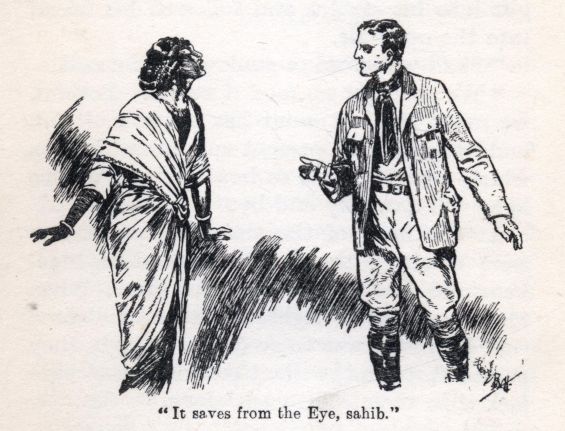
"It saves from the Eye, sahib."
She stole away behind the curtain, and Forrester, after a momentary pause, put the gift into his pocket and followed his friend into the open air.
"Shall we refuse to go down?" he said.
"We shall get no food if we do. Besides, we must find out what has become of Bob and Hamid. At present my brain is in a whirl; everything is so bewildering; maybe light will dawn by and by."
At the head of the stairway two priests were awaiting them. One signed to Mackenzie to descend, and followed him. When they were out of sight, the other indicated that Forrester was to go down. Singly they passed through the silent corridors, and were locked in their cells, each alone.
CHAPTER X
THE UNDERWORLD
Meanwhile, what of Jackson and Hamid Gul?
The former, more nervous and highly-strung than either of his friends, had suffered still more poignantly the malignant influence of the monster's eye. Like them, he had been taken that morning to the foot of the stairway, but the sight of the dizzy ascent had proved too much for him. He could not bring himself to face it, and returned to his cell, where he had remained all day in miserable solitude, his meals being brought to him at intervals.
Hamid Gul, the first to fall into unconsciousness, was also the first to revive. He came to himself as he was being carried along the corridor to the cell allotted him, and immediately began to plead for mercy on the ground that he was only a servant, only the humble cook. One of the priests, who understood Hindustani, had reasons of his own for testing the man's skill. Accordingly Hamid, after a night of solitude, was conducted to the kitchen attached to the priestly buildings on the plateau, and ordered to prepare one of his most appetising dishes. The man was as quick-witted as he was timorous. Like many native servants, he cherished a dog-like devotion for his master, and instantly made up his mind to employ his utmost art in the hope of ingratiating himself with his captors to the advantage of the whole party. He concocted one of Forrester's favourite dishes, under the eye of the priest, who, having made him eat a portion, as a precaution against poison, carried the rest away. Returning presently, he said "It is well," and informed Hamid that he was to consider himself attached, at any rate temporarily, to the kitchen staff. Hamid was delighted with his success, and would have been wondrously elated if he could have foreseen the remarkable events that were to spring from his clever cooking.
Forrester had dreaded the approach of night, when he would again have to encounter the unwinking glare of the eye. As soon as he had finished the meal brought to him by two negritos, as before, and was locked in, he took from his pocket the small article given him by the Indian girl. It looked like a tightly folded sheet of paper, greyish in colour. It crackled slightly in his hand. Opening it, he found it to be a thin sheet of some unfamiliar substance, about eighteen inches square. The only material to which he could compare it was mica; but on holding it between his eyes and the window, through which came the reflected glow of the setting sun, he discovered that it was more transparent than mica, but less than glass. From the first he had felt little confidence in the statement of the Indian girl. If this strange substance was a defence against the Eye, why had not the little negrito kept it for himself? Now that its transparency was proved, he lost even the slight hope which the girl's words had inspired. If pervious to daylight, how could this flimsy sheet give any protection against the incalculable force that must emanate from the Eye?
When darkness fell, and the green glow from the eye of the monster on the wall dominated the little apartment, Forrester, rather from curiosity than with any belief in the efficacy of the screen, held it before his eyes. To his amazement, it was absolutely effective. The glow diminished to a faint luminosity. All its searching brilliance, its compelling power, was gone. He moved the screen aside to make sure that the light was still there, that it was not eclipsed by some other agency. He was immediately undeceived, and again held the screen between his eyes and the monster. What appeared to him still more remarkable was that, protected as he was now from the light, he felt little of that terrible depression of spirits which had tortured him on the previous night.
Mackenzie's suggestion recurred to his mind. The monster's eye was part of the fell machinery employed by the Old Man of the Mountain to crush the spirits of his victims. He relied upon its influence sooner or later to terrorise their minds into utter subjection to his own. From his one night's experience, Forrester felt that the desired effect would supervene soon rather than late: no mortal man could long withstand the mysterious force which the glaring eye exercised upon him. He instantly resolved to divide the screen next day into three portions, if that were practicable, and give one secretly to each of his comrades, supposing that Jackson appeared on the plateau. The fragments might avail to arrest the gradual breaking down of their will-power.
Early next morning, before he could attempt to carry out his design, the door was opened, and the guards made signs that he was to follow them. Expecting to be led again to the stairway, he rose with alacrity. But his guides soon turned off into a passage branching from the corridor he had traversed on the previous day, and his heart sank with misgiving as he recognised presently the ante-chamber giving access to the Temple.
He was detained there for a few minutes until joined by Mackenzie and Jackson. The aspect of the latter struck him with anxious foreboding. Jackson was deathly pale: his features were pinched, his eyes dull and ringed with dark shadows.
"The Eye!" he murmured, and a shudder shook him.
There was no time for speech between them. They were led into the Temple, where the priests were already assembled, ranged in two rows as before. There was the same period of silent waiting; the same prostration to the floor when the mist ascended before the throne; the same gradual revelation of the August and Venerable. Again they chanted the solemn litany, and during the performance the Englishmen grew faint with apprehension lest it were to be followed by a ghastly scene like that which they had formerly witnessed.
The last response was uttered; an ominous silence brooded over the place; then Mackenzie and Forrester saw with a shiver of horror, between two priests advancing, the shrinking form of Lilavanti. She was lifted on to the pedestal, and silently bound to the framework; then the shaven figure on her left made his genuflexions and began to declare her crime. The Englishmen, of course, understood not a word of his recital; they were indeed as though frozen stiff to the floor. But when the first accuser had come to an end, and his colleague had bowed thrice to the awful figure on the throne before taking up the tale, the girl turned her head slightly and threw upon Forrester a glance in which he read a last anguished plea for help. A hot thrill surged through him; he felt his cheeks flush; and, clenching his fists, he sprang forward, into the gap between the ranks of the priests, and strode swiftly up the floor towards the throne.
"Stop! Stop!" he cried, raising his hands aloft.
There was not a movement among the priests. So well disciplined were they, or so terrified at what might ensue upon any infraction of the customary order, that each man remained steadfast in his place. If any looked at the profane audacious stranger, it must have been from the corners of his eyes.
At Forrester's impulsive movement Mackenzie took a step or two forward, under the instinctive prompting to support his friend. But reflection brought him to a standstill. He could do nothing at present: the prudent part was to await the issue of Forrester's intervention: perhaps his aid would be more valuable later on.
Forrester had started almost at a run, looking straight at the immobile countenance of the Old Man on the throne. But the nearer he drew to it, the slower he went. Under the steady gaze of those piercing eyes he felt his courage oozing away; he almost forgot his purpose. He struggled against the paralysis that seemed to be creeping over him; but when, standing immediately beneath the throne, he tried to raise his arms, they fell limp to his sides; when he tried to utter the burning words of entreaty on his lips, he could only mutter and mumble. And when the August and Venerable rose slowly in his place, and Forrester saw more clearly than before the lozenge-shaped ornament on his head-dress, from which the destructive beam had appeared to flash forth, he felt within his soul that he was about to share with the Indian girl the same annihilating doom.
A breathless stillness filled the Temple. Then the Old Man spoke, and his words seemed to Forrester like drops of ice-cold water falling on his head.
"You offer yourself to judgment in place of the girl?"
Unknown to Forrester, such substitution was frequently practised in China. He scarcely understood the meaning of what he had heard. Commanding his voice with an effort, he whispered:--
"Spare her! Do her no harm!"
The blazing eyes pierced him through and through; but the Old Man's voice, when he spoke again, was cold and emotionless as ever. Mackenzie, at the end of the Temple, wondered whether the wizened figure on the throne retained the least drop of warm blood in his veins, the least remnant of humanity.
"You oppose your puny strength to the Law of the Eye?"
"No, no," Forrester whispered. "She is a young girl; have mercy upon her!"
"The Law of the Eye knows no mercy," the calm voice went on. "Whoso transgresses, shall he not be cut off, even in the flower of his youth? In ignorance you have profaned this holy place: the Law ordains that the ignorant shall be chastised until he becomes wise. Its ordinances shall be fulfilled from generation to generation, even until the world dissolves. You shall be made wise, and when wisdom is yours, you shall once more, and once only, behold the Power of the Eye. You shall see that fair flower of maidenhood wither and become dust; then shall you yourself suffer the selfsame penalty, and your dust shall mingle with hers."
Speechless, fascinated, Forrester stood as though transfixed, scarcely conscious that Lilavanti was reprieved. The quivering screen rose before his eyes; the figure of the Old Man seemed to flicker and dissolve into it. He was unaware of what went on behind him--that the girl had been released from the pedestal and taken out; that Mackenzie, his joy at his friend's respite swallowed up by dismay and dread of the future, was led away to his cell; that Jackson had been carried out in a swoon; that the priests had passed out in silent procession--all but one.
Presently he rose at the touch of a hand. Staggering to his feet, he saw that the vast chamber was empty save for the priest at his side. Unresisting he allowed himself to be led through the hall into the ante-chamber, where the negrito guards, trembling in every limb, were awaiting him. They filed out before him into the corridor, and he followed them, supposing that they were leading him back to his cell. Unheeding, he did not know that they passed his bolted door. Only when they stood back, and he saw, in the dim green light, a stairway descending in the rock before him, did he become aware that he was in a part strange to him. Turning round, he asked the priest where he was. The mute immobile figure merely raised an arm and pointed downwards at the stairway.
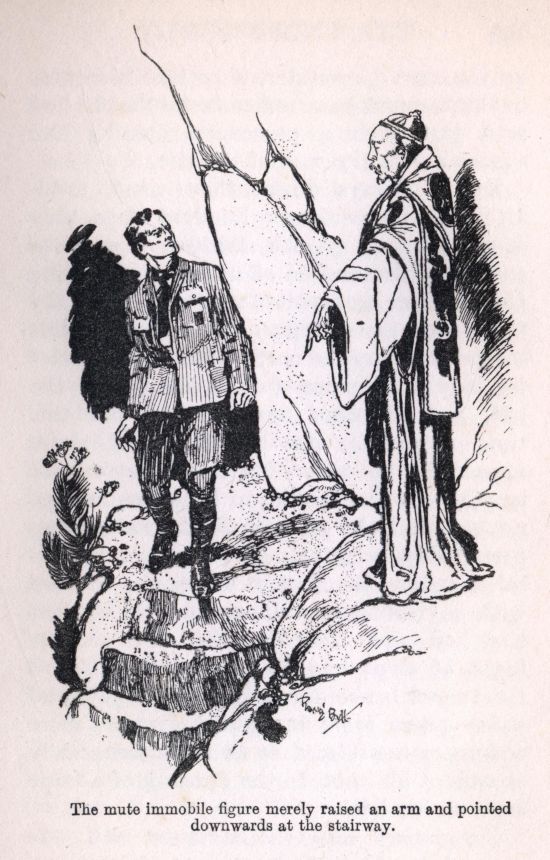
The mute immobile figure merely raised an arm and pointed downwards at the stairway.
Forrester was incapable of resistance, protest, expostulation. He felt helpless as a child, compelled to obey the behest of a stronger will. Slowly he began to descend the stairs. The negritos followed in a line, their spears slanted on their shoulders, and the priest in his wide flowing robes brought up the rear. Forrester, if he had been able to think, might have remembered that he had seen just such a procession passing like shades across the wall of the rift.
Down, always down, they went, until, after treading perhaps a hundred steps, they came to a long smooth stairless slope, steep enough to demand an effort lest the walking pace became an involuntary run. Presently there were more steps. At the foot of this second stairway the narrow, shallow tunnel--for it was no more--turned sharply to the left, and the floor again sloped, but this time upwards. Another series of stairs appeared. On ascending this Forrester, at length becoming awake to his surroundings, noticed that the greenish light was growing perceptibly brighter. He went on, up another incline, the floor of which was covered with a yielding deposit, apparently of dust that had fallen from the roof. Yet another flight of steps had to be mounted. Then the tunnel broke abruptly to the right, and a few paces more brought Forrester, more and more bewildered as he more completely recovered his wits, to the opening of a large cave on his left.
He glanced into the entrance, and was amazed to see a sheet of water, rippling a little in the greenish glow, and extending beyond eyeshot. The water washed the walls; but there was a narrow ledge of rock that lay uncovered, skirting the wall on the left. Forrester turned about to enquire whether he was to proceed along this ledge, and discovered that the negritos had halted some twenty paces in his rear, blocking up the tunnel. Behind them the taller figure of the priest stood with arm outstretched towards the cave.
Taking this as a command to go on, Forrester wheeled round, and walked towards the ledge, wondering with sickly apprehension what lay in the dim greenish mist beyond, and why his escort had not accompanied him. Glancing to the right as he reached the ledge, he saw, in a recess commanding the entrance to the cavern, a group of armed negritos and a priest standing behind them. There could be no doubt that they were placed there as a guard: the recess was a sort of wardroom.
He proceeded along the ledge, and came in about twenty yards to a gap, bridged by a broad plank with a handrail on the side towards the lake. He crossed this, went along the continuation of the ledge on the farther side, and arrived suddenly at the entrance of another cave, larger and more lofty than the first, rising to a vaulted roof like the nave of a cathedral. Its floor of rock was a foot or two above the level of the lake. Entering it, he saw a number of human figures, seated at the further end. One of them rose on seeing a stranger, and after a brief hesitation, stepped hastily forward to meet him. With a gulp and a half articulate cry, Forrester quickened his step, and in a few moments was grasping a firm hand, and looking amazedly into an English face.
CHAPTER XI
ALCHEMY
"Redfern got through?"
The eager question was like a knife in Forrester's heart.
"Yes, Redfern got through," he repeated wearily. "Your name is Beresford?"
"It is. Where is Redfern? Have you disposed of that ancient scarecrow above?"
"I am a prisoner like yourself."
The elder man gasped.
"Has he cast his spell over all of you?" he cried. "A British force conquered by a conjuring trick? For heaven's sake explain yourself."
"There is no British force. It is a long story I have to tell you."
"Come along over here, then. There's only one poor idiot who can understand you besides myself, and he's so desperately cowed that I doubt whether he will. Now, sit here: you won't catch cold: the whole place is warm, as I daresay you have discovered."
Beresford's brusque manner, quick speech, and robust personality acted as a tonic upon Forrester. Already he felt invigorated. The mystery of the place evidently had no terror for this sturdy Englishman. Forrester had vaguely expected that the archaeologist would be old, dry, bent, and spectacled: the actual man was of middle height, athletic in build, under forty years of age, with a heavy brown beard and moustache, and the large deep eyes that are the index to a mind at once eager and reflective.
They squatted side by side on the rocky floor. Beyond them, Forrester caught sight of the drooping figure of the young Chinaman, Wen Shih's companion, and several older Chinamen, clearly prisoners. Near the entrance to the cave were two negritos with spears, and, in a pagoda-shaped sentry-box, a priest of the second order.
"I didn't choose my company," said Beresford with a laugh. "Now, forge ahead; I won't interrupt you if I can help it."
It was soon evident that to listen long without interrupting was impossible to this impetuous spirit. He was patient enough while Forrester related the strange manner of his meeting Redfern, only ejaculating "Poor dear old chap!" when he heard of the captain's illness. But as Forrester was recounting the preliminary stages of the expedition, he broke in:--
"Cut that, if you don't mind. Hitch on again at your discovery of the rift."
"Yes; there's a good deal in between, but--well, the people here were warned of our coming by Wen Shih, who----"
"Wen Shih! Who is he? I suppose he comes into the part you've skipped. Wait though: I know the name. Of course; that broken-hearted young fellow over there mentioned him; seemed in two minds whether to hate or love him. But he has only been here since yesterday: he's young, and I hope to make a man of him yet. But I'm interrupting: do go on."
Forrester was too much pleased with this cheery being to resent being hustled. He went on to relate the closing scenes of the party's journey through the rift, their awaking in the rock chamber above, and the dreadful ceremony in the Temple. His voice faltered as he spoke of the beam of light and its effect.
"Ah! That's new to me," said Beresford more gravely than he had yet spoken. "That's dashed bad. You're sure it wasn't a Maskelyne and Devant trick?"
"Quite sure. There could be no possible doubt about it."
"That's what they really mean by the Eye, then. I took it to be the eye of that ridiculous creature on the wall. That old villain above is more ingenious than I fancied him. I regarded him as a mere clever bag-of-bones togged up--a sort of music-hall comedian with a straight face. But please go on."
The rest of Forrester's story was soon told.
"Well, don't be downhearted," Beresford cried, gripping his shoulder with the rough vigour of a friendly bear. "The August and Venerable sent me here too, to learn wisdom: we'll learn it together. I have been here three days----"
"Did you come down a staircase, with negritos and a priest behind?" asked Forrester, remembering the strange procession across the rift wall.
"I did. There's no other way. But why did you ask?"
"Because we saw you--what looked like half-dressed skeletons, slanting down the wall. When we found that the wall was solid, without steps, we were flabbergasted."
"I daresay," Beresford rejoined with a smile. "You will learn more wisdom here than our ancient friend upstairs reckons for!"
"But why didn't you feel the same ghastly creepiness as we did?"
"I'll tell you. It was because I knew what the old villain was up to. That knowledge was a wonderful talisman against his tricks. And what's more, he didn't know that I knew, or, after what you have told me about his murderous Eye, I should without doubt have been resolved into molecules before this. Like you, I was allowed to go up daily to the plateau--by the way, they employ a marvellously effective system of intensive cultivation there--like you, I refused to dig. Unluckily one day I lost my temper with one of his bald-headed priests: it doesn't matter why; and I knocked the fellow down. They hauled me into the Temple, and tried to lift me on to that pedestal you spoke of, supposing no doubt that the green-eyed monster and the surroundings generally had crumpled me up--that mist, for instance, a magnificent bit of stage management. But I sent one of the fellows spinning with my right and the other with my left, and marched straight up to the throne--it's pure gold, by the way--and shook my fist in the August and Venerable face, telling him what I thought of him and his crew. I am bound to say he stood it well. He didn't blink an eyelid; there wasn't a tremor in his silvery old voice when he reeled off, in surprisingly good English, a rigmarole about the Law of the Eye. I told him I didn't care a tinker's curse for the Law of the Eye. That was enough to rouse him, but the wonderful old creature wouldn't be roused. He simply yarned on about learning wisdom, and the Power of the Eye, shrouded himself in his vapour and disappeared like a dissolving view. Then I was brought here."
"I wonder you came!" Forrester exclaimed, envying the speaker's boldness, and burning to hear the secret of it.
"Well, I wanted to see all there was to be seen," Beresford replied simply. "I didn't know, of course, that I couldn't get back; and I might have acted differently if he had given an exhibition of the Power of the Eye for my benefit: I suppose there was no criminal on hand at the moment. As soon as I got here I saw that his intention was to give me a stronger dose of his horrors; he is a perfect epicure in punishments. But there was no occasion for panic. I've known Redfern for twenty odd years: he was my fag at school: and I would have given long odds that he would worry through somehow, send up a relief party and give the old reprobate what-for. I've every confidence even now that he will--if he lives. We may be here longer than I expected; but we can stand two years of it, perhaps three."
"You mean that, even if we are not taken above and pulverised, we are in mortal danger here?" Forrester asked.
"Certainly; but not of instant death unless we make fools of ourselves. The length of the process depends on your constitution. Not one of those poor wretches yonder has been here more than four years, and that's exceptional. That young fellow, the last-comer--his name is Wing Wu, by the way: did you ever hear such a name?--he will hardly last out a year: he hasn't the stamina for it."
"But what is the mystery, then?" asked Forrester, astonished at the calmness with which this intrepid fellow seemed to envisage a certain death. "People have lived much longer than four years underground."
"Never in such a dungeon as this. Come with me."
He led Forrester across the cave until they came to a spot whence the floor shelved down steeply to the wall. That part of the wall which was below the general level of the floor was brightly luminous, and on its green surface Forrester saw, as on a screen, the shadowy forms of fishes and aquatic reptiles flitting hither and thither. Watching them curiously, he was astonished when, at one and the same moment, they dispersed with a rapidity betokening terror, some to the right, some to the left. For an instant the screen was left blank; then there appeared upon it a monstrous skeletonised form, somewhat resembling the fantastic creatures depicted on the walls of the Temple, and on the wall of his own cell. It combined in one shape all the most hideous features of the alligator, the rhinoceros, and the dog-fish immensely magnified. Involuntarily Forrester started back as the figure came close up to the wall, and seemed to be looking through it, as the fish in an aquarium look through the glass of their tank. But it was a shape only; its eyes could not be seen.
"What is it?" Forrester asked in a whisper.
"I don't know," his companion responded. "It is not one of any of the species of ichthyosaurus that I have ever seen; but it is liker that reptile than to any other known creature."
"But isn't that extinct? Don't they find merely the fossil remains of it?"
"Who is to say that any creature is extinct? Scarcely a year passes but some explorer finds, in some remote neglected region, what is to him a new type, but in reality, no doubt, dates back to an antiquity beyond computation. This hideous creature seems to be the last of his kind; I have seen no sign of a mate; and his extinction would not be much of a loss."
"How can we see him at all, through the wall--just as we saw you coming down here three days ago?"
"Does no explanation occur to you?"
"Well, of course I have heard of X-rays, and things of that kind; but----"
"Exactly. Excuse my interruption, but I know what you were going to say. You were going to speak of cathodes, and vacuum tubes, and phosphorescent screens, and----"
"I wasn't," said Forrester: "I never heard of them."
"It comes to the same thing," Beresford went on imperturbably; and Forrester felt a little sorry that the man of cheery good fellowship was for the time sunk in the man of science. "Here there is none of the elaborate apparatus of the experimenter; but Nature has been experimenting through ages beyond count. What do our men of science know of the real nature of the X-rays? Next to nothing. They can produce them, that is all. And here, before our eyes, we have phenomena produced, not by man, but by the Great Artificer of the universe. Those creatures are swimming in the lake which you skirted just now. Their images are cast in some marvellous way upon this particular portion of the wall. I know no more than you the explanation, but.... My dear fellow, pardon me: this is not a lecture room. Come, I have something more to show you."
They recrossed the cavern, which was as broad as it was high, and turning a corner, were confronted by the arch-like opening of a passage. It was much more brightly illuminated by green light than the cavern out of which it led. Passing under the arch, the two men walked quickly up the passage, which twisted to right and left at every few yards, and inclined gradually upward.
"I feel very rummy," said Forrester after a while: "the sort of tingling you have before a severe thunderstorm."
"I feel it too," his companion responded: "not so intensely as you, perhaps. The thing is to keep as tight a hold on yourself as you can--as you ought to have done when that old sinner above hypnotised you."
"But----"
"Now don't talk. We shall have plenty of opportunities of discussing him, and hypnotism, and a thousand and one things. Take a grip of yourself, and will that the mephitic influence shall not affect you. You won't thoroughly succeed, but the effort will be good."
The feeling of tenseness increased as they advanced. To Forrester it seemed as though a hot band were tightening round his temples; but he kept silence. Glancing at Beresford, he perceived on his face an expression of grim, almost savage, determination. They went on, the passage becoming lighter moment by moment, until, after they had walked a few hundred yards, it widened out into a cavern, much less spacious than that which they had left, but almost as light as open ground at noonday. At the edge of it Beresford halted.
"Stand here, and watch," he said.
In the centre of the floor there was a large square slab of some greyish substance--the only spot in the cavern through which the green rays did not, as it were, percolate. It was about three feet each way, and stood a few inches above the floor. Upon it lay a coil of thin yellow-green chain, like an immense brass watch-guard tinged with verdigris, and an oblong lump about a foot in length, and of the same colour. A few feet above, a stout bar of yellow metal projected from the wall of the cavern, having at its free end, exactly over the centre of the slab, a wheel over which another chain hung.
These objects first caught Forrester's attention, no doubt because they formed a group in the centre of an otherwise bare floor; but they held it only for a moment or two. His eyes were diverted to a living figure. From a hitherto unnoticed recess on his left hand came a bent, decrepit, cadaverous Chinaman, to all appearance very old, carrying a thin square plate, in colour a dirty greenish-grey. He toddled slowly towards the slab, looking neither to right nor left, laid the plate upon it, and passed through a hole in the centre of the plate what seemed to be a small catch in the aforesaid lump of metal. This latter he attached to the chain hanging over the wheel.
This done, he moved to one side, and standing at a distance of about ten feet from the slab, pulled at the chain which lay upon it, and which, as Forrester now saw, was fastened to a stout ring in its upper edge. The slab moved on hinges slowly towards the Chinaman, and as it rose from the floor, a shaft of pale green light, blinding in its brilliance, shot up to the roof, fourteen or fifteen feet above, causing the two Englishmen to start back and retreat some paces into the passage. Forrester was conscious of an intensification of his nervous excitement. His ears buzzed; his skin tingled as if he were in an electric bath; his impulse was to cover his eyes and rush headlong to escape the terrible glare and its psychical accompaniment. But seeing Beresford venturing back by degrees, he exerted his will to the utmost, and followed him.
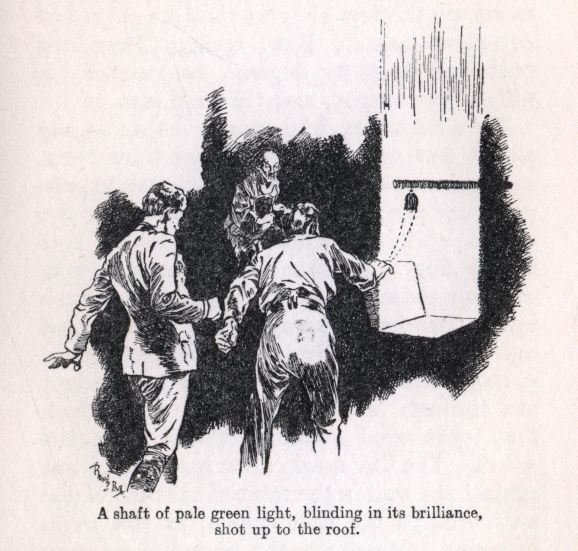
A shaft of pale green light, blinding in its brilliance, shot up to the roof.
The Chinaman, who was probably at the outset less nervously organised than they, and was certainly inured to the conditions, was carefully paying out the chain over the wheel, with its weighted plate, into a hole in the floor. As Forrester now perceived, the two chains were one, which was much longer than had appeared when it was coiled up. When it was stretched to its full length, it rose vertically from the slab to the bar, ran through hooks in this for a few feet, then descended perpendicularly over the wheel. The Chinaman drew back, and leant against the wall in the relaxed attitude of one waiting. To the Englishmen, in this overpowering atmosphere, the period of inaction seemed an hour: it was really about five minutes. Then the Chinaman approached the chain, taking care to remain as far as possible from the hole, and with careful deliberateness hauled it in, moving backward as he did so. Forrester waited with feverish impatience as it clinked inch by inch over the wheel. When at last the square plate came to the top, the Chinaman raised it until there was room for the slab to pass beneath it, and prevented it from slipping down over the wheel by hooking the chain to the wall, leaving, however, the greater part of the chain free.
Then, with a quickness all the more surprising because of his slow movements hitherto, he rushed with bent head at the slab, gave it one vigorous push, and darted back to the wall, catching at the chain in time to prevent the slab from falling violently. When it was settled in its place, and the blinding glare was shut off, the old man sank on the floor as if to rest after tremendous exertions.
At first Forrester felt a dull disappointment. Without a definite expectation, he had anticipated some striking phenomenon as the result of this elaborate performance. The plate, whose upper surface was towards him, seemed after its long descent to be exactly as it was before: there was no change in it, nor had it brought anything up from the pit into which it had been plunged. But after a few minutes had passed, the Chinaman turned it over, and Forrester was mildly surprised to perceive that the under surface had changed its colour. It was now greenish yellow, like the chain, the bar, and all the other parts of the machinery. In his half-dazed condition he did not suspect the extraordinary character of the transformation.
The Chinaman having reversed the plate, fastened it again to the chain, and went through the same series of careful movements as before. During the second period of waiting, Forrester, prompted by his companion, followed with his eyes the vertical path of the shaft of light from the hole to the roof. He noticed there an aperture, corresponding in size to the hole. A little fine dust was falling from this aperture, like soot from a chimney, into and around the opening of the pit, the minute particles dancing and glistening like the motes in a sunbeam.
When the plate came up the second time, its colour was the same on both sides. The Chinaman unhooked it, carried it across the cavern into the recess, and reappeared with a similar plate, dull and lustreless as the first had been.
Beresford drew Forrester away, and hurried him back through the passage, saying nothing until they regained the larger cavern. Then he halted, clutched the lapels of Forrester's coat, and said:--
"Well, what do you think of that?"
"I don't understand," Forrester replied, something in his companion's manner convicting him of stupidity.
Beresford smiled.
"I don't wonder," he said. "You have seen what the alchemists from Trismegistus to Roger Bacon spent their lives in fruitless efforts to discover, and what Paracelsus would have given the world to see. You have seen lead transmuted into gold! That is the Old Man of the Mountain's secret. Come along to my particular nook: I will tell you all I know."
CHAPTER XII
EXPLANATIONS AND DISCOVERIES
"I wish I had my pipe," growled Beresford as Forrester sat beside him against the wall of the cavern. "Good cut-bar is wasted on the desiccated old anatomy up above. However! ... Redfern and I, as you know, had gone to Chinese Turkestan for a few months' excavating. You have heard of the sand-buried ruins of Khotan. No? Well, seven or eight hundred miles north-west of us, between the vast Taklamakan desert and the icy Kara-Kash ranges, there is an oasis, stretching some three hundred miles from east to west, known as the oasis of Khotan. You think of an oasis, I daresay, as a verdant, beautiful spot. Khotan is not that. There is verdure: the people grow crops; but a great part of the district is simply dust. During long periods of time the sand of the desert has swept across it, destroying, and yet preserving, cities that were once the flourishing centres of an advanced civilisation.... That smacks rather of the lecture room, I'm afraid. Lecturing is my shop, of course.