Front matter (continued 3)
Reading edition
"Well, not to bore you, excavations have been going on at Khotan, bringing to light highly artistic objects--vases, frescoes, coins, ivories, and so on--which prove that it was long ago the seat of an Indian Buddhist civilisation. Redfern and I had looked forward to making some interesting finds, but we never dreamed of the one we did actually make. We were poking about in a heap of decomposed rubbish and humus, among fragments of pottery, bones of animals, chips of rotten wood, copper coins and what not, when I suddenly spotted a painted tablet like nothing we had yet come upon. I picked it up, and, scraping away at the accretions of siliceous matter that defaced it--my dear fellow, the mere thought of it sets me all of a jigget even now--under that layer, I say, I found a strip of paper about eight inches by three, torn at one corner, and covered with a few lines of writing in what we call cursive Central-Asian Brahmi.
"It was a beautiful specimen at least twelve hundred years old, and valuable enough on that account; but when I came to decipher it--if one can jump out of one's skin, I nearly did so. It was a letter, apparently from father to son, a sort of death-bed farewell, and it gave detailed directions for a journey to the far side of the Himalayas--that is to say, the southern side--to a spot where lead was transmuted into gold! Redfern pooh-poohed it, chanted 'Rowley, Powley, gammon and spinach' like a schoolboy, and when I ventured to suggest there might be something in it, was so rude that I reminded him of what I should have done twenty years ago if my fag had cheeked me. However, I was very patient, and after much persuasion I got him to agree to make a start for the place on the off chance that the story was something more than a fable.
"We set off with a miscellaneous crew of Turki natives, following the very explicit directions of the paper. But the country was so extraordinarily difficult, and the hardships of travel so great, that our escort deserted one after another. We replaced them where we could with fellows picked up en route, Tibetans most of them; but these too, when it came to crossing the passes of the Himalayas, funked it, and ultimately we were left with a single follower, a Tibetan, a regular brick of a fellow.
"I won't tell you what we went through; after all, we couldn't expect a walk over! Unluckily, the paper was torn at the corner, as I said, and I believe the missing portion described the exact locality of the spot we were making for. Without it we were at a loss, and wandered a few miles farther south than we ought to have done, until we fell in with some little forest people who told us about a mysterious region beyond a gigantic waterfall, which they were afraid to approach because of the Eye. That seemed promising! We made tracks for the fall, just as you did; we found the rift, marched up it, saw the canoes, and flattered ourselves that we should before long be in a position to verify or disprove the ancient legend.
"I led the way; our Tibetan came next; Redfern brought up the rear. We kept a good look-out, of course; but had no suspicion of danger until I heard the clang of the shutter behind me. They had dropped it a minute too soon. The Tibetan and I were shut in; Redfern was shut out; they hadn't seen him, fifty yards or so behind, round the bend. What followed was pretty much as you described your own experiences. I had just time to fire off my revolver in a way that Redfern would understand as a warning, before the gas overcame me. My Tibetan was already unconscious: I never saw him again.
"Next day they took me into the Temple, and I had a very interesting interview with the August and Venerable. As I told you, he did not turn on the Eye for my benefit; indeed, he was very courteous and suave, and I didn't pay much attention to his exposition of the Law of the Eye. It was only when I had committed the unpardonable offence of knocking down one of his priests, and he sent me down here, that I thought him anything but a plausible old humbug with ogreish tendencies.
"Prepared as I was, his little hypnotic tricks with the green eye had made no impression on me. The general atmosphere of mystery, and what I learned from the people on the plateau, convinced me that he was hiding some precious secret below stairs, and the sight of his golden throne made me suspect its nature. Never in my life was I better pleased than when they brought me down their subterranean stairs to learn wisdom! And I hadn't been here an hour before my suspicions became certainty. That Chinaman yonder will be engaged all day in letting lead plates down into the pit, and drawing them up pure gold. The plates are brought down from above: they explain the knocking you heard from the building near the old iniquity's pagoda. There is not a tool of any kind here: nothing but chopsticks, even, for eating our food; the lead is cut and hammered into plates above. The first day I was on the plateau I saw some of the prisoners staggering to that building under heavy loads. I conjecture that the Old Man has confederates somewhere outside, in China probably, who supply him at intervals with the lead, and receive the gold in return."
"It sounds incredible," exclaimed Forrester, interrupting his companion for the first time.
"The word 'incredible' ought to be banished from our vocabulary," Beresford rejoined emphatically. "Nothing is incredible. They'd have said the same thing only thirty years ago about petrol engines, wireless telegraphy, and aeroplanes. I am convinced that the search for the Philosopher's Stone, which baffled the alchemists for hundreds of years, was not the absurdity we have been taught to regard it. In some far distant age, someone discovered that Nature herself turned the base into the precious metal; the fact was rumoured abroad, though the scene of the transmutation was never allowed to become known; and the alchemists wasted their lives in trying to do artificially what had already been done by natural process. Why, aren't our chemists at the present day groping in the same direction? Don't they tell us that all terrestrial things are merely forms of the same ultimate element, or manifestations of the same ultimate force? Doesn't every fresh discovery point that way?"
"But how is it done?"
"I don't know; the Old Man doesn't know; nobody knows. In that pit yonder, a hundred and fifty feet deep, as I calculate, there is a bed of some substance that possesses this marvellous property--call it radio-active if you like. It can't be radium, for the emanations of radium produce sores on the body, as you know, and these wretched Chinamen have no sores. Its effect, from what you tell me--and I confess your news astonished and appalled me--is far more terrible. Evidently exposure to its direct ray causes instant demolition--annihilation is not the word; dust remains. Proximity to it brings about a sapping of the will; you yourself felt that in your cell; I feel it too. In the cavern yonder the effect is intensified. This mysterious power causes the mind to decay and the body to wither. How old do you suppose that Chinaman is?"
"He looks about seventy."
"He is twenty-eight! I don't know it from himself; he has no memory, cannot even tell you his name. But one of the others is his cousin--looks forty and is actually twenty-two. He has been here a year, taking his turn with the rest at the work; they have a day each. And there's a mystery about the whole organisation which at present I can't fathom. All the prisoners here engaged in the horrible work are young Chinamen of good family. I was told that on the plateau. Why does the old villain employ none but his own countrymen? I shall find out by and by; I haven't been here long enough to learn much; the poor wretches are so mentally abject that I have to go slowly with them. I do know this: that they are all brought in by priests of the second order. When one dies--their bodies are cast into the pit--he is immediately replaced by another. It seems that some of these priests are constantly prowling about the country, snatching up likely subjects here and there, some to recruit the labourers on the plateau, others for this diabolical work below. Your old Indian told me that every now and then a priest of the second order shaves his moustache and head, and enters the ranks of the first, after which he never goes into the world outside. It suggests that they are promoted after they have bagged a certain number of prisoners. How the priests are themselves recruited I don't know. They are all celibates; I suppose the Old Man has emissaries out proselytising. But these are all conjectures: I hope to find out a good deal more for certain before we get away."
"You know how to get away, then?" Forrester asked eagerly.
"I haven't given it a thought!" was the placid answer. "I pin my faith to old Runnymede--Redfern, Ruddyweed, Runnymede; you twig the process?"
"But if he doesn't come?--if he is dead?" cried Forrester, too much concerned with actualities to be interested in the evolution of nicknames. "We can't get down to the rift, even if we escape from here like the negrito."
"What negrito?"
"Didn't you know? One escaped the other day, got on to the plateau, and took refuge with the old zamindar. He was caught, and I believe it was he that we saw destroyed by the Eye."
"Dear me! That is very remarkable. I hadn't the least idea escape was possible. We must discover how the little fellow managed it, though it's of minor importance beside other things we have to learn. For instance, knowing what we do of the tremendous destructive power of that mysterious substance below ground, how did old what's-his-name above contrive to imprison a portion of it in his mitre without atomising himself? Clearly there must be some things that it doesn't affect--like that slab yonder."
"Why, I remember! Look at this!" Forrester exclaimed, taking from his pocket the crumpled sheet which he had found so useful in his cell. Unfolding it, he went on: "It was given me by the Indian girl, who received it from the negrito. She said that it saved from the Eye. When I held it between my eyes and the monster on the wall I could scarcely see the glare. It was a godsend."
"Marvels upon marvels!" cried Beresford, fingering the crackling sheet curiously. "We must look into this. But here comes dinner: we shall have plenty of time!"
CHAPTER XIII
A DRY BONE
The dishes containing the midday meal were brought to the prisoners by the two negrito sentinels, who received them from the guard at the further end of the ledge. The food, abundant in quantity, consisted of a variety of Chinese viands, strange to the Englishmen's taste, but not unpalatable.
"The Old Man feeds us well," Beresford remarked, handling his chopsticks dexterously. "He doesn't want to hasten Nature's destructive work by starving us. Drinking-water, by the way, is got from a little stream that trickles into the lake just round the corner. I confess I shouldn't care to drink the water in which that antediluvian monster disports himself. We'll take a look at him presently--if we get a chance, for he appears to be rather shy: I suppose he feels hopelessly old-fashioned, or perhaps he has an aristocratic pride in his long descent, and scorns the company of such new creatures as mere men."
"Why isn't the place more stuffy than it is?" Forrester asked. "Where does the air come from?"
"That puzzled me at first, but I discovered the other day that there is a constant current of air, slight, but quite perceptible, over the surface of the lake, through this cavern, and into a narrow cleft which I'll show you by and by. There must be a passage into the upper air. The temperature is rather too high to suit me; but the air is pure enough, and many of the dungeons in medieval castles were much worse places--barring the peculiarly oppressive effect of the stuff below.... You don't get on very well with your chopsticks. Like everything else, they require practice."
"One thing I can't make out is why we are allowed such freedom. You seem to be at liberty to move about as you please, talk to the prisoners--you speak Chinese?"
"Yes, but only out of earshot of the priest in his sentry-box yonder. I don't want him to blab to the August and Venerable--not that it matters, perhaps. The explanation of our freedom is, of course, that it is only such freedom as birds have in a cage. The passage by which we came is barred by the guards. There are no tools or implements of any kind which could be used as weapons; in fact, there's nothing here but ourselves and a few bamboo rods yonder against the wall, which I fancy must be used for keeping the sentry-box in repair. It's rather dull work for the priest, sitting there all day alone and mum; a new fellow comes every day."
After dinner Beresford led Forrester back to the transmuting cavern, and across it into a passage similar to that by which they had reached the spot. It was a cul-de-sac, except that at its further end there was a narrow cleft in the wall. The opening was barely a foot wide, and the sides were of solid rock. There were slight marks which seemed to indicate that at some time or other an attempt had been made to enlarge the opening by chipping; but the marks were very old, and it was clear that the task, if attempted, had been abandoned as hopeless. The cleft had a slight upward slope, but looking along it, Forrester saw no sign of daylight, nor did he hear any sound from the further end, which was not visible. They both agreed that no human being could possibly squeeze himself through so constricted a passage.
Returning to the outer cavern, they went to the entrance and stepped on to the ledge outside. They peered across the gloomy lake, but failed to discover the monster whose image they had seen outlined on the wall.
"He is not at home to-day, evidently," said Beresford. "Well, we have exhausted the objects of interest: all that we can do for the rest of the day is to sit on our bunkers and 'tell sad stories of the death of kings' or anything else you like. Later on I'll tackle the prisoners again. I try to stir them up a bit and get them to talk, without much success so far except with Wing Wu and his cousin. They are so horribly depressed, poor wretches! By Jove! I do wish I had my pipe."
It was impossible to gauge the passage of time. The successive days, as Beresford explained, were marked only by the arrival and departure of the guardian priests, and by the cessation from work of the man in the smaller cavern, who returned to his companions when a certain number of the leaden plates had been changed into gold. These were placed in charge of the priest on duty, who superintended their removal by the negritos when relieved next day.
That night, Beresford found the two younger Chinamen a little more communicative than they had been before. Wing Wu, indeed, evinced much pleasure in meeting Forrester again, and talked to him with a certain eagerness in English. He was the eldest son of a mandarin, he explained, and had kept a few terms at Oxford. Wen Shih, who had passed with distinction the innumerable examinations inflicted on Chinese literati, had been for a few months his father's secretary. In some subtle fashion he had obtained a commanding influence over the young man. Always courteous and agreeable, he enjoyed the complete confidence of his master, and gradually Wing Wu found himself consulting the secretary in every circumstance of his life, however trivial, until he lost all independence of judgment and even of action. He was at Wen Shih's beck and call, did his behests even against his own will, and felt that Wen Shih dictated the words he uttered, and arranged his very thoughts.
"As I half suspected," said Beresford, who had been listening intently, "these peripatetic priests are accomplished hypnotists. Under hypnotic influence a susceptible subject will declare black white, swear that his own blood is ink, and imagine himself his own grandfather, or any other absurdity. Go on, please."
Wing Wu explained that one day Wen Shih announced that he was going a journey, and that the lad was to accompany him. The command was obeyed unquestioningly. All the details of the journey were a blank to Wing Wu until the adventure with the elephant, which seemed to have shocked him temporarily into his right mind. Here Forrester took up the tale, describing the peculiar dazed sensation which both he and Jackson had experienced once or twice on the march.
"He was trying his powers on you, of course," said Beresford. "Your friend Jackson was the most susceptible of the three, Mackenzie the least. You may be sure Wen Shih gave a full account of his experiments to his august master, and I can imagine the old villain taking a fiendish delight in sapping away at Mackenzie, the toughest of you. I only wonder he didn't send Mackenzie down here. We'll see if Chung Tong can tell us any more."
He addressed the cousin in Chinese, trying with infinite patience to allure his mind from the present circumstances to his past life. Chung Tong's story, such as it was, told haltingly, resembled Wing Wu's in almost every particular. He added a detail which Beresford seized on, keeping the man's wandering attention fixed on it as firmly as possible. It came out that for many years past there had occurred at intervals mysterious disappearances in his family. Young men in the twenties had left their homes suddenly, leaving no clue to their destination, and never returning.
"A light dawns!" cried Beresford, in unacademic excitement. "The Old Man must have a spite against this particular family, and wreaks it upon them by stealing away these youths, doing them to death in this fatal laboratory of his. But why?--why? What have they done to incur vengeance so horrible?"
But no further information could be elicited from the prematurely aged young Chinaman. His enfeebled brain was exhausted by its unaccustomed groping into the past. Beresford did not press him, but worried the problem, as a dog worries a bone, for hours before he slept.
Next morning, the priest whose spell of duty had concluded, after a brief conversation with his newly arrived colleague, signified that Beresford was to accompany him on his return to the upper quarters. Forrester shook when he understood.
"Must you go?" he implored, the scenes in the Temple appearing luridly before his mind's eye.
"I shall go," Beresford replied tranquilly. "Buck up, my dear fellow. The August and Venerable won't demolish me yet. I expect it's a little cat-and-mouse performance. What if I bell the cat!"
"At any rate do take the screen with you!"
"Not at all. I don't want to lose that. We haven't discovered its secret yet. If I shouldn't come back--well, keep up your courage. Pin your faith to Redfern: I needn't say any more."
Forrester wrung his hand, and watched him pass along the half ledge, across the crazy bridge, over the rest of the ledge and into the passage beyond. At the entrance Beresford turned and waved his hand, smiling with the serenity of a man whose mind is at ease.
Two or three hours went by. Forrester paced up and down the cavern in uncontrollable agitation. The thought of losing this cheery companion was torture. He wondered with a carking anxiety what had happened to Mackenzie and Jackson--to Hamid Gul, too, the faithful servant whose little odd turns of phrase assumed almost a pathetic winningness as they recurred to his mind. But always his thoughts came back to Beresford; his imagination focussed that solitary figure confronting the cold, implacable personification of Fate on his golden throne.
Many times he went to the entrance, not heeding, unheeded by, the mute effigy in the sentry-box, and gazed across the lake into the opening beyond. For what seemed an eternity no vision of the lithe sturdy form came to gladden his eyes. But on one of these occasions his anxious ear caught the dull tramp of many feet, and presently, at the head of a negrito escort, appeared Beresford himself.
"Back again!" he shouted, his strong voice rolling over the lake.
Forrester met him at the entrance of the cave, and clasped his hand in a nervous grip.
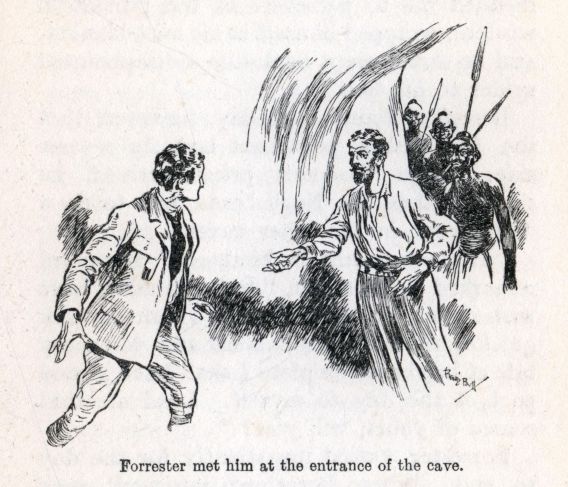
Forrester met him at the entrance of the cave.
"I've had quite a good time," said Beresford, linking arms. "The Old Man has been puzzling his wicked old head over my tablet, and he'll puzzle till doomsday for me! He orated solemnly, of course, about the Law of the Eye, and very cleverly hinted, without actually saying so, that the Law demanded an exact translation of the Brahmi writing. I told him, quite politely, to go to Jericho. He, quite politely, regretted that I had made such a poor use of my opportunities of learning wisdom. A mischievous impulse seized me to give him a shock, so I let out a few home-truths--in Chinese! Believe me, he didn't turn a hair: I don't believe he has one to turn. He scored there, but on the whole I think we may consider it a drawn game. He recommended me to persevere in the pursuit of wisdom, wrapped himself in his mist-blanket, and no doubt crept back like a disappointed spider to his web."
Beresford found next day, however, that the Old Man's politeness had its reverse side. When the new priest arrived, he signified that the Englishman was to do a day's work in the inner cavern.
"It's not meant in kindness," Beresford remarked to Forrester, "but I couldn't have wished for anything better. I shall work quicker than the Chinamen, and when my tale of bricks is complete I shall have a good part of the day to myself. Lend me that screen of yours, will you?"
Forrester waited impatiently for the day to end. When Beresford returned, very white and tired, he said:--
"I've something to tell you. Give me forty winks after supper and I'll be as fresh as a lark."
A little later, in their quiet corner, Beresford began:--
"That slab! I'm convinced that it's nothing but a sort of cement, made of the dust that has fallen from the roof, and that this screen is of the same material. I believe that the mysterious force from below, while it turns lead into gold, makes powder of all other substances exposed to its rays. This dust is no longer subject to its influence, and forms a shield against it. But for the dust, it would have bored a hole right through the roof to the upper air ages ago; but the coating of dust on the sides and roof of the cavity has preserved it. Of course, the slight earth tremors that are constantly occurring, unnoticed by us, shake down particles of the dust, and leave portions of the rock surface exposed to the action of the rays. So there's a very gradual process of eating away going on, and in course of time the rock above the cavern will be pierced clean through."
"I see," said Forrester. "The force must have been in action for ages, so that it may be ages before the hole is made. Anyway, it doesn't matter to us."
"I'm not so sure of that," returned Beresford quietly. "If we could only hasten the process, and get a ladder, we might pay our venerable host a surprise visit one of these days, for I'm pretty sure, thinking over the direction of the passages we came through on the way here, that we're almost directly under the Temple. That itself is underground, or it wouldn't glow with the green light; and you may be sure it's connected with the Old Man's pagoda. It would give me great joy to intrude upon his solitude, and see him in his bath, so to speak."
"I'd rather give him a wide berth," said Forrester. "Anyhow, it doesn't seem possible."
"We have no ladder, and certainly we can't emulate the Earth-shaker, and engineer a series of mild earthquakes expressly for our own convenience. Ah well! like the heathen, I daresay we imagine a vain thing. What's that line of Virgil?--animum pictura ... you remember the passage; where Æneas is looking at the frescoes in Dido's palace, 'and with an empty picture feeds his mind.' Well, better feed the mind even on fancies than let it starve, like these poor Chinamen. And now for sleep."
It became clear that the Old Man had set himself pitilessly to undermine Beresford's courage. Instead of taking his turn with the Chinamen in rotation at the enervating work in the inner cavern, Beresford was given the task every second day. Robust as he was, and endowed with great strength of will, the electric atmosphere wrought its devitalising effect on him, and Forrester, after a week, noticed with sickening dread that his eyes were less bright, his cheeks less rounded, his voice less resonant. An offer to replace him was rejected by the priest; Forrester wondered why he himself was being spared.
The hours dragged very heavily while Beresford was absent at his work. Forrester had nothing to do. He roamed about the cavern, talked a little to Wing Wu, looked in at Beresford occasionally; but during the greater part of the day he had only his thoughts to occupy him. But it happened one day, as he passed the spot where the spare bamboo poles were laid, that an idea flashed into his mind. It seemed fantastic, probably impracticable; but it might at least be attempted: anything was better than this stagnant life in death.
The success or failure of the scheme that had occurred to him depended on the accuracy of Beresford's theory that the dust formed by the action of the rays on the cavern roof protected the rock from further destruction. If this was correct, and the dust could be removed, exposing fresh surfaces, the piercing of the chimney could be accelerated far beyond its normal rate. With a sufficiently long pole the dust coating could be brought down during the intervals when the rays were shut off by the slab. Such a pole might be constructed from the bamboo rods.
A difficulty arose from the fact that the cavern was never dark. It was always pervaded by the dim green light emanating from the walls. But the rods were partially screened by the sentry-box, and Forrester thought that in the dead of night, when the priest was asleep, and the negritos more or less drowsy, he might succeed in purloining the bamboo, and carrying it into the passage beyond the inner cavern.
Without mentioning the matter to Beresford, he waited till all was quiet, then stole round the wall towards the rods, picked up as many as he could carry, and made his way undetected to the place determined on. Next night he removed a few more in the same way. Their disappearance had apparently not been noticed by the priest.
The following day was Beresford's turn of duty. In the early morning, after the new priest had arrived, Forrester told his companion what he had done.
"Fiat experimentum!" cried Beresford delightedly. "I will tell you the result to-night. But not a word to Wing Wu. One of these days Wen Shih may occupy the sentry-box, and the poor lad will blab everything."
As soon as he had completed the transmutation of the allotted number of plates, Beresford fitted two of the bamboo rods together telescopically, tied his coat by its sleeves to the end of the pole thus formed, and inserting this wad into the cavity, thoroughly scoured its roof. A considerable quantity of fine dust fell on to the slab and the floor around. He then raised the slab, allowing the rays to play on the roof for a longer time than when the leaden plates were sunk in the pit. This process he repeated again and again, heedless of his increasing weariness and a stupefying headache, until Forrester rushed in hurriedly to say that the priest, evidently surprised at his unusually prolonged absence, was coming towards the passage to seek its explanation. Beresford instantly untied his coat, donned it, while Forrester laid the pole in the recess; then, taking Forrester's arm, met the priest at the entrance, feigning a deeper exhaustion than he actually felt. The priests seldom entered the inner cavern; this man threw a casual glance around it, and followed the prisoners back to the outer cavern, suspecting nothing.
"It works!" Beresford whispered when he got to his customary place, and at once fell into a dead sleep.
Later on, he told Forrester that the experiment had succeeded beyond his hope.
"As nearly as I could measure with the pole," he said, "the cavity is lengthened by at least a foot. The rays act with tremendous rapidity. In a few days, unless we are much deeper than I think, we shall have cut a hole right through to the level of the Temple floor."
"But what then?" asked Forrester dejectedly. "I thought of it merely as giving us something to do--you are doing it all!--something that would buck you up if it proved your theory; but it will do us no good."
"It will at least scare the Old Man. If we are careful, he will never suspect that we have anything to do with it. He may even think the place no longer safe for his old carcase, and decamp."
"Leaving us to perish!"
"There's an old saw, 'Never go up to the chimney-pots to look for the rain.' We'll take things as they come. By the way, do you feel able to take a turn to-night, when all's quiet? The clink of the chain can't be heard here, and it will quicken the job."
"I'll try," said Forrester at once. "I've felt mean ever since they put you on and left me out."
"Thanks! One thing we must be very careful about: to brush away the dust to the sides of the cavern. We mustn't arouse suspicion. Will you do that before you leave? Don't work for more than an hour or two, as nearly as you can guess, and come away at once if you feel faint. Lay the pole against the wall of the farther passage; the Chinamen never go there, and thank goodness the priests are shy of the place, small blame to them!"
The work thus begun was continued at every opportunity during the succeeding days and nights. The pole had to be lengthened by the addition of another rod: foot by foot the chimney was excavated, the width of it remaining uniform, corresponding to the shape of the hole in the floor.
Every night before they slept the Englishmen talked over the progress made during the day.
"If we only had a ladder!" said Beresford once. "I agree with you: the mere cutting of the chimney will be an empty triumph. We shouldn't be properly constituted men if we didn't wish to profit by our energies. Every man who isn't a mug, as soon as he has conquered one difficulty, burns to tackle another. I've puzzled and puzzled, but I see no way whatever of using the chimney as a channel of escape."
"Couldn't we make a ladder of bamboo?"
"Quite impossible! To begin with, there isn't enough of it; then, we have no tools. It is tantalising in the extreme."
"There's this to be said. Even if we did break through, it would only be to find ourselves in the midst of our enemies. It would mean the Eye for both of us."
"I have been wondering lately whether that wouldn't after all be better than to stay here much longer. Forrester, the Old Man has beaten me at last. If he sends for me again, I'm afraid I shall ignominiously cave in. It was one thing to pity those poor Chinamen when we had no real personal knowledge of what they were suffering. It is quite another to share it, to feel the steady sapping of one's vigour, the horrible blankness that comes over one's mind. I know for the first time in my life what it is to writhe in the clutches of Giant Despair."
In his many blank moments, Forrester reflected in utter desolation of spirit on their desperate case. Ill and miserable as he himself felt, he dwelt, not on his own condition, but on the appalling change that was creeping over the once buoyant-hearted companion of his imprisonment. The cheeriness was gone. It was an effort now to Beresford to talk. The sickly hue induced by the greenish light had become on his countenance a ghastly pallor. His limbs shook, his gait was slow and stumbling, his once upright frame was beginning to stoop like that of an old man. On his days off duty he lay like a log, sleeping, or simply existing in apathy and listlessness. Was he to drift thus on a slow tide towards death?
One night, Forrester was wearily laying the pole in its resting-place, when he heard a sudden click near by, such as might be caused by the fall of some hard substance on the floor. He looked down, but there was nothing on the smooth rock to account for the sound. In a moment it was followed by a second click, apparently a little nearer, and from the direction of the cleft in the wall. His curiosity thoroughly aroused, Forrester stooped and glanced in. The light in the cleft was dim, but after peering for a few seconds, he caught sight of a small object at a distance of perhaps ten or twelve feet away. He had not noticed it when looking into the cleft before, but that might merely have been because he was not expecting to see anything, nor indeed making a keen examination. But it seemed that the object must have moved; otherwise the click was scarcely explicable; and Forrester was sufficiently interested to wish to get hold of it. It was far beyond reach; the cleft was too narrow to admit his head and shoulders; but he could edge one of the shorter bamboo rods sideways into the hole, and then worry the object forward until he could grasp it.
This was the work of less than a minute. To his intense mortification, the thing, when it came to hand, turned out to be nothing but a bone.
He was on the point of throwing it back, when the idea struck him that the discovery might give a momentary fillip to Beresford's flagging spirits. So he slipped the bone into his pocket, and returned to the outer cavern.
Next morning he accompanied Beresford, as he sometimes did, to the entrance of the transmuting chamber, and watched him commence his daily task. He had forgotten the incident of the night. But when the place was irradiated with the brilliant rays, he chanced to put his hand into his pocket, felt the bone, and drew it out, thinking now so little of it as to purpose casting it into the open pit. But as he turned it over in his hand, he caught sight of some thin white scratches upon it, at first sight irregular and fortuitous, but, at a second glance, forming, as it seemed to him, the initials of his name, R.F.
Puzzled, and a little excited, he looked at it more carefully. It was not an old bone; a fragment of tendon, still supple, adhered to it. Examining it end-wise, he saw that the interior was filled with a fine substance that might be desiccated marrow. He shook it; some of the powdery contents fell to the floor. He knocked it against his boot, and almost shouted with amazement: for at his feet lay a tiny spill of paper, apparently rice paper, very tightly wound.
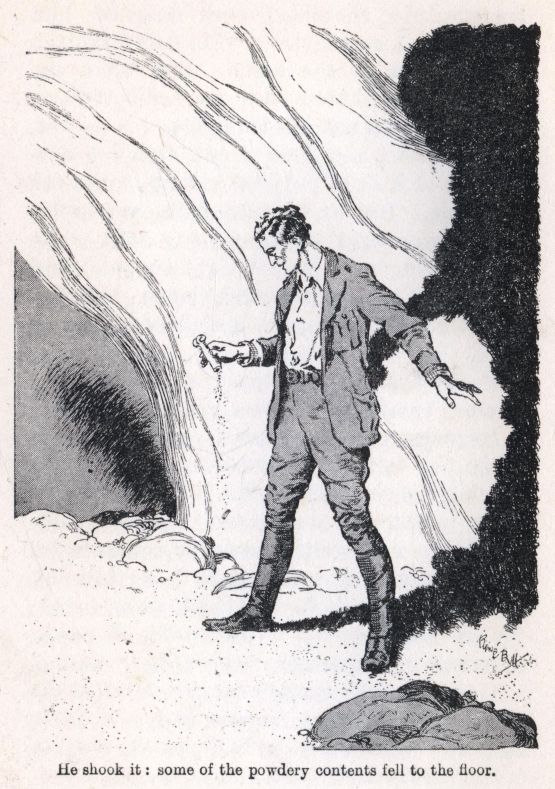
He shook it: some of the powdery contents fell to the floor.
Hot now with excitement, he unrolled the paper with nervous fingers, and saw on it, in small characters written, as it seemed, with the fire-blackened end of a sharp stick, the words, "Give me my bone."
CHAPTER XIV
HEAD COOK
Mackenzie and Jackson, it will be remembered, had been removed from the Temple before Forrester, at the close of the scene with the Old Man. They were taken back to their separate cells, and locked in for the rest of the day. Jackson's nerves were shaken all to pieces; Mackenzie, whose robuster physique was less affected, was in desperate anxiety as to Forrester's fate. He spent a wretched day, a still more wretched night. By turning his back on the monster he managed to fend off the worst effects of the baleful eye; but the consciousness that it was there behind him with its unwinking glare intensified his distress. When morning came, and he was escorted again to the foot of the rock stairway, he welcomed the respite afforded by the prospect of a day in the open air, and hoped against hope that the Old Man had relented, and would allow Forrester to join him.
Night brings counsel, and Mackenzie was a long-headed Scot. He had come to the decision that it would be sheer folly, after what had happened, to repeat his refusal to work on the plantations. The depressing influence of solitude and the mysterious light was no doubt relied on by the Old Man to bring his prisoners to a proper docility. Well, Mackenzie would assume that virtue, if he had it not, and he would advise his friends, if they came, to fall in with his own plan: to work with apparent resignation, though always alert to seize on any opportunity of escape that might offer itself.
When he was handed a spade, therefore, by the priest who appeared to act as taskmaster, he accepted it, and set to work on the plot of ground assigned to him. But he took care not to ply his implement too energetically, stopping every now and again to mop his brow with his sleeve and to heave the sigh appropriate to a forced labourer.
As the day wore on, and neither of his friends appeared, he feared the worst. Jackson's absence might easily be accounted for by a nervous breakdown natural to a man of his temperament; but Forrester would have come if he had been at liberty to do so, and it seemed only too likely that he had either been demolished by the Eye, or that he was still confined to his cell, or possibly condemned to some other punishment whose nature Mackenzie could not guess. At the close of the day he sought to relieve his suspense by addressing a question to the priest, but received only a stony stare. He could not tell whether the man understood him or not.
Several days passed in the same dreary, hopeless fashion. Mackenzie kept away from the old zamindar, who, though his daughter had been restored to him, was visibly broken down by a haunting dread of calamities yet to come. He exchanged only a few words now and again with Sher Jang, fearing, in the one case as in the other, that closer intercourse with them might tend to their harm. But one morning he was as much delighted as surprised to see Jackson appear at the head of the stairway. He had been supported in the climb, practically pushed up, by one of the priests. The taming process was evidently regarded as successful. From that time the two friends remained constantly on the plateau, being given a small hut among the cluster nearest to the dwellings of the priests. It contained no furniture; their only bedding was a blanket apiece.
In the fresh air, and under the bracing influence of Mackenzie's companionship, Jackson, in some degree, recovered tone. The two friends worked side by side. No check was placed on their association; it was evidently assumed that they were resigned to their lot, or at any rate too much dominated by their fears to give trouble. After the first day together they never spoke of Forrester: in their hearts they believed that they would see him no more.
But they sometimes speculated on the fate of Hamid Gul. They had never seen him since they passed his unconscious body in the rift. It seemed monstrous that so humble a member of their party should have fallen a victim to the Old Man's malignity; yet they could only surmise that, whatever the reason might be, the man had been put out of the way.
It was therefore with a joyous surprise that they saw him one day staggering across a field under a load of vegetables. Mackenzie called to him, but Hamid, though he must have heard the cry, pursued his way without so much as a turn of the head.
"There's a reason for that," said Mackenzie. "Hamid is no fool."
Some hours later, when work had ceased, and all the slaves had returned to their huts, a dark form appeared in the open doorway of that which Mackenzie and Jackson shared.
"Where is Forrester sahib, please to say, sahibs?" came in a whisper from Hamid Gul.
"Come away in, man," cried Mackenzie, "--if it is safe."
"It is right as rain, sahib," replied the Bengali. "Chinky jossers believe me a one-eyed ass. But Forrester sahib?"
"We don't know: we fear he is dead."
Hamid's one eye and twisted features told rather of rage than of sorrow. He poured forth a torrent of abuse in his own tongue, invoking the direst curses on the heads of the oppressors, and the uttermost defilement of their graves.
"Where have you been all this time? What have they done to you?" asked Mackenzie.
"I am head cook and bottle-washer, sahib--may the sons of pigs boil everlastingly in oil! Hiked into kitchen, there I was, I having sung my praises quite a lot. For sake of self and master, I pocketed feelings and dignity and concocted that pilaff of lamb Forrester sahib was such nuts on. A bald-headed chap kept eye on me, and made me gobble a bit; then carried dish away, and told me in due course it was well. When he was gone, pig of Chinky cook put his nose out of joint and was exceedingly rude, saying many things in barbarous lingo of libellous nature."
"But you don't understand Chinese!" Mackenzie interposed.
"Exactly, quite so, sahib; but he had a face! My sublime effort took the cake, sahibs. They offered me job on spot. Every day I made something fresh and bilious, and cook in office did not get look in. He lost his wool, sahibs, and one day set on me tooth and nails, and bald-head found us going at it hammer and tongs. Chinaman got bag, and I got crib."
Hamid went on to explain that the fly in his ointment was his employer's want of trust. His work was always done under the eyes of a priest, and he had to taste of every dish before it was removed. He was disgusted, too, because he received neither money nor thanks. He had never learnt who it was that consumed his viands; the dishes always came back empty, and his unknown master had evidently a keen tooth for dainty fare.
His quarters were a lean-to adjoining the kitchen. On the other side was the door through which the priest carried the dishes to and fro. Hamid had had the curiosity one day to follow the priest at a safe distance, but was brought up by a closed door. In the wall of the passage there was a grating which had given him the idea that his employer must be a man of great wealth, for the bars of it appeared to be of pure gold. Once, to avoid the trouble of carrying a pail of dirty water to the field on which it was usually poured, he had been on the point of emptying it through the grating; but the priest had come by at that moment, and had rebuked him with such violence, and used such alarming threats about the punishment of the Eye, that he had never ventured to save his labour again.
"Do you know anything about the punishment of the Eye?" Mackenzie asked.
"Devil a bit, sahib. My one optic is only feature I have to boast of, and it goes without saying that I cannot afford to lose it."
The Englishmen felt that Hamid had much to be thankful for. It was clear that he had no suspicion of the horrors of the place, and they saw no reason for enlightening him. The less his fear, the more useful he might be.
"Well, man, you had better not stop any longer," Mackenzie said. "And don't come here again: you may be spied on. But I wish you to keep your eyes open--your one is as good as two--and find out all you can. We are keen to get away; but we see no chance of it. Maybe you'll find out one of these days how they get down to the rift. Don't make any attempt to see us unless you have something important to communicate. We will always be on the look-out. You go into the fields sometimes. If we see you open and close your hand three times, we will know you have something to say, and we will find some way to hear you; but not here: it's maybe not safe."
"Better warn him against the Old Man," Jackson suggested.
"Ah, true! Your cooking, Hamid, is done for the master of the place, a very old Chinaman. You may never see him; if you do, watch him carefully, and above all, never cross him. Now go, and mind yourself."
In giving instructions to Hamid Gul, Mackenzie had no definite hope. The man, being practically confined to his kitchen when within doors, was not in a position to ascertain for himself the interior arrangements of the place; and his ignorance of any language but his own and English would prevent his understanding any conversation he might overhear among the Chinese. But he could be trusted to make the best use of such opportunities as might offer.
Thinking over the little information that Hamid had been able to give, Mackenzie was struck with a suspicion. The grating!--was it not likely that here, as in European castles, there were dungeons beneath the floor of the principal chambers? Might not Forrester be immured underground, in a cellar to which the grating gave access? He wished he had thought of this when Hamid was with them, and enquired about the nature of the grating, and the size of the opening it covered. Why had the priest objected to its use as a sink? Not from any tenderness towards prisoners, if prisoners there were. Either there must be, below, some treasure of the Old Man which water might injure, or--and here Mackenzie felt some excitement--it was desired that the existence of the aperture should not be known to the prisoners.
Impatient to question Hamid Gul, Mackenzie hoped every day to see him; but it was not until the third morning after his visit that the Bengali again appeared in the fields, with a basket slung on his back. He passed at some distance from the Englishmen, and they saw his left hand open and close three times. Looking around to make sure that no priest was on the watch, Mackenzie left his plot, struck off at an angle, and slipping round a plantation of tea shrubs, met Hamid in the enclosure where he was digging truffles.
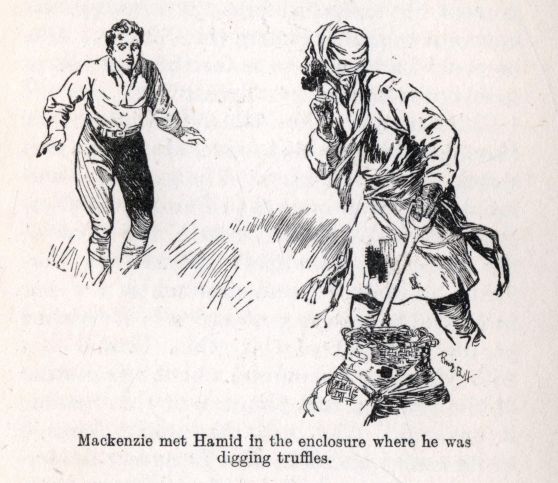
Mackenzie met Hamid in the enclosure where he was digging truffles.
"Well?" he asked eagerly.
"I have got a rise, sahib," the man replied. "Purely honorary; no pay!"
"What do you mean?"
"Rich food sometimes is cause of colic and inward qualms, sahib. After tiffin yesterday, bald-head comes to me;--he has a face, sahib!--and says 'Hai! come along!' Off I trot, knees playing castanets, blue funk, because of his face. Along passage, into room, another room, much to flabbergastation of humble self; for what do I see but gold everywhere: table of gold, seats of gold, cups of gold!
"On couch of gold was very old man, very like monkey, bald as egg. Two bald-heads on knees to him: hai! what faces! Had to go down on knees; old man he stared at me with eyes like burning coals. I shivered like jelly. 'You poison me!' he said. I swore by Siva I was innocent as new-born babe. I talked a lot, told him I was absolutely ignorant he was so old, too old to eat things that would upset ostrich digestion of piggish little sons of English sahibs. I declared with great gusto if I had known I would not have made things so bilious. 'Send for doctor,' he said. Another bald-head came. Kicked me away, knelt in my place. I crawled away, pricked in manhood's dignity, but calm in innocency of heart, and while doctor did his job, I took squint round. Great snakes, sahib! At one end of room, in recess behind screen of gold wire, I spotted gorgeous robe hanging on gold peg, and on small gold table most splendiferous head-dress. My stars! old Chinky could give socks to American millionaire."
"Did you see the Eye?" Jackson asked eagerly.
"What eye, sahib? Old man's eyes enough for me. They lugged me back; down I drop again; his eyes made me frizzle. He said 'Go!' Nothing wrong with him but liver off colour. But this morning bald-head told me to carry in dish myself: in future I must taste all grub in presence of old man. That is my rise, sahib."
"Eh, man, you're lucky," said Mackenzie. "But now tell me: the grating in the passage--what is it like?"
"It is thin bars of gold, sahib."
"How far apart?"
"Width of two fingers, sahib."
"And how large is the hole?"
"As long as my outstretched arms, and a little wider than my spread fingers."
"Big enough to crawl through?"
"If you were flat as a flounder, sahib."
"Can you see to the bottom of the hole?"
"No, sahib: it is dark, and goes deep."
"Next time you come, bring me a small marrowbone, not wider than your two fingers. Fill it with dried marrow, closely pressed together. Can you get any paper?"
"There is rice paper in kitchen, sahib."
"Bring me a piece, and something I can write with--a blackened stick, or a bit of charcoal. You will remember?"
"Like a book, sahib."
Fingering his beard meditatively, he walked away.
"What do you mean to do?" Jackson asked, when Mackenzie had repeated what Hamid had told him, and the instructions he had given.
"Put a wee note inside the bone, and get Hamid to fling it down the grating."
"But if it falls into the wrong hands, and is taken to the Old Man? He speaks English: he may read it too."
"What I write will only puzzle him."
"In any case, what's the good? Suppose Dick is there. How can he send an answer?"
"I've my notion about that, Bob. All depends on Hamid; but, as I said, he is no fool; he will do what we tell him, and take every care. I wish it were to-morrow!"
"What puzzles me is the Eye. What on earth can it be?"
"That beats me. Clearly it is harmless at times; Hamid didn't notice it. I think it's a kind of box, containing some destructive substance in a concentrated form. The Old Man evidently has some device for opening it without harm to himself. One thing is very clear."
"What's that?"
"Och, man, that the old wretch must be very human after all, or he couldn't have the stomach ache."
CHAPTER XV
THE MOLES
"Give me my bone!"
Forrester puzzled over the words. They seemed merely absurd. What could their meaning be? It was a joy to know that Mackenzie or Jackson was above, and had discovered the place of imprisonment; but they must know little about it, after all, or they would be aware that it was impossible to send them an answer. Yet they must expect an answer; they would not have sent a message, mysterious as it was, unless they looked for at least an acknowledgment that it had been received. It occurred to him that the cleft might be used as a speaking tube: but a moment's consideration told him that it would be unwise to put this to the test. His voice might be heard by an enemy!
Beresford was so much exhausted after the day's work that Forrester did not mention the strange discovery to him that night. But the next day was an off day for him, and in the afternoon, after he was somewhat restored by rest and food, Forrester showed him the bone and the paper. The effect was electric. A look of eager hope dawned in the tired eyes. A murmur of thankfulness broke from his lips, and he lay for a while thinking.
"We have nothing we can write with," he said at length.
"Nothing at all. My pockets are empty," replied Forrester.
"Not even a pin?"
"No. Wait, though!" He felt along the edge of his waistcoat. "Yes, by Jove! I've one solitary pin. They would naturally overlook that."
"Prick the words through the paper."
"But what words?"
"Something that won't give anything away if the paper falls into the wrong hands. 'Give me my bone!' Answer, 'Take it!' Put the paper in the bone, fill up with dust, and replace it in the cleft when you get a chance. Leave the rest to our friends above."
The guard kept by the priest and the negritos was little more than a form. The abject condition of the Chinese prisoners precluded any likelihood of revolt. Consequently no real watch was kept at night, and the only risk was that an unusual sound might awaken one of the three somnolent figures at the entrance. Forrester was careful to move very quietly when he returned to the cleft that night, though after all there was little chance of a slight sound from the inner cavern reaching the priest's ears.
On reaching the cleft he looked in eagerly for the string which he half expected to find there. He was not disappointed. A few feet from the opening, but within easy reach, lay another bone, with a string attached. He replaced this by the bone containing the paper, and stole back to his friend. The second bone held no message.
"We shall hear from them again to-morrow," said Beresford hopefully.
Next night, when Forrester visited the cleft, he found the bone on the end of the string, untied it, and hurried back with it to Beresford. Shaking out its contents, he found a somewhat larger screw of paper, enwrapping a sharpened stick of charcoal. On it, when opened out, he read: "String 65': hole 3' x 10": grated: where are you? Reply at once. M."
"He evidently thinks communication safe at night," said Beresford. "We can't tell him everything. Just write: 'Cavern. Boring chimney through roof. More to-morrow.'"
Forrester wrote the message, adding 'B. is here,' replaced the paper, and returning to the cleft, tied the bone again to the string. It occurred to him to give a slight tug. The string gave slightly, then stretched taut. It was evidently fastened to something above.
It was long before the Englishmen fell asleep that night. They discussed in whispers the information they had gained, and their future course of action. They could not but conclude that the cleft, narrow as it was, was the avenue by which the negrito had escaped; but what was possible to his diminutive frame was impossible to them. The grating had probably been placed over the hole after his escape was discovered, to prevent a second attempt. It was clear that the cleft was not perpendicular, or the little man could hardly have climbed up it. If they could ascertain the angle of its slope, they might calculate the vertical distance, and learn how long their chimney through the roof of the inner cavern must be made. They had no means of discovering this fact, which would have been so useful to them; but it seemed probable that, allowing for the steepest practicable slope, the chimney must be pierced for at least forty feet before it reached the surface.
By gradually lengthening the bamboo pole, and clearing the dust from the sides of the chimney, they had already extended the range of the rays nearly twenty feet above the roof, and more than thirty feet above the floor of the cavern. They had now no more bamboo rods; the pole could not be lengthened further; it was impossible to remove the dust at a greater height without a ladder to stand on. But, with communications open, a ladder might no longer be an impossibility. With a knife and some stout string they might form one of bamboo, and still leave enough for a pole wherewith to continue their work of removing the dust. Forrester resolved to ask for these articles at the first opportunity.
Beresford pointed out the importance of letting Mackenzie know the spot at which the chimney, when completed, would reach the upper air. It might prove to be in the very quarters of the enemy. In that case the chances of escape would seem to be remote indeed. But Mackenzie was cautious as well as shrewd, and with this necessary information in his possession he would know how to direct his own course, and what advice to give his friends below.
Accordingly, next day Forrester carefully paced the distance between the cleft and the pit in the inner cavern. Allowing as accurately as he could for the windings of the passage, he gauged the length to be approximately fifty yards in a straight line. At night, he found on opening the paper secreted in the bone that Mackenzie had anticipated him. "Cleft--?--> chimney." he read. He crossed out the query and wrote "50 yds.: cleft on right," adding: "Send knife + stout string." He returned to the cleft several times during the night in the hope of finding the things asked for; but it was not until the next night that they came: a large kitchen knife such as is used in boning meat, and about a dozen yards of thin hempen cord.
The work on the chimney had been perforce interrupted for several days, much to Beresford's benefit. The less prolonged exposure to the noxious atmosphere of the inner cave, and the new hope engendered in his heart by the knowledge that something was in progress above, effected a decided improvement in his physical and mental condition. His fear now was that he would be summoned again to the Old Man, and condemned without reprieve, before the chimney was complete. He resolved, if he were sent for, to persist in his refusal to translate the tablet, in the hope that the Old Man would spare him for yet further coercion.
Forrester set to work on the ladder as soon as possible after the knife came to hand. At night, in the passage, he cut short lengths of bamboo as rungs, and knotted them firmly to the two uprights with the cord. It was a crazy structure at the best, and he had a nervous dread lest, if he fell, he should break through or displace the slab over the pit, and be turned instantly to dust. But an experimental ascent against the wall and the cavern somewhat reassured him as to the ladder's stability, and setting its top in the cavity above the pit, he mounted and resumed the work of scouring away the dust overhead.
From that moment they applied themselves to the task with unremitting energy. As soon as their fellow prisoners were torpid in the heavy sleep that was the only alleviation of their lot, the Englishmen stole from their place, and laboured until their endurance gave out. Forrester spared Beresford as much as possible, and often undertook the double work, alternately lifting the slab to release the rays, and, when it was lowered, climbing to remove the dust. Each knew he carried his life in his hands, for the ladder could not be entirely hidden. If any priest should chance to visit by day the passage in which they laid it, he could not fail to observe it, and then their fate was sealed. But, judging by past experience, that risk was slight; and to disregard it was the only way to success.
Every now and then Forrester reported progress to his friends above. The length of the chimney increased about eighteen inches a day on the average; if, as they had calculated, there remained--before they constructed the ladder--twenty feet of rock to pierce, in a fortnight they should arrive at or very near the surface. Meanwhile they received no news of what was happening above ground. Mackenzie did not reveal his plans; perhaps, they thought, he had formed none, but was biding his time until the chimney was nearly completed. His messages were brief words of encouragement, assurances that all was well, and the news that he was in touch daily with Jackson, Sher Jang, and Hamid Gul.
Rather more than a week after the first use of the ladder, Forrester made the alarming discovery that he could no longer reach the top of the cavity with the outstretched pole. This threatened the stoppage of the work, for neither pole nor ladder could be lengthened. He did not mention the matter to Beresford, who by this time had ceased to work on the chimney. When he had transmuted the due number of plates, he was too much fatigued to endure the strain any longer, and Forrester persuaded him that he must conserve his strength for what might ensue when the chimney was completely pierced. Anything that might throw him back was to be avoided.
Forrester puzzled over the baffling problem that now confronted him. Time and again he stood looking up into the cavity, trying to conceive of a means by which the top might be reached. It was two days before he hit upon a possible solution. If he could cut notches in the walls of the chimney, and insert in them cross-bars of bamboo, he would be able to raise himself successively to heights from which the rock above would be within reach of the pole. To obtain material for the cross-bars he would have to shorten the pole; the difficulty was the notches: how could they be cut with no tool but a knife? Standing on the ladder, he tried the point of the blade on the rock, and found that this, while not very hard, was not friable enough to be excavated by so pliant a tool.
His thoughts turned at once to Mackenzie: perhaps he could find a more serviceable instrument. That night he placed in the bone the following note: "Work stopped: send a chisel." Next night he found in the bottom of the cleft, not a chisel, but a bar of iron slightly pointed at one end. Accompanying it was a note: "Hope this will serve. Let me know when near surface."
This implement he found to answer his purpose sufficiently well. From his perch on the top rung of the ladder he worked out two holes in the rock on opposite sides of the chimney; then with the knife he cut the proper length of bamboo, and thus fashioned a cross-bar on which he could stand to repeat the same operation higher up. In this way he made a series of steps enabling him to brush the dust, as before, from the top of the cavity after each employment of the rays. Only then did he acquaint Beresford with the difficulty and the manner in which it had been overcome.
The progress of the work was necessarily slower now. The cross-bars had to be removed after each ascent; otherwise at the next opening of the pit they would have been instantly destroyed. But the piercing went on steadily, and Forrester felt sure that, unless his calculations were very much out, his pole would in a few more days penetrate the roof of the chimney, and emerge through a hole in the floor of whatever room was immediately above him.
"Be very cautious," Beresford urged, when he learnt this good news. "To break through prematurely might be fatal to us all. Tell Mackenzie how things are, and ask for instructions."
"Yes. We shall have done our part. The rest will lie with him. I wonder what old Mac has been doing all this time?"
CHAPTER XVI
THE HOLE IN THE WALL
Mackenzie, meanwhile, had been playing a very busy and at the same time a very discreet part above ground, with timorous but efficient assistance from Hamid Gul. It was the latter who, at night, when all was quiet, stole from the kitchen into the passage, and tied the string to a bar of the golden grating, so cleverly that only the closest scrutiny could have detected it. Having ascertained by means of this device the whereabouts of Forrester, and the burrowing in which he and Beresford were engaged, Mackenzie, in his calm sagacious way, set himself to think out a plan for turning that work to account.
At first he decided to employ Hamid Gul only as postman. It was of vital importance that the Old Man should entertain no suspicion of his cook. There seemed little risk of Hamid's night-work at the grating being detected. An Indian servant moves more silently than a cat. On the other hand, if he pried and prowled in the pagoda or its precincts, for the purpose of discovering the means of access to the rift, or the other particulars about which Mackenzie was curious, he would almost certainly attract the notice of the Chinese, and ruin everything. For the same reason Mackenzie took care that his necessary meetings with Hamid should take place at different times of the day, at different spots, and in the utmost secrecy.
His own actions were dictated by shrewd policy. To begin with, he told Jackson no more, not that he distrusted him, but that he feared the possibility of his disclosing something if for any reason the priests should again practise their hypnotic powers on him. Then, he assumed in public the mien of a slave, utterly cowed, bereft of will power, who lived only to get through his appointed task, and had no other aim than to merit his masters' approval. So well did he act his part that after a few days' observation, the priests concluded that their taming process had been thoroughly effective, and paid no more attention to him than to any other of the men who toiled and sighed on the plateau. That the dejection which Mackenzie feigned was in Jackson's case real confirmed them in their delusion. Sher Jang, meanwhile, went about his tasks with philosophic submissiveness; but in his heart of hearts he believed that the sahibs, whose movements he watched unobtrusively, would some day get the better of the Chinese dogs, and he was ready instantly to obey the call which he felt would surely come.
When Mackenzie was satisfied that he was accounted well broken in, he took to roaming at night about the precincts of the pagoda. He had already settled in his mind that the way to the rift could lie only through the pagoda or one of the neighbouring buildings, and his chief aim must be to discover that. It was also of vital importance to find as nearly as possible the spot where the chimney would cut through the earth; one step towards that discovery was the knowledge that its base was fifty yards from the cleft, and therefore presumably from the grating in the passage. He had been much puzzled by the almost incessant knocking that proceeded in day-time from the low building behind the orchard, but dismissed that matter as of no account so far as he and his friends were concerned.
The wall enclosing the pagoda and its appurtenances was twelve feet in height: too high to look over, too smooth to scale. The gate by which Hamid issued to the fields was unlocked for him by a priest, and locked after him. Mackenzie meant to get inside the wall. It would not be difficult, perhaps, to make a ladder, but before taking this in hand he might as well see if there was a less ostentatious mode of entry.
Strolling at the rear of the orchard late one dark night, he was guided by the sound of running water to the stream which he and Forrester had observed on their first day upon the plateau. He followed the course of this, and discovered that it entered the enclosure on the north side by a culvert beneath the wall. The darkness rendered it impossible to measure with the eye the width and depth of the arch, but on stooping and feeling along the stonework, he found that the stream poured through an iron grating. Since the water was perfectly clear, the grating must have been designed, not as a strainer, but as a defence against intrusion. The Old Man was obviously a stickler for privacy.
Mackenzie pushed and shook the grating, to ascertain whether it was firmly fixed. It held fast, but slipping his hand under the water, he discovered that the submerged part was worn thin with long corrosion, and that there were several gaps in it where the iron had been completely rusted away. With a little exertion he managed to break off a considerable portion of the grating below water, leaving a space large enough for a man to crawl through. It had occurred to him at once that this was a safer means of getting inside than by a ladder, which would always make him a conspicuous object to anyone who chanced to be looking that way from the buildings.
There was no time like the present. Without removing his clothes, Mackenzie slipped into the stream, spread himself flat, and, taking a long breath, wriggled under water through the arch. When he stood up, he found that the top of the grating was considerably higher than his head, but that his head was higher than the earthen embankments of the stream on either side. The depth of the water was no more than three feet; but the embankments were no doubt intended to protect the buildings from flood in those seasons when the stream, swollen by the melting snow on the mountains, became a torrent.
Standing in the running water, he peered over the embankment on his right. The pagoda loomed up black against the sky some distance away. Between it and him were much lower buildings. No light was to be seen. All was quiet. He would have liked to push his exploration further, but felt that in his ignorance of the place the risk of mistake and detection was too great. Hamid's co-operation would be necessary if he was to profit by his secret entrance, and he resolved to come to an arrangement with the cook for the following night.
Returning to his hut by the same route, he stripped off his drenched clothes, spread them on the ground at the back, out of sight, to dry, rolled himself in his blanket, and was soon asleep.
"How far are your quarters from the wall?" he asked Hamid next day, meeting him among the raspberry canes.
"Thirty good paces, sahib," replied the man.
"I wish you to meet me to-night at the wall, where the stream flows under. Have you a clock?"
"An hour-glass, sahib."
"Then let the time be two hours after lock-up. And bring a blanket with you."
"I am your servant, sahib, but if I may humbly ask----"
"Ask nothing. You can get out quietly?"
"Truly, sahib, but if bald-head nabbed me----"
"Hech! Are you afraid? Have you ever seen any of them about after nightfall?"
"Answer to both questions in negative, sahib."
"Where do they sleep?"
"Other side of Old Man's house, sahib; also across garden on left."
"Very well then. You can slip out of your quarters at any time--that's so?"
"Quite O.K., sahib."
"Very well. Be at yon arch two hours after lock-up, with a dark blanket, you mind."
"I am your servant, sahib."
But Hamid asked himself with much trouble of mind what notion the Mac Sahib had in his noddle.
Jackson's curiosity had been awakened by Mackenzie's prolonged absence on the previous night.
"Where are you off to, Mac?" he asked, seeing his companion prepare to go out again into the dark.
"I'll bide a wee before I answer you, Bob. You can't help, and if I come a mucker the less you know about it the better."
On reaching the culvert, he stripped off all his clothes and laid them beneath a bush. Too many wettings would so alter their appearance, he thought, as to draw the attention of the priests. Naked he slipped into the water, crawled through the arch, and on lifting himself slightly, saw Hamid crouching beneath the shelter of the embankment. He quitted the stream, flung about him the dark-blue blanket which the Bengali had brought, and putting his fingers to his lips, motioned to Hamid to lead him along the watercourse.
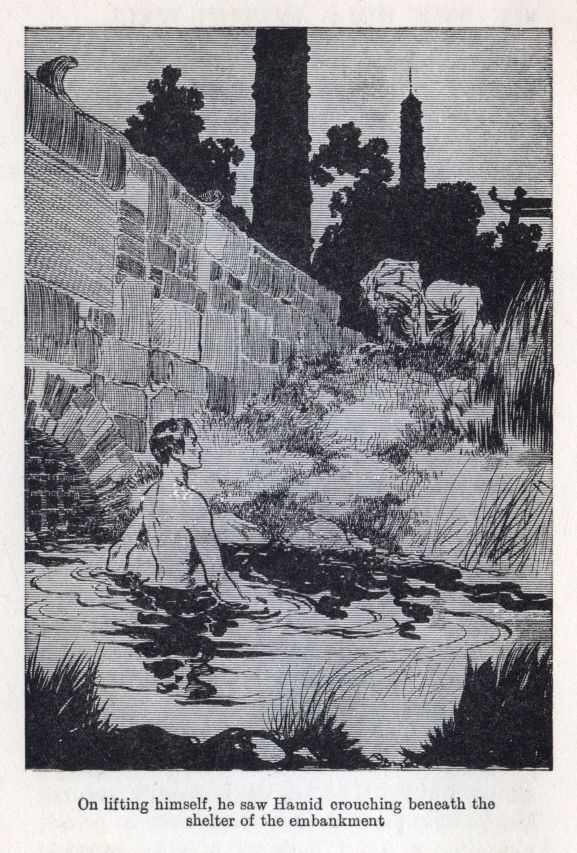
On lifting himself, he saw Hamid crouching beneath the shelter of the embankment.
Hamid was shivering with amazement and nervousness, but he obeyed in utter silence. They waded slowly through the stream, whose gurgling drowned the sound of their own movements. Presently they ducked to avoid a low bridge that led from one part of the grounds to the other. The dull thud of footsteps brought them to a sudden halt, and they crouched under the bridge, listening anxiously as the walker passed over their heads. They caught a glimmer of light, and as the footsteps receded, Mackenzie peeped out, and saw a priest, swinging a small lantern, moving towards a building a good distance on their left. He entered it, and disappeared.
"Last man out!" whispered Hamid.
After waiting a few minutes, they continued their way along the stream. It flowed through a wide inner enclosure, in which were scattered a number of small structures like summer-houses. Two slight bridges spanned the stream, and here and there were irregular masses which in the darkness could not be clearly distinguished, but which appeared to be rockeries. Quaintly shaped bushes outlined their dark forms against the walls of the distant buildings. Mackenzie concluded that this was either the Old Man's private garden, or the garden of the priests. Hamid could not tell him; he had been strictly forbidden to stray in this direction, or even to look over the low wall that surrounded the enclosure.
The watercourse was not straight. It turned now to the right, now to the left; its general course carried it obliquely across the garden, towards the angle of the wall. Thus the buildings on the right were not parallel with it. Mackenzie stopped, to take his bearings. Hamid pointed out his own quarters, the kitchen adjoining, and the wall of the passage connecting with the dwelling of the Old Man. The pagoda reared itself high above the other buildings. Beyond it lay the barrack-like lodgings of the first order of priests; those of the second order were on the opposite side of the enclosure, and were approached by means of the bridges.
"How far along the passage is the grating?" Mackenzie asked in a whisper.
"About half-way, sahib."
"And on which side?"
"Side nearest us, to be sure, sahib."
"Wait here for me, and hold this."
He placed in Hamid's hands the end of a coil of string, climbed over the embankment, and made his way with stealthy speed towards the middle point of the passage wall, as nearly as he could judge it, paying out the string as he went. On reaching the wall, he turned swiftly back, coiling the string round his finger. When he regained Hamid's side, he knew that the distance between the wall and this point of the embankment was a little more than sixty yards. The chimney which his friends were cutting would reach the surface somewhere on the circumference of a circle of which the middle of the wall was the centre, and which would come within about ten yards of his present position. He followed that imaginary line with his eye. It passed close to one of the summer-houses, ran across a bed of plants, then over the grass on which he had walked, touched the embankment some yards to the right, owing to the oblique course of this, and finally reached a point near the door of the cook's lean-to. To gauge the position of the chimney more precisely was impossible, because, though he knew that it was on the near side of the passage, he knew no more than that it was fifty yards from the grating.
Making a mental note of the course of the circumference on which lay the locus of the hole sometime to be pierced, he considered for a few moments whether to steal towards the door of the pagoda, and try to discover whether it was guarded. But by this time he was shivering with cold. His reconnaissance had not been unfruitful, and he decided to return at once to his hut. He parted from Hamid at the culvert, handed him the blanket, again entered his cold bath, and picking up his clothes, ran lightly over the ground to his lodging. Only on those two night expeditions had he taken off his clothes since his departure from the village in the forest.
Next morning Hamid handed him a note which he had drawn up in the bone. It was the longest he had yet received: Forrester had grown bolder, more reckless, perhaps, with the lapse of time. It read: "Always light below. Can't tell when it becomes dark outside. Give us a sign."
"Things are moving," he thought. "They are afraid of cutting through in the daylight. How in the world can I give them a sign? Hamid lets down the bone at all hours. Ah, well, I must think it out."
CHAPTER XVII
THE CARNIVORE
As Forrester mounted higher into the chimney, he worked with ever increasing caution. To allow the rays to break a passage through before everything was ready for joint action with his friends above would be disastrous. Another possible mischance was even more alarming. The ground might cave in prematurely by its own weight, or the weight of somebody passing over it. The result might be to hurl him on to the frail screen below, and through it into the pit.
To guard against such accidents he listened intently at each ascent, before he brushed away the protective dust. Once he thought he heard distant footfalls; another time the sound of running water. He wished that Mackenzie had been more communicative about what he was doing, and what he had discovered; but reflected that if his friend was silent, it was because, with Scotch canniness, he was determined to risk as little as possible, for the sake of all.
He waited patiently for the sign by which he would know when darkness fell in the open. The bone, no doubt, could be dropped only at uncertain intervals, as opportunity offered. Even if he knew that it would be let down precisely at the hour of sunset, he could not be sure of being then on the watch at the cleft, for it was not his duty to enter the inner cavern at all; his secret work there had been done only when guards and prisoners were asleep, and that was probably much later than sunset.
One day, Beresford, just before he had finished his task at the pit, and while Forrester was awaiting him in the outer cavern, noticed a trickle of water running from the inner passage towards him. While he was still looking at it in surprise, wondering where it came from, it was reinforced by a sudden swell, which carried the tiny stream across the floor of the cavern in a direct course for the open pit. By the time it reached the brink it had almost exhausted its energy; but some of it flowed slowly on, and poured over. Instantly there was a terrific explosion, like the bursting of an immense inflated bag, accompanied by a flash of white light which for the moment wholly conquered the green. Beresford was hurled against the wall of the cavern, and when he picked himself up, he saw that the force of the concussion had shut the screen down upon the pit, gripping the gold chain to which was suspended the plate in process of transmutation.
It was all over in a moment; but Beresford had hardly recovered his senses when Forrester came hurrying into the cavern, through the cloud of dust which had followed the explosion, with Wing Wu and the priest in charge hard on his heels.
Forrester had just time to give a word of warning. When the priest arrived, Beresford had sufficient presence of mind to explain in Chinese that while the cover was lifted from the mouth of the pit there had been a loud bang. He did not mention the stream of water; it had now ceased to flow, and though its appearance had amazed him, and in his half-dazed condition he attached no definite meaning to it, he felt instinctively that it had a meaning for himself and his fellow prisoners.
The priest looked puzzled. The dust had set him coughing. He peered through it round the walls, remaining at a discreet distance from the pit, and thus failing to notice the dwindling trickle on the farther side. The atmosphere of the cavern, at all times unpleasant and oppressive, was stifling now. In a few moments everybody was retreating along the passage to the outer cavern, Beresford remaining only to release the chain, draw up the plate, and lower the apparently uninjured screen firmly into its place. The negritos were just bringing in the evening meal.
"Are you hurt?" Forrester asked anxiously.
"Slightly bruised, perhaps; nothing serious."
"What on earth caused the explosion?"
"A trickle of water into the pit. Where it came from----"
"That was the sign!" exclaimed Forrester aloud, knowing that the priest could not understand him. But Wing Wu understood.
"What sign, sir?" he asked eagerly.
"Shall we tell him?" said Beresford.
Forrester hesitated for a moment.
"Not yet," he answered.
Wing Wu sighed, and turned away.
The priest at the entrance was joined by a second, drawn by the noise from the guard-room beyond the lake. They talked together for a few minutes, then the second man departed.
"He will tell the Old Man, no doubt," said Forrester to his companion.
"Yes; things are coming to a crisis. The water was our sign, no doubt. It could hardly have been accidental. Mackenzie must have thrown a bucketful or two through the grating. It is dark outside at about the time of our last meal."
"Do you think the priests suspect us?"
"Who can say what goes on in their Chinese minds? The fellow didn't see the water: that is pretty certain. But I am troubled. In the chimney you heard running water above you, you said?"
"I am almost sure of it--perhaps the stream that runs across the plateau."
"If our chimney pierces its bed, we are doomed. There is not the ghost of a chance for us. The explosion you heard will be as a popgun to a whole Dreadnought armament in comparison with the result if the cavern is flooded. I take it that the water which fell into the pit was instantly decomposed by the rays. Only a little trickled over the brink; yet the explosion was powerful enough to hurl me against the wall. If water pours down in any volume, the whole place will be shattered, and we shall be cremated instantly in one enormous flame."
"Will you go up the chimney yourself presently, and see if I was right?" asked Forrester, aghast at the thought of this cataclysm.
"I will try. Thanks to you I am not nearly so much crocked as I was a few days ago. But we will wait a little longer than usual, to give the priest time to settle down if he is at all suspicious.... You were quite right, by the way, not to let me explain things to Wing Wu. He is so easily hypnotised that he might betray us at the first question. It will be time enough to tell him when our work is done."
Several hours later, they stole into the inner cavern, and when Forrester had placed the cross-bars in position, Beresford mounted the ladder, and climbed laboriously into the chimney from bar to bar. He carried the piece of pointed iron, with which he carefully probed the roof. Withdrawing the implement, he passed his fingers along it from the pointed end downwards.
"We are very near the surface," he called down softly. "You have destroyed all the rock. The iron has gone through two or three inches of clay, and then into loose earth. We can't risk employing the rays again. If the earth above collapsed en masse, it would smash through the screen and carry us with it into the pit. We must bore a hole gradually with the iron."
"What about the water?" Forrester asked.
Beresford listened intently, Forrester standing below with his hand on the ladder.
"Yes," said Beresford at length, "you are right. But it appears to be at one side, not directly overhead. Ah! there are footsteps. Listen!"
They kept absolute silence. The dull thud of footsteps overhead was clearly audible. Forrester looked up at his friend, dimly visible high above him. His attention was so fully concentrated that a slight sound behind caused him to jump round with a sudden start. And there, in the entrance to the cavern, he saw the priest, peering up towards the hole in which the ladder rested.
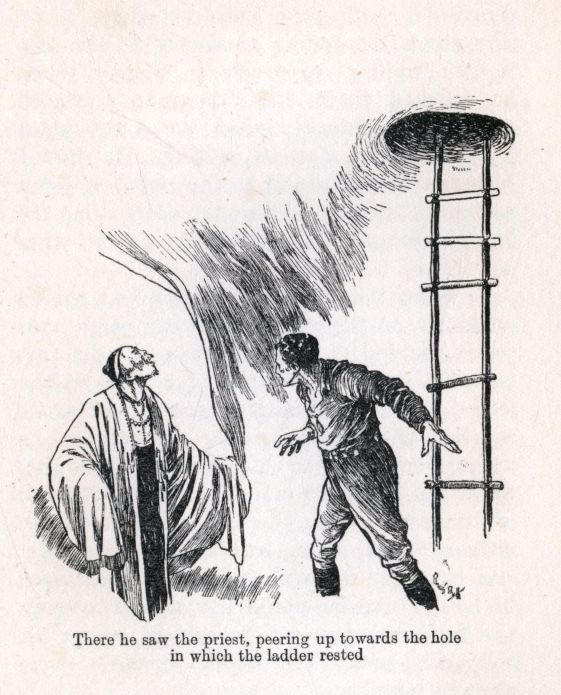
There he saw the priest, peering up towards the hole in which the ladder rested.
In after years Forrester often felt a quickening of the pulse as he tried to piece together the confused sequence of events in the next crowded minute. Whether he shouted to warn his companion before the Chinaman swung round and dashed back along the passage, or whether the Chinaman fled first and his cry followed, he could never distinctly recollect. All that he could remember was that, impelled by an instinctive feeling that the priest must be caught and silenced, he sprang like a tiger towards the intruder. Probably the fact was that the priest, being on the alert, had already turned before Forrester dashed after him, for he had a lead of several yards up the narrow passage.
Forrester was the younger and the fleeter of the two. Weeks of life in the mephitic atmosphere of the underworld, indeed, had slackened his muscles and lowered his nervous energy; his wind came short; but at this perilous crisis he seemed to regain all the athletic vigour which had served him so well on the football field in years gone by. When the priest dashed into the outer cavern, Forrester was only a few yards in the rear.
The former, feeling no doubt that he had now desperate men to deal with, rushed straight across to the entrance, where he might expect to find the negrito guards ready to support him. The little men, however, startled out of their wits by a sight which never, in all their years of servitude, had they beheld before, stood like stockfish, gazing amazedly at the two figures swiftly approaching them. When he reached them, the Chinaman appeared to realise instantly that he could place no reliance on men so palsied. He darted between them, turned to the right, and ran as fast as his long robe would allow along the ledge leading to the ward-room on the other side of the lake.
Crossing the cavern Forrester had gained on him. At the entrance he was barely two yards behind. He flashed past the astounded negritos, swung round on to the ledge, came up with his quarry just as he reached the plank bridge, and making a spring forward, caught him round the waist, as he had tackled many a man in pursuit of the oval ball. The Chinaman, however, although less agile, was of heavier build, and by sheer strength and weight he began to haul Forrester along the bridge towards the further ledge, at the end of which his colleague and the negrito guards were already massing.
Forrester clung to him desperately, tried to drag upon him by digging ineffectual heels into the plank; but with the cavern wall on his right, and only two feet of planking to manoeuvre on, he found that inch by inch he was being pulled into the jaws of danger. The Chinaman was clutching at the crazy handrail for purchase in hauling his tenacious grappler along. In a few seconds Forrester must either release him, or fall a captive into remorseless hands. Despair struck a spark in his darkening mind. There was one chance--one, and no more!
Bracing his right leg, he threw the whole weight of the Chinaman and himself against the balustrade. It creaked; there was the snap of breaking timber. Forrester released his man and drew quickly back. The priest fell with a great splash into the green oily waters of the lake.
By this time the startled company at the remote end of the ledge were beginning to advance. A spear whizzed past Forrester's ear. To protect himself, he wrenched away a piece of the broken handrail. With this club he could ward off a missile or crack a skull. Facing the enemy, he retreated with wary footsteps along the bridge. The priest, leading on his negritos, came striding along the ledge, his parchmenty features grimacing with rage.
Forrester was trembling in every limb. The sudden spurt, the muscular strain, had told heavily upon his debilitated body. And again despair seized upon his soul as he realised that his efforts after all had been made in vain. Before long the priest now menacing him would hurry to acquaint the Old Man with this revolt of the prisoners. They would be taken aloft, and then--the Eye!
But all speculation was suddenly shocked out of his mind by a tragic sequel, unlooked-for, terrible.
The Chinaman was still floundering beneath the bridge.
Swift and silent, from out the sombre spaces of the lake there slid a something huge and hideous--a Shape. A glint of greenish light in cruel eyes; a flash of gleaming teeth in jaws like those of a mammoth dog-fish; a shriek of terror and despair; then silence, and a slow heaving of the waters. The Monster had claimed his ancient right!
CHAPTER XVIII
UNDER THE STARS
Forrester and his enemies alike were for the moment paralysed by the horror of the tragic scene. Before they had recovered their wits, Beresford dashed up behind his friend, and cried to him to tear up the plank. Only one who had not seen the actual occurrence could have intervened at such a moment.
"Quick, man!" cried Beresford, amazed at the other's sluggishness.
Pulling himself together, Forrester stooped and helped Beresford to haul the plank to their own side of the ledge, leaving an impassable gap between them and their enemies. Only by swimming could they now be reached, and Forrester felt, with a return of his nausea, that the priest, after the object lesson he had just had, would recoil from so terrible a risk.
"Bring the plank back into the cavern," said Beresford. "There's no time to lose."
They hurried back. On hearing Forrester's shout, Beresford had descended the shaft with reckless speed, and hurried through the passage after him. When he gained the cavern pursuer and pursued had disappeared through the entrance. Dashing after them, he levelled the two negritos, now at last awaking from their torpor, with blows left and right. He said afterwards that it was monstrously unfair--like hitting children. Too late to witness the fate of the priest, he perceived what had escaped Forrester's over-wrought mind--that only the destruction of the bridge could save them from the Old Man's immediate vengeance. Whether it would result in their complete and final salvation was on the knees of the gods.
Returning to the cavern, they caught up the spears of the negritos, and carried them and the plank to their customary quarters at the further end. Of the Chinese prisoners, only Wing Wu and his cousin had enough spirit left to interest themselves in the extraordinary incidents of the past few minutes: the others had scarcely stirred in their sleep.
"Lie down, my lad," said Beresford kindly, as Wing Wu came to meet him, his eyes gleaming with a light not seen in them for many a day. "You will want all your strength. You shall know all about it, presently."
As he spoke, he reeled against Forrester, who caught him in his arms and lowered him gently to the floor.
"Decidedly groggy," he murmured with a haggard smile. "I'm sorry to be such a nuisance to you, old man. Give me a minute or two: then--by George! I shall talk!"
He closed his eyes, and lay for a while silent on his back, his panting nostrils telling how great had been the tax upon his weakened frame. By and by he looked up at Forrester, reclining near him.
"Thank Heaven, my brain is clear!" he began. "What an absurd thing one's body is! ... Now, they'll either rebuild the bridge and storm us, or do nothing, and starve us out. It depends on whether the Old Man can bear the thought of extinguishing us without using the Eye! Either way, we are doomed--unless we get out. That's as much as to say that we must get out at once. We must! And we must let our friends above know when to expect us Scribble a note to Mackenzie, then: we pop out of the chimney to-morrow night."