Front matter (continued 5)
Reading edition
Nepeta, Glechoma (Catmint, Catnip). Labiatæ.
Propagated by sowing seed in spring, or by divisions.
Nephelium, Dimocarpus, Euphoria (Litchi). Sapindaceæ.
May be increased by seeds, or by cuttings made of half-ripened wood.
Nephrodium. See Ferns.
Nephrolepis. See Ferns.
Nerine. Amaryllideæ.
Seeds, for new varieties. Commonly increased by means of bulbels.
Nerium (Oleander). Apocynaceæ.
Layers. Cuttings should be made of matured leading shoots, inserted in single pots and placed in a close, warm frame; or they may be rooted in bottles of water and afterwards potted in soil. See Fig. 52, a.
Nertera, Nerteria. Rubiaceæ.
Increased by seeds, divisions, or cuttings. Any small portion will grow freely, especially if placed in a warm frame.
Nesæa, including Heimia. Lythrarieæ.
May be increased by means of seeds, divisions, or green cuttings.
Nettle-tree. See Celtis.
New Zealand Flax. See Phormium.
Nicandra, Calydermos. Solanaceæ.
Seeds, sown in the open border, or under glass in the north.
Nicotiana (Tobacco). Solanaceæ.
Propagated by seeds, started under glass or in a carefully prepared seed-bed. The ornamental species sometimes by cuttings.
Nierembergia. Solanaceæ.
Grown from seeds, under glass. Cuttings of firm shoots are also used.
Nigella (Fennel Flower, Love-in-a-Mist). Ranunculaceæ.
Propagated by seeds sown in early spring in the open.
Nightshade. See Solanum.
Nine-bark. See Spiræa.
Nolana. Convolvulaceæ.
Seeds sown in the open border during spring.
Norantea, Ascium, Schwartzia. Ternstrœmiaceæ.
Ripened cuttings can be rooted in sand, in heat.
Norfolk Island Pine. See Araucaria.
Norway Spruce. See Picea.
Notelæa, Rhysospermum. Oleaceæ.
Seeds. Cuttings of firm side shoots in spring, usually without heat.
Nuphar. Propagated same as Nelumbo and Nymphæa, which see.
Nutmeg. See Myristica.
Nuttallia. Rosaceæ.
May be propagated by seeds; by divisions; by means of suckers, which spring from the roots.
Nyctanthes. Oleaceæ.
Cuttings of half-ripened shoots should be set in spring, in bottom heat.
Nymphæa, Castalia (Water Lily, Lotus). Nymphæaceæ.
Seeds, which are rolled up in a ball of clay and dropped into a pond, or sown in pots which are then submerged in shallow water, either in-doors or out. Usually increased by portions of the root-stocks, which are sunk in the pond and held by stones, or the tender species placed inside, in pans of water. Some species produce tubers on the root-stocks, which are used for propagation.
Nyssa (Pepperidge, Sour Gum, Tupelo-tree). Cornaceæ.
Increased by seeds and by layers. The seeds should be sown as soon as ripe or else stratified. They usually lie dormant the first year.
Oak. See Quercus.
Obeliscaria. See Rudbeckia.
Ochna. Ochnaceæ.
During summer, cuttings may be made of growing shoots.
Odontoglossum. Orchideæ.
Division. (See also under Orchids.)
Œnocarpus. Palmæ.
Propagated by seeds or by suckers.
Œnothera, including Godetia (Evening Primrose). Onagrameæ.
Seeds may be sown in spring or summer. Divisions may be made. Cuttings of perennials should be placed in a cool frame in the early part of the season before flowering begins.
Okra, Gumbo (Hibiscus esculentus). Malvaceæ.
Seeds, sown where the plants are to stand, or started in pots often in the north.
Olax. Olacineæ.
Grown from cuttings of firm or mature shoots in heat.
Olea. Oleaceæ.
The ornamental species are grown from cuttings of ripened shoots, either under frames or in the border, and also by seeds. For propagation of O. Europæa, see Olive.
Oleander. See Nerium.
Olearia, Eurybia. Compositæ.
Seeds. Readily increased by cuttings of growing shoots placed in a frame.
Oleaster. See Elæagnus.
Olive (Olea Europæa). Oleaceæ.
The olive is grown in large quantities from seed, especially in Europe. The pulp is removed by maceration or by treating with potash. The pits should be cracked or else softened by soaking in strong lye, otherwise they will lie dormant for one or two years. Cuttings of any kind will grow. Limbs, either young or old, an inch or two inches in diameter, and from one to two feet long, are often stuck into the ground where the trees are to grow, or they are sometimes used in the nursery. Green cuttings, with the leaves on, are often used, being handled in frames or in boxes of sand. Chips from old trunks, if kept warm and moist, will grow. The olive is often propagated by truncheons of trunks. A trunk two or three inches in diameter is cut into foot or two foot lengths, and each length is split through the middle. Each half is planted horizontally, bark up, four or five inches deep, in warm moist soil. The sprouts which arise may be allowed to grow, or they may be made into green cuttings. Knaurs (see page 56) are sometimes used. The olive can be budded or grafted in a variety of ways. Twig-budding and plate or flute-budding give admirable results. Twig-budding is the insertion of a small growing twig which is cut from the branch in just the manner in which shield-buds are cut.
Omphalodes, Picotia. Boragineæ.
Freely increased by means of seeds planted in spring, or by divisions.
Oncidium. Orchideæ.
Division. In some species detachable buds are produced in the inflorescence, and these give young plants. (See also under Orchids.)
Oncosperma, Keppleria. Palmæ.
Propagated by seeds or by suckers.
Onion (Allium Cepa). Liliaceæ.
Onions are mostly grown from seeds, which must be sown as early as possible in spring; or in the south they may be sown in the fall. They are also grown from “tops,” which are bulblets borne in the flower cluster. These are planted in the spring, or in the fall in mild climates, and they soon grow into large bulbs. “Sets” are also used. These are very small onions, and when planted they simply complete their growth into large bulbs. Sets are procured by sowing seeds very thickly in poor soil. The bulbs soon crowd each other, and growth is checked, causing them to ripen prematurely. Good sets should not be more than a half inch in diameter. Very small onions which are selected from the general crop—called “rare-ripes”—are sometimes used as sets, but they are usually too large to give good results. Some onions—the “multiplier” or “potato onions”—increase themselves by division of the bulb. The small bulb, which is planted in the spring, splits up into several distinct portions, each one of which will multiply itself in the same manner when planted the following year.
Onobrychis (Saintfoin). Leguminosæ.
Seeds, sown in spring where the plants are to remain.
Onosma (Golden Drop). Boragineæ.
Seeds, sown in the open in spring. Perennial species by cuttings in summer.
Opuntia (Prickly Pear, Indian Fig). Cacteæ.
Seeds grow readily, sown as soon as ripe in ordinary sandy soil, either in the house or out-doors. The joints grow readily if laid on sand. It is customary to allow these cuttings to dry several days before planting them. See also Cactus.
Orach (Atriplex hortensis). Chenopodiaceæ.
Seeds, sown where the plants are to stand.
Orange (Citrus Aurantium). Rutaceæ.
Orange stocks are grown from seeds, which should be cleaned and stratified in sand or other material, until sowing time. The seeds should not be allowed to become hard and dry. Some prefer to let the seeds sprout in the sand and then sow them in the nursery, but they must be carefully handled. The seeds are usually sown in seed beds, after the manner of apple seeds, and the seedlings are transplanted the next fall or spring into nursery rows. Care must always be exercised in handling orange plants, as they are often impatient of transplanting. Oranges grow readily from cuttings, although cuttage is not often practiced. Green cuttings, handled under a frame, give good results. Mature wood, either one or two years old, can be treated after the manner of long grape cuttings. They must have an abundance of moisture. Layers are sometimes made.
The named varieties are shield-budded upon other stocks. Grafting can be practiced, but it is often unsatisfactory. The nursery stocks are commonly budded in the spring, after having grown in the rows one year, which is two years from the sowing of the seed. If thorn-bearing varieties are to be propagated, a thorn with a bud in its axil is often cut with the bud, to serve as a handle in place of the leaf stalk, which is used in summer budding. Many stocks are used for the orange. The leading ones are sweet or common orange, sour orange (Citrus Aurantium, var. Bigaradia), pomelo (var. pomelana or decumana), Otaheite orange, trifoliate orange (Citrus trifoliata), and various lemons, as the “French” or Florida Rough and the Chinese. For general purposes, the sweet and sour orange stocks are probably the best. The sour stock is obtained from wild seeds, this variety having extensively run wild in Florida from early times. The trifoliate and Otaheite stocks are used for dwarfing or for small growing sorts, as many of the Japanese varieties. The trifoliate orange is also one of the hardiest of the orange stocks, and its use will probably increase upon the northern limit of the orange belt. Old orange trees can be top-budded with ease. It is advisable to cut them back a year before the operation is performed, in order to secure young shoots. In ordinary greenhouse practice, the seedlings of the pomelo make good stocks. They can be established in three-inch pots the first season, and veneer-grafted the next winter.
Orchids. Orchideæ.
The method of propagating these plants must in each species be adapted to the habit and mode of growth. The easiest and safest plan for the vast majority is by division, but seeds, cuttings, layers, offsets, and very rarely roots, are also utilized. It is important that artificial means of increase should only be adopted where the individual plants are in robust health. With many orchids the struggle of life under the unnatural conditions we supply, is necessarily severe, and any operation which transforms one weak plant into two or more weaker ones, is to be deprecated. In cases where the only method available necessitates disturbance at the roots, consideration must be paid to the constitution of the species, for some orchids, even when perfectly healthy, strongly resent interference.
Seeds. In no class of cultivated plants is propagation by seeds more difficult and tedious than it is with orchids. In all cases, fertilization must be performed by hand. In England, the length of time required for the capsules to ripen varies from three months to a year. Good seeds form a very small proportion of the whole, and it occasionally happens that the contents of a capsule will not produce a single plant. This, however, as well as the difficulty experienced in England in rearing plants to the flowering stage, is primarily due to the deficiency of sunlight, and in such a bright climate as that of the United States, would not be likely to occur. Various methods of sowing are in vogue, such as sprinkling over pieces of wood and cork or tree-fern stem, and on the top of moss and peat, in which established plants of the same or a nearly related species are growing. The last is probably the best, but it is always advisable to try several methods. Of course, the material on which the seeds are scattered must always be kept moist and shaded. The period between germination and the development of the first root is the most critical in the life of a seedling orchid. After they are of sufficient size to handle they are potted off into tiny pots, and as they gain strength, are given treatment approximating that of adult plants.
Division. Cypripediums may be taken as an example where this is readily done. It is simply necessary to carefully shake off the soil from the roots, and by the aid of a sharp knife, sever the plant into as many pieces as are required. It is always advisable to leave one or more leading growths to each portion. This method may be practiced for the increase of phaius, masdevallia, sobralia, ada, the evergreen section of calanthe, and all of similar habit.
In nearly all those kinds where the pseudo-bulbs are united by a procumbent rhizome, such as occurs in cattleyas, the process is slower. It seems to be natural for these plants to continue year after year, producing a single growth from the old pseudo-bulb. To obtain additional “leads,” the rhizomes should be cut through in early spring, two or three pseudo-bulbs being reserved to each piece. A bud will then push from the base of each pseudo-bulb nearest the division, and a new lead is formed. The pieces should not be separated until this is well established, and three years may sometimes be required. Lælia, catasetum, cœlogyne, lycaste, cymbidium, zygopetalum, odontoglossum, oncidium, miltonia, etc., are treated in this manner.
Cuttings.—This method is available for those kinds with long, jointed stems, like dendrobium and epidendrum. Just before the plants commence to grow, say in February, the old pseudo-bulbs are cut up into lengths, and laid on a moist, warm surface, such as on a pan of moss in a propagating frame. Young offshoots will shortly appear at the nodes, and when large enough are potted off with the old piece attached. This plan may be used also for barkeria and microstylis.
It is well to remember that in any method of propagation where the pseudo-bulb is divided, the vigor of the young plant is proportionate to the amount of reserve material supplied it. However suitable the external conditions may be for growth, it is for some time entirely dependent for sustenance on the old piece from which it springs. Dendrobium Phalænopsis is a case in point. If a pseudo-bulb is cut into say three pieces, it will take at least two years for the young plants to reach flowering strength, but frequently by using the entire pseudo-bulb, we can get in a single year a growth quite as large as the old one.
The treatment of young orchids should be founded on what suits the parents. As a rule, however, they require more careful nursing, and some of the conditions must be modified. Drought, intense light and cold draughts must be avoided. For many orchids, especially those from equatorial regions, where the atmospheric conditions alternate between saturation and intense heat and dryness, it is necessary, in order to induce flowering, that nature, to some extent at least, should be imitated. With young plants, by whatever method they may be obtained, the supply of water must only be reduced in accordance with the weather and season, and beyond that, no attempt at resting made. In cases, however, where plants have been divided or made into cuttings, a very limited supply of water is needed at first; but to prevent exhaustion, the atmosphere should always be kept laden with moisture.
Oreopanax. Araliaceæ.
Seeds, and cuttings of the young shoots, or division of well established plants.
Ornithogalum (Star of Bethlehem). Liliaceæ.
Seeds. Commonly by bulbels, and by division of the clumps.
Ornus. See Fraxinus.
Orobus (Bitter Vetch). Leguminosæ.
Readily propagated by seeds, or by dividing the tufts.
Orontium. Aroideæ.
Commonly increased by division, but seeds may be used.
Orpine. See Sedum.
Osage Orange. See Maclura.
Osier. See Salix and Cornus.
Osmanthus (Japan Holly). Oleaceæ.
Propagated by cuttings under glass, or by grafting on osmanthus stock, or on privet.
Osmunda (Flowering Fern). Filices.
Mostly by division; sometimes by spores. See Ferns.
Ostrya (Hop Hornbeam, Ironwood). Cupuliferæ.
Best grown from seeds. Also increased by layering; or it can be grafted. The European species is often grafted upon the hornbeam (carpinus).
Othonna, Aristotela, including Doria (Ragwort). Compositæ.
Very easily propagated by seeds and cuttings. The leaves also take root.
Ouvirandra (Lattice-leaf). Naiadaceæ.
The plants are divided, or seeds are used when they can be obtained.
Oxalis. Geraniaceæ.
Seeds, divisions and cuttings. The tuberiferous species are increased by the small tubers which form upon the roots.
Oxycoccus. See Cranberry.
Oxydendron (Sorrel-tree). Ericaceæ.
Increased by seeds, which must be handled carefully in light soil. Also by layers, which, however, often root with difficulty.
Oxylobium, including Callistachys, Podolobium. Leguminosæ.
Increased by seeds and layers. Cuttings of rather firm side young shoots, made during spring.
Oyster Plant. See Salsify.
Oxytropis. Leguminosæ.
Seeds should be sown where the plants are to stand; also by dividing the plant in spring.
Pachira, Carolinea. Malvaceæ.
Seeds. Large cuttings cut at a joint, with the leaves on, in heat.
Pæony (Peony, Piney). Ranunculaceæ.
Seeds, giving new varieties, are sown as soon as ripe. The seedlings seldom rise above the surface the first year, all their energies being spent in the formation of roots. The common herbaceous varieties are oftenest propagated by division of the clumps. Each portion should possess at least one bud upon the crown. All woody species may be increased by layers and cuttings. Cuttings are taken late in summer, cut to a heel, and are handled in a frame or cool greenhouse. During winter they should be kept from freezing. The shrubby species and P. Moutan are often grafted, and all species can be handled in this way. The operation is performed in late summer or early autumn, and the grafts are stored in sand or moss where they will not freeze. The next spring they are planted out. The cion is made from a strong short shoot, destitute of flower-buds, and is set upon a piece of root, as described and figured on a previous page (p. 88, Fig. 85). Some prefer to cut a wedge-shaped portion from the side of the stock, in which to set the cion, rather than to split the stock; but either practice is good. Strong roots of various varieties or species may be used. The Chinese pæony (P. Moutan), P. officinalis and P. albiflora are probably oftenest used.
Painted-cup. See Castilleja.
Palafoxia. Compositæ.
Seeds, commonly sown under glass, or in mild climates sown in the open.
Palicourea. Rubiaceæ.
Cuttings, made in spring under glass.
Paliurus, Aubletia (Christ’s Thorn). Rhamneæ.
May be increased by seeds, by layers or by cuttings of the roots.
Palma-Christi. See Ricinus.
Palms. Palmæ.
Palms are mostly grown from imported seeds. These should always be sown in a brisk bottom heat, in a mixture of coarse loam and sand. A hot-bed, established upon the greenhouse bench, is an excellent place in which to start palm seeds. Some species are increased by suckers, which arise from the crown or roots. For more explicit directions, see the various genera.
Pampas Grass. See Gynerium.
Panax (Ginseng). Araliaceæ.
Cuttings of stems and roots. Stems of old plants may be cut into pieces an inch or two long and inserted in sand in heat. Or young plants can be obtained by cutting down the tops of strong plants and then separating the suckers which arise.
Pancratium and Hymenocallis. Amaryllideæ.
Seeds, sown in pans in heat, are sometimes employed. Commonly increased by offsets, which usually form freely.
Pandanus (Screw Pine). Pandaneæ.
Seeds and suckers, as in palms. Also by cuttings of the young growth in heat. The “seeds” are really fruits, and if in good condition several plants, one to ten, are obtainable from each; they should be separated when well furnished with roots.
Pansy. See Viola.
Papaver (Poppy). Papaveraceæ.
Seeds—usually sown out-doors—and divisions. P. orientalis and allied species are easily propagated by root-cuttings in sandy soil under glass in autumn.
Papaw-tree. See Carica; also Asimina.
Papyrus. Cyperaceæ.
Propagation is effected by seeds and by divisions, chiefly the latter.
Pardanthus. Irideæ.
Seeds, divisions, and cuttings of young growth.
Paris. Liliaceæ.
Increased by seeds or by divisions.
Paris Daisy. See Marguerite.
Parkinsonia. Leguminosæ.
Seeds mostly. Cuttings.
Parnassia (Grass of Parnassus). Saxifrageæ.
May be propagated by seeds or by divisions.
Parrotia. Hamamelideæ.
Increased by seeds or by layers.
Parrya. Cruciferæ.
Seeds and divisions.
Parsley (Apium Petroselinum). Umbelliferæ.
Seeds, which are usually sown out-doors. The roots may be taken up in fall to be forced under glass.
Parsnip (Pastinaca sativa). Umbelliferæ.
Fresh seeds, sown where the plants are to stand.
Parthenium. Compositæ.
Seeds, sown under glass, or in the open.
Pasque-flower. See Anemone.
Passiflora (Passion Flower). Passifloreæ.
Seeds, sown under glass. Cuttings of the young growth root easily in sand in a frame. Varieties are sometimes veneer-grafted, e. g., P. coccinea.
Paulownia. Scrophularineæ.
Seeds, sown in carefully prepared soil, either in a seed-bed or in a cold-frame. Cuttings of ripe wood or of roots, made in fall or spring.
Pavonia. Malvaceæ.
Seeds, and green cuttings in a frame.
Pea (Pisum sativum). Leguminosæ.
Seeds, sown where the plants are to stand. The plants are hardy and seeds may be sown very early.
Peach (Prunus Persica) Rosaceæ.
The peach is perhaps the easiest to propagate of all northern fruit trees. Stocks are universally grown from seeds, although root-cuttings will grow. The seeds should be buried out-doors in the fall, and shallow enough so that they will be fully exposed to frost. Some prefer to simply spread them upon the surface of the ground and cover them lightly with straw to prevent them from drying out. The pits should be kept moist, and by spring most of them will be cracked. Those which do not open should be cracked by hand, for if planted they will not germinate until a year later than the others. The “meats” or kernels are sorted out and planted early in drills. Or some prefer to sprout the seeds in the house, in order to select the best for planting. Some growers upon a small scale pinch off the tip of the rootlet to make the root branch. Pits should be secured, of course, from strong and healthy trees, but the opinion that “natural seed,” or that from unbudded trees, is necessarily best, is unfounded.
The seeds should be planted in rich soil, and the stocks will be large enough to bud the same year. Any which are not large enough to bud may be cut back to the ground the next spring, and one shoot be allowed to grow for budding, but such small stocks are usually destroyed, as it does not pay to bestow the extra labor and use of land upon them. When the buds have grown one season, the trees are ready for sale—at one year from the bud and two years from the seed. Peach trees are always shield-budded, and the operation is fully described on pages 68 to 75. Grafting can be done, but as budding is so easily performed, there is no occasion for it. The peach shoots are so pithy that, in making cions, it is well to leave a portion of the old wood upon the lower end—extending part way up the cut—to give the cion strength.
Peaches are nearly always worked upon peaches in this country. Plums are occasionally employed for damp and strong soils. Myrobolan is sometimes used, but it cannot be recommended. All plums dwarf the peach more or less. The hard-shell almond is a good stock for very light and dry soils. The Peen-to and similar peaches are worked upon common peach stocks.
The nectarine is propagated in exactly the same manner as the peach. The ornamental peaches are budded upon common peach-stocks in the same manner as the fruit-bearing sorts.
For Prunus Simoni, see Plum.
Pea-nut (Arachis hypogæa). Leguminosæ.
As a field crop, the seeds should be planted where the plants are to stand. For propagation in greenhouses, see Arachis.
Pear, Alligator or Avocado. See Persea.
Pear (Pyrus communis, P. sinensis). Rosaceæ.
Pear seedlings are grown in the same manner as those of the apple, which see. Pear stocks are mostly imported from France, however, as the leaf-blight is so destructive to them here as to render their culture unprofitable. This leaf-blight is a fungus (Entomosporium maculatum), and recent experiment has shown that it can be readily overcome by four or five thorough sprayings with Bordeaux mixture, so that there is reason to hope that the growing of pear stocks may yet become profitable in this country. Heretofore, the only means of mitigating the ravages of this blight was the uncertain one of inducing a strong growth early in the season. Even when pear stocks are raised in this country, they are grown from imported French seed. Aside from its cheapness, however, this foreign seed probably possesses no superiority over domestic seed. But pear seed is so difficult to obtain in America that it is practically out of the market.
Pear seedlings should be taken up and removed from the seed-bed the first fall. The foreign stocks are imported when a year old from the seed. The seedlings are trimmed or “dressed” (see page 69), and are set into nursery rows the following spring. The next season—that is, the season in which the stocks are transplanted—shield-budding is performed, as upon the apple. The budding season usually begins late in July or early in August in the north. If the stocks are small, of “second size,” they may stand over winter and be budded the second year. Pear trees are sold at two and three years from the bud. Pears do not succeed well when root-grafted, except when a long cion is used, for the purpose of securing own-rooted trees (see page 78). Dormant buds of the pear may be used upon large stocks in early spring, the same as upon the apple, and buds may be kept upon ice for use in early summer (see page 74).
Pears are dwarfed by working them upon the quince. The Angers quince is the best stock. The ordinary orange quince and its kin make weak and short-lived trees. Quince stocks are obtained from ordinary cuttings or from mound-layering, the latter method giving much the better stocks (see Quince). The layers should stand until late in autumn of the second season when they will be found to be well-rooted, and may then be taken off, trimmed up and fitted to plant as stocks the following spring, and budded in August. It is imperative to set the bud as low as possible in order to secure long-lived trees. Some varieties do not unite well with the quince, and if it is desired to dwarf them, they should be double-worked (see page 91).
The pear can also be grown upon the apple, thorn and mountain ash. Upon the apple it is short-lived, although pear cions, set in the top of an old apple tree, often bear large fruits for a few years. When pear stocks cannot be had, pears are sometimes worked upon apple roots. If the cions are long they will emit roots, and when the apple nurse fails the pear becomes own-rooted. Good dwarf trees are often secured upon the thorn, and there is reason to believe that some of the thorns will be found to be preferable to quince stocks for severe climates and for special purposes. The subject is little understood. The mountain ash is sometimes used for the purpose of growing pears upon a sandy soil, but its use appears to be of little consequence.
Pears of the Le Conte and Keiffer type are often grown from cuttings in the south. Cuttings are made of the recent mature growth, about a foot in length, and are planted in the open ground after the manner of long grape cuttings. Le Conte, Garber, Smith, and other very strong growers of the Chinese type, are probably best when grown from cuttings. They soon overgrow French stocks, as also apple stocks, which have been used to some extent; but if long cions are used, own-rooted trees are soon obtained, and the stock will have served a useful purpose in pushing the cion the first two or three years.
Pecan (Hicoria Pecan). Juglandeæ.
Propagated by seeds. These may be planted as soon as ripe, or stratified until spring. The ground should be well prepared and the nuts planted about 3 inches deep. By grafting on pecan or common hickory stock that is not over 2 years old. Cions about 6 inches long should be cut during the winter and put in a cool place to hold them back until the stocks have fairly started in the spring. The stalks should then be cut off at the crown and the cion inserted. The tongue-graft gives the best result. Bandage securely and bank with earth nearly to the top of the cion, to keep it moist.
Pelargonium (Geranium, Stork’s Bill). Geraniaceæ.
Seeds, sown in light soil with mild heat, are sometimes employed. Commonly increased by cuttings of firm shoots, which grow readily (Figs. 52, e, and 55). The fancy or show geraniums are often grown from root-cuttings, but sometimes will not come true. Geraniums can also be grafted. (See page 39, herbaceous grafting.)
Pelecyphora (Hatchet Cactus). Cacteæ.
Propagated most freely by seeds in moderate heat, and by cuttings made of any small shoots that arise from the base See also Cactus.
Peliosanthes. Hæmodoraceæ.
Suckers.
Peltandra. Aroideæ.
Propagated by seeds when fresh, or by division.
Pennyroyal (Mentha Pulegium). Labiatæ.
Seeds and divisions.
Pentapetes. Sterculiaceæ.
Propagated by seeds; by cuttings of half-ripened shoots.
Pentas. Rubiaceæ.
Propagated, with difficulty, by seeds or cuttings of half-ripened wood.
Pentstemon (Beard-tongue). Scrophularineæ.
Seeds, sown in pans and placed under a frame; or they are sometimes sown in the border where the plants are to stand. Also by division, and rarely by cuttings in summer.
Peperomia, including Micropiper. Piperaceæ.
Seeds. Cuttings of single joints of firm stems root easily in a peaty soil. Water sparingly.
Pepper, Black. See Piper.
Pepperidge. See Nyssa.
Pepper-grass, Curled Cress (Lepidium sativum). Cruciferæ.
Grown from seeds, either under glass for early crops or in the open air.
Peppermint (Mentha piperita). Labiatæ.
Divisions of the creeping and rooting stems are planted to multiply the plant, and plantations are renewed every three or four years.
Pepper, Red or Cayenne (Capsicum). Solanaceæ.
Seeds, sown out-doors, or in the north oftener started in the house.
Pereskia (Barbadoes Gooseberry). Cacteæ.
Seeds. Cuttings, as described under Cactus. P. aculeata is much used as a stock for epiphyllums. P. Bleo is sometimes used for the same purpose, as it is fully as good as the other species. Cuttings of P. aculeata can be made a foot or more in length, and of sufficient size for immediate use, or, indeed, the graft may be inserted when the cutting is made.
Perilla, Dentidia. Labiatæ.
Sow the seeds in early spring in pans or boxes, and place in a gentle heat. Or southwards, seeds may be sown in the open.
Periploca. Asclepiadeæ.
Seeds. Increased mostly by layers or cuttings under glass, during summer or autumn. Root-cuttings succeed.
Periwinkle. See Vinca.
Pernettya. See Canarina.
Persea (Alligator or Avocado Pear). Laurineæ.
Seeds. Layers of ripened shoots may be made in autumn, or cuttings of firm shoots in spring, under glass.
Persimmon (Diospyros Kaki and D. Virginiana). Ebenaceæ.
Stocks are readily grown from seed, and they usually attain sufficient size for budding the first year. The native persimmon (Dispyros Virginiana) is largely used as a stock for the Japanese persimmon or kaki. Imported stocks are occasionally employed, but the native is more vigorous, as a rule, and probably better. Persimmons are shield-budded the same as peaches, and they may be root-grafted and top-grafted by ordinary methods.
Persoonia, Linkia. Proteaceæ.
Propagated by cuttings of the ripened shoots, under glass.
Peruvian Bark. See Cinchona.
Petalostemon (Prairie Clover). Leguminosæ.
Seeds and divisions.
Petunia. Solanaceæ.
Seeds, either in-doors or in the garden. Choice and double varieties are often increased by cuttings, which grow readily.
Phacelia, Eutoca, Whitlavia. Hydrophyllaceæ.
The annuals are increased by seeds, and the perennials by seeds and divisions.
Phædranassa, including Leperiza (Queen Lily). Amaryllideæ.
Propagated by seeds and bulbels.
Phaius. Orchideæ.
Division of the bulbs. (See also under Orchids.)
Phalænopsis. Orchideæ.
These are very slow and difficult to propagate. In the majority of the species it can only be done where a lateral off-shoot is made from the main stem. Some species, such as P. Luddemanniana, and more rarely P. amabilis, P. Stuartiana and P. Schilleriana, develop plantlets on the old flower scapes. By pegging these down on a basket of moss they may be established and afterwards separated. P. Stuartiana and P. deliciosa have been known to produce plants on the roots. Other instances of root-proliferation are recorded in Saccolabium micranthum and a species of cyrtopodium. (See under Orchids.)
Phalaris. Gramineæ.
Propagated by seeds, but the sports by divisions.
Phaleria, Drimyspermum. Thymelæaceæ.
Increased by seeds sown in heat in spring; or by cuttings of the young shoots, which should be inserted in bottom heat.
Pharbitis. See Ipomœa.
Phaseolus (Bean, Kidney, Pole, String; French Bean, etc.). Leguminosæ.
The ornamental greenhouse kinds are grown from seeds planted in light soil in a warm propagating house. See Bean.
Phebalium. Rutaceæ.
May be increased by cuttings of the young wood, under a glass.
Phellodendron (Cork Tree). Rutaceæ.
Increased by seeds, layers and by root-cuttings.
Philadelphus (Mock Orange, Syringa). Saxifrageæ.
Seeds, layers, suckers and cuttings. Layers are most used. Cuttings of mature wood are sometimes employed. Some well-marked varieties, like vars. nana and aurea of P. coronarius, are grown from cuttings of soft wood in summer in frames.
Phillyrea (Jasmine Box, Mock Privet). Oleaceæ.
Seeds. May be propagated by cuttings, layers, or by grafting on the privet.
Philodendron. Aroideæ.
Increased by seeds; and by dividing the stems, allowing two or three joints to each piece, inserting them in pots in a brisk heat.
Phlomis. Labiatæ.
All of the species may be increased by seeds; the herbaceous kinds by divisions, and the shrubby sorts also by cuttings.
Phlox. Polemoniaceæ.
The annuals are grown from seeds sown in the open. The perennials are grown from seeds, divisions, cuttings of stems and roots. Cuttings made during summer, and handled in a frame, do well. The roots are cut into short pieces, and are then handled in pans or flats under cover.
Phœnix, Elate (Date Palm). Palmæ.
Increased by imported seeds, sown in a sandy soil, in a mild hot-bed. Also by suckers. See also Date.
Phormium (Flax Lily, or New Zealand Flax). Liliaceæ.
Seeds. Also by division of the crowns before growth commences in spring.
Photinia, including Eriobotrya. Rosaceæ.
Stratified seeds or half-ripened cuttings under glass. The loquat, P. Japonica, is grown from layers or cuttings of ripe wood, and it is worked upon seedling stocks or upon thorn or quince, after the manner of pears.
Phylica. Rhamneæ.
Seeds. Cuttings of growing shoots may be inserted in sandy soil, in a warm house.
Phyllanthus, including Xylophylla. Euphorbiæceæ.
Increased by means of cuttings of hard shoots in heat.
Phyllis. Rubiaceæ.
Seeds, or cuttings under glass.
Phyllocactus, including Phyllocereus and Disocactus (Leaf Cactus). Cacteæ.
Seeds germinate readily in sandy soil. Usually increased by cuttings of the stems, five or six inches long, placed in sandy soil, which is kept only slightly moist. See also Cactus.
Phyllocladus, Thalamia (Celery-leaved Pine-Tree). Coniferæ.
Cuttings of the ripened shoots under glass, in spring. When the cuttings begin callusing, give mild bottom heat.
Physalis (Ground or Winter Cherry, Strawberry Tomato, Husk Tomato). Solanaceæ.
Seeds, sown out-doors or under cover. Perennials by division and growing cuttings.
Physianthus, Schubertia. Asclepiadeæ.
Seeds, usually started in heat. Cuttings of firm shoots usually side shoots, under glass.
Physochlaina. Solanaceæ.
Seeds. Cuttings of soft wood.
Phyteuma, Rapunculus (Horned Rampion). Campanulaceæ.
Easily increased by seeds or by divisions, in spring.
Phytolacca (Spoke, Skoke, Poke). Phytolaccaceæ.
May be propagated by means of seeds, or by divisions.
Picea. Coniferæ.
Propagated by seeds, sometimes by layers, or grafts. P. excelsa (Norway spruce) makes a good stock; the veneer graft, under glass, in winter, succeeds better than any method of out-door work practicable in our climate; if the graft is inserted near the base in young plants, it is quite possible to obtain them on their own roots after a few transplantings. Side-shoots can be used as cions, and if started in time will furnish good leaders; sometimes a leader is developed more rapidly by bending the plant over at nearly a right-angle, when a stout bud may start from the stem. See Abies.
Pickerel Weed. See Pontederia.
Picotee. See Dianthus and Carnation.
Pilea (Artillery Plant, Stingless Nettle). Urticaceæ.
May be increased by seeds, divisions or cuttings.
Pilocereus. See Cactus.
Pimelea, Banksia. Thymelæaceæ.
Seeds. Cuttings of growing shoots in moderate heat.
Pimpernel. See Anagallis.
Pinanga. Palmæ.
Propagated by seeds.
Pinckneya, Pinknea. Rubiaceæ.
Seeds. Cuttings of the ripened shoots under glass.
Pine-apple (Ananas sativa). Bromeliaceæ.
Pine-apples very rarely produce seeds, but when they are produced they are sown for the purpose of obtaining new varieties. The pine-apple is usually increased by suckers and “crowns.” If the root is left in the ground after the pine is removed, suckers will start from it. The root is then taken up and cut into as many pieces as there are suckers, each piece being then permanently planted. The crown of the fruit and the various offsets or “crownlets,” which appear on the sides and base of the fruit, may be removed and used as cuttings. These offsets are commonly used in greenhouse propagation. It is the usual practice to allow them to dry several days before they are planted, and in pine-apple regions they are often exposed to the sun for several weeks. This operation is unnecessary, however, although it is not objectionable. A good way to start the offsets is to pull off the lowest leaves and insert the offsets in damp moss in shade—giving bottom heat for greenhouse work—and as soon as roots begin to form, which will occur in from two to six weeks, plant them out permanently. In the tropics fruit can be obtained in 20 months after the offsets are transplanted; but fruit-bearing is often delayed three or four years under poor treatment.
Piney. See Pæony.
Pinguicula (Butterwort). Lentibularieæ.
The hardy and greenhouse species are increased by seeds. divisions, or by leaf cuttings.
Pink (Dianthus, various species). Caryophylleæ.
Seeds and divisions. Best results are obtained by raising new plants from seed every two or three years. Seeds are usually sown where the plants are to remain; or they may be sown in a cold-frame and transplanted.
Pinus (Pine). Coniferæ.
Seeds, which should be kept dry over winter, are commonly employed. These are often started in pots, but for most species they are sown in well-prepared beds out-doors. The seedlings must usually be shaded the first season. Varieties, as also species which do not produce seed freely, may be grafted upon stocks of white or Austrian pine or other species. This grafting may be done upon the tips of growing shoots early in the season (page 90), but it is oftener performed upon potted plants by the veneer method.
Piper, Cubeba (Pepper, Cubeb). Piperaceæ.
Seeds. All are increased by means of cuttings of the growing shoots, inserted in sandy soil under glass.
Piscidia (Fish Poison-tree, Jamaica Dogwood). Leguminosæ.
Seeds. Cuttings of growing shoots under glass.
Pistacia. Anacardiaceæ.
Seeds, cuttings and layers. The pistacio-nut or “green almond” (P. vera) is usually grown from seeds, which are planted where the trees are to stand. It is sometimes grafted upon P. terebinthus, to give it greater vigor.
Pitcairnia. See Billbergia.
Pitcher-plant. See Nepenthes and Sarracenia.
Pittosporum. Pittosporeæ.
Seeds, and by cuttings of the growing or ripe wood, under glass.
Planera (Planer-tree). Urticaceæ.
Propagated by seeds, which should be handled like elm seeds.
Plane-tree. See Platanus.
Plantago (Plantain). Plantagineæ.
Seeds. The perennial species also by division.
Plantain (fruit). See Banana.
Platanus (Plane-tree, Button-wood; Sycamore, improperly). Platanaceæ.
Usually propagated by seeds, but layers and ripe wood cuttings may be employed.
Platycerium (Stag’s-Horn Fern). Filices.
Chiefly by division. See Ferns.
Platycodon, Wahlenbergia. Campanulaceæ.
Propagated by seeds and, when old plants are obtainable, by division.
Plectocomia. Palmæ.
Seeds. May be increased by suckers.
Pleroma, Lasiandra, including Melastoma. Melastomaceæ.
Seeds. Propagated mostly by cuttings of growing shoots in a close frame at any season.
Plum (Prunus, many species). Rosaceæ.
There are so many species of plums in cultivation, and the varieties of the same species are often so different in constitution and habit, that it is difficult to give advice concerning their propagation. All the species grow readily from fresh, well-ripened seeds. The pits should be removed from the pulp and then stratified until spring. If they are allowed to freeze, the germination will be more uniform, as the pits will be more easily opened by the swelling embryo. Plum pits are rarely cracked by hand. The strong-growing species and varieties, especially southwards, will give stocks strong enough to bud the first season; but the weaker ones must stand until the next season after the seeds are planted. In all the northern states, however, plum pits are usually sown in seed-beds, in the same manner as apple and pear seeds. The seedlings are taken up in the fall, and the following spring set out in nursery rows, where they are budded in August.
Plums are extensively grown from suckers, which spring in great numbers from the roots of many species. In France this method of propagation is largely used. So long as graftage does not intervene, the sprouts will reproduce the variety; and even in grafted or budded trees this sometimes occurs, but it is probably because the tree has become own-rooted from the rooting of the cion. It is a common notion that trees grown from suckers sprout or sucker worse than those grown from seeds. Layers are also extensively employed for the propagation of the plum. Strong stools (page 35) are grown, and the long and strong shoots are covered in spring throughout their length—the tips only being exposed—and every bud will produce a plant. Strong shoots of vigorous sorts will give plants strong enough the first fall to be removed into nursery rows. Mound-layering is also employed with good results. Root-cuttings, handled like those of blackberry, grow readily, but some growers suppose that they produce trees which sucker badly. Many plums grow readily from cuttings of the mature recent wood, treated the same as long grape cuttings. This is especially true of the Marianna and its kin (P. umbellata), which are grown almost entirely from cuttings. Some sorts of the common garden plum (P. domestica) also grow from cuttings.
Plums are worked in various ways, but ordinary shield-budding is usually employed in late summer or early fall, as for peaches and cherries. Root-grafting by the common whip method is sometimes employed, especially when own-rooted trees are desired (page 78). In the north and east, the common plum (P. domestica) is commonly worked upon stocks of the same species. These stocks, if seedlings, are apt to be very variable in size and habit, and sometimes half or more of any batch, even from selected seeds, are practically worthless. Stocks from inferior or constant varieties are therefore essential. Such stocks are largely imported; but there are some varieties which can be relied upon in this country. One of the best of these domestic stocks is the Horse plum, a small and purple-fruited variety of Prunus domestica, which gives very uniform seedlings. This is largely used in New York. The French stocks which are in most common use are St. Julien and Black Damas. The Myrobolan (P. cerasifera) is much used in California for standards, but in the east it makes dwarf trees. The peach is often used as a plum stock, and it is valuable in the south, especially for light soils. In the north plum stocks are better. Almond stocks, especially for the French prune and for light soils, are considerably used in California. The apricot is sometimes employed, but results appear to be poor or indifferent, on the whole. Prunes thrive upon the above stocks also.
Various stocks dwarf the plum. The chief dwarf stock at present is the Myrobolan. This is usually imported. It is easily grown, either from seeds or cuttings. The Mirabelle, a foreign stock, is sometimes used. The many species of native plums, of the Prunus Americana and P. angustifolia (Chickasaw) types, are good stocks for dwarf or intermediate trees. In most cases, the bud or graft grows luxuriantly for two or three years, and thereafter grows rather slowly. It is best to bud or graft low upon these stocks. The Marianna is at present the most popular native stock.
The native or American plums are budded upon native seedlings, or rarely upon Prunus domestica seedlings; or they are grown from cuttings, as in the case of Marianna.
The Japanese plums are worked upon peach, common plum or upon natives, preferably Marianna.
Prunus Simoni works upon peach, common plum, Myrobolan and Marianna.
The ornamental plums are worked upon the same stocks as the fruit-bearing sorts. See Prunus.
Plum, Coco. See Chrysobalanus.
Plumbago (Leadwort). Plumbagineæ.
Seeds, divisions and cuttings. Cuttings are made from firm nearly mature wood, and should be given mild bottom heat.
Plumeria, Himatanthus. Apocynaceæ.
Seeds. Make cuttings of ripe shoots, and place under glass.
Podalyria. Leguminosæ
Readily increased by seeds. Divisions do not succeed well. In spring, cuttings may be made of strong side shoots, and planted in sand under glass.
Podocarpus Coniferæ.
Usually grown from cuttings of firm wood under cover.
Podophyllum (May-Apple, Mandrake; erroneously Duck’s Foot) Berberideæ.
Seeds and division.
Poinciana. Leguminosæ.
Propagation by seeds.
Poinsettia, Euphorbia. Euphorbiaceæ
Cuttings of growing shoots, of two or three buds each, handled upon a cutting bench or in a frame. Many propagators prefer to let the cuttings lie exposed two or three days before setting them. Cuttings of ripened wood can be used to good advantage where the heat is rather low. See Euphorbia.
Polanisia. Capparideæ.
Seeds, in-doors or in the open.
Polemonium. Polemoniaceæ.
Propagated by seeds and by division.
Polianthes (Tuberose). Amaryllideæ.
Increased by bulbels. Remove these from the parent bulb in the fall, and keep in a warm, dry place until the following spring. The soil should be light, rich and moist throughout the summer. Before frost comes in the fall, take the bulbs up, and when dry, cut off the leaves. The bulbs should be kept as during the preceding winter, and the culture during the following year is the same as during the first. The bulbs usually flower the second or third summer.
Polyanthus. See Primula.
Polycarpæa. Caryophylleæ.
The annuals are increased by seeds; perennials by cuttings.
Polygala (Milkwort). Polygaleæ.
Seeds; sometimes by division, and by cuttings of young shoots under cover, particularly for tropical species.
Polygonatum (Solomon’s Seal). Liliaceæ.
Propagated by seed and by divisions.
Polygonum (Knot-Grass or Weed). Polygonaceæ.
Seeds. The perennials are also increased by divisions of the root-stocks, and by cuttings.
Polypodium (Polypody). Filices.
Divisions usually. See Ferns.
Pomegranate (Punica granatum). Lythrœrieæ.
Largely by seeds, and all varieties are increased by cuttings, suckers, layers, and scarce sorts by grafting on a common sort.
Pomelo, Shaddock (Citrus Aurantium, var. pomelana). Rutaceæ.
Usually grown from seeds, but it may be budded upon pomelo or orange stocks, as in the Orange, which see.
Pontederia (Pickerel Weed). Pontederiaceæ.
Seeds rarely. Mostly by divisions.
Poppy. See Papaver.
Populus (Poplar, Aspen, Cotton-wood). Salicineæ.
Seeds, sown as soon as ripe and raked in light soil. Suckers are also used. Most often increased by cuttings of ripe wood, taken in fall and spring. The weeping forms are stock-grafted upon upright sorts, as P. grandidentata.
Portugal Laurel. See Prunus.
Portulaca (Purslane, Rose Moss). Portulaceæ.
The annuals are raised from seed. Varieties are sometimes propagated by cuttings.
Potato (Solanum tuberosum). Solanaceæ.
Tubers, either whole or variously divided. Also rarely stem cuttings. (See page 52.)
Potentilla, including Horkelia, Sibbaldia (Cinquefoil, Five-Finger). Rosaceæ.
Seeds, layers, divisions, green cuttings.
Poterium, including Sanguisorba (Burnet). Rosaceæ.
The herbaceous kinds are increased by seeds. The shrubs are raised from soft cuttings, under glass.
Premna, Baldingera. Verbenaceæ.
Seeds and soft cuttings.
Prickly Ash. See Zanthoxylum.
Prickly Pear. See Opuntia.
Pride of India. See Melia.
Priestleya, including Achyronia. Leguminosæ.
Seeds. Cuttings of very young wood, under cover.
Prim. See Ligustrum.
Primula, Polyanthus (Primrose, Cowslip). Primulaceæ.
Seeds, sown carefully in very fine soil, under glass. Some rare sorts are increased by division.
Prinos. See Ilex.
Pritchardia. Palmæ.
Increased by seeds.
Privet. See Ligustrum.
Prostanthera (Australian Mint). Labiatæ.
Seeds, divisions, and cuttings of growing shoots, usually by the last method.
Protea, Erodendron. Proteaceæ.
Seeds. Cuttings of growing wood, under cover.
Prune. See Plum.
Prunus, Amygdalus. Rosaceæ.
The dwarf almonds (Amygdalus) are increased by seeds, divisions, cuttings, and by budding upon seedling plum or peach stocks; also by root-cuttings. Peach stocks give larger trees at first than plum stocks, but the trees are not so long-lived. Perhaps ten years may be considered the average life of most ornamental almonds upon the peach, while upon the plum they may persist twenty-five years or more. The ornamental cherries, peaches, etc., are propagated in essentially the same manner as the fruit-bearing varieties. See Almond, Apricot, Cherry, Peach, Plum. P. Lauro-Cerasus and P. Lusitanica, the cherry laurel and Portugal laurel, may be propagated by short cuttings of ripened wood, in a cool greenhouse in autumn. P. Pissardii is said to be easily propagated by cuttings of the soft wood. This method succeeds well with many of the double-flowering plums and cherries, if the wood is grown under glass.
Pseudotsuga. Coniferæ.
Propagated the same as Abies, which see.
Psidium. See Guava.
Psoralea. Leguminosæ.
Seeds, divisions and cuttings of growing shoots, placed under glass. The tubiferous species, as the pomme blanche or Indian potato (P. esculenta) are increased by tubers or divisions of them.
Ptelea (Hop-tree). Rutaceæ.
Increased by seeds, sown in autumn or stratified, or by layers. The varieties may be grafted on the common forms.
Pteris (Brake, Bracken). Filices.
Easily grown from spores. See Ferns.
Pterocarya. Juglandeæ.
Increased by seeds, suckers and layers.
Ptychosperma, Seaforthia (Australian Feather-palm). Palmæ.
Seeds.
Pulmonaria. See Mertensia.
Pumpkin (Cucurbita, three species). Cucurbitaceæ.
Seeds, when the weather is settled.
Punica. See Pomegranate.
Puschkinia, Adamsia. Liliaceæ.
Increased by dividing the bulbs, which should be done every two or three years.
Pyrethrum. See Chrysanthemum.
Pyrola (Shin-leaf, Wintergreen). Ericaceæ.
Propagated by division; very rarely from seeds.
Pyrus. Rosaceæ.
The ornamental species and varieties of apples and crabs are budded or grafted upon common apple stocks. The mountain ashes are grown from stratified seeds, which usually lie dormant until the second year, or the varieties are budded or grafted upon stocks of the common species (P. Aucuparia). Layers and green cuttings are occasionally employed for various species and varieties of pyrus. See also Apple, Pear, Quince. It is a good plan to obtain stocks as nearly related to the plant which is to be propagated as possible; e. g., Parkman’s pyrus does better on P. floribunda than on the common apple stock.
Quamoclit. See Ipomœa.
Quassia. Simarubeæ.
Cuttings of ripe shoots under glass.
Quercus (Oak). Cupuliferæ.
Stocks are grown readily from seeds, which may be sown in the fall without stratification. The evergreen species are sometimes grown from cuttings. Varieties are grafted on stocks grown from wild acorns. The stocks are potted in the fall and the grafting is performed in January and February, or sometimes in August.
Quince (Pyrus Cydonia, P. Japonica, P. Cathayensis). Rosaceæ.
All quinces can be grown from seeds, the same as apples and pears; but seeds are not common in the market, and are therefore little used in this country. The fruit-bearing quinces are propagated most cheaply by means of cuttings of mature wood. The cuttings are taken in the fall, and are stored in sand, moss or sawdust until spring, when they are planted out-doors. Long cuttings—10 to 12 inches—are usually most successful, as they reach into uniformly moist earth. Cuttings are usually made of the recent wood, and preferably with a heel, but wood two or three years old will usually grow. With some varieties and upon some soils, there is considerable uncertainty, and layerage is therefore often employed. Mound-layering (see page 35) is practiced where extra strong plants are required. Long root-cuttings, treated like those of the blackberry and raspberry, will also grow. Many nurserymen bud or root-graft the better varieties upon stocks of Angers or other strong sorts. These stocks are imported or grown from seeds or cuttings. The Chinese quince succeeds upon the common quince. In order to secure extra strong plants and a uniform stand, some growers graft quince cuttings upon pieces of apple or pear roots. In such cases the plants should be taken up in the fall, when the quince will be found to have sent out roots of its own; the apple root should be removed, and the quince replanted the following spring in the nursery row, otherwise suckers frequently spring from the stock and interfere with the growth of the quince. The union is sufficient to nurse the cion for two or three years.
The flowering or Japanese quince is best propagated by short root-cuttings, which are usually made in the fall, and scattered in drills in frames or in a well-prepared border in spring. Cuttings of firm, nearly mature wood, handled in frames, will grow, but they are not often used. The double varieties are root-grafted upon common stocks of P. Japonica in winter. The plants are then grown on in pots. Common quince (P. Cydonia) stocks are occasionally used, but they are not in favor.
Quisqualis. Combretaceæ.
Increased by heeled cuttings of young shoots in heat.
Radish (Raphanus sativus). Cruciferæ.
Seeds, usually sown where the plants are to grow.
Ragged Robin. See Lychnis.
Ramondia, Myconia. Gesneraceæ.
Propagated by seeds or division.
Rampion (Campanula Rapunculus). Campanulaceæ.
Seeds, where the plants are to stand.
Ranunculus (Buttercup, Crowfoot). Ranunculaceæ.
Propagated by seeds and by divisions.
Raphia. Palmæ.
Seeds.
Raphiolepis. Rosaceæ.
Increased by seeds, and by cuttings of the growing shoots inserted under cover.
Raspberry (Rubus neglectus, strigosus and occidentalis). Rosaceæ.
New varieties are obtained from seeds, which are washed from the pulp and sown immediately, or stratified. The black-cap varieties are grown mostly from root-tips (Fig. 18) as described on page 32. If the ground is loose and mellow, the tips will commonly take root themselves, but upon hard ground the tip may have to be held in place by a stone or clod. Some strong-growing varieties, like the Gregg, especially in windy localities, may have to be held down. The red varieties increase rapidly by means of suckers which spring up from the roots. Better plants are obtained by means of root-cuttings, however, as described under Blackberry (see also Fig. 46). Black-caps may be increased by root-cuttings. These cuttings are best handled in warm cold-frames or mild hot-beds, being planted very early in spring. By the time the weather is settled, they will be large enough to plant in nursery rows.
Red-bud. See Cercis.
Red Cedar. See Juniperus.
Reinwardtia, Linum in part, of gardeners. Lineæ.
Seeds. Cuttings of strong shoots in heat.
Renanthera. See Ærides.
Reseda (Mignonette). Resedaceæ.
Seeds. For winter flowering, seeds are sown in July. Also grown from cuttings.
Retinospora, Chamæcyparis (Japanese Arbor-Vitæ). Coniferæ.
Grown sometimes from seeds, which should be denuded of pulp. Layers of tender branches are sometimes employed. They are most commonly grown from cuttings. These are made from tips of growing or ripened shoots, and are two or three inches long, with all the leaves left on. They are usually, from necessity, variously branched. The soft cuttings are usually taken from forced plants and are handled in a close frame or under a bell-glass, with bottom heat. In commercial establishments the cuttings of ripe wood are preferred. The following is the practice of one of the largest nurseries in the country: Cuttings of the entire season’s growth, cut to a heel, are taken in October and November, and are placed in sand in boxes in gentle heat, as in a propagating house. By February the roots will be formed, and the boxes are then placed in a cool house where the temperature is about 50°. Early in spring (about April 1st) the boxes are placed out-doors in cold-frames, where they remain until May, until frost is over. The boxes are then removed from the frames and are set on boards in a shady place, where they are left until fall. In the fall—having been nearly a year in the boxes—the plants are shaken out and are heeled-in in a cellar. The next spring they are planted out in beds, and during the following summer and winter they are given some protection from sun and cold. Yews and arbor-vitæs are handled in the same way.
Retinosporas are often grafted upon retinospora or common arbor-vitæ stocks. This operation is usually performed upon potted plants in winter by the veneer method.
Rhamnus, including Frangula (Buckthorn). Rhamneæ.
The hardy kinds may be increased by means of seeds or by layers. The stove and greenhouse species may be multiplied by cuttings of growing parts. Seeds should be stratified.
Rhaphidophora. Aroideæ.
Increased by seeds; or by cuttings inserted in peaty soil with bottom heat.
Rhaphiolepis (Indian Hawthorn). Rosaceæ.
Seeds. Cuttings of firm shoots in a frame.
Rheum (Rhubarb, Pie-plant, Wine-Plant). Polygonaceæ.
Increased by seeds and by divisions. Each division should contain at least one bud on the crown. Seeds may be sown where the plants are to stand, but will not reproduce the varieties.
Rhipsalis, including Lepismium, Pfeiffera. Cacteæ.
Cuttings, after having been dried for a few days, should be inserted in coarse gravel or sand. See Cactus.
Rhodanthe. Compositæ.
Propagated by seeds.
Rhodochiton. Scrophularineæ.
Propagated by seeds; and cuttings of the growing wood
Rhododendron, Azalea (Rose-Bay). Ericaceæ.
Seeds are largely employed, but they are small and light and must be carefully handled. They are sown in spring in pans or boxes in a soil of sandy peat, care being taken to cover them very lightly and not to dislodge them when applying water. They are handled in cold-frames or in a cool house, and the young plants must be shaded. The plants are commonly allowed to remain a year in the boxes. Low growing plants are often layered. Cuttings of growing wood, cut to a heel, are sometimes employed, being made in summer and handled in a frame, but the percentage of rooted plants will often be small. Rhododendrons are extensively grafted, the veneer method being most used. The operation is performed upon potted plants in late summer or early fall, or sometimes in a cool house in early spring. Most of the leaves are allowed to remain upon the cion. The plants are then placed in densely shaded cool frames, and are nearly covered with sphagnum. Various stocks are employed, but for severe climates the hardy species like R. Catawbiense and R. maximum are probably best. R. Ponticum is extensively used in Europe, but it is not hardy enough for the north.
Rhodotypos. See Kerria.
Rhubarb. See Rheum.
Rhus (Sumach). Anacardiaceæ.
Seeds, layers, suckers, root-cuttings, and cuttings of green or ripe wood. Suckers are oftenest used.
Rhynchosia. Leguminosæ.
Propagated by seeds and division.
Rhynchospermum. See Trachelospermum.
Ribes (Currant, Gooseberry). Saxifrageæ.
Seeds, which should be sown as soon as ripe, or else stratified for new varieties. Commonly from ripe cuttings. See Currant and Gooseberry.
Richardia (Calla) Aroideæ.
Offsets, which should be removed and potted off when the plants are at rest.
Ricinus (Castor Bean). Euphorbiaceæ.
Seeds, which in the north are started in-doors.
Rivina, Piercea (Hoop Withy). Phytolaccaceæ.
Readily propagated by seeds; also by cuttings, inserted during spring in heat.
Robinia (Locust, Rose Acacia). Leguminosæ.
Seeds, sown in fall or spring, and which usually germinate better if soaked in hot water previous to sowing. Also grown from layers and root-cuttings. Named varieties are grafted or budded, the common locust stock (R. Pseudacacia) being preferred, even for the rose acacia (R. hispida).
Rocambole (Allium Scorodoprasum). Liliaceæ.
“Cloves,” or divisions of the bulb.
Rocket, ornamental sorts. See Hesperis.
Rocket Salad (Eruca sativa). Cruciferæ.
Seeds, sown where the plants are to grow.
Rock-Rose. See Cistus.
Romneya. Papaveraceæ.
Propagated by seeds in spring.
Romulea. Irideæ.
Offsets.
Rondeletia, Willdenovia, Rogiera. Rubiaceæ.
Seeds. Cuttings of half-ripened wood, inserted in sand under glass, in heat.
Rosa (Rose). Rosaceæ.
New varieties and sometimes stocks are grown from seeds, which are sown as soon as ripe, or kept in the hips until spring. The hardy kinds are usually sown in well-prepared beds out-doors. Roses are sometimes grown from layers, and often from root-cuttings, after the manner of blackberries. The common way of propagating roses, however, is by means of short cuttings of firm or nearly mature wood, handled under glass, with a mild bottom heat (of 65° or 70°). They are commonly made in February or March from forced plants. The cuttings are made in various fashions, some allowing most of the leaves to remain, and some preferring to cut most of them off, as in Fig. 56. They are commonly cut to one-bud lengths. Long cuttings of ripened wood, handled in a cool greenhouse or in frames, may also be employed for the various perpetual and climbing roses. Most growers feel that the best plants are obtained from cuttings, but most varieties do well when budded upon congenial and strong stocks. Budding by the common shield method is considerably employed, and veneer-grafting is sometimes used. The stocks are grown either from seeds or cuttings. The commonest stock is the manetti (Rosa canina), which is a strong and hardy species. The multiflora rose (R. polyantha) is also a good stock, especially for early results. A stock somewhat used about Boston for some of the hybrid perpetuals, with excellent results, is Rosa Watsonia, a Japanese species. “Worked” roses are in greater favor in Europe than in this country.
Rosemary (Rosmarinus officinalis). Labiatæ.
Seeds and divisions.
Rubus (Bramble). Rosaceæ.
Seeds, which should be stratified or sown as soon as ripe. Root-cuttings and suckers are mostly employed. The seeds of R. deliciosus require two years for germination. See Blackberry, Dewberry, Raspberry.
Rudbeckia, including Lepachys, Obeliscaria (Cone Flower). Compositæ.
Propagated by seeds or divisions.
Rue. See Ruta.
Ruellia, including Dipteracanthus. Acanthaceæ.
Seeds. Cuttings, inserted in a light rich soil, under glass.
Rulingia. Sterculiaceæ.
Seeds. Cuttings under glass.
Ruscus (Butcher’s, Alexandrian Laurel). Liliaceæ.
Root suckers. Also seeds, when obtainable.
Rush. See Juncus.
Russelia. Scrophularineæ.
Seeds. Green cuttings under glass.
Ruta. Haplophyllum (Herb of Grace, Rue). Rutaceæ.
Propagated by seeds, divisions and cuttings. Meadow Rue, see Thalictrum.
Sabal. Palmæ.
Propagated by seeds, and by suckers, which should be taken when about one foot long. If they have no roots they must be carefully handled.
Sabbatia (American Centaury). Gentianeæ.
May be raised from seeds, which should be sown thinly in pans, or on a shady border.
Saffron (Carthamus tinctorius). Compositæ.
Propagated by seeds, in open air in spring. Saffron is also Crocus sativus.
Sage (Salvia officinalis). Labiatæ.
Seeds, sown in spring where the plants are to stand. Also by division, but seeds give better plants. Sage plantations should be renewed every two or three years. Good plants are grown from cuttings.
Sage Palm. See Cycas.
Saintfoin. See Onobrychis.
Saint John’s Bread. See Carob.
Salisburia. See Ginkgo.
Salix (Willow, Osier, Sallow). Salicineæ.
All the willows grow readily from cuttings of ripe wood of almost any age. The low and weeping varieties are top-worked upon any common upright stocks.
Sallow. See Salix.
Salpiglossis. Scrophularineæ.
Propagated by seeds in open air, or they may be started under glass.
Salsify (Tragopogon porrifolius). Compositæ.
Seeds, sown in spring where the plants are to remain.
Salvia, including Sclarea (Sage). Labiatæ.
May be increased by seeds, sown thinly and placed in a little warmth. Also by cuttings; these will root readily in heat, if they are quite soft and in a growing state.
Sambucus (Elder). Caprifoliaceæ.
Seeds, handled like those of raspberries and blackberries. Named kinds are grown from cuttings of mature wood, and by layers.
Sandoricum (Sandal-tree). Meliaceæ.
Seeds. Cuttings, in sand under glass, in heat.
Sanguinaria (Blood-root, Red Puccoon). Papaveraceæ.
Propagation is effected by means of seeds, or by divisions.
Sanguisorba. See Poterium.
Sanseviera, Salmia (Bowstring Hemp). Hæmodoraceæ.
Young plants are obtained from suckers.
Sapodilla or Sapodilla Plum. See Sapota.
Saponaria, including Vaccaria (Bouncing Bet, Fuller’s Herb, Soapwort). Caryophylleæ.
Increased by seeds and by divisions. The hardy annual and biennial kinds may be simply sown in the open border.
Sapota, Achras. Sapotaceæ.
Seeds and cuttings. In tropical countries the sapodilla (S. Achras) is raised entirely from seeds.
Sarracenia (Indian Cup, Pitcher Plant, Side-saddle Flower. Trumpet Leaf). Sarraceniaceæ.
Increased by dividing the crowns. Sometimes by seeds, sown in moss in a cool frame.
Sassafras. Laurineæ.
Increased by seeds, and by suckers and root-cuttings.
Satyrium. Orchideæ.
Division of the plants, as new growth is commencing. (See also under Orchids.)
Saurauja, Palava, Reinwardtia. Ternstrœmiaceæ.
Seeds. Ripened cuttings should be inserted in sand, under glass.
Sauromatum. Aroideæ.
Increased by offsets.
Saussurea. Compositæ.
Seeds; division.
Savin. See Juniperus.
Savoy. See Cabbage.
Savory (Satureia hortensis, S montana). Labiatæ.
Seeds, sown where the plants are to remain; or the winter savory (S. montana), which is a perennial, by division.
Saxifraga (Saxifrage, Rockfoil). Saxifrageæ.
Seeds, divisions, and in some species (as S. sarmentosa, the “strawberry geranium”) by runners.
Scabiosa (Pin-cushion Flower). Dipsaceæ.
Seeds, usually sown in the open, and sometimes by division
Scævola. Goodenovieæ.
Seeds. Cuttings should be inserted in a compost of peat and sand, under glass.
Scheeria. See Achimenes.
Schelhammera, Parduyna. Liliaceæ.
Increased usually by divisions.
Schinus. Anacardiaceæ.
Propagated by seeds.
Schismatoglottis. Aroideæ.
Increased by divisions.
Schizandra, including Maximowiczia. Magnoliaceæ.
Seeds, when procurable. Propagation is effected by layers; by ripened cuttings, which should be inserted in sand under glass.
Schizanthus (Butterfly or Fringe Flower). Solanaceæ.
The half-hardy kinds are increased by seeds sown in a little heat in spring. The seed of the hardy sorts may be sown in the open ground in early spring.
Schizophragma. Saxifrageæ.
Propagated easily by cuttings of the ripened wood in a cool house in autumn.
Schizostylis. Irideæ.
Propagated by seeds and by division.
Sciadophyllum, Actinophyllum. Araliaceæ.
Seeds. Cuttings, in sand under glass, in moderate heat.
Sciadopitys (Umbrella Pine). Coniferæ.
Slowly propagated by imported seeds. But cuttings of the half-ripened shoots, taken off in summer and inserted in sand, in heat, root readily.
Scilla (Squill, Wild Hyacinth). Liliaceæ.
Slowly increased by seeds, usually by bulbels
Scolopendrium. See Ferns.
Scorzonera (Black Salsify). Compositæ.
Seeds, sown where the plants are to stand.
Scotch Broom. See Cytisus.
Screw Pine. See Pandanus.
Scutellaria (Skull-cap, Helmet Flower). Labiatæ.
Seeds, divisions and cuttings of growing shoots under cover.
Seaforthia. See Ptychosperma.
Sea-kale (Crambe maritima). Cruciferæ.
Seeds, sown without being shelled, usually in a seed-bed. When the young plants have made three or four leaves, they should be removed to permanent quarters. Seedlings should furnish crops in three years. By root-cuttings, four or five inches long, taken from well established plants. These should give plants strong enough for cutting in two years.
Seaside Grape. See Coccoloba.
Sechium (Choko). Cucurbitaceæ.
Seeds. Tubers.
Sedge. See Carex.
Sedum, including Rhodiola (Orpine, Stonecrop). Crassulaceæ.
Propagation may be effected by seeds, by divisions of the tufts, by cuttings of stems or leaves in spring.
Selaginella. Lycopodiaceæ.
Spores. Short cuttings, inserted in very early spring, in pots or pans.
Sempervivum (House-Leek). Crassulaceæ.
Readily increased by seeds, or by the young plants which appear around the old ones at the base.
Senecio, including Cacalia, Cineraria, Farfugium, Jacobea Kleina, Ligularia (Groundsel, Ragweed). Compositæ.
The annuals are propagated by seeds. Others may be increased by seeds, by divisions, or by cuttings both of the roots and shoots.
Sensitive Plant. See Mimosa.
Sequoia, Wellingtonia (Redwood). Coniferæ.
Seeds, which must be handled in a frame or half-shady place. Layers, and cuttings handled like those of retinospora and yew.
Sericographis. See Justicia.
Sesamum (Bene). Pedaliaceæ.
Seeds, sown under glass, or in the south in the open border.
Sesbania, including Agati (Pea-tree). Leguminosæ.
Seeds for annual species; the shrubby kinds by cuttings of the half-ripened shoots under glass, in heat.
Shad-bush. See Amelanchier.
Shaddock. See Pomelo.
Shallot (Allium Ascalonicum). Liliaceæ.
Grown from “cloves,” which are formed by the breaking up of the main bulb.
Shell-bark Hickory (Shag-bark). See Hicoria.
Shepherdia (Buffalo Berry). Elæagnaceæ.
Increased by seeds sown in the fall or stratified until spring.
Sibbaldia. See Potentilla.
Siberian Pea-tree. See Caragana.
Sideritis. Labiatæ.
Seeds, divisions, cuttings.
Side-saddle Flower. See Sarracenia.
Silene (Campion, Catchfly). Caryophylleæ.
Propagation is effected by seeds, by divisions, and by cuttings.
Silk-Cotton Tree. See Bombax.
Silphium (Rosin-plant, Compass-plant). Compositæ.
Propagated by seed and by divisions.
Silver Bell. See Halesia.
Sisyrinchium (Blue-eyed Grass, Pig Root, Rush Lily, Satin Flower). Irideæ.
It may be increased in spring by seeds or by divisions.
Skimmia. Rutaceæ.
Seeds, in a frame. Also by layers and by firm cuttings in gentle heat.
Skirret (Sium Sisarum). Umbelliferæ.
Seeds, offsets, or divisions.
Slipperwort. See Campanula and Calceolaria.
Smilacina (False Solomon’s Seal). Liliaceæ.
Seeds. Division of roots.
Smilax (Green-Briar, American China Root). Liliaceæ.
Young plants are obtained by seeds and by layers and divisions of the root. For the “Smilax” or Boston-vine of conservatories, see Myrsiphyllum.
Snapdragon. See Antirrhinum.
Snowball-tree. See Viburnum.
Snowberry-tree. See Symphoricarpus.
Snowdrop. See Galanthus.
Snowflake. See Leucoium.
Soapwort. See Saponaria.
Solandra. Solanaceæ.
Increased by seeds sown in spring; by cuttings, inserted in mould or tan. If small flowering plants are desired, the cuttings should be taken from flowering shoots.
Solanum, including Aquartia, Nycterium (Nightshade). Solanaceæ.
The annuals, and most of the other species, are raised from seeds. The tuberous kinds may be increased by tubers or divisions of them. The stove and greenhouse shrubby plants may be propagated by cuttings, inserted when young in a warm frame.
Soldanella. Primulaceæ.
Increased by seeds and by division.
Solea. See Ionidium.
Solidago (Golden Rod). Compositæ.
Seeds, sown in fall or spring, and by divisions.
Solomon’s Seal. See Polygonatum.
Sonerila. Melastomaceæ.
Propagated by seeds; or by cuttings which should be inserted singly in small pots during spring and placed in a frame in a propagating house.
Sophora, including Edwardsia. Leguminosæ.
Seeds, layers and cuttings of either ripened or growing wood. The named varieties are grafted upon common stocks.
Sorghum. Gramineæ.
Usually by seeds. Sometimes by cuttings as in Sugar Cane.
Sorrel (Rumex, several species). Polygonaceæ.
Seeds and divisions.
Sorrel-tree. See Oxydendron.
Sour Gum. See Nyssa.
Sowbread. See Cyclamen.
Spanish Bayonet. See Yucca.
Sparaxis. Irideæ.
Seeds. Usually by offsets.
Sparmannia. Tiliaceæ.
Propagated by cuttings of half-ripened wood in spring.
Spathiphyllum, including Amomophyllum. Aroideæ.
Propagated sometimes by seeds sown in heat, or by divisions of the root-stocks.
Spearmint (Mentha viridis). Labiatæ.
Commonly grown from cuttings of the creeping root-stocks.
Speedwell. See Veronica.
Sphæralcea, Sphæroma (Globe Mallow). Malvaceæ.
Seeds; by cuttings of the young growth under glass, and kept shaded until rooted.
Spiderwort. See Tradescantia.
Spinage (Spinacia oleracea). Chenopodiaceæ.
Seeds, sown usually where the crop is to stand, either in fall or spring.
Spiræa (Spirea, Meadow-Sweet). Rosaceæ.
Seeds, sown as soon as ripe or stratified until spring. Commonly increased by cuttings, either of mature or green wood. Green cuttings usually make the best plants. These are made in summer and handled in frames. Some sorts, as S. ariæfolia, S. opulifolia and varieties (Nine-bark, now known as Neillia or Physocarpus opulifolia) and S. prunifolia, are usually grown from layers put down in spring. The herbaceous kinds are often increased by division.
Spondias (Hog Plum, Otaheite Apple or Plum). Anacardiaceæ.
Seeds; by large cuttings of growing wood, which should be inserted in sand or mould, in heat.
Spruce. See Picea and Abies.
Squash (Cucurbita, three species). Cucurbitaceæ.
Seeds, when the weather becomes warm.
Squill. See Scilla.
Stachys, Betonica, Galeopsis (Hedge Nettle, Woundwort). Labiatæ.
Seeds, divisions, or cuttings. Some species (as the Crosnes or S. tuberifera of recent introduction) are increased by subterranean tubers.
Staff-tree. See Celastrus.
Stanhopea. Orchideæ.
Division of the old roots. (See also under Orchids.)
Stapelia (Carrion Flower). Asclepiadeæ.
Seeds; commonly by cuttings in heat.
Staphylea (Bladder-nut). Sapindaceæ.
Seeds sown as soon as ripe or stratified until spring. By suckers, layers, and cuttings of roots or of mature wood.
Star Apple. See Chrysophyllum.
Star of Bethlehem. See Ornithogalum.
Statice (Sea Lavender, Sea Pink). Plumbagineæ.
The annuals and biennials may be increased by seeds sown in early spring, in a frame. The perennials by seeds, or by carefully made divisions. Greenhouse species should be propagated by cuttings inserted in small single pots during early spring, and placed under glass.
Staurostigma. Aroideæ.
Seeds sown in bottom heat; or by division of the tubers.
Stephanotis, Jasminanthes. Asclepiadeæ.
Propagated by seeds; also by cuttings of the previous year’s growth inserted singly in pots, in spring, and placed in a close frame with a temperature of 60°.
Sterculia. Sterculiaceæ.
Seeds. Increased by ripened cuttings, which should be taken with the leaves on, and placed under glass. Those of the stove species should be placed in moist heat.
Stevia. Compositæ.
May be increased by seeds, by divisions and by cuttings.
Stigmaphyllon. Malpighiaceæ.
Seeds. Cuttings of ripened wood, inserted in sandy soil under glass, in heat.
Stillingia. Euphorbiaceæ.
Easily propagated by imported seeds.
Stock. See Matthiola.
Stokesia. Compositæ.
Propagation by seeds and by division.
Stonecrop. See Sedum.
Strawberry (Fragaria). Rosaceæ.
New sorts are grown from seeds, which are usually sown as soon as ripe; or they may be kept until the following spring either dry or in stratification. Varieties are commonly increased by offsets, or plants formed at the joints of runners. These runners appear after the fruit is off. If strong plants are desired, the runner should be headed-in, and only one plant allowed to form on each runner. The ground should be soft and somewhat moist, to enable the young plants to obtain a foothold. Plants strong enough for setting are obtained in August and September of the same year in which they start. Ordinarily, the runners will take root without artificial aid; but in hard soils, or with new or scarce varieties, the joints are sometimes held down with a pebble or bit of earth. New varieties are often propagated throughout the season from plants which are highly fertilized, and which are not allowed to fruit. Very strong plants are obtained by growing them in pots. A 3-inch pot is sunk below the runner, and the joint is held upon it by a stone or clod. The runner is then pinched off, to prevent further growth, and to throw all its energy into the one plant. The pot should be filled with soft, rich earth. Shouldered pots are best, because they can be raised more easily than others, by catching the spade or trowel under the shoulder. The plants will fill the pots in three or four weeks, if the weather is favorable. Old tin fruit cans, which have been heated to remove the bottoms, can also be used.
Cuttings of the tips of runners are sometimes made and handled in a frame, as an additional means of rapidly increasing new kinds. These cuttings are really the cast-away tips left from the heading-in or checking of the runners.
Strawberry Geranium. See Saxifraga.
Strawberry Tree. See Arbutus.
Strelitzia (Bird of Paradise Flower, Bird’s-tongue Flower). Scitamineæ.
Increased by seeds, which should be sown in light soil, and the pots plunged in moist bottom heat. Also increased by suckers and by division of the old plants.
Streptocarpus (Cape Primrose). Gesneraceæ.
Readily propagated by seeds or by divisions.
Strobilanthes, including Goldfussia (Cone Head). Acanthaceæ.
Seeds. Cuttings, in any light soil under glass, in heat.
Struthiola. Thymelæaceæ.
Seeds, when obtainable. Cuttings in sand under a frame.
Stuartia. Ternstrœmiaceæ.
May be increased by seeds and layers, or by means of ripened cuttings, inserted in sand under a hand-glass. Seeds are oftenest used, where obtainable.
Stylidium, Candollea. Stylidieæ.
Grown from seeds, or in a few cases, from divisions of the roots. The shrubby kinds may be increased by cuttings.
Stypandra. Liliaceæ.
Propagated by divisions.
Styrax (Storax). Styraceæ.
Seeds, which must be stratified, or else sown as soon as ripe. They usually lie dormant the first year. Also by layers and cuttings of green-wood. Can be grafted upon other storaxes, or upon Halesia tetraptera.
Sugar Cane (Saccharum officinarum). Gramineæ.
Cuttings of the stems. The cuttings should possess a nope or joint which bears one or more good buds. These cuttings are planted directly in the field, and the plants will reach maturity in two or three months. Propagation by seeds has been supposed to be impossible, but recent experiments at Kew indicate that it can be done.
Sumach. See Rhus.
Sundew. See Drosera.
Sunflower. See Helianthus.
Sun Rose. See Helianthemum.
Swainsona. Leguminosæ.
Seeds. Green cuttings under cover.
Swan River Daisy. See Brachycome.
Sweet Brier. See Rosa.
Sweet Cicely. See Myrrhis.
Sweet Pea. See Lathyrus.
Sweet Potato (Convolvulus Batatas). Convolvulaceæ.
Sweet potato plants are grown in hot-beds, cold-frames or forcing-houses, from sound tubers of medium size. The tuber is laid upon a sandy or other loose bed, and is then covered with sand or sandy loam to a depth of one or two inches. Sometimes, to guard against rot, the tubers are not covered until the sprouts begin to appear. The tubers may be laid thickly upon the bed, but they are less apt to rot if they do not touch each other. Sometimes the tubers are cut in two lengthwise, the cut surface being placed down, in order to place all the plant-giving surface uppermost. In four or five weeks the young plants—three to five inches high—are pulled off and planted, and others soon arise to take their places. One hand should be held firmly upon the soil over the tuber, while the sprout is pulled off to keep it in place. Three or four crops of sprouts may be obtained from each tuber.
Sweet William (Dianthus barbatus). Caryophylleæ.
Seeds, sown in-doors or in the border. Division of the plants. Best results are obtained by starting new seedlings every other year.
Swertia. Gertianeæ.
Seeds, usually started in heat.
Sycamore. See Platanus.
Symphoricarpus (Waxberry, St. Peter’s Wort, Snowberry-tree, Indian Currant). Caprifoliaceæ.
Seeds, handled like those of blackberries. Also by suckers and cuttings.
Symphytum (Comfrey). Boragineæ.
May be increased by seeds and by division. Also by root-cuttings.
Symplocos, including Hopea. Styraceæ.
Seeds. Cuttings, in sand under glass.
Syngonium. Aroideæ.
Increased by dividing the stems into lengths of about three joints, and inserting them in pots in a brisk heat. The tops of plants may be cut off and inserted as large cuttings.
Syringa (Lilac). Oleaceæ.
New varieties and stocks are grown from seeds, which are usually stratified until spring. Green cuttings, handled in frames in summer, are largely used. Cuttings of mature wood will grow; also cuttings of the roots. Layers and suckers are often employed. Varieties are extensively grafted upon privet (Ligustrum), and common lilacs. Flute-budding is occasionally employed. Lilacs will grow for a time when worked upon the ash. Grafting succeeds well when performed in the open air.
Tabernæmontana. Apocynaceæ.
Increased by green cuttings, under glass, in moist heat.
Tacca, Ataccia. Taccaceæ.
Seeds and division of the roots.
Tacsonia. See Passiflora.
Tagetes (Marigold). Compositæ.
Seeds, sown either in-doors or out.
Tamarack. See Larch.
Tamarindus (Tamarind). Leguminosæ.
Young plants may be obtained from seeds sown on a hot-bed or out-doors in tropical countries. Cuttings, in sand under glass in heat.
Tamarix, Tamarisk. Tamariscineæ.
Increased by ripe cuttings under glass, the greenhouse kinds in heat.
Tansy (Tanacetum vulgare). Compositæ.
Seeds and divisions.
Taxodium, Glyptostrobus (Bald Cypress). Coniferæ.
Seeds are usually employed. Layers. Cuttings of young wood in wet sand, or even water, under cover. The varieties of glyptostrobus may be veneer-grafted in August or September on T. distichum.
Taxus (Yew). Coniferæ.
Seeds, sown when gathered or else stratified. Layers. Cuttings of green-wood under glass in summer, or of mature wood as recommended for retinospora. The named varieties are veneer-grafted in August or early fall upon the upright kinds.
Tecoma (Trumpet-Creeper). Bignoniaceæ.
Seeds, layers, cuttings of firm shoots, but most commonly by root-cuttings.
Terminalia (Tropical Almond). Combretaceæ.
Seeds; also by cuttings of green-wood under glass.
Ternstrœmia. Ternstrœmiaceæ.
Seeds. Cuttings of the half-ripened shoots under glass, in bottom heat.
Testudinaria (Elephant’s Foot). Dioscoreaceæ.
Grown from imported roots or seeds.
Teucrium (Germander). Labiatæ.
Seeds, divisions, and the shrubby kinds by cuttings under cover.
Thalictrum (Meadow-Rue). Ranunculaceæ.
Propagated by seeds, and divisions. The varieties by cuttings.
Thea. See Camellia.
Theobroma (Cacao, Chocolate-tree). Sterculiaceæ.
Propagated by ripened cuttings, which should be placed in sand, under glass, in heat.
Thermopsis. Leguminosæ.
By seeds and divisions.
Thrift. See Armeria.
Thrinax. Palmæ.
Seeds.
Thunbergia. Acanthaceæ.
Seeds. Cuttings of firm wood in a frame.
Thunia. Orchideæ.
As the form of the pseudo-bulbs suggests, this genus is easily propagated by cuttings. These are made about six inches long and inserted in pots of sand. After standing in an ordinary propagating-frame or moist stove for a short time young growths will appear at the nodes. When large enough they are taken up and potted in ordinary compost. Two years at least are needed for them to attain to flowering size, but this is the best method where a large number of plants are wanted. (See also under Orchids.)
Thuya, including Biota (Arbor-Vitæ, White Cedar erroneously). Coniferæ.
Seeds. Layers. Cuttings of green shoots in summer in a cool frame. Cuttings of ripe wood, as recommended for retinospora. The named varieties are often grafted on potted common stocks in winter or early fall.
Thyme (Thymus vulgaris). Labiatæ.
Seeds and divisions.
Thyrsacanthus, Odontonema (Thyrse Flower). Acanthaceæ.
Seeds; cuttings made in spring, and placed in a close, warm frame.
Tiarella. Saxifrageæ.
Seeds and divisions.
Tigridia (Tiger Flower). Irideæ.
May be increased by seeds, or generally by offsets.
Tilia (Basswood, Linden, Lime-tree). Tiliaceæ.
Stocks are grown from stratified seeds. Layers may be made, and cuttings may be employed, but the named sorts are usually grafted on strong common stocks. Mound-layering is sometimes practiced.
Tillandsia. Bromeliaceæ.
May be increased by seeds, and by suckers which should be allowed to grow large before being detached from the parent and should then be inserted singly in pots, in a compost of loam, peat, and leaf-mould. Keep moderately moist and well shaded. T. usneoides is the “Spanish Moss” of the south; rarely propagated, but may be grown from seeds or divisions of the moss.
Tobacco. See Nicotiana.
Tolu Balsam-tree. See Myroxylon.
Tomato (Lycopersicum esculentum). Solanaceæ.
Seeds, usually started under glass. Cuttings of growing shoots.
Torenia. Scrophularineæ.
Seeds. Cuttings, in a warm frame.
Torreya. Coniferæ.
Increased the same as Thuya and Retinospora.
Trachelium (Throatwort). Campanulaceæ.
Seeds and cuttings.
Trachelospermum, Rhynchospermum. Apocynaceæ.
Seeds. Firm cuttings, in a frame.
Trachycarpus. Palmæ.
Seeds and suckers.
Tradescantia. Commelinaceæ.
Usually by cuttings; also by seeds and divisions.
Trapa (Water Caltrops). Onagrarieæ.
Seeds.
Tree of Heaven. See Ailanthus.
Trichilia. Meliaceæ.
Seeds. Cuttings of the ripened wood, with leaves, or under glass in heat.
Trichopilia. Orchideæ.
Divisions of the plants. (See also under Orchids.)
Trichosanthes (Snake Gourd). Cucurbitaceæ.
Seeds, either in-doors or out.
Tricyrtis. Liliaceæ.
Seeds rarely. Offsets and divisions.
Trillium (American Wood-Lily, Indian Shamrock, Wake-Robin). Liliaceæ.
Propagated by seeds and by divisions.
Triteleia (Triplet Lily). Liliaceæ.
Propagated by seeds and by offsets.
Tritoma. See Kniphofia.
Tritonia, Aletris, including Montbretia. Irideæ.
Young plants are raised from seeds; but generally increased by divisions.
Trollius (Globe Flower, Globe Ranunculus). Ranunculaceæ.
Seeds. Divisions in early autumn or spring. The seeds should be sown fresh or a long time will be required for germination.
Tropæolum (Nasturtium, Canary-bird Flower, Indian Cress). Geraniaceæ.
Seeds, started in-doors or in the garden. Tuberiferous species by tubers or divisions of roots. Perennials sometimes by cuttings in a frame.
Trumpet Creeper. See Tecoma.
Tuberose. See Polianthes.
Tulipa (Tulip). Liliaceæ.
Seeds may be sown in boxes of light sandy soil, in late winter, and placed in a cold-frame. The next season the young bulbs should be planted in a prepared bed outside. Bulbels may be detached from established bulbs when they are lifted, and grown by themselves. This is the usual method.
Tulip-tree. See Liriodendron.
Tupelo-tree. See Nyssa.
Turnera. Turneraceæ.
Seeds, divisions and cuttings.
Turnip (Brassica). Cruciferæ.
Seeds, where the plants are to remain.
Tydæa. See Gesnera.
Typha (Bullrush, Cat’s Tail, Reed Mace). Typhaceæ.
Propagation may be effected by seeds sown in a pot plunged in water nearly to the level of the soil; or by divisions.
Ulex (Furze, Gorse, Whin). Leguminosæ.
Propagated by seeds or by cuttings.
Ulmus (Elm). Urticaceæ.
Usually propagated by stratified seeds. Layers are sometimes made, and suckers may be taken. The varieties are grafted on common stocks.
Unicorn Plant. See Martynia.
Uvularia, including Oakesia (Bellwort). Liliaceæ.
Seeds; usually by divisions.
Vaccinium (Swamp Huckleberry, Whortleberry, Blueberry, Bilberry, Cranberry). Vacciniaceæ.
Seeds, layers, root-cuttings, and divisions of the old plants. Some species by hard-wood cuttings, for which see Cranberry. Huckleberry seeds are small and somewhat difficult to grow. The seeds should be washed from the fruits and stored in sand in a cool place until late in winter. They are then sown in pans or flats on the surface of a soil made of equal parts sand and loam. Cover with fine sphagnum and keep in a cool house or frame, always keeping the seeds moist. Seeds treated in this way may be expected to germinate in a month or two, although they may lie dormant a year. Transplant frequently and keep shaded until large enough to shift for themselves. Layers should be tongued. Cuttings, two or three inches long, of the best roots, made in fall and placed in mild bottom heat in early spring, often give fair satisfaction. Native plants can be obtained from the woods and fields which will give good satisfaction if small specimens are taken.
Valeriana (Valerian). Valerianeæ.
Seeds and divisions.
Vallota. Amaryllideæ.
Bulbels, which usually appear above the surface of the pot. Division of the bulbs.
Vanda. Orchideæ.
The majority are propagated in the same way as described for aërides, but two species—V. teres and V. Hookeri—both tall and quick growing, may be cut into lengths of a few inches. The practice of the most successful cultivators is to start them every year as cuttings about a foot long. (See also under Orchids.)
Vanilla. Orchideæ.
Division and cuttings. The vanilla of commerce (V. planifolia) is propagated from cuttings which are planted at the base of trees, upon which the plant climbs. (See also under Orchids)
Vegetable Oyster. See Salsify.
Veitchia. Palmæ.
Seeds.
Veltheimia. Liliaceæ.
By fresh seeds or separation of the bulbs.
Veratrum (False or White Hellebore). Liliaceæ.
Young plants are obtained by seeds or by divisions.
Verbascum (Mullein). Scrophularineæ.
All are raised from seeds sown in any ordinary soil, except V. nigrum and V. pinnatifidum, which should be increased by divisions and cuttings respectively.
Verbena (Vervain). Verbenaceæ.
Seeds; also by cuttings of vigorous shoots. Some species by divisions.
Vernonia, including Ascaricida (Ironweed). Compositæ.
May be raised from seeds, divisions, or cuttings, depending on the character of the plant.
Veronica (Speedwell). Scrophularineæ.
Seeds and divisions. Shrubby sorts often by cuttings.
Vesicaria (Bladder-pod). Cruciferæ.
Annuals by seeds; perennials by division.
Vetch (Vicia sativa). Leguminosæ.
By seeds in open air.
Viburnum. Caprifoliaceæ.
Seeds, which should be stratified. They usually remain dormant the first year. Layers usually make the best plants. Green cuttings made in summer and handled in frames give excellent results. V. plicatum is propagated by cuttings. Ripe cuttings are sometimes used for the soft-wooded species. The snowball or guelder-rose (V. Opulus) is rapidly increased by layers. It is also a good stock for closely related species. V. Lantana and V. dentata are good stocks on which varieties difficult to handle can be worked by the veneer-graft during winter.
Victoria (Royal Water Lily, Water Platter). Nymphæaceæ.
The seeds should be kept in vessels of water until ready for sowing, when they may be placed in loamy soil, and the pot submerged a couple of inches in water, the temperature of which should not be allowed to fall below 85°. The tank should be in a light position near the glass. Annual.
Vinca (Periwinkle). Apocynaceæ.
Increased by seeds and by divisions.
Viola (Violet, Heartsease, Pansy). Violarieæ.
The named violets are increased by cuttings made in a cool house from vigorous shoots. Common species by seeds, runners and divisions of the plants. Pansies are usually grown from seeds, but named varieties may be multiplied from cuttings taken late in the season, or from layers.
Virgilia. See Cladrastis.
Virginia Creeper. See Ampelopsis.
Virgin’s Bower. See Clematis.
Viscum (Mistletoe). Loranthaceæ.
Raised from seed, which should be inserted in a notch cut in the bark or under side of a branch of the host. Avoid crushing the seed, and have the embryo directed towards the trunk. To prevent birds from disturbing the seeds after being placed in position, cover with light-colored cloth. The seed may also be fastened to a smooth part of the tree by the sticky substance surrounding it, but more seed is lost. Our native phoradendron can be handled in the same way.
Vitex (Chaste-tree). Verbenaceæ.
Seeds. Suckers. Layers. Cuttings of green or ripened wood.
Vitis. See Grape.
Vochysia, Curcullaria. Vochysiaceæ.
Seeds; by ripened cuttings in sand under glass, in heat.
Waahoo. See Euonymus.
Waldsteinia. Rosaceæ.
May be multiplied by seeds or divisions.
Wall-flower (Cheiranthus Cheiri). Cruciferæ.
Propagated by seeds; the plants, however, will not flower at the north until the second season; protection of a frame is required.
Wallichia, Wrightia. Palmæ.
May be increased by seeds; or by suckers, which should be gradually separated so as to allow them to make sufficient roots before they are quite detached.
Walnut. See Juglans.
Water-Cress (Nasturtium officinale). Cruciferæ.
Cuttings of the young stems, which root in mud with great readiness. Seeds scattered in the water or mud.
Water Lily. See Nymphæa, Nelumbo and Victoria.
Water-Melon (Citrullus vulgaris). Cucurbitaceæ.
Seeds, usually sown where the plants are to remain, after the weather is warm and settled.
Watsonia (Bugle Lily). Irideæ.
The plants are multiplied by seeds or by offsets.
Wax Flower. See Hoya.
Weigela. See Diervilla.
Wellingtonia. See Sequoia.
Whin. See Ulex and Genista.
White Cedars. See Chamæcyparis and Thuya.
White-wood. See Liriodendron and Tilia.
Whitlava. See Phacelia.
Whortleberry, Huckleberry (Gaylussacia resinosa). Ericaceæ.
Propagated by seeds, which should be stratified and otherwise carefully handled. (See also Vaccinium.)
Willow. See Salix.
Wind Flower. See Anemone.
Windsor, Broad or Horn Bean (Vicia Faba.) Leguminosæ.
Propagation by seeds in open air after the soil is fairly warm.
Winter Aconite. See Eranthis.
Winter Cress. See Barbarea.
Wistaria. Leguminosæ.
Readily grown from seeds. Sometimes by division. Layers. Cuttings of ripened wood, usually handled under glass. The common purple and white kinds are largely grown from root-cuttings, an inch or two long, placed in bottom heat, when they will start in four or five weeks. Many of the fancy kinds, especially when wood is scarce, are root- or crown-grafted upon W. Sinensis.
Witch-hazel. See Hamamelis.
Woad-Waxen. See Genista.
Woodbine. A name properly belonging to climbing Loniceras, but often applied to Ampelopsis, both of which see.
Wormwood, Southernwood (Artemisia Absinthium). Compositæ.
Seeds and division.
Wrightia, Balfouria (Palay or Ivory-tree). Apocynaceæ.
Seeds; usually by cuttings, which root readily in sand in heat.
Xanthoceras. Sapindaceæ.
Usually multiplied by seeds; root-cuttings are sometimes used.
Xanthorhiza, Zanthorhiza. Ranunculaceæ.
Seeds and suckers.
Xanthorrhœa (Black Boy, Grass-tree). Juncaceæ.
Seeds; but usually by offsets.
Xanthosoma, including Acontias. Aroideæ.
May be increased by cutting up the stem or root-stock into small pieces and planting these in light soil, or cocoa fibre, in bottom heat. After a stem has been cut off, a number of shoots are developed, which can be treated as cuttings.
Xerophyllum. Liliaceæ.
May be propagated by seeds and by divisions.
Xiphion. See Iris.
Xylophylla. See Phyllanthus.
Yam. See Dioscorea.
Yellow-wood. See Cladrastis.
Yew. See Taxus.
Yucca (Adam’s Needle, Bear’s Grass, Spanish Bayonet). Liliaceæ.
Increased by seeds; and by divisions, which may be planted in the open ground, or by pieces of thick, fleshy roots, cut into lengths, and inserted in sandy soil, in heat.
Yulan. See Magnolia.
Zamia. Cycadaceæ.
Division of the crowns when possible; or by seeds and suckers. The plants are oftenest imported directly from the tropics.
Zanthorhiza. See Xanthorhiza.
Zanthoxylum (Prickly Ash). Rutaceæ.
Seeds, suckers, but more often by root-cuttings.
Zea. See Maize.
Zephyranthes, including Habranthus (Flower of the West Wind, Zephyr Flower). Amaryllideæ.
May be multiplied by seeds; or by separating the bulbels.
Zingiber, including Zerumbet (Ginger). Scitamineæ.
Propagated by division.
Zinnia (Youth-and-old-Age). Compositæ.
Seeds, sown either in-doors or out.
Zizania (Wild or Indian Rice). Graminæ.
Seeds, sown along water courses or in bogs in fall or spring.
Zizyphus. See Jujube.
Zygadenus, including Amianthemum, Anticloa. Liliaceæ.
Readily multiplied by seeds or by divisions.
Zygopetalum. Orchideæ.
Division. (See also under Orchids.)
Zygophyllum (Bean Caper). Zygophylleæ,.
Seeds, when they can be had; otherwise by cuttings in a frame.
CHAPTER VII.
POLLINATION
Pollination.—The act of conveying the pollen from the anther to the stigma.
Close-pollination—Self-pollination.—The transfer of pollen to a stigma of the same flower.
Cross-pollination.—The conveyance of pollen to the stigma of another flower.
Crossing.—The operation or practice of cross-pollinating.
Fertilization—Fecundation—Impregnation.—The action of the pollen upon the ovules.
Close-fertilization—Self-fertilization.—The action of pollen upon the ovules of the same flower.
Cross-fertilization.—The action of pollen upon the ovules of another flower of the same species.
Individual-fertilization.—Fertilization between flowers upon the same plant.
Hybridizing.—The operation or practice of crossing between species.
Hybridism—Hybridity.—The state, quality or condition of being a hybrid.
Hybridization.—The state or condition of being hybridized, or the process or act of hybridizing.
Cross.—An offspring of any two flowers which have been cross-fertilized.
Individual-Cross.—An offspring of two flowers on the same plant.
Cross-breed—Half-breed—Mongrel—Variety-hybrid.—A cross between varieties of the same species.
Hybrid.—An offspring of plants of different species.
Half-hybrid.—A product of a cross between a species and a variety of another species.
Derivative or Derivation-hybrid—Secondary-hybrid.—A hybrid between hybrids, or between a hybrid and one of its parents.
Bigener—Bigeneric hybrid.—A hybrid between species of different genera.
Bigeneric half-breed.—A product of a cross between varieties of species of different genera.
Mule.—A sterile (seedless) hybrid.
GENERAL REQUIREMENTS.—In order to understand the methods of pollination, the reader must be able to recognize the parts of the flower. The fuchsia, Fig. 90, shows the parts distinctly. The open flower, on the right, contains four well-marked series of organs. The first series is composed of four narrow and leaf-like parts or sepals, collectively called the calyx. Borne upon these is the corolla, made up of four blunt and variously colored petals. The next series comprises eight slender stamens or male organs (S). The thread-like portions or stalks of these are the filaments and upon them are borne the anthers. The anthers contain the pollen. The last and innermost series is a pistil or female organ (P). The pistil is made up of three parts: the ovary, which develops into the seed-pod, the style or slender portion, and the stigma, or enlargement at the end. The ovary in this case is the oblong body borne at the base of the flower and upon which the other parts stand. The style runs through the flower to the ovary.
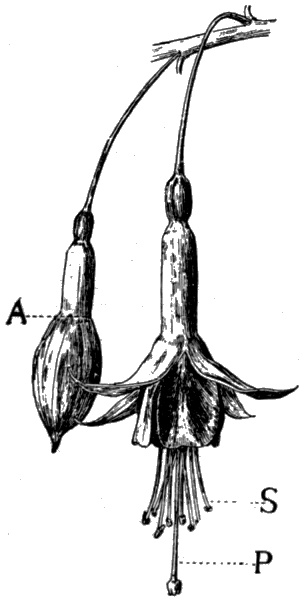
Fig. 90. Parts of the Flower.
The modifications of the flower are numberless, both in form and number of parts, but these four series of organs—the calyx, corolla, stamens and pistils—always comprise a complete flower and they are arranged in the order named. A perfect flower is one which contains both stamens and pistils without any reference to the surrounding or leaf-like organs. Many flowers are imperfect or contain only one sex. When the sexes are borne in different flowers upon the same plant, the species is said to be monœcious; and when they are borne upon different plants the species is diœcious. Sometimes the inflorescence is mixed, some flowers being perfect, some staminate and some pistillate, all upon the same plant; such species are polygamous. Most garden plants have perfect flowers. Many nut-bearing trees are monœcious, as walnuts, butternut, hickories, chestnuts, hazels and filbert and oaks. Some of the composite plants are also monœcious, the large head bearing staminate flowers in one part and pistillate in another. Pumpkins and squashes are monœcious and so are most varieties of melons. Fig. 91 shows a pistillate pumpkin flower with the ovary or young pumpkin below, and Fig. 92 a staminate flower which lacks the enlargement below. Among diœcious species may be mentioned the willows and poplars.
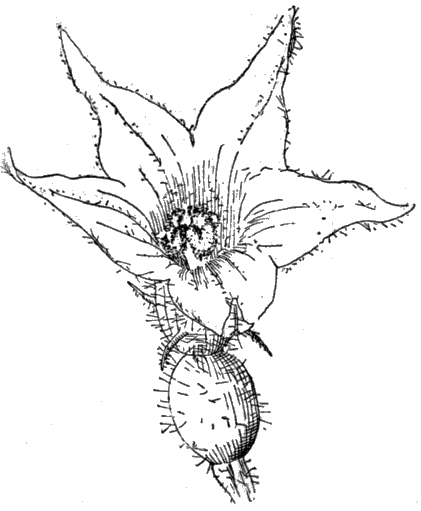
Fig. 91. Pistillate Squash flower.
The ovary contains the ovules. When these are acted upon or fertilized by the pollen they develop into seeds. The pollen falls upon the stigma or upper extremity of the pistil, and each grain germinates and sends a tube down through the style to an ovule. The stigma is a slightly roughened soft surface, and when it is “ripe,” or ready to receive the pollen, it becomes slightly moist or sticky. In most plants the stigma is merely a circular expansion of tissue (Fig. 97), but sometimes it is divided into lobes and the lobes remain closed until it is ready for the pollen. The fuchsia stigma is composed of four lobes, which are closed in Fig. 90. Fig. 93 shows the two-lobed stigma of the trumpet-creeper or tecoma before the flower is ready for pollination. Fig. 94 shows the stigma open, in condition to receive the pollen. In these flowers the stamens are hidden in the tube of the corolla.