Front matter (continued 2)
Reading edition
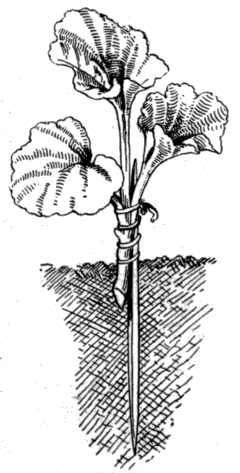
Fig. 55. Cutting held by toothpick.
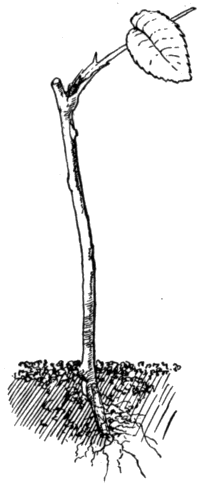
Fig. 56. Rose cutting.
These hardened cuttings, about two inches long, are often made in the winter from forced plants. This is particularly the case with roses (which see in Chapter VI). Cuttings taken in February, in the north, will be ready to transfer to borders or nursery beds when spring opens. Stout, well-rooted stock-plants are used from which to obtain these cuttings, and they are cut back when taken to the house in the fall in order to induce a good growth. Many hardy shrubs can be easily propagated in this way when the work is difficult in the open air, e. g., Spiræa Cantonensis (S. Reevesii of the catalogues) and S. Van Houttii. Stock plants of the soft species, like coleus, lantanas and geraniums, are obtained in like manner.
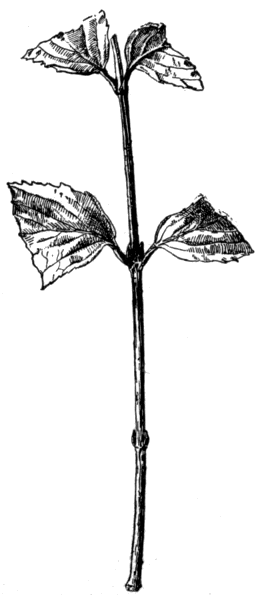
Fig. 57. Hydrangea cutting.
4. Leaf Cuttings.—Many thick and heavy leaves may be used as cuttings. Leaf cuttings are most commonly employed in the showy-leaved begonias, in succulents, and in gloxinias, but many plants can be propagated by them. Even the cabbage can be made to grow from leaf cuttings. The whole leaf may be used, as shown in Fig. 59. It is simply laid upon moist sand in a frame and held down by splinters thrust through the ribs. The wound made by the peg induces the formation of roots and a young plant arises. A half dozen or more plants can be obtained from one leaf. Some operators cut off the ribs, instead of wounding them with a prick. Many gardeners prefer to divide the leaf into two nearly equal parts, and then set each part, or the better one, upright in the soil, the severed edge being covered. This is shown in Fig. 60. Fewer plants—often only one—are obtained in this manner, but they are strong.
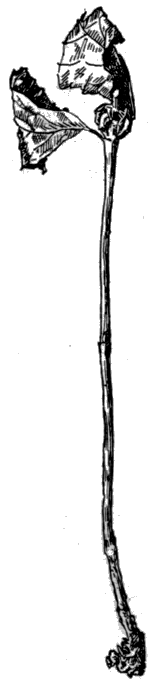
Fig. 58. Clipped Weigela cutting.
When stock is scarce the leaf may be cut into several fan-shaped pieces. The whole leaf may be divided into as many triangular portions as can be obtained with a portion of the petiole, a strong rib, or vein at the base; these inserted and treated like coleus cuttings will all root and make good plants within a reasonable time, say six months. This form of cutting should be two to three inches long by an inch or inch and one-half wide. Ordinarily, in this style of leaf-cutting, the petiole or stalk is cut off close to the leaf and the lower third or fourth of the leaf is then cut off by a nearly straight cut across the leaf. This somewhat triangular base is then cut into as many wedge-shaped pieces as there are ribs in the leaf, each rib forming the center of a cutting. The point of each cutting should contain a portion of the petiole. The points of these triangular portions are inserted in the soil a half inch or so, the cutting standing erect or nearly so. Roots form at the base or point in the ordinary manner.
Leaf cuttings are handled in the same manner as soft stem-cuttings so far as temperature and moisture are concerned. There are comparatively few species in which they form the most available means of multiplication. In some cases, variegation will not be reproduced by the rooted leaf. This is true in the ivy-leaved geranium L’Elegante; a good plant can be obtained, but it reverts to the plain-leaved type.
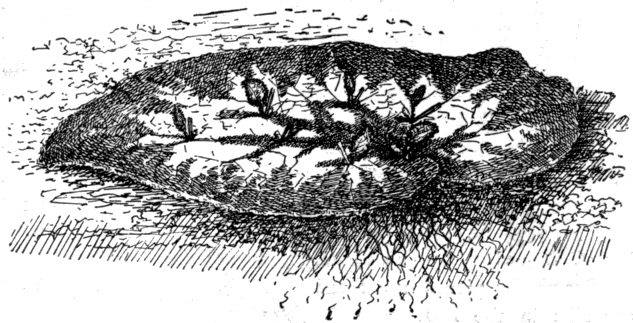
Fig. 59. Begonia leaf cutting.
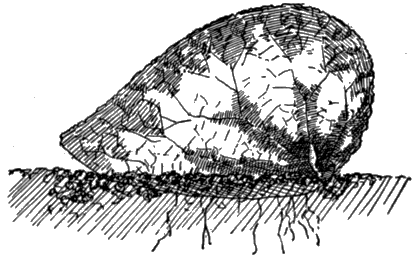
Fig. 60. A upright Begonia leaf cutting.
CHAPTER V.
GRAFTAGE.
Graftage.—The process or operation of grafting or budding, or the state or condition of being grafted or budded.
Grafting.—The operation of inserting a bud or a cion in a stock. It is commonly restricted to the operation of inserting cions of two or more buds, in distinction from budding, or the operation of inserting a single bud in the stock; but there are no essential differences between the two operations.
Stock.—In graftage, a plant or part of a plant upon which a cion or bud is set. A free stock is a seedling, in distinction from a grafted stock.
Cion or Scion.—A portion of a plant which is mechanically inserted upon the same or another plant (stock) with the intention that it shall grow.
GENERAL CONSIDERATIONS.—Graftage is rarely employed for the propagation of the species, as seedage and cuttage are more expeditious and cheaper. Its chief use is to perpetuate a variety which does not reproduce itself from seeds and which cannot be economically grown from cuttings.
Nearly all the named varieties of tree fruits and many of those of ornamental trees and shrubs are perpetuated by means of graftage. In some species which present no marked varieties, however, propagation by seeds or cuttings is for various reasons so difficult or uncertain that recourse must be had to graftage. This is particularly true in many of the firs and spruces which do not produce seeds to any extent in cultivation. In other cases graftage is performed for the purpose of producing some radical change in the character or habit of the plants, as in the dwarfing of pears by grafting them upon the quince, the elevation of weeping tops by working them upon upright trunks, and the acceleration of fruit-bearing by setting cions in old plants. It is sometimes employed to aid the healing of wounds or to repair and fill out broken tops. And it has been used to make infertile plants fertile, by grafting in the missing sex in diœcious trees, or a variety with more potent pollen as practiced in some of the native plums. All these uses of graftage fall under three heads: 1. To perpetuate a variety. 2. To increase ease and speed of multiplication. 3. To produce some radical change in nature or habit of cion or stock.
Probably all exogenous plants—those which possess a distinct bark and pith—can be grafted. Plants must be more or less closely related to each other to allow of successful graftage of the one upon the other. What the affinities are in any case can be known only by experiment. As a rule, plants of close botanical relationship, especially those of the same genus, graft upon each other with more or less ease; yet this relationship is by no means a safe guide. A plant will often thrive better upon a species of another genus than upon a congener. The pear, for instance, does better upon many thorns than upon the apple. Sometimes plants of very distinct genera unite readily. Thus among cacti the leafless epiphyllum grows remarkably well upon the leaf-bearing pereskia. It should be borne in mind that union of tissues is not a proof of affinity. Affinity can be measured only by the thrift, healthfulness and longevity of the cion. The bean has been known to make a union with the chrysanthemum, but it almost immediately died. Soft tissues, in particular, often combine in plants which possess no affinity whatever, as we commonly understand the term. Neither does affinity refer to relative sizes or rates of growth of stock and cion, although the term is sometimes used in this sense. It cannot be said that some varieties of pear lack affinity for the quince, and yet the pear cion grows much larger than the stock. In fact, it is just this difference in size and rate of growth which constitutes the value of the quince root for dwarfing the pear. When there is a marked difference in rate of growth between the stock and cion, an enlargement will occur in the course of time, either above or below the union. If this occurs upon the stem, it makes an unsightly tree. If the cion greatly outgrows the stock a weak tree is the result.
Graftage can be performed at almost any time of the year, but the practice must be greatly varied to suit the season and other conditions. The one essential point is to make sure that the cambium layers, lying between the bark and wood, meet as nearly as possible in the cion and stock. This cambium is always present in live parts, forming woody substance from its inner surface and bark from its outer surface. During the season of greatest growth it usually occurs as a soft, mucilaginous and more or less unorganized substance, and in this stage it most readily repairs and unites wounded surfaces. And for this reason the grafting and budding of old trees are usually performed in the spring. Later in the season, the cambium becomes firmer and more differentiated, and union of woody parts is more uncertain. It is also necessary to cover the wounds in order to check evaporation from the tissues. In out-door work wax is commonly used for all species of graftage which wound the wood itself, but in budding, the loosened bark, bound down securely by a bandage, affords sufficient protection. It is commonly supposed that an ordinary cleft-graft cannot live if the bark of the stock immediately adjoining it is seriously wounded, but the bark really serves little purpose beyond protection of the tissues beneath. A cion will grow when the bark is entirely removed from the stub if some adequate protection can be given which will not interfere with the formation of new bark. The cion must always possess at least one good bud. In most cases, only buds which are mature or nearly so are used, but in the grafting of herbs very young buds may be employed. These simple requirements can be satisfied in an almost innumerable variety of ways. The cion or bud may be inserted in the root, crown, trunk or any of the branches; it may be set under the bark simply or inserted into the wood itself in almost any fashion; and the operation may be performed either upon growing or dormant plants at any season. But in practice there are comparatively few methods which are sufficiently simple and expeditious to admit of general use.
Graftage may be divided into three general divisions, between which, however, there are no decisive lines of separation: 1. Bud-grafting or budding, in which a single bud is inserted upon the surface of the wood of the stock. 2. Cion-grafting or grafting proper, in which a detached twig bearing one or more buds is inserted into or upon the stock. 3. Inarching or grafting by approach, in which the cion remains attached to the parent plant until union takes place. Each of these divisions can be almost endlessly varied and sub-divided, but in this discussion only the leading practices can be detailed. The following enumeration, after Baltet, will give a fair idea of the kinds of grafting which have been employed under distinct names:
1. Bud-Grafting or Budding. 1.—Grafting with shield-buds. Bud-grafting under the bark, or by inoculation. ” ” ordinary method. ” ” with a cross-shaped incision. ” ” ” the incision reversed. ” ” by veneering. Bud-grafting, the combined or double method. 2.—Flute-grafting. ” ” common method. ” ” with strips of bark.
2. Cion-Grafting or Grafting Proper. 1.—Side-grafting under the bark. ” ” with a simple branch. ” ” with a heeled branch. ” ” in the alburnum. ” ” with a straight cleft. ” ” with an oblique cleft. 2.—Crown-grafting. Ordinary method. Improved method. 3.—Grafting de precision. Veneering, common method. ” in crown-grafting. ” with strips of bark. Crown-grafting by inlaying. Side-grafting by inlaying. 4.—Cleft-grafting, common single. Cleft-grafting, common double. ” ” oblique. ” ” terminal. ” ” ” woody. ” ” ” herbaceous. 5.—Whip-grafting, simple. ” ” complex. Saddle-grafting. 6.—Mixed-grafting. Grafting with cuttings. When the cion is a cutting. When the stock is a cutting. When both are cuttings. Root-grafting of a plant on its own root. ” ” ” ” the roots of another plant. Grafting with fruit buds.
3. Inarching or Grafting by Approach. 1.—Method by veneering. ” ” inlaying. English method. 2.—Inarching with an eye. ” ” a branch.
Particular Methods.—Budding. Budding is the operation of inserting a single bud, bearing little or no wood, upon the surface of the stock. The bud is nearly always inserted under the bark of the stock, but in flute-budding a piece of bark is entirely removed and the bud is used to cover the wound. There is no general rule to determine what species of plants should be budded and which ones cion grafted. In fact, the same species is often multiplied by both operations. Plants with thin bark and an abundance of sap are likely to do best when grafted; or if they are budded, the buds should be inserted at a season when the sap is least abundant to prevent the “strangulation” or “throwing out” of the bud. In such species the bark is not strong enough to hold the bud firmly until it unites; and solid union does not take place until the flow of sap lessens. Budding is largely employed upon nearly all young fruit-trees, and almost universally so upon the stone-fruits. It is also used in roses, and many ornamental trees. Budding is commonly performed during the growing season, usually in late summer or early fall, because mature buds can be procured at that time and young stocks are then large enough to be worked readily. But budding can be done in early spring, just as soon as the bark loosens; in this case perfectly dormant buds must have been taken in winter. Budding is always best performed when the bark slips or peels easily. It can be done when the bark is tight, but the operation is then tedious and uncertain.
Shield-budding.—There is but one style of budding in general use in this country. This is known as shield-budding, from the shield-like shape of the portion of bark which is removed with the bud. Technically, the entire severed portion, comprising both bark and bud, is called a “bud.” A shield bud is shown natural size in Fig. 61. This is cut from a young twig of the present season’s growth. It is inserted underneath the bark of a young stock or branch, and is then securely tied, as shown in Fig. 65.
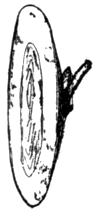
Fig. 61. Shield-bud.
The minor details of shield-budding differ with nearly every operator. In commercial practice, it is performed in the north from early July until the middle of September. In the southern states it usually begins in June. As a rule, apples and pears are budded before peaches. This is due to the fact that peach-stocks are nearly always budded the same season the pits are planted, and the operation must be delayed until the stocks are large enough to be worked. Most other fruit-stocks, especially apples and pears, are not budded until two years after the seeds are sown. The plants grow for the first season in a seed-bed. The next spring they are transplanted into nursery rows, and budded when they become large enough, which is usually the same year they are transplanted. The nurseryman reckons the age of his stock from the time of transplanting, and the age of the marketable tree from the time when the buds or grafts begin to grow. The young stocks are “dressed” or trimmed before being set into the nursery. This operation consists in cutting off a fourth or third of the top and the tap root. This causes the roots to spread and induces a vigorous growth of top because it reduces the numbers of shoots; and such stocks are more expeditiously handled than long and untrimmed ones.
Stocks should be at least three-eighths inch in diameter to be budded with ease. Just before the buds are set, the leaves are removed from the base of the stock so that they will not interfere with the operation. They are usually rubbed off with the hand for a space of five or six inches above the ground. They should not be removed more than two or three days in advance of budding, else the growth of the parts will be checked and the bark will set; any branches, too, as in the quince, which might impede the work of the budder, are to be cut off at the same time. The bud is inserted an inch or two above the surface of the ground or as low down as the budder can work. The advantage of setting the bud low is to bring the resulting crook or union where it will not be seen. It is a common and good practice, also, to place the bud upon the north side of the stock to shield it from the sun.

Fig. 62. A stick of buds.
The buds are taken from strong and well-hardened shoots of the season’s growth and of the desired variety. Usually the whole of the present growth is cut, the leaves are removed, but a part of the petiole or stalk of each leaf is left (as in Figs. 61 and 62) to serve as a handle to the bud. This trimmed shoot is then called a “stick.” A stick may bear two dozen good buds when the growth has been strong, but only ten or twelve buds are commonly secured. The upper buds, which are commonly not fully grown and which are borne on soft wood, are usually discarded. The buds are cut with a thin-bladed sharp knife. Various styles of budding knives are in use, and the budder usually has decided preferences for some particular pattern. The essentials of a good budding-knife are these: the very best steel, a thin blade which has a curved cutting end (as shown in Figs. 63 and 66), and lightness. The curved end of the blade is used for making the incisions in the stock. The handle of the budding-knife usually runs into a thin bone scalpel at the end, and this portion is designed for the lifting or loosening of the bark on the stock. Some budders, however, raise the bark with the blade. A good form of blade, but one seldom made, has a rounded end, the upper side of the curve being ground simply to a thin edge. This blade may be used both for cutting the bark and loosening it, thus overcoming the necessity of reversing the knife every time a bud is set. If this form of blade were commonly known it would undoubtedly soon come into favor. The blade of a common budding-knife can be ground to this shape.
The bud is usually cut about an inch long. Most budders cut from below upwards, but some prefer to make a downward incision. It does not matter just how the bud is cut, if the surfaces are smooth and even and the bud is not too thick. On a stick a fourth or three-eighths inch through, the cut, at its deepest point just under the bud, is about one-fourth the diameter of the twig. A bit of wood is therefore removed with the bud, as shown in Fig. 61. There is some discussion as to whether this wood should be left upon the bud, but no definite experiments have been made to show that it is injurious to the resulting tree. Some budders remove the wood with the point of the knife or by a deft twist as the bud is removed from the stick. But buds appear to live equally well with wood attached or removed. Some propagators cut the buds as they go, while others prefer to cut a whole stick before setting any, letting each bud hang by a bit of bark at the top and which is cut off squarely when wanted, as shown in Fig. 62.
The wound or matrix which is to receive the bud is made by two incisions, one vertical and one transverse (Fig. 63). These are light cuts, extending only through the bark. The vertical slit is usually made first and by the rounded end of the blade. This is an inch or inch and a half long. The transverse cut is made across the top of the vertical cut by one rocking motion of the blade towards the body. The corners of the bark may be lifted a little by an outward motion of the blade so as to allow the bud to be pushed in, but unless the bark slips very freely it will have to be loosened by the end of the blade or by the scalpel on the reverse end of the handle, as previously described. The bud is now inserted in the cleft of the bark. It is pushed down part way by the fingers, as in Fig. 64, but it is usually driven home by pushing down upon the leaf-stalk handle with the back of the knife-blade. The entire bud should pass into the cleft; or if a portion of it should project above it should be cut off. If the bark peels freely, the bud will slip in easily and will follow the cleft, but if it sticks somewhat, more care is necessary to prevent the bud from running out. If the bark is very tight, it may have to be loosened with the knife throughout the length of the cleft; but budding should be performed, if possible, when such pains are not necessary.
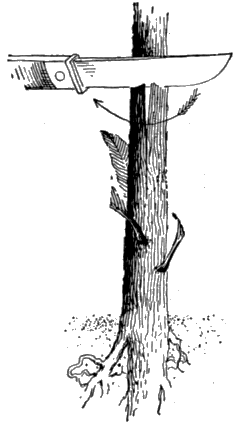
Fig. 63. Preparing the stock.
The bud must now be tied. The whole matrix should be closed and bound securely, as represented in Fig. 65. The dotted lines parallel with the cleft show the extent to which the bud projects under the bark. The string is usually started below the bud, the end being held by lapping the second course over it, and the upper end being secured by drawing a bow through under the upper course. Care should be taken not to bind the string over the bud itself. The strings are previously cut the required length—about a foot—and the tying is performed very quickly. Any soft cord can be employed. Yarn and carpet warp are sometimes used. The most common material, at least until the last few years, has been bass matting. This is the inner bark of the bass-wood or linden. The bark is stripped in early summer, and the inner portion is macerated or “rotted” in water for four or five weeks. It is then removed, cut into the desired lengths, and stripped into narrow bands—one-fourth to one-half inch wide—when it may be sorted and stored away for future use. If it is stiff and harsh when it comes from the maceration, it should be pounded lightly or rubbed through the hands until it becomes soft and pliable. The best tying material which we now have is undoubtedly raffia. It is an imported article, coming from the eastern tropics (the product of the palm Raphia Ruffia), but it is so cheap that it will probably supersede even bass-bark. It is strong and pliable, and is an excellent material for tying up plants in the greenhouse, or small ones out-doors. The greatest disadvantage in its use in the budding field is its habit of rolling when it becomes dry.
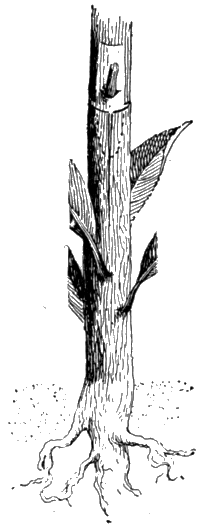
Fig. 64. Bud entering matrix.
In two or three weeks after the bud is set it will have “stuck” or united to the stock. The bandage must then be removed or cut. It is the common practice to draw a budding-knife over the strings, on the side opposite the bud, completely severing them and allowing them to fall off as they will. If the strings are left on too long they will constrict the stem and often kill the bud, and they also have a tendency to cause the bud to “break” or begin to grow. The bud should remain perfectly dormant until spring, for if it should begin to grow it will be injured and perhaps killed by the winter. It should remain green and fresh; if it shrivels and becomes brown, even though it still adheres to the stock, it is worthless. Advantage can be taken, when cutting the tyings, to rebud any stocks which have failed. If the bud should begin to grow, because of a warm and wet fall or other reasons, there is little remedy except perhaps to head the shoot back if it should become long enough. If the stocks are protected by snow during winter, some of the buds at the base of the shoot may pass the cold in safety.
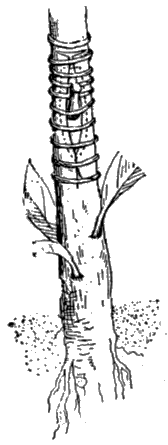
Fig. 65. The bud tied.
The next spring the stock should be cut off just above the bud (Fig. 66), in order to throw the entire force of the plant into the bud. If the root is strong and the soil good, the bud will grow two or three feet the first year; or peaches and cherries will grow from two to three times that height. All sprouts should be kept rubbed off the stock, and the bud should be trained to a single stem. In some weak and crooked growers, the new shoot must be tied, and some propagators in such cases cut off the stock five or six inches above the bud and let it serve as a stake to which to tie. The stock, of course, must not be allowed to grow. Late in the season the stock is cut down close to the bud, as in Fig. 66. Peaches and some other fruits are sold after having made one season’s growth from the bud, but pears, apples, and most other trees are not often sold until the second or third year.
“June budding” is a term applied to the budding of stocks in early summer while they are yet growing rapidly. It is employed mostly at the south where the stocks can be grown to sufficient size by the last of June or first of July. Small stocks are usually employed—those ranging from one-fourth to one-third inch being preferred. A few strong leaves should be left on the stock below the bud, and after the bud has “stuck” the whole top should not be cut off at once, else the growing plant will receive a too severe check. It is best to bend the top over to check its growth or remove the leaves gradually. The bandages should not be left on longer than six to ten days if the stock is growing rapidly. To prevent the constriction of the stem, muslin bands are sometimes used instead of bass or raffia. In hot and dry climates the bud should be set an inch or two higher in June budding than in the ordinary practice, to escape the great heat of the soil. June budding is used upon the peach more than any other tree, although it can be employed for any species which will give large enough stocks from seed by the June following the sowing. In peaches, the bud will produce a shoot from three to five feet high the same season the buds are set, so that marketable budded trees can be produced in one season from the seed.
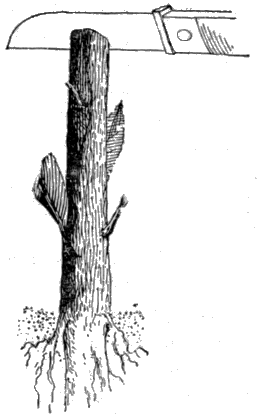
Fig. 66. Cutting off the stock.
A different kind of early summer budding is sometimes performed upon apples and other fruit-trees. In this case the stocks are one or two years old from the transplanting, and dormant buds are used. These buds are cut the previous fall or winter in the same manner as cions, and when spring approaches they are put on ice—in sawdust, sand or moss—and kept until the stocks are large enough to receive them. The particular advantage of this method is the distributing of the labor of budding over a longer season, thereby avoiding the rush which often occurs at the regular budding time.
Budders usually carry a number of “sticks” with them when they enter the nursery. These may be carried in the pocket, or thrust into the boot-leg; or some budders carry four or five sticks in the hand. The budder follows a row throughout its length, passing over those trees which are too small to work. It is a common practice to rest upon one knee while budding, as shown in Fig. 67, but some prefer to use a low stool. The tying is usually done by a boy, who should follow close behind the budder in order that the buds shall not dry out. An expert budder will set from 1,000 to 3,000 buds a day, in good stock, and with a boy (or two of them for the latter speed) to tie. Peach stocks are more rapidly budded than most others, as the bark is firm and slips easily, and some remarkable records are made by skillful workmen.
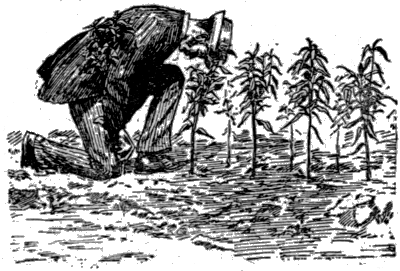
Fig. 67. Budder at work.
Budding is sometimes employed the same as top-grafting for changing over the top of an old tree from one variety to another. The buds cannot be easily inserted in very old and stiff bark, but in all smooth and fresh bark they work readily. Sometimes old trees are severely pruned the year before the budding is to be done, in order to obtain young shoots in which to set the buds. In fruit-trees six or seven years old or less, budding is fully as advantageous as grafting. New varieties are also budded into old branches in order to hasten bearing for the purpose of testing the variety. Here budding has a distinct advantage over grafting, as it uses fewer buds, and the wood of new sorts is often scarce.
Flute-Budding.—An occasional method of budding is that known under the general name of flute-budding. In this method the bud is not covered by the bark of the stock as in shield-budding. Fig. 68 illustrates it. A portion of bark is removed entirely from the stock, and a similar piece is fitted into its place. When the wound extends only part way about the stem, as in the illustration, the operation is sometimes known as veneer-budding. When it extends entirely around the stem it is called ring or annular-budding. Flute-budding is usually performed late in spring. It is best adapted to plants with very thick and heavy bark. The bud is tied and afterwards treated in essentially the same manner as in shield-budding.
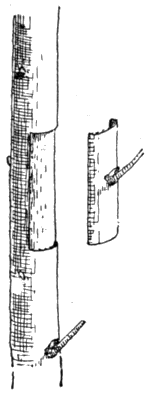
Fig. 68. Flute-budding.
A species of flute-budding in which a ring of bark is slipped down upon the tip of a shoot, which has been girdled for the purpose, is called whistle-budding or tubular-budding.
Grafting.—Grafting is divided in various ways, but chiefly with reference to the position of the union upon the plant and to the method in which the scion and stock are joined. In reference to position, there are four general classes: 1. Root-grafting, in which the stock is entirely a root. 2. Crown-grafting, which is performed upon the crown or collar of the plant just at the surface of the ground, an operation which is often confounded with root-grafting. 3. Stem-grafting, in which the cion is set on the trunk or body of the tree below the limbs, a method occasionally employed with young trees. 4. Top-grafting, or grafting in the branches of the tree. Any method of inserting the cion may be employed in these classes. The best classification, particularly for purposes of description, is that which considers methods of making the union. Some of these kinds of grafting are catalogued on page 66. For our purposes, we shall need to consider only the whip, saddle, splice, veneer, cleft and bark-grafting.
Whip-Grafting.—Whip or tongue-grafting is employed only on small stocks, usually upon those one or two years old. Both the cion and stock are cut across diagonally, the cut surface extending from one to two inches according to the size of the part. A vertical cleft is then made in both, and the two are joined by shoving the tongue of the cion into the cleft of the stock. The operation can be understood by reference to Figs. Fig. 69, Fig. 70 and Fig. 71. Fig. 69 shows the end of a cion, cut natural size. The stock is cut in the same manner, and the two are joined in Figs. Fig. 70 and Fig. 71. The parts are held firmly by a bandage passed five or six times around them. If the graft is to stand above ground, the wound must be protected by applying wax over the bandage. (Recipes for wax can be found at the end of this chapter.)
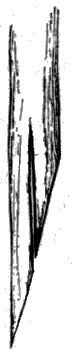
Fig. 69. Whip-graft.

Fig. 70. Whip-graft in position.
Root-grafting, especially of fruit-stocks, is performed almost entirely by the whip-graft. This operation is performed in winter. The stocks, either one or two years old, are dug and stored in the fall. In January or February the grafting is begun. In true root-grafting, only pieces of roots are used, but some prefer to use the whole root and graft at the crown. In piece-root-grafting, from two to four trees are made from a single root. A piece of root from two to four inches long is used, as shown in Fig. 71. The parts are usually held by winding with waxed string or waxed bands. The string should be strong enough to hold the parts securely and yet weak enough to be broken without hurting the hands. No. 18 knitting cotton answers this purpose admirably. It should be bought in balls, which are allowed to stand for a few minutes in melted wax. The wax soon saturates the ball. Waxed bands are made by spreading melted wax over thin muslin, which is cut into narrow strips when dry. The string is the more useful for rapid work. The grafts are packed away in sand, moss or sawdust in a cool cellar until spring, when the two parts will be firmly callused together. Some propagators are now discarding all tying of root-grafts. The grafts are packed away snugly, and if the storage cellar is cool—not above 40°—they will knit together so that they can be planted without danger of breaking apart. If the cellar is warm the grafts will start into growth and be lost.
Cions are cut in fall or winter, or any time before the buds swell in spring. Only the previous year’s growth is used in all ordinary cases, but in maples and some other trees older wood may be used. In the grafting of peaches—which is very rarely done—the best cions are supposed to be those which bear a small portion of two-year-old at the lower end. This portion of old wood probably serves no other purpose than a mechanical one, as the recent wood is soft and pithy. It is a common opinion that cions are worthless if cut during freezing weather, but this is unfounded. The cions are stored in sand, moss or sawdust in a cool cellar, or they may be buried in a sandy place. Or sometimes, when a few are wanted for top-grafting, they are thrust into the ground beside the tree into which they are to be set the following spring. Only well-formed and mature buds should be used. Sometimes flower-buds are inserted for the purpose of fruiting a new or rare variety the following year.
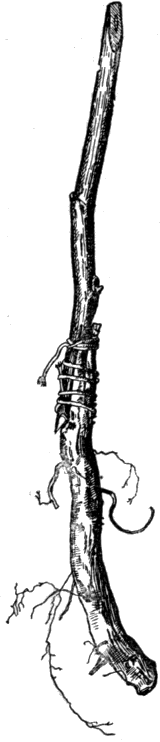
Fig. 71. Root-graft.
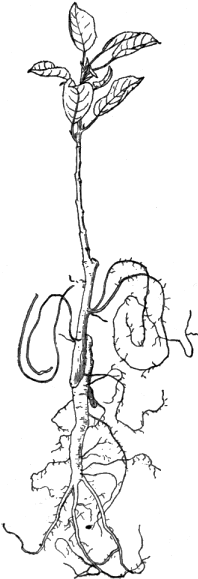
In common root-grafting in the east and south, the cion bears about three buds, and the root is about the same length, or perhaps shorter. The variable and unknown character of these roots as regards hardiness, renders it important in very severe climates that roots should be obtained from the same plant as the cion, the hardiness of which is known. It is, therefore, the practice in the prairie countries to use a very long cion—eight inches to a foot—and to set it in the ground to the top bud. The piece of root serves as a temporary support, and roots are emitted along the cion. When the tree is ready for sale the old piece of root is often removed, or sometimes it falls away of itself. In this manner own-rooted trees are obtained, and it is for this reason that root-grafting is more universally practiced west of the Great Lakes than budding. Even cions of ordinary length often emit roots, as seen in Fig. 72, but the cions are not long enough to reach into uniformly moist soil. Some varieties of fruit-trees are found in practice to root more readily than others.
Fig. 72. Growing Root-graft. Click on image to view larger sized.
There is much discussion as to the relative merits of budding and root-grafting fruit-stocks, but the observations are usually so indefinite or irrelevant that safe conclusions cannot be drawn from them. We have seen that root-grafting serves an indispensable purpose in the cold prairie regions by enabling nurserymen to secure own-rooted trees of known hardiness. Aside from this it may be said that root-grafting is cheaper than budding, as it is performed when labor is cheap and two or more trees are made from one stock, Budded or crown-grafted trees possess a greater root and usually make a stronger growth, at least the first year or two, and it has been said that their roots are more numerous and more symmetrically disposed. But there is not yet a sufficient knowledge of the subject in all its details to allow of dogmatic expressions upon it.
Saddle-Grafting.—Saddle-grafting is a simple and useful method for the shoots of small, growing plants. The stock is cut to a wedge-shaped end by two cuts, and the cion is split and set upon the wedge (Fig. 73). The union is then tied and waxed in the same way as exposed whip-grafts. It is oftenest employed when a terminal bud is used, as the wood in such cions is usually too weak to work well with a tongue.

Fig. 73. Saddle-graft.

Fig. 74. Splice-grafting.
Splice-Grafting.—The simplest form of grafting is that shown in Fig. 74, in which the two parts are simply cut across diagonally and laid together. The parts are held only by the string, which, together with the wax, is applied in the same way as upon the whip-graft. Splice-grafting is frequently used upon soft or tender wood which will not admit of splitting. It is adapted only to small shoots.
Veneer-Grafting.—Fig. 75 shows a style of grafting which is much used, particularly for ornamentals and for rare stocks which are grown in pots. An incision is made upon the stock just through the bark and about an inch long (A, Fig. 75), the bit of bark being removed by means of a downward sloping cut at its base. The base of the cion is cut off obliquely, and upon the longest side a portion of bark is removed, corresponding to the portion taken from the stock. The little tongue of bark on the stock covers the base of the cion, when it is set. The cion is tied tightly to the stock (B, Fig. 75), usually with raffia. This method of grafting makes no incision into the wood, and all the wounded surfaces are completely covered by the matching of the cion and stock. It is not necessary, therefore, to wax over the wounds, as a rule. The parts grow together quickly and uniformly, making a solid and perfect union as shown at D, Fig. 75. So far as the union of the parts is concerned, this is probably the ideal method of grafting. This method, which is nothing but the side-graft of the English gardeners with the most important condition of the longer tongue on the stock, is known by various names, but it is oftenest called veneer-grafting in this country.
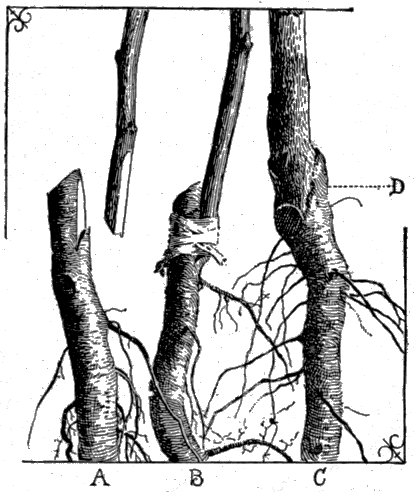
Fig. 75. Veneer-grafting.
Veneer-grafting is employed mostly from November to March upon potted plants. Stocks which are grown out-doors are potted in the early fall and carried in a cool house or pit. The cion is applied an inch or two above the surface of the soil, and the stock need not be headed back until the cion has united. (See Fig. 76.) Both dormant and growing cions are used. All plants in full sap must be placed under a frame in the house, in which they can be almost entirely buried with sphagnum, not too wet, and the house must be kept cool and rather moist until the cions are well established. Some species can be transferred to the open border or to nursery rows in the spring, but most plants which are grafted in this way are handled in pots during the following season. Rhododendrons, Japanese maples and many conifers are some of the plants which are multiplied by veneer-grafting. This method, when used with hardy or tender plants, gives a great advantage in much experimental work, because the stock is not at all injured by a failure and can be used over again many times, perhaps even in the same season; the manipulation is simple and easily acquired by inexperienced hands.
Cleft-Grafting.—In cleft-grafting the stock is cut off squarely and split, and into the split a cion with a wedge-shaped base is inserted. It is particularly adapted to large stocks and is the method universally employed for top-grafting old trees. Fig. 77 represents the operation. The end of the stock, technically called a “stub,” is usually large enough to accommodate two cions, one upon either side. In fact, it is better to use two cions, not only because they double the chances of success but because they hasten the healing of the stub. Cleft-grafting is at best a harsh process, especially upon large limbs, and its evils should be mitigated as much as possible. In common practice, the cion (Fig. 78) contains three buds, the lowest one standing just above the wedge portion. This lowest bud is usually entirely covered with wax, but it pushes through without difficulty. In fact, being nearest the source of food and most protected, its chances of living are greater than those of the higher buds. The sides of the cion must be cut smoothly and evenly. A single draw cut on each side with a sharp blade is much better than two or three partial cuts. A good grafter makes a cion by three strokes of the knife, one to cut off the cion and two to shape it. The outer edge of the wedge should be a little thicker than the inner one so that the stock will bind upon it and hold it firm at the point where the union first takes place. These cions are taken in late fall or winter, and kept in the same manner as directed for whip-grafting on pages 77 and 78.
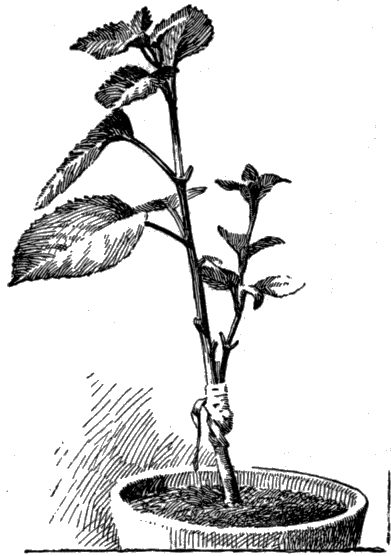
Fig. 76. Veneer-graft.
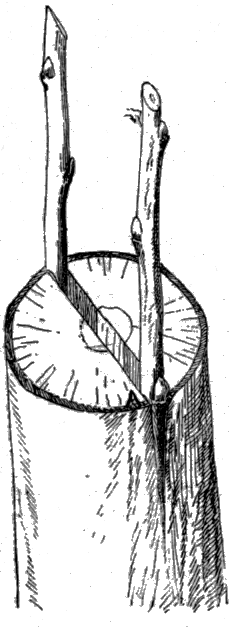
Fig. 77. Cleft-grafting.
The stock or stub must be cut off squarely and smoothly with a sharp and preferably fine-toothed saw. If one desires to be especially careful in the operation, the end of the stub, or at least two opposite sides of it, may be dressed off with a knife so that the juncture between the bark and the wood may be more easily seen. Professional grafters rarely resort to this practice, however. The stub is then split to the depth of an inch and a half or two inches. Various styles of “grafting-knife” are used to split the stub. The best one is that shown in Fig. 79. It is commonly made from an old file by a blacksmith. The blade is curved so that the bark of the stub is drawn in when the knife is entering, thereby lessening the danger of loosening the bark. Upon the end of the knife is a wedge, about four or five inches long, for opening the cleft. The wedge is driven into the cleft and allowed to remain while the cions are being placed. If the cleft does not open wide enough to allow the cions to enter, the operator bears down on the handle of the knife. The cions must be thrust down to the first bud, or even deeper, and it is imperative that they fit tightly. The line of separation between the bark and wood in the cion should meet as nearly as possible the similar line in the stock. The cions are usually set a trifle obliquely, the tops projecting outwards, to ensure the contact of the cambium layers. Writers usually state that it is imperative to success to have the exact lines between the bark and wood meet for at least the greater part of their length, but this is an error. The callus or connecting tissue spreads beyond its former limits when the wounds begin to heal. The most essential points are rather to be sure that the cion fits tightly throughout its whole length, and to protect the wound completely with an air-tight covering.

Fig. 78. Cleft-graft cion.
The wounds must now be covered with wax. Fig. 80 illustrates a stub after the covering has been applied. If the grafting is done in early spring when the weather is cold, the wax will have to be applied with a brush. The wax is melted in a glue-pot, which is carried into the tree. But if the weather is warm enough to soften the wax, it should be applied with the hands. The hands are first greased to prevent the wax from sticking. The two side or vertical portions are applied first. The end of the mass of wax in the hand is flattened into a thin portion about a half inch wide. This portion is then laid over the bud and held there by the thumb of the other hand, while the wax is drawn downwards over the cleft, being pressed down firmly upon the bark by the thumb of the first hand. The wax gradually tails out until it breaks off just below the lowest point of the cleft. The flattened upper part is then wrapped around the cion upon either side, completely and tightly encircling it. A simple deft wrapping of the wax about the cion makes a tighter joint than can be secured in twice the time by any method of pinching it into place. Another portion of wax is now flattened and applied over the end of the stub. Many grafters apply a bit of wax to the tops of the cion also. All the wounds must be covered securely.
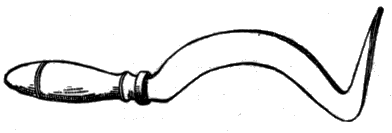
Fig. 79. A cleft grafting-knife.

Fig. 80. A waxed stub.
The top-grafting of large trees is an important operation, and there are many men who make it a business. These men usually charge by the stub and warrant, the warrant meaning that one cion of the stub must be alive when the counting is done late in summer. From two to three cents a stub is a common price. A good grafter in good “setting” can graft from 400 to 800 stubs a day and wax them himself. Much depends upon the size of the trees, their shape, and the amount of pruning which must be done before the grafter can work in them handily. Every man who owns an orchard of any extent should be able to do his own grafting. The most important factor in the top-grafting of an old tree is the shaping of the top. The old top is to be removed during three or four or five years and a new one is to be grown in its place. If the tree is old, the original plan or shape of the top will have to be followed in its general outlines. The branches should be grafted, as a rule, where they do not exceed an inch and a half in diameter, as cions do better in such branches, the wounds heal quickly and the injury to the tree is less than when very large stubs are used. The operator should endeavor to cut all the leading stubs at approximately equal distances from the center of the tree. And then, to prevent the occurrence of long and pole-like branches, various minor side-branches should be grafted. These will serve to fill out the new top and to afford footholds for pruners and pickers. Fig. 81 is a good illustration of an old apple tree just top-grafted. Many stubs should be set, and at least all the prominent branches should be grafted if the tree has been well-trained. It is better to have too many stubs and to be obliged to cut out some of them in after years, than to have too few. In thick-topped trees, care must be exercised not to cut out so much the first year that the inner branches will sunburn. All large branches which must be sacrificed ought to be cut out when the grafting is done, as they increase in diameter very rapidly after so much of the top is removed. One horizontal branch lying directly over or under another should not be grafted, for it is the habit of grafts to grow upright rather than horizontally in the direction of the branch. It is well to split all stubs on such branches horizontally, that one cion may not stand directly under another.
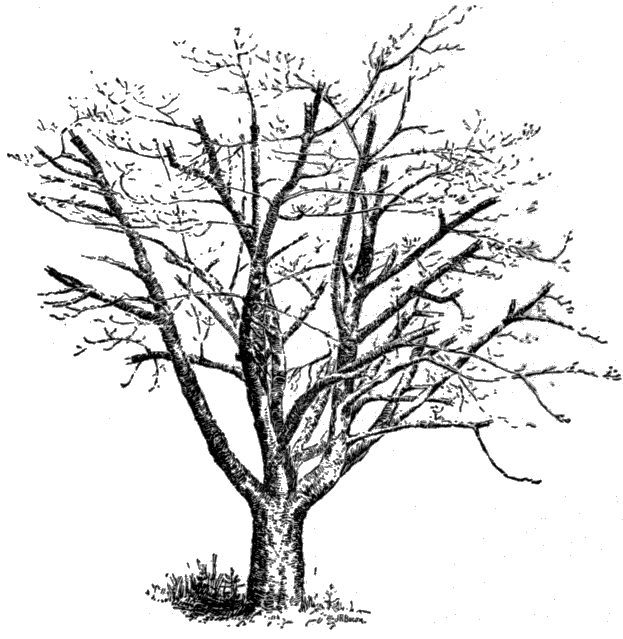
Fig. 81. Top-grafted old tree.
Top-grafting is performed in spring. The best time is when the leaves are pushing out, as wounds made then heal quickly and cions are most apt to live. But when a large amount of grafting must be done, it is necessary to begin a month or even two before the leaves start. On the other hand, the operation can be extended until a month or more after the leaves are full-grown, but such late cions make a short growth, which is likely to perish the following winter. Professional grafters usually divide their men into three gangs, one to do the cutting of the stubs, one to set the cions, and one to apply the wax. The cions are all whittled before the grafter enters the tree. They are then usually moistened by dipping into a pail of water and are carried in a high side-pocket in the jacket. The handiest mallet is a simple club or billy, a foot and a half long, hung over the wrist by a loose soft cord (Fig 82). This is brought into the palm of the hand by a swinging motion of the forearm. This mallet is always in place, never drops from the tree, and is not in the way. The knife shown in Fig. 79 is commonly used. A downward stroke of the mallet drives the knife into the tree and an upward motion immediately following strikes the knife on the outer end and removes it. Another downward motion drives in the wedge. The sharpened nails and sticks commonly pictured as wedges in cleft-grafting are useless for any serious work. And the common style of grafting-knife sold by seedsmen, comprising a thin, broad blade set in a heavy back piece, is also worthless. The blade is too thin to split the stub. The various combined implements which have been devised to facilitate cleft-grafting are usually impracticable in serious operations. A very good grafting-knife for small stocks or trees in nursery row is shown in Fig. 83. This is the Thomas knife. The larger arm is made entirely of wood. At its upper end is a grooved portion into which the blade closes. This blade can be made from the blade of a steel case-knife, and it should be about two and a half inches long. It is secured to an iron handle. The essential feature of this implement is the draw cut which is secured by setting the blades and the pivot in just the positions shown in the figure. The stock is cut off by the shears, and the cleft is then made by turning the shears up and making a vertical cut. The cleft is therefore cut instead of split, insuring a tight fit of the cions. This tool is particularly useful upon hard and crooked-grained stocks.
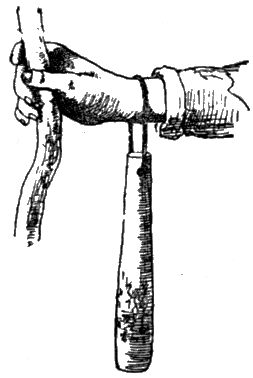
Fig. 82. Grafting-mallet.
Cleft-grafting is often employed for other purposes than the top-grafting of old trees. It is in common use on soft and fleshy stocks, as cactuses, and various fleshy roots. Fig. 84 shows a cleft-graft on cactus. The cion is held in place with a pin or cactus spine, and it is then bound with raffia or other cord. Waxing is not necessary. Fig. 85 illustrates a cleft root-graft of peony. The cleft in the thick root is cut with a knife, and the stock is bound up securely, usually with wire, as cord, unless waxed, rots off too quickly. Wax is not used, as the graft is buried to the top bud. The peony is grafted in summer. Dahlias are often grafted after the same fashion, although some operators prefer, in such fleshy subjects, to cut out a section from the side of the stock to receive the cion, rather than to make a cleft. Hollyhocks, ipomœas, gloxinias and other thick-rooted plants may be similarly treated.
Bark-grafting.—A style of grafting suited to large trees is shown in Fig. 86. The stock is not cleft, but the cions are pushed down between the bark and wood.
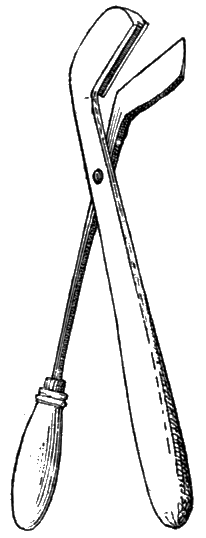
Fig. 83. Thomas' grafting-knife.
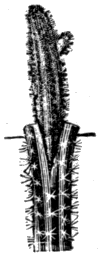
Fig. 84. Cleft-graft of cactus.
The cion must be cut very thin so that they will not break the bark on the stock. Fig. 87 represents a good style of cion. It is cut to a shoulder upon either side. Several cions can be placed in a single stub, and as no splitting is necessary, it is a useful method for very large limbs. It is especially useful in repairing trees when very large branches are broken off. A dozen or more cions may be set about the broken portion, after it is dressed off, and a few of them may be allowed to remain after the wound has been healed. Bark-grafting can be performed to advantage only when the bark peels readily. The cions should be held in place by a tight bandage, as seen in Fig. 86, and then wax should be applied in essentially the same manner as for cleft-grafting. (See Fig. 80.) This is sometimes called crown-grafting, and is useful under certain conditions.
A special form of bark-grafting is sometimes employed for covering girdles about the base of an old tree, made by mice, gophers or rabbits. The edges of the bark are trimmed, and cions are cut a couple inches longer than the width of the girdle. These are sharpened at both ends. One end is inserted under the bark below the girdle and the other above it. The cions are placed close together entirely around the tree. This operation is said to be necessary to keep up the connection between the root and the top, but this is in most cases an error. A good dressing of cow-dung, wax or clay, held on with stout bandages, is much better than the grafting. This method of grafting is sometimes, but erroneously, called inarching. A complete girdle made during the spring or early summer will usually heal over readily if it is well bandaged; and in some cases even the bandage is not necessary.
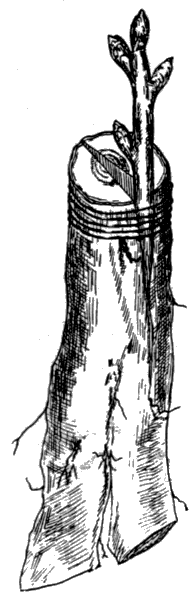
Fig. 85. Peony root-graft.
Herbaceous-grafting.—In the preceding pages, the discussions have had to do with cions which are dormant or at least well-hardened, and with stocks which contain more or less hard woody substance. But herbaceous shoots can be grafted with ease. All such plants as geraniums, begonias, coleuses and chrysanthemums can be made to bear two or more varieties upon the same individual. Almost any style of grafting can be employed, but the veneer, cleft and saddle-grafts are preferred. Shoots should be chosen for stocks which are rather firm, or in the condition for making good cuttings. The cions should be in a similar condition, and they may be taken from the tips of branches or made of a section of a branch. The union should be bound snugly with raffia, and the plant set in a propagating frame, where it must be kept close for a few days. It is not necessary, in most cases, to use wax, and upon some tender stocks the wax is injurious. Moss may be bound about the graft, but unless the union is first thoroughly covered by the bandage, roots will start into the moss and the parts will fail to unite. The growing shoots of shrubs and trees can also be grafted, but the operation is rarely employed. In various coniferous trees (as pines and spruces) the young shoots are sometimes cleft or saddle-grafted in May, the parts being well bandaged with waxed muslin or raffia, and shaded with paper bags. The walnut and some other trees which do not work readily are sometimes treated in this manner.
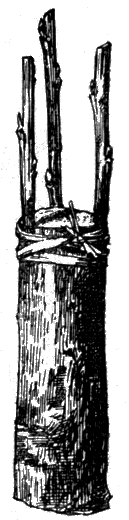
Fig. 86. Bark-grafting.
A little known species of herbaceous-grafting is the joining of parts of fruits. It is easily performed upon all fleshy fruits like tomatoes, apples, squashes and cucumbers. When the fruit is half or more grown, one-half is cut away and a similar half from another fruit is applied. Better results follow if the severed side of the parent or stock fruit is hollowed out a little, so as to let the foreign piece set into the cavity. The edges of the epidermis of the stock are then tied up closely against the cion by means of bass or raffia. The two parts are securely tied together, but no wax is required. This operation succeeds best under glass, where conditions are uniform and winds do not blow the fruits about.
Even leaves may be used as stocks or cions. Any such succulent and permanent leaves as those of the house-leeks, crassula, and the like may have young shoots worked upon them, and leaves which are used as cuttings can often be made to grow on other plants.
Seed-grafting.—A novel kind of grafting has been described in France by Pieron, which consists in using a seed as a cion. This has been used upon the grape. A seed is dropped into a gimlet-hole made near the base of the vine while the sap is flowing in the spring. The seed germinates, and after a time the plantlet unites with the stock.

Fig. 87. Cion for bark-grafting
Double-grafting.—Grafting upon a grafted tree is known as double-grafting or double-working. It is employed for the purpose of growing a variety upon an uncongenial root or of securing a straight and vigorous stock for a weak and poor grower. Some sorts of pears do not unite well with the quince, and if it is desired to secure dwarfs of these varieties, some variety which unites readily with the quince must first be put upon it. The Angouleme takes well to the quince, and upon Angouleme dwarfs the Seckel and some other varieties are often worked. The last cion is usually set after the first one has grown one season, although both may be set at the same time. Double-grafting for the purpose of securing a better growth is often practiced. The Canada Red apple, for instance, is such a poor grower that it is often stem-worked or top-worked upon the Northern Spy or some other strong stock. The Winter Nelis and the Josephine de Malines pears are often double-worked for the same reason.
Cutting-grafting.—Cuttage and graftage are combined in various ways. Cuttings of plants which root with difficulty are sometimes grafted upon those which root easily. When the plants are transplanted, the following autumn or spring, the nurse or stock can be removed, the cion having taken root. Root-grafting with a long cion, described on a previous page (78), is virtually a grafting of cuttings. In other cases, union with an uncongenial stock is facilitated by allowing the cion to project downwards beyond the point of union and to stand in the soil or moss or a dish of water. Fig. 88 is a good illustration of the practice. The cion extends into the soil nearly as far as the root itself. After union has taken place, the lower part of the cion is removed. This method can be used for some magnolias, mulberries, birches, and many other plants of which some kinds root with more or less difficulty. Bottle-grafting, described in most of the books, is essentially this method, modified by letting the end of the cion drop into a bottle of water. Sometimes a portion of the bandage is allowed to hang in water, to keep the cion fresh until the parts join.
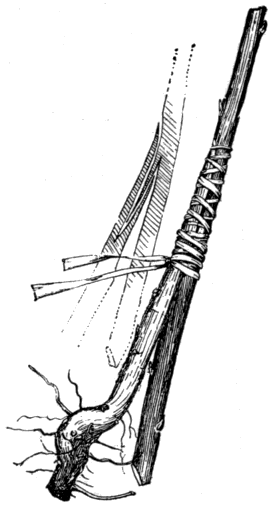
Fig. 88. Cutting-grafting.
Inarching.—Inarching or grafting by approach is the process of grafting contiguous plants or branches while the parts are both attached to their own roots. When the parts are united, one of them is severed from its root. Fig. 89 explains the operation. In this case, the larger plant is designed for the stock. When the smaller plant has united, it is cut off just below the union and it thenceforth grows upon the other plant. Limbs of contiguous trees are sometimes grafted in this way. It is the process employed by nature in what is called natural grafting. Grape-vines are often inarched. A thrifty young branch may be inarched into the stem of a fruit upon the same tree, thus supplying the fruit with additional food and causing it to grow larger than it might if undisturbed.
To join the parts, it is only necessary to remove the barks between the stock and cion and then tie the two together snugly. If out-doors, the junction should be waxed over; and it is then necessary, also, to secure the branches in such manner that the wind cannot loosen them. The parts are sometimes joined by a tongue, after the manner of a whip-graft, but this is rarely necessary. Oranges and camelias were often propagated by inarching in the old practice, but this work is now much more easily done by the veneer-graft.
Grafting-waxes.—There are great numbers of recipes for waxes or mastics for protecting grafts and covering wounds upon trees. In this country the resin and beeswax waxes are most used, although some of the alcoholic waxes are popular in some regions. In Europe, many clay and pitch waxes are in common use. For most purposes, the wax No. 1 in the following list will be found one of the best, especially for applying by the hand. In making the resin and beeswax waxes, the materials are first broken up finely and melted together. When thoroughly melted, the liquid is poured into a pail or tub of cold water. It soon becomes hard enough to handle, and it is then pulled and worked over until it becomes tough or “gets a grain,” at which stage it becomes the color of very light-colored manilla paper. When wax is applied by hand, the hands must be well greased. Hard tallow is the best material for this purpose. In top-grafting large trees it is well to carry a supply of tallow when waxing by smearing the backs of the hands before entering the tree.
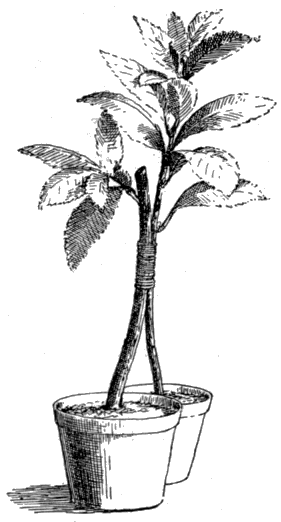
Fig. 89. Inarching.
1. Common Resin and Beeswax Waxes.
1. Resin, 4 parts by weight; beeswax, 2 parts; tallow, 1 part.
2. Resin, 4 lbs.; beeswax, 1 lb.; tallow, 1 lb.
3. Resin, 6 lbs.; beeswax, 2 lbs.; linseed oil, 1 pt.
4. Resin, 6 lbs.; beeswax, 1 lb.; linseed oil, 1 pt.; apply hot with a brush, one-eighth of an inch thick over all the joints.
5. Resin, 4 lbs.; beeswax, 1 lb.; and from half to a pint of raw linseed oil; melt all together gradually, and turn into water and pull. The linseed oil should be entirely free from cotton-seed oil. For use in warm weather.
6. Resin, 6 parts; beeswax, 1 part; tallow, 1 part. To be used warm, in the house.
7. Resin, 4 or 5 parts; beeswax, 1½ to 2 parts; linseed oil, 1 to 1½ parts. For out-door work.
2. Alcoholic Waxes.
8. Lefort’s Liquid Grafting Wax, or Alcoholic Plastic.—Best white resin, 1 lb.; beef tallow, 1 oz.; remove from the fire and add 8 ozs. of alcohol. Keep in closed bottles or cans.
9. Alcoholic Plastic with Beeswax.—Melt 6 parts white resin with 1 part beeswax; remove from stove and partially cool by stirring, then add gradually—with continued stirring—enough alcohol to make the mixture, when cool, of the consistency of porridge. In the temperature of the grafting-room it will remain sufficiently plastic to permit applying to the cut surfaces with the finger.
10. Alcoholic Plastic with Turpentine.—Best white resin, 1 lb.; beef tallow, 1 oz.; turpentine, 1 teaspoonful; add enough alcohol (13 to 15 fluid ozs. of 95 per cent. alcohol) to make the wax of the consistency of honey. Or, less alcohol may be added if the wax is to be used with the fingers.
3. French and Pitch Waxes.
11. Common French.—Pitch, ½ lb.; beeswax, ½ lb.; cow-dung, 1 lb. Boil together, melt and apply with a brush.
12. Common French Bandage Wax.—Equal parts of beeswax, turpentine and resin. While warm spread on strips of coarse cotton or strong paper.
13. Grafting Clay.—⅓ cow-dung, free from straw, and ⅔ clay, or clayey loam, with a little hair, like that used in plaster, to prevent its cracking. Beat and temper it for two or three days until it is thoroughly incorporated. When used it should be of such a consistency as to be easily put on and shaped with the hands.
14. Resin, 2 lbs. 12 ozs.; Burgundy pitch, 1 lb. 11 ozs. At the same time, melt 9 ozs. of tallow; pour the latter into the former, while both are hot, and stir the mixture thoroughly. Then add 18 ozs. of red ochre, dropping it in gradually and stirring the mixture at the same time.
15. Black pitch, 28 parts; Burgundy pitch, 28 parts; beeswax, 16 parts; grease, 14 parts; yellow ochre, 14 parts.
16. Black pitch, 28 lbs.; Burgundy pitch, 28 lbs.; yellow wax, 16 lbs.; suet or tallow, 14 lbs.; sifted ashes, 14 lbs. When used, warm sufficiently to make it liquid, without being so hot as to injure the texture of the branches.
17. Melt together 1¼ lb. of clear resin and ¾ lb. of white pitch. At the same time melt ¼ lb. of tallow. Pour the melted tallow into the first mixture, and stir vigorously. Then before the stuff cools add, slowly stirring meantime, ½ lb. of Venetian red. This may be used warm or cold.
4. Waxed String and Bandage.
18. Waxed String for Root-grafting.—Into a kettle of melted wax place balls of No. 18 knitting cotton. Turn the balls frequently, and in five minutes they will be thoroughly saturated, when they are dried and put away for future use. This material is strong enough, and at the same time breaks so easily as not to injure the hands. Any of the resin and beeswax waxes may be used. When the string is used, it should be warm enough to stick without tying.
19. Waxed Cloth.—Old calico or thin muslin is rolled on a stick and placed in melted wax. When saturated it is allowed to cool by being unrolled on a bench. It is then cut in strips to suit. Or the wax may be spread upon the cloth with a brush.
5. Waxes for Wounds.
20. Any of the more adhesive grafting waxes are excellent for dressing wounds, although most of them cleave off after the first year. Stiff and ochreous paints are also good.
21. Coal-tar.—Apply a coating of coal-tar to the wound, which has first been pared and smoothed. If the wound contains a hole, plug it with seasoned wood.
22. Hoskins' Wax.—Boil pine tar slowly for three or four hours; add ½ lb. of beeswax to a quart of the tar. Have ready some dry and finely sifted clay, and when the mixture of tar and wax is partially cold, stir into the above named quantity about 12 ozs. of the clay; continue the stirring until the mixture is so stiff, and so nearly cool, that the clay will not settle. This is soft enough in mild weather to be easily applied with a knife or spatula.
23. Schæfell’s Healing Paint.—Boil linseed oil (free from cotton-seed oil) one hour, with an oz. of litharge to each pt. of oil; then stir in sifted wood ashes until the paint is of the proper consistency. Pare the bark until smooth. Paint the wound over in dry weather, and if the wound is very large, cover with a gunny-sack.
24. Tar for Bleeding in Vines.—Add to tar about 3 or 4 times its weight of powdered slate or some similar substance. Apply with an old knife or flat stick.
25. Hot Iron for Bleeding in Vines.—Apply a hot iron to the bare surface until it is charred, and then rub into the charred surface a paste made of newly-burnt lime and grease.
26. Collodion for Bleeding in Vines.—It may be applied with a feather or small brush. In some extreme cases two or three coats will be needed, in which case allow the collodion to form a film before applying another coat. Pharmaceutical collodion is better than photographic.
CHAPTER VI.
THE NURSERY LIST.
Aaron’s Beard. See Hypericum.
Aaron’s Rod. See Verbascum.
Abelia. Caprifoliaceæ.
In spring by layers under a frame, and in summer by cuttings.
Abies (Fir, Spruce). Coniferæ.
Propagated by seeds, which are usually kept dry over winter and sown in spring in frames or in protected borders. Cones should be fully matured before being gathered. If they hold the seeds tightly they should be placed in a dry place, sometimes even in an oven, until the scales spread. In order to obtain stocky plants, the seedlings should be transplanted the following spring. The named varieties and the species which do not produce sufficient seed are winter-worked upon seedling stocks which are potted from the seed-beds in the fall. One-year-old stocks are commonly used, but in some cases the requisite size is not reached until the second year. Any of the common operations of grafting may be employed. The conifers are not difficult to graft. The European silver fir (Abies pectinata) may be used as a stock, but the common Norway spruce is now the most popular stock for species of both Abies and Picea.
Abobra. Cucurbitaceæ.
Propagated by seeds, or rarely by soft cuttings.
Abroma. Sterculiaceæ.
By seeds sown in March. By cuttings made in spring from half-ripened wood, and placed under a bell-glass.
Abronia (Sand Verbena). Nyctaginaceæ.
Propagated by seeds sown in autumn or spring, after the outer skin has been peeled off. Sow in pots of sandy soil, and keep in a frame until the following spring; then place in their flowering quarters. By young cuttings, set in spring, in sandy soil.
Abrus. Leguminosæ.
Propagated by seeds raised in heat or by cuttings under a hand-glass, in sand.
Abuta. Menispermaceæ.
Propagated by cuttings planted in a pot of sand, with a hand-glass placed over them, in heat.
Abutilon. Malvaceæ.
Sow seeds in pans, with same soil and temperature as for cuttings. By cuttings from young wood, at almost any season; the best time, however, is spring or fall. Insert in pots, in a compost of equal parts peat, leaf-mould, loam and sand, and place in a temperature of 65° to 75°.
Acacia. Leguminosæ.
Propagate by seeds sown as soon as ripe, in sandy peat; about one-fourth inch deep, or a little more for large seeds. Soak in hot water 24 hours if seeds are not fresh. Keep temperature about 55° or 60° and pot off when large enough to handle. By cuttings of the half-ripened wood, put in with a heel, in equal parts peat and sand, covered with pure sand. Insert the cuttings as soon as made; water, and leave them in the shade till dry. Place under a bell-glass, shade and water to prevent flagging. Pot off when rooted and keep in a close pit or house until the plants are thoroughly established. A. pubescens and some others strike readily from root-cuttings.
Acæna. Rosaceæ.
Propagated by seeds, divisions, creeping rootlets and cuttings.
Acalypha. Euphorbiaceæ.
Propagated by cuttings in sandy soil under a glass, in stove heat, during late winter or in spring.
Acanthephippium. Orchideæ.
Propagated by dividing the pseudo-bulbs as soon as growth commences. (See under Orchids.)
Acantholimon. Plantagineæ.
Propagated by seeds sown carefully on a warm but rather shaded border; by very carefully made divisions; and by cuttings made in late summer and placed in frames to remain during the winter.
Acanthophœnix. Palmæ.
Propagated by seeds, sown in a moist bottom heat, in a well decomposed compost of one part loam, one of peat, one of leaf-mould, and one of sand.
Acanthorhiza. Palmæ.
Propagated by seeds in a moist hot-bed in spring.
Acanthostachyum. Bromeliaceæ.
Propagated by suckers, which strike readily in bottom heat.
Acanthus (Bear’s Breech). Acanthaceæ.
Propagated by seeds sown in gentle heat, or by division of the root in autumn or early spring. Also by root-cuttings. Water carefully.
Acer (Maple). Sapindaceæ.
Stocks are grown from stratified seeds, which should be sown an inch or two deep. Some species, as A. dasycarpum, come readily if seeds are simply sown as soon as ripe. Varieties are often layered, but better plants are obtained by grafting. The Japanese sorts are winter-worked on imported A. polymorphum stocks, either by whip or veneer grafting. Varieties of native species are worked upon common native stocks. Maples can also be budded in summer, and they grow from cuttings of soft and ripe wood.
Aceras. Orchideæ.
Propagated by carefully made divisions of the tubers. (See under Orchids.)
Aceratium. Tiliaceæ.
Propagated by ripe cuttings, which root readily in sand, in heat, under a hand-glass.
Achania. See Malvaviscus.
Achillea. Including Ptarmica (Milfoil), Compositæ.
Propagated by seeds, root divisions and cuttings, during spring.
Achimenes, including Scheeria. Gesneraceæ.
Propagated by seeds, carefully sown in well-drained pans, which are filled nearly to the rim, levelled, and well watered with a fine rose. Sow seed and cover lightly with sand, and place in shady position. Keep moist and apply water very lightly. Place a sheet of glass over the seed-pan. After large enough to be pricked off, treat like rooted cuttings. The best time for all modes of grafting is early spring. By scales from the corms, carefully rubbed off and sown like seeds, in pots or pans of the same compost, barely covered with sand, and placed in bottom heat. By leaves, severed from the stems, and pricked into pots of similar soil to the cuttings, placing all the petiole below the surface, and placed in bottom heat. By cuttings from any portion of the stem; insert in a soil of equal parts of peat and sand, in well-drained pots, and place in bottom heat.
Achras. See Sapota.
Achyranthes. See Iresine.
Achyronia. See Priestleya.
Aciphylla. Umbelliferæ.
Propagated in spring by seeds or divisions.
Acis. See Leucoium.
Acisanthera. Melastomaceæ.
Increased by cuttings, which root freely in a mixture of loam, sand and peat, in stove temperature.
Acmadenia. Rutaceæ.
Increased by cuttings pricked in a pot of very sandy soil, covered with a bell-glass.
Acmena. Myrtaceæ.
Propagated by placing half-ripened cuttings in sand under a glass without heat.
Aconitum (Aconite, Monk’s Hood, Wolf’s Bane). Ranunculaceæ.
Seeds should be sown as soon as ripe in a cold-frame or border; also by division. Roots should not be left about, for they are very poisonous.
Acontias. See Xanthosoma.
Acorns. See Quercus.
Acorus. Aroideæ.
Propagated during spring by divisions.
Acradenia. Rutaceæ.
Propagated by seeds and cuttings under a bell-glass.
Acridocarpus. Malpighiaceæ.
Propagated by imported seeds, and by cuttings in bottom heat.
Acrocomia. Palmæ.
Propagated by suckers.
Acronychia. Rutaceæ.
Propagated in July by cuttings inserted in sand, under a bell-glass.
Acrophyllum. Cunoniaceæ.
Increased by cuttings of the half-ripened shoots which strike freely in a soil of sand and peat; cover with a hand-glass, and place in a cool house. The roots should be kept moist.
Acrostichum. See Ferns.
Acrotriche. Epacridaceæ.
Propagated by cuttings made of young shoots, pricked in sand, covered with a bell-glass, and placed in a cool house; afterwards treated like Epacris.
Actæa (Baneberry). Ranunculaceæ.
Propagated by seed and by division of root during spring.
Actinella, Picradenin. Compositæ.
Propagated in spring by divisions.
Actinidia. Ternstrœmiaceæ.
Propagated by seeds, layers or cuttings. The cuttings should be put in sandy soil, in autumn, under a hand-light.
Actinocarpus. Alismaceæ.
Propagated by seeds and divisions during spring.
Actinomeris, Pterophyton. Compositæ.
Increased in spring, by seeds and division. Use a warm border, with or without hand-lights, or a cold-frame.
Actinophyllum. See Sciadophyllum.
Actinotus. Umbelliferæ.
Increased by seeds sown on a hotbed in spring, and in May the seedlings may be transplanted to the open border in a warm situation, where they will flower and seed freely. Divisions of the roots grow readily.
Acyntha. See Sanseviera.
Ada. Orchideæ.
Propagated by divisions as soon as the plant commences growth. (See under Orchids.)
Adamia. Saxifrageæ.
Increased by seeds; by cuttings, which will root readily in a compost of loam, peat and sand, under a hand-glass.
Adamsia. See Puschkinia.
Adam’s Needle. See Yucca.
Adenandra. Rutaceæ.
Increased by cuttings made from the young tops, before they begin to throw out their buds, planted in a pot of sand, with a bell-glass or frame placed over them.
Adenanthera. Leguminosæ.
Increased by cuttings taken off with a heel and planted in a pot of sand in heat, placing a bell-glass over them.
Adenanthos. Proteaceæ.
Propagated by cuttings, in spring, placed in sandy soil, under a bell-glass, with gentle bottom heat.
Adenilenia. See Neillia.
Adenium. Apocynaceæ.
Increased by half-ripened cuttings, which strike root well in sand, under a hand-glass.
Adenocalymna. Bignoniaceæ.
Propagated by cuttings, which will root in sand, under a bell-glass, with bottom heat.
Adenocarpus. Leguminosæ.
Seeds may be sown in March, the hardy species out-doors, and the others in a cold house. Young cuttings root freely in sand, covered with a hand-glass.
Adenophora. Campanulaceæ.
Propagated by seeds, sown as soon as ripe, in pots placed in cold-frames. Also by suckers.
Adenostoma. Rosaceæ.
Propagated by cuttings of the young shoots, placed in sand, under glass, in spring or autumn.
Adenotrichia. See Senecio.
Adesmia. Leguminosæ.
Seeds. Cuttings should be placed in sand, covered by a hand-glass, in a gentle heat.
Adhatoda. See Justicia.
Adiantum. See Ferns.
Adike. See Pilea.
Adina. Rubiaceæ.
Propagated by cuttings placed in rich, loamy soil, under a hand-glass, in heat.
Adlumia (Mountain Fringe). Fumariaceæ.
Propagated by seeds. The plant is a biennial, blooming the second season only.
Adonis. Ranunculaceæ.
Propagated by seeds. The perennials may be divided at the root.
Ægiphila. Verbenaceæ.
Propagated by cuttings, which will root in sand, under a glass, with bottom heat.
Ægle (Bengal Quince). Rutaceæ.
Propagated by ripe cuttings, which will root in sand under a hand-glass, in heat, if not deprived of any of their leaves.
Æolanthus. Labiatæ.
Increased by seeds.
Æonium. See Sempervivum.
Ærides. Orchideæ.
The only method of propagating this genus is by removing the upper portion and planting it separately. It should always be severed low enough to include a few roots, otherwise a large proportion of leaves will be lost. A somewhat dense shade, a moist atmosphere and careful watering are essential until the young plant is established. The old stool will soon send out lateral growths, which, in time, may be separated and treated similarly. Vanda, Saccolabium, Angræcum, Renanthera are increased in the same way. (See under Orchids.)
Æschynanthus. Gesneraceæ.
Propagated by seeds, which are very unsatisfactory. By cuttings, which root freely in a well-drained pot, filled with a light compost, and having a surface of pure white sand, about one inch deep, during spring. The best are obtained from half-ripened wood, cut into two or three inch lengths, and all leaves, with the exception of one or two at the top, removed. Cover the cuttings with a bell-glass, and place in moderate bottom heat. When rooted, transfer singly to small pots, place under hand-glasses, until thoroughly established, then gradually harden off.
Æschynomene. Leguminosæ.
Propagated seeds, those of the herbaceous species requiring a good heat to start them into growth. By cuttings, placed in sand under a bell-glass, in a brisk heat.
Æsculus (Horse Chestnut, Buckeye). Sapindaceæ.
Propagated by stratified seeds sown in single rows in spring, and by layers made in the spring or fall; or by grafting or budding on the common horse chestnut or native buckeyes, usually under glass.
Æthionema. Cruciferæ.
Propagated by seeds sown in May, and by cuttings planted in summer.
Agalmyla. Gesneraceæ.
Propagated by half-ripened cuttings, in heat under glass.
Aganisia. Orchideæ.
Propagated by dividing the pseudo-bulbs just before starting into new growth. (See under Orchids.)
Aganosma. Apocynaceæ.
Propagated by cuttings in sand, under glass, with bottom heat.
Agapanthus (African Lily). Liliaceæ.
Propagated by offsets, or by divisions of the old plants in early spring.
Agapetes. Vacciniaceæ.
Increased by young hardened cuttings, in sandy soil, under a hand-glass, in high temperature.
Agaricus. See Mushroom.
Agastachys. Proteaceæ.
Propagated by cuttings of ripened wood, in sandy soil under a glass, in a cool house.
Agathæa. Compositæ.
Seeds and layers. Young cuttings root freely, in a gentle heat, at all times.
Agathomeris. See Humea.
Agathosma (Bucco, Dichosma). Rutaceæ.
Increased by cuttings, which, when young, root freely in a pot of sand, under a bell-glass, in a cool house. They require to be shaded somewhat in the summer.
Agathotes. See Swertia.
Agati. Leguminosæ.
Increased by cuttings, which will root in a pot of sand with a hand-glass over them, placed in heat.
Agave. Amaryllideæ.
Increased by seeds, to secure the production of which the flowers should be pollinated. Usually by suckers which spring naturally from the old plant.
Ageratum, Cælestina. Compositæ.
Sow the seeds in January, in heat, in sandy soil. When large enough, prick them off into thumb pots, and keep in heat till they grow freely, then place them in a cooler house. Cuttings are commonly used for propagation.
Aglaia. Meliaceæ.
Propagated by cuttings ripened at the base, and taken off at a joint. They will root in sand under a hand-glass in heat.
Agrimonia. Rosaceæ.
Propagated by root-division.
Agrostemma (Rose Campion). Caryophylleæ.
Propagated by seeds and by division.
Agrostis (Bent Grass). Gramineæ.
Increased easily by seeds, sown in spring in the open border.
Ailanthus (Tree of Heaven). Xanthoxylaceæ.
Propagated by suckers; and by pieces of the roots and planted in a pot with their points above the ground, and placed in a hot-bed. Also by stem-cuttings. Seeds are used when large quantities are desired.
Ainslæa. Compositæ.
Propagated by divisions of the root.
Aitonia. Meliaceæ.
Increased by cuttings, which must not be put in very close together; they will root in sand, under a bell-glass, with bottom heat.
Aizoon. Portulacaceæ.
Propagated by seeds and cuttings.
Ajax. See Narcissus.
Ajuga (Bugle). Labiatæ.
Perennials propagated by seeds sown in the open border, during spring or autumn; by divisions. Annuals by seeds.
Akebia, Rajania. Berberideæ.
Seeds. Layers of young or ripe wood. Dormant cuttings in bottom heat, and under glass in summer.
Alangium. Alangiaceæ.
Increased by cuttings, which root readily if planted in a pot of sand, with a hand-glass over them, in heat.
Albuca. Liliaceæ.
Propagated by seeds and by offsets (bulbels) from the old bulb.
Alcanna. See Lawsonia.
Alchemilla (Lady’s Mantle). Rosaceæ.
Propagated by seeds or by divisions of the root.
Aldea. See Phacelia.
Aletris. See Tritonia
Aleurites. Euphorbiaceæ.
Propagated by ripe cuttings in sand, under a hand-glass. Do not remove leaves.
Alexandrian Laurel. See Ruscus.
Algaroba Bean. See Ceratonia.
Alhagi (Manna Tree). Leguminosæ.
Increased by seeds sown in a hot-bed; and by cuttings rooted in sand, with a bell-glass over them, in heat.
Alibertia. Cinchonaceæ.
Increased by cuttings, which root freely in a mixture of loam and peat, under a hand-glass, in heat.
Alisma, Actinocarpus (Water Plantain). Alismaceæ.
Increased by seeds, which should be sown in a pot immersed in water and filled with loam, peat and sand; also by divisions, which root well in a moist loamy soil.
Allamanda. Apocynaceæ.
Layers. Root-cuttings will root well at any time of the year in a bottom heat from 70° to 80.° The usual time is, however, in spring, when the old plants are pruned back. Choose the tops of the shoots, retaining two or three joints to each cutting. Place in a compost of sand, and peat or leaf-mould in equal proportions, singly, in pots, and plunge the pots in the propagating bed.
Allium, including Porrum, Schœnoprasum. Liliaceæ.
Increased by seeds sown thinly in light soil in early spring. By bulbels, planting them in autumn or spring one to four inches deep. (See Onion.)
Allosorus. See Ferns.
Almeidea. Rutaceæ.
Increased by partly ripened cuttings, which will root in sand, under a hand-glass, in heat.
Almond (Prunus communis). Rosaceæ.
The almond is worked the same as the peach and apricot. Seedling almond stocks are best, but the peach is often used. Apricot stocks are sometimes employed, but they are not to be recommended.
Alnus (Alder Tree). Cupuliferæ.
Propagated usually by seeds, which are gathered in the fall and well dried. Then they are sprinkled lightly on the ground and covered very thinly. Towards the end of the year the seedlings are planted in rows one and one-half feet apart, and six inches from each other, where they may remain for two years, after which they can be placed where they are intended to stand. Planting is best done in October or April. They are also increased, but rarely, by suckers, by cuttings and by grafting.
Alocasia. Aroideæ.
Increased by seeds and divisions.
Aloe. Liliaceæ.
Commonly propagated by suckers which spring from the base of the plant. Seeds are sometimes employed.
Alomia. Compositæ.
Propagated by cuttings.
Alona. Nolanaceæ.
Increased by cuttings, which root freely in sandy loam, with a very gentle bottom heat.
Alonsoa. Scrophularineæ.
Propagated by seeds, sown in spring; also by cuttings in sandy soil, in gentle heat. The herbaceous species may be treated as out-door summer annuals, and should be raised in little heat, and planted out in May.
Aloysia (Sweet-scented Verbena, Lemon Verbena). Verbenaceæ.
Increased easily in spring by young wood. They will root in about three weeks, in sandy soil with gentle heat. Also by cuttings of ripened wood in autumn.
Alpinia. Zingiberaceæ.
Increased by division after the young shoots have made an inch of growth in spring.
Alsodeia. Violarieæ.
Propagated by cuttings, which root readily under a bell-glass, if planted in sand, in heat.
Alsophila. See Ferns.
Alstonia. Apocynaceæ.
Propagated by cuttings rooted in sand, in heat.
Alstrœmeria. Amaryllideæ.
Increased by seeds. By a careful division of the fleshy roots, during fall or spring.
Alternanthera. Amarantaceæ.
Commonly raised from cuttings of growing wood. For spring and summer bedding, the plants are started in late winter. The stock-plants, from which cuttings are taken, are procured from cuttings made late in summer. Seeds are little used.
Althæa (Marsh-Mallow, Hollyhock). Malvaceæ.
Increased by seeds, and by divisions. The biennial species must be raised from seeds every year.
Alum Root. See Heuchera.
Alyssum, including Psilonema, Ptilotrichum, Schivereckia (Madwort). Cruciferæ.
Increased by seed sown in the open border or in pans of sandy soil. By divisions. By layers. By cuttings made from young shoots two to three inches in length, placed in sandy loam, early in the season, in a shady place.
Amaranthus. Amarantaceæ.
Propagated by seeds sown in hot-beds in spring, and thinned out when about one-half inch high. About the end of May, they can be transplanted out-doors in their permanent situation, or into pots.
Amaryllis. Amaryllideæ.
Propagated by seeds and offsets. Seedlings will bloom in from one to two years.
Amber Tree. See Anthospermum.
Amblyanthera. See Mandevilla.
Ambrosinia. Aroideæ.
Increased by seeds sown as soon as ripe, in a cool house: and by divisions made just previous to new growth in spring.
Amelanchier. Rosaceæ.
Seeds. Layers and cuttings in autumn. By grafting, in early spring, on the Mountain Ash, Hawthorn or the Quince, or the weaker on the stronger-growing species. See Juneberry.
Amellus. Compositæ.
Increased by divisions; or by cuttings under glass in spring.
Amherstia. Leguminosæ.
Propagated by seeds; also by cuttings of the half-ripened wood inserted in sand under a glass, in bottom heat of about 80°.
Amianthemum. See Zygadenus.
Amicia. Leguminosæ.
Propagated by cuttings, which will root in sand under a hand-glass, in heat.
Ammodendron. Leguminosæ.
Increased by seeds and layers.
Ammyrsine. See Leiophyllum.
Amomophyllum. Spathiphyllum.
Amorpha (Bastard Indigo). Leguminosæ.
Increased by seeds, usually. Layers or cuttings, taken off at the joint, strike readily if placed in a sheltered situation early in autumn. They should remain undisturbed till the following autumn.
Amorphophallus. Aroideæ.
Propagated by offsets, or cormels, and by seeds, which, however, are usually sparingly produced in cultivation.
Ampelopsis, Quinaria. Ampelideæ.
Increased by seeds, especially the one known as A. Veitchii. Layers or cuttings made in spring from the young soft wood, root freely in gentle heat. By cuttings having a good eye, if taken in September and pricked under hand-lights in sandy soil on the open border, or in pots. Hard wood cuttings are commonly employed in this country for A. quinquefolia.
Amphicarpæa. Leguminosæ.
Propagated by seeds, which should be sown in the open border, in spring, in a sunny place.
Amphicome. Bignoniaceæ.
Increased by seeds, sown in early spring, in pots of sandy soil placed in a greenhouse. By young shoots inserted in sandy soil in gentle heat in spring.
Amphilophium, Amphilobium. Bignoniaceæ.
Increased by cuttings from young shoots, which root readily in sand, under a hand-glass, with bottom heat, during the spring months.
Amsonia. Apocynaceæ.
Propagated by seeds; by divisions of the roots in spring; or by cuttings during the summer months.
Amygdalus. See Prunus.
Amyris. Burseraceæ.
Increased by cuttings, which root readily in sand, under a hand-glass with bottom heat, during the spring months.
Anacampseros. Portulacaceæ.
Increased by seeds; by cuttings and leaves, taken off close to the plant. These should be laid to dry a few days before planting.
Anacardium (Cashew). Anacardiaceæ.
Ripened cuttings, with their leaves left on, root freely in sand under a hand-glass, in heat.
Anagallis (Pimpernel). Primulaceæ.
The annuals, by seeds sown in a warm place in spring; the perennials, by cuttings from young shoots, or by division, at any time, either under a hand-glass or in a closed frame. Keep in the shade, and when thoroughly established harden off gradually.
Anagyris. Leguminosæ.
Increased by cuttings, which should be planted in July in a pot of sand, and placed under a hand-glass.
Anamenia. See Knowltonia.
Ananas. See Pine-apple.
Anantherix. Asclepiadeæ.
Increased by seeds, which ripen in abundance, or by division of the root.
Anarrhinum. Scrophularineæ.
Propagated by seeds sown outside in the spring, or by growing cutting, but they require protection during severe winters.
Anastatica. Cruciferæ.
Increased by seeds sown in the spring in heat, and the plants afterwards potted off and plunged again in heat to hasten their growth.
Anchietea, Lucinæa, Noisettia. Violarieæ.
Propagated by young cuttings, which root freely in sand, under a bell-glass, in a moderate heat.
Anchomanes. Aroideæ.
Propagated by seeds and offsets.
Anchusa. Boragineæ.
Propagated by seeds, which should be sown in early spring in pots of sandy soil; they will germinate in three or four weeks. Also by divisions, rarely by cuttings.
Andersonia. Epacrideæ.
Propagated by cuttings from tips of young shoots. These should be made in autumn, winter or spring, and planted in sand in a gentle heat, with a bell-glass over them.
Andreusia. See Myoporum.
Androcymbium. Liliaceæ.
Increased by seeds and offsets.
Andromeda. Ericaceæ.
Propagated by seeds, sown thinly as soon as ripe, in pots or pans, in sandy peat soil. Place in a cool frame or greenhouse giving plenty of air. The young plants should be planted out in spring, if large enough, or pricked into boxes if small. By layers which, if carefully pegged down during September, will take twelve months to make sufficient roots to allow of their being separated; layerage is a common method.
Andropogon. Gramineæ.
Increased by seeds or by division of the roots.
Androsace, including Aretia. Primulaceæ.
Propagated by seeds, which should be sown as soon as possible, and raised in a frame; also by divisions and cuttings.
Androsæmum. See Hypericum.
Androstephium. Liliaceæ.
Propagated by seeds and offsets. The seeds should be sown as soon as ripe in a cold-frame.
Andryala. Compositæ.
Increased by seeds and divisions in spring.
Aneilema. Commelinaceæ.
Propagated by seeds and root divisions.
Anemia. See Ferns.
Anemone (Wind Flower). Ranunculaceæ.
Propagated by seeds, root divisions, or root-cuttings in autumn or early spring; the seeds are better sown as soon as ripe in pans, in a cold-frame.
Anemonopsis. Ranunculaceæ.
Increased by seeds, and by divisions of the root-stock in spring.
Angelica. Umbelliferæ.
Increased by seeds, which should be sown in September or March in ordinary soil.
Angelonia, Schelveria. Scrophularineæ.
Propagated by seeds which should be planted in spring in hot-beds, and transplanted in the open in May. By cuttings of the young shoots in spring. These root readily under a hand-glass, or in a propagating bed if given plenty of air daily.
Angophora. Myrtaceæ.
Increased by ripened cuttings, which will root in a few weeks in sandy soil under a hand-glass, in a cool house.
Angræcum. See Ærides.
Anguloa. Orchideæ.
Propagated by dividing the pseudo-bulbs, just before they commence to grow. (See under Orchids.)
Anigozanthus, Schwægrichenia. Hæmodoraceæ.
Propagated by dividing the roots in spring.
Anisanthus. See Antholyza.
Anise. Umbelliferæ.
Increased by seeds sown in ordinary soil, on a warm sunny border in May.
Anisochilus. Labiatæ.
Increased by seeds sown in February, in heat; or by cuttings, which will root in sandy soil under a bell-glass, in heat.
Anisomeles. Labiatæ.
Propagated by seeds, which may be sown in spring, in heat. By cuttings made in spring and inserted in heat, under a bell-glass.
Anisopetalum. See Bulbophyllum.
Anœctochilus. Orchideæ.
Propagated by cutting off the growing top just below the last new root, dividing the remainder of the stem into lengths of two or three joints. (See under Orchids.)
Anoma. See Moringa.
Anomatheca. Irideæ.
Increased sometimes by seeds sown very thinly in seed pans as soon as ripe. Also multiply very rapidly by cutting up the masses once a year. Offsets.
Anona (Custard Apple). Anonaceæ.
Increased by seeds, which should be sown in pots, and plunged into a hot-bed. By ripened cuttings, which will root in sand under a hand-glass, in a moist heat.
Anoplophytum. See Tillandsia.
Anopterus. Saxifrageæ.
Propagated by half-ripened cuttings, which root freely under a bell-glass in a cool house or frame in summer.
Ansellia. Orchideæ.
Increased by divisions of the bulbs just after flowering. (See under Orchids.)
Antennaria. Compositæ.
Propagated by seeds, sown in spring in a cold-frame, and by divisions of the roots in spring.
Anthemis (Camomile). Compositæ.
Propagated by seeds and divisions.
Anthericum, Phalangium. Liliaceæ.
Increased by seeds sown as early as possible after they are ripe, in a cold-frame; by division of the roots.
Anthocercis. Solanaceæ.
Increased by cuttings, which strike freely in sand under a bell-glass, with a mild bottom heat.
Antholoma. Tiliaceæ.
Propagated by cuttings of the ripened wood, which will strike root in sand, under a hand-glass.
Antholyza, Petamenes, including Anisanthus. Irideæ.
Increased by seeds which should be sown as soon as ripe, in light soil, in a cool house. Here they will germinate the following spring, and will be fit to plant out in the summer of the same year. Also by offsets.
Anthospermum (Amber Tree). Rubiaceæ.
Increased by cuttings, inserted in sand under a bell-glass.
Anthurium. Aroideæ.
Propagated by seeds sown as soon as ripe in shallow well-drained pans or pots filled with a compost of peat, loam, moss, broken crocks or charcoal and clean sand. Cover lightly and place in a close, moist propagating case, where a temperature of 75° to 85° is maintained; or the pots may be covered with bell-glasses. Keep the soil in a uniformly moist condition. Also increased by divisions, which should be made in January.
Anthyllis (Kidney Vetch). Leguminosæ.
Herbaceous perennials increased by seeds or cuttings. The cuttings of most species will root in a pot of sandy soil, with a bell-glass over them, in a cool house or frame. Seed of the annuals should be sown in a warm dry place in the open ground.
Anticlea. See Zygadenus.
Antirrhinum (Snapdragon). Scrophularineæ.
Increased by seeds sown in early spring or mid-summer; by cuttings, which should be taken in September when they will readily root in a cold-frame, or under a hand-glass.