The War at Home
Reading edition
How It Affects the Countries Whose Men Are At the Front.
The Effects of War in Four Countries
By Irvin S. Cobb.
[From The New York Times, Dec. 2, 1914.]
[The following story of conditions in Belgium, Germany, France, Holland, and England was sent by Irvin S. Cobb of The Saturday Evening Post to the American Red Cross, to be used in bringing home to Americans urgent need for relief in the countries affected by the great war. Red Cross contributions for suffering non-combatants are received at the Red Cross offices in the Russell Sage Foundation Building, 130 East Twenty-second Street. Such contributions should be addressed to Jacob H. Schiff, Treasurer, and, if desired, the giver can designate the country to the relief of which he wishes the donation applied.]
Recently I have been in four of the countries concerned in the present war—Belgium, France, Germany, and England. I was also in Holland, having traversed it from end to end within a week after the fall of Antwerp, when every road coming up out of the south was filled with Belgian refugees.
In Belgium I saw this:
Homeless men, women, and children by thousands and hundreds of thousands. Many of them had been prosperous, a few had been wealthy, practically all had been comfortable. Now, with scarcely an exception, they stood all upon one common plane of misery. They had lost their homes, their farms, their work-shops, their livings, and their means of making livings.
I saw them tramping aimlessly along wind-swept, rain-washed roads, fleeing from burning and devastated villages. I saw them sleeping in open fields upon the miry earth, with no cover and no shelter. I saw them herded together in the towns and cities to which many of them ultimately fled, existing God alone knows how. I saw them—ragged, furtive scarecrows—prowling in the shattered ruins of their homes, seeking salvage where there was no salvage to be found. I saw them living like the beasts of the field, upon such things as the beasts of the field would reject.
I saw them standing in long lines waiting for their poor share of the dole of a charity which already was nearly exhausted. I saw their towns when hardly one stone stood upon another. I saw their abandoned farm lands, where the harvests rotted in the furrows and the fruit hung mildewed and ungathered upon the trees. I saw their cities where trade was dead and credit was a thing which no longer existed. I saw them staggering from weariness and from the weakness of hunger. I saw all these sights repeated and multiplied infinitely—yes, and magnified, too—but not once did I see a man or woman or even a child that wept or cried out.
If the Belgian soldiers won the world's admiration by the resistance which they made against tremendously overpowering numbers, the people of Belgium—the families of their soldiers—should have the world's admiration and pity for the courage, the patience, and the fortitude they have displayed under the load of an affliction too dolorous for any words to describe, too terrible for any imagination to picture.
In France I saw a pastoral land overrun by soldiers and racked by war until it seemed the very earth would cry out for mercy. I saw a country literally stripped of its men in order that the regiments might be filled. I saw women hourly striving to do the ordained work of their fathers, husbands, brothers, and sons, hourly piecing together the jarred and broken fragments of their lives. I saw countless villages turned into smoking, filthy, ill-smelling heaps of ruins. I saw schools that were converted into hospitals and factories changed into barracks.
I saw the industries that were abandoned and the shops that were bare of customers, the shopkeepers standing before empty shelves looking bankruptcy in the face. I saw the unburied dead lying between battle lines, where for weeks they had lain, and where for weeks, and perhaps months to come, they would continue to lie, and I saw the graves of countless numbers of other dead who were so hurriedly and carelessly buried that their limbs in places protruded through the soil, poisoning the air with hideous smells and giving abundant promise of the pestilence which must surely follow. I saw districts noted for their fecundity on the raw edge of famine, and a people proverbial for their light-heartedness who had forgotten how to smile.
In Germany I saw innumerable men maimed and mutilated in every conceivable fashion. I saw these streams of wounded pouring back from the front endlessly. In two days I saw trains bearing 14,000 wounded men passing through one town. I saw people of all classes undergoing privations and enduring hardships in order that the forces at the front might have food and supplies. I saw thousands of women wearing widow's weeds, and thousands of children who had been orphaned.
I saw great hosts of prisoners of war on their way to prison camps, where in the very nature of things they must forego all hope of having for months, and perhaps years, those small creature comforts which make life endurable to a civilized human being. I saw them, crusted with dirt, worn with incredible exertions, alive with crawling vermin, their uniforms already in tatters, and their broken shoes falling off their feet.
On the day before I quit German soil—the war being then less than three months old—I counted, in the course of a short ride through the City of Aix-la-Chapelle two convalescent soldiers who were totally blind, three who had lost an arm, and one, a boy of 18 or thereabout, who had lost both arms. How many men less badly injured I saw in that afternoon I do not know; I hesitate even to try to estimate the total figure for fear I might be accused of exaggeration.
In Holland I saw the people of an already crowded country wrestling valorously with the problem of striving to feed and house and care for the enormous numbers of penniless refugees who had come out of Belgium. I saw worn-out groups of peasants huddled on railroad platforms and along the railroad tracks, too weary to stir another step.
In England I saw still more thousands of these refugees, bewildered, broken by misfortune, owning only what they wore upon their backs, speaking an alien tongue, strangers in a strange land. I saw, as I have seen in Holland, people of all classes giving of their time, their means, and their services to provide some temporary relief for these poor wanderers who were without a country. I saw the new recruits marching off, and I knew that for the children many of them were leaving behind there would be no Santa Claus unless the American people out of the fullness of their own abundance filled the Christmas stockings and stocked the Christmas larders.
And seeing these things, I realized how tremendous was the need for organized and systematic aid then and how enormously that need would grow when Winter came—when the soldiers shivered in the trenches, and the hospital supplies ran low, as indeed they have before now begun to run low, and the winds searched through the holes made by the cannon balls and struck at the women and children cowering in their squalid and desolated homes. From my own experiences and observations I knew that more nurses, more surgeons, more surgical necessities, and yet more, past all calculating, would be sorely needed when the plague and famine and cold came to take their toll among armies that already were thinned by sickness and wounds.
The American Red Cross, by the terms of the Treaty of Geneva, gives aid to the invalided and the injured soldiers of any army and all the armies. If any small word from me, attempting to describe actual conditions, can be of value to the American Red Cross in its campaign of mercy, I write it gladly. I wish only that I had the power to write lines which would make the American people see the situation as it is now—which would make them understand how infinitely worse that situation must surely become during the next few months.
How Paris Dropped Gayety
By Anne Rittenhouse.
[From The New York Times, Sept. 23, 1914.]
On Friday night the Grand Boulevards were alive with people, motors, voitures, singing, dancing, and each café thronged by the gayest light hearts in the world.
On Saturday night the boulevards were thronged with growling, ominous, surging crowds, with faces like those of the Commune, speaking strong words for and against war.
On Sunday night mobs tore down signs, broke windows, shouted the "Marseillaise," wreaked their vengeance on those who belonged to a nation that France thought had plunged their country into ghastly war. Aliens sought shelter; hotels closed their massive doors intended for defense. Mounted troops corralled the mobs as cowboys round up belligerent cattle. Detached groups smashed and mishandled things that came in the way.
Monday night a calm so intense that one felt frightened. Boulevards deserted, cafés closed, hotels shuttered. Patrols of the Civil Garde in massed formation. France was keeping her pledge to high civilization. Yellow circulars were pasted on the buildings warning all that France was in danger and appealing by that token to all male citizens to guard the women and the weak.
At daylight only was the dead silence broken; France was marching to war at that hour. Will any one who was here forget that daily daybreak tramp, that measured march of the thousands going to the front? Cavalry with the sun striking the helmets; infantry with their scarlet overcoats too large; aviators with their boxed machines, the stormy petrels of modern war; and the dogs, veritably the dogs of war, going on the humanest mission of all, to search for the wounded in the woods of battle.
And, side by side with the marching millions, on the pavement, were the women belonging to them; the women who were to stay behind.
As though the Judgment Trumpet had sounded, France was changed in the twinkling of an eye. And added to that subconscious terror that lurked in every American soul of another revolution—a terror that was dispelled after the third day when France reached out her long arm and mobilized her people into a strong component whole with but one heart, was an inexplainable dread of this terrible calm.
We knew about trained armies going to war, but here was a situation where the Biblical description of the Last Day was carried out, the man at the wheel dropped his work and was taken; he who was at the plowshare left his furrow....
First we were afraid we would not have enough to eat. A famine was prophesied, and the credulous who know nothing of the vast sources which supply France with food clamored to get to England. Then there were frenzied stories of hotels closing and prices soaring. None of which happened or had any chance of happening. Food was never better, and today we have fruit that melts in the mouth; fish that swims in the sauce, the lack of which Talleyrand deplored in England; little green string beans that no other country produces or knows how to cook.
Prices never rose for the fraction of a sou. If one had a credit at a hotel, all was well, but unless one had ready money in small notes, none of the restaurants would accept an order. Here, and here only, was a snag concerning food. It is true that women went for twenty-four hours without food, but the reason was the lack of small change, not of eatables.
After the panic caused by a thousand rumors annexed to a dozen disheartening and revolutionary conditions, after the people felt that the Commune was the figment of imagination, not inspired prophecy; that money was getting easier; that, above all, America was looking after its own, though her move toward that end seemed to take months instead of days, and because we counted by heart-beats, not calendars; after all this, we found time and interest to observe the phenomena around us. We began to feel ashamed of our petty madness on the worldly subject of money and ships and safe passage home; our passionate, twentieth century, overindulged selves who were neither fighting nor giving our beloveds in battle, and who were harassing those who were in a death struggle. Never throughout the centuries to come, whether the map of Europe is changed or not, should the stranger within her gates ever forget the courtesy of Paris.
At night powerful searchlights backed up by artillery guard the city from the monster of the air.
This is fiction come true. It is Conan Doyle, Kipling, Wells come to measure. From the moment of sunset until sunrise those comets with an orbit patrol the skies. Pointing with blazing fingers to the moon and the stars, to the horizon, they proclaim that Paris watches while her people sleep.
The idea has given comfort to thousands. You, in your safe, tranquil homes, cannot know the pleasure it gives to look out of the window in the wakeful nights and watch those wheeling comets circling, circling to catch the Zeppelin that may come.
And behind the light is the gun. Rooftop artillery! The new warfare! On the roof of the fashionable Automobile Club on the Place de la Concorde the little blue firing guns wheel with the blazing fingers. Always ready to send shot and shell into a bulging speck in the sky that does not return the luminous signals. So on the roof of the Observatoir, so on the encircling environs; sometimes three, sometimes six, they are always going. People stand in the streets to watch, hypnotized by the moment into horizon gazing. There will be a speck in the sky; people grow tense; the comet catches it; is that wigwagging on the roof, those challenges in fire, returned? No. The speck passes; we breathe again. And so it goes: a ceaseless centre of interest. It is the novelty of the world war.
The highest artillery in the world is on the Eiffel Tower. At its dizzy top, pointing to the sky, are machine guns that are trained to fire at an enemy's balloon. It is an answer to the prayer of the people that these guns have not yet been used.
But it is not only in the artillery on the top of the Eiffel Tower that interest centres; it is in the wireless that sends the messages to land and sea, safeguarding armies and navies, patrolling the earth and water. Strange, isn't it, that the plaything of a nation has become its safeguard?
That was a stirring day when Paris sang "God Save the King." Gen. French arrived from London, coming quietly to confer with M. Viviani, the Minister for War, and with President Poincaré. He was the first English General to come to the aid of France since Cromwell commissioned the British Ambassador to go to the aid of Anne of Austria. And the French heart responded as only it can; the people stood, with raised hats, in quadruple rows wherever he passed, as English, French, and foreign voices sang a benediction to Britain's King. History was made there.
That night Gen. French dined at the Ritz among a few friends. Even the newspapers seemed not to know it, and those of us who had the good chance to be there enjoyed him at leisure. He wore his field uniform of khaki in strong contrast to the French Generals, who are always in glittering gold, although he represents an empire and they a republic. He is an admirable looking soldier, somewhat small of stature, firmly knit, bronzed, white haired, blue eyed, calm. He spoke of their responsibilities without exaggeration or amelioration. He did not make light of the task before his soldiers, and his grave manner seemed a prophecy of that terrible fight near Mons, above the French frontier, which was so soon to take place and where English blood was freely spilled for France's sake.
Another day that we shall be glad we saw when it is written into the narrative history of this Summer by some future Mme. Sevigne, was when the first German flag arrived. Before it came, two soldiers exhibited a German frontier post in front of a café on the boulevard, which started the excitement, but the reception of the flag by the Government and its placement in the Invalides, where is Napoleon's tomb, was an hour of dramatic tenseness.
The only music heard in Paris since the first day of August, the day of mobilization, accompanied this flag to its resting place along with those historic relics of former French victories. The procession went over the Alexander Bridge, that superb structure dedicated in honor of the Russian Czar, whose son is now fulfilling his pledge of friendship to France. The flag was met at the Invalides by the old soldiers who bore medals of the Franco-Prussian war. In the solemn inclosure, where all stood at salute, the veterans stood with lances. The flag was presented to an old sick soldier, who stumped forward on a wooden leg, his breast covered with the medals of the Crimea and the Italian campaign. He received it for France, and when it was placed over the organ, the listening crowds that jammed the Place des Invalides heard the singing of the "Marseillaise" by the cracked old voices first, then by the sturdier younger voices, and so it joined in, this vast concourse of solemn listeners.
France has gone into this war with the spirit of the Crusaders, but the spirit of French wit cannot be repressed even under the most terrifying conditions. So after the news of the superhuman effort made by that national baby, Belgium, in detaining the huge German forces for many days, there was a placard on one of the gates at the station, placed there by some gay refugee, saying that a train de luxe would leave for Berlin the next day.
It tickled the sensibilities of travelers very much, and it gave rise to the sale of postcards by an enterprising soul. These cards gave one the right, so they said, of a daily train to Berlin to visit the tomb of Guillame. They were bought by the thousands as souvenirs of the war and as one of the few things that caused a smile in this saddened city.
Another incident that amused the people was the remark of a young soldier who had single-handed taken some German prisoners, and who, when asked whether he had done it by the revolver or the bayonet, answered that he had only held out a slice of bread and butter and the Germans had followed him.
Amusement and irritation followed the order that all telephoning must be done in French. The sensation produced depended on the temperament of the person. Certainly queer things were said over the lines, and no one could blame the "Allo girl" for laughing. The majority of Americans took it in good part by saying that it was a French lesson for five cents.
Another accomplishment that has been furthered in Paris during the last three weeks is bicycle riding. With the paucity of transportation some means of getting over the magnificent distances of this city had to be found. So people who could ride rented bicycles, and those who had not learned began to take lessons. The girls who work, and those who go on errands for the Croix Rouge, wear a most attractive costume of pale blue or violet. It has a short divided skirt, a slim blouse with blue-and-white striped collar; there is a small hat to match, and the young cyclists whirling around on their missions of mercy are a pleasant sight for very sad eyes.
Paris in October
[From The London Times, Oct. 21, 1914.]
PARIS, Oct. 19.
The more one studies the life of Paris at the present time, and especially its patriotic and benevolent activities, the more is one impressed by the unanimous determination of its inhabitants to face whatever may befall and to make the best of things. It is difficult to realize at first sight how completely, in the hour of trial, the traditional light-heartedness of the Parisian has been translated to a fine simplicity of courage and devotion to the common cause and to a high seriousness of patriotism. There is something splendidly impressive and stimulating in the spectacle of civilization's most sensitive culture suddenly confronted by the stern realities of a life-and-death struggle, and responding unanimously to the call of duty. Without hesitation or complaint, Paris has put away childish things, her toys, her luxury, and her laughter; today her whole life reflects only fixed purposes of united effort, of courage never, never to submit or yield, and this splendid determination is all the more significant for being undemonstrative and almost silent.
We English people, who, observing chiefly the surface life of the French capital, have generally been disposed to regard the Parisian temperament as mutable and often impatient of adversity, must now make our confession of error and the amende honorable; for nothing could be more admirable than the attitude of all classes of the community in their stoic acceptance of the sacrifices and sufferings imposed upon them by this war at their gates. Especially striking is the philosophic acquiescence of the city, accustomed to know and to discuss all things, in the impenetrable veil of secrecy which conceals the movements and the fortunes of the French armies in the field. Go where you will, even among those of the very poor who have lost their breadwinners, and you will hear few criticisms and no complaints. The little midinette thrown out of employment, the shopkeeper faced with ruin, the artist reduced to actual want—they also are in the fighting line, and they are proud of it. The women of the thrifty middle class consider it just as much their duty to devote their savings of years to the common cause as their husbands and brothers do to bear arms against the enemy; only in the last extremity of need do they make appeal to the "Secours National" for assistance. And when they do, they are well content to live on a maintenance allowance of 1s. a day and 5d. for every child.
The other Sunday morning at the hour of mass, when two German aeroplanes were engaged in their genial occupation of throwing bombs over the residential and business quarters of the city, I assisted at several sidewalk conversations in the district lying between the Madeleine and the Rue de Rivoli. Nowhere did I find the least sign of excitement. Indeed, there was curiously little interest shown as to the results of the explosions in that neighborhood; only a grim acceptance of this daily visitation as something to be added to the score in the final day of reckoning and some expression of surprise that the French aeroplanes (supposed to be constantly on the alert for these visitors) should not have found some means of putting an end to the nuisance. At the same time I heard several spectators express their admiration of the German aviators' courage and appreciation of the ease and grace with which they handled their beautiful machines. In the cafés that evening, when the full list of the casualties and damage had been published, one heard a good deal of criticism, seasoned with Attic salt, on the subject of the belated appearance of the French aeroplanes on the scene, and hopes that the boulevards might soon be rewarded by the spectacle of a duel in the air. They seem to think they have earned it.
But in the afternoon all Paris was out—in the Jarden des Tuileries, in the Bois, at Vincennes, basking in the sunshine of a glorious Autumn day, Madame et Bébé bravely making the best of it in the absence of Monsieur. (Not that Monsieur is always absent; the proportion of men in the crowd, and men of serviceable age, was considerably larger than one might have expected.) If the object of the German aviators is to instill terror into the hearts of the Parisians they are wasting their time and their bombs.
Those people in London who complain about not being able to get supper after the theatre, and other minor disturbances of their even tenor of existence, should spend a few days in Paris. They would observe how easily a community may learn to do without many things, and how the lesson itself becomes a moral tonic, unmistakably stimulating in its effects.
Paris is reminded every morning of duty and discipline when it begins by doing without its beloved petits pains and croissants for breakfast, the order having gone forth that bakers, being short-handed, are to make only pain de ménage. Similarly, because the majority of journalists and popular writers are under arms, Paris does without its accustomed daily refreshment of ephemeral literature, its comic and illustrated press, its literary and artistic causeries, its feuilletons, and chroniques. It does without its theatres, its music halls, without politics, art, and social amenities, without barbers, florists, and motor cars, partly because there are not men enough to keep these things going, and partly because, even if there were, la patrie comes first, so that thrifty self-denial has become the duty of every good citizen. If the telephone breaks down, (as it usually does,) there is no one to repair it, so the subscriber goes without; if the trains and trams cease running on regular schedules the Parisian accepts the fact and stays at home.
In normal times life is made up of the sum of little things, but at great moments the little things cease to count. How true this is in Paris today one may judge from the correspondence and records of the "Secours National"; they reveal an intense and widespread impulse of personal pride in self-denial, and prove that the heart of the Parisian bourgeoisie is sound to the core.
To a foreigner, accustomed to the Paris of literary and artistic traditions, perhaps the most remarkable feature in the life of the city today lies in the absence of articulate public opinion, and apparently of public interest, in everything outside the immediate issues of the war. With one or two exceptions, such as the Temps and the Débats, the press of the capital practically confines itself to recording the events and progress of the campaign; nothing else matters. So far as Paris is concerned, all the rest of the world, from China to Peru, might be non-existent. Neither the political nor the economic consequences of the war are seriously examined or discussed; the sole business of the newspapers consists in supplementing, to the best of their abilities, the meagre war news supplied through official channels. Some interest attaches, of course, to the attitude of Italy; but, beyond that, all things sublunary seem to have faded into a remote distance of unreality—sufficient unto the day is the evil thereof.
The explanation of this attitude of complete detachment lies, no doubt, chiefly in the fact that the men who make and exchange political opinions have gone to Bordeaux, while most of those who create and guide public (as distinct from political) opinion, have exchanged the pen for the sword. Just as Paris, for want of bakers, has only one kind of bread, so, for want of the men who usually inspire public opinion, her press has concentrated upon one absorbing idea, écraser les allemands. Moreover, for want of printers and of advertisers, most of the daily papers have now dwindled to microscopic proportions. The virile intelligence of Paris journalism and the nimble and adventurous inquisitiveness, which are its normally distinguishing characteristics, have gone, like everything else, to the front. As the editor of the Gil Blas says in a farewell poster to his subscribers: "Youth has only one duty to perform in these days. Our chief and all the staff have joined the colors. Whenever events shall permit, Gil Blas will resume its cheerful way. A bien-tôt."
France and England As Seen in War Time
An Interview With F. Hopkinson Smith.
[From The New York Times Sunday Magazine, Dec. 6, 1914.]
F. Hopkinson Smith was in France when the war broke out, he spent September in London, and is now back in New York. He has brought home many sketches. Not sketches which suggest war in the least, but which were made with the thought of the war lurking in the background.
"Curiously enough," he said, without waiting for any opening question from The Times reporter—Mr. Smith often interviews himself—"curiously enough, I was on my way to Rheims to make a sketch of the Cathedral when the war broke out. I had started out to make a series of sketches of the great European cathedrals. Not etchings, but charcoal sketches.
"Let me say here, too, that cathedrals for the most part ought not to be etched. You lose too many shadows, though you gain in line; but in the etching you have to cross-hatch so heavily with ink that the result is just ink, and not shadow at all. Charcoal gives you depth and transparency. I was eager to do a series of the cathedrals, as I had done a series for the Dickens and Thackeray books, and had planned to give my, entire Summer to it.
"I had been in London for some time. I had sketched in Westminster, in St. Bartholomew's. Everything peaceful and quiet. It seems now as if we ought to have felt—all of us, the people on the streets, I, shopkeepers, every one—the approach of this tremendous war. But we didn't, of course. No one in England had the faintest suspicion that this terrible inhuman thing was going to happen.
"I went on to France. I sketched Notre Dame, over which they exploded shells a month or so later. I did some work in the beautiful St. Etienne. I sauntered down into South Normandy and was stopping for a little color work at the Inn of William the Conqueror before going on to Rheims."
These water colors of French farms, French inns, and French gardens are glimpses caught at the very eleventh hour before France put on a totally different aspect.
"The war broke out. There at the quiet little French inn everything suddenly changed color. It was quick, it was quiet. There was a complete change in the snap of a finger. All the chauffeurs and the porters and the waiters—men who had been there for years and with whom we who visit there Summer after Summer have grown familiar—suddenly stopped work, gave up their jobs, were turned into soldiers. One hardly recognized them.
"We were all stunned. I realized that I could not go on to Rheims, that I probably should not get down into Italy. I scarcely realized at first what that meant. I could not conceive, none of us could conceive," Mr. Smith exploded violently, "that any one, under any necessity whatsoever, should lay hands on the Rheims Cathedral. It's too monstrous! The world will never forgive it, never!
"The world is divided, I tell you! It is not a Double Alliance and a Triple Entente; it is not a Germany and a Russia and a United States and an Italy and an England. That is not the division of the world just now. There are two sides, and only two sides. There is barbarism on the one hand, civilization on the other; there is brutality and there is humanity. And humanity is going to win, but the sacrifices are awful—awful!"
"How about the feeling in France, Mr. Smith?"
"I can't tell you how overwhelmingly pathetic it is—the sight of these brave Frenchmen. Every one has remarked it. Once and for all the tradition that the French are an excitable, emotional people with no grip on their passions and no rein on their impulses—that fiction is dead for all time.
"I saw that whole first act of France's drama. I saw the French people stand still on that first day and take breath. Then I saw France set to work. She was unprepared, but she was ready in spirit. There was no excitement, there were no demonstrations. The men climbed into their trains without any exhibitions of patriotism, without any outbursts. There were many women crying quietly, with children huddled about their skirts.
"The spirit of England is different, but there is the same lack of excitement. I chartered a motor bus when the war broke out and got to Paris, and then went back to London, where I sketched for a month, saw my friends, and talked war.
"Making sketches in war time is very different, by the way, from making sketches in time of peace. It is a business full of possibilities, when all manner of spy suspicions are afloat. I made up my mind to do a sketch of the Royal Exchange. Not as I should have done it a year before, mind you, nor even three months before, but now, with the thought of bomb-dropping Zeppelins in the back of my mind. It occurred to me when I was hurrying along one rainy evening in a taxi past the Stock Exchange, the Globe Insurance, the Bank of England. Everywhere cabs drawn up along the curbing, cabs slipping past, people, great moving crowds of people with their umbrellas up, moving off down Threadneedle and Victoria.
"A lot of human life and some very beautiful architecture and a good part of the world's business, all concentrated here. And I thought to myself what might happen should the cultured Germans get as far as London, and should the defenders of the world's civilization drop a bomb down into the heart of things here. I pictured to myself what havoc could be wrought.
"And I thought, too, of places like Southwark. Ever been in Southwark? Horrible. A year before, when I was making the sketches for my Dickens book, I spent a great deal of time in the Southwark section. Now, with the prospect of Zeppelins, I thought again of Southwark. A bomb in a Southwark street! Good Lord, can you imagine the horror of it! There fifty or sixty families are packed into a single tenement, and the houses in their turn are packed one against the next along streets so narrow that the buildings seem to be nodding to each other, touching foreheads almost. Desperately poor people, children swarming every moment of the day and night up and down these dark stairways, up and down these hideously dark streets. Now drop a bomb in the midst of it all. That is what Englishmen are thinking of now.
"I didn't go over into Southwark; I couldn't stand it. The next day I went back to the Stock Exchange to make my sketch. I've done sketches in London before—every nook and cranny of it—but this time I felt a little nervous when I got there with my umbrella and my little tools. But I managed it. I said to the bobby, I said—"
And then Mr. Smith, getting up from his chair and relapsing into the frown that always means he is going to tell a story, showed how he managed it. It is impossible to reproduce Mr. Smith's inimitable manner.
"'Are you, now?' said I.
"'Well, 'ow can I tell?' said he.
"'But if you're the excellent English bobby that I believe you to be,' said I, 'you'll see at once that I'm an honest American artist just here to do a little sketching.'
"'I tell you,' said he. W'y don't you just pop hup and see 'Is Lordship the Mayor?'
"And so I did pop up and I told the Lord Mayor my troubles, and he waved me a hearty wave of his hand and said he'd do anything to oblige an American, and I came down again, and here was the bobby still very upright but watching my approach from the tail of his eye. And I pretended I had never seen him, but as I went past I slipped him a cigar, and when I passed back again he twinkled his eye. Stuck between the buttons of his coat, there being no other place, was my fat cigar.
"I made my sketch of the Royal Exchange. I want Americans to see what can happen if His Imperial Lowness over on the Continent sees fit to send his Zeppelins to England. Not being big enough nor strong enough to injure England vitally, he can take this method of injury, he can injure women and children and maim horses, destroy business and works of art and blow up the congested districts.
"We have seen what the Savior of the World's Culture could do in France and Belgium; it is small wonder that all England has in the back of her head surmises as to what he might accomplish if some of his air craft crossed the Channel. By which I do not mean to say that the English are apprehensive. They are not nervous. I have spent more than a month with them, among my own friends, learning the general temper of the country.
"There are no demonstrations, there is no boasting, no display. London is much the same as it always was. At night London is darkened, in accordance with the order of Oct. 9, but that is about all the difference. It is so dark that you can hardly get up Piccadilly, but London takes her amusements about as usual. The theatres are not overcrowded, but neither are they empty. For luncheons and for dinners Prince's is full, the Carlton is full. The searchlights are playing over the city looking for those Zeppelins. That is a new wrinkle to me; the idea of blinding the men up there at the wheel with a powerful light is a good one.
"These Englishmen have their teeth set. They know perfectly well that they are fighting for their existence. All this talk of the necessity of drumming up patriotism in England is bosh. England has no organized publicity bureau such as Germany, and in contrast she may have seemed quiet to the point of apathy. But don't fancy that Englishmen are apathetic. They are slow and they are sure. They are just beginning to realize that they have these fellows by the back of the necks. Before I left London I saw every day in the Temple Gardens, down by the Embankment, that steady drill of thousands of young men in straw hats, yellow shoes, and business suits. I felt their spirit.
"There is a great fundamental difference between the spirit of Germany and the spirit of the Allies, and the whole world has recognized it. With the Allies there has been no boasting, even now when they realize that the top is reached and this war is on the down grade. There is determination, but there is no cock-sureness, no goose-step. There is no insolence.
"Why, in the last analysis, is the whole world against Germany? Because of her insufferable insolence. It is an insolence which has been fairly bred in the bone of every German soldier. I can give you a little concrete instance. My daughter-in-law had been serving in one of the Paris hospitals ever since the war broke out. She was finally placed on a committee which was to meet the trainloads of wounded soldiers when they first arrived.
"In one of the cars one day there was a wounded officer, a German. He spoke no French, and a young French Lieutenant, very courteous, was trying to make him understand something. My daughter, too, had no success. Finally a young German, a common soldier who was in the same car, said to this German officer: 'I am an Alsatian; I can interpret for you.'
"'How dare you!' And the German officer turned to him in perfect fury. 'How do you, a common soldier, dare to speak to me, an officer!' And with that he struck the Alsatian full in the face with what little strength he had left.
"Now there is an example of the attitude to which the German military has been trained.
"On another occasion, when a French officer, after one of the battles, came courteously to the commanding German officer of the division and said, 'Sir, you are my prisoner,' the German spat in his face. That is all very dramatic and you may say that he showed much spirit, but you could hardly call it a sporting spirit, surely not a civilized spirit.
"It is this domineering spirit that the whole world is resenting. Nothing that Germany can do through her well-organized press agents can conceal that insolence which has been a continuous policy for many years. American opinion is almost unanimous in its opposition to Germany for this one reason.
"Sir Gilbert Parker recently sent me a whole bundle of papers asking me to judge England's case fairly and ask my friends in America to do the same. I wrote back and asked him: 'Why do you waste stamps sending evidence to America? America has the evidence, and if there has been any anti-English feeling in America, von Bernstorff and Dernburg long since demolished it.'
"The world has never witnessed anything so far-reaching as this policy of insolence. Men who in daily life are cultured and fine, whose ideals are high and noble, who have achieved names for themselves in literature, art, and science—we all have many friends among them—have become unconsciously tinctured with this policy. They are intelligent men, but, by the gods, when they get on this subject of Germany's place in the sun, they become paranoiacs! This idea of their pre-eminence has become a disease with Germany. Germany is actually sick with it, and the medicine that will cure her will be pretty bitter.
"I see that George Bernard Shaw presumes to announce that this policy of insolence, this extreme militarism, has been just as prominent in England and in France. Mr. Shaw is great fun and very wise about a lot of things; moreover, he has lived in England a great deal longer than I have, but just the same he is dead wrong when he makes such a statement. I have many old friends in the army and the navy, many in politics, and some of them are of the pronounced soldier, the militarist type. Not one of them would ever dare to write such a book as Bernhardi has written, and I don't believe there's one of them that would take any stock in a man like Nietzsche. Mr. Shaw is dead wrong here; worse than that, he is writing nonsense.
"We live from day to day hoping that the end will be the absolute annihilation of the militarist principle, this get-off-the-earth attitude.
"And what has all this," concluded Mr. Smith suddenly, "to do with art? I'm sure I don't know. No one is thinking about art now."
"But you haven't told me where your sympathies are in this war, Mr. Smith."
"Hey? I don't have any sympathies, as you see. I'm neutral as President Wilson bids me be; I don't care who licks Germany, not even if it is Japan."
The Helpless Victims
By Mrs. Nina Larrey Duryee.
[From The New York Times, Sept. 9, 1914.]
Hotel Windsor. DINARD, France, Sept. 1, 1914.
To the Editor of The New York Times:
This is written in great haste to catch the rare boat to England. The author is an American woman, who has spent nine happy Summers in this beautiful corner of France, where thousands of her compatriots have likewise enjoyed Brittany's kindly hospitality.
Yesterday I saw issuing through St. Malo's eleventh century gates 300 Belgian refugees, headed by our Dinard Mayor, M. Cralard. I try to write calmly of that procession of the half-starved, terror-ridden throng, but with the memory of those pinched faces and the stories we heard of murder, carnage, burning towns, insulted women, it is difficult to restrain indignation. They had come from Charleroi and Mons—old men, women, and little children. Not a man of strength or middle age among them, for they are dead or away fighting the barbarians who invested their little country against all honorable dealings.
Such a procession! They had slept in fields, eaten berries, carrots dug from the earth by their hands; drunk from muddy pools, always with those beings behind them who had driven them at the point of their bayonets from their poor homes. Looking back, they had seen flames against the sky, heard screams for pity from those too ill to leave, silenced by bullets.
Here are some of the tales, which our Mayor vouches for, which I heard:
One young mother, who had seen her husband shot, tried to put aside the rifle of the assassin. She was holding her year-old baby on her breast. The butt of that rifle was beaten down, crushing in her baby's chest. It still lives, and I heard it's gasping breath.
Another young girl, in remnants of a pretty silk dress, hatless, her fragile shoes soleless, and her feet bleeding, is quite mad from the horrors of seeing her old father shot and her two younger brothers taken away to go before the advancing enemy as shields against English bullets. She has forgotten her name, town, and kin, and, "like a leaf in the storm," is adrift on the world penniless.
I saw sitting in a row on a bench in the shed seven little girls, none of them more than six. Not one of them has now father, mother, or home. None can tell whence they came, or to whom they belong. Three are plainly of gentle birth. They were with nurses when the horde of Prussians fell upon them, and the latter were kept—for the soldier's pleasure.
There is an old man, formerly the proud proprietor of a bakery, who escaped with the tiny delivery cart pulled by a Belgian dog. Within the cart are the remains of his prosperous past—a coat, photos of his dead wife, and his three sons at the front, and a brass kettle.
I heard from an aged man how he escaped death. He, with other villagers, was locked into a room, and from without the German carbines were thrust through the blinds. Those within were told to "dance for their lives," and the German bullets picked them off, one by one, from the street. He had the presence of mind to fall as though dead, and when the house was set on fire crawled out through a window into the cowshed and got away.
Now, these stories are not the worst or the only ones. Nor are these 300 refugees more than a drop of sand on a beach of the thousands upon thousands who are at this moment in like case. They are pouring through the country now, dazed with trouble, robbed of all they possess.
Who can help them, even to work? No one has money. Even those rich villa people, Americans, are unable to pay their servants. There is no "work" save in the fields garnering crops, for which no wages are paid. Their country is a devastated waste, tenanted by the enemy, who spread like a tidal wave of destruction in all directions. We take the better class into our homes, clothe them and feed them gladly, that we may in a minute way repay the debt civilization owes their husbands, sons, and fathers. France, too, is invaded, and now thousands more of French are homeless and penniless.
We in this formerly gay, fashionable little town see nothing of the pageantry of war—only its horrors, as trains leave with us hundreds of wounded from the front. In their bodies we find dumdum bullets, and we hear tales which confirm those of the refugees.
Will America help them? I, an American woman, could weep for the inadequacy of my pen, for I beg your pity, your compassion, and your help. Not since the days of Rome's cruelty has civilization been so outraged.
I beg your paper to print this, and to start a subscription for this far corner of France, where the tide of war throws its wreckage. The Winter is ahead, and with hunger, cold, lack of supplies, and isolation will create untold suffering. Paris, too, is now sending refugees from its besieged gates. Every corner is already filled, and hundreds pour in every day. The garages, best hotels, villas, and cafés are already filled with "those that suffer for honor's sake." The Croix Rouge does splendid work for the wounded soldiers, but who will help these victims of war? Fifty cents will buy shoes for a baby's feet. Ten cents will buy ten pieces of bread. A dollar will buy a widow a shawl. Who will give? Deny yourselves some little pleasure—a cigar, a drink of soda water, a theatre seat—and send the price to these starved, beaten people, innocent of any crime.
You American women, who tuck your children into their clean beds at night, remember these children, reared as carefully as yours, without relatives, money, or future. They will be placed on farms to do a peasant's work with peasants. These women bereft of all that was dear face a barren future. These aged men anticipate for their only remaining blessing death, which will take them from a world which has used them ill.
America is neutral. Let her remain so, but compassion has no nationality. We are all children of one Father. Send us help. These poor creatures hold out to you pleading hands for succor.
NINA LARREY DURYEE.
P.S.—I beg you to publish this. I am the daughter-in-law of the Gen. Duryee of the Duryee Zouaves, who fought through our civil war with honor. Our Ambassador, Mr. Herrick, and his wife know me socially. Any funds you can gather please send to M. Grolard, Marie de Dinard, Municipality de Dinard, Ille-et-Vilaine, France, or to Le Banque Boutin, Dinard, France.
A New Russia Meets Germany
By Perceval Gibbon.
[From The New York Times, Oct. 26, 1914.]
VILNA, Russia, Sept. 28.—For a fact as great as Russia one needs a symbol by which to apprehend it For me, till now, the symbol has been a memory of Moscow in the Winter of 1905, the Winter of revolution, when the barricades were up in the streets and the dragoons worked among the crowds like slaughtermen in a shambles. Toward that arched gateway leading from the Red Square into the Kremlin came soldiers on foot, bringing with them prisoners dredged out of the turmoil, two armed men to each battered and terrified captive, whose white and bloodstained face stared startling and ghastly between the gray uniform greatcoats. The first of them came to the deep arch, in whose recess is a lamplit shrine; I stood aside to see them go past. The soldiers were wrenching the man along by the arms, each holding him on one side; I recall yet the prisoner's lean, miserable face, with the suggestion it had of dissolute and desperate youth; and as they came abreast of the faintly gleaming ikon in the gate they let him go for a moment. His dazed eyes wandered up to the shrine; he was already bareheaded, and with a shaking, uncertain hand he crossed himself in the intricate Russian fashion. The soldiers who guarded him, too—they shuffled their rifles to a convenient hold to have a right hand free; they crossed themselves and their lips moved. Then they were through the arch and out upon the snow within the walls, and once again they had hold of their man and were thrusting him along to the prison which for him was the antechamber of death.
That was Russia then. Prisoner and captors, soldiers and revolutionaries, blinded and bewildered by the rush and dazzle of affairs, straining asunder yet linked, knitted into a unity of the spirit which they neither understood nor questioned.
But a week ago, on those still, dreary lands which border the Prussian frontier, there was evidence of a Russia that has been born or made since those hectic days in Moscow. The Germans who had forced Gen. Rennenkampf to withdraw to the border were making an attempt to envelop his left wing. Their columns, issuing from the maze of lakes and hills in Masurenland, came across the border on both banks of the little River Amulew, and fell upon him. There is a road in those parts that drifts south along the frontier, an unmade, unholy Russian road, ribbed with outcrops of stone, a purgatory to travel upon till the snow clothes it and one can go by sledge. Away to the southwest, beyond the patches of firwood and the gray, steeply rolling land, there toned the far diapason of artillery; strings of army transport, Red Cross vehicles, and miscellaneous men straggled upon the road.
From beyond the nearest shoulder of land sounded suddenly some gigantic and hoarse whistle, an ear-shattering roar of warning and urgency. There was shouting and a stir of movement; the wagons and Red Cross vans began to pull out to one side; and over the brow of the hill, hurtling into sight, huge, unbelievably swift, roaring upon its whistle, tore a great, gray-painted motor lorry, packed with khaki-clad infantrymen. It was going at a hideous speed, leaping its tons of weight insanely from rock ridge to traffic-churned slough in the road; there was only time to note its immensity and uproar and the ranked faces of the men swaying in their places, and it was by, and another was bounding into sight behind it. A hundred and odd of them, each with thirty men on board—three battalions to reinforce the threatened left wing—a mighty instrument of war, mightily wielded. It was Russia as she is today, under way and gathering speed.
At Rennenkampf's headquarters at Wirballen, where formerly one changed trains going from Berlin to Petersburg, one sees the fashion in which Russia shapes for war. Here, beneath a little bridge with a black and white striped sentry box upon it, its muddy banks partitioned with rotten planks into goose-pens, runs that feeble stream which separates Russia from Germany. Upon its further side, what is left of Eydtkuhnen, the Prussian frontier village, looms drearily through its screen of willows—walls smoke-blackened and roofless, crumbling in piles of fallen brick across its single street, which was dreary enough at its best. To the north and south, and behind to the eastward, are the camps, a city full, a country full of men armed and equipped; the mean and ugly village thrills to the movement and purpose. On the roof of the schoolhouse there lifts itself against the pale Autumn sky the cobweb mast and stays of the wireless apparatus, and in the courtyard below and in the shabby street in front there is a surge of automobiles, motor cycles, mounted orderlies—all the message-carrying machinery of a staff office. The military telephone wires loop across the street, and spray out in a dozen directions over the flat and trodden fields; for within the dynamic kernel to all this elaborate shell is Rennenkampf, the Prussian-Russian who governs the gate of Germany.
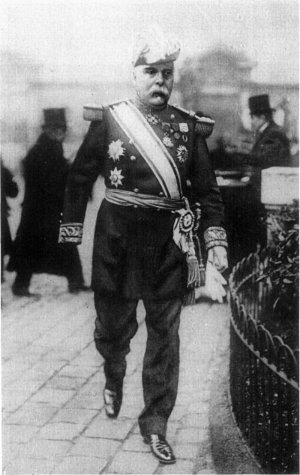
Gen. Paul Pau Commanding one of the French Armies (Photo from Underwood & Underwood.)
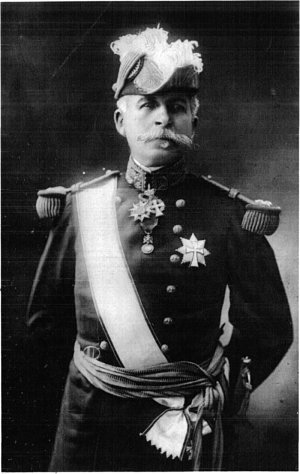
Gen. D'Amade Commanding One of the French Armies (Photo from Bain News Service.)
Here is the brain of the army. Its limbs go swinging by at all hours, in battalions and brigades, or at the trot, with a jingle of bits and scabbards, or at the walk, with bump and clank, as the gun wheels clear the ruts. It is the infantry—that fills the eye—fine, big stuff, man for man the biggest infantry in the world.
Their uniform of peaked cap, trousers tucked into knee-boots, and khaki blouse is workmanlike, and the serious middle-aged officers trudging beside them are hardly distinguishable from the men. They have not yet learned the use of the short, broad-bladed bayonets; theirs are of the old three-cornered section type with which the Bulgarians drove the Turks to Chataldja; but there is something else that they have learned. Since the first days of the mobilization that brought them from their homes there is not a man among them that has tasted strong drink. In 1904 the men came drunk from their homes to the centres; one saw them about the streets and on the railways and in the gutters. But these men have been sober from the start, and will perforce be sober to the end.
Of all that elaborate and copious machinery of war which Russia has built up since her failure in Manchuria there is nothing so impressive as this. Her thousand and odd aeroplanes, her murderously expert artillery, her neat and successful field wireless telegraph, even her strategy, count as secondary to it. The chief of her weaknesses in the past has been the slowness of her mobilization; Germany, with her plans laid and tested for a mobilization in four days, could count on time enough to strike before Russia could move. She used her advantage to effect when Austria planted the seed of this present war by the annexation of Bosnia and Herzegovina; she was able to present Russia in all her unpreparedness with the alternatives of war in twenty-four hours or accepting the situation. But this time it has been different.
At Petrograd one sees how different. Hither from the northern and eastern Governments come the men who are to swell Rennenkampf's force. Their cadres, the skeletons of the battalions of which they are the flesh, are waiting for them—officers, organization, equipment, all is ready. The endless trains decant them; they swing in leisurely columns through the streets to their depots, motley as a circus—foresters, moujiks in fetid sheepskins, cattlemen, and rivermen, Siberians, tow-haired Finns, the wide gamut of the races of Russia, all big or biggish, with those impassive, blunt-featured faces that mask the Russian soul, and all sober. No need now to make men of them before making soldiers; no inferno at the way side-stations and troop trains turning up days late. It is as if, at the cost of those annual 780,000,000 rubles, Russia had bought the clue to victory.
West beyond Eydtkuhnen, under the pearl-gray northern sky, lies East Prussia. Hereabout it is flat and fertile, with lavish, eye-fatiguing levels of cornland stretching away to Insterburg and beyond to Königsberg's formidable girdle of forts. Here are many villages, and scattered between them innumerable hamlets of only two or three houses, and a small town or two. Most of them are empty now; the German army that leans its back on the Vistula's fortresses has cleared this country like a dancing floor for its work. It has rearranged it as one rearranges the furniture in a room; whole populations have been transported, roads broken, bridges blown up, strategically unnecessary; villages burned. Nothing remains on the ground that has not its purpose assigned—not even the people, and their purpose has been clear for some time past. The Russians have been over this ground already, and fell back from it after their defeat between Osterode and Allenstein. Their advance was through villages lifeless and deserted and over empty roads; the retreat was through a country that swarmed with hostile life. Roads were blocked with farm carts, houses along their route took fire mysteriously, signaling their movement and direction, and answered from afar by other conflagrations; bridges that had been sound enough before blew up at the last moment. What the Belgians were charged with, and their country laid waste for, all East Prussia is organized to do daily as an established and carefully schooled auxiliary to the army.
A few days since there arrived a prisoner, driven in on foot by a mounted Cossack, sent back by the officer commanding the reconnoissance party which had captured him. He came up the street, shuffling at a quick walk to keep ahead of the horse and the thin, sinister Cossack—an elderly farmer, in work-stained clothes, with the lean neck and pursed jaws of a hard bargainer. In all his bearing and person there was evident the man of toilsome life who had prospered a little; in that soldier-thronged street, in his posture of a prisoner with the Cossack's revolver at his back, he was conspicuous and grotesque. His eyes, under the gray pent of his brows, were uneasy, and through all his commonplace quality and his show of fortitude there was a gleam of the fear of death that made him tragic. He had been found on his farm doing nothing in particular; it was out of simply general suspicion that the Russian officer had ordered him to be searched. The result was the discovery of a typewritten paper, giving precise instructions as to how a German civilian in East Prussia must act toward the enemy—how to signal movements of infantry, of cavalry, of artillery; how to estimate the numbers of a body of men, and what to say if questioned, and the like—a document conceived and executed with true Prussian exactitude and clearness, a masterpiece in the literature of espionage.
For him there was no hope; even The Hague Convention, which permits mine-laying, does not protect spies, however earnestly and dangerously they serve their country. He passed, always at the same forced shuffle of reluctant feet, toward his judges and his doom.
Belgian Cities Germanized
By Cyril Brown,
Staff Correspondent of The New York Times.
BRUSSELS, Nov. 4.—Of all the war capitals of Europe, Brussels under the German occupation is probably the gayest and the most deceptive. It certainly outrivals Berlin in life and brilliancy, as Berlin outshines London. The Germans are free spenders afield; their influx here by thousands has put large sums of money into circulation, resulting in a spell of artificial, perhaps superficial, prosperity.
The crowds surging all day up and down the principal shopping street, the Rue Neuve, overflow the sidewalks and fill the street. Well-dressed crowds promenade along the circular boulevard all afternoon and into the night. Places of amusement and the cafés are crowded. The hundreds of automobiles loaded with officers speeding about the streets, with musical military horns blowing, add to the gay illusion.
Nowhere save at the Great Headquarters in France, where the Kaiser stays when not haranguing his troops at the front, will you see such a brilliant galaxy of high officers—and every day seems a holiday in Brussels.
You catch the sinister undercurrent in the more obscure little cafés. Here you will find some Belgian patriot who is glad of the chance to unbosom himself to a safe American. Perhaps he will speak with unprintable bitterness of the shame of the Brussels women who, he says, wave handkerchiefs and smile friendly greetings at the singing troop trains passing through the suburbs on their way to the front, or give flowers and cigars to the returning streams of wounded. They ought to be shot as traitresses, he says. For the honor of the Belgian women, he adds, these form only a small percentage.
You are not surprised when well-informed neutral residents tell you that these people "have murder in their hearts, and that if the Germans ever retreat in a rout through Belgium, Heaven help the straggler and the rear guard." Nor that copies of English papers, whose reading is forbidden, are nevertheless smuggled in, and that copies of The London Times fetch as high as 200 francs, reading circles being often formed at 20 francs per head.
But there are no hopeful signs here of a German retreat. Brussels has not been "practically evacuated." On the contrary, one gets overwhelmingly the impression that the Germans expect to stay forever. No cannon are posted on commanding avenues or squares. There are no serious measures for the defense of the capital. The military and civil Governments occupy the principal public buildings, and seem to be working with typical German thoroughness. The Government offices begin to assume an air of permanence.
As conquerors go, the invaders seem to be bearing themselves well. There is apparently no desire to "rub it in," the military Government seemingly pursuing the wise policy of trying to spare the feelings of the natives as much as possible, perhaps in the impossible hope of ultimately conciliating them. German flags are flown sparingly. Only small squads of Landsturm are now occasionally seen marching through the streets. Even from the bitterest Belgians one hears no stories of "insult, shame, or wrong."
At the same time, swift and harsh punishment is meted out to any one whose actions are thought to tend to impair German military authority or dignity. Thus placards posted on many street corners day before yesterday informed the people that a Belgian city policeman had been sentenced to five years' imprisonment for "interfering with a German official in the discharge of his duty, assaulting a soldier, and attempting to free a prisoner." For this, also, a fine of 5,000,000 france ($1,000,000) was imposed on the City of Brussels. Another policeman was sentenced to three years' imprisonment for alleged similar offenses.
An interesting history of the German occupation can be reconstructed from these same placards pasted on buildings. Here is one, dating from the early days, forbidding bicycle riding in the country and announcing that civilian cyclists will be shot at sight. If you look long enough you can also find a mutilated specimen of ex-Burgomaster Max's famous "dementi," in which he virtually calls the German Military Governor of Liége and, by implication, the German Government, "liar." The Bruxellois must be fickle and quick to forget, for I did not hear the picturesque Max's name mentioned once.
The realities of the military occupation are brought home to the people perhaps most at the Gare du Nord and the Place de la Gare, where the Civic Guards, in their curious comic opera caps, are reinforced by German gendarmes with rifles slung over their shoulders. Civilians are not allowed to cross this square in front of the railway station. "Keep to the sidewalk" is the brusque order to those who stray. Also the park in front of the Royal Palace is closed to the public. Three bright red gasoline tank wagons among the trees give it an incongruous touch, while the walks and drives are used as an exercising ground for officers' mounts. All the windows of the Royal Palace are decorated with the sign of the Red Cross.
Brussels just now is humorously a victim of the double standard—not moral, but financial. All kinds of money go here on the basis of 1 mark equaling 1 franc 25 centimes, but shopkeepers still fix prices and waiters bring bills in francs, and when payment is tendered in marks you generally get change in both—a proceeding that involves elaborate mathematical computations. At the next table to you in the restaurant of the Palace Hotel, once a favorite stopping place for Anglo-American travelers, but now virtually an exclusive German officers' club, with the distinction of a double guard posted at the front door, sits a short, fiercely mustached General of some sort—evidently a person of great importance from the commotion his entry caused among all the other officers in the room. In his buttonhole he wears the Iron Cross of the second class, the Iron Cross of the first class pinned to his breast, and underneath the rare "Pour le Merite Order, with Swords." His bill amounts to about 7 francs, for he consumed the regular 4-franc table d'hôte, plus a full bottle of red Burgundy. He tenders a blue 100-mark bill in payment and gets in return a baffling heap of change, including 1 and 2 franc Belgium paper notes, 5 and 10 mark German bills, Belgian and German silver, and Belgian nickel coins with holes punched in the centres. The General takes out his pencil and begins elaborate calculations on the menu—then sends for the head waiter. It takes some time and much talk to convince him that he is not being "short changed." The double standard furnishes many of these humorous interludes.
Equally exasperating is the double time standard. The Germans set their official clocks and watches by Berlin time, but have made no attempt to force it on the natives, who continue loyal to Belgian time, which is one hour behind Berlin.
Brand Whitlock, the American Minister to Belgium, who runs a strong risk of having a statue erected to him some day by the grateful Belgian people, is quite the happiest, most relieved-looking person in Brussels since he heard the good news that all America was hard at work collecting food for the Belgians and that England would not prevent its delivery. Soon after the German occupation of Brussels a committee was organized to give food to the poor here, of which Mr. Whitlock and the Spanish Minister were patrons. Three weeks ago the Ministerial allies discovered that the situation was exceedingly grave, not only here but all over Belgium. Committees came to see Mr. Whitlock from Louvain, Liége, Namur, Charleroi, Mons, Dinant, &c., and the people, I was told, were within four weeks of absolute starvation. Mr. Whitlock got the German Military Governor of Belgium, Field Marshal von der Goltz, to give the Spanish Minister and himself a guarantee in writing that any food sent in for the poor Belgians would not be requisitioned for the German Army.
The next thing was to get the permission of England; so two weeks ago Secretary Gibson was sent to London with Baron Lambert, a banker, and M. Franqui to get England's permission as well as a first shipment of food. Two weeks ago Mr. Whitlock sent a long letter to the State Department and to President Wilson, asking them to do something. At least one phrase of Mr. Whitlock's coinage has been going the rounds here. In the various preliminary discussions as to whose responsibility it was to take care of the Belgian people there was considerable talk about Hague conventions. "Starving people can't eat Hague conventions" was his answer.
Minister Whitlock also feels vastly relieved that he has got practically all non-official Americans out of Belgium, the twoscore still here being mostly resident business men, with a sprinkling of the boldest tourists, who are staying "to see the fun," in spite of Ministerial warnings.
Mr. Whitlock believes he has broken the world's record by being eight Ministers at once. At one time he was representing Germany, Austria, Great Britain, Japan, Servia, Denmark, and Lichtenstein. When he told a German officer that he represented Lichtenstein—which is said to be a small sovereign State somewhere, dependent on Austria—the officer laughed and said: "Theoretically, Germany is still at war with Lichtenstein and has been since 1866, it having been overlooked in the peace shuffle." The reason for representing Denmark, which isn't at war with anybody, is that the Danish Minister is equally accredited to Belgium and The Hague, and had no Secretary to leave behind when he departed Hagueward. Of course, the American flag does not fly over the Danish Legation here. In addition, the French and Russian interests were also offered to Mr. Whitlock, but he was so full of responsibility that he had to ask to be excused.
LOUVAIN, Nov. 5.—Louvain now presents the ghastly spectacle of a dead city, buried under ruins, slowly coming to life again, and continues to give full scope to the morbid streak in human nature; for sightseers continue to flock here in increasing numbers from Antwerp, Brussels, and, in fact, all over Belgium, excepting from over the deadline of the operating zone. With the Bruxellois especially the trip is a favorite outing on a pleasant Sunday. The Germans have succeeded in restoring the train service to the extent of two passenger trains daily between here and Brussels and one between here and Antwerp, and the military authorities pursue a surprisingly liberal policy in giving traveling passes to the Belgian population. In addition to those who come by train, a steady procession of automobiles passes through all day; and next week, when a Berlin-Brussels express service is to be started, the local touring season will have a further boom.
About 5 per cent of the original population have come crawling back, and the three companies of Landsturm garrisoned here, together with the sightseers, form their source of revenue. The more courageous shopkeepers who have come back and reopened their stores are coining money as never in peace times—especially the little confectionery and pastry shops, where the soldiers off duty come for afternoon coffee, and the one tailor's shop which is open. Workmen are putting the finishing touches to the new pine-board roof on the cathedral and are making efforts to "restore" the stone exterior. The famous Gothic Hôtel de Ville is now protected by a high board fence, and two bearded Landsturm men mount guard there day and night. A gang of laborers is making headway in cleaning up the interior of the hopelessly ruined University Library, and the streets are all cleared of débris. The academic halls of the main university building, which suffered little damage, are not silent, for one of the Landsturm companies is quartered there. I found half a hundred of them and two cows in the university quadrangle or campus. The men were all unshaven, but of a good-natured sort, and many were the rough German jokes as they watched a comrade milking the cows preparatory to their slaughter on the spot by the company butcher, who stood in waiting, while at the same time the gray-haired university castellan was getting ready to take a time exposure of the cows.
"And yet they say we Germans are barbarians," laughed an under officer. "I bet you won't find that the French soldiers, or the highly civilized English gentlemen, either, have a photographer come to take a picture of the cows they are about to eat."
The venerable university guardian continued to do a brisk business making group pictures and solo portraits of Landsturm under officers and men at two francs per dozen postcards, till a Lieutenant appeared on the scene and the bugle sounded in the court for "boot inspection." All promptly lined up in double file against the brick university wall and presented feet for the critical eye of the inspector—all except the company cooks, who were busy among their pots and pans and open-air cook stoves set up in the academic stone portico.
The last of the former students of the University of Louvain was probably the well-dressed, meek-looking young Chinese, eating luncheon at the near-by restaurant—the only one open in town. The German soldiers, fortunately, did not mistake him for a Japanese, and he has not been molested.
There are touches of grim humor among the ruins. Here on the main street, for example, is a pink placard stuck on a stick on top of the heap of brick and mortar that was once a store. It reads: "Elegant corsets: Removed to Rue Malines 21." And again, on a number of houses that escaped the torch are pasted neatly printed little signs bearing the legend: "This house is to be protected. Soldiers are not allowed to enter houses or to set fire to them without orders from the Kommandantur."
The inhabitants who have no stores to keep seem continually to wander aimlessly in the streets; and here, too, is the sight, common now all over Belgium, of many women with children begging. Especially they linger around the entrances to the barracks, for hunger has given them a keen nose for bread, and they have soon learned that the soldier will give them what they have left over from their ample rations. The German Government is trying to stimulate the return of the population, and is apparently doing its best to help them to earn a living by providing work.
ANTWERP, Nov. 6.—The Germans are working incessantly to repair the fortifications of Antwerp, mount new and heavier guns, and put the whole place into a state of defense. The importance attached to their almost feverish activities is indicated by the fact that Field Marshal von der Goltz, the Military Governor of Belgium, ran over from Brussels and made a tour of inspection of the double girdle of forts yesterday. His Excellency von Frankenberg and Ludwigsdorf, Personal Adjutant of the Military Governor of Antwerp, said to me in the course of a cordial interview:
"We have two principal interests in our work here: First, that Antwerp shall become a place of great military importance again and be prepared against attacks from the enemy, although that contingency doesn't seem very probable."
His Excellency was unwilling to hazard a guess as to how long the Germans could hold Antwerp against an allied siege, but said: "I believe we could hold out longer against the Allies than they did against the Germans. Our second interest is to revive trade and industry and the life of the city generally. When we first came here there were only soldiers and hungry dogs on the streets; now, as you can see, the dead city is coming to life in short order."
He scouted the idea that the people of Belgium had been or were on the brink of starvation as the result of German occupation, saying that the very contrary was the case. "Belgium is a country which cannot sustain itself—it produces only enough food for roughly 3,000,000 out of its 5,000,000 population, because Belgium is an industrial country, and food for the remaining 2,000,000 has to be imported. Heretofore most of this food has come from Holland, whence some is still coming, but in no great quantity. We have taken the problem of food supply up with the Belgian Government, as much as there is one left, namely, with the municipalities, and at our suggestion an 'Intercommunistic Commission' has been organized, so that everything possible can be done to help the country. This commission sits in Brussels, and when any town or village or district has no more food on hand the fact is reported and it gets from the commission what is required. What food supplies we found here we took charge of to prevent their being plundered, and also because we, as a belligerent, had to supply our own necessities; that is the right of war. But by no means have we used up all the food supplies ourselves, nor set them aside for our own use; but a large part has been set aside for this commission, to be used for the poor, and another part will be given back in a short time for trade purposes, so that commerce will be revived again.
"There is no place in Belgium where the people have starved. Their most pressing need now would appear to be money, for many are unemployed and many others disinclined to work. At one place where we were told the people were starving we found stores crammed full of food—but the inhabitants had no money and the shopkeepers wouldn't give them credit.
"Everything is being done by us to revive business so that the people can again earn money. If America had not been so tender-hearted as to send foodstuffs, and if the food supply had run out, we should certainly have considered it our duty to bring food from Germany, for we are for the time being the Government here, and it is our duty to see that the people do not starve."
German newspaper readers are not aware that their Kaiser had a narrow escape from the bombs of the Allies' airmen at Thielt, for the fact of the War Lord's recent invasion of Belgium has been kept as nearly a dead secret as possible. I learned from an especially well-informed source in Brussels that the object of the Kaiser's visit was not only to encourage his troops but to reprove his Generals. According to this informant, who is frequently in touch with high officers in their more mellow moods, when military reticence somewhat relaxes, the Kaiser was said to be in a towering rage at the failure of his army to make headway against the English and Belgians on the coast, and to have decided to go in person to see about it; also there has been considerable cautiously veiled criticism of his persistent "interference" in the conduct of the campaign.
Having last seen the Kaiser two weeks ago motoring at the German Great Headquarters in Eastern France, I picked up his trail at Louvain, through which place he passed by night a week ago in a special train in the direction of Lille, after a scouting pilot engine had returned and reported "all safe." On his return journey from Flanders he was rumored to have "put up" at the Palais d'Arenberg in Brussels.
It is significant that the following notice has been placarded on the outside of the building occupied by the Military Government, next door to the Hotel St. Antoine: "Reports that the French and English are marching on Antwerp are without foundation; the public is warned against helping to circulate these false reports." All day crowds hang about the door where this notice is posted among official German news bulletins. The burghers of Antwerp are well informed about the varying fortunes of the war, for several papers printed in French are allowed to appear, under the German censorship, which seems surprisingly easygoing here and eminently fair, allowing them to print not merely the official German accounts circulated by the Wolff Bureau, but the official English, French, Russian, and even Belgian bulletins as well, in addition to matter copied from the Dutch papers, which are also allowed to circulate here.
If things look doubtful in the north, the Germans are looking confidently to the south, where the next big victory is hoped for. I learn that Gen. von Beseler, "the conqueror of Antwerp," as his popular picture postcard title reads, is now in charge of operations around Verdun, and that four of the new 42-centimeter mortars, in addition to more than thirty of the 30.5-centimeter, are already in place there. On the strength of this combination well-informed German officers confidently expect the quick fall of Verdun as soon as Beseler gives the order for the "Brummers" to speak—rather high-priced oratory, for I was told by an artillery officer that it cost the taxpayers 36,000 marks ($9,000) every time one of the 42-centimeter mortars was fired.
The Belgian Ruin
By J.H. Whitehouse, M.P.
[An Associated Press Interview, Published Oct. 2, 1914.]
LONDON, Oct. 1.—A graphic picture of the desolation of Belgium was brought to London today by J.H. Whitehouse, member of Parliament from Lanarkshire, who has just returned from a tour around Antwerp for the purpose of assisting in the relief measures.
"Having always regarded war as the negation of all that is good," said Mr. Whitehouse tonight, "I desired to see what its ravages were in a country exposed to all its fury, and what steps were possible to mitigate them. I do not think that any one here has realized the plight of the civilian population of Belgium today, and can only attempt to give any picture of this by describing some of my own experiences."
Mr. Whitehouse made the journey outside Antwerp with two military cars, attended by Belgian officials. In describing the damage which he says the Belgians had to inflict upon themselves to supplement the defenses of Antwerp, he said:
"Hundreds of thousands of trees had been cut down, so that at some points of our journey we had the impression of passing through a wilderness of roots. The tree trunks had all been removed so as to afford no cover to the enemy. All houses had been blown up or otherwise destroyed. Later we passed through the country which had been flooded as a further measure of defense. The damage resulting from these precautionary measures alone amounted to £10,000,000, ($50,000,000.)
"In the villages all ordinary life was arrested. Women and children were standing or sitting dumb and patient by the roadside. Half way to Termonde we could plainly hear the booming of guns and saw many evidences of the battle which was then raging.
"I had read newspaper accounts of the destruction of Termonde and had seen photographs, but they had not conveyed to my mind any realization of the horror of what actually happened. Termonde a few weeks ago was a beautiful city of about 16,000 inhabitants—a city in which the dignity of its buildings harmonized with the natural beauty of its situation, a city which contained some buildings of surpassing interest.
"I went through street after street, square after square, and I found every house entirely destroyed with all its contents. It was not the result of the bombardment; it was systematic destruction. In each house a separate bomb had been placed, which had blown up the interior and set fire to the contents. All that remained in every case were portions of the outer walls, which were still constantly falling, and inside the cinders of the contents of the buildings. Not a shred of furniture or anything else remained.
"This sight continued throughout the entire extent of what had been a considerable town. It had an indescribable influence upon observers which no printed description or even pictorial record could give. This influence was increased by the utter silence of the city, broken only by the sound of the guns.
"Of the population I thought that not a soul remained. I was wrong, for as we turned into a square where the wreck of what had been one of the most beautiful of Gothic churches met my eyes a blind woman and her daughter groped among the ruins. They were the sole living creatures in the whole town.
"Shops, factories, churches, and houses of the wealthy—all were similarly destroyed. One qualification only have I to make of this statement: Two or perhaps three houses bore the German command in chalk that they were not to be burned. These remained standing, but deserted, amid the ruins on either side. Where a destroyed house had obviously contained articles of value looting had taken place.
"I inquired what had become of the population. It was a question to which no direct reply could be given. They had fled in all directions. Some had reached Antwerp, but a greater number were wandering about the country, panic-stricken and starving. Many were already dead.
"What happened at Termonde was similar to what had happened in other parts of Belgium under military occupation of Germany. The result is that conditions have been set up for the civilian population throughout the occupied territory of unexampled misery. Comparatively few refugees have reached this country. Others remain wandering about Belgium, flocking into other towns and villages, or flying to points a little way across the Dutch frontier.
"Sometimes when a town has been bombarded the Germans have withdrawn and the civilians have returned to their homes, only to flee again at the renewed attack. A case in point is Malines, which, on Sunday last, as I was about to try to reach it, was again bombarded. The inhabitants were then unable to leave, as the town was surrounded, but when the bombardment ceased there was a great exodus.
"The whole life of the nation has been arrested. Food supplies which would ordinarily reach the civilian population are being taken by the German troops for their own support. The peasants and poor are without the necessities of life, and conditions of starvation grow more acute every day. Even where there is a supply of wheat available the peasants are not allowed to use their windmills, owing to the German fear that they will send signals to the Belgian Army.
"We are, therefore, face to face with a fact which has rarely, if ever, occurred in the history of the world—an entire nation is in a state of famine, and that within half a day's journey of our own shores.
"The completeness of the destruction in each individual case was explained to me later by the Belgian Ministers, who described numerous appliances which the German soldiers carried for destroying property. Not only were hand bombs of various sizes and descriptions carried, but each soldier was supplied with a quantity of small black disks a little bigger than a sixpenny piece. I saw some of these disks which had been taken from German soldiers on the field of battle. These were described to me as composed of compressed benzine. When lighted they burned brilliantly for a few minutes, and are sufficient to start whatever fire is necessary after the explosion of a bomb.
"To the conditions of famine and homelessness which exist on such a stupendous scale there must be added one which is bad—the mental panic in which many survivors remain. I understood how inevitable this was when I saw and heard what they passed through; eyewitnesses of unimpeachable character described the sufferings of women and children at Liége. As they fled from their burning houses, clinging to their husbands and fathers, they were violently pulled from them and saw them shot a few yards from them.
"I should supplement what I have said regarding the condition of Belgium with some reference to Antwerp itself, where the excited Government now sits. It is a wonderful contrast to the rest of the country, and the first impression of the visitor is that there is little change between its life now and in the days of peace. I approached it by water, and in the early morning it rose before me like a fairy city. Its skyline was beautifully broken by the spires and towers of its churches, including the incomparable Gothic Cathedral.
"When I entered its shops were open, its streets crowded, and everywhere there was eager activity. By midday the streets became congested. Early editions of the papers were eagerly bought and great crowds assembled wherever a telegram giving news could be read. This continued until early evening, but by 8 o'clock a most extraordinary change had fallen upon the city.
"Not a light of any kind in house or shop was to be seen. No lamps were lit in the streets and the city was plunged into absolute darkness. Not a soul remained in the streets. To the darkness there was added profound silence. It was as though this amazing city had been suddenly blotted out."
The Wounded Serb
[From The London Times, Oct. 18, 1914.]
VALIEVO, Sept. 25.
Valievo lies at the terminus of a narrow-gauge railway which joins the Belgrade-Salonika line at Mladinovatz. Along this single track of iron road the entire transport of the Servian Army is being effected. Westward come trains packed with food, fodder, munitions, and troops; eastward go long convoys crowded with maimed humanity. At Mladinovatz all this mass of commissariat and suffering must needs be transferred from or to the broad-gauge line. In this situation lies not the least of the problems which beset the Servians in their struggle with the Austrian invaders.
Valievo itself is a picturesque little town which in peace time is famous as the centre of the Servian prune trade. Its cobbled streets are, in the main, spacious and well planned. There still remain a few relics of the Turkish occupation—overhanging eaves, trellised windows, and the like—but these one must needs seek in the by-ways. I picture Valievo under normal conditions as one of the most attractive of Balkan townships.
Nor has the tableau lost anything in the framing, for it is encircled by a molding of verdant hills which run off into a sweep of seeming endless woods. The vista from my hotel window is almost aggravatingly English. Across the red-tiled roofs of intervening cottages rises the hillside—a checkerboard of grassy slopes and patches of woodland intersected by a brown road which runs upward until the summit, surmounted by a whitewashed shrine, amid a cluster of walnut trees, touches the gray sky.
But Valievo is not now to be seen under normal conditions. From the street below rises the sound of clatter and creak as the rude oxen wagons bump over the cobblestones. Morning, noon, and night they rumble along unceasingly, and whenever I look down I see martial figures clad in tattered, muddy, and blood-stained uniforms, with rudely bandaged body or head or foot. Every now and then a woman breaks from the crowd of waiting loiterers and rushes up to a maimed acquaintance. They exchange but a few sentences, and then she turns, buries her head in her apron, and stumbles along the street wailing a bitter lament for some husband, brother, or son who shall return no more. A friend supports and leads her home; but the onlooking soldiers regard the scene with indifference and snap out a rude advice "not to make a fuss." They brook no wailing for Serbs who have died for Servia.
The town itself has been transformed into one huge camp of wounded. All adaptable buildings—halls, cafés, school-rooms—have been rapidly commandeered for hospitals. Sometimes there are beds, more often rudely made straw mattresses, for little Servia, worn out by two hard wars, is ill-equipped to resist the onslaught of a great power. For 16 days a fierce battle has been raging near the frontier, and wounded have been pouring in much more rapidly than accommodation can be found for them.
And in the streets—what misery! The lame, the halt, the maimed. Men with damaged leg or foot hopping along painfully by the aid of a friendly baton; men nursing broken arms or shattered hands; men with bandaged heads; men being carried from operating shops to café floors; men with body wounds lying on stretchers—all with ragged, blood-bespattered remnants of what once were uniforms. One sees little of the glory of war in Valievo. The Servian Medical Staff, deprived on this occasion of outside assistance, and short alike of doctors, surgeons, nurses, and material, is striving heroically to cope with its task. Where they have been able to equip hospitals the work has been very creditably done. One building is almost exclusively devoted to cases where amputations have been necessary. It is clean, orderly, and the patients are obviously well cared for. Here, when I entered a ward of some thirty beds in which every man lay with a bandaged stump where his leg should be, I think I saw the Servian spirit at its best. They had been newly operated upon, their sufferings must have been great, and for them all the future is black with forebodings. There is no patriotic fund in little Servia. Yet amid all the pain of body and uncertainty of mind that must have been theirs they did not complain. All they desired to know was whether the Schwaba (Austrians) had been beaten out of Servia.
But it is when one leaves the organized hospitals and wends one's way through the crowds of wounded who block the pavements, and enters a lower-class café, that the appalling tragedy of it all fills even the spectator with a sense of hopelessness. There, like cattle upon their bed of straw, lie sufferers from all manner of hurts. They remain mute and uncomplaining, just as they have been dropped down from the incoming oxen transports. Their wounds—three, four, or five days old—have yet received no attention save the primitive first-aid of the battlefield. Blood poisoning is setting in; limbs that prompt dressing would have saved are fast becoming victims for the surgeon's knife. Most of them know the risk they run, for this is their third war—often, too, their third wound—in two short years. Yet the doctors cannot come, because every man of them is already doing more than human energy allows. It is a heartrending sight to look down upon this helpless mass and to realize that many of them have been sentenced to painful death for mere lack of primitive medical attention.