"Human Documents" of Battle (continued 4)
Reading edition
"I clung to a ringbolt for some time, but eventually was dropped on to the deck, and a huge wave washed me away. I climbed up the ship's side and again was washed off. Eventually, after swimming about from various overladen pieces of wreckage, I was picked up by a cutter from the Hogue, Coxswain L.S. Marks, which pulled about for some hours, picking up men and discharging them to our picket boat and steam pinnace and to the Dutch steamers Flora and Titan, and rescued, in this way, Commander Sells of the Aboukir, Engineer Commander Stokes, (with legs broken,) Fleet Paymaster Eldred, and about 120 others.
"Finally, about 11 A.M., when we could find no more men in the water, we were picked up by the Lucifier, which proceeded to the Titan and took off from her all our men except about twenty who were too ill to be moved.
"A Lowestoft trawler and the two Dutch ships Flora and Titan were extraordinarily kind, clothing and feeding our men. My boat's crew, consisting mainly of Royal Navy Reserve men, pulled and behaved remarkably well. I particularly wish to mention Petty Officer Halton, who, by encouraging the men in the water near me, undoubtedly saved many lives.
"Lieut. Commander Phillips-Wolley, after hoisting out the launch, asked me if we should try to hoist out another boat, and endeavored to do so. The last I saw of him was on the after bridge, doing well.
"Lieut. Commander Tillard was picked up by a launch. He got up a cutter's crew and saved many lives, as did Midshipman Cazalet in the Cressy's gig. Lieut. Chichester turned out the whaler very quickly.
"A Dutch sailing trawler sailed close by, but went off without rendering any assistance, although we signaled to her from the Hogue to close after we were struck.
"The Aboukir appeared to me to take about thirty-five minutes to sink, floating bottom up for about five minutes. The Hogue turned turtle very quickly—in about five minutes—and floated bottom up for several minutes. A dense black smoke was seen in the starboard battery, whether from coal or torpedo cordite I could not say. The upper deck was not blown up, and only one other small explosion occurred and we heeled over.
"The Cressy I watched heel over from the cutter. She heeled over to starboard very slowly, dense black smoke issuing from her when she attained an angle of about 90 degrees, and she took a long time from this angle till she floated bottom up with the starboard screw slightly out of water. I consider it was thirty-five to forty-five minutes from the time she was struck till she was bottom up.
"All the men on the Hogue behaved extraordinarily well, obeying orders even when in the water swimming for their lives, and I witnessed many cases of great self-sacrifice and gallantry. Farmstone, an able seaman of the Hogue, jumped overboard from the launch to make room for others, and would not avail himself of assistance until all the men near by were picked up. He was in the water about half an hour.
"There was no panic of any sort, the men taking off their clothes as ordered and falling in with hammock or wood. Capt. Nicholson, in our other cutter, as usual, was perfectly cool and rescued large numbers of men. I last saw him alongside the Flora. Engineer Commander Stokes, I believe, was in the engine room to the last, and Engineer Lieut. Commander Fendick got steam on the boat hoist and worked it in five minutes.
"I have the honor to submit that I may be appointed to another ship as soon as I can get a kit."
The Sinking of the Hawke
[By a Correspondent of The London Daily Chronicle.]
ABERDEEN, Scotland, Oct. 16.—The British cruiser Hawke was sunk in the North Sea yesterday by a German submarine, and of her crew of 400 officers and men only 73 are known to have been saved.
The cruiser Theseus, a sister ship of the Hawke, was attacked by the same submarine, but escaped because she obeyed the Admiralty's instructions and looked to her own safety instead of rushing to the aid of the Hawke's perishing crew.
A survivor of the Hawke gives the following description of the disaster: "Within eight minutes the Hawke had gone under. Had the ship gone down forward or aft there would have been some chance for us to get the boats out and clear of the cruiser, but she keeled over on her beam ends, and so of all boats we lowered those on the starboard side were useless, and those on the port side were crushed as soon as they touched the water.
"I was proud to be among such comrades. Everything was absolutely in perfect order. When the ship was struck a fearful explosion followed, and grime and dust were everywhere. I was amidships at the time, and could hardly see to grope my way to the ship's side. I heard orders given to lower the boats, and then some one shouted, 'Look after yourselves!' So I did that.
"Most of the men on board were married men. We saw hundreds in the water, but we were afraid to pick them up as our boat was already overcrowded. So we threw our lifebelts to them. It was all we could do.
"The weather was bitter cold, and I do not think that many, apart from those who were landed at Aberdeen, were saved."
Here is the statement of a rescued stoker: "When the explosion occurred I, along with others who were in the engine room, was sent flying into space and was stunned for a time. When I came to my senses I found myself in the midst of what must be described as an absolute inferno. One of the cylinders of the engine had been completely wrecked, and steam was passing out in dense, scalding clouds. The horror of the situation was increased when a tank of oil fuel caught fire, and the flames advanced with frightful rapidity.
"Seeing that there was not a ghost of a chance of doing any good by remaining in what was obviously a deathtrap, I determined to make a dash for it, and I scrambled up an iron ladder to the main deck. All this had happened in less time than it takes to tell it, but such is British pluck, coolness, and nerve even in such a situation that the commander and other officers were on the bridge, and as calmly as if we were on fleet manoeuvres the orders were given and as calmly obeyed.
"The buglers sounded a stiff call which summoned every man to remain at his post. During the first minute or two many of us believed all that was wrong was a boiler explosion, but the rapidity with which the cruiser was making water on the starboard side quickly disabused all our minds of this belief. Realizing the actual situation, the commander gave orders to close all the watertight doors. Soon after that came orders to abandon the ship and get out the boats.
"One cutter was being launched from the port side, but the Hawke at that moment heeled over before the boat could be got clear, and the cutter lurched against the cruiser's side and stove in one or two of her planks. As the Hawke went down a small pinnace and a raft which had been prepared for such an emergency floated free, but such was the onrush of men who had been thrown into the water that both were overcrowded. On the raft were about seventy men knee deep in water, and the pinnace also appeared to be overfilled.
"When those who managed to make their way into the cutter, which was also in grave danger of being overturned, caught the last glimpse of these two craft they were in a precarious condition. The cutter moved around the wreck, picking up as many survivors as the boat would hold. All those aboard her who had put on lifebelts took them off and threw them to their comrades who were struggling in the water. Oars and other movable woodwork also were pitched overboard to help those clinging to the wreckage, many of whom were seen to sink."
The Emden's Last Fight
[By the Cable Operator at Cocos Islands.]
KEELING, Cocos Islands, Nov. 12, (Dispatch to The London Daily Chronicle.)—It was early on Monday that the unexpected arrival of the German cruiser Emden broke the calm of these isolated little islands, which the distant news of the war had hitherto left unruffled. One of the islands is known as Direction Island, and here the Eastern Telegraph Company has a cable station and a staff engaged in relaying messages between Europe and Australia. Otherwise the inhabitants are all Malays, with the exception of the descendants of June Clunies Ross, a British naval officer who came to these islands ninety years ago and founded the line of "Uncrowned Kings."
The war seemed to be very far away. The official bulletins passed through the cable station, but they gave us very little real news, and the only excitement was when it was rumored that the company was sending out rifles in case of a raid on the stations, and orders came that the beach must be patrolled by parties on the lookout for Germans. Then we heard from Singapore that a German cruiser had been dispatched to these islands, and toward the end of August one of the cable staff thought he saw searchlights out over the sea. Then suddenly we were awakened from our calm and were made to feel that we had suddenly become the most important place in the whole worldwide war area.
At 6 o'clock on Monday morning a four-funneled cruiser arrived at full speed at the entrance to the lagoon. Our suspicions were aroused, for she was flying no flag and her fourth funnel was obviously a dummy made of painted canvas. Therefore we were not altogether surprised at the turn of events. The cruiser at once lowered away an armored launch and two boats, which came ashore and landed on Coral Beach three officers and forty men, all fully armed and having four Maxim guns.
The Germans—for all doubt about the mysterious cruiser was now at end—at once rushed up to the cable station, and, entering the office, turned out the operators, smashed the instruments, and set armed guards over all the buildings. All the knives and firearms found in possession of the cable staff were at once confiscated.
I should say here that, in spite of the excitement on the outside, all the work was carried on in the cable office as usual right up to the moment when the Germans burst in. A general call was sent out just before the wireless apparatus was blown up.
The whole of the staff was placed under an armed guard while the instruments were being destroyed, but it is only fair to say that the Germans, working in well-disciplined fashion under their officers, were most civil. There was no such brutality as we hear characterizes the German Army's behavior toward civilians, and there were no attempts at pillaging.
While the cable station was being put out of action the crew of the launch grappled for the cables and endeavored to cut them, but fortunately without success. The electrical stores were then blown up.
At 9 A.M. we heard the sound of a siren from the Emden, and this was evidently the signal to the landing party to return to the ship, for they at once dashed for the boats, but the Emden got under way at once and the boats were left behind.
Looking to the eastward, we could see the reason for this sudden departure, for a warship, which we afterward learned was the Australian cruiser Sydney, was coming up at full speed in pursuit. The Emden did not wait to discuss matters, but, firing her first shot at a range of about 3,700 yards, steamed north as hard as she could go.
At first the firing of the Emden seemed excellent, while that of the Sydney was somewhat erratic. This, as I afterward learned, was due to the fact that the Australian cruiser's range-finder was put out of action by one of the only two shots the Germans got home. However, the British gunners soon overcame any difficulties that this may have caused and settled down to their work, so that before long two of the Emden's funnels had been shot away. She also lost one of her masts quite early in the fight. Both blazing away with their big guns, the two cruisers disappeared below the horizon, the Emden being on fire.
After the great naval duel passed from our sight and we could turn our attention to the portion of the German crew that had been left behind, we found that these men had put off in their boats obedient to the signal of the siren, but when their ship steamed off without them they could do nothing else but come ashore again. On relanding they lined up on the shore of the lagoon, evidently determined to fight to the finish if the British cruiser sent a party ashore, but the dueling cruiser had disappeared, and at 6 P.M. the German raiders embarked on the old schooner Ayessa, which belongs to Mr. Ross, the "uncrowned king" of the islands. Seizing a quantity of clothes and stores, they sailed out, and have not been seen since.
Early the next morning, Tuesday, Nov. 10, we saw the Sydney returning, and at 8:45 A.M. she anchored off the island. From various members of the crew I gathered some details of the running fight with the Emden. The Sydney, having an advantage in speed, was able to keep out of range of the Emden's guns and to bombard her with her own heavier metal. The engagement lasted eighty minutes, the Emden finally running ashore on North Keeling Island and becoming an utter wreck.
Only two German shots proved effective. One of these failed to explode, but smashed the main range finder and killed one man. The other killed three men and wounded fourteen.
Each of the cruisers attempted to torpedo the other, but both were unsuccessful, and the duel proved a contest in hard pounding at long range. The Sydney's speed during the fighting was twenty-six knots and the Emden's twenty-four knots, the British ship's superiority of two knots enabling her to choose the range at which the battle should be fought, and to make the most of her superior guns.
The Sydney left here at 11 A.M. Tuesday in the hope of picking up any of the survivors of the Buresk, the collier that had been in attendance on the Emden and was sunk after an engagement on the previous day. Finally, with a number of wounded prisoners on board, the Sydney left here yesterday, and our few hours of war excitement were over.
Crowds See the Niger Sink
[By a Correspondent of The London Daily Chronicle.]
DEAL, England, Nov. 11.—By the destruction of the British torpedo gunboat Niger, which was torpedoed and sunk by a submarine in the Downs this afternoon, the realities of war were brought home to the inhabitants of Deal and Walmer.
A loud explosion was heard from the gunboat as she lay off the Deal pier, and great volumes of smoke enveloped the vessel. When the smoke cleared the Niger was observed to be settling down forward. Men, women, and children rushed to the sea front, exclaiming that the vessel had been torpedoed or mined. They soon realized that the Niger was doomed. The Deal and Kingsdown lifeboats as well as boats from other parts of the beach were launched in an effort to save the sailors.
Consternation and almost panic prevailed among the hundreds who stood watching the ghastly sight from the beach. Fortunately, the North Deal galley Hope, commanded by Capt. John Budd, lay at anchor near the spot, waiting to land the pilot from a London steamer which was going down the channel. When the boatmen realized that the Niger had been hit by a submarine or mine, to use their own expression, they rowed like the very devil.
"We saw the sailors," said Capt. Budd, "jumping from the vessel's side in dozens. As we neared the fast-disappearing vessel we came upon swarms of men struggling in the sea and heroically helping to support each other. Some were fully dressed, others only partly so. They were clinging to pieces of wreckage and deck furniture, and some were in lifeboats.
"It was a heartrending spectacle. The men were so thick in the water that they grasped at our oars as we dipped them in the sea. We rescued so many and our own boat got so choked that we could not move. With our own gunwale only just out of the water, we were in danger of sinking ourselves.
"We called to the men that we could take no more in or we should sink ourselves, but they continued to pour over the sides, and some hung to the stern of our boat. We had about fifty on board. Never had there been so many in the boat before. One burly sailor, whom we told to wait until the next boat came along, laughingly remarked while he was in the water, 'All right, Cocky, I will hold on by my eyebrows,' and he drifted to another galley. Another Deal boat then came along and relieved us of some of our men.
"Suddenly we heard a shout, and, looking around, saw the commander of the Niger waving and beckoning to us from the stern of the sinking ship. We could not go to him because our craft was so heavily laden. Another galley then came along, and, after taking out some of our men, together with those who were hanging on to our sides, we went closer to the sinking gunboat and took off some more men, and at the Captain's special request we waited until he took a final look around to see if there were any more men left on board the vessel.
"By this time the ship was very nearly under water, and we shouted to him to hurry up, as the Niger had turned over on her side and was likely to go down at any moment. That brave Captain only just managed to jump in time, when the gunboat gave a lurch and sank on her side in eight fathoms of water. We were proud to rescue that Captain, for he was a true sailor."
The other boats which picked up men were the Maple Leaf, the motor boat Naru, the Annie, the May, and the Deal lifeboat.
The rescuing party saw one dead sailor floating by.
The majority of those rescued received first aid on being landed at North Deal, and then they were taken in ambulances to the Marine Hospital at Walmer.
One survivor, replying to a question as to whether the Niger was torpedoed or mined, replied:
"Torpedoed, Sir. With the exception of the watch and the gun crews all were below at the time. The first order we received was to close the watertight doors."
So far as I can ascertain at present only one man is missing. Four or five have been landed at Ramsgate. The crew is said to have numbered ninety-six officers and men.
The sinking of the Niger came with tragic swiftness. It was comparatively a fine, peaceful day, and the people were resting on the promenade enjoying sea and fresh air. Anglers—men and women—were calmly fishing from the pier. One angler whom I interviewed this evening said:
"I had just baited my line and cast it out when I heard two loud reports, like an explosion. I looked seaward and saw the Niger, only a mile away, enveloped in smoke or steam. When it had cleared away. I said to my fellow-anglers, 'Oh, he is letting off steam! When I looked at her again I was startled to notice that she was lower in the water. Fortunately I had slung across my shoulder a pair of glasses, and, on looking at the vessel through them, I noticed that they were attempting to lower the boats, while the remainder of the crew stood at attention on the deck. We could see that the vessel was sinking, and the lifeboats and other boats were hastening to the rescue.
"The vessel then gradually disappeared, bow first, and after about fifteen minutes not a sign of her remained."
Lieut. Weddigen's Own Story
By Herbert B. Swope.
[Copyright, 1914, by The Press Publishing Company (The New York World).]
BERLIN, Sept. 30.—Through the kindness of the German Admiralty I am able to tell exclusively the story of Capt. Lieut. Otto Weddigen, commander of the now world famous submarine U-9, whose feat in destroying three English cruisers has lifted the German Navy to a lofty place in sea history.
There is an inviolable rule in the German Army and Navy prohibiting officers from talking of their exploits, but because of the special nature of Weddigen's exploit an exception was made, and through the good offices of Count von Oppersdorf The World was granted the right of first telling Weddigen's remarkable story.
It must be borne in mind that Lieut. Weddigen's account has been officially announced and verified by German Navy Headquarters. That will explain why certain details must be omitted, since they are of importance if further submarine excursions are undertaken against the British fleet. Following is Weddigen's tale, supplemented by the Admiralty Intelligence Department:
By CAPT. LIEUT. OTTO WEDDIGEN. Commander of the German Submarine U-9.
I am 32 years old and have been in the navy for years. For the last five years I have been attached to the submarine flotilla, and have been most interested in that branch of the navy. At the outbreak of the war our undersea boats were rendezvoused at certain harbors in the North Sea, the names of which I am restrained from divulging.
Each of us felt and hoped that the Fatherland might be benefited by such individual efforts of ours as were possible at a time when our bigger sisters of the fleet were prohibited from activity. So we awaited commands from the Admiralty, ready for any undertaking that promised to do for the imperial navy what our brothers of the army were so gloriously accomplishing.
It has already been told how I was married at the home of my brother in Wilhelmshaven to my boyhood sweetheart, Miss Prete of Hamburg, on Aug. 16.
Before that I had been steadily on duty with my boat, and I had to leave again the next day after my marriage. But both my bride and I wanted the ceremony to take place at the appointed time, and it did, although within twenty-four hours thereafter I had to go away on a venture that gave a good chance of making my new wife a widow. But she was as firm as I was that my first duty was to answer the call of our country, and she waved me away from the dock with good-luck wishes.
I set out from a North Sea port on one of the arms of the Kiel Canal and set my course in a southwesterly direction. The name of the port I cannot state officially, but it has been guessed at; nor am I permitted to say definitely just when we started, but it was not many days before the morning of Sept. 22 when I fell in with my quarry.
When I started from home the fact was kept quiet and a heavy sea helped to keep the secret, but when the action began the sun was bright and the water smooth—not the most favorable conditions for submarine work.
I had sighted several ships during my passage, but they were not what I was seeking. English torpedo boats came within my reach, but I felt there was bigger game further on, so on I went. I traveled on the surface except when we sighted vessels, and then I submerged, not even showing my periscope, except when it was necessary to take bearings. It was ten minutes after 6 on the morning of last Tuesday when I caught sight of one of the big cruisers of the enemy.
I was then eighteen sea miles northwest of the Hook of Holland. I had then traveled considerably more than 200 miles from my base. My boat was one of an old type, but she had been built on honor, and she was behaving beautifully. I had been going ahead partly submerged, with about five feet of my periscope showing. Almost immediately I caught sight of the first cruiser and two others. I submerged completely and laid my course so as to bring up in the centre of the trio, which held a sort of triangular formation. I could see their gray-black sides riding high over the water.
When I first sighted them they were near enough for torpedo work, but I wanted to make my aim sure, so I went down and in on them. I had taken the position of the three ships before submerging, and I succeeded in getting another flash through my periscope before I began action. I soon reached what I regarded as a good shooting point.
[The officer is not permitted to give this distance, but it is understood to have been considerably less than a mile, although the German torpedoes have an effective range of four miles.]
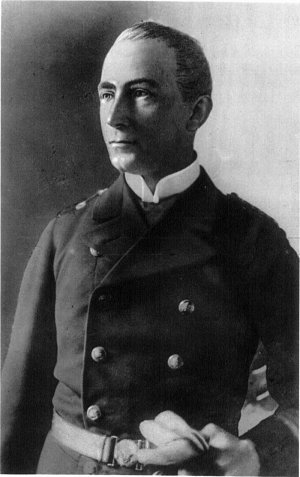
Capt. Karl von Muller Of the German Cruiser Emden (Photo (C) by American Press Assn.)
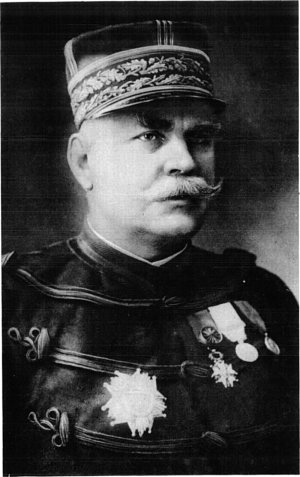
Gen. Joseph Joffre The French Commander-in-Chief. (Photo from International News Service.)
Then I loosed one of my torpedoes at the middle ship. I was then about twelve feet under water, and got the shot off in good shape, my men handling the boat as if she had been a skiff. I climbed to the surface to get a sight through my tube of the effect, and discovered that the shot had gone straight and true, striking the ship, which I later learned was the Aboukir, under one of her magazines, which in exploding helped the torpedo's work of destruction.
There was a fountain of water, a burst of smoke, a flash of fire, and part of the cruiser rose in the air. Then I heard a roar and felt reverberations sent through the water by the detonation. She had been broken apart, and sank in a few minutes. The Aboukir had been stricken in a vital spot and by an unseen force; that made the blow all the greater.
Her crew were brave, and even with death staring them in the face kept to their posts, ready to handle their useless guns, for I submerged at once. But I had stayed on top long enough to see the other cruisers, which I learned were the Cressy and the Hogue, turn and steam full speed to their dying sister, whose plight they could not understand, unless it had been due to an accident.
The ships came on a mission of inquiry and rescue, for many of the Aboukir's crew were now in the water, the order having been given, "Each man for himself."
But soon the other two English cruisers learned what had brought about the destruction so suddenly.
As I reached my torpedo depth I sent a second charge at the nearest of the oncoming vessels, which was the Hogue. The English were playing my game, for I had scarcely to move out of my position, which was a great aid, since it helped to keep me from detection.
On board my little boat the spirit of the German Navy was to be seen in its best form. With enthusiasm every man held himself in check and gave attention to the work in hand.
The attack on the Hogue went true. But this time I did not have the advantageous aid of having the torpedo detonate under the magazine, so for twenty minutes the Hogue lay wounded and helpless on the surface before she heaved, half turned over and sank.
But this time, the third cruiser knew of course that the enemy was upon her and she sought as best she could to defend herself. She loosed her torpedo defense batteries on boats, starboard and port, and stood her ground as if more anxious to help the many sailors who were in the water than to save herself. In common with the method of defending herself against a submarine attack, she steamed in a zigzag course, and this made it necessary for me to hold my torpedoes until I could lay a true course for them, which also made it necessary for me to get nearer to the Cressy. I had come to the surface for a view and saw how wildly the fire was being sent from the ship. Small wonder that was when they did not know where to shoot, although one shot went unpleasantly near us.
When I got within suitable range I sent away my third attack. This time I sent a second torpedo after the first to make the strike doubly certain. My crew were aiming like sharpshooters and both torpedos went to their bullseye. My luck was with me again, for the enemy was made useless and at once began sinking by her head. Then she careened far over, but all the while her men stayed at the guns looking for their invisible foe. They were brave and true to their country's sea traditions. Then she eventually suffered a boiler explosion and completely turned turtle. With her keel uppermost she floated until the air got out from under her and then she sank with a loud sound, as if from a creature in pain.
The whole affair had taken less than one hour from the time of shooting off the first torpedo until the Cressy went to the bottom. Not one of the three had been able to use any of its big guns. I knew the wireless of the three cruisers had been calling for aid. I was still quite able to defend myself, but I knew that news of the disaster would call many English submarines and torpedo boat destroyers, so, having done my appointed work, I set my course for home.
My surmise was right, for before I got very far some British cruisers and destroyers were on the spot, and the destroyers took up the chase. I kept under water most of the way, but managed to get off a wireless to the German fleet that I was heading homeward and being pursued. I hoped to entice the enemy, by allowing them now and then a glimpse of me, into the zone in which they might be exposed to capture or destruction by German warships, but, although their destroyers saw me plainly at dusk on the 22d and made a final effort to stop me, they abandoned the attempt, as it was taking them too far from safety and needlessly exposing them to attack from our fleet and submarines.
How much they feared our submarines and how wide was the agitation caused by good little U-9 is shown by the English reports that a whole flotilla of German submarines had attacked the cruisers and that this flotilla had approached under cover of the flag of Holland.
These reports were absolutely untrue. U-9 was the only submarine on deck, and she flew the flag she still flies—the German naval ensign—which I hope to keep forever as a glorious memento and as an inspiration for devotion to the Fatherland.
I reached the home port on the afternoon of the 23d, and on the 24th went to Wilhelmshaven, to find that news of my effort had become public. My wife, dry eyed when I went away, met me with tears. Then I learned that my little vessel and her brave crew had won the plaudit of the Kaiser, who conferred upon each of my co-workers the Iron Cross of the second class and upon me the Iron Cross of the first and second classes.
[Weddigen is the hero of the hour in Germany. He also wears a medal for life-saving. Counting himself, Weddigen had twenty-six men. The limit of time that his ship is capable of staying below the surface is about six hours.]
The Soliloquy of an Old Soldier. By O.C.A. Child. You need not watch for silver in your hair, Or try to smooth the wrinkles from your eyes, Or wonder if you're getting quite too spare, Or if your mount can bear a man your size. You'll never come to shirk the fastest flight, To query if she really cares to dance, To find your eye less keen upon the sight, Or lose your tennis wrist or golfing stance. For you the music ceased on highest note— Your charge had won, you'd scattered them like sand, And then a little whisper in your throat, And you asleep, your cheek upon your hand. Thrice happy fate, you met it in full cry, Young, eager, loved, your glitt'ring world all joy— You ebbed not out, you died when tide was high, An old campaigner envies you, my boy!