“THE CASE OF BELGIUM”
Reading edition
“In the Light of Official Reports Found in the Secret Archives of the Belgian Government after the Occupation of Brussels”
Remarks Introductory to the Secret Documents
By Dr. Bernhard Dernburg
HEREWITH are published facsimiles of papers found among the documents of the Belgian General Staff at Brussels, referring to arrangements between the English Military Attaché and the Belgian Minister of War regarding British intervention in Belgium.
It will be remembered from the British "White Book" that in November, 1912, a correspondence passed between Sir Edward Grey and the French Minister in London, in which it was stated that British and French military and naval experts had consulted together from time to time as to plans to be followed in case of war, and it was stated in this correspondence that in accordance with such prearranged plans the French fleet would stay in the Mediterranean to safeguard the joint interests there, whereas the British fleet would safeguard their interests in the north. Of this correspondence the members of the British Cabinet remained ignorant until the Cabinet meeting immediately preceding the written statement by Great Britain on Aug. 2 that in case a German fleet attacked the French coast or passed into the Channel, England would give all the assistance in her power, (British "White Papers," No. 148,) and it was also, of course, concealed from the British public until the speech of Sir Edward Grey on Aug. 3. It will be remembered that in consequence of this revelation the British Minister of Commerce, Mr. John Burns, and two other members, Lord Morley and Mr. Trevelyan, left the British Cabinet under protest; that the leader of the British Labor Party, Mr. Ramsey Macdonald, resigned from the leadership and that Mr. Arthur Ponsonby in his famous letter denounced Sir Edward Grey's practices.
Mr. Ponsonby said that time and again they had been assured that there were no obligations whatsoever on the part of Great Britain to come to France's assistance and yet they found themselves now so hopelessly entangled that as a matter of fact the British Government could not back out.
The fact of these consultations, by which, of course, all the plans of mobilization of both the British and French armies were disclosed to the two allies and which include the landing of English troops in France, is now fully established by the annexed documents. They show that these conversations were also held with Belgium, that plans had been concerted to invade Belgium with an army of 100,000 men by way of three French ports—viz., Dunkirk, Calais, and Boulogne—and that the British plans even considered a landing by way of the Scheldt, thus violating also Dutch neutrality.
The documents, giving all the details as translated and showing that Belgian railway cars were to be sent to the named French ports in order to transport the British troops into Belgium, are dated from 1906.
The Belgian Minister at Berlin, Baron Greindl, a well-known Belgian patriot, protested to his Government. The heading of his protest is also given in facsimile. In it he said that it was not quite safe to trust to the British and French to keep the Belgian neutrality, that it was not wise to take all measures only against a German infraction of Belgian neutrality and that the British spirit was clearly shown by the words of Col. Barnardiston that the Scheldt might be used for transporting troops into Belgium.
Furthermore, it will be remembered that the British and French Governments violently protested when the plans were made public that the Dutch Government intended to fortify the mouth of the Scheldt in 1906. But in 1912, when the Balkan crisis became acute, the British went one step further. When Col. Bridges, in a conversation with Gen. Jungbluth, the Chief of the Belgian General Staff, said that England was ready to strike, that 160,000 men were ready to be landed and that they would land them as soon as any European conflict should break out, Gen. Jungbluth protested that for such a step the permission of Belgium was necessary. The cool reply was that the English knew it, but thought that, as Belgium was not strong enough alone to protect herself, England would land troops anyway. Gen. Jungbluth answered that Belgium felt strong enough to protect herself, which is in keeping with her declaration to France, when she offered to protect Belgium by five army corps, as reported in the British "White Book." The position of England was therefore that, while in 1906 they had already concerted plans for a joint action, in 1912 England intended action in any case, should a European conflagration break out.
Now, it must be recollected that as early as July 28, 1914, Sir Edward Grey said to Prince Lichnowsky, as mentioned in his communication to Sir E. Goschen: "The situation was very grave. While it was restricted to the issues at present actually involved, we had not thought of interfering in it. But if Germany became involved in it and then France, the issue might be so great that it would involve all European interests, and I did not wish him to be misled by the friendly tone of our conversation—which I hoped would continue—into thinking that we should stand aside." (British "White Papers," No. 89.)
This was at a time when the Belgian issue had not been raised at all. It only came about by Sir Edward Grey's notes written on July 31. Thus the British entanglement with France, as evidenced by the British "White Book," prevented England taking the same attitude in 1914 which she had taken in 1870, when she made a treaty with France as against the German invasion of Belgium and with Germany as against the French invasion of Belgium. A similar agreement was suggested by Prince Lichnowsky to Sir Edward Grey on Aug. 1, 1914, as reported in the English "White Book," No. 123, when the former asked Sir Edward Grey whether if Germany gave a promise not to violate Belgian neutrality England would engage to remain neutral, upon which Grey replied that he could not say that.
It is therefore perfectly evident, in the first place, that in case of a German war, that was sure to be brought about by Russia's mobilization against Germany, England would go to war against Germany, and it has been proved that the English assurance to that effect has strengthened the hands of the Russian war party, which thereupon got the upper hand and forced the Russian Czar into the war, (see report of Belgian Chargé d'Affaires at St. Petersburg to the Minister of Foreign Affairs at Brussels, July 30.)
In the second place, it is shown that England meant, with or without Belgium's will, to land her troops, in violation of Belgium's neutrality, in Belgium, irrespective of whether German troops were marching through Belgium or not, because no such declaration had been made in 1912 or any time thereafter until Aug. 4 in the German Reichstag. It is further evident that as soon as Russia mobilized, Germany would have to fight Russia as well as France and England, and that in such a fight she was forced to draw quickly when she saw her enemies reaching for their hip pockets. And only the prompt action at Liége that put this important railway centre commanding the railway connections to France and Germany into German hands prevented the English landing and invading Belgium.
The guilt of the Belgian Government in this matter consists, in the first place, in making and concerting plans with the English and French Governments as to what steps to take in case of war. A plan of the French mobilization was found in the same docket, and it cannot be presumed that the conference between British and French experts was unknown to the British Military Attaché in Brussels. It is furthermore impossible to believe that the French railway for the shipping of British troops from Calais, Dunkirk, and Boulogne into Belgium in Belgian cars could have been used without the knowledge of the French authorities. Secondly, that Belgium did not heed the advice of Baron Greindl and did not try to insure her independence in the same way by approaching Germany and making a similar contract with her. This disposes of the contention that the Belgian conversation had a purely defensive character as against all comers. It shows the one-sidedness of the inclination, which is evidenced also by the placing of all Belgium's fortresses on the eastern frontier.
The Belgian people had been told at the beginning of the war that Germany demanded that the Belgian forces should fight with the Germans against the French and the English, and the truth had become known only three full months later, when the Belgian "Gray Book" was published. Then Belgium was practically occupied territory. While Belgium pretended neutrality and friendship toward Germany, it was secretly planning for her defeat in a war which was considered unavoidable. The poor Belgian people, however, must suffer because of the large ambitions of King Leopold of Congo fame and of a broken-down diplomacy.
The Imperial Chancellor has declared that there was irrefutable proof that if Germany did not march through Belgium, her enemies would. This proof, as now being produced, is of the strongest character. So the Chancellor was right in appealing to the law of necessity, although he had no regret that it violated international law. This law of necessity has been recognized as paramount by nearly every prominent statesman, including Gladstone, and by all teachers of international law, even by the United States Supreme Court's decision, Vol. 130, Page 601, stating in regard to the treaty with China concerning Chinese immigration into the United States: "It will not be presumed that the legislative department of the Government will lightly pass laws which are in conflict with the treaties of the country, but that circumstances may arise which would not only justify the Government in disregarding their stipulations, but demand in the interests of the country that it should do so, there can be no question. Unexpected events may call for a change in the policy of the country." And to strengthen this opinion another decision by Justice Curtis, rendered in 1908, may be cited, stating that, "while it would be a matter of the utmost gravity and delicacy to refuse to execute a treaty, the power to do so was a prerogative of which no country could be deprived without deeply affecting its independence."
We now let these Belgian documents speak for themselves.
Summary of the Secret Documents
I. The first document is a report of the Chief of the Belgian General Staff, Major Gen. Ducarme, to the Minister of War, reporting a series of conversations which he had had with the Military Attaché of the British Legation, Lieut. Col. Barnardiston, in Brussels. It discloses that, as early as January, 1906, the Belgian Government was in consultation with the British Government over steps to be taken by Belgium, Great Britain, and France against Germany. A plan had been fully elaborated for the landing of two British army corps in French ports to be transferred to the point in Belgium necessary for operations against the Germans. Throughout the conversation the British and Belgian forces were spoken of as "allied armies"; the British Military Attaché insisted on discussing the question of the chief command; and he urged the establishment, in the meantime, of a Belgian spy system in Germany.
II. When in the year 1912 Lieut. Col. Barnardiston had been succeeded by Lieut. Col. Bridges as British Military Attaché in Brussels, and the Chief of the Belgian General Staff, Major Gen. Ducarme, had been succeeded by Gen. Jungbluth as Chief of the Belgian General Staff, the conversations proceeded between the two latter officials. That is to say, these were not casual conversations between individuals, but a series of official conversations between representatives of their respective Governments, in pursuance of a well-considered policy on the part of both Governments.
III. The above documents are given additional significance by a report made in 1911 by Baron Greindl, Belgian Minister in Berlin, to the Belgian Minister for Foreign Affairs, from which it appears that this representative of the Belgian Government in Berlin was familiar with the plans above set forth and protested against them, asking why like preparations had not been made with Germany to repel invasion by the French and English.
Taken together, these documents show that the British Government had the intention, in case of a Franco-German war, of sending troops into Belgium immediately—that is, of doing the very thing which, done by Germany, was used by England as a pretext for declaring war on Germany.
They show also that the Belgian Government took, in agreement with the English General Staff, military precautions against a hypothetical German invasion of Belgium. On the other hand, the Belgian Government never made the slightest attempt to take, in agreement with the German Government, military precautions against an Anglo-French invasion of Belgium, though fully informed that it was the purpose of the British Government to land and dispatch, across French territory into Belgium, 160,000 troops, without asking Belgium's permission, on the first outbreak of the European war. This clearly demonstrates that the Belgian Government was determined from the outset to join Germany's enemies.
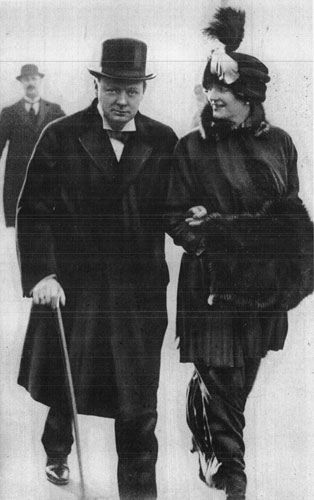
MR. AND MRS. WINSTON SPENCER CHURCHILL
A Recent Photograph of the Head of the British Admiralty.
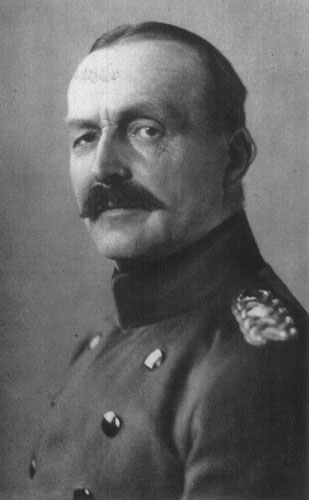
QUARTERMASTER GENERAL VON STEIN
Germany's Official War News Is Issued Through the Office of the Quartermaster General.
(Photo from Brown Bros.)
DOCUMENT NO. 1
Report of Gen. Ducarme, Chief of the Belgian General Staff, to the Belgian Minister of War
"Confidential Letter to the Minister Concerning the Confidential Conversations.
"BRUSSELS, April 10, 1906.
"Mr. Minister:
"I have the honor to report to you briefly about the conversations which I had with Lieut. Col. Barnardiston and which have already been the subject of my oral communications.
"The first visit took place in the middle of January. Mr. Barnardiston referred to the anxieties of the General Staff of his country with regard to the general political situation, and because of the possibility that war may soon break out. In case Belgium should be attacked, the sending of about 100,000 troops was provided for.
"The Lieutenant Colonel asked me how such a measure would be regarded by us. I answered him, that from a military point of view it could not be but favorable, but that this question of intervention was just as much a matter for the political authorities, and that, therefore, it was my duty to inform the Minister of War about it.
"Mr. Barnardiston answered that his Minister in Brussels would speak about it with our Minister of Foreign Affairs.
"He proceeded in the following sense: The landing of the English troops would take place at the French coast in the vicinity of Dunkirk and Calais, so as to hasten their movements as much as possible. The entry of the English into Belgium would take place only after the violation of our neutrality by Germany. A landing in Antwerp would take much more time, because larger transports would be needed, and because, on the other hand, the safety would be less complete.
"This admitted, there would be several other points to consider, such as railway transportation, the question of requisitions which the English army could make, the question concerning the chief command of the allied forces.
"He inquired whether our preparations were sufficient to secure the defense of the country during the crossing and the transportation of the English troops—which he estimated to last about ten days.
"I answered him that the places Namur and Liége were protected from a coup de main and that our field army of 100,000 men would be capable of intervention within four days.
"After having expressed his full satisfaction with my explanations, my visitor laid emphasis on the following facts: (1) That our conversation was entirely confidential; (2) that it was not binding on his Government; (3) that his Minister, the English General Staff, he and I were, up to the present, the only ones[1] informed about the matter; (4) that he did not know whether the opinion of his sovereign had been consulted....
"In a following discussion Lieut. Col. Barnardiston assured me that he had never received confidential reports of the other Military Attachés about our army. He then gave the exact numerical data of the English forces; we could depend on it, that in twelve or thirteen days two army corps, four cavalry brigades, and two brigades of horse infantry would be landed.
"He asked me to study the question of the transport of these forces to that part of the country where they would be useful, and he promised to give me for this purpose details about the composition of the landing army.
"He reverted to the question concerning the effective strength of our field army, and he emphasized that no detachments should be sent from this army to Namur and Liége, because these places were provided with garrisons of sufficient strength.
"He asked me to direct my attention to the necessity of granting the English Army the advantages which the regulations concerning the military requisitions provided for. Finally he insisted upon the question of the chief command.
"I answered him that I could say nothing with reference to this last point and promised him that I would study the other questions carefully....
"Later on the English Military Attaché confirmed his former calculations: twelve days would at least be necessary to carry out the landing at the French coast. It would take a considerably longer time (1 to 2-1/2 months) to land 100,000 men in Antwerp.
"Upon my objection that it would be unnecessary to await the end of the landing in order to begin with the railway transportations, and that it would be better to proceed with these when the troops arrived at the coast, Lieut. Col. Barnardiston promised to give me exact data as to the number of troops that could be landed daily.
"As regards the military requisitions, I told my visitor that this question could be easily regulated....
"The further the plans of the English General Staff progressed, the clearer became the details of the problem. The Colonel assured me that one-half of the English Army could be landed within eight days; the rest at the conclusion of the twelfth or thirteenth day, with the exception of the horse infantry, which could not be counted upon until later.
"In spite of this I thought I had to insist again upon the necessity of knowing the exact number of the daily shipments, in order to regulate the railway transportation for every day.
"The English Military Attaché conversed with me about several other questions, namely:
"(1) The necessity of keeping the operations secret and of demanding strict secrecy from the press;
"(2) The advantages which would accrue from giving one Belgian officer to each English General Staff, one interpreter to each commanding officer, and gendarmes to each unit of troops, in order to assist the British police troops....
"In the course of another interview Lieut. Col. Barnardiston and I studied the combined operations to take place in the event of a German offensive with Antwerp as its object and under the hypothesis of the German troops marching through our country in order to reach the French Ardennes.
"In this question, the Colonel said he quite agreed with the plan which I had submitted to him, and he assured me also of the approval of Gen. Grierson, Chief of the English General Staff.
"Other secondary questions which were likewise settled had particular reference to intermediary officers, interpreters, gendarmes, maps, photographs of the uniforms, special copies, translated into English, of some Belgian regulations, the regulations concerning the import duties on English provisions, to the accommodation of the wounded of the allied armies, &c. Nothing was resolved on as regards the activity which the Government or the military authorities might exert on the press....
"During the final meetings which I had with the British Attaché, he informed me about the numbers of troops which would be daily disembarked at Boulogne, Calais, and Cherbourg. The distance of the last place, which is necessary for technical considerations, will involve a certain delay. The first corps would be disembarked on the tenth day, and the second on the fifteenth day. Our railways would carry out the transportation so that the arrival of the first corps, either in the direction of Brussels-Louvain or of Namur-Dinant, would be assured on the eleventh day, and that of the second on the sixteenth day.
"I again, for a last time, and as emphatically as I could, insisted on the necessity of hastening the sea transports so that the English troops could be with us between the eleventh and twelfth day. The happiest and most favorable results can be reached by a convergent and simultaneous action of the allied forces. But if that co-operation should not take place, the failure would be most serious. Col. Barnardiston assured me that everything serving to this end would be done....
"In the course of our conversations, I had occasion to convince the British Military Attaché that we were willing, so far as possible, to thwart the movements of the enemy and not to take refuge in Antwerp from the beginning.
"Lieut. Col. Barnardiston on his part told me that, at the time, he had little hope for any support or intervention on the part of Holland. At the same time he informed me that his Government intended to transfer the basis of the British commissariat from the French coast to Antwerp as soon as all German ships were swept off the North Sea....
"In all our conversations the Colonel regularly informed me about the secret news which he had concerning the military circumstances and the situation of our eastern neighbors, &c. At the same time he emphasized that Belgium was under the imperative necessity to keep herself constantly informed of the happenings in the adjoining Rhinelands. I had to admit that with us the surveillance service abroad was, in times of peace, not directly in the hands of the General Staff, as our legations had no Military Attachés. But I was careful not to admit that I did not know whether the espionage service which is prescribed in our regulations was in working order or not. But I consider it my duty to point out this position which places us in a state of evident inferiority to our neighbors, our presumable enemies.
"Major General, Chief of the General Staff. (Initials of Gen. Ducarme.)
"Note.—When I met Gen. Grierson at Compiègne, during the manoeuvres of 1906, he assured me the result of the reorganization of the English Army would be that the landing of 150,000 would be assured and, that, moreover, they would stand ready for action in a shorter time than has been assumed above.
"Concluded September, 1906." (Initials of Gen. Ducarme.)
DOCUMENT NO. 2
Minutes of a Conference Between the Belgian Chief of the General Staff, Gen. Jungbluth, and the British Military Attaché Lieut. Col. Bridges
(Lieut. Col. Barnardiston, British Military Attaché in Brussels, was succeeded in his office by Lieut. Col. Bridges. Likewise, Gen. Ducarme was succeeded, as Chief of the Belgian Staff, by Gen. Jungbluth. A conversation between Col. Bridges and Gen. Jungbluth was committed to writing, and that writing was also found at the Belgian Foreign Office. The document, which is dated April 23 and is presumed to belong to the year 1912, is marked "confidentielle" in the handwriting of Graf v.d. Straaten, the Belgian Foreign Secretary. This is the translation:)
"Confidential.
"The British Military Attaché asked to see Gen. Jungbluth. The two gentlemen met on April 23.
"Lieut. Col. Bridges told the General that England had at her disposal an army which could be sent to the Continent, composed of six divisions of infantry and eight brigades of cavalry—together 160,000 troops. She has also everything which is necessary for her to defend her insular territory. Everything is ready.
"At the time of the recent events the British Government would have immediately effected a disembarkment in Belgium (chez nous) even if we had not asked for assistance.
"The General objected that for that our consent was necessary.
"The Military Attaché answered that he knew this, but that—since we were not able to prevent the Germans from passing through our country—England would have landed her troops in Belgium under all circumstances (en tout état de cause).
"As for the place of landing, the Military Attaché did not make a precise statement; he said that the coast was rather long, but the General knows that Mr. Bridges, during Easter, has paid daily visits to Zeebrugge from Ostend.
"The General added that we were, besides, perfectly able to prevent the Germans from passing through."
DOCUMENT NO. 3
Report of Baron Greindl, Belgian Minister in Berlin, to the Belgian Minister of Foreign Affairs
[On the 23d of December, 1911, Baron Greindl, then and for many years Belgian Minister in Berlin, made a report to the Belgian Minister of Foreign Affairs. There was found in Brussels a copy of this report. Although a copy, the official character of this third document found in Brussels is evident from the official imprint on the paper on which the copy stands. The first page reads:]
....... SECTION No. ........... ..... ENCLOSURE COPY Reply to No. General department Office of ........
BERLIN, Dec. 23, 1911.
Belgian Legation, No. 3,022—1,626.
Strictly Confidential.
What is Belgium to do in case of war?
Mr. Minister:
I have had the honor to receive the dispatch of the 27th November last, P without docket number, registration number 1,108....
[Baron Greindl's report is an extremely long one. Extracts from it were published in The North German Gazette of Oct. 13. A facsimile has been made of the first page only of the document, because of its great length.
The writer reveals with great astuteness the ulterior motives underlying the English proposal and draws attention to the danger of the situation in which Belgium had become involved by a one-sided partisanship in favor of the powers of the Entente. In this very detailed report, dated Dec. 23, 1911, Baron Greindl explains that the plan of the General Army Staff for the defense of Belgian neutrality in a Franco-German war as communicated to him only concerned the question as to what military measures should be adopted in case Germany violated Belgian neutrality. The hypothesis of a French attack on Germany through Belgium had, however, just as much probability in itself. The diplomat then goes on in the following manner:]
"From the French side danger threatens not only in the south of Luxemburg, it threatens us on our entire joint frontier. We are not reduced to conjectures for this assertion. We have positive evidence of it.
"Evidently the project of an outflanking movement from the north forms part of the scheme of the entente cordiale. If that were not the case, then the plan of fortifying Flushing would not have called forth such an outburst in Paris and London. The reason why they wished that the Scheldt should remain unfortified was hardly concealed by them. Their aim was to be able to transport an English garrison, unhindered, to Antwerp, which means to establish in our country a basis of operation for an offensive in the direction of the Lower Rhine and Westphalia, and then to make us throw our lot in with them, which would not be difficult, for, after the surrender of our national centre of refuge, we would, through our own fault, renounce every possibility of opposing the demands of our doubtful protectors after having been so unwise as to permit their entrance into our country. Col. Barnardiston's announcements at the time of the conclusion of the entente cordiale, which were just as perfidious as they were naïve, have shown us plainly the true meaning of things. When it became evident that we would not allow ourselves to be frightened by the pretended danger of the closing of the Scheldt, the plan was not entirely abandoned, but modified in so far as the British Army was not to land on the Belgian coast, but at the nearest French harbors.
"The revelations of Capt. Faber, which were denied as little as the newspaper reports by which they were confirmed or completed in several respects, also testify to this. This British Army, at Calais and Dunkirk, would by no means march along our frontier to Longwy in order to reach Germany. It would directly invade Belgium from the northwest. That would give it the advantage of being able to begin operations immediately, to encounter the Belgian Army in a region where we could not depend on any fortress, in case we wanted to risk a battle. Moreover, that would make it possible for it to occupy provinces rich in all kinds of resources and, at any rate, to prevent our mobilization or only to permit it after we had formally pledged ourselves to carry on our mobilization to the exclusive advantage of England and her allies.
"It is therefore of necessity to prepare a plan of battle for the Belgian Army also for that possibility. This is necessary in the interest of our military defense as well as for the sake of the direction of our foreign policy, in case of war between Germany and France."
[The text of the documents presented above is not disputed by the Belgian Government. Instead it is made the basis of the Belgian reply, beginning on the next page.]