Holland’s Future
Reading edition
By H.G. Wells.
(Copyright by The New York Times Company.)
The article which follows was written by H.G. Wells for publication in England. The British censor, however, refused to permit its appearance there, and thus it was printed in the United States for the first time by The New York Times on Feb. 7, 1915. In the development of his argument Mr. Wells points out that "the Dutch hold a sword at the back of Germany." That Holland has no intention of sheathing this sword, so removing a menace from Germany, is indicated by the recent cable from The Hague telling of the message sent by the Government to the Second Chamber of the Legislature dealing with pending legislation to prolong the term of enlistment in the regular army, in which this language is used: "The position of our country demands today, as it did in August, that our entire military force should be at all times available."
WHAT changes for Holland are likely to result from the present war?
Let me, as an irresponsible journalist, try to estimate them, and try to forecast what Holland is likely to do in the next few months. I do not want for a moment to suggest what Dutchmen ought to do; this preaching to highly intelligent neutrals is not a writer's business, but I want to imagine how things must look in the private mind of a wary patriotic Hollander, and to guess what may be the outcome. Because in many ways Holland does seem to hold the key to the present situation.
It is clear that whatever fears may have been felt for the integrity of Holland at the beginning of the war must now be very much abated. The risk of Germany attacking Holland diminishes with each day of German failure, and the whole case and righteousness of the Allies rests upon their respect for Holland. Holland's position as regards Germany now is extraordinarily strong materially, and as regards the Allies it is overwhelmingly strong morally. She has behaved patiently and sanely through a trying crisis. She has endured much almost inevitable provocation and temptation with dignity and honesty. Were she now subjected to any German outrage she could strike with her excellent army of 400,000 men at Aix-la-Chapelle, and turn repulse into rapid disaster.
That is the interesting thing about the Dutch position now. The Dutch hold a sword at the back of Germany. Were they to come into the war on the German side, they would, no doubt, provide a most effective but certainly not a decisive reinforcement to the German western front, but they would also lay open a convenient way for the Allies to the vital part of Germany, Westphalia. But were they to come in on the side of the Allies they would at once deliver a conclusive blow. They could cut the main communications of the German army in Flanders, they could round up and assist to capture a very large portion of the German western forces, and they could open the road not only to attack but to turn the Rhine defenses. In fact, they could finish Germany.
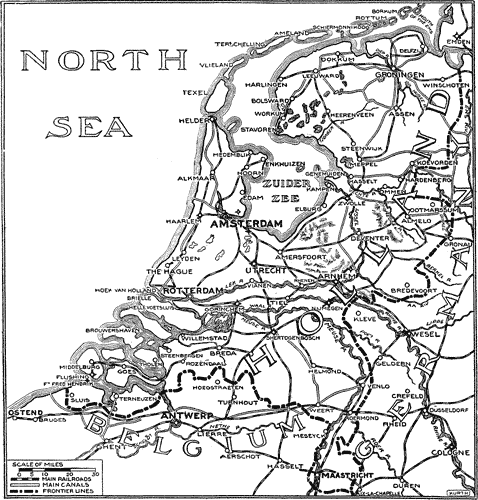
This situation is already fairly obvious; I betray no strategic secret; it must become manifest to every Dutchman before many more weeks. One has but to look at the map. Every day now diminishes the possibility of Germany being able to make any effective counterattack, any Belgian destruction, in Holland, and every day increases the weight of the blow that Holland may deliver. What are the chances that Holland may not ultimately realize to the full the possibilities of that blow and join the Allies?
Against her doing so is the consideration that she is doing very well as she is. She keeps her freedom. Practically the Allies fight to secure it for her. The dread of Germanization which has hung over Holland for forty years seems to recede.
And, of course, as a secondary restraining force there is the reasonable fear of devastation. The "good German" vindictiveness might make one last supreme effort.
But, on the other hand, is she really doing as well as it seems? Unless she intervenes this war will probably last for another full year. She wants it to end. It is a terrible oppression. Her army must remain mobilized, even if it does not fight. Her trade stagnates. She is incumbered by refugees. What if she struck to end the war and get the tension over? Not now, perhaps, but presently. Simultaneously with the Franco-British counter-stroke that now draws near.
And what if she struck also for a hatred of what has happened to Belgium? Suppose the Dutch are not so much frightened by the horrible example of Belgium as indignant. My impression of the Dutch—and we English know something of the Dutch spirit—is that they are a people not easily cowed. Suppose that they have not only a reasonable fear but a reasonable hatred of "frightfulness." Suppose that an intelligent fellow-feeling for a small nation has filled them with a desire to give Germany a lesson. There, it may be, is a second reason why Holland should come in.
And by coming in, there is something more than the mere termination of a strain and the vindication of international righteousness to consider. There is the possibility, and not only the possibility but the possible need, that Holland should come out of this world war aggrandized. I want to lay stress upon that, because it may prove a decisive factor in this matter.
The Dutch desire aggrandizement for the sake of aggrandizement as little as any nation in Europe. But what if the path of aggrandizement be also the path of safety?
It is clear that both France and Belgium will demand and receive territorial compensation for these last months of horror. It is ridiculous to suppose that the Germans may fling war in its most atrocious and filthy form over Belgium and some of the sweetest parts of France without paying bitterly and abundantly for the freak.
Quite apart from indemnities, France and Belgium must push forward their boundaries so far that if ever Germany tries another rush she will have to rush for some days through her own lost lands. The only tolerable frontier against Germans is a day's march deep in Germany. Of course, Liége will have to be covered in the future by Belgian annexations in the Aix region and stretching toward Cologne, and France will go to the Rhine. I think Belgium as well as France will be forced to go to the Rhine.
It is no good talking now of buffer States, because the German conscience cannot respect them. Buffer States are just anvil States. At any rate, very considerable annexations of German territory by Belgium and France are now inevitable, and Holland must expect a much larger and stronger Belgium to the south of her, allied firmly to France and England.
And to the north is it very likely that the British will be able to tolerate the continued German possession of the Frisian Islands? These islands, and the coast of East Friesland, have had but one use in German hands, and that use has been the preparation of attacks on England. Clearly the British may decide to have no more of such attacks. Every advance in scientific warfare may make them more dangerous and exasperating. The British intend soberly and sanely to do their utmost to make a repetition of the present war impossible. To secure this they may find it necessary to have Germany out of the North Sea. But they have no desire whatever to take either the Frisian Islands or East Friesland, if Holland will save them that trouble.
Now, suppose the Dutch will not think of this now. Suppose, for the want of their aid, the Allies are unable to press the war to the complete regimentation of Germany, what will be the position of Holland in twenty years' time?
[Enlarge]
She will stand between England and Germany. A Germany incompletely beaten means an Anglophobe Germany. Belgium and France expanded, recuperated, allied, linked by a common literature and language, may be too formidable for another German attack. So that there is the possibility that in twenty years' time or so Germany, recovering and vindictive, may in some way contrive to hold off France and Belgium, and try her luck against England alone. By that time submarine and aeroplane may be so developed as to render a German attack on England much more hopeful than it is at present, especially by way of the Rhine mouth. What, in the light of the Belgian experience and the new doctrine of a "right of way," will be the outlook for a little isolated Holland, as small as she is now, as a buffer State in such a case.
She has always been claimed as a part of the great Pan-German scheme, and at any time she may find the German heel upon her face, vindictively punishing her for her lack of enthusiasm for Teutonic brotherhood. Hadn't she better get herself a little larger and stronger now; hadn't she better help to make the ending of the German threat more conclusive, and link herself definitely with the grand alliance of the Western Powers? Now she could make a very good bargain indeed. If she inquired she would find Britain ready enough to guarantee the integrity and protection of Holland's colonial empire forever by the British fleet. All the four Western Powers, France, Belgium, Holland, Britain, would be willing to make the most binding pledges for such mutual protection. It is the manifest common-sense of the settlement that they should set up such a collective guarantee. And, in addition, there are those Frisian Islands, and East Friesland, and that dangerous wedge that Germany drives into Holland along the Rhine. It is not difficult to map a very much improved Dutch frontier along the Ems, and thence striking down to the Rhine and meeting the iron country on the left bank of the Rhine, whose annexation and exploitation is Belgium's legitimate compensation for her devastation and sufferings. Here are the makings of a safer Greater Holland! Thousands of Dutchmen must be looking on the map at the present time and thinking such things as this. There, clearly and attractively, is the price of alliance.
The price of neutrality is an intact Holland—and a certain isolation in the years ahead. But still, I admit, a not unhappy Holland, Dutch and free. Until a fresh Anglo-German struggle begins. Yet, be it noted, a Holland a little helpless and friendless if some renascent Asiatic Power should presently covet her Eastern possessions.
The price of participation with Germany, on the other hand, is complete envelopment in the warm embrace of the "good German brotherhood"—the gradual substitution of the German language for the Dutch, and a Germanization of such colonies as the Allies may still leave for Holland, frequent State visits from Kaisers, and the subordination of Dutch mercantile interests to those of Hamburg and Altona and (Germanized) Antwerp. And—the everlasting howling everywhere of "Deutschland, Deutschland über Alles."
(No! No! They will never fight for the Germans. No sane people will ever fight for the Germans if they can possibly avoid it. Not even our press censorship, not even the Maximilian Krafts in our silliest weekly papers will provoke Holland to that.)
But I have a sort of feeling, for the reasons I have stated, that even without any serious breach of Dutch neutrality by the Germans, Holland may decide presently to put her troops beside the Belgians. And if, as is always possible, the Germans do make some lumpish onslaught upon Dutch neutrality, then I am convinced that at once that sturdy little country will up and fight like the very devil. And do remarkably well by it.
And I have a much stronger feeling that presently the Dutch Government will ask the Germans to reconsider their proposed annexation of Belgium. Upon that point Holland has absolutely dictatorial power at the present moment. She could secure the independence of Belgium at the cost of a little paper and ink, she could force Germany to evacuate her sister country by the mere movement of her army.
Copyright in U.S.A.