Volume 2 / Part 3 — PART III BLUE-JACKETS OF '61. (continued 6)
Reading edition
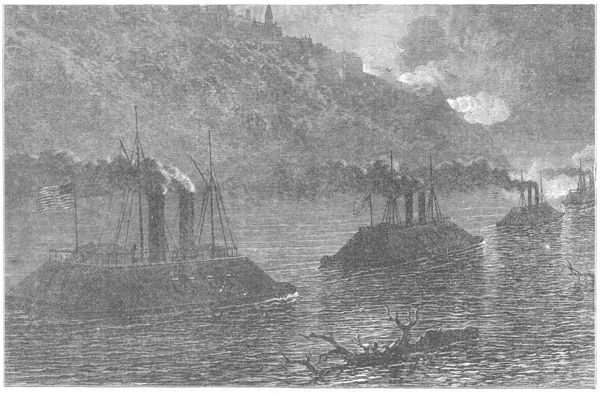
Passing the Vicksburg Batteries.
"Since that day the regular siege has continued. We are utterly cut off from the world, surrounded by a circle of fire. Would it be wise, like the scorpion, to sting ourselves to death? The fiery shower of shells goes on day and night. H——'s occupation, of course, is gone, his office closed. Every man has to carry a pass in his pocket. People do nothing but eat what they can get, sleep when they can, and dodge the shells. There are three intervals when the shelling stops,—either for the guns to cool, or for the gunners' meals, I suppose,—about eight in the morning, the same in the evening, and at noon. In that time we have to both prepare and eat ours. Clothing cannot be washed, or any thing else done. On the 19th and 22d, when the assaults were made on the lines, I watched the soldiers cooking on the green opposite. The half-spent balls, coming all the way from those lines, were flying so thick that they were obliged to dodge at every turn. At all the caves I could see from my high perch, people were sitting, eating their poor suppers at the cave doors, ready to plunge in again. As the first shell again flew, they dived; and not a human being was visible. The sharp crackle of the musketry-firing was a strong contrast to the scream of the bombs. I think all the dogs and cats must be killed or starved: we don't see any more pitiful animals prowling around.... The cellar is so damp and musty, the bedding has to be carried out and laid in the sun every day, with the forecast that it may be demolished at any moment. The confinement is dreadful. To sit and listen as if waiting for death in a horrible manner, would drive me insane. I don't know what others do, but we read when I am not scribbling in this. H—— borrowed somewhere a lot of Dickens's novels, and we re-read them by the dim light in the cellar. When the shelling abates, H—— goes to walk about a little, or get the 'Daily Citizen,' which is still issuing a tiny sheet at twenty-five and fifty cents a copy. It is, of course, but a rehash of speculations which amuses a half-hour. To-day he heard, while out, that expert swimmers are crossing the Mississippi on logs at night, to bring and carry news to Johnston. I am so tired of corn-bread, which I never liked, that I eat it with tears in my eyes. We are lucky to get a quart of milk daily from a family near, who have a cow they hourly expect to be killed. I send five dollars to market each morning, and it buys a small piece of mule-meat. Rice and milk is my main food: I can't eat the mule-meat. We boil the rice, and eat it cold, with milk, for supper. Martha runs the gauntlet to buy the meat and milk once a day in a perfect terror. The shells seem to have many different names. I hear the soldiers say, 'That's a mortar-shell. There goes a Parrott. That's a rifle-shell.' They are all equally terrible. A pair of chimney-swallows have built in the parlor chimney. The concussion of the house often sends down parts of their nest, which they patiently pick up and re-ascend with."
Grant's impassable lines about the beleaguered city soon made starvation more to be feared than even the terrible shells from the cannon of the gunboats. Necessaries of all sorts became woefully scarce in Vicksburg. Five dollars could purchase only a little bit of mule's flesh, hardly enough for a meal for two people. Flour was not to be had at any price. Bread was made of coarse corn-meal or grated peas. The ammunition of the soldiers in the trenches soon began to give out, and the utmost economy was exercised. Many of the soldiers were armed with muskets that required caps, and it was not many days before caps were at a great premium. They were generally smuggled into the city through the Union lines by fleet-footed carriers, who ran a long gauntlet of Union pickets. Many were shot down in the attempt, but more succeeded. One man who brought in sixteen thousand caps, was nine days travelling thirteen miles, and was fired on more than twenty times.
But, though Grant could have starved the city into subjection by simply sitting and waiting, he grew tired of this, and determined to force matters to an issue. The first thing to be done was to get the gunboats and transports past the batteries. The transports were put into shape to stand a cannonade by having their weaker parts covered with cotton-bales; and on one dark night in June, the flotilla started down the river, with the iron-clad gunboats in advance. Admiral Porter led in the "Benton." At eleven o'clock the fleet got under way; and, as the "Benton" came abreast of the first batteries, the alarm was given in the Confederate camp, and a fierce cannonade began. Huge fires were lighted on the shores to light up the river, and make the gunboats visible to the Confederate cannoneers. The warships swung grandly around the bend, responding with rapid broadsides to the fire of the forts. All the vessels were hit once or oftener. The heavy smoke that accompanies such fierce cannonading hung over the river, cutting off all view of the surroundings from the sailors. The eddying currents of the river caught the steamers, swinging them now this way, now that, until the perplexed pilots knew not which way their vessels were headed. The blue-jackets at the guns worked away cheerily, knowing that enemies were on every side of them, and that, no matter which way their missiles sped, an enemy was to be found. More than one vessel turned completely around; and once, when the rising breeze cleared away the smoke, the pilot of the "Benton" found that he was taking his ship up-stream again, and was in imminent danger of running down a friendly gunboat. But they all passed on without receiving any severe injuries, and at five o'clock in the morning lay anchored far below the city, ready to begin the attack upon the Confederate batteries at Grand Gulf, which were called "the key to Vicksburg."[Back to Contents]
CHAPTER XVI.
VICKSBURG SURRENDERS, AND THE MISSISSIPPI IS OPENED. — NAVAL EVENTS ALONG THE GULF COAST.
he first grand step toward the capture of Vicksburg was made when the river-flotilla followed Porter down the Mississippi, and past the guns of the Confederate batteries. Grant, with his army, had followed along the western bank of the great river; and we now find him ready to cross the river, and move upon the Vicksburg batteries from the south. But, before this could be done, the Confederate works at Grand Gulf must be silenced; and it again happened that the navy was to be the chief factor in the contest. For this new battle all the blue-jackets were ready and anxious. Admiral Porter says that "when daylight broke, after the passage of the fleet, I was besieged by the commanding officers of the gunboats, who came to tell me of their mishaps; but, when I intimated that I intended to leave at Carthage any vessel that could not stand the hammering they would be subject to at Grand Gulf, they suddenly discovered that no damage had been done to their vessels, which, if any thing, were better prepared for action than when they started out!"

The Confederate works at Grand Gulf mounted eighteen guns; and, as they stood upon high bluffs overlooking the river, they were most formidable. It was decided by the Federals that the navy alone should undertake the task of reducing the fortifications,—a decision that was of benefit to the Confederates, for their strongest position was along the river-front. Four of the guns held a raking position up and down the long stretch of muddy water that swirled and eddied by with a current of seven miles an hour.
While the fort had the advantage of position, the gunboats were much stronger in their armament; and the contest was looked forward to as one bound to be desperate. The position of every gun in the batteries, and the size of the garrison, were well known to every commander of a Union vessel; and they made the most careful preparations for the assault.
The Confederates knew that the result of that day's battle would decide the ownership of Vicksburg, and they were prepared to offer the most desperate resistance. The orders at every battery were to use shell alone; and the men were instructed to fire carefully, and only after taking deadly aim. In a high tree just outside the fort a lookout was stationed; and at early daylight, on the morning of the 29th of April, 1863, he signalled that the fleet of gunboats was bearing down upon the works.
Men who were in the fort that morning saw a strange panorama. The stillness was most profound on the shore and on the river. The boats moved slowly and grandly down, not a man in sight, and with no sign of life. The trees up the river were black with Federal spectators; and the chirp of birds was all about the men who stood waiting beside the huge cannon.
Porter went at his work with a vim which made the forest tremble and the river bubble. For the first few minutes the Confederates were appalled by the fierceness of the fire, which stands on record as the fastest in the war; but, when the forts did get down to their work, they went in with a roar that almost deafened the Federal soldiers three miles away. Great shells burst over the gunboats, or, falling into the water close by their sides, threw up columns of water that deluged the decks. The vessels found the greatest difficulty in getting good positions for the swift-eddying current. One moment they were bow on, the next headed down stream, or up, or whirling around in circles. Of course this greatly hurt the aim of the gunners, but it likewise made the vessels poor targets for the Confederates.
Three gunboats—the "Benton," "Tuscumbia," and "Lafayette"— engaged the upper battery; and nowhere in naval history is found the record of faster firing than was done by these ships. Their huge shells tore away at the walls of earth, throwing up tons of dirt with each explosion, but not seeming to affect the strength of the fort at all. Not a shot entered an embrasure, though many came near it. One of the Confederate artillerists said after the fight,—
"There was not one single minute in all that five hours in which I did not expect death. We all worked away as if in a nightmare, and we all felt that any moment might be our last. The 'Benton' fired repeatedly at my gun; and as many as twenty of her shells struck the opening, tearing holes in the parapet ten feet back. Twenty times we were almost buried out of sight under the clouds of dirt, and the loose earth was knee deep around our gun when the fight closed. Not one of us was hit hard enough to draw blood, and yet we all felt ten years older for that five hours' work. I sighted the gun, and saw fourteen of my shot hit the 'Benton,' and six plunge into another."
The gunboats fought in a way that showed desperate determination. The first gun from the "Lafayette" was answered by a shell which crashed through her side and exploded in a wardroom, knocking every thing into chips. Three times the carpenter came up and reported to the captain that the ship was sinking; and each time the reply was, "Very well, sir: keep right on firing until the guns are under water." When the ship came out of the fight, she counted up fifty scars.
The long-range firing that was carried on at first did not satisfy the "Mound City." One particular gunner on the Confederate works seemed to cherish a spite against her; and every time the flame leaped from the muzzle of his gun, a solid shot banged against the gunboat's side. This was not to be tamely borne; and the "Mound City" rushed up so close to the bank that her bow stirred up the mud, and from that position opened fast and furiously upon the forts with grape and canister. A hail of rifle-bullets fell upon her decks; but she stuck to her post, and succeeded in driving the enemy to the bomb-proofs.
But, with all their pluck and rapid firing, the gunners of the fleet were making no impression on the works. Gen. Grant, who was watching the engagement from a tug in mid-stream, saw this, and determined to rush his soldiers past the fort in transports, while the navy engaged the enemy's guns. This was done quickly, and towards night the ships returned to their post up the river, leaving the Confederates in possession of the batteries. But the great point had been gained; and Grant's army was moving on Vicksburg, with nothing to interfere with its besieging operations.
Then began that series of attacks and repulses, of building trenches, paralleling, and advancing steadily, until the lines of the Federals and the Confederates were so close together that the men used to shout jokes and taunts over the breastworks. All the Confederates were known as "Johnnies," and all Union soldiers as "Yanks." Often "Johnny" would call out, "Well, Yank, when are you coming into town?" Sometimes the answer was, "We propose to celebrate the Fourth of July there." The "Johnnies" did not believe this; but it was true, nevertheless, for on July 4 Grant's victorious army marched into Vicksburg. A day or two later the Confederate works at Port Hudson and Grand Gulf were surrendered to the Federals, and the Mississippi was again open for commerce throughout its length.
When the fall of Vicksburg had thus left the river clear, Admiral Porter was ordered to take his fleet up the Red River, and clear away any Confederate works that he might find on the banks of that stream. Gen. A. J. Smith, with a strong body of troops, accompanied him; while Gen. Banks was to march his troops overland from Texas, and join the expedition at Shreveport. For several days the gunboats pressed forward up the crooked stream, meeting with no opposition, save from the sharp-shooters who lined the banks on either side, and kept up a constant fire of small-arms.
Shreveport was reached in safety; and, after a short halt, the flotilla started again on their voyage up the river. They had proceeded but a short distance when a courier came galloping down the river's bank, waving a despatch, which he handed to Admiral Porter.
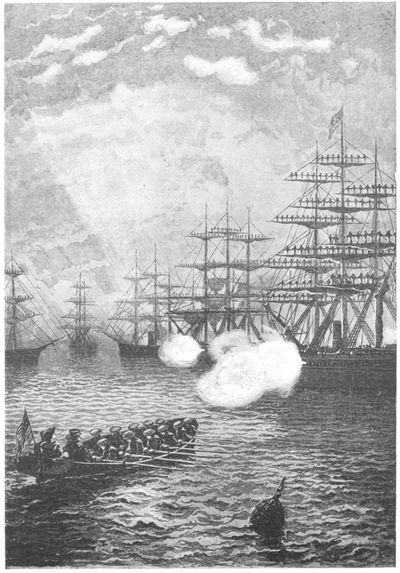
Manning the Yards.
"The despatch read, 'Gen. Banks badly defeated; return,' Here was a dilemma to be placed in,—a victorious army between us and our own forces; a long, winding, shallow river wherein the vessels were continually grounding; a long string of empty transports, with many doubtful captains, who were constantly making excuses to lie by or to land (in other words, who were trying to put their vessels into the power of the Confederates); and a thousand points on the river where we could be attacked with great advantage by the enemy; and the banks lined with sharp-shooters, by whom every incautious soldier who showed himself was shot."
But, though the admiral clearly saw all the dangers he was exposed to, and which he recounts in the foregoing paragraph, he did not propose to return, but pressed forward. He soon reached the scene of battle, and with the big guns of his boats covered the retreat of the troops; then, having done all there was to be done, started down the river.
But now came the great trouble of the whole expedition. Those Southern rivers are accustomed in summer to fall rapidly until they become mere dry ditches, with a narrow rivulet, hardly deep enough to float a row-boat, flowing down the centre. This was the summer season, and the Red River was falling fast. The banks swarmed with gray-coated soldiery, anxious to be on hand to capture the ships. At Grand Écore the "Eastport" became unmanageable, and was blown up. The fleet continued on its way quietly, until a serious obstacle was met. Admiral Porter writes:—
"One of the 'Cricket's' guns was mounted on the upper deck forward, to command the banks; and a crew of six men were kept stationed at it, ready to fire at any thing hostile.
"We went along at a moderate pace, to keep within supporting distance of each other. I was sitting on the upper deck, reading, with one eye on the book and the other on the bushes, when I saw men's heads, and sang out to the commanding officer, Gorringe, 'Give those fellows in the bushes a two-second shell.' A moment after the shell burst in the midst of the people on the bank.
"'Give them another dose,' I said, when, to my astonishment, there came on board a shower of projectiles that fairly made the little 'Cricket' stagger. Nineteen shells burst on board our vessel at the first volley. It was the gun-battery of which our prisoner had told us. We were going along at this time about six knots an hour; and, before we could fire another gun, we were right under the battery and turning the point, presenting the 'Cricket's' stern to the enemy. They gave us nine shells when we were not more than twenty yards distant from the bank, all of which burst inside of us; and, as the vessel's stern was presented, they poured in ten more shots, which raked us fore and aft.
"Then came the roar of three thousand muskets, which seemed to strike every spot in the vessel. Fortunately her sides were musket-proof.
"The 'Cricket' stopped. I had been expecting it. How, thought I, could all these shells go through a vessel without disabling the machinery? The Rebels gave three cheers, and let us drift on: they were determined to have the whole of us. They opened their guns on the two pump-boats, and sunk them at the first discharge. The poor negroes that could swim tried to reach the shore; but the musketeers picked off those that were in the water or clinging to the wrecks. It was a dreadful spectacle to witness, with no power to prevent it; but it turned out to be the salvation of the 'Cricket.' All this took place in less than five minutes.
"The moment the 'Cricket' received the first discharge of artillery, I went on deck to the pilot-house, saluted by a volley of musketry as I passed along; and, as I opened the pilot-house door, I saw that the pilot, Mr. Drening, had his head cut open by a piece of shell, and the blood was streaming down his cheeks. He still held on to the wheel. 'I am all right, sir,' he said: 'I won't give up the wheel.'
"Gorringe was perfectly cool, and was ringing the engine-room bell to go ahead. In front of the wheel-house, the bodies of the men who manned the howitzer were piled up. A shell had struck the gun, and, exploding, had killed all the crew,—a glorious death for them."
Porter now found himself in a bad fix. His guns could not be elevated enough to bear on the batteries that stood on the crest of the high bluffs. There was nothing to do but to run by at the best possible rate of speed. Suddenly the engine stopped, and the vessel floated helplessly down the stream. Porter rushed below to discover the trouble. In the engine-room stood the engineer leaning heavily against the throttle. Porter shouted at him, but received no reply; then, putting his hand on the man's shoulder, found him dead. The admiral threw the body aside, pulled open the throttle, and the "Cricket" glided along past the batteries to a safe refuge down-stream. The other ships came down safely, although more or less cut up; and the flotilla continued its retreat down the stream. For a day or two all went smoothly as a holiday excursion; then came a sudden reverse, that, for a time, seemed to make certain the loss of the entire fleet. At Alexandria the Red-river bottom is full of great rocks that make it impassable except at the highest water. When Porter's gunboats arrived, they found themselves caught in a trap from which there seemed to be no hope of escape. The army was encamped along the banks of the river, and the soldiers began again their jokes upon Porter's habit of taking gunboats for an overland journey. The army generals began to get impatient, and advised Porter to blow up his ships, as the troops must soon march on and leave him. Porter was sick in bed, but this suggestion aroused him. "Burn my gunboats!" he cried, springing to his feet. "Never! I'll wait here for high water if I have to wait two years." And, indeed, it began to look as though he would be forced to wait nearly that long.
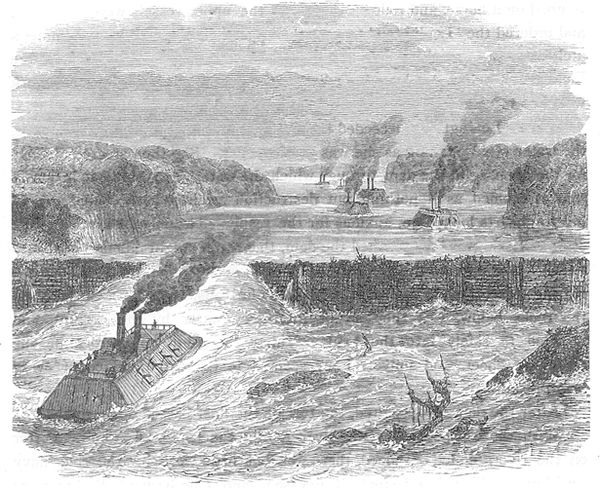
Bailey's Dam on the Red River.
In this time of suspense, there arose a man equal to the emergency. A certain Lieut-Col. Bailey, who had been a Wisconsin lumberman, came to Porter, and suggested that a dam should be built to raise the water fourteen feet above the falls. Porter jumped at the suggestion, and eight thousand men were set to work.
"It will take too much time to enter into the details of this truly wonderful work," writes Admiral Porter. "Suffice it to say that the dam had nearly reached completion in eight days' working-time, and the water had risen sufficiently on the upper falls to allow the 'Fort Hindman,' 'Osage,' and 'Neosho' to get down and be ready to pass the dam. In another day it would have been high enough to enable all the other vessels to pass the upper falls. Unfortunately, on the morning of the 9th instant the pressure of water became so great that it swept away two of the stone barges which swung in below the dam on one side. Seeing this unfortunate accident, I jumped on a horse, and rode up to where the upper vessels were anchored, and ordered the 'Lexington' to pass the upper falls if possible, and immediately attempt to go through the dam. I thought I might be able to save the four vessels below, not knowing whether the persons employed on the work would ever have the heart to renew their enterprise.
"The 'Lexington' succeeded in getting over the upper falls just in time, the water rapidly falling as she was passing over. She then steered directly for the opening in the dam, through which the water was rushing so furiously that it seemed as if nothing but destruction awaited her. Thousands of beating hearts looked on, anxious for the result. The silence was so great as the 'Lexington' approached the dam, that a pin might almost be heard to fall. She entered the gap with a full head of steam on, pitched down the roaring torrent, made two or three spasmodic rolls, hung for a moment on the rocks below, was then swept into deep water by the current, and rounded to safely into the bank. Thirty thousand voices rose in one deafening cheer, and universal joy seemed to pervade the face of every man present."
After the dam was repaired, the rest of the fleet passed down safely.
With the escape of the Red-river flotilla, the career of Admiral Porter on the rivers ended. Indeed, there was but little work for the river navy remaining. The Mississippi, Tennessee, and Cumberland Rivers were opened; and the Confederate works on the smaller streams were unimportant, and could be left to fall with the fall of the Confederacy, which was near at hand. There was work for fighting sea-captains along the Atlantic coast, and thither Admiral Porter was ordered. He will re-appear at the bombardment of Fort Fisher.
An event which caused the greatest excitement in naval circles at this time, and which for courage and dash has probably never been equalled in the history of the world, was the run of the Confederate privateer "Florida" past the United States fleet blockading the harbor of Mobile. The "Florida" was originally a merchant-ship, known as the "Oreto;" and under that name she sailed from Liverpool, carrying a peaceful cargo, and manned by sailors who had no idea that any thing beyond a peaceable voyage was planned. She was commanded by an English sea-captain; and, although the United States consul at Liverpool looked on her with some suspicion, yet he could find no pretext upon which to oppose her departure.
Hardly had the ship passed the mouth of the Mersey, when her course was shaped for Nassau, the haven of privateers and blockade-runners. At Nassau several officers of the Confederate navy were living; and from the anxiety with which they scanned the horizon day after day, through their telescopes, it would seem that they were watching for some friendly craft. The "Oreto" arrived safely at Nassau; and a young gentleman who had come with her made all possible haste ashore, and delivered to the watchful gentlemen in the town certain letters, which made them first look with the greatest satisfaction at the newly arrived ship, and then begin again their outlook for vessels. The letters were from Capt. Bulloch, the agent in London of the Confederacy; and by them he notified his brother naval officers that he delivered to them the "Oreto," an admirably built ship, suited for an armed cruiser. "It has been impossible to get the regular battery intended for her on board," wrote Capt. Bulloch; "but I have sent out four seven-inch rifled guns, with all necessary equipments, in the steamship 'Bahama,' bound for Nassau."
So here were the naval officers and their ship, but the guns were yet to come; and, when they did come, some shrewd planning would be necessary to get the guns mounted without alarming the British authorities. By the time the "Bahama" arrived, the plans were all made. As the steamer came up to the dock, a small schooner slipped alongside, and eight or ten heavy cases were transferred from the larger vessel's hold to the deck of the coaster. Then the little vessel sailed over to Green Cay, a desert island about sixty miles from Nassau, where she was soon joined by the "Oreto." There the work of changing the peaceful merchantman "Oreto" into the war-cruiser "Florida" began.
The work of transferring the armament, and mounting the guns, was very laborious. The hot sun of August at the equator poured down upon them. Exposure and general discomforts told heavily upon them; and before long the yellow-fever, that most terrible scourge of the West Indies, broke out among the men. There was no surgeon on board, and the care of the sick fell upon Capt. Maffitt. Two United States men-of-war were hunting through the West Indies for the vessel they knew was fitting out somewhere amid the coral reefs and sandy, desolate keys. But Maffitt kept up his courage, and before long found himself at sea, with a good stanch ship and crew, that, though short-handed, was made up of the very best material. But he had hardly cut loose from civilization, and started out upon his cruise, when he discovered, that, in the worry and haste of his departure, he had put to sea without rammers or sponges for his guns. He was in a desperate plight. Had the smallest United States man-of-war met the "Florida," the Confederate could not have offered the slightest resistance. She could not have even fired a gun. Capt. Maffitt ran his vessel into Havana in the hopes of being allowed to refit there; but the fortunes of the Confederacy were waning fast, and all nations feared to give it aid or comfort. Seeing no hope, Maffitt determined to dare all things, and make a dash for Mobile through the very centre of the blockading-fleet.
When the "Florida" put out from the harbor of Havana, only four or five men were able to be on deck. The rest, with her commander, were below, deathly sick with yellow-fever. Under the command of a young lieutenant, her course was laid for Mobile; and in a few hours the smoke of the blockading-vessels could be seen rising on the clear air. An English ensign was hoisted, and the fleet ship dashed towards the men-o'-war that lay in wait. A blank cartridge was fired to warn her away, but she paid no heed. Then came a solid shot that ploughed up the water before her bow. As this evoked no response, the whole fleet opened fire with shot and shell. "Had they depressed their guns but a little," said Maffitt afterwards, "the career of the 'Florida' would have ended then and there." But, as it was, she sped on, with no signs of damage save the flying ends of cut cordage. She could not respond to the fire, for but three men remained on her deck. So, silently and grimly, she rushed through the fleet, and finally passed the last frigate. Quarter of an hour later she anchored under the guns of Fort Morgan. She had received eight shots in her hull, and her masts were chipped by dozens of fragments of shell. After refitting, the "Florida" waited nearly a month for a chance to get out again. Finally the moment arrived; and she made her escape, though chased for four hours by the blockaders. Once on the open sea, she began the regular career of Confederate cruisers, burned unarmed ships, and avoided war-vessels, until she was run down in a neutral port by a Union man-of-war, whose commander acted in utter defiance of all the rules of modern warfare. In the career of the "Florida," after her escape from Mobile, there was nothing of moment; and her capture, treacherous as it was, brought more discredit upon the Northern arms than did her depredations work injury to the Northern merchant-marine.[Back to Contents]

CHAPTER XVII.
OPERATIONS ABOUT CHARLESTON. — THE BOMBARDMENT, THE SIEGE, AND THE CAPTURE.
e have now reached the period at which the rapid decline in the prospects of the Confederacy had become apparent, not only to its enemies, but to its friends. Throughout the South the stars and bars floated over only three strongholds of any importance,—Charleston, Mobile, and Wilmington. One after the other these were destined to fall, and their final overthrow was to be the work of the navy. It was no easy task in any one of the three instances to dislodge the Confederates from their positions; for though beaten in the Middle States, driven from the Mississippi, and with their very citadel at Vicksburg in the hands of the Federals, they still fought with a courage and desperation that for a long time baffled the attacks of the Unionists.

From the very opening of the war, Charleston Harbor had been the scene of naval hostilities. The Confederates, looking upon their mouldering wharves, and vessels tugging idly at their chains, then looking out to sea past Fort Sumter, could see the ships of the blockading-squadron maintaining the watchful guard that was slowly reducing the city to penury. What wonder that the blood of the good people of Charleston boiled, and that they built, and hurled against their hated enemy, weird naval monsters, shapeless torpedo-boats running beneath the water, or huge rams that might even batter in the heavy walls of Fort Sumter!
One attack so made was successful to a certain extent. It was in February, 1864, that an inventive genius in the beleaguered city brought out a steam torpedo-boat. The craft was about twenty-five feet long, shaped like a cigar, built of boiler iron, and propelled by a screw. She had no smokestack, and her deck barely rose above the surface of the water. Running out from her bow was a stout spar fifteen feet long, bearing at its end a huge torpedo charged with two hundred pounds of powder. Just before nine o'clock one night, the lookout on the deck of the frigate "Housatonic" saw this strange object approaching the ship. It was a bright night, with no sea on. As yet torpedoes were hardly known, so the lookout took it for a large fish, and simply watched with interest its playful movements. Not until it came so close that no guns could be brought to bear, did any suspicion of danger enter the lookout's mind. Then there was the roll of the alarm-drums; while the men rushed to the side, and poured a fierce fire from small-arms on the mysterious object. The "Housatonic" started her engines, and tried to escape; but, before any headway could be gained, the launch dashed alongside, and a slight jar was felt. Then, with a tremendous roar, a huge column of water was thrown high in air, washing away men and boats from the deck of the warship. A hole large enough to drive a horse through was rent in the hull of the ship. Great beams were broken in twain, the heaviest guns were dismounted, and men were hurled fifty feet into the air. In five minutes the ship had gone to the bottom, and boats from other vessels were picking up the crew. The launch escaped in the excitement.
The Union sailor-boys did not let the Confederates outdo them in dash and pluck. One of the cleverest bits of work in the whole war was done by four boat-crews from two men-of-war on the Charleston station. Word had been brought to the blockaders, that, far up a little deep and narrow creek, a large steamship was loading with cotton, expecting to reach the ocean through the labyrinth of inlets that fairly honeycomb the South Carolina coast. Should she once get into that network of waterways, it would require a whole fleet to catch her; for there was no telling at what point she might emerge.
It was at once determined to try to capture her as she lay at her deck, and four boats' crews of picked men were sent out on the expedition. It was early evening when they set out; and all through the dark night they pulled away, threading the mazes of the tidal inlets. Just as the eastern horizon was beginning to grow gray with the coming dawn, they came in sight of their destination. Sure enough, there on the bank of the river was a little Southern village, changed into a prosperous town by the blockade-runners that had evidently been making this place a harbor for some time.
All was dark and silent as the grave. Confident in their fancied security, the blockade-runners had all turned in, leaving no one on guard. The steamer was loaded, and ready to sail in the morning; and the thin wreaths of smoke rising from her smokestack told that the fires were up. Stealthily the sailors pulled alongside, and clambered on deck. Without a word they stole below, put the crew under guards, and rushed into the engine-room, where they found the engineer dozing on his stool. He was ordered to get under way at once; and, though he looked rather dazed, he obeyed the order. And in fifteen minutes the steamer was speeding down-stream, leaving the old town still asleep.
One man alone of all the townspeople had seen the capture. A negro, hiding behind a pile of lumber on the dock, had watched the whole affair, and, as if struck dumb with astonishment, failed to give the alarm until the steamer was out of sight down the winding stream. The blue-jackets took their capture safely out of the enemy's lines, and the next day it was sent to New York as a prize.
While the navy was keeping the port of Charleston sealed, and every now and then beating back the improvised gunboats that the Confederates sent out in the forlorn hope of breaking through the blockade, the armies of the North were closing in upon the doomed city. All the North cried aloud for the capture of Charleston. It was the city which fired the first gun of the war. Let it be reduced! On every available point of land a Union battery was built. Far out in the swamps back of the city, where it was thought no living thing save reptiles could exist, the soldiers of the North had raised a battery, mounting one two-hundred-pound gun. When a young lieutenant was ordered to build this battery, he looked the ground over, and reported the thing impossible. "There is no such word as impossible," sternly answered the colonel. "Set to work, and call for whatever you need to secure success."
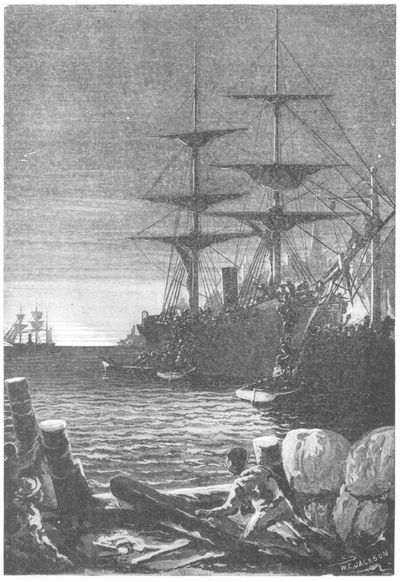
Cutting out a Blockade-Runner.
The next day the lieutenant, who was a bit of a wag, made a requisition on the quarter-master for one hundred men eighteen feet high, to wade through mud sixteen feet deep. Pleasantry is not appreciated in war; and the officer was arrested, but soon secured his release, and built the battery with men of ordinary height.
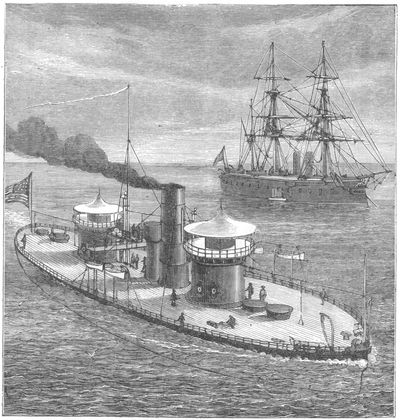
War-ships off Charleston Harbor.
In April, 1862, Admiral Du Pont had lined his iron-clads and monitors up before the beetling walls of Fort Sumter, and had hurled solid shot for hours, with only the effect of breaking away sharp corners and projecting edges of the fort, but leaving it still as powerful a work of defence as ever. The little monitors exposed to the terrible fire from the guns of Sumter were fairly riddled; and, when the signal was finally made to withdraw from the action, the humblest sailor knew that Charleston would only fall after a siege as protracted and wearisome as that of Vicksburg.
The investment of Charleston lasted from the date of that first attack upon Fort Sumter until 1865. From time to time the war-vessels would throw a few shells into the city, as a reminder to the inhabitants that they were under surveillance. Early in the siege the Swamp Angel, as the big gun back in the swamp was called, began sending hourly messages, in the form of two-hundred-pound shells, into the city. In one quarter, where the shells fell thickest, a severe fire was started, which raged fiercely, driving people from their homes, and reducing whole blocks to ashes; while the deadly shells aided in the work of destruction. But the life of the Swamp Angel, whose shells were the most destructive, was but short; for, after a few days' work, it burst, scattering the sand-bags, of which the battery was built, far and wide over the swamp.
The officers of the army, who were bringing their troops nearer and nearer to the city, expected the iron-clad vessels to steam boldly up the harbor, and compel a surrender of the city; but the naval officers dared not, owing to the torpedoes with which the channel was thickly planted. If Sumter could only be captured, the torpedoes could be searched out and easily removed; and, with this thought in mind, a number of bold sailors fitted out an expedition to attack the fort. Thirty boats, filled with armed men, made their way to the base of the shattered walls of the fort. As they came up, not a sign of life was to be seen about the huge black monster that had so long kept the iron-clads at bay. Rapidly and silently the men swarmed from their boats, and, led by three brave officers, began the ascent of the sloping walls. "The Johnnies are asleep," they whispered to each other: "we have the fort this time." But the Johnnies were wide awake, and waiting behind those grim bastions until the proper moment should arrive. Higher and higher climbed the blue-jackets; and they were just about to spring over the last barrier, when there rose before them a wall of men and a deadly fire of musketry, and a storm of hand-grenades cut their ranks to pieces. Around the corner of the fort steamed a small gunboat, which opened fire on the assailants. The carnage was terrible; and the sailors were driven back to their boats, leaving two hundred dead and wounded, and three stands of colors, as trophies for the garrison.
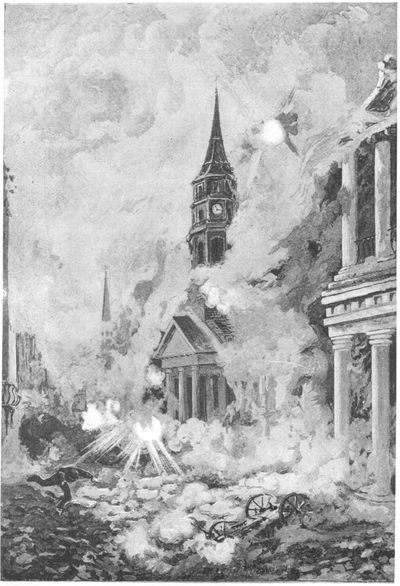
Charleston Bombarded.
After that grapple with the giant fortress, the Federals did not again try to come to close quarters; but, keeping at a distance, maintained a steady fire upon the fort, which drove its defenders from the guns, and enabled the Union troops to throw up batteries upon all the neighboring islands. The fleet then remained on blockading-service until Feb. 18, 1865, when the Confederates evacuated the city, and left the fort to the victorious Federals. Five years after the date when Major Anderson with his little band of soldiers had marched out of Sumter, leaving the fort to the enemy, the same gallant officer returned, and with his own hand hoisted the same tattered flag over the almost ruined fortress, amid salvos of artillery and the cheers of a victorious army and navy.[Back to Contents]
CHAPTER XVIII.
THE BATTLE OF MOBILE BAY.
he last two actions of the United States navy in the civil war were destined to be the grandest successes of a long record of daring and successful exploits. Farragut at Mobile, and Porter at Fort Fisher, added to their wondrous careers the cap-sheaves of two victories wrested from apparently unconquerable adversaries.
It was on a bright August morning in 1864 that Admiral Farragut stood on the deck of his stanch frigate the "Hartford," that had borne him through so many desperate battles. Around the flagship were clustered the vessels of the Gulf squadron. There was the battered old "Brooklyn," scarred with the wounds of a dozen fights; the "Richmond" and the "Itasca," that received their baptism of fire at the fight below New Orleans. In all there were fourteen wooden vessels and four iron-clad monitors assembled in front of the strongest combination of harbor defences that warships ever yet dared attack. Yet Farragut was there that bright summer morning to enter that bay, and batter the forts of the enemy into subjection. To capture the city was not his purpose,—that he left to the army,—but the harbor forts and the great ram "Tennessee" must strike their colors to the navy.
Before arranging for the attack, the admiral made a reconnoissance, the results of which are thus told by one of his officers: "On the afternoon of the day of our arrival, Admiral Farragut, with the commanding officers of the different vessels, made a reconnoissance on the steam-tender 'Cowslip,' running inside of Sand Island, where the monitors were anchored, and near enough to get a good view of both forts. On the left, some two miles distant, was Fort Gaines, a small brick-and-earth work, mounting a few heavy guns, but too far away from the ship-channel to cause much uneasiness to the fleet. Fort Morgan was on the right, one of the strongest of the old stone forts, and greatly strengthened by immense piles of sand-bags covering every portion of the exposed front. The fort was well equipped with three tiers of heavy guns, some of them of the best English make, imported by the Confederates. In addition, there was in front a battery of eleven powerful guns, at the water's edge on the beach. All the guns, of both fort and water battery, were within point-blank range of the only channel through which the fleet could pass. The Rebels considered the works impregnable, but they did not depend solely upon them. Just around the point of land, behind Fort Morgan, we could see that afternoon three saucy-looking gunboats and the famous ram 'Tennessee.' The latter was then considered the strongest and most powerful iron-clad ever put afloat; looking like a great turtle, with sloping sides covered with iron plates six inches in thickness, thoroughly riveted together, and having a formidable iron beak projecting under the water. Her armament consisted of six heavy guns of English make, sending a solid shot weighing one hundred and ten pounds,—a small affair compared with the heavy guns of the present time, but irresistible then against every thing but the turrets of the monitors. In addition to these means of resistance, the narrow channel in front of the fort had been lined with torpedoes. These were under the water, anchored to the bottom, and were chiefly in the shape of beer-kegs filled with powder, from the sides of which projected numerous little tubes containing fulminate, which it was expected would be exploded by contact with the passing vessels.
"Except for what Farragut had already accomplished on the Mississippi, it would have been considered a foolhardy experiment for wooden vessels to attempt to pass so close to one of the strongest forts on the coast; but when to the forts were added the knowledge of the strength of the ram, and the supposed deadly character of the torpedoes, it may be imagined that the coming event impressed the person taking his first glimpse of naval warfare as decidedly hazardous and unpleasant. So daring an attempt was never made in any country but this, and was never successfully made by any commander except Farragut, who in this, as in his previous exploits in passing the forts of the Mississippi, proved himself the greatest naval commander the world has ever seen. It was the confidence reposed in him, the recollection that he had never failed in any of his attempts, and his manifest faith in the success of the projected movement, that inspired all around him."
When the reconnoissance was completed, the admiral called a council of his captains in the wardroom of the "Hartford," and announced that the attack would be made early the following morning. The council over, each commander returned to his ship, there to make ready for the dread business of the morrow. The same writer whom we have before quoted tells how the night before a battle is spent by brave men not afraid of death:—
"At sunset the last order had been issued. Every commanding officer knew his duty, and unusual quiet prevailed in the fleet. The waters of the Gulf rested for a time from their customary tumult, a gentle breeze relieved the midsummer heat, and the evening closed upon us as peacefully as if we had been on board a yachting squadron at Newport. During the early part of the night, the stillness was almost oppressive. The officers of the 'Hartford' gathered around the capacious wardroom table, writing what they knew might be their last letters to loved ones far away, or giving to friends messages and instructions in case of death. There were no signs of fear; but, like brave and intelligent men, they recognized the stern possibilities of the morrow, and acted accordingly.
"But this occupied but little time; and then, business over, there followed an hour of unrestrained jollity. Many an old story was retold, and ancient conundrum repeated. Old officers forgot for the moment their customary dignity, and it was evident that all were exhilarated and stimulated by the knowledge of the coming struggle. Capt. Heywood of the marines proposed a final 'walk-around;' Tyson solemnly requested information as to 'Which would you rather do or go by Fort Morgan?' and all agreed they would prefer to 'do.' La Rue Adams repeated the benediction with which the French instructor at the naval academy was wont to greet his boys as they were going into examination: 'Vell, fellows, I hope ve vill do as vell as I hope ve vill do.' Finally, Chief Engineer Williamson suggested an adjournment to the forecastle for a last smoke, and the smoking club went forward; but somehow smoke had lost its customary flavor, and, after a few whiffs, all hands turned in, to enjoy what sleep would come."
When the morning dawned, the men were called to quarters, and the advance upon the forts was begun at once. It was a foggy morning, and the ships looked like phantom vessels as they moved forward in line of battle, with the "Brooklyn" in the van. Second came the "Hartford," with the admiral high up in the rigging, where he could overlook the whole scene.
"Nearly every man had his watch in his hand, and waited for the first shot. To us, ignorant of every thing going on above, every minute seemed an hour; and there was a feeling of great relief when the boom of the first gun was heard. This was from the monitor 'Tecumseh,' at forty-seven minutes past six o'clock. Presently one or two of our forward guns opened, and we could hear the distant sound of the guns of the fort in reply. Soon the cannon-balls began to crash through the deck above us, and then the thunder of our whole broadside of twelve Dahlgren guns kept the vessel in a quiver. But as yet no wounded were sent down, and we knew we were still at comparatively long range. In the intense excitement of the occasion, it seemed that hours had passed; but it was just twenty minutes from the time we went below when an officer shouted down the hatchway: 'Send up an army signal-officer immediately: the 'Brooklyn' is signalling.' In a moment the writer was on deck, where he found the situation as follows: The 'Brooklyn,' directly in front of us, had stopped, and was backing and signalling; the tide was with us, setting strongly through the channel, and the stopping of the 'Brooklyn' threatened to bring the whole fleet into collision and confusion; the advance vessels of the line were trying to back to prevent a catastrophe, but were apparently not able to overcome the force of the current; and there was danger not only of collision, but of being drifted on shore."
While the fleet was thus embarrassed and hampered, the gunners in the forts were pouring in their shot thick and fast. On the decks of the ships the most terrible scenes of death were visible. Along the port side the bodies of the dead were ranged in long rows, while the wounded were carried below, until the surgeon's room was filled to its last corner. One poor fellow on the "Hartford" lost both legs by a cannon-ball, and, falling, threw up both arms just in time to have them carried away also. Strange to say, he recovered from these fearful wounds.
Just as the fight was at its hottest, and the vessels were nearing the line, the passage of which meant victory, there went up a cry from the whole fleet, "The 'Tecumseh!' Look at the 'Tecumseh!'" All eyes were turned on the monitor, and every one saw that she was sinking. She staggered for a moment, and went down with a rush, carrying her brave commander and over a hundred of her crew. A few escaped, the last of whom was the pilot. As the pilot was rushing for the hatchway that led to the open air and to life, he met at the foot of a narrow ladder Commander Craven. Craven stepped back, saying gravely, "After you, pilot;" and the pilot passed out. "There was nothing after me," said he, in relating the story afterwards; "for as I sprang out of the hatchway the water rushed in, carrying all behind me to the bottom."
This terrible sight made the ships stop for a moment in some confusion; but Farragut signalled sternly from his flagship, "Go on," and all advanced again. As the fight grew fiercer, the admiral grew tired of being on the second ship in the line, and ordered the "Hartford" to forge ahead.
"On board a war steamer the engines are directed by the tap of a bell, the wires connected with which lead to the quarter-deck. One stroke of the bell means 'go ahead;' two, 'stop;' three, 'back;' and four, 'go ahead as fast as possible.' Leaning down through the shrouds to the officer on deck at the bell-pull, the admiral shouted, 'Four bells, eight bells, SIXTEEN BELLS! Give her all the steam you've got!' The order was instantly transmitted, and the old ship seemed imbued with the admiral's spirit; and running past the "Brooklyn" and the monitors, regardless of fort, ram, gunboats, and the unseen foe beneath, dashed ahead, all alone, save for her gallant consort, the 'Metacomet.'"
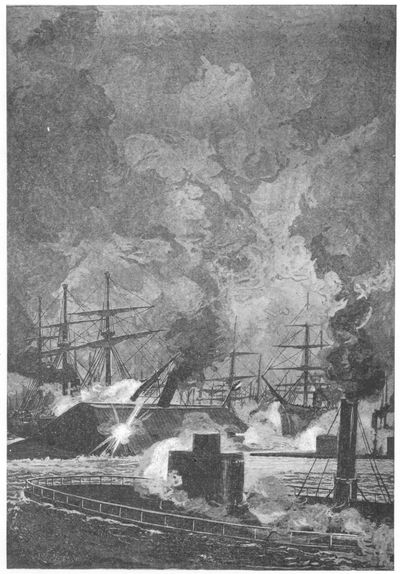
Fight at Mobile Bay.
But by this time the fleet was well abreast of the forts, and now, pouring out broadside after broadside, they swept along past the terrible ramparts. The Confederate gunboats had found the fight too hot for them, and had fled for shelter, with the exception of the dreaded "Tennessee," which seemed to be holding itself in reserve. It was but a short time before the vessels were safely past the fort, and out of range, floating on the smooth waters of the inner bay. Then the crews were piped to breakfast, and all hands began to recount their narrow escapes.
But the end was not yet, for the ram "Tennessee" was now ready to try her mettle with the fleet. Lieut. Kinney of the "Hartford" tells graphically the story of the desperate fight that the ram carried on alone against the whole attacking flotilla.
"We were just beginning to feel the re-action following such a season of extreme peril and excitement, when we were brought to our senses by the sharp, penetrating voice of executive officer Kimberly calling all hands to quarters; and a messenger-boy hurried down to us with the word, 'The ram is coming.' Every man hastened to his post, the writer to the quarter-deck, where the admiral and fleet-captain were standing. The cause of the new excitement was evident at once. The 'Tennessee,' as if ashamed of her failure, had left the fort and was making at full speed directly for the "Hartford," being then perhaps a mile and a half distant. The spectacle was a grand one, and was viewed by the Rebel soldiers in both forts, who were now out of range of our guns, and lined the walls. Few audiences have ever witnessed so imposing a sight. The great ram came on for a single-handed contest with the fleet. She was believed to be invulnerable, and had powerful double engines by which she could be easily handled; while our monitors were so slow-gaited that they were unable to offer any serious obstacle to her approach. Farragut himself seemed to place his chief dependence on his wooden vessels. Doubtless the crowd of Confederate soldiers who watched the fight expected to see the 'Tennessee' sink the Yankee vessels in detail, and the chances seemed in its favor....
"Meanwhile, the general signal, 'Attack the enemy,' had gone up to the peak of the 'Hartford;' and there followed a general slipping of cables, and a friendly rivalry to see which could quickest meet the foe. The 'Monongahela,' with her artificial iron prow, was bravely in the lead, and struck the Rebel craft amidships at full speed, doing no damage to the ram, but having her own iron prow destroyed, and being otherwise injured. Next came the 'Lackawanna,' with a like result. The huge iron frame of the 'Tennessee' scarcely felt the shock, while the wooden bow of the Union ship was badly demoralized. For an instant the two vessels swung head and stern alongside of each other. In his official report, Capt. Marchand naïvely remarks:—
"'A few of the enemy were seen through their ports, who were using most opprobrious language. Our marines opened on them with muskets: even a spittoon and a holystone were thrown at them from our deck, which drove them away.'
"The 'Tennessee' fired two shots through her bow, and then kept on for the 'Hartford.' The two flag-ships approached each other, bow to bow. The two admirals, Farragut and Buchanan, had entered our navy together as boys, and up to the outbreak of the war had been warm friends. But now each was hoping for the overthrow of the other; and, had Buchanan possessed the grit of Farragut, it is probable that moment would have witnessed the destruction of both vessels. For had the ram struck us square, as it came, bows on, it would have ploughed its way half through the 'Hartford;' and, as we sank, we should have carried it to the bottom, unable to extricate itself. But the Rebel admiral was not desirous of so much glory; and, just as the two vessels were meeting, the course of the 'Tennessee' was slightly changed, enough to strike us only a glancing blow on the port-bow, which left us uninjured, while the two vessels grated past each other. He tried to sink us with a broadside as he went by; but only one of his guns went off, the primers in all the others failing. That gun sent a shell that entered the berth-deck of the 'Hartford,' and killed five men."
But by this time the unequal conflict was becoming too much even for a man of Buchanan's courage. The armor of the ram was penetrated in several places, and at last came a shot that almost fatally wounded her commander. With the controlling mind that guided her course gone, the ram was useless; and in a moment a white flag fluttered from the shattered stump of her flagstaff. And so closed the naval battle that effectually ended Confederate rule on the Gulf coast, and earned for Farragut his proudest laurels.[Back to Contents]
CHAPTER XIX.
THE FALL OF FORT FISHER. — THE NAVY ENDS ITS WORK.
n noticing the work of the blockading-fleet, we have spoken of the fine harbor of Wilmington, and the powerful works that defended its entrance. This Confederate stronghold was known as Fort Fisher, and had been for a long time a cause of anxiety and worry to the Northern authorities. The war had gone past Fort Fisher. To the north and to the south of it, the country was under the sway of the Federal authorities; but there in North Carolina stood the formidable bastions over which floated, in defiance of the laws of the Union, the stars and bars of the rapidly dying Confederacy. With its connected batteries, Fort Fisher mounted seventy-five guns, and was stronger than the celebrated Malakoff at Sebastopol.

To reduce this stronghold, a joint naval and military expedition was fitted out; and Gen. Butler was placed in command of the land forces, while Admiral Porter, torn from his beloved Western rivers, was given command of the fleet. Butler introduced a novel feature at the very opening of the siege. He procured an old steamer, and had her packed full of gunpowder. On a dark night this craft was towed close to the walls of the fort and set afire, in the hopes that she might, in blowing up, tear the works to pieces. But in this the projectors were disappointed; for the explosion, though a terrific one, did absolutely no harm to the Confederate works. When Porter finally did get into the fort, he asked a soldier what he thought of the attempt to blow them up. "It was a mighty mean trick," responded the Southerner satirically. "You woke us all up."
After this fiasco had set all the world laughing, Butler retired voluntarily, and was succeeded by Gen. Terry; and on Christmas Eve of the year 1864 the fleet began the bombardment, although the land forces were not yet prepared for the assault. It was the grandest armada that was ever arrayed against any fortress. The thunder of nearly five hundred guns rent the air on that Christmas Eve, when carols were being sung in Christian churches throughout the world. Tremendous as was the cannonade, the earthworks were almost a match for it. The fort was not a mass of masonry that these enormous guns might batter down and crumble into rubbish, but a huge bank of earth in which the shells might harmlessly bury themselves. But five hundred cannon are more than a match for any fort, and so they soon proved to be in this instance. Earthworks, guns, and men alike went down before them. The iron-clads were stationed about three-quarters of a mile from the fort, a little farther out were the frigates and heavy sloops, and still beyond were the smaller vessels,—all firing to cover themselves; and all along the whole extended line there blazed one almost continuous sheet of flame, while the rolling thunder of the broadsides, and the defiant answering roar from the guns of the forts, shook earth and sea. Clouds of dust went up from the bastions of the fort, and mingled with the floating smoke above. Within the forts, there was a scene of the most terrible confusion: guns were overturned, piles of cannon-balls were knocked to pieces and scattered about, and two magazines were blown up and scattered fragments all over the parade. In one hour and a quarter all the gunners were driven to the bomb-proofs, and the forts were silenced, not returning a single shot.
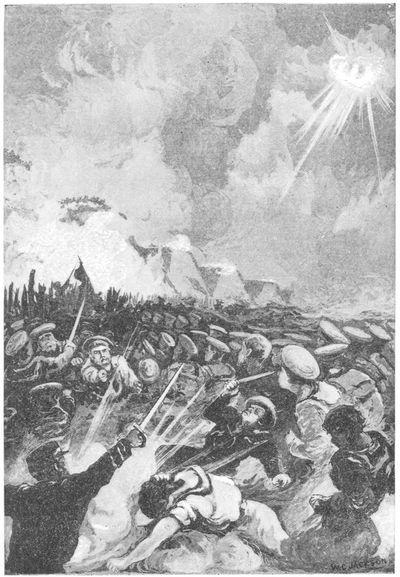
Charge of Sailors at Fort Fisher.
On Christmas morning Gen. Terry arrived with all his transports, and the attack was recommenced. Early in the morning the ships fell into position and began a slow fire, merely to cover the landing of the troops. Again the garrison was driven to the bomb-proofs; and, indeed, so entirely were they chased from their posts, that a Federal soldier went into the fort and brought off a Confederate flag without ever having been seen by the garrison. All the troops were landed; but for some reason the attack was deferred, much to the disgust of the officers of the fleet, who felt sure that the fort could be taken then by a dash. But the troops returned to their transports or went into camp, and it was not until weeks after that the assault was fairly made. In the mean time, the ships rode out the winter gales at their anchors, doing a little desultory firing to keep the garrison in a state of unrest.
On the 14th of January the heavy bombardment began again, and again the troops were landed. By night it was seen that every gun on the face of the fort was disabled, and it was decided to storm the works the next day. Sixteen hundred sailors and four hundred marines were told off as the storming-party.
Early in the morning the ships began a fierce cannonade, under cover of which the sailors and marines landed, and threw up light breastworks to cover them until the time should be ripe for the charge. The arrangements contemplated a fierce charge by the blue-jackets, armed with their cutlasses and revolvers; while the marines, remaining in the rifle-pits, should cover the advancing party with a hot fire of musketry. The soldiers from the army-camp were to charge the fort on the other side.
At three o'clock came the signal that all was ready. The whistles of the ships rent the air; and the blue-jackets, with ringing cheers, dashed in a compact body up the beach. But in an instant the Confederate ramparts were black with men, and a furious fire of musketry rained down upon the sailors, who were helpless. The marines in the rifle-pits failed to do what was expected of them, and the sailors halted for a moment in surprise.
As they stood, a most destructive fire rained down upon them; and the poor fellows, grasping their useless cutlasses, turned and fled down the beach, leaving great heaps of dead and wounded behind. Then the Confederates, thinking the day was theirs, sprang on the ramparts, and began a vigorous cheer just as the Union soldiers came pouring over the landward face of the fort. Then ensued a fierce hand-to-hand fight that lasted for hours. The blue-jackets, encouraged, rushed back to the fight, and now at close quarters swung their cutlasses with deadly effect, until step by step the Confederates were driven out of the fort. Then the fleet opened upon them, and they fled for dear life while a sailor sprang to the flagstaff and pulled down the Confederate flag. Fort Fisher had fallen. It was a noble victory, and formed a fitting climax to the work of the navy throughout that great war.
With the fall of Fort Fisher, the navy ceased to be a prominent factor in the war. Its work was done. Along the seacoast, and inland as far as navigable rivers extended, the ships of the North had carried the starry banner; and the sailor-boys of the North had defended it. And their opponents, whether on sea or shore, had shown themselves courageous and dashing, and worthy to be numbered as men of the same nation as those who proved the victors. And who can doubt, that, should the need arise, the sons of these men will show that they have in their veins the blood that animated the Blue-Jackets of '61?[Back to Contents]