Volume 2 / Part 3 — PART III BLUE-JACKETS OF '61. (continued 5)
Reading edition

When the storm of civil war burst upon the country, the Confederates of New Orleans were prompt to seize this and Fort St. Philip, that stood on the other side of the river. They found Fort Jackson in the state of general decay into which most army posts fall in times of peace, and they set at work at once to strengthen it. All over the parapet, bomb-proofs, and weak points, bags of sand were piled five or six feet deep, making the strongest defence known in war. Steamers plied up and down the river, bringing provision, ammunition, and new cannon, and soon the fort was ready to stand the most determined siege. Fort St. Philip, across the river, though not so imposing a military work, was more powerful. It was built of masonry, and heavily sodded over all points exposed to fire. It was more irregular in shape than Fort Jackson, and with its guns seemed to command every point on the river. Both were amply protected from storming by wide, deep moats always filled with water.
In these two forts were stationed troops made up of the finest young men of New Orleans. For them it was a gay station. Far removed from the fighting on the frontier, and within an easy journey of their homes, they frolicked away the first year of the war. Every week gay parties of pleasure-seekers from New Orleans would come down; and the proud defenders would take their friends to the frowning bastions, and point out how easily they could blow the enemy's fleet out of water if the ships ever came within range of those heavy guns. But the ships did not come within range of the guns for many months. They contented themselves with lying at the Head of the Passes, and stopping all intercourse with the outer world, until New Orleans began to get shabby and ragged and hungry, and the pleasure-parties came less often to the forts, and the gay young soldiers saw their uniforms getting old and tattered, but knew not where to get the cloth to replace them.
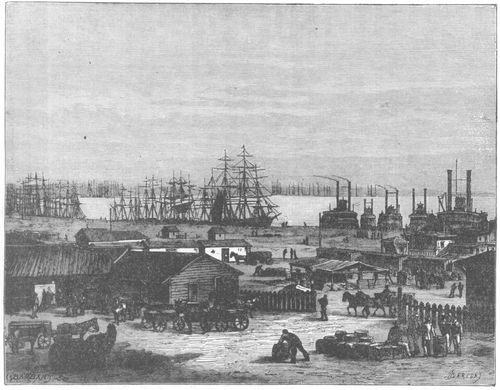
Levee at New Orleans before the War.
In the city no rumble of commerce was heard on the streets. Grass grew on the deserted levee, where in times of peace the brown and white cotton-bales were piled by the thousand, waiting for strong black hands to seize and swing them upon the decks of the trim Liverpool packets, that lay three or four deep along the river front. The huge gray custom-house that stood at the foot of Canal Street no longer resounded with the rapid tread of sea-captains or busy merchants. From the pipes of the cotton-presses, the rush of the escaping steam, as the ruthless press squeezed the great bale into one-third its original size, was no longer heard. Most of the great towering steamboats that came rushing down the river with stores of cotton or sugar had long since been cut down into squat, powerful gunboats, or were tied up idly to the bank. Across the river, in the shipyards of Algiers, there seemed a little more life; for there workmen were busy changing peaceful merchant vessels into gunboats and rams, that were, the people fondly hoped, to drive away the men-of-war at the river's mouth and save the city from starvation. From time to time the streets of the city resounded with the notes of drum and fife, as one after the other the militia companies went off to the front and the fighting. Then the time came when none were left save the "Confederate Guards," old gray-haired men, judges, bankers, merchants, gentlemen of every degree, too old for active service at the front, but too young not to burn for the grasp of a gun or sword while they knew that their sons and grandsons were fighting on the bloodstained soil of Virginia and Tennessee.
But, while the city was gradually falling into desolation and decay, preparations were being made by the Federal navy for its capture. On the 2d of February, 1862, Admiral Farragut sailed from Hampton Roads in his stanch frigate the "Hartford," to take command of a naval expedition intended to capture New Orleans. The place of rendezvous was Ship Island, a sandy island in the Gulf of Mexico. Here he organized his squadron, and started for his post in the Mississippi, below the forts. The first obstacle was found at the mouth of the river, where the heavy war-vessels were unable to make their way over the bar. Nearly two weeks were occupied in the work of lightening these ships until they were able to pass. The frigate "Colorado" was unable to get over at all. The "Pensacola" was dragged through the mud by the sheer strength of other vessels of the expedition. While they were tugging at her, a huge hawser snapped with a report like a cannon, and the flying ends killed two men and seriously wounded five others. But at last the fleet was safely past all obstacles, and Admiral Farragut found himself well established in the lower Mississippi, with a force of twenty-five men-of-war, and twenty mortar-schooners; one of the most powerful armadas ever despatched against an enemy. Farragut lost no time in getting his ships prepared for the baptism of fire which was sure to come. While he was diligently at work on his preparations, he was visited by some French and English naval officers, who had carefully examined the defences of the Confederates, and came to warn him that to attack the forts with wooden vessels, such as made up his fleet, was sheer madness, and would only result in defeat. "You may be right," answered the brave old sailor, "but I was sent here to make the attempt. I came here to reduce or pass the forts, and to take New Orleans, and I shall try it on." The foreigners remarked that he was going to certain destruction, and politely withdrew.
In the mean time, the tars on the mortar-fleet were working industriously to get their ships in fighting-trim. The topmasts were stripped of their sails, and lowered; the loose and standing rigging strapped to the masts; the spars, forebooms, and gaffs unshipped, and secured to the outside of the vessels to avert the danger from splinters, which, in naval actions, is often greater than from the shots themselves. From the main-deck every thing was removed that could obstruct the easy handling of the tremendous mortars; and the men were drilled to skill and alertness in firing the huge engines of death. The work was hastened on the mortar-schooners, because the plan was to rush them into position, and let them harass the Confederates with a steady bombardment, while the ships-of-war were preparing for their part in the coming fight.
The mortar-fleet was under command of Admiral Porter, an able and energetic officer. He soon had his ships ready, and began moving them into position along the banks of the river, out of sight of the forts. To further conceal them from the gunners in the forts, he had the masts and rigging wrapped with green foliage; so that, lying against the dense thickets of willows that skirt that part of the river, they were invisible. Other boats that were in more exposed positions had their hulls covered with grass and reeds, so that they seemed a part of the swamp that bordered the river. After the line of fire had been obtained by a careful mathematical survey, Porter got all his mortar-boats into position, and began his bombardment. The gunners on the mortar-boats could not see the forts; but the range had been calculated for them, and they merely fired mechanically. A lookout, perched on the masthead, could see over the low willow-forest, and watch the course of the shells as they rushed high into the air, and then, falling with a graceful curve, plunged into the forts. The firing was begun on the 16th of April, and was kept up with a will. The twenty huge mortars keeping up a constant fire, made a deafening roar that shook the earth, and could be heard far up the river at New Orleans, where the people poured out into the streets, and gayly predicted defeat for any enemy who should attack "the boys in the forts." The forts were not slow in returning the fire; but as the mortar-vessels were hidden, and did not offer very large marks, their fire was rather ineffective. Parties of Confederates, old swamp-hunters, and skilled riflemen, stole down through the dense thickets, to pick off the crews of the mortar-schooners. They managed to kill a few gunners in this way, but were soon driven away by the point-blank fire of the supporting gunboats. But all this time the shells were falling thick and fast, driving the soldiers to the bomb-proofs, and tearing to pieces every thing unprotected. One shell set fire to some wooden structures that stood on the parade-ground in Fort Jackson; and, as the smoke and flames rose in the air, the gunners down the river thought that the fort was burning, and cheered and fired with renewed vigor. The shells that burst upon the levee soon cut great trenches in it, so that the mighty Mississippi broke through with a rush, and flooded the country all about. But the forts seemed as strong and unconquered as ever.
While the soldiers were crowded together in the bomb-proofs to escape the flying bits of shell, the sailors on the little fleet of Confederate vessels anchored above them were busily engaged in getting ready a fire-raft which was to float down the river, and make havoc among the vessels of the Union fleet. Two such rafts were prepared; one of which, an immense affair, carrying cords of blazing pine-wood, was sent down in the early morning at a time when the vessels were utterly unprepared to defend themselves. Luckily it grounded on a sandbar, and burned and crackled away harmlessly until it was consumed. This warned Commander Porter of the danger in which his mortar-vessels were of a second attack of the same nature; and accordingly he put in readiness one hundred and fifty small boats with picked crews, and well supplied with axes and grapnels, whose duty it was to grapple any future rafts, and tow them into a harmless position. They did not have long to wait. At sundown that night, Commander Porter reviewed his little squadron of row-boats as they lay drawn up in line along the low marshy shores of the mighty river. The sun sank a glowing red ball beneath the line at which the blue waters of the gulf and the blue arch of heaven seemed to meet. The long southern twilight gradually deepened into a black, moonless night. The cries of frogs and seabirds, and the little flashes of the fireflies, were silenced and blotted out by the incessant roar and flash of the tremendous mortars that kept up their deadly work. Suddenly in the distance the sky grows red and lurid. "The fort is burning!" cry the men at the guns; but from the masthead comes the response, "No, the fire is on the river. It is another fire-raft." The alarm was instantly given to all the vessels of the fleet. Bright colored signal-lights blazed on the decks, and the dark, slender cordage stood out against the brilliant red and green fires that flickered strangely upon the dark wooded banks of the river. Rockets rushed high into the air, and, bursting, let fall a shower of party-colored lights that told the watchers far down the river that danger was to be expected. Then the signal-lights went out, and all was dark and silent save where the lurid glare of the great mass of fire could be seen floating in the great curves of the tortuous river toward the crowded ships. It was a time of intense suspense. The little flotilla of fire-boats, organized by Commander Porter that day, was on the alert; and the blue-jackets bent to their oars with a will, and soon had their boats ranged along a bend far above the fleet. Here they waited to catch the fiery monster, and save the ships. The danger came nearer fast. Rapidly the flames increased in volume, until the whole surrounding region was lighted up by the glare; while from the floating fire, a huge black column of smoke arose, and blended with the clouds that glowed as though they themselves were on fire. When the raft came into view around a point, it was seen to be too big for the boats to handle unaided, and two gunboats slipped their cables, and started for the thing of terror. From every side the row-boats dashed at the raft. Some grappled it, and the sailors tugged lustily at their oars, seeking to drag the mass of flames toward the shore. Then the "Westfield," under full head of steam, dashed furiously against the raft, crashing in the timbers and sending great clouds of sparks flying high in the air. From her hose-pipes she poured floods of water on the crackling, roaring, blazing mass; while all the time, with her powerful engines, she was pushing it toward the shore.
In the mean time, the sailors from the fleet of small boats were swarming upon the raft wherever they could find a foothold free from flame. Some carrying buckets dashed water upon the flames, some with axes cut loose flaming timbers, and let them float harmlessly down the river. It was a fight in which all the men were on one side; but it was a grand sight, and was eagerly watched by those on the imperilled vessels. The immediate arena of the conflict was bright as day, but all around was gloom. At last the pluck and determination of the men triumph over the flames. The raft, flaming, smouldering, broken, is towed out of the channel, and left to end its life in fitful flashes on a sandy point. The returning boats are greeted with cheers, and soon darkness and silence fall upon the scene. The mortars cease their thunderous work for the night; and ere long the only sounds heard are the rush of the mighty waters, or the faint cry of the night birds in the forest. The sentinel pacing the deck peers in vain through the gloom. War gives way for a time to rest.
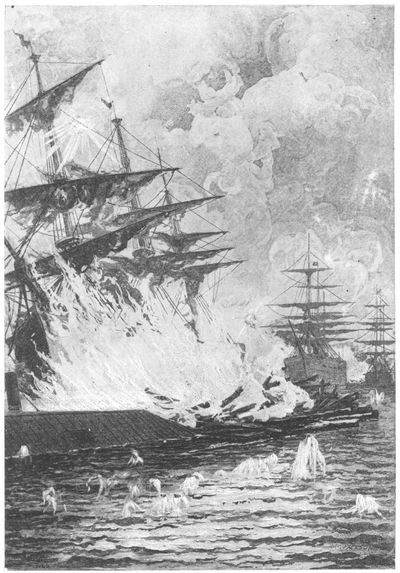
Fire-raft at Forts of the Mississippi.
Hardly had the gray dawn begun to appear, when the roll of the drums on the decks of the ships was heard; and, soon after, the roar of the opening gun was heard from one of the mortar-schooners. Again the bombardment was opened. The twenty boats in the mortar-fleet were divided into three divisions, each of which fired for two hours in succession, and then stopped for a time to allow the great cannon to cool. Thus a continuous bombardment was kept up, and the soldiers in the forts were given no time to repair the damages caused by the bursting shells. Every mortar was fired once in five minutes; so that one shell was hurled towards the fort about every minute, while sometimes three shells would be seen sweeping with majestic curves through the air at the same time. The shells weighed two hundred and fifteen pounds; and when they were hurled into the air by the explosion of twenty pounds of powder, the boat bearing the mortar was driven down into the water six or eight inches, and the light railings and woodwork of buildings at the Balize, thirty miles away, were shattered by the concussion. The shells rose high in the air, with an unearthly shriek, and after a curve of a mile and a half fell into or near the forts, and, bursting, threw their deadly fragments in all directions. Day after day, and night after night, this went on. If the men on the mortar-schooners showed bravery and endurance in keeping up so exhausting a fire so steadily, what shall we say for the men in the forts who bore up against it so nobly? Before noon of the first day of the bombardment, the soldiers of Fort Jackson saw their barracks burned, with their clothing, bedding, and several days' rations. Shells were pouring in upon them from vessels that they could not see. The smooth-bore guns mounted in the embrasures would hardly send a shot to the nearest of the hostile gunboats. Then the river broke through its banks, and half the fort was transformed into a morass. An officer in Fort Jackson said, after the surrender, that in two hours over one hundred shells had fallen upon the parade-ground of that work, tearing it up terribly. For six days this terrible fire was endured; and during the latter half of the bombardment the water stood knee deep on the gun-platforms, and the gunners worked at their guns until their shoes, soaked for days and days, fairly fell from their feet. For bed and bedding they had the wet earth, for rations raw meat and mouldy bread. If there were glory and victory for the Union sailors, let there at least be honor and credit granted the soldiers of the gray for the dogged courage with which they bore the terrible bombardment from Porter's flotilla.
While the mortars were pounding away through those six long days and nights, Farragut was getting ready to take his ships past the forts. Union scouts and spies had travelled over every foot of land and water about the forts; and the exact strength of the Confederates, and the difficulties to be overcome, were clearly known to the Federal admiral. One of the chief obstructions was a chain of rafts and old hulks that stretched across the channel by which the fleet would be obliged to ascend the river. Under cover of a tremendous fire from all the mortars, two gunboats were sent up to remove this obstruction. The night was dark and favorable to the enterprise, and the vessels reached the chain before they were discovered. Then, under a fierce cannonade from the forts, Lieut. Caldwell put off in a row-boat from his vessel, boarded one of the hulks, and managed to break the chain. The string of hulks was quickly swept ashore by the swift current, and the channel was open for the ascent of the Union fleet.
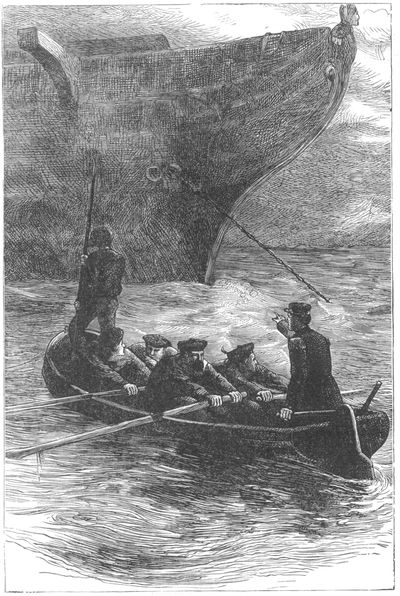
Breaking the Chain.
On the 23d of April, Farragut determined that his fleet should make the attempt to get past the forts the following day. He knew that the enemy must be exhausted with the terrible strain of Porter's bombardment, and he felt that the opportunity had arrived for him to make a successful dash for the upper river. The fleet was all prepared for a desperate struggle. Many of the captains had daubed the sides of their vessels with the river mud, that they might be less prominent marks for the Confederate gunners. The chain cables of all the vessels were coiled about vulnerable parts, or draped over the sides amidships to protect the boilers. Knowing that it was to be a night action, the gun-decks had been whitewashed; so that even by the dim, uncertain light of the battle lanterns, the gunners could see plainly all objects about them. Hammocks and nettings were stretched above the decks to catch flying splinters from the spars overhead. Late at night the admiral in his longboat was pulled from ship to ship to view the preparations made, and see that each captain fully understood his orders.
It was two o'clock on the morning of the 24th of April, when the Confederates on the parapets of their forts might have heard the shrill notes of fifes, the steady tramp of men, the sharp clicking of capstans, and the grating of chain cables passing through the hawse-holes on the ships below. Indeed, it is probable that these sounds were heard at the forts, and were understood, for the Confederates were on the alert when the ships came steaming up the river.
They formed in a stately line of battle, headed by the "Cayuga." As they came up the stream, the gunners in the forts could see the mastheads over the low willow thickets that bordered the banks of the stream. The line of obstructions was reached and passed, and then the whole furious fire of both forts fell upon the advancing ships. Gallantly they kept on their way, firing thunderous broadsides from each side. And, while the ships were under the direct fire of the forts, the enemy's fleet came dashing down the river to dispute the way. This was more to the taste of Farragut and his boys in blue. They were tired of fighting stone walls. In the van of the Confederate squadron was the ram "Manassas," that had created such a panic among the blockading squadron a month before. She plunged desperately into the fight. The great frigate "Brooklyn" was a prominent vessel in the Union line, and at her the ram dashed. The bold hearts on the grand old frigate did not seek to avoid the conflict, and the two vessels rushed together. The ram struck the "Brooklyn" a glancing blow; and the shot from her one gun was returned by a hail of cannon-balls from the frigate's tremendous broadside, many of which broke through the iron plating. Nothing daunted, the ram backed off and rushed at the frigate again. This time she struck full on the frigate's side. The shock was terrible. Men on the gun-deck of the ram were hurled to the deck, with the blood streaming from their nostrils. The frigate keeled over farther and farther, until all thought that she would be borne beneath the water by the pressure of the ram. All the time the spiteful bow-gun of the iron monster was hurling its bolts into her hull. But the blow of the ram had done no damage, for she had struck one of the coils of chain that had been hung down the "Brooklyn's" side. The two vessels slowly swung apart; and, after a final broadside from the "Brooklyn," the "Manassas" drifted away in the pitchy darkness to seek for new adversaries. She was not long in finding one; for as the gray dawn was breaking she suddenly found herself under the very bows of the "Mississippi," which was bearing down upon her and seemed sure to run her down. The captain of the "Manassas" was an able steersman, and neatly dodged the blow; but in this quick movement he ran his vessel ashore, and she lay there under the guns of the "Mississippi," and unable to bring any of her own guns to bear. The captain of the frigate was not slow in taking advantage of this chance to be revenged for all the trouble she had given the Union fleet; and he took up a good position, and pounded away with his heavy guns at the iron monster. The heavy shots crashed through the iron plating and came plunging in the portholes, seeking every nook and cranny about the vessel. It was too much for men to stand, and the crew of the "Manassas" fled to the woods; while their vessel was soon set on fire with red-hot shots, and blew up with a tremendous report soon after.
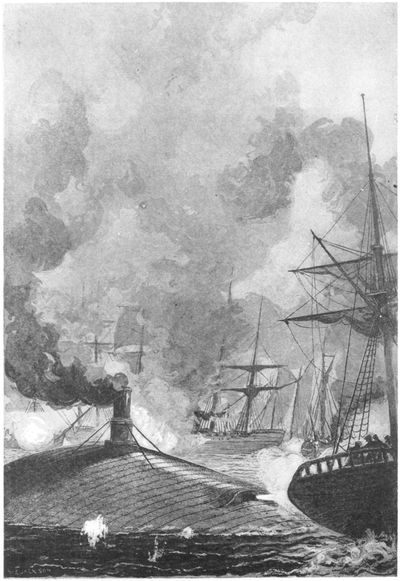
Ram "Tennessee" at Mobile Bay.
In the mean time, the ships of the Union fleet were doing daring work, and meeting a determined resistance. The flagship "Hartford" was met by a tug which pushed a huge burning fire-raft against her sides. There the flaming thing lay right up against the portholes, the flames catching the tarred rigging, and running up the masts. Farragut walked his quarter-deck as coolly as though the ship was on parade. "Don't flinch from that fire, boys," he sang out, as the flames rushed in the portholes, and drove the men from their guns. "There's a hotter fire than that for those who don't do their duty. Give that rascally little tug a shot, and don't let her go off with a whole coat." But the tug did get away, after all; and no one can feel sorry that men plucky enough to take an unarmed tug into a terrible fight of frigates and iron-clads should escape with their lives. The men on the "Hartford" fought the flames with hose and buckets, and at last got rid of their dangerous neighbor. Then they saw a steamer crowded with men rushing toward the flagship without firing a shot, and evidently intending to board. Capt. Broome, with a crew of marines, was working a bow-gun on the "Hartford." Carefully he trained the huge piece upon the approaching steamer. He stepped back, stooped for a last glance along the sights, then with a quick pull of the lanyard the great gun went off with a roar, followed instantly by a louder explosion from the attacking steamer. When the smoke cleared away, all looked eagerly for the enemy; but she had vanished as if by magic. That single shot, striking her magazine, had blown her up with all on board.
Much of the hardest fighting was done by the smaller vessels on either side. The little Confederate "cotton-clad" "Governor Moore" made a desperate fight, dashing through the Union fleet, taking and giving broadsides in every direction. The Union vessel "Varuna" also did daring work, and naturally these two ships met in desperate conflict. After exchanging broadsides, the "Governor Moore" rammed her adversary, and, while bearing down on her, received a severe raking fire from the "Varuna." The "Governor Moore" was in such a position that none of her guns could be brought to bear; but her captain suddenly depressed the muzzle of his bow-gun, and sent a shot crashing through his own deck and side, and deep into the hull of the "Varuna." The vessels soon parted, but the "Varuna" had received her death-wound, and sank in shallow water. The "Governor Moore" kept on her way, but was knocked to pieces by the fire from the heavy guns of the frigates shortly after.
And so the battle raged for five hours. To recount in full the deeds of valor done, would be to tell the story of each ship engaged, and would require volumes. Witnesses who saw the fight from the start were deeply impressed by the majesty of the scene. It was like a grand panorama. "From almost perfect silence,—the steamers moving through the water like phantom ships,—one incessant roar of heavy cannon commenced, the Confederate forts and gunboats opening together on the head of our line as it came within range. The Union vessels returned the fire as they came up, and soon the hundred and seventy guns of our fleet joined in the thunder which seemed to shake the very earth. A lurid glare was thrown over the scene by the burning rafts; and, as the bombshells crossed each other and exploded in the air, it seemed as if a battle were taking place in the heavens as well as on the earth. It all ended as suddenly as it commenced."
While this gigantic contest was going on in the river abreast of the forts, the people of New Orleans were thronging the streets, listening to the unceasing roar of the great guns, and discussing, with pale faces and anxious hearts, the outcome of the fight. "Farragut can never pass our forts. His wooden ships will be blown to pieces by their fire, or dashed into atoms by the 'Manassas,'" people said. But many listened in silence: they had husbands, sons, or brothers in that fearful fight, and who could tell that they would return alive? By and by the firing ceased. Only an occasional shot broke the stillness of the morning. Then came the suspense. Had the fleet been beaten back, or was it above the forts, and even now sullenly steaming up to the city? Everybody rushed for the housetops to look to the southward, over the low land through which the Mississippi winds. An hour's waiting, and they see curls of smoke rising above the trees, then slender dark lines moving along above the tree-tops. "Are they our ships?" every one cries; and no one answers until the dark lines are seen to be crossed by others at right angles. They are masts with yard-arms, masts of seagoing vessels, the masts of the invader's fleet. A cry of grief, of fear, of rage, goes up from the housetops. "To the levee!" cry the men, and soon the streets resound with the rush of many feet toward the river. "The river is crooked, and its current swift. It will be hours before the Yankees can arrive: let us burn, destroy, that they may find no booty." Let one who was in the sorrowful city that terrible April day tell the story. "I went to the river-side. There, until far into the night, I saw hundreds of drays carrying cotton out of the presses and yards to the wharves, where it was fired. The glare of those sinuous miles of flame set men and women weeping and wailing thirty miles away, on the farther shore of Lake Pontchartrain. But the next day was the day of terrors. During the night, fear, wrath, and sense of betrayal, had run through the people as the fire had run through the cotton. You have seen, perhaps, a family fleeing, with lamentations and wringing of hands, out of a burning house; multiply it by thousands upon thousands: that was New Orleans, though the houses were not burning. The firemen were out; but they cast fire on the waters, putting the torch to the empty ships and cutting them loose to float down the river.
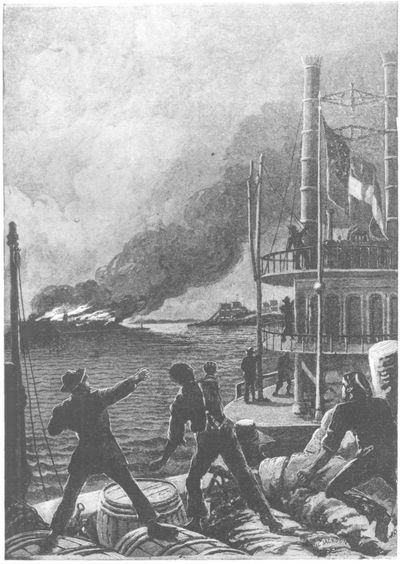
New Orleans on Approach of Fleet.
"Whoever could go was going. The great mass that had no place to go to, or means to go with, was beside itself. 'Betrayed! betrayed!' it cried, and ran in throngs from street to street, seeking some vent, some victim for its wrath. I saw a crowd catch a poor fellow at the corner of Magazine and Common Streets, whose crime was that he looked like a stranger and might be a spy. He was the palest living man I ever saw. They swung him to a neighboring lamp-post; but the Foreign Legion was patrolling the town in strong squads, and one of its lieutenants, all green and gold, leaped with drawn sword, cut the rope, and saved the man. This was one occurrence; there were many like it. I stood in the rear door of our store, Canal Street, soon after re-opening it. The junior of the firm was within. I called him to look toward the river. The masts of the cutter 'Washington' were slowly tipping, declining, sinking—down she went. The gunboat moored next her began to smoke all over and then to blaze. My employers lifted up their heels and left the city, left their goods and their affairs in the hands of one mere lad—no stranger would have thought I had reached fourteen—and one big German porter. I closed the doors, sent the porter to his place in the Foreign Legion, and ran to the levee to see the sights.
"What a gathering!—the riff-raff of the wharves, the town, the gutters. Such women! such wrecks of women! and all the juvenile rag-tag. The lower steamboat-landing, well covered with sugar, rice, and molasses, was being rifled. The men smashed; the women scooped up the smashings. The river was overflowing the top of the levee. A rain-storm began to threaten. 'Are the Yankee ships in sight?' I asked of an idler. He pointed out the tops of their naked masts as they showed up across the huge bend of the river. They were engaging the batteries at Camp Chalmette, the old field of Jackson's renown. Presently that was over. Ah, me! I see them now as they come slowly round Slaughterhouse Point, into full view: silent, so grim and terrible, black with men, heavy with deadly portent, the long banished stars and stripes flying against the frowning sky. Oh for the 'Mississippi,' the 'Mississippi!' Just then she came down upon them. But how? Drifting helplessly, a mass of flames.
"The crowds on the levee howled and screamed with rage. The swarming decks answered never a word; but one old tar on the 'Hartford,' standing with lanyard in hand, beside a great pivot-gun, so plain to view that you could see him smile, silently patted its big black breech and blandly grinned."
As the masts of the fleet came up the river, a young man stepped out upon the roof of the City Hall, and swiftly hoisted the flag of the State of Louisiana. When the ships came up, two officers were sent ashore to demand the surrender of the city; and shoulder to shoulder the two old sailors marched through a howling, cursing mob to the City Hall. The mayor refused to surrender the city, saying that Farragut already had captured it. The officers went back to their ships, and the flag still floated. Two days later the officers, with a hundred sailors and marines, returned and demanded that the flag be hauled down. No one in the city would tear it down, and the Federals went up to the roof to lower it themselves. The street and surrounding housetops were crowded with a hostile people, all armed. No one could tell that the fall of the flag would not be followed by a volley from the undisciplined populace. The marines in front of the building stood grouped about two loaded howitzers that bore upon the darkly muttering crowd. Violence was in the air. As the two officers rose to go to the roof, the mayor, a young Creole, left the room and descended the stairs. Quietly he stepped out into the street, and without a word stood before one of the howitzers, his arms folded, eying the gunner, who stood with lanyard in hand, ready to fire at the word of command. The flag fell slowly from the staff. Not a sound arose from the crowd. All were watching the mayor, who stood coldly looking on death. The Federal officers came down carrying the flag. A few sharp commands, and the marines tramped away down the street, with the howitzers clanking behind them. The crowd cheered for Mayor Monroe and dispersed, and New Orleans became again a city of the United States.[Back to Contents]
CHAPTER XIV.
ALONG THE MISSISSIPPI. — FORTS JACKSON AND ST. PHILIP SURRENDER. — THE BATTLE AT ST. CHARLES. — THE RAM "ARKANSAS." — BOMBARDMENT AND CAPTURE OF PORT HUDSON.
hile New Orleans was thus excited over the capture of the city, the soldiers in the forts below were debating as to the course they should adopt. They had not surrendered; and although the great bastions were pounded out of shape by the heavy guns of the fleet, yet they were still formidable defences, giving perfect security to the men in the bomb-proofs. But their case was hopeless: for Farragut was at New Orleans, and could cut off their supplies; while Porter, with his mortar-boats, was below them, putting escape out of the question. Every now and then a big shell would drop on the parade, and its flying pieces would remind the garrison that their enemies were getting impatient. After waiting a day or two, Porter sent a lieutenant with a flag of truce to the fort, calling upon the Confederate commander to surrender the two forts and the shattered remnant of the Confederate navy. He complimented the Confederates upon their gallant defence, but warned them, that, should they refuse to surrender, he would recommence his bombardment with new vigor. The Confederates refused to surrender until they heard from New Orleans; and the next day the monotonous thunder of the heavy mortars began again, and again the heavy shells began falling thick and fast upon the forts. Wearily the gray-coated soldiers settled down to continue what they felt must be a useless defence. The officers did their best to inspirit the men; but all knew that a surrender must come before long, and at last the men mutinously left their guns, and said they would fight no longer. They had borne without flinching a terrible bombardment, and now they felt that to fight longer would be a foolish sacrifice of life. Many left the forts, and plunged into the woods to escape the terrible shells. Gen. Duncan saw that all was lost, and on the night of the 28th of April sent an officer to the fleet announcing the surrender. On the following day Porter proceeded up-stream with his squadron, and anchored off the fort. A boat, manned by six trim sailors in dress uniforms, put off, and soon returned, bringing the commander of the defeated forces and two or three officers. They were received on the "Harriet Lane," and Commodore Porter had made great preparations for the meeting. The crews of all the vessels were dressed in snow-white mustering-suits, and the officers in brass-buttoned blue coats and white trousers. The decks were scrubbed, and all traces of the fight cleared away. As the Confederate officers came up to the fleet, one of them, a former lieutenant in the Union navy, said, "Look at the old navy. I feel proud when I see them. There are no half-breeds there: they are the simon-pure." As the Confederates came over the side, Porter stood, with his officers, ready to receive them. The greatest politeness was observed on either side; and Porter writes, "Their bearing was that of men who had gained a victory, instead of undergoing defeat." While the papers of capitulation were being signed, a message came from the deck that the huge Confederate iron-clad "Louisiana" was drifting down upon them, a mass of flames, and there was great danger that she would blow up in the midst of the Union fleet. "This is sharp practice, gentlemen," said Porter, "and some of us will perhaps be blown up; but I know what to do. If you can stand what is coming, we can; but I will make it lively for those people if anybody in the flotilla is injured."
"I told Lieut. Wainwright to hail the steamer next him," writes Capt. Porter, "and tell her captain to pass the word for the others to veer out all their riding-chains to the bitter end, and stand by to sheer clear of the burning iron-clad as she drifted down. I then sat down to the table, and said, 'Gentlemen, we will proceed to sign the capitulation.' I handed the paper to Gen. Duncan, and looked at the Confederate officers to see how they would behave under the circumstances of a great iron-clad dropping down on them, all in flames, with twenty thousand pounds of powder in her magazines. For myself, I hoped the fire would not reach the powder until the ship had drifted some distance below us. My greatest fear was that she would run foul of some of the steamers.
"While I was thinking this over, the officers were sitting as coolly as if at tea-table among their friends.
"Just then there was a stir on deck, a kind of swaying of the vessel to and fro, a rumbling in the air, then an explosion which seemed to shake the heavens. The 'Harriet Lane' was thrown two streaks over, and every thing in the cabin was jostled from side to side; but not a man left his seat, or showed any intention of doing so.
"I was glad that I had signed before the explosion took place, as I would not have liked to have my autograph look shaky."
The destruction of the "Louisiana" was a bit of trickery on the part of the Confederate naval officers, which Farragut punished by sending them North as close prisoners, while the army officers were granted freedom under parole. So ended the Confederate control over the mouth of the Mississippi; and Porter, after waiting long enough to see a blue-coat garrison in Forts St. Philip and Jackson, started up the river to rejoin his chief in New Orleans.
But, on reaching the city, he found that the energetic admiral had already started out to clear the river of the Confederate batteries that lined it on either side as far up as Vicksburg. This was a service of no little danger, and one bringing but little satisfaction; for no sooner had the gunboats left one point, from which by hard firing they had driven the Confederates, than the latter would return in force, build up again their shattered earthworks, mount new guns, and be once more ready for battle. But more powerful than these little one or two gun-batteries were the Confederate works at Port Hudson, the destruction of which was absolutely necessary for further Union successes on the great river. Between Port Hudson and Vicksburg, the river was completely under the control of the Confederates; and it was a powerful gunboat that could hope to navigate that stretch of water unharmed. Farragut determined to attack Port Hudson, and set the 14th of March, 1863, as the date for the action.
Port Hudson batteries were perched on a high bluff that overlooks one of those abrupt curves around which the current of the Mississippi River sweeps with such terrific force. The heavy guns bore down upon a point at which the ships would almost inevitably be swept out of their course by the swift stream, and where the river was filled with treacherous shifting shoals. Naval officers all agreed that to pass those batteries was a more difficult task than had been the passage of the forts below New Orleans; yet Farragut, eager to get at the stronghold of the foe in Vicksburg, determined to make the attempt. The mortar-vessels were stationed below to drive the enemy from his guns with well-directed bombs; while the fleet, led by the stanch old "Hartford," should make a bold dash up the river.
Night fell upon the scene; and the ships weighed anchor, and started upon their perilous voyage. To the side of each man-of-war was bound a gunboat to tow the great vessel out of danger in case of disaster. Silently the long string of vessels swept upward towards the batteries; but, as the "Hartford" came into range, the watchful Confederates gave the alarm, and the nearest battery at once opened fire. Then from Porter's mortar-schooners far down the river came an answering roar; and, as ship after ship came up into range, she opened with shot and shell upon the works. On the dark river-banks great alarm fires were kindled, lighting up the water with a lurid glare, and making the ships clearly visible to the Confederate gunners. But soon the smoke of battle settled down over all; and gunners, whether on shore or on the ships, fired at random. The "Hartford" led the way, and picked out the course; and the other vessels followed carefully in her wake. In the mizzen-top of the flagship was stationed a cool old river pilot, who had guided many a huge river steamer, freighted with precious lives, through the mazy channels of the Mississippi. There, high above the battle-smoke, heedless of the grape-shot and bits of flying shell whistling around him, he stood at his post, calmly giving his orders through a speaking-tube that led to the wheel-room. Now and then the admiral on the deck below would call up, asking about the pilot's safety, and was always answered with a cheery hail. But though the "Hartford" went by the batteries, heedless of the storm and lead poured upon her, she found herself alone, when, after firing a last gun, she swept into the clear air and tranquil water out of range of the enemy's guns. She waited some time for the other ships to come up, while all on board watched eagerly, save those who lay moaning on the surgeon's tables in the cock-pit below. The night wore on, and all on board were consumed with anxiety for the fate of the vessels that had dropped behind. The lookout in the tops reported that he could see far down the river a bright red light that could only be caused by a burning vessel. It proved to be the steamer "Mississippi," that had grounded under the guns of the batteries, and had been fired and abandoned by her crew. But of this the admiral knew nothing; and when, after an hour or two he heard the dull, heavy boom of an explosion, he went sadly to his cabin, fearing that the lives of many valiant sailors had been sacrificed. There was no way to communicate with the fleet below, and it was not until days afterward that the admiral learned how his fleet had been beaten back by the heavy guns of the Confederates and the swift current of the river. The "Richmond" grounded at a point within easy range of the batteries, and her crew fought desperately while shell after shell went crashing through her hull. They saw the other vessels of the fleet go drifting by helpless in the mighty current of the river, but they faltered not in their brave defence until they saw their ship a wreck and in flames. Then leaving their dead comrades with the "Richmond" for a funeral pyre, they escaped to the shore, and threaded their way through miles of morasses and dense thickets until they came to the mortar-boats, where they found refuge and rest. And so that first attack on Port Hudson ended with Farragut above the batteries, and his ships, below. It had only served to prove, that, safe in their heavy earthworks, the Confederates could defy any attack by ships alone. This fact was clear to the Union authorities, and they began massing troops about the hostile works. Two months later, Porter's mortar-boats, the frigates and gunboats, and the batteries and muskets of an immense body of troops, opened on the works. While the heavy fire was being kept up, the Union armies were closing in, digging trenches, and surrounding the Confederates on all sides. The firing came to be short-range work and very deadly. "To show you what cool and desperate fighting it was," says a Confederate, "I had at least twenty-five shots at Federals not two hundred feet away. In one instance I fired upon a lieutenant who was urging on his men. I wounded him in his left arm. He fired at me with his revolver, and sent a bullet through my cap. Next time I hit him in the hip, and he fell;, but, while I was reloading, he raised himself up, and shot the man next to me through the head. The officer was so close to me that I could tell the color of his eyes, and detect a small scar on his face."
This sort of work continued for weeks, with occasional charges by the Federals. Farragut's fleet kept up its bombardment, but did little damage. One of the Confederate soldiers said, some time after the war, "One can get used to almost any thing. After the first two or three days, we took the bombardment as part of the regular routine. Pieces of shell were continually flying about, and it was the regular thing for a bomb to drop down among us at intervals. I have seen them come down within fifty feet of a sentinel, and throw up a wagon-load of dirt, without his even turning his head. We had but few men hurt by the artillery-fire. I do not believe we averaged one man hit for every thousand pounds of metal thrown. I remember that one day I counted thirteen shells and bombs hurled at the spot where I was posted before we had a man hurt, and he was only slightly wounded." Naturally, such work as this could not drive the Confederates from their trenches; and the fleet soon concluded to leave the army to capture Port Hudson, while the ships steamed on up the river toward Vicksburg. The army kept up the siege for weeks, until the Confederates, hearing of the fall of Vicksburg, surrendered.
While the Union fleet was thus fighting its way up to Vicksburg, the Confederates were working away at a great ram that they were building in a secluded spot far up the Yazoo River. Work on the ram was being pushed with the greatest energy; and the Union sailors, in their ships on the Mississippi, listened daily to the stories of escaping negroes, and wondered when the big ship would come down and give them a tussle. The crew of the ram were no less impatient for the fray; for they were tired of being hidden away up a little river, plagued by mosquitoes and gnats. The dark shades of the heavy forests were seldom brightened by a ray of sun. The stream was full of alligators, that lay lazily on the banks all day, and bellowed dismally all night. The chirp of a bird was rarely heard. In its place were the discordant screams of cranes, or hisses of the moccasins or cotton-mouths. When at last the carpenters' clatter had ceased, and the ram, ready for action, lay in the little river, the crew were mustered on the deck, and told that the new boat had been built to clear the Union vessels from the Mississippi, and that purpose should be carried out. No white flag was to flutter from that flagstaff; and she should sink with all her crew before she would surrender. Any sailor who feared to enter upon such a service might leave the ship at once. No one left; and the "Arkansas" started down the river to look for an enemy. She was not long in finding one. At the mouth of the Yazoo floated three Union gunboats,—the "Carondelet," the "Tyler," and the "Queen of the West." As the ram came down into sight, her men heard the roll of the drums on the decks of the hostile vessels. The gunboats quickly opened fire, which was as promptly returned by the "Arkansas;" and, as she came swiftly rushing down the stream, the three vessels fled before her. The men on the ram were all new recruits, and made awkward work of the firing; but as she came to close quarters she sent her shells crashing into the Union ships, while the shot she received in return rattled harmlessly off her steel-mailed sides. The "Carondelet" was the first vessel to come to grief. She had hardly fired four shots when a heavy solid shot crashed through her side, and rattled against the most delicate part of the engine. She was helpless at once; and hardly had this damage been reported when a second shot came with a burst into an open port, killed five men, and broke its way out the other side. In ten minutes her decks were slippery with blood, and thick strewn with wounded and dead men. The current of the river drifted her upon a sandbar; and she lay there helplessly, now and again answering the galling fire of her foe with a feeble shot. Pouring in a last broadside, the "Arkansas" steamed past her, and, disregarding the other two vessels, headed for Vicksburg, where she knew her aid was sorely needed.
The news of her coming preceded her; and, when she came within sight of the steeples of the city, at least ten thousand people were watching her progress, and wondering whether she could pass by the Federal batteries and through the Federal fleet. The Federal fleet was all ready for her, and prepared such a gauntlet for the "Arkansas" as had never been run by any vessel. As she came within range, every Union gun that could be brought to bear opened; and shot and shell rained from shore-batteries and marine guns upon the tough hide of the ram. As she sped by the vessels, they gave her their broadsides, and the effect was tremendous. As the huge iron balls struck the ship, she keeled far over; and to her crew inside, it seemed as though she was being lifted bodily out of the water. Not a shot broke through the armor; but the terrible concussions knocked men down, and made blood come pouring from their nostrils. For new men, her crew fought well and bravely; though two fell flat on their faces, afraid to lift their heads, lest they be taken off by a shell.
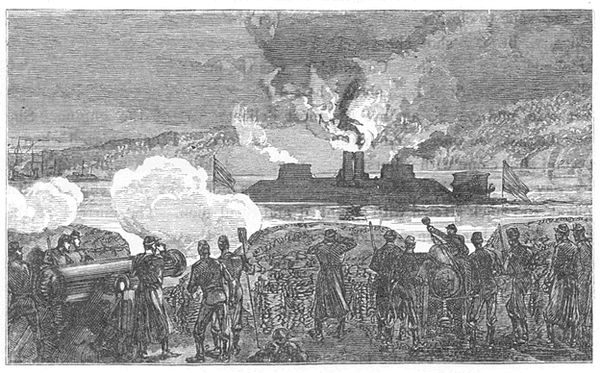
The "Arkansas" under Fire.
When it was seen that the "Arkansas" was likely to pass through the lines unscathed, the Federals tried to blockade her way; but she deviated not an inch from her path. The vessel that stood before her had to move aside, or take the chances of a blow from her terrible iron beak. She came straight to the centre of the fleet before opening fire; and when her portholes were opened, and the big guns peered out, they found plenty of targets. Her first volley knocked a gunboat to pieces; and in another minute she had crashed into the side of a Union ram, sending that unlucky craft ashore for repairs. But the storm of solid shot was too much for her; and she was forced to seek shelter under the bluffs, where the heavy guns of the Confederate shore-batteries compelled the Union ships to keep a respectful distance. Here she lay for several weeks, beating off every assault of the Federals, and making a valuable addition to the defences of the city. But, in an evil hour, the Confederate authorities decided to send her down the river to recapture Baton Rouge. When her journey was but half completed, she was pounced upon by several United States vessels, with the "Essex" in the lead. Her engines breaking down, she drifted upon a sand-bank; and the attacking ships pounded her at their leisure, until, with the fire bursting from her portholes, she was abandoned by her crew, and blazed away until her career was ended by the explosion of her magazine. She had given the Federal fleet some hard tussles, but beyond that had done nothing of the work the Confederates so fondly hoped of her.
While the flotilla of gunboats, led by the "Essex," were planning for the destruction of the "Arkansas," a small naval expedition, consisting of three gunboats, was threading its way up the narrow channel of the White River in search of some Confederate batteries said to be on the banks. Within twelve hours from the start, the sailors learned from a ragged negro, whom they captured on the shore, that the Confederates had powerful batteries only five miles farther up, and that the river channel was obstructed by sunken vessels. Anchor was cast for the night; and in the morning the troops accompanying the expedition were landed, and plunged into the forest with the plan of taking the fort by a rush from the rear. The gunboats began a slow advance up the river, throwing shells into the woods ahead of them. The blue-jackets kept carefully under cover; for, though they could see no foe, yet the constant singing of rifle-bullets about the ships proved that somewhere in those bushes were concealed sharp-shooters whose powder was good and whose aim was true. The "Mound City" was leading the gunboats, and had advanced within six hundred yards of the enemy's guns, when a single shot, fired from a masked battery high up the bluffs, rang out sharply amid the rattle of small-arms. It was the first cannon-shot fired by the Confederates in that engagement, and it was probably the most horribly deadly shot fired in the war. It entered the port-casemate forward, killed three men standing at the gun, and plunged into the boiler. In an instant the scalding steam came hissing out, filling the ship from stem to stern, and horribly scalding every one upon the gun-deck. The deck was covered with writhing forms, and screams of agony rang out above the harsh noise of the escaping steam and the roar of battle outside. Many were blown overboard; more crawled out of the portholes, and dropped into the river to escape the scalding steam, and struggling in the water were killed by rifle-balls or the fragments of the shells that were bursting all around. The helpless gunboat turned round and round in the stream, and drifted away, carrying a crew of dead and dying men. So great was the horror of the scene, that one of the officers, himself unhurt, who saw his comrades thus tortured all about him, went insane.
While this scene was going on before the fort, the Union troops had come up behind it, and with a cheer rushed over the breastworks, and drove the garrison to surrender. The Confederate banner fell from the staff, and the stars and stripes went up in its place. But how great was the price that the Federals had to pay for that victory! That night, with muffled drums, and arms reversed, the blue-jackets carried to the grave fifty-nine of their comrades, who twelve hours before were active men. With three volleys of musketry the simple rites over the sailors' graves were ended; and those who were left alive, only said with a sigh, "It is the fortune of war."[Back to Contents]
CHAPTER XV.
ON TO VICKSBURG. — BOMBARDMENT OF THE CONFEDERATE STRONGHOLD. — PORTER'S CRUISE IN THE FORESTS.
hile the smaller gunboats were thus making dashes into the enemy's country, destroying batteries and unfinished war-vessels, and burning salt-works, the heavier vessels of the fleet were being massed about Vicksburg, and were preparing to aid the army in reducing that city to subjection. We need not describe the way in which Gen. Grant had been rushing his troops toward that point, how for weeks his engineers had been planning trenches and approaches to the Confederate works, until toward the middle part of June, 1863, the people in that city found themselves hemmed in by a huge girdle of trenches, batteries, and military camps. Gen. Pemberton, with his army of Confederate soldiers, had been forced backward from point after point, until at last he found himself in Vicksburg, with the prospect of a long siege before him, and no way to get past the inexorable lines of blue that surrounded him. It is true that he had a wonderfully strong position, and many were the tongues that said Vicksburg could never be taken. But though stronger than Sebastopol, stronger than the Rock of Gibraltar, Vicksburg was destined to fall before that mighty army that encircled it, and was slowly starving the city into subjection.
But the Union soldiers, looking from their camps toward the Confederate citadel, saw that they had before them some severe work before that flag that flaunted over the city should be replaced by the stars and stripes. The city stands on a towering bluff high above the eastern bank of the Mississippi River. On that frowning height the busy hands of Pemberton's soldiers had reared mighty batteries, that commanded the Mississippi for miles up and down stream. To think of carrying the works by assault, was madness. Sherman had tried, and was beaten back with terrible loss. Then Grant, with nearly twenty thousand men, and with the co-operation of the river-flotilla, came upon the stage, and determined to take the city though it kept him at bay for months.
All imaginable plans were tried to get the army below the city; for Grant's command had come down from Cairo, and were at the northern and most impregnable side of the enemy's works. As at Island No. 10, a sharp bend in the river made a long peninsula right under the Confederates' guns. Grant, remembering the plan adopted before, set to work to cut a canal through the peninsula, so that the gunboats and transports might get below the forts. Twelve hundred negroes worked with a will upon this ditch for weeks. Then came a terrible rain-storm: the swollen, muddy torrent of the river broke in upon the unfinished canal, and that work was wasted. Then a new plan was suggested, this time by Commodore David Porter, who all through the war showed the greatest delight in taking his big gunboats into ditches where nothing larger than a frog or musk-rat could hope to navigate, and then bringing them out again safe after all.
The country back of Vicksburg was fairly honeycombed with shallow lakes, creeks, and those sluggish black streams called in the South bayous. Porter had been looking over this aqueous territory for some time, and had sent one of his lieutenants off in a steam-launch to see what could be done in that network of ditches. When the explorer returned, he brought cheering news. He was confident that, with tugs and gangs of axemen clearing the way, the gunboats could be taken up the Yazoo River, then into a wide bayou, and finally through a maze of small waterways, until they should reach the Mississippi again below the Vicksburg batteries. Then the transports could follow, the troops could march down the other side of the river, be met by the transports, ferried across, and take Vicksburg on the flank. It was a beautiful plan; and Porter went to Grant with it, full of enthusiasm.
Gen. Grant considered the matter for some time, but finally gave his consent, and detailed a number of blue-coated soldiers to aid Porter's blue-jackets in the work. They first cut the levees, and let the mighty tide of the Mississippi sweep in, filling the bayous to the brim, and flooding all the country round about. Then the gunboats plunged in, and were borne along on the rushing tide until they brought up, all standing, against the trunks of trees, or had their smoke-stacks caught by overhanging branches.
Then came the tug of war; and the axemen were called to the front, and set to work. They chopped their way along for some distance; the rapid current from the river banging the vessels against the trees and stumps, until all the standing rigging and light cabins were swept away. After a good deal of work they saw before them a broad river, wide enough for two vessels to steam abreast. Soon they drifted out into it, and the commanding officer sang out cheerily, "On to Vicksburg, boys, and no more trees to saw." And so they steamed on, thinking how neatly they should take the "gray-coats" in the rear, when suddenly a bend in the river showed them, just ahead, a fort in the middle of the river, with the channel blocked on either side. That was a surprise. The works were new, and the water was still muddy about the sunken steamers. Clearly the wily Pemberton had heard of this inland naval expedition, and was determined to check it effectually.
The gunboats backed water, and crowded in confused groups. The gunners in the fort took hurried aim, and pulled the lanyards of their cannon, forgetting that those pieces were not loaded. It was hard to tell which party was the more excited at the unexpected meeting. This gave the blue-jackets a chance to collect their thoughts, and in a minute or two the gunboats opened fire; but they were soon convinced that the fort was too much for them, and they turned and crawled back through the woods to the fleet above Vicksburg. Pemberton scored one point for successful strategy.
But, even while this expedition was working its way back to the station of the vessels on the Mississippi, Porter was starting another through a second chain of water-courses that he had discovered. This time he was so sure of getting into the rear of Vicksburg, that he took four of his big iron-clads, and two light mortar-boats built especially for work in the woods. Gen. Sherman, with a strong army-force, marched overland, keeping up with the gunboats. Admiral Porter, in his Memoirs, gives a graphic picture of this expedition. Back of Vicksburg the country is low, and intersected in every direction by narrow, tortuous bayous, lined on either side by gloomy morasses or majestic forests. Into these little-known water-courses Porter boldly led his ponderous iron-clads; while Sherman, with a detachment of troops, advanced along the shore, keeping as near the flotilla as possible. Seldom have naval vessels been detailed upon so strange a service. For days they steamed on under the spreading branches of trees, that often spanned the bayous in a mighty arch overhead, shutting out all sunlight. For a time this navigation of placid, shady waterways was pleasant enough; but, as they penetrated farther into the interior, the jackies sighed for the blue waters of the ocean, or even for the turbid current of the Mississippi. The heavy foliage that gave so grateful a shade also harbored all sorts of animals; and coons, rats, mice, and wildcats, that had been driven to the trees for shelter during the prevailing high water, peered down upon the sailors, and often dropped sociably down upon the decks of the vessels gliding beneath.
At some portions of the voyage the flotilla seemed to be steaming through the primeval forest. The bayou was but a few feet wider than the gunboats, and its banks were lined by gnarled and knotted old veterans of the forest,—live oaks, sycamore, and tupelo gum trees that had stood in majestic dignity on the banks of the dark and sullen stream for centuries. Sometimes majestic vistas would open; broad avenues carpeted with velvet turf, and walled in by the massive tree trunks, extending from the banks of the stream far back into the country. Again, the stately forests would be replaced by fields of waving corn or rice, with the tops of a row of negro cabins or the columned front of a planter's house showing in the distance. Then, as the flotilla steamed on, this fair prospect would disappear, and be replaced by noisome cypress brakes, hung thick with the funereal Spanish moss, and harboring beneath the black water many a noxious reptile.
So through the ever-changing scenery the gunboats moved along, making but little progress, but meeting with no serious obstacle, until one morning there appeared on a bit of high ground, some yards in advance of the leading gunboat, an army officer mounted on an old white horse. It was Gen. Sherman, and his troops were in camp near by. He greeted the naval forces cheerily, and, rallying Porter on the amphibious service into which his gunboats had been forced, warned him that he would soon have not a smokestack standing, nor a boat left at the davits.
"So much the better," said the undaunted admiral. "All I want is an engine, guns, and a hull to float them. As to boats, they are very much in the way."
A short time only was spent in consultation, and then Sherman with his forces left the bayou and plunged into the interior, first warning Porter that he would have a hard time getting any farther, even if the enemy did not come down and surround him. But Porter was not the man to abandon the advance, so long as there was water enough to float his gunboats. Besides, he had gained some ideas regarding navigation in the forests, that enabled him to move his fleet forward with more celerity than at first. When a tree blocked the course of the iron-clads, they no longer stopped to clear it away by work with the axes; but, clapping on all steam, the powerful rams dashed at the woody obstruction, and with repeated blows soon knocked it out of the way.
Soon after leaving Sherman, Porter saw that the difficulties he had thus far met and conquered were as nothing to those which he had yet to encounter. The comparatively broad stream up which he had been steaming came to an end, and his further progress must be through Cypress Bayou, a canal just forty-six feet wide..[??-second period a smudge?] The broadest gunboat was forty-two feet wide, and to enter that narrow stream made retreat out of the question: there could be no turning round to fly. The levees rose on either side of the narrow canal high above the decks of the iron-clads, so that the cannon could not be sufficiently elevated to do effective work in case of an attack. But there were nine feet of water in the great ditch; and that was enough for Porter, who pressed boldly on.
The country into which the combined military and naval expedition was advancing was in truth the granary of Vicksburg. On all other sides of the beleaguered city, the Federal lines were drawn so closely that the wagons laden with farm produce could not hope to pass. But here, back of the city, and far from the camps of Grant's legions, the work of raising produce for the gallant people of Vicksburg was prosecuted with the most untiring vigor. The sight, then, of the advancing gunboats aroused the greatest consternation. From the deck of his vessel Porter could see the people striving to save their property from the advancing enemy. Great droves of cattle were being driven away far into the interior; negroes were skurrying in all directions, driving poultry and pigs to the safe concealment of the forest; wagons groaning under the weight of farm and garden produce could be seen disappearing in the distance. What the inhabitants could not save they destroyed, in order that it might not profit the invaders. A short distance from the mouth of the bayou "were six thousand bales of cotton piled up on opposite sides of the stream, ready to be taken aboard a steamer when the war should end. As the gunboats advanced slowly, making little headway against the two-knot current of the bayou, Porter saw two men, carrying lighted pine-knots, dash up to the cotton, and begin to set it afire. The admiral looked on in disgust. "'What fools these mortals be!'" said he to an officer standing at his side; "but I suppose those men have a right to burn their own cotton, especially as we have no way of preventing them."
"I can send a howitzer shell at them, sir," said the officer, "and drive them away."
But to this Porter demurred, saying that he had no desire to kill the men, and that they might do as they liked with their own. Accordingly the officers quietly watched the vandals, until, after twenty minutes' work, the cotton was blazing, and a dense mass of smoke cut off all vision ahead, and rose high in the air. Then Porter began to suspect that he had made a mistake. The difficulties of navigation in the bayou were great enough, without having smoke and fire added to them. Yet to wait for the cotton to burn up might cause a serious delay. On the high bank of the bayou stood a negro begging the sailors to take him aboard.
"Hallo, there, Sambo!" sung out Porter, "how long will it take this cotton to burn up?"
"Two day, massa," responded the contraband; "p'raps tree."
That ended the debate. "Ring the bell to go ahead fast," said the admiral to the pilot; and away went the flotilla at full speed, plunging into the smoke and fire. It was a hot experience for the sailors. The heavy iron-clads made but slow progress, and were scorched and blistered with the heat. The ports were all shut down, and the crews called to fire-quarters, buckets in hand. To remain on deck, was impossible. Porter and his captain made the trial, but had hardly entered the smoke when the scorching heat drove both into the shelter of an iron-covered deck-house. The pilot standing at the wheel seized a flag, and, wrapping it about his face and body, was able to stay at his post. As the flames grew hotter, the sailors below opened the main hatch, and, thrusting up a hose, deluged the deck with floods of water. So, without a man in sight, the huge iron ship moved along between the walls of flame. Suddenly came an enormous crash. The gunboat shivered, and for a moment stood still; then, gathering headway, moved on again, though with much ominous grating beneath her keel. Soon after she passed out of the smoke and heat, and all hands rushed on deck for a whiff of the fresh, cool air. Their first thought was of the cause of the collision; and, looking eagerly astern, they saw a heavy bridge, about fifty feet of which had been demolished by the tremendous power of the ram. This gave Porter a hint as to the force he had at his command; and thereafter bridges were rammed as a matter of course whenever they impeded the progress of the iron-clads. The astonishment of the people along the shore may well be imagined.
The great and formidable obstacles that stood in the path of the squadron were, as a rule, overcome by the exertion of the great powers of the steam-driven, iron-plated vessels; but at last there came a check, that, though it seemed at first insignificant, terminated the sylvan manœuvres of the iron-clad navy. After running the gantlet of the burning cotton, butting down trees, and smashing through bridges, the column entered a stretch of smooth water that seemed to promise fair and unobstructed sailing. But toward the end of this expanse of water a kind of green scum was evident, extending right across the bayou, from bank to bank. Porter's keen eye caught sight of this; and, turning to one of the negroes who had taken refuge on the gunboat, he asked what it was. "It's nuffin' but willows, sah," he replied. "When de water's out of de bayou, den we cuts de willows to make baskets with. You kin go troo dat like a eel."
Satisfied with this explanation, the admiral ordered the tug which led the column to go ahead. Under a full head of steam, the tug dashed into the willows, but began to slow up, until, after going about thirty yards, she stopped, unable to go forward or back. Undaunted by this unexpected resistance, Porter cried out that the "Cincinnati" would push the tug along; and the heavy gunboat, withdrawing a short distance to gain headway, hurled herself forward, and dashed into the willows with a force that would have carried her through any bridge ever built. But the old fable of the lion bound down by the silken net was here re-enacted. The gunboat did not even reach the tug. The slender willow-shoots trailed along the sides, caught in the rough ends of the iron overhang, and held the vessel immovable. Abandoning the attempt to advance, the gunboat strove to back out, but to no avail. Then hooks were rigged over the side to break away the withes, and men slung in ropes alongside vigorously wielded sharp cutlasses and saws; but still the willows retained their grip. Matters were now getting serious; and, to add to Porter's perplexity, reports came in that Confederate troops were coming down upon him. Then he began to lose confidence in his iron-clads, and wish right heartily for Sherman and his soldiers, of whose whereabouts he could gain no knowledge. The enemy did not leave him long in doubts as to their intention, and soon began a vigorous fire of shells from the woods. Porter stopped that promptly by manning his mortars and firing a few shells at a range measured by the sound of the enemy's cannon. The immediate silence of the hostile batteries proved the accuracy of the admiral's calculations, and gave him time to devise means for escaping from his perilous position.
How to do it without aid from Sherman's troops, was a difficult question; and in his perplexity he exclaimed aloud, "Why don't Sherman come on? I'd give ten dollars to get a telegram to him." The admiral was standing at the moment on the bank of the bayou, near a group of negroes; and an athletic-looking contraband stepped forward, and, announcing himself as a "telegram-wire," offered to carry the note "to kingdum kum for half a dollar." After sharply cross-questioning the volunteer, Porter wrote on a scrap of paper, "Dear Sherman,—Hurry up, for Heaven's sake. I never knew how helpless an iron-clad could be, steaming around through the woods without an army to back her."
"Where will you carry this?" asked Porter, handing the despatch to the negro.
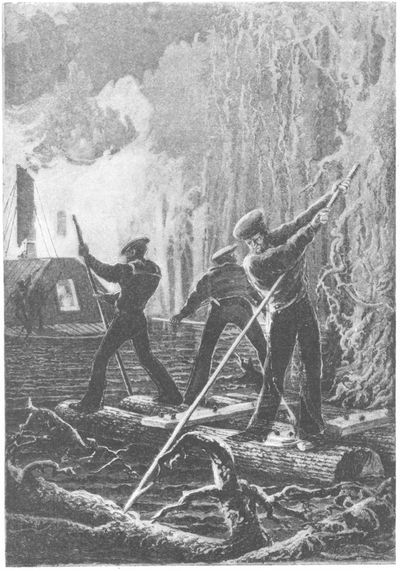
Porter's Flotilla on the Red River.
"In my calabash kiver, massa," responded the messenger with a grin; and, stowing the paper away in his woolly hair, he darted away.
The telegram being thus despatched, Porter again turned his attention to the willows; and, a fortunate rise in the water having occurred, he was able to extricate his vessels and begin his retreat down the bayou. He was somewhat perplexed by the silence of the Confederates, from whom he had heard nothing since his mortars silenced their masked batteries. The conundrum was solved by the sound of wood-chopping in the forests ahead, and the discovery shortly after of two heavy logs lying athwart the bayou, and stopping the progress of the vessels. An hour's hard work with axe and saw removed this obstruction; and the tug, slipping through first, shot ahead to prevent any more tree-felling. The loud reports of her howitzer soon carried back to the fleet the news that she had come up with the enemy, and was disputing with them the right to the bayou.
The difficulties of the retreat were no less great than those of the advance, with the intermittent attacks of the enemy added. The work of removing heavy, soggy logs, half submerged beneath the black waters of the bayou, clearing away standing trees, and breaking up and removing Red-river rafts, wearied the sailors, and left them little spirit to meet the enemy's attacks. The faint sounds of wood-chopping in the distance told too well of the additional impediments yet in store for the adventurous mariners. Scouts sent out reported that the enemy had impressed great gangs of negroes, and were forcing them to do the work of felling the trees that were to hem in Uncle Sam's gunboats, for the benefit of the C.S.A. But the plans of the Confederates to this end were easily defeated. Porter had not only many willing arms at his command, but the powerful aid of steam. When the gunboats came to a tree lying across the bayou, a landing party went ashore and fastened large pulleys to a tree on the bank. Then a rope was passed through the block; and one end having been made fast to the fallen tree, the other was taken aboard a gunboat. The word was then given, "Back the iron-clad hard;" and the fallen monarch of the forest was soon dragged across the bayou and out of the way So expert did the jackies become in this work, that they were soon able to clear away the trees faster than the enemy could fell them. The tug then went ahead, and for a time put an end to further tree-chopping, and captured several of the negro axemen.
From the captured contrabands Porter learned that the attempt to cut off his retreat was directed by the military authorities at Vicksburg. This was a startling revelation. He had thought that the Confederates were in entire ignorance of his movement; and now it turned out that the wily Pemberton had kept a sharp lookout on the marauding gunboats, and was shrewdly planning for their capture. While Porter was pondering over this new discovery, a party of scouts came in, bringing in four captured Confederates, two of whom were commissioned officers. The commanding officer, a mere boy, was somewhat chagrined at being captured, but felt confident that his friends would recapture him shortly. Porter politely asked him to take a glass of wine and some supper.
"I don't care if I do," responded the youngster; "and I have the less compunction in taking it, as it belongs to us anyhow. In two hours you will be surrounded and bagged. You can't escape. How in the Devil's name you ever got here, is a wonder to me."
Porter smiled pleasantly, and, helping his guests lavishly, proceeded to question them on the numbers and position of the Confederate troops. He learned that a large body of troops had been sent out to surround the iron-clads, and were even then closing in upon the intruders. The danger was imminent, but Porter showed no trepidation.
"How far off are your troops?" he asked.
"About four miles. They will bag you at daylight," was the confident response.
"Well, gentlemen," said the admiral, "Gen. Sherman is now surrounding your forces with ten thousand men, and will capture them all before daylight." And so saying the admiral went on deck, leaving his captives lost in wonder; for the information carried to the Vicksburg authorities had made no mention of troops.
Though Porter had put on so bold a front before his captives, he really felt much anxiety for the fate of his iron-clads. He could hear nothing from Sherman, who might be thirty miles away for all he knew. Accordingly he retraced his course for a few miles, to throw the enemy off the scent, and the next day began again his descent of the bayou, bumping along stern foremost amid snags and standing trees. The enemy soon gave evidence that he was on the watch, and opened fire with his artillery from the rear. At this one gunboat steamed back and silenced the artillery for a time, after which she rejoined her fellows. Sharp-shooters in the thickets along the levee then began to grow troublesome; and the whistle of the rifle-balls, with an occasional ping as one struck the smokestack, warned the sailors that the deck of a gunboat in a narrow canal was no safe place in time of war. The high levees on either side of the bayou made it impossible to use the guns properly: so Porter turned them into mortars, and, by using very small charges of powder, pitched shells up into the air, dropping them into the bushes back of the levee. This somewhat checked the fire of the sharp-shooters, but the decks were still dangerous places to frequent. A rifle-ball struck Lieut. Wells in the head as he stood talking to Porter; and he fell, apparently dead, upon the deck. The admiral beckoned an officer to come and bear away the body; but the newcomer was also hit, and fell across the body of the first. Porter concluded that the locality was getting rather hot, and gladly stepped behind a heavy plate of sheet-iron, which an old quarter-master brought him with the remark, "There, sir, stand behind that. They've fired at you long enough."
From behind his shield, Porter looked out anxiously at the forces by which he was beleaguered. He could see clearly that the Confederates were increasing in numbers; and, when at last he saw a long gray column come sweeping out of the woods, his heart failed him, and for a moment he thought that the fate of his flotilla was sealed. But at that very moment deliverance was at hand. The Confederates were seen to fall into confusion, waver, and give way before a thin blue line,—the advance guard of Sherman's troops. The negro "telegram-wire" had proved faithful, and Sherman had come on to the rescue.
That ended the difficulties of the flotilla. The enemy, once brought face to face with Sherman's men, departed abruptly; and soon the doughty general, mounted on an old gray horse, came riding down to the edge of the bayou, for a word with Porter. Seeing the admiral on the deck of his gunboat, he shouted out, "Hallo! Porter, what did you get into such an ugly scrape for? So much for you navy fellows getting out of your element. Better send for the soldiers always. My boys will put you through. Here's your little nigger. He came through all right, and I started at once. Your gunboats are enough to scare the crows: they look as if you had got a terrible hammering."
Somewhat crestfallen, Porter remarked, that he "never knew what helpless things iron-clads could become when they got in a ditch, and had no soldiers about." As Sherman declined to come aboard, Porter went below to look after his two prisoners.
"Well, gentlemen," said he, as he entered the cabin, "you were right. We are surrounded by troops."
The two Confederates were greatly exultant, but assured Porter that they would see that he was kindly treated when taken into Vicksburg.
"To Vicksburg!" said he with mock amazement. "Who said any thing of Vicksburg?"
"Why, of course you'll be taken there as a prisoner, now that our men have surrounded you."
"Oh, you are mistaken there!" responded Porter. "The troops by whom I am surrounded are Sherman's boys, six thousand strong." And at this news the chagrined captives subsided, and began to consider the prospects of a trip to the North, and incarceration in one of the military prisons.
Sherman's army soon came up in force, and went into camp along the road that skirted the levee. As night fell, the scene took on a wild and picturesque air. In the narrow bayou lay the gunboats, strung out in single file along a line of half a mile. They bore many signs of the hard knocks they had received in their excursion through the woods. Boats, davits, steam-pipes, and every thing breakable that rose above the level of the deck, had been swept away by the overhanging boughs, or dashed to pieces by falling trees. The smoke-stacks and wheel-houses were riddled by the bullets of the Confederate sharp-shooters. The decks were covered with rubbish of all kinds, and here and there was a fissure that told of the bursting of some Confederate shell. The paint was blistered, and peeling off, from the effects of the cotton-fire through which the fleet had dashed.
On the shore blazed the camp-fires of Sherman's troops; and about the huge flaming piles the weary soldiers threw themselves down to catch a moment's rest, while the company cooks prepared the evening meal. Many of the idle soldiers strolled down to the edge of the bayou, and, forming a line along the levee, began chaffing the sailors on the ludicrous failure of their attempt to perform naval evolutions in a swamp.
"What's gone with your boats, Jack?" sung out one tall fellow in cavalry garb. "Been in dry-dock for repairs?"
"How do you like playing mud-turtle?" said another. "Better stick to salt water after this."
"Don't go bush-whacking again, unless you have the soldiers with you. You look as if your mothers didn't know you were out." And at this a yell of approval went up all along the line, while the badgered sailors growled and tried to make sharp retorts to the stinging ridicule of the landsmen.
So ended this memorable gunboat expedition. It is unparalleled in the history of warfare. The feats performed by the unwieldy iron-clads in the narrow bayous gained for them, from Lincoln, the title of "web-footed" gunboats. They had traversed shallow and tortuous channels; they had cleared their path of trees, snags, and even bridges; they had run the gantlet of flaming cotton-bales and Confederate bullets. After meeting and overcoming so many obstacles, their final stoppage by a thicket of pitiful willow-shoots irritated the blue-jackets and their commander extremely. Porter had penetrated so far into the Yazoo country, that he could see how great damage could be inflicted upon the Confederates, if the expedition could but be carried out successfully. He had definite information to the effect, that, at Yazoo City, the Confederates had a thriving shipyard, at which they were pressing forward the construction of steam-rams with which to sweep the Mississippi. To reach that point and destroy the vessels, would have been a service thoroughly in accord with his tastes; but the willows held him back. However, he was able to console himself with the thought that the rams were not likely to do the Confederates any immediate service; for a truthful contraband, brought in by the Union scouts, informed the admiral that "dey has no bottom in, no sides to 'em, an' no top on to 'em, sah; an' dere injines is in Richmon'."
When the dangers encountered by the gunboats during this expedition are considered, the damage sustained seems surprisingly small. Had the Confederates acted promptly and vigorously, the intruders would never have escaped from the swamps into which their temerity had led them. A few torpedoes, judiciously planted in the muddy bed of the bayou, would have effectively prevented any farther advance. More than once the Confederates posted their artillery within effective range, and opened a rapid and well-directed fire upon the gunboats, but erred in using explosive shells instead of solid shot. "They were evidently greenhorns," wrote Porter, exulting over his narrow escape, "and failed to understand that we were iron-clad, and did not mind bursting-shell. If they had used solid shot, they might have hurt us." The infantry forces of the enemy were ample to have given the marauding gunboats a vast deal of trouble, if the Confederate officers had been enterprising, and had seized upon the opportunities afforded them. Night after night the flotilla lay tied up in the centre of a narrow bayou, with the levees towering so high above the gunboats' ports, that the cannon were useless. At such a time, a determined assault by a body of hostile infantry could hardly have been resisted. Such an attack was the danger which Porter most feared throughout the expedition, and he nightly made preparations for a desperate resistance. The widest part of the bayou was chosen for the anchorage, in order that a strip of water at least four feet wide might separate the gunboats from the shore. The sides of the iron-clads were then greased, and the guns loaded with grape, and elevated as much as possible. Landing parties with howitzers were sent ashore, and posted so as to enfilade any attacking force; scouts were sent out in all directions; and the crews of the gunboats slept at their quarters all night, ready for action at the first alarm. But it is doubtful whether even these elaborate precautions could have saved the flotilla, had the Confederates brought one regiment to the assault. However, the enemy let the golden moment pass; and, after suffering the agonies of suspense for several days, Porter at last saw his gunboats safely anchored by the side of Sherman's protecting regiments.
Sherman and Porter held a consultation that night, and concluded that it was useless to try to get around Vicksburg by hauling the gunboats through the woods; and the following morning the flotilla started back to the Union headquarters on the Mississippi.
Gen. Grant was beginning to get impatient. Weeks had passed away, and there were still no gunboats or transports below the Vicksburg batteries to aid him in carrying out his military plans. He held a long consultation with Porter, the outcome of which was that the admiral decided to run his gunboats and transports right through the fire of the Confederate guns.
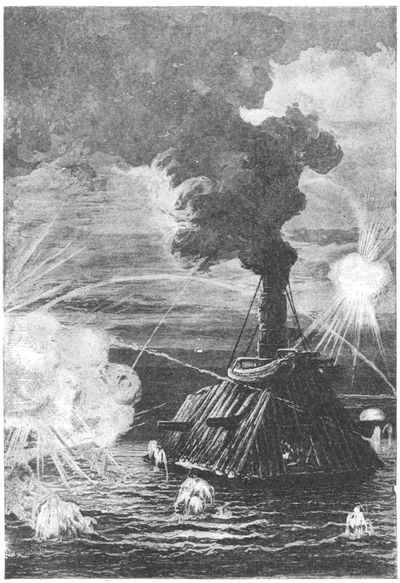
Dummy Gunboat passing Forts on the Mississippi.
But, before sending a vessel through, Porter thought that he would test the accuracy of the Confederate gunners by giving them a dummy to fire at. He took a large flat boat, and built it up with logs and lumber until it looked like a powerful ram. Two huge wheel-houses towered amidships, on each of which was painted, in great, staring letters, "Deluded Rebels, cave in." From the open ports, the muzzles of what appeared to be heavy rifles protruded; though the guns that seemed so formidable were really only logs of wood. Two high smoke-stacks, built of empty pork-barrels, rose from the centre of this strange craft; and at the bottom of each stack was an iron pot, in which was a heap of tar and oakum that sent forth volumes of black smoke when lighted. One dark night the fires in this sham monster were lighted, and she was towed down to the Confederate batteries, and set drifting down the river. She was quickly discovered, and the batteries on the bluffs opened on her with a roar. There was nothing about the dummy to be hurt, however; and it was impossible to sink her. So she sailed majestically through the plunging hail of solid shot, and past the terrible batteries that were thought to be a match for any thing afloat. The Confederates in the trenches looked at each other in astonishment and dismay. Word was sent to Gen. Pemberton that a powerful Yankee iron-clad had passed the batteries unhurt, and was speeding down the stream. The General's first thought was of a gunboat, the "Indianola," lately captured from the Federals, and now being converted into an iron-clad ram. She must be saved from recapture, even if it should be necessary to destroy her. Word was hurriedly sent down the river that a formidable ram was bearing down upon the "Indianola;" and, if the latter vessel was not in condition to do battle, she should be blown up. Accordingly, while the dummy ram, caught in an eddy of the river, was whirling helplessly around just below Vicksburg, the Confederates put the torch to their new war-vessel, and she was soon a heap of ashes. Porter's little joke was a good one for the United States.
But all the time that the Union navy was making these futile attempts to get the better of the wily general who held the fort at Vicksburg, a constant bombardment of the city was kept up. From gunboats and land batteries, shells were hurled into the streets of the town, tearing down houses, killing men, women, and children, and driving the inhabitants to their cellars, or to deep caves dug in the hills. The fire from the Union gunboats was most destructive, for they could drop down to an advantageous point, shell the city until tired, then steam back into safety again.
Cave-digging in the city became a regular business; and caves brought from twenty to fifty dollars, according to their size. They generally consisted of two or three rooms, and people lived in them quite cheerfully during the time that the iron hail was falling in the city's streets.
A Northern woman, who was pent up in Vicksburg during the siege, tells graphically the story of the bombardment:—
"For many nights we have had but little sleep, because the Federal gunboats have been running past the batteries. The uproar when this is happening is phenomenal. The first night the thundering artillery burst the bars of sleep, we thought it an attack by the river. To get into garments, and rush up-stairs, was the work of a moment. From the upper gallery we have a fine view of the river; and soon a red glare lit up the scene, and showed a small boat, towing two large barges, gliding by. The Confederates had set fire to a house near the bank. Another night, eight boats ran by, throwing a shower of shot; and two burning houses made the river clear as day. One of the batteries has a remarkable gun they call 'whistling Dick,' because of the screeching, whistling sound it gives; and certainly it does sound like a tortured thing. Added to all this is the indescribable Confederate yell, which is a soul-harrowing sound to hear. I have gained respect for the mechanism of the human ear, which stands it all without injury. The streets are seldom quiet at night: even the dragging about of cannon makes a din in these echoing gullies. The other night we were on the gallery till the last of the eight boats got by. Next day a friend said to H——, 'It was a wonder you didn't have your heads taken off last night. I passed, and saw them stretched over the gallery; and grape-shot were whizzing up the street just on a level with you.' The double roar of batteries and boats was so great, we never noticed the whizzing. Yesterday the 'Cincinnati' attempted to go by in daylight, but was disabled and sunk. It was a pitiful sight: we could not see the finale, though we saw her rendered helpless.