THOUGHTS ON THE NAME "TACOMA."
Reading edition
This beautiful name of the city whose rapid and marvellous growth and development have been unparalleled even in our Western civilization, is a pure invention. Its very euphony divests it of all claim as the Indian nomination of Old Mount Rainier, the name conferred by the illustrious circumnavigator, George Vancouver, borne for a century upon the map of the world.
Tacoma is a word of extremely modern origin, invented, or used first by Lieut. Theodore Winthrop, U. S. Army, in his readable book—"Canoe and Saddle." The writer of these thoughts first heard it late in the "sixties," when Capt. D. B. Finch, among the pioneers of steam navigation on Puget Sound, presented a building in Olympia to the Good Templars, and his gift was christened "Tacoma Hall." Contemporaneously Tacoma City, now the first ward of Tacoma, was thus named by some Portland town-builders—Gen. McCarver, Lewis M. Starr and James Steel. The then leading hotel of Olympia, about the same time, assumed that title and wore it for several years; but a whole decade passed before the attempt was made to obliterate the time-honored name of the great mountain peak of Northwest America, conferred at the first visit of white men to Commencement Bay in 1792. Late in 1878, a lithograph map and bird's-eye view of the embryo city of New Tacoma was published under the patronage of the Tacoma Land Company, entitled—"New Tacoma and Mount Rainier"—issued in 1880. At that date the name "Tacoma" existed, but it was not applied to the mountain; nor was it even dreamed that the town was named from the Indian name of the mountain. The fact is that the name, "Mount Tacoma," has been recently conferred on the mountain by white men. A decade back, the name will not be found on the maps of Washington Territory, and it is to be hoped that the attempt to obliterate from the map of the world the name conferred by that illustrious contributor to geographic science, Captain George Vancouver, R. N., will prove unsuccessful.
When Gen. Hazard Stevens, and that splendid scholar and writer, P. B. Van Trump, Esq., ascended the grand old mountain, the pronunciation and spelling of the name which Gen. Stevens, in his narrative, ascribed to the mountain, was still unsettled. He spelt the word Te-ho-ma. The "h" being aspirated really represents an Indian guttural grunt without beauty or even resolving itself into a well-defined consonant.
In the year 1882, the writer was invited to perform the role of orator on Independence Day at the beautiful settlement called Puyallup. The committee coupled with the invitation the expressed desire that the theme should be Puget Sound reminiscences—the early settlement of Pierce county. He adopted as a starting theme the thoughts suggested by the words "Tacoma" and "Puyallup," or their origin thus euphonized into household words of significance and anglicised beauty, bearing but little resemblance in sound to the half-uttered nasal grunts of the fish-eating natives of Puget Sound, whose syllables are "without form and void;" their language, if such it be considered, acquiring meaning or intensity of signification when accompanied by pantomimic motion, speaking far more than all their syllabic combinations. Through the valued assistance of that veteran Indian student and interlocutor, John Flett, some twenty aged, prominent Indians, who would not deign to talk other than their own dialect, who despised even the Chinook Jargon, but adhered to the grunts and syllabic utterances and the pantomime of their race for the ages before the advent of the Hudson's Bay Company or American settlers, gathered in the writer's office in New Tacoma, as the city of Tacoma was then called, and seated on the floor for hours discussed what they called the mountains and mountain range, its surrounding and attributes. About half were of the White river bands, those who originally lived on the sources of the streams issuing from Mount Rainier. The remainder were Puyallups and 'Squallys, whose original haunts were near the Sound. The form was to put the writer's question or wish for information into Chinook Jargon, which was then translated into the Indian dialect. The old men expressed themselves in their native utterances. It would be the grossest perversion to call their answers "words." They were not so couched—at best, strong syllabic utterances—mere grunts, at times which, with eloquent pantomime, assumed grand and eloquent thought and meaning, when translated, to give just expression arising to poetry of ideas, but as a language, technically so considered, poverty-stricken to the greatest degree, and without its accompanied earnestness of movement, without a single attribute of beauty or euphonism.
That interesting study and those comparative views, by old men of the mountain and the sea, extended through hours; and the writer will never forget the eloquence of action required and used by those aged natives, which more than compensated that paucity of syllables or words, which we call language. No such word of beauty as "Tacoma" could possibly be coined by them, nor result from any combination of their uttered but significant grunts, their attempted vocalization of thoughts or ideas. True, there were syllabic emissions of sound which might be resolved into words by toning down grunts and inharmonious belchings of thoughts rather than their legitimate utterances. The manner of conducting that "interview" was the assumption that the word "Tacoma," or some kindred appropriate word identified the grand old mountain in their language; in other words, their attention was invited to the fact, that our people had been told that "Tacoma" was the native name of the mountain. Then began the expression by all, in turn, as to the Indian method of referring to great landmarks, mountains individual and in range, rivers, etc., when talking with each other. Their views on the information communicated found expression in several varied, combined characteristic grunts and shrugs, which were interspersed with some analogous syllables or utterances from which Indian philologists have resolved words, some of which have more or less resemblance to some of the syllables embraced in the word Tacoma, or that word as spelled by different writers. They then detailed their reasons for so speaking of the mountain or any of its natural surroundings or physical features. In that colloquy, no two of those Indians pronounced the same word or used that same guttural utterance or combination of syllables. All were especially interrogated as to the snow-capped mountain. All gave the meaning or idea that they knew as to the cause for a name, by which any other could identify it, and the significance of the utterances by each adopted in referring to it.
Each band, not to say each individual, had a peculiar reason for his name of it, contingent upon color, shape or function. In that interview, the literal translations of their syllabic combinations appertaining more or less in sound to the syllables constituting the name Tacoma—Te-ho-ma, Ta-ko-ber, Tak-o-man, etc., as rendered by the venerable John Flett, a truthful, skillful and reliable Indian authority was—"A woman's breast that feeds," a "nourishing breast." To one band, the shape of the cone suggested the breast shape for a name; to another, the milky whiteness was a reminder of the source of nourishment; to another, the color of the streams which flow down from the mountain in the annual freshets, gave origin to the idea of the generous fountain of the great milk-white breast-shaped sentinel for ages; while the Puyallups and 'Squallys, more practical in view, associated the fact that from the mountain rushed the torrents of white water, resembling milk, which fertilized the valleys of Puget Sound. While such was the conversation and speech of those old patriarchs, several of whom had lived to become octogenarians, communicated as above stated, the writer is well aware that across the mountain chain, residing in the vicinity of the mountain, that several bands of the Klickitat nation attach different meanings for synonymous syllabic combinations approximating in sound to the combinations referred to used by Western Washington bands, with shades of meaning more practical, less figurative, less Indian; but the writer has been content to accept as authority, at all events so far as the Aborigines of Western Washington are concerned, the result of the conference of Indian patriarchs convened at his instance in 1882. While that conference failed to establish that there was such an Indian word as "Tacoma," or that these Indians had any distinctive Indian names for "Mount Rainier," or that there was any recognized Indian name known to the several tribes; yet, the different bands did use such syllabic utterances, by which they referred to the mountain chain, to the leading mountain of the chain. That color, shape, and attributed function, suggested such expression, and that the combination of syllables which have been so euphoniously metamorphosed into the beautiful word "Tacoma," when pronounced by them in its native utterances, meant as herein expressed. The writer, however, finds no warrant for adopting Tacoma as an Indian word, nor does he believe that such word, or its approximate, was a name conferred by Indians upon the mountain, or exclusively recognized as the name of the mountain by the original natives of this region.
ELWOOD EVANS.
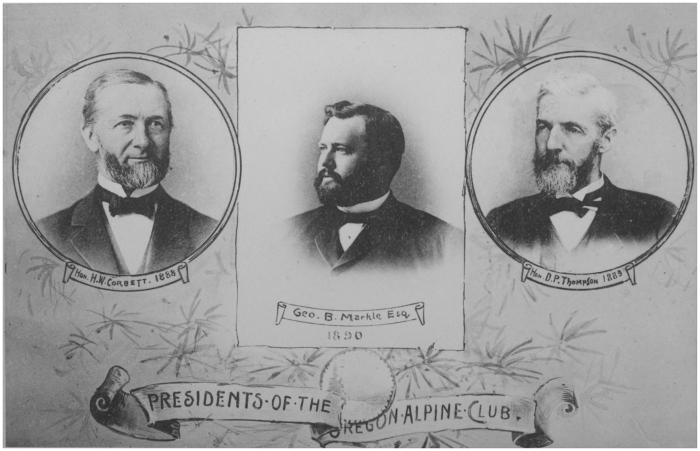
PRESIDENTS OF THE OREGON ALPINE CLUB.