NIGHT ON THE SUMMIT OF MOUNT RAINIER.
Reading edition
Monday, August 14, 1889, Mr. J. Nichols, of Tacoma, and the writer, left Tacoma for Mt. Rainier, determined, if possible, to reach its highest point.
The provisions, blankets, alpine stocks (a hickory staff seven feet long with a steel point at one end), alpine ax and all that was necessary in making the ascent easy, were taken from Tacoma, while pack horses were procured at Yelm, a station twenty-five miles south of Tacoma, and from which the trail leads eastwardly to Mount Rainier. It first follows river bottoms, then mountains, ridges and river bottoms again, while an occasional fording of the glacial stream, lends interest to the ever-changing scenes. We aimed at the end of each day to camp where feed could be obtained for hard working horses. Darkness coming on as we reached the first ford, left in some doubt the exact location of the crossing, so camp was made on the bank of the river with nothing but oats for our tired horses. Daylight found us fording the river, which had risen during the night about ten inches, making it quite exciting as the foaming water splashed the horses' sides, and wet our feet and ankles.
Stopping at the first place where hay could be had, a stay of nearly two hours was made for breakfast for ourselves and horses.
From our last night's experience, we decided to carry hay with us and camp wherever night should overtake us, which was at the foot of a high mountain our trail led over, and on the bank of the river as before. The day was uneventful, if we omit mention of the many hornets' nests we passed through and the four pheasants which fell before the unerring aim of Nichol's rifle. The pheasants led us to a fitting close of the day in the shape of pheasants and dumplings, prepared by the writer and pronounced by Nichols (who, by the way, is an epicure) to be simply par excellence. And here I might add that the writer is a single man.
The end of the third day found us at the Hotel Longmire at Hot Springs, located on the southwest slope of Mt. Rainier, at an altitude of three thousand feet, and some five miles from the perpetual snow limit. And no finer people ever lived than Mr. and Mrs. Longmire, who own and preside over the hotel and springs. The hotel material was cut by hand out of the finest grained cedar that ever grew—boards twelve inches wide and fifteen feet long—as perfect as though sawed.
As a matter of information for those interested, it might be well to say here that the waters of the springs are positively life-giving. The writer has visited many mineral springs, and has never seen anything that will compare with the stimulating and health-giving qualities of these springs.
But, to resume: we left the springs next morning, with a single pack horse, expecting to leave the horse at the top of the ridge (eight thousand feet altitude) overlooking Paradise valley, and, with blankets on our backs, to make our way to Ewing's camp, ten thousand five hundred feet above sea level. We reached Paradise valley, and, finding the same had been so well and truly named, decided to stop till next day and enjoy some of its beauties. Accordingly, camp was pitched, fire-wood gathered, and a camp fire built, and a pot of beans placed thereon. After a light lunch we strolled, enjoying the alpine beauties of the valley, well named Paradise.
During the afternoon the wind changed to the southwest, and clouds gradually spread over the firmament. From our experience a year ago on Mount Hood in a storm, at no higher altitude than we now were, no thought was given to ascending higher till fair weather and a northwest wind prevailed. Morning dawned and no indications of good weather. Our spirits were accordingly depressed. Observing the barometer, we found it moving quite rapidly in the direction of storm. By noon the sky was heavily overcast, and an hour later undercast as well.
By 3 o'clock rain began to fall. The wind had already risen to quite a gale. Re-staking our tent, digging a ditch around the head and sides, and piling wood and rocks along the edges to keep out the wind and rain, we crawled into our blankets and awaited developments. Soon the storm broke upon us with all its alpine fury, and raged during the entire night. By morning the rain had turned into sleet and snow, the thermometer, at daylight registering 34 degrees. Shortly the storm ceased. After some difficulty a fire was started and coffee made. Sampling our pot of beans, which had boiled at least four hours, we found them still hard; after an hour more boiling we emptied them on the ground, having learned that beans are hard to cook at an eight thousand foot altitude. Our barometer still indicating foul weather, we decided to start at once for a more congenial climate. Accordingly our shivering horses (which we had blanketed) were packed and four hours later we were at the Springs hotel, in a rather moody frame of mind. Tuesday morning all was clear, the barometer indicated fair weather, and we started early, reaching the 8500-foot ridge at 1 p.m. Turning our horses loose to feed upon the succulent grass, we bound our blankets upon our backs and started for Ewing's camp, altitude 11,000 feet. Evening coming on, we made camp at 10,500. Clearing away the rocks, leaving a sandy bottom, we stretched our light, small tent, banking wet sand around the edges to keep out the piercing wind, which almost invariably blows at high altitudes. Placing our oilcloth over the damp, cool sand, we soon had a comfortable bed. For tent poles we used our alpine stocks, one of which was seven and one-half feet long. Our bed being satisfactorily arranged, we took notes on the scenery, temperature, etc. A haze hung over the valleys; in fact, it rose to a height of nine thousand feet. The rosy-tinted summits of Hood, Adams and St. Helens towered away above it, however, reflecting the rays of the declining sun.
The chilliness of the temperature, 28 degrees, prevented us from remaining long outside our tent. Crawling in, we tightly fastened the flaps and really passed a comfortable night. Twenty minutes after 4 a.m. found us astir, and at five o'clock we were under way.
We had scarcely as yet taken time to admire the beauties of the scene, so intent had we been on getting an early start so as to be able to return before sundown to our blankets and provisions.
We soon had an opportunity to admire the beauties around and below us, as climbing above eleven thousand feet altitude is productive of sudden stops for rest and breath.
We expected to reach the summit by noon, at latest; but on account of the icy condition of portions of the mountain side, it was necessary to cut steps over quite long stretches. This delayed us more than two hours. Twelve o'clock came and went and we were not quite to the top of the "big rock"—a large rock on the south side, the top of which is about two thousand feet below the summit.
By 1 o'clock we were past the rock several hundred yards. From here to the summit we crossed eight or nine crevasses. The snow or ice stood in pinnacles often six and seven feet high.
Three o'clock came and the top was still beyond us. Having no blankets or provisions, the question now presented itself: Could we make the summit and back over the dangerous points before dark. Not much talking was done, however, as breath was too precious; but we still pushed on.
At 4 o'clock we held a council of war and decided that since it was already so late we could not return before dark, and we would make for the summit, where steam caverns were said to exist, and where Messrs. Longmire and Van Trump stayed over night in '83. They found themselves in the same predicament we were now in, by their determination to reach the summit. This being settled, we pushed on, turned out of our way by first one and then another obstacle, until we found ourselves about one hundred feet, not more, below the summit of the highest western bump or dome. From this we descended about a hundred feet, and thence across a level piece of snow about one-third of a mile, to the foot of the main pinnacle, in which is located the crater.
Some three hundred feet (in altitude) more climbing, over ashes and fine pumice stone of the outside walls of the crater, and we stood on the apex of one of the highest mountains in the United States. Mr. Nichols claims the honor of being the first and only Tacomaite who has reached the summit.
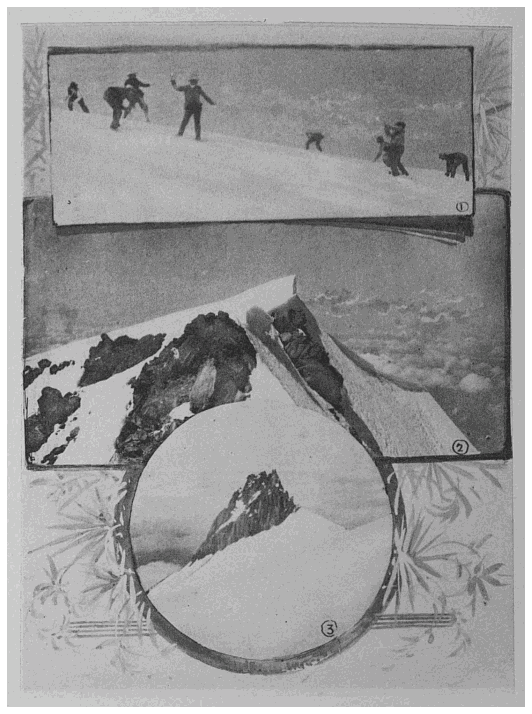
1. Snowballing on Mt. St. Helens, July 22d, 1889. 2. Summit of Mt. Hood, looking West. 3. Illumination Rock on Mt. Hood.
It was now 5:10 p.m., the thermometer registering 23° above zero; and having no blankets, our first business was to find a warm place in the steam to pass the night. Steam could be seen issuing from a dozen different places on the inside rim of the crater, say sixty to seventy feet below the crest.
Writing our names on a card, with a short account of the climb, we placed it inside of a small box, on which was inscribed, "Oregon Alpine Club, Portland." This was left on the top of the ridge. We heaped rocks around it to prevent the wind from blowing it away. We soon found a sort of semi-spherical opening in the rocks, from which the warm steam poured forth. Clearing away the rocks, leaving a sandy bottom, we built a wall of rocks two feet in height to break the wind, and then turned our attention to looking for canned corned beef.
We were told a can had been left there by Prof. Ingram's party ten days before. This was soon found, together with a package of French chocolate, a box of sardines and some cheese. We were already the possessors of one lemon. As nothing more was needed we got into our den. Taking a cup found lashed to a rock on the crest of the crater and filling it with snow we placed it in our oven and soon had plenty of water.
We ate some lunch, but fourteen and fifteen thousand foot altitudes are not productive of strong appetites, so we ate sparingly, and being so completely exhausted soon fell asleep.
About 8 o'clock p.m., we were rudely awakened by what appeared to be a dash of ice water in our faces and down our necks. The sky being clear the ice water was explained a few moments later. The wind had arisen and was drifting dry snow—(eight inches of which had fallen Sunday)—from a bank about fifteen feet distant, against the sloping roof and walls of our warm den; thus the snow was turned to water by the time it reached our faces. To prevent being so rudely drenched again we removed our coats, which were then wrapped around our heads.
The wind having veered to the west, some anxiety was felt that a storm might arise before we could return. However, fortune smiled upon us in our dizzy resting place so far above the clouds, and morning dawned clear, cold and beautiful.
Upon the first gleams of the sun we made for the ridge for our dry clothes, which were placed there before retiring to our den the night before. We had fortunately worn two suits of heavy underclothes, two pairs of pants and two coats, so we now had dry clothes, and well it was we took the precaution of removing a suit and placing it out of the way of the wet steam. Before we could return to our den every vestige of clothing, including a soft hat, was frozen stiff. The cold seemed to strike at once clear through. The agility with which we got into our steam chest would have been amusing to an uninitiated observer. We were soon warm again, and by slight assistance from each other, our dripping clothes were soon changed for dry ones. Mounting the ridge of the crater on the highest side, sunrise observations were taken. The sun appearing above the eastern horizon tinted Rainier's top with molten silver, while the country beneath was still wrapped in shade. Not many moments elapsed till the adjacent mountains, Hood, Adams and St. Helens, one by one in order named, donned their silvery shields like mighty giants in battle attitude, defending themselves against the sun, their common enemy. The effect at this time was grand, indeed, the heavy rains of two days previous having entirely dissipated the smoke.
Eastward all was clear, while westward, nearly fifteen thousand feet below, the valleys and lowlands were hidden beneath billowy clouds, which, like the mountain tops, soon turned from gray to shining silver.
Soon Sol's rays had reached the western horizon. Mountain shadows now appeared reaching westward to the limit of our vision; the jagged edges resting on hills and plains and valleys contributed to a changing scene, the memory of which will last so long as life is given.
Our selfish aim more than attained, we were satisfied and determined at once to descend to earth, from whence we came. Our determination being carried out, we reached Hot Springs at 8 p.m., and Tacoma three days later.
CHAS. H. GOVE, Of Oregon Alpine Club.