Chapter IX · THE FEEDING OF CHILDREN[17]
Reading edition
CHAPTER IX THE FEEDING OF CHILDREN[17]
“We are what we eat.”
“We should eat to live and not live to eat.”
“Heavenly Father, for this food, We, Thy children, thank Thee. Sun and showers and earth have wrought it, Labors of our neighbors brought it. May it give us strength to love And serve Thee and our neighbor.”
One of the most important factors in the well-being of any individual is right feeding in childhood, especially in early childhood. One of the chief causes of sickness and death among young children is their wrong feeding. A conservative estimate would be two thousand ill on any one day from this cause. Further, wrong feeding weakens the system so the child is much more susceptible to infectious diseases.
Not only the general health of the individual but also the quality of the teeth, the efficiency of the digestive system, the desire for stimulants, the stability of the nervous system, the quality of mental activity, power of will, strength of character, the happiness or misery of everyday living, are profoundly affected by the foods and régime of feeding during childhood.
The intelligence of the mother or the nurse, the grandmother, the father, and the friend has far more to do with the right feeding of children than does the amount of the family income. The child in the wealthy home is quite as liable to be wrongly fed as the child in the poor home. It is possible to buy enough of the right kinds of nourishing foods for a very small sum.
To feed a child so as to produce one hundred per cent. efficiency in his health to-day and fifty years from to-day should be the ambition of every one who has the care of that child,—not merely to keep him from death or present illness. This is not an easy matter, nor to be learned in a day or a month. It requires careful and earnest study of food composition, food values, the physiology of digestion, dietetics, cooking; and then patience, thoroughness, and practicability to put this knowledge into use three to five times a day, seven days in the week, every week in the year.
The Fundamental Principles of Feeding
Cleanliness and Purity. The following standards are necessary to meet these requirements.
1. Unadulterated foods. Foods unwholesome because of adulteration include:
a. Canned goods preserved with benzoate of soda or other artificial preservative
b. Candies, jams, pickles, containing coal-tar dyes and other adulterants
c. Sulphur-bleached dried fruits and molasses
d. Bakery goods made with preserved eggs, milk, and other adulterants
2. Protection from dust, dirt, and insects. Dry foods, such as bread, crackers, dates, figs should be kept wrapped in moisture-proof paper. Butter, bakery goods, and dried fruits not so wrapped should be kept under glass. Fruits and vegetables should be kept within doors, protected from dogs and cats. Milk, which is most easily contaminated, should be produced in a clean dairy, by clean workers, kept covered constantly, protected from animals, in a cool place.
3. Preparation under sanitary conditions. Bakeries and other food factories and kitchens should be scrupulously clean, with abundance of fresh air and sunlight. All persons handling food should be free from any contagious disease, with clean hands and garments. This factor is even more important than freedom from adulteration.
It is easily possible to-day to ascertain what products meet the pure food requirements. By careful purchasing, and the preparation and serving of food at home by healthy individuals, with intelligent attention to sanitation, these essential requirements of hygiene can be most completely assured.
Regularity. Meals should be served promptly at regular hours, and no food taken between meals. If food is taken irregularly, rhythm is disturbed, the digestive fluids are not ready and cannot act efficiently. If food is taken while undigested food remains in the stomach, the work of digestion must begin over again, as the fluids secreted in the early stage of digestion are different from those in the last stages. Thus the food previously taken is kept in the stomach too long; it ferments, too much acid is produced, sour stomach results, the stomach is irritated, the glands are overworked and become exhausted, and the consequence is poor digestion. To do its best work, the stomach requires rest between feedings.
During sleep, the activity of the digestive tract is very slow. Solid food taken less than an hour or two before bedtime is not well digested and is likely to remain in the stomach and ferment; the pressure produces disturbed sleep and “bad dreams”; the stomach is not ready for digesting breakfast; the individual wakens tired, without appetite, and possibly with headache or nausea. Babies, having only milk, can be fed at bedtime. With children two to six years, an hour should intervene between the light supper and sleep; with older children, from two to four hours.
If a child is regularly hungry between meals, the cause may be (a) insufficient quantity at meals; (b) diet not well balanced—frequently insufficient mineral foods; (c) eating too rapidly so that food is not well chewed and therefore not assimilated; (d) too long intervals between meals. If occasionally hungry between meals, light food requiring little digestion should be given, such as fruit juice, ripe fruit, dates, figs, or a glass of milk. Cake, cookies, candies, or other hearty foods upset digestion.
Simplicity. This applies both to the variety served at one meal, to the method of preparation, and to the serving. A maximum of five or six food items at one meal is sufficient, and is more easily digested than a greater number. Foods simply cooked require less work of the digestive organs than do more complex mixtures; at the same time they cultivate simple tastes, with their contentment.
Cheerfulness. Good cheer is the best of appetizers. Professor Pawlow has discovered that the amount and the efficiency of the gastric juice are affected by the anticipation and enjoyment of food, and that the gastric juice thus poured out at the beginning of a meal, which he has called the “appetite juice”, is the most powerful and active. Happiness and laughter (but not silliness or horseplay) should therefore be encouraged at meals.
A child should not be fed when excited, angry, cross, crying, unhappy, or overtired. Under emotional stress no gastric or intestinal juices are formed, and food cannot be digested. When a child is very tired, the system is too exhausted to do the work of digestion, and nitrogenous foods (such as meat or eggs) taken then are positively harmful, as they only decay. If at mealtime a child is cross simply because he is hungry, feeding will help put him in a happy mood, conducive to digestion. Otherwise, it is better to give only a small quantity of easily digested food, such as fruit juice, thin gruel, vegetable broth, toast, milk.
Sufficiency. This applies to the total quantity of energy and fuel foods, or what is technically called caloric sufficiency; and to the quantity and proportions of each of the food elements, technically called a balanced ration. Careful studies of dietetic needs have been made within the last ten years, and the approximate needs and conditions for different ages are now so well defined that adequate feeding need no longer be mere guess-work.
Caloric Sufficiency. A calorie is the measure of a unit of heat as an inch is a measure of a unit of space. One calorie[18] of heat is the amount that will raise the temperature of a pint of water 4° Fahrenheit. The amount of a given food, as of bread, that would furnish this much of heat when digested in the body is a one-calorie portion of bread,—1/10 ounce, or a half-inch cube. The total caloric requirement depends upon the amount of bodily heat and muscular energy needed by an individual. This will depend upon the individual’s (1) weight, (2) age, (3) occupation, (4) health, (5) climate. The amount of outdoor life, clothing, the temperament, height, and personal idiosyncrasies will require individual variations from the average.
Daily Energy Requirements During Growth.
Part of this energy is needed to carry on the vital processes, such as circulation, secretion, digestion; during the waking hours, energy is needed for every muscular action, such as walking, dressing, talking, exercising.
Age in Years Calories per Pound of Normal Body Weight Calories per Day
Under 1 year 50-45 280-900
1-2 45-40 900-1200
2-5 inclusive 40-35 1200-1500
6-9 ” 35-30 1400-2000
10-13 ” 30-25 1800-2200
14-17 ” 25-20 2300-3000
18-25 ” 16-18 2000-3400
Proportions of Food Elements. To furnish what is termed a “balanced ration”, the protein, carbohydrate, and fat should each constitute, in the total calories for the day, approximately the following proportions: protein 10 to 15 per cent., carbohydrate 50 to 60 per cent., fat 25 to 35 per cent. To some extent the fat and carbohydrate are interchangeable, but a great excess of fat or carbohydrate produces indigestion, and great insufficiency of fat starves the nerves. Each gram (about 1/28 ounce) of protein or carbohydrate furnishes four calories of heat; each gram of fat furnishes nine calories. Without sufficient protein, the child will not increase in growth. An excess of protein is no less injurious, as it cannot be stored in the body, but must be eliminated. Especially injurious is an excess of proteins containing purin-bodies, which produce urea and uric acid, thereby causing forms of kidney disease, gout, and rheumatisms. Excess of food, combined with sluggish elimination, produces putrefaction and fermentation in the intestine, resulting in auto-intoxication from the poisonous gases and chemicals, thereby inducing irritability, nervousness, languor, low resistance to germ diseases, colds.
In childhood and maternity a purin-free diet and one least likely to produce auto-intoxication is especially important.
A sufficient proportion of minerals is no less essential to life and health, although these are needed in minute quantities. Research in physiological chemistry has only recently discovered the vital significance of minerals. The quantities needed in childhood are not yet exactly known. Not only the bones and teeth but each cell and fluid requires mineral matter. The digestion and assimilation of food, the absorption of oxygen and the elimination of carbonic acid gas by the blood, the normal action of the heart, the generation of energy, the sensitiveness and reaction of the nerves, are all dependent upon the mineral supply in the system. There are no less than twelve, the principal ones being calcium, phosphorus, iron, soda, potash, sulphur. Calcium (lime) is especially needed for bones and teeth, phosphorus for growth and for nerve cells, iron for red blood corpuscles, soda for elimination of carbonic acid gas. The daily requirements for a man are:
Lime .7 gram; Phosphorus 2.75 grams; Iron .015 gram.
The allowance for a child should probably approximate this, and growing children probably need more of lime and phosphorus.
Minerals supplied to the body in vegetable and animal tissues or fluids have in some way been vitalized and made organic, so they are readily assimilated by the system. Mineral matter as dug from the earth and purchased at the drugstore is inorganic and is not assimilated either so thoroughly or readily.
Vitamines are equally essential in the food. These are subtle organic substances, as yet little understood, but necessary for perfect assimilation. Cooking, especially at a high temperature or for a long period, usually diminishes the vitamines in foods. This is one special objection to boiled, condensed, and powdered milk, patent baby foods, canned vegetables, canned, dried and salted meats. Children kept exclusively on such foods and boiled water do not thrive. Such a diet produces scurvy. Some fresh, uncooked food, such as raw milk, uncooked fruit or fruit juices, uncooked vegetables, is needed every day.
Laxative elements are also essential. These are (a) cellulose, found in the husk of whole wheat, and the fibers of vegetables and fruits; (b) water, found in milk, vegetables, and fresh or stewed fruits; (c) oil, found in cream, olive oil, and fatty nuts; (d) sugars, found in honey, molasses, dried fruits; (e) vegetable acids, found in fruits.
Hard foods, requiring work of the jaws, are needed every day, especially from nine months to seven years of age, while the first and second teeth are coming. Hard foods exercise and develop the jaws and teeth, and promote a good circulation through the jaws, mouth, and nose. They may be supplied by a chicken or chop bone wiped free of the cooked meat, or after nine months by hard crust, hard toast, zwieback, or educator crackers, given at one or two meals every day. Soft, mushy foods as a steady diet are injurious, not only because they fail to supply the needed exercise and circulation, but also because they cling to the teeth, and by fermenting produce their early decay.
Foods containing growth-producing principles are needed daily. Little is yet known of this factor. Some foods that, according to their chemical composition, would be considered valuable for growth, have been found on experimentation to be lacking in growth-producing properties; among these are corn, bacon, gelatine. Other foods have marked growth-producing results, and among these are milk, butter, eggs, whole wheat.
Foods Permissible for Children at Different Ages. Add each new food gradually, beginning with a mere taste and observing whether it agrees. Eggs, especially white, should be added cautiously, and discontinued if they cause swelling, indigestion, or diarrhea. Raw fruits must be selected with great care, neither overripe nor underripe, nor swallowed in lumps; they are prohibited in diarrhea.
10 months:
Milk
Oatmeal or whole wheat jelly
Rice or barley jelly
Zwieback, hard toast
Strained spinach
Prune juice, prune pulp
Orange juice, strained, diluted
Gelatine
12 to 15 months, add:
Baked potato
Junket
Egg yolk hard-boiled, grated
Coddled egg (½)
½ egg (raw) beaten in milk
Vegetable broth with purée of potato, carrot, or spinach
Stale whole wheat bread
Wheatsworth crackers
Olive oil
Cottonseed oil
White grape juice
Chicken bone or chop bone, cooked, meat scraped and wiped off
15 to 18 months, add:
Rice boiled or steamed (cooked 3 to 6 hours)
Oatmeal gruel (cooked 6 to 12 hours)
Butter
Baked apple (pulp)
Date pulp
Custards
18 to 24 months, add:
Purée (strained) of fresh peas, dried peas, celery, onions, corn
Hominy (ground) cooked 12 hours
Tapioca thoroughly cooked
Scraped raw apple
Ripe raw peach
Strained honey
Stewed dried peaches, mashed
2 to 3 years, add:
Young tender peas or lima beans, mashed
Asparagus tips, stringless beans, chopped fine
Tender carrots, beets, celery, minced fine
Mashed potatoes
Whole wheat breakfast cereal, corn meal, corn bread, bran muffins, macaroni
Poached egg
Stewed pear, mashed
Stewed chopped figs
Apple sauce
Oatmeal crackers
Purple grape juice
3 to 4 years, add:
Vegetables, diced
Sweet potatoes, mashed
Raw, grated carrots
Cornflakes
Shredded wheat
Seedless grape pulp
Grape fruit
Ground almonds, pecans, filberts
4 to 6 years, add:
Purée of dried beans, lentils
Heart of tender celery (raw or stewed)
Minced, tender lettuce
Stewed tomatoes
Stewed apricots, strawberries
Whole cooked prunes
Whole dates, figs (sterilized)
Ripe banana, scraped and mashed, or cooked (occasionally)
Peppermints
Ice cream
Gingerbread
Sponge cake, molasses or sugar cookie
6 to 8 years, add:
Eggs scrambled or omelet
American cheese (cooked)
Cottage cheese
Oysters (cooked)
Lentils, dried Lima beans
Raw tomatoes, cress
Peanut butter
Seedless raisins, chopped
Simple preserves, marmalade, jam
Raw pears, strawberries, raspberries
Cantaloupe, watermelon
Simple layer or loaf cake
Foods Injurious to Children. Never to be given under twelve years of age; not advised for any age.
Stimulants: Coffee, tea, beer, wine. These furnish no food value but stimulate the heart and leave serious poisons that injure kidneys, liver, stomach, and nerves.
Condiments: Pepper, mustard, catsup, vinegar, pickles, horseradish. These are irritating to the delicate lining of the stomach; they overstimulate the appetite; they have no food value. Excess of acids extracts needed mineral from the body.
Meats: Pork roast or chops, ham, sausages, canned or dried meats and fish, corned beef, sweetbreads, kidneys, game. All are difficult of digestion.
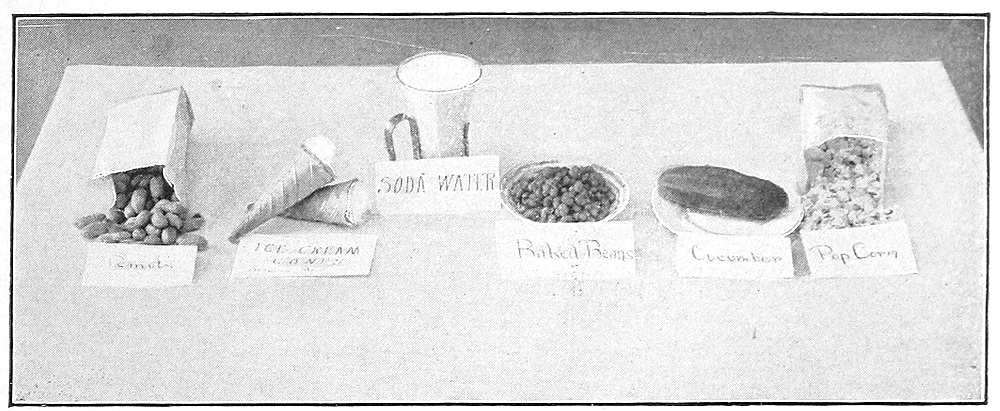
Some Foods Especially Dangerous for Children Under Six.
Peanuts, ice-cream cones, soda water, baked beans, raw cucumbers, popcorn.
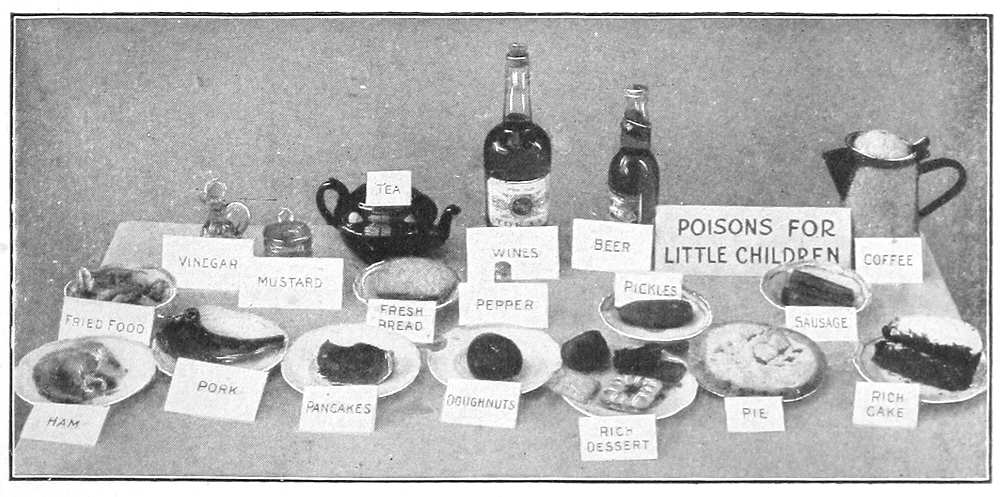
Poisons for Little Children.
Not for vitality, beauty, clear thinking at any age.
Pastry: Pie, tarts, dumplings, cream puffs. The combination of fat and starch makes these difficult of digestion.
Rich Foods: Rich cake, puddings, sauces, preserves, and conserves. Excess of sugar or fat overtaxes the digestion and also spoils the appetite for simple, wholesome foods.
Fried Foods: Fried meat, potatoes, eggs; fritters, doughnuts, waffles, pancakes, French toast. Fat so combined with starch or protein delays, even prevents, digestion. Starch requires longer cooking than is possible in frying.
Fresh Baked (less than twenty-four hours old): Bread, rolls, muffins, cake. Rolls or muffins may be served warm by re-heating in oven. Fresh bread or cake forms a sticky mass, very difficult for the digestive juices to dissolve or penetrate.
Not permissible for children under six years:
All difficult of digestion.
Popcorn
Soda water
Ice cream cones
Peanuts
Baked beans
Rusks
Grocery cookies
Cucumbers
Cabbage
Whole nuts
Cherries
Berries
(Some physicians also exclude all cake, candy, ice cream, jam.)
Illnesses Produced by Wrong Feeding. Illness may be due to one of several causes. Wrong feeding is one fundamental cause of ill health and a direct cause of many forms of illness. An excess or deficiency of any one of the food elements, wrong combinations of foods, wrong habits of feeding, lack of cleanliness or purity, improper cooking, may all produce illness.
The general ill health and low vitality from wrong feeding may be due to:
(a) Auto-intoxication, from putrefaction of food in the intestine because of constipation, or from excess of purins;
(b) Excess of acid in the blood, due to excess of acid-forming foods or deficiency of alkali-forming foods;
(c) Malnutrition or anemia, due to insufficient food, or to lack of some food element; frequently due to lack of fats or minerals.
While the exact relation between wrong feeding and some of the specific forms of illness is still a moot question, some of the probabilities now tentatively held by many physicians may be indicated in a general way, as in the following table:
“Colds”:
Overfeeding, especially of protein or sugar
Colic:
Irregular feeding
Overfeeding
Food taken too rapidly
Constipation:
Lack of fruits and green vegetables
Lack of cellulose
Lack of water
Irregular feeding
Convulsions:
Solid food at too early age
Food difficult to digest
Constipation
Gastric indigestion (nausea):
Indigestible combinations, e.g. fried foods, milk with acids
Excess of sugar or starch
Excess of fat
Irregular feeding
Headaches:
Constipation
Indigestible combinations
Excess of sugar or purins
Intestinal Indigestion:
Excess of protein
Excess of cellulose
Excess of carbohydrates
Kidney Disorders:
Excess of purins
Excess of acid-forming foods
Excess of salt
Excess of sugar
Nervousness:
Irregular feeding
Auto-intoxication
Constipation
Excess of acid-forming foods
Excess of sugar or meat
Insufficient fats
Insufficient minerals
Rheumatism:
Excess of purins
Deficiency of minerals
Rickets:
Lack of vitamines
Lack of minerals
Lack of fats
Scurvy:
Lack of vitamines
Lack of minerals
Summer Diarrhea:
Unclean food, especially milk
Underripe or overripe fruit
Digestion. In the process of digestion, foods are not broken down into simple chemical elements, as nitrogen, hydrogen, oxygen, but into simpler yet still very complex compounds, as organic minerals (lime, phosphorus, soda), simpler sugars, fatty acids, emulsions, soaps; and the proteins into their many forms of amino-acids and (if these are inherent) purins and uric acid. Soluble minerals, simple sugars, and many drugs are quickly absorbed from the stomach directly into the circulation. Water passes into the small intestine in five to twenty minutes. The solid portions of mother’s milk complete their stomach digestion in about two hours, cow’s milk and other easily digested foods in two and a half to three hours, under favorable conditions. Digestion is continued in the small intestine, where about four hours are required for further digestion; the soluble portion is absorbed into the circulation, and the indigestible remainder, with waste cell material and bile, passes into the large intestine. There the journey is very irregular and slow, requiring from ten to twenty hours. The longer the delay, the greater the fermentation and putrefaction, and the accumulation of putrefactive bacteria and poisonous gases; the poisons, which are constantly being absorbed into the system, produce auto-intoxication. About half the solid waste is bacteria and waste cell tissue.
Food Composition. Every one who is responsible for the feeding of children should be thoroughly acquainted with the different food substances and the composition and value of common foods. For practical purposes of dietetics, foods are analyzed into their content of protein, carbohydrate, fat, mineral, cellulose, water. Some foods contain only one or two of these elements; other foods contain them all.
1. Protein foods are those that contain nitrogen; their special use is to build new body cells (for growth) and to replace waste of tissue; they also furnish energy. Proteins differ in value according to the number and the kinds of amino-acids in their composition.
Foods containing high percentage of protein:
Eggs Milk Cheese Cereals Almonds Peanuts Peas Beans Lentils Fish Lean meat
2. Carbohydrates (sugars and starches) furnish bodily heat and muscular energy.
Foods containing high percentage of starch:
Potatoes Rice Cereals Tapioca Macaroni Farina
Foods containing high percentage of sugar:
Sweet fruits Dried fruits Beets Carrots Honey Maple Syrup Molasses Barley sugar Cane sugar
Starch digestion begins in the mouth by the action of the saliva and is completed in the intestines. Starches are changed to a form of sugar. Excess of carbohydrates is stored in the liver or as fat through the body.
3. Fats furnish energy and heat.
Foods containing high percentage of fat:
Cream Butter Egg yolk Olive oil Cottonseed oil Nuts (except chestnuts) Meat fats
4. Minerals are found in grains, in fruit, green vegetables, milk, eggs, meat.
Calcium and phosphorus are furnished in high percentage by:
Grape juice Orange juice Rhubarb Maple sap Milk
Calcium, phosphorus, and iron are all supplied in high percentage in:
Spinach Celery Peas Lima beans String beans Apples Prunes Peaches Pears Dates, raisins Whole wheat Whole cereals Egg yolk Lean meat (except calcium)
While milk contains only a low percentage of iron, it furnishes a high proportion of the day’s supply in children’s diet, because of the total quantity used.
Valuable mineral material in many fruits and vegetables is just beneath the skin. It is dissolved into the water if these foods are boiled. The mineral matter is conserved by baking, or stewing, or steaming, by cooking without paring, or by using the water in which they are boiled.
The mineral matter is in the germ and the husks of grains. Refined foods, such as white flour and sugar, polished or puffed rice, processed barley and corn meal, cream of wheat, cornstarch, sago, from which the husk has been removed, have been robbed of their mineral matter. The whole ground grains and brown sugar retain the minerals.
5. Water, a necessary part of all tissues, constitutes about sixty per cent. of the body weight. It promotes circulation of the blood and other internal fluids, dissolves poisons, aids elimination of waste through urine, feces, and perspiration. Water is best taken half an hour before meals, and at the close. If taken with the meal, it should be only after food in the mouth has been swallowed, that it may not interfere with the action of the saliva upon the food. Ice in water makes it too cold for the stomach, and unless artificial, is apt to contain dangerous impurities. Water should be sipped, warmed in the mouth before being swallowed, and not more than one glass taken at a time. Water is supplied in:
Milk Cocoa Broths Fruit juices Fruits Green vegetables
Water constitutes about 65 per cent. of meats, 80 per cent. of fish, 90 per cent. of fresh fruits and vegetables.
6. Cellulose. The indigestible cellulose and fibers in food furnish a bulk of waste which stimulates the intestines to muscular action. Supplied in:
Whole wheat Whole cereals Prunes, dates Figs, raisins Fibrous vegetables as celery, spinach, onions, carrots, beets, peas, beans Skins of apples, pears
Cellulose is lacking in concentrated foods, as cheese, nuts, sugar, butter; refined foods, as white flour, cream of wheat, cornstarch; in liquid foods.
Laxative Foods:
Figs Dates Prunes Orange Apple Raisins Peach Plum Rhubarb Grapes Whole wheat cereals Whole wheat bread Whole wheat crackers Corn meal Bran muffins Peanut butter Pecan nuts Gingerbread Molasses Honey Onions Spinach Olive oil Cottonseed oil
Purin Bodies in Common Foods. Purin bodies are found in some protein foods. Purins are uric-acid forming. The poisons of purins are believed to be productive of gout, rheumatism, migraine and periodic headaches, bilious attacks, catarrhs, neurasthenia, and general ill-health of an indefinite nature.
Foods Containing High Per Cent. Purins[19] Grains Per Pound Foods Containing 2 Grains or Less[19] Purin-free Foods[19]
Sweetbreads 70 Peas Milk
Liver 19 Potatoes Cheese
Kidney Onions Butter
Beef 14-7 Carrots Flour
Pork 8 Turnips Rice
Chicken 9 Parsnips Macaroni
Veal 8 Asparagus Tapioca
Salmon 8 Rhubarb Sugar
Halibut 7 Spinach Cauliflower
Mutton 7 Dates Cabbage
Figs Lettuce
Codfish (4) Strawberries
Flounder
Acid-forming and Alkali-forming Foods. The blood contains some acids and some alkalies. For physical efficiency, the balance should be slightly alkaline. In the process of digestion minerals are oxidized into their chemical constituents of acids or alkalies. An excess of acid interferes with the normal alkalinity of the blood and secretions, prevents the normal absorption of oxygen and elimination of carbonic acid gas by the blood, hinders the work of the white blood corpuscles, irritates the nerves, lowering, therefore, the resistance and vitality, and irritates the kidneys. In the dietary, care should be taken to include alkali as Well as acid-forming foods.
Meat Milk
Eggs Fruits
Grains Vegetables, especially:
Rice Spinach Lettuce
Tapioca Celery Cress
Sugar Potatoes Radishes
The Question of Meat. Some authorities on dietetics now advise against giving meat in early childhood. Wiley and Mendel advise waiting until about four years, Sherman and Lorand until about eight.
The following objections are made to meat in children’s diet:
(1) It has a high percentage of purin bodies, which the child’s organism is less fitted to dispose of.
(2) It is acid-forming to a high degree.
(3) “Meat proteins are much more susceptible to putrefaction in the intestine, giving rise to absorption of putrefactive products which are more or less injurious (producing ‘auto-intoxication’) than are the proteins of most other foods.”[21]
(4) It is stimulating to the flow of gastric juice, especially the extractives, which are found particularly in meat juices, meat broths, beef tea. As an acid-forming food it is stimulating, and easily irritating, to the nerves, and therefore is disadvantageous with nervous children, or when the nervous system is yet highly sensitive, as it is in early childhood.
(5) Carnivorous animals, such as the cat and the dog, do not permit their young to have meat until the teeth are developed. Meat given experimentally to young kittens produced convulsions.
(6) It is an expensive form of protein. Beef juice contains chiefly the stimulating extractives, and a slight quantity of iron.
(7) Protein in milk, selected vegetables, and (usually) eggs, is more easily digested; and iron can be supplied by selected vegetables and fruits.
The following table gives approximately the comparative value of a 100-calorie portion of beef juice (requiring 3½ pounds of lean beef) and an equal bulk of milk.
Beef juice 14.1 oz. 100 19.6 2.4 .015 .46 .003
Milk 14.1 oz. 276 13.1 15.9 20 .649 .832 .0009
The meat at twenty-two cents a pound costs seventy-seven cents; the milk at ten cents a quart costs five cents. One pound of meat will give little more than one fourth of this food value; one ordinary serving (2 ounces) only 3 per cent. of the above values.
Physicians, on the other hand, more often advise meat, especially for the iron and the stimulation to digestion.
The Question of Sugar. Sugar is a concentrated form of fuel food. Children need much of fuel foods, but this can be given in the form of fats and starches as well as sugar. Sweet easily spoils the appetite for plain, more wholesome foods, and gives a sense of sufficiency before the needs of the body have been satisfied. Children whose taste has been spoiled by sweetened food are more likely to show a distaste for wholesome vegetables. Sugar taken between meals or in excess at meals is irritating to the sensitive lining of the stomach. Sugar excess causes fermentation in the stomach and intestines, overtaxes the liver, reduces the normal alkalinity of the blood, produces nausea, headache, biliousness, irritability, nervousness. It injures the teeth by causing mouth acidity, which produces tooth decay, and by causing distaste for simple lime-containing foods. The peevishness and irritability of children after an overdose of candy is very likely due to the indigestion and the hyperacidity of the blood, which irritates the nerves.
Cane sugar and candy lack the mineral matter found with sugar in the natural syrups, fruits, and vegetables. The necessary amount (and it is small) of sugar should therefore be given to young children in the form of fruits, at the close of the midday meal. It is advantageous to the child’s efficiency and contentment not to have candy or ice cream under four years of age, and he will thrive without them until ten years. When allowed, they should be given only in slight amount as a dessert at the close of dinner, and not between meals.
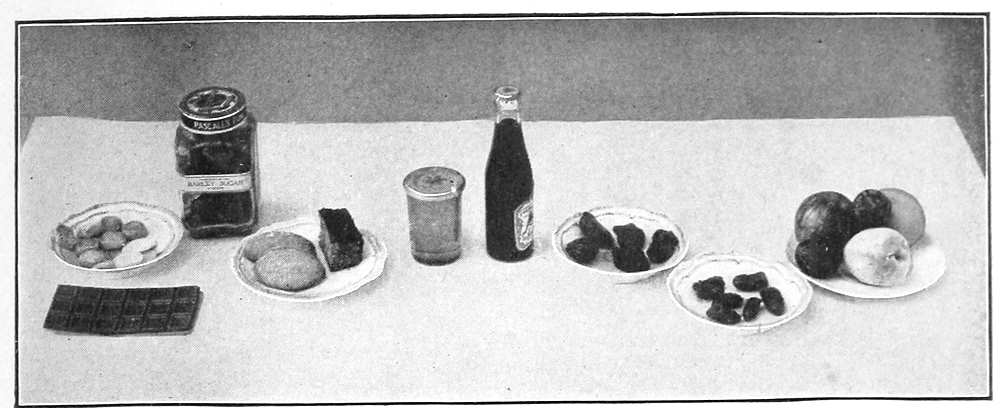
Wholesome Sweets at Suitable Ages.
Homemade peppermints, sweet chocolate, barley sugar, sponge cookies, molasses cake, honey, maple syrup, prunes, figs, dates, plums, apples, peaches.
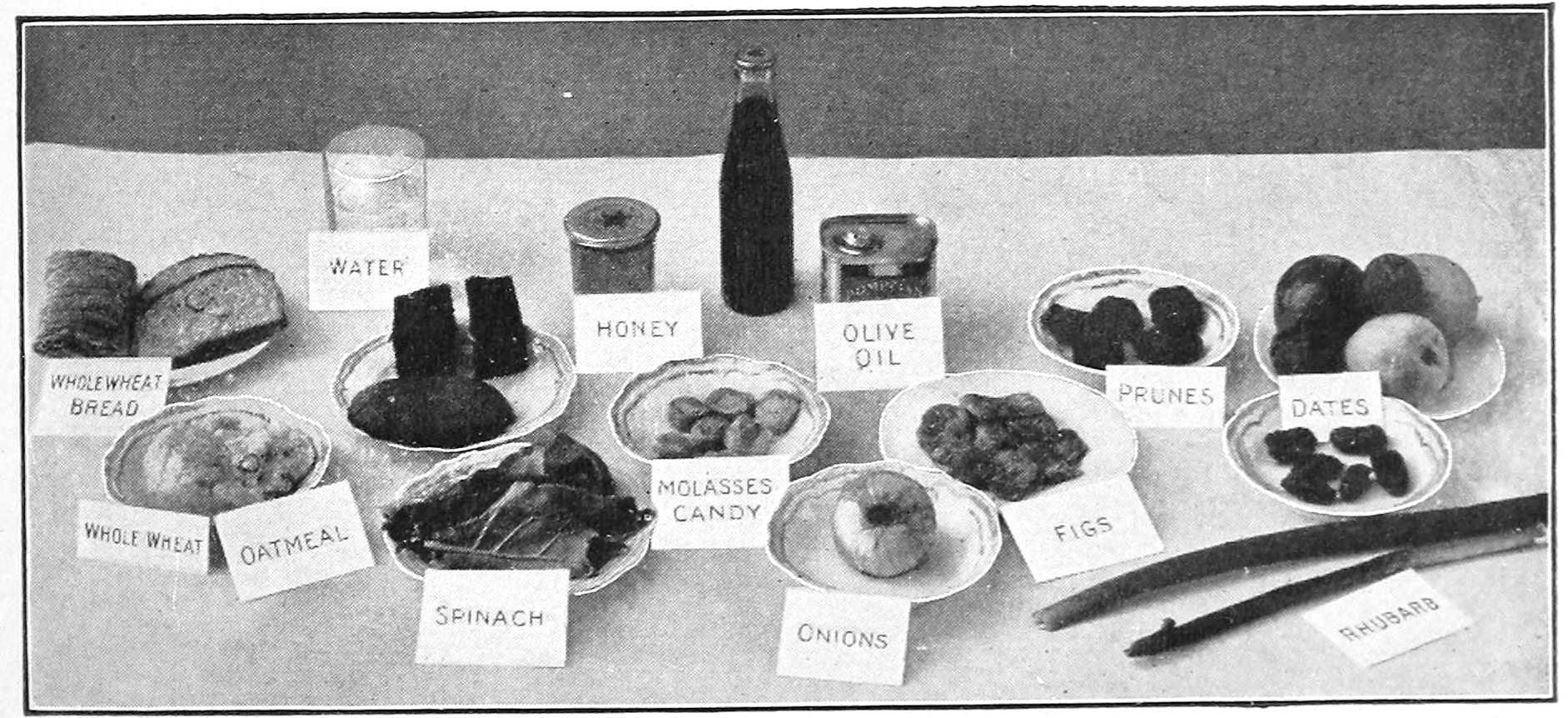
Laxative Foods.
To be selected, appropriate to age.
Wholesome Sweets[23]
Honey
Maple syrup
Sweet fruits:
Oranges, Apples
Peaches, Plums
Seedless grapes
Dates, Figs
Seedless raisins
Prunes
Simple, pure candy
Molasses candy
Peppermint wafers
Milk chocolate
Barley sugar
Simple homemade cake
Sponge cake
Gingerbread
Molasses or sugar cookies
Rational Dietary. A rational dietary for children should meet the following requirements:
1. Total calories per day, computed for the age, weight (normal); modified by the activity, season, health, of the individual child
2. Balance of protein, fat, carbohydrate: Protein 10-15 per cent; fat 25-35 per cent; carbohydrate 50-60 per cent.
3. Purin-free or low in purins
4. Minerals supplied, especially lime, phosphorus, iron, soda, potash
5. Vitamines supplied by some uncooked or fresh, slightly cooked foods
6. Laxatives furnished by cellulose, water, oils, sugars, vegetable acids
7. Hard foods, requiring gnawing and chewing
8. No irritants or artificial stimulants, e.g. pepper, mustard, vinegar, condiments, alcohol, beer, tea, coffee
9. Combination of food carefully arranged:
a. Some alkali-forming
b. Milk not served with acids, as tomatoes, oranges, apples, apricots, peaches, lemon juice
c. Agreeable proportion of liquids and solids
d. Flavors combined that taste well together
e. Variety slight at one meal (3 to 6 items); wider range from day to day
10. Cooking:
a. Albumen (milk, white of egg) slightly coagulated
b. Cereals and starches thoroughly cooked
c. Fats not overheated (below smoking or scorching point)
d. Fats not mixed while hot with starches or sugars (gravies, sauces, fried foods, pastry), or with protein (fried eggs)
e. Vegetable cellulose removed, or divided, according to the development of the digestive system of the child
Table for Hours of Feeding
Age No. Feedings Intervals Hours Addenda
12 to 24 months 4-5 4 hours 6, 10 A.M., 2 P.M. Fruit juice 8 A.M.
Dinner 2 P.M.
2 to 3 or 4 years 4 4 hours 6:30, 10 A.M., 2, 5 P.M. Do.
3 or 4 to 9 years 3 4½-5 hours 7:30 A.M., 12, 5 P.M. Fruit juice 6:30 A.M.
Dinner 12 M.
Milk or fruit 3:30 P.M.
After 9 years 3 4½-5½ hours 7:30 A.M., 12, 6 P.M. Do.
Differences of social, economic, and climatic conditions will naturally lead to differences of usual rising hour and general day’s régime. The above schedule is consistent with the environment represented in the daily schedule on pages 124, 125.
A special schedule should be made out for the individual child, according to his environment and special needs. Certain fundamental principles must be followed, in varying this schedule. (1) Regular times for meals; (2) intervals between meals; (3) heaviest meal at midday; (4) interval before bedtime; (5) interval before bath.
To make out a dietary for a given individual.
1. To compute the total calories required for one day, (a) take the normal weight for the age, sex, height (see appendix), and (b) multiply this by the calories required per pound of body weight. (Table, page 160.)
Use the minimum calories for youngest, maximum for oldest in each age group. A child of active temperament requires more calories than a phlegmatic child of same age and weight. Factors indicating a liberal allowance of calories are outdoor life, cold weather, vigorous exercise, or a child under normal weight. A smaller allowance is indicated by indoor life, little activity, hot weather, or a child over normal weight.
2. Compute the number of these total calories for protein (15 per cent. of total calories), fat (25-35 per cent.), carbohydrates (50-60 per cent.).
3. Make out a tentative day’s dietary, in 100-calorie portions, and add or deduct portions until the total of computed calories is approximated; a difference not to exceed 10 per cent. is allowable. (Table, page 160.)
4. Analyze these portions (see appendix), and compare with computed amounts (2 above) for balance of protein, fat, carbohydrate. Differences not to exceed ten per cent. are allowable. For compound foods, as custard, purée, analyze each of the ingredients.
5. Analyze for lime, phosphorus, iron.
6. Check for alkali-forming foods, vitamines, laxatives, hard foods.
7. Divide into meals. The heaviest meal should come in the middle of the day.
8. Note the method of preparation suited to the development and condition of the individual.
The making of a well-balanced and organized dietary for a day requires several hours of careful calculating. It is therefore the part of wisdom, as well as economy of energy, to carefully make out a dietary for six or seven days, that there may be balance in each day’s ration, and a wide range of variety from day to day; and to preserve these for reference. By measuring out 100-calorie portions of common foods for a few days, the student comes to recognize these quickly, and the assembling of a meal comes to have all the zest of a game.
Illustration of Method in Making out a Dietary.
Age: 4 years Activity: Out-of-doors
Sex: Boy Season: Winter
Health: Robust Temperament: Active
Height: 39 inches
1. Normal weight: 35 pounds; Calories per pound: 38; Total Calories: 1330
2. Estimated Calories: Protein, 200; Fat, 465; Carbohydrates, 665
3.-5. Analysis of Day’s Food
Food Quantity (Uncooked) Calories Prot. Fat Cbhy. Lime Phos. Iron
Cal. Cal. Cal. Grams Grams Grams
Grape juice 5 T 75 75 .016 .03
Milk 1½ pt. 500 95 260 145 1.195 1.515 .0017
Oatmeal 1 T 25 4 2 19 .007 .054 .0002
Bread (whole wheat) 2 slice 200 30 10 160 .032 .32 .0012
Butter 1½ cube 150 1 149 .004 .006
Crackers (Wheatsworth) 1 25 4 5 16 .004 .061 .0003
Rice 1 T 50 5 45 .004 .085 .0004
Potato ½ med. 50 6 44 .009 .083 .0007
Peas (fresh) 2 T 50 14 2 34 .016 .12 .0008
Egg 1 74 24 50 0 .044 .175 .0014
Apple sauce 1 apple 100 3 7 90 .022 .05 .0005
Dates 3 50 1 4 45 .01 .01 .0005
1349 187 489 673 1.363 2.509 .0079
6.-7. Feedings, 4. Hours, 7:30, 10:00 A.M., 12:00; 5:00 P.M.
Day’s menu: (See menu for child 2 to 4 years, page 181).
8. Method of preparation: For first teeth; vegetables diced; whole dates, prunes.
Typical Menus For Different Ages[24]
I. Twelve to Fifteen Months
Calculated for 21 pounds at 45 calories = 945 calories
Calories Vita. Alka. Lax. Hard
A.M.
6:00 1½ glass warm milk 150 s s
8:00 orange juice 75 s s s
10:00 oatmeal jelly 25
1½ glass milk 150 s s
½ t top milk 5 s s
P.M.
2:00 ½ potato, baked 25 s
1 t top milk 15 s s
½ slice bread, toasted 50 s s
prune pulp 100 s (?) s
1½ glass milk 150 s s
5:30 oatmeal jelly 25
1½ glass milk 155 s s
small slice zwieback 25 s
Totals as analyzed 950
CALORIES GRAMS
Prot. Fat Cbhy. Lime Phos. Iron
Calculated: 142 331 473
Analyzed: 145 333 472 1.622 2.293 .0043
Vitamines may exist in some degree in slightly cooked foods.
II. Fifteen to Twenty-Four Months
Calculated for 26 pounds at 42 calories = 1092 calories
Calories Vita. Alka. Lax. Hard
A.M.
6:00 2 glasses warm milk 200 s s
1 Wheatsworth cracker 25 s
8:00 orange juice 75 s s s
10:00 oatmeal gruel 50
2 glasses milk 200 s s
1-2 slice toast, whole wheat 50 s s
P.M.
2:00 ½ coddled egg 37 s
¼ baked potato 25 s
1 T spinach 10 s s s
¼ slice bread, whole wheat 25 s
¼ T butter 25 s s
5:30 oatmeal gruel 50
½ slice toast, whole wheat 50 s s
1 Wheatsworth cracker 25 s
2 glasses milk 200 s s
Totals as analyzed 1047
CALORIES GRAMS
Prot. Fat Cbhy. Lime Phos. Iron
Calculated: 164 382 546
Analyzed: 177 386 484 1.647 2.592 .0068
III. Two to Four Years
Calculated for 35 pounds at 38 calories = 1330 calories
Calories Vita. Alka. Lax. Hard
A.M.
6:30 grape juice 75 s s s
7:30 ¼ serving oatmeal 25
2 glasses milk 200 s s
½ slice toast, whole wheat 50 s s
½ T butter 50 s s
10:00 1 glass milk 100 s s
1 Wheatsworth cracker 25 s
12:00 ½ potato baked 50 s
1 T peas 50 s
1 egg coddled 74 s
1 T butter 100 s s
apple sauce 100 s s
½ slice bread, whole wheat 50 s
P.M.
5:00 rice (unpolished) 50
date pulp 50 s s s
2 glasses milk 200 s s
1 slice zwieback 100 s s
Totals as analyzed 1349
CALORIES GRAMS
Prot. Fat Cbhy. Lime Phos. Iron
Calculated: 200 465 665
Analyzed: 187 489 673 1.363 2.509 .0079
IV. Four to Six Years
Calculated for 40 pounds at 37 calories = 1480 calories
Calories Vita. Alka. Lax. Hard
A.M.
6:30 orange juice 100 s s s
7:30 rice 50
chopped figs 50 s s s
2½ glasses milk 250 s s
1 slice toast, whole wheat 100 s s
butter 75 s s
12:00 lima beans, fresh 50 s
2 T spinach 25 s s s
potato, boiled in skin 50 s
chicken 25
1 slice bread, whole wheat 100 s
butter 100 s s
2 plums 50 s (?) s
P.M.
5:00 ½ shredded wheat 50 s
2½ glasses milk 250 s s
molasses cookie, hard 100 s s
Totals as analyzed 1475
CALORIES GRAMS
Prot. Fat Cbhy. Lime Phos. Iron
Calculated: 222 518 740
Analyzed: 203 481 791 1.557 2.760 .0109
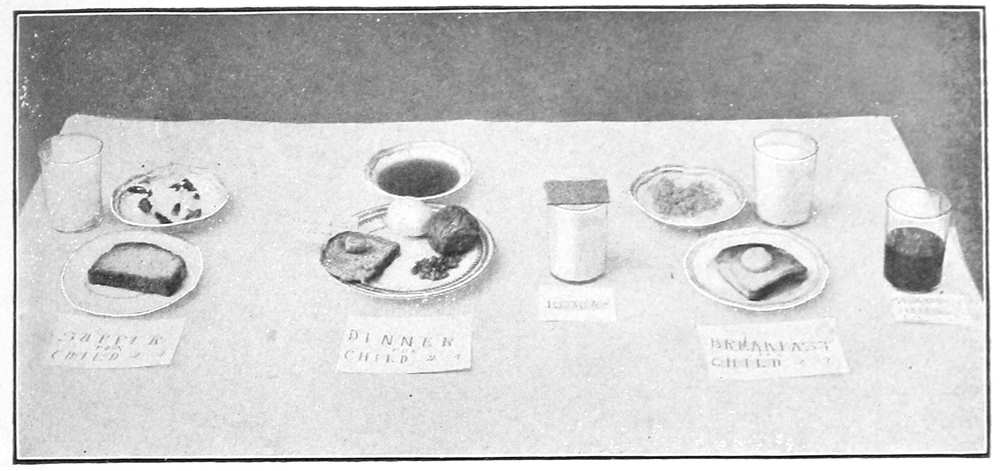
Day’s Menu for Child Two to Four Years.
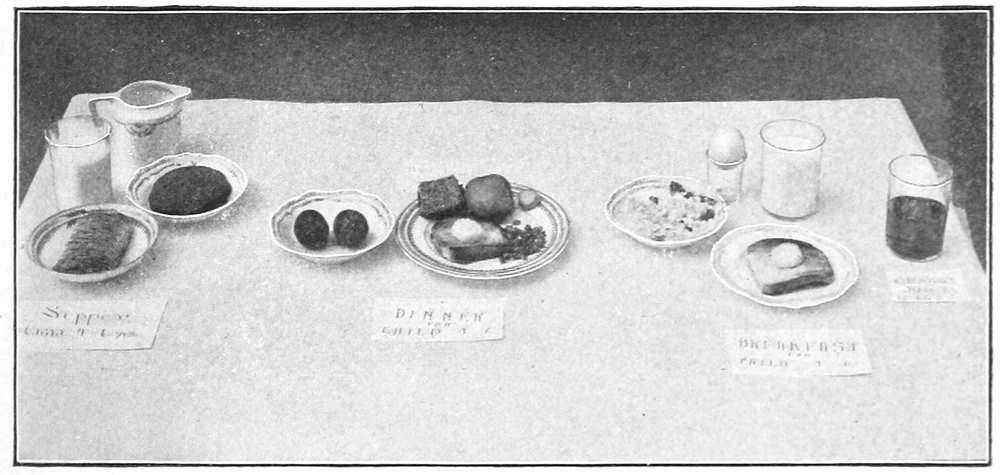
Day’s Menu for Child Four to Six Years.
V. Six to Eight Years
Calculated for 47 pounds at 33 calories = 1551 calories
Calories Vita. Alka. Lax. Hard
A.M.
6:30 orange juice 100 s s s
7:30 whole wheat cereal 100 s
1½ glass milk 150 s s
1 slice toast, whole wheat 100 s s
½ T butter 50 s s
soft boiled egg 74 s
½ fig 50 s s s
12:00 ½ portion macaroni 50
1 T cheese, cooked 100
4 T string beans 25 s
lettuce, oil, lemon juice 55 s s s
1 slice bread 100 s
½ T butter 50 s s
raw apple 100 s s s
P.M.
5:00 1 shredded wheat 100 s
1 cup milk 100 s s
1 cup custard 150
1 slice toast, whole wheat 100 s s
½ T butter 50 s s
Totals as analyzed 1604
CALORIES GRAMS
Prot. Fat Cbhy. Lime Phos. Iron
Calculated: 233 543 775
Analyzed: 214 517 873 1.475 1.865 .0099
Care of Food. All food should be kept covered, protected from dust, bacteria, insects, odors, poisonous gases (from bad drainage in refrigerator or kitchen). Butter should be kept in oiled paper or covered by a salted muslin cloth.
Cooked foods should be quickly and thoroughly cooled, and then covered and kept in a cool place.
Milk requires the most painstaking care, as bacteria multiply in it very rapidly unless it is kept cool and clean. It should be kept in a seamless, non-rusting receptacle, covered from dust and insects (preferably with a clean, double muslin cloth that will admit air but keep out dust); and placed in a clean, odorless, ventilated place. If a refrigerator or clean, cool cellar, springhouse, or well is not available, a homemade refrigerator may be constructed, similar to the fireless cooker, that will require little ice. Or the bottle may be placed in a basin of cool running water and covered with a clean muslin cloth the edges of which absorb the water; if thus placed in a draft, the evaporation will keep the milk cool. In hot weather it should be pasteurized for children under six years, and at other seasons for children under four, unless certified.
Milk should preferably be bottled at the dairy for delivery. If delivered from cans it should be exposed as little as possible to the air and dust, the measures should be scrupulously clean, and it should be poured at once into bottles or jars that have been sterilized by boiling and that are covered from dust until filled. It should be immediately covered.
If milk is delivered in bottles, provision should be made for protecting these from dust, sun, and animals until they are brought into the kitchen. The bottles should be well washed in cool water, especially around the top and cover, before opening. The rim of the bottle should be wiped with a clean cloth and the cover replaced immediately after pouring.
Milk which has been warmed or which has stood uncovered outside the bottle should not be poured back or used again for the children to drink, as bacteria have multiplied in it very rapidly. It may be used for cooking.
Milk. The production of milk requires the greatest cleanliness. If a cow is kept, the dairy, utensils, methods of milking and caring for the new milk should conform to the standards set forth in the Federal and State Health Bulletins. If milk is purchased, inspection should, if possible, be made of the dairy and the methods of cooling and transportation. In the large cities, milk is now graded according to the degree of care and the cleanliness as indicated by the bacteria count. Certified or Grade “A” should be used for children under three years of age. Grade “A” is preferable, but Grade “B” can be used for children over two years. Grade “C” and loose milk are fit only for cooking.
The milk from a herd is more uniform from day to day than from a single cow. Holstein or Guernsey milk is preferable for children, especially for infants, as the lower fat content and softer curds make it more easily digested than Jersey milk.
Sterilized or condensed milk is less easily digested and less nutritious than raw milk, and is conducive to constipation. The high degree of heat to which they have been subjected has reduced the vitamines and affected the protein.
Milk may spoil even before it has soured. Pasteurizing delays souring but not spoiling. Unscrupulous dealers sometimes add preservatives to prevent souring. Such milk is dangerous. Clean, freshly soured milk is harmless, but should not be given to children under three except as buttermilk. With young children and babies, buttermilk can sometimes be retained and digested when sweet milk cannot be taken. The special tablets containing the Bulgarian bacillus should be used, and usually, with the whole milk, in making buttermilk for young children. These tablets may be obtained from the druggist.
Skimmed milk has all the value of whole milk except the cream. Whey contains the minerals, sugar and fats. Bottled commercial cream has a very high bacteria count and should never be used for children. Ice cream should be freshly made of fresh, pasteurized milk, with scrupulous cleanliness.
Principles of Cooking. Before food can be utilized by the body, it must be made soluble—changed into substances that are dissolved so they can pass readily through the walls of the food tube into the blood. In the digestive tract fats, carbohydrates, and protein must first be separated, as different digestive fluids are provided to act upon each of these. Cooking for children should (1) make foods easily soluble; (2) produce little mixture of protein, carbohydrates and fats; (3) improve the flavor, and (4) raise the temperature to about blood heat (98° F.), when served.
The degree of development of the digestive fluids, the stomach, and the teeth must be considered in preparing food for an individual child. In infancy the digestive system is undeveloped, lacking in digestive fluids, stomach small, and there is no provision for chewing.
Until nine months of age babies do not have digestive fluids for starch, or for protein except the curds of milk; their teeth are not yet serviceable for chewing, and solid food of any kind is so indigestible that it often causes convulsions, if given.
After nine months, starches thoroughly cooked and without cellulose may be given cautiously.
All food must be easily soluble until two years of age, that is, until enough of the first teeth have developed for adequate chewing of soft cellulose.
For children under 18 months, cellulose and fibers strained out of vegetables.
For children 18 months to 3 years (before first teeth are all cut) vegetables mashed or chopped fine; coarse cellulose removed.
At three years, all the first teeth (20) should be cut, and the child can chew the cellulose of vegetables and fruits.
For children three years (first teeth all cut) to 8 years (second teeth partially cut) vegetables diced, whole cooked fruits.
During the first two years of second dentition (from 6 to 8 years) the missing teeth make chewing less adequate, and care is needed to provide easily divided food. After eight years enough of the permanent teeth have been cut to permit fibers of meat in the diet.
Cooking for Children. Before beginning the preparation of food, wash the hands thoroughly and clean the finger nails. See that all utensils are scrupulously clean, as well as dish towels with which they are wiped. Use agate or enamelware for all acid fruits and vegetables, and a double boiler for milk. Do not use aluminum ware for acids or eggs, or tin for acids, as poisonous compounds would be formed. Taste food before serving, using a clean spoon which is not replaced in the food but immediately washed. Keep food uncovered as little as possible.
Milk. In heating milk always use a double boiler and do not let the milk reach the boiling point. Boiling hardens the protein and makes it difficult of digestion.
To pasteurize milk: put in sterilized bottles, stoppered with non-absorbent cotton. Place bottles in kettle with cold water coming to height of milk in bottles. Put cloth or paper in bottom of kettle and between bottles, to prevent breaking. Milk is advisably pasteurized by bringing water to 145° F. and maintaining at exactly this temperature for thirty minutes, either turning fire low or removing kettle from fire, leaving bottles in water for half an hour, or placing the kettle in a fireless cooker, or covering tightly with newspapers. Cool bottles quickly by placing in lukewarm water, then in cold water, then on ice, or where temperature of 45° can be maintained.
Toast. Use stale bread. Make in the oven, drying hard throughout, the outside then lightly browned in gas oven or over coals or an electric toaster.
Dried fruits. Sort carefully, remove blemishes, wash thoroughly in colander. Soak overnight in water to cover; bring to boil, and let simmer with low fire or in fireless cooker until soft. Add no sugar to prunes, dates, figs, seedless raisins, and little to peaches, apples, apricots. California prunes should be used, as they are sweeter and less acid. Honey may be used, instead of sugar, for sweetening other fruits. Soda should be added to tart fruits, as apricots. For children one to three years, make pulp by removing pits and mashing through fine colander (not tin). For children over three, dates and figs may be served uncooked, after thorough washing, or sterilizing for ten minutes in a colander over steam and then drying.
Cereals. Cereals require a high degree of heat for the first five or ten minutes, to burst the covering of the tiny starch cells, then long cooking at a moderate temperature. This applies to oatmeal, barley, wheat cereals, corn meal, samp, rice, tapioca, sago. A double boiler should be used and, unless a coal fire is available for a long period, a fireless cooker. The latter can be made in a few hours at a cost of less than half a dollar, by using a wooden box with a hinged cover, sawdust for packing, and asbestos paper for lining.
In cooking any cereal, have the water boiling in both the upper and lower parts of the double boiler. Put the upper part directly over the heat and let the water boil violently for a minute. Add salt in the proportion of 1 tablespoon to one quart of water. Pour in the cereal very slowly, so the boiling does not stop. Let this boil five minutes, shaking gently, then place in boiler and put into fireless cooker, or over low fire.
Gruel or porridge:
1 part rolled or flaked oatmeal or wheat to 2 parts water
1 part corn meal or rice to 3 parts water
1 part fine wheat or hominy, coarse oatmeal, tapioca or barley to 4 parts water
Cereal jelly is made by straining the gruel through cheesecloth or finest wire strainer.
Cereal water is made by using a smaller proportion of cereal—from 1 to 2 tablespoons to 1 pint of water,—and straining. It may be made from the prepared barley, wheat, oat, or rice flour, using 1 tablespoon of the flour, blended with 2 tablespoons cold water, and proceeding then as with the whole cereal, stirring occasionally, and cooking from thirty to sixty minutes.
Note that cereal water contains little nourishment and, unless made from the whole grains, little mineral.
The ready-cooked oatmeals and wheat cereals should be cooked not less than one hour for children.
The dry, ready-to-serve cereals are thoroughly dextrinized and easily digested if well chewed, and therefore as advantageous for children over two or three.
Eggs. Eggs are quite easily digested raw, strained through a fine sieve. Raw egg is usually laxative. They should be cooked merely until the whites begin to set and are like soft jelly. Or the grated yolk, after boiling twenty minutes, may be used.
To soft boil. Place in boiling water which is immediately removed from the fire; let stand eight to ten minutes. Or put into cold water in covered saucepan; bring to boiling point and remove saucepan from fire.
To poach. Grease the bottom of a small skillet with some fat. Put in boiling water with 1 teaspoon salt. Drop in egg from saucer, and turn fire low, or remove skillet. Let stand 2 to 5 minutes, until white is set. Remove with perforated spoon or ladle. Serve on toast which has been dipped in boiling salted water and slightly buttered.
Cocoa. For children four to eight years old, make cocoa weak, using only ¼ teaspoon cocoa to a cup of milk. Blend the cocoa with ¼ teaspoon sugar and 1 tablespoon boiling water. Add ½ cup of boiling water and boil for five minutes. A larger portion may be made at one time, and kept on ice. Heat the milk in a double boiler and add the hot cocoa to this. Do not let the milk boil.
Soups and Purées. For thin soups, take equal parts of milk and the vegetable water from cooking potatoes, rice, spinach, carrots, celery, corn, lima or string beans, peas. Heat in double boiler.
Purées are made by mashing and straining any of these vegetables, and adding milk.
The most nutritious thickening is given by adding cereal gruel, or raw egg beaten in just before serving, after removing from the stove. Thickening of flour or cornstarch requires cooking for half an hour. Flour in melted fat is indigestible.
Vegetables. Use fresh, tender vegetables. Sort carefully, removing bruised and blemished places. Wash or scrub thoroughly through two or three waters, using a colander. If canned, remove all immediately from container. For children under two years, potatoes should be baked, and other vegetables cooked thoroughly and put through a fine sieve, removing all cellulose. For children of two and three years, vegetables should be minced; for those four to eight years, merely diced.
Baked potato. Remove skin from two ends to permit escape of steam in cooking. Bake in hot oven until mealy—about forty-five minutes. Pierce with hot fork or break open slightly to permit escape of steam.
Boiled potatoes. Boil in skins to prevent loss of mineral nutrients. Put into boiling water; add 1 teaspoon of salt to each pint of water, and boil gently for half an hour. Test with a fork, and when mellow, drain off the water, remove the cover, and let the moisture evaporate. If very large potatoes are used, add a cup of cold water when the outside is cooked; this prevents overcooking of outside portion.
Other vegetables may be baked, steamed (cooked in a steamer), or stewed. The ordinary method of cooking vegetables by boiling in a large quantity of water removes the essential minerals and watersoaks the vegetables.
Dried peas, beans, lentils, should be soaked overnight, salted and boiled for fifteen minutes, then put into the casserole or fireless cooker and cooked from six to ten hours.
Young beets, string beans, lima beans, carrots, spinach, peas, asparagus, summer squash are best steamed until tender (from thirty to sixty minutes). They may be stewed by putting in a covered saucepan with just enough salted water to prevent burning, and with the water just boiling.
Onions should be put into boiling water with 1 teaspoon salt, ¼ teaspoon soda, and a piece of charcoal to 1 quart of water. After cooking five minutes, pour off the water and add freshly boiling, salted water; after ten minutes drain again and put into salted boiling water. Boil until tender—forty-five to sixty minutes. Leave the cover off to avoid odors. Spanish or Bermuda onions are mildest in flavor.
T = Tablespoon t = teaspoon c = cup
3 t = 1 T
16 T = 1 c
2 c = 1 pt.
1 t = ½ oz.
1 T = 1½ oz.
1 c = 8 oz.
16 fluid oz. = 1 pt.
16 oz. by wt. = 1 lb.
1 oz. = 28 grams (metric)
2½ lb. = 1 Kilogram (metric)
Spoonful or cupful means level. Teaspoons vary in size.
In serving vegetables, add a little cream for young children; omit sauces.
Serving. Let the child eat outdoors whenever possible. If indoors, have the room well ventilated and not above 68° F.
Until six years of age the child preferably should have his meals, at least dinner and supper, at separate hours from the adults. He will give better attention to his food, will not be tempted by adult food, and not subjected to the table conversation which is too often directed at him or not of interest.
A low chair and table is much to be preferred to a high chair, until six years; then a higher chair, comfortable for the dining table, with a foot rest, should be provided, to be cut down as the child grows.
Serve milk at blood heat (98° F.) to children under two years of age, and in cold weather for children to six years. Serve warm milk for cooked cereal.
The serving plate for children under three should be kept warm during the mealtime. Special children’s plates are now procurable that have thermos qualities or that are kept warm by hot water.
Avoid any possibility of infection. For example: Do not return spoon or fork to child’s food, or give to child, after you have used it yourself, or another child has used it. Do not blow into child’s food; use some other means of cooling.
Cereals should be fresh cooked within twelve hours for children under two, and within twenty-four hours for older children. Baked potatoes and eggs should be fresh cooked for each meal. Vegetables, soups, and purées should be cooked within twenty-four hours.
Toast should be buttered when cold. If buttered hot, the fat surrounds the starch grains and makes their digestion difficult or impossible.
Cereal should be served without sugar or butter, which make digestion difficult and form a rich combination that spoils the appetite for simple, wholesome foods. Top milk may be added, and for children two years, chopped stewed fruit.
The digestive juices in the mouth have an important part in the digestion of starches, therefore every means should be used for the insalivation of starchy foods. Dry buttered toast or whole wheat cracker, for instance, eaten with cereal, necessitates longer chewing of the cereal. The saliva is alkaline, and its action upon starches is hindered by the presence of an acid; therefore acid fruits, such as apple sauce, should not be taken into the mouth at the same time as starchy foods, such as bread, crackers, or cookies. Bread and milk are more digestible when taken together, as the milk is thus divided into smaller curds. Milk from a glass should be slowly sipped, in small swallows; this is a very important habit to cultivate in small children.
The diet should be carefully selected and analyzed, carefully prepared and daintily served with the minimum portions to meet the child’s needs. With these conditions a child should be trained to eat what is set before him, without argument, having a second helping of the simple foods to the limit of his caloric needs. Do not permit a child to be finicky about his food. The tastes and food habits are formed in early childhood.
Cultivate a taste for vegetables by giving first in vegetable broths, and then gradually give a teaspoonful of the mashed vegetable.
If a wholesome food is refused on first offering at one meal, give that first at a subsequent meal and withhold more desired foods until this is taken. Keep dessert out of sight until other food is eaten. An occasional child is not able to digest some special food, as milk, eggs, strawberries, fish. Some children cannot digest plain milk but can take it in foods, as in broth, junket, custard, pudding.
Common faults and tendencies in the child to be guarded against are:
Insufficient chewing Eating too rapidly Drinking milk rapidly instead of sipping Dawdling over meals Eating with fingers Carelessness about the dropping of food on table and floor Unwillingness to try new foods Unwillingness to eat vegetables Preference for sweets and starches Overeating of bread
Common faults of adults, in the feeding of children:
Overfeeding Irregular feeding Allowing child to choose or refuse food and become finicky Giving too large a portion of bread and cereal Too much mushy food More than one quart of milk a day Insufficient hard foods Coaxing child to eat when not hungry or when tired or ill
School children should always have an adequate warm breakfast, with plenty of time to eat without hurrying, and a warm midday meal. If the school is too far away for them to return home, some provision should be made with the teacher, school principal, or near-by home, for one or two warm dishes.
Children under six years should always have the mother or other intelligent attendant with them during meals to train in careful chewing and drinking, neatness, courtesy, conversation. With children under four years a spirit of play may be brought into the feeding, especially with the less desired foods; this should gradually be dropped during the fifth year.
Utilize the opportunity for training in motor coördination and self-reliance. Babies can be given water from a spoon at one month, and can begin drinking from a cup at six months; thus trained, they will never acquire the bottle habit, and they can learn to feed themselves during the second or third year. The motor control and self-reliance thus gained are far more important than the messing of food during a few months. Let the children help clear their table (18 months); brush up any crumbs (2 years); bring in their own dishes and food (3 years); wash dishes (3 years); help with the cooking (4 years).
Use enamel cups, sauce dishes, and plates until at about three years the child can confidently handle dishes without breaking them.
The serving of food has the value of a religious ceremony and a social banquet, as well as the satisfying of physical needs. With intelligence and forethought it can be made of such significance, and a means of teaching reverence, courtesy, self-control of physical appetites, pleasant conversation.