THE STORY OF THE MOORS IN SPAIN. (continued 4)
Reading edition
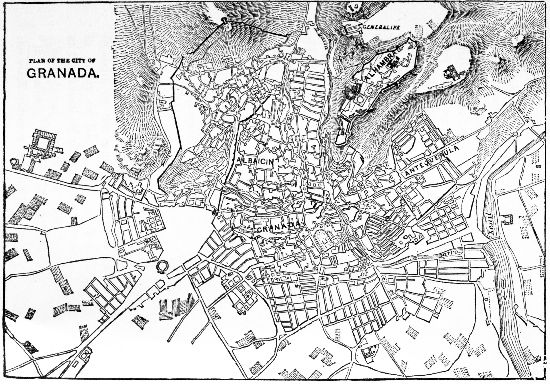
PLAN OF THE CITY OF GRANADA LONDON: T. FISHER UNWIN, PATERNOSTER SQUARE, E.C.
In our search through the intricate plan of the pile, we find ourselves in the boudoir of the Sultana, the windows of which command the same prospect over the Vega, a scene to which distance lends its greatest charm. We are reminded on every side of the luxury of the olden time, when we see the apertures in the white marble floor near the entrance, through which perfumes arose from drugs, which tradition says were burned beneath the floor to make the air of the lady's apartment redolent with their sweet scents. We look down into the garden of the Lindaraja, upon which Irving also looked when he occupied those apartments which have become historic on his account. The garden itself is scarcely worthy of notice, for it is a little-cultivated court; but near by are the baths of the Sultans, with their delicate filigree work, intricate tracery, and brilliant mosaics. There is the fountain which ripples in gentle cadence, as if keeping time to the harmony that the musicians poured down from the balconies when the ladies of the harim enjoyed the pleasures of the Oriental bath, or rested themselves upon cloth of gold. Each bath, cut from a single mass of white marble, was placed in its own vaulted chamber, and lighted through openwork of stars and roses.
Perhaps the most celebrated portion of the entire palace is the Court of the Lions, which occupies a space somewhat smaller than that of the Court of the Myrtles. One hundred and twenty-eight white marble columns, arranged by threes and fours in symmetrical fashion, support galleries which rise to no very lofty height; but the extreme gracefulness and elegance of their varied capitals, the delicate traceries, the remnants of gold and colour, the raised orange-shaped cupolas, the graceful minarets, the innumerable arches, beautiful in their labyrinthine design, the empty basin into which the twelve stiff and unnatural "lions" once poured their constant streams of cooling waters, the alabaster reservoir, constitute a whole that poetry and romance have lauded even to extravagance.
From this beautiful court, through a door ornamented with rare designs, one is ushered into the Hall of the Abencerrages, named from the legend that in its precincts the chiefs of that family were beheaded by order of Boabdil. Convenient spots in the stone floor are exhibited to credulous visitors as evidences that the blood was there spilt. The sweet and peaceful light which enters the apartment by sixteen airy windows in the star-shaped stalactite roof, illuminating its arches ornamented in azure and scarlet, seem all inappropriate to such a scene of slaughter, and charity would lead us, if history did not, to doubt that the stain should rest upon the memory of Boabdil.
GARDEN OF THE GENERALIFE, GRANADA.
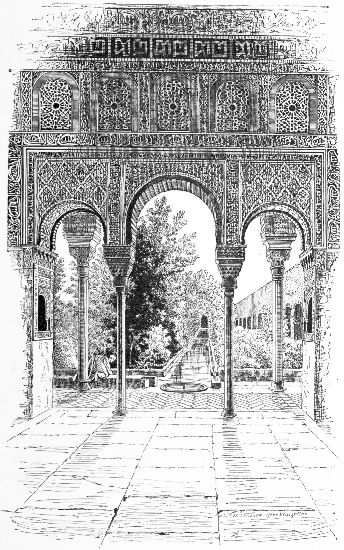
Time would fail us to go through all the courts and halls of the comprehensive building, and we must make our way over the road that crosses the ravine of Los Molinos, bordered with figs and pistachios, laurels and roses, to the other palace, the Generalife, or "Garden of the Surveyor." This is the "Country House" of the greater palace, and, so far as the exterior of the building is concerned, presents the usual simplicity of Oriental structures. Here are the walls without windows, the terraces, the galleries, the arcades—all of which are in a state of ruin. The delicate arabesques are covered with thick layers of whitewash; the fine sculptures have disappeared, and the internal beauty of the edifice has long since departed; but the charm of the gardens and waters remains. A rapid stream runs through an artificial channel of marble the entire length of the enclosure under a series of arcades and leafy screens formed by curiously twisted yews, while cypresses and orange trees cast their cooling shadows upon the waters. Jets and fountains, rapid-flowing streams and placid ponds, little basins nestling under ancient bays, murmuring rivulets and winding courses reflecting the blue of the sky, are intermingled with the utmost perfection of skill, and the combination forms one of the most charming effects that can be imagined.
"Here," says Irving, "is everything to delight a southern voluptuary: fruits, flowers, fragrance, green arbours and myrtle hedges, delicate air and gushing water. Here I had an opportunity of witnessing those scenes which painters are fond of depicting about southern palaces and gardens. It was the saint's day of the Count's daughter, and she had brought up several of her youthful companions from Granada to sport away a long summer's day among the breezy halls and bowers of the Moorish palace. A visit to the Generalife was the morning's entertainment. Here some of the gay companions dispersed themselves in groups about the green walks, the bright fountains, the flight of Italian steps, the noble terraces, and marble balustrades. Others, among whom I was one, took their seats in an open gallery or colonnade, commanding a vast prospect; with the Alhambra, the city, and the Vega far below, and the distant horizon of mountains—a dreamy world, all glimmering to the eye in summer sunshine. While thus seated, the all-pervading tinkling of the guitar and click on the castanets came stealing up the valley of the Darro, and half-way down the mountain we descried a festive party under the trees enjoying themselves in true Andalusian style; some lying on the grass, others dancing to the music."
From the ruined building one gains, perhaps, the most satisfactory view of the Alhambra, as its reddish line of half-demolished walls is traced along the undulations of the mountain on which it stands; while the white ridges of the Sierra Nevada furnish a magnificent background for the picture, and set off the heavy mass of the unfinished palace of Charles the Fifth.
Two centuries of prosperity, with a powerful Christian State almost at bow-shot, were as much as the Moors had any right to expect; and towards the third quarter of the fifteenth century there were signs that their knell was about to sound. The union of Aragon with Castile by the marriage of Ferdinand and Isabella was the note of doom. Two such sovereigns could not long leave the Moors undisturbed in their corner of the peninsula. Muley Aly, generally known by his surname, Abu-l-Hasan (which the Spaniards change into Alboacen, and many English writers into Aben Hasan), who was of a fiery and warlike nature, resolved to be beforehand with their Catholic majesties in opening the game of war. He refused to pay the customary tribute, and when the ambassador of Ferdinand came to insist, he made answer: "Tell your sovereigns that the kings of Granada who paid tribute are dead: our mint now coins nothing but sword-blades!" To make his meaning unmistakable, he proceeded to carry a raid into the lands of the Christians. Zahara was the spot he selected for attack. A gifted American author has told the story of the last wars of the Moors in his own eloquent style; and we must follow Washington Irving in relating the assault of Zahara.[27]
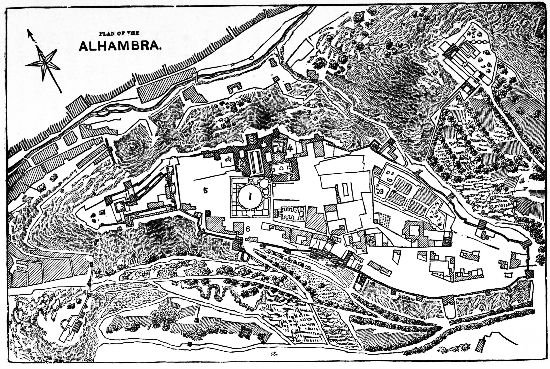
1.Palace of Charles V. 4.Hall of Two Sisters.
2.Casa Real.5.Place of the Cisterns.
3.Tower of Comares.6.Gate of Justice.
LONDON: T. FISHER UNWIN, PATERNOSTER SQUARE, E.C.
"In the year of our Lord one thousand four hundred and eighty one, and but a night or two after the festival of the most blessed Nativity, the inhabitants of Zahara were sunk in profound sleep; the very sentinel had deserted his post, and sought shelter from a tempest which had raged without for three nights in succession; for it appeared but little probable that an enemy would be abroad during such an uproar of the elements. But evil spirits work best during a storm. In the midst of the night an uproar rose within the walls of Zahara, more awful than the raging of the storm. A fearful alarm-cry, 'The Moor!' 'The Moor!' resounded through the streets, mingled with the clash of arms, the shriek of anguish, and the shout of victory. Muley Abu-l-Hasan, at the head of a powerful force, had hurried from Granada, and passed unobserved through the mountains in the obscurity of the tempest. While the storm pelted the sentinel from his post and howled around tower and battlement, the Moors had planted their scaling-ladders, and mounted securely into both town and castle. The garrison was unsuspicious of danger until battle and massacre burst forth within its very walls. It seemed to the affrighted inhabitants as if the fiends of the air had come upon the wings of the wind, and possessed themselves of tower and turret. The war-cry resounded on every side, shout answering shout, above, below, on the battlements of the castle, in the streets of the town; the foe was in all parts, wrapped in obscurity, but acting in concert by the aid of preconcerted signals. Starting from sleep, the soldiers were intercepted and cut down as they rushed from their quarters; or, if they escaped, they knew not where to assemble, or where to strike. Whenever lights appeared, the flashing scimitar was at its deadly work, and all who attempted resistance fell beneath its edge. In a little while the struggle was at an end. Those who were not slain took refuge in the secret places of their houses, or gave themselves up as captives. The clash of arms ceased, and the storm continued its howling, mingled with the occasional shout of the Moorish soldiery roaming in search of plunder. While the inhabitants were trembling for their fate, a trumpet resounded through the streets, summoning them all to assemble, unarmed, in the public square. Here they were surrounded by soldiery, and strictly guarded until daybreak. When the day dawned, it was piteous to behold this once prosperous community, which had lain down to rest in peaceful security, now crowded together without distinction of age, or rank, or sex, and almost without raiment, during the severity of a winter storm. The fierce Muley Abu-l-Hasan turned a deaf ear to all remonstrances, and ordered them to be conducted captives to Granada. Leaving a strong garrison in both town and castle, with orders to put them in a complete state of defence, he returned flushed with victory to his capital, entering it at the head of his troops, laden with spoil, and bearing in triumph the banners and pennons taken at Zahara. While preparations were making for jousts and other festivities in honour of this victory over the Christians, the captives of Zahara arrived—a wretched train of men, women, and children, worn out with fatigue and haggard with despair, and driven like cattle into the city gates by a detachment of Moorish soldiery."
The civilized people of Granada were shocked at the cruelty of Abu-l-Hasan, and felt that this was the beginning of the end. "Woe to Granada!" they cried. "The hour of its desolation is at hand. The ruins of Zahara will fall upon our own heads!"
Retribution was not far off. The redoubtable Marquess of Cadiz captured the castle of Alhama by surprise, and thus planted a Christian garrison in the heart of the Moslem territory, within a short distance of Granada itself. In vain did Muley Abu-l-Hasan invest the captured castle; the Christians within performed prodigies of valour in its defence, and held the place till their friends came to their support. Ay de mi Alhama! "Woe for my Alhama!" was the cry that arose in Granada; "Alhama is fallen; the key of Granada is in the hands of the infidels!" Byron has made every one familiar with the plaintive ballad which he mistranslated:
Pasavase el rey Moro
Por la ciudad de Granada,
Desde las puertas de Elvira
Hasta las de Bivarambla.
Ay de mi Alhama!
Henceforward, the castle proved a sore thorn in the side of the Moorish kings; for thence the brave Count of Tendillo harried the Vega and wrought infinite destruction. "It was a pleasing and refreshing sight," says the Jesuit chronicler[28] invented by Washington Irving, "to behold the pious knight and his followers returning from one of these crusades, leaving the rich land of the infidel in smoking desolation behind them: to behold the long line of mules and asses laden with the plunder of the Gentiles, the hosts of captive Moors, men, women, and children; droves of sturdy beeves, lowing kine and bleating sheep—all winding up the steep acclivity to the gates of Alhama, pricked on by the Catholic soldiery.... It was an awful spectacle at night to behold the volumes of black smoke, mingled with lurid flames, that rose from the burning suburbs, and the women on the walls of the towns wringing their hands and shrieking at the desolation of their dwellings."
Inflamed by their respective conquests, both sides busied themselves in raids such as these, with little result, save general devastation and exasperation. The Christians at last attempted a movement on a larger scale. They resolved to invade the province of Malaga, and, marshalling the forces of the south, led by the Marquess of Cadiz and other noted warriors, they set out upon their fateful march. "It was on a Wednesday[29] that the pranking army of high-mettled warriors issued forth from the ancient gates of Antequera. They marched all day and night, making their way secretly, as they supposed, through the passes of the mountains. As the tract of country they intended to maraud was far in the Moorish territories, near the coast of the Mediterranean, they did not arrive there till late in the following day. In passing through these stern and lofty mountains, their path was often along the bottom of a barranca, or deep rocky valley, with a scanty stream dashing along it, among the loose rocks and stones which it had broken and rolled down in the time of its autumnal violence. Sometimes their road was a mere rambla, or dry bed of a torrent cut deep into the mountains and filled with their shattered fragments. These barrancas and ramblas were overhung by immense cliffs and precipices, forming the lurking-places of ambuscades during the wars between the Moors and Spaniards, as in after times they have become the favourite haunts of robbers to waylay the unfortunate traveller.
"As the sun went down, the cavaliers came to a lofty part of the mountains, commanding, to their right, a distant glimpse of a part of the fair Vega of Malaga, with the blue Mediterranean beyond, and they hailed it with exultation, as a glimpse of the promised land. As the night closed in they reached the chain of little valleys and hamlets, locked up among those rocky heights, and known among the Moors by the name of Axarquia. Here their vaunting hopes were destined to meet the first disappointment. The inhabitants had heard of their approach; they had conveyed away their cattle and effects, and with their wives and children had taken refuge in the towers and fortresses of the mountains.
"Enraged at their disappointment, the troops set fire to the deserted houses, and pressed forward, hoping for better fortune as they advanced. Don Alonzo de Aguilar, and the other cavaliers in the van-guard, spread out their forces to lay waste the country, capturing a few lingering herds of cattle, with the Moorish peasants who were driving them to some place of safety.
"While this marauding party carried fire and sword in the advance, and lit up the mountain cliffs with the flames of the hamlets, the Master of Santiago, who brought up the rear-guard, maintained strict order, keeping his knights together in martial array, ready for attack or defence should an enemy appear. The men-at-arms of the Holy Brotherhood attempted to roam in quest of booty; but he called them back and rebuked them severely.
"At last they came to a part of the mountain completely broken up by barrancas and ramblas, of vast depth, and shagged with rocks and precipices. It was impossible to maintain the order of march; the horses had no room for action, and were scarcely manageable, having to scramble from rock to rock, and up and down frightful declivities, where there was scarce footing for a mountain goat. Passing by a burning village, the light of the flames revealed their perplexed situation. The Moors, who had taken refuge in a watch-tower on an impending height, shouted with exultation when they looked down upon these glistening cavaliers, struggling and stumbling among the rocks. Sallying forth from their tower, they took possession of the cliffs which overhung the ravine, and hurled darts and stones upon the enemy.
"In this extremity the Master of Santiago despatched messengers in search of succour. The Marquess of Cadiz, like a loyal companion-in-arms, hastened to his aid with his cavalry. His approach checked the assaults of the enemy, and the master was at length enabled to extricate his troops from the defile....
"The Adalides, or guides, were ordered to lead the way out of this place of carnage. These, thinking to conduct them by the most secure route, led them by a steep and rocky pass, difficult for the foot soldiers, but almost impracticable to the cavalry. It was overhung with precipices, from whence showers of stones and arrows were poured upon them, accompanied by savage yells, which appalled the stoutest heart. In some places they could pass but one at a time, and were often transpierced, horse and rider, by the Moorish darts, impeding the progress of their comrades by their dying struggles. The surrounding precipices were lit up by a thousand alarm fires; every crag and cliff had its flames, by the light of which they beheld their foes bounding from rock to rock, and looking more like fiends than mortal men. Either through terror and confusion, or through real ignorance of the country, their guides, instead of conducting them out of the mountains, led them deeper into their fatal recesses. The morning dawned upon them in a narrow rambla; its bottom formed of broken rocks, where once had raved along the mountain torrent; while above them beetled huge arid cliffs, over the brows of which they beheld the turbaned heads of their fierce and exulting foes....
"All day they made ineffectual attempts to extricate themselves from the mountains. Columns of smoke rose from the heights where, in the preceding night, had blazed the alarm fire. The mountaineers assembled from every direction: they swarmed at every pass, getting in the advance of the Christians, and garrisoning the cliffs, like so many towers and battlements.
"Night closed again upon the Christians, when they were shut up in a narrow valley traversed by a deep stream, and surrounded by precipices which seemed to reach the sky, and on which the alarm fires blazed and flared. Suddenly a new cry was heard resounding along the valley. Ez-Zagel! Ez-Zagel! echoed from cliff to cliff. 'What cry is that?' said the master of Santiago. 'It is the war-cry of Ez-Zagel, the Moorish general,' said an old Castilian soldier; 'he must be coming in person with the troops of Malaga.'
"The worthy Master turned to his knights: 'Let us die,' said he, 'making a road with our hearts, since we cannot with our swords. Let us scale the mountains, and sell our lives dearly, instead of staying here to be tamely butchered.'
"So saying, he turned his steed against the mountain, and spurred him up its flinty side. Horse and foot followed his example, eager, if they could not escape, to have at least a dying blow at the enemy. As they struggled up the height, a tremendous storm of darts and stones was showered upon them by the Moors. Sometimes a fragment of rock came bounding and thundering down, ploughing its way through the centre of their host. The foot soldiers, faint with weariness and hunger, or crippled by wounds, held by the tails and manes of their horses, to aid them in their ascent, while the horses, losing their footing among the loose stones, or receiving some sudden wound, tumbled down the steep declivity, steed, rider, and soldier rolling from crag to crag, until they were dashed to pieces in the valley. In this desperate struggle the Alferez, or standard-bearer of the Master, with his standard was lost, as were many of his relations and dearest friends. At length he succeeded in attaining the crest of the mountain; but it was only to be plunged in new difficulties. A wilderness of rocks and rugged dells lay before him, beset by cruel foes. Having neither banner nor trumpet, by which to rally his troops, they wandered apart, each intent upon saving himself from the precipices of the mountains and the darts of the enemy. When the pious Master of Santiago beheld the scattered fragments of his late gallant force he could not restrain his grief, 'O God!' exclaimed he, 'great is Thy anger this day against Thy servants! Thou hast converted the cowardice of these infidels into desperate valour, and hast made peasants and boors victorious over armed men of battle!'
"He would fain have kept his foot soldiers and gathered them together, and have made head against the enemy; but those around him entreated him to think only of his personal safety. To remain was to perish without striking a blow; to escape was to preserve a life that might be devoted to vengeance on the Moors. The Master reluctantly yielded to their advice. 'O Lord of Hosts,' exclaimed he again, 'from Thy wrath do I fly, not from these infidels. They are but instruments in Thy hands to chastise us for our sins!' So saying, he sent the guides in advance, and, putting spurs to his horse, dashed through a defile of the mountain before the Moors could intercept him. The moment the Master put his horse to speed, his troops scattered in all directions: some endeavoured to follow his traces, but were confounded among the intricacies of the mountain. They fled hither and thither, many perishing among the precipices, others being slain by the Moors, and others taken prisoners."
The horrors of that night among the mountains of Malaga were not speedily forgotten by the Christians. They burned for vengeance; and when "Boabdil" (properly Abu-Abdallah), the King of Granada, who had temporarily ousted his father from the sovereignty, sallied forth on a sweeping raid into the lands of the Christians, they took a signal revenge. Boabdil marched secretly by night; but his movements were not long undetected. Beacon fires blazed from the hill-tops, and the Count of Cabra, aroused by their flames, sounded the alarm, and assembled the chiefs of the district. They fell upon the Moors near Lucena, and, aided by the cover of the woods, made so skilful an attack, that the enemy turned. "Remember the mountains of Malaga!" was the ominous cry, as the Christian knights set spurs to their horses in pursuit of the Moslems: with shouts of St. James they dashed upon them, and the retreat became an utter rout. When the fugitives entered the gates of Granada a great wave of lamentation passed through the city: "Beautiful Granada, how is thy glory faded! The flower of thy chivalry lies low in the land of the stranger; no longer does the Bivarambla echo to the tramp of steed and sound of trumpet; no longer is it crowded with thy youthful nobles, gloriously arrayed for the tilt and tourney. Beautiful Granada! the soft note of the lute no longer floats through thy moonlit streets; the serenade is no more heard beneath thy balconies; the lively castanet is silent upon thy hills; the graceful dance of the Zambra is no more seen beneath thy bowers. Beautiful Granada! why is the Alhambra so forlorn and desolate? The orange and myrtle still breathe their perfumes into its silken chambers; the nightingale still sings within its groves; its marble halls are still refreshed with the plash of fountains and the gush of limpid rills! Alas! the countenance of the king no longer shines within those halls. The light of the Alhambra is set for ever!"
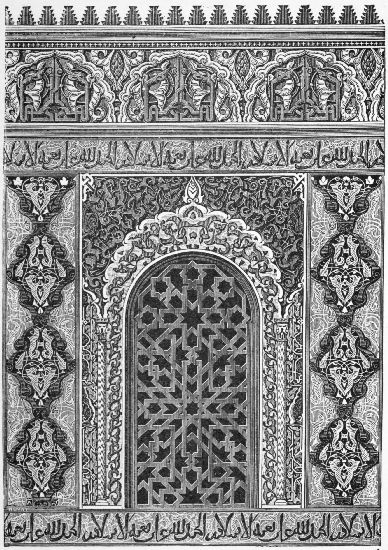
A WINDOW IN THE ALHAMBRA.
Boabdil, indeed, had been made prisoner and was now a captive on his way to Cordova, while Ferdinand ravaged the Vega, and old Muley Abu-l-Hasan, who now returned to his kingdom, ground his teeth in impotent rage behind his stout ramparts.


XIII. THE FALL OF GRANADA.
THE capture of Boabdil by the Christian sovereigns was a fatal blow to the Moorish power. The loss of the prince himself was the smallest part of the misfortune. Boabdil, though he could show true Moorish courage in the battle-field, was a weak and vacillating man, and was perpetually oppressed by the conviction that destiny was against him. He was known as Ez-Zogoiby, "the Unlucky;" and he was ever lamenting his evil star, against which he felt it was useless to struggle. "Verily," he would exclaim, after every reverse, "it was written in the book of fate that I should be unlucky, and that the kingdom should come to an end under my rule!" Boabdil could easily be spared; but innocuous as he was in himself, he might become dangerous in the hands of a clever adversary; and events showed that Boabdil's subjection to Ferdinand contributed as much as any other cause to the overthrow of the Moorish power in Andalusia. The Catholic sovereigns received him with honour at Cordova, and, by friendly persuasion and arguments drawn from his own desperate situation and the strongly contrasted successes of the Christians, they induced him to become their instrument and vassal.
As soon as they felt that they had completely mastered their tool, the politic king and queen suffered him to return to Granada, where his father, Abu-l-Hasan, once more held the fortress of the Alhambra. Favoured by his old supporters in the Albaycin quarter of the city, Boabdil managed to effect an entrance, and to seize the citadel or keep called Alcazaba, whence he carried on a guerilla warfare with his father in the opposite fort. The quarrel was further embittered by the rivalry between the wives of Abu-l-Hasan. Ayesha, the mother of Boabdil, was intensely jealous of a Christian lady, Zoraya, whom Abu-l-Hasan loved far beyond his other wives; and the chief courtiers took up the cause of either queen. Thus arose the celebrated antagonism between the Zegris, a Berber tribe from Aragon, who supported Ayesha, and the Abencerrages, or Beny-Serrāj, an old Cordovan family, which ended in the celebrated massacre of the Abencerrages in the Palace of Alhambra, though whether Boabdil was the author of this butchery is still matter of doubt. Supported by the Zegris, Boabdil for some time held his ground in the citadel. Old Abu-l-Hasan was too strong for him, however, and the son was soon compelled to take refuge at Almeria. Henceforward there were always two kings of Granada: Boabdil, on the one hand, always unlucky, whether in policy or battle, and despised by good Moors as the vassal of the common enemy; on the other, Abu-l-Hasan, or rather his brother Ez-Zaghal, "the Valiant," for the old king did not long survive the misfortunes which his son's rebellion had brought upon the kingdom. He lost his sight, and soon afterwards died, not without suspicion of foul play.
In Ez-Zaghal we see the last great Moorish King of Andalusia. He was a gallant warrior, a firm ruler, and a resolute opponent of the Christians. Had he been untrammelled by his nephew, Granada might have remained in the hands of the Moors during his life, though nothing could have prevented the final triumph of the Christians. Instead of delaying that victory, however, the kings of Granada did their best to further and promote it by their internal disputes. Quem Deus vult perdere, prius dementat: when the gods have decreed that a king must fall, they fill him first with folly. Such a suicidal mania now invaded the minds of the rulers of Granada; at a time when every man they could gather together was needed to repel the invasion of the Christians, they wasted their strength in ruinous struggles with each other, and one would even intercept the other's army when it was on the march against the common enemy. The people of Granada, divided into various factions, aided and abetted the jealousy of their sovereigns: always fickle and prone to any change, good or bad, the Granadinos loved nothing better than to set up and put down kings. So long as a ruler was fortunate in war, and brought back rich spoils from the territories of the "infidels," they were well pleased to submit to his sway; but the moment he failed, they shut the gates in his face and shouted, Long live the other!—who might be Boabdil or Ez-Zaghal, or any one else who happened for the moment to possess Granada's changeable affections.
MOSQUE LAMP FROM GRANADA.
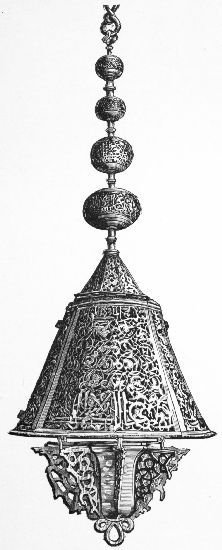
While Boabdil the Unlucky was doing his best to foil the efforts of his brave uncle Ez-Zaghal, the Christians were gradually narrowing the circle that they had drawn round the doomed kingdom. City after city fell into their hands. Alora and other forts were taken in 1484, with the aid of Ferdinand's heavy "lombards"—a new and destructive form of artillery. Coin, Cartama, Ronda, followed in the next year, not without some vigorous reprisals on the part of Ez-Zaghal, who caught the knights of Calatrava in an ambush, and effected a terrible slaughter. Still the course of Christian conquest steadily continued. Loxa fell in 1486, when an English Earl, Lord Scales, with a company of English archers, led the attack. Illora and Moclin succumbed; "the right eye of Granada is extinguished," cried the Moors in consternation; "the Catholic sovereigns have clipped the right wing of the Moorish vulture," was the Christian comment. The western part of the kingdom had, indeed, been absorbed by Ferdinand and his intrepid consort. The pomegranate (granada) was being devoured grain by grain. Ez-Zaghal became unpopular with the people, who could not brook disappointment, and they received Boabdil once more into their city. He found it hard work to maintain his foothold there against his uncle; but with the help of some troops furnished by the Christians he contrived to stand awhile at bay. Just then Ferdinand was laying siege to Velez, near Malaga, and the news roused the strongest feeling of indignation in Granada; for Malaga was the second city of the kingdom. Its site, shut in by mountains and the sea, its vineyards and orchards, gardens and pastures, and its fine defensive works, made it the right hand of the Moslem kingdom. If Malaga fell, then the Alhambra must also pass into the hands of the "eaters of swineflesh." Moved by the general emotion, and ever ready to break lance with the invader, Ez-Zaghal boldly led his troops to the relief of Velez. He knew that his treacherous nephew was in Granada, ready to take advantage of his absence to recover his old supremacy; but Ez-Zaghal was rightly called the Valiant; he put aside all thoughts of self, and set out to save Malaga. But he had to deal with a shrewd opponent; and while he took his measures for a combined attack from the besieged and the relieving army, Ferdinand intercepted his messages and countermined his plans. One night the people of Velez saw the hosts of Ez-Zaghal gathered in long array upon the neighbouring heights; the next morning not a soul remained; the night attack had failed, and the relieving army had melted like the mist before the resolute onslaught of the Marquess of Cadiz. When the dejected stragglers began to steal sadly into the gates of Granada, the populace easily threw off their old allegiance, and breaking into furious indignation against Ez-Zaghal, denounced him as a traitor, and proclaimed Boabdil king in his stead. As Ez-Zaghal drew near to the gates of Granada with the remnant of his army, he found them closed in his face, and looking up he saw the standard of Boabdil floating above the towers of the Alhambra. His city, always intolerant of failure, had shut its heart against him in his day of trouble, so he turned away and established his court at Guadix.
The siege of Malaga itself was now begun, but the strength of its defences rendered it a formidable obstacle. It was surrounded by mountains, defended by stout walls, overshadowed by the citadel and the still loftier Gibralfaro, or "Hill of the Beacon," whence its garrison could pour down missiles upon the Christians in the plain. Moreover, the defence was led by Ez-Zegry, an heroic Moor, who had been Alcayde of Ronda and could not forgive the Christians for wrenching that famous rocky fortress from him, and who now inspired the citizens and his following of African troops with a spirit of daring and endurance which the Catholic sovereigns in vain tried to subdue. Commanding the Gibralfaro, he was able to defend the city in spite of the peaceful inclinations of its trading classes. When the king attempted to bribe him, he dismissed the messenger with courteous disdain; and when the city was summoned to surrender, and the merchants eagerly acquiesced, Ez-Zegry said: "I was set here not to surrender but to defend." Ferdinand concentrated his attack upon the Gibralfaro; his terrible cannon, known as the "Seven Sisters of Ximenes," wrapped the castle in smoke and flame; night and day the artillery blazed to and fro. The Christians attempted to take the place by assault, but Ez-Zegry and his undaunted followers poured boiling pitch and rosin upon the assailants, hurled huge stones upon their heads as they climbed the ladders, and transfixed them with well-aimed arrows from the tower above, till the storming party were compelled to retire with heavy loss. Mines were tried with better success, and some of the fortifications were blown up with gunpowder, for the first time in Spanish history; but still the garrison held out. The chivalry of Spain was now gathered about the walls of Malaga; Queen Isabella herself came, and her presence infused a fresh spirit of enthusiasm into her knights and soldiers. Wooden towers were brought to bear upon the battlements; a testudo of shields was used as cover for the men who undermined the walls; but Ez-Zegry was still unsubdued. At last there appeared a worse enemy than cannon and gunpowder: famine began to distress the people of Malaga, and they were more inclined now to listen to the pacific policy of the traders than to the bold counsels of the commander. Help from without was not to be expected. Ez-Zaghal had, indeed, once more made an effort to save the besieged city. He had gathered together what was left of his army and gone forth from Guadix to succour Malaga; but his ill-starred nephew again proved his title to the name "Unlucky," for in a fit of insensate jealousy he ordered out the troops of Granada, intercepted Ez-Zaghal's small force as it was on its way to Malaga, and dispersed it. Ez-Zegry's last sally was repulsed with terrible slaughter; the people were starving, and mothers cast their infants before the governor's horse, lamenting that they had no more food and could not bear to hear their children's cries. The city at last surrendered, and Ez-Zegry, who still held out in the Gibralfaro, was forced by his soldiers to open the gates, and was rewarded for his heroism by being cast into a dungeon, never to be heard of again.
MALAGA.
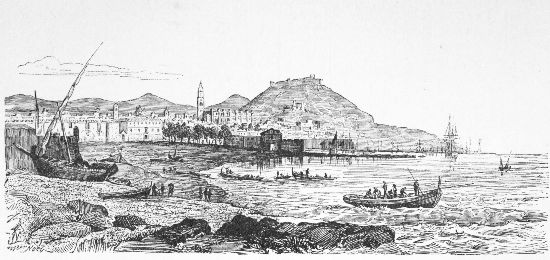
The long siege was over; the famished people fought with one another to buy food from the Christians. The African garrison, who still kept their proud look, though worn and enfeebled with their long struggle and privations, were condemned to slavery; the rest of the inhabitants were permitted to ransom themselves, but on these insidious terms—that all their goods should at once be paid over to the king as part payment, and that if after eight months the rest were not forthcoming, they should all be made slaves. They were numbered and searched, and then sent forth. "Then might be seen old men and helpless women and tender maidens, some of high birth and gentle condition, passing through the streets, heavily burdened, towards the Alcazaba. As they left their homes they smote their breasts, and wrung their hands, and raised their weeping eyes to heaven in anguish; and this is recorded as their plaint: O Malaga! city so renowned and beautiful, where now is the strength of thy castle, where the grandeur of thy towers? Of what avail have been thy mighty walls for the protection of thy children?... They will bewail each other in foreign lands; but their lamentations will be the scoff of the stranger." The poor people were sent to Seville, where they were kept in servitude till the eight months had expired, and then, since they had no money to pay the remainder of their ransoms, they were one and all condemned to perpetual slavery, to the number of fifteen thousand souls. Ferdinand's ungenerous ingenuity was thus rewarded.
The western part of the kingdom of Granada was now entirely in the hands of the Christians. The famous Moorish fortresses of the Serrania de Ronda and the beautiful city of Malaga held Christian garrisons. Granada itself was in the hands of Boabdil, who hastened to congratulate his liege lord and lady upon their triumph over Malaga. But in the east old Ez-Zaghal still turned a bold front to the invader, and gathered around his standard all that remained of patriotism among the disheartened Moors. From Jaen in the north, to Almeria, the chief port of Andalusia on the Mediterranean coast, his sway was undisputed; he held the important cities of Guadix and Baza; and within his dominion the rugged ridges of the Alpuxarras mountains, the cradle of a hardy and warlike race of mountaineers, sheltered countless valleys, fed with cool waters from the Sierra Nevada's snowy peaks, where flocks and herds, vines, oranges, pomegranates, citrons, and mulberry trees provided wealth for a whole province.
In 1488 Ferdinand turned his victorious arms towards this undisturbed portion of the Moorish dominion. Assembling his troops at Murcia, he marched westwards into Ez-Zaghal's territory, and attacked Baza. Here his advance was sternly checked; Ez-Zaghal's hand had not lost its ancient cunning, and he drove the Christians back from the walls of Baza, and began to retaliate by making raids into their own country. In the following year Ferdinand, nothing disheartened, renewed his attack on Baza; but instead of sacrificing his troops in vain assaults, he laid waste the fertile country round about, and so starved the city into submission. It took six months, and the Christians lost twenty thousand men from disease and exposure, joined to the accidents of war; but in December, 1489, Baza finally submitted, and with the loss of this chief city Ez-Zaghal's power was broken. The castles that dominated the fastnesses of the Alpuxarras yielded one by one to Ferdinand's prestige or gold. Ez-Zaghal perceived that the rule of the Moors was doomed: reluctantly he gave in his submission to Ferdinand, and surrendered the city of Almeria. He was allotted a small territory in the Alpuxarras, with the title of King of Andarax. He did not long remain in the land of his lost glory and present shame; he sold his lands and went to Africa, where he was cruelly blinded by the Sultan of Fez, and passed the remainder of his days in misery and destitution, a wandering outcast,—pitied by those who could recognize the hero in a mendicant's rags, or read the badge which he wore, whereon was written in the Arabic character, "This is the hapless King of Andalusia."
Granada alone remained to the Moors. Boabdil had been well pleased to see his old rival Ez-Zaghal dethroned by their Catholic Majesties: "Henceforth," he cried to the messenger who brought him the news, "let no man call me Zogoiby, for my luck has turned:" to which the other made answer that the wind which blew in one quarter might soon blow in another, and the king had best reserve his rejoicings for more settled weather. Boabdil, though he heard his name cursed in the streets of his capital as a traitor in league with the infidels, indulged in blind confidence, now that his detested uncle was powerless; as the vassal of Ferdinand and Isabella he believed that he had nothing to fear. He had forgotten that when, in his fatuous hatred of Ez-Zaghal, he incited the Christian sovereigns to subdue his rival's dominions, he had engaged by treaty that should Ferdinand succeed in reducing Ez-Zaghal's country, with the cities of Guadix and Almeria, he would on his part surrender Granada. He was not, however, long left without a spur to his memory. Ferdinand wrote to inform him that the conditions named in the treaty had been fulfilled on his side, and demanded the surrender of Granada in accordance with the terms then laid down. Boabdil in vain implored delay; the king was determined, and threatened to repeat the example of Malaga if the capital were not immediately given up. Boabdil did not know what to reply; but the people of Granada, led by Mūsa, a brave and gallant knight, took the matter into their own hands, and told his Catholic Majesty that if he wanted their arms he must come and take them!
When these bold words were said, the beautiful Vega of Granada was waving with crops and fruit; it had recovered from the devastations which accompanied the struggle between Ez-Zaghal and Boabdil, and a splendid harvest was awaiting the sickle. Ferdinand saw his opportunity, and, adopting his usual tactics, poured his troops, twenty-five thousand strong, over the Vega, and for thirty days abandoned it to their destroying hands. When he turned back towards Cordova, the Vega was one great expanse of desolation. It was enough for one season; yet once more was the cruel work of destruction carried out in that year of grace 1490.
SWORD OF BOABDIL (Villaseca Collection, Madrid).
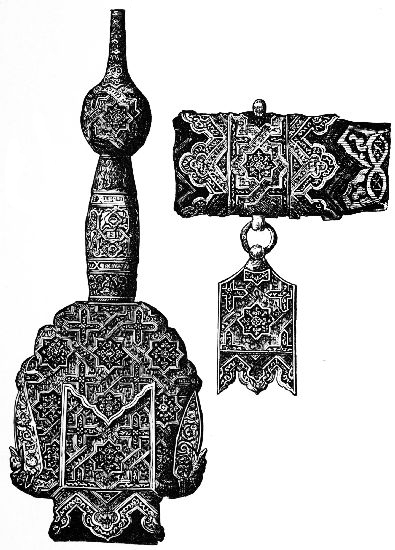
Boabdil had at last been roused to a desperate courage. Guided by Mūsa, whose mettle was of the finest, he girded on his armour, and began to carry the war into the enemy's quarters. The Moors round about, who had given in their submission to Ferdinand, were heartened by the sight of the King of Granada once more on the war path, and, hastily consigning their promises to the winds, rose up and joined him. It really seemed as if the good old days of Granada were returning; some fortresses were recovered from the Christians, and the Moorish army ravaged the borders. It was but the last gleam of light before the final setting of the sun. In April, 1491, Ferdinand and Isabella set forth upon their annual crusade, resolved not to return till Granada was in their power. The king led an army of forty thousand foot and ten thousand horse, with such commanders as the famous Ponce de Leon, Marquess of Cadiz, the Marquess of Santiago, the Counts of Tendilla and Cabra, the Marquess of Villena, and the redoubtable knight, Don Alonzo de Aguilar. Boabdil held a council in the Alhambra, whence the clouds of dust raised by Christian horsemen could be seen on the Vega; some urged the futility of resistance, but Mūsa got up and bade them be true to their ancestors and never despair while they had strong arms to fight and fleet horses wherewith to foray. The people caught Mūsa's enthusiasm, and there was nothing heard in Granada but the sound of the furbishing of arms and the tramp of troops.
Mūsa was in chief command, and the gates were in his charge. They had been barred when the Christians came in view; but Mūsa threw them open. "Our bodies," he said, "will bar the gates." The young men were kindled by such words, and when he told them, "We have nothing to fight for but the ground we stand on; without that we are without home or country," they made ready to die with him. With such a leader, the Moorish cavaliers performed prodigious feats of valour in the plain which divided the city from the Christian camp. Single combats were of daily occurrence; the Moors would ride almost among the tents of the Spaniards, and tempt some knight to the duel, from which he too often did not return. Ferdinand found his best warriors were being killed one by one, and he straitly forbade his knights to accept the Moors' challenge. It was hard for the Spanish chivalry to sit still within their tents, while a bold Moorish horseman would ride within hail and taunt them with cowardice; and when at length one of the Granadinos waxed so venturesome that he cast a spear almost into the royal pavilion, Hernando Perez de Pulgar, surnamed "He of the Exploits," could no longer contain himself, but gathering a small band of followers, rode in the dead of night to a postern gate in the walls of Granada, and, surprising the guards, galloped through the streets till he came to the chief mosque, which he forthwith solemnly dedicated to the Blessed Virgin, and in token of its conversion nailed a label on the door inscribed with the words Ave Maria. Granada was awake by this time, and soldiers were gathering in every direction; but Pulgar put spurs to his horse, and, amid the amazement of the people, plunged furiously through the crowd, overturning them as he galloped to the gate, and, fighting his way out, rode back in triumph to the camp. The Pulgars ever after held the right to sit in the choir of the mosque-church during the celebration of High Mass.
Such feats of daring, however, did little to advance the siege, nor were the few engagements conclusive. Ferdinand renewed his old tactics. He sallied forth from his camp, which had accidentally been burnt to the ground, and proceeded to lay waste what remained of the fertility of the Vega. The Moors made a last desperate sally to save their fields and orchards, and Mūsa and Boabdil fought like heroes at the head of their cavalry; but the foot soldiers, less steadfast, were beaten back to the gates, whither Mūsa sadly followed them, resolved never again to risk a pitched battle with such men behind him. It was the last fight of the Granadinos. For ten years they had disputed every inch of ground with their invaders; wherever their feet could hold they had stood firm against the enemy. But now there was left to them nothing beyond their capital, and within its walls they shut themselves up in sullen despair. To starve them out was an agreeable task for the Catholic king; and following the precedent of the third Abd-er-Rahmān in the siege of Toledo, he built in eighty days a besieging city over against Granada, and called it Santa Fé, in honour of his "Holy Faith," and there to this day it stands, a monument of Ferdinand's resolution. Famine did the work that no mere valour could effect. The people of Granada implored Boabdil to spare them further torture and make terms with the besiegers, and at last the unlucky king gave way. Mūsa would be no party to the surrender. He armed himself cap-à-pie, and mounting his charger rode forth from the city never to return. It is said that as he rode he encountered a party of Christian knights, half a score strong, and, answering their challenge, slew many of them before he was unhorsed, and then, disdaining their offers of mercy, fought stubbornly upon his knees, till he was too weak to continue the struggle: then with a last effort he cast himself into the river Xenil, and, heavy with armour, sank to the bottom.
On the 25th of November, 1491, the act of capitulation was signed, and a term was fixed during which a truce was to be observed, after which, should no aid come from outside, Granada was to be delivered up to their Catholic Majesties. In vain the Moors watched for a sign of the help they had sought from the Sultans of Turkey and Egypt. No aid came, and at the end of December Boabdil sent a message to Ferdinand to come and take possession of the city. The Christian army filed out of Santa Fé, and advanced across the Vega, watched with mournful eyes by the unhappy Moors. The leading detachment entered the Alhambra, and presently the great silver cross was seen shining from the summit of the Torre de la Vela; beside it floated the banner of St. James, while shouts of "Santiago!" rose from the army in the plain beneath; and lastly, the standard of Castile and Aragon was planted by the side of the cross. Ferdinand and Isabella fell on their knees and gave thanks to God; the whole army of Spain knelt behind them, and the royal choir sang a solemn Te Deum. At the foot of the Hill of Martyrs, Boabdil, attended by a small band of horsemen, met the royal procession. He gave Ferdinand the keys of Granada, and, turning his back upon his beloved city, passed on to the mountains. There, at Padul, on a spur of the Alpuxarras, Boabdil stood and gazed back upon the kingdom he had lost: the beautiful Vega, the towers of Alhambra, and the gardens of the Generalife; all the beauty and magnificence of his lost home. "Allahu Akbar," he said, "God is most great," as he burst into tears. His mother Ayesha stood beside him: "You may well weep like a woman," she said, "for what you could not defend like a man." The spot whence Boabdil took his sad farewell look at his city from which he was banished for ever, bears to this day the name of el ultimo sospiro del Moro, "the last sigh of the Moor." He soon crossed over to Africa, where his descendants learned to beg their daily bread.
There was crying in Granada when the sun was going down;
Some calling on the Trinity—some calling on Mahoun.
Here passed away the Koran—there in the Cross was borne—
And here was heard the Christian bell—and there the Moorish horn:
Te Deum Laudamus! was up the Alcala sung:
Down from the Alhambra's minarets were all the crescents flung;
The arms thereon of Aragon they with Castile display;
One king comes in in triumph—one weeping goes away.
Thus cried the weeper, while his hands his old white beard did tear,
Farewell, farewell, Granada! thou city without peer!
Woe, woe, thou pride of heathendom! seven hundred years and more
Have gone since first the faithful thy royal sceptre bore!
Thou wert the happy mother of a high renownèd race;
Within thee dwelt a haughty line that now go from their place;
Within thee fearless knights did dwell, who fought with mickle glee,
The enemies of proud Castile, the bane of Christentie.
Here gallants held it little thing for ladies' sake to die,
Or for the Prophet's honour, and pride of Soldanry;
For here did valour nourish and deeds of warlike might
Ennobled lordly palaces in which was our delight.
The gardens of thy Vega, its fields and blooming bowers—
Woe, woe! I see their beauty gone, and scattered all their flowers!
No reverence can he claim—the king that such a land hath lost—
On charger never can he ride, nor be heard among the host;
But in some dark and dismal place, where none his face may see,
There weeping and lamenting, alone that king should be.[30]


XIV. BEARING THE CROSS.
BOABDIL'S "last sigh" was but the beginning of a long period of mourning and lamentation for the luckless Moors he had ushered to destruction. At first, indeed, it seemed as if the equitable terms upon which Granada had capitulated would be observed, and freedom of worship and the Mohammedan law would be upheld. The first archbishop, Hernando de Talavera, was a good and liberal-minded man, and forcible conversion formed no part of his policy. He strictly respected the rights of the Moors, and sought to win them over by force of example, by uniform justice and kindness, and by conforming as far as possible to their ways. He made his priests learn Arabic, and said his prayers in the same ungodly tongue, and by such concessions "so wrought on the minds of the populace that in 1499, when Cardinal Ximenes was sent by the queen to aid him in the work, it seemed as if the scenes which occurred at Jerusalem in the infancy of the Faith were about to be reenacted at Granada. In one day no less than 3,000 persons received baptism at the hands of the Primate, who sprinkled them with the hyssop of collective regeneration."[31] Ximenes was little in harmony with the archbishop's soft ways: he was the apostle of the Church Militant, always most active when militant meant triumphant, and would have the souls of these "infidels" saved from hell fire whether they liked it or no. He insinuated in Isabella's holy mind the pernicious doctrine that to keep faith with infidels was breaking faith with God; and it is one of the few blots on the good queen's name that she at length consented to the persecution of the Moors—or "Moriscos," as they now began to be called.
The first attempt to coerce the Granadinos was a failure. Some of the straiter Moslems expressed their repugnance to the new conversions to Christianity, and these malcontents were arrested. A woman being haled to prison on such a pretext roused the people of the Albaycin; they rose in arms and rescued her, and Granada was filled with uproar and barricade-fights. The garrison was hopelessly outnumbered; Ximenes raged with impotent fury; but the peaceful archbishop went forth, followed only by his cross-bearer, and, fearlessly entering the Albaycin, was at once surrounded by the people, who kissed his garments, and laid their wrongs before him in whom they accepted a just and generous mediator. Talavera composed the disputes, and the Cardinal had to retire.
Ximenes was, however, not a man to be easily deterred from his purpose. He induced the queen to promulgate a decree by which the Moors were given their choice of baptism or exile. They were reminded that their ancestors had once been Christian, and that by descent they themselves were born in the Church, and must naturally profess her doctrine. The mosques were closed, the countless manuscripts that contained the results of ages of Moorish learning were burnt by the ruthless Cardinal, and the unhappy "infidels" were threatened and beaten into the Gospel of Peace and Goodwill after the manner already approved by their Catholic Majesties in respect of the no less miserable Jews. The majority of course yielded, finding it easier to spare their religion than their homes; but a spark of the old Moorish spirit remained burning bright among the hillmen of the Alpuxarras, who for some time held their snowy fastnesses against their persecutors. The first effort to suppress the rebellion ended in disaster. Don Alonzo de Aguilar, whose fame in deeds of derring-do had been growing for forty years of valiant chivalry, was sent into the Sierra Bermeja in 1501, and sustained a terrible defeat at the hands of the Moriscos, who crushed his cavalry with the massive rocks which they hurled down upon them.
Beyond the sands, between the rocks, where the old cork trees grow,
The path is rough, and mounted men must singly march and slow;
There o'er the path the heathen range their ambuscado's line,
High up they wait for Aguilar, as the day begins to shine.
There naught avails the Eagle eye, the guardian of Castile,
The eye of wisdom, nor the heart that fear might never feel,
The arm of strength that wielded well the strong mace in the fray,
Nor the broad plate from whence the edge of falchion glance away.
Not knightly valour there avails, nor skill of horse and spear;
For rock on rock comes rumbling down from cliff and cavern drear;
Down, down like driving hail they come, and horse and horseman die
Like cattle whose despair is dumb when the fierce lightnings fly.
Alonzo with a handful more escapes into the field,
There like a lion, stands at bay, in vain besought to yield:
A thousand foes around are seen, but none draws near to fight,
Afar with bolt and javelin, they pierce the steadfast knight.
A hundred and a hundred darts are hissing round his head;
Had Aguilar a thousand hearts, their blood had all been shed;
Faint and more faint he staggers upon the slippery sod—
At last his back is to the earth, he gives his soul to God.
Another and more probable legend, however, tells how Aguilar was killed in fair fight by the commander of the Moors. He was the fifth lord of his line who died in combat with the infidels.
This temporary success, however, only aggravated the reprisals of the now exasperated Christians. The Count of Tendilla stormed Guejar; the Count of Serin "blew up the mosque in which the women and children of a wide district had been placed for safety," and King Ferdinand himself seized the key of the passes, the castle of Lanjaron. The remnant of the rebels fled to Morocco, Egypt, and Turkey, where their skill as artificers secured them a living. Thus the first revolt in the Alpuxarras was suppressed.
Half a century of smouldering hatred ensued. The Moriscos grudgingly fulfilled the minimum of the religious duties imposed on them by their outward conversion; but they took care to wash off the holy water with which their children were baptized as soon as they were out of the priest's sight; they came home from their Christian weddings to be married again after the Mohammedan rite; and they made the Barbary corsair at home in their cities, and helped him to kidnap the children of the Christians. A wise and honest government, respecting its pledges given at the surrender of Granada, would have been spared the dangers of this hidden disaffection; but the rulers of Spain were neither wise nor honest in their dealings with the Moriscos, and as time went on they became more and more cruel and false. The "infidels" were ordered to abandon their native and picturesque costume, and to assume the hats and breeches of the Christians; to give up bathing, and adopt the dirt of their conquerors; to renounce their language, their customs and ceremonies, even their very names, and to speak Spanish, behave Spanishly, and re-name themselves Spaniards. The great Emperor Charles V. sanctioned this monstrous decree in 1526, but he had the sense not to enforce it; and his agents used it only as a means of extorting bribes from the richer Moors as the price of official blindness. The Inquisition was satisfied for the time with a "traffic in toleration" which filled the treasury in a highly satisfactory way. It was reserved for Philip II. to carry into practical effect the tyrannical law which his father had prudently left alone. In 1567 he enforced the odious regulations about language, customs, and the like, and, to secure the validity of the prohibition of cleanliness, began by pulling down the beautiful baths of the Alhambra. The wholesale denationalization of the people was more than any folk—much less the descendants of the Almanzors, the Abd-er-Rahmāns, and the Abencerrages—could stomach. A fracas with some plundering tax-gatherers set light to the inflammable materials which had long been ready to burn up: some soldiers were murdered by peasants in whose huts they were billeted; a dyer of Granada, Farax Aben Farax, of the blood of the Abencerrages, gathered together a band of the disaffected, and escaped to the mountains before the garrison had made up their minds to pursue him; Hernando de Valor, of the race of the Khalifs of Cordova, a man of note in Granada, but brought to disgrace by his dissolute habits, was chosen King of Andalusia, with the title of Muley Mohammed Aben Omeyya; and in a week the whole of the Alpuxarras was in arms, and the second Morisco rebellion had begun (1568).
The district of the Alpuxarras was well fitted to harbour a revolt. The stretch of high land between the Sierra Nevada and the sea, about nineteen miles long and eleven broad, is "so rudely broken into rugged hill and deep ravine, that it would be hard to find in its whole surface a piece of level ground, except in the small valley of Andarax and on the belt of plain which intervenes betwixt the mountains and the sea. Three principal ranges, spurs of the Sierra Nevada, and themselves spurred with lesser offshoots, intersect it from north to south. Through the glens thus formed a number of streams—torrents in winter but often dry in summer—pour the snows of Muleyhacen and the Pic de Valeta into the Mediterranean. In natural beauty, and in many physical advantages, this mountain land is one of the most lovely and delightful regions of Europe. From the tropical heat and luxuriance, the sugar-canes and the palm-trees, of the lower valleys and of the narrow plain which skirts the sea like a golden zone, it is but a step, through gardens, steep cornfields, and olive groves, to fresh Alpine pastures and woods of pine, above which vegetation expires on the rocks where snow lies long and deep, and is still found in nooks and hollows in the burning days of autumn. When thickly peopled with laborious Moors, the narrow glens, bottomed with rich soil, were terraced and irrigated with a careful industry which compensated for want of space.[32] The villages, each nestling in its hollow, or perched on a craggy height, were surrounded by vineyards and gardens, orange and almond orchards, and plantations of olive and mulberry, hedged with the cactus and aloe; above, on the rocky uplands, were heard the bells of sheep and kine; and the wine and fruit, the silk and oil, the cheese and the wool of the Alpuxarras, were famous in the markets of Granada and the seaports of Andalusia."[33] It was this beautiful province that the bigotry of the priest was about to deliver over to the sword and brand of the soldier.
The great rebellion in the Alpuxarras lasted for two years, and its repression called forth the utmost energy of the Spaniards. Its records are full of deeds of reckless bloodshed, of torture, assassination, treachery, and horrible brutality on both sides; but they are relieved by acts of heroism and endurance which would do honour to any age and any nation. The struggle was fierce and desperate: it was the Moors' last stand; they felt themselves at bay, and they avenged in their first mad rush of fury a hundred years of insult and persecution. Village after village rose against its oppressors; churches were desecrated, Our Lady's picture was made a target, priests were murdered, and too often horrid torture was used against the Christians, who, for their part, took refuge in belfries and towers, and valiantly resisted the sudden assault of the enemy. We read how two women, left alone in a tower, fastened the door, and armed only with stones which they aimed from the battlements, wounded by arrows, and supported by nothing save their own brave hearts, kept out their assailants from dawn till noon, when relief fortunately came. Another golden deed is told of the advance of the Christian expedition to put down the revolt. The troops had arrived at the ravine of Tablete, a grim chasm, a hundred feet deep, with a roaring torrent at the bottom. The Moriscos had destroyed the bridge, and only a few tottering planks remained, by which a venturesome scout might cross if needful. On the other side of these planks Moorish archers kept their bows at stretch. It is not surprising that the soldiers recoiled from such a crossing; the dancing plank, the torrent's roar, and the Moorish arrows, were enough to daunt the bravest. While the army stood irresolute, a friar came to the front, and calmly led the way across the plank over the torrent, to the very arrows of the enemy, who were too much struck with admiration to think of shooting. Two soldiers sprang after the devoted friar—one reached the other side, the other fell into the hissing flood beneath. Then the whole army plucked up heart and crossing as quickly as they could, and mustering on the other side, charged up the slope, and carried the position. It was a Thermopylæ reversed, with a friar for its Leonidas; a Balaclava galloped upon quicksands; and it redeems a long catalogue of baseness.
The Marquess of Mondéjar, who commanded at Granada, endeavoured by conciliation and generosity to calm the rebellion, which his resolute march into the mountains at the head of four thousand men had to a great extent suppressed; but an accidental massacre at Jubiles, and an act of treachery at Laroles, rekindled the flame of revolt which had been partly extinguished; and the ruthless murder of one hundred and ten Moriscos by their Christian fellow-prisoners in the jail of the Albaycin still further exasperated the persecuted race. Mondéjar was innocent of any share in this bloody work, and was marching with his guard to the prison to quell the disturbance, when the Alcayde met him with the remark: "It is unnecessary; the prison is quiet—the Moors are all dead." After this the Moriscos gained daily in strength, and Aben Umeyya became really lord of the whole district of the Alpuxarras. This incapable and profligate sprig of Cordovan nobility enjoyed his power for a very brief period, however; for in October, 1569, private spite and suspicion led to his being strangled in bed by his own followers, when an able and devoted man, the true leader of the rebellion, and one who could even dare to die for his friend, assumed the title of king as Muley Abdallah Aben Abó.
Aben Abó had to deal with a new opponent. The king's half-brother, Don John of Austria, a young man of twenty-two, but full of promise, superseded Mondéjar as commander-in-chief against the Moriscos, and after a protracted war of letters he convinced Philip of the gravity of the situation and the necessity for strong measures. At last Don John received his marching orders, and after that, it was but a short shrive that the Moriscos had to expect. In the winter of 1569-70 he began his campaign, and in May the terms of surrender had been arranged. The months between had been stained with a crimson river of blood. Don John's motto was "no quarter"; men, women, and children were butchered by his order and under his own eye; the villages of the Alpuxarras were turned into human shambles.
Even when the rebellion seemed at an end, a last feeble flicker of revolt once more sprang up: Aben Abó was not yet reconciled to oppression. Assassination, however, finally convinced him: his head was exhibited over the Gate of the Shambles at Granada for thirty years. The Grand Commander, Requesens, by an organized system of wholesale butchery and devastation, by burning down villages, and smoking the people to death in the caves where they had sought refuge, extinguished the last spark of open revolt before the 5th of November, 1570. The Moriscos were at last subdued, at the cost of the honour, and with the loss of the future, of Christian Spain.
Slavery and exile awaited the survivors of the rebellion. They were not very many. The late wars, it was said, had carried off more than twenty thousand Moors, and perhaps fifty thousand remained in the district on that famous Day of All Saints, 1570, when the honour of the apostles and martyrs of Christendom was celebrated by the virtual martyrdom of the poor remnant of the Moors. Those taken in open revolt were enslaved, the rest were marched away into banishment under escort of troops, while the passes of the hills were securely guarded. Many hapless exiles died by the way, from want, fatigue, and exposure; others reached Africa, where they might beg a daily pittance, but could find no soil to till; or France, where they received a cool welcome, though Henry IV. had found them useful instruments for his intrigues in Spain. The deportation was not finished till 1610, when half a million of Moriscos were exiled and ruined. It is stated that no less than three million of Moors were banished between the fall of Granada and the first decade of the 17th century. The Arab chronicler mournfully records the coup-de-grâce; "The Almighty was not pleased to grant them victory, so they were overcome and slain on all sides, till at last they were driven forth from the land of Andalusia, the which calamity came to pass in our own days, in the year of the Flight, 1017. Verily to God belong lands and dominions, and He giveth them to whom He doth will."
The misguided Spaniards knew not what they were doing. The exile of the Moors delighted them; nothing more picturesque and romantic had occurred for some time. Lope de Vega sang about the sentencia justa by which Philip III., despreciando sus barbaros tesoros, banished to Africa las ultimas reliquias de los Moros; Velazquez painted it in a memorial picture; even the mild and tolerant Cervantes forced himself to justify it. They did not understand that they had killed their golden goose. For centuries Spain had been the centre of civilization, the seat of arts and sciences, of learning, and every form of refined enlightenment. No other country in Europe had so far approached the cultivated dominion of the Moors. The brief brilliancy of Ferdinand and Isabella, and of the empire of Charles V., could found no such enduring preëminence. The Moors were banished; for a while Christian Spain shone, like the moon, with a borrowed light; then came the eclipse, and in that darkness Spain has grovelled ever since. The true memorial of the Moors is seen in desolate tracts of utter barrenness, where once the Moslem grew luxuriant vines and olives and yellow ears of corn; in a stupid, ignorant population where once wit and learning flourished; in the general stagnation and degradation of a people which has hopelessly fallen in the scale of the nations, and has deserved its humiliation.
CHRONOLOGICAL TABLE.
A.D.
Tarik: Battle of the Guadalete711
Charles Martel: Battle of Tours733
Charlemagne: Pass of Roncesvalles777
———
Omeyyad Kings755—1008
1.Abd-er-Rahman I.755
2.Hisham I.788
3.Hakam I.796
4.Abd-er-Rahman II.822
5.Mohammad852
6.Mundhir886
7.Abdallah888
8.Abd-er-Rahman III., the Great912
9.Hakam II.961
10.Hisham II., &c.976
———
Almanzor Vezir978—1002
Berbers and Slavs1008
The Cid1064—1099
Invasion of Almoravides: Battle of Zallaka1086
Invasion of Almohades1145
Battle of Las Navas1212
Fall of Granada1491
Revolts in the Alpuxarras1501 & 1568
Final Expulsion of the Moors from Spain1610

INDEX TO THE TEXT AND THE NOTES.
————
A, B, C, D, E, F, G, H, I, J, K, L, M, N, O, P, Q, R, S, T, V, W, X, Y, Z
A
Abbadites, 176
Abbāside, 59, 60, 63-4
Abdallah, 98-107
Abd-el-Melik, 55, 56
Abd-er-Rahmān I., 33, 57, 59-68, 131, 136
Abd-er-Rahmān II., 78-94
Abd-er-Rahmān III., 107-128
Abd-er-Rahmān of Narbonne, 28
Aben Abó, 277-8
Abencerrages, 227, 247
Aben Dmeyya, 274
Abu-l-Hasan (Alboacen), 232 ff., 247
Acisclus, St., 89
Aguilar, Don Alonzo de, 237, 271-2
Ahmar, Ibn-el-, 218
Alans, 6
Alarcos, 217
Albarracin, 209
Albaycin, 247, 271, 277
Albucasis, 144
Alcazar of Cordova, 131
Aledo, 177, 180
Alexander the Great, 1
Alexandria, 76
Alferez, 240
Alfonso I., 33
Alfonso IV., 176-181, 186, 194-196, 206
Alfonso the Battler, 184
Alfonso the Learned, 194, 218
Algarve, 110
Algeciras, 13, 179, 214, 221
Alhama, 235
Alhambra, 221 ff.
Alhandega, 123
Almanzor, 156-166
Almeria, 148, 151, 176
Almohades, 214
Almoravides, 178-184
Alpuente, 209
Alpuxarras, 259, 271-280
Alvar Fañez, 181, 196
Alvaro, 86
Amir, Ibn-Aby-, 156-166
Andalus, Emir of, 51
Andalusia, 43
Andarax, 259
Antequera, 236
Aquitaine, 28, 29
Arabic Studies, 90
Arabs, pre-Mohammedan, I
Aragon, 208, 218
Archidona, 25, 62
Arts in Andalusia, 147
Asturias, 27, 33, 35, 116 ff., 186
Aurora, 156, 157, 158, 161, 164
Avenzoar, 144
Averroes, 144
Axarquia, 237
Ayesha, 225, 247
B
Badajoz, 119, 179, 186, 217
Barcelona, 165, 166, 201
Basques, 13, 34
Bavieca, 210, 213
Baza, 258, 259
Beaune, 28
Bedr, 61
Beja, 63
Bellido, 195
Berbers, 4, 13n., 20, 40, 52-6, 65, 101, 109, 167-184
Bermudez, Pero, 201, 213
Bernardo del Carpio, 34
Beytar, Ibn-, 144
Boabdil, 225, 242, 245, 246 ff., 267
Bobastro, 102, 110
Body-guard, 66, 75, 114, 158
Bordeaux, 29
Burgos, 197
Burgundy, 28
C
Cabra, Count of, 242, 263
Cadiz, 177-8, 184
Cadiz, Marquess of, 235, 236, 238, 252, 263
Calahorra, 206
Calatrava, 251
Campeador, 192, 195
Carcasonne, 28
Cardeña, St. Pedro de, 199, 213
Carmona, 28, 63, 184
Castile, 123 ff., 165, 189
Cava, 11 n.
Cazlona, 105
Ceuta, 4, 54, 55, 217
Cid, The, 177, 178, 181, 191-213
Charlemagne, 30, 33-8, 57, 65
Charles V., 222, 225, 231, 273
Charles Martel, 29, 30
Christian disaffection, 83 ff.
Christian power, 116 ff., 185 ff.
Christianity in Roman and Gothic Spain, 6-8
Chronicle of the Cid, 192, 195 ff.
Coimbra, 186
Cordova, 24, 26, 62, 74, 78, 106-7, 129-145, 184, 218
Coria, 55
Covadonga, 116-7
D
Darro, 225
Dhu-n-Nūn, 101, 176
Dozy, 47, 52, 56, 63, 76, 122, 127, 163, 176, 192
Durenda, 36-7
E
Elvira, 25, 56, 102
Emir, 121
Estevan de Gormaz, San, 119, 120
Estremadura, 101
Eudes, 28, 29, 55
Eulogius, 86-95
F
Fakis, 76
Farax, 274
Fātimite Khalifs, 115
Ferdinand and Isabella, 232, 251, 257, 260 ff.
Fernando I. of Leon and Castile, 186
Fernando III., 218
Feth, El-, 113
Fez, 76
Flora, 86-93
Florinda, 11
Foss, Day of the, 74
France, Arab advance into, 28-30
Franks, 29
G
Galicia, 55, 118, 165, 186
Garcia, 123
Garonne, 29
Gayangos, 56n.
Gebal-Tārik (Gibraltar), 14
Generalife, 228, 231
Gerona, 148
Ghālib, 159
Gibralfaro, 253, 254
Gonzalez, Fernando, 123-5
Goths, 4-8, 26
Granada, 25, 102, 184, 217 ff., 267
Greek ambassadors, 143
Greek Empire, 3, 4
Guadalete, 14, 23
Guadarrama, 40, 185
Guadalquivir, 40, 131, 135
Guadix, 252, 254, 258
Guarinos, 35
H
Hafsūn, Ibn-, 102, 106, 107, 110
Hajjāj, Ibn-, 105-6
Hakam I., 74-7, 78
Hakam II., 152-6
---- his library, 155
Hamdin, Ibn-, 184
Hammūd, 175, 176
Harūn-er-Rashīd, 78, 81
Hasdai, 125-6
Hayyān, Ibn-, 67, 116
Henry VI., 279
Hishām I., 71-4, 136
Hishām II., 156-171
Hishām III., 171
Hroswitha, 144
Hūd, Ibn-, 217
I
Isaac the monk, 88, 89
Isaac the Mosilite, 81
Isabella, 232, 251, 254, 260, 269
Isidore of Beja, 48
Islam, 2
Irving, Washington, 19, 221 ff., 232 ff.
J
Jaen, 56
Jayme I., 218
Jews of Spain, 24
John of Austria, Don, 278
Julian, 4, 11, 12, 13, 27
K
Kādy, 87
Kāsy, Ibn-, 184
Khalif, 23, 27, 51, 56, 58-60
Khalif of Spain, 122
Kharaj, 44
L
Lamtūny, 184
Lanjaron, 272
Laroles, 277
Leon, 34, 35, 118, 159, 163, 189
Leon chivalry, 119, 190
Library of Hakam, 155
Lockhart, 21, 34-5, 124, 267, 271
Lorca, 101
Lormego, 186
Lothair, 29
Louis the Debonnaire, 83
Loxa, 251
Lucena, 242
M
Majolica, 148
Makkary, 56n, 128, 131
Malaga, 25, 56, 214, 251, 257
Malaga, the mountains of, 236 ff.
Mamlūks, 114
Mansūr, the Khalif, 64
Marabout, 53
Mardanīsh, Ibn-, 184
Martin, Abbey of St., 29
Mary, 92-3
Maxwell, Sir W. Stirling, 269, 275
Maymūn, Ibn-, 184
Medina, 73
Medinaceli, 166
Merida, 28, 47, 55, 119
Mohammed I., 94, 98
Mohammed the Prophet, 2
Mahammedanism, 2
Mohammedan conquests, 3
Mondéjar, Marquess of, 277
Monousa, 55
Moor, 13n
Moriscos, 270 ff.
Mosque of Cordova, 136 ff.
Mo'temid, 176, 178, 180
Muez, 121
Mughīth, 23, 24
Mughīth, Ibn-, 63
Mundhir, 98
Murcia, 25, 103, 110, 176, 218
Murviedro, 209
Mūsa of Granada, 263-6
Mūsa, son of Noseyr, 12, 13, 23, 27, 28
Mus-hafy, 158-160
Mutes, 75, 76
Muzaffar, 169
N
Najera, 206
Narbonne, 28, 30, 136
Nāsir-li-dīni-llāh, En-, 122
Nasr, 81, 89
Nasr, Beny-, 217 ff.
Navarre, 119-121, 165, 166
Navas, Las, 217
O
Oliver, 37
Omeyyads, 33, 57, 59, 60, 62 ff.
Ordoño II., 119, 120, 121
Ordoño IV., 125
Orelia, 19
Orihuela, 25, 47
Osma, 119, 120
Ostrogoths, 4
P
Paderborn, 33
Padul, 267
Pamplona, 166
Pavement of Martyrs, 30
Pelagius, or Pelayo, 33, 116-7
Perfectus, 89
Philip II., 273
Philip III., 279
Pinos, 226
Poictiers, 29
Pulgar, 264
Q
Quixote, Don, 35
R
Ramiro II., 122
Regio, 110
Renegades, 48, 102
Requesens, 278
Roland, 36-8
Roderick, 4, 8, 11-22, 48
Roderick's vision, 18, 19
Roncesvalles, 34-8, 65
Ronda, 251, 258
S
Sacralias, 179
Sancho, 90
Sancho of Navarre, 119-121
Sancho of Castile, 195
Sancho the Fat, 125
Santa Fé, 265
Santiago, Master of, 238 ff.
Santiago de Compostella, 165
Saracens, 3
Science, 147
Seddaray, 184
Septimania, 28
Seville, 28, 62, 105, 109, 170-1, 176, 180, 184, 186, 214, 218
Sierra Nevada, 274
Simancas, 119
Slaves, 48
Slavs, 114, 158, 161, 170, 171, 175
Southey's Cid, 193
Spain under the Romans and the Goths, 4, 5-8
Suevi, 4, 6
Sultān, 121
T
Tablete, 276
Talavera, Archbishop, 269, 270
Tarīf, 13
Tarīfa, 13, 181
Tārik, 13, 20, 21, 23-28
Tarraconaise, 29
Tarūb, 81
Taxes, 44
Tendilla, Count of, 235, 263
Theodemir of Murcia, 25
Theological students, 73-6, 161
Theuda, 123
Tizona, 213
Toledo, 12, 14, 26, 28, 64, 74, 94, 102, 110, 148, 176, 186
Toledo, enchanted tower, 14-19
Toulouse, 28
Tours, 29, 30
Tribes, Arab, 50-2, 56, 101
Tudela, 120
Turpin, pseudo-, 35
V
Val de Junqueras, 120
Valencia, 176, 178, 182, 184, 205-213, 218
Vandals, 6
Vega, 221, 260
Velez, 251
Viseu, 186
Visigoths, 4-8
W
Wady Bekka, 14
Welīd the Khalif, 23, 28
Wittekind, 33, 34
Witiza, 8, 11, 20, 21, 27
X
Xativa, 205
Xeres, 184
Ximena, 198, 199, 200, 213
Ximenes, Cardinal, 269, 270
Ximenes, Seven Sisters of, 253
Y
Yahyā, 73
Yahyā of Valencia, 205
Yemen tribes, 61, 65
Yūsuf the Almoravide, 179-181
Yūsuf, 62
Z
Zāb, Prince of, 164
Zaghal, Ez-, 240, 247 ff., 259
Zahara, 232-4
Zahrā, Medinat-ez-, 140-4, 175
Zallāka, 179
Zamora, 119, 195
Zaragoza, 34, 65, 101, 122-3, 176, 186, 200
Zegris, 247
Zegry, Ez-, 253, 254
Ziryāb, 81-2
Zogoiby, 246
Zoraya, 247
The following changes have been made in the text (note of etext transcriber):
Guadelquivir=>Guadalquivir {2}
Carcasfonne=>Carcasonne
Generalifé=>Generalife