THE STORY OF THE MOORS IN SPAIN. (continued 3)
Reading edition
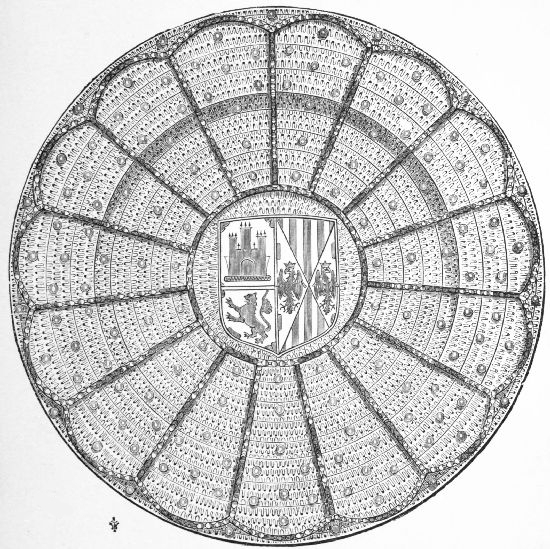
HISPANO-MORESCO LUSTRED PLATE, WITH ARMS OF LEON, CASTILE, AND ARAGON. (In the South Kensington Museum.)

IX. THE PRIME MINISTER.
ANCIENT KORAN CASE. (Escurial Library.)

ABD-ER-RAHMĀN III. was the last great Sultan of Cordova, of the family of the Omeyyads. His son, Hakam II., was a bookworm, and although bookworms are very useful in their proper place, they seldom make great rulers. A king cannot be too highly educated; he may know everything under the sun, and, like several of the Cordovan Sultans, he may employ his leisure in music and poetry; but he must not bury himself in his library, or care more for manuscripts than for campaigns, or prefer choice bookbinding to binding up the sore places of his subjects. Yet this was what Hakam did. He was not a weak man, or at all regardless of his great responsibilities; but he was too much absorbed in his studies to care about the glories of war; and his other delight, which consisted in building, was so far akin to his studious nature that it involved artistic tastes, which are often allied to those of literature. Hakam's peaceful, studious temperament did no great harm to the State. He was son enough of the Great Khalif to lead his armies against the Christians of Leon when they did not carry out their treaties; and so overwhelming was the awe that his father had inspired, so universal the sentiment of his crushing power, that the Christian princes of the north submitted to Hakam's interference with their affairs, and one of them even came to Cordova, and with many abject genuflexions implored the aid of the Sultan to restore him to his throne. Peace was soon signed between all the parties, and Hakam had leisure to collect his famous library. He sent agents to all parts of the East to buy rare manuscripts, and bring them back to Cordova. His representatives were constantly searching the booksellers' shops at Cairo and Damascus and Baghdad for rare volumes for the Sultan's library. When the book was not to be bought at any price, he would have it copied; and sometimes he would even hear of a book which was only in the author's brain, and would send him a handsome present, and beg him to send the first copy to Cordova. By such means he gathered together no fewer than four hundred thousand books, and this at a time when printing was unknown, and every copy had to be painfully transcribed in the fine clear hand of the professional copyist. Not only did he possess all these volumes, but, unlike many collectors, he is said to have read them all, and even to have annotated them. So learned was he that his marginal notes were greatly prized by scholars of after times, and the destruction of a great part of his library by the Berbers was a serious loss to Arab literature.
It was possible for one successor of the Great Khalif to rest upon his father's laurels, and enjoy his studious tranquillity, while the enemy without was watching for an opportunity of renewing his attacks; but two such sovereigns would undo the great work which Abd-er-Rahmān had accomplished, and bring the Cordovan empire tumbling down to the ground again. Hakam II. only reigned fourteen years, and his son, Hishām II., was a boy of twelve when he ascended the throne. What the young Sultan might have been, had he been allowed fair play, no one can say; but it is recorded that he exhibited many signs of intelligence and sound judgment in his childhood, and showed some promise of following in the brilliant steps of his grandfather. Hakam's easy-going scholar's rule had, however, deprived his son and successor of any chance of real power. While the student Sultan was anxiously collating a manuscript, or giving directions to a copyist or bookbinder, the great officers of the State were gradually attaining a degree of authority which Abd-er-Rahmān III. would have instantly checked. The ladies of the Sultan's harīm also began to exercise an influence upon the government of the country. Abd-er-Rahmān built a city to please his wife, but he would have been very much astonished if Ez-Zahrā had ventured to dictate to him who was to be the prefect of police. When Hakam died, however, the harīm influence was very strong, and the Sultana Aurora, mother of the young Khalif Hishām, was perhaps the most important person in the State. There was one, however, a favourite of hers, who was destined soon to become even more influential. This was a young man called Ibn-Aby-Amir, or the "Son of the Father of Amir," but whom (since this is rather a roundabout name) we shall call by the title he afterwards adopted, when he had won many victories over the Christians—Almanzor, which means "the victorious by the grace of God." Almanzor started in life as an insignificant student at the university of Cordova, where his father was known as a learned lawyer of good but not influential family. The young man, however, had no intention of restricting his ambition to the modest elevation which his father had attained. While still a student he dreamed of power, and confidently predicted that one day he would be master of Andalusia; he even asked his schoolfellows—for they were little more than boys—what posts they would prefer to have when he came to power, and it is worth noticing that when that event came to pass he did not forget his promises. His career is an interesting example of what pluck, talent, and selfishness could do in a Moslem State, where the road to power was open to genius, however unpromising the beginnings. Almanzor, who was at first merely a professional letter-writer to the court servants, ingratiated himself with the Grand Chamberlain, who exercised the functions which would nowadays be held by a Prime Minister, and in due course he was appointed to some small offices about the court. Here his charm of manner and skilful flatteries gained him the favour of the ladies of the royal harīm, and especially of Aurora, who fell in love with the brilliant young man. Step by step, by dint of paying his court to the princesses, and making them magnificent presents (for which he had sometimes to draw upon public funds), he rose to higher offices; and by the age of thirty-one he enjoyed a comfortable plurality of posts, including that of superintendent of the property of the heir-apparent, a judgeship or two, and the office of commander of a division of the city guard. Everybody was charmed with his courtesy, his prodigal generosity, and the kindness with which he helped the unfortunate. He had already succeeded in attaching to himself a large number of persons, some of whom were of very high rank, when the death of the Khalif Hakam placed Aurora in a position of great importance, as mother of the boy Khalif, and gave Almanzor the opportunity he needed of making his power felt. The two worked together, and after establishing the child Hishām on the throne, which was only effected by the murder of a rival claimant, he quickly suppressed the conspiracy of the palace "Slavs," who would have nothing to say to the accession of Hishām. The head of the government was Mus-hafy, the chamberlain who had helped Almanzor to climb the first rung of the ladder of power; and his junior readily joined him in his policy. The repression of the Slavs, many of whom were now banished, made the two officials very popular with the people of Cordova, who cordially hated the foreign mercenaries. But this alliance was only for a time: as soon as he saw his way to get rid of the chamberlain, Almanzor was determined to do so without scruple. The first thing, however, was to increase his own popularity. An occasion immediately happened, which the young official boldly seized. The Christians were again becoming overweening on the northern marches, and the Chamberlain Mus-hafy, being no soldier, did not know how to cope with their aggressions. Almanzor, who had been a judge and an inspector, was no more a soldier than the chamberlain; but he came of a sound old stock, and his ancestor had been one of the few Arabs who had accompanied Tārik and his Berbers in the first invasion of Spain. Without a moment's hesitation or self-distrust, he volunteered to lead the army against the Christians; and so successful was the raid he made upon Leon, and so liberal was his largesse to the soldiery, that he returned to Cordova, not only triumphant—a civilian general—but also the idol of the army.
A second campaign was undertaken against the Christians of the north, in which the generalship was really done by Ghālib, the commander of the frontier forces, a brave officer, whom Almanzor adroitly made his friend. Ghālib protested so warmly that the victories were the fruit of the young civilian's talents, and vaunted his sagacity so highly, that the court and people came to believe that there lay a military genius under the cloak of the ex-lawyer—as, indeed, there was. Strengthened by this series of successes, and by Ghālib's support, Almanzor next ousted the son of the chamberlain from the post of prefect of Cordova, and took his place; and so admirably did he exert his authority, that never had the city been so orderly or the law so justly administered. Even his own son was beaten, till he died, because he had transgressed. His father, like Junius Brutus, allowed no exceptions in the execution of the law. By this policy he added to his laurels; he had already won over the army and pleased the populace, and now he had won the favour of all law-abiding citizens. The time had come for a great stroke of diplomacy. He played the chamberlain off against Ghālib so skilfully, that he widened the breach that already existed between the scarred man of arms and the nerveless clerk who held the functions of Prime Minister, and by inducing the former to throw over an engagement he was making with the chamberlain for an alliance between their families, and to give his daughter to Almanzor instead, he gave the last blow to the old minister. In 978, only two years after the death of Hakam, Almanzor had played his cards so ably, that he was in a position to accuse Mus-hafy of peculation—not without ample reason—and have him arrested, tried, and condemned. For five years the once powerful chamberlain led a wretched life at the heels of Almanzor, and then he died in prison, poisoned probably by his conqueror, in a state of utter destitution, covered only by an old tattered cloak of the jailor. Such was the fate of all who came between Almanzor and his ambition. The chamberlain, from the summit of glory and power, when thousands would come on bended knee to beg his favour, and when even an ex-king of Leon had sought humbly to kiss his hand, had been reduced to want and degradation by a young upstart whose insignificant origin had not crushed his genius.
That same day on which the chamberlain was disgraced, Almanzor stepped into his place. He was now at the height of power, and enjoyed the position of virtual ruler of all Mohammedan Spain. The government of Andalusia consisted of the Khalif in council; but Almanzor had buried the Khalif in his seraglio; and as for the Council of Vizirs who should advise him concerning affairs of State, Almanzor virtually united it in his own person. From his palace in the suburbs he ruled the whole kingdom; letters and proclamations were issued in his name; he was prayed for from the pulpits and commemorated on the coinage; and he even wore robes of gold tissue woven with his name, such as kings only were wont to wear. He was not, however, safe from the attacks of his enemies. Ambition brings its own dangers, and those who have been trampled upon are apt to turn and avenge themselves. Such was the case with Almanzor. One of the "Slavs," whom he had summarily deposed when they were planning a change in the succession, made an attempt to assassinate him; but it failed, and its author, along with a number of influential persons who had abetted the conspiracy, was arrested, condemned, and crucified.
In Cordova Almanzor was now supreme, for the young Khalif showed no symptoms of rebelling against the tutelage to which he was subjected, and the queen of the harīm, Aurora, was still the great minister's friend. One man only could pretend to any sort of equality with Almanzor, and this was Ghālib, his father-in-law. The army admired Almanzor, and wondered at his daring in taking the command of campaigns against the Christians without military experience; but they loved and adored Ghālib, as a type of the true warrior, bred to arms, and unconquerable in personal prowess. Ghālib was therefore a formidable rival, and Ghālib must be removed. The Prime Minister set about this task with his usual quiet determination. Whatever he undertook he carried out with the same immovable composure and iron will. A proof of his character was shown very strikingly one day, when he was seated with the Council of Vizirs, who formed the Cabinet of the Moorish government. They were discussing some public question, when a smell of burnt flesh rose in the chamber, and it was discovered that the minister's leg was being cauterized with red-hot iron while he was calmly debating the affairs of State! Such a man would find little difficulty in disposing of any obstacle—even General Ghālib. He laid his plans carefully, and they never failed. When his measures were a little too strong to be immediately approved by the people, he always had a plan ready for restoring the mob to acquiescence. Thus, when the revolt of several leading men had culminated in the attempted assassination already mentioned, he perceived that he had enemies among the theological and legal classes, and he lost no time in making his peace with them. Summoning a meeting of the chief doctrinal authorities, he asked them to make a list of those works on philosophy which they considered dangerous and heretical. The Moslems of Spain were famous for their rigid orthodoxy, and the philosophers received very harsh treatment from them. They soon decided upon what the Roman Catholic Church calls an "Index Expurgatorius," or list of condemned books, and Almanzor forthwith had the proscribed works publicly burnt. By this simple means, although really a man of broad views and perfectly tolerant of philosophical speculation, he succeeded in making himself the champion of orthodoxy; the theologians conspired no more against him.[24]
A man so fertile in expedients would not find much difficulty in getting rid of Ghālib. He first began a series of army reforms, by which he reduced the influence of individual commanders and gained for himself the devotion which had previously been bestowed upon captains of divisions. This he accomplished by drawing his recruits from Africa and from among the Christians of the north, who were of course without any prejudice in favour of any particular Moslem leader, and soon became attached to Almanzor, when they understood his liberality, and were convinced by repeated proofs of his military genius. He was a stern commander, and had been known to cut a man's head off with the culprit's own sword, because the same weapon had been seen gleaming in the dressed ranks when it should have been in its scabbard. But while a martinet in matters of drill and discipline, he was a father to his soldiers so long as they fought well and maintained order. His influence was unbounded. Once, when he sat in camp and saw his men in panic, running in, with the Christians at their heels, he threw himself from his throne, flung his helmet away, and sat down in the dust. The soldiers understood the despairing gesture of their general, and, suddenly turning about, fell upon the Christians, routed them, and pursued them even into the streets of Leon. Moreover, no one could lead them to such vast stores of booty as the man who made more than fifty successful campaigns against the princes of the north. The army thus formed of new levies became devoted to their master, and Ghālib and his veterans of the frontier were speedily beaten; Ghālib himself died in an engagement. One other leader, Ja'far, the Prince of Zāb, threatened the peace of Almanzor by his extreme popularity with the troops; and he was presently invited to the minister's hall, made very drunk, and assassinated on his way home. This was by no means a solitary instance of Almanzor's treachery and bloodguiltiness; such acts deprive him of the title of hero to which his many brilliant qualities almost attain, and it is impossible to like him. Yet, with all his sternness and unscrupulousness, Almanzor brought Andalusia to a pitch of glory such as even the great Khalif, Abd-er-Rahmān III., had hardly contemplated. While keeping such hostile factions as remained in Cordova tranquil and powerless; whilst conciliating the people by making splendid additions to the great mosque of Cordova, when he found that they were beginning to grow indignant at the seclusion in which their young Khalif was kept, and were listening to the insinuations of Aurora and the palace party, who had grown tired or jealous of Almanzor; whilst overawing the Khalif himself by his personal influence; whilst keeping a watchful eye, that nothing escaped, upon every department of the administration, and devoting no little time to the cultivation of literature and poetry—amid all these various employments, this indefatigable man waged triumphant war in Africa and spread the dominion of the Khalif along the Barbary coast; and twice a year, in spring and autumn, led his troops, as a matter of course, against the Christians of Leon and Castile. Like a man of culture, he took his books along with his sword—his books were the poets who always accompanied his campaigns. Never was a general so constantly victorious. Supported by his hardy foreigners, and also by many Christians who were attracted by his pay and the sure prospect of booty, he carried fire and sword through the lands of the north. He captured Leon, and razed its massive walls and towers to the ground; he seized Barcelona; and, worst of all, he even ventured into the passes of Galicia, and levelled to the ground the splendid church of Santiago de Campostella, which was the focus of countless pilgrimages and almost formed the Kaaba of Europe. The shrine of St. James, however, where numerous miracles attested the presence of the saint's relics, was spared. It is said that when the conqueror entered the deserted city he found of all its inhabitants but a solitary monk, who still prayed before the holy shrine. "What doest thou here?" demanded Almanzor. "I am at my prayers," replied the old monk. His life was immediately spared, and a guard was set round the tomb to protect him and it from the violence of the soldiery, who proceeded to destroy everything else in the city. Almanzor well deserved his title of "Victorious," which was assumed after one of these campaigns. So long as his armies made their half-yearly expeditions, the Christian princes were paralysed, and Leon and the neighbouring country became a mere tributary province of the kingdom of Cordova. Castile, Barcelona, and Navarre were repeatedly defeated. He had taken the very capitals—Leon, Pamplona, Barcelona, and even Santiago de Campostella. Once he had brought the King of Navarre to his knees simply because the uncompromising Minister learned that there remained one captive Moslem woman in his kingdom. She was instantly delivered up, and many apologies were tendered for the inadvertence. Another time Almanzor found himself and his army cut off by the Christians, who had occupied an impregnable position in his rear, and barred his return to Cordova. Nothing daunted, he ordered his troops to foray the country round about, and collect materials for sheds, and implements of husbandry. Soon the Christians, who dared not attack, but believed they held the Moslems in their grasp, perceived them deliberately setting up barracks, and contentedly tilling the soil and preparing for the various operations of agriculture. Their astonished inquiries were answered by the cool reply, "We do not think it is worth while to go home, as the next campaign will begin almost immediately; so we are making ourselves comfortable for the interval!" Filled with consternation at the prospect of a permanent Moslem occupation, the Christians not only abandoned their strong position and allowed the enemy to go scot free, laden with booty, but even supplied them with baggage mules to carry off the spoils!
Almanzor, however, though invincible by man, was not proof against death. After a last victorious campaign against Castile, he was seized with mortal illness, and died at Medinaceli. The relief of the Christians is expressed in the simple comment of the monkish annalist: "In 1002 died Almanzor, and was buried in hell."

X. THE BERBERS IN POWER.
THE best constituted countries will occasionally fall into anarchy when the will that has guided them is removed; and this is one of the strong arguments of those who hold that a State is best governed by the mass of its people. Keep a people in leading strings, it is said, and the moment the strings break, or are worn out, the people will not know where to go. The theory, however, is only a general statement of an obvious truth, and its application depends greatly upon the character of the people. Some nations seem always to need leading strings, and none has yet become absolutely independent of the guidance of a dominant mind; nor would such independence be desirable, unless a dead level of mediocrity be our ideal of a State. Andalusia, at all events, could not dispense with her leaders; and the instant her leader died, down fell the State. When "great Cæsar fell," then "I and you and all of us fell down," not so much for sympathy as incapacity. The multiplicity of mutually hostile parties and factions made anything resembling a settled constitution impossible in the dominion of the Moors. Only a strong hand could restrain the animosity of the opposing creeds and races in Andalusia; and those who have considered the character and history of Ireland, and the irreconcilable enmity which prevails between the north and the south in that island of factions, will allow that the Arabs were not the only people who found mixed races and religions impossible to govern with the smoothness of a homogeneous nation.
The history of Andalusia, so far as we have told it, has been a series of ups and downs. First we saw a magnificent raid, led by born soldiers, ending in an unexpected conquest. Hardly was the peninsula won, when the jealousies and divisions of the various elements that made up the invading host bade fair to destroy the harvest just reaped by the sword. Then the strong man, the born king, appeared in the person of the first Abd-er-Rahmān, and Andalusia once more became, outwardly, one dominion. "O King, live for ever!" was the conventional form of address to the Persian monarch, and one is tempted to think that its realization might be the solution of all political troubles, provided the right king was chosen for immortality. The first king of Andalusia was naturally not immortal; and the consequence of his death was what always happens when a strong repressing force is withdrawn: the people fell again into civil war and anarchy. Yet again the God-gifted king came to rescue the nation. The Great Khalif imposed law and order throughout his dominions, beat back the invader, and trod the rebel under foot. For fifty years Andalusia was a paradise of peace and prosperity; had the third Abd-er-Rahmān been immortal she might have been peaceful to this day, and we should never have heard of the persecutions of Jews and Moors, of the terrible work of the Inquisition, or even (to come to very small things) the Carlists. It is a pity that such dreams cannot be true. But the Great Khalif had not left the country unprovided with a leader. A king had saved Spain twice, and now it was a prime minister who held the State together. Almanzor, the unconquerable minister, was able to make his masterful will felt to every corner of the peninsula; but Almanzor, too, was mortal, and when he died, and (as the monk piously hoped) "was buried in hell," the land which owed him her prosperity and wealth, her perfect orderliness and security, became a prey to all the hostile forces which only his iron hand could repress. For eighty years Andalusia was torn to pieces by jealous chiefs, aggressive and quarrelsome tyrants, Moors, Arabs, Slavs, and Spaniards; and though many of the old roots of dissension had been plucked up by time, and the jealousies that arose from memories of tribal glories were sometimes forgotten because men had lost their pedigrees, there were enough rivalries, personal, racial, and religious, to make Andalusia as much a hell upon earth as even the monkish chronicler could have desired for a burial-place for Almanzor.
For six years after the Prime Minister's death, his son Muzaffar maintained the unity of the kingdom. Then followed the deluge of greedy adventurers, rival khalifs, and impudent pretenders. The Spaniards, who formed after all the bulk of the population in which they were merged, loved to be ruled by a king; they liked a dynasty, and were proud of the memories of the great Omeyyad house. The rule of a minister, however just and good, was not their idea of government; the king must rule by himself. So they rebelled against the authority of a second son of Almanzor, who had provoked them by publicly putting in his claim to succeed to the throne, and they insisted on the Khalif taking the reins of State into his own weak hands. The unfortunate Hishām, thus suddenly dragged out of the seclusion of his harīm, where he had been a happy prisoner for thirty years, in vain implored the people not to demand impossibilities of him; they would have him rule, and when it became clear to everybody that the feeble middle-aged man was as helpless as an infant, they made him abdicate, and set up another member of his family in his place. This was really the end of the Omeyyad dynasty of Andalusia. Khalif after khalif was set up for the next twenty years; one was the puppet of the Cordovans, another was the puppet of the Slav guards; a third was the puppet of the Berbers; a fourth was a sort of figure-head to mask the ambition of the ruler of Seville; but all were puppets of some faction, and had no vestige of real authority. The throne-room in the palace became the scene of murder after murder, as khalif succeeded khalif. One poor wretch hid himself in the oven of the bath-room, till he was discovered, dragged out, and butchered before the eyes of his successor, whose turn was not far off. Hishām II., the poor creature who had been kept in a state of perpetual infancy by Almanzor and the queen-mother Aurora, was forced to play his part in the raree-show. He was again set up, and again pulled down; and the silken chains of his imprisonment among the beauties of his harīm were exchanged for the gloomy walls of a real dungeon. What became of him afterwards is unknown. His women said that he had contrived to escape, and had taken refuge in Asia, or at Mekka. The throne possessed few attractions for the miserable Khalif, who loved seclusion and pious duties; and he must have known that his presence in Andalusia gave a rallying cry to ambitious partisans, and could only lead to further strife. It was natural that he should prefer to end his days in the exercise of devotion at the holy temple of Islam. An impostor, who closely resembled Hishām in person, set himself up as the Khalif at Seville, and was acknowledged as a convenient puppet by the powerful lord of that city; but the real Hishām had disappeared for ever, and no one heard of him again.
How pitiful was the fate of the unhappy Omeyyads, who allowed the ferocious Moors, or Slavs, in turn, to use them as pieces on their chess-board, may be seen from what happened at the deposition of the third Hishām. By order of the chief men of the city, this mild and humane prince was dragged with his family to a dismal vault attached to the great mosque of Cordova. Here, in total darkness, half frozen with the cold and damp, and poisoned by the foul air of the place, the wretched Khalif sat, holding his only child, a little girl, to his breast, while his wives hung round him in scanty clothing, weeping, shivering, and dishevelled. They had been long without food, and their inhuman jailers had left them unnoticed for hours. The sheykhs then came to announce to Hishām the decision of the council which had been hastily summoned to debate upon his fate; but the poor Khalif, who was trying to restore a little warmth to the child in his arms, interrupted them: "Yes! yes! I will submit to their decision, whatever it is; but for God's sake get me some bread; this poor child is dying of hunger." The sheykhs were touched—they had not designed such torments—and the bread was brought. Then they began again: "Sire, they have determined that you shall be taken at daybreak to be imprisoned in such and such a fortress." "So be it," answered the Khalif; "I have only one favour to ask: permit us to have a lantern, for the darkness of this dismal place appals us." The lord spiritual and temporal of the Mussulmans of Spain had fallen to such straits that he had to beg for bread and a candle.
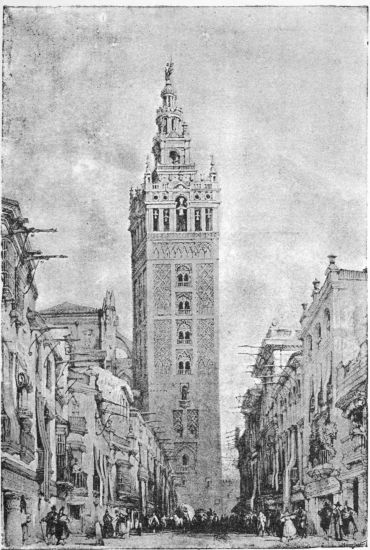
THE GIRALDA AT SEVILLE.
Such scenes as this were now frequent in Cordova. Each revolution brought its fresh crop of horrors. The people of Cordova, who had greatly increased in numbers, had also nourished those independent sentiments which the immense development of trade and manual industry, and the consequent creation of a prosperous artisan class, generally promote; and when they overturned Almanzor's dynasty, the mob broke out in the usual manner of mobs, and wreaked their vengeance by pillaging the beautiful palace which the great Minister had built in the neighbourhood of the capital for the use of himself and the government officials. When they had ransacked the priceless treasures of the palace, they abandoned it to the flames. Massacres, plundering, and assassination went on unchecked for four days. Cordova became a shambles. Then the Berbers had their turn; the imperious Slav guards, who had won the cordial detestation of the people, were succeeded by the brutal Berbers, who rioted in the plunder of the city. Wherever these barbarians went, slaughter, fire and outrage followed. Palace after palace was ransacked and burnt, and the lovely city of Ez-Zahrā, the delight of the Great Khalif, was captured by treachery, sacked, and set on fire, so that there remained of all the exquisite art that two khalifs had lavished upon its ornament nothing but a heap of blackened stones. Its garrison was put to the sword; its inhabitants fled for refuge to the mosque; but the Berbers had neither scruples nor bowels, and men, women, and children were butchered in the sacred precincts (1010).
While the capital was torn to pieces by savage bands of Slavs and Berbers, and was setting up one khalif after another, varying the family of Omeyya with that of Hammūd, or trying the effect of a governing town council, the provinces had long thrown off all allegiance to the central State. Every city or district had its own independent lord—so soon had the consolidating effects of Almanzor's rule disappeared. The Spaniards themselves enjoyed little of this sudden accession of small powers. They had to look on and lament, while foreigners divided their land among them. Berber generals fattened upon the South; the Slavs subdued the East; "the rest fell to parvenus or to the few noble families who had by some accident survived the blows which Abd-er-Rahmān III. and Almanzor had dealt at the aristocracy. Cordova and Seville, the two most important cities of Andalus, had set up republics,"[25] in name, however, rather than fact; for the Moslem First Consul was a very close likeness of the Emperor. In the first half of the eleventh century some twenty independent dynasties came into power in as many towns or provinces, among which the Abbadites of Seville, the Hammūd family at Malaga and Algeciras, the Zirites at Granada, the Beny Hūd at Zaragoza, the Dhu-n-Nūn dynasty at Toledo, and the rulers of Valencia, Murcia, and Almeria, were the most important. Some of these dynasts were good rulers, most of them were sanguinary tyrants, but (curiously) not the less polished gentlemen, who delighted to do honour to learning and belles lettres, and made their courts the homes of poets and musicians. Mo'temid of Seville, for instance, was a prince of many accomplishments, yet he kept a garden of heads, cut off his enemies' shoulders, which he regarded with great pride and delight. As a whole, however, the country was a prey to disorder as intolerable and as dangerous as that which had prevailed when the Great Khalif came to the throne. It was not quite the same in character; for there was no great Christian rebellion like that of Ibn-Hafsūn; but the anarchy was as universal, and the danger of a total collapse more imminent than ever.
For the Christians of the north were now on the move. They saw their opportunity, and they made the most of it. Alfonso VI., who had united under his sway the three kingdoms of the Asturias, Leon, and Castile, understood his part perfectly. He saw that he only had to allow the various Moslem princes rope enough, and they would proceed to hang themselves with the utmost expedition. These short-sighted tyrants, indeed, caring only for their petty individual power, and eagerly aiding in anything that could weaken their rivals, threw themselves at Alfonso's feet, and implored his assistance whenever they found themselves overmastered by a more powerful neighbour. Partly in consequence of acts of this kind, and partly in terror at the furious raids which the Castilians made throughout the country, even as far as the port of Cadiz, the Moslem States were almost all tributaries of the King of Castile, who took care to annually demand heavier and more heavy tribute, as the price of his friendship, in order to lay up stores for the great conquest which he had in mind. The north was poor, and with a fine irony he trusted to the immense contributions of his vassals among the Andalusian princes to provide the sinews of the war which should destroy them. Divided and jealous as were the Mohammedan dynasts, there was a limit to their patience. When Alfonso had bathed in the ocean by Hercules' Pillars, rejoicing that at last he had traversed all Spain and touched the watery border; when he had established a garrison of more than twelve thousand daring men in the fortress of Aledo, in the very midst of the Moslem territories, whence they ruthlessly emerged to harry the whole country and commit every sort of savage outrage; when Rodrigo Diaz de Bivar, "my Cid the Challenger," had established himself in Valencia with his Castilians, and laid waste the neighbouring lands; when it became clear to everyone that Alfonso meant nothing less than the reconquest of all Spain, and the extermination of all Moslems—then at last the Mohammedan princes awoke to their danger, and began to take measures for their defence. Helpless in themselves and, in spite of the common danger, despairing of any firm collected action among so many and such hostile factions, they took the only other course possible—they called in the aid of the foreigner. Some, indeed, foresaw dangers in such aid; but Mo'temid, the King of Seville, silenced them: "Better be a camel-driver in African deserts," he said, "than a swineherd in Castile!" The power they required was not far off. A new Berber revolution had taken place in North Africa, and a sect of fanatics, called the marabouts or saints (Almoravides, as the Spaniards named them), had conquered the whole country from Algiers to Senegal. They were much the same sort of people as Tārik and his followers, and they were ready enough to cross the water and conquer the fertile provinces of Spain. They made it a favour, indeed, and evinced supreme indifference to the attractions of Andalusia; but they came, and it was easy to see that they meant to stay.
When the Almoravides first came over like a cloud of locusts to devour the country thus offered to their appetite, they found the way perfectly open. The mass of the people of Andalusia rejoiced to see once more a strong arm coming to repress the disorder which had destroyed their well-being ever since the death of the great Almanzor; the petty tyrants either had invited them or could not resist them, and were, at all events, glad to see the Castilians successfully repelled. The Almoravide king, Yūsuf, the son of Teshfīn, after appropriating Algeciras, as a harbour and necessary basis of operations, marched unopposed through the provinces, and met Alfonso at Zallāka, or, as the Spaniards call it, Sacralias, near Badajoz, October 23, 1086. Alfonso, as he looked upon his own splendid army, exclaimed, "With men like these I would fight devils, angels, and ghosts!" Nevertheless he resorted to a ruse to score a surprise over the joint forces of the Berbers and Andalusian; but Yūsuf was not easily disconcerted. He took the Castilian army skilfully in front and rear, and, thus placed between two fires, in spite of the obstinate resistance which the tried warriors of Castile knew well how to offer, he crushed them utterly. Alfonso barely escaped with some five hundred horsemen. Many thousands of the best sword-arms in Castile lay stiff and nerveless on that fatal field.
After the victory, Yūsuf the Almoravide returned to Africa, leaving three thousand of his Berbers to help the Andalusians. He had promised to make no annexations, and, except in retaining the harbour of Algeciras, he had so far kept his word. The Andalusians were delighted with him; they praised his valour and exulted over the saving of the land; they admired his simple piety, which let him do nothing without the advice of his priests, and which had induced him to abolish all taxes in Spain except those few authorized by the Khalif Omar in the earliest days of Islam. The upper classes, indeed, ridiculed his ignorance and rough manners; he could speak but little Arabic, and when the poets recited their charming verses in his honour he generally missed the point of the compliment—no slight offence to the polished and elegant Andalusians, who never forgot their poetry even when they were up to their knees in blood. Yūsuf was to them a mere barbarian. But their contempt for his education did not greatly matter; they could not do without his sword, and the vast mass of the people, thinking rather of comfort than culture, were ready to receive him joyfully as sovereign of Andalusia. In 1090 the King of Seville again prayed the Almoravide to come over and help him against the Christians, who were as bold as ever, and carried on a perpetual guerilla warfare from their stronghold of Aledo. He acceded, with assumed unwillingness, and this time he directed his attacks quite as much against the Andalusian princes as against the Christians of Castile. These foolish tyrants dinned into his ears innumerable complaints against each other, and mutually betrayed themselves to such an extent, that Yūsuf very soon had grounds for distrusting the whole body of them. He had on his side the people, and, above all, the priests. These soon absolved him from his promise not to annex Andalusia, and even went so far as to urge him that it was his duty, in God's name, to restore peace and happiness to the distracted land. Always under the influence of his spiritual advisers, and sufficiently prompted by his own ambition without any such external impetus, Yūsuf readily fell in with this view, and before the year 1090 was out he had begun the subjugation of Spain. He entered Granada in November, and distributed its wonderful treasures—its diamonds, pearls, rubies, and other precious jewels, its splendid ornaments of gold and silver, its crystal cups, and gorgeous carpets, its unheard-of riches of every sort—among his officers, who had never in their lives seen anything approaching such magnificence. Tarīfa fell in December, and the next year saw the capture of Seville and many of the chief cities of Andalusia. An army sent by Alfonso, under the famous captain, Alvar Fañez, was defeated, and all the south lay at the feet of the Almoravides—save only Valencia, which no assault could carry so long as the Cid lived to direct the defence. In 1102, after the hero's death, Valencia succumbed, and now the whole of Mohammedan Spain, with the exception of Toledo, had become a province of the great African empire of the Almoravides.
The mass of the people had reason to be satisfied, for a time, with the result of their appeal to the foreigner. A minority, consisting of all the men of position and of education, were not so well pleased with the experiment. The reign of the Puritans had come, and without a Milton to soften its austerity. The poets and men of letters, who had thriven at the numerous little courts, where the most bloodthirsty despot had always a hearty and appreciative welcome for a man of genius, and would generally cap his verses with impromptu lines, were disgusted with the savage Berbers, who could not understand their refinements, and who, when they sometimes attempted to form themselves upon the model of the cultivated tyrants who had preceded them, made so poor an imitation that it was impossible to help laughing. The free-thinkers and men of broad views saw nothing very encouraging in the accession to power of the fanatical priests who formed the Almoravides' advisers, and who were not only rabidly opposed to anything that savoured of philosophy, but read their Koran exclusively through the spectacles of a single commentator. The Jews and Christians soon discovered what the tolerance of the Almoravides was: they were cruelly persecuted, massacred, or else transported. The old noble families, the few that remained, and the remnants of the petty princes, were in despair when they saw the stranger, whom they had bidden to their aid, taking up his permanent station in their dominions, and recalled with terror the doings of similar hordes of Berbers in the latter days of the Cordovan Khalifate. But the mass of the people were glad enough to see the Almoravides staying in the land; their lives and goods were at last safe, which had never been the case when the country was cut up into a number of separate principalities, few of which were strong enough to protect their subjects outside the castle gates; the roads were free from the brigands who had made travelling impossible for many years, and the Christians, instead of pouncing upon unsuspecting villages and harrying the land, were driven back to their own territory, where a wholesome dread of the Berbers, and a long strife among themselves, kept them at a safe distance. Order and tranquillity reigned for the moment; the law was respected, and the people once more dreamed of wealth and happiness.
The dream was a delusion. There was no prosperity in store for the subjects of the Almoravides. What had happened to the Romans and the Goths now happened to the Berbers. They came to Spain hardy rough warriors, unused to ease or luxuries, delighting in feats of strength and prowess, filled with a fierce but simple zeal for their religion. They had not been long in the enjoyment of the fruits of their victory when all the demoralization which the soft luxuries of Capua brought upon the soldiers of Hannibal came also upon them. They lost their martial habits, their love of deeds of daring, their pleasure in enduring hardships in the brave way of war—they lost all their manliness with inconceivable rapidity. In twenty years there was no Berber army that could be trusted to repel the attacks of the Castilians; in its place was a disorganized crowd of sodden debauchees, miserable poltroons, who had drunk and fooled away their manhood's vigour and become slaves to all the appetites that make men cowards. Instead of preserving order, they had now become the disturbers of order; brigands, when they could pluck up courage to attack a peaceful traveller; thieves on all promising opportunities. The country was worse off than ever it had been, even under the petty tyrants. The enfeebled Berbers were at the beck and call of bad women and ambitious priests, and they would counterorder one day what they had commanded the day before. Such rulers do not rule for long. A great revolution was sapping the power of the Almoravides in Africa, and the Castilians under Alfonso the Battler resumed their raids into Andalusia. In 1125 they harried the south for a whole year. In 1133 they burnt the very suburbs of Cordova, Seville, and Carmona, and sacked Xeres and set it in a blaze. The Christian forays now extended from Leon to the Straits of Gibraltar, yet the besotted government did nothing to meet the danger. Exasperated at its feebleness, the people finally rose in their wrath and drove their impotent rulers from the land.
"At last," says the Arab historian, "when the people of Andalus saw that the empire of the Almoravides was falling to pieces, they waited no longer, but, casting away the mask of dissimulation, broke out into open rebellion. Every petty governor, chief, or man of influence, who could command a few followers and had a castle to retire to in case of need, styled himself Sultan, and assumed the other insignia of royalty; and Andalus had as many kings as there were towns in it. Ibn-Hamdīn rose at Cordova, Ibn-Maymūn at Cadiz, Ibn-Kāsy and Ibn-Wezīr Seddaray held the west, Lamtūny Granada, Ibn-Mardanīsh, Valencia; some Andalusians, others Berbers. All, however, shortly disappeared before the banners of Abd-el-Mumin, who deprived every one of them of their dominions, and subjected the whole of Andalus to his rule." Abd-el-Mumin was the leader of the Almohades, who succeeded to the Almoravide power in Africa and Spain.

XI. MY CID THE CHALLENGER.
IT is time to glance at the opponents of the Moors in the North. We have seen how Pelayo gathered together the remnant of the Goths in the inaccessible caves and fastnesses of the Asturian mountains; how this remnant soon advanced beyond its early boundaries, and, taking courage from the indifference or the disunion of the Berber tribes who were quartered on the frontiers of the Mohammedan dominions, gradually recovered most of the territory north of the Sierra de Guadarrama, and there established the kingdom of Leon and the county of Castile; while the separate kingdom of Navarre arose further east, beneath the Pyrenees. We have also seen how these Christian kingdoms were in a state of almost constant war with their Moorish neighbours, and might have been seriously dangerous but for the no less constant divisions which neutralized the various Christian States. So long as the kingdom of Cordova remained strong and undivided, while the Christians of Leon, Castile, and Navarre wasted their vigour in civil wars, the Moors were fully equal to the task of preserving their dominions. But when the kingdom of Cordova fell, and Andalusia became a prey to petty dynasties, each of which thought first of its own interests, and then perhaps of the interests of the Mohammedan power at large, the Christians became more venturesome, and were enabled to wring from the Moors a considerable accession of territory. During the confusion of the eleventh century, when almost every city in Andalusia formed a State by itself, we have seen that the Christians scoured the land of the Moslems with their victorious armies, and exacted tribute from many of the most important Moorish princes. At this time Fernando the First had united the greater part of the north under his own sceptre. He had combined the conflicting provinces of Leon and Castile, and incorporated the Asturias and Galicia in his dominions. Fernando was undoubtedly the most powerful monarch in all Spain at this time; he had annexed Lormego, Viseu, and Coimbra in Portugal, and took tribute from the kings of Zaragoza, Toledo, Badajoz, and Seville; and though his imprudent division of his dominions among his three sons and two daughters involved the north in a series of civil wars after his death, Alfonso VI. "the Valiant" eventually succeeded in cementing the scattered fragments together again, and henceforward the progress of the Christian power in Spain was inevitable. It was only the immense bribes of the Mohammedan princes (who paid blackmail to a fabulous amount to buy off the Christians), and the armies of the Almoravides in the background, that prevented the entire reconquest of Andalusia by the Christians at this period of Moorish weakness. As it was, the Moors were in no sense their own masters; they were harassed between the dread of Alfonso and the scarcely less alarming supremacy of their Almoravide ally; and in the end they had to succumb to the latter. At this time we find the Christians interfering in most of the political affairs of the Mohammedan states; Christian armies overrunning their territories and demanding heavy tribute for their goodwill; and so complicated became the alliances between the two parties that many Christian mercenaries were to be found in the armies of the Moors, vigorously assisting in campaigns of devastation and sacrilege through Christian provinces, while Moors were ready to join the Castilians against their fellow-Moslems. It was, in short, a time of adventurers, of paid mercenaries, of men who fought for personal interest and profit, instead of for king and country.
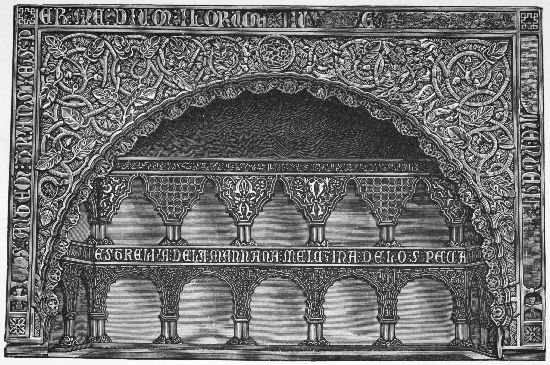
BOTICA DE LOS TEMPLARIOS, TOLEDO.
We should make a great mistake if we regarded the warriors of Leon and Castile as anything approaching an ideal of knightly honour and chivalry, and a still greater error would be to imagine them polished, cultivated gentlemen. The Christians of the north formed the most striking possible contrast to their Moorish rivals. The Arabs, rough tribesmen as they had been at their first arrival, had softened, by contact with the Andalusians and by their own natural disposition to enjoyment and luxury, into a highly civilized people, delighting in poetry and elegant literature, devoted to the pursuit of learning, and, above all, determined to enjoy life to the utmost. Their intellectual tastes were unusually fine and delicate; they were moved by emotions which could only be felt by men of taste and savoir vivre. They were romantic, imaginative, poetical, speculative, and would bestow on a well-turned epigram what would have sufficed to pay a regiment of soldiers. The most tyrannical and bloodthirsty among their despots was held in some contempt if he were not also something of a poet, or at least instinctively appreciative of polished wit and courtly eloquence. Music, oratory, as well as the severer pursuits of science, seemed to come naturally to this brilliant people; and they possessed in a high degree that quality of critical perception and delicate appreciation of the finer shades of expression which in the present day we associate with the French nation.
The Christians of the north were as unlike this as can well be conceived. Though descended from an older kingdom, the northern states had most of the qualities of new nations. They were rude and uncultivated; few of their princes possessed the elements of what could be called education, and they were too poor to indulge in the refined luxuries of the Moorish sovereigns. The Christians were simply rough warriors, as fond of fighting as even their Moslem antagonists, but even better prepared by their hard and necessarily self-denying lives for the endurance of long campaigns and the performance of desperate deeds of valour. They had no idea of the high standard of chivalrous conduct which poets afterwards infused into their histories; they were men of the sword, and little besides. Their poverty made them any man's servants; they sold their valour to him who paid them best; they fought to get a livelihood. We have seen how the great minister Almanzor won his victories against Leon and took Santiago with the aid of a large contingent of the Leonese themselves, who perceived clearly enough on which side their fortunes were to be made. The history of the eleventh century in Spain is full of such examples of the employment of Christian chevaliers d'industrie by Moorish princes; but of these none has ever attained such celebrity as the Cid, the national hero of Spain.
The Cid's proper name was Rodrigo Diaz of Bivar, and he was called the Cid because that was the title which his Moorish followers naturally gave him. A Mohammedan gentleman is still addressed in Egypt and elsewhere by the title Sīd, which is a corruption of the word Seyyid, meaning "master." The Cid, or "master," was also styled Campeador, which signifies "champion," or, more accurately, "challenger," because his exceeding prowess made him the natural challenger in those single combats which in Spanish wars commonly preceded a general engagement between two armies. A famous warrior would advance before the ranks, as Goliath of Gath stood forth before the armies of Israel, and challenge the opposing forces to send him out a champion; and none was more renowned for his triumphs in this manner of warfare than Rodrigo Diaz, "myo Cid el Campeador," as the old chronicler affectionately calls him. It is not easy to decide how much of the splendid history which has gathered round the exploits of the Cid is true. The Christian chroniclers stopped at nothing when they began to describe their national hero; and the enthusiasm that did not shrink from relating how the King of Leon seized Paris, and conquered the French, Germans, Italians, and even the Persians, can be trusted still less when it sounds the glories of the beloved Cid. The Spanish ballads surround their hero with a saintly aureole of all the virtues, and forget that many of these virtues would not have been understood or appreciated by the Cid himself or his contemporaries in Castile. The Arabic writers are generally more trustworthy, but their judgment can hardly have been unbiassed when they spoke of a Christian who worked such misery to the Moslems of Valencia as did the famous Campeador. Yet even they call him a "miracle of God."
In this critical age we are frequently obliged to abandon with regret the most charming traditions of our childhood's histories; and the Cid has not been spared. A special book has been written by an eminent Orientalist to prove that the redoubtable Challenger was by no means the hero he was supposed to be; that he was treacherous and cruel, a violator of altars, and a breaker of his own good faith. Professor Dozy maintains that the romantic history of the Cid is a tissue of inventions, and he has written an account of "the real Cid" to counteract these misleading narratives. He founds his criticisms mainly on the Arabic historians, in whom, despite their national and religious bias, he places as blind a reliance as less learned people have placed in the Chronicle of the Cid. Yet it is surprising how trifling are the differences that can be detected between his "real Cid" and that romantic Chronicle of the Cid, the substance of which was compiled by Alfonso the Learned only half a century after the Cid's death, and which Robert Southey translated into English in 1805 with such skill and charm of style that his version has ever since been almost as much a classic as the original. Every one can separate for himself the obviously legendary incidents in the delightful old Chronicle without any assistance from the Arabic historians, who deal chiefly with one period alone of the Cid's career; and the best popular account of the hero, in discriminating hands and with due allowances, is still Southey's fascinating Chronicle. The Cid of the Chronicle is not at all the same as the Cid of the Romances; and while we cheerfully abandon the latter immaculate personage, we may still believe in the former. Of course our Cid had his faults, and was guilty of not a few thoroughly indefensible acts. He was no very orthodox champion of the faith, for he fought as well for the Moors as for the Christians, and would as dispassionately rob a church as a mosque. But all this is clear enough to any one who reads the Chronicle, and it does not make the Cid anything but what he always was—a hero of the rude days of yore. If we are to limit our definition of heroism to characters that display all Christian virtues, long-suffering, gentleness, and pity, we shall have to dismiss most of our old friends. Achilles was not very gentle or compassionate when he dragged the body of Hector round the walls of Troy: but Achilles is the hero of the Iliad. Nine out of ten of the heroes of antiquity committed a host of acts which we moderns, with our superfine sensibilities, call cruel, ungenerous, even dastardly. It is a pure perversion of history to apply latter-day codes of morality to the heroes of bygone ages. Let us admit that they are not all gold; and then let us delight in their great deeds, the mighty swing of their sword-arm, the crushing shock of their onset, their tall stature and flashing eyes as they ride to meet their foes. We do not expect them to be philosophers or strict advocates of the theories of political economy. We are quite satisfied with them as they are: heroes,—brave, gallant leaders of men.
The Cid was a real hero to the Spaniards: first, because he fought so magnificently, and that used once to be title enough to reverence; secondly, because, like the mythical Bernardo del Carpio and the real Fernando Gonzalez, he was the champion of Castile, and had bearded the King of Leon, and thus represented the immemorial jealousy which the Castilians entertained for the powerful neighbours who absorbed their province; and thirdly, because the minstrels forgot his long alliance with the Moors, or contrived to give it a disinterested aspect, and remembered him only as the great champion of the Christian people against the infidels. But the very cause which specially commended him to the Castilians, his insubordination to King Alfonso, made him a less perfect hero to the writer of the Cronica General, from which the Chronicle of the Cid was extracted. That writer or compiler, Alfonso the Learned, King of Leon and Castile, could not approve the haughty independence of the Cid towards his own forerunner the sixth Alfonso. Hence in Southey's version of the Chronicle (which is enriched with many extracts from the Poem of the Cid and other sources) we have a check upon the excessive adulation of the ballads and romances. There is no lack of details in the work which are anything but creditable to the Cid; but, nevertheless, the true heroic character, with all its faults and limitations, is well sustained, and the record forms a wonderfully interesting picture of a stirring time and the greatest figure among the Spanish chevaliers.
The story of the Cid would fill a volume by itself; all we can attempt here is to extract a few of the most striking passages of the Chronicle. The youth of the hero is, to a large extent, merged in myth; he first comes into historical documents in 1064, when, though scarcely more than twenty, he had already won his title of Challenger by a triumphant single combat with a knight of Navarre, and was soon afterwards appointed commander-in-chief of the forces of Castile. He helped Sancho of Castile to overcome his brother Alfonso of Leon, by a surprise which savoured strongly of treachery, but which passed for good strategy in those rough-and-ready times. After the murder of Sancho by Bellido, under the walls of Zamora, the Cid passed into the service of his successor, the very Alfonso whom he had before driven into exile. The king at first welcomed the invincible knight of Castile to his court, and married him to his own cousin; but jealous rivals poisoned his mind, already filled with the memory of past wrongs, against Rodrigo (or Ruy Diez, as he is styled in the Chronicle), and in 1081 the Cid was banished from his dominions. The Chronicle must tell the story of his farewells:
"And the Cid sent for all his friends and his kinsmen and vassals, and told them how King Don Alfonso had banished him from the land, and asked of them who would follow him into banishment, and who would remain at home. Then Alvar Fañez, who was his cousin-german, came forward and said, Cid, we will all go with you, through desert and through peopled country, and never fail you. In your service will we spend our mules and horses, our wealth and our garments, and ever while we live be unto you loyal friends and vassals. And they all confirmed what Alvar Fañez had said; and the Cid thanked them for their love, and said that there might come a time in which he should guerdon them.
"And as he was about to depart he looked back upon his own home, and when he saw his hall deserted the household chests unfastened the doors open, no cloaks hanging up, no seats in the porch, no hawks upon the perches, the tears came into his eyes, and he said, My enemies have done this.... God be praised for all things. And he turned toward the East and knelt and said, Holy Mary Mother, and all Saints, pray to God for me, that He may give me strength to destroy all the Pagans, and to win enough from them to requite my friends therewith, and all those who follow and help me. Then he called for Alvar Fañez and said unto him, Cousin, the poor have no part in the wrong which the king hath done us; see now that no wrong be done unto them along our road; and he called for his horse. And then an old woman who was standing at her door said, Go in a lucky minute, and make spoil of whatever you wish, And with this proverb he rode on, saying, Friends, by God's good pleasure we shall return to Castile with great honour and great gain. And as they went out from Bivar they had a crow on their right hand, and when they came to Burgos they had a crow on the left.
"My Cid Ruydiez entered Burgos, having sixty streamers in his company. And men and women went forth to see him, and the men of Burgos and the women of Burgos were at their windows, weeping, so great was their sorrow; and they said with one accord, Dios! how good a vassal if he had but a good lord! must be scanno?] and willingly would each have bade him come in, but no one dared so to do. For King Don Alfonso in his anger had sent letters to Burgos, saying that no man should give the Cid a lodging; and that whosoever disobeyed should lose all that he had, and moreover the eyes in his head. Great sorrow had these Christian folk at this, and they hid themselves when he came near them because they did not dare speak to him; and my Cid went to his Posada, and when he came to the door he found it fastened for fear of the king. And his people called out with a loud voice, but they within made no answer. And the Cid rode up to the door, and took his foot out of the stirrup, and gave it a kick, but the door did not open with it, for it was well secured; a little girl of nine years old then came out of one of the houses and said unto him, O Cid, the king hath forbidden us to receive you. We dare not open our doors to you, for we should lose our houses and all that we have, and the eyes in our head. Cid, our evil would not help you, but God and all His saints be with you. And when she had said this she returned into the house. And when the Cid knew what the king had done he turned away from the door and rode up to St. Mary's, and there he alighted and knelt down, and prayed with all his heart; and then he mounted again and rode out of the town, and pitched his tent near Arlanzon, upon the Glera, that is to say, upon the sands. My Cid Ruydiez, he who in a happy hour first girt on his sword, took up his lodging upon the sands, because there was none who would receive him within his door. He had a good company round about him, and there he lodged as if he had been among the mountains....
"The cocks were crowing amain, and the day began to break, when the good Campeador reached St. Pedro's. The Abbot Don Sisebuto was saying matins, and Doña Ximena (the Cid's wife) and five of her ladies of good lineage were with him, praying to God and St. Peter to help my Cid. And when he called at the gate and they knew his voice, Dios! what a joyful man was the Abbot Don Sisebuto! Out into the courtyard they went with torches and with tapers, and the Abbot gave thanks to God that he now beheld the face of my Cid. And the Cid told him all that had befallen him, and how he was a banished man; and he gave him fifty marks for himself, and a hundred for Doña Ximena and her children. Abbot, said he, I leave two little girls behind me, whom I commend to your care. Take you care of them and of my wife and of her ladies: when this money be gone, if it be not enough, supply them abundantly; for every mark which you expend upon them I will give the monastery four. And the Abbot promised to do this with a right good will. Then Doña Ximena came up, and her daughters with her, each of them borne in arms, and she knelt down on both her knees before her husband, weeping bitterly, and she would have kissed his hand; and she said to him, Lo, now you are banished from the land by mischief-making men, and here am I with your daughters, who are little ones and of tender years, and we and you must be parted, even in your life-time. For the love of St. Mary tell me now what we shall do. And the Cid took the children in his arms, and held them to his heart and wept, for he dearly loved them. Please God and St. Mary, said he, I shall yet live to give these my daughters in marriage with my own hands, and to do you service yet, my honoured wife, whom I have ever loved even as my own soul.
"A great feast did they make that day in the monastery for the good Campeador, and the bells of St. Pedro's rung merrily. Meantime the tidings had gone through Castile how my Cid was banished from the land, and great was the sorrow of the people. Some left their houses to follow him, others forsook their honourable offices which they held. And that day a hundred and fifteen knights assembled at the bridge of Arlanzon, all in quest of my Cid; and there Martin Antolinez joined them, and they rode on together to St. Pedro's. And when he of Bivar knew what a goodly company were coming to join him, he rejoiced in his own strength, and rode out to meet them and greeted them full courteously; and they kissed his hand, and he said to them, I pray to God that I may one day requite ye well, because ye have forsaken your houses and your heritages for my sake, and I trust that I shall pay ye twofold. Six days of the term allotted were now gone, and three only remained: if after that time he should be found within the king's dominions, neither for gold nor for silver could he then escape. That day they feasted together, and when it was evening the Cid distributed among them all that he had, giving to each man according to what he was; and he told them that they must meet at mass after matins, and depart at that early hour. Before the cock crew they were ready, and the Abbot said the mass of the Holy Trinity, and when it was done they left the church and went to horse. And my Cid embraced Doña Ximena and his daughters, and blessed them; and the parting between them was like separating the nail from the quick flesh: and he wept and continued to look round after them. Then Alvar Fañez came up to him and said, Where is your courage, my Cid? In a good hour were you born of woman. Think of our road now; these sorrows will yet be turned into joy."
The Cid offered his services to the Moorish King of Zaragoza, the most powerful of the northern Moslem princes; and they were joyfully accepted. At the head of his own followers, who were the more devoted to him since they lived by the booty he procured them, he made a raid through Aragon, and so rapid was his riding that he harried a vast tract of country in five days, and was off before the Christians could sound the alarm. He led the Moors against the Count of Barcelona, won a signal victory, and made the Count his ally. How the Cid and his merry men triumphed in the battle-field, let the Chronicle again relate:
"Pero Bermudez could not bear this, but holding the banner in his hand, he cried, God help you, Cid Campeador; I shall put your banner in the middle of that main body; and you who are bound to stand by it—I shall see how you will succour it. And he began to prick forward. And the Campeador called unto him to stop as he loved him, but Pero Bermudez replied he would stop for nothing, and away he spurred and carried his banner into the middle of the great body of the Moors. And the Moors fell upon him that they might win the banner, and beset him on all sides, giving him many and great blows to beat him down; nevertheless, his arms were proof, and they could not pierce them, neither could they beat him down, nor force the banner from him, for he was a right brave man and a strong and a good horseman, and of great heart. And when the Cid saw him thus beset, he called to his people to move on and help him. Then placed they their shields before their hearts, and lowered their lances with the streamers thereon, and, bending forward, rode on. Three hundred lances were they, each with its pendant, and every man at the first charge slew his Moor. Smite them, knights, for the love of charity! cried the Campeador. I am Ruydiez, the Cid of Bivar! Many a shield was pierced that day, and many a false corselet was broken, and many a white streamer dyed with blood, and many a horse left without a rider. The misbelievers called on Mahomet, and the Christians on Santiago, and the noise of the tambours and of the trumpets was so great that none could hear his neighbour. And my Cid and his company succoured Pero Bermudez, and they rode through the host of the Moors, slaying as they went, and they rode back again in like manner; thirteen hundred did they kill in this guise. If you would know who they were, who were the good men of that day, it behoves me to tell you, for though they are departed, it is not fitting that the names of those who have done well should die, nor would they who have done well themselves, or who hope so to do, think it right; for good men would not be so bound to do well if their good feats should be kept silent. There was my Cid, the good man in battle, who fought well upon his gilt saddle; and Alvar Fañez Minaya, and Martin Antolinez the Burgalese of prowess, and Muno Gustios, and Martin Munoz who held Montemayor, and Alvar Alvarez, and Alvar Salvadores, and Galin Garcia the good one of Aragon, and Felez Munoz the nephew of the Campeador. Wherever my Cid went, the Moors made a path before him, for he smote them down without mercy. And while the battle still continued, the Moors killed the horse of Alvar Fañez, and his lance was broken, and he fought bravely with his sword afoot. And my Cid, seeing him, came up to an Alguazil, who rode upon a good horse, and smote him with his sword under the right arm, so that he cut him through and through, and he gave the horse to Alvar Fañez, saying, Mount Minaya, for you are my right hand."
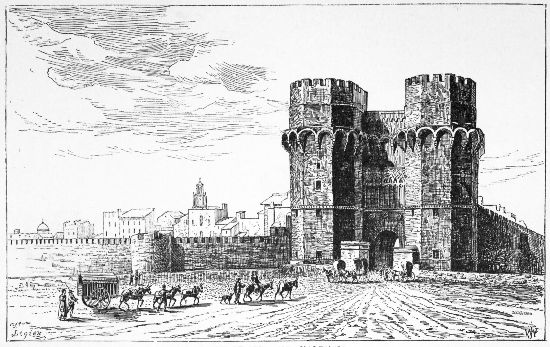
GATE OF SERRANO, VALENCIA.
The great feat of the Cid's career was the conquest of Valencia. By force of political troubles he came to occupy the position of protector of the Moorish King of Valencia in the name of the King of Zaragoza. His first entry was peaceful and unopposed:
"Then the Cid went to Valencia, and King Yahya received him full honourably, and made a covenant with him to give him weekly four thousand maravedis of silver, and he on his part was to reduce the castles to his obedience, so that they should pay the same rents unto him as had been paid unto the former kings of Valencia; and that the Cid should protect him against all men, Moors or Christians, and should have his home in Valencia, and bring all his booty there to be sold, and that he should have his granaries there. This covenant was confirmed in writing, so that they were secure on one side and on the other. And my Cid sent to all those who held the castles, commanding them to pay their rents to the King of Valencia as they had done aforetime, and they all obeyed his command, every one striving to have his love."
From the vantage post of Valencia the Cid carried his triumphant arms against the neighbouring kingdoms. He "warred against Denia and against Xativa, and abode there all the winter, doing great hurt, insomuch that there did not remain a wall standing from Orihuela to Xativa, for he laid everything waste, and all his booty and his prisoners he sold in Valencia." On one of these expeditions, however, he lost his capital for a while. Alfonso, in 1089, has received him back to favour, given him castles, and decreed that all the Cid's conquests should be his own property. In other words, he recognized the Cid as an almost independent prince. Almost immediately, however, the king became again suspicious of his powerful vassal, and seized the opportunity of the Cid's absence in the north to besiege his peculiar possession, the city of Valencia. When the Campeador heard this he was very wroth, and, by way of retaliation, carried fire and sword through Alfonso's districts of Najera and Calahorra, razed Logroño to the ground, and, in the words of the old Latin Gesta, "with terrible and impious despoilment he wasted and harried the land, and stripped it bare of its riches and seized them for himself." Alfonso hastily abandoned the siege of Valencia, and returned to defend his own country. But the Cid, having effected his purpose, came back another way, and found the gates of Valencia closed against him.
Then began that memorable siege of nine months, during which the people of Valencia suffered agonies of hunger and thirst, while the Cid maintained his remorseless leaguer round the walls. The besieged were reduced to the agonies of starvation, and those who rushed out, or were thrust forth as useless burdens by the townspeople, were massacred or sold into slavery by the Cid's soldiers. It is even said by the Moorish historians that the Cid had many of them burnt alive. The Chronicle pathetically records: "Now there was no food to be bought in the city, and the people were in the waves of death; and men were seen to drop and die in the streets." Thus wrote a poet of the devoted city:
"Valencia! Valencia! trouble is come upon thee, and thou art in the hour of death; and if peradventure thou shouldst escape, it will be a wonder to all that shall behold thee.
"But if ever God hath shown mercy to any place, let Him be pleased to show mercy unto thee; for thy name was joy, and all Moors delighted in thee and took their pleasure in thee.
"And if it should please God utterly to destroy thee now, it will be for thy great sins, and for the great presumption which thou hadst in thy pride.
"The four corner stones whereon thou art founded would meet together and lament for thee, if they could!
"Thy strong wall which is founded upon these four stones trembles, and is about to fall, and hath lost all its strength.
"Thy lofty and fair towers which were seen from far, and rejoiced the hearts of the people, ... little by little they are falling.
"Thy white battlements which glittered afar off, have lost their truth with which they shone like the sunbeams.
"Thy noble river Guadalaviar, with all the other waters with which thou hast been served so well, have left their channel, and now they run where they should not.
"Thy water-courses, which were so clear and of such great profit to so many, for lack of cleansing are choked with mud.
"Thy pleasant gardens which were round about thee; ... the ravenous wolf hath gnawn at the roots, and the trees can yield thee no fruit.
"Thy goodly fields, with so many and such fair flowers, wherein thy people were wont to take their pastime, are all dried up.
"Thy noble harbour, which was so great honour to thee, is deprived of all the nobleness which was wont to come into it for thy sake.
"The fire hath laid waste the lands of which thou wert called Mistress, and the great smoke thereof reacheth thee.
"There is no medicine for thy sore infirmity, and the physicians despair of healing thee.
"Valencia! Valencia! from a broken heart have I uttered all these things which I have said of thee.
"And this grief would I keep unto myself that none should know it, if it were not needful that it should be known to all."
At last, in June, 1094, Valencia surrendered, and the Cid stood once more upon her towers and ramparts. He made hard conditions with the people, many of whom he sent away to the suburbs to make room for his Castilians. But if he was harsh and not quite honest in his dealings with the vanquished, his triumph was stained by no wholesale butchery. The people were sometimes ruined; but their lives, except their leader's, were safe. The Cid had now attained the summit of his power. He sent for his wife and daughters from the abbey, and established himself permanently as King of Valencia and suzerain of the country round about. The King of Aragon besought his alliance. He exacted heavy tribute from his neighbours; his revenue included 120,000 pieces of gold yearly from Valencia, 10,000 from the lord of Albarracin, 10,000 from the heir of Alpuente, 6,000 from the Master of Murviedro, and so forth. He dreamed of reconquering all Andalusia. "One Roderick," he said, "lost Spain; another shall recover it." When the Almoravides came against him, he put them to rout. The Chronicle tells the story:
"Day is gone, and night is come. At cock-crow they all assembled together in the Church of St. Pedro, and the Bishop Don Hieronymo sang mass, and they were shriven and assoyled and howselled. Great was the absolution which the bishop gave them: He who shall die, said he, fighting face forward, I will take his sins, and God shall have his soul. Then said he, A boon, Cid Don Rodrigo; I have sung mass to you this morning: let me have the giving the first wounds in this battle and the Cid granted him this boon in the name of God. Then, being all ready, they went out through the gate which is called the Gate of the Snake, for the greatest power of the Moors was on that side, leaving good men to guard the gates. Alvar Fañez and his company were already gone forth, and had laid their ambush. Four thousand, lacking thirty, were they who went out with my Cid, with a good will, to attack fifty thousand. They went through all the narrow places and bad passes, and, leaving the ambush on the left, struck to the right hand, so as to get the Moors between them and the town. And the Cid put his battles in good array, and bade Pero Bermudez bear his banner. When the Moors saw this they were greatly amazed; and they harnessed themselves in great haste, and came out of their tents. Then the Cid bade his banner move on, and the Bishop Don Hieronymo pricked forward with his company, and laid on with such guise, that the hosts were soon mingled together. Then might you have seen many a horse running about the field with the saddle under his belly, and many a horseman in evil plight upon the ground. Great was the smiting and slaying in short time; but by reason that the Moors were so great a number, they bore hard upon the Christians, and were in the hour of overcoming them. And the Cid began to encourage them with a loud voice, shouting God and Santiago! And Alvar Fañez at this time issued out from ambush, and fell upon them, on the side which was nearest the sea; and the Moors thought that a great power had arrived to the Cid's succour, and they were dismayed, and began to fly. And the Cid and his people pursued, punishing them in a bad way. If we should wish to tell you how every one behaved himself in this battle, it is a thing which could not be done, for all did so well that no man can relate their feats. And the Cid Ruydiez did so well, and made such mortality among the Moors, that the blood ran from his wrist to his elbow! Great pleasure had he in his horse Bavieca that day, to find himself so well mounted. And in the pursuit he came up to King Yusuf, and smote him three times; but the king escaped from under the sword, for the horse of the Cid passed on in his course, and when he turned, the king being on a fleet horse, was far off, so that he might not be overtaken; and he got into a castle called Guyera, for so far did the Christians pursue them, smiting and slaying, and giving them no respite, so that hardly fifteen thousand escaped of fifty that they were."
TOMB OF THE CID AT SAN PEDRO DE CARDEÑA.
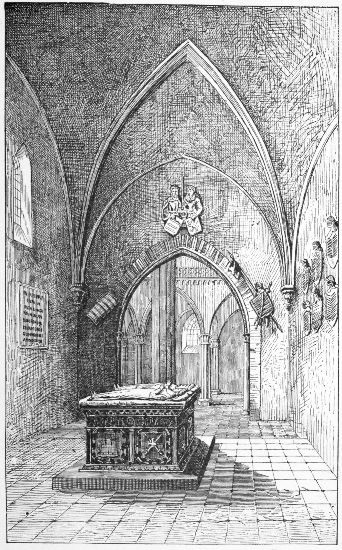
But the fortune of war is fickle. The troops of the Cid were defeated at last by the invaders; and the Campeador died of grief in July, 1099. They took his body and embalmed it, and kept vigil by its side; then, in the legend of the poets, they did as the Cid had bidden them: they set him upon his good horse Bavieca, and fastened the saddle well, so that he sat erect, with his countenance unchanged, his eyes bright and fair, and his beard flowing down his breast, and his trusty sword Tizona in his hand. No one would have known that he was dead. And they led Bavieca out of the city: Pero Bermudez in front with the banner of the Cid and five hundred knights to guard it, and Doña Ximena behind with her company and escort. Slowly they cut a path through the besiegers, and took the road to Castile, leaving the Moors in sore amazement at their strange departure: for they did not know that the Cid was dead. But the body of the hero was set in an ivory chair beside the great altar of San Pedro de Cardeña, under a canopy whereon were blazoned the arms of Castile and Leon, Navarre and Aragon, and of the Cid Campeador. Ten years the Cid sat upright beside the altar, his face still noble and comely, when the signs of death at last began to appear; so they buried him before the altar, where Doña Ximena already lay; and they left him in the vault, still upright in the ivory chair, still in his princely robes with the sword Tizona in his hand,—still the great Campeador whose dinted shield and banner of victory hung desolate over his tomb.

XII. THE KINGDOM OF GRANADA.
WITH such soldiers as the Cid, and such kings as Fernando and Alfonso, the recovery of all Spain by the Christians was only a matter of time. Every nation, it appears, has its time of growth and its period of efflorescence, after which comes the age of decay. As Greece fell, as Rome fell, as every ancient kingdom the world has known has risen, triumphed, and fallen, so fell the Moors in Spain. Their time was now near at hand. They had been divided and undisciplined before the Almoravide annexation: they were not less so when their Berber masters had been expelled. But hardly had the Almoravides disappeared, when a new enemy came on the scene. The Almohades, or fanatical "Unitarians," who had overthrown the power of the Almoravides in Africa, resolved to imitate their vanquished predecessors by including Andalusia in their empire. The dissensions among the princes of the long-shattered kingdom of the Moors made the task an easy one. In 1145 the Almohades took Algeciras; in 1146 they occupied Seville and Malaga, and the next four years saw Cordova and the rest of southern Spain united under their sway. Some princes, indeed, held out for a while, but the hordes of African fanatics were too overpowering for any single chief to make a protracted stand against them.
BANNER OF THE ALMOHADES.
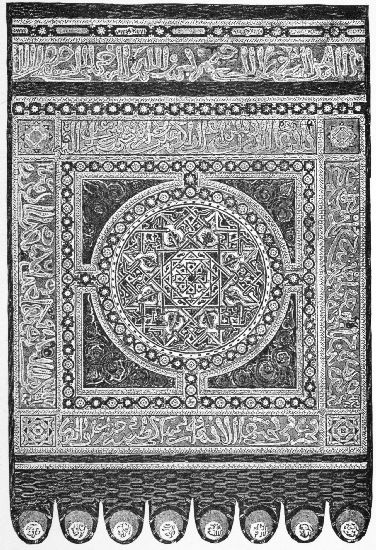
The Almohades, however, had no thought of making Andalusia the centre of their government. They ruled it from Africa, and the consequence was that their hold upon Spain was weak. The disturbed provinces of Andalusia were not easily to be retained by princes who contented themselves with deputies sent from Morocco, and with an occasional expedition to repel the attacks of the Christians. When they came in force their efforts were generally crowned with success. They won a splendid victory over the Christians in 1195 at Alarcos, near Badajoz, where thousands of the enemy were slain, and immense spoils fell into the hands of the fanatics. But the fortune of war changed when, in 1212, the disastrous field of Las Navas decided the fate of the Almohades. Of 600,000 men, few escaped to tell the tale of slaughter. City after city fell into the hands of the Christians; and family dissensions among the foreigners, and the attacks of rival dynasties in Africa, enabled the chiefs of Andalusia, who had grown impatient of the spasmodic rule of their foreign masters, in 1235, to drive the Almohades out of the peninsula. An Arab chief, Ibn-Hūd, then made himself master of most of the south of Spain, and even of Ceuta in Africa; but he died in 1238, and the command of Andalusia now devolved upon the Beny-Nasr of Granada.
The kingdom of Granada was the last bulwark of the Moors in Spain. It was not much that was now left to them. Between 1238 and 1260, Fernando III. of Castile and Jayme I. of Aragon conquered Valencia, Cordova, Seville, and Murcia; and the rule of the Moors was now restricted to the present province of Granada, i.e., the country about the Sierra Nevada and the sea coast from Almeria to Gibraltar. Within this limit, however, their kingdom was destined to endure for another two centuries and a half. Though hemmed in on all sides, the Moors were well served by soldiers. The people of the conquered cities, the most valiant warriors of the vanquished Moslem states, came to place their swords at the disposal of the one remaining Mohammedan king. Fifty thousand Moors are recorded to have fled to his protection from Valencia, and three hundred thousand from Seville, Xeres, and Cadiz. Nevertheless, Granada was forced to become tributary to the Castilian crown. The founder of the dynasty of the Beny-Nasr, an Arab named Ibn-el-Ahmar, or the "Red man," because of his fair skin and hair, was a vigorous sovereign, but he could not withstand the power of the Christians, who now held nearly the whole of Spain. He paid homage and tribute to Fernando and his son Alfonso the Learned, not, however, without more than one struggle to free himself from their yoke; and from that time forward Granada with its surrounding territory was generally let alone by the Christian kings, who had enough to do to settle their already vast acquired territory and to do away with local pretenders. From time to time the Moors made war upon their Christian neighbours, but eventually they had to make up their minds to a secondary position. The sum of twelve thousand gold ducats was the tribute paid by Mohammed X., in 1463, as a condition of peace. During these two centuries the Moorish territory had suffered little diminution. Gibraltar had been lost and won and lost again; other places, notably Algeciras, had become part of the Christian dominions; but the general extent of the Moslem realm remained in the third quarter of the fifteenth century much what it had been in the first half of the thirteenth.
SHIELD OF A KING OF GRANADA.
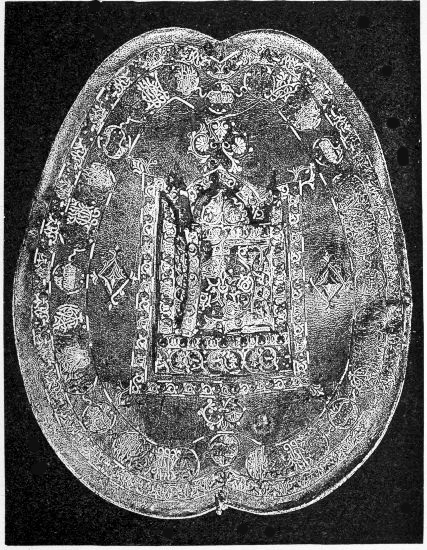
During this period of comparative tranquillity, Granada had taken the place of Cordova as the home of the arts and sciences. Its architects were renowned throughout Europe; they had built the marvellous "Red Palace," Alhambra, so called from the colour of the ferruginous soil on which it stands, and they had covered it with the splendid gold ornament and Arabesque mouldings which are still the wonder of artists of all countries.[26] Granada itself, with its two castles, was a pearl of price. It stands on the border of a rich plain, the famous "Vega," lying at the feet of the snowy "mountains of the moon," the Sierra Nevada. From the heights of the city, and still better from the Alhambra, which stands sentinel over the plain like the Acropolis of Athens, the eye ranges over this beautiful Vega, with its streams and vineyards, its orchards and orange groves. No city in Andalusia was more favoured in site or climate; the breezes from the snow mountains made the hottest summer tolerable, and the land was fertile beyond compare.
The site chosen by the Moors for their celebrated Red Palace is a terrace bounded by precipitous ravines, at the foot of which, to the north, flow the waters of the river Darro. Solid walls of stone covered with stucco, and strengthened at frequent intervals by towers, surround the terrace. The enclosed space is somewhat of the form of a lanceolate leaf lying on the table-land, with its greatest length (about half a mile) from east to west.
The visitor finds his way into the enclosure through a massive embattled tower of orange and red pierced by the Gate of Justice under which the khalifs, like the judges of the Hebrews, were wont to sit in judgment. Twenty-eight feet above the pavement, over the horseshoe arch, a cabalistic key and a gigantic hand are carved on two stones. Once inside the walls, the visitor finds himself in a square, on one side of which is an unfinished palace designed by Charles the Fifth. The corridor through which entrance is now gained to the Alhambra crosses an angle of this ruined structure and admits the visitor to the Court of the Myrtles, so called from the profusion of those shrubs which adorn its sides. A narrow passage ushers us into a court one hundred and forty feet long, and half as broad, flooded with sunlight and gay with gold-fish, which disport themselves in a long pond that fills the larger part of the space. Pillars and galleries adorn the sides and ends of the enclosure, and on the north the great square tower of Comares rises against the horizon. The court is a place of peace; the water scarcely makes a ripple as it gently oozes into the ample reservoir, and leaves it without a gurgle; the multitudinous goldfishes gleam and glitter in the profusion of sunshine; no suggestion of the outer world penetrates the stillness.
THE COURT OF THE LIONS IN THE ALHAMBRA.
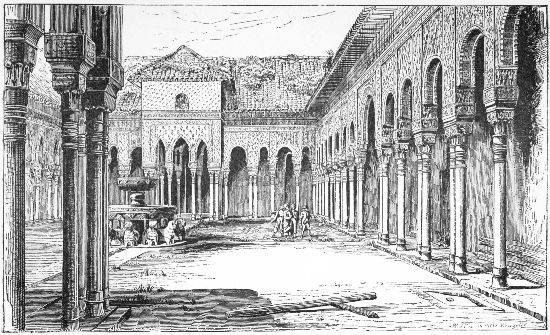
All is calm, but it is not the dull, cold calm of ruin and death; we can but feel a sense of companionship with the former masters of the palace and the grounds. We walk through the Barca, or boat-shaped antechamber, to the Hall of the Ambassadors, and imagine the khalif of the Omeyyads seated upon his throne at the end; while we gaze up into the lofty dome and allow our eyes to wander about the great apartment as we admire the medallions, the graceful characters of the Arabic inscriptions, the delicate patterns of the plaster-work with which the walls are adorned; the balconies, the white, blue, and gold of the cornice and ceiling; the circles, crowns, and stars moulded to imitate the vault of heaven. We stop before the window looking over the Darro to think how Ayesha once let Boabdil down in a basket from it five centuries ago; how Charles the Fifth said of the unfortunate Moor, "Ill-fated was the man who lost all this!" We bring up before us the discoverer of America, as tradition paints him, pleading in this place with the good Isabella for gracious permission to add another jewel to her crown—the bright gem of a New World. We climb to the terraced roof of the tower, following the narrow windings of the steep stairway once trodden by fair lady and gallant prince as they hastened to the lofty battlement to watch the approach of some army or anxiously to study the progress of a battle on the Vega. Our eyes search the broad expanse for that bridge of Pinos where Moor and Christian more than once fought for the mastery. We remember that it was at that spot that Isabella's messenger overtook the despairing Columbus, as he conveyed to him the queen's recall, when the mariner was plodding towards other realms to carry his bold proposition to other and, as he hoped, more gracious sovereigns. We care not that it is tradition only which fixes the spot; tradition and romance are a portion of the charm of the Alhambra.