THE STORY OF THE MOORS IN SPAIN. (continued 2)
Reading edition
For seven years, indeed, the memory of the "Day of the Foss," as the massacre at Toledo was called, kept the fanatics of Cordova within bounds; but as the recollection of that fearful hole into which the murdered bodies of all the nobility of Toledo had been cast, grew fainter, there were symptoms of a fresh insurrection at the capital. Popular feeling ran very high, not only against the Sultan, because he would not wear sackcloth and ashes or pretend to be an ascetic, but still more against his large body-guard of "Mutes," so called because, being negroes and the like, they could not speak Arabic. The Mutes dared not venture in the streets of Cordova except in numbers; a single soldier was sure to be mobbed, and might be murdered. One day a wanton blow struck by a member of the guard roused the whole people. They rushed with one accord to the palace, led by the thousands of theological students who inhabited the southern suburb of the city, and seemed bent on carrying it by assault in spite of its fortifications and garrison. The Sultan Hakam looked forth over the sea of faces, and watched with consternation the devoted mob repulsing the charge of his tried cavalry; but even in this hour of desperate peril he did not lose the sang-froid which is the birthright of great men. Retiring to his hall, he told his page Hyacinth to bring him a bottle of civet, with which he proceeded calmly to perfume his hair and beard. The page could not repress his astonishment at such an occupation, when the cruel mob was even then battering at the gates; but Hakam, who was fully aware of his danger, replied: "Silence, rascal! How do you suppose the rebels would be able to find out my head among the rest, if it were not distinguished by its sweet odour?" He then summoned his officers, and took his measures for the defence. These were simple enough; but they proved effectual. He despatched his cousin with a force of cavalry, by a roundabout way, to the southern suburb, which he set in flames, and when the people turned back in terror from the besieged palace to rescue their wives and children from their burning homes, Hakam and the rest of the garrison fell on them in the rear. Attacked on both hands, the unfortunate rebels were cut to pieces; the grim Mutes rode through them, slashing them down by the hundred, and disregarding, if they understood, their prayers for mercy. Hakam's manœuvre saved the palace and the dynasty; and the insurrection was converted into a wholesale massacre.[12]
Yet in the moment of his triumph the Sultan stayed his hand; he did not press his victory to the last limits, but was content with ordering the destruction of the rebellious suburb and the exile of its inhabitants, who were forced to fly, some to Alexandria, to the number of fifteen thousand, besides women and children, whence they eventually crossed to Crete; others, eight thousand in all, to Fez, in Africa. The majority of the exiles were descendants of the old Spanish population, who had embraced Islam, but were glad of a pretext to assert their racial antipathy for the Arab rule. The chief offenders, the fakis, or theological students, however, were left unpunished, partly, no doubt, because many of them were Arabs, and partly in deference to their profession of orthodoxy. To one of their leaders, who was dragged before Hakam, and who told the Sultan, in the heat of his fanatical rage, that in hating his king he was obeying the voice of God, Hakam made the memorable reply: "He who commanded thee, as thou dost pretend, to hate me, commands me to pardon thee. Go and live, in God's protection!"


V. THE CHRISTIAN MARTYRS.
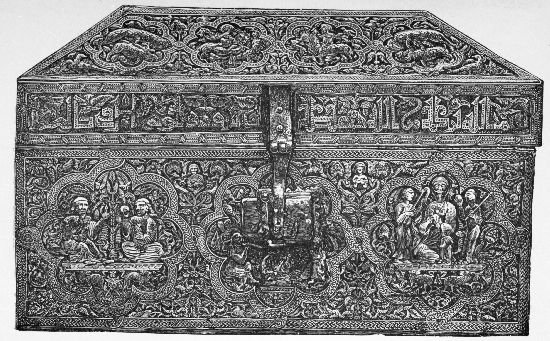
MOORISH IVORY CASKET OF THE 11TH CENTURY IN THE CATHEDRAL OF PAMPLONA.
THE Sultan Hakam died in 822, after a reign of twenty-six years. He left a comparatively tranquil inheritance to his son Abd-er-Rahmān II.; the renegades of Cordova had been subdued and exiled, the bigots had been given a lesson that they were not likely to forget, and there only remained the chronic disturbances on the Christian borders to be occasionally repressed. Abd-er-Rahmān II. inherited his father's talent for enjoyment, but not that strength of character by which self-indulgence was preserved from degenerating into weakness. The new Sultan converted Cordova into a second Baghdad, and imitated the prodigalities of the great Harūn-er-Rashīd, who had recently left the scene of his fantastic amusements for, let us hope, a better world. Abd-er-Rahmān built palaces, laid out gardens, and beautified his capital with mosques, mansions, and bridges. Like all cultivated Moslem sovereigns, he was a lover of poetry, and claimed to be no mean poet himself, though his verses were sometimes written by other pens whom he paid to compose for him. His tastes were refined, and his nature was gentle and easily led. Four people ruled him throughout his career: one was a singer, the second a theologian, the third a woman, and the fourth a black slave. The most influential of these was the theologian Yahya, the same who had before stirred up the students against Hakam, and who now acquired an absolute ascendency over the mind of the new Sultan. The Queen Tarūb and the slave Nasr, however, exercised no light authority in political matters; but the singer Ziryāb confined his interest to matters of taste and culture, and refused to meddle in the vulgar strife of politics. He was a Persian, and had been a pupil of the famous musician of Baghdad, Isaac the Mosilite, until one day he had the misfortune to excel his master in a performance before the Khalif Harūn, and had immediately afterwards been offered by the jealous Mosilite the choice of death or banishment. He accepted the latter; and, arriving in Spain, was received with effusion by the cultivated Sultan, who assigned him a handsome pension, supplies of food, houses, and other privileges and allowances, so that the fortunate singer counted an immense income. So delighted was the Sultan with Ziryāb's talents that he would seat him beside him, and share his meals with him, and would listen for hours to his songs and to the wonderful tales he could tell of bygone times, and the wise sayings he could relate from his boundless stores of reading. He knew more than a thousand songs by heart, each with its separate tune, which he said the spirits of the air taught him; he added a fifth string to the lute, and his style of playing was quite unlike any one else's, so that people who had heard him would listen to none other afterwards. He had a curious way with his musical pupils. He used to make the would-be singer sit down and try to sing his loudest. If the voice was weak, he told him to tie a band round his waist to increase the volume of sound; if he stammered or had any defect in his speech, Ziryāb made him keep a piece of wood in his mouth till his jaws were properly stretched. After this, if the novice could shout Ah at the top of his voice, and keep the sound sustained, he took him as a pupil and trained him carefully; if not, he dismissed him.[13] Never was any one so polished, so witty, so entertaining as Ziryāb; he soon became the most popular man in Andalusia, and held the position of arbiter of fashion, like Petronius or Beau Brummell. He made the people change their manner of wearing their hair. He introduced asparagus and force-meat balls to Andalusia, and a dish was long afterwards known as "Ziryāb's fricassee." He set the example of drinking out of glass vessels instead of metal, of sleeping on leather beds, dining off leather mats, and a host of other refinements; while he insisted on a careful gradation of clothes, diminishing by slow degrees from the thick of winter to the thin of summer, instead of the abrupt change which the people had hitherto made. Whatever he prescribed, the fashionable world followed; there was nothing that this delightful epicure could not persuade them to think both necessary and charming.
But while the Court was preoccupied with the tasting of new dishes, or the cut of its hair, there were earnest people among the subjects of the Sultan, in Cordova itself, who were absorbed by much deeper thoughts. It was not the external enemy that thus endangered the peace of the Moorish kingdom. Many a time, indeed, did Abd-er-Rahmān II., who was not wanting in personal courage and love of military glory, lead his armies with success against the Christians of the north, who, aided by Louis the Debonnaire, were continually making some expedition or foray over the frontiers. These petty campaigns were not yet serious enough to shake the stability of the Moslem rule. The trouble in these early days always came from within. In the present instance it arose from the too exalted spirit of a small number of Christians at Cordova. Most of the Christians, indeed, were by no means anxious to emphasize their creed; they found themselves well treated, free to worship as they pleased, with no hindrance from their rulers; and also free to trade and get rich, as well as their Moslem neighbours. What more could be desired, unless the recovery of their ancient kingdom? And as that was impossible just then, they were content to let well alone, and make the best of their mild and tolerant governors.
This temper was very general in Andalusia, but there were here and there ambitious or enthusiastic spirits that chafed against such compliance with the rule of the "infidel." They remembered the former power and prosperity of their church, and the priests especially could no longer restrain their hatred of the Moslems who had taken away from them their authority and substituted a false creed for the religion of Christ. The very tolerance of the Moors only exasperated such fervent souls; they preferred to be persecuted, like the saints of old; they longed to be martyrs, and they were indignant with the Moslems, because they would not "persecute them for righteousness' sake" and ensure them the kingdom of heaven. Especially hateful to these earnest people was the open gaiety and sensuous refinement of the Moors; their enjoyment of life and all its pleasure, their music and singing, their very learning and science, were abhorrent to these ascetics. Life, to the true believer, meant only scourges and fasts, penances and confessions, purification through suffering, the mortifying of the flesh and sanctifying of the spirit. What happened was, in truth, nothing but the manifestation of the ascetic or monastic form of Christianity among the subject populations. A sudden and violent enthusiasm took the place of the indifference that had hitherto been the prevailing characteristic of Spanish Christianity, and a race for martyrdom began.
It was a grievous pity to see good people throwing away their lives, and the lives of others, for a dream. The suicides of Andalusia were really no whit more reasonable or truly religious than the sufferings of the priests of Baal who cut themselves with knives, or of the Indian ascetics who let their nails grow through the palms of their hands. The fact that the Spanish "martyrs" were mad in a better cause does not make them less insane. Christianity does not teach its disciples to fling away their lives wantonly, out of mere joy in being tortured and killed. It was not as if the Christians were persecuted or hindered in the exercise of their faith; it was not as if the Moors were ignorant of Christianity and needed to be preached to. They knew more of the Scriptures than many of the Christians themselves, and they never spoke the name of Jesus Christ without adding, "May God bless him." Mohammedanism recognizes the inspired nature of Christ, and inculcates profound reverence towards him. The Moslems were not ignorant of Christianity, but they preferred their own creed; and while they let the Christians hold to theirs, there was no excuse for the latter posing in the heroic character of persecuted believers. Indeed there was no rational way of getting martyred; since Christians were allowed free exercise of their religious rites, might preach and teach without let or hindrance, they could not find a legal ground for being persecuted unless they left the paths of the Gospel and set aside the great lesson of Christ, "Love your enemies, do good to them that hate you, and pray for them that despitefully use you and persecute you." They were not despitefully used or persecuted; the mass of the Christians were entirely unmolested and though the priests were sometimes subjected to some public ridicule by the street boys and common people, the better class of Moslems never joined in this; yet so far were the poor Christians from attempting to love these mild adversaries that they went out of their way to curse them and blaspheme their religion, with the simple intention of being martyred for their pains. Now it is a well-known law in Moslem countries that he who blasphemes the Prophet Mohammed or his religion must die. It is a stern and barbarous law, but the world has seen as bad principles carried into effect over the faggots of Smithfield and Oxford in later ages than that of which we are writing. Wilfully to stir up religious strife and injuriously to abuse another faith are no deeds for Christians; voluntarily to transgress a law which carries with it capital punishment is not martyrdom, but suicide; and the pity we cannot help feeling for the "martyrs" of Cordova is the same that one entertains for many less exalted forms of hysterical disorder. The victims were, indeed, martyrs to disease, and their fate is as pitiable as though they had really been martyrs for the faith.
The leading spirit of these suicides was Eulogius,[14] a priest who belonged to an old family of Cordova, always noted for its Christian zeal. Eulogius had spent years in prayer and fasting, in bitter penance and self-mortification, and had reduced himself to the ecstatic condition which leads to acts of misguided but heroic devotion. There was nothing worldly left in him, no thought for himself or personal ambition; to cover the false faith of the Moors with contumely, and to awaken a spirit of exalted devotion among his co-religionists, such were his aims. In these he had throughout the cordial support of a wealthy young man of Cordova, Alvaro by name, and of a small but fervid body of priests, monks, and women, with a few laymen. Among those who found a close affinity to the devoted young priest, was a beautiful girl named Flora. She was the child of a mixed marriage, and her Christian mother had brought her up secretly in her own faith. For many years Flora was to all outward appearance a Mohammedan; but at length, moved by the same spirit of sacrifice and enthusiasm which had stirred Eulogius, and excited by such passages in the Bible as, "Whoso shall deny Me before men, him will I also deny before My Father which is in heaven," she fled from her brother's house—her father was dead—and took refuge among the Christians. The brother, a Mohammedan, searched for her in vain; many priests were thrown into prison on the charge of being accomplices in the abduction; and Flora, unwilling that others should suffer through her fault, returned to her home and confessed herself a Christian. Her brother tried the sternest means at his disposal to compel her to recant, and at last, in a rage at her obstinacy, brought her before the Kādy, or Mohammedan judge, and accused her of apostacy. The child of a Moslem, even though the mother be a Christian, is held in Mohammedan law to be born a Moslem, and apostacy has always been punishable by death. Even now in Turkey the law holds good, though there has been a tacit understanding for the last forty years that it shall not be enforced; and a thousand years ago we must expect to find less tenderness towards renegades. Yet the judge before whom Flora was thus arraigned displayed some compunction towards the unhappy girl. He did not condemn her to death—as he was in law bound to do—or even to imprisonment; he had her severely beaten, and told her brother to take her home and instruct her in the Mohammedan religion. She escaped, however, again, and took refuge with some Christian friends, and here for the first time she met Eulogius, who conceived for the beautiful and unfortunate young devotee a pure and tender love such as angels might feel for one another. Her mystical exaltation, devout piety, and unconquerable courage, gave her the aspect of a saint in his eyes, and he had not forgotten a detail of this first interview six years later when he wrote to her these words: "Thou didst deign, holy sister, to show me thy neck torn by the scourge, and shorn of the beautiful locks that once hung over it. It was because thou didst regard me as thy spiritual father, and believe me to be pure and chaste as thyself. Softly did I lay my hand on thy wounds; I had it in me to seek to heal them with my lips, had I dared.... When I parted from thee I was as one that walketh in a dream, and I sighed without ceasing." Flora and a sister who shared her enthusiasm were removed to a safe place of concealment, and Eulogius did not see her again for some time.
Meanwhile the zeal of the Cordovan Christians was bearing fruit. A foolish priest, Perfectus, had been led into cursing the dominant religion, and had been executed on a great Mohammedan feast-day, when all the world was rejoicing at the termination of the rigorous fast of Ramadan, which had lasted a whole month. The Moslems, men and women, made this feast a special occasion of merry-making, and the execution of the offending priest added a new subject of excitement to the crowds that thronged the streets and sailed on the river and frolicked on the great plain outside the city. The poor priest died bravely, cursing Mohammed and his religion with his last breath, surrounded by a vast crowd of scoffing and pitiless Moslems. The Bishop of Cordova, followed by an army of priests and devotees, took down his body, buried him with the holy relics of St. Acisclus, a martyr of Diocletian's persecution, in whose church he had officiated, and forthwith had him made a saint. The same evening two Moslems were drowned, and this was at once accepted as the judgment of God on the murderers of Perfectus. The black slave, Nasr, who had superintended the execution, died within the year, and the Christians triumphantly declared that Perfectus had predicted his decease: "It was another judgment!"
Soon a monk named Isaac sought an interview with the Kādy, on the pretext of wishing to be converted to the Mohammedan religion; but no sooner had the learned judge explained the doctrines of Islam than the would-be convert turned round, and began to heap maledictions upon the creed which he had asked to be taught. It was no marvel that the astonished Kādy gave him a cuff. "Do you know," said he, "that our law condemns people to death for daring to speak as you have spoken?" "I do," answered the monk; "condemn me to death; I desire it; for I know that the Lord said, 'Blessed are they who are persecuted for righteousness' sake, for theirs is the kingdom of heaven.'" The Kādy was sorry for the man, and begged the Sultan to overlook his crime, but in vain. Isaac was decapitated, and thereupon became a saint, and it was proved conclusively that he had worked many miracles, not only ever since his childhood, but even before he came into the world.
Presently one of the Sultan's guards, Sancho, a pupil of Eulogius, blasphemed Mohammed, and lost his head. Next Sunday six monks rushed before the Kādy and shouted, "We, too, say what our holy brothers Isaac and Sancho said," and forthwith fell to blaspheming Mohammed, and to crying, "Avenge your accursed Prophet! Treat us with all your barbarity!" Their heads were cut off. Three more priests or monks, infected with the fever of suicide, rushed excitedly to present their necks to the headsman. Eleven thus fell in less than two months during the summer of 851.
The great body of the Christians were dismayed at the indiscreet zeal of their brethren. It must not be forgotten that the Spaniards had not so far been remarkable for religious fervour. Their creed sat lightly upon them, and so many of them had been converted to Islam, that the two creeds and the two peoples had become to a considerable extent mixed together in friendly intercourse. The Christians had come to despise their old Latin language and literature; they learned Arabic, and soon were able to write it as well as the Arabs themselves. Eulogius himself deplores this change. The Christians, he says, delight in the Arabic poems and romances instead of the Holy Scriptures and the works of the Fathers. The younger generations know only Arabic; they read the Moslems' books with ardour, form great libraries of them, and find them admirable; while they will not glance at a Christian book. They are forgetting their own language, he adds, and hardly one in a thousand can write a decent Latin letter; yet they indite excellent Arabic verse. The Christians, in fact, found Arab romances and poetry much more entertaining than the writings of the Fathers of the Church. They were growing more and more Arab; more civilized, more refined, and also more indifferent to distinctions of faith. They were grateful to the Moors for treating them well, and the sudden animosity displayed by their excited brethren amazed and shocked them. They endeavoured to avert the threatening storm by showing their brethren the futility of their conduct. They argued with them; reminded them how tolerant the Moslems had always been to the Christians; recalled to them the peaceful teaching of the gospel, and the words of the apostle, that "Slanderers shall not enter the kingdom of heaven;" and told them how the Moslems regarded these deaths with no disquietude, for they argued, "If your religion were true, God would have avenged His martyrs."
These worthy Christians of the common kind, who knew not the force of spiritual exaltation for good and for evil, and only did their duty to their neighbours and said their prayers in the simple, old-fashioned manner, tried in vain to restrain the zealots. They perceived that these continued insults and swift-following punishments must at last end in real persecution. Eulogius, on the contrary, who set himself to answer their objections with texts out of the Bible and the Lives of the Saints, coveted such a result, and the zealots desired nothing better than the fire of persecution. The ecclesiastical authorities, worked upon by the moderate party, and also by the Moorish government, could not permit the spirit of revolt to continue much longer unreproved; the bishops met in council under the presidentship of the Metropolitan of Seville, and though they could not precisely repudiate the former "martyrdoms," since the Church had already canonized the sufferers, yet they ordained that no more exhibitions of the kind should be made, and in furtherance of this decision the leaders of the zealots were thrown into prison. Here Eulogius met Flora again. She had been praying earnestly one day in a church, when she saw beside her a fellow-enthusiast, a sister of that monk Isaac who had been one of the earliest "martyrs." Mary wanted to join her brother in the kingdom of heaven, and Flora resolved to accompany her. They went before the Kādy and did their best to excite his anger by blaspheming the name of Mohammed and his religion. Two young and beautiful girls, professing most sincerely the religion of "peace on earth and goodwill towards men," stood before the magistrate with lips full of cursing and bitterness, reviling his faith as "the work of the devil." But the good judge was not to be roused so easily. He was weary of all this hysterical mania, and had many a time pretended to be deaf when people thrust themselves upon death; he thought it was a pity of these two girls, and wished they would not be so foolish. He would try to induce them to retract, or make as though he had not heard. But they persisted in their heroic purpose, and he had to put them in prison.
Here, in the long confinement, the maidens were daunted, and almost inclined to waver in their sacrificial ardour, when Eulogius came to strengthen and destroy them. His task was the hardest in the world: to encourage the woman whom he loved with all his soul to go to the scaffold; yet, in spite of every natural and human feeling, this man of iron nerved himself to fan the flame of enthusiasm to the point of martyrdom. It was a daily agony to the unhappy priest, but he never relaxed his efforts in what he believed to be the good cause. He even wrote an entire treatise to convince Flora—who needed it but little—of the supreme beauty and glory of martyrdom for the faith. He spent his days and nights in reading and writing, to banish from his heart those feelings of compunction and love which threatened to shake his resolution. But it was only too firm. Flora and Mary remained constant and undismayed in spite of the anxious efforts of the Kādy to help them to save themselves; and after the final interview, when sentence of death was pronounced, Eulogius saw Flora:—"She seemed to me an angel," he wrote afterwards, glorying in the spiritual triumph. "A celestial illumination surrounded her; her face lightened with happiness; she seemed already to be tasting the joys of the heavenly home.... When I heard the words of her sweet mouth, I sought to stablish her in her resolve by showing her the crown that awaited her. I worshipped her; I fell down before this angel, and besought her to remember me in her prayers; and strengthened by her speech, I returned less sad to my sombre cell." Flora and her companion Mary were executed at last, 24th November, 851, and Eulogius wrote a pæan of joy to celebrate what he deemed a great victory of the Church.
Soon after this, Eulogius and the other priests were released from prison, and the next year Abd-er-Rahmān II. died, and was succeeded by his son Mohammed, a rigid, cold-hearted egotist, who screwed savings out of the salaries of his ministers, and was universally detested for his meanness and unworthiness. The theologians alone liked him, for he seemed likely to avenge to the full the insults which the excited Christians had poured upon the Mohammedan religion. Churches were demolished, and such severe persecutions were set on foot, that though many Christians had become Moslems when the bishops had officially condemned suicidal martyrdom, many more now followed their example; indeed, according to Eulogius and Alvaro, the majority recanted. The wise and kindly policy of Abd-er-Rahmān and his ministers, who shut their eyes when the Christians were wantonly committing themselves, was now exchanged for a policy of cruel repression, and it is no wonder that apostacy was the rule.
Still, the influence of the little band of zealots was powerful, and had already extended far beyond the limits of Cordova. Toledo made Eulogius its bishop, and when the Sultan refused his consent, the primacy was kept vacant until the zealot should be permitted to occupy it. Two French monks came to Cordova to beg some relics of the holy martyrs, and went back to St. Germain-des-Pres with a handsome bag of bones, which were presently displayed to the faithful at Paris. But a heavy blow was about to fall upon the enthusiasts. Another girl deserted her parents to follow Eulogius; and this time she and her teacher were brought before the Kādy. Eulogius was guilty only of proselytizing, and his legal punishment was but a scourging. But the priest was not made of the stuff that endures the whip. Humble and long-suffering before his God, willing to inflict any torture on his own body for the sake of the faith, he could not submit to be flogged by the infidel. "Make sharp thy sword, judge," he cried; "send my soul to meet my Creator; but think not that I will suffer my body to be lacerated with whips." And here he burst into a flood of maledictions against Mohammed and his religion.
The Kādy would not take upon himself the responsibility of executing the sentence upon so prominent a leader as Eulogius, and the priest was accordingly brought before the privy council. One of the body expostulated with him, and asked why a man of sense and education should voluntarily run his head into peril of death; he could understand fools and maniacs doing so, he said, but Eulogius was of a different stamp. "Listen to me," he added, "I entreat you; yield for once to necessity; retract what you said before the Kādy; say but the word, and you shall go free." But it was too late. Eulogius, though he preferred the position of trainer of martyrs to setting the example himself, could not retreat from his ground with dignity. He must go on to the bitter end. And refusing to retract anything, he was forthwith led out to execution, and died with courage and devotion on March 11, 859.[15]
Deprived of their leader, the Christian martyrs lost heart, and we do not hear of their mad devotion again.

VI. THE GREAT KHALIF.
MY readers may perhaps be disappointed that so far we have but few records of noble deeds or great wars, and that instead of individual heroes we have been chiefly interested in large movements of races and religions. We had, it is true, a stirring outset with Tārik and his Berbers, whose brilliant conquests are no more legendary than is the history of the nineteenth century. We had the great and decisive battle of Tours, but of this the details, which might have proved of surpassing interest, are wanting; and the other engagement with the Franks, the field of Roncesvalles, errs in the opposite direction, for it is overclouded with myth. Since that day, a hundred years have now passed, and we have come to the death of Eulogius and the consequent decline of the Christian martyrs; and in all that century we have been reading of nothing but the struggle between the different races and creeds that made up the mixed population of the Spanish peninsula. But after all, golden deeds are rare, and are too often the invention of poets, whose spiritual minds clothe with the attributes of ideal chivalry what are really the ordinary events of war; while the struggle of race with race and creed with creed is what the world has been incessantly witnessing ever since man came into existence. We must not allow ourselves to think that the history of these large movements is uninteresting because it has not the personal charm of individual acts of heroism. In the devotion of countless unnoticed men and women during the piteous epoch of martyrdom at Cordova there was perhaps more real heroism than in the impetuous deeds of chivalry displayed by rude warriors on the battle-field. It is much easier to be brave in hot blood than to endure the alarms and sufferings of long imprisonment, to look forward with undaunted courage to the day of execution, and keep a firm heart through it all. The Christian martyrs were misguided, they threw away their lives without cause; but their courage is as worthy of admiration as their wisdom is to be pitied. Flora was as real a heroine as if she had sacrificed herself for a worthy sake. Eulogius, with all his bigotry, was of the true hero's mould. And in all these great movements of race or faith there are numberless acts of devotion and fortitude which, though they may escape the eye of the historian, call for as much resolution and endurance as the most brilliant exploits of the soldier. It is often in the little acts of heroism that the hardest duties of mankind are found; and in the conflicts between large bodies of people there are endless opportunities for their exercise.
It is much easier to realize heroic character in a person than in a whole people or even a city; and we are now coming to the career of a man who approached as few have ever done the high ideal of kingly greatness. A great king is the result of a great need. When the nation is sore beset, when the times are full of presage of disaster, and ruin hangs ominously on the horizon; then the great king comes to rescue his people from danger, to restore order and well-being, and to reign over a realm once more made happy and prosperous by his efforts. The need of such a ruler was anxiously felt at the beginning of the tenth century in Spain. The excited conduct of the Christians of Cordova had been followed by a still more dangerous and widespread rebellion in the provinces. The throne was occupied by incapable sovereigns; for the energetic policy of Mundhir, who had succeeded his father Mohammed in 886, was arrested by his assassination in 888, and his brother Abdallah, who had instigated the murder, was incapable of dealing courageously with the numerous sources of danger which then menaced the kingdom. His policy was shifty and temporizing; he alternately tried the effects of force and conciliation, with the usual consequence that both policies failed; and he was personally so despicable, cruel, and vile, that all parties in his dominions seemed for once to be agreed in their detestation of him, and their resolve to cast off his rule. He had hardly been reigning three years when the greater part of Andalusia was virtually independent. All the various factions of the State were now again in active opposition to the central power. Every nobleman or chief, were he Arab, Berber, or Spaniard, seized the opportunity of a bad and weak sovereign, and general anarchy, to appropriate a portion of the land for his own exclusive benefit, and from behind his ramparts to defy the Sultan. The old Arab aristocracy, the descendants of the Arab tribes who completed the conquest of Spain, were few and greatly outnumbered by the other races; but though their weakness should have kept them loyal to the Arab kingdom of Cordova, they too turned against it, and established themselves in independent princedoms, especially at Seville, which now became a formidable rival to Cordova. In other cities, though the Arabs were not strong enough to break openly with the Sultan, they gave him but a nominal homage; and the governors of Lorca and Zaragoza were really quite independent of their feeble king. In no place, outside Cordova, where the mercenary guards of the Sultan compelled a certain outward submission, were the Arabs to be counted upon for the defence of the Omeyyad power.
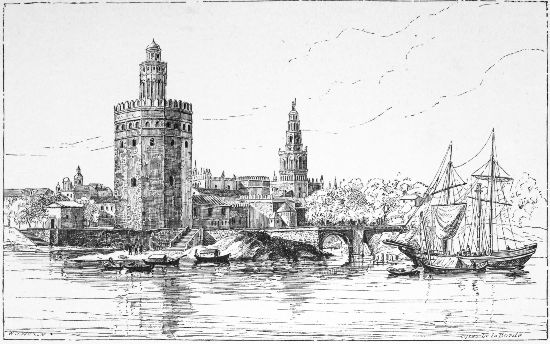
THE GOLDEN TOWER, SEVILLE.
The Berbers were more numerous than the Arabs, and at least equally disaffected. They had abandoned any pretence of submission to the Sultan's authority, and had returned to their old political system of clan government. The western provinces of Spain, such as Estremadura, and the south of Portugal, were now the independent possessions of the Berbers; and they also held various important posts, such as Jaen, in Andalusia itself. The Berber family of Dhu-n-Nun, consisting of the father Mūsa, "a great scoundrel and an abominable thief," and his three sons, who resembled him in their physical strength and their unrivalled brutality, carried fire and sword through the land, and burnt, sacked, and massacred wherever they went.
The Mohammedan Spaniards, who had put on something of Arab civilization along with their new faith, were by no means barbarians like the Berbers; but they were not the less hostile to the central power. The province of Algarve, at the south-west corner of the peninsula, was entirely in their power; and they held numerous independent cities and districts throughout Andalusia. Indeed all the most important cities were in secret or open revolt. Arab governors, Berber chiefs, Spanish renegades, alike joined in repudiating or disregarding the sovereign authority of Abdallah; and most powerful of all, Ibn-Hafsūn, a Christian, who had raised the mountaineers of the province of Elvira (Granada), reigned in perfect security in his rocky fastness, Bobastro, and gave laws to the regions around. Again and again had the Sultan attacked him, and each time suffered defeat; now he was disposed to try the ignominious policy of conciliation, only to find Ibn-Hafsūn quite ready to trick him at that. Murcia, the "land of Theodemir," was independent under a mild and cultivated renegade prince, who governed his subjects wisely, and was beloved by them; who was devoted to poetry, but did not neglect to keep up a considerable army, which included five thousand horsemen. Toledo was, as usual, in revolt, and nothing but the jealousies and divisions of the Christians of the north prevented them from reconquering their long lost territory. Split up as it was into numberless little seigniories, resembling rather the estates or counties of feudal barons than portions of a once powerful realm, Andalusia could have offered but an ill-directed resistance to a determined invader.[16]
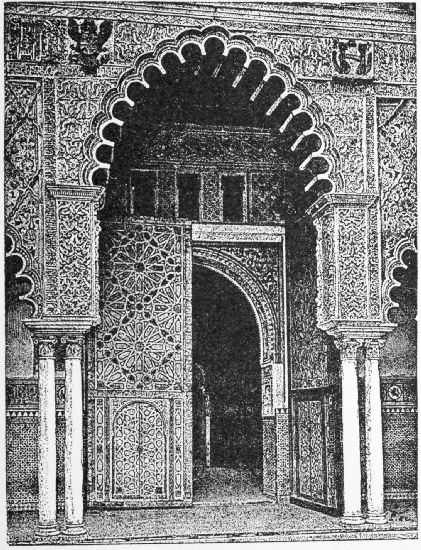
DOOR OF THE MAIDEN'S COURT, ALCAZAR OF SEVILLE.
There were of course some gleams of light amidst all this anarchy. We have said that the province of Murcia was ruled by an enlightened and benevolent prince. The lord of Cazlona was also distinguished for his patronage of poets and the arts; his halls were raised upon marble pillars, and the walls were encrusted with marble and gold; all that makes life enjoyable was to be found within his palace. Ibn-Hajjāj, too, the Arab king—for he was nothing less—of Seville, who had compelled the Sultan to come to terms with him and make him his friend, exercised his unbounded authority in the noblest manner. His city was admirably governed, order reigned there undisturbed, and evil-doers were sternly but justly punished. He kept his state like an emperor; five hundred cavaliers formed his escort, and his royal robe was of brocade, with his name and titles embroidered on it in gold thread. Kings from over the sea sent him presents: silken stuffs from Egypt, learned doctors of the law from Medina, and matchless singers from Baghdad. The beautiful lady "Moon," renowned for her lovely voice, her eloquence, and poetic fire, sang of him thus: "In all the west I find no right noble man save Ibrahim, but he is nobility itself. When one has known the delight of living with him, to dwell in any other land would be misery." The very poets of Cordova were attracted to his brilliant court, where they were sure of a princely welcome. Once only did a poet receive a cold greeting from Ibrahim the son of Hajjāj. This was one who thought to please the prince by reciting a scurrilous poem on the nobles of Cordova, to whom the ruler of Seville was not well disposed. "You are mistaken," was Ibn-Hajjāj's comment, "if you think that a man like myself can find any gratification in listening to these base calumnies."
Yet these occasional flashes of enlightenment cannot make amends for the general condition of anarchy to which Andalusia had become a prey, by the weakening of the central power, and the aggrandisement of countless petty rulers and brigand chiefs. The country was in a deplorable state, and Cordova itself, now threatened even with conquest at the hands of Ibn-Hafsūn and his bold mountaineers, was given over to mournful sadness. "Without being yet actually besieged, she was already suffering all the ills of beleaguerment." "Cordova," said the Arab historians, "was in the condition of a frontier town exposed to all the attacks of the enemy." Time after time the inhabitants were startled from their sleep, in the midst of night, by the cries of distress raised by the wretched peasants across the river, when the horsemen of Polei were setting the sword to their throats. "The State is menaced with total dissolution," wrote a contemporary witness; "disasters follow one another ceaselessly; thieving and pillaging go on; our wives and children are dragged into slavery." There were universal complaints of the Sultan's want of energy, of his weakness, and his baseness. The troops were grumbling because they were not paid. The provinces had stopped the supplies, and the treasury was empty.
What money the Sultan had been able to borrow, he spent to bribe the few Arabs who still affected to support him in the provinces. The deserted markets showed how trade had been destroyed. Bread had reached a fabulous price. Nobody believed any longer in the future; despair had sunk into all hearts. The bigots, who regarded all public misfortunes as the chastisement of God, and called Ibn-Hafsūn the scourge of the divine wrath, afflicted the city with their doleful prophecies. "Woe to thee, Cordova!" they cried, "woe to thee, sink of defilement and decay, abode of calamity and anguish, thou who hast neither friend nor ally! When the Captain, with his great nose and ugly face, he who is guarded before by Moslems and behind by idolaters—when Ibn-Hafsūn comes before thy gates, then will thy awful fate be accomplished!"
When things were at the worst, a gleam of hope shone upon the miserable inhabitants of the royal city. Abdallah, who was quite as despairing as his subjects, tried for once a bold policy, and in spite of the discouragement of his followers, and, the overwhelming numbers of the enemy who surrounded him on every side, he contrived to win a few advantages. Then he did the best thing that he could do for his country: he died on October 15, 912, aged sixty-eight, after a reign of twenty-four unhappy years. His life had seen the fall of the Omeyyad power, a fall sudden and apparently irremediable. The reign of his successor was destined to see as sudden, as complete, a restoration of that power.
The new Sultan was Abd-er-Rahmān III., a grandson of Abdallah. He was only twenty-one when he came to the throne, and there were several uncles and other kinsmen who might be expected to oppose the succession of a mere youth at so troublous a time. Yet no one made any resistance; on the contrary, his accession was hailed with satisfaction on all sides. The young prince had already succeeded in winning the favour of the people and the court. His handsome presence and princely bearing, joined to a singular grace of manner and acknowledged powers of mind, made him generally popular, and it was with a feeling of renewed hope that the Cordovans, who were almost the only subjects he had left, watched the first proceedings of the new Sultan. Abd-er-Rahmān made no attempt to disguise his intentions. He abandoned once and for all the policy of his grandfather, which, in its alternate weakness and cruelty, had worked such injury to the State; and in its place he announced that he would permit no disobedience throughout the dominions of the Omeyyads; he summoned the disaffected nobles and chieftains to submit to his authority; and he let it be clearly understood that he would leave no portion of his kingdom under the control of rebels. The programme was bold enough to satisfy the most sanguine; but there seemed every probability that it would unite all the rebels in all parts in one great league to crush the dauntless young prince. But Abd-er-Rahmān knew his countrymen, and his boldness was well founded. Nearly a generation had passed since Ibn-Hafsūn and the other rebels had raised the standard of insurrection, and every one had come to feel that there had been enough of it. The early zeal that had prompted the Spaniards, Moslem and Christian alike, to strike a blow for their national independence, had now cooled,—such movements never last unless they achieve a complete success at the first white heat of enthusiasm; the leaders were either dead or aged, and a calmer spirit had come over their followers. People had begun to ask themselves what was the good that they had obtained by their fine revolutions? They had not freed Andalusia from the "infidel," but had contrariwise given her over to the worst members of the infidel ranks—to brigand chiefs and adventurers of the vilest stamp. The country was harried from end to end by bands of lawless robbers, who destroyed the tilled fields and vineyards, and turned the land into a howling wilderness. Anything was better than the tyranny of brigandage. The Sultan of Cordova could not make matters worse than they were, and there was a general disposition to see whether he might not possibly improve them.
Consequently, when Abd-er-Rahmān began to lead his army against the rebellious provinces, he found them more than half willing to submit. His troops were inspirited to see their gallant young sovereign at their head—a sight that Abdallah had not permitted them for many years—and they followed him with enthusiasm. The rebels, already tired of their anarchic condition, opened their gates after a mere show of resistance. One after another the great cities of Andalusia admitted the Sultan within their walls. The country to the south of Cordova was the first to submit; then Seville opened her gates; the Berbers of the west were reduced to obedience; and the prince of Algarve hastened to offer tribute. Then the Sultan advanced against the Christians of the province of Regio, where for thirty years the mountain fastnesses had protected the bold subjects of Ibn-Hafsūn, and where no one knew better than Abd-er-Rahmān that no speedy victory was to be won. Yet step by step this difficult region was subdued. Seeing the scrupulous justice and honour of the Sultan, who kept his treaties with the Christians in perfect good faith, and observed the utmost clemency to those who submitted to him, fortress after fortress surrendered. Ibn-Hafsūn himself, in his fastness, remained unconquered and defiant as ever, but he was old, and soon he died, and then it was only a matter of time for the arms of the Sultan to penetrate even into Bobastro. When the Sultan stood at last upon the ramparts of this redoubtable fortress, and looked down from its dizzy heights upon the cliffs and precipices that surrounded the rebel stronghold, he was overcome with emotion, and fell upon his knees to render thanks to God for the great victory.[17] Then he turned to acts of mercy and pardon, and all the days he stayed in the fort he observed a solemn fast. Murcia had now given in its allegiance to the Sultan, and Toledo alone remained unsubdued. The proud city on the Tagus haughtily rejected Abd-er-Rahmān's offer of amnesty, and confidently awaited the siege. But it had to do with a different assailant from the feeble generals who had from time to time reaped disgrace beneath the walls of the Royal City. To prove to its defenders that his siege was no transitory menace, the Sultan quickly built a little town, which he called El-Feth ("Victory"), on the opposite mountain, and there he resided in calm anticipation of the result. Pressed by famine, the city surrendered, and Abd-er-Rahmān III. entered the last seat of rebellion in the dominions which he had inherited from his namesake, the first Abd-er-Rahmān, which now (930) once more reached to their full extent.
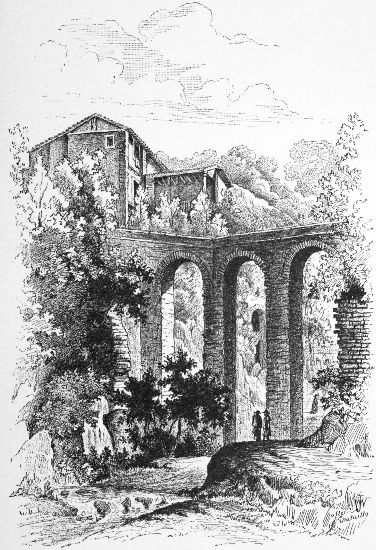
AQUEDUCT NEAR GRANADA.
It had taken eighteen years to recover the whole breadth of dominion which his predecessors had lost; but the work was done, and the royal power was firmly established over Arabs, Berbers, Spaniards, Moslems and Christians alike. Henceforward Abd-er-Rahmān permitted no special prominence to any party; he kept the old Arab nobility in severe repression; and the Spaniards, who had always been treated by them as base canaille, rejoiced to see their oppressors brought low. Henceforth the Sultan was the sole authority in the State; but his authority was just, enlightened, and tolerant. After so many years of confusion and anarchy, the people accepted the new despotism cheerfully. There were no more brigands to destroy their crops and vines; and if the Sultan was absolute in his power, at least he did not abuse it. The country folk returned to the paths of peace and plenty; they were at last free to get rich and to be happy after their own way.

VII. THE HOLY WAR.
ABD-ER-RAHMĀN III.'s principle of government consisted in retaining the sovereign power entirely in his own hands, and administering the kingdom by officers who owed their elevation wholly to his favour. Above all, he took care to leave no power in the hands of the old Arab aristocracy, who had so ill served previous rulers. The men he appointed to high places were parvenus, people of mean birth, who were the more attached to their master because they knew that but for him they would be trampled upon by the old Arab families. The force he employed to sustain the central power was a large standing army, at the head of which stood his select body-guard of Slavs, or purchased foreigners. They were originally composed chiefly of men of Slavonian nationality, but came by degrees to include Franks, Galicians, Lombards, and all sorts of people, who were brought to Spain by Greek and Venetian traders, and sold while still children to the Sultan, to be educated as Moslems. Many of them were highly cultivated men, and naturally attached to their master. They resembled in many respects the corps of Mamlūks which Saladin's successors introduced into Egypt as a body-guard, and which subsequently attained such renown as Sultans of Egypt and Syria. Like that body of purchased Turkish and Circassian slaves, they had their own slaves under them, were granted estates by the Sultan, and formed a sort of feudal retainers, prepared to serve their lord at the head of their own followers whenever he might call upon them. Like the Egyptian Mamlūks, too, they came after a while to such a pitch of influence that they took advantage of the decay of the central power, which followed upon the death of Abd-er-Rahmān III. and his successor, to found independent dynasties for themselves, and thus contribute to the final overthrow of the Moslem domination in Spain.
With the aid of his "Slavs," the Sultan not only banished brigandage and rebellion from Spain, but waged war with the Christians of the north with brilliant success. The Mohammedan realm was menaced by more dangers than those of internal anarchy. It was pressed between two threatening and warlike kingdoms, each of which required to be kept in watchful check. To the south the newly-founded empire of the Fātimite Khalifs in North Africa was a standing menace. It was natural that the rulers of the Barbary coast should remember that the Arabs before them had used Africa as a stepping stone to Spain; the traditional policy of the African dynasties was to compass, if possible, the annexation of the fair provinces of Andalusia. It was only by skilfully working upon the sectarian schisms, and consequent insurrections, which divided the Berbers of Africa, that the Sultan succeeded in keeping the Fātimites at a distance. He did succeed, however, so well, that at one time a great part of the Barbary coast paid homage to the ruler of Spain, who also obtained possession of the important fortress of Ceuta. A great part of the Spanish revenue was devoted to building a magnificent fleet, with which Abd-er-Rahmān disputed with the Fātimites the command of the Mediterranean.
On the opposite side, on the north, the Moslem power had to deal with an even more threatening enemy. The Christians of the Asturias had sprung from very small beginnings, but they were now increasing in strength, and they had the stimulating thought to spur them on, that they were reconquering their own land. When first they had felt the shock of the Moslem invasion, their rout had been utter and complete. They had fled to the mountains of the Asturias, where their trifling numbers and the inaccessibility of their situation gave them safety from the Mohammedan attack. Pelagius, the "old Pelayo" of the ballad, had but thirty men and ten women with him in the cave of Covadonga, which became the refuge of the Gothic Christians; and the Arabs did not think it worth while to hunt down the little remnant of refugees. Here, in the recesses of the cave, which was approached through a long and narrow mountain pass, and entered by a ladder of ninety steps, a handful of men might have set an army at defiance.
The Arab historian[18] thus contemptuously describes the origin of the Christian kingdom: "During Anbasa's administration a despicable barbarian, whose name was Pelayo, rose in the land of Galicia, and, having reproached his countrymen for their ignominious dependence and their cowardly flight, began to stir them up to avenge their past injuries and to expel the Moslems from the land of their fathers. From that moment the Christians of Andalus began to resist the attacks of the Moslems on such districts as had remained in their possession, and to defend their wives and daughters. The commencement of the rebellion happened thus: there remained no city, town, or village in Galicia but what was in the hands of the Moslems, with the exception of a steep mountain on which this Pelayo took refuge with a handful of men; there his followers went on dying through hunger, until he saw their numbers reduced to about thirty men and ten women, having no other food for support than the honey which they gathered in the crevices of the rock which they themselves inhabited like so many bees. However, Pelayo and his men fortified themselves by degrees in the passes of the mountain, until the Moslems were made acquainted with their preparations; but, perceiving how few they were, they heeded not the advice conveyed to them, and allowed them to gather strength, saying, 'What are thirty barbarians, perched up on a rock? They must inevitably die!'" "Would to God!" adds another historian—"Would to God that the Moslems had then extinguished at once the sparks of a fire which was destined to consume the whole dominions of Islam in those parts!"
The little band of refugees was strengthened from time to time by fresh accessions, and, by degrees waxing more confident, came forth from their stronghold, and began to harass the Berbers who formed the frontier settlers. The Moors were at length compelled to seek out the intrepid raiders in their cavern; but the result was discouraging; they were driven back pell-mell with great loss. In 751 Alfonso of Cantabria (where the Moslems had never penetrated), having married the daughter of Pelayo and thus united the Christian forces, roused the northern provinces against the Moors, and, joined by the Galicians of the west, began a series of brilliant campaigns, by which the enemy was driven step by step further south. One after the other the cities of Braga, Porto, Astorga, Leon, Zamora, Ledesma, Salamanca, Saldaña, Segovia, Avila, Osma, Miranda, were recovered from the Moslems, and the Christian frontier was now pushed as far as the great Sierra, and Coimbra, Coria, Talavera, Toledo, Guadalaxara, Tudela, and Pamplona became the Moslem border fortresses. Alfonso had in fact recovered the provinces of Old Castile, Leon, Asturias, and Galicia; but the scanty band of Christians had neither money nor serfs wherewith to build fortifications and cultivate the fields over so immense an area: they contented themselves with leaving the conquered country as a debatable land between them and the Moors, and retired to the districts bordering the Bay of Biscay until such time as their numbers should justify the occupation of a wider area.
In the ninth century they were in a position to advance upon the territory they had already in part recovered from the Moors. They spread over Leon, and built the fortresses of Zamora, San Estevan de Gormaz, Osma, and Simancas, to overawe the enemy. The debatable land was now much narrower, and the hostile forces were almost in contact at various places along the frontier. At the beginning of the tenth century the Moors of the borders made a strenuous effort to regain their lost dominions; but the Christians, aided by the men of Toledo, and by Sancho, King of Navarre, who had become the bulwark of Christianity in the north, defeated them severely, and began to harry the country over the border. The forays of the Christians were a terrible curse to their victims; they were rude, unlettered people, and few of them could even read; their manners were on a par with their education; and their fanaticism and cruelty were what might be expected from such uncouth barbarians. Seldom did the soldiery of Leon give quarter to a defenceless foe, and we may look in vain for the fine chivalry and toleration of the Arabs; where the latter spared nobly, the rough robbers of Leon and Castile massacred whole garrisons, cities full of inhabitants, and those whom they did not slaughter they made slaves.
Abd-er-Rahmān III. had hardly been seated two years on the throne when Ordoño II. of Leon carried a devastating foray to the walls of Merida; and so affrighted were the people of Badajoz that they hastened to conciliate him with blackmail. These cities are not very far from Cordova; only the lofty heights of the Sierra Morena separated the capital of the Omeyyads from the companies of Ordoño. The situation was fraught with danger. The young Sultan, had he been a coward, might have excused himself from instant action on the plea that Merida had not yet recognized his authority, and that it was not his affair if the Christians harried rebellious provinces. This, however, was not Abd-er-Rahmān's policy or temper. He collected his troops and sent an expedition to the north, which made a successful raid into the Christian territories; and the following year, 917, he ordered a second attack. This was defeated with heavy loss by Ordoño before the walls of San Estevar de Gormaz, and the brave Arab general, seeing that the fight was lost, threw himself among the enemy, and died sword in hand. The King of Leon had the pitiful cowardice to nail the head of this gallant soldier to the gate of the fortress, side by side with that of a pig. Encouraged by this success, the armies of Leon and Navarre ravaged the country about Tudela in the following year, but not with equal impunity, for they were twice beaten by the Cordovan troops. Seeing, however, that it took a good deal of defeat to daunt the Christians, Abd-er-Rahmān resolved upon stronger measures. In 920 he took command of the army himself, and by rapid marches and skilful strategy surprised Osma, and razed the fortress to the ground; destroyed San Estevan, which he found deserted by its garrison; and then turned towards Navarre. Twice did he drive Sancho from the field, and when the forces of Navarre were reinforced by those of Leon, and the Christians had the best of the natural position, the Sultan delivered battle with them in the Val de Junqueras (Vale of Reeds), and totally routed their combined array. Incensed by the obstinate defence of the borderers, the Moslems put the garrison of Muez to the sword; and it is unfortunately true that in some of these campaigns the Moors imitated the barbarities of their antagonists, especially when their armies included a considerable admixture of African troops, who were notoriously savage.
Nothing could exceed the heroic determination of the defeated Christians; barbarous they were, but they had the courage of men: routed again and again, they ever rose with fresh heart from the disaster. The very year after the fatal battle in the Valley of Reeds, Ordoño, who was the soul of the Christian resistance, led his men on another raid over the borders; and in 923 Sancho of Navarre, not to be behindhand, recaptured some strong castles. Thus roused once more, the Sultan set out for the north, filled with a stern resolve; he sacked and burned all that came in his way; the cities emptied as he approached, so terrible was the dread he inspired; and he entered the deserted capital of Pamplona, driving Sancho away in confusion as he approached. The cathedral and many of the houses of the capital were ruthlessly destroyed, and Navarre was at his feet. About the same time Ordoño of Leon died, and the civil war which arose between his sons gave the Sultan time to attend to other matters.
On his return from this triumphant campaign, Abd-er-Rahmān III. assumed a new title. Hitherto the rulers of Andalusia had contented themselves with such titles as Emīr (governor), Sultan (dominator), "son of the Khalifs." Although they were the heirs of the Omeyyad Khalifs, and never recognized the Abbāsides who had overturned them, the Andalusian Sultans had not hitherto asserted their claim to the spiritual title: they had considered that the name of Khalif should not be held by those who had no authority over the Holy Cities of Islam, Mekka and Medina, and had been content to leave the Abbāsides in undisputed possession of the name. Now, however, when it was known in Spain that the Abbāside Khalifs no longer exercised any real authority outside the city of Baghdad, and were little better than prisoners even there, in consequence of the growing independence of the various local dynasties, Abd-er-Rahmān, in 929, assumed his title of Khalif with the style of En-Nāsir li-dīni-llāh, "The Defender of the Faith of God."[19]
The Khalif had still thirty years more to reign when he adopted this new name; and they were filled chiefly with wise and cultivated administration at home, and with constant, even annual, expeditions against the Christians, against whom he was indeed a "Defender" of his religion. The civil war, which had for a time neutralized the power of the Leonese, had now given place to the authority of a worthy successor of the great Ordoño. Ramiro II. succeeded in 931, and his warlike character soon asserted itself in resolute opposition to the Khalif's armies. Not long afterwards a formidable league was formed in the north between the Christians and the Arab governor of Zaragoza, and Abd-er-Rahmān hastened to demolish the coalition. In 937 he reduced Zaragoza, and, marching on Navarre, spread such terror around his way that the Queen Regent, Theuda, hastily paid him homage as her suzerain. Ramiro, however, was no party to this surrender. He gathered his men together, and inflicted a tremendous defeat on the Moslems in 939 at Alhandega. Fifty thousand Moors fell upon the field: the Khalif himself barely escaped with his life, and found himself flying through the country with less than fifty horsemen. That disastrous year was long known in Andalusia as the "Year of Alhandega."
Had the Christians pressed their advantage, a different history of Spain would perhaps have had to be written; but, as usual, internecine jealousies among the Christian princes came to the help of the Khalif, and while his foes quarrelled among themselves he repaired his disaster, recruited his army, and made ready for another campaign. The civil war which thus aided him had its origin in the revolt of Castile from the Leonese supremacy. The Count of Castile at this time was the celebrated Fernando Gonzalez, of whom many minstrels have sung. He is one of the great Spanish heroes, and was mated to a heroine. Twice did his wife rescue him from the prison into which he had been cast by his jealous neighbours of Navarre and Leon, and the second time she did it by exchanging clothes with her husband and exposing herself to the fury of his jailers. The earlier occasion was before their marriage, when he was on his way to her father Garcia's court at Navarre, to ask her hand in marriage, and the perfidious king laid hands upon him. A ballad tells the story of his release:
They have carried afar into Navarre the great Count of Castille,
And they have bound him sorely, they have bound him hand and heel....
And there is joy and feasting because that lord is ta'en,
King Garci in his dungeon holds the doughtiest lord in Spain.
The poet goes on to tell how a Norman knight was riding through Navarre—
For Christ his hope he came to cope with the Moorish scimitar:
and how he told Garcia's daughter of the captivity of Gonzalez, and how grievous an injury it was to the cause of Christian Spain—
The Moors may well be joyful, but great should be our grief,
For Spain has lost her guardian, when Castile has lost her chief;
The Moorish host is pouring like a river o'er the land—
Curse on the Christian fetters that bind Gonzalez' hand!
And the Norman knight prayed the princess to set the prisoner free.
The lady answered little, but at the mirk of night,
When all her maids are sleeping, she hath risen and ta'en her flight:
She hath tempted the Alcayde with her jewels and her gold,
And unto her his prisoner that jailor false hath sold.[20]
So the princess took the Count out of his dungeon, and together they rode to Castile.
At the time we have now reached, this is an old story, for Gonzalez had been married many a year, and had determined that Castile should be a separate kingdom, no longer under the suzerainty of Leon. For this he was again captured and imprisoned by Ramiro, and only released when it was apparent that the people of Castile would have no other lord but him, and would even pay their homage to a mere statue of their Count sooner than recognize a Leonese governor. Then the king let him out, after making him swear to remain subject to the kingdom of Leon and to give his daughter in marriage to Ordoño the son of Ramiro. After this humiliation, Fernando Gonzalez was less eager to fight beside the men of Leon against the Moors; he resolved to let the Leonese take their share of humiliation. But this was not to be in the days of the great Ramiro; for he won another victory over the Moslems, near Talavera, in 950, and the next year he died in undiminished glory.
On his death, Gonzalez began to play the part of king-maker. He espoused the cause of Sancho against his brother, Ordoño III., and when Sancho succeeded the latter, in 957, Gonzalez turned about and expelled the new king from Leon, and set up a wretched cripple, Ordoño IV., surnamed the Wicked, in his stead. Sancho took refuge with his grandmother, Theuda, the Queen of Navarre, and they presently appealed to the Khalif of Cordova to help them in their difficulties. Sancho was a martyr to corpulency; he could not even walk without being held up. He resolved to consult the eminent doctors of Cordova, whose skill was famous over all the world. So Queen Theuda sent ambassadors to Abd-er-Rahmān, who in return despatched the great Jewish physician, Hasdai, to undertake the cure of Sancho the Fat. But he laid down certain conditions, among which was the surrender of a number of castles, and the personal appearance of Sancho and the Queen Theuda at Cordova. It was a hard thing to make the long journey to the Moorish Court, and to feel that she was there as a sort of show, in witness to the Khalif's power; but the Queen went, with her son, the King of Navarre, and her grandson, the exiled King of Leon. Abd-er-Rahmān received them with all the gorgeous ceremony and all the native courtesy which belonged to him; and not only did Sancho speedily get rid of his fatness under the care of Hasdai, but he returned to the north, supported by the armies of the Khalif, who restored him to the throne of Leon in 960.
In the following year the great Khalif died. He was seventy years old, and his reign, of nearly fifty, had brought about such a change in the condition of Spain as the wildest imagination could hardly conjure up. When he came to the throne, a youth of twenty-one, his inheritance was the prey to a thousand brigand chiefs or local adventurers; the provinces had set up their own rulers; the many factions into which the population was divided had each and all defied the authority of the Sultan; and anarchy and plunder devastated the land. On the south the African dynasty of the Fātimites threatened to engulf Spain in their empire; on the north the Christian princes seemed ready to descend upon their ancestral dominions and drive the Moors from the land. Out of this chaos and vision of imminent destruction Abd-er-Rahmān had evolved order and prosperity. Before half his reign was over he had restored peace and good government throughout the length and breadth of the Moslem dominions; he had banished the authority of parties, and established the absolute power of the Sultan over all classes of his subjects. In the second half he maintained the dignity and might of his State against outside foes; held the African despots at a distance, planted a garrison at Ceuta to withstand their advance, and contended with them on equal terms on the sea; and in the north he curbed the growing power of the Christians of Leon, Castile, and Navarre, and so convinced them of his superiority that they even came to him to settle their differences and restore them to their rights. He had rescued Andalusia both from herself and from subjection by the foreigner.[21] And he had not only saved her from destruction; he had made her great and happy. Never was Cordova so rich and prosperous as under his rule; never was Andalusia so well cultivated, so teeming with the gifts of nature, brought to perfection by the skill and industry of man; never was the State so triumphant over disorder, or the power of the law more widely felt and respected. Ambassadors came to pay him court from the Emperor of Constantinople, from the kings of France, of Germany, of Italy. His power, wisdom, and opulence, were a byword over Europe and Africa, and had even reached to the furthest limits of the Moslem empire in Asia. And this wonderful change had been wrought by one man, with everything against him: the restoration of Andalusia from the hopeless depths of misery to the height of power and prosperity had been effected by the intellect and will alone of the Great Khalif Abd-er-Rahmān III.
The Moorish historians describe this resolute man in colours that seem hardly consistent with his strong imperious policy: nevertheless, they describe him faithfully as "the mildest and most enlightened sovereign that ever ruled a country. His meekness, his generosity, and his love of justice became proverbial. None of his ancestors ever surpassed him in courage in the field and zeal for religion; he was fond of science, and the patron of the learned, with whom he loved to converse." Many anecdotes are told of his strict justice and impartiality.
The Arab historian tells us that after his death a paper was found in the Khalif's own handwriting, in which he had carefully noted those days in his long reign which had been free from all sorrow; they numbered only fourteen. "O man of understanding, wonder and observe how small a portion of unclouded happiness the world can give even to the most fortunate!"[22]

VIII. THE CITY OF THE KHALIF.
"CORDOVA," says an old Arab writer, "is the Bride of Andalusia. To her belong all the beauty and the ornaments that delight the eye or dazzle the sight. Her long line of Sultans form her crown of glory; her necklace is strung with the pearls which her poets have gathered from the ocean of language; her dress is of the banners of learning, well knit together by her men of science; and the masters of every art and industry are the hem of her garments." So did the Oriental historian clothe the city he loved with the far-fetched imagery of the East. Cordova, under the rule of the Great Khalif, was indeed a capital to be proud of; and except perhaps Byzantium, no city of Europe could compare with her in the beauty of her buildings, the luxury and refinement of her life, and the learning and accomplishments of her inhabitants. When we remember that the sketch we are about to extract from the records of Arabian writers, concerning the glories of Cordova, relate to the tenth century, when our Saxon ancestors dwelt in wooden hovels and trod upon dirty straw, when our language was unformed, and such accomplishments as reading and writing were almost confined to a few monks, we can to some extent realize the extraordinary civilization of the Moors. And when it is further recollected that all Europe was then plunged in barbaric ignorance and savage manners, and that only where the remnants of the Roman Empire were still able to maintain some trace of its ancient civilization, only in Constantinople and some parts of Italy, were there any traces of refinement, the wonderful contrast afforded by the capital of Andalusia will be better appreciated.
Another Arab writer says that Cordova "is a fortified town, surrounded by massive and lofty stone walls, and has very fine streets. It was in times of old the residence of many infidel kings, whose palaces are still visible within the precincts of the walls. The inhabitants are famous for their courteous and polished manners, their superior intelligence, their exquisite taste and magnificence in their meals, dress, and horses. There thou wouldst see doctors shining with all sorts of learning, lords distinguished by their virtues and generosity, warriors renowned for their expeditions into the country of the infidels, and officers experienced in all kinds of warfare. To Cordova came from all parts of the world students eager to cultivate poetry, to study the sciences, or to be instructed in divinity or law; so that it became the meeting-place of the eminent in all matters, the abode of the learned, and the place of resort for the studious; its interior was always filled with the eminent and the noble of all countries, its literary men and soldiers were continually vying with each other to gain renown, and its precincts never ceased to be the arena of the distinguished, the racecourse of readers, the halting-place of the noble, and the repository of the true and virtuous. Cordova was to Andalus what the head is to the body, or what the breast is to the lion."[23]
Oriental praise is apt to be somewhat high flown; but Cordova really deserved the praise that has been lavished upon it. In its present state it is impossible to form any conception of the extent and beauty of the old Moorish capital in the days of the Great Khalif. Its narrow streets of whitewashed houses convey but a faint impression of its once magnificent extent; the palace, Alcazar, is in decay, and its ruins are used for the vile purpose of a prison; the bridge still spans the Guadalquivir, however, and the noble mosque of the first Omeyyad is still the wonder and delight of travellers. But in the time of Abd-er-Rahmān III., or perhaps a little later, when a great minister added a new faubourg, it was at its best. Historians are divided as to its extent, but a length of at least ten miles seems to be the most probable dimension. The banks of the Guadalquivir were bright with marble houses, mosques, and gardens, in which the rarest flowers and trees of other countries were carefully cultivated, and the Arabs introduced their system of irrigation, which the Spaniards, both before and since, have never equalled. The first Omeyyad Sultan imported a date tree from Syria, to remind him of his old home; and to it he dedicated a sad little poem to bewail his exile. It was planted in the garden which he had laid out in imitation of that of his grandfather Hishām at Damascus, where he had played as a child. He sent agents all over the world to bring him the rarest exotics, trees, plants, and seeds; and so skilful were the Sultan's gardeners that these foreign importations were speedily naturalized, and spread from the palace over all the land. The pomegranate was thus introduced by means of a specimen brought from Damascus. The water by which these numerous gardens were supplied was brought from the mountains (where vestiges of hydraulic works may still be seen) by means of leaden pipes, through which it was conducted to numerous basins, some of gold or silver, others of inlaid brass, and to lakes, reservoirs, tanks, and fountains of Grecian marble.
EXTERIOR OF THE GREAT MOSQUE AT CORDOVA.
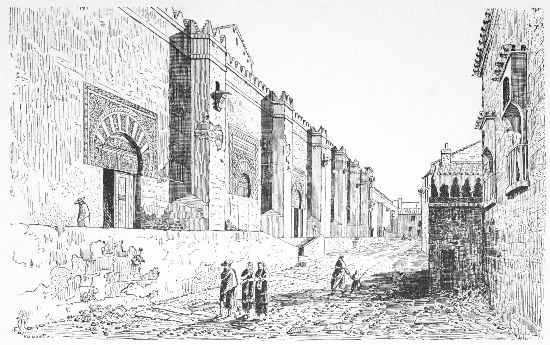
The historians tell us marvellous things about the Sultan's palaces, with their splendid gates, opening upon the gardens or the river, or again giving entrance to the Great Mosque, whither the Sultan betook himself on Fridays, over a path covered from end to end with rich carpets. One of these palaces was called the Palace of Flowers, another the Palace of Lovers, a third the Palace of Contentment, and another the Palace of the Diadem, and so forth, while one retained the name of the old home of the Omeyyads and was called "Damascus." Its roofs rested upon marble columns, and its floors were inlaid with mosaics; and so beautiful was it, that a poet sang, "All palaces in the world are nothing when compared to Damascus, for not only has it gardens with the most delicious fruits and sweet-smelling flowers, beautiful prospects and limpid running waters, clouds pregnant with aromatic dew, and lofty buildings; but its night is always perfumed, for morning pours on it her grey amber, and night her black musk." Some of the gardens of Cordova had tempting names, which seem to invite one to repose beside the trickling waters and enjoy the sweet scent of the flowers and fruit. The "Garden of the Water-wheel" gives one a sense of lazy enjoyment, listening to the monotonous creaking of the wheel that pumped up the water to the level of the garden beds; and the "Meadow of Murmuring Waters" must have been an entrancing spot for the people of Cordova in the hot weather. The quiet flow of the Guadalquivir was a constant delight to the inhabitants; for the Eastern (and the Moors of Spain were Easterns in everything but longitude) loves nothing better than a view over a rippling stream. It was spanned by a noble bridge of seventeen arches, which still testifies to the engineering powers of the Arabs. The whole city was full of noble buildings, among which were counted more than fifty thousand houses of the aristocracy and official classes, more than a hundred thousand dwellings for the common people, seven hundred mosques, and nine hundred public baths. The last were an important feature in all Moslem towns, for among the Mohammedans cleanliness is not "next to godliness," but is an essential preparation for any act of prayer or devotion. While the mediæval christians forbade washing as a heathen custom, and the monks and nuns boasted of their filthiness, insomuch that a lady saint recorded with pride the fact that up to the age of sixty she had never washed any part of her body, except the tips of her fingers when she was going to take the Mass—while dirt was the characteristic of Christian sanctity, the Moslems were careful in the most minute particulars of cleanliness, and dared not approach their God until their bodies were purified. When Spain had at last been restored to Christian rulers, Philip II., the husband of our English Queen Mary, ordered the destruction of all public baths, on the ground that they were relics of infidelity.
GATE OF THE MOSQUE OF CORDOVA.
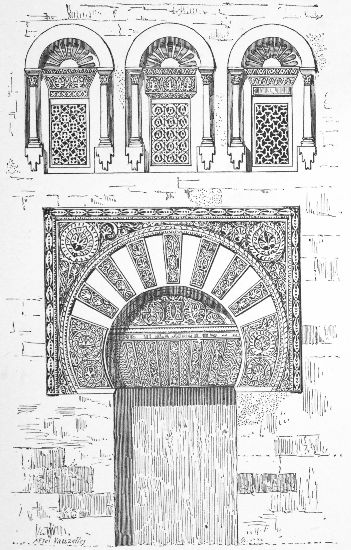
Among the great architectural beauties of Cordova, the principal mosque held, and still holds, the first place. It was begun in 784 by the first Abd-er-Rahmān, who spent 80,000 pieces of gold upon it, which he got from the spoils of the Goths. Hishām, his pious son, completed it, in 793, with the proceeds of the sacking of Narbonne. Each succeeding Sultan added some new beauty to the building, which is one of the finest examples of early Saracenic art in the world. One put the gold on the columns and walls; another added a new minaret; another built a fresh arcade to hold the swelling congregations. Nineteen is the number of the arcades from east to west, and thirty-one from north to south; twenty-one doors encrusted with shining brass admitted the worshippers; 1,293 columns support the roof, and the sanctuary was paved with silver and inlaid with rich mosaics, and its clustered columns were carved and inlaid with gold and lapis-lazuli. The pulpit was constructed of ivory and choice woods, in 36,000 separate panels, many of which were encrusted with precious stones and fastened with gold nails. Four fountains for washing before prayer, supplied with water from the mountains, ran night and day; and houses were built at the west side of the mosque, where poor travellers and homeless people were hospitably entertained. Hundreds of brass lanterns, made out of Christian bells, illumined the mosque at night, and a great wax taper, weighing fifty pounds, burnt night and day at the side of the preacher during the month of fasting. Three hundred attendants burnt sweet-smelling ambergris and aloes wood in the censers, and prepared the scented oil which fed the ten thousand wicks of the lanterns. Much of the beauty of this mosque still remains. Travellers stand amazed among the forest of columns, which open out in apparently endless vistas on all sides. The porphyry, jasper, and marbles are still in their places; the splendid glass mosaics, which artists from Byzantium came to make, still sparkle like jewels on the walls; the daring architecture of the sanctuary, with its fantastic crossed arches, is still as imposing as ever; the courtyard is still leafy with the orange-trees that prolong the vistas of columns. As one stands before the loveliness of the Great Mosque, the thought goes back to the days of the glories of Cordova, the palmy days of the Great Khalif, which never will return.
Even more wonderful, though not more beautiful, was the city and palace of Ez-Zahrā, which Abd-er-Rahmān III. built as a suburb to Cordova. One of his wives, whose name was Ez-Zahrā, "the Fairest," to whom he was devotedly attached, once begged him to build her a city which should be called after her name. The Great Khalif, like most Mohammedan sovereigns, delighted in building, and he adopted the suggestion. He at once began to found a city at the foot of the mountain called the "Hill of the Bride," over against Cordova, and a few miles distant. Every year he spent a third of his revenues upon this building; and it went on all the twenty-five remaining years of his reign, and fifteen years of the reign of his son, who made many additions to it. Ten thousand workmen laboured daily at the task, and six thousand blocks of stone were cut and polished every day for the construction of the houses of the new city. Some three thousand beasts of burden were daily used to carry the materials to the spot, and four thousand columns were set up, many of which were presents from the Emperor of Constantinople, or came from Rome, Carthage, Sfax, and other places, besides the home marbles quarried at Tarragona and Almeria. There were fifteen thousand doors, coated with iron or polished brass. The Hall of the Khalifs at the new city had a roof and walls of marble and gold, and in it was a wonderful sculptured fountain, a present from the Greek Emperor, who also sent the Khalif a unique pearl. In the midst of the hall was a basin of quicksilver; at either side were eight doors set in ivory and ebony, and adorned with precious stones. When the sun shone through these doors, and the quicksilver lake was set quivering, the whole room was filled with flashes like lightning, and the courtiers would cover their dazzled eyes.
The Arabian authors delight in telling of the wonders of this "City of the Fairest," Medinat-Ez-Zahrā, as it was called, after the Khalif's mistress. "We might go to a great length were we only to enumerate all the beauties, natural as well as artificial, contained within the precincts of Ez-Zahrā," writes one: "the running streams, the limpid waters, the luxuriant gardens, the stately buildings for the household guards, the magnificent palaces for the high functionaries of State; the throng of soldiers, pages, and slaves, of all nations and religions, sumptuously attired in robes of silk and brocade, moving to and fro through its broad streets; or the crowd of judges, theologians, and poets, walking with becoming gravity through the magnificent halls and ample courts of the palace. The number of male servants in the palace has been estimated at thirteen thousand seven hundred and fifty, to whom the daily allowance of flesh meat, exclusive of fowls and fish, was thirteen thousand pounds; the number of women of various kinds and classes, comprising the harīm of the Khalif, or waiting upon them, is said to have amounted to six thousand three hundred and fourteen. The Slav pages and eunuchs were three thousand three hundred and fifty, to whom thirteen thousand pounds of flesh meat were distributed daily, some receiving ten pounds each, and some less, according to their rank and station, exclusive of fowls, partridges, and birds of other sorts, game and fish. The daily allowance of bread for the fish in the pond of Ez-Zahrā was twelve thousand loaves, besides six measures of black pulse which were every day macerated in the waters. These and other particulars may be found at full length in the histories of the times, and recorded by orators and poets who have exhausted the mines of eloquence in their description; all who saw it owned that nothing similar to it could be found in the territories of Islam. Travellers from distant lands, men of all ranks and professions in life, following various religions,—princes, ambassadors, merchants, pilgrims, theologians, and poets—all agreed that they had never seen in the course of their travels anything that could be compared to it. Indeed, had this palace possessed nothing more than the terrace of polished marble overhanging the matchless gardens, with the golden hall and the circular pavilion, and the works of art of every sort and description—had it nothing else to boast of but the masterly workmanship of the structure, the boldness of the design, the beauty of the proportions, the elegance of the ornaments, hangings, and decorations, whether of shining marble or glittering gold, the columns that seemed from their symmetry and smoothness as if they had been turned by lathes, the paintings that resembled the choicest landscapes, the artificial lake so solidly constructed, the cistern perpetually filled with clear and limpid water, and the amazing fountains, with figures of living beings—no imagination however fertile could have formed an idea of it. Praise be to God Most High for allowing His humble creatures to design and build such enchanting palaces as this, and who permitted them to inhabit them as a sort of recompense in this world, and in order that the faithful might be encouraged to follow the path of virtue, by the reflection that, delightful as were these pleasures, they were still far below those reserved for the true believer in the celestial Paradise!"
In the palace of Ez-Zahrā the Khalif received the Queen of Navarre and Sancho, and gave audience to great persons of State. Here he sat to welcome the ambassadors which the Greek Emperor sent to his court at Cordova:
"Having appointed Saturday the eleventh of the month of Rabi' el-Awwal, of the year 338 [A.D. 949], and fixed upon the vaulted hall in his palace of Ez-Zahrā as the place where he would receive their credentials, orders were issued to the high functionaries of State and to the commanders of the forces to prepare for the ceremony. The hall was beautifully decorated, and a throne glittering with gold and sparkling with gems was raised in the midst. On either hand of the throne stood the Khalif's sons; next to them the vizirs, each in his post to the right and left; then came the chamberlains, the sons of vizirs, the freedmen of the Khalif, and the officers of the household. The court of the palace was strewn with the richest carpets and most costly rugs, and silk awnings of the most gorgeous kind were thrown over the doors and arches. Presently the ambassadors entered the hall, and were struck with astonishment and awe at the magnificence displayed before them and the power of the Sultan before whom they stood. Then they advanced a few steps, and presented a letter of their master, Constantine, son of Leo, Lord of Constantinople, written in Greek upon blue paper in golden characters."
Abd-er-Rahmān had ordered the most eloquent orator of the court to make a suitable speech upon the occasion; but hardly had he begun to speak, when the splendour of the scene, and the solemn silence of the great ones there assembled, so overawed him, that his tongue clove to the roof of his mouth, and he fell senseless on the floor. A second essayed to fill his place, but he had not got very far in his address when he too suddenly broke down.
So interested was the Great Khalif in building his new palace that he omitted to go to the mosque for three successive Fridays; and when at last he made his appearance, the preacher threatened him with the pains of hell for his negligence.
HISPANO-MORESCO VASE. (Preserved at Granada.)
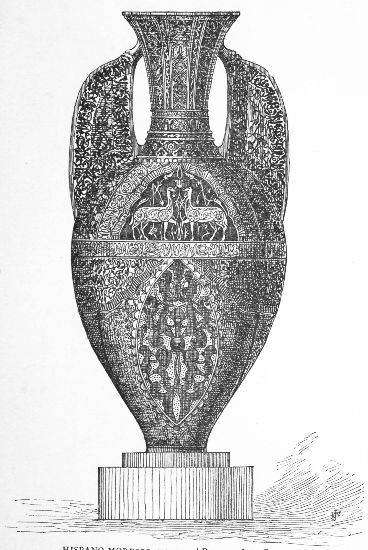
Beautiful as were the palaces and gardens of Cordova, her claims to admiration in higher matters were no less strong. The mind was as lovely as the body. Her professors and teachers made her the centre of European culture; students would come from all parts of Europe to study under her famous doctors, and even the nun Hroswitha, far away in her Saxon convent of Gaudersheim, when she told of the martyrdom of St. Eulogius, could not refrain from singing the praises of Cordova, "the brightest splendour of the world." Every branch of science was seriously studied there, and medicine received more and greater additions by the discoveries of the doctors and surgeons of Andalusia than it had gained during all the centuries that had elapsed since the days of Galen. Albucasis (or Abu-l-Kāsim Khalaf, to give him his proper name) was a notable surgeon of the eleventh century, and some of his operations coincided with the present practice. Avenzoar (Ibn Zohr) a little later made numerous important medical and surgical discoveries. Ibn Beytar, the botanist, travelled all over the East to find medicinal herbs, on which he wrote an exhaustive treatise; and Averroes, the philosopher, formed the chief link in the chain which connects the philosophy of ancient Greece with that of mediæval Europe. Astronomy, geography, chemistry, natural history—all were studied with ardour at Cordova; and as for the graces of literature, there never was a time in Europe when poetry became so much the speech of everybody, when people of all ranks composed those Arabic verses which perhaps suggested models for the ballads and canzonettes of the Spanish minstrels and the troubadours of Provence and Italy. No speech or address was complete without some scrap of verse, improvised on the spur of the moment by the speaker, or quoted by memory from some famous poet. The whole Moslem world seemed given over to the Muses; Khalifs and boatmen turned verses, and sang of the loveliness of the cities of Andalusia, the murmur of her rivers, the beautiful nights beneath her tranquil stars, and the delights of love and wine, of jovial company and stolen meetings with the lady whose curving eyebrows had bewitched the singer.
In the arts Andalusia was pre-eminent; such buildings as the "City of the Fairest," or the mosque of Cordova, could not have been erected unless her workmen had been highly skilled in their handicrafts. Silk weaving was among the most cherished arts of Andalusia; it is said that there were no less than one hundred and thirty thousand weavers in Cordova alone; but Almeria had the greatest name for her silks and carpets. Pottery was carried to great perfection, and it was from the island of Majorca, where the potters had attained to the art of producing a ware shining with iridescent gold or copper lustre, that the Italian pottery obtained its name of Majolica. Glass vessels, as well as others of brass and iron, were made at Almeria, and there are some beautiful specimens of delicate ivory carvings still in existence, which bear the names of great officers of the court of Cordova. These arts were no doubt imported from the East, but the Moorish workmen became apt pupils of their Byzantine, Persian, and Egyptian masters. In jewellery an interesting relic of the son of the Great Khalif is preserved on the high altar of the cathedral of Gerona; it is a casket, plated with silver gilt, and adorned with pearls, bearing an Arabic inscription invoking blessings upon the Prince of the Faithful, Hakam II., which reads rather curiously upon a Christian altar. The sword-hilts and jewels of the Moors were very elaborate, as the sword of Boabdil, the last King of Granada, shows. The Saracens were always renowned for their metal work, and even such small things as keys were beautifully ornamented. How exquisitely the Spanish Moors could chase bronze is proved by the engraving in chapter xi. of the beautiful mosque lamp which was made for Mohammed III. of Granada, and is still to be seen at Madrid. The delicacy of the open filigree work is only surpassed by similar work made at Damascus and Cairo. Over and over again we read the same Arabic inscription, the motto of the kings of Granada, "There is no conqueror but God." We have already spoken of the brass doors of the palaces of Cordova; and some remains of these are still to be seen in the Spanish cathedrals. Every one has heard of the Toledo sword-blades, and though the tempering of steel is older in Spain than the invasion of the Arabs, the skill of the Toledo armourers was fostered by the Khalifs and Sultans of Cordova. Almeria, Seville, Murcia, and Granada were also famous places for armour and weapons. The will of Don Pedro in the fourteenth century runs: "I also endow my son with my Castilian sword, which I had made at Seville, ornamented with stones and gold." In arts, sciences, and civilization generally, the Moorish city of Cordova was indeed "the brightest splendour of the world."