Volume 2 / Part 2 — THE MONIST.
Reading edition
OUR MONISM. THE PRINCIPLES OF A CONSISTENT, UNITARY WORLD-VIEW.
The question, What are the essential features of Monism? was brought home to me when I read in the last number of The Monist the critical remarks made with reference to the new edition of my “Anthropogeny.” I shall here endeavor briefly to draw up the outlines of my conception of the world in a manner which will indicate the most characteristic features of my views. Thus both the agreements with and the divergences from the position editorially upheld in The Monist will plainly appear.
As is the case with the majority of philosophical differences, so also in the present instance I find that the divergences which exhibit themselves in our respective unitary conceptions of the world are in part only apparent and in part occasioned by the divergent significances of our fundamental ideas. But this will, perhaps, be made clearer by the following methodically arranged eight theses.
I. MONISM.
Like all general concepts of fundamental scope, that of monism also is liable to different definitions and divergent modifications,—the natural result of individual differences of subjective conception. In the determinate sense in which monism is at present employed by the majority of philosophers and physical inquirers, the sense which I believe I was the first to establish in 1866 in my “General Morphology” (Vol. I, p. 105), it denotes a unitary or natural conception of the world, in opposition to a supernatural or mystical one, that is, in opposition to dualism. For us, accordingly, there exists (in the sense of Goethe) no opposition whatsoever between nature and mind, between World and God. Mental existences, “spirits,” outside nature, or in opposition to nature, do not exist. What are commonly termed the “mental sciences,”—for example, philology, history, and philosophy,—are in reality simply a part of physical philosophy, of Natur-philosophie. The latter discipline embraces, in our opinion, the entire body of human knowledge; it is based upon empiricism, on the experiences, the observations, and the experiments of physical inquiry; but it does not become philosophy until it has brought together and united its empiric products, abstracted general laws from its isolated experiential facts, and synthetised the isolated results which analysis has empirically ascertained.
II. MECHANICALISM.
Since an early date, this important fundamental concept has frequently been used in three different and divergent senses, namely:
A. In its widest sense, as synonymous with monism; wherein mechanical causes (causæ efficientes), in the sense of Kant, are assumed as the sole effective causes and are placed in opposition to the teleological causes (causæ finales) in the sense of dualism. “Mechanical conception of the world” is in this sense synonymous with “monistic conception of the world.”
B. In its more restricted sense, as a universal motion-principle of physics, so that, for example, the postulated ether-vibrations of optics, of electricity, and so forth, as well as the grosser material oscillations of acoustics, heat, and so forth, are designated as mechanical processes subject to definite laws. “Mechanical natural philosophy,” in this sense, is identical with physics.
C. In its narrowest sense, as that branch of physics which deals with the grosser and visible processes of motion; as gravitation, locomotion, and the phoronomy of organisms. Mechanics, in this the most restricted sense, is viewed as opposed to optics, acoustics, etc., as the usages of the schools indicate.
Since, now, the phrases “mechanical laws” and “mechanical explanation,” at the present day even, are frequently understood in these three distinct senses, no end of misunderstandings arise. Such misunderstandings may be best avoided, perhaps, by retaining the notion of mechanics in its narrowest (C) sense, and by substituting physics for the next narrower sense (B) and monism for its most extended sense (A).
III. PSYCHISM.
In exactly the same way as the idea of mechanicalism, so also that of psychism is employed in a three-fold divergent sense. As in the former case motion, so here feeling is conceived, now as a universal world-principle, now simply as a vital activity of all organisms, now simply as the particular mental activity of man.
A. In its widest sense: Panpsychism. All matter is ensouled, because all natural bodies known to us possess determinate chemical properties, that is to say react uniformly and by law when subjected to the determinate chemical (i. e. molecular-mechanical) influences of other bodies: chemical affinity. Simplest example: sulphur and quicksilver rubbed together form cinnabar, a new body of entirely different properties. This is possible only on the supposition that the molecules (or atoms) of the two elements if brought within the proper distance, mutually feel each other, by attraction move towards each other; on the decomposition of a simple chemical compound the contrary takes place: repulsion. (Empedocles’s doctrine of the “love and hatred of atoms.”)
B. In its more restricted sense: Biopsychism. The organisms alone are regarded as “ensouled,” because here the chemical processes are more complicated and more striking (producing motions in cyclically repeated succession) than in the case of the so-called “dead matter” of the inorganic bodies. In particular does organic “irritability” appear here as a higher form of the physical reaction called “Auslösung” [the setting free, disengagement], and “soul-activity” (reflexes) again as a higher form of irritability. However, all the phenomena of organic life ultimately admit of being reduced to “mechanical” (or “physico-chemical”) processes that differ from the processes of the inorganic world only in point of degree or quantitatively, not qualitatively. (“General Morphology,” I, Chap. V; VII, pp. 109-238. “Natural Creation,” VIII, First Edition, Lecture XV.)
C. In its narrowest sense: Zoopsychism. Irritability, or universal organic soul-activity, such as is the attribute of all organisms, (identical with “life,”) reaches a higher stage through abstraction, through the formation of ideas. Feeling and will become more distinctly separated. This real soul-life, which is the attribute only of the higher animals, passes through a long succession of different stages of development, the most perfect of which is the soul of man. The so-called “freedom of the will” is apparent only, as each single volitional action is determined by a chain of precedent actions which ultimately rest either upon heredity (propagation) or upon adaptation (nutrition). As these last are (“mechanically”) reducible to molecular motions, the same also holds true of the former.
IV. THEISM.
The idea of god that alone appears to be logically compatible with monism, is pantheism (or “cosmotheism”) in the sense of Goethe and Spinoza. God according to this view is identical with the sum-total of the force of the universe, which is inseparable from the sum-total of the matter of the universe. In opposition to this view stands anthropotheism. This is the outcome of dualism, which places God as a personal being in opposition to the “world” created by him, and consequently is always forced in its reasonings to resort to anthropomorphic expedients.
V. MATERIALISM.
The most important differences of form in which this much misunderstood and variously interpreted movement of philosophy has presented itself, may be classed as follows:
A. In its most extended sense: as synonymous with monism (or with mechanicalism). All the phenomena of the world are founded upon material processes, upon motions (mechanicalism) or upon feelings (psychism), both of which, as fundamental qualities, are inseparable from matter. Immaterial forces or immaterial “spirits” (minds) are unknown to us. As Goethe once said, “Mind can never exist and act without matter, matter never without mind.”
B. In its more restricted sense: originally matter alone exists and creates secondarily force (or “mind”). The fallacy of this view lies in its regarding the two things “matter and force” as disjoint and separate. According to our view the two are inseparably connected,—united in each atom from the very first.
VI. SPIRITUALISM.
This phase also of the world-conception has been the subject of the same misunderstandings and perverted conceptions as its apparent opposite, materialism.
A. In its most extended sense, spiritualism is susceptible of identification with psychism—consequently also with monism. For feeling (pleasure and pain) is just as much a thoroughly universal and fundamental property of matter (of each atom!) as is motion (attraction and repulsion). Every single “spirit” is inseparably united with some “matter.”
B. In its more restricted sense: originally force alone exists and creates secondarily matter. This view, which is very old and very widely spread (“creation of the world”), is just as false and as one-sided as its contrary (5 B).
VII. IMMORTALISM.
The “belief in immortality” is scientifically (critically) tenable only as a general proposition, and is in this case identical with the most universal law of physics, the conservation of energy (coincidently, of course, the conservation of matter). On the other hand, the widely disseminated dogmatic belief in a personal immortality, a belief supported by the mass of the ecclesiastical religions, and of utmost importance as the consciously or unconsciously assumed base-axiom of a great number of philosophical systems, is, scientifically, absolutely untenable. The “human soul” (i. e. the sum-total of the individual life-activity: feeling, motion,—will,—and idea) is simply a transient developmentary phenomenon—a very highly developed “vertebrate-soul.”
VIII. COSMISM.
The determinate, and, as I believe, logical, form of the conception of the world, the principles of which I have advocated for thirty years, and whose most important aspects have been briefly outlined in the preceding paragraphs, may also be designated cosmism, to the extent that it proceeds from the fundamental idea that cosmogeny or the “world-process,” as world-development, is, within certain limits, (within the limits namely of a reduction to the basic notions: matter and its two inseparable fundamental qualities motion and feeling,) a knowable natural process. Cosmism is opposed, thus, to agnosticism.
One highly important principle of my monism seems to me to be, that I regard all matter as ensouled, that is to say as endowed with feeling (pleasure and pain) and with motion, or, better, with the power of motion. As elementary (atomistic) attraction and repulsion these powers are asserted in every simplest chemical process, and on them is based also every other phenomenon, consequently also the highest-developed soul-activity of man. For the comprehension of this graduated psychical development of matter perhaps my three stages will be useful: III A. (Panpsychism), III B. (Biopsychism), III C. (Zoopsychism). So too consciousness, as the highest psychical action and the one most difficult to be explained, is in my views imply a higher stage of brain-activity, based upon the association, the abstraction, and centralisation of groups of ideas. Perhaps I have expressed myself poorly in these expositions, as I am little accustomed to dealing with philosophical axioms abstractly, and am too exclusively engaged in the concrete activity of my own special department. I cherish the hope, however, of being able within two or three years to devote more of my time to purely philosophical labors; when my work with the Challenger material, which has now absorbed twelve years of unremitting toil, is ended, my special zoological activity will have been completed; and I shall then find the opportunity of contributing more frequently to your highly valued magazines The Monist and The Open Court.
Ernst Haeckel.
THE MAGIC SQUARE.
I. INTRODUCTORY.
Among the philosophies of modern times there is no other which emphasises so much the importance of form and formal thought as the monism of The Monist. An expression thereof is found in the following passages:
“The order that prevails among the facts of reality is due to the laws of form. Upon the order of the world depends its cognisability.
“... The laws of form are no less eternal than are matter and energy and ‘Verily I say unto you, till heaven and earth pass, one jot or one tittle shall in no wise pass from the law!’
“The laws of form and their origin have been a puzzle to all philosophers. ‘Ay, there’s the rub!’ The difficulties of Hume’s problem of causation, of Kant’s a priori, of Plato’s ideas, of Mill’s method of deduction, etc., etc., all arise from a one-sided view of form and the laws of form and formal thought.”
Considering the great results which engineering and other applied sciences accomplish through the assistance of mathematics, we must confess that the forms of thought are wonderful indeed, and it is not at all astonishing that the primitive thinkers of mankind when the importance of the laws of formal thought in some way or another first dawned on their minds, attributed magic powers to numbers and geometrical figures.
We shall devote the following pages to a brief review of magic squares, the consideration of which has made many a man believe in mysticism. And yet there is no mysticism about them unless we either consider everything mystical, even that twice two is four, or join the sceptic in his exclamation that we can truly not know whether twice two might not be five in other spheres of the universe.
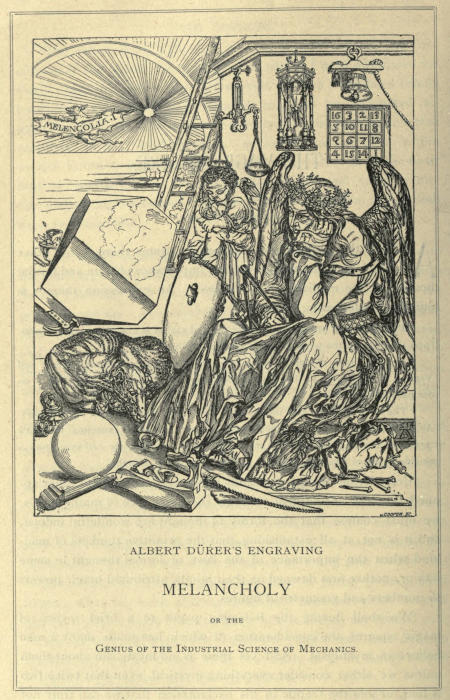
ALBERT DÜRER’S ENGRAVING
MELANCHOLY or the Genius of the Industrial Science of Mechanics
The author of the short article on “Magic Squares” in the English Cyclopædia (Vol. III, p. 415), presumably Prof. DeMorgan, says:
“Though the question of magic squares be in itself of no use, yet it belongs to a class of problems which call into action a beneficial species of investigation. Without laying down any rules for their construction, we shall content ourselves with destroying their magic quality, and showing that the non-existence of such squares would be much more surprising than their existence.”
This is the point. There obtains a symphonic harmony in mathematics which is the more startling the more obvious and self-evident it appears to him who understands the laws that produce this symphonic harmony.
On the wood-cut named “Melancholia”[68] of the famous Nuremberg painter, Albrecht Dürer, is found among a number of other emblems, which the reader will notice in our reproduction of the cut, the subjoined square. This arrangement of the sixteen natural numbers from 1 to 16 possesses the remarkable property that the same sum 34 will always be obtained whether we add together the four figures of any of the horizontal rows or the four of any vertical row or the four which lie in either of the two diagonals. Such an arrangement of numbers is termed a magic square, and the square which we have reproduced above is the first magic square which is met with in the Christian Occident.
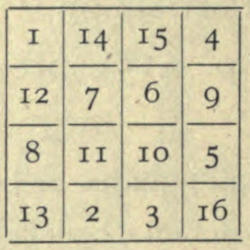
Fig. 1.
Like chess and many of the problems founded on the figure of the chess-board, the problem of constructing a magic square also probably traces its origin to Indian soil. From there the problem found its way among the Arabs, and by them it was brought to the Roman Orient. Finally, since Albrecht Dürer’s time, the scholars of Western Europe also have occupied themselves with methods for the construction of squares of this character.
The oldest and the simplest magic square consists of the quadratic arrangement of the nine numbers from 1 to 9 in such a manner that the sum of each horizontal, vertical, or diagonal row, always remains the same, namely 15. This square is the adjoined.
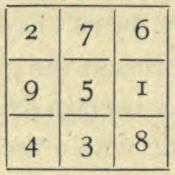
Fig. 2.
Here, we will find, 15 always comes out whether we add 2 and 7 and 6, or 9 and 5 and 1, or 4 and 3 and 8, or 2 and 9 and 4, or 7 and 5 and 3, or 6 and 1 and 8, or 2 and 5 and 8, or 6 and 5 and 4.
The question naturally presents itself, whether this condition of the constant equality of the added sum also remains fulfilled when the numbers are assigned different places. It may be easily shown however that 5 necessarily must occupy the middle place, and that the even numbers must stand in the corners. This being so, there are but 7 additional arrangements possible, which differ from the arrangement above given and from one another only in the respect that the rows at the top, at the left, at the bottom, and at the right, exchange places with one another and that in addition a mirror be imagined present with each arrangement. So too from Dürer’s square of 4 times 4 places, by transpositions, a whole set of new correct squares may be formed. A magic square of the 4 times 4 numbers from 1 to 16 is formed in the simplest manner as follows. We inscribe the numbers from 1 to 16 in their natural order in the squares, thus:
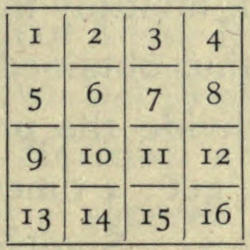
Fig. 3.
We then leave the numbers in the four corner-squares, viz. 1, 4, 13, 16, as well also as the numbers in the four middle-squares, viz. 6, 7, 10, 11, in their original places; and in the place of the remaining eight numbers, we write the complements of the same with respect to 17: thus 15 instead of 2, 14 instead of 3, 12 instead of 5, 9 instead of 8, 8 instead of 9, 5 instead of 12, 3 instead of 14, and 2 instead of 15. We obtain thus the magic square
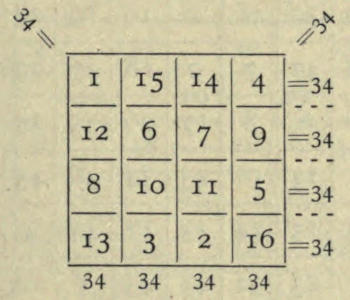
Fig. 4.
from which the same sum 34 always results. It is an interesting property of this square that any four numbers which form a rectangle or square about the centre also always give the same sum 34; for example, 1, 4, 13, 16, or 6, 7, 10, 11, or 15, 14, 3, 2, or 12, 9, 5, 8, or 15, 8, 2, 9, or 14, 12, 3, 5. We may easily convince ourselves that this square is obtainable from the square of Dürer by interchanging with one another the two middle vertical rows.
II. EARLY METHODS FOR THE CONSTRUCTION OF ODD-NUMBERED SQUARES.
Since early times rules have also been known for the construction of magic squares of more than 3 times 3, or 4 times 4 spaces. In the first place, it is easy to calculate the sum which in the case of any given number of cells must result from the addition of each row. We take the determinate number of cells in each side of the square which we have to fill, multiply that number by itself, add 1, again multiply the number thus obtained by the number of the cells in each side, and, finally, divide the product by 2. Thus, with 4 times 4 cells or squares, we get: 4 times 4 are 16, 16 and 1 are 17, and one half of 17 times 4 is 34. Similarly, with 5 times 5 squares, we get: 5 times 5 are 25, and 1 makes 26, and the half of 26 times 5 is 65. Analogously, for 6 times 6 squares the summation 111 is obtained, for 7 times 7 squares 175, for 8 times 8 squares 260, for 9 times 9 squares 369, for 10 times 10 squares 505, and so on. The Hindu rule for the construction of magic squares whose roots are odd, may be enunciated as follows: To start with, write 1 in the centre of the topmost row, then write 2 in the lowest space of the vertical column next adjacent to the right, and then so inscribe the remaining numbers in their natural order in the squares diagonally upwards towards the right, that on reaching the right-hand margin the inscription shall be continued from the left-hand margin in the row just above, and on reaching the upper margin shall be continued from the lower margin in the column next adjacent to the right, noting that whenever we are arrested in our progress by a square already occupied we are to fill out the square next beneath the one we have last filled. In this manner, for example, the last preceding square of 7 times 7 cells is formed, in which the reader is requested to follow the numbers in their natural sequence (Fig. 5).
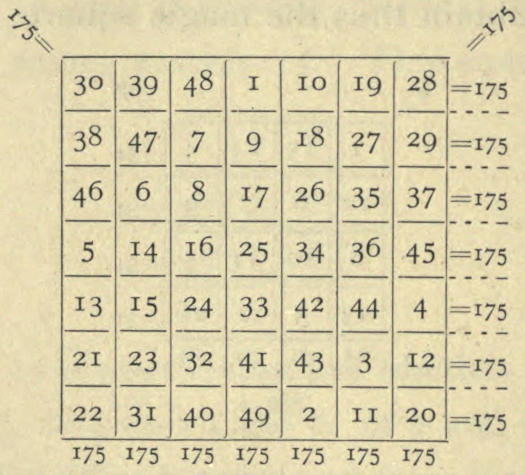
Fig. 5.
For the next further advancements of the theory of magic squares and of the methods for their construction we are indebted to the Byzantian Greek, Moschopulus, who lived in the fourteenth century; also, after Albrecht Dürer who lived about the year 1500, to the celebrated arithmetician Adam Riese, and to the mathematician Michael Stifel, which two last lived about 1550. In the seventeenth century Bachet de Méziriac, and Athanasius Kircher employed themselves on magic squares. About 1700, finally, the French mathematicians De la Hire and Sauveur made considerable contributions to the theory. In recent times mathematicians have concerned themselves much less about magic squares, as they have indeed about mathematical recreations generally. But quite recently the Brunswick mathematician Scheffler has put forth his own and other’s studies on this subject in an elegant form.
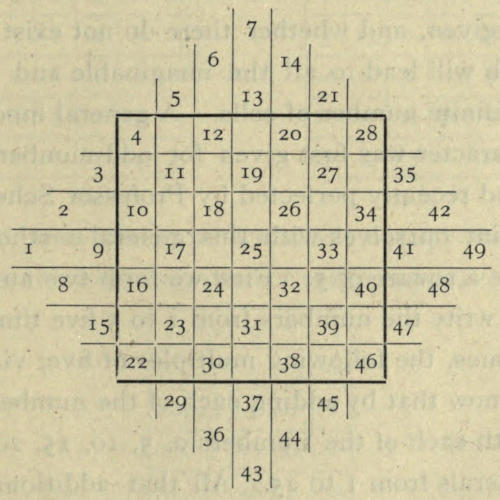
Fig. 6.
The best known of the various methods of constructing magic squares of an odd number of cells is the following. First write the numbers in diagonal succession as in the preceding diagram (Fig. 6). After 25 cells of the square of 49 cells which we have to fill out, have thus been occupied, transfer the six figures found outside each side of the square, without changing their configuration, into the empty cells of the side directly opposite. By this method, which we owe to Bachet de Méziriac, we obtain the following magic square of the numbers from 1 to 49:
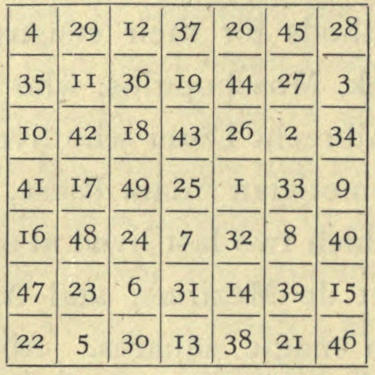
Fig. 7.
III. MODERN MODES OF CONSTRUCTION OF ODD-NUMBERED SQUARES.
The reader will justly ask whether there do not exist other correct magic squares which are constructed after a different method from that just given, and whether there do not exist modes of construction which will lead to all the imaginable and possible magic squares of a definite number of cells. A general mode of construction of this character was first given for odd-numbered squares by De la Hire, and recently perfected by Professor Scheffler.
To acquaint ourselves with this general method, let us select as our example a square of 5. First we form two auxiliary squares. In the first we write the numbers from 1 to 5 five times; and in the second, five times, the following multiples of five, viz.: 0, 5, 10, 15, 20. It is clear now that by adding each of the numbers of the series from 1 to 5 with each of the numbers 0, 5, 10, 15, 20, we shall get all the 25 numerals from 1 to 25. All that additionally remains to be done therefore, is, so to inscribe the numbers that by the addition of the two numbers in any two corresponding cells each combination shall come out once and only once; and further that in each horizontal, vertical, and diagonal row in each auxiliary square each number shall once appear. Then the required sum of 65 must necessarily result in every case, because the numbers from 1 to 5 added together make 15, and the numbers 0, 5, 10, 15, 20 make 50.
We effect the required method of inscription by imagining the numbers 1, 2, 3, 4, 5 (or 0, 5, 10, 15, 20) arranged in cyclical succession, that is 1 immediately following upon 5, and, starting from any number whatsoever, by skipping each time either none or one or two or three etc. figures. Cycles are thus obtained of the first, the second, the third etc. orders; for example 3 4 5 1 2 is a cycle of the first order, 2 4 1 3 5 is a cycle of the second order, 1 5 4 3 2 is a cycle of the fourth order, etc. The only thing then to be looked out for in the two auxiliary squares is, that the same “cycle” order be horizontally preserved in all the rows, that the same also happens for the vertical rows, but that the cycle order in the horizontal and vertical rows is different. Finally we have only additionally to take care that to the same numbers of the one auxiliary square not like numbers but different numbers correspond in the other auxiliary square, that is lie in similarly situated cells. The following auxiliary squares are, for example, thus possible:
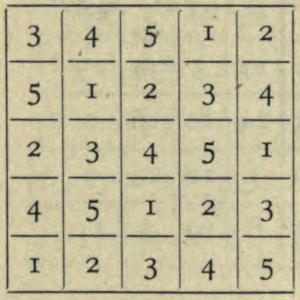
Fig. 8.
and
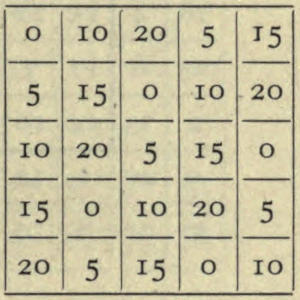
Fig. 9.
Adding in pairs the numbers which occupy similarly situated cells, we obtain the following correct magic square:
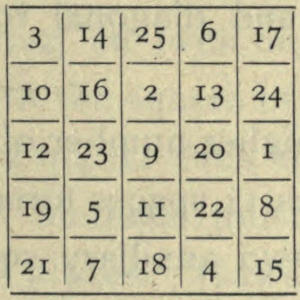
Fig. 10.
It will be seen that we are able thus to construct a very large number of magic squares of 5 times 5 spaces by varying in every possible manner the numbers in the two auxiliary squares. Furthermore, the squares thus formed possess the additional peculiarity, that every 5 numbers which fill out two rows that are parallel to a diagonal and lie on different sides of the diagonal also give the constant sum of 65. For example: 3 and 7, 11, 20, 24; or 10, 14 and 18, 22, 1. Altogether then the sum 65 is produced out of 20 rows or pairs of rows. On this peculiarity is dependent the fact that if we imagine an unlimited number of such squares placed by the side of, above, or beneath an initial one, we shall be able to obtain as many quadratic cells as we choose, so arranged that the square composed of any 25 of these cells will form a correct magic square, as the following figure will show:
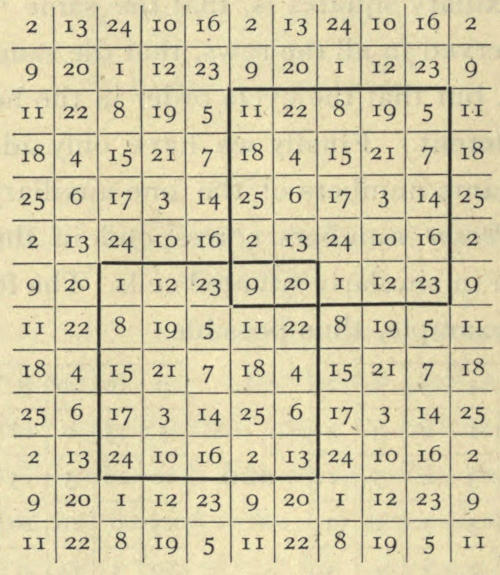
Fig. 11.
Every square of every 25 of these numbers, as for example the two dark-bordered ones, possesses the property that the addition of the horizontal, vertical, and diagonal rows gives each the same sum, 65.
As an example of a higher number of cells we will append here a magic square of 11 times 11 spaces formed by the general method of De la Hire from the two auxiliary squares of Figs. 12 and 13. From these two auxiliary squares we obtain by the addition of the two numbers of every two similarly situated cells, the magic square, exhibited in Diagram 14, in which each row gives the same sum 671.
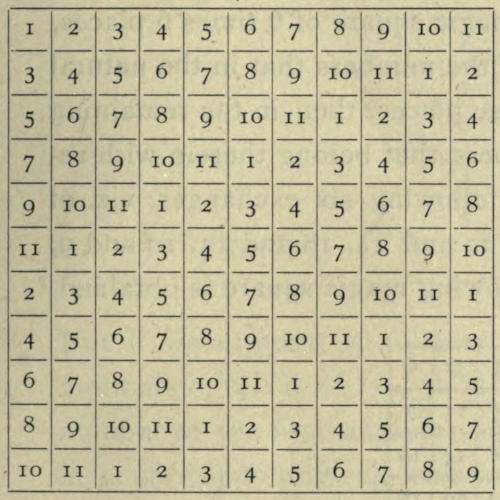
Fig. 12.
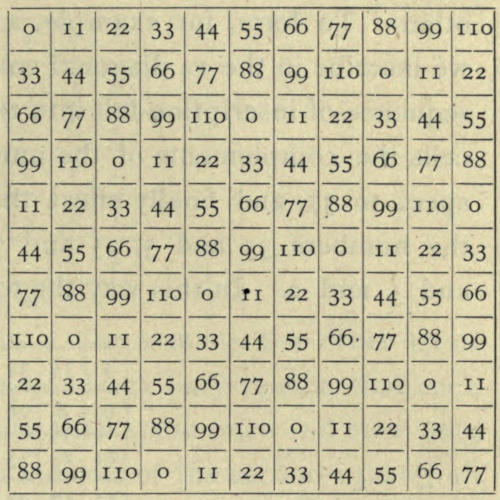
Fig. 13.
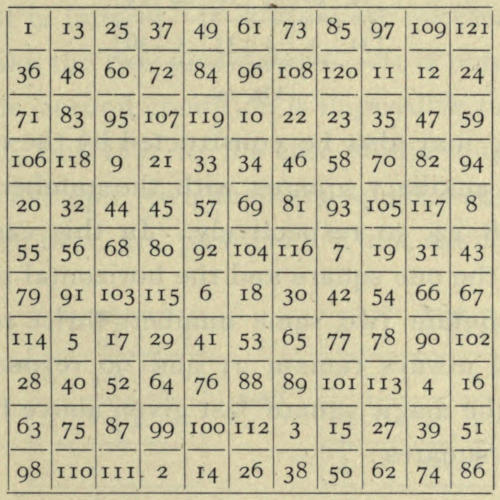
Fig. 14.
IV. EVEN-NUMBERED SQUARES.
Of magic squares having an even number of places we have hitherto had to deal only with the square of 4. To construct squares of this description having a higher even number of places, different and more complicated methods must be employed than for squares of odd numbers of places. However, in this case also, as in dealing with the square of 4, we start with the natural sequence of the numbers and must then find the complements of the numbers with respect to some other certain number (as 17 in the square of 4) and also effect certain exchanges of the numbers with one another. To form, for example, a magic square of 6 times 6 places, we inscribe in the 12 diagonal cells the numbers that in the natural sequence of inscription fall into these places, then in the remaining cells the complements of the numbers that belong therein with respect to 37, and finally effect the following six exchanges, viz. of the numbers 33 and 3, 25 and 7, 20 and 14, 18 and 13, 10 and 9, and 5 and 2. In this way the following magic square is obtained.
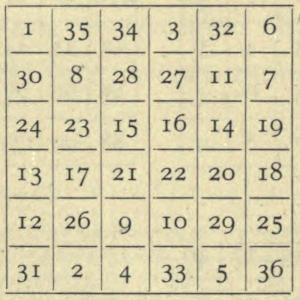
Fig. 15.
This square may also be constructed by the method of De la Hire, from two auxiliary squares with the numbers 1, 2, 3, 4, 5, 6 and 0, 6, 12, 18, 24, 30 respectively. In this case, however, the vertical rows of the one square and the horizontal rows of the other must each so contain two same numbers thrice repeated that the summation shall always remain 21 and 90 respectively. In this manner we get the magic square last given above from the two following auxiliary squares:
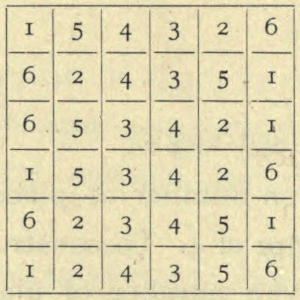
Fig. 16.
and
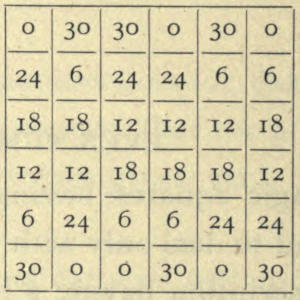
Fig. 17.
It is to be noted in connection with this example that here also as in the case of odd-numbered squares, it is possible so to inscribe six times the numbers from 1 to 6 that each number shall appear once and only once in each horizontal, vertical, and diagonal row; for example, in the following manner:
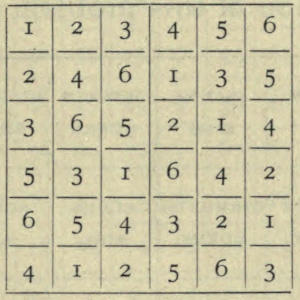
Fig. 18.
But if we attempt so to insert, in a like manner, the other set of numbers 0, 6, 12, 18, 24, 30 in a second auxiliary square, that each number of the first auxiliary square shall stand once and once only in a corresponding cell with each number of the second square, all the attempts we may make to fulfil coincidently the last named condition will result in failure. It is therefore necessary to select auxiliary squares like the two given above. It is noteworthy, that the fulfilment of the second condition is impossible only in the case of the square of 6, but that in the case of the square of 4 or of the square of 8, for example, two auxiliary squares, such as the method of De la Hire requires, are possible. Thus, taking the square of 4 we get
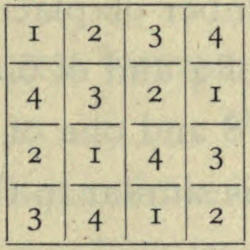
Fig. 19.
and
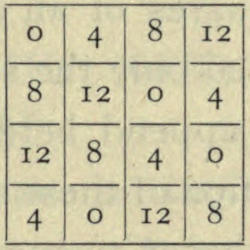
Fig. 20.
The reader may form for himself the magic square which these give.
The existence of these two auxiliary squares furnishes a key to the solution of a pretty problem at cards. If we replace, namely, the numbers 1, 2, 3, 4 by the Ace, the King, the Queen, and the Knave, and the numbers 0, 4, 8, 12 by the four suits, clubs, spades, hearts, and diamonds, we shall at once perceive that it is possible, and must be so necessarily, quadratically to arrange in such a manner the four Aces, the four Kings, the Four Queens, and the four Knaves, that in each horizontal, vertical, and diagonal row, each one of the four suits and each one of the four denominations shall appear once and once only. The auxiliary squares above given furnish the appended solution of this problem:
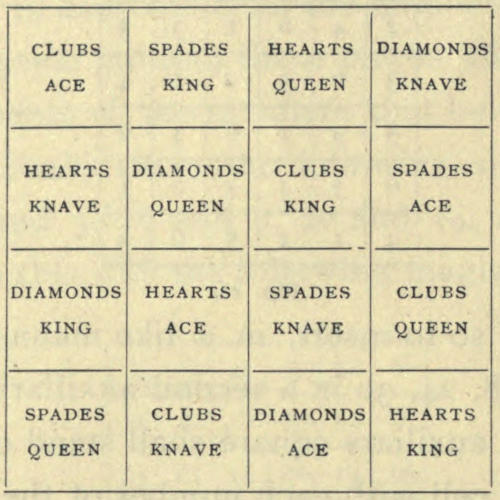
Fig. 21.
To fix the solution of the problem in the memory, observe that, starting from the several corners, each suit and each denomination must be placed in the spots of the move of a Knight. If we fix the positions of the four cards of any one row, there will be only two possibilities left of so placing the other cards that the required condition of having each suit and each denomination once and only once in each row shall be fulfilled.
Of magic squares of an even number of places we have up to this point examined only the squares of 4 and of 6. For the sake of completeness we append here one of 8 and one of 10 places. The mode of construction of these squares is similar to the method above discussed for the lower even numbers.
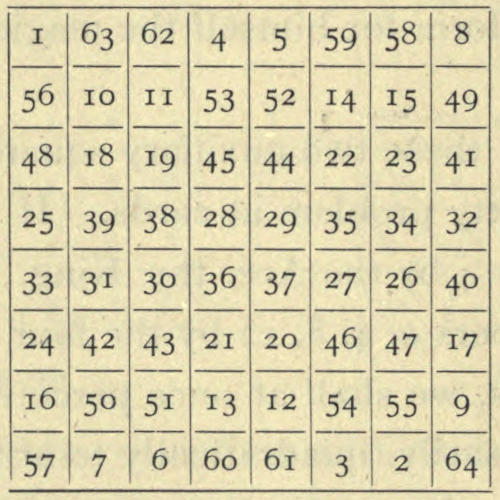
Fig. 22.
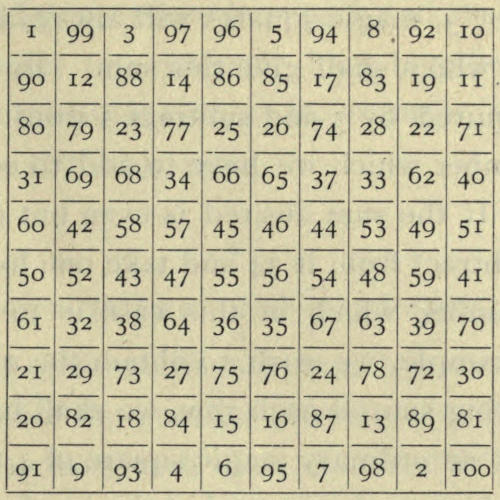
Fig. 23.
The magic squares of even numbers thus constructed are not the only possible ones. On the contrary, there are very many others possible, which obey different laws of formation. It has been calculated, for example, that with the square of 4 it is possible to construct 880, and with the square of 6, several million, different magic squares. The number of odd-numbered magic squares constructible by the method of De la Hire is also very great. With the square of 7, the possible constructions amount to 363,916,800. With the squares of higher numbers the multitude of the possibilities increases in the same enormous ratio.
V. MAGIC SQUARES WHOSE SUMMATION GIVES THE NUMBER OF A YEAR.
The magic squares which we have so far considered contain only the natural numbers from 1 upwards. It is possible, however, easily to deduce from a correct magic square other squares in which a different law controls the sequence of the numbers to be inscribed. Of the squares obtained in this manner, we shall devote our attention here only to such in which, although formed by the inscription of successive numbers, the sum obtained from the addition of the rows is a determinate number which we have fixed upon beforehand, as the number of a year. In such a case we have simply to add to the numbers of the original square a determinate number so to be calculated, that the required sum shall each time appear. If this sum is divisible by 3, magic squares will always be obtainable with 3 times 3 spaces which shall give this sum. In such a case we divide the sum required by 3 and subtract 5 from the result in order to obtain the number which we have to add to each number of the original square. If the sum desired is even but not divisible by 4, we must then subtract from it 34 and take one fourth of the result, to obtain the number which in this case is to be added in each place. If, for example, we wish to obtain the number of the year 1890 as the resulting sum of each row, we shall have to add to each of the numbers of an ordinary magic square of 4 times 4 spaces the number 464; in other words, instead of the numbers from 1 to 16 we have to insert in the squares the numbers from 465 to 480. As the number of the present year 1892 is divisible by 11, it must be possible to deduce from the magic square constructed by us at the conclusion of Section III a second magic square in which each row of 11 cells will give the number of the year 1892. To do this, we subtract from 1892 the sum of the original square, namely 671, and divide the remainder by 11, whereby we get 111 and thus perceive that the numbers from 112 to 232 are to be inscribed in the cells of the square required. We get in this way the preceding square, from which one and the same sum, namely 1892, can be obtained 44 times, first from each of the 11 horizontal rows, secondly from each of the 11 vertical rows, thirdly from each of the two diagonal rows, and fourthly twenty additional times from each and every pair of any two rows that lie parallel to a diagonal, have together 11 cells, and lie on different sides of the diagonal, as for example, 196, 122, 158, 205, 131, 167, 214, 140, 187, 223, 149.
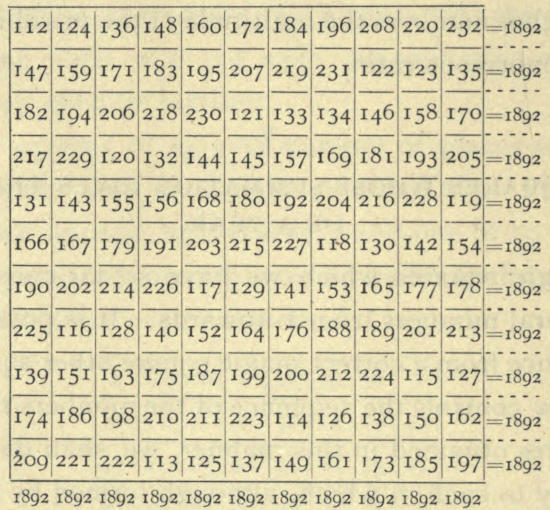
Fig. 24.
VI. CONCENTRIC MAGIC SQUARES.
The acuteness of the mathematicians has also discovered magic squares which possess the peculiar property that if one row after another be taken away from each side, the smaller inner squares remaining will still be magical squares, that is to say, all their rows when added will give the same sum. It will be sufficient to give two examples here of such squares, (the laws for their construction being somewhat more complicated,) of which the first has 7 times 7 and the second 8 times 8 places. The numbers within each of the dark-bordered frames form with respect to the centre smaller squares which in their own turn are magical.
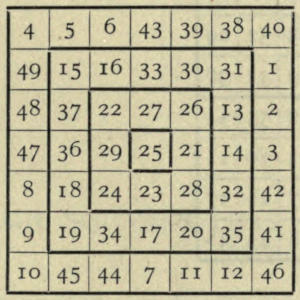
Fig. 25.
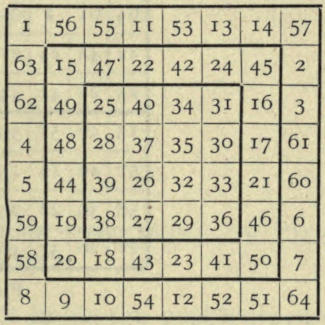
Fig. 26.
In the first of these two squares the internal square of 3 times 3 places contains the numbers from 21 to 29 in such a manner that each row gives when added the sum of 75. This square lies within a larger one of 5 times 5 spaces, which contains the numbers from 13 to 37 in such a manner that each row gives the sum of 125. Finally, this last square forms part of a square of 7 times 7 places which contains the numbers from 1 to 49 so that each row gives the sum of 175.
In the second square the inner central square of 4 times 4 places contains the numbers from 25 to 40 in such a manner that each row gives the sum of 130. This square is the middle of a square of 6 times 6 places which so contains the numbers from 15 to 50 that each row gives the sum 165. Finally, this last square is again the middle of an ordinary magic square composed of the numbers from 1 to 64.
VII. MAGICAL SQUARES WITH MAGICAL PARTS.
If we divide a square of 8 times 8 places by means of the two middle lines parallel to its sides into 4 parts containing each 4 times 4 spaces, we may propound the problem of so inserting the numbers from 1 to 64 in these spaces that not only the whole shall form a magic square, but also that each of the 4 parts individually shall be magical, that is to say, give the same sum for each row. This problem also has been successfully solved, as the following diagram will show.
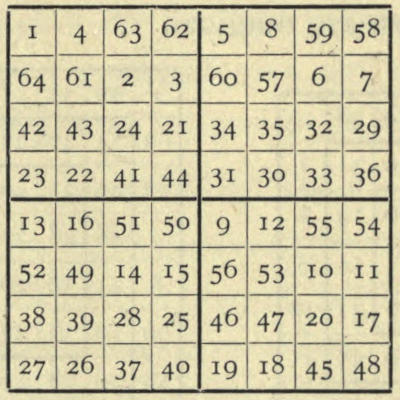
Fig. 27.
The 4 numbers in each row of any one of the sub-squares here, gives 130; so that the sum of each one of the rows of the large square will be 260.
Finally, in further illustration of this idea, we will submit to the consideration of our readers a very remarkable square of the numbers from 1 to 81. This square, which will be found on the following page (Fig. 28), is divided by parallel lines into 9 parts, of which each contains 9 consecutive numbers that severally make up a magic square by themselves.
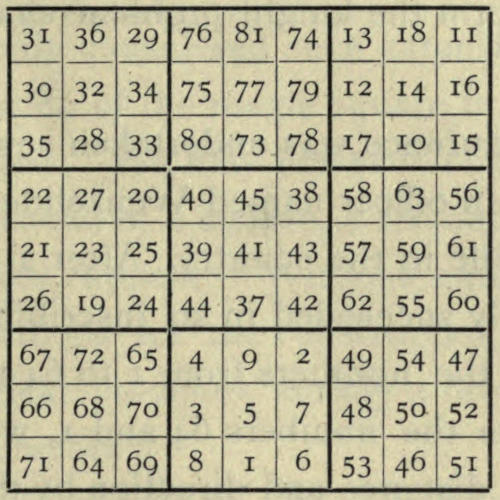
Fig. 28.
Wonderful as the properties of this square may appear, the law by which the author constructed it is equally simple. We have simply to regard the 9 parts as the 9 cells of a magic square of the numbers from I to IX and then to inscribe by the magic prescript in the square designated as I the numbers from 1 to 9, in the square designated as II the numbers from 10 to 18, and so on. In this way the square above given is obtained from the following base-square:
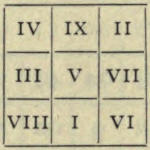
Fig. 29.
VIII. MAGIC SQUARES THAT INVOLVE THE MOVE OF THE CHESS-KNIGHT.
What one of our readers does not know the problems contained in the recreation columns of our magazines, the requirements of which are to compose into a verse 8 times 8 quadratically arranged syllables, of which every two successive syllables stand on spots so situated with respect to each other that a chess-knight can move from the one to the other? If we replace in such an arrangement the 64 successive syllables by the 64 numbers from 1 to 64, we shall obtain a knight-problem made up of numbers. Methods also exist indeed for the construction of such dispositions of numbers, which then form the foundation of the construction of the problems in the newspapers. But the majority of knight-problems of this class are the outcome of experiment rather than the product of methodical creation. If however it is a severe test of patience to form a knight-problem by experiment, it stands to reason that it is a still severer trial to effect at the same time the additional result that the 64 numbers which form the knight-problem shall also form a magic square.
This trial of endurance was undertaken several decades ago, by a pensioned Moravian officer named Wenzelides, who was spending the last days of his life in the country. After a series of trials which lasted years he finally succeeded in so inscribing in the 64 squares of the chess-board the numbers from 1 to 64 that successive numbers, as well also as the numbers 64 and 1, were always removed from one another in distance and direction by the move of a knight, and that in addition thereto the summation of the horizontal and the vertical rows always gave the same sum 260. Ultimately he discovered several squares of this description, which were published in the Berlin Chess Journal. One of these is here appended:
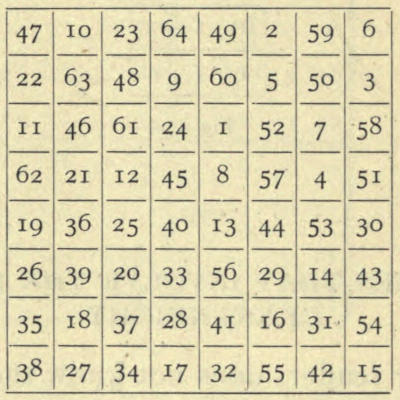
Fig. 30.
The move of the knight and the equality of the summation of the horizontal and vertical rows, therefore, are the facts to be noted here. The diagonal rows do not give the sum 260. Perhaps some one among our readers who possesses the time and patience will be tempted to outdo Wenzelides, and to devise a numeral knight-problem of this kind which will give 260 not only in the horizontal and vertical but also in the two diagonal rows.
IX. MAGICAL POLYGONS.
So far we have only considered such extensions of the idea underlying the construction of the magic square in which the figure of the square was retained. We may however contrive extensions of the idea in which instead of a square, a rectangle, a triangle, or a pentagon, and the like, appear. Without entering into the consideration of the methods for the construction of such figures, we will give here of magical polygons simply a few examples, all supplied by Professor Scheffler:
1) The numbers from 1 to 32 admit of being written in a rectangle of 4 × 8 in such a manner that the long horizontal rows give the sum of 132 and the short vertical rows the sum of 66; thus:
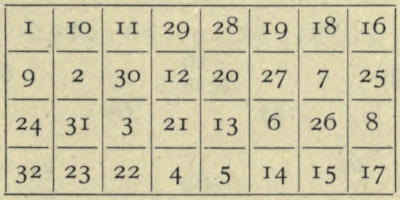
Fig. 31.
2) The numbers from 1 to 27 admit of being so arranged in three regular triangles about a point which forms a common centre, that each side of the outermost triangle will present 6 numbers of the total summation 96 and each side of the middle triangle 4 numbers whose sum is 61; as the following figure shows:
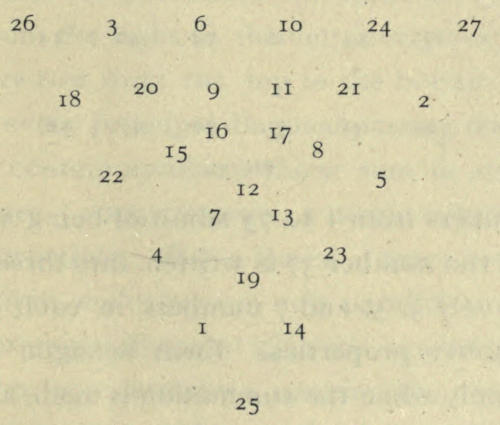
Fig. 32.
3) The numbers from 1 to 80 admit of being formed about a point as common centre into 4 pentagons, such that each side of the first pentagon from within contains two numbers, each side of the second pentagon four numbers, each of the third six numbers, and each side of the fourth, outermost pentagon eight numbers. The sum of the numbers of each side of the second pentagon is 122, the sum of those of each side of the third pentagon is 248, and that of those of each side of the fourth pentagon 254. Furthermore, the sum of any four corner numbers lying in the same straight line with the centre, is also the same; namely, 92.
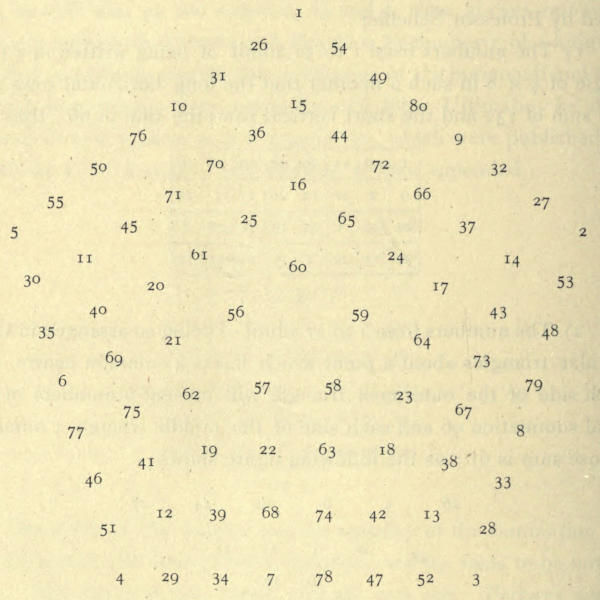
Fig. 33.
4) The numbers from 1 to 73 admit of being arranged about a centre, in which the number 37 is written, into three hexagons which contain respectively 3, 5, and 7 numbers in each side and possess the following pretty properties. Each hexagon always gives the same sum, not only when the summation is made along its six sides, but also when it is made along the six diameters that join its corners and along the six that are constructed at right angles to its sides; this sum, for the first hexagon from within, is 111, for the second 185, and for the third 259.
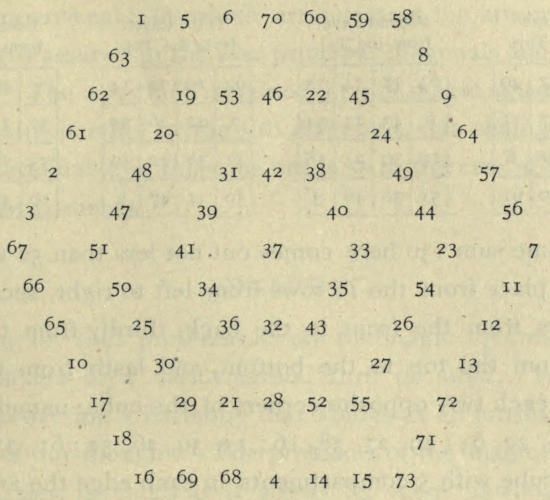
Fig. 34.
X. MAGIC CUBES.
Several inquirers, particularly Kochansky (1686), Sauveur (1710), Hugel (1859), and Scheffler (1882), have extended the principle of the magic squares of the plane to three-dimensioned space. Imagine a cube divided by planes parallel to its sides and equidistant from one another, into cubical compartments. The problem is then, so to insert in these compartments the successive natural numbers that every row from the right to the left, every row from the front to the back, every row from the top to the bottom, every diagonal of a square, and every principal diagonal passing through the centre of the cube shall contain numbers whose sum is always the same. For 3 times 3 times 3 compartments, a magic cube of this description is not constructible. For 4 times, 4 times 4 compartments a cube is constructible such that any row parallel to an edge of the cube and every principal diagonal give the sum of 130. To obtain a magic cube of 64 compartments, imagine the numbers which belong in the compartments written on the upper surface of the same and the numbers then taken off in layers of 16 from the top downwards. We obtain thus 4 squares of 16 cells each, which together make up the magic cube; as the following diagrams will show:
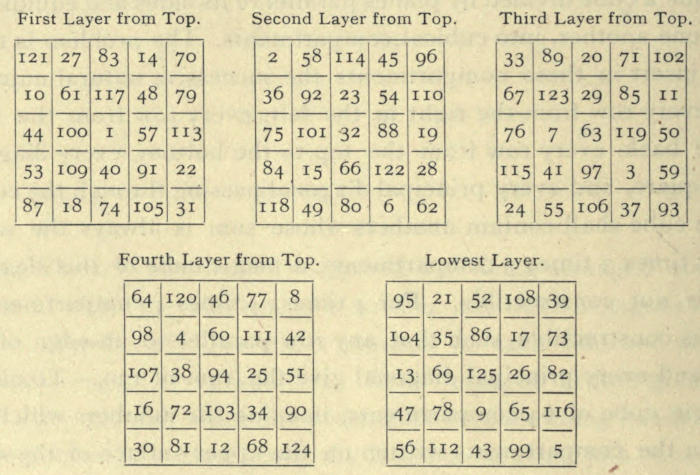
The same sum 130 here comes out not less than 52 times; viz. in the first place from the 16 rows from left to right, secondly from the 16 rows from the front to the back, thirdly from the 16 rows counting from the top to the bottom, and lastly from the 4 rows which join each two opposite corners of the cube, namely from the rows: 1, 43, 22, 64; 49, 27, 38, 16; 13, 39, 26, 52; 61, 23, 42, 4.
For a cube with 5 compartments in each edge the arrangement of the figures can so be made that all the 75 rows parallel to any and every edge, all the 30 rows lying in any diagonal of a square, and all the 4 rows forming any principal diagonal shall have one and the same summation, 315.
Just as the magic squares of an odd number of cells could be formed with the aid of two auxiliary squares, so also odd-numbered magic cubes can be constructed with the help of three auxiliary cubes.
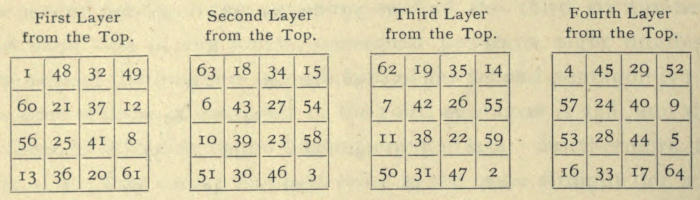
In this manner the preceding magic cube of 5 times 5 times 5 compartments is formed, in which, it may be additionally noticed, the middle number between 1 and 125, namely 63, is placed in the central compartment; by which arrangement the attainment of the sum of 315 is assured in the four principal diagonals and the 30 sub-diagonals. The condition attained in the magic squares, that the diagonal-pairs parallel to the sub-diagonals also shall give the sum 315 is not attainable in this case but is so in the case of higher numbers of compartments.
CONCLUSION.
Musing on such problems as are the magic squares is fascinating to thinkers of a mathematical turn of mind. We take delight in discovering a harmony that abides as an intrinsic quality in the forms of our thought. The problems of the magic squares are playful puzzles, invented as it seems for mere pastime and sport. But there is a deeper problem underlying all these little riddles, and this deeper problem is of a sweeping significance. It is the philosophical problem of the world-order.
The formal sciences are creations of the mind. We build the sciences of mathematics, geometry, and algebra with our conception of pure forms which are abstract ideas. And the same order that prevails in these mental constructions permeates the universe, so that an old philosopher, overwhelmed with the grandeur of law, imagined he heard its rhythm in a cosmic harmony of the spheres.
H. Schubert.
FOOTNOTES:
MR. SPENCER ON THE ETHICS OF KANT.
Mr. Herbert Spencer published in the Fortnightly Review for July 1888 and in the Popular Science Monthly for August of the same year an article on “The Ethics of Kant” in which he so strangely misrepresents Kant’s position that Kant to any uninitiated reader must appear not only as superficial and shallow, but even as palpably nonsensical.
Mr. Spencer’s article on “The Ethics of Kant” is a severe criticism mainly of the nonsensical idea, erroneously imputed to Kant, of a will that has no end. At the same time Mr. Spencer reproaches Kant with assuming the simplicity of conscience and believing in a non-evolutionary origin of the minds of living beings.
In reply to Mr. Spencer an editorial article appeared in The Open Court under the caption “Herbert Spencer on the Ethics of Kant” (Nos. 51 and 52), which was supplemented by another article entitled “Kant on Evolution” (No. 158), the latter being elicited by a renewed attack of Mr. Spencer upon Kant’s views (which appeared in Mind, No. LIX, p. 313).
Mr. Spencer has republished his article “The Ethics of Kant” together with many other older articles in a work of three volumes entitled “Essays Scientific, Political, and Speculative,” 1891, in which he repeats the following sentence:
“Thus the basis of the argument by which Kant attempts to justify his assumption that there exists a good will apart from a good end, disappears utterly; and leaves his dogma in all its naked unthinkableness.”
To this sentence he adds the following foot-note as a reply to my criticisms:
“I find that in the above three paragraphs I have done Kant less than justice and more than justice—less, in assuming that his evolutionary view was limited to the genesis of our sidereal system, and more, in assuming that he had not contradicted himself. My knowledge of Kant’s writings is extremely limited. In 1844 a translation of his ‘Critique of Pure Reason’ (then I think lately published) fell into my hands, and I read the first few pages enunciating his doctrine of Time and Space: my peremptory rejection of which caused me to lay the book down. Twice since then the same thing has happened; for, being an impatient reader, when I disagree with the cardinal propositions of a work I can go no further. One other thing I knew. By indirect references I was made aware that Kant had propounded the idea that celestial bodies have been formed by the aggregation of diffused matter. Beyond this my knowledge of his conceptions did not extend; and my supposition that his evolutionary conception had stopped short with the genesis of sun, stars, and planets, was due to the fact that his doctrine of Time and Space, as forms of thought anteceding experience, implied a supernatural origin inconsistent with the hypothesis of natural genesis. Dr. Paul Carus, who, shortly after the publication of this article in the Fortnightly Review for July, 1888, undertook to defend the Kantian ethics in the American journal which he edits, The Open Court, has now (Sept. 4, 1890), in another defensive article, translated sundry passages from Kant’s ‘Critique of Judgment,’ his ‘Presumable Origin of Humanity,’ and his work ‘Upon the different Races of Mankind,’ showing that Kant was, if not fully, yet partially, an evolutionist in his speculations about living beings. There is, perhaps, some reason for doubting the correctness of Dr. Carus’s rendering of these passages into English. When, as in the first of the articles just named, he failed to distinguish between consciousness and conscientiousness, and when, as in this last article, he blames the English for mistranslating Kant, since they have said ‘Kant maintained that Space and Time are intuitions,’ which is quite untrue, for they have everywhere described him as maintaining that Space and Time are forms of intuition, one may be excused for thinking that possibly Dr. Carus has read into some of Kant’s expressions, meanings which they do not rightly bear. Still, the general drift of the passages quoted makes it tolerably clear that Kant must have believed in the operation of natural causes as largely, though not entirely, instrumental in producing organic forms: extending this belief (which he says ‘can be named a daring venture of reason’) in some measure to the origin of Man himself. He does not, however extend the theory of natural genesis to the exclusion of the theory of supernatural genesis. When he speaks of an organic habit ‘which in the wisdom of nature appears to be thus arranged in order that the species shall be preserved’; and when, further, he says ‘we see, moreover, that a germ of reason is placed in him, whereby, after the development of the same, he is destined for social intercourse,’ he implies divine intervention. And this shows that I was justified in ascribing to him the belief that Space and Time, as forms of thought, are supernatural endowments. Had he conceived of organic evolution in a consistent manner, he would necessarily have regarded Space and Time as subjective forms generated by converse with objective realities.
“Beyond showing that Kant had a partial, if not a complete, belief in organic evolution (though with no idea of its causes), the passages translated by Dr. Carus show that he entertained an implied belief which it here specially concerns me to notice as bearing on his theory of ‘a good will.’ He quotes approvingly Dr. Moscati’s lecture showing ‘that the upright walk of man is constrained and unnatural,’ and showing the imperfect visceral arrangements and consequent diseases which result: not only adopting, but further illustrating, Dr. Moscati’s argument. If here, then, there is a distinct admission, or rather assertion, that various human organs are imperfectly adjusted to their functions, what becomes of the postulate above quoted ‘that no organ for any purpose will be found in it but what is also the fittest and best adapted for that purpose’? And what becomes of the argument which sets out with this postulate? Clearly, I am indebted to Dr. Carus for enabling me to prove that Kant’s defence of his theory of ‘a good will’ is, by his own showing, baseless.”
Mr. Spencer’s reply to my criticisms is surprising in more than one respect.
First, without even mentioning the objections I make he discredits my arguments by throwing doubt upon the correctness of the translations of the quoted passages.
Secondly, he alleges, with a view of justifying his doubt, that in the first of my articles I “failed to distinguish between consciousness and conscientiousness.”[69]
Thirdly, Mr. Spencer declares that I had “read into some of Kant’s expressions, meanings which they do not rightly bear.”
Fourthly, Mr. Spencer bases this opinion upon a double mistake: he blames me for not distinguishing between the Kantian phrases that “Space and Time are intuitions” and that they are “forms of intuition.”
Fifthly, acknowledging after all that Kant had at least “a partial belief in organic evolution,” Mr. Spencer accuses him of inconsistency.
Sixthly, several statements concerning Kant’s views are made not because Kant held them but because Mr. Spencer assumes for trivial reasons that he is “justified in ascribing them to him.”
Seventhly, these statements so vigorously set forth are accompanied by Mr. Spencer’s remarkably frank confession of unfamiliarity with the subject under discussion.
It may be added that Mr. Spencer calls my criticisms “defensive articles.” He says that “I undertook to defend the Kantian ethics”; while, in fact, my articles are aggressive. Kant needs no defense for being misunderstood, and it would not be my business to defend him, for I am not a Kantian in the sense that I adopt any of the main doctrines of Kant. On the contrary I dissent from him on almost all fundamental questions. In ethics I object to Kant’s views in so far as they can be considered as pure formalism.[70] I am a Kantian only in the sense that I respect Kant as one of the most eminent philosophers, that I revere him as that teacher of mine whose influence upon me was greatest, and I consider the study of Kant’s works as an indispensable requisite for understanding the problems of the philosophy of our time. Far from defending Kant’s position, I only undertook to inform Mr. Spencer of what Kant had really maintained, so that instead of denouncing absurdities which Kant had never thought of, he might criticise the real Kant.
I shall now take up the details of Mr. Spencer’s reply:
I.
I am sorry to see that Mr. Spencer, instead of frankly acknowledging his errors, has taken refuge in discrediting the translations, which might very easily have been examined either by himself or by friends of his; especially as the German original of the most important passages, wherever any doubt might arise, and also of those expressions on the misconception of which Mr. Spencer bases his unfavorable opinion of Kant, were added in foot-notes.
II.
But Mr. Spencer adduces, as if it were a fact, an instance of my grave mistakes. He says that I failed to distinguish between “consciousness” and “conscientiousness.” Mr. Spencer makes much of a small matter, which, if it were as he assumes, would have to be considered as a misprint.
Mr. Spencer’s statement is so positive that it must make on any reader the impression of being indubitably true. However, in the whole first article of mine, and indeed in both articles, “conscientiousness” is nowhere mentioned and it would be wrong to replace the word “consciousness” in any of the passages in which it occurs by “conscientiousness.”
I should be glad if Mr. Spencer would kindly point out to me the passage which he had in mind when making his statement, for since there is not even so much as an occasion for confounding consciousness and conscientiousness, I stand here before a psychological problem. Mr. Spencer’s statement is a perfect riddle to me. Either I have a negative hallucination, as psychologists call it, so that I do not see what is really there, or Mr. Spencer must have had a positive hallucination. That which Mr. Spencer has read into my article, was never written and it is not there. The alleged fact to which he refers, does not exist.
This kind of erroneous reference into which Mr. Spencer has inadvertently fallen is a very grievous mistake. It appears more serious than a simple slip of the pen, when we consider that Mr. Spencer uses the statement for the purpose of incrimination. He justifies upon this exceedingly slender basis his doubt concerning the correctness of the translations of the quoted passages, and Mr. Spencer’s doubt concerning the correctness of these translations is his main argument for rejecting my criticisms in toto.
It is not impossible, indeed it is probable, that Mr. Spencer meant “conscience” instead of “conscientiousness.” There is one passage in which a superficial reader might have expected “conscience” in place of “consciousness.” However that does not occur in any of the translations, but in a paragraph where I speak on my own account. This passage appears in the appended reprint on page 23, line 14. Whatever anybody might have expected in that passage, I certainly intended to say “consciousness,” and only a hasty reader, only he who might merely read the first line of the paragraph, would consider the word “consciousness” a mistake.
To avoid any equivocation, however, even to hasty readers, and to guard against a misconstruction such as Mr. Spencer possibly has given to the sentence, I propose to alter the passage by adding a few words as follows:
“It is quite true that not only conscience, but every state of consciousness is a feeling,” etc.
The italicised words are inserted, simply to show that here I mean “consciousness,” and not “conscience.” For the rest, they do not alter in the least the sense of the sentence. In this passage as throughout the whole article the terms “consciousness,” and “conscience” have been used properly.
Observing that Mr. Spencer appears to have committed the same mistake for which he erroneously blames me, I do not mean to say that he “failed to distinguish between” conscientiousness and conscience. I should rather regard it as trifling on my part if I drew this inference from what is either a slip of the pen or an oversight in proof-reading. But it strikes me that that knavish rogue among the fairies whom Shakespeare calls Puck and scientists define as chance or coincidence played in a fit of anger and perhaps from a sentiment of pardonable irony a humorous trick upon Mr. Spencer. The moral of it is that when an author censures his fellow authors with undue severity for things that might be mere misprints, he should keep a close eye on his own printer’s devil.
III.
Mr. Spencer discredits my knowledge of Kant. He says of me:
“One may be excused for thinking that possibly Dr. Carus has read into some of Kant’s expressions, meanings which they do not rightly bear.”
I did not give Mr. Spencer any occasion for making this personal reflection. I do not boast of any extraordinary familiarity with Kant’s writings. There are innumerable German and also English and American scholars and philosophers who know Kant almost by heart. But the question at issue is not what I conceive Kant’s ideas to be, but what Kant has really said, and I was very careful in letting Kant speak for himself.
My criticism of Mr. Spencer’s conception of Kant consisted almost exclusively in collating and contrasting Mr. Spencer’s views of Kant with quotations from Kant’s works. How can I read anything into some of Kant’s expressions, if I present translations of the expressions themselves, adding thereto in foot-notes the original whenever doubts could arise? And the general drift of the quotations alone suffices to overthrow Mr. Spencer’s conception of Kant.
The truth is that Mr. Spencer committed the mistake himself, for which he censures me unjustly. “Mr. Spencer has read into some of Kant’s expressions meanings which they do not rightly bear.”
IV.
But Mr. Spencer adduces a fact, which, if it were as Mr. Spencer represents it, would show an inability on my part of making important distinctions. He says of me:
“He blames the English for mistranslating Kant, since they have said ‘Kant maintained that Space and Time are intuitions,’ which is quite untrue, for they have everywhere described him as maintaining that Space and Time are forms of intuition.”
This is a double mistake: (1) Kant and his translators did not make the distinction of which Mr. Spencer speaks, and (2) the quotation Mr. Spencer makes from my article is represented to mean something different from what it actually means in the context.
Before I speak for myself as to what I actually said, let us state the facts concerning Kant’s usage of the terms “intuitions” and “forms of intuition.”
Kant defines in § 1 of his “Critique of Pure Reason” what he understands by “Transcendental Æsthetic.” He distinguishes between “empirical intuition” (empirische Anschauung) and “pure intuition” (reine Anschauung). He says:
“That sort of intuition which relates to an object by means of sensation, is called an empirical intuition.”
Representations contain besides that which belongs to sensation some other elements. Kant says:
“That which effects that the content of the phenomenon can be arranged under certain relations, I call its form.”
And later on he continues:
“This pure form of sensibility I shall call pure intuition.”
These are Kant’s phrases in J. M. D. Meiklejohn’s well known translation. The term “pure intuition” is repeated again and again, and we find frequently added by way of explanation the phrases “as a mere form of sensibility,” “the mere form of phenomena,” “forms of sensuous intuition,” and also (as Mr. Spencer emphasises as the only correct way) “forms of intuition.”
Kant says:
1) “Diese reine Form der Sinnlichkeit wird auch selber reine Anschauung heissen. § 1.
2) “Zweitens worden wir von dieser (der empirischen Anschauung) noch alles abtrennen, damit nichts als reine Anschauung und die blosse Form der Erscheinungen übrig bleibe. § 1.
3) “Raum ... muss ursprünglich Anschauung sein. § 3.
4) “Der Raum ist nichts anderes als nur die Form aller Erscheinungen äusserer Sinne. § 3.
5) “Der Raum aber betrifft nur die reine Form der Anschauung. (This passage appears in the first edition only, the paragraph containing it is omitted in the second edition.) § 3.
6) “Die Zeit ist ... eine reine Form der sinnlichen Anschauung.... § 4.
7) “Es muss ihr[71] unmittelbare Anschauung zum Grunde liegen. § 4.
8) “Die Zeit ist nichts anderes als die Form des inneren Sinnes. § 6.
9) “... dass die Vorstellung der Zeit selbst Anschauung sei. § 6.
10) “Wir haben nun ... reine Anschauung a priori, Raum und Zeit. § 10. Beschluss der transcendentalen Æsthetik.”
These quotations do not pretend to be exhaustive, nor is that necessary for the present purpose.
Kant, as we learn from these quotations, makes no distinction between reine Anschauung and Form der Anschauung. He uses most frequently the term reine Anschauung and designates in several places Space and Time simply as Anschauung. (See the quotations 3, 7, and 9.) So far as I can gather from a renewed perusal, the expression proposed by Mr. Spencer, “form of intuition,” Form der Anschauung, occurs only once and that too in a passage omitted in the second edition.
It is almost redundant to add that the English translators and interpreters of Kant follow the original pretty closely. Accordingly it is actually incorrect “that they have everywhere(!) described Kant as maintaining that Space and Time are forms of intuition.” In addition to the quotations from Meiklejohn, I call Mr. Spencer’s attention to William Flemming’s “Vocabulary of Philosophy” (4th ed., edited by Henry Calderwood) which reads sub voce “Intuition,” p. 228 with reference to Kant’s view:
“Space and time are intuitions of sense.”
To say “Time and Space are forms of intuition” is quite correct according to Kantian terminology. No objection can be made to Mr. Spencer on that ground. But to say “Time and Space are intuitions” is also quite correct, and Mr. Spencer is wrong in censuring the expression.
Why does Mr. Spencer rebuke me so severely on a point which is of no consequence? He appears confident that I have betrayed an unpardonable misconception of Kant’s philosophy. But having pointed out by quotations from Kant that this is not so, I shall now proceed to explain why the quotation which Mr. Spencer makes from my article, although the eight words in quotation marks are literally quoted, is a misquotation. It is torn out of its context. I did not blame the English translators of Kant at all, but I blamed his interpreters, among whom the English interpreters (not all English interpreters, but certainly some of them) are the worst, for “mutilating Kant’s best thoughts, so that this hero of progress appears as a stronghold of antiquated views”; and as an instance I called attention to the misconception of Kant’s term Anschauung, saying:
“How different is Kant’s philosophy, for instance, if his position with reference to time and space is mistaken! ‘Time and Space are our Anschauung,’ Kant says. But his English translators declare ‘Kant maintained that space and time are intuitions.’ What a difference it makes if intuition is interpreted in the sense applied to it by the English intuitionalist school instead of its being taken in the original meaning of the word Anschauung.”
The word “intuition” implies something mysterious; the word Anschauung denotes that which is immediately perceived, simply, as it were, by looking at it. So especially the sense-perceptions of the things before us are Anschauungen.
Mr. Spencer, believing that he had caught me in making unawares a blunder, tears the passage out of its context, ignores its purport, makes a point of an antithesis which had nothing in the world to do with the topic under discussion, only to throw on me the opprobrium of incompetence. Even if Mr. Spencer’s antithesis of “intuition” and “forms of intuition” were of any consequence (as, unfortunately for Mr. Spencer, it is not), it would count for nothing against me because I did not speak of “forms” in the passage referred to, I simply alluded to one misinterpretation of the term Anschauung, which is quite common among English Kantians. It was not required by the purpose I had in view, to enter into any details as to what kind of Anschauung I meant, and an allusion to “form” or to any other subject would have served only to confound the idea which I intended to set forth in the paragraph from which Mr. Spencer quotes.
Misquotation of this kind, into which Mr. Spencer was inveigled by a hasty reading, should be avoided with utmost care, for it involves an insinuation. It leads away from the main point under discussion to side issues, and it misrepresents the author from whom the quotation is made. It insinuates a meaning which the passage does not bear and which was not even thought of in the context out of which it is torn.
Mr. Spencer quotes the passage as if I had preferred the term “intuition” to the term “form of intuition,” or at least, as if I had no idea that Kant conceives Time and Space as “forms.” Yet Mr. Spencer in trying to make out a point against me betrays his own lack of information. Kant insisted most emphatically on calling the forms of our sensibility (i. e. space and time) “Anschauungen.”
But Mr. Spencer’s case is worse still. While he insists upon the statement that according to the translators of Kant space and time are “forms of intuition,” which is at least correct, he uses twice in the very same paragraph the expression that according to Kant “space and time are forms of thought,” which is incorrect. The forms of thought according to Kantian terminology are not space and time but the domain of the transcendental logic. Anyone who confounds the two terms “forms of intuition” and “forms of thought” proves himself unable to form a correct opinion on Kant’s philosophy. That is just characteristic of Kant that he regards time and space not as thought, nor as forms of thought, but as Anschauungen and in contradistinction to sense-intuitions (i. e. sensations) he calls them reine Anschauungen or Formen der Anschauung.
V.
Mr. Spencer commenting upon his criticism of Kant’s idea of a Good Will, says:
“I find that in the above three paragraphs I have done Kant less than justice and more than justice—less, in assuming that his evolutionary view was limited to the genesis of our sidereal system, and more, in assuming that he had not contradicted himself.
“Clearly, I am indebted to Dr. Carus for enabling me to prove that Kant’s defence of his theory of ‘a good will’ is, by his own showing, baseless.”
Kant’s idea of a good will has nothing to do with evolution, and we can abstain here from discussing whether or not Kant was an evolutionist. Whether evolution is true or not, what difference does it make to the proposition, that a good will is the only thing which can be called good without further qualification (ohne Einschränkung)? Pleasure is good, but it is not absolutely good, there are cases in which pleasure is a very bad thing. We must qualify our statement and limit it to special cases. A good will, however, says Kant, is in itself good under all circumstances.
Did Mr. Spencer prove the baselessness of Kant’s proposition by proving evolution? Is it inconsistent to believe in evolution and at the same time to regard a good will as absolutely good, as good without reserve or limitation? I think not!
VI.
Mr. Spencer in admitting that “the general drift of the passages quoted makes it tolerably clear that Kant must have believed in the operation of natural causes ... in producing organic forms,” adds:
“He does not, however, extend the theory of natural genesis to the exclusion of the theory of supernatural genesis.”
How does Mr. Spencer prove his statement? Does he quote a passage from Kant which expresses his belief in supernaturalism? No, Mr. Spencer does not quote Kant, and it would be difficult to find a passage to suit that purpose. Mr. Spencer adduces a few unmeaning phrases gleaned at random and torn out of their context, and from these phrases he concludes that Kant believed in the supernatural. Kant spoke somewhere of “the wisdom of nature” who has things so arranged that the species might be preserved. If the wisdom of nature in preserving the species is to be taken literally, the phrase might prove that Kant believed nature to be a wise old woman. Kant spoke further of “the germ of reason placed in man whereby he is destined to social intercourse.” Does the usage of the word “destined” really “imply divine intervention,” as Mr. Spencer says? Mr. Spencer adds:
“And this [viz. Kant’s usage of these phrases] shows that I was justified in ascribing to him the belief that Space and Time, as forms of thought [sic!], are supernatural endowments.”
What might we not prove by this kind of loose argumentation!
Kant did not introduce any supernatural explanations; on the contrary, he proposed to exclude “supernatural genesis.” He says e. g. in a passage of the “Critique of Judgment” quoted on page 41 of the appendix:
“If we assume occasionalism for the production of organised beings, nature is thereby wholly discarded ... therefore it cannot be supposed that this system is accepted by anyone who has had to do with philosophy.”
And furthermore Kant rejects the partial admission of the supernatural, saying:
“As though it were not the same to make the required forms arise in a supernatural manner at the beginning of the world as during its progress.”
Mr. Spencer charges Kant with inconsistency. We do not intend to say that Kant was in all the phases of his development consistent with himself. But we do say that the charge of Mr. Spencer against Kant consists in this: the real Kant has said things which are incompatible with Mr. Spencer’s view of Kant.
This settles the sixth point.
VII.
Mr. Spencer’s reply to my criticism is a very strange piece of controversy and I have actually been at a loss, how to account for it.
The situation can be explained only by assuming that Mr. Spencer, being an impatient reader, when finding out that he disagreed with my propositions, could go no further and wrote his reply to me without having read my articles. This is very hard on a critic who, carefully avoiding everything that might look like fault-finding, is painstakingly careful in giving to the author criticised every means of investigating the truth himself and helps him in a friendly way to correct his errors.
There is only one consolation for me, which is, that I am in good company. The great thinker of Koenigsberg is very severely censured in almost all of Mr. Spencer’s writings for ideas which he never held. And now Mr. Spencer confesses openly and with ingenuous sincerity, that his knowledge of Kant’s writings is extremely limited. But why he condemns a man of whom he knows so little Mr. Spencer does not tell us.
Mr. Spencer says:
“My knowledge of Kant’s writings is extremely limited. In 1844 a translation of his “Critique of Pure Reason” (then I think lately published) fell into my hands, and I read the first few pages enunciating his doctrine of Time and Space: my peremptory rejection of which caused me to lay the book down.
“Twice since then the same thing has happened; for, being an impatient reader, when I disagree with the cardinal propositions of a work I can go no further.
“One other thing I knew. By indirect references I was made aware that Kant had propounded the idea that celestial bodies have been formed by the aggregation of diffused matter. Beyond this my knowledge of his conceptions did not extend; and my supposition that his evolutionary conception had stopped short with the genesis of sun, stars, and planets was due to the fact that his doctrine of Time and Space, as forms of thought [sic] anteceding experience, implied a supernatural origin inconsistent with the hypothesis of natural genesis.”
Kant has been a leader in thought for the last century. It is very important to criticise his ideas wherever they are wrong, but his errors cannot be conquered by ex cathedra denunciations.
Darwin’s habits in investigating and weighing the pro and con of a question were very different from Mr. Spencer’s, and Darwin’s success is in no small degree due to the sternness with which he adhered to certain rules of reading and studying. We find in his “Autobiography” certain reminiscences labeled “important” from which the following is most instructive:
“I had also, during many years, followed a golden rule, namely, that whenever a published fact, a new observation or a thought, came across me, which was opposed to my general results, to make a memorandum of it without fail, for I had found by experience that such facts and thoughts were far more apt to escape from the memory than favorable ones.”
Experience teaches that we can learn most from those authors with whom we do not agree. The ethics of reading and studying demand other habits than laying a book down when we disagree with its cardinal propositions. Such habits prevent progress and create prejudices.
Mr. Spencer has not answered my criticism at all. Mr. Spencer did not even take into consideration the passages quoted from Kant. He republished all the false statements of Kant’s views, so inconsiderately made, together with all the perverse opinions based upon them. The assurance with which Mr. Spencer makes statements which have no foundation whatever is really perplexing even to a man who is well informed on the subject, and it will go far to convince the unwary reader. What, however, shall become of the general tenor of philosophical criticism and controversy if a man of Mr. Spencer’s reputation is so indifferent about being informed concerning the exact views of his adversary, if he is so careless in presenting them, if he makes positively erroneous statements on confessedly mere “supposition,” and finally, if in consequence thereof he is flagrantly unjust in censuring errors which arise only from his own too prolific imagination?
We feel confident that Mr. Spencer will explain his side of the question satisfactorily. His mistakes being undeniable, we do not believe that he will seek to deny them. Yet we trust that Mr. Spencer as soon as he finds himself at fault, will not even make an attempt at palliation, that he will not blink the frank acknowledgment of his misstatements and also of having treated Kant with injustice. A man who has devoted his life to the search for truth will not suffer any blot to remain on his escutcheon.
Editor.
FOOTNOTES:
WHAT DOES ANSCHAUUNG MEAN?
Mr. Spencer’s erroneous statement that Kant conceives space and time as forms of thought instead of forms of intuition induces me to make a few explanatory remarks concerning the term Anschauung.
Kant means that space and time are immediately given in experience and not inferences drawn from the data of experience; they are not thoughts, but objects of direct perception.
Sense-impressions are data, they are prior to ideas, the latter being constructions made out of sense-impressions. Sense-impressions are facts, but ideas are of an inferential nature; they are (to use Lloyd Morgan’s excellent term) constructs. Now Kant claims that space and time are in the same predicament: they also are immediately given, they also are Anschauungen. Kant did not trouble himself much to prove that they are forms; he seems to have taken that for granted. But he was very careful to show that they are not ideas, not thoughts, not abstractions, not generalisations, but that they are as direct data as are sense-impressions and he calls the knowledge which man has by directly facing the object of knowledge “Anschauung.”
The conclusion which Kant draws from this may be characterised as follows:
Sensations are not things but appearances; they are subjective, not objective, they are not the objects themselves but what our sensibility makes of objects. Space and time being Anschauungen, Kant argues that they are of the same kind as the sense-data of knowledge, that they are inherent in our nature. Thus Kant maintains: “Sensations are the products of our sensibility, and space and time are the forms of our sensibility.”
The word Anschauung has been a crux interpretum since translations have been made from Kant, and it is quite true that no adequate word to express it, exists in English. I enjoyed of late a discussion on the subject with Mr. Francis C. Russell who called my attention to several notes in The Journal of Speculative Philosophy. The following is from the pen of Dr. W. T. Harris (Vol. II, p. 191):
“Through a singular chance, the present number of the journal contains two notes from two contributors on the proper translation of the German word Anschauung. Mr. Kroeger holds that the word Anschauung, as used by Fichte and also by Kant, denotes an act of the Ego which the English word Intuition does not at all express, but for which the English word ‘contemplation’ is an exact equivalent. Mr. Peirce suggests that no person whose native tongue is English will translate Anschauung by another word than Intuition. Whether there is a failure to understand English on the one hand or German on the other, the Editor does not care to inquire. It is certain that while intuition has been adopted generally as an equivalent for the word under consideration both by English and French translators, yet it was a wide departure from the ordinary English use of the term. Besides this, we have no English verb intuite (at least in the Dictionaries), and the reader will find that the verb used by Meiklejohn (in the translation of Kant’s Kritik) for it, is contemplate, and the same rendering is given by Smith in his excellent translation of Fichte’s Popular Works (London, 1849).”
Mr. Charles S. Peirce says:
“No person whose native tongue is English will need to be informed that contemplation is essentially (1) protracted (2) voluntary, and (3) an action, and that it is never used for that which is set forth to the mind in this act. A foreigner can convince himself of this by the proper study of English writers. Thus, Locke (Essay concerning Human Understanding, Book II., chap. 19, § 1) says, ‘If it [an idea] be held there [in view] long under attentive consideration, ’tis contemplation”; and again, (Ibid., Book II., chap. 10, § 1) ‘Keeping the Idea, which is brought into it [the mind] for some time actually in view, which is called Contemplation.’ This term is therefore unfitted to translate Anschauung; for this latter does not imply an act which is necessarily protracted or voluntary, and denotes most usually a mental presentation, sometimes a faculty, less often the reception of an impression in the mind, and seldom, if ever, an action.
“To the translation of Anschauung by intuition, there is, at least, no such insufferable objection. Etymologically the two words precisely correspond. The original philosophical meaning of intuition was a cognition of the present manifold in that character; and it is now commonly used, as a modern writer says, ‘to include all the products of the perceptive (external or internal) and imaginative faculties; every act of consciousness, in short, of which the immediate object is an individual, thing, act, or state of mind, presented under the condition of distinct existence in space and time.’ Finally, we have the authority of Kant’s own example for translating his Anschauung by Intuitus; and, indeed, this is the common usage of Germans writing Latin. Moreover, intuitiv frequently replaces anschauend or anschaulich. If this constitutes a misunderstanding of Kant, it is one which is shared by himself and nearly all his countrymen” (ibid. p. 152 et seqq.).
Mr. Peirce adds the following explanation concerning the term intuition in another note (ibid. p. 103):
“The word intuitus first occurs as a technical term in St. Anselm’s Monologium. He wished to distinguish between our knowledge of God and our knowledge of finite things (and, in the next world, of God, also); and thinking of the saying of St. Paul, Videmus nunc per speculum in œnigmate: tunc autem facie ad faciem, he called the former speculation and the latter intuition. This use of ‘speculation’ did not take root, because that word already had another exact and widely different meaning.
“In the middle ages, the term ‘intuitive cognition’ had two principal senses, 1st, as opposed to abstractive cognition, it meant the knowledge of the present as present, and this is its meaning in Anselm; but 2d, as no intuitive cognition was allowed to be determined by a previous cognition, it came to be used as the opposite of discursive cognition (see Scotus, In sentent. lib. 2, dist. 3, qu. 9), and this is nearly the sense in which I employ it. This is also nearly the sense in which Kant uses it, the former distinction being expressed by his sensuous and non-sensuous. (See Werke, herausg. Rosenkrantz, Thl. 2, S. 713, 31, 41, 100, u. s. w.)
“An enumeration of six meanings of intuition may be found in Hamilton’s Reid p. 759.”
If we have to choose between the two translations “intuition” and “contemplation,” we should with Mr. Peirce decidedly prefer the word “intuition.” The word contemplation corresponds to the German Betrachtung and all that Mr. Peirce says against it holds good. But we must confess that the term intuition (as Mr. Peirce himself seems to grant) is not a very good translation either. The term intuition has other meanings which interfere with the correct meaning of Anschauung and was actually productive of much confusion.
The English term intuition is strongly tinged with the same meaning that is attached to the German word Intuition. It means an inexplicable kind of direct information from some supernatural sources, which mystics claim to possess as the means of their revelations. In this sense Goethe characterises it satirically in Faust (Scene XIV). Mephistopheles describes the process as follows:
A blessing drawn from supernatural fountain! In night and dew to lie upon the mountains; All Heaven and Earth in rapture penetrating; Thyself to Godhood haughtily inflating; To grub with yearning force through Earth’s dark marrow, Compress the six days’ work within thy bosom narrow,— To taste, I know not what, in haughty power, Thine own ecstatic life on all things shower, Thine earthly self behind thee cast, And then the lofty intuition [with a gesture] at last.
The satire is good on Intuition but it would not apply to Anschauung, for the latter word excludes rigidly any mysticism or supernaturalism which the former essentially involves. To employ the term “intuition” for both ideas must necessarily weaken the meaning of Anschauung.
Besides we should bear in mind that the German Anschauung is vernacular and should find a correspondent Saxon word. Such Latin words as intuition convey in English as much as in German the impression of being terms denoting something very abstract. Vernacular terms much more strongly indicate the immediateness and directness which is implied in Anschauung. In my conversation with Mr. Russell, we tried to coin a new word that should cover the meaning of Anschauung as an act of “atlooking” and the word “atsight” readily suggested itself.
The word “atsight” is an exact English equivalent of the German Anschauung. It describes the looking at an object in its immediate presence. At the same time the word is readily understood, while philologically considered, its formation is fully justified by the existence of the words “insight and foresight.”
One of the most important of Kant’s doctrines is the proposition that all thought must ultimately have reference to Anschauung, i. e. to atsight. Through atsight only the objects of experience can be given us. All speculations not founded upon this bottom rock of knowledge are mere dreams. This is the maxim of positivism and it is the basis of all sound philosophy. Says Kant in the “Anhang” to his Prolegomena (in reply to a critic who had misunderstood his idealism) as a summary statement of his views:
“Der Satz aller echten Idealisten, von der eleatischen Schule an bis zum Bischof Berkley, ist in dieser Formel enthalten: ‘alle Erkenntnis durch Sinne und Erfahrung ist nichts als lauter Schein, und nur in den Ideen des reinen Verstandes und Vernunft ist Wahrheit.’
“Der Grundsatz, der meinen Idealismus durchgängig regiert und bestimmt, ist dagegen: ‘Alles Erkenntnis von Dingen, aus blossem reinen Verstande oder reiner Vernunft, ist nichts als lauter Schein, und nur in der Erfahrung ist Wahrheit.’”
“The doctrine of all genuine idealists from the Eleatic School down to Bishop Berkeley is contained in this formula: All cognition through the senses and experience is nothing but illusion; and in the ideas of the pure understanding and reason alone is truth.
“The principle, however, that rules and determines my idealism throughout is this: All cognition out of pure understanding or pure reason is nothing but mere illusion and in experience alone is truth.”
Kant then proposes in order to avoid equivocation to call his views “formal or critical idealism,” adding that his idealism made any other idealism impossible. Criticism truly is the beginning of philosophy as an objective science. It gives the coup de grace to those worthless declamations which still pass among many as philosophy. Says Kant:
“So viel ist gewiss: wer einmal Kritik gekostet hat, den ekelt auf immer alles dogmatische Gewäsche.”
“That much is certain: He who has once tasted critique will be forever disgusted with all dogmatic twaddle.”
It is strange that in spite of Kant’s explicit declaration, which leaves no doubt about the positive spirit that pervades the principles of his philosophy, he is still misunderstood by his opponents no less than by those who profess to be his disciples.
There is no occasion now to treat the subject exhaustively, but it may be permitted to add a few remarks on Kant’s proposition that space and time are atsights.
We must distinguish three things:
1) Objective space.
2) Space as atsight, and
3) Space-conception.
Space as atsight is the datum. It is the immediate presence of relations among the sensory impressions. This, however, is not as yet that something which we generally call space. That which generally goes by the name of space is a construction built out of the relational data that obtain in experience and we propose to call it space-conception. Our space-conception, accordingly, (and here I include the mathematician’s space-conception) is based upon space as atsight, but it is more than atsight. It is an inference made therefrom, it is the product of experience. Space-conception, however, is as are all legitimate noumena, no mere subjective illusion, it possesses objective validity; it describes some real existence and this real existence represented in space-conception is what may be called objective space.
Objective space is the form of reality. Space as atsight is the form of sensibility. Space as space-conception is a construct of an abstract nature and serves as a description or plan of the form of reality.
The same is true of Time. Time as atsight is the relation of succession obtaining in the changes of experience. Time as time-conception is the noumenon constructed out of these data to represent that feature of reality which may for lack of a better term be called objective time.
Briefly: Space and Time are not things, not essences, not entities, but certain features of existence. They are the forms of reality. When existence finds a representation in the feelings of a sentient being, time and space appear as their forms, and these forms furnish the material out of which are built the conceptions of Space and Time.
Editor.
THE LAW OF MIND.
In an article published in The Monist for January 1891, I endeavored to show what ideas ought to form the warp of a system of philosophy, and particularly emphasised that of absolute chance. In the number of April 1892, I argued further in favor of that way of thinking, which it will be convenient to christen tychism (from τύχη, chance). A serious student of philosophy will be in no haste to accept or reject this doctrine; but he will see in it one of the chief attitudes which speculative thought may take, feeling that it is not for an individual, nor for an age, to pronounce upon a fundamental question of philosophy. That is a task for a whole era to work out. I have begun by showing that tychism must give birth to an evolutionary cosmology, in which all the regularities of nature and of mind are regarded as products of growth, and to a Schelling-fashioned idealism which holds matter to be mere specialised and partially deadened mind. I may mention, for the benefit of those who are curious in studying mental biographies, that I was born and reared in the neighborhood of Concord,—I mean in Cambridge,—at the time when Emerson, Hedge, and their friends were disseminating the ideas that they had caught from Schelling, and Schelling from Plotinus, from Boehm, or from God knows what minds stricken with the monstrous mysticism of the East. But the atmosphere of Cambridge held many an antiseptic against Concord transcendentalism; and I am not conscious of having contracted any of that virus. Nevertheless, it is probable that some cultured bacilli, some benignant form of the disease was implanted in my soul, unawares, and that now, after long incubation, it comes to the surface, modified by mathematical conceptions and by training in physical investigations.
The next step in the study of cosmology must be to examine the general law of mental action. In doing this, I shall for the time drop my tychism out of view, in order to allow a free and independent expansion to another conception signalised in my first Monist-paper as one of the most indispensable to philosophy, though it was not there dwelt upon; I mean the idea of continuity. The tendency to regard continuity, in the sense in which I shall define it, as an idea of prime importance in philosophy may conveniently be termed synechism. The present paper is intended chiefly to show what synechism is, and what it leads to. I attempted, a good many years ago, to develop this doctrine in the Journal of Speculative Philosophy (Vol. III.); but I am able now to improve upon that exposition, in which I was a little blinded by nominalistic prepossessions. I refer to it, because students may possibly find that some points not sufficiently explained in the present paper are cleared up in those earlier ones.
WHAT THE LAW IS.
Logical analysis applied to mental phenomena shows that there is but one law of mind, namely, that ideas tend to spread continuously and to affect certain others which stand to them in a peculiar relation of affectibility. In this spreading they lose intensity, and especially the power of affecting others, but gain generality and become welded with other ideas.
I set down this formula at the beginning, for convenience; and now proceed to comment upon it.
INDIVIDUALITY OF IDEAS.
We are accustomed to speak of ideas as reproduced, as passed from mind to mind, as similar or dissimilar to one another, and, in short, as if they were substantial things; nor can any reasonable objection be raised to such expressions. But taking the word “idea” in the sense of an event in an individual consciousness, it is clear that an idea once past is gone forever, and any supposed recurrence of it is another idea. These two ideas are not present in the same state of consciousness, and therefore cannot possibly be compared. To say, therefore, that they are similar can only mean that an occult power from the depths of the soul forces us to connect them in our thoughts after they are both no more. We may note, here, in passing that of the two generally recognised principles of association, contiguity and similarity, the former is a connection due to a power without, the latter a connection due to a power within.
But what can it mean to say that ideas wholly past are thought of at all, any longer? They are utterly unknowable. What distinct meaning can attach to saying that an idea in the past in any way affects an idea in the future, from which it is completely detached? A phrase between the assertion and the denial of which there can in no case be any sensible difference is mere gibberish.
I will not dwell further upon this point, because it is a commonplace of philosophy.
CONTINUITY OF IDEAS.
We have here before us a question of difficulty, analogous to the question of nominalism and realism. But when once it has been clearly formulated, logic leaves room for one answer only. How can a past idea be present? Can it be present vicariously? To a certain extent, perhaps; but not merely so; for then the question would arise how the past idea can be related to its vicarious representation. The relation, being between ideas, can only exist in some consciousness: now that past idea was in no consciousness but that past consciousness that alone contained it; and that did not embrace the vicarious idea.