Volume 2 — THE MONIST.
Reading edition
MENTAL EVOLUTION. AN OLD SPECULATION IN A NEW LIGHT.
The theory of organic evolution, now generally accepted, needs to be supplemented by a theory of mental evolution. On a superficial examination of the matter the necessity for such a supplementary theory does not perhaps strike one as obvious, the mental seeming naturally to arise out of the organic and to be part of one continuous development. But closer investigation and a more rigid and exact treatment bring to light certain important and peculiar features, and disclose the necessity of some such hypothesis as it is my purpose to set forth briefly in the following pages.
By organic evolution I mean the natural development, whether by “selection” alone or by this in co-operation with other natural processes, of the organisms which live upon the surface of this earth; and by mental evolution I mean the natural development of the mental faculties in at least the higher animals among these organisms. Now with regard to organic evolution there is no common and general agreement in respect of the first origin of primitive life on the earth. Some evolutionists believe that the living was somewhen, somehow, and somewhere evolved from the not-living. Others do not feel justified in holding this view, and deem it wiser to restrict their speculations as to natural genesis within the limits of the organic. So too at the other end of the developmental curve; there is no common and general agreement as to the evolution of the mental faculties or spiritual being of man. Some evolutionists believe that both in body and in mind, man is the product of natural development; others do not feel justified in holding this view, and retain unshaken the conviction that man in his spiritual essence is no part nor product of the common elements of nature. Seeing then that on either side there is want of agreement, on the one hand as to the origin of life, on the other as to the origin of man, I shall deal for the most part with that large area concerning which there is a more unanimous consensus of opinion, and in the main confine my speculations within the field of mental evolution in animals, ranging, say, from the amœba to the dog.
Few will be found to deny or even to question the fact that our dumb companions and four-footed friends have mental faculties which enable them accurately to adjust their actions to the varied circumstances in the midst of which their lives are passed. Even if we see cause to hesitate, as I myself hesitate, before we ascribe to them self-consciousness and reason, in the narrower sense in which this word is used; still we must acknowledge that their instincts are powerful, their intelligence wonderfully keen and active; and that they are capable of strong emotional feeling both of affection and of antipathy. Should we so welcome them as our companions and friends if we regarded them as unconscious, insentient automata? But when we turn to the other end of the scale of life, to the amœba and all the myriad minutiae that swarm in ponds and stagnant pools, we are wont to speak with less confidence. Their consciousness, if so we can call it, is of so simple an order, their sentience of so low a grade, that we can hardly with any accuracy use the phrase “mental faculties” with reference to organisms so lowly. We feel uncertain whether in their case unconscious automatism does not after all pretty accurately express the facts. At any rate it would trouble us little or not at all if some one proved their automatism to-morrow. And yet, on the theory of evolution, out of such lowly beginnings have sprung the sagacity and affectionate devotion of the dog. But if the amœba and his tribe are insentient automata, at what stage of the development did consciousness creep in? And whence came it? Or put what is fundamentally the same question in another way. In the common course of generation the dog is developed from a minute egg-cell, one hundredth of an inch or less in diameter, with which a yet more minute sperm has entered into fertile union. Supplied with shelter, warmth, and nutriment by that maternal self-sacrifice which is a deeply significant fact of organic progress, this little speck of living stuff passes, by a process strictly continuous, though profoundly modified by the catastrophe of birth, into the dog with its wealth of intelligence and affection. It is surely impossible without extravagance to speak of the fertilised ovum as conscious. Where then in the continuous process of development does consciousness come in? How, and whence? We are not nowadays to be put off with the ambiguous assertion that consciousness and intelligence are “potentially” present in the germ. We ask: What is actually present therein as the basis of this potentiality? Or are we told that consciousness dawns at or shortly after the catastrophe of birth? Then again we ask: Whence comes this dawning consciousness, and by what means does it become associated with the puppy’s brain? In yet another form does a question of like general implication suggest itself. Granted that in the ovum there is present something which we may call the germ of consciousness somehow associated with the protoplasmic material of which that ovum is constituted. How comes it that, in the adult dog, consciousness is associated with the brain? Why is the association of consciousness concentrated, so to speak, in this one tissue of the many which arise during the differentiation of development? That the association is so concentrated or specialised is now generally admitted to be the fact. We speak indeed of the skin, the palate, the nose, the eye, the ear, as each in its kind sensitive. But none the less we believe that the seat of consciousness is the brain or some part of it. Only when the nerves running inwards from skin, palate, nose, eye, or ear, have conveyed their appropriate stimuli to the brain, does that organ tingle with the accompaniment of consciousness. There and there only does consciousness “emerge”; not in peripheral sense-organ or ingoing nerve. But why? How comes it that there is this peculiar association of consciousness with the functioning of a particular organ?
Perhaps we are told that consciousness is the special product of brain-tissue. But let us note that the word “product” is here used in an unwonted sense. We are not likely, it is to be hoped, to fall into the crude and demonstrably false materialism expressed in the formula, “as the liver secretes bile, so does the brain secrete consciousness.” Consciousness being immaterial, the second and fourth terms are incommensurable, and the formula is sheer nonsense. Nor are we likely (though here there is greater danger) to fall into the more subtle error of regarding consciousness as a mode of energy. “Granted,” says Professor Tyndall, “that a definite thought and a definite molecular action of the brain occur simultaneously; we do not possess the intellectual organ, nor apparently any rudiment of the organ, which would enable us to pass by a process of reasoning from the one to the other: the chasm between the two classes of phenomena would still remain intellectually impassable.” Consciousness is something sui generis. It is neither matter nor energy. It may accompany the transformations of energy in the dog’s brain; but to the category of these transformations of energy it does not, and, for any clear thinker, can not belong. And if we are told that the word “product” is used in the sense implied by Professor Huxley when he speaks of phenomena of consciousness being “called into existence” by physical processes; then we must again ask whence they are called into existence. We do not now speak of matter or energy being called into existence from a shadowy nowhere. When a cloud is called into existence on a mountain peak we know that the material particles have only assumed a new form. When the electrical current is called into existence or generated as we phrase it, we know that we are dealing with one of the many transformations of energy. And when phenomena of consciousness are said to be called into existence, we have a right to ask: Do you mean, by this phrase, creation ex nihilo? Or do you mean, origin by transformation? And if the latter, transformation of what?
Having thus opened up these several questions, all of like implication, let us now endeavor to set forth the answer which seems most philosophical and most closely in accordance with scientific analogies. And to this end let us consider the living dog. His frame is pulsating with life and restless activity, and somehow associated with the transformations of energy in that brain of his there is consciousness—or what in the dog is the analogue of that consciousness with which alone I can claim any acquaintance at first hand, my own. Were his skin and the walls of his skull as transparent as glass; did the molecular vibrations of his brain lie open to the keenest scrutiny of the physical investigator; could we trace in detail all the varied and orderly transformations of energy of which that brain is the theatre; the accompanying consciousness would still be beyond our reach. We might follow the changes of energy; he alone would feel the states of consciousness. But suppose that the dog dies. His body lies before us stiff with the rigor mortis. If we had weighed it previous to death, and if we were to weigh it again after death, the scales would give us no information of the departure of anything material. All signs of consciousness, however, are gone. And could we see through skin and skull into the brain, which during life was the theatre of so complex and orderly a sequence of transformations of energy, we should find that it was still and motionless. It is true that we cannot actually do this. But we know that, whereas, during life, the functional action of the brain gives rise to certain material products, at death the production of these substances ceases. We are therefore justified in saying that, omitting minor qualifications, the orderly transformations of energy in the brain and the concomitant consciousness cease together at death. Closely associated during life, varying together in health and sickness, ceasing together at death, what is the nature of their connection?
On the hypothesis of scientific monism it is believed that they are different aspects of the same phenomena: that what objectively to the physical investigator are transformations of energy in the brain, are subjectively to the dog states of consciousness? Let us look into this hypothesis. Let us see whither it will lead us; and if it will in any way help us over some of our difficulties. But first let us pay a moment’s attention to the impatient exclamation which some may feel inclined to interpose, that this assumption of the ultimate identity of brain-energy and consciousness, the two being respectively the objective and subjective aspects of the same occurrences, does not in the least do away with the mystery of the matter. That the same two occurrences should have different aspects, objective and subjective, is, it will be said, just as mysterious as that two separate existences energy and consciousness should be associated together. Of course it is. I should be shallow and pretentious indeed if my object were by any hocus pocus to attempt to hide the so-called mystery. All ultimate facts are mysterious. The fall of a stone to the ground is to-day as mysterious as it was in the days before Newton; the phenomena of life, as mysterious as in the days before Darwin. Our advances in science and in thought may do away with minor mysteries, but they leave the great ultimate facts of nature as mysterious as before. The end of our explanations is always to bring us face to face with the inexplicable. Not, therefore, in any hope of doing away with an ultimate mystery do I suggest that we look into and follow out some implications of this so called identity hypothesis.
Let us regard the matter from the objective aspect first, from the side to which the occurrences present themselves as transformations of energy. The state of consciousness being ex hypothesi accompanied or “called into existence” by certain complex and orderly molecular vibrations in the brain or some part thereof, we have to note that from the physical point of view these molecular vibrations constitute an exceeding complex and orderly mode of energy. It is upon this energy that we must fix our attention; the material structure of the brain being what we may call the vehicle of its manifestation. I am anxious that the reader should carefully follow me here. We are too apt to regard the structure as the essential thing on which to concentrate our mental gaze, partly no doubt because, through the invaluable labors of microscopists, we know so much that is definite about this structure. But a more penetrating insight enables us to see that the structure is merely the necessary basis of what is the really important thing—the manifestation of energy. The material structure of a steam-engine is of importance. But why? Because it is the vehicle for the performance of work. That is the really essential part of the business. In like manner nerve-structure is of importance. But why? Because it is the vehicle for what Professor Huxley happily termed the neurosis, the complex and orderly manifestation of energy. The essential importance of looking at the going machine, at the performance of work, at the energy of the matter in motion, not merely the material structure that is moved—the essential importance, I say, of fixing our attention on this, being fairly grasped, we may now proceed to enquire from what the complex and orderly vibrations of the dog’s brain have been evolved. In the fertilised ovum from which the dog was developed, (and the same is true of the amœboid ancestor from which, hypothetically, the race of dogs has been evolved,) there is certainly nothing approaching the orderly complexity of these molecular vibrations. But there are simpler organic modes of motion from which these complex molecular vibrations have arisen by a continuous process of development. It is from these simpler modes of energy in the simpler organic substance of the ovum that the more complex modes of energy which characterise the workings of the dog’s brain have been evolved. In the development of the ovum into the embryo, and thence into the puppy and the dog, we may trace step by step all the stages of the evolution of those material structures which are the vehicles of these special manifestations of organic energy. We may watch the further and further differentiation of the nervous tissue, and the fashioning of the brain and its parts. It is true that we cannot indicate the exact moment when, in the increasing complexity of the tissues, the simpler forms of organic energy pass into the higher form of brain energy accompanied by consciousness. But that is just because it is a continuous development, an evolution. That the passage from the one into the other does actually take place we are bound, by all the canons of logical reasoning, to admit. It is only during life, however, that neurosis occurs or is possible. A great number of modes of organic energy proceed side by side in the pulsating tissues of the living dog, their orderly continuance being what we term life. And only in and through their orderly continuance is the maintenance of the structure of the tissues rendered possible. The organic structure is like a spinning top. Only so long as it spins and manifests its proper energy is its stability maintained. All around it are forces which tend to make it totter to its fall. But so long as it spins freely it can resist all minor attempts to upset its stability. And when the dog dies; what happens then? The molecular vibrations of the brain in common with all other forms of organic energy cease. The top no longer spins; and the structure totters to its fall. Decomposition sets in. The orderly organic changes which characterise life, give place to the destructive changes which characterise decay. But according to the law of the conservation of energy, although there is decomposition of the tissues of which the body was composed there is no destruction or annihilation of energy. The particular modes of energy through which the body was instinct with life pass away; but only to give rise to their equivalents in other modes of energy. Just as the puddle in the road disappears, but only to give origin to an equivalent mass of invisible water-vapor; just as the candle disappears, but only to give rise to its equivalent mass in the products of combustion; so throughout life and in death the energy which throbs in the tissues neither appears nor disappears except at the expense of, or to the gain of, other modes of energy. Life is like a vortex in a rapid stream; on surrounding energy it is dependent for its continued existence; into surrounding energy it melts away. And this is true not only of individual life but of life in its entirety. Some believe that the vortex had a natural origin, the organic being evolved from the inorganic. Others hold that it was through the direct interposition of the finger of God that the tiny vortex of primitive life was set a twirling. Be this as it may, once initiated the vortex of life is dependent on surrounding stores of energy.
Turning now from the objective aspect to the subjective aspect we pass from neural processes to states of consciousness. In the language of the identity hypothesis, here provisionally adopted, the states of consciousness in the dog’s mind, are the subjective aspect of what, from the objective aspect, are the molecular vibrations of his brain-tissues. And as in considering the matter objectively, so now in regarding the mental aspect, we must ask from what the complex and orderly states of consciousness of the dog’s mind have been evolved. In the fertilised ovum from which the dog is developed, (and the same is true of the amœboid ancestor from which, hypothetically, the race of dogs has been evolved,) nothing so complex as a state of consciousness is to be found. From what then have the states of consciousness been evolved? Do we not seem forced by parity of reasoning to answer: From something more simple than consciousness but of the same order of existence, which answers subjectively to the simpler organic energy of the fertilised ovum? Such, at any rate, is the hypothesis which appears to me the most philosophical and the most logically consistent. It requires, however, no little effort of thought to conceive the existence of those elementary states from which consciousness may have had its origin. We may be aided in doing so, perhaps, if we fix our attention on the close association of brain-energy and states of consciousness, regarding them as distinguishable but not separable. Now the nervous energy of the brain is extraordinarily complex; and yet we believe that it arises by a process of continuous development from the much less complex energy of the fertilised ovum. In the ovum there is no brain-energy; there is only the far simpler germinal energy from which it is evolved. So too, the consciousness in the dog’s mind is wonderfully complex; but if it has arisen by a process of development, it must have been evolved from something of like nature only indefinitely simpler. May we not fairly suppose, therefore, that in the fertilised ovum, though there is no consciousness, there are the germinal states from which consciousness may be evolved? Or to put the matter tersely, may we not say: As the complex molecular vibrations of the brain are to the simpler molecular vibrations of the ovum; so are the complex states of consciousness associated with the former to the simpler states of infra-consciousness, if we may so call them, associated with the latter? It is the association of consciousness and infra-consciousness with energy—its objective manifestation—that is the distinguishing feature of the view which I am endeavoring to set forth. Concomitant with the evolution of higher modes of organic energy from those lowly modes which alone obtain in the ovum or the amœba, is the evolution of consciousness from lowly modes of infra-consciousness.
It is true that it is only through the exercise of the conceptual faculty of reason, never through the senses or by direct perception, that we can reach this suggested infra-consciousness. But this will hardly be regarded as a valid objection by those who believe in the existence of the ether, or by those who adopt the atomic theory, neither of which could be reached by the senses or by perception alone. Still less will it be regarded as an objection by those who have grasped the distinction between energy as manifested in the objective world, and consciousness as inevitably subjective. Of no consciousness other than our own have we direct and first-hand experience. And yet certain manifestations of energy as exhibited by other living beings force upon us the conviction that we are not alone in possessing the subjective attribute of consciousness. That not only the dog and the elephant, but the bee also and the spider are endowed with this attribute and are conscious, though not self-conscious, few of us doubt for a moment. But their consciousness is presumably far simpler than ours. Carrying this simplification yet farther down the scale of animal life, we reach in the jelly-fish, the sea-anemone, and the sponge, forms of life which can hardly be said to be conscious at all with a consciousness comparable to our own. Yet they would seem to be endowed with the dim foreshadowings of such consciousness. Finally in the amœba and the monad we have these dim foreshadowings reduced to the lowest terms that are suggested by the study of organic life. If, then, in the series of organic forms, down even to the lowest, we admit consciousness or its foreshadowing, though it lies and must ever lie beyond the reach of our senses, why should we hesitate to generalise our belief in logical and scientific form, and hold that all organic modes of energy are associated with conscious or infra-conscious states?[30] It may perhaps, be objected that such a view, carried to its logical conclusion involves the supposition that all the tissues of the body are conscious or at least infra-conscious, whereas it is a well-established scientific conclusion that consciousness is specially associated with the nervous tissue of the brain. I see no reason, however, why this conclusion should not be accepted. If the organic transformations of energy in the ovum are associated with what for lack of a better term I have here called infra-consciousness, then there are two possibilities. Either the accompanying consciousness is entirely concentrated in association with the molecular vibrations of the brain; or it merely becomes dominant in the functioning of that tissue and continues in the dim infra-conscious condition in the other tissues of the body. Now to judge from our own experience it is only the dominant molecular vibrations in the brain that are accompanied by the clear light of consciousness. The sub-dominant neural changes are indeed accompanied by a dim sub-consciousness. But there are many molecular changes (even in the cerebral hemispheres themselves where consciousness is “called into existence”) which do not rise to the level of consciousness at all or are quite lost in the glare of that consciousness. Why this should be so I am not prepared to say. It seems to be a law of our mental being. Certainly it is convenient that it is so; and it may have been fostered or established by natural selection. We all know the sense of confusion that arises when, in certain states of intense nervous excitement, a host of ideas are crowding up into dominance and jostling each other for supremacy. An organism so constituted that such a state of things was normal, would, we may suppose, stand but a poor chance of survival. Hence perhaps there has arisen that due subordination of conscious, sub-conscious, and infra-conscious states which characterises the normal life of conscious beings. Having regard, then, to the cerebral hemispheres where consciousness emerges, not all the molecular changes there transpiring rise to the level of full consciousness. There is not a little of what Dr. Carpenter used to call unconscious cerebration. We seem forced to admit the existence of submerged states of consciousness; states which are infra-conscious, but which may become conscious at any moment by rising into dominance. And if in the cerebral hemispheres there are infra-conscious states, why should there not be associated with every molecular thrill of the living body yet lower states of infra-consciousness too deeply submerged ever in man to become dominant?
It is, however, one thing to show that there is no insuperable objection to accepting the existence of such infra-conscious states, if such existence be otherwise probable, and another thing to establish this probability. And this leads us back again to the grounds on which their existence may fairly be regarded as probable. We are told that the mental faculties of the dog in common with his physical or organic frame, have arisen in the course of ages by a process of development. It is clear that such a statement is intended to apply to the living dog with active faculties; to a going mechanism, or rather organism which is also conscious. Well and good. The material structure has been evolved from lower forms of matter: the organic modes of energy (in virtue of which he lives), from lower forms of energy, the mental states (in virtue of which he is conscious), from—what? I suggest in continuation and conclusion of this sentence—from lower forms of infra-consciousness; that is to say, of what is of the same order of existence as consciousness, but has not yet risen to the level of consciousness. Many people will no doubt see no necessity for such a conclusion. It is making an unnecessary bother, they will say, about a very simple matter. At some undefined stage of organic evolution—perhaps when nervous tissue had its genesis, perhaps earlier—consciousness began to dawn and has since developed in clearness and brightness during the evolution of higher and higher organisms. According to this view, the ascending curve of evolution is divisible at some undefined point into two portions: of which one represents organic evolution previous to the dawn of consciousness; the other organic evolution subsequent to the dawn of consciousness. But the question at once suggests itself: From what did consciousness dawn at this undefined point? In answer to which there are some who do not hesitate to reply that the consciousness arose out of the physical conditions; that when the rhythmic dance of organic molecules reached a certain intensity and intricacy consciousness was developed. There is, indeed, a certain class of nerve-physiologists, or of medical men who write on nerve-physiology, who, if they do not hold that states of consciousness are generated from the energy which accompanies the working of the brain-tissues, at any rate write as if this was their belief. But such a view is quite untenable. If there is one thing clearly established, both by those who have approached the matter from the scientific side, and by those who have approached the matter from the metaphysical side, it is that the distinction between energy and consciousness is radical and absolute. No conceivable increase in the orderly complexity of the molecular vibrations of brain-tissue could give rise to that consciousness which differs toto cœlo from any manifestation of energy.
And yet though stated in a form that is philosophically false, and therefore misleading, the conclusions of these earnest students of nerve-physiology are practically sound. Grant, for the moment, that the states of consciousness in the dog’s mind are the subjective aspect of the molecular energy of his brain. Then the following diagram (Fig. 1.) will represent the ascending curve of development which, from the objective aspect, is a development of modes of energy, and from the subjective aspect is a development of modes of consciousness.
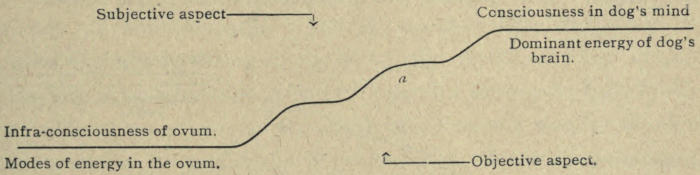
Fig. 1.
Now what the nerve-physiologists are sometimes apt to do is, at some moment of development say a, to change their point of view, from the subjective aspect which deals with consciousness to the objective aspect which deals with energy. Their conclusions are practically sound because they are still dealing with the same developmental curve. They state these conclusions in language which is philosophically misleading because they suddenly jump from the subjective aspect to the objective aspect and ignore the great distinction between the two. When they say that consciousness emerges from the physical conditions at a, they presumably mean that at this point we are first justified in speaking of consciousness or the subjective aspect in anything like a human sense. But is it not more logical to hold that, just as from the objective standpoint the complex energy of the dog’s brain has been developed from the simpler energy of the ovum, so from the subjective standpoint, the complex consciousness of the dog’s mind has been developed from the simpler infra-consciousness of the ovum? And if we do not accept this view, do we not seem committed to the unevolutionary doctrine that the conscious aspect suddenly makes its appearance, without those lowly germinal beginnings which it is of the essence of any theory of development to postulate?
It will perhaps be said that all this assumes an identity hypothesis, with its supposed double aspect, which is not accepted by the majority of men of science. Let us look at the matter, therefore, from what would seem the only other point of view open to one who accepts the theory of development as applicable alike to the dog’s mind and to the dog’s body. If states of consciousness and the molecular transactions in the brain are not different aspects of the same occurrences, they are parallel, concomitant, or associated phenomena. Our diagram will thus become that given below.
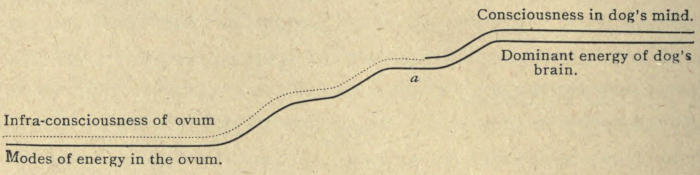
Fig. 2.
Here the parallel or associated phenomena occur together at the higher end of the developmental curve, and, at a, the consciousness is supposed to emerge. On this view there is less justification for the nerve-physiologists’ assertion that it arises out of physical processes; for it is not simply another aspect of these processes, but something wholly different arbitrarily associated with them. Even on this view it would seem more logical to suppose that since the association of mental states with the dominant neural energy is of normal occurrence from a onwards, the consciousness there emerging has been evolved from infra-consciousness parallel and concomitant with the physical processes in the ovum. If this be not so, we may once more ask: From what has the parallel line to the right of the diagram been evolved? We cannot say from the neural conditions without changing our point of view and ignoring the great distinction between matter and energy on the one hand and consciousness on the other. From what then has the consciousness been evolved, if not from something of like nature only indefinitely simpler which has here been spoken of as infra consciousness?
We must now take a further step, one however in which all evolutionists will not be prepared to follow us. Attention has already been drawn to the fact that those who accept the theory of evolution are not agreed in their faith—for it is on either side a matter rather of belief than of demonstration—with respect to the origin of life. Some believe that the primitive organic germs were not produced by natural development nor through any process of evolution. For such, the hypothesis I am advocating must be submitted in the following form—when first the life-energy was started by the direct interposition of the finger of God it was endowed with some dim form of infra-consciousness which in the course of evolution developed into consciousness. And presumably those who see in the amœba and the fertilised ovum some dim foreshadowings of consciousness may follow me thus far. But for those who believe that the organic has arisen on this earth by process of natural development from the inorganic, the hypothesis must be more sweeping in its range. We must say that all modes of energy of whatever kind whether organic or inorganic have their conscious or infra-conscious aspect.[31] Startling as this may sound there is, I believe, no other logical conclusion possible for the evolutionist pur sang. For where are we to draw the line? The states of consciousness of the higher animals have been evolved from lower forms of infra-consciousness in the amœba-like or yet more simple protoplasmic germs in the dawn of life. But if those low forms of organic infra-consciousness were themselves evolved, from what could they arise if they were not developed from yet more lowly forms of infra-consciousness similar in kind but inferior in degree associated with inorganic transformations of energy? In any case it is here submitted that this doctrine that infra-consciousness is associated with all forms of energy is necessarily implied in the phrase mental evolution for all thinkers who have grasped the distinction between consciousness and energy. And if this be admitted there is disclosed, by implication, an answer behind and beyond that ordinarily given to a question which has again and again been asked—the question:—Is there a conservation of consciousness analogous to the conservation of energy? The negative answer generally given to this question results from the fact that the question itself has always been put in a form which does not admit of a satisfactory solution. There is not a conservation of consciousness any more than there is a conservation of neural energy or a conservation of electricity. There is no conservation of neural energy because this is only one mode of energy which may be transformed into other modes. Not until we have generalised energy so as to include all its modes can we speak of conservation in reference to it. So too not until we have generalised that universal form of existence, of which consciousness is only the highest and most developed mode, so as to include all modes, can we speak of conservation in reference to it. But so generalised I submit that there is a conservation of that form of existence which includes both consciousness and infra-consciousness, co-ordinate and coextensive with the conservation of energy.[32] Just as the dominant neural transformations in the dog’s brain are like a special vortex in the onward-flowing stream of the world’s energy, so are the states of consciousness in his mind like a special vortex in the onward flowing stream of that mode of existence which, whether it have risen to the level of consciousness or not, is still of the conscious order. For the believer in scientific monism there is but one vortex, objectively presented as energy, subjectively felt in consciousness. For the dualist there are two vortices, (1) an objective vortex and (2) a subjective vortex associated with the other and “called into existence” by it. In either case the vortex is dependent for its continual existence on surrounding stores of that out of which it has arisen; and in either case the modern tendencies of scientific thought suggest conservation which is but the antithesis of creation ex nihilo.[33]
In conclusion it should be noted that this hypothesis is but a new presentation of an old speculation. It differs as it here stands from any theory of “mind-stuff” in that it regards the question rather from the dynamical than from the statical point of view. Not “mind-stuff” answering to matter but a universal conscious order or aspect of existence answering to universal energy is the leading idea I have sought to develop. In its newer form, again, this hypothesis differs from the view that “all force is will-power,” or the view that “all matter is conscious,” or the theory of “intelligent monads,” in endeavoring, not to carry anything like our consciousness down into association with the simpler manifestations of energy, but rather to seek in association with these lower manifestations the germinal states indefinitely simpler than consciousness, from which nevertheless consciousness has been developed. Finally the keynote of this newer presentation is that which is the keynote of all modern theories of life and of thought—the doctrine of evolution.
C. Lloyd Morgan.
FOOTNOTES:
THE NEW CIVILISATION DEPENDS ON MECHANICAL INVENTION.
By reason of his physical nature man is hampered by three wants—he needs food, clothing, and shelter. In his first and lowest stage of civilisation man lives in a state of enthrallment to nature. He dreads and worships the cruel forces of matter. But by the aid of science, and invention which flows from science, man attains domination or control over things and forces and directs them into the service of humanity for use or for beauty. The soul conquers nature by science and machinery and then it next desires to see this conquest over nature reflected in works of art. Hence it creates architecture, sculpture, painting, music, and poetry, all of these fine arts portraying man’s victory over wants and necessities.
If the spectacle of pauperism and crime, the savagery that still lingers in the slums of our cities, sternly reminds us of the yet feeble hold which our civilisation has obtained even in cities—if the census of mankind proves that three-fourths are yet counted as below the line that separates the half-civilised from the civilised—yet we are wont to console ourselves by the promise and potency which we can all discern in productive industry aided by the might of science and invention. This view is always hopeful. We see that there is a sort of geometric progress in the conquest over things and forces. The ability of man to create wealth continually accelerates. The more he obtains the more he can obtain. The more each one gets the more his neighbor also can get. Even the weakling of society, the pauper or beggar, the insane, and the criminal all fare better in the centres of wealth than they do at a distance from them where there is no wealth to beg or steal and no asylums created and sustained by wealth to shelter and heal their diseased bodies.
Wealth in the modern sense of the word, far more than in its ancient sense, is self-productive. It is capital, and capital is wealth that generates wealth. Capital represents conquered forces and things—conquered for the supply of human wants. Capital consists of natural forces yoked and set to work for food, clothing, shelter, and the facilities of human culture. The three physical wants (food, clothing, and shelter) are produced by nature—they are the chains and fetters whereby nature asserts her right to enslave humanity—to keep man in a state of thralldom.
But the Promethean cunning of man, realised first in science and next in useful machines, has succeeded in subduing the powers of nature and imposing on them the task of supplying and gratifying the very needs which nature creates in us. Nature had chained man to the task of daily toil for food, clothing, and shelter. But man turns back upon nature and compels her to take the place of human drudgery and produce an abundance of these needed supplies and bring them wherever they are needed for consumption. This is accomplished by mechanical combinations that secure the service of steam, electricity, and various devices of earth, air, fire, and water.
This self-generating wealth that exists in the shape of capital is so much on the increase that it fills all classes of our population with hopes or if not with hopes at least with discontents—and discontent is certainly the product of hope struggling up from the depths of the soul. Without the vivid perception of a higher ideal and without the feeling that it is attainable, there would not be any such thing as discontent. The average production of man, woman, and child in the United States increased in the thirty years between 1850 and 1880 from about 25 cents per day to 40 cents per day—an increase of over 60 per cent. This means the production of far more substantial improvements for human comfort. Much more wealth is created that possesses an enduring character and may be handed down to the next generation. Finer dwellings, better roads and streets, fences for lands, drainings and levelings, and the processes necessary to bring wild land under cultivation, artificial supplies of water and gas, the warehouses and elevators, and the appliances of commerce—and finally the buildings and furnishings of culture, including churches, schools, libraries, museums, asylums, and all manner of public buildings. Great Britain, the leading nation in commerce and manufactures, according to the returns for 1888 (see Mulhall’s “Dict. Statistics,” new edition) distributed comfortable incomes of $1000 and upwards to each family of 30 per cent. of the entire population, and the remaining 70 per cent. averaged $485 per annum (for each family). France provided incomes of $1300 per annum for 24 per cent. of its families. This shows what great capitalists are doing for the creation and distribution of wealth. Italy showed by its income returns that less than 2 per cent. received incomes of $1000 and upwards, while 98 per cent. of the families averaged less than $300 income. Italy makes little use of steam power and labor saving machines.
If science progresses and its concomitant, useful invention, progresses as fast for the next hundred years as it has done for the past forty years, the vision of Edward Bellamy of comfort for all will be realised without the necessity of any form of socialism. There will be comfort and even luxury for all who will labor a moderate amount of time.
Science inventories nature and discovers properties and possible combinations. Invention uses these combinations to meet mechanical problems. Can any one doubt who looks into the state of science and its continually improving methods that the conquest of nature will be more rapid in the coming century than it has been in the past century?
But we are challenged by the question: What is the good of annihilating the necessity for bodily toil? Will not man degenerate spiritually as he comes to possess luxury at cheaper and cheaper rates? These material advantages gained by useful invention which create a steady and permanent supply of food, clothing, and shelter, are they not mere sumptuary provisions and do they imply progress in civilisation? To this challenge we reply by pointing out the relation of invention to the communication of intelligence and the diffusion of knowledge by newspaper and book.
In the first place it is obvious that the three classes of employments devoted chiefly to the supply of the physical wants—namely agriculture, manufactures, and commerce—are undergoing change by aid of mechanic invention in such a manner as to bring the laborer everywhere more and more into relation with his fellow men. In other words commerce increases more and more, and becomes a part of all employments. In exchanging goods each gets something that he needed more than what he parted with. But the best result of the exchange is the acquaintance formed between producer and consumer. Each has learned something of the other’s ideas, modes of looking at the world and habits of action. Each one’s life is enriched by the addition of the knowledge of the life of the other.
Man as a spiritual being has for his problem the exploration of the two worlds—the worlds of nature and man. The problem is too great for the individual and he must avail himself of the work of others. Each man may inventory a small portion of nature different from all others. Each one may live a life different from another’s. But the individual gets a very small glimpse of nature by the aid of his own senses. He gets a very small arc of the total of human life in his survey of his own biography.
But by intercommunication each one may extend and supplement his own observations of nature and of the experience of life,—he may avail himself of the aid of the sense-perceptions of others and still more of the aid of the thoughts and reflections of others.
We see at once that man is man because he possesses and uses this means of re-enforcing his individual observations and reflections by those of the race. Man is an individual endowed with the power of absorbing the results of the race. We have with this a definition of civilisation and a standard of measurement by which we may determine the rate of progress. Advancement means that there are improved means realised by which each individual can give to the rest of mankind the results of his living and doing and thinking and at the same time share in the lives, thoughts, and deeds of others.
Looked at in the light of this definition we shall be enabled to claim progress in civilisation on substantial grounds. We shall be able to see something more hopeful in the material progress promised us in the coming century than the cheap supply of bodily comforts. We see a progressive increase of intercommunication which will enable each individual to command the results of the rational intelligence of all mankind.
Man is first a speaking animal and next a writing animal. Each word that he uses expresses a general meaning. Each word therefore stores up an indefinite amount of experience. All men may pour into it their experience and by it recognise the experience of others. The art of writing at once increases infinitely the possibility of intercommunication because it preserves the experience recorded for persons widely separated in space and far removed in time. It renders every where in some sense a here and every when a now. But mechanic invention comes to the aid of speech and the elementary arts of writing by printing with movable types. Printing and gunpowder are two great elementary arts both attributed to the Germanic race—the two wheels of modern civilisation so to speak. But the Anglo-Saxon has added the steam engine and the telegraph. The one makes locomotion possible to an increasing degree and the other makes instantaneous intercommunication with all places possible.
Armed with these instrumentalities our modern civilisation lives in a sort of spiritual border land. It looks across the frontier and is in a constant process of interaction with all other nations. The great instrument of this process is the daily newspaper. Our people are becoming from year to year a travelled people—in a short time the per cent. of the population that has crossed the ocean has doubled. The per cent. that has visited the western border land has quadrupled. But the number of people who live in constant daily interrelation with all mankind by aid of the daily newspaper has increased a hundred fold within a single generation.
The test of a civilisation is its efficiency in re-enforcing the endeavors of each individual so as to give him access to the labors of the world. We are approaching a spiritual civilisation as well as an era of the general distribution of wealth.
W. T. Harris.
RELIGION AND PROGRESS. INTERPRETED BY THE LIFE AND LAST WORK OF WATHEN MARK WILKS CALL.
On August 20, 1890, died Wathen Mark Wilks Call, M. A.,—a spirit finely touched to fine issues. The posthumous work before me revives the sense of personal bereavement, but soothes it with the satisfaction of holding another interview with the beloved scholar on themes that through many years engaged our conversation. Here is a casket of golden thoughts cast up from the deep where went down the white-winged ship freighted with such treasures. The general world is unconscious that it is poorer; its ports and marts had little welcome for the dainty wares of this unfamiliar bark. Many an American thinker will through this specimen of the sunken treasures realise the world’s loss when it is irreparable; and some who used to hover around the silver sail now vanished, and come ashore laden with its gifts, have wondered that this writer, valued by Mill, George Eliot, and the scholarly English circle, should have courted obscurity rather than fame. He was not indolent, though his published volumes were few: “Lyra Hellenica” (1842), “Reverberations” (1849, second edition 1876), “Golden Histories” (1871). Besides his poems, his contributions in the reviews,—some, like “The Nero Saga” (Theological Review, July, 1871), equal to volumes,—would make a substantial and important collection. There is enough thought and learning in his poems and anonymous articles, to have earned fame for an ambitious and pushing author. Why then did the world get so much less than it ought to have got from this fine and active brain, and why is he so little known?
Many years ago I heard from his own lips the story of his life, which is partly told in the fifty pages that introduce this book, under the title “A Chapter from my Autobiography.” It will there be seen that even so late as thirty-six years ago the finest minds and hearts that could not accept creed-dogmas might be almost mortally wounded. From that time he lived and wrote as from a retreat. The actual case, as he told it me, was that his sister, a widow, left him executor of her last will and testament, and the guardian of her children. He was tenderly attached to this sister and to her children. She knew his opinions and his doubts. When he went into the court for confirmation of his trust he was confronted by the postscript of a letter he had written to a supposed friend intimating his “dissent from the creeds of the churches.” For this mild and vague heresy he was prevented from acting as the guardian of his sister’s children, and fulfilling a sacred trust.
At this time he was a clergyman in the Church of England, which to-day contains many ministers more unorthodox than Mr. Call was when he received this crushing legal blow. This public disgrace of a sensitive scholar, the loss of position, the alienation of friends, added to the grief of seeing his sister’s children carried to strangers, parted him from the world. He seemed to have no place in it. Stunned, lacerated, he had no heart to enter on any new profession. But from his retreat came the poems, pathetic but hopeful, entitled “Reverberations,” some of which are sung in the liberal chapels of England. Deified egotism and vengeance had brought home to him all their heartlessness: all nature was overcast with this chilling cloud.
Silently bearing his grief, he gave himself to the search for truth in those matters which had been predetermined for him by a thousand subtle influences and associations. Born in 1817, he had graduated at Cambridge,—the chief poet of its Magazine,—had passed through his Shelleyan phase of scepticism, and entered the church (1845) through one of the many casuistical blind-ways provided in that old minster for those who hesitate at the main portal. Eleven years were occupied in passing from one to another theoretical cloister or tower of the venerated church before he finally discovered that it had no place for him. Nor was there any church which he could honestly enter. He must be the hermit of his truth. But in that retreat, where the lonely scholar must eat his own heart, the healing hand of a true divinity found him.
Love found him. He married (1857) a lady whose beauty was the expression of her genius. Her father was Dr. Brabant, the friend of Strauss, and founder of the Westminster Review. In early life she married C. C. Hennell, author of “An Inquiry into the Origin of Christianity,”—a work which made a deep impression on Theodore Parker, who made it the subject of an article in the old Dial. Miss Brabant, versed in ancient and modern languages, did excellent work on the Westminster Review, assisted by her friend Marian Evans, afterwards known as “George Eliot.” These two ladies, as I have heard, undertook together the translation of Strauss’s “Leben Jesu,” and were more than half through it when Miss Brabant married. By a contrivance of Mrs. Hennell the name of Marian Evans alone, and to her regret, appeared on the title-page. “George Eliot” thereby gained a reputation helpful to her, though somewhat embarrassing, implying as it did a knowledge of Hebrew and Greek which she did not possess.
Mr. Call’s marriage was most happy. The Calls were regarded by their circle of kindred spirits as representing the true ideal union. They had together shared the friendship of the finest intellects, and had moved abreast in intellectual progress, for more than the life of a generation when parted by death.
About seven years ago trouble for the first time entered this almost sacred household. A formidable consumption of one lung set in, threatening Mr. Call’s life. I have always believed that this was the long latent bequest of pious cruelties suffered in earlier life. Six years ago the case became hopeless, in its normal course, and the physicians said that the only possibility of recovery lay in a rare and difficult operation, imperilling the few months of life that might remain. The patient and his devoted wife resolved to incur this risk. A tube was inserted through the back; through it the pus was drained from the ulcerated lung; and little by little the tube was withdrawn, by infinitesimal degrees, as the healing process went on behind it. It was a painful anxious process of many weeks. At this time, when he was kept motionless, I marvelled at his cheerful spirit; though the slightest miscarriage in the wearisome operation might prove fatal, the patient was always serene. One of his physicians, by no means sure of the result, approached him on the subject of religion, and the condition of his soul. Soon after Mr. Call gave me an account of the conversation. In religious matters the doctor had dabbled where Call had dived; it ended in the physician’s being compelled to consider the condition of his own soul, and why he should be holding the religion of primitive man along with a science almost able to raise the dead.
The wonderful operation was perfectly successful. Love had healed the young man’s broken heart; science had healed the mature man’s dying frame. The real miracles that supplant fictitious ones, and fulfil their fables, had been brought home to him. Five happy years were added to his life, during which he wrote the important work to be hereafter considered. On a summer evening last year he passed a pleasant evening at home, ended with a game of cribbage with his wife. During the night he died painlessly of heart disease; a post mortem examination proved the lungs quite sound. My friend’s body and mind and affections were so combined in organic unity that his very ailments had for me symbolical significance. The unsuspected failure of the heart, for instance, seems a last sequel of the spiritual lesion given him by Dogma as a parting blow: its counterpart is to me visible in the fact that after writing this work he hardly had heart to publish it. The substance of it was completed in 1887; it was entirely finished in 1889; it lay in his library one year. His wife wished him to publish it—so she told me—but he thought the world would not be interested in his views. So deep had bigotry been able to send this man into the vale of Humiliation; and what an intellect was thus discouraged may be partly estimated by those who shall read this book on “Final Causes” published by his widow.
In the last generation many young men, awakened by the song of Byron and Shelley, started out on a new spiritual pilgrimage. Their path was at first fringed with poetic flowers, and in the distance shone the city called Beautiful. But the path at length became flinty, the city became more dim with progress towards it, and many a pilgrim turned back. Those who pressed on were unique men, so that they came to parting ways, and each had to advance on his individual and lonely path, albeit they were travelling in the same direction. The records of these pilgrimages, wherever found, are chapters in the scriptures of their generation. There is one thing common to them all,—the tenacity with which they have clung to their old faith, and after it to their old church, until beaten off by bigotry or by conscience. “My God, my God, why hast thou forsaken me?” It was no mere cry, but a question reaching far into the ages, and stirring innumerable crucified hearts that have found no voice. Men do not forsake their God; their God forsakes them. They have invested some ancient name with all the pearls of their heart; they have idealised him as wisdom, justice, love, compassion; but no sooner do they think an honest thought, or maintain justice and love against unjust and heartless dogmas, than their Good Shepherd beats such tender lambs with his crook and sets the wolves on them. Yet even then, so long as they can, they keep in the fold, and lift their lacerated hands in prayer. They will even practice some self-deception that they may continue the old formulas after the truth has forsaken these.
Mr. Call’s youthful scepticism,—a spell wrought by Byron and Shelley,—being chiefly the expression of others’ experiences, and with but little root in his own, carried him no further than the study of philosophy and theology. It was not deep enough to prevent his entering on residence in the University of Cambridge with a view of becoming a clergyman. The struggle being not yet in the arena of his own life and heart, but a combat for his soul between the Humes and the Jeremy Taylors, poetic sentiment easily carried the day. His nature clamored for a realised ideal, and the Church captivated him. “The church, as the embodiment of celestial truth, as the aggregate of noble and beautiful spirits, dead or living, appeared a sublime conception.” When a youth falls in love does he consider whether his beautiful lady’s bloom may not be hectic, or hereditary cancer be hovering near the fair breast? Our young scholar weds our Lady of the Litany amid the light of stained windows, and the white-robed choristers. He presently finds that the lovely creature insists on his preaching the doctrine that all who do not yield to her charms are to be burnt at the stake eternally. “Human philosophy had failed to explain to me the mystery of existence; Christian philosophy explained it to be the perpetuation of sin and misery, intensified by omnipotent intervention.” Recoiling from this the young clergyman went through years of critical investigation; he mastered the exegesis of the Germans and the French; and at length found himself a simple believer in the religion of Humanity. He, a clergyman of the Church of England!
In the fifty preliminary pages of this posthumous book, comprising “A Chapter from my Autobiography,” we have a succinct and useful summary of the crucial criticisms under which biblical authority and supernaturalism have been relegated to professional casuistry. This we will not study here—profoundly interesting as it is—but dwell for a little on the situation in which the scholar found himself.
“While I had thus been working my way through darkness into light—the sober light of sad reality—life had been bringing to all who belonged to me, as well as to myself, varied experiences of pain and sorrow. For their sake I had already done violence to my better nature. Was I now to render the previous sacrifice nugatory? Was the black shadow of my unbelief to enfold those who had already more than their share of the burden of life to sustain? Sympathising friends had early encouraged me to retain my position in the church. A beneficed clergyman, advanced in years, whose studies had ended, like my own, in the abandonment of dogmatic Christianity, had drawn up a statement of the motives which, as he argued, justified him in the retention of his preferment. This statement was forwarded to me. A celebrated and venerable German professor had sent me a message deprecating the abandonment of a post which, he thought, I might continue to occupy without dishonor to myself and with profit to others. I had hitherto deferred to the judgment of persons whom I regarded as superior to myself in knowledge of life and in ability to determine questions of moral obligation; but the progress of unbelief and enlarged experience decided me, at last, on the adoption of an independent course of thought and action. Taking counsel of my own heart, I resolved to terminate a conflict which had become intolerable. Painful and singular complications preceded, accompanied, and followed my retirement from the English Church.”
Here is the “Robert Elsmere” of real life. Since Mr. Call left the Church of England, thirty-five years ago, it has become a largely rationalistic institution. Legal prosecutions of clergymen for heresy have resulted in proving that the evangelical and orthodox have no more right to the Church, in Law, than the liberals. They were usurpers of authority not guaranteed by the constitution, in which there is nothing requiring a clergyman to believe in hell, or the devil, or miracles, or the infallibility of the Bible. Many clergymen are now honestly preaching a simple theistic and humanitarian religion, and when told they ought to leave the Church need only reply, “If you think so you have a right to prosecute me.”
The English charlatan who calls himself “Father Ignatius,” who could only make himself ridiculous as a heresy-hunter abroad, seems to have found the Episcopal Church in New York provincial enough to take him seriously. He would never venture to suggest the prosecution of a Broad Churchman at home. His ignorant tribe have too keen a recollection of their severe falls in grappling with Bishop Colenso, and the authors of “Essays and Reviews.” We have, however, to deal with America, where the sects, by departure of some of their best brains, seem falling more and more under control of their illiberal constituents, though the consecration of Bishop Phillips Brooks show that reactionists will not have it all their own way. The passage I have quoted above bears upon a moral problem which has already become urgent among us, and in the progress of inquiry must inevitably become of very serious importance to large numbers of ministers and their families. I therefore introduce here a little digression on this subject.
What is the moral duty of a young minister who finds himself occupying the pulpit of a denomination in whose generally accepted doctrines he has ceased to believe? The New York Evening Post recently declared this to be a plain moral question. If—thus it argues—a man has voluntarily entered the ministry of a church, and afterwards forms opinions which, if known, would have prevented his admission, he is morally bound to resign. But the question is much more complex than that. In a majority of cases the minister has not entered “voluntarily,”—within the genuine moral scope of that term. His orthodox parents, abetted by their preacher, have kept light from him, repressed his reason, imprisoned him in Sunday schools and prayer-meetings; he has been accorded no free choice; he has been led as a captive, before his intellect was capable of judgment, artificially terrified about his soul, and the world’s danger of damnation, and at length found himself in the pulpit. When the victim finds himself disabused of these fictions, what is his duty? In my belief it would be immoral for him to resign without having first secured a public decision of his church on the issue. His paramount obligations are to the community in which he lives. He is morally bound to preach the truth as he sees it, openly, honestly, plainly. He cannot utter the discredited creeds, prayers, or dogmas. But he has a right,—nay he is bound,—to throw upon the church which has entrapped him the responsibility of repudiating his principles and doctrines. He should say to his church: “You are responsible for the unhappy situation in which I find myself. By your zealous propaganda you frightened or persuaded my parents, my friends, myself, into acceptance of dogmas I now find false. The logical result of taking you seriously was to turn from all worldly occupations, and devote my life to the work of saving mankind from a terrible doom. Now, awakened from the nightmare superinduced by you, I find myself past the opportunities of youth, the time for preparations in other professions irrecoverably lost, and a family dependent on me. The situation concerns not only you and me, but others we have involved. For years I have been laboring with you to try and persuade other youths into the same situation as my own. Something is due to them. I have deceived them and must undeceive them. You say I must be true, but you must be true also. I have innocently reached a position which enables me to compel you to publish to the world exactly where you stand. I will clearly define my convictions: if you cannot tolerate them in your pulpit the youth will know the precise limits to their freedom they agree to in entering your ministry. If you can tolerate them they will know your liberalism. Therefore I remain here proclaiming my truth, and will not help you to cover the truth up by a resignation relieving you of the duty of proclaiming your position with equal clearness. You have got me here, and if I go now you must turn me out. So shall the cause of truth be advanced.”
While this may be affirmed, I think, as a general ethical principle, it is equally true that each case must be judged by itself. The above principle depends on the condition that the ministry has been honestly entered from religious motives, there being no mental reservations at that time. It will be observed that in the case of Mr. Call the consideration entered that he had passed through a phase of Shelleyan scepticism in early youth. This had to be weighed, and perhaps may have had much to do with his determination to retire voluntarily from the ministry. He never concealed his views, however, and it is well known that great efforts are made by older preachers to beat down the scepticism that often arises in the minds of young candidates for the ministry. In such case these unwise advisers assume a large share of responsibility for the event, whether enough to justify the subsequent heretic in compelling a conflict must depend on the minister’s conscience. Although, therefore, Mr. Call decided rightly, in accordance with his moral consciousness, it were by no means fair to maintain, with the author of “Robert Elsmere,” that ministers who find themselves more liberal than the majority of preachers in their church should surrender to such mere superiority of physical force without testing its legality and laying on it responsibility for its exercise of power. Robert Elsmere should, on moral principles, have remained in the church. By so remaining Colenso, Dean Stanley, Charles Kingsley, Max Müller, Professor Jowett, Matthew Arnold, and others, have revealed the fact that, in their church, thought is not delivered up by law to the despotism of a majority.
The case, however, is somewhat different again where the new opinions adopted by a minister amount to an abandonment of the fundamental doctrines of his church. That may not exonerate him from demanding a formal and public declaration of the church, but this being secured, it must affect his relation to the general world. Should it be proved that he may be legally tolerated, he must then consider whether it is his legitimate means of influence, or whether he would be substituting for his own expression the mask of an extinct faith. The ethical principle above affirmed relates to the first practical step of the minister whose beliefs have changed. The progressive and inquiring mind that continues in a church where it is barely tolerated does so at great peril. Where the swift foot agrees to march with the halt the pace must be that of the halt. Sceptical minds occupying pulpits even of liberal denominations are likely to discover, should such engagements end, that they have been unconsciously arresting their own development in finding a conciliatory modus vivendi with the reactionary brethren. There is, indeed, a class of fine intellects, like the great English Broad Churchmen already named, whose comparatively advanced views are the result of larger learning; they have discovered that two and two are four, and gathered courage to deny that the amount is five. These constitute the right leaven by which great organisations are raised to higher standards of knowledge and veracity. But there are original and philosophic inquirers whose particular power were only buried in such organisations, without elevating them. These are due to the corps of pioneers in the direction whither the organisations are advancing. Their task is original research. These cannot wisely wear the uniform of any religious or political party.
Mr. Call was such an original mind, and after he had left the English church his course was to the maturity represented in this ripe book on “Final Causes.” But had he not passed eleven of his best years in the church, out of his true habitat, we should have more fruit of this fine flavor. It is therefore a voice from his experience that here reaches us, as from his grave:
“Scepticism has been vigorously advancing in the nation—I might say, in Europe. And not only has it extended its sphere, but it includes within that sphere some of the loftiest and profoundest intellects of the age—men renowned for vast and exact erudition, for scientific research or critical acumen. Philosophers, poets, historians, novelists, openly or silently disavow Christianity. In palaces, in lordly mansions, in college halls, in secluded homesteads, and here and there in rectory or vicarage, scepticism, if it has not a bold and fearless utterance, at least expresses itself in a guarded whisper. It becomes doubly a duty, then, when notwithstanding the general diffusion of avowed or latent unbelief, we trace everywhere the presence of a conservatism that conceals and hesitates and trembles at the doubts which it cannot suppress, that individual dissentients should candidly disclose their theological divergences. Christianity, indeed, which has had its triumphs in the past, will long conserve a portion of its power, and continue to furnish guidance not only for the unreasoning multitude, but for thousands of excellent men and women who cannot abandon the old religious ideal. But there is no final arrest for the intellectual progress of mankind.”
We now turn to Mr. Call’s work on “Final Causes.” In an introductory chapter of eight pages he compresses the history of the doctrine of Design in nature from Anaxagoras, B. C. 500, to our own time, stating its modifications, criticisms, denials. In the second chapter a brief account is given of “Natural Theology,” whose modern form is found to rest fundamentally on Newton’s generalisation, that a body at rest continues at rest unless acted upon by some external force; and on the geometrical order of planetary revolutions. Starting anew from this point the human mind has discovered in the varied realms of nature apparent evidences of a supersensuous Intelligence. Kant, however, is brought to criticise Newton. “Kant notes with delight that the ‘harmonical relations which excite the feelings in a more sublime manner than even the contingent beauties of nature originate in the properties of space’; and this inevitable congruity he refers ultimately, indeed, to Divine Wisdom, but directly to a common dependence on a single sovereign ground, to a unity of possibilities which it is no more difficult to conceive as self-existent than it is to conceive an Intelligent Cause as self-existent.” Matter is not, then, naturally inert, but an aggregate of forms and forces, and nature a self-adjusting, self-evolving power. In a chapter on “Order and General Adaptation” it is shown that nature contains vast realms of Disorder; and alleged “special adaptations” are shown too as often as otherwise for cruelty and agony. “With what feelings,” asks G. H. Lewes, “can we contemplate the destruction of such an organism as that of man for the sake of some microscopic animal made to live upon it? With what feelings can we think of a human being sacrificed to the growth of cancer-cells? What is the contrivance and benevolence here?” Particular illustrations of design on which teleologists have depended,—the eye, the bee’s cell, the bird’s wing—are examined with critical and scientific care, and imperfections, gratuitous and cruel if ascribed to omnipotent wisdom, found everywhere. “To assert that the Creator of the world is infinitely powerful and infinitely wise were to deny that he is infinitely good.”
To escape the dilemma just stated, some theists postulate a “limited or constitutional deity.” Dr. Martineau’s idea of a “material datum objective to God” is an effort to relieve the deity of responsibility for the evils of nature, but Mr. Call declares the selection of “power” as the limited attribute is arbitrary. We have, he thinks, no more logical right to limit the deity’s power than his intelligence, or his benevolence. (This is doubtful, however, and requires more consideration than is here given it.) “The Evolutionary God” is next considered, and disproved by the uselessness and unfitness of some structures in various organisations, the often injurious character of others, (e.g. the intestinal canal called the vermiform process,) while the moral sense is still offended by the general predatory method of natural selection.
The validity of the Design argument disposed of, Mr. Call leaves to the theist whatever evidences of a deity he may find in his ideals, emotions, aspirations, intuitions. He points out that the Designer thus disproved has never been able to satisfy the intellect or heart, the like being true of the “Unknowable.” The sole sacred ideal left us is that of humanity; not of the whole race but of the purer, nobler constituents of it.
“As Humanity will be the sole Ideal Object to which dutiful obligation and exalted sentiment will be referred, so the world of Humanity will be the world revealed, not by divine inspiration or metaphysical intuition, but by Positive Science The shadowy abstractions of the speculative rationalist, the fanciful conceptions of the theologian, will gradually pass away. To the Semitic explanation of the world and of man will succeed that of Laplace and Darwin. The great and majestic truths of the stellar universe, the mysteries of life, of light, of heat, of sound; the wonders of natural history, the magic of geologic lore, the epic of man’s progression in time; the exaltation, the solace, the delight which flow from poetry, music, painting, sculpture; the interest in the arts, industrial no less than æsthetic; in the fellowship of work which ameliorates the common lot; in friendships of man and woman, short of passionate love, and in the happier profounder affection of wife and husband; in all home charities and patriotic activities, and in the identification of personal ‘feelings with the entire life of the human race’;—all these incidents of thought and varieties of emotion and action will possess the intellect and fill the heart of future generations, in a mode and degree which we can now only imperfectly realise, and which, in the end, will leave men but little reason to regret that the raptures of saint or prophet, or the splendours of ancient theocracy, or the power and glory of the Mediæval Church, or the imposing premise of Hellenic or of Teutonic speculation, are as the dreams of a night that has passed forever away.”
Have we, in this prophetic conclusion, the afterglow of a faith sunk beneath the horizon? Why should we suppose that such beautiful things will come to pass in the future? Such prophecies have hitherto been inspired by belief in an overruling and omnipotent Love. But we are now brought by science and philosophy to the misgiving of Solomon, “We are born at all adventure.” Things, the sceptic may say, will grow better if man compels them so, otherwise they can as easily grow worse.
It appears to me that in the old dogma of Jehovah’s curse on the world and its redemption by Jesus there is buried, as in a sarcophagus, a skeleton of human nature, and of moral history, resembling the man of to-day, and the history we are making. There was an appeal of the human heart from Jehovah to Jesus,—from the cursing to the saving deity. The terrible arraignments of nature written by some of the greatest men since Darwin’s discovery have not found any one to answer them. The severest indictment of the world, perhaps, is that by the late Cardinal Newman, who declares, “Either there is no Creator, or this living society of men is in a true sense discarded from his presence.... Since there is a God, the human race is implicated in some terrible aboriginal calamity.” From a deity who having created his own materials, built up a creation liable to such calamity, mankind are once more appealing. The ancient case was Jesus vs. Jehovah; the present case is Humanity vs. the Creator of Nature. This rebellion of the moral sentiment and of compassionateness is not intellectually conscious; it goes on, and for a long time must go on, with ceremonial respect to the Final Cause of all the evils humanity tries to heal; but it appears to me certain that the heart and enthusiasm which once went out to a personal God are again turning to a crucified humanity. The humanitarian movements of our time have arisen simultaneously with the overwhelming evidences of nature’s cruelty and imperfections revealed by Science. The earlier deists appealed from biblical superstitions and ecclesiastical cruelties to the God visible in the order and beauty of the universe. With the existence of evil in external nature they never grappled. Bishop Butler’s “Analogy” first stated the problem. He answered deistic objections to the inhumanities of the Bible by pointing out the like in nature. Instead of answering the deists he set them on a new departure which has ended in results summed up in Mr. Call’s book. The omnipotent creator of nature is following the biblical Jehovah into extinction. But the instincts and aspirations of the human heart and mind remain the same; the religious sentiment remains. The stream that is dammed up in one direction or another does not lose any force thereby; it streams into other channels if it can find such, or floods field and village if it finds none. It will beat earthward as strongly as it once beat heavenward; it will, if channels be not provided, carry away institutions as it has carried away gods and goddesses.
It has become therefore of great importance to recognise if possible the lines of least resistance along the mighty stream of religious enthusiasm, and provide that its energies shall not be destructive but conservative of human welfare. At present the most conservative force in the earth is ignorance: were the suffering masses of the world to discover, suddenly and universally, that the old creeds are fictions, their evils not providential, their heavenly hopes vain, every nation would be filled with convulsions. Fortunately the sun is not shot up into the heavens. But enlightenment progresses rapidly, and we have begun none too soon turning the rising flood of light and fire into the human channels long obstructed by sanctified inhumanities.
Mr. Call’s little book, which I hope will find publication and wide circulation in America, sums up succinctly and cogently the present religious situation, and the steps by which it has been reached. It remains for us all to sweep the new horizon with eye and telescope, to compare our observations and to catch the first ray of the star that shall point wise men to the new incarnation. To my own mind this book is one of the many signs and promises that the divine will be steadily merged into and identified with the human. Not with humanity as an objective and historical entity, as Comte believed, but with the distinctive characteristics of humanity, the supreme qualities of reason and love: this will become the ideal of the reasoners and the lovers; it will then become the creating Word, instructing all; it will finally be made flesh and dwell among us, and all shall behold in it the glory of the kingdom of Man.
Moncure D. Conway.
FACTS AND MENTAL SYMBOLS.
I perceive from Dr. Carus’s answer to my letter in No. 3 Vol. I of The Monist, that amid all the agreement of our mutual endeavors a material difference of opinion exists between us on an important question of special character. As I was not successful in rendering my thought clear on this point, I shall endeavor on the present occasion to explain what it was that forced me to abandon my old position (1863), which is very near to that of Dr. Carus, and to assume a new one. The supposition that our difference of opinion is merely apparent and can be adjusted by a precise agreement as to the terms employed is a very natural one in philosophical discussions. It is hardly tenable, though, when the divergent views in question arise subsequently to one another in the same person.
I must state, in starting, that I pursued in my youth physical and philosophical studies, particularly psychology, with equal ardor. There was hardly the question at that time of an experimental psychology, of a relation of psychological to physiological research. No more so did physics at that day think of a psychological analysis of the notions it was constantly employing. How the notions of “body,” “matter,” “atom,” etc., were come by, was not investigated. Objects were given of which physicists never questioned the inviolability and with which they unconcernedly pursued their labors.
The fields of physical and psychological research thus stood unconciliated the one by the side of the other, each having its own particular concepts, methods, and theories. No one questioned, indeed, that the two departments were connected in some way. The way, however, appeared an insoluble riddle; as it yet appears to Dubois-Reymond.
Now although this condition of things was not such as to satisfy my mind, it was nevertheless natural that as a student I should seek to acquire tentatively the prevailing views of both provinces and put them into consistent connection with one another.
I thus formed provisorily the view that Nature has two sides—a physical and a psychological side. If psychical life is to be harmonised at all with the theories of physics we are obliged, I thought, to conceive of the atoms as feeling (ensouled). The various dynamic phenomena of the atoms would then represent the physical processes, while the internal states connected therewith would be the phenomena of psychic life. If we accept in faith and seriousness the atomistic speculations of the physicists and of the early psychologists (on the unity of the soul), I still see hardly any other course to arrive at a half-way supportable monistic conception.
It is unnecessary to set forth at length here what a prominent place the artificial scaffolding we employ in the construction of our knowledge assumes in these monadic theories as contradistinguished from the facts that deserve knowledge, and how poorly such theories satisfy in the long run a vigorous mind. As a fact, employment with this cumbrous artifice was in my case the means that effected very soon the appearance of my better conviction, already latently present.[34]
In the further progress of my physical work I soon discovered that it was very necessary sharply to distinguish between what we see and what we mentally supply. When, for example, I imagine heat as a substance (a fluid) that passes from one body into another, I follow with ease the phenomena of conduction and compensation. This idea led Black, who established it, to the discovery of specific heat, of the latent heat of fusion and vaporisation, and so forth. This same idea of a constant quantity of heat-substance prevented on the other hand Black’s successors from using their eyes. They no longer mark the fact which every savage knows, that heat is produced by friction. By the help of his undulatory theory Huygens follows with ease the phenomena of the reflexion and refraction of light. The same theory prevents him, for he thinks solely of the longitudinal waves with which he was familiar, from marking the fact of polarisation which he himself discovered, but which Newton on the other hand, undisturbed by theories, perceives at once. The conception of fluids acting at a distance on conductors charged with electricity facilitates our view of the behavior of the objects charged, but it stood in the way of the discovery of the specific inductive capacity, which was reserved for the eye of Faraday undimmed by any traditional theories.
Valuable therefore as the conceptions may be which we mentally (theoretically) supply in our pursuit of facts, bringing to bear, as they do, older, richer, more general, and more familiar experiences on facts that stand alone, thus affording us a broader field of view, nevertheless, the same conceptions may, as classical examples and our own experience demonstrate, lead us astray. For a theory, indeed, always puts in the place of a fact something different, something more simple, which is qualified to represent it in some certain aspect, but for the very reason that it is different does not represent it in other aspects. When in the place of light Huygens mentally put the familiar phenomenon of sound, light itself appeared to him as a thing that he knew, but with respect to polarisation, which sound-waves lack, as a thing with which he was doubly unacquainted. Our theories are abstractions, which, while they place in relief that which is important for certain fixed cases, neglect almost necessarily, or even disguise, what is important for other cases. The law of refraction looks upon rays of light as homogeneous straight lines, and that is sufficient for the comprehension of the geometrical aspect of the matter. But the propositions that relate to refraction will never lead us to the fact that the rays of light are periodical, that they interfere. Just the contrary, the favorite and familiar conception of a ray as a smooth straight line will rather render this discovery difficult.
Only in rare cases will the resemblance between a fact and its theoretical conception extend further than we ourselves postulate. Then the theoretical conception may lead to the discovery of new facts, of which conical refraction, circular polarisation, and Hertz’s electric waves furnish examples that stand in opposition to those given above. But as a general rule we have every reason to distinguish sharply between our theoretical conceptions of phenomena and that which we observe. The former must be regarded merely as auxiliary instruments that have been created for a definite purpose and which possess permanent value only with respect to that purpose. No one will seriously imagine for a moment that a real circle with angles and sines actually performs functions in the refraction of light. Every one, on the contrary, regards the formula sinα/sinβ = n as a kind of geometrical model that imitates in form the refraction of light and takes its place in our mind. In this sense, I take it, all the theoretical conceptions of physics—caloric, electricity, light-waves, molecules, atoms, and energy—must be regarded as mere helps or expedients to facilitate our viewing things. Even within the domain of physics itself the greatest care must be exercised in transferring theories from one department to another, and above all more instruction is not to be expected from a theory than from the facts themselves.
But instances were not lacking that demonstrated to me, how much greater the confusion was which was produced by the direct transference of theories, methods, and inquiries that were legitimate in physics, into the field of psychology.
Allow me to illustrate this by a few examples.
A physicist observes an image on the retina of an excised eye, notices that it is turned upside down with respect to the objects imaged, and puts to himself very naturally the question, How does a luminous point situated at the top come to be reflected on the retina at the bottom? He answers this question by the aid of dioptrical studies. If, now, this question, which is perfectly legitimate in the province of physics, be transferred to the domain of psychology, only obscurity will be produced. The question why we see the inverted retina-image upright, has no meaning as a psychological problem. The light-sensations of the separate spots of the retina are connected with sensations of locality from the very beginning, and we name the places that correspond to the parts down, up. Such a question cannot present itself to the perceiving subject.
It is the same with the well-known theory of projection. The problem of the physicist is, to seek the luminous object-point of a point imaged on the retina of the eye in the backward prolonged ray passing through the point of intersection of the eye. For the perceiving subject this problem does not exist, as the light-sensations of the retinal spots are connected from the beginning with determinate space-sensations. The entire theory of the psychological origin of the “external” world by the projection of sensations outwards is founded in my opinion on a mistaken transference of a physically formulated inquiry into the province of psychology. Our sensations of sight and touch are bound up with, are connected with, various different sensations of space, that is to say these sensations have an existence by the side of one another or outside of one another, exist in other words in a spatial field, in which our body fills but a part. That table is thus self-evidently outside of my body. A projection-problem does not present itself, is neither consciously nor unconsciously solved.
A physicist (Mariotte) makes the discovery that a certain spot on the retina is blind. He is accustomed to associating with every spatial point an imaged point, and with every imaged point a sensation. Hence the question arises, what do we see at the points that correspond to the blind spots, and how is the gap in the image filled out? If the unfounded influence of the physicist’s method of procedure on the discussion of psychological questions be excluded, it will be found that no problem exists at all here. We see nothing at the blind spots, the gap in the image is not filled out. The gap, moreover, is not felt, for the reason that a defect of light-sensation at a spot blind from the beginning can no more be perceived as a gap in the image than the blindness say of the skin of the back can be so perceived.
I have chosen intentionally simple and obvious examples, such as render it clear what unnecessary confusion is caused by the careless transference of a conception or mode of thought which is valid and serviceable in one domain, into another.
In the work of a celebrated German ethnographer I read recently the following sentence: “This tribe of people deeply degraded itself by the practise of cannibalism.” By its side lay the book of an English inquirer who deals with the same subject. The latter simply puts the question why certain South-Sea islanders eat human beings, finds out in the course of his inquiries that our own ancestors also were once cannibals, and comes to understand the position the Hindus take in the matter—a point of view that occurred once to my five-year-old boy who while eating a piece of meat stopped suddenly shocked and cried out, “We are cannibals to the animals!” “Thou shalt not eat human beings” is a very beautiful maxim; but in the mouth of the ethnographer it sullies the calm and noble lustre of unprepossession by which we so gladly discover the true inquirer. But a step further and we will say, “Man must not be descended from monkeys,” “The earth shall not rotate,” “Matter ought not everywhere to fill space,” “Energy must be constant,” and so on. I believe that our procedure differs from that just characterised only in degree and not in kind, when we transfer views reached in the province of physics with the dictum of sovereign validity into the domain of psychology, where they should be tested anew with respect to their serviceability. In such cases we are subject to dogma, if not to that which is forced upon us by a power from without like our scholastic forefathers, yet to that which we have made ourselves. And what result of research is there that could not become a dogma by long habit of use, since the very skill which we have acquired in familiar intellectual situations, deprives us of the freshness and unprepossession which are so requisite in a new situation.
Now that I have set forth in general outlines the position I take, I may be able perhaps to establish my opposition to the dualism of feeling and motion. This dualism is to my mind an artificial and an unnecessary one. The way it has arisen is analogous to that in which the imaginary solutions of certain mathematical problems have arisen—by the improper formulation of the questions involved.
In the investigation of purely physical processes we generally employ notions so abstract that as a rule we only think cursorily or not at all of the sensations that lie at and constitute their foundation. For example, when I establish the fact that an electric current of 1 Ampère develops 10½ cubic centimetres oxyhydrogen gas at 0° C. and 760 mm mercury pressure in a minute, I am easily disposed to attribute to the objects defined a reality wholly independent of my sensations. But I am obliged in order to arrive at what I have determined to conduct the current through a circular wire having a definite measured radius, so that the current, the intensity of terrestrial magnetism being given, shall turn the magnetic needle at its centre a certain angular distance out of the meridian. The intensity of terrestrial magnetism must have been disclosed by a definite observed period of vibration of a magnetic needle of measured dimensions, known weight, and so forth. The determination of the oxyhydrogen gas is no less intricate. The whole statement, so simple in its appearance, is based upon an almost unending series of simple sensory observations (sensations), particularly so when the observations are added that guarantee the adjustment of the apparatus, which may have been performed in part long before the actual experiment. Now it may easily happen to the physicist who does not study the psychology of his operations, that he does not (to reverse a well-known saying) see the trees for the woods, and that he slurs over the sensory elements at the foundation of his work. Now I maintain, that every physical notion is nothing more than a definite connection of the sensory elements which I denote by A B C ..., and that every physical fact rests therefore on such a connection. These elements—elements in the sense that no further resolution has for the present been effected of them—are the most ultimate building stones of the physical world that we have as yet been able to seize.