Volume 2 / Part 2 — THE MONIST. (continued 2)
Reading edition
Some minds will here jump to the conclusion that a past idea cannot in any sense be present. But that is hasty and illogical. How extravagant, too, to pronounce our whole knowledge of the past to be mere delusion! Yet it would seem that the past is as completely beyond the bonds of possible experience as a Kantian thing-in-itself.
How can a past idea be present? Not vicariously. Then, only by direct perception. In other words, to be present, it must be ipso facto present. That is, it cannot be wholly past; it can only be going, infinitesimally past, less past than any assignable past date. We are thus brought to the conclusion that the present is connected with the past by a series of real infinitesimal steps.
It has already been suggested by psychologists that consciousness necessarily embraces an interval of time. But if a finite time be meant, the opinion is not tenable. If the sensation that precedes the present by half a second were still immediately before me, then, on the same principle the sensation preceding that would be immediately present, and so on ad infinitum. Now, since there is a time, say a year, at the end of which an idea is no longer ipso facto present, it follows that this is true of any finite interval, however short.
But yet consciousness must essentially cover an interval of time; for if it did not, we could gain no knowledge of time, and not merely no veracious cognition of it, but no conception whatever. We are, therefore, forced to say that we are immediately conscious through an infinitesimal interval of time.
This is all that is requisite. For, in this infinitesimal interval, not only is consciousness continuous in a subjective sense, that is, considered as a subject or substance having the attribute of duration; but also, because it is immediate consciousness, its object is ipso facto continuous. In fact, this infinitesimally spread-out consciousness is a direct feeling of its contents as spread out. This will be further elucidated below. In an infinitesimal interval we directly perceive the temporal sequence of its beginning, middle, and end,—not, of course, in the way of recognition, for recognition is only of the past, but in the way of immediate feeling. Now upon this interval follows another, whose beginning is the middle of the former, and whose middle is the end of the former. Here, we have an immediate perception of the temporal sequence of its beginning, middle, and end, or say of the second, third, and fourth instants. From these two immediate perceptions, we gain a mediate, or inferential, perception of the relation of all four instants. This mediate perception is objectively, or as to the object represented, spread over the four instants; but subjectively, or as itself the subject of duration, it is completely embraced in the second moment. [The reader will observe that I use the word instant to mean a point of time, and moment to mean an infinitesimal duration.] If it is objected that, upon the theory proposed, we must have more than a mediate perception of the succession of the four instants, I grant it; for the sum of the two infinitesimal intervals is itself infinitesimal, so that it is immediately perceived. It is immediately perceived in the whole interval, but only mediately perceived in the last two thirds of the interval. Now, let there be an indefinite succession of these inferential acts of comparative perception; and it is plain that the last moment will contain objectively the whole series. Let there be, not merely an indefinite succession, but a continuous flow of inference through a finite time; and the result will be a mediate objective consciousness of the whole time in the last moment. In this last moment, the whole series will be recognised, or known as known before, except only the last moment, which of course will be absolutely unrecognisable to itself. Indeed, even this last moment will be recognised like the rest, or, at least be just beginning to be so. There is a little elenchus, or appearance of contradiction, here, which the ordinary logic of reflection quite suffices to resolve.
INFINITY AND CONTINUITY, IN GENERAL.
Most of the mathematicians who during the last two generations have treated the differential calculus have been of the opinion that an infinitesimal quantity is an absurdity; although, with their habitual caution, they have often added “or, at any rate, the conception of an infinitesimal is so difficult, that we practically cannot reason about it with confidence and security.” Accordingly, the doctrine of limits has been invented to evade the difficulty, or, as some say, to explain the signification of the word “infinitesimal.” This doctrine, in one form or another, is taught in all the text-books, though in some of them only as an alternative view of the matter; it answers well enough the purposes of calculation, though even in that application it has its difficulties.
The illumination of the subject by a strict notation for the logic of relatives had shown me clearly and evidently that the idea of an infinitesimal involves no contradiction, before I became acquainted with the writings of Dr. Georg Cantor (though many of these had already appeared in the Mathematische Annalen and in Borchardt’s Journal, if not yet in the Acta Mathematica, all mathematical journals of the first distinction), in which the same view is defended with extraordinary genius and penetrating logic.
The prevalent opinion is that finite numbers are the only ones that we can reason about, at least, in any ordinary mode of reasoning, or, as some authors express it, they are the only numbers that can be reasoned about mathematically. But this is an irrational prejudice. I long ago showed that finite collections are distinguished from infinite ones only by one circumstance and its consequences, namely, that to them is applicable a peculiar and unusual mode of reasoning called by its discoverer, DeMorgan, the “syllogism of transposed quantity.”
Balzac, in the introduction of his Physiologie du mariage, remarks that every young Frenchman boasts of having seduced some Frenchwoman. Now, as a woman can only be seduced once, and there are no more Frenchwomen than Frenchmen, it follows, if these boasts are true, that no French women escape seduction. If their number be finite, the reasoning holds. But since the population is continually increasing, and the seduced are on the average younger than the seducers, the conclusion need not be true. In like manner, DeMorgan, as an actuary, might have argued that if an insurance company pays to its insured on an average more than they have ever paid it, including interest, it must lose money. But every modern actuary would see a fallacy in that, since the business is continually on the increase. But should war, or other cataclysm, cause the class of insured to be a finite one, the conclusion would turn out painfully correct, after all. The above two reasonings are examples of the syllogism of transposed quantity.
The proposition that finite and infinite collections are distinguished by the applicability to the former of the syllogism of transposed quantity ought to be regarded as the basal one of scientific arithmetic.
If a person does not know how to reason logically, and I must say that a great many fairly good mathematicians,—yea, distinguished ones,—fall under this category, but simply uses a rule of thumb in blindly drawing inferences like other inferences that have turned out well, he will, of course, be continually falling into error about infinite numbers. The truth is such people do not reason, at all. But for the few who do reason, reasoning about infinite numbers is easier than about finite numbers, because the complicated syllogism of transposed quantity is not called for. For example, that the whole is greater than its part is not an axiom, as that eminently bad reasoner, Euclid, made it to be. It is a theorem readily proved by means of a syllogism of transposed quantity, but not otherwise. Of finite collections it is true, of infinite collections false. Thus, a part of the whole numbers are even numbers. Yet the even numbers are no fewer than all the numbers; an evident proposition since if every number in the whole series of whole numbers be doubled, the result will be the series of even numbers.
1, 2, 3, 4, 5, 6, etc. 2, 4, 6, 8, 10, 12, etc.
So for every number there is a distinct even number. In fact, there are as many distinct doubles of numbers as there are of distinct numbers. But the doubles of numbers are all even numbers.
In truth, of infinite collections there are but two grades of magnitude, the endless and the innumerable. Just as a finite collection is distinguished from an infinite one by the applicability to it of a special mode of reasoning, the syllogism of transposed quantity, so, as I showed in the paper last referred to, a numerable collection is distinguished from an innumerable one by the applicability to it of a certain mode of reasoning, the Fermatian inference, or, as it is sometimes improperly termed, “mathematical induction.”
As an example of this reasoning, Euler’s demonstration of the binomial theorem for integral powers may be given. The theorem is that (x+y)ⁿ, where n is a whole number, may be expanded into the sum of a series of terms of which the first is xⁿy⁰ and each of the others is derived from the next preceding by diminishing the exponent of x by 1 and multiplying by that exponent and at the same time increasing the exponent of y by 1 and dividing by that increased exponent. Now, suppose this proposition to be true for a certain exponent, n = M, then it must also be true for n = M + 1. For let one of the terms in the expansion of (x+y)ᴹ be written Axᵖy𐞥. Then, this term with the two following will be
Axᵖy𐞥 + A(ᵖ⁄ᵩ₊₁)xᵖ⁻¹y𐞥⁺¹ + A(ᵖ⁄ᵩ₊₁)(ᵖ⁻¹⁄ᵩ₊₂)xᵖ⁻²y𐞥⁺²

Now, when (x+y)ᴹ is multiplied by x+y to give (x+y)ᴹ⁺¹, we multiply first by x and then by y instead of by x and add the two results. When we multiply by x, the second of the above three terms will be the only one giving a term involving xᵖy𐞥⁺¹ and the third will be the only one giving a term in xᵖ⁻¹y𐞥⁺²; and when we multiply by y the first will be the only term giving a term in xᵖy𐞥⁺¹, and the second will be the only term giving a term in xᵖ⁻¹y𐞥⁺². Hence, adding like terms, we find that the coefficient of xᵖy𐞥⁺¹in the expansion of (x+y)ᴹ⁺¹ will be the sum of the coefficients of the first two of the above three terms, and that the coefficient of xᵖ⁻¹y𐞥⁺² will be the sum of the coefficients of the last two terms. Hence, two successive terms in the expansion of (x+y)ᴹ⁺¹ will be
A[1+(ᵖ⁄ᵩ₋₁)]xᵖy𐞥⁺¹ + A(ᵖ⁄ᵩ₊₁)[1+(ᵖ⁻¹⁄ᵩ₋₂)]xᵖ⁻¹y𐞥⁺² = A(ᵖ⁺𐞥⁺¹⁄ᵩ₊₁)xᵖy𐞥⁺¹ + A(ᵖ⁺𐞥⁺¹⁄ᵩ₊₁). (ᵖ⁄ᵩ₊₂)xᵖ⁻¹y𐞥⁺².

It is, thus, seen that the succession of terms follows the rule. Thus if any integral power follows the rule, so also does the next higher power. But the first power obviously follows the rule. Hence, all powers do so.
Such reasoning holds good of any collection of objects capable of being ranged in a series which though it may be endless, can be numbered so that each member of it receives a definite integral number. For instance, all the whole numbers constitute such a numerable collection. Again, all numbers resulting from operating according to any definite rule with any finite number of whole numbers form such a collection. For they may be arranged in a series thus. Let F be the symbol of operation. First operate on 1, giving F(1) Then, operate on a second 1, giving F(1,1). Next, introduce 2, giving 3rd, F(2); 4th, F(2,1); 5th, F(1,2); 6th, F(2,2). Next use a third variable giving 7th, F(1,1,1); 8th, F(2,1,1); 9th, F(1,2,1); 10th, F(2,2,1); 11th, F(1,1,2); 12th, F(2,1,2); 13th, F(1,2,2); 14th, F(2,2,2). Next introduce 3, and so on, alternately introducing new variables and new figures; and in this way it is plain that every arrangement of integral values of the variables will receive a numbered place in the series.[72]
The class of endless but numerable collections (so called because they can be so ranged that to each one corresponds a distinct whole number) is very large. But there are collections which are certainly innumerable. Such is the collection of all numbers to which endless series of decimals are capable of approximating. It has been recognised since the time of Euclid that certain numbers are surd or incommensurable, and are not exactly expressible by any finite series of decimals, nor by a circulating decimal. Such is the ratio of the circumference of a circle to its diameter, which we know is nearly 3.1415926. The calculation of this number has been carried to over 700 figures without the slightest appearance of regularity in their sequence. The demonstrations that this and many other numbers are incommensurable are perfect. That the entire collection of incommensurable numbers is innumerable has been clearly proved by Cantor. I omit the demonstration; but it is easy to see that to discriminate one from some other would, in general, require the use of an endless series of numbers. Now if they cannot be exactly expressed and discriminated, clearly they cannot be ranged in a linear series.
It is evident that there are as many points on a line or in an interval of time as there are of real numbers in all. These are, therefore, innumerable collections. Many mathematicians have incautiously assumed that the points on a surface or in a solid are more than those on a line. But this has been refuted by Cantor. Indeed, it is obvious that for every set of values of coördinates there is a single distinct number. Suppose, for instance, the values of the coördinates all lie between 0 and + 1. Then if we compose a number by putting in the first decimal place the first figure of the first coördinate, in the second the first figure of the second coördinate, and so on, and when the first figures are all dealt out go on to the second figures in like manner, it is plain that the values of the coördinates can be read off from the single resulting number, so that a triad or tetrad of numbers, each having innumerable values, has no more values than a single incommensurable number.
Were the number of dimensions infinite, this would fail; and the collection of infinite sets of numbers having each innumerable variations, might, therefore, be greater than the simple innumerable collection, and might be called endlessly infinite. The single individuals of such a collection could not, however, be designated, even approximately, so that this is indeed a magnitude concerning which it would be possible to reason only in the most general way, if at all.
Although there are but two grades of magnitudes of infinite collections, yet when certain conditions are imposed upon the order in which individuals are taken, distinctions of magnitude arise from that cause. Thus, if a simply endless series be doubled by separating each unit into two parts, the successive first parts and also the second parts being taken in the same order as the units from which they are derived, this double endless series will, so long as it is taken in that order, appear as twice as large as the original series. In like manner the product of two innumerable collections, that is, the collection of possible pairs composed of one individual of each, if the order of continuity is to be maintained, is, by virtue of that order, infinitely greater than either of the component collections.
We now come to the difficult question, What is continuity? Kant confounds it with infinite divisibility, saying that the essential character of a continuous series is that between any two members of it a third can always be found. This is an analysis beautifully clear and definite; but unfortunately, it breaks down under the first test. For according to this, the entire series of rational fractions arranged in the order of their magnitude, would be an infinite series, although the rational fractions are numerable, while the points of a line are innumerable. Nay, worse yet, if from that series of fractions any two with all that lie between them be excised, and any number of such finite gaps he made, Kant’s definition is still true of the series, though it has lost all appearance of continuity.
Cantor defines a continuous series as one which is concatenated and perfect. By a concatenated series, he means such a one that if any two points are given in it, and any finite distance, however small, it is possible to proceed from the first point to the second through a succession of points of the series each at a distance from the preceding one less than the given distance. This is true of the series of rational fractions ranged in the order of their magnitude. By a perfect series, he means one which contains every point such that there is no distance so small that this point has not an infinity of points of the series within that distance of it. This is true of the series of numbers between 0 and 1 capable of being expressed by decimals in which only the digits 0 and 1 occur.
It must be granted that Cantor’s definition includes every series that is continuous; nor can it be objected that it includes any important or indubitable case of a series not continuous. Nevertheless, it has some serious defects. In the first place, it turns upon metrical considerations; while the distinction between a continuous and a discontinuous series is manifestly non-metrical. In the next place, a perfect series is defined as one containing “every point” of a certain description. But no positive idea is conveyed of what all the points are: that is definition by negation, and cannot be admitted. If that sort of thing were allowed, it would be very easy to say, at once, that the continuous linear series of points is one which contains every point of the line between its extremities. Finally, Cantor’s definition does not convey a distinct notion of what the components of the conception of continuity are. It ingeniously wraps up its properties in two separate parcels, but does not display them to our intelligence.
Kant’s definition expresses one simple property of a continuum; but it allows of gaps in the series. To mend the definition, it is only necessary to notice how these gaps can occur. Let us suppose, then, a linear series of points extending from a point, A, to a point, B, having a gap from B to a third point, C, and thence extending to a final limit, D; and let us suppose this series conforms to Kant’s definition. Then, of the two points, B and C, one or both must be excluded from the series; for otherwise, by the definition, there would be points between them. That is, if the series contains C, though it contains all the points up to B, it cannot contain B. What is required, therefore, is to state in non-metrical terms that if a series of points up to a limit is included in a continuum the limit is included. It may be remarked that this is the property of a continuum to which Aristotle’s attention seems to have been directed when he defines a continuum as something whose parts have a common limit. The property may be exactly stated as follows: If a linear series of points is continuous between two points, A and D, and if an endless series of points be taken, the first of them between A and D and each of the others between the last preceding one and D, then there is a point of the continuous series between all that endless series of points and D, and such that every other point of which this is true lies between this point and D. For example, take any number between 0 and 1, as 0.1; then, any number between 0.1 and 1, as 0.11; then any number between 0.11 and 1, as 0.111; and so on, without end. Then, because the series of real numbers between 0 and 1 is continuous, there must be a least real number, greater than every number of that endless series. This property, which may be called the Aristotelicity of the series, together with Kant’s property, or its Kanticity, completes the definition of a continuous series.
The property of Aristotelicity may be roughly stated thus: a continuum contains the end point belonging to every endless series of points which it contains. An obvious corollary is that every continuum contains its limits. But in using this principle it is necessary to observe that a series may be continuous except in this, that it omits one or both of the limits.
Our ideas will find expression more conveniently if, instead of points upon a line, we speak of real numbers. Every real number is, in one sense, the limit of a series, for it can be indefinitely approximated to. Whether every real number is a limit of a regular series may perhaps be open to doubt. But the series referred to in the definition of Aristotelicity must be understood as including all series whether regular or not. Consequently, it is implied that between any two points an innumerable series of points can be taken.
Every number whose expression in decimals requires but a finite number of places of decimals is commensurable. Therefore, incommensurable numbers suppose an infinitieth place of decimals. The word infinitesimal is simply the Latin form of infinitieth; that is, it is an ordinal formed from infinitum, as centesimal from centum. Thus, continuity supposes infinitesimal quantities. There is nothing contradictory about the idea of such quantities. In adding and multiplying them the continuity must not be broken up, and consequently they are precisely like any other quantities, except that neither the syllogism of transposed quantity, nor the Fermatian inference applies to them.
If A is a finite quantity and i an infinitesimal, then in a certain sense we may write A + i = A. That is to say, this is so for all purposes of measurement. But this principle must not be applied except to get rid of all the terms in the highest order of infinitesimals present. As a mathematician, I prefer the method of infinitesimals to that of limits, as far easier and less infested with snares. Indeed, the latter, as stated in some books, involves propositions that are false; but this is not the case with the forms of the method used by Cauchy, Duhamel, and others. As they understand the doctrine of limits, it involves the notion of continuity, and therefore contains in another shape the very same ideas as the doctrine of infinitesimals.
Let us now consider an aspect of the Aristotelical principle which is particularly important in philosophy. Suppose a surface to be part red and part blue; so that every point on it is either red or blue, and, of course, no part can be both red and blue. What, then, is the color of the boundary line between the red and the blue? The answer is that red or blue, to exist at all, must be spread over a surface; and the color of the surface is the color of the surface in the immediate neighborhood of the point. I purposely use a vague form of expression. Now, as the parts of the surface in the immediate neighborhood of any ordinary point upon a curved boundary are half of them red and half blue, it follows that the boundary is half red and half blue. In like manner, we find it necessary to hold that consciousness essentially occupies time; and what is present to the mind at any ordinary instant, is what is present during a moment in which that instant occurs. Thus, the present is half past and half to come. Again, the color of the parts of a surface at any finite distance from a point, has nothing to do with its color just at that point; and, in the parallel, the feeling at any finite interval from the present has nothing to do with the present feeling, except vicariously. Take another case: the velocity of a particle at any instant of time is its mean velocity during an infinitesimal instant in which that time is contained. Just so my immediate feeling is my feeling through an infinitesimal duration containing the present instant.
ANALYSIS OF TIME.
One of the most marked features about the law of mind is that it makes time to have a definite direction of flow from past to future. The relation of past to future is, in reference to the law of mind, different from the relation of future to past. This makes one of the great contrasts between the law of mind and the law of physical force, where there is no more distinction between the two opposite directions in time than between moving northward and moving southward.
In order, therefore, to analyse the law of mind, we must begin by asking what the flow of time consists in. Now, we find that in reference to any individual state of feeling, all others are of two classes, those which affect this one (or have a tendency to affect it, and what this means we shall inquire shortly), and those which do not. The present is affectible by the past but not by the future.
Moreover, if state A is affected by state B, and state B by state C, then A is affected by state C, though not so much so. It follows, that if A is affectible by B, B is not affectible by A.
If, of two states, each is absolutely unaffectible by the other, they are to be regarded as parts of the same state. They are contemporaneous.
To say that a state is between two states means that it affects one and is affected by the other. Between any two states in this sense lies an innumerable series of states affecting one another; and if a state lies between a given state and any other state which can be reached by inserting states between this state and any third state, these inserted states not immediately affecting or being affected by either, then the second state mentioned immediately affects or is affected by the first, in the sense that in the one the other is ipso facto present in a reduced degree.
These propositions involve a definition of time and of its flow. Over and above this definition they involve a doctrine, namely, that every state of feeling is affectible by every earlier state.
THAT FEELINGS HAVE INTENSIVE CONTINUITY.
Time with its continuity logically involves some other kind of continuity than its own. Time, as the universal form of change, cannot exist unless there is something to undergo change, and to undergo a change continuous in time, there must be a continuity of changeable qualities. Of the continuity of intrinsic qualities of feeling we can now form but a feeble conception. The development of the human mind has practically extinguished all feelings, except a few sporadic kinds, sound, colors, smells, warmth, etc., which now appear to be disconnected and disparate. In the case of colors, there is a tridimensional spread of feelings. Originally, all feelings may have been connected in the same way, and the presumption is that the number of dimensions was endless. For development essentially involves a limitation of possibilities. But given a number of dimensions of feeling, all possible varieties are obtainable by varying the intensities of the different elements. Accordingly, time logically supposes a continuous range of intensity in feeling. It follows, then, from the definition of continuity, that when any particular kind of feeling is present, an infinitesimal continuum of all feelings differing infinitesimally from that is present.
THAT FEELINGS HAVE SPATIAL EXTENSION.
Consider a gob of protoplasm, say an amœba or a slime-mould. It does not differ in any radical way from the contents of a nerve-cell, though its functions may be less specialised. There is no doubt that this slime-mould, or this amœba, or at any rate some similar mass of protoplasm feels. That is to say, it feels when it is in its excited condition. But note how it behaves. When the whole is quiescent and rigid, a place upon it is irritated. Just at this point, an active motion is set up, and this gradually spreads to other parts. In this action, no unity nor relation to a nucleus, or other unitary organ can be discerned. It is a mere amorphous continuum of protoplasm, with feeling passing from one part to another. Nor is there anything like a wave-motion. The activity does not advance to new parts, just as fast as it leaves old parts. Rather, in the beginning, it dies out at a slower rate than that at which it spreads. And while the process is going on, by exciting the mass at another point, a second quite independent state of excitation will be set up. In some places, neither excitation will exist, in others each separately, in still other places, both effects will be added together. Whatever there is in the whole phenomenon to make us think there is feeling in such a mass of protoplasm,—feeling, but plainly no personality,—goes logically to show that that feeling has a subjective, or substantial, spatial extension, as the excited state has. This is, no doubt, a difficult idea to seize, for the reason that it is a subjective, not an objective, extension. It is not that we have a feeling of bigness; though Professor James, perhaps rightly, teaches that we have. It is that the feeling, as a subject of inhesion, is big. Moreover, our own feelings are focused in attention to such a degree that we are not aware that ideas are not brought to an absolute unity; just as nobody not instructed by special experiment has any idea how very, very little of the field of vision is distinct. Still, we all know how the attention wanders about among our feelings; and this fact shows that those feelings that are not co-ordinated in attention have a reciprocal externality, although they are present at the same time. But we must not tax introspection to make a phenomenon manifest which essentially involves externality.
Since space is continuous, it follows that there must be an immediate community of feeling between parts of mind infinitesimally near together. Without this, I believe it would have been impossible for minds external to one another, ever to become coördinated, and equally impossible for any coördination to be established in the action of the nerve-matter of one brain.
AFFECTIONS OF IDEAS.
But we are met by the question what is meant by saying that one idea affects another. The unravelment of this problem requires us to trace out phenomena a little further.
Three elements go to make up an idea. The first is its intrinsic quality as a feeling. The second is the energy with which it affects other ideas, an energy which is infinite in the here-and-nowness of immediate sensation, finite and relative in the recency of the past. The third element is the tendency of an idea to bring along other ideas with it.
As an idea spreads, its power of affecting other ideas gets rapidly reduced; but its intrinsic quality remains nearly unchanged. It is long years now since I last saw a cardinal in his robes; and my memory of their color has become much dimmed. The color itself, however, is not remembered as dim. I have no inclination to call it a dull red. Thus, the intrinsic quality remains little changed; yet more accurate observation will show a slight reduction of it. The third element, on the other hand, has increased. As well as I can recollect, it seems to me the cardinals I used to see wore robes more scarlet than vermilion is, and highly luminous. Still, I know the color commonly called cardinal is on the crimson side of vermilion and of quite moderate luminosity, and the original idea calls up so many other hues with it, and asserts itself so feebly, that I am unable any longer to isolate it.
A finite interval of time generally contains an innumerable series of feelings; and when these become welded together in association, the result is a general idea. For we have just seen how by continuous spreading an idea becomes generalised.
The first character of a general idea so resulting is that it is living feeling. A continuum of this feeling, infinitesimal in duration, but still embracing innumerable parts, and also, though infinitesimal, entirely unlimited, is immediately present. And in its absence of boundedness a vague possibility of more than is present is directly felt.
Second, in the presence of this continuity of feeling, nominalistic maxims appear futile. There is no doubt about one idea affecting another, when we can directly perceive the one gradually modified and shaping itself into the other. Nor can there any longer be any difficulty about one idea resembling another, when we can pass along the continuous field of quality from one to the other and back again to the point which we had marked.
Third, consider the insistency of an idea. The insistency of a past idea with reference to the present is a quantity which is less the further back that past idea is, and rises to infinity as the past idea is brought up into coincidence with the present. Here we must make one of those inductive applications of the law of continuity which have produced such great results in all the positive sciences. We must extend the law of insistency into the future. Plainly, the insistency of a future idea with reference to the present is a quantity affected by the minus sign; for it is the present that affects the future, if there be any effect, not the future that affects the present. Accordingly, the curve of insistency is a sort of equilateral hyperbola. [See the figure.] Such a conception is none the less mathematical, that its quantification cannot now be exactly specified.
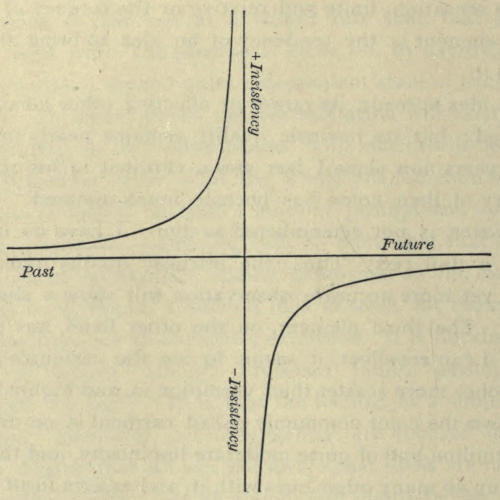
Now consider the induction which we have here been led into. This curve says that feeling which has not yet emerged into immediate consciousness is already affectible and already affected. In fact, this is habit, by virtue of which an idea is brought up into present consciousness by a bond that had already been established between it, and another idea while it was still in futuro.
We can now see what the affection of one idea by another consists in. It is that the affected idea is attached as a logical predicate to the affecting idea as subject. So when a feeling emerges into immediate consciousness, it always appears as a modification of a more or less general object already in the mind. The word suggestion is well adapted to expressing this relation. The future is suggested by, or rather is influenced by the suggestions of, the past.
IDEAS CANNOT BE CONNECTED EXCEPT BY CONTINUITY.
That ideas can nowise be connected without continuity is sufficiently evident to one who reflects upon the matter. But still the opinion may be entertained that after continuity has once made the connection of ideas possible, then they may get to be connected in other modes than through continuity. Certainly, I cannot see how anyone can deny that the infinite diversity of the universe, which we call chance, may bring ideas into proximity which are not associated in one general idea. It may do this many times. But then the law of continuous spreading will produce a mental association; and this I suppose is an abridged statement of the way the universe has been evolved. But if I am asked whether a blind ἀνάγκη cannot bring ideas together, first I point out that it would not remain blind. There being a continuous connection between the ideas, they would infallibly become associated in a living, feeling, and perceiving general idea. Next, I cannot see what the mustness or necessity of this ἀνάγκη would consist in. In the absolute uniformity of the phenomenon, says the nominalist. Absolute is well put in; for if it merely happened so three times in succession, or three million times in succession, in the absence of any reason, the coincidence could only be attributed to chance. But absolute uniformity must extend over the whole infinite future; and it is idle to talk of that except as an idea. No; I think we can only hold that wherever ideas come together they tend to weld into general ideas; and wherever they are generally connected, general ideas govern the connection; and these general ideas are living feelings spread out.
MENTAL LAW FOLLOWS THE FORMS OF LOGIC.
The three main classes of logical inference are Deduction, Induction, and Hypothesis. These correspond to three chief modes of action of the human soul. In deduction the mind is under the dominion of a habit or association by virtue of which a general idea suggests in each case a corresponding reaction. But a certain sensation is seen to involve that idea. Consequently, that sensation is followed by that reaction. That is the way the hind legs of a frog, separated from the rest of the body, reason, when you pinch them. It is the lowest form of psychical manifestation.
By induction, a habit becomes established. Certain sensations, all involving one general idea, are followed each by the same reaction; and an association becomes established, whereby that general idea gets to be followed uniformly by that reaction.
Habit is that specialisation of the law of mind whereby a general idea gains the power of exciting reactions. But in order that the general idea should attain all its functionality, it is necessary, also, that it should become suggestible by sensations. That is accomplished by a psychical process having the form of hypothetic inference. By hypothetic inference, I mean, as I have explained in other writings, an induction from qualities. For example, I know that the kind of man known and classed as a “mugwump” has certain characteristics. He has a high self-respect and places great value upon social distinction. He laments the great part that rowdyism and unrefined good-fellowship play in the dealings of American politicians with their constituency. He thinks that the reform which would follow from the abandonment of the system by which the distribution of offices is made to strengthen party organisations and a return to the original and essential conception of office-filling would be found an unmixed good. He holds that monetary considerations should usually be the decisive ones in questions of public policy. He respects the principle of individualism and of laisser-faire as the greatest agency of civilisation. These views, among others, I know to be obtrusive marks of a “mugwump.” Now, suppose I casually meet a man in a railway-train, and falling into conversation find that he holds opinions of this sort; I am naturally led to suppose that he is a “mugwump.” That is hypothetic inference. That is to say, a number of readily verifiable marks of a mugwump being selected, I find this man has these, and infer that he has all the other characters which go to make a thinker of that stripe. Or let us suppose that I meet a man of a semi-clerical appearance and a sub-pharisaical sniff, who appears to look at things from the point of view of a rather wooden dualism. He cites several texts of scripture and always with particular attention to their logical implications; and he exhibits a sternness, almost amounting to vindictiveness, toward evildoers, in general. I readily conclude that he is a minister of a certain denomination. Now the mind acts in a way similar to this, every time we acquire a power of coördinating reactions in a peculiar way, as in performing any act requiring skill. Thus, most persons have a difficulty in moving the two hands simultaneously and in opposite directions through two parallel circles nearly in the medial plane of the body. To learn to do this, it is necessary to attend, first, to the different actions in different parts of the motion, when suddenly a general conception of the action springs up and it becomes perfectly easy. We think the motion we are trying to do involves this action, and this, and this. Then, the general idea comes which unites all those actions, and thereupon the desire to perform the motion calls up the general idea. The same mental process is many times employed whenever we are learning to speak a language or are acquiring any sort of skill.
Thus, by induction, a number of sensations followed by one reaction become united under one general idea followed by the same reaction; while by the hypothetic process, a number of reactions called for by one occasion get united in a general idea which is called out by the same occasion. By deduction, the habit fulfils its function of calling out certain reactions on certain occasions.
UNCERTAINTY OF MENTAL ACTION.
The inductive and hypothetic forms of inference are essentially probable inferences, not necessary; while deduction may be either necessary or probable.
But no mental action seems to be necessary or invariable in its character. In whatever manner the mind has reacted under a given sensation, in that manner it is the more likely to react again; were this, however, an absolute necessity, habits would become wooden and ineradicable, and no room being left for the formation of new habits, intellectual life would come to a speedy close. Thus, the uncertainty of the mental law is no mere defect of it, but is on the contrary of its essence. The truth is, the mind is not subject to “law,” in the same rigid sense that matter is. It only experiences gentle forces which merely render it more likely to act in a given way than it otherwise would be. There always remains a certain amount of arbitrary spontaneity in its action, without which it would be dead.
Some psychologists think to reconcile the uncertainty of reactions with the principle of necessary causation by means of the law of fatigue. Truly for a law, this law of fatigue is a little lawless. I think it is merely a case of the general principle that an idea in spreading loses its insistency. Put me tarragon into my salad, when I have not tasted it for years, and I exclaim “What nectar is this!” But add it to every dish I taste for week after week, and a habit of expectation has been created; and in thus spreading into habit, the sensation makes hardly any more impression upon me; or, if it be noticed, it is on a new side from which it appears as rather a bore. The doctrine that fatigue is one of the primordial phenomena of mind I am much disposed to doubt. It seems a somewhat little thing to be allowed as an exception to the great principle of mental uniformisation. For this reason, I prefer to explain it in the manner here indicated, as a special case of that great principle. To consider it as something distinct in its nature, certainly somewhat strengthens the necessitarian position; but even if it be distinct, the hypothesis that all the variety and apparent arbitrariness of mental action ought to be explained away in favor of absolute determinism does not seem to me to recommend itself to a sober and sound judgment, which seeks the guidance of observed facts and not that of prepossessions.
RESTATEMENT OF THE LAW.
Let me now try to gather up all these odds and ends of commentary and restate the law of mind, in a unitary way.
First, then, we find that when we regard ideas from a nominalistic, individualistic, sensualistic way, the simplest facts of mind become utterly meaningless. That one idea should resemble another or influence another, or that one state of mind should so much as be thought of in another is, from that standpoint, sheer nonsense.
Second, by this and other means we are driven to perceive, what is quite evident of itself, that instantaneous feelings flow together into a continuum of feeling, which has in a modified degree the peculiar vivacity of feeling and has gained generality. And in reference to such general ideas, or continua of feeling, the difficulties about resemblance and suggestion and reference to the external, cease to have any force.
Third, these general ideas are not mere words, nor do they consist in this, that certain concrete facts will every time happen under certain descriptions of conditions; but they are just as much, or rather far more, living realities than the feelings themselves out of which they are concreted. And to say that mental phenomena are governed by law does not mean merely that they are describable by a general formula; but that there is a living idea, a conscious continuum of feeling, which pervades them, and to which they are docile.
Fourth, this supreme law, which is the celestial and living harmony, does not so much as demand that the special ideas shall surrender their peculiar arbitrariness and caprice entirely; for that would be self-destructive. It only requires that they shall influence and be influenced by one another.
Fifth, in what measure this unification acts, seems to be regulated only by special rules; or, at least, we cannot in our present knowledge say how far it goes. But it may be said that, judging by appearances, the amount of arbitrariness in the phenomena of human minds is neither altogether trifling nor very prominent.
PERSONALITY.
Having thus endeavored to state the law of mind, in general, I descend to the consideration of a particular phenomenon which is remarkably prominent in our own consciousnesses, that of personality. A strong light is thrown upon this subject by recent observations of double and multiple personality. The theory which at one time seemed plausible that two persons in one body corresponded to the two halves of the brain will, I take it, now be universally acknowledged to be insufficient. But that which these cases make quite manifest is that personality is some kind of coördination or connection of ideas. Not much to say, this, perhaps. Yet when we consider that, according to the principle which we are tracing out, a connection between ideas is itself a general idea, and that a general idea is a living feeling, it is plain that we have at least taken an appreciable step toward the understanding of personality. This personality, like any general idea, is not a thing to be apprehended in an instant. It has to be lived in time; nor can any finite time embrace it in all its fulness. Yet in each infinitesimal interval it is present and living, though specially colored by the immediate feelings of that moment. Personality, so far as it is apprehended in a moment, is immediate self-consciousness.
But the word coördination implies somewhat more than this; it implies a teleological harmony in ideas, and in the case of personality this teleology is more than a mere purposive pursuit of a predeterminate end; it is a developmental teleology. This is personal character. A general idea, living and conscious now, it is already determinative of acts in the future to an extent to which it is not now conscious.
This reference to the future is an essential element of personality. Were the ends of a person already explicit, there would be no room for development, for growth, for life; and consequently there would be no personality. The mere carrying out of predetermined purposes is mechanical. This remark has an application to the philosophy of religion. It is that a genuine evolutionary philosophy, that is, one that makes the principle of growth a primordial element of the universe, is so far from being antagonistic to the idea of a personal creator, that it is really inseparable from that idea; while a necessitarian religion is in an altogether false position and is destined to become disintegrated. But a pseudo-evolutionism which enthrones mechanical law above the principle of growth, is at once scientifically unsatisfactory, as giving no possible hint of how the universe has come about, and hostile to all hopes of personal relations to God.
COMMUNICATION.
Consistently with the doctrine laid down in the beginning of this paper, I am bound to maintain that an idea can only be affected by an idea in continuous connection with it. By anything but an idea, it cannot be affected at all. This obliges me to say, as I do say, on other grounds, that what we call matter is not completely dead, but is merely mind hide-bound with habits. It still retains the element of diversification; and in that diversification there is life. When an idea is conveyed from one mind to another, it is by forms of combination of the diverse elements of nature, say by some curious symmetry, or by some union of a tender color with a refined odor. To such forms the law of mechanical energy has no application. If they are eternal, it is in the spirit they embody; and their origin cannot be accounted for by any mechanical necessity. They are embodied ideas; and so only can they convey ideas. Precisely how primary sensations, as colors and tones, are excited, we cannot tell, in the present state of psychology. But in our ignorance, I think that we are at liberty to suppose that they arise in essentially the same manner as the other feelings, called secondary. As far as sight and hearing are in question, we know that they are only excited by vibrations of inconceivable complexity; and the chemical senses are probably not more simple. Even the least psychical of peripheral sensations, that of pressure, has in its excitation conditions which, though apparently simple, are seen to be complicated enough when we consider the molecules and their attractions. The principle with which I set out requires me to maintain that these feelings are communicated to the nerves by continuity, so that there must be something like them in the excitants themselves. If this seems extravagant, it is to be remembered that it is the sole possible way of reaching any explanation of sensation, which otherwise must be pronounced a general fact absolutely inexplicable and ultimate. Now absolute inexplicability is a hypothesis which sound logic refuses under any circumstances to justify.
I may be asked whether my theory would be favorable or otherwise to telepathy. I have no decided answer to give to this. At first sight, it seems unfavorable. Yet there may be other modes of continuous connection between minds other than those of time and space.
The recognition by one person of another’s personality takes place by means to some extent identical with the means by which he is conscious of his own personality. The idea of the second personality, which is as much as to say that second personality itself, enters within the field of direct consciousness of the first person, and is as immediately perceived as his ego, though less strongly. At the same time, the opposition between the two persons is perceived, so that the externality of the second is recognised.
The psychological phenomena of intercommunication between two minds have been unfortunately little studied. So that it is impossible to say, for certain, whether they are favorable to this theory or not. But the very extraordinary insight which some persons are able to gain of others from indications so slight that it is difficult to ascertain what they are, is certainly rendered more comprehensible by the view here taken.
A difficulty which confronts the synechistic philosophy is this. In considering personality, that philosophy is forced to accept the doctrine of a personal God; but in considering communication, it cannot but admit that if there is a personal God, we must have a direct perception of that person and indeed be in personal communication with him. Now, if that be the case, the question arises how it is possible that the existence of this being should ever have been doubted by anybody. The only answer that I can at present make is that facts that stand before our face and eyes and stare us in the face are far from being, in all cases, the ones most easily discerned. That has been remarked from time immemorial.
CONCLUSION.
I have thus developed as well as I could in a little space the synechistic philosophy, as applied to mind. I think that I have succeeded in making it clear that this doctrine gives room for explanations of many facts which without it are absolutely and hopelessly inexplicable; and further that it carries along with it the following doctrines: 1st, a logical realism of the most pronounced type; 2nd, objective idealism; 3rd, tychism, with its consequent thorough-going evolutionism. We also notice that the doctrine presents no hindrances to spiritual influences, such as some philosophies are felt to do.
C. S. Peirce.
FOOTNOTES:
MR. CHARLES S. PEIRCE’S ONSLAUGHT ON THE DOCTRINE OF NECESSITY.
The problem of necessity lurks at the bottom of all problems, and according as we accept or reject the idea of necessity we shall be led to two entirely different world-conceptions.
The conception of indeterminism generally offers itself first to the doubting mind; and it is apparently a pleasant idea. It promises freedom, it leaves room for the imagination, it makes the world and its possibilities wide, much wider than it could be on the plan of determinism. Determinism is at first sight an oppressive notion and we naturally shrink from it. It seems to destroy the freedom of the will and all moral responsibility. From infinite possibilities it narrows the world down to one single actuality; and thus it seems to destroy all the charms of life.
The former view may be represented as conceiving the all-power of the whole in which and through which we live as a well meaning and yielding ruler or a kind-hearted parent who if strongly plied with prayer, will for a trifle in order to please an importune favorite change his decisions. The dispensations of his government will be full of exceptions, of private cabinet decrees, of counter orders and irregularities. The latter view, however, would represent the entirety of the All as an inexorable and uncompromising sovereign, or as a severe educator, a stern father who unfalteringly clings to his principles. He leaves full independence to his children, he does not prevent their mistakes, yet rigidly lets them bear the consequences of their actions. He never answers prayers except that the prayer itself has its educating effects upon him who prays; but he never alters objective facts for the sake of him who requests his interference, and he never makes exceptions either in favor or disfavor of anybody. In brief; the God of him who accepts the former view, will be Chance, while the God of him who accepts the latter view will be Law.
The choice between the two views seems to remind us of the choice left to the heroes of our fairy tales. He who chooses that which appears pleasant will be led into inextricable confusion, he who chooses that which appears rigid and oppressive will be led on a path where in spite of many difficulties he will be able to make firm and certain steps and will arrive at clearness as well as moral freedom. It is not the golden casket that contains Portia’s picture.
Science constantly operates on the basis of the maxim that there is no chance, that everything that happens, happens as it does with necessity. The question is, Is this maxim a mere assumption, a non-verifiable working hypothesis; or is there any reliable evidence in its favor? Is it true, and if it is, how can it be proved?
I. DAVID HUME REDIVIVUS.
Mr. Charles S. Peirce’s article entitled “The Doctrine of Necessity Examined,” which appeared in the last number of The Monist, must have been a surprise to many thinking readers. It must have affected them in a somewhat similar manner as Hume’s “Treatise of Human Nature” affected Kant. It roused him from his dogmatic slumber: He abandoned dogmatism but nevertheless did not accept Hume’s skepticism; he remained positive; yet he propounded a better positive view than was the old dogmatism; he established in philosophy the method of critique.
The parallelism between David Hume, who doubted the validity of our conception of causation, and Mr. Charles S. Peirce who denies the universality of the doctrine of necessity, is very marked in more than one respect. It is, in spite of many differences, a case of close analogy, and the answer which we shall have to give to either, will in many respects be suited to both. Both shake the ultimate ground of scientific research at its very root. Both call in question the most fundamental concept upon which all our methods of investigation and philosophy rest. Both challenge the reliability of an idea of which few would hesitate to say that it is all but universally accepted. In fact the ideas “causation” and “necessity” are more than kin. If analysed, many of their elements will be found to be actually identical. Thus the one cannot be either established or doubted without establishing or doubting the other. Accordingly Mr. Peirce, in some respect, repeats David Hume’s onslaught upon the current conception of the basis of human knowledge with the more formidable weapons which a century of close thought and scientific investigation have furnished him.
If Kant’s answer to Hume had been satisfactory, Mr. Peirce probably would not have renewed the attack or he would have had to modify it considerably. Kant, however, whom we both, Mr. Peirce as much as I myself, admire as a master of philosophic thought, did not solve the question satisfactorily. Yet Kant pointed out the way of solving it, which was the middle way between dogmatism and scepticism, called by him and his followers “Criticism,” and it is this way on which we trust is safest travelling.
Mr. Peirce is right that the doctrine of necessity cannot be “postulated,” for “to postulate a proposition is no more than to hope it will be true.” The doctrine of necessity is, indeed, usually treated as a postulate, and Mr. Peirce’s attack appears formidable because he shows the weakness of the arguments which are commonly brought forward in its favor and which we grant to be insufficient.
Mr. Peirce says (The Monist, II, 3, p. 330):
“In view of all these considerations, I do not believe that anybody, not in a state of case-hardened ignorance respecting the logic of science, can maintain that the precise and universal conformity of facts to law is clearly proved, or even rendered particularly probable, by any observations hitherto made. In this way, the determined advocate of exact regularity will soon find himself driven to a priori reasons to support his thesis. These received such a sockdologer from Stuart Mill in his Examination of Hamilton, that holding to them now seems to me to denote a high degree of imperviousness to reason; so that I shall pass them by with little notice.”
Mr. Peirce is right when saying that necessitarianism must be founded on something other than observation. Observation is a posteriori; it has reference only to single facts, to particulars; yet the doctrine of necessity, if there is anything in it at all, is of universal application. The doctrine of necessity, let us not be afraid to pronounce it clearly, is of an a priori nature. The scientist assumes a priori, i. e. even before he makes his observations or experiments, as a general law applicable to every process which takes place, that, whatever happens, happens of necessity in consequence of a cause and in conformity to law, so that the same cause under the same circumstances will produce the same effects. If all the a priori reasons, as Mr. Peirce maintains, received a sockdologer from Stuart Mill, then indeed we shall have to abandon the idea of necessity as the superstition of a past and erroneous philosophy and we shall have to start the world of science over again.
Mr. Peirce denies the strict regularity of natural law and introduces an element of chance. He says (ibid. p. 336):
“To undertake to account for anything by saying boldly that it is due to chance would, indeed, be futile. But this I do not do. I make use of chance chiefly to make room for a principle of generalization, or tendency to form habits, which I hold has produced all regularities.[73] The mechanical philosopher leaves the whole specification of the world utterly unaccounted for, which is pretty nearly as bad as to boldly attribute it to chance. I attribute it altogether to chance, it is true, but to chance in the form of a spontaneity which is to some degree regular.”
Mr. Peirce is the pathfinder of a new and as yet untried road. He strikes out boldly into the tumultuous ocean of chance, hoping to find in his journey the connection between the East and the West, between contrasts that seem to him otherwise unconnectible. The confidence of the bold discoverer is set forth in the warnings he gives to all seafaring people. He attempts to frighten the ill-informed minds who might innocently venture out in other directions; and he will thus naturally prevent many from falling either into the Charybdis of doubting the propriety of applying the logic of probabilities to the problem of necessity and causation in general, or, worse still, into the Scylla of the a priori. The former, he tells us denotes “a state of case-hardened ignorance respecting the logic of science,” the latter “a high degree of imperviousness to reason.”
Mr. Peirce is well known as one of the keenest logicians now living. Considering this fact I am slow to take up arms against him in defending a case which he so strongly brands beforehand. I must from the beginning plead guilty to a belief in necessity, and having critically revised my view once more I cannot help upholding it. I am fully conscious of the fact that hundreds, thousands, and millions of single experiences (which in Kantian terminology are called a posteriori arguments) cannot establish a solid belief in necessity, nor can any imaginable number of sequences prove the rigidity of causation, and I confess freely that I support my thesis with a priori reasons. Yet at the same time attention must be called to the fact that neither Mr. Hamilton nor Mr. Mill had any adequate conception of the a priori, and Mr. Mill’s sockdologer does not disturb in the least the assurance of my view; for the a priori can, in my opinion, be based upon the firm ground of experience.
All the many sense-experiences at our command, if considered singly, cannot constitute knowledge. In order to weave the woof of the a posteriori into coherent cloth we want the warp of the a priori, and I do not see how we can do without it. But the a priori is not that mystical hocus-pocus of absolute truth with its impertinent assumptions such as it is presented by pseudo-Kantians and justly denounced by Mill; it is not as Mr. Peirce brands it an “I cannot help believing,” it is not a “natural belief,” nor is it as others conceive it an innate idea. It is, briefly described, simply and solely formal knowledge, such as 2 × 2 = 4, to which we attribute universality and necessity and with the assistance of which we are enabled to predict and predetermine certain results beforehand (i. e. a priori). We might invent a new name for the a priori, the latter having become odious through the denunciations of its enemies and worse still, having been distorted beyond recognition through the misuse to which it was put by its defenders and suppositional friends. Yet that would be another question, and the idea of the a priori, i. e. of formal knowledge involving universality and necessity would remain the same.
The universality and necessity of formal knowledge are as a rule taken for granted by scientists. But philosophy can take nothing for granted, and the problem rises: How is the belief in the universality and necessity of formal knowledge to be justified? Mr. Peirce’s onslaught on the doctrine of necessity is a challenge to answer this question.
II. CAUSATION NOT MERE SEQUENCE.
Mr. John Venn published some twenty-five or six years ago an excellent treatise called “The Logic of Chance.” This work opened the eyes of many to the great importance of the calculus of probabilities as a method of science which was of much wider application than had before been suspected. This admirable work we may boldly say marks a new epoch in the study of logic, it opened new vistas, and many expectations created by it have since been realised. Yet it is to be regretted that the author adopts Hume’s erroneous conception of causality and thus implicitly paves the way which Mr. Peirce has actually followed and which leads to a denial of the doctrine of necessity. Concerning “the doctrine of universal causation” Mr. Venn says, in Chapter XIV:
“We will employ the word simply in the sense which is becoming almost universally adopted by scientific men, viz. that of invariable unconditional sequence.
“It is in this sense that the word cause is used by Mr. Mill....
“This meaning of the term is rapidly becoming the popular, or rather, the popular scientific one.”
This idea of “sequence” however was exactly Hume’s mistake, adopted by Mr. Mill and through Mr. Mill popularised among English thinkers. If the nature of cause and effect were really constituted by invariable sequence, then the night might be called the effect of the day because night is invariably consequent upon day.
Hume, taking the ground that cause and effect constitute a sequence, attempted a synthesis of both; he searched for a proof of their identity and failed. And it was natural that he failed, for cause and effect are so radically different that we cannot bring them into the formula of an equation as “cause = effect.” There is no cause that is equal to its effect.
Hume should have considered causation as one single process, and instead of attempting a synthesis, he should have made an analysis. The analysis would have shown that cause and effect are two abstract and correlative terms of one whole and inseparable event. Cause is not identical with effect, but the whole event is identical with itself.
If my finger touches a key of the piano, a chord is struck; the chord swings and produces certain air-vibrations. In this process from the beginning to the end all the energy employed and the mass of the material particles remain in amount the same, yet there is a change of form taking place. Causation is not mere sequence, but a sequence of quite a special kind. It is a sequence of two states which belong together as an initial and a final aspect of one and the same event.
So long as we know of two events simply that they follow one another, although the sequence may in every case be invariable and unexceptional, we are not justified in calling them cause and effect. No amount of experience is sufficient to constitute causation by a mere synthesis of sequences, and to have appreciated this truth is the immortal merit of the great Scotchman who boldly took the consequence of the argument and acquiesced in scepticism.
The problem, however, is not so desperate as Hume thought. If Hume could have considered his argument in the light which the law of the conservation of matter and energy sheds upon it, he would most likely have abandoned his scepticism; for causality is perfectly intelligible if conceived not as a synthesis of two radically different events, but as a process of transformation, of which the prior state is called cause and the final one effect.
That two radically different events, which are not thought of as transformation, invariably follow each other without our being able to discover any connection between them, will naturally appear as a mystery; but that two forms are radically different things, although they may be forms of the same amount of matter and energy, is no mystery. The effect is, or may be, something entirely new.
The configuration of things as it appears in the effect, did not exist before. But for that reason, it is no creation out of nothing, it is not an incomprehensible event, it is no miracle.
It is a very wonderful thing that two congruent regular tetrahedrons, when put together, will form a hexahedron, but the laws of form do perfectly and satisfactorily explain it. Supposing we had no idea of the laws of form or only an incoherent and fragmentary knowledge of them, should we not look upon the result of this combination as a strange and incomprehensible mystery. Two heaps of flour one poured upon the other will give one heap of the same kind and shape but of a larger size. However, the combination of the two four-sided bodies does not produce another four-sided body doubly as large as any of the two four-sided bodies. Nor does it produce an eight-sided body. It produces a six-sided body, which is something quite new. The result is not contained in the conditions singly, for no one can say that six-sidedness is a quality implicitly contained in four-sided bodies.
The process of combining hydrogen with oxygen into water (H₂O) is an immensely more complex case, and the qualities resulting from a difference of density as well as configuration are entirely unknown to us. There is nevertheless no reason whatever to consider the process as different in principle; it is a case of transformation in which the amount of matter and energy remains the same.
Whatever the value of the logic of chance may be for scientific reasoning in establishing gradations of certainty and formulating the reliability of a certain belief, we deny most positively its applicability to the principle of causation in general. If we ask what the chance is of a combination of two congruent tetrahedrons becoming a hexahedron, we must answer that the probability is exactly 1, which means certainty, and certainty is but another name for necessity.
Mr. Peirce does not object to necessity in certain cases, he objects to necessity being a universal feature of the world. He objects to the rigidity of causation in so far only as to allow a trifle of chance to enter into nature.
One or two cases or even a hundred, and a thousand, nay millions of millions of cases in which causation is explicable as transformation is no proof that this must always be so. Mr. Peirce may grant and most likely he does grant that causation in a definite set of experiences is transformation, yet what guarantee do we have for saying that it is the only kind of causation. Might there not be room in this world for another causation which for lack of a full comprehension of its nature, we may call the causation of chance?
We answer that form is a quality of this world, not of some samples of it, but throughout, so far as we know of existence even in the most superficial way, and thus we know beforehand or a priori that the laws of form hold good so far as our telescopes sweep through space. We are ignorant as to the qualities dependent upon special forms of matter or energy, and we can acquire any knowledge thereof only through experience; but that is no reason to doubt the validity of causation in general, or to surmise the probability of there being somewhere a different arrangement of nature.
Thus we come to the conclusion that the calculus of probabilities is not applicable to the order of the world as to whether it may or may not be universal. And in corroboration of this our position we quote the following passage from a high authority in the science of logic, who is no less than Mr. Charles S. Peirce himself. “Illustrations of the Logic of Science,” (Popular Science Monthly, 1877, p. 714):
“The relative probability of this or that arrangement of Nature is something which we should have a right to talk about if universes were as plenty as blackberries, if we could put a quantity of them in a bag, shake them well up, draw out a sample, and examine them to see what proportion of them had one arrangement and what proportion another. But, even in that case, a higher universe would contain us, in regard to whose arrangements the conception of probability could have no applicability.”
Mr. Peirce is still more emphatic in another passage which reads (ib. 1878, p. 205):
“If any one has ever maintained that the universe is a pure throw of the dice, the theologians have abundantly refuted him. ‘How often,’ says Archbishop Tillotson, ‘might a man, after he had jumbled a set of letters in a bag, fling them out upon the ground before they would fall into an exact poem, yea, or so much as make a good discourse in prose! And may not a little book be as easily made by chance as this great volume of the world?’ The chance world here shown to be so different from that in which we live would be one in which there were no laws, the characters of different things being entirely independent; so that, should a sample of any kind of objects ever show a prevalent character, it could only be by accident, and no general proposition could ever be established. Whatever further conclusions we may come to in regard to the order of the universe, thus much may be regarded as solidly established, that the world is not a mere chance-medley.”
Here follows a close reasoning of several pages which ends (on p. 207) with a paragraph beginning with the words:
“This shows that a contradiction is involved in the very idea of a chance world.”
And a long paragraph on p. 208 winds up with these sentences:
“The actual world is almost a chance-medley to the mind of a polyp. The interest which the uniformities of Nature have for an animal measures his place in the scale of intelligence.”
This is exactly the position which I defend. If universes were as plenty as blackberries we might talk about the order of other universes. They might be four- or five- or n-dimensional. Yet even in all these cases they would not be void of form. The four-dimensional universe would have another arrangement, but its laws would be none the less orderly, none the less regular, and a higher universe would contain them all. Supposing there were four- or five-dimensional space somewhere, we could state with absolute precision all the formal laws by which bodies of so many dimensions were governed.[74]
The order of form and the rigidity of formal laws is as universal and omnipresent as God. They encompass our path and our lying down, they have beset our behind and before. If we ascend up into heaven they are there, if we make our beds in hell, behold they are there. If we take the wings of the morning and dwell in the uttermost parts of the sea, even there they shall lead us and hold us.
III. MR. PEIRCE’S LOGIC OF SCIENCE.
In spite of the fundamental difference that obtains between Mr. Peirce’s and our own world-conception, we must state that there are many most important points of agreement. Mr. Peirce says in his article “Illustrations of the Logic of Science,” (ibid. p. 3 and 7):
“The object of reasoning is to find out, from the consideration of what we already know, something else which we do not know....
“The settlement of opinion is the sole object of inquiry.”
There are according to Peirce several methods of settling opinion, which swayed humanity in an historic succession: (1) The method of tenacity. Doubt being an uneasy and dissatisfied state, we cling tenaciously not merely to believing, but to believing just what we do believe. (2) The method of authority, which is that of the Roman Church and of all great political and religious institutions of the past. (3) The a priori method, by which Mr. Peirce understands the fixing of belief agreeably to reason, i. e. to the subjective conviction of the individual thinker. All these methods have their merits, says Mr. Peirce (ibid. p. 13):
“The a priori method is distinguished for its comfortable conclusions. It is the nature of the process to adopt whatever belief we are inclined to, and there are certain flatteries to the vanity of man which we all believe by nature, until we are awakened from our pleasing dream by some rough facts. The method of authority will always govern the mass of mankind.... But most of all I admire the method of tenacity for its strength, simplicity, and directness.”
It is apparent that the merit of the a priori method so called is really a vice. The a priori method so called is the basis of agnosticism. If according to my reason this, and according to your reason that, may be the truth, where does truth remain? If truth is purely subjective, truth becomes impossible. The method of settling belief agreeably to our individual tempers is the death of objective truth, of science and philosophy.
Mr. Peirce fully recognises the practical importance of thought. He says:
“The production of belief is the sole function of thought” (ibid. p. 289).
“Our beliefs guide our desires and shape our actions” (ibid. p. 5).
“What is belief? First, it is something that we are aware of; second, it appeases the irritation of doubt; and third, it involves the establishment in our nature of a rule of action, or, say for short, a habit” (ibid. p. 291).
“Thus, we come down to what is tangible and practical, as the root of every real distinction of thought, no matter how subtile it may be; and there is no distinction of meaning so fine as to consist in anything but a possible difference of practice” (ibid. p. 293).
Mr. Peirce is very far from considering philosophy as a mere matter of speculation or theory without practical importance. He says:
“What sort of a conception we ought to have of the universe, how to think of the ensemble of things, is a fundamental problem in the theory of reasoning.”
The a priori method, so called by Mr. Peirce, translated into practical life is not only the death of truth but also of morality. The objective criterion of truth is gone, and with it goes the objective standard of right and wrong. If that is true which seems so to my individual reason, then that is right which pleases me best. What is right to me might be wrong to you. Thus this method leads either to moral indifference, or to basing ethics upon the greatest amount of pleasure attainable, (Hedonism, as represented by Mr. H. Spencer, Prof. Harald Höffding, Professor Gizycki, and others,) or to relying upon the individual conscience as an absolute and ultimate authority.[75]
The method of settling opinion agreeably to individual reason is at present the most fashionable and widely spread conception, and it shows its influence in the almost universal acceptation of agnosticism to-day. Is that the final decision with which we have to rest satisfied? If it were, we would better return to the method of authority or tenacity. No, it is not the sum of all wisdom. The a priori method so called represents a period of transition, which, if persistently pursued, will lead to the bankruptcy of thought, the desperate appearance of which is well disguised in the big sounding and modesty-parading term agnosticism. And here we return to the exposition of Mr. Peirce’s views. Mr. Peirce does not accept the a priori method, he believes in “the logic of science.” Mr. Peirce says:
“To satisfy our doubts, therefore, it is necessary that a method should be found by which our beliefs may be caused by nothing human, but by some external permanency—by something upon which our thinking has no effect.... The method must be such that the ultimate conclusion of every man shall be the same. Such is the method of science” (ibid. p. 11.)
“That whose characters are independent of how you or I think is an external reality” (ibid. p. 298).
“All the followers of science are fully persuaded that the processes of investigation, if only pushed far enough, will give one certain solution to every question to which they can be applied.... They may at first obtain different results, but, as each perfects his method and his processes, the results will move steadily together toward a destined centre.... The opinion which is fated to be ultimately agreed to by all who investigate, is what we mean by the truth, and the object represented in this opinion is the real” (ibid. pp. 299-300).
The word “fated” must be understood as Mr. Peirce understands it. He adds in a foot-note:
“Fate means merely that which is sure to come true, and cannot be avoided.”
IV. NECESSITY IN THOUGHT PRESUPPOSES NECESSITY IN FACTS.
I have thus outlined Mr. Peirce’s views, not only because his line of reasoning[76] is admirable and deserves to be universally known and recognised, but also because it seems to me to have some bearing upon the question at issue.
If the ultimate conclusion of every man concerning reality shall be the same, there must be some truth in the idea of necessity. If there is an opinion “fated to be ultimately agreed to,” we are confronted in our representation of reality with something that is inevitable. Shall there be necessity in thought but not in that of which all our ideas are but images and symbols? We can conceive of the necessity in the ideal realm of thought only as a reflection of that necessity which pervades the original and prototype of our thought, which lives in reality.
V. MR. PEIRCE’S EVOLUTIONISM.
I have tried to find an explanation of Mr. Peirce’s position which appears to me self-contradictory and I believe I have found the key that will explain it.
I read somewhere a stray remark of Mr. Peirce’s in which he demanded that evolutionism should be thorough-going. The conception of evolution in vogue at present, he said, stops short at a certain point, and substitutes for an explanation the unknowable. Mr. Peirce says:
“Does not space call for some explanation? Is not that a half-way philosophy which in these our days does not explain, or at least hold out some promise of explaining, why space is continuous, why it has such a wonderful uniformity in all its parts, why there are neither more nor less than three dimensions everywhere, why every closed curve can, by a continuous change of position, size, and form, be brought into coincidence with every other, and why the three angles of a triangle make exactly one hundred and eighty degrees, or at least so very closely so that we cannot tell whether they make more or less?”
Mr. Peirce does not intend to halt before these problems, but to explain them and carries the principle of evolution to its ultimate conclusions, so as to explain from it not only the forms of living organisms but also the laws of nature including the laws of space. Mr. Peirce declares in his article “The Architecture of Theories” (The Monist, Vol. I, No. 2, p. 165):
“Uniformities are precisely the sort of facts that need to be accounted for.... Law is par excellence the thing that wants a reason.”
And what he means by it is further elucidated in his article “The Doctrine of Necessity Examined” (The Monist, Vol. II, No. 3, p. 334):
“That single events should be hard and unintelligible, logic will permit without difficulty: we do not expect to make the shock of a personally experienced earthquake appear natural and reasonable by any amount of cogitation. But logic does expect things general to be understandable. To say that there is a universal law, and that it is a hard, ultimate, unintelligible fact, the why and wherefore of which can never be inquired into, at this a sound logic will revolt; and will pass over at once to a method of philosophising which does not thus barricade the road of discovery.”
It is perfectly true that “law is par excellence the thing that wants a reason,” and any explanation that explains it by the assumption of an unknowable is unphilosophical. I agree with Mr. Peirce that we must not halt here; but I have no confidence in his method of explanation. Mr. Peirce’s original idea, then, and I should add, his main mistake, is that he proposes to explain the origin of natural law by evolution.
In his legitimate anxiety to explain law, Mr. Peirce declares chance to be exempt therefrom. He says:
“That a pitched coin should sometimes turn up heads and sometimes tails calls for no particular explanation.” (The Monist, Vol. I, No. 2, p. 165.)
But chance in our opinion needs exactly as much explanation as anything else. Mr. Peirce very improperly identifies “that which cannot be accounted for” with “that which need not be accounted for.” Absolute chance, if it existed, would not so much not call for a particular explanation as actually be unexplainable, and being incapable of explanation, it would have to be considered as an unintelligible fact, as inscrutable, incomprehensible, and mystical. On the assumption that chance need not be accounted for, Mr. Peirce builds the architecture of his theory. He says:
“Chance is first, law is second, the tendency of habits is third.”
The application of this general statement is set forth in the following passage:
“In psychology Feeling is First, Sense of reaction Second, General conception Third, or mediation. In biology, the idea of arbitrary sporting is first, heredity is second, the process whereby the accidental characters become fixed is third.”
How little after all we can escape the determinism of law as being a feature of the world will be seen from the fact, that the explanation for the evolution of law is presented by Mr. Peirce as being itself a law, i. e. a formula describing a regularity supposed to obtain in facts. Does not Mr. Peirce’s formula, supposing it to be true, deserve the same reproach which he casts upon natural law in general, viz., that it is “a hard, ultimate, unintelligible fact, the why and wherefore of which can never be inquired into”?
VI. WORLD-CONSTRUCTIONS.
There are two methods of philosophising, one starts with ideas which are supposed not to need any explanation, the other starts from facts and uses facts as data. The former is the method of the constructionist or ontologist, the latter that of the positivist. The constructionist attempts to beget a world-theory in the same way that God was supposed to have created the world; he attempts to bring it into being either out of a real nothing or out of something like nothing. He constructs a world-theory out of the self-evident, out of the absolute, out of the indubitable, or out of that the contrary of which is inconceivable. The positivist, however, employs facts as the given material, which he works out into a consistent and systematic whole. The former view is synthetic and constructive, the latter is analytic and descriptive. The former view is the method of Hegel, Oken, and also of Mr. Spencer, the latter is the method of all scientists and the ideal of the positive philosophy.
Mr. Peirce although very positivistic in his logic of science, must in philosophy still be counted among the constructionists.
Chance is to Mr. Peirce as much absolute as was to Hegel the idea of “abstract being,” which as such, Hegel said, is equivalent to “non-being.” Non-being need not be accounted for. So Hegel starts with this idea, and finding that “becoming” is the oscillation between being and non-being launches his abstract thought upon the terra firma of reality.
In the same way and with similar ingenious ingenuity Oken starts the world with zero. Zero or non-being need not be accounted for. Its existence calls for no particular reasons. What is zero? We can conceive it as “0 = 1 - 1.” Thus we have “+1” and “-1,” two units. The whole world, according to Oken, is only a disintegration of Nothing, an equation of enormous complexity but always equal to zero. And that explains the world!
Mr. Spencer, adopts “the principle of setting out with propositions of which the negations are unconceivable,” without being aware that any inveterate belief or prejudice can be defended from that standpoint. The principle is purely subjective. It does not admit of any objective verification and limits knowledge to individual conception. If Mr. Spencer’s principle were admissible, we could not refute the adversaries of the Copernican system, when they declare that the rotation of the earth up on which we stand is inconceivable. The maxim that that proposition is most certain the negation of which is inconceivable might after all, and it actually did very often, come into conflict with facts. Many propositions are now confidently accepted which were formerly declared to be positively inconceivable.
Mr. Peirce, I say, starts the world with an abstract idea of a something of which he assumes we need not give any account, as did the great ontologists of former times. He constructs, agreeably to his reason, a theory of the way in which the world might have originated, and thus he falls into the mistake criticised by himself as the a priori method. Yet the weakest point of Mr. Peirce’s system is that his “absolute chance” begets order; irregularity becomes law by practice, as if by a sufficiently prolonged shaking the dice would by and by acquire the habit of turning up the same faces each time.
The present world-conception of the scientist regards natural laws as eternal. The order that prevails in these laws constitutes the principle of evolution and changes the chaos of a nebula into a well-arranged planetary system. Thus the original chaos is properly speaking no chaos. It is in all its parts regulated by law and only appears chaotic in comparison with more advanced stages of evolution.
Desirous to account for the regularities of nature Mr. Peirce proposes the idea that nature in the beginning was a real, true chaos, without order, without laws, the single actions of reality taking place irregularly and in a sportive manner. Absolute chance prevailed. Everything was undetermined, exactly as much so as a man is undetermined in his action before his belief is settled. Yet a man, by and by, forms a belief and acts accordingly, not once or twice, but often, until a habit is formed. Thus Mr. Peirce assumes, Nature’s actions are first undetermined, they may be of this kind or of another kind. The same particle of reality may under the same conditions act in different ways, yet it acts somehow; it acts again, and repeats a certain kind of action more frequently than others, thus forming habits. Laws according to Mr. Peirce are the habits acquired by nature.
The proposition of Mr. Peirce’s logic of science points out another method of constructing a world-conception. The recognition of reality in the sense as he conceives it, admonishes us that our world-conception should be a picturing, a mirroring, an imitation of the objective world of facts. It should not be the architecture of a theory, but first an analysis and then a reconstruction of experience; it should be a description of facts, methodically arranged.
VII. FACTS AND LAWS.
That which we call natural law is not the description of a certain special and concrete form of existence which is now or then and here or there, but of some general quality of facts which is everywhere and always. The former, i. e. every special and concrete form of existence, can be explained by evolution, the latter, i. e. natural law, cannot. The former has to be accounted for by the law of causation, the latter by the principle of sufficient reason. And it is this distinction between cause and reason which Mr. Peirce does not seem to have regarded.
Every special form of existence must, at least theoretically, be traceable as the effect of some cause and every law of nature must be explainable by showing its connection with other natural laws. The only thing in the world of which we cannot and need not give account is the existence of facts itself, or being in general, which is the stubborn presence of reality in us ourselves and also outside of us, objected to our own being as an independent power to which we have to adapt our conduct. We need not prove its existence, for it exists. If anything is ultimate, facts are ultimate; and cognition is nothing but the reconstruction of facts for the purpose of orientation among them, it is a methodical description of reality in the symbols of the feelings that exist in sentient beings.
A scientist having observed a special process of nature, describes it, if possible, in such a way that it is recognised as a transformation. A description of this kind is called an explanation. It renders the process intelligible to us; it is complete and exhaustive. In order to make such a description available for comprehending other cases of the same or similar kind, we have to introduce another principle, which is that of economy. We must single out those features which are common to a certain class and remove all diversity and specificalness. All specificalness and diversity are transient features due to special conditions; they disappear with these special conditions. Thus the notion of natural law involves as an essential characteristic and fundamental quality the absence of the incidental and the temporal.
Natural laws describe the facts of nature sub specie aeternitatis. They cease to be natural laws in the proper sense of the word as soon as they are conceived, like legal laws, as products of evolutions, which have appeared in time and may disappear again. Eternity is the characteristic feature of a natural law, it is its backbone, the essence of its being, its conditio sine qua non.
Thus in considering a natural phenomenon we are led to distinguish between its cause and its reason: Its cause is something special, it is an individual event, happening in time, and accordingly being transient; it is an occurrence of some kind, it is a single and definite fact. However its reason is not anything special, it is something general; it is not a single and definite fact, but it is a law of universal application; it is not transient, but a conception of things in which the incidental and temporal are eliminated. A reason is applicable to all cases of the same kind and also to all cases of any time. A cause, i. e. a fact, if it truly exists, is real (not true); a law, i. e. a reason, if it really obtains in nature, is true (not real), and any attempt at explaining natural laws as a product of evolution, being based upon the view that regards them as causes not as reasons, as real not as true, as a description of temporal existences, not as viewing facts sub specie aeternitatis, must from the outset be a failure.[77]