THE NATURALIST.
Reading edition
SPEED AND DIET OF THE OSTRICH.
In the Annals of Sporting it is observed:—"If we are to place confidence in traveller's tales, the ostrich is swifter than the Arabian horse. During the residence of Mr. Adamson at Pador, a French factory on the south side of the river Niger, he says that two ostriches, which had been about two years in the factory, afforded him a sight of a very extraordinary nature. These gigantic birds, though young, were of nearly the full size. They were (he continues) so tame, that two little blacks mounted both together on the back of the larger. No sooner did he feel their weight, than he began to run as last as possible, and carried them several times round the village,—and it was impossible to stop him, otherwise than by obstructing the passage. This sight pleased me so much, that I wished it to be repeated, and, to try their strength, directed a full-grown negro to mount the smallest, and two others the larger. This burden did not seem at all disproportioned to their strength. At first, they went at a pretty sharp trot; but when they became heated a little, they expanded their wings, as though to catch the wind, and moved with such fleetness that they seemed scarcely to touch the ground. Most people have, at one time or other, seen the partridge run, and consequently must know that there is no man able to keep up with it; and it is easy to imagine, that if this bird had a longer step, its speed would be considerably augmented. The ostrich moves like the partridge, with this advantage; and I am satisfied that those I am speaking of would have distanced the fleetest race-horses that were ever bred in England. It is true, that they would not hold out so long as a horse; but they would, undoubtedly, be able to go over the space in less time. I have frequently beheld this sight, which is capable of giving one an idea of the prodigious strength of the ostrich, and of showing what use it might be of, had we but the method of breaking and managing it as we do the horse."
The following interesting particulars, relating to the capability of the ostrich to digest hard substances, is given by Mr. Fuller, in his Tour of the Turkish Empire:—"An ostrich, belonging to an English gentleman, arrived at Cairo from Upper Egypt, and afforded us an opportunity of observing this curious peculiarity in the natural history of that animal. The persons in charge of him observing his great propensity for hard substances, mistook, unfortunately, for his natural and ordinary diet, things that were only the objects of his luxury; and while they gave him corn only occasionally, administered every day a certain portion of iron, chiefly in the form of nails, to which he occasionally added a knife or a razor, which he chanced to pick up, or a few loose buttons, which he pulled from the coats of his attendants. This metallic system did not however succeed; the poor bird drooped gradually, his strength just lasted him to walk with a stately step into the court of the Consulate, and he died in about an hour afterwards. On a post mortem examination, at which I was present, about three pounds of iron were taken from his stomach. A considerable portion of the hardest parts, such as the blades of the knives and razor, was dissolved; and it is possible that the whole might in time have been digested, as the death of the animal was in part accidental, being immediately occasioned by a sharp boat-builder's nail, three or four inches long, which he had swallowed, and which had penetrated quite through the stomach, and produced mortification."
W.G.C.
EFFECTS OF LIGHT AND AIR ON PLANTS.
The importance of light and air to plants is well known. When unassisted by these agents, plants lose their colour, and are deprived of many of their properties. Colour is thus evidently produced by the absorption of carbonic acid gas: and the colouring matter may be detected by a powerful microscope, lodged in the cellular substance of the leaf. How this colour is formed, and why it assumes different tints in different plants, are, however, questions which it is at present impossible to decide. The secretions of plants depend upon light, and their flavour and nutritious qualities are materially altered by their exclusion from it. The importance of this knowledge to a practical horticulturist is proved by the fact, that sea-kale, so well known as a wholesome and palatable vegetable, is not eatable in its original state; and that any part of the cultivated plant, if accidentally left exposed to the action of the air and light, becomes tough, and so strong in flavour as to be extremely unpleasant to the taste. Celery, also, in its native state, is poisonous; and it is only the parts that are blanched that are perfectly fitted for the table. Though colour is generally supposed to depend principally on the plant's being exposed to the light, some portion of colouring matter appears to be occasionally absorbed by the root. This colouring substance is, however, never a deep green. Red and yellow, as may be seen in forced rhubarb, &c., are the most common hues. Succulent plants are less susceptible of the influence of light than any others. As they are always natives of hot countries, nature, to prevent the danger they would be exposed to from excessive evaporation, has provided them with leaves almost destitute of pores; and the moisture they absorb by their roots thus remains for the nourishment of the plant. It is for this reason that cactuses, mesembryanthemums, and other plants of a similar description, require very little water when kept in pots. Scarcely any carbon is found in plants grown in the dark. Many experiments have been tried to show the stimulus afforded to vegetation by light; trees of the same species and variety have been planted in the same garden and the same soil, but against walls with different aspects, and differently situated with regard to shade. The effect has been, not only a difference in the growth and appearance of the tree, but also in the size, colour, and flavour of the fruit which it produced. The contrast between plants grown in hot-houses with wooden sash frames, and those grown in hot-houses with iron sash-frames, has been found equally striking; the difference of light between the two kinds of houses being as seven to twenty-seven, or, sometimes, as three to twenty-three. Light is required at an early period of vegetation; but, as its properties are to give strength and flavour, it must be admitted with caution, as it is sometimes injurious. Too much light renders the skin of fruits tough, and will make cucumbers bitter. Bérard of Montpelier found that the ripening of fruits is merely the turning the acid which they contain into sugar, by exposure to the light; and that too much light and heat, before they have attained their proper size, will bring on premature ripening, and make them insipid.
Lindley's Lectures, reported in the Gardeners' Magazine.
PLANTS IN ROOMS.
It is very difficult to make plants grow in rooms. They must necessarily be deficient in the three important auxiliaries to vegetable life, light, air, and moisture; the latter of which cannot be maintained in apartments that are daily occupied. In large towns, plants cannot thrive even in the open air, as the minute particles of soot, which are constantly floating about, settle upon their leaves, and choke up their pores. The gases produced by the combustion of coal, &c., are also injurious to plants. Sulphurous acid, which abounds in the atmosphere of London, turns the leaves yellow; and the want of evaporation and absorption by the leaves prevents the proper elaboration of the sap, and makes the trees stunted and unproductive.
Ibid.
THE CHLAMYPHORUS.
In our account of the Nine-banded Armadillo, at page 57 of the present volume, we noticed the curious fact of the whole series of armadillos offering a notable example of one genus being confined to a particular country, viz. South America; of their standing perfectly insulated, and exhibiting all the characters of a creation entirely distinct, and, except as to the general character of mammiferous quadrupeds, perfectly of its own kind.
The nearest resemblance to the armadillo is, we believe, to be traced in a very curious little quadruped which is occasionally to be seen in the district of Cuyo, at the foot of the Andes, on the eastern side. The first instance of its being brought to Europe was a specimen preserved in spirit, which was added to the Museum of the Zoological Society, about four years since, by the Hon. Capt. Percy, R.N. who received it from Woodbine Parish, Esq. British consul at Buenos Ayres. It had been previously known only by the figures and description given by Dr. Harlan, in the Annals of the Lyceum of Natural History of New York. His specimen was, however, deprived of the skeleton and internal parts, which are perfect in the specimen, in one of the lower rooms of the Museum in Bruton-street. It is called the Chlamyphorus, and may be said to unite the habits of the mole with the appearance of the armadillo. Its upper parts and sides are defended by a coat, or rather cloak, of mail, of a coriaceous nature, but exceeding in inflexibility sole-leather of equal thickness. This cloak does not adhere, like that of the armadillo, to the whole surface, occupying the place of the skin—but is applied over the skin and fur, forming an additional covering, which is attached only along the middle of the back and on the head. The hinder parts of the animal are also protected by it, to cover which, it is suddenly bent downwards at nearly a right angle. The tail is short, and is directed forwards along the under surface of the body. Owing to the rigidity of the case which so nearly encloses the animal, its motions must be limited almost entirely to those of mere progression, and even for these, the structure of its fore-feet is ill suited. The anterior limbs are, indeed, scarcely fitted for any other purpose than that of burrowing. For this operation, the long and broad claws with which they are furnished are truly admirably adapted; and their sharp points and cutting lower edges must materially assist in clearing through the entangled roots which the animal may encounter in its subterranean travels. Its teeth resemble those of the sloth more nearly than any other animal's; and it seems to represent, beneath the earth, that well-known and singular inhabitant of trees—for its motions, so far as can be conjectured from its conformation, must also be executed with extreme slowness.
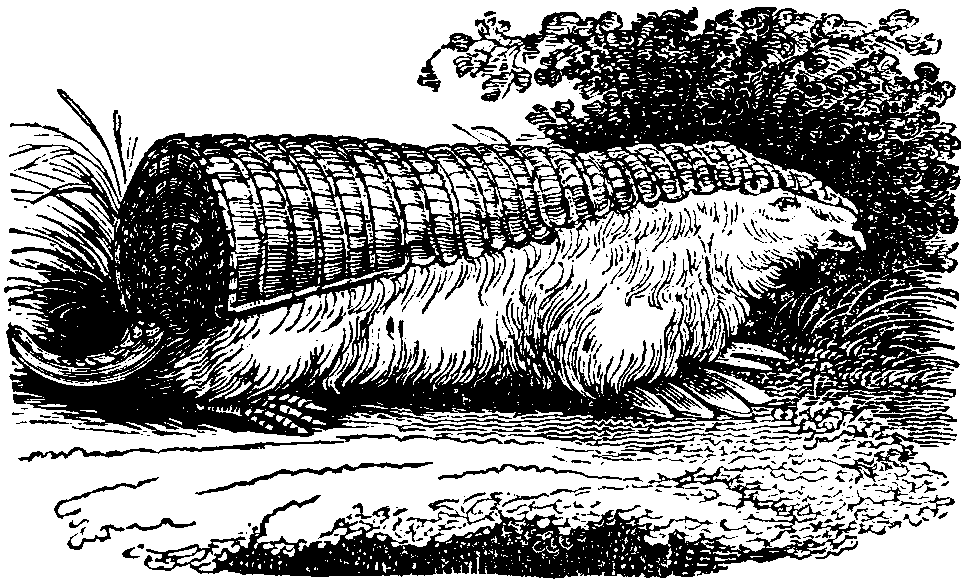
(The Chlamyphorus.)
The dimensions of the specimen in the Museum are as follow: length from tip of nose to root of tail, 5-1/2 inches; ditto tail, 1-1/4 in.; height at shoulder, 1-3/4 in. A more detailed account of the internal structure and economy of this extraordinary little animal will be found in the Zoological Journal, vols. ii. and iii.
ARROW ROOT.
[Mr. Andrew Mathews, of Lima, has communicated to the Gardeners' Magazine the following account of the Otaheitan method of preparing the excellent farinaceous substance termed Arrow Root, so extensively used in this country.]
The root (Tacca pinnatifida Lin., the Pea of the natives) grows in the greatest abundance in all the islands which we visited; viz., in Otaheite, Eimeo, Huaheine, Raiatea, and Otaha. Its favourite situation is on the sides and ridges of the hills which rise directly from the sea, and which are generally covered with a coarse grass, on a red sandy loam. The root is round, white, smooth, full of eyes like a potato, and from 2 to 3 in. in diameter. The flower-stem rises directly from the root, simple; from 2 to 4 ft. in height, as thick as a man's finger, bearing its flowers in a loose simple umbel on the summit; and, when large and full blown, it presents a beautiful and delicate appearance. The leaf is large, tri-pinnatifid, segments acute, of a rich shining green: it is subject to great variation in the size of the segments, some leaves being much more cut, and having the segments narrower, than others. When a sufficient quantity of the roots is collected, they are taken to a running stream, or to the sea-beach, and washed; the outer skin is carefully scraped off at the same time with a shell; and those who are particular in the preparation scrape out even the eyes. The root is then reduced to a pulp, by rubbing it up and down a kind of rasp, made as follows:—A piece of board, about 3 in. wide, and 12 ft. long, is procured, upon which some coarse twine, made of the fibres of the cocoa nut husk, is tightly and regularly wound, and which affords an admirable substitute for a coarse rasp. The pulp, when prepared, is washed first with salt or sea water, through a sieve made of the fibrous web which protects the young frond of the cocoa-nut palm; and the starch, or arrow-root, being carried through with the water, is received in a wooden trough made like the small canoes used by the natives. The starch is allowed to settle for a few days; the water is then strained, or, more properly, poured off, and the sediment rewashed with fresh (or river) water. This washing is repeated three times with spring water; after which the deposit is made into balls of about 7 or 8 in. in diameter, and in this state dried in the sun for twelve or twenty-four hours. The balls are then broken, and the powder spread for some days in the sun to dry; after which it is carefully wrapped in tapa (the native cloth), and put into baskets, and hung up in the houses. The natural indolence of the people is so great, and their avarice such, that but few of them will give the arrow-root sufficient time to dry, if they have an opportunity of parting with it, which I suspect was the case with that sent to England some few years back by the missionaries. So abundant is the root, that several tons might be prepared annually by proper management: as it is, there is a considerable quantity prepared; it being not only eaten by the natives and strangers on the island, but also by the crews of the vessels that touch there.
At present, when the roots are taken up, the only precaution used to secure a crop the following year is to throw the smaller roots back into the holes from which they were taken, and to leave them to chance. I have no doubt that, with proper care and cultivation, any quantity might be produced. When we visited the island, we purchased the prepared arrow-root at 2d. per lb., and a missionary there informed us, that he would engage to procure any given quantity at 1-1/2d. per lb., which is, I believe, much less than it can be purchased at either in the East or the West Indies. Its quality is excellent; I should say equal to that of the East Indies, and far superior to that of Chile, with which I have since my return, had an opportunity of comparing it.