NOTES OF A READER.
Reading edition
JULIET'S TOMB.
"In fair Verona, where we lay our scene."
The traditionary story of Romeo and Juliet is fact. The animosities of the houses of Montagu and the Capulet are matter of the history of Verona, where, in olden times, Pliny and Catullus were born. Juliet was buried in the soutterain of Fermo Maggiore, which belonged to an order of Franciscan friars, and was founded in 1230. Some years ago the monastery was burnt down, and the vaults and burying-place reduced to ruins. At this time the stone sarcophagus, the sepulchre of Juliet, was removed, and placed where it now is, in the entrance gateway of the monastery. The upper edge of it was entire when it was first put here, but has since been mutilated, as is represented in the Cut, for scraps to carry away as relics. Thus noted Mr. Duppa, a few years since; but we have other pilgrims and fair pens to establish the identity.
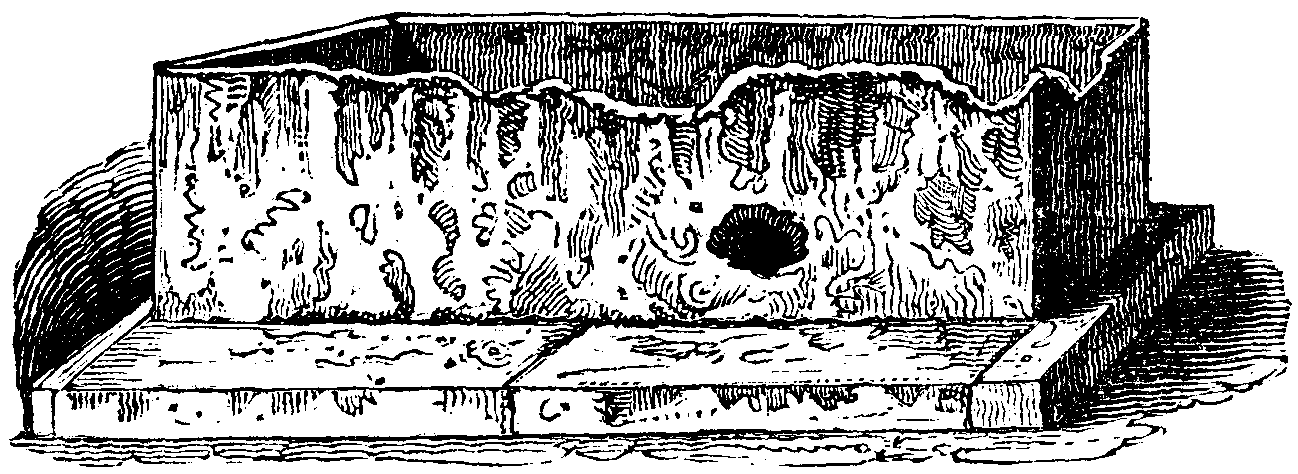
(Juliet's Tomb.)
MONASTERIES.
It is a strange error to conceive that English monasteries, before the dissolution, fed the indigent part of the nation, and gave that general relief which the poor laws are intended to afford.
Hallam.
PIRACY.
Mr. Hallam makes the following excellent observations upon the frequency of piracy in the middle ages:—"A pirate, in a well-armed, quick-sailing vessel, must feel, I suppose, the enjoyments of his exemption from control more exquisitely than any other free-booter; and, darting along the bosom of the ocean, under the impartial radiance of the heavens, may deride the dark concealments and hurried nights of the forest robber. His occupation is indeed extinguished by the civilization of later ages, or confined to distant climates. But in the 13th or 14th centuries, a rich vessel was never secure from attack; and neither restitution nor punishment of the criminals was to be obtained from governments, who sometimes feared the plunderer, and sometimes connived at the offence."
GOOD EFFECTS OF SALT.
Salt appears to be a necessary and universal stimulus to animated beings; and its effects upon the vegetable as well as animal kingdom have furnished objects of the most interesting inquiry to the physiologist, the chemist, the physician, and the agriculturist. It appears to be a natural stimulant to the digestive organs of all warm-blooded animals, and that they are instinctively led to immense distances in pursuit of it. This is strikingly exemplified in the avidity with which animals in a wild state seek the salt-pans of Africa and America, and in the difficulties they will encounter to reach them: this cannot arise from accident or caprice, but from a powerful instinct, which, beyond control, compels them to seek, at all risks, that which is salubrious. To those who are anxious to gain further information upon this curious subject, I would recommend the perusal of a work entitled "Thoughts on the Laws relating to Salt," by Samuel Parkes, Esq., and a small volume by my late lamented friend Sir Thomas Bernard, on the "Case of the Salt Duties, with Proofs and Illustrations." We are all sensible of the effect of salt on the human body; we know how unpalatable fresh meat and vegetables are without it. During the course of my professional practice, I have had frequent opportunities of witnessing the evils which have attended an abstinance from salt. In my examination before a committee of the House of Commons in 1818, appointed for the purpose of inquiring into the laws respecting the salt duties, I stated, from my own experience, the bad effects of a diet of unsalted fish, and the injury which the poorer classes, in many districts, sustained in their health from an inability to procure this essential condiment. I had some years ago a gentleman of rank and fortune under my care, for a deranged state of the digestive organs, accompanied with extreme emaciation. I found that, from some cause which he could not explain, he had never eaten any salt with his meals: I enforced the necessity of his taking it in moderate quantities, and the recovery of his digestive powers was soon evinced in the increase of his strength and condition. One of the ill effects produced by an unsalted diet is the generation of worms. Mr. Marshall has published the case of a lady who had a natural antipathy to salt, and was in consequence most dreadfully infested with worms during the whole of her life.—(London Medical and Physical Journal, vol. xxix. No. 231.) In Ireland, where, from the bad quality of the food, the lower classes are greatly infested with worms, a draught of salt and water is a popular and efficacious anthelmintic. Lord Somerville, in his Address to the Board of Agriculture, gave an interesting account of the effects of a punishment which formerly existed in Holland. "The ancient laws of the country ordained men to be kept on bread alone, unmixed with salt, as the severest punishment that could be inflicted upon them in their moist climate. The effect was horrible; these wretched criminals are said to have been devoured by worms engendered in their own stomachs." The wholesomeness and digestibility of our bread are undoubtedly much promoted by the addition of salt which it so universally receives.
Dr. Paris—quoted in the Doctor.
PROGRESS OF THE SCIENCES.
The first savages collected in the forests a few nourishing fruits, a few salutary roots, and thus supplied their most immediate wants. The first shepherds observed that the stars moved in a regular course, and made use of them to guide their journeys across the plains of the desert. Such was the origin of the mathematical and physical sciences. Once convinced that it could combat nature by the means which she herself afforded, genius reposed no more, it watched her without relaxation, it made incessantly new conquests over her, all of them distinguished by some improvement in the situation of our race. From that time a succession of conducting minds, faithful depositories of the attainments already made, constantly occupied in connecting them, in vivifying them by means of each other, have conducted us, in less than forty ages, from the first essays of rude observers to the profound calculations of Newton and La Place, to the learned classifications of Linnaeus and Jussieu. This precious inheritance, perpetually increasing, brought from Chaldea into Egypt, from Egypt into Greece, concealed during ages of disaster and of darkness recovered in more fortunate times, unequally spread among the nations of Europe, has everywhere been followed by wealth and power; the nations which have reaped it are become the mistresses of the world; such as have neglected it, are fallen into weakness and obscurity.
Curtis's Lectures on the Ear.
THE CAUSES OF DISEASE.
Daily observation demonstrates that the human structure, even in its most perfect formation is liable to lesions of organization and derangment of function, producing that state of the system in which its usual actions or perceptions are either interrupted or attended with pain—this state is called disease. Every animal carries within itself the germ of its own destruction, or, in other words, it is formed for a limited existence. Many diseases, therefore arise spontaneously, or without any assignable external cause; but many more are produced by causes, over which we have some control, and perhaps the chief source of the physical ills to which we are liable, is the deviation we make from the simplicity of nature. The injurious influence that domestication has upon the health of the lower animals is very strikingly apparent; and in proportion as their subjugation is more complete, and their manner of life differs more widely from that which is natural to them, so are their diseases more numerous and severe. The diseases of our more valuable domestic animals are sufficiently numerous and important to employ a particular class of men; and the horse alone has professional assistance appropriated to him. Men of education and talent have devoted themselves to the investigation of the diseases of this noble and useful creature. The poor little canary birds confined in their prisons, are very liable to disease, more especially inflammation of the bowels, asthma, epilepsy, and soreness of the bill. No animal deviates so far from the simplicity of nature in its habits, as man; none is placed under the influence of so many circumstances, calculated to act unfavourably upon the frame. His morbid affections are hence abundant and diversified, as may be seen by referring to the different nosological arrangements; these long catalogues of diseases affording strong evidence that man has not carefully followed that way of life which has been marked out for him by nature. The crowded state of the inhabitants of large cities; the injurious effects of an atmosphere loaded with impurities; sedentary occupations; various unwholesome avocations; intemperance in food; stimulating drinks; high-seasoned and indigestible viands (and these taken hastily in the short intervals allowed by the hurry and turmoil of business); the constant inordinate activity of the great central circulation, kept up by the double impulse of luxurious habits and high mental exertions; the violent passions by which we are agitated and enervated; the various disappointments and vexations to which all are liable, reacting upon and disturbing the whole frame; the delicacy and sensibility to external influences, caused by heated rooms, too warm clothing, and other indulgencies; are all contrary to the voice of nature, and they produce those morbid conditions of the system which a more simple and uniform mode of living would prevent. Our associates of the animal kingdom do not escape the influence of such causes: the mountain shepherd and his dog are equally hardy, and form an instructive contrast between a delicate lady and her lap-dog; the extreme point of degeneracy and imbecility of which each race is susceptible. In the early ages of society man enjoyed long life, his manner of living was simple, his food, habitation, and pursuits, were all calculated to fortify the body, and no anxious cares disturbed his mind.
Curtis's Essay on the Deaf and Dumb.
REFORM OF CRIMINAL LAW.
How noble and pure was the ambition of Sir Samuel Romilly we may learn from the following beautiful passages, where he has explained the motives by which he was actuated in his proposed reforms of the criminal law. "It was not," said he, "from light motives—-it was from no fanciful notions of benevolence, that I have ventured to suggest any alteration in the criminal law of England. It has originated in many years' reflection, and in the long-established belief that a mitigation of the severe penalties of our law will be one of the most effectual modes to preserve and advance the humanity and justice for which this country is so eminently distinguished. Since the last session of parliament, I have repeatedly reconsidered the subject: I am more and more firmly convinced of the strength of the foundation upon which I stand; and even if I had doubted my own conclusions, I cannot forget the ability with which I was supported within these walls; nor can be insensible to the humane and enlightened philosophy by which, in contemplative life, this advancement of kindness has been recommended. I cannot, therefore, hastily abandon a duty which, from my success in life, I owe to my profession—which, as a member of this house, I owe to you and to my country—and which, as a man blessed with more than common prosperity, I owe to the misguided and unfortunate."
Roscoe's Lives of Eminent Lawyers.
AN UPRIGHT JUDGE.
The character of Sir Matthew Hale as a judge was splendidly pre-eminent. His learning was profound; his patience unconquerable; his integrity stainless. In the words of one who wrote with no friendly feeling towards him, "his voice was oracular, and his person little less than adored." The temper of mind with which he entered upon the duties of the bench is best exemplified in the following resolutions, which appear to be composed on his being raised to the dignity of chief baron at the restoration.
"Things necessary to be continually had in remembrance:—
"1. That in the administration of justice I am intrusted for God, the king, and country; and therefore,
"2. That it be done—1. uprightly; 2. deliberately; 3. resolutely.
"3. That I rest not upon my own understanding or strength, but implore and rest upon the direction and strength of God.
"4. That in the exertion of justice I carefully lay aside my own passions, and not give way to them, however provoked.
"5. That I be wholly intent upon the business I am about, remitting all other cares and thoughts as unseasonable and interruptions.
"6. That I suffer not myself to be pre-possessed with any judgment at all, till the whole business and both parties be heard.
"7. That I never engage myself in the beginning of any cause, but reserve myself unprejudiced till the whole be heard.
"8. That in business capital, though my nature prompt me to pity, yet to consider there is a pity also due to the country.
"9. That I be not too rigid in matters purely conscientious, where all the harm is diversity of judgment.
"10. That I be not biassed with compassion to the poor, or favour to the rich, in point of justice.
"11. That popular or court applause or distaste have no influence in anything I do, in point of distribution of justice.
"12. Not to be solicitous what men will say or think, so long as I keep myself exactly according to the rule of justice.
"13. If in criminals it be a measuring cast, to incline to mercy and acquittal.
"14. In criminals that consist merely in words, where no more harm ensues, moderation is no injustice.
"15. In criminals of blood, if the fact be evident, severity is justice.
"16. To abhor all private solicitations, of what kind soever, and by whomsoever, in matters depending.
"17. To charge my servants—1. Not to interpose in any matter whatsoever; 2. Not to take more than their known fees; 3. Not to give any undue precedence to causes; 4. Not to recommend counsel.
"18. To be short and sparing at meals, that I may be the fitter for business."
Under the influence of resolutions like these, the conduct of Hale on the bench appears to have been almost irreproachable.
Ibidem.