FURNITURE AND ITS MAKERS Thomas Sheraton
Reading edition
FIVE

At forty years of age Thomas Sheraton was a poverty-pinched journeyman cabinet maker and Baptist preacher in Stockton-on-Tees. Then in 1790 he went to London, where he found even a greater poverty, but where he made for himself as a designer of furniture a name that will last as long as the world loves beautiful things. The fifteen remaining years of his life were tragically sad.
Sheraton’s knowledge was gained through years of hardship and privation. He lived to see his chosen art reach its zenith, and then to see it fall away. He had scarce perfected his creations when they were overwhelmed by a wave of bad taste that swept much beauty from English furniture.
When Sheraton reached London he hadn’t enough money to set up shop, much less to employ skilled workmen. So, instead of making furniture, he wrote about it, varying this occasionally by writing sermons or tracts. He made little money, but many enemies, for he had a bitter tongue.
Adam Black, afterward the famous publisher, was then a printer’s apprentice, and lived for a time in Sheraton’s humble home. “The night I arrived,” Black wrote, “there were but two cups and saucers, one of which I used, Sheraton’s wife sharing her young daughter’s porridge bowl.”
Black published Sheraton’s “Encyclopedia of Furniture.” This brought Sheraton some fame, but little food. The big work showed the great range and variety of Sheraton’s art.
We love his furniture for its finely curved surfaces, graceful sweeps of sideboards and cabinets reflecting the light. Aside from its beauty, Sheraton’s furniture was essentially practical—sometimes in most original fashion. For example, he invented a summer bed, divided in the center so as to give a greater circulation of air. There was likewise a hollow-front sideboard that became popular for the ease with which a butler could reach across for a stray glass or piece of china ware. His “conversation chair” was designed for the beaux of Georgian times, whose coat-tails were too costly to be sat upon. The proper position in this chair was for the sitter to face the back of the chair, with his arm resting on the top rail, so that his coat-tails could hang. The so-called “Pouch Table,” much beloved today by neat housewives, was Sheraton’s invention. It was a work table with a pouch of silk on each side.
Besides his great book, Sheraton got up a handbook for the benefit of his brother craftsmen, in which he gave in a helpful manner minute descriptions of his various pieces. The spirit that prompted him to do this was the finest thing in Sheraton’s nature. He had his faults. He was narrow, self-centered, and bitterly resentful of the success of others, but he believed it to be a man’s duty to give to the world the benefit of his full knowledge, and he sacrificed himself through life to do this.
PREPARED BY THE EDITORIAL STAFF OF THE MENTOR ASSOCIATION ILLUSTRATION FOR THE MENTOR, VOL. 1, No. 30, SERIAL No. 30
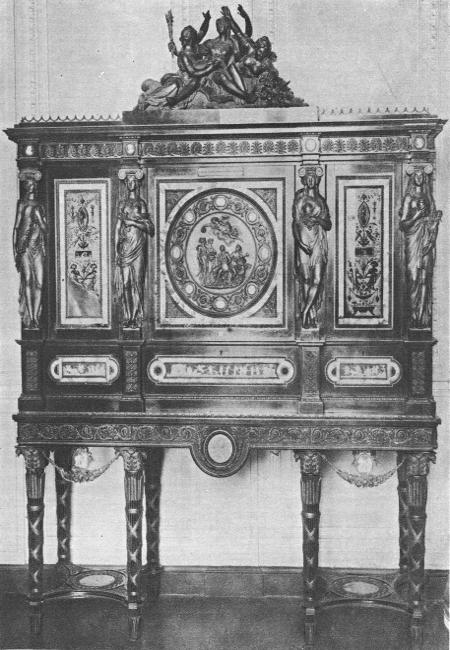
LOUIS XVI CABINET