FURNITURE AND ITS MAKERS Boulle and Marot
Reading edition
TWO

There was no limit to the prices a reckless and profligate court was willing to pay for luxurious beauty during the sumptuous, extravagant reign of Louis the Magnificent of France. For much that was most splendid and beautiful in furniture making at this period stands the name of Charles André Boulle. His imagination and skill were given full play, and he proved equal to the demands made upon him.
Boulle was a remarkable man. In a court whose only thought was of pleasure and display, he realized that his furniture must not only excel all others in richness, beauty, and cost; it must also be both comfortable and useful. He was appointed cabinet maker to the Dauphin, the heir to the throne of France. This distinction, together with his own tastes, led him to copy some of the manners and bearing of his rich customers.
He was an aristocrat among furniture makers. He spent the greater part of his large fortune in filling his workshop with works of art. His warehouses were packed with precious woods and finished and unfinished pieces of magnificent furniture. In his own rooms were priceless works of art, the collection of a lifetime—gems, medals, drawings, and paintings, which included forty-eight drawings by Raphael.
Boulle’s ruin came in a single night. When he was seventy-eight years old all his property was destroyed by fire. His loss was not only of fortune, but of reputation as well; for when he was down and out he resorted to tricks and questionable dealings which brought him many lawsuits. He died in debt and poverty, a discredited and broken man.
The English court vied with France in its extravagance, and heaped honors and wealth on the man who, like Boulle, in France, was foremost among designers of furniture in that country. The authorities on fine furniture frequently speak of Marot’s work in connection with that of the great Boulle. Daniel Marot was the son of Jean Marot, an architect and engraver. After he went to England with William III he principally concentrated his talent upon the adornment of Hampton Court Palace. Much of the furniture at Hampton Court bears unmistakable traces of his authorship. At Windsor Castle also there is a silver table that is attributed to him.
Marot’s work differs from that of Boulle in that he inserted, in medallion form, pictorial subjects in a heavy framework of ornament. In other pieces the inlay took the form of geometrical, floral, and animal patterns, combined with the warmer and more beautiful tints of the exotic woods. The whole was marked by an unsurpassed degree of excellence in workmanship.
Besides furniture, Marot designed carved chimney pieces, panels for walls, ceilings, and wall brackets. He was also famous as a designer of gold and silver plate, and he even made tea urns and cream jugs.
PREPARED BY THE EDITORIAL STAFF OF THE MENTOR ASSOCIATION ILLUSTRATION FOR THE MENTOR, VOL. 1, No. 30, SERIAL No. 30
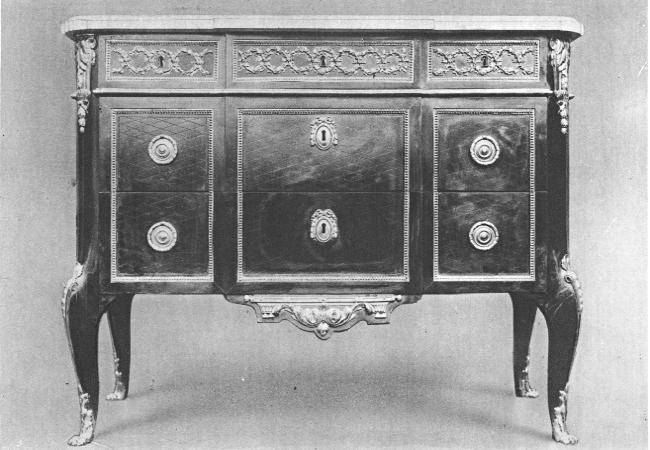
LOUIS XV SIDEBOARD—MADE BY RIESENER