FURNITURE AND ITS MAKERS
Reading edition
CHARLES ANDRÉ BOULLE
DANIEL MAROT
J. HENRI RIESENER
THOMAS CHIPPENDALE
THOMAS SHERATON
GEORGE HEPPELWHITE
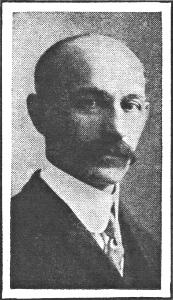
By PROFESSOR C. R. RICHARDS Director of Cooper Union, New York.
It is rather surprising to find how late a development furniture is in the modern sense. Up to the seventeenth century chairs were far from common. Outside of the large and heavy armchairs reserved for the head of the family, benches, chests, and stools were the only seats in all but the wealthiest households. Before the sixteenth century fixed tables were unusual. Dining tables were almost always composed of a set of boards placed upon trestles at mealtime. Going a little further back to the fourteenth century we find furniture, even in castles of the nobility, of the scantiest and simplest. In the sleeping rooms the pieces were limited to a bed, one or two chests, a bench before the fireplace, and seats built into the wall, commonly under the windows. In the hall where meals were served the only indispensable article besides the trestle tables and benches was a dressoir or buffet for the display of plate. All of these pieces were exceedingly heavy and massive, and oftentimes built into the structure of the room. Not until the seventeenth century did furniture become lighter, more easily movable, and more comfortable. It was at this period that chairs began to be made with sloping backs and furnished with cushioned seats of leather or woven stuff.
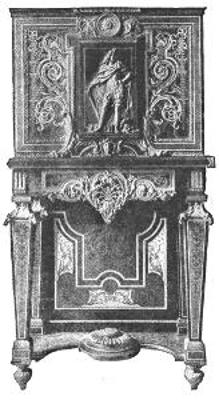
LOUIS XIV CABINET
EXAMPLE OF BOULLE
Every age has impressed its artistic standards strongly upon the furniture of the period. Long after Gothic cathedral building had ceased, the cabinetmakers of northern Europe continued to carve their delicate window tracery upon the panels of chests and buffets and to copy the moldings of pier and mullion.
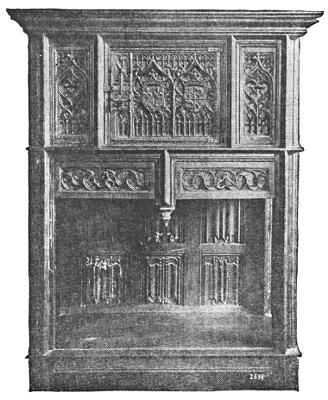
FRENCH OR FLEMISH CABINET OF THE FIFTEENTH CENTURY
The Renaissance brought a great change in the surface appearance of furniture, and in Italy, France, Flanders, and Germany the new art spirit manifested itself in different forms, each of which reflected the peculiar genius of the people of the land.
But all the earlier developments in furniture were overshadowed by the splendid achievements of French art in the latter part of the seventeenth century. These began under Louis XIV, and continued with undiminished productiveness and refinement of design through the reigns of Louis XV and Louis XVI, to a decline under the Empire.
LOUIS XV—FURNITURE OF THE BOUDOIR
The foundation by Colbert, minister of Louis XIV, of the Manufactures Royales des Meubles de la Couronne, commonly called the Gobelins, brought together for the production of furniture and tapestry for the royal palaces the most talented designers and expert craftsmen of the time. Of these Charles André Boulle was the master cabinetmaker. His name is commonly identified with marquetry of tortoise shell and brass, which he carried to a high state of perfection; but he was much more than a craftsman. He developed a furniture style that harmonized perfectly in its vigor and magnificence with the splendid proportions of the great royal residences. Large in scale and massive in construction, his pieces rely for their effect upon bold and striking decoration of gilded bronze and marquetry.
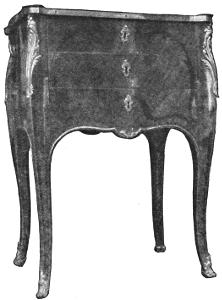
AN EXAMPLE OF RIESENER MARQUETRY
STYLE OF LOUIS XV
Boulle’s pieces accord thoroughly with the years of pomp and splendor of Le Grand Monarque; but even before the death of Louis a notable change in the appearance of furniture set in. The nobility, whose resources had been severely strained to maintain the splendor set by the king, found it necessary to substitute smaller apartments for their great rooms and galleries. Moreover, the heroic quality of the earlier Louis XIV decorations was no longer suited to the growing softness and effeminacy of the age. Smaller and more delicate furnishings were demanded. The Louis XIV chairs had borrowed the high upholstered backs, together with the S curves for arms and legs, from the Italians—later on the bold bombé curve appeared in the supports of the tables. By the time of the Regency these outlines had become more slender and refined and the reign of the curved line in furniture became established,—a reign that lasted for fully half a century, during which time some of the ablest masters of design that have ever lived played and conjured with curves delicate and curves bold, now bringing forth an outline pure and exquisite in quality, and again with amazing inventiveness interlacing curve with curve in combinations of infinite variety and bewildering richness.
Most Louis XV furniture develops naturally from that of Louis XIV, and is built upon thoroughly structural lines. The reaction, however, against severity and the increasing demand of a frivolous aristocracy for new and more striking effects, gradually produced a style in which decoration was often not subordinated to structure, but made an end in itself.
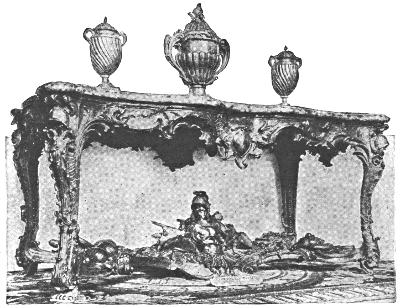
LOUIS XV TABLE
The rococo (from rocaille, rock, and coquille, shell) ran its extravagant course with increasing exaggeration and license during the first half of the reign of Louis XV; but it should not be thought of as affecting all the furniture even of this period, for its manifestations were mainly in the field of the carver and bronze worker, and the outlines of furniture were very little influenced, except in the case of the smaller and lighter pieces, such as console tables. About the middle of the reign the limit of artistic license had been passed and a reaction set in. The ormolu, which had reached excessive size and had become overloaded on the surface, was withdrawn to the edges, and made smaller and more suitable for the delicate proportions of the pieces. In its place marquetry of beautiful colored woods, more or less practised for over a century, was brought to a perfection never before equaled.
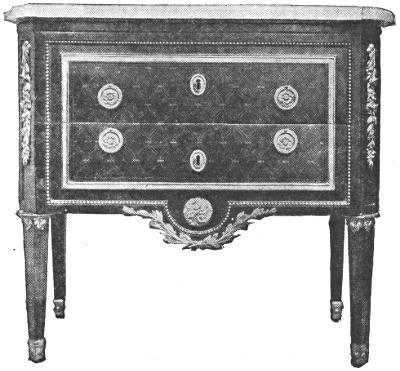
LOUIS XV COMMODE
LOUIS XVI—THE INFLUENCE OF THE CLASSIC
The reaction against the excesses of the rococo which had set in as early as the middle of the eighteenth century continued to gain strength during the next two decades, and to carry the design of furniture farther and farther from the fashion of the early years of Louis XV.
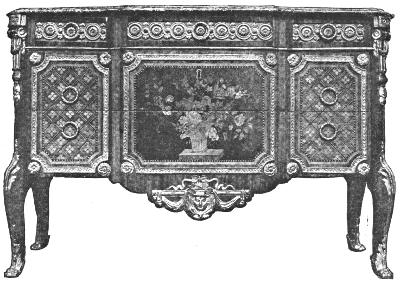
LOUIS XVI COMMODE
The new impulse turned naturally to the straight contour. This meant almost inevitably the adoption of classic lines. At first the change showed itself in the straightened bodies of commodes, cabinets, and writing tables, which still retained their curved supports. Finally the legs themselves were made straight or rather tapering; until by the end of the reign of Louis XV the curved outline had quite disappeared and the style called Louis XVI was fairly launched.
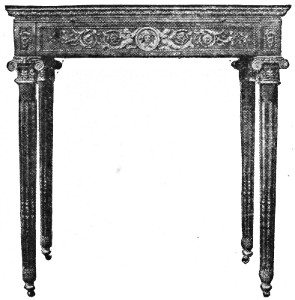
LOUIS XVI TABLE
The ormolu takes new forms. It is limited to the edges and to frames of panels, to friezes, and to important centers, and follows the classic spirit: not an outright imitation of Roman or Greek forms, but a charming French interpretation of the antique. The designs of the metal worker had never been more delicate, or his execution finer. Delicacy and appropriateness of ornament, fineness of proportion, and sobriety of treatment were the ideals of the new cabinetmakers. The art of marquetry was still further advanced, and reached perhaps its culminating expression in the fine examples of Riesener and Röntgen.
It was during this reign that mahogany began to be extensively and almost exclusively used as a cabinet wood, in place of the walnut previously employed. Where walnut was still used, as in the case of chairs, it was generally gilded or enameled. The chair and the canape or sofa stand out as among the most successful achievements of the Louis XVI designers. Simple as to structural lines, their details were worked out with scrupulous care and, from fluted tapering legs to the carved frames inclosing the beautiful tapestry backs, they represent extreme elegance and consistency of style.
Toward the end of the reign of Louis XVI the quality of furniture design degenerated. Instead of charming adaptations and interpretations of the classic spirit, mechanical imitations of Greek and Roman forms appear, and heavy bronze caryatids overweigh and distort the outlines of cabinets and tables. Dull heaviness takes the place of elegance and the play of fertile invention. The decline had begun.
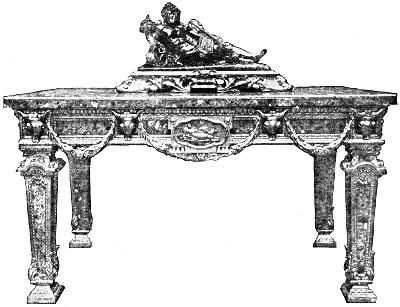
LOUIS XVI TABLE
EMPIRE—THE IMITATION OF THE CLASSIC
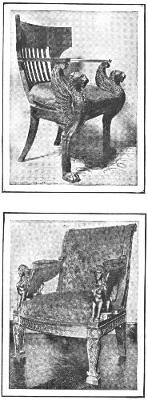
EMPIRE ARMCHAIRS
The new order, built on the overthrow of monarchical society and with no sympathy for delicacy and refinement, desired a setting free from the traditions of the past. The cabinetmakers, however, had only their training of the reign of Louis XVI, and this they could not transcend. For motives they had only their knowledge, or what they considered knowledge, of the antique. On this they endeavored to build a new style by direct adoption of classic forms. In chairs and couches they attempted to reproduce the actual shape used by the Greeks and Romans. Figures of caryatids and sphinxes take the place of simpler structural supports in tables and stands.
Ormolu was no longer employed in an architectural manner in which one decorative detail is set off against another in a play of rhythm and contrast; but was applied as single figures or small ornamental motives on a plain surface of mahogany. Oftentimes this ornament has so little relation to the space decorated that it could well be omitted without loss of real effectiveness. This enthusiasm for the antique passed through Egyptian, Greek, and Roman phases. Heavy and unimaginative as most of the Empire pieces seem, it can at least be said that they are more consistent and satisfying than the inharmonious mixture that characterized the furniture of the last year of Louis XVI. Many of the Empire chairs indeed are of real dignity and beauty of proportion. In some of these ormolu, introduced for the first time in chairs, was used in combination with polished mahogany; but in most cases the woodwork was sparingly carved with rosettes and enameled in white and gold. For the coverings, silk brocade and appliqué in the prevailing colors of yellow and red took the place of tapestry.
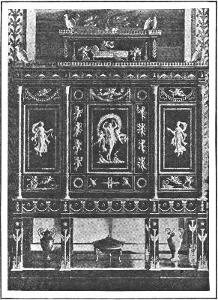
JEWEL CABINET OF MARIE LOUISE
LATE EMPIRE
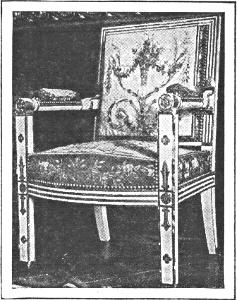
EMPIRE ARMCHAIR
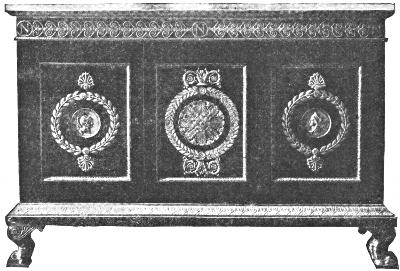
EMPIRE COMMODE
CHIPPENDALE—THE MASTER OF LINE
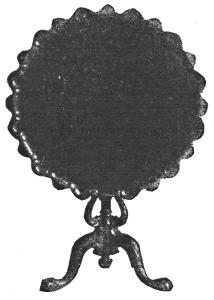
CHIPPENDALE PIECRUST TABLE
The French styles were the result of many designers working upon common lines; but in England during the last half of the eighteenth century certain noted individual cabinetmakers set the fashion, and for a period of years the designs of Chippendale, Heppelwhite, and Sheraton were each in turn recognized as the established vogue.
Thomas Chippendale began business in London on his own account about 1735, and evidently rapidly built up a very flourishing establishment, inasmuch as the “Gentleman and Cabinet-maker’s Director,” which he published in 1754, contains a wide variety of designs suitable only for wealthy customers.
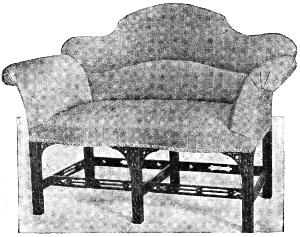
CHIPPENDALE SETTEE—FRETWORK
The “Director” contains many designs that are fantastic, and many that are difficult and even impossible to execute. Fortunately Chippendale’s fame does not rest upon these designs, made to catch the eyes of his richer patrons, but upon the pieces actually made, and it is refreshing to see how much finer are these latter, evolved by the trained craftsman, understanding every limitation and every possibility of his material. Chippendale’s chairs represent by far the best expression of his genius. Starting with the modified Dutch forms introduced by William and Mary and Queen Anne, in which the cabriole leg with ball and claw feet and the flowing curved back with solid splat are the prominent features, he soon developed an individual style marked by great dignity, strength, and originality. His earliest chairs are perhaps the finest. In these the cabriole leg is always employed, and the side frames of the back curve outward as they run up to more or less pronounced ears at the top. The top rail takes more or less of a cupid bow shape, and the central splat fills in the inclosed space. It is in the design of these central splats and the inclosed framework that Chippendale is at his best. The almost inexhaustible variety of figure in these pierced and interlaced centers, always in the happiest relation to the framework, gives the principal interest to these chairs, and stamps Chippendale as one of the great masters of design.
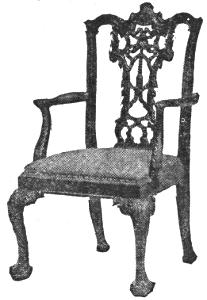
CHIPPENDALE ARMCHAIR
Chippendale’s styles represent many influences. His early work was patterned closely upon Queen Anne models; but with the “Director” appeared many examples of Gothic and fretted furniture. The Gothic, unsuitable as it was for domestic use, obtained little vogue; but the ornamentation of chairs and tables, either by open or, more commonly, applied fretwork, was popular for a dozen years or more, and is characteristic of some of Chippendale’s most successful if not most showy productions.
During this same period a rage for things Chinese possessed the popular taste, and in many latticed chair backs and canopied tops of cabinets the versatile cabinetmaker catered to this new interest.
Besides his chairs, the name of Chippendale is closely associated with the charming tripod tables, generally made with tilted top and often with molded or “piecrust” border, with the flat card tables so much used in the gaming of the period, and with the all-china cabinets and bookcases with glass fronts, and oftentimes with a characteristic broken pediment at the top.
The two other men who identified their names with English styles worked under the influence of the classical revival brought about in England largely by the influence of the brothers Adam. In the case of Heppelwhite this influence greatly affected but did not absolutely determine the style; for this practical cabinetmaker was a man of independent if not original ideas, and his work bears a strong stamp of individuality. Heppelwhite died in 1786, and the “Cabinet-maker and Upholsterer’s Guide,” published by his widow and partners in 1788, shows us in the form of a trade catalogue much of the spirit and quality of his work.
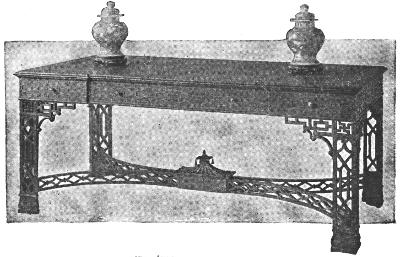
CHIPPENDALE TABLE
This table shows strong Chinese influence.
HEPPELWHITE—THE EXPONENT OF ELEGANCE
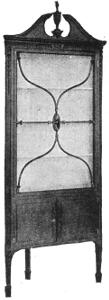
HEPPELWHITE CORNER CABINET
The most characteristic designs of Heppelwhite are his chair backs. These are commonly shield or oval shaped, with open center splats, in the center of which were often introduced the ostrich plumes of the Prince of Wales. Another form of back frequently employed by Heppelwhite was that with slightly curved sides and strongly bowed top, known as the “camel back.”
The legs of Heppelwhite’s chairs are almost always tapering and square in sections and end in a spade foot. The proportions of these chairs give an effect of extreme elegance and refinement. They seem almost fragile; but the material is disposed with such skill and the workmanship is so excellent that in reality they are far stronger than might appear.
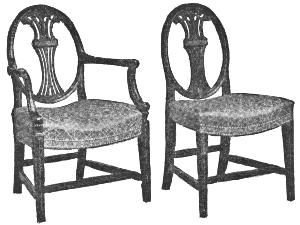
EXAMPLES OF HEPPELWHITE CHAIRS
From the time of the Middle Ages the buffet has existed as an important article of furniture; but to Heppelwhite is due the credit of perfecting the sideboard in its present English form. He combined the pedestal cellaret and side table of Robert Adam in one structure, and effected a union of utility with elegance, which he executed in many pleasing designs of bow and serpentine front.
To Heppelwhite we must also give credit for the most refined and tasteful use of inlay and of veneers to be found in English furniture. On the doors of wardrobes and on the front of drawers he employed veneers of the beautiful curl mahogany that came into favor about 1760, and on the front of his solid mahogany tables, sideboards, and bookcases he substituted for carving the inlay of low-toned colored woods in the form of lines and narrow bands and other ornamental motives.
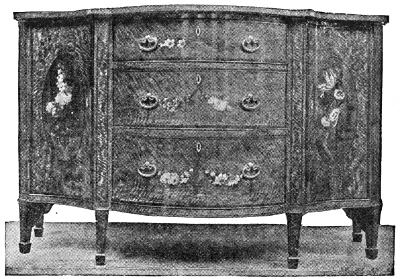
HEPPELWHITE COMMODE
SHERATON—THE PURIST
The last of the three great cabinetmakers represents the culmination of the classic spirit derived both from the brothers Adam and the French Louis XVI style. Sheraton’s productions, or rather his designs, depicted in the “Cabinet-maker and Upholsterer’s Drawing-Book,” have little of the vigor and strength of Chippendale’s work; but they are always characterized by delicacy and refinement.
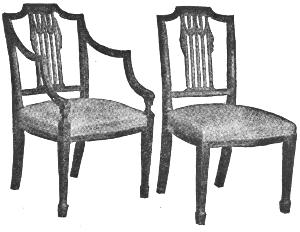
EXAMPLES OF SHERATON CHAIRS
Sheraton designed furniture both in mahogany and in satinwood, decorated by inlay and by painting, and it is with this last style, the introduction of which was largely due to the popularity of the gifted young artist Angélique Kauffmann, that he is particularly identified. His work in mahogany is characterized by simplicity of form and by the tasteful use of inlay, in which respect he was perhaps the equal of Heppelwhite.
His chair backs are almost always based upon the straight line, and, although sometimes made petty by the introduction of inappropriate classic ornament, they exhibit on the whole much skill and refinement in composition. In the legs of chairs and tables he almost invariably used turned and tapering supports, which were frequently decorated by reeding. In the sides and often the backs of his chairs he reintroduced the vogue of canework, which had not appeared in fashionable furniture since the seventeenth century.
Sheraton’s satinwood furniture took the form mainly of commodes or bureaus, small writing desks, toilet tables, and other lighter articles for the boudoir. The daintiness and elegance of some of these pieces decorated by the brush of Angélique Kauffmann or Pergolesi challenge comparison with some of the exquisite furniture made during the reign of Louis XVI, and they mark the final culmination of English furniture before its degeneration into the mediocrity of later times.
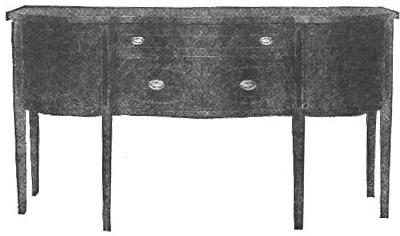
SHERATON SIDEBOARD
SUPPLEMENTARY READING
French FurnitureA. Saglio
A History of English FurniturePercy Macquoid
French Furniture in the Eighteenth CenturyLady Dilke
Colonial Furniture in AmericaLuke Vincent Lockwood
English Furniture of the Eighteenth CenturyHerbert Cescinsky
FurnitureEsther Singleton
French and English FurnitureEsther Singleton
The Furniture Designs of Thomas ChippendaleJ. Munro Bell
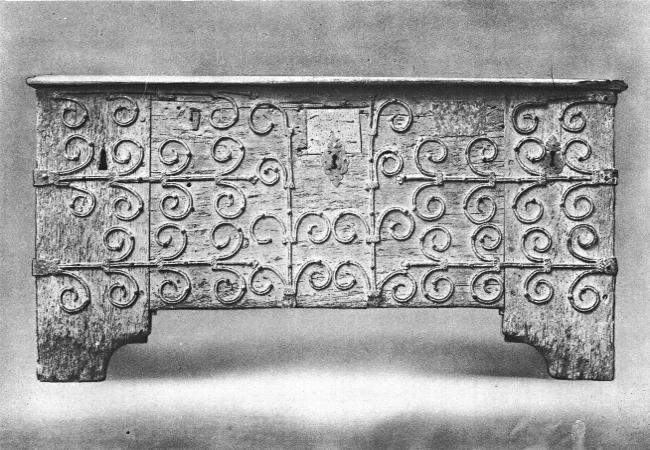
ANTIQUE CHEST—THIRTEENTH CENTURY