CARLO GOZZI. (continued 5)
John Addington Symonds translation
Sacchi joined me in my box; and casting my eyes over the sea of faces, I soon perceived Signor Gratarol with a handsome woman at his side. He had come to{272} air his philosophy, but I trembled for him. The curtain rose, and the play proceeded with great spirit. All the actors did their best. I was satisfied with their performance, and the audience applauded. At length, toward the close of the first act, Don Adone appeared. Then, and not till then, I understood the reason of the change of parts by which this rôle had fallen to Vitalba.[64] He was a good fellow, but a poor artist; and unfortunately he resembled Signor Gratarol pretty closely both in figure and colour of hair. The knavery of the comedians had furnished him with clothes cut and trimmed exactly on the pattern of those worn by Gratarol. He had been taught to imitate his mincing walk and other gestures. The caricature was complete; and I had to confess that Signor Gratarol had actually been parodied upon the stage in my comedy of the Droghe d'Amore. Innocent as I was of any wish to play the part of Aristophanes in modern Venice, the fact was obvious; and the audience greeted Vitalba with a storm of applause and rounds of clapping which deafened our ears.
I turned sharply upon Sacchi, and complained bitterly of the liberty he had taken with my unoffending comedy. He only shrugged his shoulders, and said he was afraid that an exhibition which promised so well for his money-box might be suppressed{273} as a public scandal. That was all I could extort from him; and the play advanced to the middle of the third act, accompanied with universal approval. Whenever Don Adone entered and spoke a line or two, he was greeted with thunders of applause. I still hoped for those salutary hisses which might have damned the piece. The audience had been crammed together now for full seven hours; they numbered some two thousand persons, and were largely composed of people from the lower ranks of life. It was no wonder that they began to be restless, fought together, tried to leave the house, and raised a din which drowned the voices of the actors. Don Adone made his last exit, and there was nothing to excite interest but the dregs of an involved and stationary plot. The hubbub rose to a tumult, and my hopes rose with it. The actors gabbled through the last scenes in helpless unintelligible dumb-show. At last the drop-scene fell upon a storm of cat-calls, howls, hisses, and vociferations. I turned to Sacchi and said: "Your vile machinations deserved this retribution. Now you will admit that I prophesied the truth about my play." "Pooh!" he answered, "the play took well enough up to a certain point. It is only necessary to shorten it a little, and we shall not have the same scene another night." Then he left the box all in a heat, without waiting for my reply and without even bidding me good-night.{274}
LVIII.
Gratarol tries to stop the performance of the play, which is no longer in my power.—Intervention of Signor Carlo Maffei.—Conference with him and Gratarol at my house.—The worst hour I ever lived through.
Next morning the actors came to me with joy beaming on their faces, and announced that the Droghe d'Amore was going to be performed again. The town insisted on its repetition; and they had brought the manuscript, hoping I would condescend to make some alterations and curtailments.
Much as I disliked the news, I was glad at least to get my composition back. I made the players promise to modify Don Adone's costume, so that the effect of caricature might be reduced, and then sat down to hack away at the comedy. Besides shortening it at the expense of structure, plot, and coherence of parts, I carefully erased all passages which might seem to have some bearing upon Signor Gratarol. In this way, by mutilating my work and changing the costume of Don Adone, I flattered myself that the illusion of the public might be dissipated. Vain hope! The cancer had taken firm hold, and was beyond the reach of any cautery.
The Droghe d'Amore was repeated upon four successive{275} nights to crowded audiences.[65] Don Adone, in spite of my endeavours, still formed the principal attraction. All I could do was to persuade Sacchi to replace it by another piece upon the fifth evening. I kept away from the theatre after the second representation; and on the morning of the fifth it gave me satisfaction, while crossing the Rialto, to read placards announcing an improvised comedy at S. Salvatore. "Sacchi," said I, "has kept his word." But this was not the case. Plenty of people stopped to tell me what had happened at the theatre the night before. Just as the curtain was going up and a full house was calling for the spectacle, a messenger arrived to say that Mme. Ricci had fallen downstairs, hurting her leg so badly that she could not move. An indescribable tumult arose; shrieks, screams, curses, squabbles, hustlings,—all the commotion of an eager audience deprived of its legitimate amusement.
When I reached the piazza, several actors of the troupe confirmed the news in all its details. They added that Ricci's husband had to go before the footlights in order to assure the public of his wife's{276} accident. But nobody believed that this was more than a ruse concocted by Signor Gratarol to stop the play. Surgeons were sent to Mme. Ricci's house, who reported her in perfect health. Signor Vendramini forwarded an account of the disturbance at his theatre to the tribunals of the State, and they decreed that the comedy was to be repeated on the night of the 17th. An officer of the Council of Ten received orders to attend Mme. Ricci to the theatre on that occasion, and see that she performed her duty.
Thus Gratarol's unworthy stratagem made matters infinitely worse for us. I only discovered at a later date that he was seeking to gain time for dark and treacherous machinations against my person.
On the 15th of January I found myself, as usual, at S. Salvatore, expecting one of those old-fashioned improvised comedies which never fail to divert me. My excellent friend, Signor Carlo Maffei, stepped up, and begged for a few moments' serious conversation. I assented; we entered his box; he carefully secured the door, and made the following communication. But before proceeding to relate what passed between us, I must describe a few traits of this worthy gentleman's character. He is the very soul of honour, scrupulously upright in all his dealings, incapable of trickery or meanness, but gifted with such tenderness of heart and sensibility that he sometimes falls into mistakes of judgment about people who are not distinguished by his own sterling{277} qualities. Signor Maffei only erred in admiring me and my writings beyond their merits. Yet he lived a very different life from mine. He was a prominent member of that society which is called bon ton and the great world at Venice. Partaking freely of its amusements, he had formed an intimacy with Signor Gratarol. Indeed, he must have known that gentleman several years before he became my friend. This accounts for the proposal which I shall now report.
"Gratarol's misfortunes," he began, "have made a deep and painful impression on my feelings. He came a little while ago to visit me, and literally drew tears from my eyes. He is in a state bordering on distraction. What he came to ask was whether I could undertake to arrange a conference between you and him apropos of that unfortunate comedy. It is indifferent to him whether we meet at my house or at yours."
When I heard this, I felt sure that some scorpion must be concealed beneath so tardy an attempt at reconciliation. I told Maffei so, and asked why Gratarol had not sought me out at the commencement, when Mme. Ricci was pouring her insidious venom into his ears. Now it was too late to do any good. I had lost the last thread of authority over my play. The Supreme Tribunal had taken cognisance of the affair, and we were both powerless to stir a finger. All the same, at Maffei's request, I was{278} willing to meet Gratarol, although I could not conceive what object he had in ferreting me out.
If I had but known, while my friend was pleading for him, that this horned serpent had just presented an information to the Inquisitors of State, denouncing me in person, and deliberately aiming at my honour and my safety, I should have returned a very different answer.[66]
In the end, after enumerating all that had occurred in the long history of my unlucky drama, I gave my consent, suggesting at the same time that the meeting had better not take place in my house, and expressly begging Signor Maffei to let Gratarol clearly understand beforehand that I was utterly helpless with regard to the Droghe d'Amore.
Maffei left the box at once, repaired to Signor Gratarol, and soon returned with the answer that his friend was absolutely determined to come to my house for the interview.
I spent a large part of that night in racking my brains to imagine what Gratarol could possibly hope to gain by this new step of his. Giving the problem{279} up as insoluble, I laid a scheme of my own, the only one which seemed to me at all practicable, and which I resolved to propose to him upon the morning of the 16th. It was as follows. I should write a prologue addressed to the public, saying that my comedy was going to be stopped after the evening of the 17th, at my own request, because it had been turned to bad account and misinterpreted, to the injury of myself and persons whom I esteemed as friends. This prologue could be printed and distributed before the performance of the play. Then Signor Gratarol and I would go together, and take our places amicably side by side in a front box of the theatre. The whole world would see that we were not at enmity, and I should be able to convince him, as the play proceeded, that Don Adone was not intended to be a personal satire on himself.
The plan approved itself to my judgment, and I went to sleep, persuaded that I had found a satisfactory way out of our worst difficulties.
Next morning, the 16th of January, I rose betimes, entered my study, and hurriedly composed a little prologue of twenty-four lines. Hardly had I finished the last verse, when my servant announced Signor Gratarol in a sonorous voice. Yes, there was the raging Cerberus Gratarol, accompanied by the gentle lamb Maffei! And all hopes of concealing this visit from the public had vanished. My servant had their names upon his lips, and Venice would soon be{280} saying that my humiliated enemy had gone to prostrate himself at his persecutor's feet.[67]
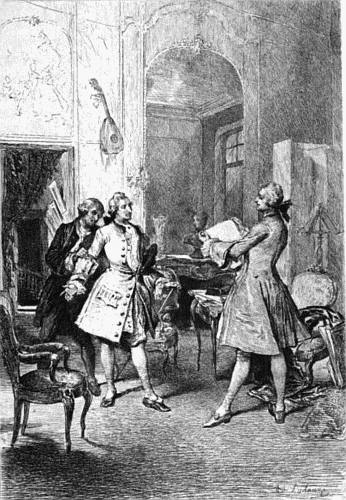
Gratarol did not make his entrance like a suitor. He was closely masked, and came swaggering into my tiny workroom with the swaying gait which is called "English style." When he raised his mask, the steam from his face rose to the ceiling, and I could see by his rolling eyes, quivering lips, spasms of pain, and frensied contortions, that the man suffered like the Titan with the vulture preying on his liver.
We all three took seats, and Signor Gratarol opened the conference by saying: "I have come to visit you, not as a suitor, but as a reasoner upon the merits of this case. Pray do not interrupt the thread of my argument, but give me patient hearing to the end." For upwards of an hour he thundered and declaimed like an infuriate Demosthenes against what he chose to call my "vindictive comedy." "Not that the personage of Don Adone has the least resemblance to my character," he added, "but that you meant it to hurt and outrage me." Starting on this note, he proceeded to dilate upon the splendour of his birth and education, his widespread celebrity, the offices of State he had discharged, his election as ambassador{281} at Naples, and the magnificent career which lay before him. "From the height of all this glory," said he, "I have fallen in a moment, and become the public laughing-stock through your comedy!" Then he touched upon his enemies among the great, and alluded significantly to a certain lady who had vowed his ruin. That led up to a moving picture of his present distress: "When I pass along the streets or cross the piazza in my magisterial robes, the very scum and canaille swarm around me, leave their shops, and point me out as the secretary to the Senate who is being turned to ridicule in your Droghe d'Amore." He writhed upon his seat and tears fell from his eyes as he spoke these words, never reflecting that it was not my play, but his own bad management which had brought these tragi-comic woes upon him.
Resuming the thread of his discourse, he imprudently let out the fact that during the last few days he had presented a petition—to what tribunal he did not say—for the suppression of my piece. Then, hastily catching himself up, as though he had gone farther than he meant, "In short," he added, "every door has been shut against me!" I was not so stupid as not to guess the awful tribunal to which an ambassador-elect had applied, and by which he had been rejected. Opening my eyes wide, I turned them meaningly on my worthy friend Maffei, as though to ask: "What devil of a visitor have you brought here for my torment?"{282}
At length the pith of the oration came to light. Admitting me to be susceptible of justice, humane feeling, religion, honour, magnanimity, and a host of other virtues, Gratarol laid it down as an axiom that "I was able and that I ought to stop the performance of the comedy upon the evening of the 17th, and so long as the world lasted." "Able and ought," exclaimed I to myself; "when I have made it clear to Maffei that I cannot stir a finger to prevent the play, and have already been rebuked by a respectable magistrate for attempting to do so!" I perceived that Maffei had omitted to inform Gratarol of my powerlessness. However, I determined to hear his speech to the end in patience. He now proceeded to demonstrate my power by asserting that Sacchi was not in a position to refuse any of my requests;[68] Sacchi had declared he would be governed by me in the matter of the comedy; Sacchi was independent of the patrician Vendramini; it was consequently my duty to put pressure upon Sacchi; all I had to do was to go to Sacchi and forbid the performance. "If you do not do so," he continued, "you will become deservedly an object of hatred to your country; everybody regards you as the author of my misfortunes, and the public{283} is on the point of turning round to take my side against you." I knew that this was unluckily only too probable; but the painful position in which we were both placed had been created, not by my malice, but by his credulity and blundering.
When this oration came to an end, I replied as briefly and as calmly as I could. I began by observing that even if I had the power to stop the play, I should expose myself to the greatest misconceptions. Everybody would believe that it had been suspended by an order from the magistracy in consequence of its libellous character. But that was not the real question at issue. The question was whether I had or had not the power to do this. By a succinct enumeration of all the incidents connected with the revision of the comedy, I proved that neither myself nor Sacchi could interfere with a performance officially commanded and announced for to-morrow evening. Gratarol put in abruptly: "What you are saying is irrelevant and inconsequential. My reasoning has made it certain that you can and ought to stop the play to-morrow and in perpetuity." At this point I begged to remind him that he had recently applied to a supreme tribunal—by his own admission, let drop in the hurry of his cogent reasoning—and that "the door had been shut in his face." It was of little use to argue with Signor Gratarol. To every thing I said he kept exclaiming: "Nonsense, nonsense! You can and must stop the performance."{284}
Wishing to cut matters short, but not without the greatest difficulty, and only by the assistance of Signor Maffei, I got him to listen to the plan I had devised that morning, and read him out my prologue. It was composed in a popular style, and ran as follows:
GRATAROL'S INTERVIEW WITH GOZZI Original Etching by Ad. Lalauze
"To the Respectable Venetian Public,
CARLO GOZZI.
"This harmless drama, which hath won the grace
Of your most generous and kind applause,
Large-hearted men of Venice, at the prayers,
Repeated prayers, and not without effect,
Of him who wrote it, now has been withdrawn.
He knows not by what accidents or how,
The various characters, the actors too,
In this plain piece of stage-work, which he took
From an old Spaniard, Tirso da Molina,
Adapting it to our Italian taste,
Have lent themselves to satire, falsely felt,
On living persons whom the author loves.
Scandal, malignant rumours, which abuse
His frank and candid pen, incapable
Of setting snares for names whom all respect,
Have moved him to implore that from to-night
Le Droghe d'Amore shall no longer run:
He meant it for amusement, not offence.
Warm thanks, dictated by his heart, he yields
To you, choice courteous public, who have deigned
To greet so poor a play with your applause;
And promises new works on other themes; and swears
That his sole object is to furnish sport
To you, dear countrymen, and keep your friend."
"Well, well!" cried Gratarol, rising from his chair with a contortion of impatience: "all that is nothing but mere water, water, water! I solemnly reject{285} your prologue and your plan.[69] My cogent reasoning upon the merits of the case has proved that you can and must stop the play." On my replying again and again that I was impotent to do so, his brows darkened, and he muttered with eyes wandering all round the room: "I warn you, sir, that if the play comes on the stage to-morrow evening, I shall not value my own life at a brass farthing. Yes, yes, I mean what I am saying; I shall not care for my existence."
The excellent Maffei was sitting all this while in a state of the greatest discomfort and distress. Seeing how pale and wretched he was, I rose to my feet, and addressed Gratarol in these words: "Sir, I do not wish you to part from me under the impression that I am not your friend. All I can undertake is to use my influence by prayers and entreaties to prevent the performance of my comedy. This I promise to do. But I cannot engage to succeed, for I am not the master in this matter. You shall have a full and punctual report of my endeavours. Pray kiss me as a sign that we do not part in enmity." The kiss was exchanged; and what I shall have to relate shortly will enable my readers to judge which of us two gave the kiss of Judas.{286}
LIX.
The several steps I took to meet the wishes of my blind and false antagonist.—History of a long tedious day.
How I spent the rest of the day after this painful scene may be told very briefly. I first sent a letter to the noble gentleman Signor Vendramini, entreating him in courteous but urgent terms to sanction the suspension of the comedy. A polite and distant answer expressing his inability to do so was placed in my hands. Then I hurried to find Sacchi. He was dining at the house of the patrician Giuseppe Lini at S. Samuele. I sent for him into the ante-chamber, and explained my reasons for having the performance stopped. "What can I do?" exclaimed the capocomico. "Have you forgotten that the sublime tribunal has given orders for the play, and that Ricci is going to be brought to the theatre by one of its foot-soldiers? You are demanding the impossible—the ruin of myself and all my company." "But did not you yourself declare," said I, "that you would punctually fulfil my wishes in this matter?" "To whom, and when, and where?" he answered in some heat; "who has told these lies? I should like to be confronted with the man. Do you imagine I am such a donkey as to make ridiculous assertions{287} of the kind? Nevertheless, if you can smooth away all obstacles, I am willing to submit to your demand."
The noise we were making in the ante-chamber brought Signor Lini and his guests out of the dining-room. They protested with one voice that it was impossible to withdraw a comedy which was already the property of the public and under the protection of the Government. Gratarol had stirred up all the mischief by fitting the cap on his own head. It was too late to think of the misfortunes he had brought by his own madness on himself.
Furnished with Sacchi's conditional promise, I flew off at once to my friend Maffei. I told him what I had already done, and with what poor success. "Nevertheless," I added, "there is yet another stone which I do not mean to leave unturned. I may find the noble lady Caterina Dolfin Tron at home, if I go to her immediately. She certainly suggested and contrived the travesty which turned Vitalba into a caricature of Gratarol. She has availed herself of the latter's indiscretion and false steps, the excitement of the public, and the dust stirred up about my wretched drama, to wreak her vengeance for what crime against herself I cannot say. Tell Signor Gratarol what I have attempted up to the present moment, and come to meet me under the Procuratie Nuove at three hours after sunset."
The January day in which I had to work was short; and I may parenthetically observe, although{288} the fact is trivial, that I did not allow myself time to eat a mouthful of food.
It was already an hour and a half past sundown when I turned my steps to the palace of that noble lady. I wished to have a witness of our colloquy, and met with no one on the way more proper for the purpose than Luigi Benedetti, the actor, and Sacchi's nephew. We climbed the long staircase and asked if her ladyship were at home. "Yes," said the servant, "she is receiving a company of ladies, senators, and men of letters." I begged to be announced; and shortly afterwards Mme. Dolfin Tron appeared, closing the doors of her reception-room behind her, from whence there came the sound of animated conversation. She saluted me cheerfully with her usual epithet of Bear, bade me take a chair beside her, and motioned to the actor to be seated.[70]
I unfolded the object of my visit in a few sentences, explained how urgently I desired the suppression of my comedy, and described the ineffectual steps which I had taken for securing it. "Now I fling myself upon your powerful assistance, in the earnest hope that you will help me to suspend the performance of the Droghe d'Amore."{289}
"What a request!" she cried: "what has inspired you to make it?" I replied by describing my own bitter annoyance at figuring as the libeller and satirist of private persons. I painted the distress of Gratarol, and the sympathy which I felt for him. "The kindness of your heart is worthy of all honour," she answered; "but if you knew the whole facts, you would not take compassion on that man. He has not merely let himself be bamboozled by an actress, fomented the scandal from which he is now suffering, set himself up against the decrees of the tribunals, calumniated people who deserve respect, pretended that the prima donna's leg was broken, and floundered from stupidity to stupidity until the Government itself is enraged against him. He has not merely committed all these follies. He has done more, of which you are not yet aware."
"I am quite prepared to believe you," I replied; "but in a case like his, any honest man might be excused for losing his head and acting with imprudence. Do not let us think of him. I come to beg you to save me from what I regard as an odious source of humiliation to myself. Signor Gratarol persists in saying that I can and ought to stop the performance of my play." The noble lady looked laughing in my face and said: "Any blind man can see that you have no power over your comedy. You made a gift of it to certain actors. It has been twice revised and licensed by the censors of{290} the State. It belongs to the public, and the public have the right to profit by it. You will only get yourself into a scrape if you insist on championing the cause of that presumptuous, conceited, and unruly man. If I cannot persuade you, there are senators in that room" (pointing to her drawing-room) "who will tell you plainly that you are impotent—your comedy no longer yours, but the property of the public and the magistrates of State." "All this I know quite well," I answered; "and I have repeated it a hundred times. I cannot stir a finger. This is the very reason why I come to you. I know that you can settle matters if you like. Intelligent people will perhaps understand how helpless I am in the whole matter. But the vulgar and the populace are sure to think otherwise, and I shall be prejudiced in the opinion of my countrymen. It is to your feeling heart that I make this last appeal, beseeching you to liberate me from the purgatory I am in of hearing all these scandals daily, and seeing the unfortunate Gratarol exposed to scorn in a base and cruel pillory." At the end of this speech I bent down, and stooped to the, for me, unwonted abasement of kissing a woman's hand five or six times.
All my entreaties, and even this last act of submission, were of no avail. Madame told me in conclusion that, for reasons which I did not know, the official decree was irreversible. The Ricci would be conducted by an officer of the Council of Ten to the{291} theatre next evening. After that, the comedy might cease to run; and my protegé Gratarol ought to be well contented with the result of the whole matter. She rose to rejoin her company, and I took my departure with my witness, Benedetti.
This was not, however, the last act for me of that long trying day. I met my best of friends, Maffei, and reported the ill success of my efforts. He undertook to go at once to Gratarol, and tell him that the performance on the 17th was inevitable. He must try to endure his humiliation in silence. On the 18th, and from that night forward, my comedy should never more be seen upon the stage.
Maffei returned, discouraged and annoyed, to inform me that Gratarol still stood by his "cogent and irrefragable demonstrations." "Count Gozzi," he had said, "can and ought to meet my wishes,"—the wishes of his worship. I replied to my friend that I felt sure Gratarol was about to play some awkward trick. We had both involved ourselves in a nasty job, I by undertaking to use my influence in the man's behalf, and Maffei by rendering himself the protector of a maniac whose churlish character was ill adapted to his candid friendship. "Oh, bad, bad!" murmured Maffei between his teeth, downcast and mortified to an extent which moved my sympathy. "Do you perhaps know any person of authority and good sense," I inquired, "who has influence over this lunatic?" "If there is any one," he replied, "I think{292} we shall discover this person in Gratarol's uncle, Signor Francesco Contarini. This gentleman holds the private affairs of the family, and Gratarol's own disordered fortunes, in his hands. Gratarol can hardly refuse to pay attention to what he says." "I wish I had the good fortune to know Signor Contarini," said I: "that is not my privilege; but if you will introduce me, we may persuade him to open his nephew's eyes to the prudence of accepting the inevitable."
On this suggestion, we repaired at once to Signor Contarini's dwelling at S. Angelo. He received me with politeness, and asked me to explain my errand. I laid the whole matter in its many details before him, and begged him to induce his nephew to accept the only compromise which now was possible. Maffei supported me, corroborated all that I related, and added his own convictions and desires to the same effect.
Signor Contarini acknowledged the cogency of our reasoning, and frankly admitted that I had no power to arrest the performance of my disastrous play. He very courteously offered to go at once to his nephew, and to back us up with his authority, although the hour was late, and it was not his habit to leave the house at night. While preparing himself for the journey, he turned and spoke as follows: "Gentlemen, I am sorry to have to add one observation. We are dealing with a giddy-pated and most obstinate{293} man. I cannot rely on bringing him to reason. My nephew has undoubted talent; but his head is filled with so many outlandish notions, at variance with the social atmosphere and civil institutions of his native country, that he has been forced, as it were, to incur enmities and to lay himself open to mortifications."
My friend Maffei and I adjourned to a coffee-house in the Calle de' Fabbri or alley of the smiths, called Berizzi, and awaited the result of Signor Contarini's embassy.
When he returned, the report was very different from what I had expected. His manner had changed from affability to an austere and imperious haughtiness. The ultimatum, dictated or commanded by his nephew, ran thus: "On the part of my nephew and myself, I have to tell you that you can and ought to prevent the reappearance of your comedy upon the stage."
I will spare my readers the reply which I found myself obliged to give. It consisted of excuses for having exposed him to so much trouble, and of reiterated assertions that I was powerless to move a finger in the matter. Contarini left us, hard as marble, scarcely deigning to salute me with an inclination of the head.
I almost regretted, at the close of this long weary day, that I had promised to suspend my comedy after its official performance on the 17th. Yet I had{294} Sacchi's word, solemnly passed on oath, to the effect that he would find some means for putting an end to further annoyances. How he kept it will be seen in the ensuing chapters.
LX.
Gratarol's case against me, which had no foundation in fact or verity.—His chivalrous way of meeting the difficulty, which had arisen between us through his own bad management.
On the evening of the 17th of January, the Droghe d'Amore was given again, as strict orders from the Government made necessary. I kept away from the theatre, and passed my time at S. Gio. Grisostomo, where I heard, to my vexation, that S. Salvatore was thronged with spectators. However, I contented myself with thinking that this was the last night of the notorious comedy.
When my servant came to call me next morning, he volunteered this information, much to my astonishment: "Your comedy, sir, is going to be played again to-night at S. Salvatore." "How do you know that?" I asked. "I read the posters just now set up at the Rialto."
While putting on my clothes in haste to see if this had not been some blunder of the bill-stickers, I was{295} interrupted by the visit of two friends, the patrician Paolo Balbi and Signor Raffaelle Todeschini, a young cittadino of the highest probity. They came to congratulate me on the repetition of my play, which had been called for last evening by an overwhelming and irresistible vote of the audience. On hearing this news, which admitted of no doubt, I felt the blood freeze in my veins.
"You do not know," I said to Signor Balbi, "what sort of fish are stewing in my kettle. I gave my word yesterday that the play should not be repeated. How was I to imagine that my blameless reputation would have to suffer by an actor's breach of faith?" My friends tried to comfort me and soothe me down, while I, oblivious of all the laws of politeness, kept fastening my shoe-buckles, washing my hands, and busying myself about my toilet. I was desperately impatient to get out, and do the utmost in my power to remedy the mischief.
This was my one thought, as the above-named gentlemen can bear me witness, when a new turn was given to affairs by a fresh act of Signor Gratarol's imprudence and vindictive rancour. My servant entered and announced that a footman was waiting outside with a letter which he had orders to deliver into my own hands. I left my room, and found the man there at the top of the staircase. He handed me the letter, and stood waiting for my answer. I saw at a glance, before I opened it, from whom it{296} came, broke the seal, and read the following missive:[71]
"Sir Count—Pursuant to the arguments I maintained in your house two mornings ago, the playbill published yesterday entitles me to say that in the whole course of my life I have never met with hypocrisy and imposture equal to yours; and the playbill published this morning proclaims you on the face of it to be no gentleman and a liar.
"Go on, I pray. Satiate your vengeance—vengeance begotten by an amorous passion, in part concealed from the public gaze, possibly not credited by some folk, and which is known to only me in all its real extent. Continue, I say, to rear your masked forehead in the front rank of all those foes who envy, calumniate, persecute, and hate me. To-day it is your turn to laugh. Perhaps this will not always be so. Perhaps the vicissitudes of human life will one day reverse your unworthy triumph and my unmerited oppression.
From my house, the 18th of January 1776/1777, "Pietro Antonio Gratarol."
Having perused this fine flower of Pietro Antonio Gratarol, nobleman of Padua, his eloquence, I folded up the paper, and told the footman, with a smile{297} which concealed my boiling indignation, and saved him from being kicked down the staircase at the risk of his neck, that he might go back to his master and say that I fully understood the contents of his note.
Returning to the room where I had left Balbi and Todeschini, I put Gratarol's letter into the hands of the former, and said: "Your Excellency will learn from this to what annoyances I am exposed by the recall of my comedy." He turned pale, and so did Todeschini, when they gathered the contents of the cowardly, disgusting document.
Balbi asked me what I meant to do. I replied, putting the last touches to my toilet, that the right thing for me to do would be to compel Sacchi at once to play my comedy every night until the end of the Carnival. "Gratarol's letter has certainly been spread broadcast before now over Venice. I do not mean to give him an answer. What I propose would be the best means of punishing Sacchi for his want of faith—since the theatre will certainly be empty—and Gratarol for his delirious importunity. But, if your Excellency permits me, I shall walk abroad. I should like to let a certain lady, who bolstered up my comedy against my will, and who protected a reckless avaricious comedian—I should like her to see and read in this letter to what she has condemned my peaceable nature, incapable of injuring a fly, by her wrong-headed, whimsical, unbecoming pique against a madman."{298}
While I spoke thus to my friend Balbi, the blood was boiling in my veins. Concealed from him, I had quite other plans in preparation. They were not consistent with philosophy; they were not in agreement with the Gospel. Some time later, but not till many days had passed and these heats had cooled, I recognised and condemned them as wrong and reckless, begotten by the blindness of the natural man deprived of reason for the moment.[72]
Signor Balbi offered to accompany me to the noble lady, Signora Caterina Dolfin Tron; and I was rejoiced to have so excellent a witness of our interview. On presenting ourselves, and being received with her customary gaiety, I contented myself with these few words: "Your Excellencies have been amusing yourselves with the Droghe d'Amore, and its recall to the stage. The amusements which fall to my poor share are these." I handed her the letter.
She cast her eyes over the page, and I could read upon her countenance and by the trembling of her hands, how deeply she was moved. It is right for me to add that, strongly as I condemned the revengeful caprice against Signor Gratarol which caused this lady to involve me in a series of revolting annoyances,{299} I felt a thrill of gratitude for the cordial emotions expressed at that moment by her every gesture. I saw that she felt for me. I saw that, although her judgment had been spoiled by a course of unwholesome reading, and by conversation with the vaunted esprits forts of our "unprejudiced" age, her heart remained in the right place and uncontaminated.[73]
When she had finished reading, she only said: "Leave this paper in my hands." I obeyed, and took my departure.
It is needless to add that innumerable copies of the precious letter flew about the city. There was not a house, a shop, in which Signor Gratarol's chivalrous proclamation of his rights and wrongs did not form the theme of conversation.
Perhaps I ought to have used circumspection while taking my walks alone about the city, according to my wont. I ought perhaps to have reflected that my antagonist was a man who showed his prowess mainly in ambuscades.[74] But it was never in my nature to know what fear is; and the perils to which I exposed myself while serving in Dalmatia had inured me to ignore it. Therefore, returning to what I hinted some few pages back, I confess that{300} my one burning desire, concealed from every friend, was to find myself face to face with the author of that brutal cartel.[75] Day and night, alone and unattended, I prowled around his casino at S. Mosè, nursing this condemnable desire within my breast. Of a truth, I should have been forced to set fire to the house before I drew him from its shelter. That I shall prove; but I was not an incendiary.
Doctor Andrea Comparetti, professor of medicine now in the University of Padua, expressed astonishment when he met me pacing the darkest and the most perilous alleys on the night of that famous 18th of January. He lectured me upon my want of prudence, and reminded me of the circumstances in which I was placed. I laughed the matter off, and he had to leave me with a smile. Let no one imagine, however, that I am boasting of the desire which burned my blood, or that I record my nocturnal wanderings as a sign of heroism. I have never been a gasconading braggart. From a man who could pen a letter like Gratarol's I had to expect some stab in the dark. It was only a blind human weakness which prompted this temerity. I know well enough how to distinguish recklessness from courage.{301}
LXI.
The sequel to Gratarol's missive of defiance.—My personal relations with him cease.
On the morning of the 19th I rose from sleep with a calm mind, and recovered my natural risibility. My ante-chamber was thronged with gentlemen, relatives, and friends, who thought it their duty to pay me respects after the event of yesterday. They were not a little eager to learn how I had been dragged into a mess so much at variance with the well-known tenor of my life. While I was gratifying their excusable curiosity with a candid and humorous account of the whole matter, my brother Gasparo appeared. He brought with him the Senator Paolo Renier, afterwards Doge of Venice,[76] whom I had not hitherto the privilege of knowing.{302}
In compliance with this nobleman's request, I told the whole tale over again. "So then," he said, "make a plain and brief statement in writing of the facts you have described to me. Put it in the form of a memorial to the Supreme Tribunal. Petition to have your honour vindicated. Enclose Gratarol's defamatory letter. Name your witnesses. Add anything you think of use, and bring the whole to me."
I obeyed him blindly; and I do not suppose that any one will be so foolish as to imagine that I departed in one hair's-breadth from the truth while appealing to those awful Three, before the very name of whom the whole town trembles.[77]
The difficulty of narrating a long series of closely connected incidents prevented me from making my memorial as short as I could have wished. Such as it was, I took it, with its appended documents, to Senator Renier. When he had read it through, he{303} said: "I must confess that the tribunal before which this document will appear is not accustomed to peruse compositions of such length. Yet I can find no superfluities which could be omitted. So it will serve its purpose."
What happened to my supplication is utterly unknown to me. I can only say that on the morning of the 23rd of January, while I was still in bed, the same footman who had brought me the letter of the 18th was introduced into my chamber. He handed me a sealed missive, saying: "My master bade me give this note into your own hands." I took it, and read what follows:—
"Sir Count, my most revered friend,—In complete contradiction of the sentiments expressed by me in a letter of some days ago, I beg you to understand by these present, which are in no way different from the sincere esteem and good-will I have entertained for you through many years, that I never meant to offend you; and that, forgetting byegones,[78] I shall continue{304} to profess toward you the same regard and friendship, in the hope of receiving from you a reciprocation of feeling commensurate with the candour of my declaration.
From my house, the 23rd of January 1776/1777, "Your most devoted servant and friend, "Pietro Antonio Gratarol."
Folding the paper, I bade the servant carry my respects to his master.
Visitors arrived, and Gratarol's letter of retractation circulated through the city in a score of copies. There was the usual result of tittle-tattle, especially among the idlest and most numerous members of the community.
I repaired to the senator who had espoused my cause, in order to express my thanks and to report{305} what had occurred. On hearing that I had received the letter, he replied with gravity: "I am well aware of it." "I was thinking," I continued, "of paying that gentleman a visit. He has been twice to my house; and as I harbour no ill-will against him, and can excuse the errors into which his heated temper drove him, I should like to assure him of my cordiality by a friendly embrace." Signor Renier dissuaded me from taking this course. "You have ability and penetration," he observed, "but you do not sufficiently understand the nature of men puffed up with pride. In case you meet Gratarol, and only if he should be the first to raise his hat, you may return the salute with reserved politeness. Do not extend your civility to words or any inconsiderate demonstrations. A man so perversely proud as he is may stir up new mischief and involve you in further embarrassments. I take it that now the actors will continue to perform your comedy." "I do not know," I answered, "but from what I have heard, the piece has been withdrawn." "Wrong, very wrong!" he rejoined; "that arrogant fellow will try to make it be believed that his retractation was given as an equivalent for the suspension of the performance. They ought at least to put your comedy once more upon the boards, letting the public know that people of importance have bespoken it." I could only answer that, so far as I was concerned, the production, repetition, continued presentations, and suspension of the{306} play had taken place without my interference. Comedians, I added, only looked to their own pecuniary interests. The senator proceeded to deliver an eloquent and singularly penetrative discourse upon the corruption of the age, and the ill-regulated ways of thinking which had been introduced and widely diffused amongst us. I have never heard this matter handled with more acumen, learning, precision of judgment, logical clearness, breadth of view, and pungent truth. I am speaking only of an elevated mind and ready tongue. I do not pretend to see into the inmost hearts of men.[79]
When I took my leave, I resolved to carry out the recommendations of Signor Renier to the letter. In obedience to this determination, I told Sacchi what he had said about the repetition of my comedy. He replied that he should not have withdrawn it except for the behaviour of Signora Ricci. During the last two evenings she mumbled and gabbled out her part in a way to provoke the audience. Catcalls from the pit and gallery and opprobrious epithets from the boxes were showered upon her; all of which, together with the reproaches of her comrades,{307} she bore with stolid indifference. "Verily," cried I, "Gratarol owes a great deal to that poor woman. For his sake she fell down a staircase, and now she bears the brunt of public outrage! You have done well to stop a comedy which ought to have been damned beyond redemption on the first night."
To wind up the episode of Signor Gratarol, I may say, in conclusion, that I often met him both in Venice and at Padua. To his credit let it be spoken, that he never stooped one inch from the high perch of his incorrigible haughtiness. His hat stuck to that cage of cockchafers he called his head, as though it had been nailed there. Mindful of the advice I had received, and which amounted to a command, I refrained from bowing. I should have liked to be on good terms with him, and felt uncomfortable at the rudeness I was bound to display. Had he drawn his sword upon me, I could have understood that his retractation had been forced. But there was nothing in his stupid inurbanity to justify this supposition. Who could have divined that he was planning a flight to Stockholm, and that he would draw his sword upon me there and stab me with words, while I remained at Venice?{308}
LXII.
A tragic accident, with a happy termination.
A few months after these occurrences, my brother Gasparo, who had fallen ill of too much study and harassing cares, went to Padua to consult the physicians of that famous university. Though we no longer shared the same home, and had divided our patrimony, I always regarded him as my friend and master. The news I received of his sad state of health, which declined from bad to worse, in spite of the most skilful medical assistance, caused me the gravest uneasiness.
One morning a gondolier in the service of Mme. Dolfin-Tron brought me a letter which she had received from Professor Giovanni Marsili at Padua, together with a note from his mistress. The note urgently begged me to repair to her at once. The letter contained news of far more serious import. From it I learned that my poor brother, whether oppressed by dark and melancholical phantasies, or by the delirium of a burning fever which attacked him, had thrown himself in a fit of exaltation from a window into the Brenta. He had fallen with his chest upon a great stone; and though he had been brought alive out of the river, he was speechless, spat{309} blood continually, and lay insensible, plunged in profound lethargy, and consumed with a mortal fever, which left but little hope of his survival.
In spite of my philosophy, the reading of this letter well-nigh deprived me of my wits, and I ran in a state of distraction to that noble lady. I found her stretched upon a sofa, drowned in tears. No sooner did she cast eyes upon me than she rose, and rushed into my arms upon the point of fainting. "Dear friend," she sobbed out, as soon as she found power to speak, "go to Padua at once; save my father for me, save my father!"[80] Then she fell back upon the sofa and shed a torrent of tears.
What though I needed comfort myself, I strove to comfort her affliction, by promising to go upon the spot to Padua, and by reminding her that my brother's case might not be so desperate as was supposed.
I shall not describe my hurried journey. At Fusina I ran up against Count Carlo di Coloredo, who asked me with much sweetness of manner whether there was anything astir in Venice. I believe that I brutally said "Nothing," as I jumped into a carriage and departed. The gloomy anticipation of finding my poor brother a corpse grew upon me with increasing strength as I approached the walls of Padua, shutting out the sense of water, earth, trees, animals, and men upon that doleful journey.{310}
When I arrived, I alighted at my friend Innocenzio Massimo's hospitable dwelling, and was received, as always, with open arms. Sadness was written on the faces of all his family. I hardly dared to inquire after my brother; and when I summoned courage to do so, I was told that he was yet alive, but in a state which left too little hope.
I repaired at once to his lodgings in the Prato della Valle. There I found Mme. Jeanne Sarah Cenet, a Frenchwoman of some five-and-fifty years, mere skin and bones, who was attending unremittingly to the invalid, half-mad herself with grief and tears and watching. She gave me a detailed account of my brother's condition. He lay there, a scarcely breathing corpse, afflicted with continuous fever, incapable of speech, taking no nourishment, and barely swallowing a few drops of water. The hæmoptysis had ceased, and the expectoration was only tinged with blood.
I asked what doctor was attending him. She replied that there were four. Without questioning their ability, I was terrified at the number of them. Then she added that a fifth physician, the celebrated Professor della Bona, had been called into one consultation. He had suggested certain remedies, which the other four doctors rejected as frivolities, and none of them had been employed. "Very well!" said I.
At this point they came to tell me that the invalid,{311} on hearing my voice from his bedroom, had opened his eyes and spoken these words very faintly: "My brother Charles!" I went to him and tried to rouse him. Drowned in his lethargy, he made no answer; but I thought I could detect upon his face some spark of relief.
One of the four doctors boasted of having restored my brother to life when he was taken from the river, by using the methods prescribed by the Magistrates of Public Health for the resuscitation of drowned persons. I went to offer this man an honorarium, and found him surrounded by his witnesses, engaged in drawing up a memorial to the Magistrates of Health. It set forth the prodigious energy with which he, the doctor, had successfully employed their methods on the person of Count Gasparo Gozzi, and wound up with an energetic petition for the golden medal awarded in such circumstances to the operator. He was anxious to relate the whole event, to enlarge upon his merits, and to read aloud his eloquent memorial. I begged him to spare me what could only torture an afflicted fancy with fresh images of sorrow. Then I placed some sequins in his hand, and left him to the elaboration of his petition. Afterwards, I heard that he had received the medal, and I bore no grudge against the needy expeditious son of science.
My brother passed some days and nights between life and death, in his deep lethargy and ardent fever, without taking nourishment. Mme. Cenet used to{312} force open his jaws and insinuate little balls of butter between his teeth in a coffee-spoon. This was all the food he had, licking the spoon and swallowing the butter without consciousness. The four doctors came to see him twice a day very kindly, for they had all been urgently besought to do so by Mme. Dolfin Tron. They looked at the water, examined the expectoration, felt the pulse, affirmed that it was a mortal fever, shrugged their shoulders, and went away again.
The anxious thoughts which weighed upon my mind, fatiguing cares for the sick man, errands I had to run, and the great heat of the season, contributed to tax my strength. But, in addition, I had to carry on a voluminous correspondence daily with Venice, writing long letters to Mme. Dolfin Tron, to the secretary of the Riformatori di Padova,[81] and to other persons. My brother held an office under the Riformatori, which brought him in seven or eight hundred ducats a year. One day I received a pressing letter from the noble lady above mentioned, informing me that many applicants were already intriguing and canvassing for this post, in the expectation of my brother's death. Her husband, who presided at the board, and herself were both of opinion that I ought to apply in writing for the{313} office. She guaranteed my unopposed election if I did so.
Instead of relieving my mind, this letter only added to my sadness. I answered that I was grateful for the counsels she had given, and for her generous promises; but she ought to know my temper, and to remember that I had refused to compete for the far more important and lucrative office of Master of the Posts to Vienna, which she had recommended, and for which she had engaged the influence of her powerful consort. I had undertaken heavy charges for the sake of my family, but I did not care to burden my shoulders with affairs which involved public responsibility. I had neither wife nor children, was averse to taking place among the great, disliked the ceremonies and observances which office necessitates, did not want to become rich, and was satisfied with my moderate estate. To see my brother in health again, I would willingly strip myself to my shirt of all that I possessed: but I civilly declined the offer which she generously made.
This called forth an answer, in which the lady treated me as a Quixotic hero of romance. She insisted that I should send in a petition for the office, and repeated that various applicants were moving heaven and earth to secure the reversion of it. In conclusion, she told me that I was in duty bound to accept a post of emolument which would enable me to assist my brother's family.{314}
Here I detected the real motive which urged her to make me assume the part of candidate against my inclination. I was embittered when I remembered how much I had already done for more than thirty years to protect the interests of my kindred, prosecuting their lawsuits, paying off their debts, and fighting their battles with a host of litigious claimants. Now, forsooth, I was to be goaded into dragging the chain of an onerous and troublesome office, for which I felt myself entirely unfit.
I replied that no pricks of conscience with regard to my brother's family impelled me to seek what I neither desired nor deserved. If an application were made in my name (for I well knew that my sister-in-law was capable of taking such a step), I should feel myself obliged to utter a protest. Here I was at Padua, ready to spend my blood for my brother. If he survived, by the favour of God, I hoped that the Riformatori would not deprive him of his post. If he died, to my infinite sorrow, the tribunal would be able to award it to some fitting person, who deserved it more than I did.
I hoped to be delivered from this well-meant tyranny. But such was not the case. Doctor Bartolommeo Bevilacqua, rector of the public schools of Venice, and my good friend, arrived at Padua. He had been sent off post-haste by the lady to persuade me into taking the step which she thought it a folly to refuse. I repeated all that I had previously urged,{315} and declared that my mind was made up to accept no office under any magistracy. I meant to remain a peace-loving madman to the end. Perhaps I shall be condemned for the repugnance I have always felt to becoming the slave of great folk and public interests; but this point in my character is fixed and ineradicable. I may add that the result of these negotiations was to free me from the pertinacious patronage against which I rebelled with my whole nature.
Under these various anxieties and the heat of the season my health gave away. I was seized with a violent fever, which confined me to bed for three days. During that time the news which I received about my brother grew always worse and worse. When I was able to leave my room, I went to Mme. Cenet. She told me that a priest had been summoned to assist him in his passage from this world. Two of the doctors, on examining his expectoration, found that it consisted of pure matter. They concluded that the lungs, bruised by his fall, had begun to gangrene, and that he had only a few hours to live. I asked whether Professor della Bona had repeated his visit. She answered, No. Happening just then to catch sight of that eminent physician passing along the Prato della Valle, I ran out, and besought him to come up and give a look at my poor dying brother. He willingly complied; and on the way I told him what the doctors had discovered.{316}
At this point I am obliged to exchange the tragic tone for comic humour, and shall perhaps appear satirical against my will.
The worthy professor listened attentively a long time to my brother's breathing. Then he said: "The respiration is certainly weak, but unimpeded. There can be no question of gangrene. Where is that purulent expectoration?" We brought him the vessel, which he inspected closely, and laid aside with these words: "There is no pus there; it is only butter." And so it was. The butter which Mme. Cenet administered had been spat up from time to time by the patient. "Our invalid," continued the physician, "is dying of nothing else but an acute fever. Has he drunk the manna-water I recommended, and have you made the injections of quinine?" Mme. Cenet answered that these remedies had not been used, because the other doctors disapproved of them. "Fine!" he replied. "What was the object then of calling me in? I am not accustomed to play the part of Truffaldino." Turning to me, he added: "Your brother's life hangs upon a thread. I cannot answer for it in the state of extreme weakness to which he is reduced. Yet, though the case looks desperate, follow my prescriptions, and repeat them frequently."
I begged him not to abandon the sick man, and superintended the treatment he had ordered. Gradually the fever abated. My brother opened his{317} eyes, and began to utter a few words. He took small quantities of stronger food, and swallowed moderate doses of quinine. Then arrived a terrible crisis. His whole alimentary canal, from the œsophagus to the rectum, was covered with those ulcers which medical men call apthæ. Professor Della Bona regarded this as very serious. But in a few days my brother regained strength, sat up in bed, and joked with the doctor. Then, at the end of another period, he left his couch, ate with appetite, and composed some sonnets. His health, undermined by study, misfortunes, advanced age, and a mortal illness, was now in as good a state as could be expected under the circumstances.
Seeing him thus re-established, I was able to leave Padua. But I ought to add, that when I went to express my heartfelt thanks to Professor Della Bona, and to press a fee upon him, that generous and benevolent man refused to accept anything. He was paid enough, he said, by the recovery of one whom he prized as a friend; not to speak of the obligations which he owed to the great lady who had recommended my brother to his care.{318}
LXIII.
Once more about the "Droghe d'Amore."—I leave my readers to decide upon the truth of my narration.—Final dissolution of Sacchi's company.—Sacchi leaves Venice for ever.
In this chapter I shall wind up the history of my comedy Le Droghe d'Amore, and relate the termination of my long connection with Sacchi's company of actors.
Sacchi, who had proceeded on his summer tour to Milan, thought fit to exhibit the notorious play in that city. Although it could not win the succès de scandale which made it so profitable to his pocket at Venice, the performance gave rise to fresh prepossessions against Signor Gratarol.
News reached Venice that the actor Giovanni Vitalba, who played the too famous part of Don Adone, had been assaulted by a ruffian one night, going to or returning from the theatre. The fellow flung a huge bottle of ink full in his face, with the object of spoiling his beauty. Fortunately for Vitalba, the bottle, which was hurled with force enough to smash his skull, hit him on the thickly-wadded collar of his coat. To this circumstance he{319} owed his escape from injury or death, designed by the abominable malice of some unknown ill-wisher.
The peaceable character of this poor comedian, who lived retired and economically, earning his bread upon the stage, and implicitly obeying Sacchi's orders, was so well known that no one suspected the hand of a private enemy. Suspicion fell not unnaturally upon Gratarol. For myself, I may say with candour that I did not lend my mind to the gossip which disturbed the town; but it is certain that this act of violence inflamed Gratarol's political adversaries, and made them remorseless when he applied for the ratification of his appointment to the embassy at Naples.[82]
On my brother's return to Venice, I begged him to speak as warmly as he could in Gratarol's behalf to the Procuratore Tron and his all-powerful lady. Everybody knew that Gratarol was expecting a decree of the Senate granting him some thousands of ducats for the expenses of his outfit; it was also asserted that, having received the usual allowance for an embassy to Turin, which he had not been able to employ upon that mission, his enemies intended to make this a reason for cancelling his appointment to Naples. I thought it therefore worth while to engage Gasparo's influence with that noble couple{320} for the benefit of my would-be foe and rival in his present difficulty. What Gratarol may think about my intervention, it is impossible for me to imagine. Not improbably he will stigmatise it as an act of officious hypocrisy. Yet I am certain that it was sincerely and cordially meant to serve him.
My brother punctually discharged his mission, and returned with a verbal answer from the Procuratessa and her husband, to the effect that "insuperable obstacles lay in the way of sending the Secretary to the Court of Naples; Pietro Antonio Gratarol cannot and will not go; the best course for him to take is to send in his resignation." That was the ostensible pith of their reply; but the gist, if gist it was, lurked from sight in a cloud of political and economical considerations, anecdotes about Gratarol's ways of life and fortune, personalities, piques, private spites, and evidences of an unbecoming and vulgar will to trample on him. I do not intend to expose myself to the charge of evil intentions by setting down Mme. Dolfin Tron's malicious ultimatum in full here. I wrote it out, however, and have kept the memorandum among the papers locked up in my desk, whence I hope that no one will have the wish to drag it forth and read it.
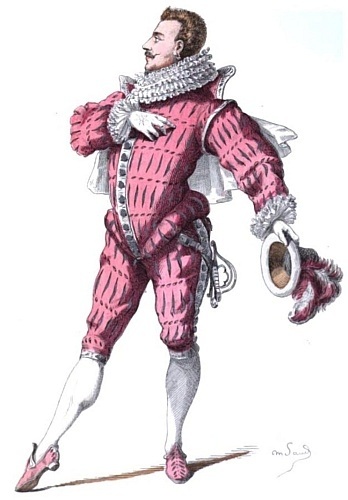
LEANDRE Illustrating the Italian Commedia dell'Arte, or Impromptu Comedy
Gratarol, at the close of these transactions, finding himself disfavoured by the Senate, did not take the prudent course of sending in his resignation and lying by for a better turn of affairs, such as is always to be looked for in a government like ours of{321} Venice. On the contrary, he flung out with all the violence of his headstrong and indomitable temper. He left the country in a rage, exposing himself and his relatives to the thunderbolts which were hurled upon him, partly by the mechanical operation of our laws, but also by the force of a rapacious and inhuman tyranny.
I shall not enlarge upon what followed after Gratarol's flight to foreign lands. These circumstances, disastrous to himself and prejudicial to the enemies he left behind him, are only too fresh in the memory of men. But I may indulge in one philosopher's reflection. The man was said to be, in spite of his many profligacies and excesses, gifted with exuberant health and physical vigour. Considering his mental parts and moral qualities, it is a pity that he did not suffer from a tertian or a quartan fever, the headache, the colic, or peradventure piles. Handicapped in this salutary way, he might have continued to be a prosperous and able servant of the State. So true is it that men often find the faculty on which they most pride themselves their worst stumbling-block in life!
After Signer Gratarol's departure to the frozen North, I felt strongly inclined to have done, at once and for ever, with my lucubrations for the stage. Friends, however, pointed out that a sudden retirement from the pastime of many previous years would expose me to malignant comments. Accordingly,{322} I completed two plays which I had already planned—Il Metafisico and Bianca Contessa di Melfi—giving them to Sacchi in exchange for the autograph and all the copies of my now too notorious Droghe d'Amore. Those manuscripts I locked up in my escritoire, vowing that the comedy should never see the footlights of a theatre again.
It will not be impertinent, as I have touched upon these stage-affairs, to relate the dissolution of Sacchi's company in detail.
I had patronised my friends with heroico-comical perseverance for a quarter of a century. The time now came for me to part with them. Sacchi himself, aged in years, was falling rapidly to pieces. Absurd octogenarian love-affairs completed the ruin of his dotage. His daughter, who not unreasonably expected to inherit money, plate, and jewels of considerable value, never ceased inveighing against her father's anachronistic fondnesses. These invectives reached his ears, and exasperated a naturally irritable temper. Meanwhile, his partners in the company resented the despotism with which he claimed to rule the roost and use their common purse for benefactions to his mistresses. Detected in these private foibles, yet far from being taught the error of his ways, old Sacchi became a kind of demon. He never opened his lips without insulting his daughter, his partners, and the whole troupe. I do not expect my reader to imagine that their replies{323} were sweetmeats. Discord ruled in every hall and chamber of this house of actors. It came to drawing swords and knives; and bloodshed was only obviated by the bodily intervention of bystanders.
I felt that the moment had come to take my leave. With this in view, I packed up a bundle of Spanish books lent to me by Sacchi and returned them. But things had gone too far to be remedied by hints and intimations. Petronio Zanerini, the best actor of Italy; Domenico Barsanti, a very able artist; Luigi Benedetti and his wife, both of them useful for all ordinary purposes; Agostino Fiorelli, stupendous in the rôle of Tartaglia; each and every one of these retired in disgust and took engagements with rival companies. Sacchi's eccentricities had reduced his troupe to a mere skeleton. Finally, the patrician who owned S. Salvatore, scenting disaster in the air, gave the lease of his theatre to another set of players.
I took certain steps at this juncture to keep what remained of the company together and to heal its breaches. Through my mediation Atanagio Zannoni, a splendid actor, an excellent fellow, and Sacchi's brother-in-law, consented to hold on upon the understanding that Sacchi should execute a deed according his partners their just share in the management. The document was drawn up and signed. Sacchi cursed and swore while signing; and Zannoni told me that it would prove waste paper, as indeed it did.
Patched up in this way, the company removed to the{324} theatre of S. Angelo, which had been their old quarters before I succeeded in transferring them to S. Salvatore. They were scarce of money, scarce of actors, and the few actors they had were people of no talent. Two pieces I composed for them, Cimene Pardo and La Figlia dell'Aria, could not be put upon the stage for want of funds and proper players to sustain the parts. I had eventually to give these dramas to two different companies. The history of one of them, Cimene Pardo, brings my old friend and gossip, Teodora Ricci, once more upon the scene; but I do not think that I should interest my readers by relating it.[83]
Suffice it to say, that everything went daily from bad to worse with Sacchi's troupe. He did not improve in temper. Receipts dwindled. The paid actors had to recover their salaries by suits at law, and left the company. Nothing was heard but outcries, lamentations, mutual reproaches, threats, complaints, demands for money, talks about executions, writs, and stamped papers from the courts. At last, after two years of this infernal squabbling, a troupe which had been the terror of its rivals and the delight of our theatres broke up in pitiable confusion.
Sacchi, on the point of setting out for Genoa, came to visit me, and spoke as follows, shedding tears thereby. I remember his precise words: "You{325} are the only friend on whom I mean to call before I leave Venice secretly and with sorrow for ever. I shall never forget the benefits you have heaped upon me. You alone have told me the truth with candour. Do not deny me the favour of a kiss at parting, the favour of your pardon, and of your compassion."
I gave him the kiss he asked for. He left me weeping; and I—I am bound to say it—remained not less affected at the closing of this long and once so happy chapter in my life.[84]
After that moment I laid my pen down, and never again resumed it for dramatic composition.
LXIV.
We cannot always go on laughing.—Deaths of friends.—Dissolution of the old Republic of S. Mark.—I lay my pen down on the 18th of March 1798.
As years advanced, it came to me, as it comes to all, to be reminded that we cannot go on always laughing. One Sunday I was hearing mass in the Church of S. Moisè, when a friend came up and asked me in a whisper whether I had heard of the{326} fatal accident to the patrician Paolo Balbi. "What accident?" I said with consternation. "Last night he died," was the reply. "What!" exclaimed I, still more terrified: "why, I was with him three hours yesterday evening; he was in perfect health and spirits." "Nevertheless," said my informant, "the poor gentleman is dead. Excuse me if I have been the bearer of disastrous news." When the mass, to which I listened without listening, was over, I ran to the patrician's house. I cherished warm affection for this friend of many years, and hoped against hope that the news might be false. Alas! the house resounded with funeral lamentations; the widow and children had already left it for the palace of their relatives, the Malipieri.
Not many days afterwards I received the sad announcement that my brother Francesco was seriously ill of a kind of cachexy on his estate in Friuli. A few days later I learned that he had breathed his last. The poor fellow left his wife and three sons well provided for; but when the salutary restraint of his authority was removed by death, they showed every inclination to dissipate what he had brought together for their comfort.
One morning my friend Raffaelle Todeschini was announced. His countenance wore an expression of alarm, while he began: "I come to bring you painful news. Last evening, in the coffee-house at the Ponte dell'Angelo, that honourable gentleman,{327} Carlo Maffei, died suddenly." The blow fell heavy on my heart; for I have enjoyed few friendships equal to that of this most excellent gentleman. In his will he mentioned me in terms of the highest and most unmerited praise, bequeathing me his gold snuff-box by way of remembrance. That was the one and only legacy which fell to my share in the course of my whole life.
In a short period of time I lost successively several other relatives and friends. My brother Gasparo expired at Padua, recommending his second wife, the Mme. Cenet who had nursed him through his long illness, to my care. A sudden stroke of apoplexy robbed me of the first and faithfullest friend I ever had, Innocenzio Massimo. My sister Laura, who was married and lived at Adria, passed away while yet in the prime of womanhood. I could add other names to this funereal catalogue, if I were not unwilling to detain my readers longer in the graveyard.
Meanwhile, a terrible attack of fever laid me low in my turn. The physician, Giorgio Cornaro, a man of the highest probity and candour, who showed a vigilant affection for his patients, came at once to visit me. The intense pains I suffered during the following night, and the excessive fierceness with which the fever renewed its assaults, made me feel that I was about to follow my relatives and friends to the tomb. I waited through those sombre hours; but when I heard my servant stirring, I sent him for{328} a confessor. The man refused at first, and had to be dispatched upon his errand by a voice more worthy of a cut-throat than a penitent. While I was confessing, Dr. Cornaro entered. He inquired what I had been about, and I replied that I did not think it amiss to be prepared beforehand. "I felt sufficiently ill to fulfil the duties of a Catholic upon his death-bed, and have saved you the trouble of breaking the news to me in case of necessity." "Very well," said he, feeling my pulse and frowning. "We must cut short this fever with quinine, before it reaches the third assault. It is a violent attack of the sort we call pernicious." How many pounds of the drug I swallowed is unknown to me. I only remember that they brought me a large glassful every two hours. The fever abated; but I had to drag through three months of a slow and painful convalescence.
But now it is time to close these Memoirs. The publisher, Palese, informs me that the third volume will be more than large enough. I lay my pen aside just at the moment when I should have had to describe that vast undulation called the French Revolution, which swept over Europe, upsetting kingdoms and drowning the landmarks of immemorial history. This awful typhoon caught Venice in its gyration, affording a splendidly hideous field for philosophical reflection. "Splendidly hideous" is a contradiction in terms; but at the period in{329} which we are living paradoxes have become classical.
The sweet delusive dream of a democracy, organised and based on irremovable foundations—the expectation of a moral impossibility—made men howl and laugh and dance and weep together. The ululations of the dreamers, yelling out Liberty, Equality, Fraternity, deafened our ears; and those of us who still remained awake were forced to feign themselves dreamers, in order to protect their honour, their property, their lives. People who are not accustomed to trace the inevitable effects of doctrines propagated through the centuries see only mysteries and prodigies in convulsions of this kind. The whole tenor of my writings, on the other hand, and particularly my poem Marfisa bizzarra, which conceals philosophy beneath the mantle of burlesque humour, prove that I was keenly alive to the disastrous results which had to be expected from revolutionary science sown broadcast during the past age. I always dreaded and predicted a cataclysm as the natural consequence of those pernicious doctrines. Yet my Cassandra warnings were doomed to remain as useless as these Memoirs will certainly be—as ineffectual as a doctor's prescriptions for a man whose lungs are rotten. The sweet delusive dream of our physically impossible democracy will end in the evolution of....
But Palese calls on me to staunch this flow of ink upon the paper. Let us leave to serious and{330} candid historians the task of relating what we are sure, if we live, to see.
To-day is the 18th of March in the year 1798; and here I lay my pen down, lest I injure my good publisher. Farewell, patient and benign readers of my useless Memoirs!
LXV.
SEQUEL TO GOZZI'S AUTOBIOGRAPHY.
Supplied by the Translator.
Gozzi broke off his Memoirs on the 18th of March 1798. He lived another eight years, and died upon the 4th of April 1806, aged eighty-six. On reviewing his life, we find four clearly marked periods. The first ends with the death of his father in 1745, and includes his three years' service in Dalmatia. The second closes with the year 1756, and is marked by the break-up of the Gozzi family and his engagement in those litigations and affairs of business which formed his real occupation for a long series of years. Short as was this second period, it gave a decisive tone to his character by confirming the man's natural obstinacy and litigiousness. Undoubtedly it was not for nothing that he frequented the Venetian law-courts and studied the{331} arts of chicanery. In all his polemical writings we detect the habit of forensic warfare, the wariness of an experienced pleader, and the licensed plausibility of one who is accustomed to conceal the weak points in his own case while magnifying the shortcomings of his adversary. His unremitting attention to practical matters made him an experienced man of business. This was the true Carlo Gozzi; not that fantastic dreamy plaything of the sprites and fairies which his romantic French and German critics have discerned in the author of the Fiabe. At the same time, during this second period, he never neglected literature, but went on writing in the intervals of serious affairs. Self-taught, well-nigh devoid of systematic culture in history, philosophy, and language, but gifted with a sincere admiration for the best Italian authors, with an active fancy and a natural bias for burlesque humour, he formed that peculiar manner, at once prolix and forcible, effective and slovenly, which distinguishes his published works. Unequal in style, incorrect in diction, incapable of giving perfect form or polish to his compositions, he nevertheless posed as a purist and threw himself with passion as a conservative into the literary polemics of his day. The Accademia Granellesca, founded at the close of this period, recognised in him its stoutest champion and most quarrelsome fore-fighter. I have mentioned the year 1756 as the date which opens the third period in Gozzi's life. It marks the publication of his{332} Tartana degli Influssi and the return of Sacchi's company to Venice. This period terminates in 1781, and includes all that was most memorable in his career—the quarrel with Goldoni and Chiari, the alliance with Sacchi, the composition of the Fiabe and twenty-three plays on Spanish subjects, the liaison with Teodora Ricci, and the episode of Gratarol. Gozzi was past sixty when Sacchi's company broke up, and Gratarol's misfortunes threw a gloomy light upon his past theatrical career. The fourth period of seventeen years is distinguished by little literary activity. Yet we owe to it the Memorie Inutili, which were professedly written as an answer to Gratarol's Narrazione Apologetica. Partly composed in 1780, but suppressed by order of the Government, they did not see the light until the year 1797-98, when Gozzi completed the work and sent it in a hurry to the press. Meanwhile the Republic of S. Mark had fallen, never to rise again. In the midst of this political earthquake, Gozzi retained his old aristocratic principles intact, though he bowed to custom and used the shibboleths of the French Revolution, as he confesses, with conscious cynicism.[85] The period of old age was passed in comparative solitude, cheered, however, by the friendly relations which he maintained with the{333} surviving members of his family. The cycle of his dramatic works was closed; and after 1782 he had the mortification of seeing his Fiabe neglected, while Goldoni's star reascended the firmament of popularity and fame. Indeed, the Fiabe had no chance of surviving the improvised style of comedy, to support which Gozzi composed them, and which he fondly imagined immortal. Goethe, in 1788, was present at a performance given by the last débris of Sacchi's company; but when the old Commedia dell'Arte and the old actors died out, the Fiabe were relegated to marionettes and puppet-shows. The poet and the man of letters dwindled in Gozzi, but the man of business survived. His correspondence during this fourth period shows him engaged in various commercial affairs upon a small scale, minute in his accounts, involved in litigation, attentive to the produce of his farms, busied about the interests of friends, trafficking in lace and stuffs, groceries, wine, fowls, and carriages.[86] This forms a curious contrast to the romantic portrait of the old man vamped up for us by Paul de Musset. The ordinary troubles of advanced age—rheums, aches, and infirmities—fell upon him. In one of his letters to Innocenzio Massimo he describes their correspondence as "a hypochondriacal gazette." On the 13th of February 1804 he signed a holographic will, which shows him still loyal to his{334} conservative creed in religion, politics, philosophy, and morals. At this time he appears to have been living in the Campo S. Angelo, one of the broadest, busiest, and sunniest squares of Venice. Indeed, he had quitted the ancestral palace of the Gozzi at S. Cassiano many years before, finding it too distant from the theatres and the piazza. For a long while he occupied a casino alone in the Calle Lunga S. Moisè. The little dwelling belonged to him; and in a passage of his Memoirs, which did not lend itself to the scheme of my translation, he relates the circumstances of his removal to this habitation.[87] I shall insert it here, because it throws light upon the last stage of Gozzi's journey in this world. "Many years," he says, "had passed away since my brothers Francesco and Almorò with their families were established in Friuli, while I remained at Venice, the sole occupant of our paternal mansion. For me alone, the vast place was like a wilderness. In the winter I shivered with cold there. Snow, rain, and the Rialto caused me innumerable annoyances when I left the theatres at night to gain my distant home. I was growing old, and this made the journey seem each year more irksome. A casino which I owned in the quarter of S. Maria Zobenigo, Calle Lunga S. Moisè, not far from S. Marco, had been let for sixty ducats a year to the majordomo of a Venetian nobleman. This man left Venice with his master on an{335} embassy, giving me no notice that he had sold his furniture and handed over my casino to the mistress of some man about the town. By a series of similar changes, the tenement passed successively through the hands of several women of the same sort. I always got the rent and asked no questions. The best of it was that the money was punctually paid me by priests, who uttered panegyrics on the heroism of my female tenants. The last of these heroines sent to tell me that my house needed certain repairs. Accordingly I went there, and was received by a well-restored relic of womanhood, who pointed out the alterations she judged necessary in her dwelling-place. Casting my eyes over the lodgings, I thought that they would serve my purpose admirably, and told the lady so. In a moment she changed her honeyed tone and language of affected flattery to oaths and threats and declarations that nothing in the world would make her turn out. I phlegmatically remarked that she had no lease, that my lessee had no power to sublet, and that I would grant her sufficient time to seek another nest. In such matters, as is well known to readers of these Memoirs, I have always had some trouble. But at last, by taking over certain pieces of damaged furniture, I came to terms with the Nymph of Cocytus, and installed myself in my casino. I did it up, and stayed there fourteen years, letting on lease my former abode at S. Cassiano. I should have been there still, had not{336} my brother Almorò written to say that he was tired of Friuli. A widower, with a son and daughter, he should like to send the former to the university at Padua, and to make a home with me in Venice. I was always ready to oblige my brother, and this casino could not hold us all. Accordingly, we took a larger house at S. Benedetto; and here my brother, much aged in my eyes, as I must probably have seemed in his, came to live with me. His children, whom I had only known as little creatures, had grown into giants. Before a year was over, the daughter made a good match in Friuli, and the son went to Padua, whence the troubles of the Revolution drove him away before he had obtained the laurels of a doctor's degree. In that commotion the laurel, destined for the brows of students, was consecrated to the kitchen and the garnishing of dishes on the table."[88]
It is possible that the marriage of this niece and the subsequent marriage of his nephew broke up the joint-household at S. Benedetto, and that Gozzi then removed to the neighbouring quarter of S. Angelo.[89]{337} Almorò and his son Gasparo were appointed executors to Carlo Gozzi's will, which winds up with the following characteristic admonition to the young man: "Preserve your affection for your well-bred, well-behaved, and excellent wife. Look to the careful education of your children, and protect them from the false maxims of that sophistic science which is the bane of our age, involving all humanity in disastrous mists of error and confusion, in labyrinths of infelicity and misery." Gozzi died on the 4th of April 1806, and was buried in the church of S. Cassiano.{338}
PIETRO LONGHI,
The Painter of Venetian Society during the Period of Gozzi and Goldoni.[90]

I.
The eighteenth century was marked in Venice by a partial revival of the art of painting. Four contemporary masters—Tiepolo, Canaletti, Longhi, and Guardi—have left abundance of meritorious work, which illustrates the taste and manners of society, shows how men and women dressed and moved and took their pastime in the City of the Waters, and{339} preserves for us the external features of Venice during the last hundred years of the Republic.[91]
As an artist, Tiepolo was undoubtedly the strongest of these four. In him alone we recognise a genius of the first order, who, had he been born in the great age of Italian painting, might have disputed the palm with men like Tintoretto. His frescoes in the Palazzo Labia, representing the embarkation of Antony and Cleopatra on the Cydnus, and their famous banquet at Canopus, are worthy to be classed with the finest decorative work of Paolo Veronese. Indeed, the sense for colour, the robust breadth of design, and the firm, unerring execution, which distinguish that great master, seem to have passed into Tiepolo, who revives the splendours of the sixteenth century in these superbly painted pageants. It is to be regretted that one so eminently gifted should have condescended to the barocco taste of the age in those many allegories and celestial triumphs which he executed upon the ceilings of palaces and the cupolas of churches. Little, except the frescoes of the Labia reception-hall, survives to show what Tiepolo might have achieved had he remained true to his native instinct for heroic subjects and for masculine sobriety of workmanship.
Of Canaletti it is not necessary to say much. The{340} fame which he erewhile enjoyed in England has been obscured of late years—to some extent, perhaps by the fussy eloquence of Mr. Ruskin, but really by the finer sense for landscape and the truer way of rendering nature which have sprung up in Europe. Canaletti's pictures of Venetian buildings and canals strike us as cold, tame, and mechanical, accustomed as we are to the magic of Turner's palette and the penetrative force of his imagination.
Guardi, the pupil and in some respects the imitator of Canaletti, has met with a different fate. Less prized during the heyday of his master's fame, he has been steadily acquiring reputation on account of certain qualities peculiar to himself. His draughtsmanship displays an agreeable sketchiness; his colouring a graceful gemmy brightness and a glow of sunny gold. But what has mainly served to win for Guardi popularity is the attention he paid to contemporary costume and manners. Canaletti filled large canvasses with mathematical perspectives of city and water. At the same time he omitted life and incident. There is little to remind us that the Venice he so laboriously depicted was the Venice of perukes and bag-wigs, of masks and hoops and Carnival disguises. Guardi had an eye for local colour and for fashionable humours. The result is that some of his small pictures—one, for instance, which represents a brilliant reception in the Sala del Collegio of the Ducal Palace—have a real value for us by{341} recalling the life of a vanished and irrecoverable past. Thus Guardi illustrates the truth that artists may acquire posthumous importance by felicitous accident in their choice of subjects or the bias of their sympathies. We would willingly exchange a dozen so-called "historical pictures" for one fresh and vivid scene which brings a bygone phase of civilisation before our eyes.[92]
In this particular respect Longhi surpasses Guardi, and deserves to be styled the pictorial chronicler of Venetian society in the eighteenth century. He has even been called the Venetian Hogarth and the Venetian Boucher. Neither of these titles, however, as I shall attempt to demonstrate, rightly characterise his specific quality. Could his numerous works be collected in one place, or be adequately reproduced, we should possess a complete epitome of Venetian life and manners in the age which developed Goldoni and Casanova, Carlo Gozzi and Caterina Dolfin-Tron.{342}
II.
Very little is known of Longhi's career, and that little has no great importance. He was the son of a goldsmith, born at Venice in 1702, and brought up to his father's trade. While yet a lad, Pietro showed unusual powers of invention and elegance of drawing in the designs he made for ornamental silver-work. This induced his parents to let him study painting. His early training in the goldsmith's trade, however, seems to have left an indelible mark on Longhi's genius. A love of delicate line remained with him, and he displayed an affectionate partiality for the minutest details of decorative furniture, dress, and articles of luxury. Some of his drawings of plate—coffee-pots, chocolate-mills, ewers, salvers, water-vessels—are exquisite for their instinctive sense of graceful curve and unerring precision of contour. It was a period, as we know, during which such things acquired an almost flawless purity of outline; and Longhi felt them with the enthusiasm of a practised artisan.
He studied painting under Antonio Balestra at Venice, and also under Giuseppe Maria Crespi at Bologna. The baneful influences of the latter city may be traced in Longhi's earliest known undertaking. This is an elaborate work in fresco at the{343} Sagredo Palace on the Grand Canal. The patrician family of that name inhabited an old Venetian-Gothic house at San Felice. Early in the last century they rebuilt the hall and staircase in Palladian style, leaving the front with its beautiful arcades untouched. The decoration of this addition to their mansion was intrusted to Pietro Longhi in 1734. The subject, chosen by himself or indicated by his patron, was the Fall of the Giants—La Caduta dei Giganti. Longhi treated this unmanageable theme as follows. He placed the deities of Olympus upon the ceiling. Jupiter in the centre advances, brandishing his arms, and hurling forked lightnings on the Titans, who are precipitated headlong among solid purple clouds and masses of broken mountains, covering the three sides of the staircase. The scene is represented without dignity, dramatic force, or harmony of composition. The drawing throughout is feeble, the colouring heavy and tame, the execution unskilful. Longhi had no notion how to work in fresco, differing herein notably from his illustrious contemporary Tiepolo. A vulgar Jove, particularly vulgar in the declamatory sweep of his left hand, a vulgar Juno, with a sneering, tittering leer upon her common face, reveal the painter's want of feeling for mythological grandeur. The Titans are a confused heap of brawny, sprawling nudities—studied, perhaps, from gondoliers or stevedores, but showing a want of even academical adroitness in their ill-drawn extremities and inadequate foreshortenings.{344} It was essential in such a subject that movement should be suggested. Yet Longhi has contrived to make the falling rocks and lurid clouds look as though they were irremovably wedged into their places on the walls, while his ruining giants are clearly transcripts from naked models in repose. Here and there upon the ceiling we catch a note of graceful fancy, especially in a group of lightly-painted goddesses,—elegant and natural female figures, draped in pale blues and greens and pinks, with a silvery illumination from the upper sky. But the somewhat effeminate sweetness of this episode is ill-combined with the dull and impotent striving after violent effect in the main subject; and the whole composition leaves upon our mind the impression of "sound and fury, signifying nothing."