CARLO GOZZI. (continued 4)
John Addington Symonds translation
This tirade, which might have been effective in some comedy, but which was too full of delicate sentiment for a comedian, made my actress bend her brows to earth, repeating over and over again: "What a mess I have made of it!" "Yes," I replied, "you will soon find what a nasty mess it is!" And so I rose to take my leave. "Sir, dear friend and gossip," she began again, detaining me with tears which fell from her eyelids—tears more probably of rage than of repentance—"I swear that I did not mean to act amiss. Gladly will I throw that satin out of window. Oh, wretched trade of us poor actresses! We have always devils round us, to torment and work upon our weakness. The old man promised me plate, jewels, splendid toilette-tables. He turned my brains and dulled my senses." "Very well," I answered. "I do not want to prevent you from buying wealth at the price of infamy, and{206} of the libels which attend it. But I do not mean to serve as screen, to be the friend and consort of a woman of your sort." "I am quite prepared," she added, "to return the satin; and you may be sure that I left Sacchi under the impression that I should pay for it out of my salary. By all that I hold sacred, I swear to you that I have never given, and shall never give, that old seducer what he asks for. I come to you for advice now, and you shall see that I will follow it to the very letter."
I told her that she was asking for advice too late in the day to be of any use. "Sacchi is spiteful, vicious, brutal, corrupt in his opinions upon human nature, and—a player. What is worse, he is in love. He does not believe you capable of giving up this satin or of paying for it. He will scent the truth that I have been at work here, because he knows my principles of conduct. Shame, rage, and spite will make a demon of the man. He will conceive a violent hatred against me, which he will vent upon you, his interest being to keep on good terms with myself. I am truly sorry for you. You do not know the lengths to which the infernal nature of the animal will carry him. Yet I cannot recommend any other course but that which your own sense of duty will dictate to you."
A few days after this scene, she told me with a beaming countenance that she had announced to Sacchi her firm intention of paying for the satin out{207} of her appointments. "I wholly approve of the step which you have taken," said I in answer, "but I beg you to tell me without reserve how he took your declaration." "To speak the candid truth," she replied, "he looked at me askance, then turned surly, and muttered, 'Yes, yes! I see who gave you the advice. Well, well, you shall pay for the gown!'" "My poor girl," I added, "prepare yourself to pay dearly for the satin, both with money and with tears. May this be a lesson to you not to coax presents out of brutal libertines."
The fact was that from this moment forward she became the butt of that bad old man's persecutions. From the height of his position as director of the troupe, he launched taunt after taunt against her, subjected her to the grossest sarcasms, and did not spare them even in my presence. If she had to act upon the stage with him, he employed his popularity with the audience and his ability as actor to turn her into ridicule with scurvy jests and sallies. Nay, more: in one of the rooms behind the theatre, where some eight actors and actresses were assembled, the brute, before my face, insulted her by implying that he had been admitted to her last familiarities. I saw her turn pale and on the point of fainting.
I was absolutely certain that Sacchi's innuendoes had no grain of truth in them. He only wished to compromise her in my eyes, in order that I might abandon her to his desires and vengeance. This stung{208} me to espouse her cause, although I knew that prudence pointed in the contrary direction. Next day I found her drowned in tears. I told her that the moment had not come for me to leave her. "Sacchi has insulted me as well as you, forgetful of the benefits which I have heaped upon him. It is now my business to tame the devil in him without open scandal. All I am afraid of is, that you will force me to abandon you by future follies of a like description. As far as the present case is concerned, you may trust to my fidelity."
SACCHI AND SIGNORA RICCI Original Etching by Ad. Lalauze
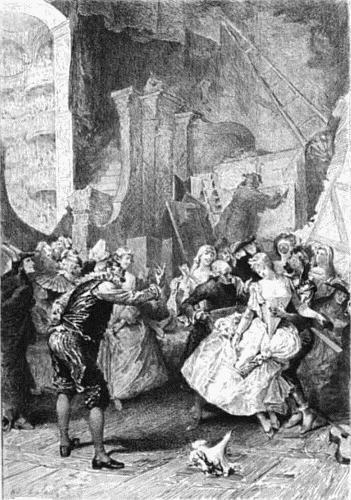
I had just given a new piece to the company, and went to assist at its first reading in the green-room. Sacchi shot his usual arrows at Signora Ricci, and alluded to her love-affairs with Coralli. Perhaps he meant to rouse my jealousy without reflecting that this liaison had in my eyes nothing dishonourable. Coralli was a poor actor, and Teodora ran no risk of passing for a venal beauty in his company. I contented myself by showing the disgust I felt for the old man's insinuations by my manner, without condescending to utter a word. Knowing well that it is only possible to wound comedians in the sensitive point of their pecuniary interest, I laid my plans accordingly. I cut short my visits to Signora Ricci, avoided the green-room of the theatre, and did not put in an appearance at the next rehearsal of my piece. The actors began to whisper. Some of them inquired whether I was ill. "I am perfectly well," I {209}answered, "but it seems to me that I am superfluous at your rehearsals. Besides, I have private business." Next evening I kept away from the theatre, and next day I avoided the rehearsal. The agitation among the actors grew to a tumult. When the Ricci was asked about me, she replied with perfect truth that she had not seen me. The uproar increased, while I amused myself with thinking how my machinations were succeeding.
On the fourth morning, an actor, called Luigi Benedetti, a Roman, and Sacchi's nephew, waited on me. He was in great distress, and wet to the skin with a heavy shower which happened to be falling. He opened the conversation by expressing the regrets of all the troupe at my unaccountable desertion of them. I said nothing about the real point in question, but replied with cheerful dignity to this effect: "Sacchi does not care for my attendance or assistance. I am not a hired poet, nor yet a man of plaster. If your uncle comes to rehearsal, he spends the time in insulting Signora Ricci before my face and before the whole company. He committed this lady to my charge, and begged me to make her useful to the troupe. I have done my duty; she has become a valuable actress. I am godchild to one of her children and her friend, and do not choose to be exposed to rudeness on her account. Therefore I take it that the best course for me will be to withdraw from the society of Signora{210} Ricci and the rest of you. I shall not harbour hostile feelings against any one; but I cannot stay to be made uncomfortable in return for the many kindnesses I have conferred upon your company." On hearing this speech, Benedetti was really vexed, or at any rate he acted extreme annoyance. Admitting that his uncle was a man of eccentric, inconsiderate, and nasty temper, he tried to convince me that certain vexations connected with a married daughter had quite upset him during the last few days. He did not know, indeed, what he was doing. Then the young actor proceeded to sing my praises, protesting that I should be the ruin of the troupe if I deserted them, and assailing me with passionate entreaties. I smiled, and promised to attend the rehearsal of my piece next morning, and to be guided by what I found at the theatre. I went accordingly, and met with nothing but politeness, contented faces, harmony. Matters stood thus until the end of the Carnival, when the company left Venice for its customary six months' tour, and I stayed behind to reflect upon the perilous qualities of Teodora Ricci.{211}
LI.
Reflections made in vain; flattering expectations dissolved into what deserves neither flattery nor reflection.—The troubles to which a man is exposed who takes a company of comedians and an actress under his protection.
The upshot of my meditations upon the events related in the preceding chapters was as follows. One day or another, this woman, with her explosive character and egregious vanity, will expose me to some public scandal. She cannot rest contented with the gains of her profession, and is sure to add to them by baser means. She only cares for me because I am useful to her at the theatre, and convenient as a cloak for her intrigues. All my arguments and warnings are wasted. It is useless to try to make a Lucretia or a Pamela out of an actress who will never be more than Teodora Ricci.
Meanwhile, she went on writing to me by nearly every post, expressing much affection for myself, and indulging in the usual lamentations over her miserable earnings. One morning brought a letter in which she informed me that she had just signed an engagement with a certain Signor Francesco Zannuzzi.{212}[47] He wanted to take her to Paris as prima donna in the Italian theatre which he directed there. Her salary was to be 3000 francs a year. I was glad to get this news; for if things stood as she declared, I should be freed from all my obligations, and separated by several hundred leagues from her.
All the same, I replied in writing that she must remember her engagement to Sacchi. It would be only right and proper to give him sufficient notice of her intentions, in order that he might provide himself with another leading actress. I added that the appointments offered by Zannuzzi would hardly suffice for her expenses in a capital like Paris. Also, I did not think her specially well qualified to appear with success before a French audience; and her total ignorance of the language seemed to me a grave objection. Nevertheless, she was quite free to do as she thought best.
While thus indulging myself in the hope that she might actually leave Italy, I was surprised by a visit from Signor Zannuzzi. He was known to me, and was a man of excellent breeding. After exchanging compliments, he began to say that his company had sent him on a voyage of discovery through Italy to{213} find a prima donna for their theatre at Paris. "I heard of this," I answered, "and, like an intelligent man, you have selected Teodora Ricci." "By no means," he put in; "it is true that I have seen her and held some general conversation on the subject with her. But she is deficient in several points of great importance for our theatre. The actress who seems most suitable is Elisabetta Vinacesi, with whom I have spoken, and from whom I expect a decisive answer." "What the devil," said I to myself, "has Teodora been up to, lying in this way to her friend and gossip?" Nevertheless, I did my utmost to persuade Zannuzzi that there was no comparison between the two actresses; he ought certainly to choose Signora Ricci. My diplomacy was thrown away. Later on, I heard that Vinacesi preferred remaining in Italy to exposing herself to the bustle and irregularities of a professional career at Paris. Also I was informed that Zannuzzi had tried to engage other actresses, without reopening negotiations with the Ricci. Thus my hope of being liberated from what I felt to be a perilous situation vanished into air.
October arrived, when the acting companies return to Venice for the winter. I found Signora Ricci in good health, and related to her with displeasure what Zannuzzi had communicated to me about her proposed engagement. She replied, not without heat, that he was on his way to Paris in order to{214} report to his associates. She expected letters from him confirming what had passed between them in their interviews. Then she launched forth into her usual invectives against Sacchi's troupe, and vowed she would not serve for such pitiful appointments any longer. I tried in vain to convince her that she was singularly well off compared with other actresses, and considering the circumstances of the profession in Italy. In reply to all I said she only went on beating the same old gong. It was clear that her head had been turned upon her summer tour by flatterers and so-called philosophical admirers of the modern school.
Two days after the arrival of the company, Coralli came to see me, and made the following confidences. "Sacchi," said he, "is dying of love for Teodora Ricci. I do not conceal my affection for the young woman; I frequent her house, attend her in public, and make myself as useful as I can to her. He is brutally jealous of me, and I have had to put up with a thousand outrages and insults. Finally, he has forbidden me to visit at her house, alleging that if Count Gozzi came to remark our intimacy, he would retire from the company in disgust." I burst into a fit of laughter worthy of Margutte.[48] "What sort of people have I got myself mixed up with?" said I to myself; "for whom am I wasting pen, ink, paper{215} and brains? Does Sacchi, who has received a thousand benefits at my hands, expect to make me a stalking-horse in his drivelling amours?" Recovering my gravity as well as I could, I informed Coralli that, so far as I was concerned, he might cultivate Signora Ricci's intimacy without scruple. If she played the part of a mercenary beauty with libertines of fashion, I could not remain her friend. But he was not one of those persons who could compromise my reputation. Only, I added, that I feared for him; "Sacchi is revengeful, and will use his powerful arms against you." Coralli, enlightened as to my way of thinking, returned a thousand thanks and took his leave. Next day I went to visit Teodora, and found Coralli there. I made a point of dining with them, and inviting them both to dinner at my house. By thus acting, I taught Sacchi how little chance there was of frightening Coralli by alleging my jealousy. Baffled in his plans, he took the opportunity of Christmas, when managers of theatres make changes in their troupes, to give Coralli warning.
Coralli came at once to report what had befallen him, and to beg for my intervention in his favour, while Teodora showed herself extremely annoyed by his expulsion. Nothing meanwhile was heard among the actors but virtuous remarks upon the scandalous connection which Sacchi had so firmly put an end to. I tried to make the director see reason, and not to expel a member of his troupe who{216} was certainly a very useful actor. All I could extort was a promise to keep Coralli, if some other player happened to retire. Yet I knew that, after I had once expressed a wish that he should stay, Sacchi would have managed this to gratify me. In fact, the man was only forced to leave at last because of his own knavish trickery. After learning from me what Sacchi had conceded, he persuaded a good and simple fellow of his own city, Domenico Barsanti, that the manager meant to give him, Barsanti, warning, and that he had better, for his own repute, anticipate this misfortune by sending in his resignation. When Barsanti proceeded to do so, Sacchi wormed the secret out of him, and answered: "I had no intention of dismissing you. Go to Conte Gozzi, tell him the whole story, and beg for his protection. That will teach him what sort of fellow Coralli is." Barsanti accordingly arrived, and stupefied me with the recital of this piece of swindling ingenuity. I need not add that Coralli disappeared at the end of the Carnival. I got a letter from him full of remorse, especially for having hurt me by his stratagem for staying in the company.
I went on as usual with Signora Ricci, and had nothing particular to notice in her conduct. Only I observed that gondoliers used often to come behind the scenes with messages from ladies who desired her company in the boxes. That they were not ladies, but a very different sort of persons, I discovered{217} in course of time. Again, she chose at this epoch to change her dwelling from a house in the neighbourhood of the theatre, which opened on a frequented street, to another at some distance, far more expensive, and which had the disadvantage of standing in a little lonely alley. This step exposed her to a renewal of the worst reports about her private character and conduct. It also severely taxed her purse for the expenses of removal and installation.
When she left Venice at the end of the Carnival, she placed her little girl, my godchild, out at nurse. I used frequently to go and see this excellent little creature in her mother's absence. For the rest, our correspondence by letters continued much on the same footing as before.
LII.
Fresh benefits conferred upon the playing company protected by me.—Fresh advantages won by me for Mme. Ricci.—All thrown away as nought.
I feel that this long story of my liaison with an actress cannot fail to be tedious. Yet I am obliged to continue it in detail, inasmuch as events to which the public attached considerable importance, and which exposed me to criticism, can only be understood{218} in their right light by reference to this piece of private history.[49]
It may be demurred that I ought to have withdrawn from Sacchi's troupe when I detected the evil spirits which were making mischief there. To this I reply that I had found recreation and amusement in their society for many years, that I enjoyed the opportunity of seeing my plays acted by such clever artists, and also that my temper inclines me to endure many inconveniences rather than break old habits. For example, I have always borne with vicious inattentive servants, tailors who cheated me and spoiled my clothes, shoemakers who tortured my feet with their ill-fitting handiwork, barbers who flayed my chin with their razors, hairdressers who snipped my ears with their scissors, and other tiresome folk of the same sort, to whom I never administered a sharp rebuke, but only such jesting expostulations as made them laugh.
When October brought the actors back to Venice, Sacchi was disagreeably surprised by a piece of news which threatened him with ruin. Before the theatres open for the season, they are examined by official architects, who report upon their substantiality and safety. The theatre of S. Salvatore was condemned this year by the experts, and an order from the Government prohibited its being used. Signor Vendramini{219} and the players were in despair. Thirty and more persons, who gained their bread by acting, saw themselves thrown out of work. Steps were immediately taken to put the house in repair, and render it fit for the reception of the public. During two-and-twenty days, while this work was going on, the company took not a penny. Yet Sacchi continued to pay his hired actors at their stipulated rates. This seemed to me generous on his part, and I tried to persuade Teodora Ricci that she ought to be grateful. She took no notice of my arguments, but kept on repeating her old complaints about her salary. Her husband, who had come back, but no longer occupied the same room as his wife, saw the matter in its proper light.
Meanwhile the rival theatres triumphed over our discomfiture. At S. Gio. Grisostomo a new Truffaldino appeared, whom the fickle Venetians dubbed a better Zanni than their old friend Sacchi. Satirical sonnets began to circulate against my protegés, and they replied with pasquinades. This wordy warfare filled the town with dirty libels. I begged Sacchi's associates to keep their temper and be silent, trusting to my power of restoring their prestige by a new piece I was at work on. This was entitled Il Moro di Corpo Bianco, ossia lo Schiavo del Proprio Onore.[50]
{220}
At last the repairs were finished, and received the surveyor's approval. An official edict appeared to the effect that the theatre Vendramini at S. Salvatore would be safe for the autumn and ensuing Carnival. This limited announcement did not restore the confidence of the public, who still feared that the house might tumble about their ears. Accordingly, the first ten or twelve nights saw a desert in our theatre. The Venetians had two other houses for plays and three for operas open; and they persisted in regarding S. Salvatore as a trap for the destruction of the human race.
While things were dragging on in this way, I got my drama finished. We read it aloud to the whole company at a dinner given in the Wild Man Inn.[51] The enthusiastic applause of the actors made me feel sure of its success. I made them a present of it, and the piece was mounted with the least possible delay. The playbills drew a large audience. Everybody was burning to know what the deuce a Moor with a white body could possibly be; this taught me that the prospect of a new excitement will drive the fear of death out of the heads of my Venetians. During a run of eighteen successive nights, all the other theatres were drained of their spectators, and the opera-houses cursed my Moro di Corpo Bianco. The reputation of S. Salvatore was fully re-established,{221} and we heard nothing more about the fabric being a rat-trap to catch human beings.
Teodora Ricci had scored a great success by her brilliant acting. Intoxicated with popular plaudits, she began to grumble, and threatened to break her engagement unless her salary were raised. Under these circumstances, Sacchi came to me one day and begged me to draw up articles between the actress and the troupe, by which she should commit herself to five years of fixed service. He left the settlement of her appointments to me, but stipulated that a fine of 500 ducats should be exacted from whichever of the contracting parties broke the bond. I undertook this negotiation with some reluctance, and concluded it, to my own satisfaction, in the following way. Signora Ricci and her husband were to receive 850 ducats a year, they engaging to serve the company five years, under the above-mentioned penalty of 500 ducats if they cancelled the agreement. The articles were drawn up in writing and signed by Ricci and her husband. I fancied I had done what was right and equitable for both parties, and took the articles with some pride to Sacchi. That brutal old fellow thanked me in the way I shall relate. Putting his spectacles upon his nose, he began to read the document; and when I wished to explain it, he burst into a torrent of oaths, banging the table with his fists as though I had just attempted a surgical operation upon his tenderest parts. I remarked that, if{222} he did not approve of the conditions, he might tear the paper up: it was all the same to me. This line he did not take; but set his signature to the document, grumbling all the while that neither fines nor penalties would bind that woman to her word, and that he reckoned upon my influence to keep her in the straight path. Then I took the contract back to the Signora, who murmured some words between her teeth about the hard condition of her five years' service.
The imposthume, which had so long been forming, was bound to come to a head at last and burst. It is now my business to relate what made the final rupture between me and Teodora Ricci unavoidable.
The actors left Venice for their summer tour, and many letters passed between her and me, which showed that she was still aggrieved with Sacchi, and more than ever puffed up with the flatteries of lovers. I read and pondered her correspondence, and came to the conclusion that before a year was out we must cease to be friends.
When she returned in the autumn, on the occasion of my first visit, she expressed some surprise at the alteration of my manner. It so happened that at this very moment her servant Pavola handed her a letter which had just arrived from Turin. She flared up, and flung herself about, manifesting a strong desire to be able to strike the woman dead for bringing the letter in my presence. "What{223} has the poor girl done amiss?" I asked. "Do not wrong me by supposing that I am inquisitive about your correspondence. If one of the lovers, whom you actresses always leave behind you, has written you a billet-doux, I have no right to interfere in such concerns of wholly private interest." "This is no affair of lovers," she replied with heat, opening and casting her eyes over the pages. When she had read the letter, she hesitated a little, and then handed it to me. "I do not want to hide anything from you; read it, and you will see that it has nothing to do with love." I replied that I did not care to read it, being sure from her behaviour to the servant that it contained some secret which she wished to conceal from me. "Well, then," she said, "I must inform you that I made the acquaintance at Turin of a lady called Mme. Rossetti, whose husband lives at Paris. This lady expressed her regret at my being obliged to drag my life out among wretched Italian comedians. She encouraged me to act with spirit in my own interest, and gave me hopes of entering the theatre at Paris through her husband's assistance. The writer of this letter in my hand is a certain Abbé of Turin, who negotiates the matter, and is a very able diplomatist. He informs me that the affair is on the point of being settled to my wishes."
I pointed out that, if she intended to accept an engagement at Paris, it was her duty to inform Sacchi, and to pay the penalty of 500 ducats. "No,"{224} she replied, "that is precisely what I want to avoid doing." "So then," I retorted, "you mean to transact your business secretly, and to swindle the poor actors to whom you are engaged here! Be open, tell Sacchi the truth, and I will engage to manage matters so that you shall not have to pay the fine." "Sacchi," she rejoined, "must know nothing about the transaction. If he gets wind of these negotiations, he will engage another leading actress; and should my treaty fail, I shall be dismissed and thrown upon the street. What an excellent friend and gossip you are, forsooth, at a pinch like this! We actors and actresses are not accustomed to such niceties and scruples." I told her that she ought to rely on me for carrying her through any difficulties, and that I could only recommend fair dealing in the matter. "However," I added, "if you prefer to take the tortuous path and work by intrigue, I promise to keep the secret which you have disclosed."
Having passed my word, I let her do what she liked in this affair, and asked no further questions. But I was more than ever resolved to withdraw as prudently and quietly as possible from the complicated position in which I found myself placed. I wished to avoid open scandal; but I little reckoned on the people I had to deal with. You cannot disengage yourself so easily from actors.{225}
LIII.
Candid details regarding the composition and production of my notorious comedy entitled "Le Droghe d'Amore."—More too about the Ricci, and her relations to Signor P. A. Gratarol.
Just about this time I had planned and partly executed a new comedy, which afterwards obtained a succès de scandale under the title of Le Droghe d'Amore.[52] The dust stirred up by this innocent piece in three acts obliges me to enter at some length into the circumstances which attended its composition and production.
Everybody is aware that, after the long series of my allegorical fables had run their course upon the stage, I thought fit to change my manner, and adapted several Spanish dramas for our theatre. Sacchi used to bring me bundles of Spanish plays. I turned them over, and selected those which seemed to me best fitted for my purpose. Taking the bare skeleton and ground-plot of these pieces, I worked them up with new characters, fresh dialogue, and an improved conduct of the action, to suit the requirements of the Italian theatre. A whole array of dramas—the Donna{226} Innamorata, the Donna Vendicativa, the Donna Elvira, the Notti Affannose, the Fratelli Nimici, the Principessa Filosofa, the Pubblico Segreto, the Moro di Corpo Bianco, the Metafisico, and the Bianca di Melfi, all of which issued from my pen, attest the truth of these remarks.[53] I need say no more about them, because the prefaces with which I sent them to the press have sufficiently informed the public.
In pursuance of this plan, then, I had been working up Tirso da Molina's piece, entitled Zelos cum Zelos se Curat, into my own Droghe d'Amore. I was but little satisfied, made tardy progress, and had even laid aside the manuscript as worthless—condemning it, like scores of other abortive pieces, to the waste-paper basket. It so happened that after Christmas in this year, 1775, I was laid up with a tedious attack of rheumatism, which threatened to pass over into putrid fever, and which confined me to the house for more than thirty days. Signora Ricci kept up amicable relations with me during this illness; and even after Carnival began, she and her husband used to spend their spare evenings at my house. The society which cheered me through my lingering convalescence included the patrician Paolo Balbi, Doctor Andrea Comparetti, Signor Raffaelle Todeschini, my nephew Francesco, son of{227} Gasparo, Signor Carlo Maffeo, Signor Michele Molinari, and an occasional actor from Sacchi's troupe. Wanting occupation for my hours of solitude, I took up the Droghe d'Amore, and went on working at it; always against the grain, however, for the piece seemed to me to drag and to want life. There is so much improbability in the plots of Spanish dramas that all the arts of rhetoric and eloquence have to be employed in order to convey an appearance of reality to the action. This tends to prolixity, and I felt that my unfinished piece was particularly faulty in that respect. It was divided into three acts, and I had brought the dialogue down to the middle of the third. Little as I liked it, the fancy took me to see what impression it would make upon an audience. Accordingly, I read it aloud one evening to Teodora Ricci, my nephew, Doctor Comparetti, and Signor Molinari. They were interested beyond my expectation, and loudly opposed my intention of laying it aside. The prima donna, in particular, urged me in the strongest terms to finish what remained of it to do. The gentlemen I have just named can bear witness to the sincerity of my coldness for this play, which afterwards, by a succession of accidents, came to be regarded as a deliberate satire on a single individual.
Some days after the reading, Signora Ricci asked me casually if I was acquainted with Signor Piero Antonio Gratarol, secretary to the Senate. I answered{228} that I did not know him, which was the simple truth. I added, however, that he had been pointed out to me on the piazza, and that his outlandish air, gait, and costume struck me as very different from what one would expect in a secretary to the grave Venetian Senate. "Yet I have heard him spoken of as a man of ability and intelligence." "He has a great respect for you," said she. "I am obliged to him for his good opinion," I replied. "I think him a man of breeding," she went on, "and I also think him a man of honour." "So far as I am concerned," I answered, "I know nothing to the contrary, unless it be his unfortunate notoriety for what is now called gallantry." There was no malice in thus alluding to what was universally talked about, and had even come before the judges of the State. I only intended to give a hint to my gossip, which I soon discovered to be too late for any service. Having spoken, I immediately sought to soften what I said by adding: "I do not deny that externals may expose a man to false opinion in such matters; and not being familiar with Signor Gratarol, I neither affirm nor deny what is commonly voiced abroad about him." "He is elected ambassador to Naples," she continued, "and I am anxious to appear upon a theatre in that capital. He may be of the utmost service to me." "Why," said I, "are not you thinking of going to Paris?" "I must try," she replied, "to make my fortune where and how I can." "Do as you like,"{229} I answered, and turned the conversation upon other topics.
It was clear to my mind that, during my long illness, the Ricci had struck up a friendship with this Signor Gratarol, and that she was beating about the bush to bring us together at her house. She had not forgotten my determination to cut short my daily visits if she received attentions from a man of fashion and pleasure. I, for my part, should have been delighted to meet Signor Gratarol anywhere but in the dwelling of the actress I had protected and publicly acknowledged for the last five years.
It now became my fixed resolve to procrastinate until the end of the Carnival, avoiding the scandal which would ensue from a sudden abandonment of Teodora Ricci. But when she left Venice for the spring and summer tour, I determined to drop our correspondence by letter, and to meet her afterwards upon the footing of distant civility. Events proved how useless it was to form any such plans with reference to a woman of her character.
Wearying at length of my long imprisonment, I ventured abroad against my doctor's advice, and found myself much the better for a moderate amount of exercise.[54] This encouraged me to seek my accustomed{230} recreation in the small rooms behind the scenes of the theatre. There I was welcomed with loud unanimous delight by all the members of the company. But, much to my surprise, and in spite of Sacchi's usual strictness with regard to visitors, I found Signor Gratarol installed in the green-room. He seemed to be quite at home, flaunting a crimson mantle lined with costly furs, and distributing candied citrons and Neapolitan bonbons[55] right and left. He very politely offered me some of his comfits, as though I had been a pretty girl, on whom such things are well bestowed. I thanked him for the attention, and took good care to utter no remarks upon the novelty of his appearance in that place.
I have already mentioned that Signora Ricci's removal to a lonely quarter of the town had exposed her to much malignant gossip. Her ill-wishers suggested that she was laying herself out for clandestine visits and company which compromised her reputation. I went to see her still, but not every day as formerly, and always at times when I was certain not to meet with Signor Gratarol. He meanwhile continued to be a constant guest behind the scenes of the theatre.{231}
In order to cast dust in my eyes, and not to lose the support of my protection, Mme. Ricci took every opportunity of alluding to the good-breeding and excellent behaviour of her new friend. He treated her with the respect due to a queen, she said, and greatly regretted that he was never fortunate enough to find me at her house. I reflected, perhaps unjustly, that Signor Gratarol would indeed have been delighted to meet me there. This would have suited his game; for when the flirtation had advanced to the stage of gallantry, his mistress would still have had her old friend and gossip to rely on. Anyhow, I responded to her suggestions in terms like these: "I am much obliged to the gentleman in question. I believe all you tell me, although nobody else would believe it. You know my principles, and the position I have willingly assumed toward you. I am sorry to see you exposing yourself to fresh calumnies, and to be no longer able to defend you. With Signor Gratarol, much as I differ from him upon certain points, I should be glad to enter into social relations anywhere but under your roof. You must have observed that I treat him with esteem and respect when we come together behind the scenes. It is impossible, however, that he can be ignorant of the open friendship I have professed for you during five whole years. All Venice knows it. I desire nothing more than that he should continue to treat you like a queen, as you say he does. But since I do not seek to oppose{232} your liberty of action, I trust that you will not be so indiscreet as to impose conditions on my freedom."
What report of this conversation she made to Signor Gratarol is known only to her and him. She was exasperated, and I do not think the picture she drew of me can have been very flattering. Probably I was described as weakly jealous:—jealous, however, I had never been of other admirers, who did not compromise me in my intimacy with this actress.
A few weeks were left of the Carnival, when, entering the small rooms of the theatre one evening, I found Signor Gratarol as usual there. He addressed me courteously: "Count, Sacchi here and Fiorelli and Zannoni have been invited to eat a pheasant with me at my casino at S. Mosè. I hardly venture to invite you also; yet knowing the kindly feeling you have for these persons, and the pleasure you take in their company, if you were disposed to join our party, I should esteem it an honour." The invitation could not have been more politely given; and as the other guests had been named, I saw no reason to refuse. I added, however, that the state of my health prevented me from counting with certainty upon the pleasure he offered; anyhow, my absence would not be a great loss to his party. After a few compliments, the day was fixed.
On the following morning I met Sacchi upon the piazza. His eyes were starting from their sockets, and he told me he was in urgent need of my advice.{233} What passed between us I will relate in dialogue. Sacchi began:—
"A short time since, I met a gentleman who was dining last night at the house of a patrician, the President of the Supreme Tribunal.[56] He took me aside and said: 'Such and such a nobleman (and you know over what Tribunal he presides) was speaking last night about the theatres; in the course of his remarks he let these words fall:—I do not know how it is that Sacchi, who has the reputation of managing his troupe with strictness, and only allowing a few confidential friends to appear behind the scenes of his theatre, should receive secretaries of the Senate openly and every night in the green-room.—Dear Sacchi,' this gentleman continued, 'do not tell any one that I have reported these words; my only object is to put you on your guard.' You see, sir, that the communication forces me to take some active measures. If I neglect it rashly, I shall find myself in difficulties. I confess that I am puzzled, and come to you for counsel."
"You have chosen an inappropriate adviser in this affair," I answered. "You are the master in your own theatre, and have always been severe upon the point in question. Why did not you civilly put a stop to the irregularity before it assumed so embarrassing an aspect? I was a whole month absent{234} from your stage, owing to my illness. When I returned, I found Signor Gratarol installed, and hail-fellow-well-met with everybody. At any rate, it would not have befitted me to make remarks upon the sort of people you admitted."
"I did not introduce the man," said Sacchi. "I noticed him one evening, and thought his visit might be accidental. When he came again and again, I made inquiries; and the whole troupe assured me with ironical malice that he came in the company of the Ricci, was introduced by her, and only came on her account."
"That makes it still more difficult for me to advise you," I replied. "Yet I think I may tell you that I do not believe Signor Gratarol to be indiscreet. If you inform him privately, or let him know through Mme. Ricci, what has been reported to you, I am certain that he will not show himself behind the scenes again."
"I am aware," rejoined Sacchi, "that my way of talking is brusque, passionate, and awkward. Pray do me the kindness to speak to Ricci."
"Excuse me," said I; "I do not undertake commissions of this kind, and have no wish to be mixed up with what only concerns you."
"Nay, I beseech you to do me this kindness!" exclaimed Sacchi once more. "You need only hint at what I have communicated. I assure you, Count, that if I begin to give that woman a bit of my{235} mind, I shall not be able to refrain from some gross insults."
"Why do you not speak civilly to Signor Gratarol?"
"To tell you the truth, I have not the courage. He is always polite to me. I am afraid that he will take my remarks for an actor's scheming to expel him from the green-room. He might become my enemy, and Ricci in her rage might do me some injury. You know that in our profession we are forced to keep on good terms with everybody."
"Well," said I, "I see that you want me to put my paw into the fire to draw the chestnut out! Never mind! If the opportunity occurs, I will try to do what you request, and set things straight as cautiously as may be."
In the course of one of my coldly ceremonious visits to Mme. Ricci, I dropped these words before rising to take my leave: "I was forgetting to tell you something, which I do not like to say, but which it would be unfriendly to leave unsaid. Sacchi has mentioned this and this to me, and asked me to give you a hint. You can see Signor Gratarol as much as you like in your own house. I hope that you will arrange matters so as not to incur further odium." "Gratarol does not come behind the scenes for me!" cried she, flaming up; "what does it matter to me whether he comes or stays away? Sacchi can tell him to drop his visits." "I have reported to you a{236} fact," said I with perfect calm, "at the request of an old acquaintance. Whether you, or Sacchi, or nobody tells Signor Gratarol, is all the same to me." I left her fuming and chafing in a fury.
I perceived that my customary readiness to make myself of use had got me into a scrape. The viperish temper in which the woman was when I left her, made me feel sure that she would bite me behind my back; and what followed confirmed my apprehension. She saw with rage that my friendship for her was expiring. She wanted to hold her new friend fast. Incapable of acknowledging herself in the wrong, blinded by vanity and folly, she persisted in regarding me as the victim of jealousy. After the conversation I have just related, Signor Gratarol did not show himself again behind the scenes. What his feelings were towards me Heaven only knows.
On the evening before the famous banquet, I was in one of the small rooms of the theatre with Sacchi, Mme. Ricci, a sister of hers named Marianna who danced in the ballet, and several other actresses and actors. Sacchi suddenly burst into the following tirade:—"To-morrow," he began, "we are to dine with Signor Gratarol. I thought that the guests were Count Gozzi, myself, Fiorelli, and Zannoni. Now it reaches my ears that certain actresses of my troupe have been invited, and that the sumptuous and splendid festivity is given solely in honour of Mme. Teodora Ricci. It has never been my habit{237} to act as go-between for the women of my establishment. Deuce take it all—&c., &c.—let him go who likes; I shall not, that is flat." He followed up this flood of eloquence with the foulest invectives.
The Ricci's face burned; she did not know where to look, and fixed her eyes upon the ground. Everybody was staring at her. I confess that I felt sorry to see her pilloried in this way. "Well," said I to myself, "the labour of five years has been cast to the winds by this vain woman's frivolous misconduct. The imbroglio is becoming so serious that I fear I shall not drag on to the end of the Carnival without some tiresome explosion." Meanwhile Sacchi went storming on. I tried to calm him down. "You say you do not want to make enemies, and yet you are ready to affront a gentleman who treats you with politeness. The whole affair may be quite harmless, and I do not see why you should lash yourself into a rage about it. You listen too much to idle or malignant gossip." I succeeded in restoring peace, and Sacchi promised to keep his appointment.
I, for my part, feeling really indisposed, and having a rooted antipathy for banquets, especially when the host is no intimate friend of my own, excused myself next morning on the score of health, and received a letter of profuse compliments and expressions of regret in return.{238}
LIV.
A visit from Signor Gratarol.—Notes of our conversation.—Mutinous murmurs in the playing company.—My weakly kindness toward the Ricci.—Final rupture.
On the morning after Signor Gratarol's superb banquet, I was still in bed when my servant announced a visit from that gentleman, whom I had only met before in passing at the theatre. He entered, walking more like an Englishman than a Venetian, elegantly attired, and uttering compliments which my humility forced me to regard as ill-employed cajoleries.
I begged him to excuse me for receiving him in bed. He inquired after my health, and then proceeded to business. A society of gentlefolk, he told me, had been formed, all of whom were amateur actors, and a theatre had been built at San Gregorio for them to play comedies and tragedies. He was a member of this company; and he had suggested to his friends the propriety of electing a permanent chief, with full authority to control and dictate regulations, whose word should be implicitly obeyed. This suggestion having been unanimously accepted, he had taken the liberty to name me as the chief{239} and manager in question, and my nomination had been received with general approval.
Beside the revolting flattery which underlay this speech, I was positively taken aback to hear a secretary of the august Venetian Senate, an ambassador-elect from the most Serene Republic to the court of a monarch of the Two Sicilies, discussing such a frivolous affair with so much seriousness and making such a fuss about it. I had much ado to maintain my gravity, and could not speak for a few seconds. He came to my relief by resuming his discourse. "Such an institution," he went on, "will be extremely useful in Venice for developing and training the abilities of young men, for giving them, in short, a liberal culture. In my opinion it is admirable, of the greatest utility, and worthy of respect. What do you think, Count?"
I replied that I was far from disapproving of the well-established custom in schools and seminaries of making boys and young men act; and I thought that the same custom in families had many advantages. Besides sharpening and suppling the mental faculties of young people, and improving their elocution, it kept them to some extent aloof from those low sensual pleasures which were deplorably in vogue amongst them. It seemed to me, however, that persons of a mature age, holding offices and posts of public dignity, would do better to extend protection and encouragement to such performances than{240} to appear themselves upon the stage. Such was my private opinion. But I did not wish to set up for being a critic of my neighbours. For the rest, I thanked him for the honour done me by his amateur society, but begged to decline the office of director. I gave many reasons for not caring to undertake the responsibilities of such a post, and reminded him that my interest in the theatre served only as a distraction from many onerous and painful duties which I had voluntarily undertaken for the benefit of my numerous and far from wealthy relatives.
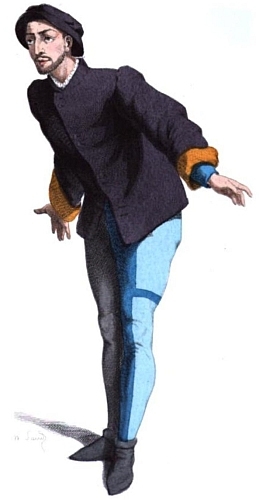
RUZZANTE (1525) Illustrating the Italian Commedia dell'Arte, or Impromptu Comedy
I do not know how far this candid answer was agreeable to Signor Gratarol. Much of it must certainly have gone against his grain, and a good deal he probably took for sarcasm. Nevertheless, he continued on the note of adulation which annoyed me. "In truth," he said, "I hardly hoped for your acceptance, knowing how much you value a quiet life. Yet perhaps you will do me the favour of suggesting some one fit to undertake the duty." "In my opinion," I replied, "the Marchese Francesco Albergati would be a very proper man.[57] He is{241} an enthusiastic amateur, and has great experience in theatrical affairs. He has fixed his residence at Venice, and is sure to accept the post with pleasure." "Do you really think him capable?" asked Gratarol with the utmost gravity, as though we were discussing a matter of vast importance. "Most capable," I answered. "Pray allow me then," he continued, with the same ludicrous concern, "to propose Marchese Albergati to my company of noble amateurs at your recommendation!" "Certainly, if you think fit," I replied, with difficulty repressing a yawn. The long conversation about nothing had almost tired my patience out. At length he rose to take his leave, drowning me in an ocean of compliments. I thanked him for his visit, and promised to return it, blessing Heaven for his departure.
After Signor Gratarol's banquet, which was described to me as regal in its pomp, the whole of Sacchi's troupe let their spite loose against Mme. Ricci. It was a storm of innuendoes and equivocal allusions, upon which my presence barely imposed a check. Some of the actresses went so far as to ask me in private whether I was not at last convinced of what they had always told me about that woman's character. I fenced with them as well as I could, sometimes pretending not to understand, sometimes rebuking their evil gossip, and sometimes turning my back with affected indignation. And so I rubbed on, always sighing for the arrival of Lent.{242}
One evening, her sister Marianna met me in a little room behind the theatre. "What do you think, Sir Count," she said, "of this extraordinary turn of affairs?" "What are you talking about?" I replied. "About my madcap sister, of course," she added: "Teodora was always a hair-brained, giddy, imprudent creature of caprice. But who would have thought that, after five years of countenance and real friendship extended to her by you, she would have given herself so openly and formally to a man like Gratarol?" While I was revolving some answer, which should signify nothing, a knot of actors entered, and relieved me of my embarrassment.
I had always invited some of the comedians to a dinner at my house before the end of the Carnival; and this year, not choosing to deviate from old custom, I fixed it for a Thursday. Among the guests were Ricci and her husband, Fiorelli and Zannoni, with other actresses and actors. The conversation was as brilliant as usual; but I noticed, to my deep regret, that Fiorelli's witticisms returned again and again to certain new ornaments worn by Mme. Ricci. His allusions seemed to cut her to the quick. She blushed, and shifted on her chair without replying. The others laughed, and I vainly strove to introduce fresh topics. From this day forward, rumour dealt loudly and cruelly with her reputation. Folk went so far as to assert that every evening she retired from the theatre with Signor{243} Gratarol to his casino, and spent the whole night there. How far these reports were true, I do not pretend to judge. It is certain, however, that her imprudent connection with a notorious voluptuary was nothing short of disastrous to a woman in her profession. How Signor Gratarol justified his behaviour in causing this open scandal to a person still ostensibly beneath my protection, can only be conjectured. It is possible that Mme. Ricci concealed from him the obligations she was under to me, and my repeated declarations that I should abandon her to her fate if anything of the sort occurred. Yet he must have been aware that he was placing me in a false and odious position.
All Sacchi's troupe made it only too clear that they wished me to drop her at once and for ever. Their innuendoes directed against myself, and the continuous open gossip which went on, overcame my philosophy at last, and I resolved to suspend my visits altogether without waiting for Lent. Yet, before I exposed her unprotected to the hatred of her comrades, I thought it best to take one final step, which proved, as things turned out, a false one. I went to her sister Marianna, and told her to warn Teodora that I meant at last to leave her. I could not play the part of a fool and go-between. I was not jealous, and had never been jealous of her other admirers; but a man in Gratarol's position, notorious for libertinism, belonging to my own class, and with the eyes{244} of the world upon him, made my position as her friend and protector odious beyond expression. She must choose between giving him up or losing me for ever.
Marianna promised to discharge her mission, and spared no words of reprobation for her sister's conduct. I ought, however, to have reflected that a ballet-girl would be sure to misinterpret my real delicacy, and to depict me as a jealous lover.
Two days later on, both sisters appeared at my house. Teodora began to excuse herself. "My sister tells me that you are angry with me, and I am come to ask the reason why." I replied that I was not angry, but that I wanted to save her from certain ruin. If that was impossible, I meant to provide for my own peace of mind and honour by doing what I had always said I should. She begged me, with exaggerated demonstrations of concern, to give her but one chance, averring that she had certain things she wished to say to me in private. I weakly consented to pay her a visit at her own house, and went there on the following day. There I found her still in bed; and sitting down, I begged her to make a clean breast of everything which concerned Signor Gratarol. She told me frankly that she was not in love with him, and that she had only received a couple of trifling presents at his hands—a little Neapolitan watch-chain and an embroidered satin muff. Upon this, I advised her, if things had not gone further, to write{245} a polite letter to Gratarol, begging him, as a gentleman, to discontinue his attentions. She might return his two presents, as a mark of delicacy. The actress sighed, and said she supposed she must follow my advice. I took her at her word; and added that, since I found her so well disposed to adopt the only right course open to her, I was willing not to withdraw my protection.
I did not inquire whether she actually wrote the letter to Signor Gratarol, but continued to treat her with politeness, trusting to her word and honour. One evening, when she had no engagement at the theatre, I proposed that we should go together to the opera at S. Samuele. She accepted, but showed a singular curiosity to know the row and number of the box. "I will send you the key," I said, "this morning, and you will see where it is placed. If you like to go before me with your husband, I will look in during the evening." I fancied there must be some intrigue hidden under this anxiety about the number of the box; but I said nothing, and did what I had promised.
When the evening came, I went to S. Samuele, and found Mme. Ricci with her husband in the box. His duties at the other theatre obliged him to retire, and I was left alone with Teodora. Scarcely had I taken my seat, when I heard the door of the next box open, and some one entered, who was greeted by the actress with charming airs of coquetry and winning{246} grace. I had my shoulders turned to the person, but I divined who it was. The Ricci had informed Gratarol that she was going with me to S. Samuele, and had given him the number of our box. Pretending to notice him by accident, I turned my head round, bowed, and begged him to excuse me for not having yet returned his visit. He overwhelmed me, as usual, with a shower of those compliments which won for him the fame of eloquence.
"This then," said I to myself, "is the woman's way of writing notes at my advice!" However, I attended her back to her house without making any comment on what had happened.
The last day of this most tedious Carnival at length arrived. It was the custom for the leading members of Sacchi's troupe, together with a numerous company of friends, to celebrate the evening with a supper at some inn. I had always accompanied Teodora Ricci on these occasions; and I now determined to put the final stroke to our friendship by acting as usual. After a very festive supper, the whole party adjourned to the opera at S. Samuele. The performance began at midnight, and several boxes had been engaged beforehand. It chanced that I found myself alone in one of them with Mme. Ricci. Thereupon, seeing that the Carnival was over, and the moment of my emancipation had arrived, I opened my mind to the young woman, and informed her that my patience was exhausted. She tried to turn the matter off with a{247} jest; her liaison with Gratarol had been a mere Carnival caprice, which would end with the Carnival. (As if that made any difference to me!) I replied with firmness that it was now too late. She had thrown away the fruits of my benefits conferred on her through five long years, and had repaid them by exposing me to shame and insult. I forgave her and left her at liberty; but abode by my decision to withdraw from her friendship.
"What!" said she, "shall I not be your gossip[58] any more?" "Please to forget that title," I replied: "a good woman does not try to turn her gossip into a simpleton or go-between. I shall not become your enemy, and have no petty thirst for vengeance. If I were wise, I should cut my old connection with the troupe whom I have protected for twenty years. That would secure me against further annoyances and tittle-tattle. But I do not mean to take this step. And you may be very grateful to me; for were I to leave them, they would ascribe the loss of their great champion to you alone." "Oh, what will ever happen to me?" she exclaimed with an air of tragic desperation. "Nothing," I added laughing, "except what you have sought and brought about."
When the opera was over, I attended her home, and standing in the doorway, repeated that this was the last time she would be troubled with my company.{248} "Do you not mean then to visit me any more?" cried she. "You certainly will not be exposed to that disturbance," I replied. "Oh, we shall see you here, we shall see you!" she answered with a cheerful air of security. I could not help laughing at her conceit. "So you persist in looking on me as a hopeless victim of your charms! If I do come to visit you, you will see me, certes!" "But I shall come to you," she added. "I hope that you will never give yourself the trouble," said I; and with these final words I turned my back and walked away.
So ended the open and ingenuous friendship which I had carried on for five years with this woman.
LV.
Annoyances to which I was exposed by the Ricci after this act of rupture.—Some little matters concerning Sacchi's company and my protection of them.—A long and tedious illness.—The "Droghe d'Amore" resumed.
I was not destined to escape without further annoyances. A woman wounded in her amour propre becomes the worst of wild beasts. This I soon discovered; for Mme. Ricci, when she saw I was in earnest, made a point of vexing me, as though, forsooth, she could worry me back into good-will!{249}
That Lent the actors stayed at Venice; and we used to meet at Sacchi's house during the evenings. A game of cards, a plate of fritters, a bottle of wine, and a lavish expenditure of wit and merriment, formed the staple of our recreation. The Ricci had never been in the habit of joining these parties. She did so now in order to launch sarcasms at me. Her rudeness became so intolerable, that, after bearing it in silence for three evenings, I stayed at home. This alarmed the actors, by whom I was regarded as their tutelary genius. They came to me and told me that she had been peremptorily forbidden to show her face again at their reunions.
This did not improve her temper; and her next move was an attempt to draw me into correspondence. First came a letter complaining that my man-servant had spoken insultingly about her to her maid. Of course I paid no attention to such nonsense. Then, about the middle of Lent, arrived a huge epistle in a handwriting I did not recognise. It turned out to be from her husband, who rated me soundly for having outraged his wife by withdrawing my protection. He had the impudence to say that my behaviour was unworthy of a gentleman. The remainder of this voluminous rigmarole consisted of arguments to prove the following thesis:—If a husband approves of the male friends his wife receives, her other male friends have no right to inquire into their character. "Farewell, compliant{250} husband!" cried I, folding up the letter, and laying it aside unanswered.
One morning during Holy Week my servant announced Mme. Ricci's husband. I allowed him to enter, asked him to sit beside me on the sofa, and told my man to bring him chocolate. Looking into the poor fellow's eyes, I could see that he had been forced to pay this visit, and that he was doing his very best to pluck up courage. "We are on the point of leaving for Mantua," he began, "and I am come to pay you my respects, to offer you my wife's regards, and to wish you good health." "You have given yourself unnecessary trouble," I replied; "nevertheless, I am obliged, and I wish you a good journey and a prosperous tour." He kept silence for a minute or so. Then he pulled himself together and began again: "By the way, I wrote you a letter some time since, which has not yet been answered." "You did wrong to write that letter," I rejoined, "and I did well to take no notice of it." Thinking that my indifference was a sign of meekness, he presumed so far as to reply with arrogance: "On the contrary, I did well to write it." I judged it best to change my tone and put the fellow down. So, knitting my brows and looking him hard in the face, I spoke as follows: "You did extremely wrong. Remember that you are in my house. Do not presume upon my civility and forbearance. I am astounded that you have the boldness to pursue me{251} into my own sitting-room, and to bolster up the dirty arguments of your epistle."
The wretch turned pale and sat like a statue. Just at this unlucky minute my servant came in and offered him a cup of chocolate. With trembling hand he took the cup and drank a single mouthful, then put it down upon the salver, saying he did not feel well enough to finish it. When the servant left the room he flung himself upon his knees and begged me to pardon him. "Get up," I said. "I am perfectly aware that you had nothing to do either with that letter or this visit. You are only an emissary, who does not count." Thus encouraged, he entered into a long recital, to which I listened because it gave me some amusement. "I shall tell you the whole truth," he said, "just as if I were kneeling before an altar. Signor Gratarol began to turn my wife's head with his candied orange-peel and Neapolitan bonbons. A box of the latter arrived one day at our house, together with a very flattering billet, expressing the donor's strong desire to be allowed to pay his respects to her. My wife was for sending an answer back by the servant, thanking him for the bonbons, and saying that his visits would be most acceptable. I bade her reflect that this might expose her to slander, and be disagreeable to yourself—the good Count Gozzi, the godfather of our child, our protector and adviser and benefactor for so many years. She called me a fool, and sent the note{252} against my will. You know, Sir Count, that with my wife it is all the same whether I speak or hold my tongue. By all that is sacred, I swear that I have told you the whole truth. Signor Gratarol began and continued his visits both by day and night, without any fault of mine, and without my consent." The opening of this flirtation by the gift of bonbons diverted me; and I sent Ricci's unfortunate husband away with the assurance that I was not angry with him, that Signor Gratarol's visits were of no consequence to me, and that I was firmly resolved not to renew an intimacy with his wife which she had forfeited by her folly.
Two days before Sacchi set out for Mantua, he came to me, and very civilly expressed his disappointment at my having done so little for the troupe with my pen during the past year. I told him that bad health and pressure of business had prevented me from attending to dramatic composition. Then he inquired whether I had not adapted Tirso da Molina's comedy for the Italian theatre. He had heard my Droghe d'Amore highly praised, especially by Mme. Ricci. I replied that it was true; I had nearly finished the piece, but finding it dull and prolix, I had laid it aside among my waste papers. On his insisting, and saying he should like to hear my play, I consented to read it aloud, and promised to see whether I could not bring myself to complete the last act in the course of the summer.{253}
My health remaining weak, I passed the greater part of this summer at a little country-house I had near Stra upon the Brenta. Here I rapidly recovered strength, more by open-air exercise and rational diet than by drinking the Cila waters recommended by my doctor. In the long idle days of this villeggiatura, I set hand once more to the Droghe d'Amore, and finished it with indescribable aversion. Leaving Stra for Padua, I took the play with me, and read it aloud to my friend Massimo, under whose roof I was staying. He listened patiently all through the tedious declamation, praised certain passages of the comedy, and said he thought the chief objection to it was its prodigious length. When I returned to Venice, I made up my mind to put this abortion of my talent on the shelf; but Sacchi would not let it rest. He wrote so urgently upon the subject, that I begged my brother Gasparo to undergo the mortal tedium of hearing and pronouncing judgment on the play. His opinion was that, though it contained some excellent scenes, it too closely resembled my Principessa Filosofa in parts, and that its length would render it ineffective. The comedy was one of character and sentiments, and had no spectacular novelties to enliven it. However, he promised to read it through, and see whether judicious retrenchments could be made. After ten days or so, I received the manuscript again, with my brother's verdict that nothing could be omitted without breaking{254} the warp on which the plot was woven. Accordingly, I wrote to Sacchi, saying that the Droghe d'Amore would really not do, and promising some other piece instead. I had, indeed, already planned my Metafisico and Bianca Contessa di Melfi, but had not had the time to dramatise them.
Meanwhile Sacchi came to Venice in a prodigious bustle. Meeting me upon the piazza, he said that Mme. Ricci was about to break her engagement and to go to Paris. I persuaded him to remit the fine of 500 ducats, provided she continued to serve the company until the end of the next Carnival. This arrangement was finally concluded by the intervention of a Venetian gentlewoman of the Valmarana family. So Sacchi had to look out for another prima donna. His choice had already fallen on a certain Regina, the daughter of an actor, whom he begged me to go and see. I found the girl decidedly ill-favoured. Still I begged her to recite a piece from my Principessa Filosofa. She spoke with an asthmatic voice and the lowest of plebeian accents, made frequent mistakes which spoiled the sense, and was insufferably monotonous in her delivery. I told Sacchi that this young woman would not do for him. But alas! Cupid had played one of his pranks with the octogenarian Don Juan, and Regina was engaged at a salary of 400 ducats, beside special allowances for her outfit. The effects of this girl's introduction into the troupe were disastrous. She proved its evil{255} genius by her bad character and by her ascendancy over the capocomico, playing no small part in that final dissolution of the company which I shall have to relate.
LVI.
Ricci returns to Venice.—Her metamorphosis and my reflections on it.—Sacchi entreats to have the "Droghe d'Amore," and I abandon it to him, in order to save myself from persecution.—The play is read by me before the actors.
Autumn brought the actors back again as usual; and I composed a prologue for the opening of their theatre, which was recited by Mme. Ricci. I used to meet that actress in the rooms behind the scenes, and was much struck by the singular change which had come over her. She continued to do everything she could to annoy me; and I kept wondering how it was that she had managed to conceal her true nature so cleverly during the five years of our friendship. Now she openly bragged about the presents she received; the wax-candles which gave light to her apartment; the exquisite wines, perfect coffee, boxes of bonbons, refined chocolate, and other dainties which furnished her repasts. She even went to the length of inviting that old satyr Sacchi to her house,{256} adding, in order to insult me: "You will find no tiresome moral preachers on the convenances to frighten you away!" While as anxious as ever to lure me back, she piqued herself on letting it be understood that she had given me my dismissal. Indeed, I found it somewhat difficult to treat the woman with that reserved civility which I wished to preserve toward her in public.
The amusement I enjoyed in studying her new ways and manners compensated for these gnat-bites. She had become in six months shameless and affected, as meddlesome and garrulous as a magpie. She pretended to have learned all kinds of important sciences, and gravely informed us that the game rocambol was derived from two English words. She had left off wearing drawers, she said, because it was healthy to ventilate the body, adding details of the most comical indecency. Always dreaming about Paris, Venice had become a kind of sewer in her opinion. The Venetians and Italians in general were a race of stupid mediocrities, unenlightened and insupportable. "I am dying to get to Paris!" she exclaimed; "there the rich financiers fling purses full of louis d'or at actresses with as little regard as one flings a pear in Italy." And then to show how well she had got rid of prejudices: "Ah! blessed power of making love without the checks of a misguided education! To make love through our lifetime is the supreme happiness of mortals!" Not{257} a word or a thought for her husband and two children.
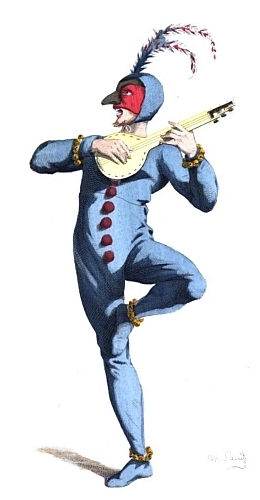
COVIELLO (1550) Illustrating the Italian Commedia dell'Arte, or Impromptu Comedy
Every evening she filled the theatre with such a potent smell of musk, that people complained and said it gave them the headache. "What a prejudice!" she cried with a grimace in what she thought the French style. "At Paris everything smells of musk, down to the very trees in the Tuilleries gardens, against which ladies may have leant a moment." She was taking French lessons; and her retentive memory made her catch up phrases, which she flung about with volubility. Paris entered into everything she said. She modelled her gait and action and tone of voice upon what she conceived to be the Parisian manner, producing a most laughable caricature which spoiled her acting. I felt really sorry for her, while observing this progressive deterioration in her art. She had been an excellent comedian in the Italian style, and would certainly have been appreciated on the stage at Paris. Now she had become an ape of the French race, surcharged with affectation, and unsuccessful in her travesty. It is impossible, I thought, that the Parisians, who require an Italian actress, and not a mongrel imitation of themselves, will put up with her. This prognostication, to my sincere regret, was verified when she appeared in that metropolis.
We had reached the first days of November in the year 1776, and Sacchi's receipts were languishing.{258} He had been spoiled by getting gratis at my hands two or three pieces annually, which found favour with the public. This made him careless about supplying himself with novelties; while I was so engaged with law business that I had no time to dramatise my Metafisico and Bianca di Melfi. In fact, I had nothing on hand but the Droghe d'Amore. Pestered by perpetual applications for this comedy, in an evil moment I drew it from its sepulchre and tossed it over to the capocomico. I told him that he might take the manuscript as a gift, but that if the play failed before the public, as I thought it would, I should never exercise my pen again on compositions for the stage.
It was impossible to foresee that a chain of untoward circumstances would convert this harmless drama into an indecent personal satire upon Signor Gratarol. Mendacious and vindictive meddling on the part of an infuriated actress, false steps and ill-considered opposition on the part of the man whom she deceived, the pique of great folk who disliked him, and the ingenuity of comedians eager for pecuniary gains, effected the transformation. I was placed in a false light—shown up to public curiosity as the prime agent in a piece of vulgar retaliation, the victim of a weak and jealous fancy. If I could have divined what lay beyond the scope of divination, I swear to God that I should have flung that comedy into the flames rather than let it become the property of a capocomico.{259}
Far be it from me to assert that Gratarol was not brought upon the stage in that very comedy of my creation. He certainly was. But he owed this painful distinction to his own bad management, to the credulity with which he drank the venom of a spiteful woman's tongue, to the steps he took for prohibiting my play which roused the curiosity of the whole city and gave it a succès de scandale, to the enmity of great people whom he had imprudently defamed, and finally to the artifices of an acting company who saw their way to making money out of these conflicting interests. I was victimised, as will appear in the course of my narration, for the truth of which I can refer to a crowd of worthy witnesses. I lost control over my play. I saw it bandied about from hand to hand. Condemned to inactivity by magistrates of the State, I had it turned before my eyes, against my will, into a vile engine for inflicting pain upon a person of whom I had never once thought while composing it. Indeed, the part I played in the affair would furnish forth the subject of another comedy, with me for protagonist.
Well, soon after I had placed the manuscript in Sacchi's hands, he told me that it had passed the official revision and had been licensed for the stage. Only some eight or ten lines were struck out. This happens to every play which is referred to the censors of the State. Nothing occurred which called its character in question, or suggested that it was{260} more than a comedy with traits of satire upon society in general.
Sacchi announced the new play to the public, and its capricious title whetted their interest. I distributed the rôles between the actors of the troupe; but later on, this assignment of parts was altered, without my knowledge or consent, in order to fit the cap which Signor Gratarol constructed for himself upon its fabricator's head. The actors saw their way to pointing a caricature, undesigned by me, by shifting the rôle of Don Adone from one player to another. Looking only to receipts at the door of the theatre, they were dead to every other consideration.
After distributing the rôles, I had to read the comedy aloud. This is necessary; for players are so made among us that, unless they catch the spirit of their parts from the author, they are sure to spoil them by some misconception of their values. The reading took place at Sacchi's lodgings. Mme. Ricci appeared in all her glory, and established herself at my right hand. I shall not enlarge upon the characters and plot of the Droghe d'Amore, because the play will be found among my works in print. Suffice it to say, that when I had toiled onward to the sixteenth scene of the first act, where Don Adone makes his appearance on the stage, Mme. Ricci began to writhe upon her seat. One would have imagined that she had never heard the play{261} before, and that this character took her by surprise. Yet more than a year ago she had been introduced to Don Adone, as I have said above, at my own house.[59]
I continued my reading. But whenever Don Adone turned up—and his part is merely episodical in the drama—Mme. Ricci marked her agitation by still more extraordinary signs of impatience. She muttered between her teeth and moved about upon her chair, in a way which made me think that she was indisposed. At last I turned to her and said: "Madam, you seem to be more bored than I am by this reading!" The only answer which I got was a shrug of the shoulders, a turn of the body to the side away from me, and an exclamation: "Oh, 'tis nothing, nothing!"
The reading continued. At every word which Don Adone uttered, Mme. Ricci repeated her grimaces and contortions of the body. I bluntly reminded her that she knew all about this personage twelve months and more ago, and that she had urged me to complete the play. Forced to say something, she put on a sour sardonic smile, and murmured: "Well, well! That Don Adone of yours, that Don Adone of yours!"
Like lightning, the truth flashed upon my brain. I saw what she was up to. In spite of having been, as it were, an accomplice in my comedy those many months before, she meant to fix the character of Don Adone upon Signor Gratarol. This was her plan for{262} rousing his resentment against myself, for revenging herself for my indifference, and for stirring up a scandal worse than all the humdrum scenes my flat comedy contained.
I finished my reading, as may be imagined, in a perfunctory manner, flung the manuscript down upon the table, and told the assembled actors that I did not expect the piece to succeed. It was far too feeble and too prolix. All the same, I had given it away to them, and they must do as they liked with it.
Sacchi, on the spot, gave orders for the copying of the several parts, which were to be distributed as I had settled. The party then broke up, and I kept my eyes upon Signora Ricci. She seemed in a great hurry to get away, as though some one were waiting for her, and I saw that she was bent on mischief.
LVII.
The history of the "Droghe d'Amore."—In spite of my endeavours to the contrary, Gratarol, by his imprudent conduct, forces it upon the stage.—It is represented for the first time.—The town talks, and a scandal is created.
The impressions left upon my mind after this night's reading were painful. I expected some disturbance of the peace through the malice of that woman, who had now become irreconcilably antagonistic.{263} Meeting Sacchi next morning on the Piazza di San Marco, I asked him whether he had noticed the strange conduct of Mme. Ricci on the previous evening. He said that he had certainly been aware of something wrong, but that he could not ascribe it to any cause. Then I communicated my suspicion. "The actress," said I, "means to persuade Signor Gratarol that he is being satirised under the character of Don Adone." "What is her object?" exclaimed Sacchi. "That I will tell you briefly," I replied: "she wants to gain credit with her new friend, to inflict an injury on your troupe, and to cause me annoyance by stirring up a quarrel between me and the gentleman in question." "It is not impossible," said Sacchi, "that she is planning something of the kind. But what are your reasons for thinking so?" "If you had only been attentive to her mutterings and attitudinisings last evening, when the part of Don Adone was being read, you would not put that question," I answered. "I ask you, therefore, as a friend, to withdraw my play until the next season. Lent will soon arrive. The Ricci will go to Paris, and Signor Gratarol to Naples. You can make use of the Droghe d'Amore later on, when its appearance will cause no scandal." After some persuasion, he promised to fulfil my wishes; and next morning he told me that the play had been suspended.
Here the affair would have rested if Signor Gratarol, poisoned by his mistress's report, had not{264} taken a step fatal for his own tranquillity. She returned, as I had imagined, from the reading of my play, and told him that he was going to be exposed upon the stage in the person of Don Adone. He set all his influence at work to prevent the public exhibition of the comedy. The result was that, four days afterwards, Sacchi came to me in great confusion and told me that Signor Francesco Agazi, censor of plays for the Magistrato sopra alla Bestemmia, had sent for the Droghe d'Amore. A new revision was necessitated by certain complaints which had been brought against the rôle of Don Adone.
"So then," said I, "you have given the manuscript to Signor Agazi?" "No," he answered; "I was afraid that I might lose it altogether. I told that gentleman that I had lent it to a certain lady.[60] He smiled and said that when she had done with it he expected to have it in his hands again. In fact, not wishing to be proved a liar in this matter, I took the play to the lady I have mentioned, related the whole story about Gratarol and Ricci, and recommended myself to her protection." Sacchi could{265} not have taken any step more calculated to give importance to this incident. I said as much to him upon the spot; predicted that the lady, who was known to have a grudge against Signor Gratarol, would do her best to circulate the scandal; assured him that the whole town would blaze with rumour, that I should be discredited, and that he might find himself in a very awkward position. "The tribunals of the State," I added, "are not to be trifled with by any of your circumventions."
Signor Gratarol had made a great mistake. Instead of listening to the gossip of an actress, and then setting the machinery of the State in motion by private appeals to persons of importance, he ought to have come at once to me. I should have assured him of the simple truth, and the Droghe d'Amore would have appeared without doing any dishonour to either of us.
His manœuvring had the effect of putting all Venice upon the qui vive, and placing an instrument of retaliation against him in the hands of powerful enemies. The noble lady, Caterina Dolfin Tron, to whom Sacchi took my comedy, read it through, and read it to her friends, and passed it about among a clique of high-born gentlemen and ladies. None of them found any mark of personal satire in the piece. All of them condemned Gratarol for his self-consciousness, and accused him of seeking to deprive the public of a rational diversion, while moving heaven{266} and earth to reverse the decision of the censors of the State.
In two days the town buzzed of nothing but my wretched drama, Gratarol, and me. It was rumoured that I had composed a sanguinary satire. Not only Gratarol, but a crowd of gentlemen and ladies were to be brought upon the scene. A whole theatre, with its pit, boxes, stage, and purlieus could not have contained the multitude of my alleged victims. Everybody knew their exact names and titles. Neighbours laid their heads together, quarrelled, denied, maintained, argued, whispered in each other's ears, waxed hot and angry, told impossible anecdotes, contradicted their own words, and, what was most amusing, everybody drew his information from an infallible source.
One thing they held for certain—that I had made Gratarol the protagonist of my satire. That became a fixed idea, which it only wanted his own imprudence to turn into a fact.
Knowing pretty well where the real point of the mischief lay, I determined to act, if possible, upon the better feelings of Mme. Dolfin Tron.[61] I had enjoyed the privilege of her acquaintance for many{267} years. But my unsociable and unfashionable habits made me negligent of those attentions which are expected from a man of quality. I did not pay her the customary visits; and when we met, she was in the habit of playfully saluting me with the title of Bear. My brother Gasparo, on the contrary, saw her every day, and she bestowed on him the tender epithet of Father. Such being our respective relations, I thought it best to apply to him.
I asked my brother, then, to do all he could to induce this powerful lady to oppose the production of my comedy for at least the present season. Through the machinations of Signora Ricci, against my will, and much to my discredit, the piece was going to create a public scandal, with serious injury to a gentleman whom I had not meant to satirise. My brother, muttering a curse on meddlesome women in general and actresses in particular, undertook the office. He did not succeed. Mme. Tron replied that I was making far too much fuss about nothing, and that my comedy had passed beyond my control. It had become the property of a capocomico, and was at the present moment under the inspection of the State.{268}
Not many days elapsed before I was summoned to the presence of Francesco Agazi, the censor, as I have before observed, for the Signori sopra la Bestemmia.[62] I found him clothed in his magisterial robes, and he began as follows: "You gave a comedy, entitled Le Droghe d'Amore, to the company of Sacchi. I perused it and licensed it for the theatre at S. Salvatore. The comedy has been passed, and must appear. You have no control over it. Pray take no steps to obstruct its exhibition. The magistracy which I serve does not err in judgment." I could not refrain from commenting upon Signor Gratarol's action in this matter, and protesting that I had never meant to satirise the man. He bade me take no heed of persons like Gratarol, whose heads were turned by outlandish fashions. "I made some retrenchments," he added, "in the twelfth scene of the last act of your comedy. They amount, I think, to about ten or twelve verses. These lines expressed sentiments such as are usually maintained by men of Gratarol's sort. You meant them to be understood ironically. But our Venetians will not take them so. What strikes their ear, they retain in its material and literal sense. And they learn much which is mischievous, unknown to them before.—May I parenthetically observe that certain gentlemen want to give orders where they have no right to speak?{269}—I repeat to you that the magistracy which I serve does not err; and I repeat the decree which has been passed." Having spoken these words, Signor Agazi bowed, and left me for his business.
What passed between me and the censor I repeated to friends of mine, who will bear me witness that I found myself estopped in my attempts to suppress the comedy. It had to appear; and Signor Gratarol owed this annoyance to his having powerful enemies.
Unfortunately he did his best to exasperate these enemies. Teodora Ricci, primed by him and parroting his words, went about libelling men and women of the highest rank, whom she had never seen. Phrases of the grossest scurrility were hurled at eminent people by their names. "If Gratarol has committed himself in this way to an actress," said I in my sleeve, "what must he not have let fall to other friends and acquaintances? Such indiscretion marks him out as little fitted for the post of ambassador at Naples or elsewhere."
I have said that I had lost all authority over my wretched drama. I only wanted to see it well hissed on its first appearance, and to bury the annoyances it caused me in a general overthrow. Yet I was obliged to be present at rehearsals. At the first which I attended, I noticed that two of the rôles had been changed. I had given Don Adone to an actor called Luigi Benedetti, and the jealous Don Alessandro to Giovanni Vitalba. Sacchi reversed my disposition{270} of these parts, alleging that Benedetti was better fitted to sustain the character of a furious lover than Vitalba, who was somewhat of a stick. This seemed to me not unreasonable; and I was so accustomed to have my plays cut and hacked about by the actors, that I accepted his decision.
At the second rehearsal, Mme. Ricci asked me negligently if I knew why this alteration had been made. I answered that Sacchi had explained it to my satisfaction. She held her tongue, thinking doubtless that I was well acquainted with certain machinations of which she had fuller knowledge than I.
At last the piece appeared—it was the night of January 10, 1777—at the theatre of S. Salvatore. I went there in good time, and found the entrance thronged with a vast multitude. For three hours people had been clamouring for seats, and the whole house was crammed. They told me that the boxes had been sold at fabulous prices. This might have swelled another playwright's heart with pride. I, on the contrary, was extremely dejected by finding my worst anticipations realised. Pushing my way through the press, which encumbered every passage and clung against the walls, I reached the coulisses with much toil.[63] There I saw a swarm of masks begging for{271} places anywhere at any price. "What the deuce is the meaning of this extraordinary concourse?" I exclaimed. The Ricci answered me at once with: "Don't you know? The town has come to see your satire on a certain person." I put her down by saying bluntly that more than a year ago she heard my play, and knew that there was no personal satire in it. It was not my fault if diabolical intrigues and a succession of blunders had given it a false complexion. She dropped her eyes. I turned my back, and took refuge in a box I had upon the third row of the theatre.
Going up the staircase, I caught sight before me of Gratarol's unhappy wife, and heard her chattering to certain gentlemen she met upon the way: "I wanted to see my husband on the stage." These words of the poor deserted woman enlightened me as to the expectation of the public. Yet why was the whole house so intoxicated? why did a wife look forward to the spectacle of her husband's caricature? I can only explain this phenomenon by remembering the corruption of our age. Women seduced and left to shift for themselves, rivals supplanted in their love-affairs, jealous husbands, wives abandoned and heart-broken, form an inflammable audience for such a piece as the Droghe d'Amore under the notorious circumstances of its first appearance.