CARLO GOZZI. (continued 3)
John Addington Symonds translation
I had formed the habit of conversing with my family of players in our hours of leisure; and very racy did I find the recreation of their society. In a short space of time I learned to understand and see into the characters and talents of my soldiers, with insight so perfect that all the parts I wrote for them and fitted, so to speak, upon their mental frames, were represented on the stage as though they issued naturally from their hearts and tempers. This added hugely to the attraction of the spectacle. The gift of writing for particular actors, which does not seem to be possessed or put in use by every dramatist, is almost indispensable while dealing with the comic troupes of Italy. The moderate payments which are customary in our theatres prevent these people from engaging so large a number of actors and actresses as to be able to select the proper representatives of all the varied characters in nature. To the accident of my possessing this gift, and the ability with which I exercised it, must be ascribed a large part of my{136} success. Goldoni alone devoted himself with patience to the study of the players who put his premeditated pieces on the boards;[27] but I defy Goldoni and all the writers for our stage to compose, as I did, parts differing in character, containing jokes, witticisms, drolleries, moral satire, and discourses in soliloquy or dialogue, adapted to the native genius of my Truffaldino, Tartaglia, Brighella, Pantaloni, and Servette, without lapsing into languor and frigidity, and with the same result of reiterated applause.
Other playwrights, who attempted to put written words into the mouth of extempore actors, only made them unnatural; and obtained, as the reward of their endeavours, the abuse and hisses of the public at the third representation of their insipid pieces. It is possibly on this account that they revenged themselves by assuming comic airs of grave and serious criticism, treating our miracles of native fun and humour as contemptible buffoons, all Italy as drunken and besotted, myself as the bolsterer up of theatrical ineptitudes, and my prolusions in a new dramatic style as crumbling relics of the old Commedia dell'Arte. So far as the last accusation goes, everybody will allow that the Masks which I supported as a tour de force of art and for the recreation{137} of the public who rejoiced in them, play the least part in my scenic compositions; my works, in fact, depend for their existence and survival on the sound morality and manly passion, which formed their real substratum, and which found expression on the lips of serious actors.[28]
For the rest, the players whom I had taken under my wing looked up to me as their tutelary genius. Whenever I appeared, they broke into exclamations of delight, and let the whole world know that I was the propitious planet of their resurrection. They professed themselves indebted to me for benefits which could not be repaid, except by an eternal gratitude.
XL.
The actors and actresses of Italy in general, considered with regard to their profession, their characters, and their manners; written from the point of view of a philosophical observer.
Among all sorts and conditions of human beings who offer themselves to a philosophical observer, none are so difficult to know in their real nature as actors and actresses.{138}
Educated in deception from the cradle, they learn the art of masking falsehood with an air of candour so completely, that it requires great gifts of penetration to arrive at their true heart and character. Journeyings from place to place, affairs of business, accidents of all sorts, experience of common life, examples furnished by their commerce with the world, the constant exercise of wit and intellect in rivalry, wake their brains up, and subtilise their comedians' nature.
In another chapter I intend to paint a special picture of Sacchi's company, with whom I fraternised, and whom I helped for about a quarter of a century. At present I shall confine my remarks to Italian players in general, who are, I think, in no essential points of moral quality different from those of other nations.
It may be laid down as an axiom, to be accepted with closed eyes, that the chief idol of all actors is their venal interest. Expressions of politeness, acknowledgments of obligation, terms of praise, humanity, sympathy, courteous welcome, and so forth, have no value among actors, except as parts of a fixed system of deception which they consider necessary in the worship of this idol. If that idol of pecuniary interest is attacked (with justice it may be and the best reasons), you will not find in them a shadow of these fine sentiments. The merest scent of coming profit makes them disregard and blindly{139} sacrifice the persons who have done them good; the reputation of the whole world is as nothing to them then; they take no thought of the damage they may have to suffer in the future, blinded by greediness, lulled into security for the time being, and hoping to avoid impending disasters by address and ingenuity. The present moment is all that actors think of.
Hot and choleric temperaments reveal their true selves more readily among this class of people. The cool-headed are more difficult to fathom. Their system of cozenage is not only applied to persons outside the profession, from whom they expect material gains; it is always at work to take in and delude the members of the guild. Of course they find it less easy to checkmate the initiated in their own devices. But if they have attained to the position of being necessary to their comrades in the trade, there is no sort of impropriety, pretence, injustice, swindling, tyranny, which they do not deem it lawful to employ.
These arts, which the progress of our century has extended to many kinds of persons who are not of the profession, have a certain marked character among the tribe of actors. Other people, when detected, show some sense of shame and self-abasement. The unmasked comedian, after all his turns and twists have been employed in vain, is so unprejudiced and candid that he laughs good-humouredly in the face of his detective, and seems to exclaim{140} with indescribable effrontery: "You are a great fool if you flatter yourself that you have made a notable discovery."
Such is my experience. But of course it is possible that among the innumerable actors, male and female, whom I have known, conversed with, and studied, some phœnix of the one or the other sex may have escaped my observation.
In what concerns the practice of their art, all that these people know is how to read and write; one better, and one worse. Indeed, I have been acquainted with both actors and actresses who have not even had that minimum of education, and yet they carried on their business without flinching. They got their lines read out to them by some friend or some associate, whenever a new part had to be impressed in outline on their memory. Keeping their ears open to the prompter, they entered boldly on the stage, and played a hero or a heroine without a touch of truth. The presentation of such characters by actors of the sort I have described abounds in blunders, stops and stays, and harkings back upon the leading motive, which would put to shame the player in his common walk of life.
Barefaced boldness is the prime quality, the chief stock-in-trade, the ground-element of education in these artists. Assiduous use of this one talent makes not a few of them both passable and even able actors.{141}
These are the reasons why a civil war is always raging in our companies about the first parts in new pieces. The conflict does not start from an honest desire to acquire or to manifest theatrical ability. The players are actuated wholly by ambition, by the hope of attracting favourable notice through the merit of their rôle, by the wish to keep themselves continually before the public, performing ill or well as their blind rashness prompts them.
Notwithstanding all these disadvantages, Italy would be able to make a good show in comparison with other nations if our theatres were better supported and remunerated. There are not wanting persons of fine presence, of talent, sensibility, and animation. What we do want are the refinements of education, solid protection, and emoluments sufficient to encourage the actor in his profession.
I have observed that the best artists of both sexes are those who have some higher culture; but I have also observed that the support of themselves and their families, and the inevitable expenses of their wardrobe, render their professional salaries inadequate. They make up for these deficiencies by spunging upon credulous tradesmen and besotted lovers; and thus they bring discredit on the whole profession.
I have always laughed at those who depreciate the influences of the pulpit, and think they can instil sound morality into the people by the means{142} of scenic shows. When Rousseau maintained that the precept Do what I tell you, and not what I do, is worthless without a good example from the man who gives it forth, he uttered one of the truest things that can be said. I leave people to meditate upon the inverted morality which is being now diffused in our most recent dramas, the dramas of so-called culture, from the lips of players in the place of preachers.
XLI.
A description of Sacchi's company in particular.—I continue the tone of a philosophical observer.
Having recorded the impression made upon me by Italian actors and actresses in general, I shall now attempt a description of Sacchi's company, which I had good opportunities of studying through some twenty-five years.
Though I read with sufficient ease into the hearts and characters of these my protegés, and could supply them with sentiments, dialogues, and soliloquies adapted to their inmost natures, I found it difficult to penetrate the motives of their moral conduct, which were far more closely fenced about from prying gaze than either their intellectual or their physical peculiarities.
There is no doubt that at least seven members of{143} this troupe were excellent artists in the national Commedia alla sprovveduta—a species of comedy which has always afforded innocent recreation to the public when performed with taste and spirit, but which is utterly insufferable when badly executed. This much I concede to the persecutors of the species—little talents, more ridiculous and useless with their ostentation of gravity than are even bad harlequins.
Sacchi's company enjoyed general respect in so far as their personal conduct was concerned. On this point they differed widely from the majority of our actors, who are for the most part very badly looked upon. This excellent reputation weighed strongly with me, when I sought their society, and entered into fraternal relations with them. The way they held together, the harmony which reigned among them, their domesticity, studious habits, severity in moral matters, their rules against visits being paid to women, the abhorrence the women themselves displayed for those who took presents from seducers, the regularity with which they divided their hours between household duties, religious exercises, and charitable attentions to the indigent among their members, gratified my taste. I may incidentally mention that if any of the salaried actresses or actors exceeded the prescribed bounds of decent conduct, they were quickly sent about their business; and such offenders were replaced by others, whose moral{144} character had been subjected to stricter inquiry than even their professional ability.
I am sufficiently unprejudiced and free from scruples; I have never evaded opportunities of studying human nature, which brought me into passing contact with all sorts of men; yet it is certain that I should not have entered into familiar relations and daily converse in my hours of recreation with these people, for upwards of the space of twenty years, if it had not been for their exceptional good character.
PANTALONE (1550) Illustrating the Italian Commedia dell'Arte, or Impromptu Comedy
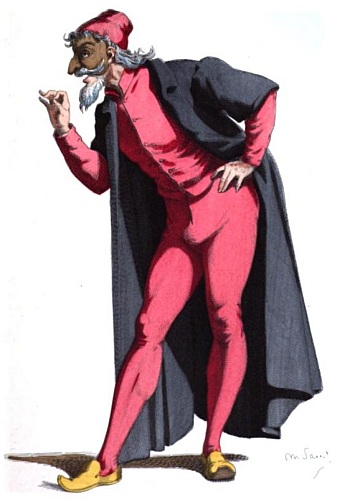
I not only composed for them a long series of theatrical pieces, novel in kind and congenial to their talents, but I also furnished them with a new arsenal of stock passages, essential to the Commedia dell'Arte, and which they call its dote, or endowment.[29] I could not say how many prologues and epilogues in verse I wrote, to be recited on the first and last evenings of the run of some play by the leading lady for the time being; nor how many songs to be inserted in their farces; nor how many thousand pages I filled with soliloquies, sallies of despair, menace, reproach, supplication, paternal reprimand, and such-like matters appropriate to all kinds of scenes in improvised comedy. The players {145}call such fragments of studied rhetoric generici, or commonplaces. They are vastly important to comedians who may not be specially gifted for improvisation; and everything of the sort I found in their repertory was vitiated by the turgid mannerisms of the seicento.
I was godfather at the christening of their babies, author-in-chief, counsellor, master, and mediator to the whole company; all this without assuming the pretentious airs of a pedant or a claimant on their gratitude; but always at their own entreaty, while I preserved the tone of disinterested, humane, and playful condescension.
Some of the girls of this dramatic family—none of whom were ugly, and none without some aptitude for the profession—begged me to help them with support and teaching. I consented, provided them with parts adapted to their characters, taught them how they ought to act these parts, and put them in the way of winning laurels. At their entreaties I devoted some hours of my leisure to giving them more general instruction. I made them read and translate French books suited to their calling. I wrote them letters upon divers familiar themes, calculated to make them think and develop their sentiments under the necessity of composing some reply or other. I corrected their mistakes, which frequently consisted in the unexpected and uncalled-for use of capital letters, and laughed{146} heartily while doing so. This afforded me sprightly amusement and gave them a dash of education.
When they left Venice for the customary six months,[30] I ran no risk of not receiving letters from them, written in rivalry with one another—sometimes real love-letters—arriving by each post from Milan, Turin, Genoa, Parma, Mantua, Bologna, all the cities where they stopped to act. Nor were answers wanting upon my side; playful, affectionate, threatening, derisive; taking any tone which I judged capable of keeping these young creatures wide-awake. It seemed to me that such an active correspondence and exchange of sentiments was the most appropriate and profitable school for a comedian.
Let no man deceive himself by supposing that it is possible to converse with actresses without love-making. You must make it, or pretend to make it. This is the only way to guide them to their own advantage. Love moulds and kneads them in flesh, bones, and marrow. Love begins to be their guiding-star at the age of five or six. In this respect, I soon discovered that the austerity of Sacchi's company was a barren formula; just as I had previously noticed that strictness in private families, beyond a certain point, had ceased to be accounted of utility or value.{147}
Among actresses, the term friendship is something fabulous and visionary. They immediately substitute the word love, and do not attend to distinctions. Their idea of friendship only serves as the means of mutual deception between women, accompanied by deluges of endearing phrases and Judas kisses.
I ought, however, to declare that the actresses of Sacchi's company carried on their love-affairs with prudence and without indecency. The ideal of severity which prevailed there bore at least these fruits of goodness; and the ideal of honesty produced notably different results from those which other systems in the trade of love elicited elsewhere. How many actresses lay siege deliberately and in cold blood to their lovers, despoil them of their property, and do their very best to suck them dry! Catching at the locks of what they call their fortune and I call their infamy, these women do not stop to see whether the path before them be clean or filthy. They worship wickedness and abhor good living, if they hope to fill their purse or gratify their cupidity by the former. Though they strive to cloak their baseness with the veil of verbal decency, and do all in their power to preserve external decorum, they trample in their souls on shame and sing this verse:—
"Colla vergogna io già mi sono avvezza."
("With infamy I long have been at home.")
For the actresses of Sacchi's company, it is only justice{148} to assert that they were far removed from harbouring such sentiments of vile and degrading venality.
There are two phrases in the slang of the profession; one is miccheggiare, which means to cozen folk out of their money by wheedling; the other is gonzo, gull or cully, the foolish lover who believes himself an object of affection, and squanders all his fortune under the influence of this impression. I must declare that the women of Sacchi's company never put the arts which these words imply into practice. They made love by instinct, inclination, and hereditary tradition.
This does not mean that they were not eager to get lovers who could support them on the stage, or who would be likely to marry them, and withdraw them from a calling which they always professed, hypocritically I believe, to abhor.
In what concerned myself, I looked upon their love-intrigues as duels of wit and comic passages, which furnished me amusement. Closely related to each other, and ambitious for advancement in their art, they regarded me as a bright shining star, worshipped by the leading members of the troupe, and capable of securing them success upon the stage. Their mutual rivalry, which I made use of for their own advantage, the profit of the company, and the success of my dramatic works, turned their brains. They would have done anything to gain my heart. Possibly some matrimonial projects entered into their{149} calculations; but on this point I was always careful to disabuse them in the clearest terms. Meanwhile, their attentions, protests, fits of rage, jealousies, and tears on my account had all the scenic illusion of an overwhelming passion.
In the cities where they passed the spring and summer, the same comedy was re-enacted with a score of lovers. On their return to Venice, the correspondence which they carried on with these admirers, and which they vainly strove to hide from me, betrayed their inconstancy. By cross-examination and adroit suggestive questionings, I always brought them to make a clean breast of it, and their avowals furnished me with matter for exquisite amusement. They protested that the letters they received were written by young merchants or rich citizens, sometimes by gentlemen of the Lombard towns, who entertained the liveliest intentions of an honourable kind, and were only waiting for the death of an uncle or a father or a mother, all upon the point of dying of apoplexy or consumption or dropsy, to offer them their hands and fortunes. Finally, in order to reveal the sincerity of their hearts, when lying could no longer help them, they offered me these precious epistles. Probably they hoped to excite jealousy in my own breast. This opened a new chapter of diversion. I read the love-letters, and found that the vaunted admirers were either bombastic lady-killers or romancers or libertines, or{150} sometimes, to my astonishment, dull Lombard hypocrites upon the scent of goatish pleasure.
I enlightened them, so far as this was possible; advised them not to waste their time in such perilous fooleries, which distracted their attention from the serious concerns of their profession; bade them look out for young comedians of talent, with whom they might marry and propagate the breed of actors. They never failed to express that loathing for the trade which all actresses profess, remaining actresses, however, in the utterance of their repugnance. In order to open their eyes to the real state of the case, I then dictated answers to these lovers, affectionately urging them to declare themselves on the essential point. Cold replies came with the next post, and after a short exchange of letters the correspondence dropped. In this way, they were brought to see their error, remaining always ready to resume it on the next occasion.
Their sentiments for me, according to their own showing, were the most enduring and substantial; and my incredulous laughter wounded them. They bullied and maligned each other, complained, and accused their comrades at my judgment-seat. I pronounced sentence against them all; but the most persecuted were always the object of my heartiest protection. When I wrote parts adapted to their characters, they were lifted to the heavens. What obligations! What gratitude! What vows of love!{151} I cannot deny that in certain moments they were justified in thinking they had gained my affection. The next day they found me quite another man, indifferent and icy cold. Amour propre then made them fly into a rage, and grow the angrier the more they saw me laugh at their frenzies.
All things considered, it is very difficult to frequent the society of young actresses, who harbour in their breasts six books upon the art of love beside those of Ovid, to be their daily guide, philosopher, and friend, to make their fortunes in the theatre, and not to fall into some low matrimonial scrape, which would be called a solemn act of folly by the world. I use such terms as scrape, baseness, folly here, in order to adopt the language of people in general; although I am persuaded by personal observation, and by philosophical study of the current training given to girls, that it is easier to find a good wife on the stage than in private families. People in general are not philosophers enough to recognise and confess this truth; but the opinion of the general is always respectable.
My temperament, my abhorrence of ties, my partiality for study, the pity for human woes which I derived from knowledge of my neighbours, and the thirty-five years which I counted at the period in question, were my faithful counsellors. I have already written a chapter on my love-affairs, which sufficiently explains my sentiments.[31]
{152}
In the midst of these feminine intrigues and rivalries, it is impossible to distribute protection with perfect impartiality among all claimants. The girl who is most persecuted by her comrades, most looked down upon, and reckoned stupidest in her profession, will always be chosen out by me for support and advancement, without regard for hostile gossip bred by envy.
In course of time I saw all these young women married, thanks to the fame they acquired through my efforts on their behalf. Some of them found husbands in the theatre, and some outside it. Without withdrawing my assistance from married actresses, I took care, from the moment of their nuptials, to cause no shadow of disturbance in their home. This I did by persistently refusing to visit them, which made them know me in my true principles apart from pleasantry. My conduct astounded them, and they affected notable displeasure at my withdrawal from their intimacy.
With regard to the chief men in this commonwealth of comedians, they were always most attentive lest I should receive annoyances. Above all things, they begged me not to take notice of any indiscretions prompted by levity, professional jealousy, touchiness on points of honour, pretensions to leading parts in my forthcoming plays, which might issue from the steaming brains of their women. I used to reply that, so long as the company maintained its{153} good reputation, and so long as such quarrels and idle chatterings were confined to the women, I should never deign to be annoyed or to withdraw my aid and friendship from their troupe; but that if the men took to the same follies and dissensions as the women, I should have to think otherwise.
It was a comfort to me to pass my hours of leisure among those lively-witted, humorous, civil, merry people. It gratified me to observe that the men were eagerly sought after and invited to the tables of the quality and honest folk, while the women received similar attentions from gentlefolk of their own sex, a thing almost unheard of with respect to others of their calling. Finally, I was pleased to see them thriving in their business and making profits by their theatre, which I had revived and continued to sustain by a long series of new and successful dramatic pieces. If prejudice or malignity were to cast it in my teeth that I had evil motives in this choice of my companions through so many years, I might easily turn the satire back against what is commonly called the respectable society of casini, assemblies, and caffès. In order not to incur hatred by describing inconvenient facts, I will, however, confine myself to begging my critics to reflect and to be indulgent for differences of taste.
Returning to my comic protegés, I have yet to say that the insinuation of so-called culture into our theatres gradually corrupted the customs of this well-{154}regulated family of actors, much in the same way as the advance of culture into private families corrupted domestic manners. Outsiders, hired at wages to swell the ranks and to take serious parts in tragedies or comedies, introduced a new freedom of thinking and behaving. The old habits of the troupe, which may perchance have only worn a feigned appearance of respectability, altered for the worse. The time has not arrived for describing this change, which I shall have to do in its proper place, since it was closely connected with important occurrences in my own life.
Some weaknesses are so entwined with our instincts as to be incurable. Such, in my case, are good faith and compliance, which often degenerated into silliness. During the whole course of my life, as my writings prove, and as is well known to my friends and acquaintances, I have always scourged hypocrisy. I cannot, however, deny the fact that the apparent honesty, piety, and good behaviour, in which my protegés persevered for so long a period, was convenient to their friends and extremely profitable to their pockets; whereas the freedom of thinking and acting introduced among them by the science of this depraved century and by so-called culture, brought them to the condition of the builders of the Tower of Babel.
I have seen them pass from ease to indigence, forget that they were relatives and friends—all at{155} war together, all suspicious, each man of his neighbour—all irreconcilable and hostile—in spite of frequently renewed attempts on my part to bring them into harmony again; so that, at the last, I had to withdraw from their society, as will be stated in the sequel of these Memoirs.
XLII.
The end of the rage for Goldoni and Chiari.—I go on amusing my fellow-citizens with plays.—Make reflections, and perhaps catch crabs.
We had arrived at the year 1766, when it became evident that my band of comedians, by this time well established in their theatre, and supported by the public, who flocked eagerly to see the pieces I provided for them, were about to win a decisive victory over our adversaries. Chiari's works stood revealed in all their native nakedness; the glamour of enchantment had departed. Those of Goldoni, in spite of their real merit, did not make the same effect as in the past. People noticed that he repeated himself; they discovered poverty of ideas, flaccidity, and faults of construction in his later pieces. They said that he was played out.
The truth is that a rage so vehement and fanatical as that created by Chiari and Goldoni was bound{156} to die away. They had been so much spoken and quarrelled about that their very names began to pall upon the ear. In Italy, moreover, there is no well-founded and intelligent respect for authors. Dramatists in particular are merely regarded as purveyors of ephemeral amusement. Perhaps Venice exceeds every other capital in this way of thinking. A Venetian citizen, to take a single instance, was congratulating Goldoni on the success of one of his comedies; then, as though ashamed of condescending to so trivial a theme, he added: "It is true that works of this sort are trifles, which do not deserve our serious attention; and yet I can imagine that you may have been gratified by the reception of your play."
Goldoni, with true business-like prudence, had compelled the shabby Italian comedians to pay him thirty sequins for every piece, good, bad, or indifferent, which he supplied them. I gave my dramatic fancies away gratis. It is very probable that, finding themselves eclipsed by what their rivals got for nothing, Goldoni's paymasters waxed insolent against him.
Chiari stopped writing when he saw that his dramas ceased to take. Goldoni went to Paris, to seek his fortune there, whereof we shall be duly informed in his Memoirs. Sacchi's company remained in possession of the field and earned a handsome competency.
It became a necessity, a sort of customary law dictated by my friendship, to present these actors{157} every year or two with pieces from my pen. The ability with which they had interpreted my fancies deserved gratitude; and the sympathy of the Venetians, who had so warmly welcomed them, called for recognition. Accordingly, I added the Donna Serpente, the Zobeide, and the Mostro Turchino to those dramatic fables which I have already mentioned. This brought us down to the year 1766.[32]
The new genre which I had brought into fashion, and which, by being confined to Sacchi's company, inflicted vast damage on their professional rivals, inspired other so-called poets with the wish to imitate me. They relied on splendid decorations, transformation scenes, and frigid buffooneries. They did not comprehend the allegorical meanings, nor the polite satire upon manners, nor the art of construction, nor the conduct of the plot, nor the real intrinsic force of the species I had handled. I say they did not comprehend the value of these things, because I do not want to say that they were deficient in power to command and use them. The result was that their pieces met with the condemnation which their contempt for me and for the public who appreciated me richly deserved.
You cannot fabricate a drama worthy to impress the public mind for any length of time by heaping up absurdities, marvels, scurrilities, prolixities, puerilities,{158} insipidities, and nonsense. The neglect into which the imitations of my manner speedily fell proves this. Much the same may be said about those other species—romantic or domestic, intended to move tears or laughter—those cultured and realistic kinds of drama, as people called them, though they were generally devoid of culture and of realism, and were invariably as like each other as two peas, which occupied our stage for thirty years at least.[33] All the good and bad that has been written and printed about my fables; the fact that they still hold the stage in Italy and other countries where they are translated in spite of their comparative antiquity; the stupid criticisms which are still being vented against them by starving journalists and envious bores, who join the cry and follow these blind leaders of the blind—criticisms only based upon the titles and arguments I chose to draw from old wives' tales and stories of the nursery—all this proves that there is real stuff in the fabulous, poetical, allegorical genre which I created. I say this without any presumptuous partiality for the children of my fancy; nor do I resent the attacks which have been made upon them, for I am humane enough to pity the hungry and the passion-blinded.{159}
Goldoni, who was then at Paris, vainly striving to revive the Italian theatre in that metropolis, heard of the noise my fables were making in Italy, and abased himself so far as to send a fabulous composition of his own fabrication back to Venice. It was called Il Genio buono e il Genio cattivo, and appeared at the theatre of S. Giov. Grisostomo, enjoying a long run. The cause of its success lay in the fact that his piece displayed dramatic art, agreeable characters, moral reflection, and some philosophy. I conclude, therefore, that allegorical fables on the stage are not so wholly contemptible.
At the same time, just as there are differences between the different kinds of dogs, fishes, birds, snakes, and so forth, though they all belong to the species of dogs, fishes, &c., so are there notable differences between Goldoni's Genio buono e cattivo and my ten Fiabe, though all are grouped under the one species of dramatic fable. Goldoni, who has deserved renown for his domestic comedies, had not the gifts necessary for producing poetic fables of this kind; nor could I ever understand why my ridiculous censors cast the ephemeral success of his two Genj in my teeth, with the hope of mortifying a pride I did not feel.
The dramatic fable, if written to engage the interest of the public and to keep its hold upon the theatre, is more difficult than any other species. Unless it contains a grandeur which imposes, some{160} impressive secret which enchants, novelty sufficient to arrest attention, eloquence to enthral, sententious maxims of philosophy, witty and attractive criticisms, dialogues prompted by the heart, and, above all, the great magic of seduction whereby impossibilities are made to seem real and evident to the mind and senses of the audience—unless it contains all these elements, I repeat, it will never produce a firm and distinctive impression, nor will it repay the pains and perseverance of our poor actors by its permanent pecuniary value. It may be that my fables possess none of these qualities. Yet the fact remains that they contrived to produce the effects I have described.
XLIII.
I re-open a lawsuit, and continue to scribble my fantastic pieces for the stage.
In this same year, 1766, my brothers warmly urged me to revive the lawsuit against Marchese Terzi of Bergamo.[34] Since our family documents had been dispersed, and only three old wills and some worm-eaten summaries remained to guide me, I obtained an injunction ordering the defendant to produce the deeds whereby he claimed the disputed{161} property, and the papers relating to several suits between his ancestors and ours. At last two enormous chests, full of musty writings, were delivered at the Magistracy of the Avvogaria. Perhaps my adversaries thought to dash my spirits and damp my ardour by this ocean of pages which had to be explored. If so, they were mistaken. I procured one of those licenses, which are technically called courtesies, from Signor Daniele Zanchi, the defendant's advocate, to study the documents at his chambers, and set myself down with imperturbable phlegm to peruse millions of lines in antique characters, faded, half-effaced, semi-Gothic, and for the most part hieroglyphical. I selected those which seemed to the purpose, and had forty-two volumes of transcripts filled at my cost by Signor Zanchi's copyists.
Painful circumstances leave ineffaceable impressions on the memory. The examination of those vast masses of manuscript, word by word and letter by letter, so different from delightful literature in prose or verse, taxed every nerve and fibre. I well remember that my study of them lasted over more than two months, in the dead of a hard snowy winter. Signor Zanchi, taking pity on my shivering wretchedness, kindly furnished me with a brazier of live coals; and yet I thought, what with the irksome labour and the cold, that I should have to breathe my last between the walls of the fortress of my enemies.{162}
I shall not weary my readers with a detailed account of this tedious lawsuit. My brother Almorò, whose heart was always in the right place, contributed to the expenses according to his means. My brother Francesco, remaining a wary economist, refused to exceed an annual payment of 150 lire during the progress of the suit. My brother Gasparo only lent his name and assent. The following anecdote is characteristic of his easy-going, popularity-loving temperament. Some gentlemen, friends and supporters of the Marquis, asked him with serious faces: "What the devil is this annoyance you are causing Marchese Terzi?" To which he shrugged his shoulders and answered: "I know nothing about the matter. They are devices of my brother Carlo, a litigious fellow, who thinks that he is in the right here." He did not mean, I fully believe, to shun responsibility and odium by shifting the blame to my shoulders. This answer was only of a piece with the pacific indolence which made him bear infinite wretchedness in his own home.
In the course of two years I had to expend 17,000 lire on the costs of this suit; and had it not been for the generosity of friends, among whom Signor Innocenzio Massimo stood first, Marchese Terzi would have scored one of those victories which make us inclined to doubt of Providence. Beside the anxiety and incessant labour which preyed upon my health and spirits, I was annoyed by my adversary's powerful{163} friends, who went about the town denouncing me for a quarrelsome, vexatious, captious, and inequitable fellow. Rude rebukes addressed to me by such persons I met with significant smiles and silence, never deigning to take up the cudgels in my own defence against accusations which I knew to be discourteous and baseless. In addition to all these sources of discomfort, I had to fight the battle single-handed; for my excellent friend and advocate, Signor Antonio Testa, was compelled by stress of business to leave me in the heat of action.
It is not to be wondered at that I fell ill at last. But what will seem more wonderful, nay, almost incredible, is that I sought distraction during my few leisure hours in planning and composing dramatic pieces. I used to take sheets of paper on which I had sketched the outlines of scenes in my pocket down to a coffee-house on the Riva degli Schiavoni. There I engaged a room facing San Giorgio, had coffee brought, and ordered pen and ink. Thus furnished, I forgot my troubles for a while in the elaboration of soliloquies and dialogues. It was in this way that, while my suit dragged on through three tempestuous years, I produced the Augel Belverde, the Rè de'Genj, the Donna Vendicativa, the Caduta di Donna Elvera, and the Pubblico Segreto. I flatter myself that none of these plays betrayed the melancholy and distraction of a harassed brain. They were welcomed with enthusiasm by the public,{164} and brought fame and profit to my friends the actors.
After a long course of anxious litigation, complicated by somewhat tortuous proceedings on the part of my opponents, the cause was settled in the following way. I obtained as compensation for my claims a farm of about forty-six acres in the Paduan district, several houses in Venice, some substantial and some ruinous, a sum of money in the funds of the Mint, and three thousand ducats by way of repayment of arrears. A solemn agreement was signed, which may God preserve unbroken through all the centuries to come! After paying the costs and debts contracted in this long campaign, and assigning their portions of the balance to my brothers, I took breath again, like a man broken by a tedious and disastrous journey, who stretches out his wearied limbs upon a bed of down.
XLIV.
The beginning of dissensions in Sacchi's company.—My attitude of forbearance and ridiculous heroisms.
Having spent ten years of serene recreation among my professional friends, the time had come for clouds to gather on the horizon. Le due notti affannose, my last dramatic venture, was the source of much profit to Sacchi. But the company, while gaining strength{165} from actors hired to sustain serious parts, began to degenerate in their behaviour. Though they professed the same severe morality as formerly, I noticed signs of change and of dissension. Differences between relatives spread the seeds of future dissolution. The imported actors helped the theatre, but introduced pernicious ideas into this previously happy family. They criticised the administration of the property; accused the managers of injustice, tyranny, even fraud; sympathised with those who thought themselves oppressed; threw stones, and carefully concealed the hands which launched them. Pluming themselves upon their sapience, they contrived to persuade the troupe that the plays I gave for nothing were not so beneficial as the latter blindly believed. They ascribed the crowds which filled the theatre to the attraction of stage decorations and their own spirited performance. Not unlike the fly in Æsop's fable, they exclaimed: "Look at the dust which we are raising!" By artfully reckoning the cost of putting my fables on the stage, and by insinuating calumnies against the managers, they brought some of the sharers into a state of mutiny, made them depreciate my services, and stirred up anger and suspicion against Sacchi. Finally, they got them to think it would be more advantageous to exchange their shares for salaries, and prepared them for hating one another cordially.
The older and more sagacious comedians still continued{166} to pay me court and beg for my poetical assistance. I thought it, however, wiser to suspend my collaboration for a year or two, without showing annoyance, or letting it be known that I was aware of what was being said against me. I could not take a better way of bringing them back to reason; and my private engagements provided me with a good pretext for withdrawing my assistance.
In the first year after my retirement, the public began to grumble at the lack of new pieces. In the second, it began to growl. The audiences thinned, and Sacchi's theatre became a desert. There were not wanting folk who from the boxes shouted insults at the actors. Their dejection increased daily; and then they all with one accord broke into protestations of affection and fervent entreaties for my help.
I had accustomed the public to novel kinds of drama, and the company had seconded my efforts. I did not think it right to assist them for ten years and then to drop them. To condescend to take affront at what comedians say or do is utterly impossible for me. I could, indeed, have laughed in their faces and turned my back. But I preferred to laugh in my sleeve while once more coming to their aid with the energy and good results which I shall presently describe.
The owners of the other theatres in Venice, finding themselves extremely injured by the plays I gave to Sacchi, kept making me proposals to write{167} for their houses; and the pretty actresses who worked there seconded these misplaced endeavours by spreading snares to catch me with their charms. Though my old protegés would have richly deserved it, I had the burlesque heroism not to desert them.
Sacchi often complained of having to remain in theatres out of the way and inconvenient for the people, such as S. Samuele and S. Angelo, where only striking novelties like mine could draw large houses. He was always sighing to get the lease of S. Salvadore,[35] a most popular theatre, since it is situated at the centre of the town, within easy reach of its densely inhabited quarters. Now it so happened that this theatre was occupied by a company which performed pieces in the fashion introduced by Chiari and Goldoni. I have already said that the vogue of such things had declined; and the proprietor, his Excellency Vendramini, was anxious to secure me in the interest of his failing house. He sent a priest of my acquaintance, a certain Don Baldassare, as envoy, offering me his cordial regards, together with considerable emoluments, if I would pass from Sacchi's company to that which occupied S. Samuele. I draped myself in the dignity of Attilius Regulus, and replied that I did not write for money, but for pastime. As long as Sacchi's troupe kept together and remained competent, I did not mean to give away my work to any other.{168} If his Excellency had the fancy to see plays of mine performed at his theatre, he could indulge it by placing the house at Sacchi's disposal. Not many months passed before I was chosen by that gentleman as arbitrator between him and Sacchi. I acted the solicitor, drew up a lease, and installed my manager in the theatre his heart was set on.
I should have liked to devote myself entirely to my private studies; but the responsibility I had taken by transferring Sacchi's company to S. Samuele, together with the informal engagement I felt under to Signor Vendramini, made me resume my task of writing for the stage. I ought to add that my old habit of associating with the actors weighed strongly with me in this circumstance. Therefore a new chapter of some fourteen years in my life was opened, the principal events of which I mean to write with all the candour and the piquancy I can.
XLV.
Dangerous innovations in Sacchi's company.—My attempts to arrange matters, my threats, prognostications, and obstinate persistence on the point of honour to support my protegés—things sufficient to move reasonable mirth against me.
The grant of the theatre at San Salvadore for the next year had hardly been handed over to Sacchi,{169} when the other troupe, who were expelled to make room for him, engaged the theatre at Sant'Angelo, which he was leaving, and began at once to plot revenge. They tried, by flatteries and promises of money (always needed by Italian comedians), to circumvent the best actors of the company, among whom were Cesare Derbes, the excellent Pantalone, and Agostino Fiorelli, the famous Tartaglia. In fact, they did seduce these two champions of impromptu comedy to desert Sacchi's ranks and join their squadron, more with the object of weakening our forces than of strengthening theirs, since their own members were unfit for any performances but those of the so-called cultivated drama.
This desertion mortified the sharers in Sacchi's company, and they whispered their misfortune in my ears. For my own part, I was sorry to think that the quartette of masks, real natural wonders, who made such pleasant mirth in concert, should be scattered. I determined, therefore, to try whether I could not dissuade these two actors from the somewhat shabby step they had resolved on. When I remonstrated with Derbes, who was my gossip, the answer he gave me ran as follows: "Precisely because I feared that you would attempt to separate me from my new comrades, and because I know my inability to refuse you anything, I concealed the agreement from your eyes, and signed it in secret, so that I might not have it in my power to comply with{170} your request. It grieves me that I am no longer able to meet your wishes." On hearing this preposterous excuse, I lost my humour for a moment, and burst into serious reproaches. He assumed a theatrical air of sorrow, and defended himself by repeating the complaints which were current among the disaffected members of Sacchi's troupe. I contented myself with prophesying that he would find himself without place or part in his new company, adding by way of menace that I should well know how to make him repent of his desertion to the enemy.
Then I repaired to Fiorelli with as much solicitude as though I were bent on averting some grave disaster from myself. Him I found more tractable. He had not signed his agreement; and I was able to reconcile him with his old comrades, and to make him subscribe a paper, by which he promised to remain with them for the next three years.
A bad system of etiquette divides the actors and actresses of every troupe in Italy into first, second, third, and so forth. It happened at this time that Sacchi had dismissed his first actress, Regina Cicucci, a very able artist, but one who had not won great fame with Venetian playgoers. "What a fine stroke of business it would be," said he to me one day, "if we could rob our rivals of their first actress, Mme. Caterina Manzoni! The revenge would be complete and just, and I should be provided with a{171} leading lady. I am afraid, however," he added, "that my company would not suit her." Signora Manzoni was my good friend. I appreciated her talents, her personal attractions, her cultivated manners, and her educated mind. She had often asked me whether I could not introduce her into Sacchi's company; and though I did not usually mix myself up with such affairs, the present occasion and Sacchi's speech inclined me to attempt a negotiation.
Accordingly, I made proposals to the lady, which she welcomed with great delight and profuse expressions of gratitude. Some differences with regard to appointments and other details arose. These I settled, like an able broker, and brought the bargain to an agreement. When I presented the papers for her signature, the beautiful young woman met me with an air of sadness, which added to her charms. She looked as though she had not the courage to address me. I did not understand what this meant, and strove to hearten her up. At length she told me, dropping a few lovely tears, that her former friends and comrades, when they got wind of her meditated desertion, had come to her weeping violently, and had flung themselves at her feet imploring her not to abandon them to certain ruin. Moved by a spirit of compassion, she had signed a paper which obliged her to remain with them for some years to come.
Although I knew the tenderness of her heart, I{172} did not think her capable of such a breach of promise through mere sensibility. She must have had stronger reasons for breaking the engagement she had entered into with me; and if she ever writes her Memoirs, we shall hear of them.[36] Perhaps I ought to have lost my jovial humour, as I did with Derbes. I could not do so in the face of so much beauty. I only told her, with a smile upon my lips, that she was her own mistress; Sacchi might get a first actress of any sort he could; I should have wit enough to make the person as able an artist as my fair renegade. With these words I engaged myself to a new point of honour.
I have never regretted that I treated Signora Manzoni in this courteous fashion. She has always shown me the attentions of delicate and cordial politeness; and it is only justice to declare that she possesses qualities which would be estimable in a gentlewoman. A few years after the events related here she married, retired from the profession, and devoted herself to the education of her two little boys in sound moral and religious principles.
When I reported the failure of my negotiation to Sacchi, he replied roughly: "I knew that the person in question could never have adjusted herself to my{173} company." Then he pushed forward his correspondence for the engagement of another prima donna.
I should like my readers to believe that my intervention in the affair I have described was due principally to my regard for the Cavaliere[37] who granted his theatre at my request to Sacchi's company. Really afraid that their internal dissensions, rivalries, and intrigues might reduce them to a state of impotence, and that his interests would suffer in consequence, I wished to avoid having any share in this disaster. A barren and old-fashioned delicacy!
XLVI.
Sacchi forces me to give advice.—Teodora Ricci enters his company as first actress.—An attempt at sketching her portrait.—The beginnings of my interest in this comedian.
Whenever Sacchi had to engage a prima donna, all the other actresses rose up in tumult. Why they should have done so, when the engagement was merely temporary, remains a mystery. That they were connected among themselves by blood or marriage does not explain their conspiracy. The newcomers had to endure a martyrdom of criticism, depreciation in their art, and gross calumny in their morals. Who knows whether the prospect of such{174} imminent tribulation did not form one reason of Signora Manzoni's defection? These details do not appear to have any bearing on my Memoirs; but it will soon be seen that they have only too much.
Sacchi always affected, out of prudence, to consult with me on his affairs, especially at this time, when the change of theatre had disorganised his system of management. Accordingly, he informed me one day that he was in treaty with two first actresses, and asked for my advice. One of them was Signora Maddalena Battagia, a Tuscan by birth, talented, but no longer in her prime, incapable of taking part in the Commedia dell'Arte, and extremely exacting with regard to precedence, etiquette, and a substantial salary. The other was Signora Teodora Ricci; from what he heard about her, she was a beginner, young, full of spirit, with a fine figure and voice, who had been applauded in every city where she had appeared; moreover, she was accustomed to act in the Commedia dell'Arte. She had a husband, of some distinction as a player; and Sacchi could get them both at a salary of only 520 ducats a year.
I had never heard before of either. But after weighing and comparing their testimonials and correspondence, I gave a laconic answer: "Engage Signora Ricci with her husband." This is precisely what Sacchi had resolved in his own mind on doing; and his appeal to me for counsel was only a comedian's way of feigning esteem and sense of dependence.{175}
The Ricci and her husband were bound over under articles for three years at a salary of 520 ducats. This was a wretched stipend for a poor actress, who had to provide herself with a decent wardrobe on the stage, to meet the expenses of frequent journeys, and to maintain a husband and a son; and who, moreover, was expecting her confinement, and was about to expose herself to all the calumnies, criticisms, and venomous detractions of the allied women of the company.
My new protegé reached Venice in the Lent of 1771. I received an invitation from Sacchi to meet her and her husband at his house one evening, on their arrival from Genoa. He wanted me to hear her recite a passage from some tragedy, in order that I might form an estimate of her manner, her talent, and her disposition. I saw at once that she was a young woman of fine figure, though her pregnancy took off from its appearance. Her face was pitted with the small-pox; but this did not prevent it from being theatrically effective at a distance. The abundance of her beautiful blonde hair made up for some defects of feature. Her clothes, which betrayed a scanty purse, were well put on; and she carried them with such an air and grace that no one stopped to think whether they were of silk or wool, new or worn. She seemed to be somewhat constrained by the unfamiliar society in which she found herself. I could not make my mind up whether her reserve{176} and shyness were the result of timidity or cunning. Yet I detected in her something of habitual impatience. She chafed because her husband did her little honour in our conversation. He, good man, slept sweetly, in spite of the clandestine nudges which she gave him.
She recited the fragment of a tragic scene in verse, with a fine and powerful voice, sound sense, intelligence, and a fire which gave good hopes of her in her profession, especially in fierce vituperative parts. I noticed a trifle of hardness and monotony in her declamation, and some other defects which could be remedied. One incurable fault she had; this was the movement of her lips, which often amounted to what is called making a wry face. Her mouth, not small by nature, had been relaxed and ravaged at its angles by the small-pox, so that the poor young woman could not overcome the involuntary fault of which I speak. I must add a physiological observation I have made, which bears upon this point. When we feel disgust for any object disagreeable to our senses, we naturally express it by a writhing of the mouth. The Ricci, through prejudice, or through something proud and wayward in her temper, was always hearing and seeing things which she felt nauseous and repulsive, and this repugnance stamped itself upon her features in a contortion of the lips. Enforcing and stereotyping the physical blemish in question, {177}it became an ineradicable habit, or rather second nature.
THE RICCI RECITES BEFORE GOZZI AND SACCHI Original Etching by Ad. Lalauze
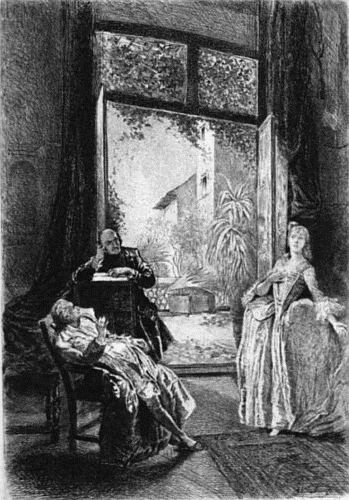
When the trial-piece was finished, I paid her some deserved compliments, and sought to inspire her with a courage which seemed lacking in her demeanour. The other actresses hung upon my words; but Sacchi, more attentive to his interests than to what I was saying, turned toward me and spoke: "Signor Conte, I have engaged this young woman at your advice; pray bear in mind that you have a duty to perform—that is, of making her useful to our company." I replied that I would do the utmost in my power, both for him and for her, as soon as I had made myself acquainted with her real gifts for comedy and tragedy. On the faces of the other actresses I read a sullen sadness and a disposition to squirt poison.
The company was bound for Mantua. Signora Ricci begged for my assistance in studying the new parts assigned to her during the few days which remained before they left Venice. I complied; and hardly a day passed without my going to her lodgings, and giving her the instructions I thought needful. Feeling my honour pledged by what I had said to Derbes and Signora Manzoni, and wishing to establish a strong troupe in Cavaliere Vendramini's theatre, I had pronounced a good opinion of young Ricci's future, and I was sincerely anxious not to find it faulty. She received me with affability{178} and an air of satisfaction. As the days went on, I discovered in her gifts above the average.
Sometimes I found her plunged in sadness; and on inquiring the reason, she told me that she saw certain ruin staring her in the face. She had entered a company of actresses and actors related by blood, and all allied against her. She was alone, without protection and support. Her mother had reproved and terrified her for having accepted this position, prophesying that she would be discredited and driven out of Venice, to the loss of all the fame which she had gained in other cities. I laughed at her fears, told her that her presentiments were phantoms, and tried to make her believe the great falsehood that real merit always ends by overcoming obstacles. I promised to write pieces adapted to her talents. If she could but once make herself necessary to the company by winning the favour of the public, all her difficulties would vanish. But this could only be achieved by conquering her trepidation and steeling her mind against untoward circumstances.
The respect I enjoyed in Sacchi's troupe for past favours conferred and future benefits expected impressed her mind; and she resolved to cultivate my friendship as her only stay. Her poverty moved my compassion; and I liked her civil hearty ways of greeting me, which seemed sincere. I wanted to study her disposition in order to compose parts suited{179} for her; but time was short, and I could not do much. Meanwhile, my visits and attentions roused the jealousy of the other actresses. They used to question me with affected nonchalance upon the Ricci's talent; confessed they saw great faults in her, and doubted whether she could ever be of service to the company; but ingenuously added that they hoped they were mistaken. Seeing through their artifice, I repeated my favourable prognostications, and engaged myself to secure the fulfilment of my prophecies.
It was then that calumnies began to fly abroad against my poor new pupil's moral character. That was only what had to be expected. Everybody knew the reports for facts, and nobody had set them going. I have said that my habit of protecting the persecuted amounted to a vice. Now that she was attacked in her honour, I vowed with greater fervour to defend and rehabilitate her.
The troupe departed in due course of time for Mantua; thence they passed to Verona, where the Ricci was delivered of a baby, which Heaven in kindness removed from this world. Letters arrived from these cities depreciating her talents, accusing her of invincible defects, and prejudicing the public mind against her. Meanwhile, the partisans of two able actresses in the rival company at S. Samuele were not idle; and I foresaw that I should have formidable obstacles to overcome before I succeeded in establishing{180} her reputation. This only made me the more obstinate.
Not being thoroughly acquainted as yet with her character and special gifts, I composed a drama called La Innamorata da Vero.[38] My object was to place her in different lights, and to give her the opportunity of hitting the public taste in one point or another. She had to play the part of a lady in love, exiled, forced to disguise herself as a waiter, then as a gipsy, then as a soldier, then as a gentleman of quality, in order to hide from the pursuit of justice and to remain faithful to her passionate attachment. At the least I hoped that great pains in the performance of this rôle might win for her indulgence and favour. I had reason to see that I was mistaken in my expectations and my judgment. The piece, though it proved successful in itself, was not adapted to the Ricci. Sacchi, however, wrote about it and the actress enthusiastically from Mantua, where it was exhibited.
I shall now have to describe the début of this young artist at Venice, the difficulties we met with, the triumph which finally confirmed my prophecies, and the friendship which I maintained with her for the space of six years. Many of my friends have asked for the real history of this friendship. It was always my habit to waste no breath in talking, but to use up several pens without fatigue in{181} writing. I shall, therefore, very likely be too long and prolix in my narrative of a friendship, which folk are quite at liberty to call love if they like. Since it occupied six years of my life, I cannot omit it; but every one is at liberty to skip the following chapters if they find them tedious.[39]
XLVII.
Teodora Ricci makes her début at Venice without marked success.—My reasons for feeling engaged in honour to support her.
My histrionic phalanx returned to Venice, and took possession for the first time of the theatre at S. Salvatore, deprived of one of their best actors, Derbes. The managers of the company wished to keep the public in suspense about the new actress for the first few nights. This is the common policy of such people. They reason thus: "We are all of us novelties at the beginning of the season. Let us keep the new actor in reserve to stimulate the{182} public when our own attractions fall off. Come what may, we are sure to have our purses full that night at least." Desire of gain is their only motive principle.
At last the time came for poor Ricci to be exhibited. The flaming announcement of new actress, new play, La Innamorata da Vero, drew a full house. My piece was well received; but the Ricci was voted a barely tolerable artiste. This pleased the other actresses of the troupe and amused me, who had formed a very decided opinion of her real ability. She next appeared as the Queen of England in the old play of the Conte d'Essex. Poorly dressed, she raised no applause, although she acted well; and her capital sentence seemed to be irrevocable.
About this time Sacchi asked me to translate a French play called Fajel,[40] in which he proposed to give the part of Gabrielle to the débutante Ricci. I remember that I scribbled off this version in the small rooms of the theatre while my friends were acting; an earthen pipkin with some ink in it and a dirty stump of a pen, supplied by the green-room man, helped me through it in a few evenings.
Before it appeared I chose to have my translation published, together with an essay inveighing against the habit of importing plays from France. The stir caused by this essay, together with other circumstances, drew a large house on the first night of{183} Fajel. Ricci sustained the part of Gabrielle admirably; but it so happened that Signora Manzoni had recently been acting a nearly identical rôle at the theatre of S. Angelo, and her partisans determined to crush the débutante, whom they considered a presumptuous rival. This third failure made her ruin palpable to every eye.
Fervid and impetuous by nature, proud as Lucifer, and intensely ambitious, she chafed and wept, took to her bed, and raged there like a lioness, cursing the hour when she had joined Sacchi's troupe and set her foot in Venice. As far as possible, she concealed the true cause of her fury, and dwelt on family difficulties, her poverty, and a new confinement in prospect. To my attempts at consolation, though flattering and reasonable, she turned a deaf ear.
It was then that, having gained a perfect knowledge of her character, I composed my Principessa Filosofa,[41] precisely with a view to her. When I read it to the company, they broke forth into their usual extravagant laudations. But just at this time they were plotting the removal of the Ricci; and the actresses most interested in expelling her from the troupe raised obstacles against the Principessa being put upon the stage. They buzzed about from ear to ear that my drama was languid and tiresome. I had omitted the four masks, and had constructed the piece with the sole object of bolstering up an actress{184} already out of credit and rejected by the public. The Ricci chafed with rage; while I continued to laugh, knowing well that I should find the means of bringing these passion-blinded creatures back to reason.
Just then it happened that the patrician of Venice, Francesco Gritti, one of our best and liveliest pens, translated Piron's tragedy of Gustavus Vasa from the French.[42] At my request, he gave this play to Sacchi, assigning the part of Adelaide to Teodora Ricci. New difficulties and new intrigues arose among the jealous actresses. These I put down with a high hand, the play in question being not my own, but my distinguished friend's donation to the company. La Ricci learned her part with diligence and ease. Her chief anxiety was about her costume; for the managers refused to make her any advances on this score, and her rivals, who took subordinate parts in the tragedy, were straining all the resources of their lengthier purse to outshine her by the wardrobe. I amused myself enormously at their ill-founded expectations. When the night arrived, the play was very decently got up, and the Ricci entered on the scene far better dressed than any of her comrades. Gustavus Vasa had a decided{185} success; and the Ricci, who played Adelaide well, but certainly not better than the three parts which had well-nigh ruined her, was encouraged by a fair amount of applause. I could see how much good this little gleam of sunshine did her.
Meanwhile days flew by without anything being said about my Principessa Filosofa. I thereupon determined to try what a little artifice could do. I began by confiding to some of our actors that I could not resist the wish to see this piece upon the stage; and that appreciating Sacchi's reasons for not venturing to take the risk of it, I was thinking of offering my Principessa to the company at S. Angelo. Signora Manzoni, I added, seemed to be admirably fitted for the leading part. No sooner was it whispered that I intended to follow Derbes to the rival camp, than marvellous alacrity began to be displayed. Sacchi, always violent and excessive, insisted that the Principessa Filosofa should be got up and ready for representation in the course of a few days. In fact, this piece appeared upon the 8th of February 1772. The Ricci, carefully coached by me, sustained the title-rôle with astonishing spirit. She was welcomed with thunders of applause; and a run of eighteen nights to overflowing houses established her reputation as an artist of incomparable energy and spirit. This joint triumph of author and actress made the latter necessary to Sacchi's company. Yet some of her comrades persisted in regarding her{186} with covered rancour. They never acknowledged her talents, and ascribed her success to the rôle I had composed for her.
XLVIII.
A pliant disposition is apt to neglect the dictates of reflection.—I proceed with my narrative regarding the Ricci and myself.
If the company loaded me with gratitude, Teodora Ricci was not behindhand with the same sweet incense. She professed herself wholly and simply indebted to my zeal, good management, and friendship for her victory. She did everything in her power, and laid herself out in every way to secure my daily visits. So long as I frequented her house, she felt safe from her persecutors; and her main ambition was to commit me to an open and deliberate partiality. She did not, however, know the true characters of her comrades, nor yet my fundamental principles and temperament; nor, what was worse, did she know herself.
Had I declared that open partiality which she desired, it is certain that I should have exposed her to still more trying enmities and persecutions. The managers of the troupe, governed exclusively by calculations of interest, would have felt themselves{187} compelled to curry favour with me by indulging her in all her whims, demands, breaches of discipline, and a thousand feminine caprices. Nothing could be more alien to my real character than to make myself the proud and domineering protector of one actress to the injury of her companions. Besides, her views and mine were so fundamentally at variance upon some elementary points of conduct, that I doubted whether a liaison between us could ever be of long duration. Light-headed, vain, and sensitive to flattery, she had no regard for prudence and propriety; nor did she recognise those faults in herself which were always involving her in difficulties. I knew, moreover, that characters like hers must sooner or later incline to those who caress their foibles and pervert their judgment, while they come to regard their real friends and honest counsellors as tiresome pedants. She had no grounds for believing that I was in love with her. Yet, such was her self-assurance, that she interpreted my kind offices on her behalf into signs of submission to her charms. Finally, though I was far from believing all she said about her affection for my person, I determined to extend to her a cordial friendship.
There are two classes of sinners, whom the world, however dissolute, will always hold in abhorrence—the shameless cynic and the hypocrite. Libertines invariably attempt to confound prudent and respectful friends of women with the odious tribe of hypocrites.{188}[43] I delighted in the theatre. I was known, appreciated, and courted by actors and actresses of all sorts, composers, singers, ballet-dancers. They came to me for advice and support on all occasions. I had to write pieces for them, prologues, epilogues, and what not. I was consulted about the arrangement of pantomimic scenes, dances, words for music. If the innumerable actresses with whom I conversed were to give their testimony, it would appear that I never took advantage of these opportunities to play the part of a seducer or a libertine. These Memoirs I am writing, together with the whole tenour of my life through a long course of years, suffice to clear me from the imputation of hypocrisy. Some of my readers will probably suppose that I am making a vain parade of philosophy in order to gain credit for virtues I did not possess. Others will call me a simpleton for not availing myself more freely of my exceptional position among the beauties of the stage. What I am going to relate concerning my friendship for the Ricci will show that I erred upon the side of simplicity and folly. It was my fixed intention to benefit her, and at the same time to benefit the troupe I had taken under my protection, by making her an able artist and verifying my own opinion of her talents in the teeth of jealousy and opposition.
She had spirit, a good voice, a retentive memory,{189} extraordinary rapidity of perception, and a fine figure, which she knew how to set off to the best advantage. On the other hand, she was inattentive to the conduct of a dialogue, deficient in naturalness and in real sensibility for the rôles she undertook. These defects, which are fatal to scenical illusion, proceeded from lack of intelligence, want of real heart for her business, and all kinds of feminine distractions. Some literary culture would have been of service to her; but, like all Italian actresses, she was deficient in such culture. According to her own account, she had been the most neglected of five or more sisters. After taking some lessons in dancing, she abandoned that branch of the profession because of a physical weakness in her knee-joints. Her mother, poor, and with a drunken husband, then made her the domestic drudge. Since she showed some talent for acting, however, a certain Pietro Rossi begged this woman to let her enter his company of players. She made no difficulties; and signing the girl's forehead with a large maternal cross, sent her out into the world with this practical injunction: "Go, and earn your bread; do not come back to be a burden to the family, where there are too many mouths to feed already." Throwing herself with courage and closed eyes into her new career, Teodora won applause by her natural aptitude for acting, and by the charm of her youth. The piece I wrote for her placed her well before the public, and I was not at all doubtful of her future{190} success. Yet I could not but apprehend that her defective moral education, her inflammable and reckless disposition, might make me one day repent of my cordiality and intimacy.
In conversation with this young woman I enjoyed no exchange of wit or sentiment, no perspicacity of intellect, no piquant sallies and discussions. On the other hand, her way of meeting me was always frank and open; she showed much decency and neatness in her poverty; told anecdotes with comic grace; mimicked her comrades, the actresses, with spirit; evinced a real repugnance for immodesty; betrayed the ingenuousness of her nature by a hundred little traits. What above all attracted me towards her was that she could not tell a lie without showing by involuntary blushes how much the effort cost her. Time taught me that I ought to mistrust her apparent ingenuousness. The artless sallies with which she turned old friends and benefactors into ridicule made me reflect that she might come to treat me in like manner. Her blushes, when she told a fib, did not spring from a dislike of lying, but from anger with herself for not being able to distort the truth more cleverly. Yet self-love is a weakness so ingrained in human frailty, that men are always ready to believe that they will fare better than their neighbours, because they think they have deserved better, or fancy themselves preferred by the woman on whose very faults they put an{191} indulgent interpretation. This was my case with the Ricci.
I was never able to induce her to sacrifice even a few hours a day to reading good books or exercising her mind by writing. Arguments, entreaties, reproaches were all thrown away. She excused herself by pleading her domestic duties; and though I was ever anxious to spend our time together in useful studies, as I had done with other actresses, I could not bring her to do more than con the parts she had to play upon the stage. Probably she thought that her native pluck and talent were sufficient to sustain her without troubling her brains by serious work. The duties which she always pleaded consisted in sitting at her toilet-table before the eternal looking-glass, arranging laces, changing ribands, altering the folds of veils, matching colours, and such-like frivolities. All these things are useful with a view to stage effect; but exclusive devotion to them distracts the mind from the higher exigencies of dramatic art, leads an actress to court applause by illegitimate means, and brings her in course of time to mere posing and peacocking upon the boards before the eyes of voluptuaries in the boxes. The Ricci was only too prone to such faults; and besides, her purse could not stand the expenses of her toilette.
When I ventured to express my fears upon these points, she betrayed her real way of thinking by replies to the following effect: "If we do not earn{192} more than our fixed wages, how on earth are we poor actresses to hold out in a profession like ours?" I did not conceal my abhorrence of the principles implied in such remarks; and she professed that she had only spoken in jest. At the same time, her behaviour was so good, she ruled her house with such economy, paid her debts so regularly, and conducted herself with such propriety, that I hoped, by good advice and by getting her salary increased, to save her from the evil influences of a misdirected early training. Vain illusion to flatter oneself that one can ever cure an actress of the faults instilled in her from childhood! I was perhaps blinded by the partiality I felt for her; and no man, face to face with a woman, can trust the clearness of his insight. Six years of continual assiduity, friendship, benefits, were not worth one straw against the poison she had imbibed. The woman who, with a sound education, might have become a person of true culture and a real friend, gave herself up to flattery and her own perverted inclinations; so that in the end she brought upon me troubles which the world has judged of serious importance and public gravity.[44]
{193}
XLIX.
I publicly avow my friendship for Mme. Ricci.—Efforts made to secure her advancement.—I become godfather to her child, and indulge in foolish hopes about her future.
Before entering into those open and formal ties of friendship which in Italy carry something of the nature of an obligation, I thought it right to warn Signora Ricci with regard to certain matters.[45] I pointed out that she was a member of a company renowned for its good character, and that she had already been exposed to calumny by her detractors. This ought to make her circumspect in repelling the advances of men of pleasure who might compromise her reputation. For myself, I meant to be her avowed friend, her daily visitor, and cavalier in{194} public; but she must not think that I wanted to play the part of a lover, far less of a flatterer. My age, which bordered upon fifty, and my temperament were enough to prevent me from making any foolish pretensions to her favours. Should she find herself in need, through the failure of her monthly salary to meet expenses, she might count upon my purse. If, in spite of my good counsels, she increased her reputation for light conduct, I should be obliged to break with her at once and for ever. On the other hand, if my principles were distasteful to her, she had only to speak the word, and I would leave her absolutely at liberty. So long as I supported her in public and championed her honour as a woman and her fame as an artist, I had the right to expect conduct from her conformable to my avowed philosophy of life.
To these Quixotical discourses she replied by saying that all honest folk congratulated her upon acquiring my favour. They urged her to do all in her power to strengthen our alliance, and to avoid everything which could make me leave her. Nay, more: her spiritual director, in the course of confession, had exhorted her to remain by me, a man whom he regarded as a marvel of our century. This I thought a little exaggerated; it smacked of the stage.
The Ricci's husband was a good sort of fellow, who had been a bookseller, and had acquired a kind{195} of literary fanaticism in that business.[46] All day and night he scribbled volumes, which were sure, he said, to be the source of vast profit to himself and his heirs. Absorbed in these barren studies, he abandoned the household to his wife, philosophically making no claims on her attention. Shoes in holes and muddy stockings never troubled him. But meanwhile his health was being ruined. He grew as lean as a corpse and spat blood from the lungs, while bending over his beloved desk. His wife vainly scolded him, predicting that he was sure to fall into a consumption, which might infect his family. He pitied her gross ignorance, and continued to immolate himself upon the altar of learning. How this ill-assorted couple ever came together I cannot imagine. They appeared, however, to like each other, and lived on fairly good terms.
An income of 500 ducats was wholly insufficient for man and wife and child, with an expected confinement, and the expenses of a theatrical wardrobe{196} to be met. I represented the case to Sacchi, who agreed to add a sum of 130 ducats annually, remarking, however, that each year Teodora would be sure to clamour for a further rise in wages. He was right. In proportion as she grew more necessary to the company, she augmented her threats of leaving it and her demands for better appointments.
On the days when she was not on duty at the theatre, I used to accompany her openly to the opera and playhouses and other places of diversion. She had her cover laid at my house, and she frequently dined there in company with her husband, whom I liked for his modest and civil manners. I also managed to introduce her into society. Many of the noble or wealthy families of Venice took pleasure in receiving members of Sacchi's troupe at their houses. At first Teodora Ricci was excluded from such invitations, so cruelly had her character been blackened by female jealousy and malice. I made myself responsible for her good behaviour, and removed the prejudices which placed her at this disadvantage. Under my protection, she went to fashionable dinner-parties and polite assemblies; I also introduced both men and women of good manners to her at her own home. Acting with reckless or stupid good faith, I did not foresee how soon the hidden mines of her perverted inclinations and bad early training would explode and cover me with confusion.
Meanwhile her condition improved in other ways.{197} She exchanged the dark, ill-smelling apartment she first occupied for a small but convenient abode. Perhaps I ought to touch upon those material services which she may have from time to time received from me; but if she can forget them, it is easier for me to do so also. I must add that, while I was never blindly enamoured of her, I never found her grasping or rapacious.
The time arrived when my friends the actors were about to leave Venice for the theatres of Bergamo and Milan. Before parting from Teodora, I begged her to remember that she had to some extent my honour in her keeping. She was going into danger, among a crowd of envious persons who would enjoy nothing better than to see her compromise herself and me by levity of conduct. She replied that her wishes and intentions were so firmly bent on abiding by my counsels, that she should like to ratify our alliance by a bond of religion. Would I hold her expected infant at the font? I said that I should be very willing to do so, but that I could not promise to leave Venice to be present at the christening. To this I added jestingly: "Your request is somewhat despotic in the condition it imposes on me. You are thinking more of your own interests than of my affections, which may perchance have been engaged for you. This bond of religion puts an insuperable barrier to my desires." We laughed the matter over, and agreed upon it amicably.{198}
She begged for letters of recommendation to Bergamo and Milan. Knowing how worse than useless such introductions are, I confined myself to one testimonial, addressed to my good friend Signor Stefano Sciugliaga, Secretary of the University at Milan, and to his wife, an estimable couple, full of kindness and distinguished by their virtues. Furnished with this letter, the Ricci left me, and I felt the loss of her at Venice. She went to Bergamo, where she gave birth to a little girl, for whom Sacchi stood my proxy at the font. I discharged the usual duties to the Church, and did what was proper in the circumstances by the mother of my godchild. Teodora pursued her journey to Milan, whence she wrote me a full account of the kindness and courtesy she received from Signor Stefano Sciugliaga and his wife Lucia.
The weariness I feel in writing this chapter makes me measure what my readers must experience in reading it. I therefore cut it short and finish it.
L.
Fresh passages regarding my foolish but persevering friendship for Mme. Ricci.—Highly comical discoveries which involved me further in the line I had adopted.
Sacchi's troupe had just finished their season at Milan, when I received a letter from my friend Sciugliaga,{199} informing me that my new gossip's husband was seriously ill. A celebrated physician of that city declared him to be in the last stage of consumption. This being the case, the interests of his wife and two young children imperatively demanded a separation. Sacchi had returned before the rest of the company, and I immediately communicated the news to him. We settled that it would be best to induce the Ricci's husband to leave Venice for his native air of Bologna, offering him three francs a day for his expenses there, until his health should be sufficiently restored for him to resume his duties. My friend's mother, Emilia Ricci, happened to be in Venice at the time; and I thought that the delicate charge of making this communication to the poor fellow might be intrusted to her. I found her very well disposed to undertake it.
When Signora Ricci arrived, I went to visit her, and was received with all her usual demonstrations of cordiality. She looked extremely thin and pale and downcast. On my asking after her health, she replied with a gesture of despair, and, as though she was afraid of being overheard: "I am at my wits' end; my husband goes on spitting blood. Yet I must sleep with him; I am living in hourly dread for myself and my poor children." I did my best to calm her by describing the plan on which Sacchi and her mother had agreed with me. But days flew by, and her mother, why I know not, never made{200} the necessary communication. Meanwhile the man grew worse, and the poor young wife had at last to take this disagreeable duty on herself. She discharged it with a judgment and a feeling which raised her in my esteem. Her husband took the announcement in a Christian spirit, and set off for Bologna, committing his wife and family to me with streaming eyes. I may incidentally remark that the Milanese physician had mistaken his case. Rest among his relatives restored him to a better state of health, and after some months he was able to return to Venice and resume work at the theatre. But the separation between him and his wife continued from this time forward.
The absence of her husband altered my relations to Signora Ricci, and made her position very delicate. I told her frankly that it would be more prudent if I discontinued my daily visits to her house. We should have plenty of opportunities for meeting in the green-room of the theatre. To this she replied: "So, then! In the midst of my enemies, without a husband, on the eve of being made a widow, with two children, I am to be left alone, abandoned by my friends!" Pale, thin, and out of health, she spoke these words with such an accent of intense sorrow that my resolution was shaken. I promised to alter nothing in my conduct with regard to her, only stipulating that she, on her side, should be careful not to compromise us both by any imprudence{201} of behaviour. How ill-judged this yielding to compassion and inclination was, will appear too plainly in the sequel.
She was fairly well off, enjoying a salary of 530 ducats, while her husband lived at Bologna at the charges of the company. In fact, her position, compared with that of other leading actresses, was decidedly good; yet she continued to complain and haggle for an increase of wages. I did all in my power to interest the other members of the troupe in her behalf, and brought Sacchi to her house. In this way an intimacy sprang up between her and the director of the company which led in a short while to his augmenting her appointments by more than a hundred ducats. He told his partners that this addition was made in order that she might improve her stage wardrobe. I always laugh when I remember that excuse for generosity. My readers will soon know why.
The Ricci, left without her husband, stood in need of some domestic counsellor and friend, who would assist her not only in Venice, but during the six months of her theatrical tours. She chose for this purpose a young Bolognese actor called Coralli, of more education than his comrades, but somewhat of a humbug. I liked the fellow for his polished manners and dramatic talent, and saw no reason to resent this intimacy. Nor did I object to the male visitors whom I met at her house. They were{202} actors, men of business, letter-carriers from Florence, Bologna, and Modena, and persons of the same sort. But I warned her frequently and seriously against admitting men of the town and pleasure, who would certainly compromise her reputation and bring discredit on my friendship. I could see that she rebelled in secret against the severity of my principles. I repeated that, if she broke into revolt, I should immediately carry out my threat of leaving her to her fate. In taking this line, I confess that I acted very foolishly. I could not change her nature or substitute sound views of life for the corrupt traditions of her calling. She imagined that I was nothing more than a jealous lover, and only sought my society for the protection it afforded her, and for the benefits I was able to confer upon her by my writings. She also hoped to make me a screen for carrying on intrigues in accordance with her vitiated principles. I ought indeed to have withdrawn from her at this point. But my good-nature and the task I had undertaken of pushing her in the profession kept me at her side.
Very soon new motives for taking the decisive step of a rupture with Signora Ricci appeared. Sacchi, whom I had introduced to her house, was seized with a blind and brutal passion for the young woman. Who would have imagined that an old fellow of eighty, gouty, with swollen legs and frozen veins, could have been inflamed by such desires? Sometimes, when I{203} happened to pay visits at unwonted hours, I saw him running as fast as he could to hide himself from my sight. I pretended not to notice this, but I felt sure that a conspiracy of some sort was being hatched between them.
One morning I found my gossip engaged in unrolling a piece of white satin, some thirty ells in length. She hung lost in admiration over the beautiful stuff. "So," said I, "you have been making purchases?" "Yes," she answered, "I wanted a new gown of white satin, and have been to buy it." "You are always complaining that your salary is insufficient, but I am glad to see that you can afford yourself this indulgence." "Sacchi was with me this morning; he gave the merchant security; I have got the stuff on credit, and three sequins a month are to be deducted from my salary to pay for it." Now I have said that Teodora Ricci could not tell a lie without betraying some confusion. I noticed a blush overspread her face, and quietly resumed the conversation: "Well, you have not behaved well by me. I know how punctual you are in paying debts, and have before now given the same security for you on more than one occasion. Why did you resort to Sacchi for this little service? You are not dealing frankly with me." She blushed still deeper, and exclaimed with irritation: "I suppose I must tell you the truth! That old man is madly in love with me. He wants to give me the dress, and expects from{204} me what he will never get." I saw at a glance why the capocomico had been hiding from me, and began to address the following remarks to the young actress: "Dear gossip, it is impossible that an old man of eighty can have gone so far without encouragement from you. I have often noticed that he ran away and hid himself on my approach. What reason had he for doing this? You are sowing the seeds of dissension between me and an associate of more than twenty years standing. You are painting me in false colours to that man; and this is your return for a thousand kindnesses. I have stood by you in your profession, and declared myself the champion of your honour. Now, for a satin gown, you are going to destroy the work of years. That white dress upon your shoulders will be the filthiest, the most besmirched, the most shameful of your wardrobe. It will be a robe of infamy, and work your ruin. Pray reflect that old Sacchi has a viper for his wife, with two daughters, who hate and vilify and slander you. Do you imagine that you will conceal your intrigues from their curious eyes? No indeed. They will assail you with their tongues, and having caught you in so vile an act, will spare nothing to cast the truth in your teeth, as previously they spread abroad their lies behind your back. I am speaking far more for you than for myself. I can always save my honour by quitting you without an open scandal. I know quite well that you fancy I am in love with you and jealous{205} of your decrepit adorer. That is not the case. I am only jealous for your honour and for mine. I shall certainly do what I have often threatened, and shall do it without breaking my heart, although 'tis true I have a warm affection for you. What right have I to lay the law down and to preach to you? None. But you have no right to imagine that a man like me, your gossip and your friend, will play the part of screen to your disgraceful traffic. My remedy is to leave you absolute mistress of yourself by withdrawing from your intimacy."