CHIANTI AND THE IMPRUNETA
Reading edition
E made our first home in Florence with our good friend Signora V—— and her daughter. Our rooms were on the second piano, which meant three flights of uncompromising stone stairs, but once at the top our windows overlooked the piazza on one side, a pretty garden on the other, and gave us plenty of sunshine; moreover, we had a loggia, a very different matter from a balcony or gallery both in name and character, and from which we got charming views of the distant hills. Within was every creature comfort—not luxury, perhaps, but cleanliness, order, refinement, and an excellent table with two servants, merry-faced Dina and kindly Annunziatina, to serve and pet us, to identify our wants and interests as their most pleasurable duty, and teach us to say that Tuscan cookery and Tuscan servants, at their best, cannot be equaled the world over. The relation between the Italian family and servants is in many cases almost ideal: there is complete understanding and freedom of speech; the mistress talks and consults with the maid, and she, in turn, depends on her mistress as on a mother, and yet neither forgets her place or dignity. As for food, where will one find such sweet, tender vegetables, such crisp salads, and macaroni served in a dozen different ways, each better than the other? For the first month every dish brought to the table was a mystery and delightful surprise. How could one have lived half a century and never known fritto misto, or the changes that may be rung on rice or corn meal? What a far different object the pomidoro is in Tuscany from the tomato of commerce in Boston! Then, who ever can measure the capacities of chestnuts? As for meats, if variety is limited, certainly the methods of cooking are legion, and one never seems cloyed with the Tuscan chicken; oil and cheese are delicious. For tea Italians care nothing, and their coffee leaves much to be desired; but who would drink either, or even the questionable water of Val d'Arno, when pure wine may be had for the asking? Tuscan wine certainly "needs no bush," but there are so many degrees, even of the boasted Chianti, that only the wise may be sure of the best. At our signora's we had the most delicious wine, both white and red, and, mark you, without extra charge. "It is Chianti," she said, when we asked its name. "But," we urged, "all the wine of Tuscany is Chianti, non è vero?" "Quite the contrary," was her answer, "it is only produced in a certain limited region on the hillsides of Chianti; we must take you some day to our vineyard in the true Chianti hills, where this wine was made." That happy day came in April, when the Tuscan spring was in its fullest bloom. We took a steam tram at the Porta Romano, which, as its name indicates, opens on the old Roman road to Siena, and at once began our climb into the hill country. Three miles from the gate, where the little rivers Ema and Greve join, we passed near the Certosa, more like a fortress than a monastery, seated so imposingly on its lofty hill; then our road led along the banks of the Greve till we reach the village of the same name, which is the chief town of the Chianti region. It was a beautiful ride, trending southeastward, and by many a turn and loop, affording views of glens, valleys, and hills, grey stone bridges, castles, villas, and churches. At Greve a carriage was waiting for those who wished to ride; others preferred the steep, breezy walk over the hills that separate Greve from Val di Pesa, from which we saw Florence in her Val d'Arno, twenty miles away. All along the road were ruins of ancient castles and piers of bridges, which once defined the marches between Siena and Florence, held only by constant war-fare; but now the crumbling towers keep watch and ward over peaceful olive groves and unmolested vineyards.

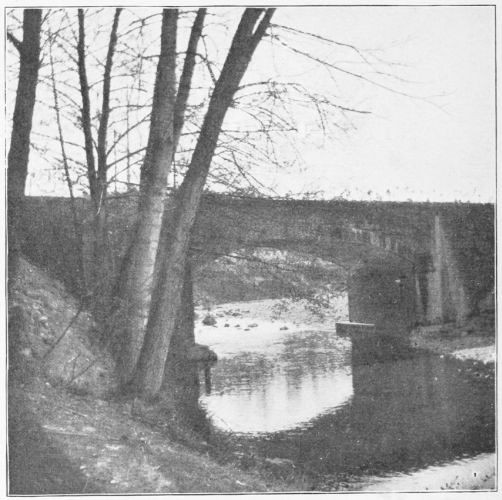
L. C. Dexter
PONTE FALCIANO, CHIANTI
[See larger version]
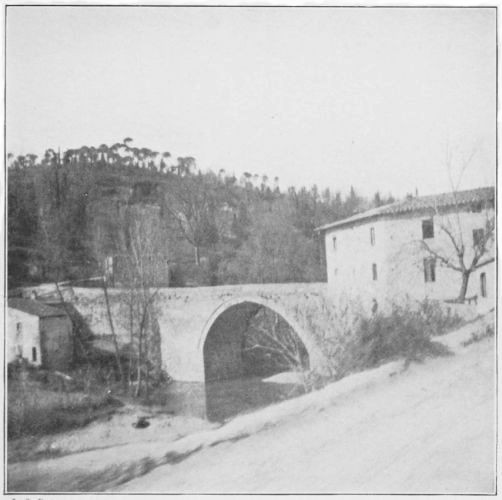
L. C. Dexter
PONTE CAPELLO. ALONG THE RIVER GREVE, CHIANTI
[See larger version]
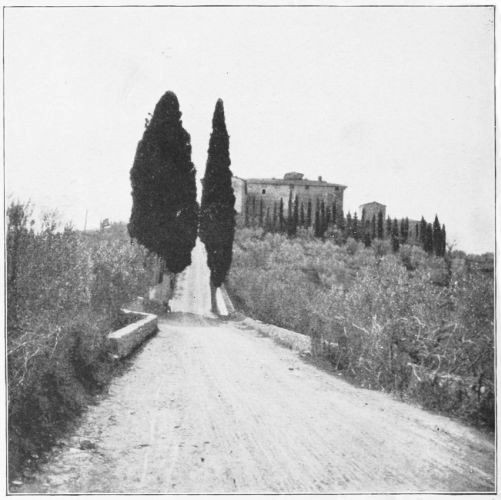
M. S. Nixon
VITIGLIANO, CHIANTI
[See larger version]
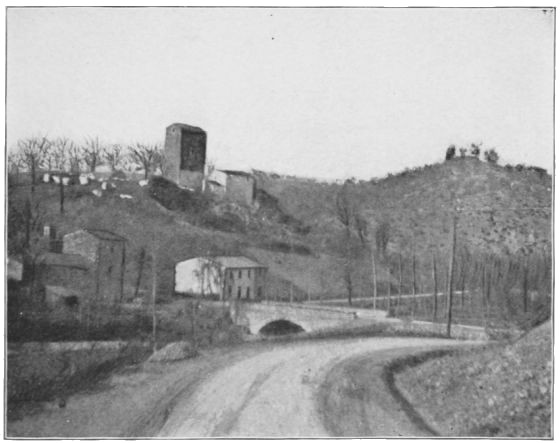
M. M. Newell
OLD WATCH-TOWER, CHIANTI
[See larger version]
M. M. Newell
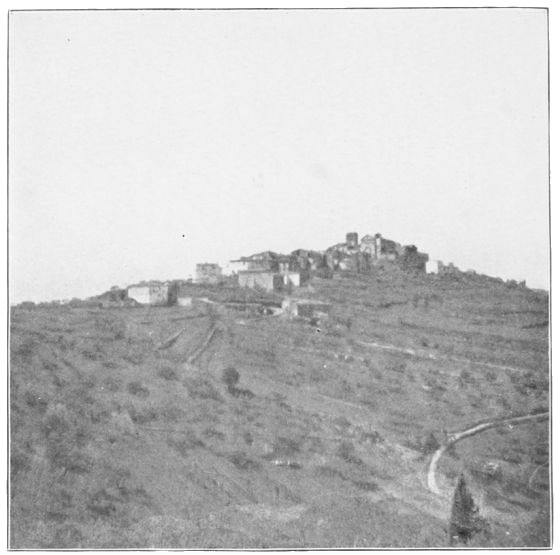
PANZANO FROM A DISTANCE, CHIANTI
[See larger version]
L. C. Dexter
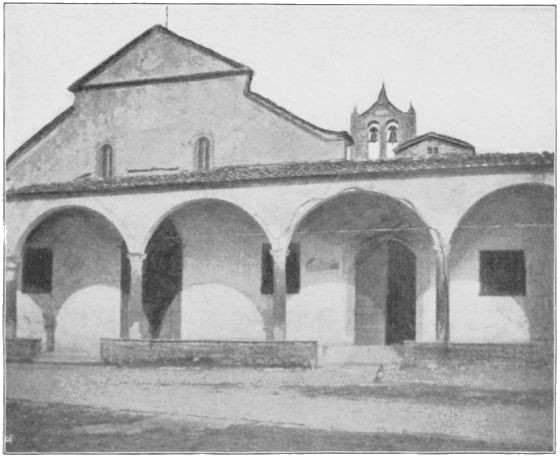
S. LEOLINO A FLACCIANO. PIEVE DI PANZANO, CHIANTI
[See larger version]
Morning wears on toward midday before we get a distant view of Panzano, a warm, grey tangle of towers and red roofs, looking calm and friendly enough in the sunshine, with groves and vineyards at its feet, but once doubtless given over to the dread clamour of war. A little farther on is the parish church, Pieve di S. Leolino, with its pleasant loggia and weather-beaten bell-tower. Within are two Della Robbias, a ciborium, and a tabernacle from the atelier, and not far away is the country villa, of Count Viviani della Robbia, the present representative of the illustrious family of artists.
L. C. Dexter
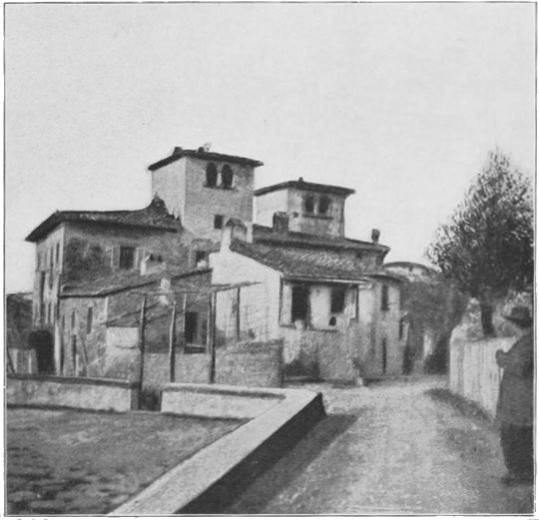
A VILLA IN PANZANO, CHIANTI
[See larger version]
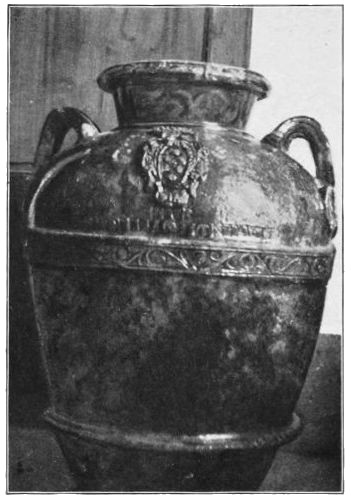
Thus we approach the podere, or farm, in the very midst of the Chianti district, and can easily understand the charm it has for our host, and the reason he so often puts aside his books and walks over the hills from Florence to this charming spot, which has for over a century belonged in his family. "It is admirable land for the grape," we are told, "and the constituents of the soil most favourable for producing the best wine in the world, if it were only properly enriched and our methods of cultivation somewhat modernized; as it is, we must send our wine in casks to the French, who turn it into Bordeaux, and export it at very large prices." In spite of such obstacles, the fact remains that Italy is the first wine-growing country in the world, but ranks only third in wine exportation, although in the year 1902 she exported wine in casks to the value of over seven million dollars. We received a cordial welcome at our host's modest red villa, in and about which was a stir of preparation—glimpses of cheery faces and savoury odours escaping from the kitchen, all indicative of a festa. We were urged to taste delicious home-made cordial, and to admire our host's two treasures—the chair in which Garibaldi sat when he visited the villa, and an interesting wine-jar, or amphora, of elegant shape, with a decorated band and the Medici shield, bearing the seven palle, also an inscription. We then walked about the podere, or farm, through which runs the Roman road, and would have made advances to the noble white Tuscan watch-dog had we not been warned of danger. We visited the substantial grey stone house of the contadino, or farmer, hard by the villa, where it has sheltered members of the same family for generations; the grandmother, evidently mistress of the establishment, a fine, dignified-looking woman, welcomed us courteously, and gratified our curiosity by taking us over the house, which consisted of three rooms; she displayed, with evident pride, the spacious bedroom, where, probably, the whole family sleep; at all events, the bed alone would accommodate half a dozen children put crossways, and there were piles of blankets and linen, all spun and woven on the farm, furnishing an inexhaustible provision for additional couches. In the kitchen we saw the great kneading-trough for the pane nero (brown bread), and the domed brick oven where it is baked; and in the loggia, or porch, stretched a long table with benches on either side, capable of seating twenty-four persons, the present census of the household. The house was clean and orderly, and suggested comfort and independence. Connected with the house, at a lower level, are the stables, where the handsome white oxen live, the ample hen-houses, and places for tools, grain, hay, etc. While we were walking about the house and sheds a peasant woman, distaff in hand and a basket on her arm, came down the Roman road, and stopped to gaze with astonishment on the group of forestieri, who, in their turn, gazed with interest into her good, honest face, and begged to take a photograph.
M. M. Newell
THE OLD WINE JAR. CHIANTI
[See larger version]
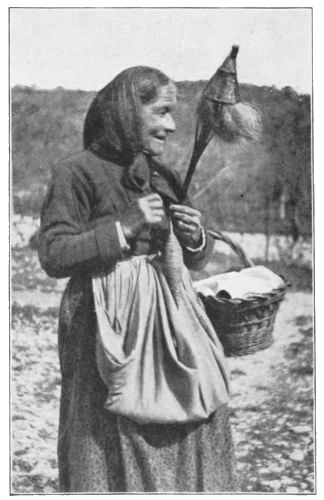
M. M. Newell
A PEASANT OF THE CHIANTI
[See larger version]
The method of letting and working farms in Tuscany is novel and peculiarly interesting to Americans, and we urged Signor G—— to enlighten our ignorance somewhat on the subject. It seems that his estates, like the majority in Tuscany, are let on the mezzadria or metayerage system—words indicating the halving, or equal division, of products between the proprietor and his farmer.[3] The proprietor's land in Tuscany is almost invariably divided into poderi (i.e., small farms of about forty acres), and each farm is tilled by a single family, who must live on the land in a comfortable house (casa colonica), furnished by the proprietor, who also provides farming tools, cattle, etc. The system is of ancient date and has come to stand as an habitual form of contract, and in Tuscany has become legalized by almost universal usage. The contract between proprietor and metayer, or farmer, holds only from year to year, but is regularly renewed, and, in most cases, the same family remains on the farm for generations. Attached to the soil they cultivate, their interest is one with that of the proprietor, and they consider themselves as much owners of the land as the proprietor himself. So old is the system that language has been influenced by it; dating back to feudal times, the word contadino meant "count's man," etc. There are various understood conditions attached to the contract. The contadino must annually replant a certain number of shrubs and trees, keep roads and watercourses in order, and at Easter, Michaelmas, and Christmas supply the landlord with a fixed number of fowls and eggs. In his own house the contadino, with the title of capoccia (head), represents the family in all its dealings with the outer world: assigns tasks, decides when the vintage or harvest shall begin, apportions personal expenses, and must be consulted before his children marry; also no member of the family may marry without the consent of the proprietor, and he may even require any member of the family to marry. By the father's side stands the massaia, the wife, who superintends all housework, governs the women, assigns tasks of weaving, spinning, and mending, presides over the poultry-yard, raising of the silk-worm, etc. The mezzadria system, if not "the perfect social contract between the owner and tiller of the soil," as some claim, seems to be, in Tuscany at least, the solution of many vexed questions; it holds that labour is an absolute equivalent for capital. The metayer, or contadino, works directly for his own interests, and is generally in comfortable circumstances, has a good house, excellent food and necessary implements; he is usually shrewd, knows the capabilities of his farm, is an excellent judge of an ox, and can drive a sharp bargain; he is generally sober, self-respecting, and industrious; is seldom at a loss for money on account of the diversity of his crops; he always has something to sell; his calendar is about as follows, viz.: December to March, the olive harvest; June, the cocoons; July, the wheat harvest; September, the corn; October, the vintage. The obverse side of this picture is his hide-bound devotion to antiquated methods, and lack of educated intelligence; he knows nothing of the rotation of crops, the chemistry of plants and soil, or of modern implements and conveniences; he cuts his grain with a sickle and threshes it on the earth; the spade is his favourite tool, and an old Tuscan proverb runs, "The spade has a golden edge." As some one writes, Virgil's Georgics might practically be used in Tuscany as a "handbook of agriculture." Finally, the Tuscan farmer is satisfied with modest results; his average income for the year from his oil, wine, grain, vegetables, cattle, silk-worms, and straw plaiting is, approximately, three hundred dollars.
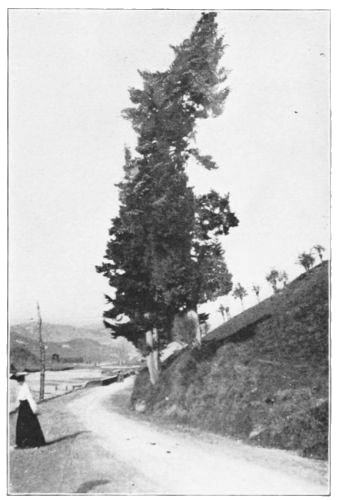
M. M. Newell
THE STATELY CYPRESS
[See larger version]
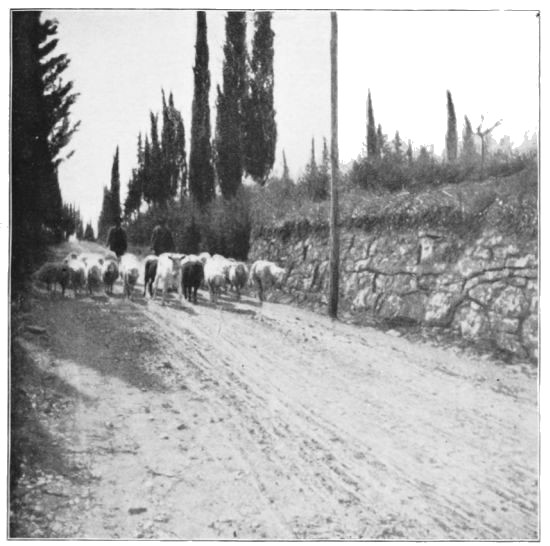
M. S. Nixon
A COUNTRY ROAD, CHIANTI
[See larger version]
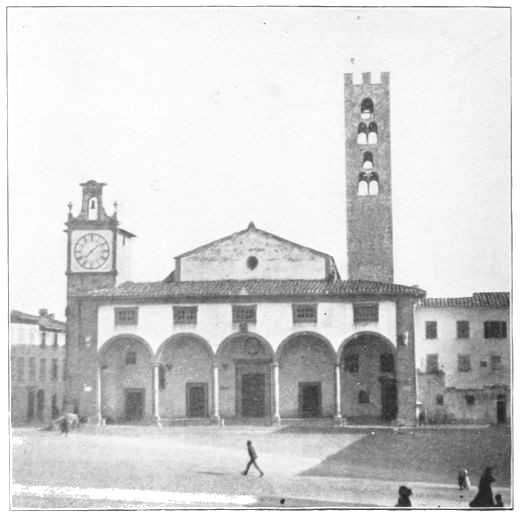
M. M. Newell
PIAZZA OF THE IMPRUNETA
[See larger version]
M. M. Newell
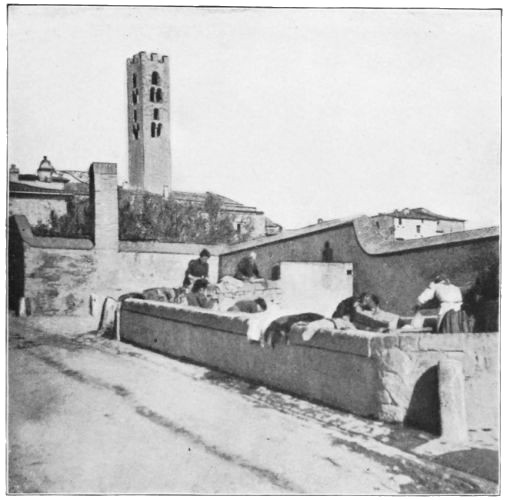
A STREET IN IMPRUNETA
[See larger version]
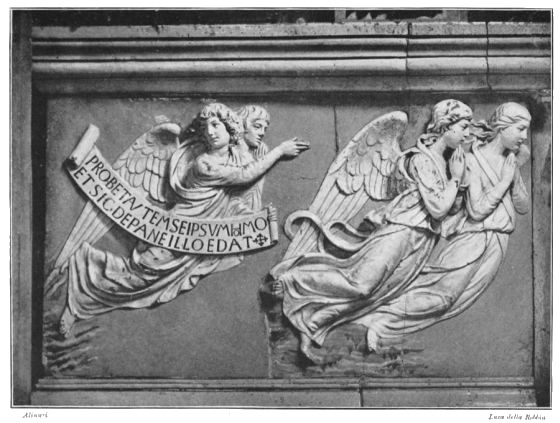
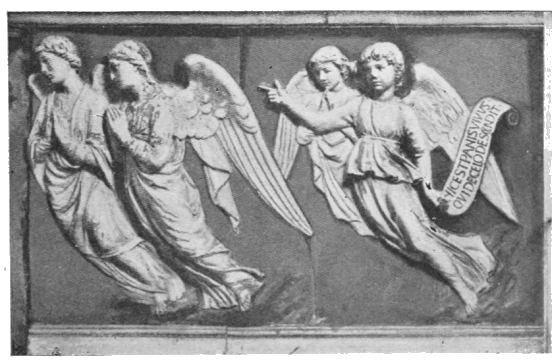
The call to luncheon was certainly most welcome after our morning on the hills and lesson on agriculture; as for those superior persons who proclaim that the Italian lives principally on macaroni dried on the sidewalk, black bread, garlic, and sour wine, we only wish they might have shared our feast that day in the Chianti. There was broda (soup), macaroni with pomidoro sauce, home-grown chickens and fresh salad, pane nero, sweet and warm from the oven, with the "best butter," and a delicious, fresh goat's milk cheese, served on a flat basket of plaited green rushes, to say nothing of coffee and wine without stint—some of the Chianti made twenty years before; and now we know how the true Chianti ought to taste. It was a day never to be forgotten; and dreading its coming to an end, we said our reluctant good-bys to the hospitable family at Villa Rosso, and pursued our road homeward in a leisurely and roundabout way, stopping now to visit some wayside church, or tempted by charming country roads leading through vineyards and lines of cypresses to some hill-crowning villa in the distance. Finally we climbed the long hill clad with olive orchards to Impruneta, where, if not too much entranced with the superb view, we may remember is the famous shrine of La Madonna dell' Impruneta, one of the most important pilgrimage churches in Tuscany. The black image of the Madonna is said to have given its name to the village, but it is more probable that it is derived from the grove of stone pines crowning the hill, and is a corruption of La Pineta.[4] The tradition is that this Madonna was wrought by St. Luke the Evangelist, and, having been stolen from the church, it was sought in vain until a peasant, plowing in the field, saw his oxen fall suddenly on their knees and refuse to get up; search being made, the sacred image was found, and is said to have uttered a cry when struck by the spade. Whatever its origin, the Madonna is reverenced by the people, and Savonarola, we read, had faith in its miraculous power. On occasions of danger it is carried in solemn procession, but always closely veiled, and worshipped as the "Hidden Mother." After all, it is not so much for the black Madonna that our pilgrimage is made to Impruneta, but for the Chapel of the Madonna, which enshrines her, and the one opposite, called the Chapel of the Holy Cross, both adorned by Luca della Robbia, the head of his family and the great master of glazed terra-cotta; the Crucifixion in a chapel near the altar is also by his hand. The predella of the Tabernacle of the Holy Cross is one of Luca's most beautiful creations, representing four buoyant, serious angels, ivory-tinted, against a pale blue background. Both chapels are roofed with charming designs, and about the top, as a cornice, runs a frieze of fruits and pine cones, peculiarly appropriate to the Church of La Pineta. In the centre of each frieze is a Madonna "clasping the Child in her arms, white on a blue background," and that which indubitably belongs to Luca "is one of his most human and tender conceptions both of Mother and Child," the memory of which fitly crowns and hallows our happy day in the Chianti.
Alinari Luca della Robbia
PREDELLA TO TABERNACLE, CHAPEL OF THE HOLY CROSS, IMPRUNETA
[See larger version]
[See larger version]