CASTRUCCIO CASTRACANE LORD OF LUCCA
Reading edition
NE lucky day, as we were sauntering about Pistoja, some one said: "Let us go to Serravalle, and get more in touch with that stirring fellow, Castruccio Castracane, who seems to have filled this region with war's alarum, and left his name, if not more substantial marks, in every town in this part of Tuscany." We remember that he bribed Filippo Tedici with ten thousand golden florins, and so got possession of Pistoja and the traitor's daughter, Dialta, as his wife, and that their wedding festivities took place in the Piazza della Sala, where the Mercato is to-day; also, that when Castruccio once got within the walls he ruled the city well.
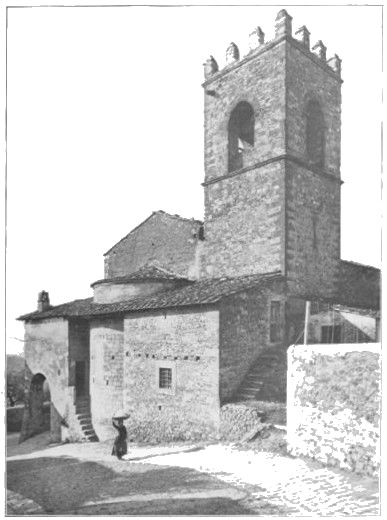
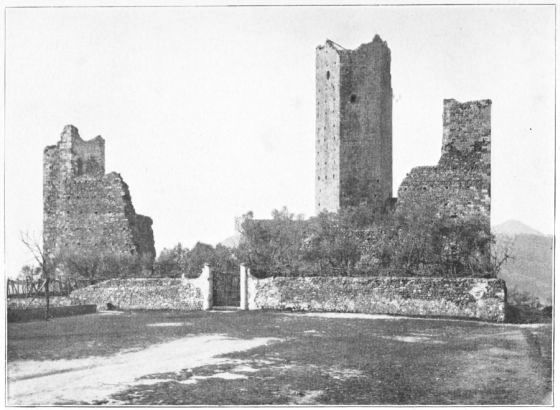
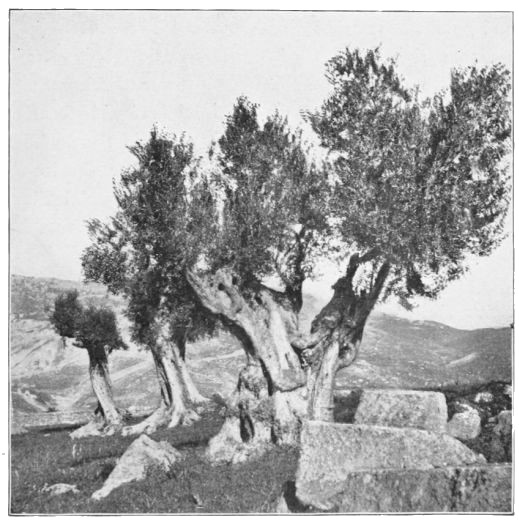
Serravalle is a picturesque little town but three miles from Pistoja, on the highway to Lucca—as pretty a walk as one could wish to take. It is clustered on the top of a steep hill, and, if somewhat squalid in these later days, its ancient loggia, church, and castle are fine in colour and delightfully irregular and surprising in form. We climb up to the twelfth-century church, which contains a valuable old painting, then round the hill under an imposing loggia, and take our way up to the rocca, or castle, which Castruccio built early in the fourteenth century on a spur of the hill, an admirable place of defence, and which answers to its name by closing the valley (serra valle). From this vantage-point we have a good view of Pistoja on one side, on the other lies the fertile valley of the Nievole, so often Castruccio's battle-field. The grass is soft and green about the crumbling walls of the old castle now, and clumps of silvery-leaved olive trees, swept by Apennine breezes, brush gently against the old bastions and lofty six-sided tower, which command an outlook over the entire valley. The castle was evidently built out of ruins of earlier buildings, and probably erected in some haste to stay the progress of a dangerous enemy; but it must have been good, honest work to have lasted six hundred years, and Castruccio must have had a genius for building castles and fortresses, not only peculiarly adapted to his own needs of defence, but in such a way as to hold their own down through the centuries, and in their last ruinous state to challenge universal admiration. At Sarzana the fortress he built and named Sarzanello is very different from the one at Serravalle, but perhaps even finer, and one can easily understand why Lorenzo, Il Magnifico, should wish to possess it as a thing of beauty, even had it not been supremely necessary to the northern defences of Florence on the Ligurian coast. It is planted on the brow of a hill overlooking the sea, and is a rather low, battlemented fortress of grey stone, its bastions, towers, and ponderous arches all surrounded by a moat.
Alinari
APSE END AND CAMPANILE
CHURCH OF S. ANDREA, SERRAVALLE
[See larger version]
Alinari
RUIN OF THE ROCCA OF CASTRUCCIO, SERRAVALLE
[See larger version]
M. M. Newell
OLIVE TREES
[See larger version]
From the heights of Serravalle, looking toward Lucca, we see the mediæval bell-tower of Altopascio, and remember that one of Castruccio's signal victories over the Florentines took place there in 1323. The previous spring Castruccio had dashed into the lower Val d'Arno, taken several towns, and menaced Florence herself. Clearly his victorious career must be stopped; accordingly, Florence collected the finest army she had ever put in the field, headed by the carroccio and martinella, and marched to Pistoja, hoping to tempt Castruccio out of the city; but having spent some days insulting the garrison by games and races under the walls, the Florentines moved on toward Lucca. This was Castruccio's chance; rapidly following the great army, he surprised it at Altopascio, routed it completely, and then led the carroccio, with many noble prisoners, in triumphal procession through the gates of Lucca. A year later "he occupied Signa, pillaged Prato, laid siege to Montemurlo, and wasted the greater part of the Florentine contado."[5] But it would be impossible to follow Castruccio Castracane through all his adventurous course, and it is time to inquire what manner of man he was. Ruskin calls him "the greatest captain of his age," an estimate probably made with nice distinction, for though he must be reckoned among the Italian condottieri, one of the "six sorts of despots," according to Mr. Symonds' classification,[6] "raging in Italy during the fourteenth and fifteenth centuries," he certainly differs essentially from tyrants like the Sforzi of Milan, the Scali of Verona, the Baglioni of Perugia, and others like them, who, springing from peasant or bourgeois ranks, became powerful enough to found kingdoms, maintain splendid courts, and follow their natural tastes for arts and the new learning. The Baglioni patronized Perugino; Il Moro had his Leonardo da Vinci; Petrarch had his seat of honour at Galeazzo Visconti's table, and the Malatesti dukes of Urbino displayed a passionate zeal for philosophy and art, while "the spell of science was stronger over them than the charms of love." Castruccio was unlike these tyrants, in that we hear nothing of his taste for books, or music, or art; indeed, by his ruthless devastation of the environs of Florence, incalculable treasures, representing early Italian art, were irretrievably lost; and though we know that Castruccio had sons and other kinsmen, there was no successor to the great "soldier of fortune who had raised himself to be Duke of Lucca, Lord of Pisa, Pistoja, Volterra, and much of the Genoese Riviera."[7] Castruccio may, perhaps, be compared with that "captain of adventure," Il Medeghino, son of a certain Bernardo de' Medici, not connected with the Medicean family of Florence, who delighted in war for its own sake, and by cunning and skill became master of the region about Lake Como, where he played the rôle of Marquis of Musso and Count of Lecco, setting up his court and coining money with his own name and devices. It was when he reached this dizzy point of success that he arrogantly assumed the arms of the Florentine family and swept the lake at the head of a squadron led by his flagship, from which floated a red banner with the golden palle of the Medici. When Il Medeghino died the Senate of Milan put on mourning, and in the cathedral we may see his splendid tomb, the work of Leone Lioni.[8] The services of Castruccio Castracane to the Ghibelline or Emperor's party in Italy were not recognized by such high honours. He led the simple, hardy life of a soldier, died in the harness at the beginning of a fresh campaign, and was buried at Lucca in the Church of S. Francesco, used now as a military magazine.
Alinari
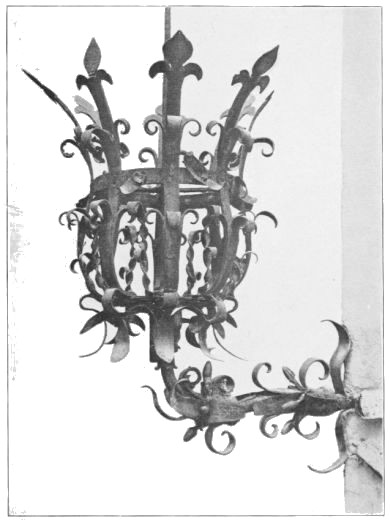
AN IRON LANTERN, PALAZZO BARONI, LUCCA
[See larger version]
Alinari A. Verrocchio
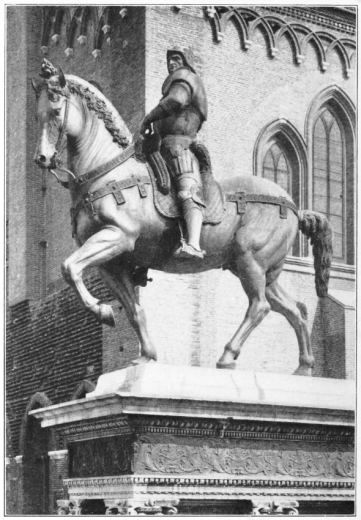
MONUMENT OF GENERAL BARTOLOMMEO COLLEONI
CAMPO DI S. GIOVANNI E. PAOLO. VENICE
[See larger version]
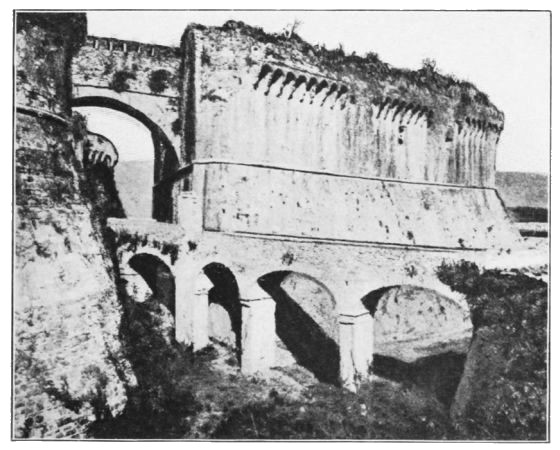
MOAT OF THE CASTLE SARZANELLO, SARZANA
[See larger version]
Alinari Donatello
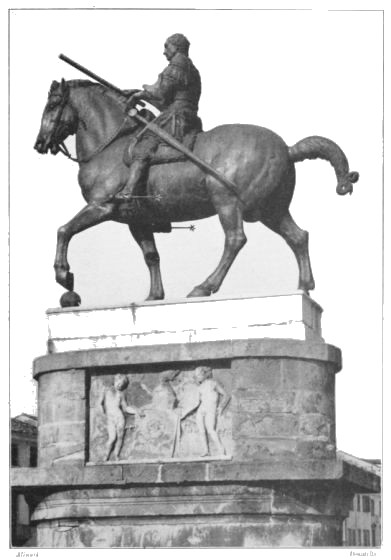
MONUMENT TO GENERAL GATTAMELATA, PADUA
[See larger version]
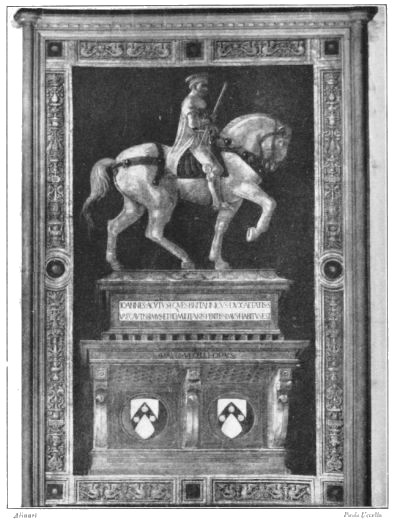
Alinari Paolo Uccello
EQUESTRIAN STATUE OF JOHN HAWKWOOD
CATHEDRAL, FLORENCE
[See larger version]
In physical strength and agility, in foxlike cunning and ready audacity, and in his sense of honour and justice, Castruccio resembles Bartolommeo Colleoni, of Bergamo, who trained under the greatest condottiere of his age, distinguished himself in many engagements for the Visconti, and was finally elected general-in-chief of all the Venetian forces by the Republic of St. Mark, and received his truncheon of office from the hand of the Doge before the high altar of San Marco. At Bergamo we see his chapel, built by Amadeo, as a "monument of the warrior's puissance even in the grave." There also is the equestrian statue in gilded wood voted by the town of Bergamo, and, far more noteworthy, the beautiful tomb of his favorite daughter, Medea. But the great general's rightful monument is in Venice, where the "finest bronze equestrian statue in Italy, if we except the Marcus Aurelius of the Capital," was reared in his honour. The second great equestrian statue in Italy, strange to say, is also that of a condottiere—Erasmo da Narni, better known as Gattamelata, a noble work of Donatello, erected in the Piazza del Santo at Padua.
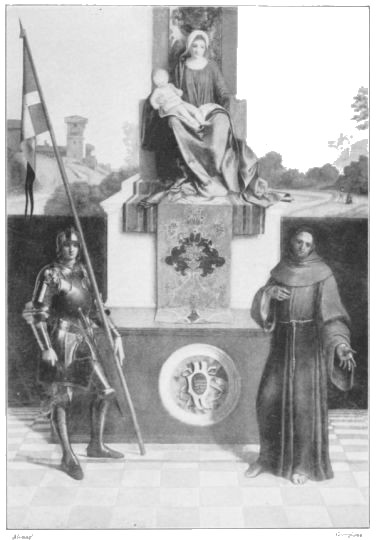
Alinari Giorgione
MADONNA AND CHILD, WITH TWO SAINTS
PAROCHIAL CHURCH. CASTELFRANCO
[See larger version]
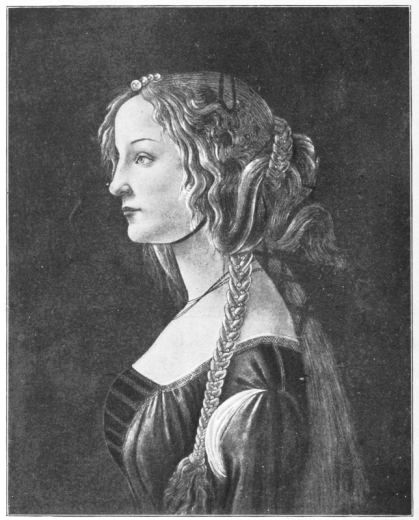
Hanfstaengl Botticelli
PORTRAIT OF A YOUNG FLORENTINE
ROYAL GALLERY, BERLIN
[See larger version]
It is impossible to compare Castruccio exactly with any other free-lance of his time. There are condottieri and condottieri; the range is so wide and, defining lines so elastic that in the day when individuality was more marked than in any other period of the world's history, it is not strange to find in the same class such widely differing characters as Francesco Sforza, called the "great Condottiere," the brave and skillful but humane Carmagnuola, or the youthful Matteo Costanzo, who, in full armour and bearing the standard of the cross, figures as San Liberale in Giorgione's celebrated Castelfranco Madonna and Child. Matteo died young, but had been trained as condottiere by his father, who gave Giorgione's Madonna to the Church, as a votive offering in memory of his lamented son. There was no bronze statue raised in Castruccio's honour, and no portrait of him is mentioned, though it is said he appears in Benozzo Gozzoli's Procession of the Magi in the Riccardi Palace, and in Orcagna's Triumph of Death in the Campo Santo of Pisa. Of his personal appearance, therefore, we are wholly ignorant, except for the tradition that he had red hair. Nor are we much more certain of his youth and training. Machiavelli's romantic account relates that he was a foundling, picked up in her vineyard by the kindly Dianora Castracane, of Lucca, who carried the infant home, and, calling her brother, a canon of San Michele, with whom she shared her house, tried to determine the child's future. After much discussion it was decided to give him the name of Castracane and educate him for the Church; but, though quick to learn, Castruccio had no taste or desire for the cloister; his one thought was for athletic sports, adventure, and the noble art of war. Playing with his fellows in the Piazza of San Michele, he attracted the attention of a nobleman of Lucca, who, when Castruccio was eighteen, adopted him, trained him to arms, and, upon his death, confided to him the care of his estates and direction of his only son. His masters in war were the most notable military leaders of the time, and "Machiavelli goes to the length of saying that, as a general, he was not inferior to Philip of Macedon, or Scipio."[9]
The more sober historians hold that Castruccio was a member of the Interminelli family, who had been exiled in his youth, and gained much military experience in England when serving under Edward I. All accounts agree that he was a remarkable man, and one critic writes of him thus: "Not only as a soldier but as a statesman he was undoubtedly the foremost man in Italy, and it is not improbable that, had he lived, he would have subjugated the whole peninsula."
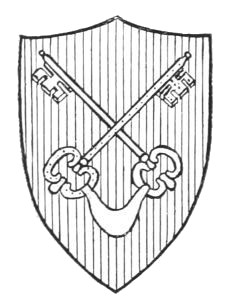
STEMMA OF SERRAVALLE