A SUNDAY AMONG THE HILLS OF BRANCOLI
Reading edition
[See larger version]
"O day most calm, most bright." —Herbert.
N St. Patrick's Day in the morning we left Florence, had a full day's sight-seeing in Pistoja, Groppoli, and Serravalle, and pushed on to Lucca the same evening, arriving about seven o'clock.
Acting on sound British advices, we drove at once to the Albergo dell'Universo, a comfortable little inn occupying the first floor of the old Palazzo Arnolfo, where we had our belated dinner, took our ease before a cheerful open fire, and congratulated ourselves that at last we were in Lucca—a hope long deferred.
M. M. Newell
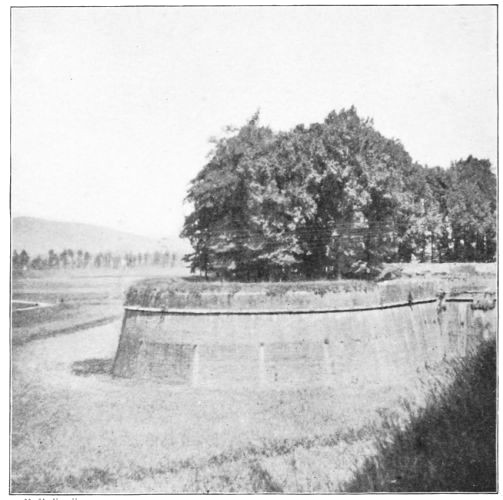
THE OLD CITY WALL AND MOAT, LUCCA
[See larger version]
Alinari Jacopo della Quercia
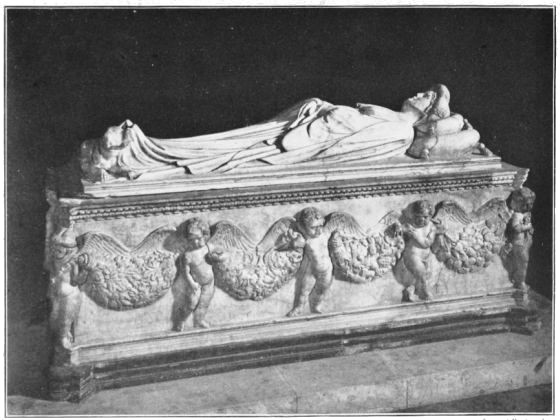
TOMB OF ILARIA DEL CARRETTO, CATHEDRAL, LUCCA
[See larger version]
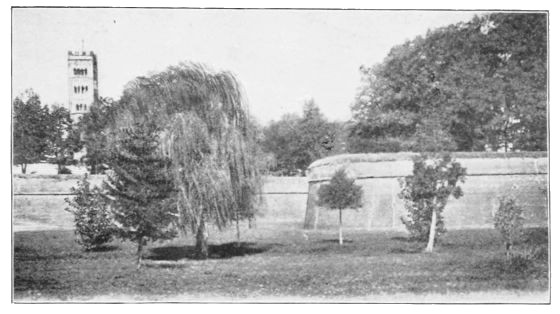
The morrow is crisp and brilliant; and, forgetful of our guide-book's express advice, to crown and finish our Lucca visit with a walk on the ramparts, we turn our backs on churches and priceless works of art and hasten at once to the old city walls. How faithfully those mediæval bricklayers did their work! Their walls, well preserved, still surround the town, no longer bristling with engines of war, but planted thick with shade-trees—elms, acacias, and limes—affording one of the most beautiful promenades in Italy. Lifted well above the city streets, they command extensive views on every side: here the broad, fertile plain, stretching to the Arno; yonder, at the north, the chain of rugged Apuans, two sharp peaks of which are now capped with glistening snow; southward rise the heights of Monte Pisani, noted in Roman days, and since, for its hot-springs. From thence comes the pure drinking-water for Lucca, conveyed by an aqueduct built by the Duchess Marie Louise, for which her grateful people erected a monument in her honour. As it crosses the sunlit plain on its four hundred and fifty-nine grey stone arches, we are reminded of the Roman Campagna, and remember that Lucca, in the day of her greatest splendour, was a favorite summer residence for the Romans, and that many traces still exist of their occupation, particularly the massive arcades of an amphitheatre in the present market-place. Standing on the old ramparts, on a rare spring morning, ten chances to one you forget all the sights awaiting you down there, in the "city of the Magnificent People and Commune of Lucca"—its palaces, towers, and picture-galleries, its chapels and churches, of which there are no less than seventy "to satisfy the wants of 22,000 souls." The fame of San Frediano's seventh century church, with its magnificent tower, its sculptured font and Madonna, has reached us over sea. For years we have yearned to look on Jacopo della Quercia's marble of that fair lady, Ilaria del Carretto, resting in the transept of St. Martin's cathedral. We know there are paintings by Fra Bartolommeo, palaces and libraries; but the fresh mountain air has driven all these things from our desire; we only long for those mountains delectable, those chestnut-crowned hills and distant grey towers. We begin to ask why we should study the churches of Lucca, and who is Matteo Civitali that he should keep us within the city walls? We consult time-tables and guide-books; there's a tram, they tell us, leading out of Porta Santa Maria in ten minutes, and if we catch it we may ride six miles, and then ... perhaps a carriage may be found, though it is early in the season. "But," importunes the handsome driver of the cab waiting to take us to the tram, and who in some way has divined our wants, "the tramvia will not take the signore to the hills, and surely there is no carriage at Ponte Moriano so early in the year. Ecco, this buon cavallo and your devoted Pepino, who will take you all the way so comfortably!" Off comes the shabby hat with inimitable native grace, and the bold, brown eyes are convincingly eloquent. You can no more resist Pepino's reasoning than that rush of mountain air on the ramparts. All preconceived plans are fast taking flight; but Prudence keeps her head and demands with thrifty caution, "How much, inclusive, there and back?" Then Pepino: "Oh, a mere bagatelle, my illustrissime signore, only twelve lire." Prudence, scouting this declaration with lofty scorn inspired by a profound knowledge of tariffs and coachmen from Paris to Palermo, exclaims: "Preposterous! Ten francs it shall be, and not a centesimo more." "Ah, signorina, the roads are very steep and it will take my whole morning," returns Pepino, beseechingly; but in vain he seeks for a sign of relenting. His struggle is brief, and, with a deprecating flourish of his small, shapely hands, he mounts the box, and the air with which he says, "as you will have it, signorina," is that of a gracious conqueror dictating terms to the vanquished; he cherishes no resentment, he has no interest but ours. We never for a moment regret the tram. Pepino knows every villa and grey tower, every path through the hills, every bridge over the torrenti; he never intrudes his knowledge, and, above all, he is kind to his horse.
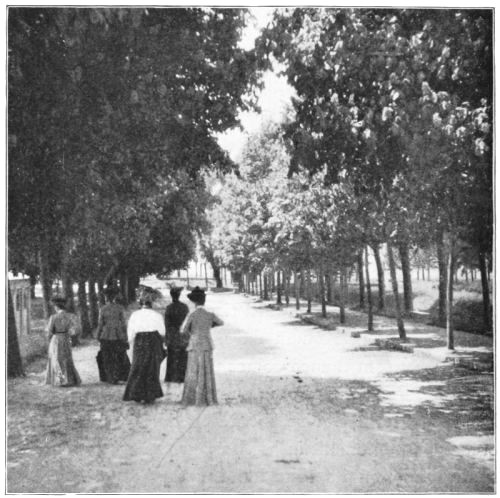
M. M. Newell
ON THE RAMPARTS, LUCCA
[See larger version]
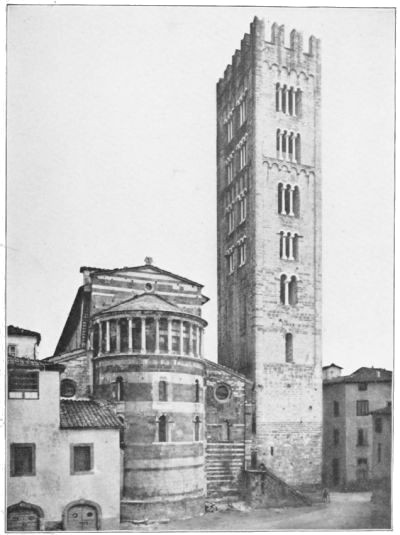
Alinari
S. FREDIANO, LUCCA
EAST END, WITH THE CAMPANILE (11TH AND 13TH CENTURY)
[See larger version]
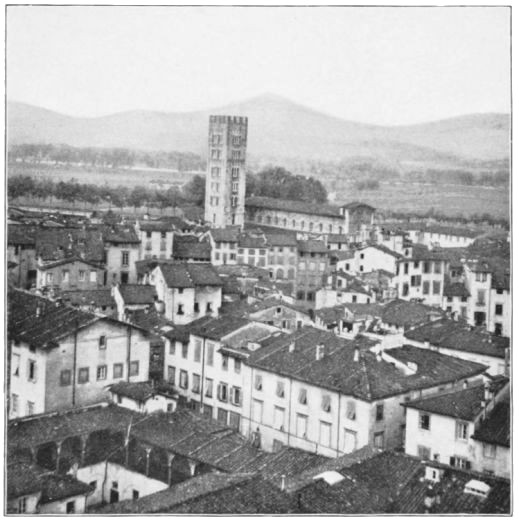
M. M. Newell
SAN FREDIANO FROM THE GUINIGI TOWER, LUCCA
[See larger version]
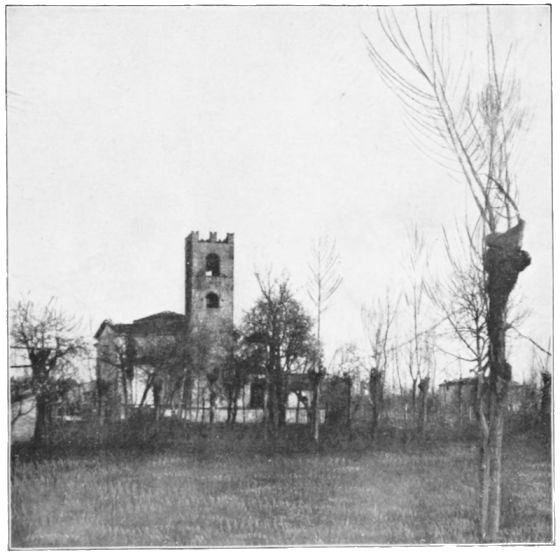
M. M. Newell
A "GREY TOWER"
[See larger version]
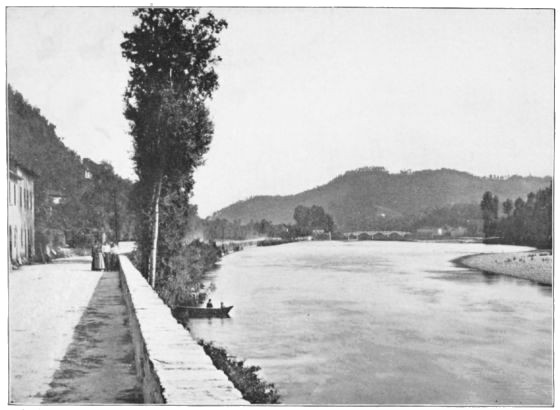
"Yonder cross on the round, bare hill," he says, "is Brancoli," and Brancoli is the hill of our desire. Our good road at first runs over the plain following the east bank of the Serchio, principal river of the province; it rises in a northernly valley among the Apuans and fed by many a mountain stream or torrente, maintains a southeasterly course almost to Lucca, which it avoids by a broad loop westward, and then makes its way to the Mediterranean almost parallel with the Arno. We pass clusters of farm-houses, well-cultivated fields and vineyards, until in less than an hour we reach Ponte Moriano, which is little more than a busy street of shops and dwellings, but has a good stone church founded by San Frediano in five hundred and something. Its rather tall, square tower, of good proportions and crenellated battlements, is characteristic of all the church towers in this region. Here is the terminus of the tramvia, and Pepino was right, there is no appearance of a carriage; but his Italian for "I told you so," was kept under his breath with true Lucchese courtesy.
Alinari
PONTE A MORIANO, WITH A VIEW OF THE SERCHIO RIVER
[See larger version]
M. M. Newell
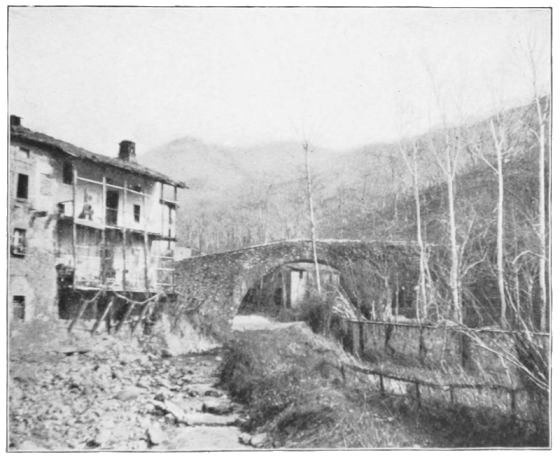
AN OLD STONE BRIDGE
[See larger version]
M. M. Newell
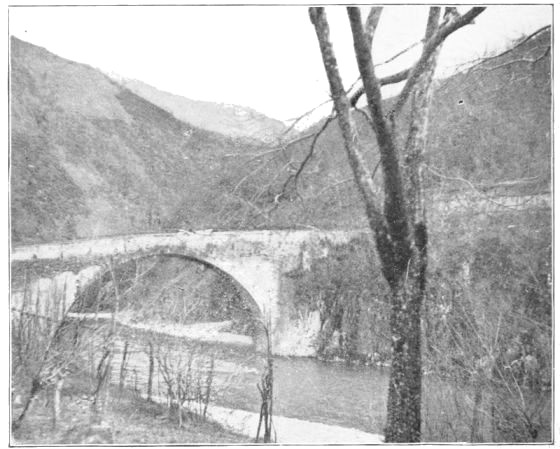
BRIDGE OVER THE SERCHIO RIVER
[See larger version]
A mile farther on is the little hamlet of San Giusto, situated at a point where the Lima joins the Serchio. Here we leave the main road, turn sharply to the right, and follow the windings of the little river, which is crossed by the picturesque stone bridge of Vinchiana. An old mill, half hidden by white birches, turns its moss-covered wheel close under the steep river banks, overhung with a tangle of vines and flowery shrubs. The road becoming rather steep, we now leave the carriage and proceed on foot. What an entrancing walk it is! Always ascending, we follow the turnings of the stream, now far below, and glancing like a silver thread along the valley. We round the grey shoulders of jutting cliffs, where clumps of white heather are in full bloom and the "maidenly birches" are touched with the first tender green; the air is intoxicating in its freshness, and the sky never so blue. "Ecco!" calls Pepino. "Ecco! San Ilario!" How has the fellow guessed that we ought to study churches rather than maunder about posies! The little church of cut stone, flanked by its good tower, stands hard by the roadside, convenient and inviting to tired feet and aching hearts, as many a pilgrim in the old days knew full well. Its doors stand open wide, admitting floods of sunshine and spring fragrance. We enter unbidden, to find the little temple quiet and empty, all its pictures and sacred emblems covered, and all as clean and fresh as if waiting in reverent silence the miracle of Easter morning. We proudly boast the stern old Puritan blood running cool and inviolate in our veins, but there's a silent appeal in these modest temples and shrines of the elder faith that "must give us pause," and silence the voice of criticism. Taking the road again, we still ascend from one fold of the hill to another, whence we overlook the Serchio pursuing its lazy course far below, the views becoming more and more beautiful, until in half an hour we come upon the little stone church of San Lorenzo, close by the road. Small as it is, San Lorenzo is as complete in all its attributes, and as true to its architecture, as a full-fledged duomo, even to the little apse. The sturdy tower, square and shapely, small, round-arched windows and sides of warm, grey stone, the red-tiled roof, flecked with patches of green moss, make a charming picture, found in no country but Italy. This time the church is closed, but there are keys hanging in the north door, perhaps entering the sacristy, and we make bold to peep. It is a clean and cold room, entirely separated from the church proper, and evidently serving at present for a store-room, as a slender stock of various commodities and a few bottles of wine attest. Meantime Pepino has made our wants known at the near farm-house, and is returning, accompanied by a handsome young girl with the keys to the proper church door, which she opens, saluting us with respectful dignity, and, without questioning, draws the curtain from the Della Robbia over the altar; for well she knows that the forestieri only come to see our "beautiful white San Lorenzo." The statue is small and perfect, like everything about this woodland chiesetta. The head is exquisitely modelled, all in white, with the finish and the ivory-tinted glaze which belongs to Andrea Della Robbia's best work, though the wise in such matters ascribe it to one of his pupils.
Alinari
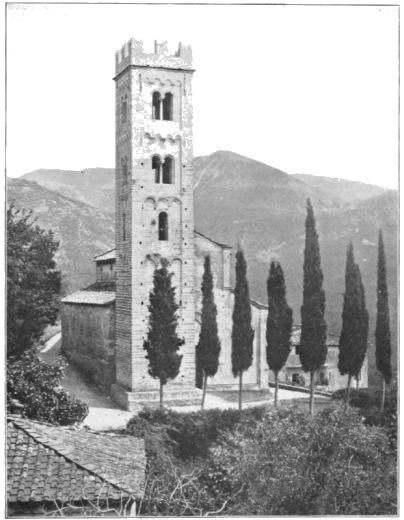
PARISH CHURCH OF S. MARIA E S. GIORGIO (11TH CENTURY)
BRANCOLI
[See larger version]
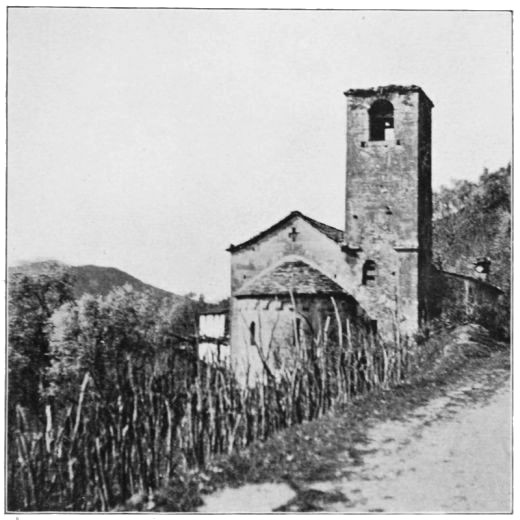
M. M. Newell
SAN LORENZO, BRANCOLI
[See larger version]
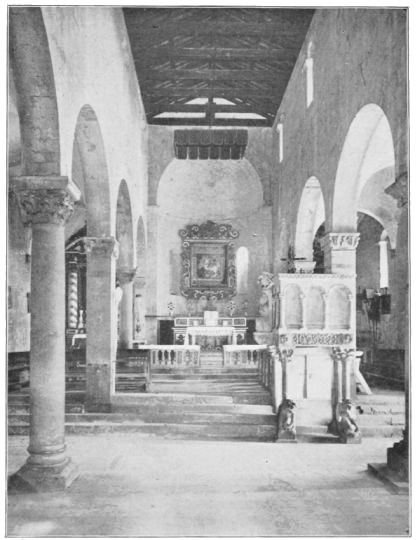
Alinari
THE INTERIOR (11TH CENTURY), PARISH CHURCH OF S. MARIA
E S. GIORGIO, BRANCOLI
[See larger version]
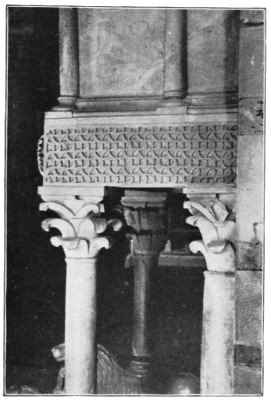
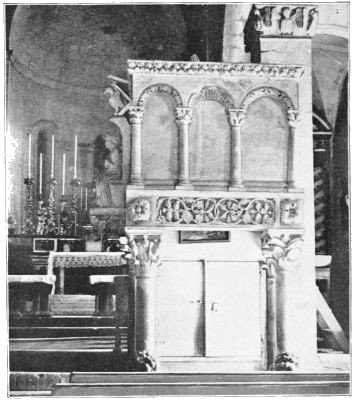
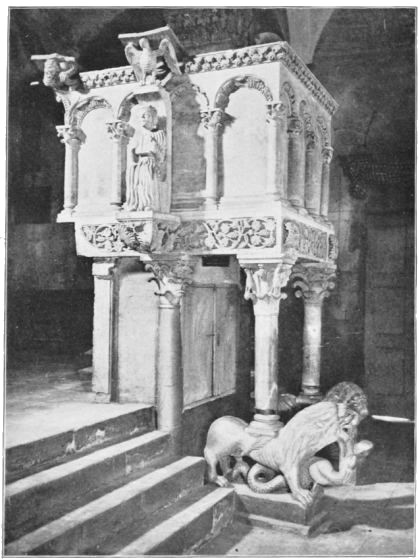
Saying our buon giorno, and pressing a small fee into the reluctant hand of the handsome contadina, we now turn from the carriage road and begin a short but rather difficult climb up the steep hillside by a roughly paved path, which leads us through chestnut woods to the crest of the hill and the parish church of Santa Maria e San Giorgio, belonging to the eighth century. We have seen it all the way from the plain, perched on a commanding height, surrounded by its sombre guard of stately cypresses. The tower is especially fine in its proportions and built quite apart from the church, though only a foot or so from its walls. Unusually tall, it has four orders of arched windows, and is crowned with bifurcated, or "swallow-tail," battlements, indicative of Ghibelline influence. The exterior of the church, built of squared blocks of travertine, has a plain façade, broken only by shallow pilasters and a round-headed doorway, with a bit of rude carving on the cornice, perhaps representing the vine. The south side has two rows of irregular windows, with remains of ornament, and an arched doorway, over which is a singularly grotesque figure. Both doors are wide open, the noonday sun lighting up vaulted aisles and the ancient timber roof of the nave. We enter without let or hindrance and possess the church for a good hour, uninterrupted even by a footstep on the road hard by. The interior, which gives an impression of space and dignity, is divided into nave and aisles by columns and piers with interesting sculptured capitals. The choir is raised by four steps well above the nave, the high altar, still higher, fills the apse, and over all is a good timber roof, richly coloured by time. Near the west end in the south aisle is a quaint and seemingly very ancient holy-water stoup, carved with rude but expressive figures of men and animals attacked by serpents. On the crown surmounting the principal head is inscribed "Raitus me fecit," but having no date. Many of the capitals of the pillars bear sculptures of rude symbolic figures, indicating early Lombardic work. The fine hexagonal baptismal font is attributed to the thirteenth century, but the carved heads and vine suggest an earlier date. The same period is accorded to the very beautiful marble pulpit standing at the entrance to the choir. It is square in shape, supported by four columns, two of which rest on the backs of grotesque Lombard lions struggling with savage beasts, symbolic of Divine power overcoming evil; the capitals are boldly sculptured in foliage and animal forms. On the front is a serious crowned figure holding the Book, above it the eagle serving as lectern. On the corner toward the altar a sculptured figure bends to support another reading-desk. Altogether this pulpit may be reckoned among the most interesting ones of Tuscany.
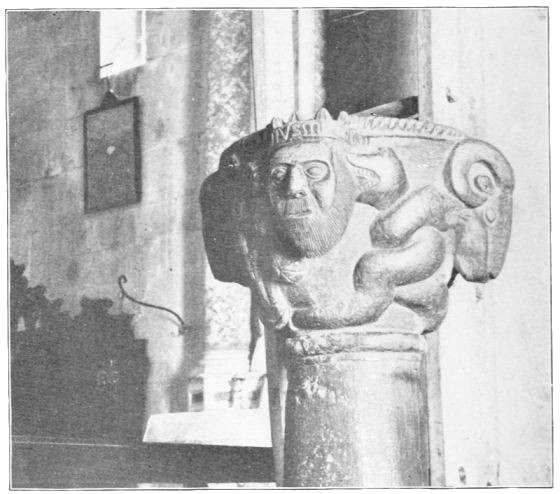
M. M. Newell
HOLY-WATER STOUP, PARISH CHURCH OF S. MARIA E S. GIORGIO
BRANCOLI
[See larger version]
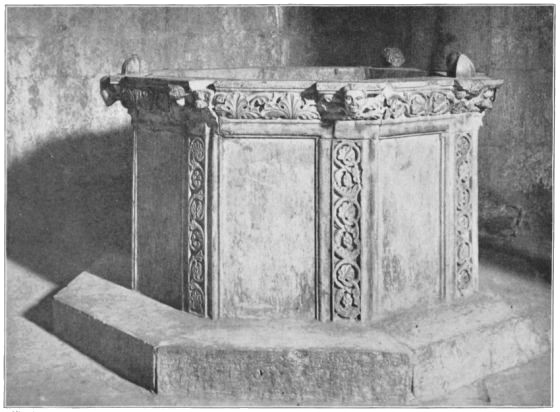
Alinari
HEXAGONAL BAPTISMAL FONT (13TH CENTURY), S. MARIA E S. GIORGIO
BRANCOLI
[See larger version]
M. M. Newell
DETAIL OF PULPIT, PARISH CHURCH OF S. MARIA
E S. GIORGIO, BRANCOLI
[See larger version]
M. M. Newell
DETAIL OF PULPIT, PARISH CHURCH OF BRANCOLI
[See larger version]
Alinari
PULPIT (13TH CENTURY), S. MARIA E S. GIORGIO, BRANCOLI
[See larger version]
Finally, added to its many attractions, the church contains a fine and unusual piece of Della Robbia terra-cotta, the work of Andrea and his son Giovanni. Miss Cruttwell writes: "This romantic scene—I had almost said painting, 'St. George Slaying the Dragon'—is one of the best pictorial works." It is probably the only instance of an attempt by Andrea to represent a horse, and it is undeniably stiff and indifferently modelled. The princess in the background also is rather heavy, but the grace and action of the youthful rider and the beauty and radiance of his expression are remarkable. The frame, probably the work of Giovanni, consists of garlands upheld by winged cherubs, with graceful candelabra and medallions characteristic of the artist.
We left the church of Santa Maria e San Giorgio with regret, but with a sense of complete satisfaction with our day among the hills and temples of Brancoli.
"Sundaies the pillars are On which heav'ns palace arched lies, The other days fill up the spare And hollow room with vanities." —Herbert.
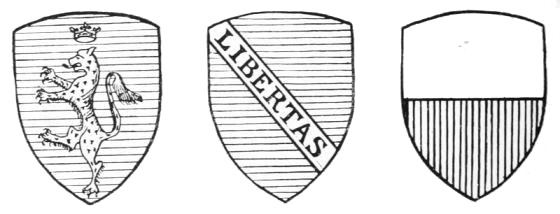
COATS OF ARMS OF LUCCA
[See larger version]
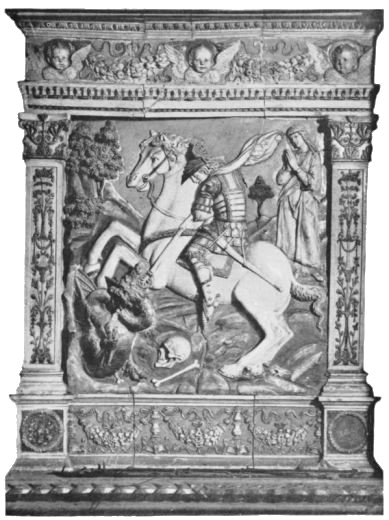
Alinari Andrea and Giov. della Robbia
ST. GEORGE AND THE DRAGON, S. MARIA E S. GIORGIO BRANCOLI
[See larger version]