"The Log of the Flying Fish" (continued 6)
Reading edition
Had the travellers been less experienced than they were this suggestion as to the employment of women would have come upon them as a surprise; but they were well aware that among many savage races labour is looked upon as degrading, and therefore imposed solely upon the women; so they merely thanked Lualamba for his promise, and intimated that women would serve them equally as well as men. Upon which Lualamba withdrew, promising that a gang of at least fifty should be at the ruined temple—or whatever it was—“before the sun reached the top of the sky;” in other words, before noon. This promise was faithfully fulfilled, for at eleven o’clock the explorers saw the gang of labourers come filing in among the ruins, armed with rude wooden mattocks and spades, and provided with large baskets in which to convey away the soil as it was dug out. They were as unprepossessing a lot of specimens of female humanity as could well be imagined. Naked, save for a filthy ragged skin petticoat round their waists and reaching to the knee, their faces wore, without exception, an expression of sullen stupidity, and they looked as though they had never experienced a joyous moment in their lives; but they were active and muscular, and soon showed that they thoroughly understood how to use their clumsy tools to the best advantage. They were led by and worked under the directorship of a lean, shrunken, withered old grey-haired hag of superlative ugliness, who did no work herself, but went constantly back and forth along the line of workers, bearing in her hand a long thin pliant rattan, which she did not hesitate to smartly apply to the shoulders of those who seemed to her to be doing less than their fair share of the work in hand. This bit of petty cruelty was, however, as a matter of course, promptly stopped by the professor, who thereby won for himself a look of withering scorn from the hag aforesaid, and glances of stupid wonder—in which in some cases could be also detected faint traces of an expression of gratitude—from the unfortunate sisterhood who laboured under her.
The amount of work performed was, as might naturally be expected, nothing approaching to that which would have been accomplished in the same time by the same number of white labourers; indeed, a gang of half a dozen good honest hard-working English navvies would have accomplished fully as much per diem as the fifty women who laboured among the ruins. But the explorers were quite satisfied; they were in no particular hurry; the climate was delightful; M’Bongwele was wonderfully civil, sending large supplies of provisions, fruit, and milk to the ship daily, accompanied by the most solicitous inquiries through Lualamba as to whether all things were going well with his visitors. There was no attempt whatever, so far as they could discover, to pry into their doings, not a single warrior, save Lualamba, having been seen by them since the day of the king’s visit, and everything seemed to be favourable to a thorough and leisurely execution of their purpose.
On the fourth day from the commencement of the excavation the explorers were gratified by the uncovering of a yard or two of what appeared to be a magnificent tesselated pavement of white and variegated marble; and by the end of a fortnight fully half of its supposed area was exposed, showing it to be of an entirely novel and exquisitely graceful design, the intricate outline of the pattern being emphasised by the insertion of plates of gold about a quarter of an inch wide between the tesserae. The pavement was smooth, level, and in perfect preservation, and the explorers were in the very highest of spirits at their exceptional good luck.
At the outset of the work the four friends had been in the habit of returning every day to the ship for luncheon, but as time passed on they felt that to do this in the very hottest part of the day was a wholly unnecessary waste of energy, and they accordingly transferred from the ship to the scene of their operations a spacious umbrella-tent (that is to say, a tent with a top but no sides), together with a small table and four chairs. And under the shadow of this tent they were wont to partake of the mid-day meal (usually a cold collation), which they generally finished off with a cup of chocolate or coffee and a cigar, the potables being prepared by a particular one of the women labourers, who speedily developed quite a special aptitude for the task, and who at length fell into the habit of regularly bringing with her, every day, the milk needed for the purpose. The tent being pitched on a spot which commanded a full view of the operations in progress, the quartette gradually acquired the habit of lingering somewhat over their luncheon, and especially over the final coffee and cigar, the inevitable result of which was that, for the next hour or two, they experienced a feeling of delicious languor and drowsiness, and an almost unconquerable disinclination to exchange the grateful shade of the tent for the scorching heat of the afternoon sun. At first they struggled resolutely and manfully against this overpowering temptation to idleness; but finding, or fancying, that they could supervise the work as efficiently from the tent as they could at a yard or two from its shelter, they gradually gave up the struggle, yielding day after day more completely to the seductive feeling of lassitude which seemed to have laid hold upon them.
Finally, one hot afternoon, overcome by the drowsy influence of the warm perfumed air which played about their languid bodies, they all fell asleep.
Unknown to and wholly unsuspected by them, the old crone who was in charge of the gang of female labourers had, for some days past, been keeping a sharply watchful eye upon the investigators, and upon the day in question she had been, if possible, more sharply watchful than ever. So interested in them did she at last become that, turning her back upon the women and leaving them to work or not as they saw fit, she advanced until she entered the shadow of the tent, where she paused, eagerly scanning the features of the slumberers. For some ten minutes or so she stood motionless as a statue, her sunken glittering eyes turning from one placid face to the other; then she stepped to the baronet’s side and, seizing him by the shoulder, shook him sharply. The sleeper might have been dead for all the consciousness which he exhibited at her rude touch. Another and more violent shake proved equally unproductive of results. Then she passed on to the colonel, to Mildmay, and to the professor, experimenting in like manner with each. If she wished to arouse them, her efforts were useless; they were, one and all, locked fast in the embrace of sleep—profound, unnatural, death-like sleep. A scornful laugh grated harshly from her lips, and, wheeling sharply upon her heel, she rejoined the gang of excavators, exclaiming:
“Cease this useless labour; there is no further need of it. The witch-potion has done its work, and you may all return to the village. I go to summon the warriors.”
The women, without further ado, gathered up their tools and baskets, and, breaking into a low monotonous song, to which their feet kept time, took the trail leading to the village, and soon disappeared among the scattered ruins and the bush which clustered thickly about them.
Ten minutes later a band of dusky warriors, fully armed and numbering about a hundred, made their appearance, and, led by Lualamba, advanced to the tent, which they surrounded. Four grass hammocks, each of which was stretched between two long bamboo poles, were then brought forward, and, by the directions of the chief, the unconscious white men were carefully lifted from their seats and deposited at full length in them. The tent was then struck, and, with its simple furniture, taken in charge by certain members of the band told off for the purpose, when each of the hammocks, with its sleeping burden, was carefully raised from the ground and shouldered by four savages, and, the remainder of the warriors forming round them as an escort, the band took the trail to the village, and marched rapidly away.
On reaching their destination the prisoners (for such they evidently were) were carried to a new hut, which had all the appearance of having been specially constructed for them, and, once inside, the poles of the hammocks were carefully laid in the forked ends of upright posts, firmly fixed in the ground, the whole forming a sufficiently comfortable bed. Four young women then entered the building, and, taking their places, one at the head of each sleeper, proceeded, with the aid of large feather fans, to protect their helpless charges from the attacks of the mosquitoes and other insect torments with which the village swarmed; when the hammock-bearers filed out, and the white men were left to sleep off, undisturbed, the effects of the potent drug which had been artfully mingled with the milk with which their coffee had that day been prepared.
The hut in which our four friends were thus left had been erected in a spacious palisaded quadrangle which surrounded the king’s palace, so that M’Bongwele might, as it were, always have them under his own eye; and the fact that, having got them into his power, the king was determined, if possible, to keep them there, was made manifest by the presence of a strong cordon of guards, who, on the passage of the prisoners within the portal, immediately ranged themselves round the hut outside. The hut was only some twelve feet square, and entirely open at one end, the open end being, however, protected from the sun by a continuation of the roof in the form of a broad verandah supported at the eaves upon two stout verandah-posts; and round this diminutive structure were ranged twenty picked men, facing inward, fully armed with bow, spear, and shield; it was pretty evident, therefore, that, unless the prisoners had the power to render themselves invisible, or of paralysing their guards, there was little probability of their effecting their escape.
The posting of the guard having been effected to Lualamba’s satisfaction, he entered the palace to make his report to the king, who was anxiously expecting him. M’Bongwele listened attentively to all the details of the capture, and, upon its completion, rose and, accompanied by the chief, made his way to the hut, which he cautiously entered, placing himself at the foot of each hammock in succession, and long and anxiously regarding the countenances of the sleepers. He had been successful in his bold enterprise beyond his most sanguine hopes; but it was evident that even in the very moment of his triumph he was anxious and disturbed in his mind. He trembled at the audacity which had led him to pit himself against these extraordinary beings, and the very ease with which he had accomplished his purpose frightened him. Had these men—if men they were—been encountered and overcome awake, and in the full possession of their senses, he would have been happy, for he would then have felt that his own power was superior to theirs. But they had been surprised whilst under the influence of a subtle and potent drug prepared by the chief witch-doctor; and when they awoke and discovered what had been done to them, what might not the consequence be? But what was done was done; he had now gone too far to retreat; besides which, his ambition overmastered his fears, and he determined to go on and risk the consequences.
Having obtained possession of the persons of these formidable beings, obviously the next thing would be to secure that wonderful thing which they called a “ship;” and this M’Bongwele determined to do at once: who knew but that its possession might give him a much-needed and decisive power over its former owners? He accordingly retired from the prison hut, and gave orders for the immediate assembling of all his available cavalry; at the head of which he soon dashed off in the direction of the ruins, leaving Lualamba in charge of the guard and of the prisoners, a position of responsibility which that chief by no means coveted, and which he accepted with much inward perturbation.
Proceeding at a gallop, the impatient M’Bongwele and his troopers soon reached the Flying Fish, which they immediately surrounded. The king then dismounting, and summoning some fifty of his most famous braves to follow him, cautiously approached the ship, with the purpose of boarding her. But the rope-ladder, by means of which he had on a former occasion accomplished this feat, was no longer there; and, as he glanced upward at the gleaming cylindrical sides of the towering structure, it began to dawn upon him that the task he had undertaken was, after all, not without its difficulties. Presently, however, a brilliant idea occurred to him, and, selecting a dozen men, he gave them certain orders which sent them scurrying off at a gallop. Half an hour later they returned, dragging behind them two long stout bamboos and a considerable quantity of tough pliant “monkey-rope” or creeper. With these materials the men, under M’Bongwele’s instructions, proceeded to construct a ladder, which, when completed, they reared against the side of the ship; and by this means the king and his fifty chosen warriors ascended and triumphantly reached the deck.
M’Bongwele now regarded himself as completely successful; he had gained possession of the wonderful structure; and all that remained was to make use of it in a similar manner to that of its former owners. He accordingly advanced pompously to the gangway, and ordered his troopers to first remove the ladder from the ship’s side, and then return to the village with all speed, adding exultantly that he and those with him on the “flying horse’s back” would be there long before them.
Resolved to give the cavalcade a good start, he watched it disappear in a cloud of dust among the ruins, and then, assuming his most commanding attitude and manner, raised his right hand aloft and exclaimed:
“We will now return through the air to the village—keeping as close to the ground as possible,” he added with some trepidation as he nervously grasped the guard rail in anticipation of the expected movement.
The ship, however, remained motionless. Something was evidently wrong, but what it might be he could not imagine; surely he had not forgotten or misunderstood the formula as stated to him by Lualamba? He now most heartily wished that he had brought that trusty chief with him, and so provided against all possibility of error; however, the omission could not be helped, and he would try again, adopting a somewhat different form of words. This time he stamped rather impatiently on the deck, exclaiming:
“Take us back to the village, good flying horse, but gently, and not very far above the ground.”
Still no movement. The king began to look puzzled, and to feel as vexed as he dared, with the consciousness weighing heavily upon him that he was playing with frightfully keen edged tools. He did not know what to make of this persistent immobility; it was uncanny, sinister, portentous, almost appalling. He would try again. He did try again, not once but nearly a dozen times, varying the form of words, more or less, every time; and, of course, with the same ill success. At length, in chagrin and disgust, he gave up the attempt to move the ship, and turned his attention to an examination of her interior. He advanced to the pilot-house, complacently reflecting that here, at least, he could not possibly be beaten; he had only to walk up to the door and enter. But here, again, surprise and confusion awaited him; for, after twice making the circuit of the building, he was unable to find a door; there was no perceptible entrance anywhere excepting the circular windows, which, however, were all open. Summoning his followers to his assistance, he made them give him a “back;” and, scrambling up on their shoulders, he at length contrived to raise himself to the level of these openings and to look in. He saw a great many levers, and knobs, and buttons, and short lengths of insulated wire; in fact, he got a glimpse of pretty nearly all the apparatus contained in the pilothouse; but that did not help him in the least, for he had not the most remote idea of what all these things were for; and when he essayed an entrance by one of the windows he was again foiled; it was much too small. At length, after a great deal of ineffectual wriggling and struggling—which occasioned serious inconvenience and anxiety to the human supports who were with the utmost difficulty maintaining a state of very unstable equilibrium beneath his feet—his patience completely failed him, and, in a fit of childish anger and spite, he sent a series of truly blood-curdling yells echoing into the interior of the pilot-house. These cries were of course distinctly heard by George and the chef, but (acting upon a concise code of instructions furnished to them when they were first engaged for the voyage, and which provided for almost every conceivable emergency), neither of these individuals condescended to take any notice of them. Having thus given vent to a portion of his spleen, king M’Bongwele, paying but scanty attention to the comfort or dignity of his supporters, scrambled down from his elevated position to the deck, and sat down to reflect upon the next steps to be taken. He would gladly now have left the ship and made the best of his way back to the village, even though the journey would have had to be performed on foot; but the ladder had, by his own command, been removed, and his retreat was thus effectually cut off, a drop of about forty feet from the bottom of the metal accommodation ladder to the ground being a something not to be thought of.
Chapter Twenty.
The History of certain Distressed Damsels.
Meanwhile Seketulo, the chief in command of king M’Bongwele’s household cavalry, returned to the village in due course, and lost no time in dismissing his men, chuckling to himself as he reflected that, after all, he had beaten his monarch in the race homeward.
Time passed on; the sun set; the evanescent twilight faded out of the sky; the stars twinkled forth in all the mellow radiance characteristic of the tropics; and still the adventurous M’Bongwele and his wondrous prize came not. Hour after hour lagged slowly away; and at length the expectant villagers, who had poured into the open air to witness the triumphant arrival of the king, returned to their huts—their transient enthusiasm overcome by their habitual apathy and indolence—and surrendered themselves willingly enough to the blandishments of sleep. All, with the exception, that is to say, of the guard detailed to watch over the prisoners, the anxious Lualamba, and Seketulo. These were all wakeful enough, the latter perhaps even more so than any of the others. For, as the night waxed and the great full moon rolled slowly upward into the sky, the powerful chief, who had won for himself the envied position of commander of the king’s cavalry (a position equivalent to that of commander-in-chief of the whole army), felt the hope growing within him that the foolhardy king and those with him had been carried off to the nether regions for a permanency by the wondrous Thing of which they had so audaciously sought to secure the possession. And in that case (M’Bongwele being without sons, and having, in order to avoid possible future complications, carefully slaughtered all his brothers and other relations on his accession to the throne) there would be a vacancy in that particular country for a king, which vacancy Seketulo believed himself powerful enough to secure and fill.
Giving free rein to these ambitious ideas and aspirations, the chief paced thoughtfully to and fro in a retired corner of the village until about ten o’clock that night, when his impatience could no longer be curbed, and he felt that he must sally forth to ascertain, if possible, the fate of M’Bongwele and his party. Accordingly, mounting his horse, he took his way out of the village, passing through the principal gateway, and heading for the ruins at a gallop. He was greatly disconcerted, on reaching his destination, to discover that the Flying Fish still peacefully reposed in her usual berth; and his disgust was supreme when he further noticed, crouched on her lofty deck, a disconsolate-looking group, which his fears only too truly assured him must be the king and his companions. His first impulse was to retire and leave them to their merited fate; but the unwelcome reflection suggesting itself to him that they might possibly be discovered and rescued in the morning, he altered his purpose, and, making a virtue of what was almost a necessity, advanced with the intention of proffering a respectful inquiry as to whether any unfortunate accident had delayed the royal return. He was, however, forestalled by the king and his party, who, the instant they saw him, hailed his appearance with joyous shouts and an almost piteous entreaty to him to replace the ladder. This he, still making a virtue of necessity, at once attempted to do; but the clumsy construction proved too much for his strength. A happy idea, however, now flashed through the mind of one of the party; and, unstringing their bows, they joined the strings together into one continuous line, which, luckily for them, reached the ground; and Seketulo bending the lower end on to the ladder, the latter was soon, by the exertions of all hands, reared into position. The party, thoroughly crestfallen, now lost no time in making their way to the ground, when M’Bongwele at once requisitioned Seketulo’s horse, and galloped off homeward at top speed, the chief and the rest of the party being left to plod back to the village at their leisure and as best they could.
Notwithstanding this most dismal failure, M’Bongwele still entertained hopes of being able to possess himself of the coveted ship; and early next morning every available man and woman was marched to the scene of the preceding day’s discomfiture to attempt the task of carrying the Flying Fish to the village! This attempt, it is scarcely necessary to say, also resulted in complete failure, and with this failure king M’Bongwele was at last compelled to recognise himself as beaten. It became clear to him that the mysterious beings whose persons he had so rashly seized possessed certain peculiar and wonderful powers; and the only course now open to him seemed to be to make the best terms he could with them for their co-operation in the furtherance of his schemes. And he felt heartily glad—pluming himself at the same time upon his prudence—that he had not taken advantage of their seemingly helpless condition, when brought to the village, to attempt the putting of a period to their existence.
Meanwhile, Seketulo, though greatly chagrined at the turn of affairs, by no means abandoned hope. He felt that though disappointment had for once overtaken him, it by no means followed that such would always be the case; and if his ambitious dreams could not be realised in one way, they still might be in another. The king, unfortunately, had not been carried off to perdition; but, figuratively speaking, that seemed to be his ultimate and speedy destination. For, had he not pitted his own power against that of the mysterious strangers, and lost the game? He had inflicted a most grievous outrage upon them, and had ineffectually attempted to seize their wonderful ship; yet not a particle of gain or advantage of any description had been secured, and the wrath of these strangers had yet to be faced; the penalty of his audacious deeds had yet to be paid. Did not all this point to M’Bongwele’s speedy downfall? And if such a state of things should happily be in the near future, would it not be worth his (Seketulo’s) while to approach the strangers in a friendly spirit and (after cautiously feeling his way) with offers of assistance? He decided that it undoubtedly would, and that he would forthwith adopt that line of policy, cautiously, yet without losing a single favourable opportunity.
So far as M’Bongwele was concerned, he found himself in a greater strait than ever. He had not only failed completely in his ambitious schemes, but he had also lost prestige with his own people and had made enemies of the strangers. His situation was distinctly worse than if he had done nothing at all; and how to make his way out of the imbroglio he knew not, nor could any of his ministers advise anything. He now fervently wished he had adopted other and more friendly measures with his visitors; but it was too late; he fully recognised that, with the odium of failure fresh upon him, any attempt at conciliation would be utterly hopeless; the only course still open to him appearing to be that of “masterly inactivity.” This would, at all events, leave time for events to shape themselves, and afford him an opportunity of regulating his conduct in accordance therewith; and this course he accordingly determined to pursue; at the same time issuing the most imperative orders that the prisoners were to be treated with the utmost courtesy and consideration consistent with their safe-keeping.
In accordance with these orders, the prisoners found that, after the second day of their seizure, they had very little of which to complain beyond the actual loss of their liberty. They were abundantly supplied with provisions of all kinds within the resources of the village; the four young women originally detailed to watch over them during their drugged slumber were permanently appointed to attend upon them, do their cooking, keep their hut clean, and so on; and they were allowed to take unrestricted exercise within the bounds of the compound. Their attendants and guards were allowed to answer any questions except such as related to the king’s recent attempt to possess himself of their property; and hints were freely offered to the effect that M’Bongwele was most anxious to secure their friendship, and would gladly afford them an audience whenever they might desire it. But they had no intention whatever of seeking an audience with the king; they had a very shrewd suspicion of what had actually taken place; and having by this time formed a tolerably accurate estimate of the royal character, they felt convinced that their only chance of advantageously dealing with M’Bongwele lay in forcing upon him the character of a suitor to them.
Thus matters stood for nearly a fortnight from the date of their seizure—Seketulo doing his best to effectually ingratiate himself in the strangers’ favour before venturing to tender his proposed offer of assistance; and M’Bongwele waiting with daily growing impatience for overtures from his prisoners—when an event occurred which, simple though it seemed at the moment, was destined to have an important bearing on the fortunes of certain other white prisoners then in the king’s power.
It happened thus. The quartette were sitting under the verandah of their hut one morning, whining away the very last remains of their carefully hoarded stock of tobacco, when a soft thud, followed by a low startled cry of pain and terror from one of their female attendants caused them to glance hastily round. The sight which then met their eyes was startling enough to make them spring instantly to their feet. A snake fully seven feet long, and of the most deadly venomous kind (which had evidently just dropped out of the thatch of the hut), had flung its coils round the bare leg of one of the women, and, before help could be rendered, had struck its fangs deep into the flesh. The cruel heart-shaped head, with its wicked eyes glowing like a couple of carbuncles, was already drawn back to repeat the stroke when Lethbridge sprang forward, and, seizing a small pliant rattan which happened to be handy at the moment, dealt the reptile a swift downward cut across the body, dividing the creature almost in two; following up the blow by a rapid dart of his hand, grasping the reptile by the neck and tearing the quivering coils away from the wounded limb. Another second, and the head was being fiercely ground into the dust under the thick solid leather of his boot-heel, the wounded body twisting and writhing in the most horrible contortions meanwhile.
Two out of Lethbridge’s three companions stood helplessly aghast whilst this tragedy was in progress; but the professor, ever alert in the interests of science, promptly compelled the wounded girl to lie down, and instantly applied his lips to the wound made by the poisonous fangs of the snake, sucking vigorously until he had induced as copious a flow of blood as could reasonably be expected from the two tiny punctures. Then, fumbling in his waistcoat pocket, he drew forth a small stick of lunar caustic (with which he had some time previously provided himself in anticipation of possible snake-bites) and effectually cauterised the wound. The result of which prompt treatment was that the girl, after enduring some three hours’ slight suffering and inconvenience from the pain and subsequent swelling of the wound, recovered, and in a day or two was as well again as ever.
This incident was, as might be expected, much talked about in the village, and it very soon reached M’Bongwele’s ears. That monarch happened, just then, to be plunged into a state of serious domestic affliction; and, inspired by the above occurrence with a brilliant idea, he, after much painful cogitation, resolved to seek the aid of his prisoners. Briefly stated, the difficulty was this. His youngest and favourite wife had just added another to his already too numerous family of daughters, thus disgusting and seriously disappointing the king, who had confidently looked forward to being this time blessed with a son. This was by no means the first disappointment of the kind that the monarch had been called upon to endure; and it had been his wont, on such occasions, to banish the offending wife from his presence, replacing her with a new one. He proposed to follow the same rule upon the present occasion; and the only difficulty which lay in his way consisted in suitably filling up the vacancy. There were, of course, hundreds of sable damsels within the limits of his dominions who would gladly have accepted the responsibilities of the position, but that would no longer suit king M’Bongwele; the women of his own race had, one and all, so far as he had tried them, failed disgracefully in their duty of providing him with an heir, and he was now determined to try elsewhere. He happened to have in his possession, as prisoners, four white women, one of whom was somewhat elderly, whilst the remaining three were young, and, though by no means sufficiently embonpoint to be strictly handsome, from an African savage’s point of view, still attractive enough to justify his choice of either of them as a wife. The difficulty with these women was that they were unfortunately all insane—a circumstance which (in accordance with one of the many superstitious beliefs of the natives, and quite apart from the equally important objection of consequent unsuitability) effectually precluded any resort to threats or compulsion for enabling the king to carry out his plans. And it was for the purpose of securing these unfortunate creatures’ restoration to reason that M’Bongwele now resolved to invoke the potent aid of his new prisoners. When making up his mind to this course he was at first greatly puzzled as to how he should approach the individuals he had so basely betrayed, and how explain and excuse his conduct; but at last the happy idea suggested itself of ignoring his ill-behaviour altogether; and acting upon this, and without giving himself time for further consideration, he hurried off to the hut and presented himself before his prisoners.
Seating himself jauntily upon one of the bedsteads, he opened the negotiations by explaining that he had come to express his admiration of, and his thanks for, the wonderful manner in which the woman had been saved from the deadly effects of the snake-bite; and then, without affording an opportunity for interruption, he went on to state, in full detail, his further business.
The indignation excited in the breasts of his listeners by the cool impudence of the king soon subsided under the influence of the interesting news that four white women were captives in the village; and when M’Bongwele closed his explanation and proffered his request, the professor, instead of loading his captor with reproaches, followed the latter’s example of ignoring all cause for unpleasantness, and simply stated that no promise of any kind could be made until the four friends had been afforded an interview with the afflicted women. To this proposition the king eagerly assented, overjoyed at so unexpected a measure of success, indeed he volunteered to personally conduct the quartette into the presence of his female prisoners; but this was promptly negatived, the professor declaring that if he and his friends went to see the women at all they must go entirely unattended, and at such time as might be most convenient to themselves. It would have suited M’Bongwele very much better to have been present at this interview, for he was suspicious to a really absurd degree; but, finding the white men firm upon this point, and, apparently, wholly indifferent in the matter, and being also unable to discover any cause for suspicion in their conduct, he at length yielded his assent and retired, giving the necessary instructions to the guard as he passed out of the hut.
The next morning, about eleven o’clock, having previously talked this curious matter carefully over together, they paid their promised visit; the women’s prison (to which they were carefully escorted by their entire guard) being situated close to the principal opening in the palisading which surrounded the village; the same guard being apparently made to serve for both the prison and the gateway. The building was an almost exact facsimile of their own place of confinement, both in shape and dimensions; but at the very threshold the visitors encountered evidences of female delicacy and refinement in the shape of finely woven grass curtains or portières across the otherwise unclosed entrance, and these trifling elegances were multiplied a hundred-fold in the interior, converting the little building into a veritable miniature palace in comparison with their own unadorned domicile.
But these little interior adornments did not attract the visitors’ notice until later on; their whole attention was at once claimed, upon their entrance, by the occupants of the building, or at least by the fairer portion of them. There were eight altogether—four white and four black, the ebony damsels evidently filling the position of attendants. Of the white women three were young—that is to say, they apparently ranged between nineteen and twenty-five years of age—whilst the fourth seemed to be somewhere between forty and fifty. This lady was of medium height, with a figure slightly inclined toward stoutness, brown hair with just a single streak of silver discernible here and there amongst it, a complexion still in fairly good preservation, a pair of keen but kindly grey eyes, an excellent set of teeth, shapely hands and feet, and a pleasant smile which at once prepossessed the beholder in its possessor’s favour. Of the three younger women, two, aged respectively twenty-one and nineteen, were sisters; whilst the third, aged twenty-five, was their cousin, the elderly lady being aunt to all three.
On entering the hut, in response to the cry of “Come in” which followed their knock on the framework of the portal, the visitors at once found themselves face to face with the four ladies, who had risen to their feet to meet them; the sable attendants crouching at the rear end of the apartment with a grin of sympathetic curiosity overspreading their shining visages.
“You are most welcome, gentlemen,” said the elderly lady, advancing and offering her hand to each of her visitors in succession. “We have been expecting you. Allow me to perform the ceremony of introduction. I am Mrs Scott, widow of Brigadier-general Scott of her majesty’s forces in India. This lady is Miss Sabine, my niece and the only daughter of Major-general Sabine; and these are respectively Miss Rose and Miss Lucilla Lumsden, the daughters of an Indian judge.”
The gentlemen bowed low as each name was mentioned, and, upon Mrs Scott making a somewhat significant pause, the baronet took up his parable, remarking:
“We are greatly honoured and delighted, ladies, at thus unexpectedly making your acquaintance in this out-of-the-way spot, and we sincerely hope that the acquaintanceship will redound to our mutual advantage. I am Sir Reginald Elphinstone. This gentleman is Colonel Lethbridge; this is Lieutenant Mildmay, of her majesty’s navy; and, last but by no means least, this gentleman is Professor von Schalckenberg, an eminent German scientist, a most delightful companion, and a man clever enough, I firmly believe, to help us all out of our present difficulties.”
A general shaking of hands ensued; and then Mrs Scott laughingly invited the gentlemen to seat themselves on the four bamboo pallets which occupied opposite sides of the apartment, apologising at the same time for the lack of suitable sitting accommodation.
“And now,” said Mrs Scott laughingly, “to which of you gentlemen are we to look for the cure of our madness?”
“It is expected, I believe,” said Sir Reginald, “that we shall each aid, to the best of our ability, in the good work. But,” he continued in a lower and more cautious tone of voice, “is it not rather imprudent of you to behave in so very sane a manner before these women?”
“Oh,” said Mrs Scott, “they are all right. They are perfectly trustworthy—indeed, they are actively aiding and abetting us in the exceedingly disagreeable but necessary deception we are practising upon king M’Bongwele. The wretch!” she continued, starting indignantly to her feet. “Would you believe it? He actually has the audacity and impudence to—to—to—”
“To aspire to a matrimonial alliance with one, if not all, of you. Yes, I am aware of his ambition,” said the baronet with a smile; “and whilst we are here to-day, at his request, to remove the obstacle which your most deplorable insanity interposes, I hope that the ultimate result will be your speedy deliverance, with our own, from his power. We are, like yourselves, prisoners, but we are by no means hopeless of escape, and I pledge you my word that we will not leave until we can take you all with us.”
Mrs Scott shook her head somewhat doubtfully. “We are all infinitely obliged to you for your generous promise,” she said with a sigh; “but I greatly fear you are somewhat overrating your powers. The difficulties of escape—in the first place, from this village, and, in the next place, from the country itself—are so formidable that we have almost given up all hope. May I ask what strange accident brought you hither?”
“Assuredly,” answered the baronet. “And when I have informed you of the facts, you will see that the difficulties of escape are, after all, not so very enormous, and I trust that you will all take heart once more.”
Sir Reginald then proceeded to give a detailed description of the Flying Fish; and of his own and his companions’ adventures in her; winding up with an account of their capture—so far as they were aware of its details—and a recital of the grounds upon which they founded their hopes of escape.
The ladies listened to Sir Reginald’s singular story with an astonishment which they vainly strove to conceal, and had it been uncorroborated, they would probably have suspected in him a touch of the same malady with which they were supposed to be afflicted; but, as matters were, they had no choice but to credit the tale, and very much gratified they were to learn that there existed a means of conveyance affording, if they could but once gain access to it, a safe, easy, and speedy escape from the realms of king M’Bongwele.
Sir Reginald, having brought his story to an end, requested that he and his companions might be favoured with an account of the manner in which the ladies had fallen into the hands of the savages, which request Mrs Scott complied with, somewhat in the following terms:
“It is, to a great extent, my fault that these poor girls find themselves in the unfortunate position which they occupy to-day. I have been a widow for nearly seven years; but, having been early left an orphan, with no friends in England and many in India, I did not, as many newly-made widows do, turn my face homeward immediately on my husband’s death; on the contrary, I determined rather to remain in the country of my adoption, and, being left in tolerably comfortable circumstances, made arrangements to reside alternately in Delhi and Simla. These arrangements I duly carried into effect, and nothing occurred to disturb them until about a year ago, when my brother, Sir James Lumsden, died, leaving his motherless daughters—Rose and Lucilla here—in my care, with an earnest entreaty that I would convey them, at my earliest convenience, home to their grandfather, who owns a very fine place in Hampshire, and who would, doubtless, be glad to receive them. I, of course, very willingly undertook the duty—not the less so, perhaps, from the fact that I was myself somewhat ailing, and had been strongly urged by my medical adviser to try the effect of change and a long sea voyage. Our preparations were soon completed, and we journeyed down to Bombay, at which place I happened to meet my brother-in-law, General Sabine. He, poor man, was in a great difficulty just then, being under orders to proceed at once to Afghanistan, and not knowing what to do with his daughter, who, I ought to explain, has been motherless from her infancy. The best way I could see out of the difficulty was for her to take the trip home to Europe with us, and, upon my making the proposal, it was joyfully adopted. So far all was well; but at this point our difficulties were to begin. We, unfortunately, took passage for London in a sailing ship for my health’s sake. We, or the ship rather, had to call at the Cape, and, three weeks after we sailed, the captain died. The chief mate then assumed the command of the vessel, and in a few days afterwards we found that he was giving way to drink. That was, doubtless, the cause of the disaster which followed, for on a dark and stormy night, whilst the chief mate—or captain, rather, I suppose I ought to call him—was lying in his berth in a state of almost helpless intoxication, and the ship was flying before the rising gale under all the sail the sailors could spread, we struck! the masts snapped short off at the deck, and in a moment all was confusion and panic. The mate, or captain, staggered up on deck to see what was the matter, and he had scarcely reached the poop when a breaker swept down upon the wreck and washed the unhappy wretch overboard, never to be seen again. The next officer—a brave energetic young fellow - then took command, and by his coolness and courage soon restored order among the crew. He commanded the lead-line to be dropped overboard, and by its means ascertained that the ship was being rapidly driven shoreward by the force of the waves. Meanwhile the shocks of the ship striking against the ground gradually grew less and less severe, until they ceased altogether, and the vessel became motionless save for an occasional sickening lurch when an exceptionally heavy wave struck her. By this time it was ascertained that the hold was nearly full of water, a circumstance from which the young officer in charge came to the conclusion that the hull was irretrievably damaged, and he then gave orders to lower the boats. This task the sailors with great difficulty accomplished, and then, there being at the moment no immediate prospect of the wreck going to pieces, the boats were secured under the shelter of the ship, and it was determined to defer until daylight our attempt at landing, when the dangers of the enterprise could be distinctly seen and more easily avoided. About two hours elapsed between the first striking of the vessel and the launching of the boats, during which time I and my nieces were on deck in our night-dresses, supplemented by such wraps as we had been able to hastily snatch on the moment of the first alarm. But when the boats had been safely lowered into the sea and secured, Mr Snelgrove (the young officer who had last assumed the command) came to us, and, in the kindest manner possible, begged us to retire to our cabins, assuring us that we might do so with perfect safety, and that we might depend on him to summon us in good time to attempt a landing with the rest of the crew. We accordingly took his advice, glad to get back to the shelter of the saloon, where we at once discarded our wet garments and proceeded to make ourselves as comfortable as the circumstances permitted. Day broke at length, and then Mr Snelgrove made his appearance in the saloon, informing us that the weather had moderated, the sea gone down a good deal, and the tide had ebbed, rendering it a favourable moment to attempt a landing, which he believed might be effected without much danger; he further added that the seamen were then passing provisions and water into the boats, and that he would allow us ten minutes wherein to select and pack a small bundle of such clothing and effects as might be deemed by us most necessary. At length the eventful moment arrived for us to pass down into the boats, and though we were assured by the sailors that there was no danger, I never was so thoroughly frightened in my life, for the sea was still very rough, leaping, curling, and foaming all round us. However, we all managed to embark without accident, and then our boat (which was the second to make the attempt) pushed off and made for the shore. The breakers were appalling, and the boat was turned round with her bow pointing seaward, and ‘backed’—I think they called it—toward the shore. The sea broke over us several times, half filling the boat; but two men were kept constantly baling with buckets, and at length—thanks to Mr Snelgrove’s admirable management—we safely reached the beach, but wet to the skin as a matter of course. Meanwhile, the first boat, in charge of the boatswain, had discharged her cargo on the beach, and was now sent back with four men to the wreck to bring on shore the remainder of the crew and whatever of value they could lay their hands upon. This going to and fro between the beach and the ship lasted nearly all day, and by nightfall we had quite a large quantity of provisions, water, canvas, spars, and other matters, and last, but not least, all my nieces’ and my own boxes. The sailors constructed two tents in a sheltered spot high up on the beach—one for themselves and one for us—and we at length retired to spend our first night in the character of castaways.
“About an hour before daybreak we were rudely awakened—to find ourselves in the power of the savages. I am of opinion that we must have been watched during the whole of the previous day, for the surprise of the camp was complete; we had been noiselessly surrounded, and, whilst we unfortunate women were spared, the equally unfortunate men were, for the most part, slain in their sleep; not one had escaped—at least we never afterwards saw any of them alive. The camp was of course ransacked, and when every man had possessed himself of whatever happened to take his fancy, we were placed in the centre of the band and conveyed to this place, where we have been detained close prisoners ever since. The scattered contents of the camp must afterwards, I fancy, have been collected and brought to this village, for a few days later our boxes—broken open and the contents in a dreadfully soiled and disordered condition—were brought to us, and upon our replying in the affirmative to the questions put to us by signs as to whether they were our property, were left in our possession. I have only to add that the wreck, and the horrors which succeeded it, proved too much for poor Lucilla in her then somewhat weak state of health, and she fell into a low fever with delirium, which prostrated her for nearly three months, and from the effects of which she has even now not wholly recovered. It was during this dreadfully anxious period that those four poor black creatures were appointed to attend upon us. They have been most zealous and faithful in their efforts to help us; they have instructed us to some extent in their simple language; and they have informed us, not only that they are cast-off wives of the king, but that he was, and still is, anxious to secure one (if not more) of my nieces for a wife, and that the only hope of escape from such a fate lay in our simulating insanity, which, most reluctantly, we have been compelled to do whenever M’Bongwele or any of his emissaries have visited us. But, beyond our close confinement and this horrible ever-impending danger, we have no very great cause for complaint, all our expressed wants being instantly satisfied so far as the resources of the king will permit.”
Mrs Scott having thus brought her story to an end, the gentlemen expressed their sympathy and condolences, and the conversation gradually grew more general. At length, much as they would have liked to prolong the interview, they felt that they had already lengthened it out almost beyond the bounds of prudence, so they rose to take leave, uttering a few encouraging remarks, which Sir Reginald rounded off with an exhortation to them to be ever on the watch, and to hold themselves in readiness for flight at a moment’s notice, adding that one or other of the gentlemen would visit them as often as possible and keep them well informed upon the progress of events.
Chapter Twenty One.
Retribution overtakes King M’Bongwele.
King M’Bongwele had evidently been keenly on the watch for the return of the four prisoners, for they had scarcely had time to enter their hut when the monarch presented himself before them, and, with some little impatience of manner, began his interrogations with the single word:
“Well?”
“We can cure them,” briefly answered the professor.
“Good!” ejaculated the king, his impatience yielding to almost childish delight. “When is the cure to be performed?”
“Within one span of the sun’s journey through the sky after we have administered a certain medicine, which we must procure from the ship. Provide us each with a horse to go and fetch this medicine, and I promise you, that before you see the stars to-night those women shall be in as full possession of their reason as you are.”
“No,” said the king, eyeing the professor keenly, “I will arrange better than that. You shall tell Lualamba where to find this wonderful medicine, and he shall fetch it for you.”
“That will not do at all,” answered the professor. “Lualamba could never find the medicine; he could not even gain access to the ship. We must fetch it ourselves.”
M’Bongwele rested his chin in his hand for some minutes, pondering deeply. Then he rose to his feet and stalked out of the hut again without vouchsafing a word, either “yea” or “nay.”
“He is not quite such a fool as he looks,” was the baronet’s sole comment upon this strange behaviour, and then they sat down to luncheon.
The king, upon re-entering his palace, at once sent for Lualamba, and, upon that chief making his appearance, issued strict orders that every available man, woman, and child, not only in the village but in the entire district, should be mustered by noon next day, to make one grand and final attempt to move the ship to the village, pending which the king decided to hold no further communications with his prisoners. The attempt was made in due course, and, like the others, it proved, as might be expected, a miserable failure. Poor M’Bongwele was now completely at a loss; he knew not what to do. He was most anxious to have the white women cured; but he had a powerful presentiment that if those singular beings, whom he certainly to some extent had in his power, once again set foot upon that curious thing they called a “ship,” his power over them would be gone for ever. And in such a case he felt that his fate was certain; he had laid unholy hands upon them, and dire would be his punishment. No; he was convinced that at all costs they must be debarred from access to that terrible “ship,” unless he could first of all gain their forgiveness, amity, and good-will, and interest them in his fortunes to the extent of securing their active co-operation in his schemes of conquest and aggrandisement. How to do this was, however, the question which puzzled king M’Bongwele; and it puzzled him so long that—but stay, we must not forestall the story.
Thus engaged in a futile endeavour to discover a way out of his dilemma, the king kept himself strictly secluded in his palace day after day, allowing no one access to him unless upon business of the utmost urgency and importance. Meanwhile, Seketulo, deeming the period a favourable one for the furtherance of his own schemes, first exhibited an increased amount of precaution in the proper posting of the guard over the prisoners, and then a gradually growing disposition to converse with the prisoners themselves. From this he proceeded to develop an interest, which, after a suitable lapse of time, was allowed to merge into anxiety for their welfare and greater comfort, and, finding these cautious advances well received, he then set to work in real earnest upon the delicate task of unfolding his proposals. He was so very cautious, however, and took so long a time about this, that he missed his opportunity altogether, and that, too, through a very simple accident.
It happened one night that, after an unusually long, disjointed, and desultory conversation with this same chief, Mildmay failed to get to sleep with his usual promptitude, and he lay tossing restlessly upon his pallet until he became impatient and finally exasperated at his want of success. The hut felt hot and stuffy to the verge of suffocation, and the lieutenant at length came to the conclusion that there was no hope of his getting to sleep until he had taken a turn or two up and down the compound, in the comparatively cool night air.
He accordingly scrambled to his feet, and, groping his way in the intense darkness, made for the verandah. Here he paused for a moment, glancing upward to the sky, which he found to be obscured by a dense canopy of heavy black cloud, portending rain, which sufficiently accounted for the pitchy darkness. His eyes at length becoming accustomed to the obscurity, he looked round for the guard; and he eventually discovered the various members faithfully occupying their posts, but, one and all, squatted upon the ground evidently fast asleep. He stalked out toward the centre of the compound and took two or three turns up and down its length, his footsteps falling noiselessly upon the light sandy soil, and not one of the savages manifested the slightest consciousness of his presence. Then he gradually extended his walk until he reached the gate in the palisade, and here too the guard was fast asleep. An idea presented itself to him; and he was about to make an attempt to noiselessly remove the bars and open the gate, when prudence suggested another and a better plan. He tiptoed lightly back to the hut, and, gently awakening each of his companions in turn, whispered in their ears:
“Up at once! There is an opportunity for us to effect our escape!”
The aroused sleepers instinctively comprehended the situation and sprang to their feet. Another minute, and four shadowy shapes stole noiselessly across the compound, to vanish almost instantly in the deeper shadows of the palisading. The closed gate was reached and passed, and presently the fugitives found themselves in the angle of the compound most distant from the slumbering guard. Here Mildmay offered a “back” to the baronet, whispering:
“You go first.”
Without a word Sir Reginald complied, clambering first upon his companion’s back and thence noiselessly to the top of the palisading. In another second a faint thud on the outside told that the first adventurer had successfully scaled the barrier. “You go next,” whispered Mildmay to the colonel, “and remain on the top of the palisade to give the professor a hand.”
Up went the colonel, and up after him went the professor. The latter, with the baronet’s assistance from below on the outside, accomplished his descent in safety; and then the colonel, reaching as far down as he could, assisted Mildmay to the top. The rest was easy; and a minute later they were cautiously making their way up the road to the top end of the village, or that which was most thinly inhabited. At this moment down came the rain, a regular tropical deluge, which was undoubtedly a most fortunate circumstance for the fugitives, as they could otherwise have scarcely hoped to escape the vigilance of the numerous prowling curs belonging to the village, who, as it was, were driven by the rain to take refuge in their masters’ huts.
Five minutes sufficed the travellers to reach the stout lofty palisade which inclosed the village; and this, the framework all being on the inner side, they were easily enabled to surmount. Once outside this obstacle, Mildmay assumed the leadership, confidently declaring his ability to find the ship, though he had only once before, consciously, passed over the ground between the village and the ruins.
The party made their way in the first place along the outer side of the palisading until they reached the main entrance gate to the village; and from this point Mildmay “took his departure.” A well-defined pathway led for some distance down into the plain, and this they traversed until the lieutenant believed he had reached the point at which to turn off. Here he paused for a full minute, looking about him and peering into the darkness. The rain was still pelting down, though not so heavily as at first; and away to the eastward the clouds were already beginning to break, allowing a star to peep through here and there. At length Mildmay thought he had got his bearings right; and, selecting a star to steer by, away he plunged into the long thick wet grass, his companions following closely behind. A few minutes later the rain ceased, the clouds vanished from the sky, and the stars shone calmly out in all their beauty, affording an ample sufficiency of light to distinctly reveal to the wayfarers the nearer clumps of bush, trees, and other large objects. Mildmay now paused again, and, shading his eyes with his hand, once more keenly surveyed the horizon.
“All right,” he murmured. “We are going just right, I believe. I can indistinctly make out something away there on the horizon, just ahead, which I feel certain must be the ruins. Come along, my hearties; heave ahead!”
Again they pushed forward, dripping wet, drenched to the skin with the recent shower, and stumbling every now and then as their feet became entangled in the long matted grass; now swerving to the right to avoid a clump of bush, then to the left for the same purpose; but ever keeping one particular star, low down on the horizon, as nearly straight ahead as possible. Though the rest of the party felt themselves utterly lost, without the faintest notion of where they were going, and though neither of them could distinguish anything even remotely resembling the ruins, Mildmay still persisted that he was right; and he continued to press rapidly forward, the rest following him, since they could do no better. At length they struck a narrow path through the grass, and Mildmay at once announced his intention of following it.
“It is a little off our course,” he said, “but the walking is so much easier here that we shall gain more than we shall lose by following it; and I should not be surprised to find that it leads to the ruins.”
Half an hour later a brilliant star suddenly appeared in the dense darkness ahead. It shone steadily for nearly a minute, disappeared, and almost instantly appeared again.
“Hurrah!” ejaculated the lieutenant joyously, “there is the ship’s light. Now we know that we are right. Another hour’s tramp will, if all be well, take us alongside. How I wish I had a pipe of tobacco!”
“Don’t mention it!” fervently ejaculated the professor, who was an ardent lover of the weed. “However, in another hour, as you say—ah!”
The professor’s “ah!” was so very expressive of anticipated pleasure that his companions with one accord burst into a hearty laugh, which, however, was abruptly cut short by a low savage growl and a sudden rustling in the grass close by.
“What was that?” was the simultaneous inquiry as the party came abruptly to a dead halt.
“Push on, push on!” urged the professor. “It is some nocturnal animal prowling in search of prey. At this moment he is more frightened than we are; but if we wait here until he has regained his courage he will perhaps spring on one of us.”
The march was accordingly resumed, with perhaps some little precipitation; and at length Mildmay’s companions began to be conscious of the presence of certain shapeless blotches of blackness rising up against the sky ahead of them and occasionally obscuring for a few seconds the now brilliant light which gleamed from the top of the Flying Fish’s pilot-house. These shapeless blotches of blackness increased in size with almost startling rapidity; and in a few minutes the travellers, still following the footpath, found themselves in the midst of them, winding in and out between great blocks of masonry which suddenly rose up in front of them in the darkness, and stumbling over loose boulders and fragments of stone. At length they found themselves in the clear open space occupied by the Flying Fish; and in another quarter of an hour the party passed into the black tunnel formed by the bilge-keel and the side of the ship, and began to feel with their feet for the open trap-door. This was soon reached; the party entered the opening, closed the flap, and, with a murmured “Thank God, we are safe at last!” began to feel for the button which was to open the door giving access to the interior proper of the ship. Another second and this door swung open, and the party found themselves at the foot of the cylindrical staircase, in the full blaze of the electric lamps.
“Now,” said the baronet, “ten minutes in which to strip, rub down, and don dry garments, and then we will be off to the rescue of those poor women, after which I think we must give our friend M’Bongwele a salutary lesson on the evil and impolicy of treachery.”
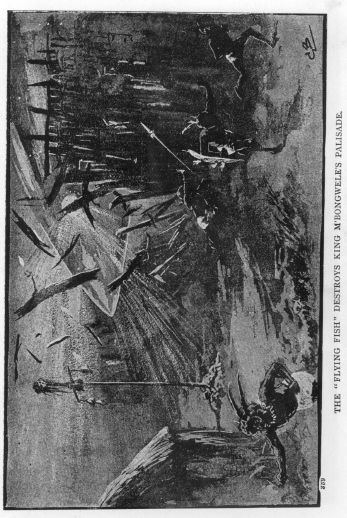
The allotted ten minutes had not quite expired when the professor, the last of the party, made his appearance in the pilot-house, by which time the Flying Fish was some five hundred feet in the air, with her nose pointing in the direction of M’Bongwele’s village, and her propeller driving her ahead at full speed. The electric lights of the ship were all called into requisition for the illumination of the landscape, producing a weird and ghostlike effect as the trees and clumps of bush first caught the light and then brightened into full radiance as they flashed past, to instantly fade again into obscurity. A startled howl or two smote upon the ears of the travellers, and the forms of hastily retreating animals were momentarily caught sight of; but all eyes were intently directed ahead in anxious expectancy of catching sight of the village, and presently it came into view. The speed was at once reduced and the vessel’s flight directed earthward, and in another moment she dashed through the palisade, shivering the principal entrance gate to splinters, and (as was intended) frightening the guard clean out of their senses. With one shrill, piercing scream of terror, as they caught sight of the dazzling bow lights of the ship, the sable warriors took to their heels and vanished in the darkness, whilst the Flying Fish was dexterously brought to earth close alongside the hut tenanted by Mrs Scott and her nieces. That appalling yell effectually awakened the entire occupants of the hut; and whilst they were sitting up on their pallets, rubbing their eyes and wondering what the terrible sound might portend, the portière was pushed aside and the professor, bearing a hand-lamp, unceremoniously made his appearance before them with an earnest request that they would dress with all speed and join him on the outside of the hut, where he would await them, the hour of their deliverance having arrived.
A quarter of an hour later the bewildered ladies were conducted by von Schalckenberg in through the trapdoor in the bottom of the Flying Fish and up the cylindrical staircase to the saloon, where they were warmly welcomed by the other three gentlemen, who, after a few congratulatory remarks on their fortunate escape, retired to secure and convey on board the boxes containing the remainder of their guests’ wardrobes. This done, Mrs Scott and her nieces were conducted to the cabins assigned for their use, and the gentlemen then retreated to the pilot-house, where, over a keenly enjoyed pipe, a hasty council was held as to what should be done with M’Bongwele.
This question was settled just as the first faint streaks of approaching dawn began to brighten the eastern horizon, when the ship was moved up into the great square before the king’s house, where the whole of the king’s body-guard were drawn up under arms, and, beyond them, the remaining inhabitants of the village, a dense, surging, excited, squabbling crowd.
On the approach of the Flying Fish the latter flung themselves face downwards, in abject terror, to the ground, and the armed and mounted warriors betrayed a disposition to stampede which was only with the utmost difficulty checked and restrained by Seketulo. Even this chief found himself unable to wholly conceal the feeling of nervousness which agitated him; but he in this trying moment enjoyed a consciousness, unshared by any other man there present, of having done his best to make the erstwhile prisoners comfortable.
As the huge ship settled quietly down in the centre of the great square a profound and deathlike silence suddenly succeeded the confused babbling sound which had hitherto prevailed, and when the four travellers stepped out from the pilot-house to the deck and appeared at the gangway a visible shudder ran through the entire concourse of people there assembled. They dreaded they knew not what, and their fears were only in a very trifling degree allayed by the promise of intercession on their behalf which Seketulo had made to them.
The professor was of course to be spokesman for the occasion; it was he, therefore, who broke the terrible silence by exclaiming, in a loud, commanding tone of voice:
“Seketulo, we are your friends. Advance, therefore, and listen to the commands which we are about to lay upon you!”
The reassured and now happy chief struck with his spurred heels the sides of his charger, and the animal, bounding and caracoling, advanced to within a few yards of the ship’s side, where his rider dismounted and, with bowed head and bended knee, waited for such communication as might be vouchsafed him.
“Listen, O Seketulo!” continued the professor. “We entered this country animated by feelings of the most amicable nature to its king and to every one of its inhabitants. We showed this by distributing presents of beads, cloth, and other matters when Lualamba and his warriors first visited us. And we asked for nothing in return save permission to examine and explore the ruins on yonder plain; offering to pay promptly and liberally for whatever assistance we might need. Is not this the truth?”
“It is, O most mighty wizard,” answered Seketulo humbly; some of the braver warriors also venturing to murmur:
“It is! It is!”
“And how have we been treated?” asked the professor. “Your king, not satisfied with our friendship and the presents we gave him, wickedly and treacherously devised a scheme to get us into his power—a scheme which, in order to try him, we permitted to succeed. And, having done that, he further attempted to gain possession of this ship,”—this fact having leaked out in Seketulo’s previous conversations—“profanely and audaciously thinking he could subdue her to his will and control her as we do. Now, therefore, be it understood by all present that, for his base treachery, M’Bongwele is dethroned, and Seketulo will, from this moment, reign in his stead. Let a detachment of the guard enter the palace and bring M’Bongwele forth to hear his sentence!”
In an instant Lualamba—anxious above all things to please the powers that be, and having, moreover, in revengeful remembrance many little gratuitous slights and insults which he had suffered at the king’s hands—dismounted a squadron of the guard, and, surrounding the palace, himself entered the building at the head of half a dozen men. Two or three minutes later the party reappeared with the dethroned monarch in their midst. They advanced until almost level with the spot occupied by Seketulo, when, at a sign from the professor, they halted; the guards disposing themselves round M’Bongwele in such a manner that, whilst to escape was an utter impossibility, he could still see and hear the individual who, perched far aloft in the gangway of the ship, was about to address him.
M’Bongwele never, perhaps, looked more kingly than whilst he thus stood to receive his sentence of dethronement. He was fully conscious of his treacherous behaviour to his guests, but he felt no shame thereat, for he had been schooled in the belief that treachery, falsehood, ay, even deliberate, cold-blooded murder, was perfectly justifiable in the pursuit of power. His only feeling was that he had played a bold game for a high stake and had lost it. The moment of reckoning had now arrived, the penalty of failure had to be paid, and though he knew not what that penalty might be—though his brain was teeming with all sorts of possible and impossible horrors—he never for a moment forgot that he was a monarch, that the eyes of his people were on him, noting his every look and gesture, and he summoned all his fortitude to his aid, in order that, since fall he must, he should fall as becomes a king.
So there he stood in the bright sunlight of the early morning—an unarmed man, surrounded by those who, whilst they would yesterday have poured out their heart’s blood at his command, were now prepared to hew him in pieces at the bidding of a white-skinned stranger—with arms folded across the muscular naked chest which throbbed visibly with the intensity of his hardly repressed emotions, his head thrown back, his brows knitted, his lips firmly closed over his rigidly set teeth, and his eyes unquailingly fixed upon the group of white men whom he recognised and tacitly acknowledged as his conquerors and judges. And when the sentence of dethronement, separation from his family, and instant banishment for life from his country, was pronounced upon him, he offered no plea for pardon or mitigation of his punishment; he urged nothing in extenuation or justification of his conduct, but simply bowed his head in token of his submission to the inevitable, and begged a respite of a few minutes in which to bid farewell to his family before setting out upon his journey to the frontier, whither he was to be escorted by a small well-armed party, in whom Seketulo knew he could place implicit trust.
This somewhat painful scene over, the troops and people there present were required to swear allegiance and fidelity to their new king, which they readily did with all the formalities customary among them on such occasions; after which the crown of gold and feathers worn by M’Bongwele was brought forward and placed upon Seketulo’s head; and the new king was then invited on board the ship to confer with—and in reality to receive instructions respecting his future policy and conduct from—the men who had raised him to the supreme dignity. The advice—given with sufficient firmness and emphasis to constitute a command—comprised many valuable hints for the wise and humane government of the nation, and was concluded with a powerful exhortation to treat with fairness, justice, humanity, and hospitality all strangers who might be brought by accident or otherwise into the country; to succour, nourish, and carefully protect them from molestation or spoliation of any and every kind whilst within its borders; and to afford them every help and facility to leave whensoever they might desire. And, finally, a satisfactory arrangement was made whereby the baronet and his companions were enabled to continue and complete their exploration and examination of the ruins.
The Flying Fish and her inmates remained in the country for rather more than three months from that date; quite long enough to satisfy the party that they had really acted wisely, and for the benefit of the nation, in deposing M’Bongwele; and long enough to enable them to make several most surprising and interesting discoveries among the ruins—discoveries which it is not necessary to describe or particularise here, since the professor has prepared, and is now revising for the press, an elaborate and exhaustive treatise upon the subject.
Chapter Twenty Two.
An Adventure on the Top of Mount Everest.
Leaving the country at last—to the very great regret of the inhabitants, who found that every little service rendered to the white strangers was munificently rewarded by a present of beads, buttons, party-coloured cloth, or perhaps a small hand mirror—the travellers made the best of their way to Bombay, at which place Mrs Scott and her nieces were anxious to be landed, and there they bade their fair guests a reluctant adieu. Thence, starting under cover of night and rising to a height of about ten thousand feet above the ground surface, the travellers made their way across the Indian peninsula in a north-easterly direction, travelling at a speed of about one hundred miles per hour, and arriving about eight o’clock the next morning at the foot of Mount Everest, the summit of which—towering into the sky to the enormous altitude of twenty-nine thousand feet above the sea-level, and believed to be the most lofty spot of earth on the surface of our globe—they intended attempting to reach.
Here, on a magnificent grassy plateau surrounded by trees, and with not a single sign of human life at hand, the Flying Fish was brought to earth and temporarily secured whilst the party took breakfast.
“Now,” said the professor as they rose from the breakfast-table, “in seeking to plant our feet upon the topmost peak of Mount Everest we are about to enter upon a task of no ordinary difficulty and danger, and it is desirable that no avoidable risks should be run. The danger arises from two causes—the excessive cold, and the highly rarefied state of the atmosphere at so enormous an elevation. The first can be guarded against by suitable clothing; the second can only be overcome by the assumption of our diving dresses. The latter, no doubt, seems to you a strange precaution; but it is a fact, that on the top of Mount Everest the air is too thin to support life, at all events in comfort, and for any but the briefest possible time; so we must take up our air with us. Let us therefore go and make these necessary changes of costume before we attempt moving the ship from her present position.”
Half an hour later, the party, accoutred in their diving armour—between which and their ordinary clothing they had interposed stout warm flannel overalls—and armed with small ice-hatchets, mustered in the pilot-house; the ship was released from the ground, a vacuum created in her air-chambers, and upward she at once shot into the clear blue cloudless sky. A few minutes only sufficed her to soar to the height of ten thousand feet, after which her progress upward, as indicated by the steadily falling column of mercury in the tube of the barometer, gradually decreased in velocity. At the height of twenty-nine thousand feet the mercury ceased to fall, or the ship ceased to rise, which amounted to the same thing, and Mount Everest lay before them, its snowy peak glistening in the sun ten miles away, and its topmost pinnacle still towering somewhere about five hundred feet above the line of their horizon.
“Well,” said the professor, remarking upon their failure to attain a greater altitude, “I anticipated this; I was quite prepared to find that here, where the sun is so much more nearly vertical than it is with us in England, we should meet with a more rarefied atmosphere. However, we cannot help it. We must do what we can; and if we fail to reach the summit we shall simply be obliged to descend again, rid ourselves temporarily of a few of our more weighty matters, and then renew the attempt. Perhaps we may be enabled to force her up that remaining five hundred feet by the power of her engines. Let us try.”
The engines were sent ahead at full speed, and the Flying Fish rushed toward the glittering peak, the professor so adjusting the helm as to give the ship’s bows a slight upward inclination. The experiment resulted in partial success, an additional elevation of some two hundred feet being attained, but beyond that it was found impossible to go; even then it was necessary to keep the ship moving at full speed, and to maintain the upward inclination of her bows, in order to preserve the slight additional height gained, her tendency being to sink immediately upon any relaxation of speed. It was resolved to be satisfied with this, to effect a landing somewhere, and to attempt surmounting the remaining three hundred feet by climbing. A landing-place was next sought for, and this was at length found on the northern side of the mountain, on a sidelong slanting snow-bank, which seemed to have accumulated between two projecting crags. It was by no means a desirable spot on which to effect a landing, the area of the bank being very small, and the surface sloping most awkwardly; however, it was the best place the travellers could find, and they were therefore obliged to rest content with it; so the ship was headed toward it, and in another second or two a harsh grating sound, accompanied by an upward surge, showed that she had taken the ground, or rather the snow-bank. The engines were then stopped, and the grip-anchors brought into requisition to secure her in her somewhat precarious berth.
“Well, here we are,” exclaimed the baronet; “and the next thing, I suppose, is to land and commence our climb without loss of time. What a wild-looking spot it is, to be sure; if I were to stand looking at it long I believe I should lose my nerve and shirk the task.”
“Better not look at it any longer, then, until we can contemplate the prospect from the peak away up aloft there,” remarked the practical Mildmay. “But,” he continued, “I don’t half like the idea of going out upon that sloping slippery surface of frozen snow that the ship has grounded upon; a single slip or false step and away one would go over the edge, to bring up, perhaps, on a rock a thousand feet below. I shall hook on the rope-ladder, and endeavour to make a start from yonder naked spur of rock.”
The others also seemed to think this the wisest plan, and in a few minutes they were making their way cautiously down the rope-ladder one after the other, the baronet, an experienced mountaineer, leading, and Mildmay bringing up the rear.
The adventurers soon found that their task was likely to be a great deal more difficult and hazardous than they had at all contemplated. The snow-bank upon which the Flying Fish rested proved to be the only even approximately level spot at that elevation; the rocks rising almost sheer above them everywhere, with only an occasional crevice here and there by way of foothold, and in many places the precipice was coated with treacherous frozen snow, sometimes tenacious enough to afford a momentary support, but more often crumbling away beneath the weight of the body. Slowly and steadily, however, they worked their way upward—now occupying perhaps five minutes to advance as many feet, and anon hitting upon a favourable spot where twenty or thirty feet might be gained in a single minute. At length, after a toilsome and hazardous climb of more than an hour’s duration, the baronet found himself clinging to a slender pinnacle of rock about seven feet high and four feet in diameter, upon the top of which he next moment triumphantly seated himself. The colonel, the professor, and Mildmay speedily followed, and there they sat, undoubtedly the first human beings who had ever reached the topmost pinnacle of Mount Everest.
Having accomplished the ascent, they now settled themselves down as comfortably as they could upon their narrow perch to enjoy at leisure the magnificent view spread out around them, a view such as no human eye had ever before looked upon, and which even they would probably never have another opportunity of beholding. The atmosphere, most fortunately, was exceptionally clear and transparent, not a vestige of cloud or vapour being anywhere visible; the view was therefore unobstructed to the very verge of the horizon, which extended round them in a gigantic circle measuring four hundred and eighteen miles in diameter.
Northward of them stretched the vast plains of Thibet, the only object worthy of notice being the river Sampoo, which, although sixty miles distant, was distinctly seen as it issued from the purplish-grey haze of the extreme distance on their left, meandering along the plain beneath for a visible distance of nearly two hundred miles before its course became again lost in the haze on their right hand. Eight and left of them stretched the vast mountain chain of the Himalayas, their wooded slopes and countless peaks and cones presenting a bewildering yet charming picture of variegated colour, sunlight and shadow, as they dwindled away on either hand until all suggestion of local colouring was swallowed up and lost in an enchanting succession of increasingly pure and delicate soft pearly greys, which merged and melted at last into the vague shapeless all-pervading purple-grey of the horizon. Glancing immediately around and beneath them their blood curdled and their brains whirled with the vertigo which seized them as they peered appalled and shrinkingly down upon the sharp crags, the sheer precipices, the steeply-sloping snow-fields with their lower edges generally overhanging some fathomless abyss, the great glaciers, the awful crevasses spanned here and there by crumbling snow bridges—the effect of the scene being heightened and intensified in its impressive grandeur by the deathlike silence which prevailed, broken only by the occasional thunderous roar of an avalanche far below. The scene was absolutely fascinating in its appalling sublimity; but it was a relief to turn the eye further afield until it rested to the eastward upon the grandly towering mass of Everest’s rival, snow-capped Kunchinjinga, which reared its giant crest aloft to a height of twenty-eight thousand five hundred feet above the sea-level, and which, though it was eighty-five miles away, appeared to be almost within rifle-shot. And still more was it a relief to turn the eye in an opposite direction, and to allow it to rest upon the glittering summit of Dhawalagiri, which, at a distance of no less than two hundred and forty miles, gleamed faint and softly opalescent out of the western haze. And, lastly, to the southward of them they beheld the fertile province of Nepaul, watered by countless tributaries to the mighty Ganges; and, beyond it again, the still more fertile province of Oudh. The professor, totally forgetful of his exceedingly perilous position, was enthusiastically expatiating, after his usual manner, upon the marvellous extent and beauty of the prospect, and interrupting the flow of his eloquence at short intervals to assure his companions that a—to them—invisible object on the far horizon must be the town of Patna, when a terrific crackling crash just below them drew the eyes of the party in that direction, just in time for them to see the supposed projecting crag—in reality an enormous mass of ice—which supported the snow-bank on which the Flying Fish rested, break off and go thundering down into the unfathomable depths below. The spectators clung to each other in helpless nerveless terror at so appalling a spectacle as the falling of this mass, weighing probably millions of tons; but the full significance and import of the catastrophe did not present itself to their dazed and bewildered senses until they beheld the Flying Fish, after following the falling mass for a couple of hundred feet, recover herself and float jauntily in the air, adrift, at a distance of fully two thousand feet from the mountain side. Then, indeed, the full horror of their position began to slowly dawn upon them, and they looked at each other with eyes in which could be read a despair too deep and too complete to need or find expression in words. Their long search for a landing-place that morning had unconsciously impressed upon them a fact which now—and not till now—took intelligible shape within their brains, and it was this: they could descend the mountain as far as the spot at which they had left the Flying Fish, but no further; beyond that point further descent, with the means at their disposal, was impossible. Which meant, in plain language and few words, that, sooner or later, they would try to get down, and either be dashed to pieces in the attempt or perish miserably of starvation upon the edge of some ghastly impassable precipice.
It took but a moment for these ideas to shape themselves intelligibly, and then a general movement was made to commence the descent and thus cut short a state of suspense which would soon become unbearable.
But at this moment the colonel interposed with a word of caution.
“One moment,” said he. “Before we start let each one of us clearly understand that perfect coolness and presence of mind is imperatively necessary if we would emerge from this strait alive. We may perhaps find a way down after all, but in order to do so we must have our wits completely about us; let no man move, therefore, until he has fully recovered the control of his nerves; when all have done so we will make a start, and I will go last.”
“And I first,” exclaimed the baronet, “because, next to you, I believe I am the most experienced mountaineer of the party.”
The colonel’s little speech produced a most beneficial effect upon the nerves of the whole party, his own included; and now, without further ado, a general start was made, the baronet going first and directing and helping the professor, who followed him; Mildmay going third, also helping von Schalckenberg, and being helped in his turn by Lethbridge, and the latter bringing up the rear.
The descent, owing to the perpendicular precipices over which they had to pass, and the extremely dangerous character, generally, of the road, proved to be even more tedious and difficult than the ascent; and within the first quarter of an hour (during which they had accomplished only about one hundred feet of perpendicular descent) every one of the party had experienced at least one narrow escape from certain death.
Steadily, however, they toiled on; foot by foot they crept down the face of the icy precipice, and at length they reached a ledge nearly a foot in width, upon which the entire party were enabled to pause for a minute or two to rest and relieve their tired and quivering muscles.
When their feet were safely planted upon this ledge Mildmay spoke.
“I may now venture,” he said, “to call your attention to a fact which I feared to mention before, lest it should upset the balance of your nerves and produce a catastrophe. It is this. The Flying Fish, floating undisturbed in this motionless air, is, in obedience to the law of gravitation, slowly but steadily being drawn in toward the side of the mountain; and if—which God grant—it remains perfectly calm up here for another quarter of an hour, she will be once more alongside, and we may yet regain access to her. To do this, however, we must edge away more toward the eastern side of the mountain, where I fear we shall encounter even greater difficulties than we have yet met with. We can but try, however, and I think the sooner we push on the better.”
“Forward, then, at once,” cried the baronet; “and take heed to your steps, my friends, for this ice is terribly smooth and slippery.”
Once more was the journey resumed, the baronet availing himself of the ledge, as far as it extended, to work his way round the shoulder of the hill in the required direction; and by the time they reached a point where actual descent had again become necessary, they had once more come within sight of the ship, and had the satisfaction of seeing that she had drawn sensibly nearer to the cliff.
“All right,” exclaimed Sir Reginald cheerfully, “I see the spot we must aim for—that pinnacle of bare rock yonder, and there is a tolerably easy road down to it, moreover.”
Away they now went, their spirits at the very highest pitch of exhilaration, and their nerves by so much the steadier, and such rapid progress did they make that ten minutes later saw them clustered together clinging to the rocky pinnacle before mentioned. And a gruesome-enough looking spot it was—a sharp projecting point of rock overhanging a sheer precipice some two hundred feet deep, with a narrow snow-bank immediately beneath, and then another frightful abyss of unknown depth beyond. And, to the right and left of it, an almost vertical face of bare rock coated with smooth, slippery, transparent ice, any attempt to traverse which would be courting death in its most horrible form.
The Flying Fish seemed to be drifting steadily in toward this pinnacle of rock, though at a depth of some twenty feet below it, and it was resolved to pause there and allow events to develop somewhat before exerting themselves further.
Slowly, very slowly, the Flying Fish drifted nearer and nearer in; the little party clustered upon the rock watching her with bated breath, and every moment dreading that a faint air of wind might after all waft her beyond their reach. But nothing of the sort occurred; in she steadily came, until at last her starboard gangway was immediately underneath the party.
“Now or never!” exclaimed Sir Reginald. “I am going to make a jump for her. We shall scarcely have a better chance; and breeze may at any moment sweep round the face of the rock and carry her away from us. Lethbridge and Mildmay, let me steady myself by your shoulders whilst I stand on the extreme point of the rock. Stand firm, now; I am about to jump. Are you ready? Then—one—two—three!”
The body of the baronet darted outward from the face of the rock, Mildmay and the colonel retaining their footing with the utmost difficulty under the recoil from the outward impulse; and then the three men left behind on the rock craned their necks over the precipice to watch the result.
The sight which met their eyes caused their hair to bristle and their blood to curdle with horror. Sir Reginald had either miscalculated his distance, or his foot had slipped in the act of springing, for instead of alighting upon the ship’s deck, as he had intended, he had fallen on the circular bilge of the vessel, from whence, after an unavailing struggle to secure a footing, he slid off, and, with a piercing scream, went whirling downward until he alighted on the narrow snow-bank some two hundred feet below. His horror-stricken companions fully expected to see him rebound and go plunging over the edge of the next precipice, but luckily the snow upon which he had fallen was so deep that his body sank into it, and there he lay, motionless.
“Merciful Heaven, he is killed!” ejaculated the colonel with stammering lips.
“Perhaps not,” returned Mildmay; “at all events we will hope for the best. Let me see if I can do better. Quick—out of the way—ah! The wind after all! We are too late!”
And even as he spoke the bows of the Flying Fish swung slowly round, and her hull was swept gently away from the face of the cliff by a capricious zephyr which just then came creeping along the mountain side.
Chapter Twenty Three.
How the Adventure terminated.
The silence of despair again settled upon the three remaining travellers; they had lost one of their party, and were a second time left stranded upon that terrible mountain top, from which it now began to appear that there was no possibility of escape. One thing at least was certain, which was, that on their side of the mountain there was no means of further descent; the pinnacle of rock upon which they then stood was the lowest accessible point; there was no possible way even of reaching poor Sir Reginald’s body, and the way downward, if indeed such existed, must be sought elsewhere.
They crouched where they were, in helpless bewilderment, watching the ship until she slowly drifted out of sight round a projecting bluff; and then, in a dazed, halfhearted way, and with nerves all unstrung by disappointment and the dreadful accident which had befallen the baronet, they began to slowly retrace their steps, in the faint hope of stumbling upon some means of escape.