"The Log of the Flying Fish" (continued 4)
Reading edition
Chapter Twelve.
Another Startling Discovery.
Notwithstanding the state of excitement which the travellers had been thrown into by the successful accomplishment of this, the first, and, perhaps, the most difficult part of their novel enterprise, they managed to secure a tolerably sound night’s rest—if one may venture to term night any part of the twenty-four hours at that season and in that region, where the sun had never once sunk beneath the horizon since the twenty-first of the preceding March, and where the day had still two months more to run before it should wane into the long six-months’ night of winter. But, as might be expected, they were up bright and early on the following morning, eager to explore this strange new polar land, and scarcely patient enough to sit down and consume with becoming leisure the appetising breakfast which the still imperturbable George had provided for them.
The meal, however, like most other matters, had an end at last; and the travellers felt themselves free to follow the bent of their impatient inclinations. But the expedition upon which they were about to enter was one not to be undertaken without due foresight and preparation. It was only to be a preliminary exploration, it is true, only a journey of some three or four miles into the interior; but the country and the climate having already proved so extraordinarily at variance with all their preconceived ideas, who could say what new and strange forms of animal life might not possibly be lurking within those vast forest depths? It therefore behoved them to adopt at least a reasonable amount of precaution, and so to equip themselves that, in the event of their encountering new and hitherto unsuspected dangers, they might not find themselves in a wholly defenceless condition.
The question of the kind of clothing to be worn was soon settled. The temperature stood at the extraordinary height (for that latitude) of fifty-seven degrees Fahrenheit; and the air, actually cool and bracing, felt almost oppressively warm to them after the rigours of the paleocrystic ice-field; they therefore donned a suit of rough serviceable cloth of moderate thickness, and stout waterproof leather walking boots. Then, for arms, as they were merely going on a reconnoitring and not a hunting expedition, they decided to take their large-bore repeating rifles, which, with the explosive shells constituting their ammunition, would enable the explorers to face anything. And lastly, as accident or design might cause them to extend their ramble beyond its originally intended limits, they adopted the precaution of providing themselves each with a small light knapsack of provisions. Thus equipped they proceeded on deck, raised the two boats with their davits out of the snug below-deck compartments in which they had hitherto been concealed, and, lowering the smaller boat of the two, stepped into her, and were quickly conveyed to the shore.
It was with a curiously mingled feeling of awe and exultation that they sprang from the boat to the strand, and planted their feet for the first time upon this hitherto unknown and unvisited ground.
“Behold!” exclaimed the baronet, pointing to their footprints in the sand; “behold the first human footprints ever impressed upon this soil.” And stepping rapidly forward until he had passed beyond the high-water mark, he unfurled a small union-jack which he carried in his hand, and, forcing the butt-end of the staff into the yielding sand, exclaimed:
“In the name of her most gracious majesty Victoria, Queen of Great Britain and Ireland, I annex this land as a dependency of the British crown!”
Then they all took off their hats and gave three cheers for the queen; after which Colonel Lethbridge proposed that the newly-discovered country be called “Elphinstone Land,” a proposition which was carried with acclamation by a majority of three to one, the dissenting voice being that of the baronet, who modestly disclaimed the honour of having the country named after himself.
But were theirs, after all, the first human footprints which had ever been impressed upon that soil? A decided answer in the negative awaited them; for they had not advanced very many yards from the shore when they came upon an object which, upon examination, proved to be an ancient and much-rusted spear-head broken short off but with some six inches of the haft still attached to it. The travellers felt, greatly disconcerted at this discovery; it robbed them at once irretrievably of the honour of being the first discoverers of the North Pole, and showed them that, at some unknown period in the remote past, there must have existed a man, or more probably a body of men, who, not only without the exceptional facilities offered by the possession of such a ship as the Flying Fish, but with, in all probability, ships infinitely inferior to the worst of those used by modern explorers, had actually achieved the hitherto deemed impossible feat of piercing the great ice-barrier and actually reaching the northern pole of the earth.
Who were they? Of what country could they possibly have been natives? And why was the fact of their important discovery suffered to sink into oblivion? Such were the questions which at once rose to the minds of the baronet and his companions, and to which their lips spontaneously gave utterance.
“I think there can be little doubt as to who and what they were,” remarked the professor. “They were Vikings; and their leader it must unquestionably have been who drew the chart found by us in the Viking ship buried in the ice of the paleocrystic sea. It is his ship which we see delineated upon the chart; this is the land from which she is represented as sailing triumphantly away; and it was doubtless this land which the Viking ship, discovered by us, was making so desperate an effort to reach when death claimed her crew as its prey. The other question, as to why the discovery of this land was suffered to remain an unknown fact, is not by any means so easy to answer. Perhaps the man before whose dead body the chart lay spread open upon the table may have been its author and the original discoverer of this land; perhaps the ship represented on the chart and the ship discovered by us may have been one and the same; she may have been on her homeward voyage; and, finding the channels to the southward completely blocked with ice, may have been attempting to force her way back into the open Polar Sea when her fate overtook her.”
“But, admitting for the moment that such may possibly have been the case,” remarked the baronet, “how do you account for the fact that, whilst she must necessarily have forced her way twice through the ancient ice, she should have failed in her third attempt?”
“Her third attempt may have been made late in the season,” answered the professor. “But it is just possible that her final attempt may have been to force not a third but a second passage through the ice. She may have been attempting to return southward instead of northward, as I just now suggested. My impression, with respect to the vast field of paleocrystic ice, is that at certain seasons—as when, for instance, two or three very mild winters have occurred in succession in the Arctic circle, followed possibly by exceptionally hot summers—it undergoes partial disruption, splitting up, in fact, into several lesser fields which drift for longer or shorter distances out into the open Polar Sea. The fact that Scoresby, Penny, and Kane all beheld, at different periods, an open Polar sea, tends to confirm this impression; and the circumstance that the bows of the galley discovered by us were pointing to the northward may be due, not to the fact that she was actually making her way north when finally frozen in, but to the accident of that portion of the field by which she was surrounded being subsequently turned completely round whilst adrift. But what object do I see yonder? Surely it is not a human habitation?”
It was, however, or at least had been, at some more or less distant period. It was the roofless ruin of a once most substantially built log-hut, measuring some twenty-five feet long by sixteen feet broad. The roof had fallen in; the log sides were decayed and moss-grown; and the interior was overgrown with long grass and brambles, with a stately pine springing to a height of some ninety feet from the very centre of the structure—all of which incontestably proved its antiquity; but that it was the work of man—most probably those who had left behind them the rusty spear-head—there could be no possible doubt.
The party minutely inspected this interesting ruin, but without making any further discovery, and then pressed forward through the heart of a belt of pine forest which they had by this time reached.
The walking was not difficult and they made tolerably rapid progress. That the country was not absolutely tenantless they soon had abundant proof, for they had not advanced more than half a mile before an Arctic fox was discovered gliding rapidly away before them. A little further on they came unexpectedly upon a herd of moose-deer. The behaviour of these animals—naturally extremely shy—conclusively proved that they had never before met such an enemy as man, for, instead of bounding rapidly away, as is their wont, they merely ceased feeding for a moment to stand and gaze curiously upon the new-comers, and then went on browsing again with the utmost composure. Their fearlessness offered a strong temptation to such inveterate sportsmen as Sir Reginald and the colonel; but not being in actual need of their flesh, and being, moreover, anxious not to disturb them just then, the party passed quietly on without firing a shot. A huge brown bear was the next animal encountered, and this time the baronet’s love of sport overcame his humanity, bruin falling an easy victim to the noiseless but deadly percussion shell of Sir Reginald’s large-bore rifle. A solitary prowling wolf next fell before the equally deadly weapon of the colonel; and then the explorers emerged on the other side of the forest-belt, and found themselves on the borders of an extensive tract of tolerably level country intersected here and there by low hills, with occasional patches of marshy land, the high flat table-land, which had been the first object sighted by them when approaching these shores from the southward, looming up, still misty and grey, at a long distance in the extreme background of the landscape.
Heading directly for this mountain, as a conspicuous landmark, the party again pressed forward, and were speedily delighted to observe several flocks of ptarmigan busily feeding on the crests of the low hills which here and there crossed the route. These birds proved rather shy, though not so much so as to have prevented the sportsmen making a very decent bag had they been provided with fowling-pieces. As it was, however, the birds were, of course, permitted to go free and undisturbed. A mile further on a small drove of musk-oxen were seen grazing in the distance, and, whilst some of the party were watching the animals and discussing the possibility of stalking them, Mildmay, who had been intently gazing through his binocular in another direction, startled his companions by exclaiming, in an almost horrified tone of voice:
“What on earth are those immense creatures moving slowly about in the valley away yonder? Surely they can’t be elephants?”
“Elephants! my dear fellow, don’t be absurd,” remonstrated the baronet. “Where are they? Oh, ah! now I have them,” as he brought his glass to bear in the right direction. “By George, they are elephants, though, and monsters into the bargain. And, I declare, it seems to me that they are covered with a thick coat of shaggy hair. Why, I never saw such a thing in my life.”
“Elephants? Covered with hair?” exclaimed the professor in a voice so eager that it almost amounted to a scream. “Lend me a binocular, somebody; with my usual luck I have left mine at home—on board, I mean. A thousand thanks, Mildmay, my dear fellow. Now, where are these elephants of yours? Quick, show me where to look for them. Good heavens! if it should really be so. Ah! now I see them. Yes—yes—they are—they must be—Gentlemen, as I am a man of science, I solemnly declare to you the stupendous fact that those extraordinary animals are neither more nor less than living Mammoths. I congratulate you, gentlemen—I congratulate myself. Ach, himmel! to think that it should ever be my good fortune to actually behold, not only one, but a whole herd of living mammoths! I cannot believe it—yet—yes, there they are; it is no freak of a disordered imagination, but an actual, positive, undeniable reality.”
The worthy professor was so excited that he could scarcely hold the binocular firmly enough to look through it, and it was really laughable—to his companions—to hear his “Ach’s” and “Pish’s” of impatience as he vainly strove to steady his trembling hands and get another good look at the herd of hitherto believed extinct monsters, which were quietly feeding at a distance of about two miles away. At length he, with a comical gesture of despair, restored the borrowed binocular to Mildmay, and, turning to his companions, exclaimed in a voice of feverish earnestness:
“Come, my dear friends, why do we stand idly gaping here and wasting valuable time, when we really have not a moment to lose? We may never have such a priceless opportunity again. Let us press forward, then, and at all risks secure a specimen of so unique an animal as the mammoth. If we were to achieve this and nothing more our success would be ample repayment for all the anxious thought devoted to the designing of our vessel, and all the money spent in her construction.”
His excitement was contagious, and the baronet, after briefly arranging with the colonel a plan of operations, invited von Schalckenberg to follow him; Lethbridge and Mildmay going off in another direction, with the object of getting on the other side of the animals, and, in co-operation with the other party, driving them, if possible, within easy distance of the harbour in which the Flying Fish lay at anchor.
To do this a wide détour was necessary, and it was nearly an hour and a half later when the four men found themselves in a proper position to commence the operation of “driving.” They had arranged themselves in the form of a semicircle round the herd, at a distance of about a quarter of a mile away, and, at a signal from the baronet, all hands advanced toward the huge creatures, shouting and gesticulating to the utmost extent of their several powers.
The mammoths, utterly unsuspicious of danger, had been quietly feeding among the long grass during the approach of their enemies; but on the baronet’s first signal shout they paused, and, facing rapidly round in the direction of the noise, raised their trunks in the air and waved them slowly from side to side as though scenting the air. The hunters now redoubled their exertions, fully expecting that, on seeing them, the animals would wheel about and shamble off in the required direction. But, to their dismay, the creatures, instead of doing this, no sooner caught sight of the party than, with upraised trunks and harsh trumpet-like screams of rage and defiance, they charged furiously straight down upon them. The herd numbered ten individuals, four of which appeared to instantly constitute themselves the defenders of the party; and each of these promptly selected his own particular enemy, occupying his attention so fully that the remaining members of the herd were afforded every facility for escape.
It was a nervous moment for the hunters, who, never having faced such a creature before, had not the most remote idea of its fighting tactics; moreover, the aspect of the monsters, with their towering stature of fully fifteen feet, their thick shaggy coats of rusty brown hair, their enormous spirally curving tusks, and their small eyes blazing with fury as they rushed forward to the attack, all combined to produce such a hideous tout ensemble as might well strike terror to the boldest heart. But neither Sir Reginald nor the colonel were the men to shrink from an encounter when game was before them; Mildmay possessed all the cool daring and recklessness of the British seaman; and as for the professor, he would willingly have faced a thousand deaths to secure so new and rare a specimen of natural history as the creature before him.
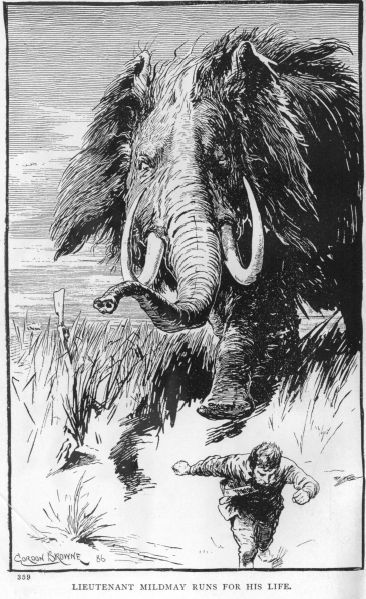
The four sportsmen pulled trigger almost simultaneously. The baronet and the colonel had each selected the same spot, the eye, as the object of their aim, and both had been equally successful, the shell in each case passing upward through the eyeball into the brain, exploding there and causing instant death. The professor’s fascinated gaze being riveted upon the wide-open mouth of his own particular adversary, he seemed to think that the yawning cavern thus revealed would be as good a place as any to empty his rifle into; and he did so—just in bare time to bring down his game and save himself from being trampled to a jelly. Mildmay, however, was not so fortunate. He seemed to think that it mattered very little where he directed his aim, so long as he made sure of hitting the brute somewhere, and he therefore fired point-blank at the chest of the mammoth which was menacing him. The shell sped true, but, encountering the thick shaggy coat and the enormously tough hide of the creature, failed to penetrate the body, and, exploding outside, only inflicted such wounds as further excited the already angry monster to a perfect frenzy of rage. Even at this critical moment there was time for another shot; but Mildmay most unfortunately forgot that he had nine loaded chambers still available, and instead of firing again he flung away his piece and ran for his life. The race was a disastrously short one, however; he had not run more than twenty yards when the huge creature was upon him. The great uplifted trunk gave one whirl in the air and descended with force enough to slay an ox. It struck poor Mildmay on his right side, and, but for the fortunate accident of his having at that moment tripped and fallen forward, the lieutenant would there and then have lost the number of his mess. As it was, he was sent whirling through the air like a cricket-ball, to fall senseless, and bleeding from the nose and mouth, fully forty feet away. The vindictive brute instantly turned short off with the evident intention of trampling his victim to death; but before he could reach the prostrate body a shell from the colonel’s rifle sent him crashing lifeless to the ground. The remainder of the herd, evidently dismayed at the slaughter of their companions, now abandoned a half-formed intention which they had at first manifested to stay and fight it out, and went off in full retreat with horrible trumpetings of anger and alarm.
The colonel was the first to reach the side of his unfortunate friend, the professor and the baronet joining him as speedily as their legs could convey them to the spot. Very fortunately von Schalckenberg, among his other multitudinous acquirements, possessed a very fair knowledge of medicine and surgery; and his skilful fingers were soon at work removing the lieutenant’s clothing so far as was necessary to investigate the nature and extent of his injuries. Singularly enough these were found to be comparatively trifling, a fractured rib and several very severe bruises being the sum of them. A little brandy forced between the lips of the sufferer soon restored him to consciousness, and he was able to sit up.
On attempting to rise to his feet, however, he experienced such severe pain that it was then and there resolved to let him remain where he was, two of his companions also remaining to mount guard over him and see that he came to no harm; whilst the third was to hurry back with all speed to the ship and bring her out on to the plain close by the spot where the accident occurred, when it would be a comparatively easy matter to convey the lieutenant from the spot where he then lay to his own bed on board the Flying Fish.
The professor, having first made Mildmay as easy and comfortable as circumstances permitted, volunteered for the service of moving the ship, explaining to his companions that, in the event of an attack of any kind, they, as seasoned sportsmen, would be able to far more effectually defend the wounded man than he could possibly hope to do; and then, Sir Reginald and the colonel quite concurring in this view, he set off for the bay, shouting back an assurance as he went that he would not be absent one moment longer than should prove absolutely necessary.
The worthy scientist was as good as his word; for in less than an hour from the moment of his departure the immense bulk of the Flying Fish was seen to rise into the air beyond the tops of the distant pine-trees, and, with her polished hull gleaming and flashing in the rays of the sun, to sweep gracefully round until she was heading straight in the direction of the anxious watchers. Under the professor’s able pilotage she was soon brought to the ground and secured within a dozen yards of the spot occupied by them, when it was the work of a few minutes only to convey the injured man to his own stateroom, where his hurts were at once properly attended to and himself made thoroughly comfortable.
As soon as luncheon was over Sir Reginald and the colonel set out for the spot were they had shot the bear in the morning, one of them being armed with a large-bore rifle and the other carrying a fowling-piece; and on their return somewhat late in the afternoon they bore not only the skin, skull, and claws of the defunct bruin, but also a goodly bag of ptarmigan. During their absence the professor had also been very busy, dividing his attention pretty evenly between Mildmay and the finest specimen of the slain mammoths, the latter of which he had succeeded in nearly half-denuding of its skin. With the assistance of his two able-bodied friends this task was completed by dinner-time; and by the corresponding hour next evening not only was the enormous hide undergoing the first stage of preparation for the taxidermist, but the indefatigable labourers had also succeeded in hewing out the tusks of the other slaughtered mammoths. For health’s sake the ship was then moved about a mile further inland, and the carcasses were left to the wolves, which had already gathered in large numbers in the vicinity.
Under the skilful treatment of the professor Mildmay made steady and rapid progress toward recovery from the very first; the baronet and the colonel had therefore no hesitation about carrying out a project which had been under discussion between them for the last two or three days, and which was neither more nor less than a pedestrian excursion to the far distant table-land which they had first sighted from the sea. They estimated that this goal of their journey, upon which they expected to find the actual site of the Northern Pole of the earth, must be about sixty miles distant from the ship; and they considered that the trip there and back would occupy them about six days. It would of course have been very much easier, and more convenient in every way, to have made the journey on board the Flying Fish; but the professor was busy with the preparation of his mammoth, the skin of which he had carefully stretched and pegged out on the ground alongside the ship, and was so averse to the losing sight of it, even for a few hours, that it was soon decided the Flying Fish must not be moved for the present. After all, the journey would probably not involve any very great amount of hardship; it simply meant camping out for five or six nights, or at least those hours of the twenty-four which did duty for night. And this the two seasoned hunters looked forward to as rather a pleasant change than otherwise.
The necessary preparations were all made on the previous evening, and after breakfast on the appointed day the two adventurers set out, taking leave of Mildmay—who was already out of bed again—and of the professor, who, to tell the truth, was heartily glad to be left to the uninterrupted prosecution of his task.
They were in light marching order, having resolved to carry nothing which they could possibly do without; their previous experience of the country had taught them that game was pretty plentiful, and that they might safely depend upon their guns for the supply of their larder; and their stock of provisions consisted solely, therefore, of a few biscuits and a substantial flask of brandy each. The temperature was decidedly mild, and had been so ever since their arrival at “Elphinstone Land,” with settled fine weather, and they therefore carried nothing in the shape of extra clothing save a light macintosh each, which they bore securely strapped on the top of their knapsacks. The remainder of their impedimenta consisted of a double-barrelled gun for each man—one barrel being rifled and the other a smooth bore—two cartridge belts, one for the waist and the other for the shoulder, fully stocked; a formidable double-edged hunting knife each; a capacious waterproof bag containing a reserve supply of cartridges, and a small stock of matches and tobacco.
Their road for the first five or six miles led up a gentle acclivity, just sufficient to make itself felt, but not steep enough to render walking difficult or fatiguing. Then came a stretch of flat country, bounded on each side by the projecting spurs of a range of rugged hills of fantastic outline which stretched immediately across their path at a distance of some three or four miles or so. The pedestrians had not progressed very far across this plain before their attention became arrested by a curious phenomenon. The atmosphere immediately behind the range of hills last mentioned was thick with fleecy vapour, now so thin that the distant table-land could be dimly seen through it as through a veil, and anon so dense that it assumed a decided cloud-like shape upon which the unsetting sun shone with dazzling brilliancy. This thickening of the vapour seemed to occur at tolerably regular intervals of about twenty minutes each, and was immediately preceded by a sudden silvery gleam succeeded by a most brilliant and perfectly formed rainbow. The periodical recurrence of this singular phenomenon under a perfectly cloudless sky of course greatly excited the curiosity of the pedestrians, and they pushed rapidly forward, eager to ascertain the cause.
As they advanced, the encircling hills thrust their projecting spurs further and further into the narrowing plain, their slopes became steeper and more rugged, and rocks began to crop out here and there with increasing frequency through the lessening soil. A corresponding change of course occurred in the character of the landscape; it grew increasingly picturesque and wild at every step, and at length the travellers found themselves at the mouth of a narrow rocky boulder-strewn gorge bounded on either side by titanic masses of volcanic rock, rugged and moss-grown, with little patches of herbage here and there, or an occasional stunted pine growing out of an almost imperceptible fissure. The only signs of life in this wild spot consisted of a diminutive musk-ox here and there cropping the scanty herbage half-way up the apparently inaccessible height in spots from which it appeared equally impossible for the creature to advance or to retreat.
Plunging into this defile, the travellers advanced with steadily increasing difficulty, the boulders with which their path was strewed growing ever larger and more numerous until at length the narrowing road became completely choked with them, and the only mode of progression was that of a slow, toilsome, dangerous scramble. Still the pair pushed resolutely on, every minute hoping that the difficulties of the journey would come to an end, and every minute less willing to turn back and again encounter the obstacles already surmounted. At length the path became so narrow that one enormous boulder sufficed to completely block the way, whilst the perpendicular rocky walls of the chasm towered so far aloft that only the merest thread of sky was visible; the air grew chill and damp, and so deep a twilight gloom pervaded the place that it was difficult to distinguish any object more than half a dozen yards distant.
The weary travellers looked at each other in dismay. Was this to be the ineffectual ending of that long and toilsome scramble through the ravine? There was just one single narrow crevice between the huge boulder which blocked their way, and one of the precipitous walls which pressed so closely in upon them—a crevice left by the irregular shape of the block, and affording barely space enough for a man of robust proportions to squeeze himself through—and they determined that, before retracing their steps, they would at least satisfy their curiosity so far as to creep through this crevice and see what lay on the farther side. The baronet with some little difficulty squeezed through first, and his exclamation of astonishment quickly took the colonel to his side.
The pair found themselves in a narrow rent between the two vertical faces of rock—the projections of the one accurately corresponding with the indentations of the other, and clearly demonstrating that, at some distant period of the earth’s history, that mighty chasm had been suddenly torn open by a great natural convulsion awful in its intensity beyond all power of imagination. The rent was roofed in as it were by boulders which thickly hung suspended and jammed in at varying heights between the almost touching walls of the rift; and the adventurous explorers could not repress a shudder as they glanced aloft at these huge masses and thought of the consequences to themselves which would ensue should a projecting corner just then yield and suffer its parent rock to come crashing down to the bottom. Their first impulse was to beat a precipitate retreat; their second, to go forward; for at only a few yards’ distance before them the rift closed altogether, except at the very bottom, where a low cavern-like fissure dimly appeared. A hasty consultation passed between them, resulting in a determination to go forward and explore the fissure.
Fortunately for their purpose they had, at an early stage of their difficulties, provided themselves with a couple of stoutish pine branches—wrenched from their parent stems and hurled into the ravine perchance by some winter storm—to aid them in surmounting the difficulties of the way, and these they now determined to utilise if possible as torches.
With some little difficulty the smaller ends of these brands were induced to kindle; but, once fairly ignited, they blazed up bravely, and thus provided with the necessary lights the adventurers boldly pushed forward and plunged into the recesses of the fissure.
Chapter Thirteen.
At the North Pole.
The opening was so low and so narrow, that for the first fifty or sixty feet the explorers were I obliged to creep forward on their hands and knees; then it widened and became gradually higher, so that by the time they had penetrated a couple of hundred feet they were able to resume a perpendicular attitude. The cavern, if such it could be called, still however remained so narrow that it was only here and there possible for them to walk side by side. It was also very tortuous; and the heights varied momentarily, at one time compelling them to stoop almost double in order to pass beneath some immense projection, and anon increasing so greatly that the light of their torches failed to reach and reveal the roof. They observed several rifts or crevices to the right and left of them as they pressed forward, but, with one or two exceptions, these were quite impassable, and those which were not so were still so cramped that they offered no inducement to deviate from the main passage.
Groping thus in semi-darkness over painfully rough and broken ground, a full hour was spent, and the colonel was just expressing his conviction that they must have traversed a distance of fully two miles when a faint glimmer of daylight revealed itself on one of the rocky walls of the passage; and, turning sharply round an angle, the pair suddenly found themselves once more within a few yards of the open air.
Emerging into broad daylight a most wonderful spectacle greeted the two adventurous explorers. They found themselves standing on a narrow strip of coarse sandy beach at the bottom of an immense basin, measuring fully a mile in diameter, the sides of which were formed of lofty precipitous cliffs of volcanic rock, so smooth and so nearly vertical that nowhere, at least in their immediate neighbourhood, could they discover a spot capable of being scaled. Before them, and occupying the whole bottom of this enormous basin, stretched a placid lake, the water of which was as clear as crystal. A thin filmy veil of vapour rose everywhere from the surface of the water, softening the hard outlines of the more distant landscape, and imparting an aspect of dreamlike witchery and unreality which it would certainly have otherwise lacked.
“Why, the water is tepid!” exclaimed Sir Reginald, plunging his hand into the lake and raising a small quantity of its water in his palm, to ascertain by taste whether it was fresh or salt.
The colonel thereupon thrust his hand down, and satisfied himself by experiment of the truth of his companion’s statement. It was even more than tepid, it was positively warm.
The two were still discussing the probable reason for this phenomenon when their attention was suddenly arrested by a curious movement of the water in the centre of the lake. First a few tremulous ripples appeared, spreading outward from the centre; then the disturbance became more pronounced, until, within a minute, an area of some thirty or forty yards in diameter had assumed an appearance of violent ebullition. Suddenly a jet of steam and spray shot up out of the centre of this disturbed spot; and then, before either of the two bewildered spectators could find time to remark upon so curious a phenomenon, an immense column of purest crystal water shot into the air to a height of at least two hundred feet, and, gleaming and flashing in the sunbeams as it soared away above the level of the encircling cliffs, spread out into a dome-like sheet, and, leaving behind it aloft a dense cloud of vapour of dazzling whiteness, fell again into the lake in the form of a shower of boiling water.
“A geyser!” exclaimed the baronet. “A geyser! and of such grandeur that the Great Geyser of Iceland, which I have seen, sinks into the utmost insignificance compared with it.”
“You are right,” acquiesced Lethbridge. “I too have seen the so-called Great Geyser, and admired it immensely; but after this—”
He finished with a shrug of the shoulders so expressive that there was not the slightest need for words to explain his meaning.
“We must bring the professor to see this,” he continued after a slight pause. “And—look here, Elphinstone—if you wish to intensely gratify the worthy man, call this geyser after him—‘The Von Schalckenberg Geyser’—eh? It doesn’t sound half bad, does it?”
The baronet laughingly consented to his friend’s proposal, the more readily as he knew that what Lethbridge had said as to the professor’s gratification was perfectly true; and then the wanderers resumed their journey, passing along the narrow strip of sand which divided the edge of the water from the base of the cliffs.
“There is no doubt, I think, that this geyser produces the cloud of vapour and the sudden flashing gleam, at tolerably regular intervals, which so aroused our curiosity this morning,” remarked the baronet as they plodded somewhat wearily along side by side over the sand.
His companion assented, and then they both paused, and finally flung themselves down upon the sand to witness a repetition of the eruption, the premonitory signs of which at that moment made their appearance. Then, when it was over, finding themselves very comfortable—and very hungry—they concluded to take luncheon before again moving; and, this being followed by a pipe, it was after four o’clock in the afternoon when they once more made a move.
A saunter for three-quarters of an hour along the margin of the lake enabled them to reach a spot almost directly opposite that where they had emerged into daylight from the interior of the cavern; and here they found the point of overflow from the lake. The chain of hills, which from their first point of sight had appeared to completely surround the sheet of water, was here pierced by a narrow valley, through which a small shallow stream, emanating from the geyser lake, made its devious way. As the course of this valley appeared to trend generally in a northerly direction, or toward the high table-land of which the travellers were in quest, and as, moreover, the valley appeared to offer the only exit from the lake basin in a northerly direction, the travellers decided to follow its course, which they did by keeping close to the margin of the stream. This mode of procedure, whilst it afforded them tolerably easy walking, also enabled them to estimate more accurately than they had hitherto done, the enormous quantity of water projected into the air by the geyser; for whilst the stream normally consisted of a body of water some ten feet wide by three or four inches deep, it was swollen—at regular intervals of twenty minutes each, corresponding with the periodical discharge of the geyser—into a rushing and foaming torrent of about ten feet wide and four feet deep, lasting thus for about a minute, when the stream again rapidly subsided to its previous depth.
For a distance of about two miles the stream wound its way over a bed of exposed rock, beyond which occurred a considerable stretch of coarse gravelly soil, thickly overgrown with long grass. The constant flow of water for untold ages through this bed of gravel had scoured out a channel nearly forty feet wide by half that depth; the banks being perfectly vertical, except in a few places where the gravel had crumbled away to a rather steep slope.
It was whilst the wanderers were passing one of these places that—the sun being by this time in the western quarter of the heavens, and his level rays falling directly upon the right bank of the stream—the baronet’s attention was arrested by the appearance of several bright sparkling gleams emanating from among the débris of the crumbling bank. He directed the colonel’s attention to these, whereupon the latter, seized with sudden excitement, scrambled down the bank, waded across the shallow stream, and in another instant flung himself down upon his knees on the gravel. Before the astonished baronet could follow him he leaped to his feet again, and, whilst he waved some glittering object above his head, shouted:
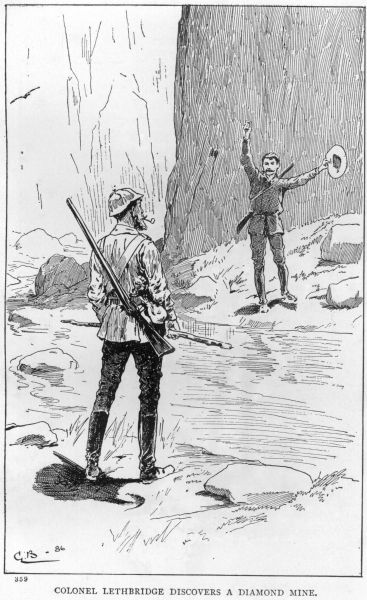
“Hurrah! hurrah! Elphinstone, my dear fellow, we are in luck to-day. Here is a fabulous fortune for every one of us, to be had merely for the trouble of picking up. This is a bed of diamondiferous gravel.”
Sir Reginald hastened across the stream, and, scrambling half-way up the bank, joined his companion on the spot where the latter had halted.
“Look here!” exclaimed Lethbridge, holding out for inspection a crystal as large as a pigeon’s egg; “what think you of that for a first find? And it is of the first water, too.”
The baronet took it in his hand and examined it critically. Then he handed it back with the remark:
“Well, my dear fellow, I am no judge of diamonds, at least in their natural uncut state; but if your supposition—that you have discovered a ‘bed’ or ‘pocket,’ or whatever you call it, of diamonds—be correct, I most heartily congratulate you.”
“You—congratulate—me?” gasped the colonel. “Why, my dear Elphinstone, what on earth do you mean? I am much obliged for your congratulations, certainly; but whether the diamonds here be many or few, we shall of course all share alike, so you may also congratulate yourself and our absent friends at the same time. And as to my supposition being correct, I have had too much experience at the South African diamond-fields to make a mistake in such a matter. Why,” he continued, looking round and picking up two or three more stones, “they are positively sown broadcast just here—an hour’s diligent work in this spot will make us all rich beyond the power of computation.”
“If that be the case,” returned the baronet, “then here goes to help you. But, mind, I am a rich man already; and not a single stone will I accept until all three of you are perfectly satisfied that you have abundantly sufficient for all your requirements.”
“Very well,” said the colonel. “Go ahead with that understanding if you like. I feel pretty confident that, even upon such terms, you will be able to take back to England, if all goes well, sufficient gems to make the future Lady Elphinstone—should there ever be such a personage—a diamond suite which shall cause her to be the envied of all beholders.”
Sir Reginald laughed gleefully. “I have never yet met a woman charming enough to induce me to yield up my freedom of action and movement for her sake, and I do not think it likely I ever shall,” he said.
Lethbridge shook his head a little doubtfully, but he was just then so busy digging down into the gravel with his hunting-knife that he had no breath to waste in the words of a disclaimer.
The baronet moved away to a distance of some twenty feet, and began poking about the gravel in a very careless, half-hearted sort of way, occasionally picking up and slipping into one of his capacious pockets such crystals as he thought likely to be of value.
Half an hour of this work sufficed him; and, rising to his feet, he cried: “Spell, ho! as our friend Mildmay would probably observe. Now, Lethbridge,” as he sauntered up to his companion, “let us compare the results of our labour.”
With this he flung himself down upon the gravel, and, plunging his hand into his pocket three or four times, produced a goodly little heap of gems of all sizes, ranging from that of a pea up to stones of fully one ounce in weight. Meanwhile the colonel brought his collection to light, and a very fine one it was, the stones being nearly twice as many as those gathered by the baronet, though many of them were much smaller.
“Is that all?” asked Sir Reginald.
“All?” echoed Lethbridge; “why, my dear sir, what would you have? If, after we have quite exhausted the ground here, my share amounts to such a handsome collection as this, I can assure you I shall be exceedingly well satisfied. You have made a most excellent haul too, but I think mine is the more valuable of the two.”
“Perhaps,” said the baronet, “this will go some way toward equalising our finds.” And as he spoke he quietly slipped his hand into his pocket and smilingly produced a stone fully as large as a hen’s egg.
The colonel took it into his hands and critically examined it for several minutes. It was most unmistakably a diamond, and that, too, of the very finest water, without the faintest trace of a flaw of any kind. He remained silent so long that Sir Reginald grew impatient and finally blurted out:
“Well, man, what is it? Is it a diamond, or is it merely a worthless piece of crystal? Why don’t you speak?”
“Simply,” said the colonel as he took a final look at it against the light and then handed it back, “because I am at a loss for words to express my admiration. It is a diamond, and, so far as I know, the finest that has ever yet been brought to light. Its value must be simply fabulous, and I heartily congratulate you on its discovery. Where did you find it? Was it deep in the gravel?”
“Come with me and I’ll show you,” was the reply; and, leading the colonel back to the spot, Sir Reginald quietly pointed to a hole about eighteen inches deep which he had excavated, and wherein lay, side by side, seven other gems equally as fine as the one he had produced.
“Help yourself, my dear fellow,” he said with a laugh, “and then let us be moving; we have our dinner to find yet, you know.”
Lethbridge fairly gasped for breath as his eyes first fell upon the magnificent jewels; but he lost no time in transferring them to his pocket, and then he turned to the baronet and asked what would be the best thing for them to do next.
“Let us simply continue our journey,” answered the baronet. “Of course if these stones which we have found are really diamonds, which I do not doubt, since you assure me that they are, I am as fully alive as yourself to the fact that a mine of incalculable wealth lies here at our feet. But it will not run away within the next few days. Let us finish our exploration and return to the Flying Fish. We will then move her to this spot, and all hands of us can then go to work at diamond-hunting in good earnest. Meanwhile, if these large stones are of such inestimable value, it seems to me that they are likely to prove, after all, practically valueless, for the simple reason that nobody will be found willing to spend the enormous sum which would enable him to become a purchaser.”
“That is very true,” answered the colonel with a laugh. “The stones of moderate size are what we must hope to realise upon; nevertheless, I shall not pass over such large ones as may happen to thrust themselves under my notice, for if we should fail to dispose of them, they will still come in handy as ornaments for our future wives, in which, notwithstanding a remark you made a little while ago, I somehow have a profound belief. Now, if you are ready to march, so am I.”
The pair accordingly shouldered their guns, and, turning their backs for the time being upon the diamond mine, continued their course down the valley.
Half an hour later a herd of reindeer was discovered browsing upon the lichens and mosses which grew plentifully on the rocky spurs of the range of hills from which the travellers were now emerging, and one of these was soon afterwards killed with little or no difficulty by means of a bullet from one of the rifles. To such experienced hunters as Sir Reginald and the colonel the task of “breaking up” the deer was an easy one, and, that done, they went into camp on the spot, and feasted royally that night upon reindeer tongue and marrow-bones.
The two following days passed uneventfully, that is to say the travellers met with no adventure specially worth recording. They passed through extensive tracts of pine forest, and saw plenty of game, to say nothing of such valuable fur-bearing animals as the sable and ermine, both of which animals seemed to be extraordinarily abundant, and late on the evening of the third day they found themselves at the base of the table-land, after a somewhat fatiguing but most enjoyable tramp.
The next day was devoted to a thorough examination of the somewhat remarkable object which they had set out to visit. It proved to be an enormous mass of rock, nearly circular in shape, about three miles in circumference, and towering aloft from the surface of the surrounding plain to a height of between three and four thousand feet, as nearly as could be measured without the aid of instruments. Their idea had of course been not only to reach this enormous rock, but also to ascend to its summit, but this they found to be quite impracticable, a journey round it demonstrating the fact that on all sides its cliffs rose perpendicularly and without a single break from the base to the flat summit. For that time at least they were defeated; but when they finally turned their backs upon “Mount Mildmay,” as they determined to name it, it was with a fixed resolve that, before many days were over, they would reach the summit with the aid of the Flying Fish.
Their journey back to the ship was marked by no more noteworthy incident than the sighting in the distance of a herd of mammoths, apparently the identical animals with which they had already had an encounter. They followed a somewhat different route from their outward one, making a détour round the group of hills which inclosed the “Schalckenberg Geyser,” and arrived at the ship late on the evening of the sixth day from their departure, weary and somewhat foot-sore it is true, but in all other respects in the very best of health, and with thoroughly pleasant memories of their journey.
They were of course welcomed with open arms by the two friends they had left behind them. Mildmay, under the professor’s skilful treatment, was rapidly advancing toward complete recovery; and as for the scientist himself, he was jubilant in the highest degree over the fact that he had been thoroughly successful in his preparation of that gigantic “specimen,” the mammoth. A great deal of desultory conversation of course took place within the first hour of the wanderers’ return; but at last the party settled down, and then followed a recital by Sir Reginald of the particulars of the journey. Both the professor and Mildmay were of course intensely interested in the story, but in different ways. Mildmay’s interest was merely that of the ordinary travelled man of culture, but von Schalckenberg was disposed to regard everything from the scientist’s view-point, and incessantly broke the continuity of the narrative by a whole string of questions which neither Sir Reginald nor the colonel could possibly answer. He was extravagantly delighted with both the description of the geyser and the sight of the diamonds, and it was difficult to say which pleased him most; perhaps the most gratifying circumstance to him was the information that the geyser had been named after him, at all events he begged most pathetically that the projected visit to this most interesting object might be allowed to take precedence of that to the diamond mine.
Such being the case, it will readily be understood that no pen of mere ordinary graphic power could hope to adequately portray the ecstasy of enthusiasm with which the worthy man, two days later, actually viewed the geyser itself from so advantageous a stand-point as the deck of the Flying Fish; such a task is utterly beyond the powers of the present narrator and must be left to the vivid imagination of the indulgent reader. For over two hours did that amiable and learned scientist sit immovably in his deck chair with a meerschaum of abnormal dimensions in his mouth, and with his eyes beaming in a rapt admiration, which was almost adoration, upon the magnificent spectacle; and it was not until he had been solemnly assured by the others that he would be excused from all participation in the task of diamond-hunting and have full liberty to return to the geyser and spend there the whole of the time during which the rest of the party might be so engaged, that he consented to leave the spot at all.
Three days were spent at the diamond mine; and, with the aid of proper tools obtained from the ship, this time proved sufficient for the accumulation of such a hoard of priceless gems as would, if disposed of at even half their market value, realise a magnificent fortune for each of the lucky finders.
The next move was to the summit of the flat tableland, which was of course easily reached by the Flying Fish. It proved to be, as had already been surmised, merely an enormous mass of bare rock, without a scrap of soil or vegetation of any kind about its surface, and useful only as a citadel, into which, had it been planted in some more accessible spot on the earth’s surface, it would undoubtedly have been converted, in which case it would have eclipsed even Gibraltar itself in the matter of impregnability. Useless as it was, however, where it stood, its summit afforded an admirable look-out; and from that point of vantage the travellers made the discovery that “Elphinstone Land” was an island, the horizon at that elevation being bounded by the sea on every side. The rock was roughly circular in shape, with a circumference of about three miles, and the travellers made the circuit of the summit in about an hour and a half, pausing at frequent intervals to admire and enjoy the magnificent panorama of woods and hills and streams which lay spread out beneath them. Herds of elk, reindeer, and musk-oxen were seen dotted about here and there on the plains below, as well as a skulking wolf or two, a few Arctic foxes, and other wild animals. The herd of mammoths—apparently the only herd in the island—was also seen; and, with the aid of their telescopes, the travellers were also able to make out, far away at sea, certain dark moving spots which, from their alternate appearance above and disappearance beneath the surface, they judged to be whales.
The chief business of the travellers, however, on the summit of “Mount Mildmay” was to ascertain whether or no the North Pole of the earth was or was not situated within its circumference. This was rightly regarded as a matter of such great importance that several days were unhesitatingly devoted to its settlement; and Mildmay, the professor, and Colonel Lethbridge were busy from breakfast time in the morning until dinner-time at night, making the most careful observations and working out the necessary calculations. These were at length satisfactorily completed—not one moment too soon, for the sun was daily dropping nearer and nearer to the horizon—and the trio were enabled, not only to say that the North Pole was contained within the limits of the summit, but to plant their feet upon it and to say unhesitatingly and authoritatively:
“This is the North Pole!”
The position having thus been accurately determined, the next thing was to mark the spot.
With this object a large triangle was first described about it, and a point was carefully marked off on each of its sides in such a position that a line tightly strained from such point to the opposite angle of the triangle would pass directly through the pole. This done, an excavation six feet deep in the solid rock was made, and in its bottom was deposited a tightly-sealed bottle containing a small parchment scroll, on which was inscribed a brief statement of the circumstances connected with the discovery of the spot, with the date, and the signatures of the joint discoverers. This bottle was carefully packed in and buried up with small fragments of rock, and made finally secure by a covering of excellent concrete, the materials for compounding which had been carefully and with infinite labour prepared by the professor. Then, when the concrete had become properly hardened, a substantial flagstaff of aethereum was stepped into the hole in a position accurately corresponding with the North Pole of the earth, and also made secure by being built in or “set” in concrete, which completely filled the hole. The professor next, with the aid of a diamond, engraved on the staff, in bold conspicuous characters, at a height of five feet from the ground, the words:
“This staff marks the exact position of the North Pole of the earth.” And finally, amid cheers from the rest of the party, Sir Reginald Elphinstone ran the Union Jack up to the staff head and knotted the halliards so that it would remain there, thus formally claiming for the British nation the honour of actual discovery.
Chapter Fourteen.
Southward Ho!
So important a matter as the localisation of the Pole having thus been satisfactorily disposed of, it was next resolved to effect a thorough exploration of the entire island, including its circumnavigation. This, with the aid of the Flying Fish, was pretty effectually accomplished in a fortnight, after which the ship returned to her original anchorage in the harbour, on the south side of the island, now named Lethbridge Cove.
Both the forests and the adjacent waters of this favoured hyperborean land were found to be literally swarming with game and other animals, some of which afforded in their flesh a welcome change from the preserved meats with which the ship’s larder was stocked, whilst the chief value of others lay in their “pelts” or skins; and, the hydrographic features of the island having been carefully ascertained and recorded, the party, with the exception of von Schalckenberg, now gave themselves up unreservedly to the pleasures of the chase. The professor’s tastes lay more in the direction of geology, mineralogy, and botany, though he was also an enthusiastic naturalist, and thus, whilst he sallied forth every morning armed with gun, hammer, specimen box for his botanical treasures, and bag for his minerals, the three others went their several ways, either armed with traps and guns in search of game, or in one of the boats, duly provided with dredger, net, and line, in quest of ocean spoils.
Thus employed, the short remainder of the Arctic summer swiftly passed away; the sun daily sank nearer and nearer the horizon; the temperature fell; frost made its appearance, hardening the soil beneath the tread and coating the pools and puddles and morasses with an ever-thickening sheet of ice and the vegetation with a delicate tracery of silver; and at length the day came when the anchor was lifted and the Flying Fish moved some few miles out to sea to enable her occupants to witness the final disappearance of the sun beneath the southern horizon. Some anxiety had been experienced by the travellers for the last few days, as clouds had been gathering in the sky, with every indication of a speedy change of weather, and it was feared that the sight, which they had long been promising themselves, would, after all, be denied them; but at the last moment, or rather at the last hour, fortune proved favourable to them; the cloud-bank broke up along the south-western horizon, the vapours grouped themselves into a series of imposingly picturesque masses, all aflame with the most gorgeous tints of sunset, and from a little after eleven o’clock until shortly after noon the thin golden upper edge of the luminary’s disc was visible sweeping imperceptibly along the purple horizon, until finally, as it reached the point of disappearance, it glimmered feebly for a moment, and, whilst the travellers stood watching it bare-headed, sank out of sight. The Arctic day was over, and the six months of night and winter had set in. Not, it must be understood, that darkness set in immediately—far from it; for several succeeding days there ensued a weird, delicious, magic, and ever-deepening twilight; but by the eighth day after the sun’s final disappearance this also had vanished, and night reigned with undisputed sway.
And now, too, winter laid its icy hand with unrelenting grasp upon this beauteous polar island; not, however, to desolate it with storm and howling tempest and the deadly cold with which he visits less favoured climes, but only to add newer and more unaccustomed beauties to the scene. It is true that for the first fortnight after the disappearance of the sun the weather wore a more or less unsettled aspect. The sky became overcast with a canopy of cloud which, light and fleecy at first, steadily increased in density; and at length, on the travellers emerging from the pilot-house one morning after breakfast, they found the motionless air thick with falling snow, which, settling noiselessly down, had already covered the deck to a depth of some three inches. The darkness was of course intense, so much so, indeed, that it was impossible to see for a distance of half the length of the ship, and for all that they could see of the land it might as well have been a hundred miles distant.
This state of things lasted without intermission for the ensuing four days and kept the travellers close prisoners on board their ship. This, however, they in nowise regretted; indeed this short breathing space was positively welcome to them, for they had plenty of work to do; and, shut up warm and snug on board the Flying Fish, with all her saloons, cabins, and corridors brilliantly illuminated by the electric light, they busied themselves in carefully preparing and curing the many unique specimens of natural history and the various choice skins and furs they had already accumulated.
But on the morning of the fifth day they found that another change of weather had taken place, and, on going out on deck, a glorious spectacle greeted their delighted eyes. The snowfall had ceased, the sky was once more cloudless, and the deep sapphire blue was studded with countless myriads of scintillating stars that gleamed with the cold sharp lustre which is seen only in periods of very severe frost. But it was not the brilliant starlight, beautiful though that was, which drew ejaculations of wonder and delight from the lips of the entranced beholders; it was another and a rarer sight which excited their admiration. As they looked, the sky immediately overhead, and for a distance of some twenty degrees all round from the zenith, became tinged with the softest and most delicate rose-colour, bordering which there suddenly appeared a broad circle of flashing rays of light, blood-red at the inner rim of the circle, and merging from thence through the richest purple into brilliant blue, and from thence, through green of every conceivable tint, into a clear dazzling yellow at the points of the rays. These superbly-tinted rays were animated by a constant motion; now withdrawing themselves into the main body of the circle as into a sheath, and anon darting out again until they almost reached the horizon; and so delicately transparent were they that, notwithstanding their brilliant colour, the stars were distinctly perceptible through them. This magnificent spectacle continued for a full hour with ever-increasing brilliancy, suffusing sea and land with a quivering glow of prismatic light, and imparting an aspect of magic, unearthly, indescribable beauty to the scene. Then the colours gradually faded, the flashes became more feeble, and the darting rays ever shorter and shorter, until they finally faded completely away, to be succeeded shortly afterwards by the keen silvery radiance of the young crescent moon which slowly rolled upwards from the horizon, and, shedding her subdued light upon the snow-clad landscape, invested it with an air of bewitching mystery and unreality which was distinctly heightened by the profound impressive silence of the long Arctic night.
With nature thus presenting herself to the travellers in so novel and attractive a guise a month swiftly passed away, during which they tended their traps or prosecuted their hunting expeditions under the glorious light of the aurora, the cold steel-like radiance of the silver moon, or the dim mysterious starlight; alternating these open-air employments with assiduous devotion to their easels, in sufficiently clever but altogether unsuccessful efforts to adequately transfer to canvas the entrancing beauties of the Arctic scenery and phenomena which constantly charmed their delighted eyes.
Toward the end of October, however, the temperature had fallen so low that ice had begun to form all along the coast-line of Elphinstone Land, and the weather had taken a decided change for the worse. Moreover, the party had accumulated so much extra weight in the shape of valuable skins, natural history specimens, and other curiosities, as to seriously affect the buoyancy of the Flying Fish as an aerial ship; and they therefore at last—more than half-reluctantly—came to the determination to desert the enchanted region of the Pole and wend their way southward.
Accordingly, on the morning of the first day of November the anchor was hove up; the vapour was turned into the air and water chambers, producing an almost perfect vacuum; and, rising into the air to an altitude of about ten thousand feet, the Flying Fish turned her nose southward, and, illumined by the dazzling effulgence of the most glorious aurora the voyagers had ever seen, was sent ahead at the utmost limit of her speed.
It was determined to return to England forthwith, and without pause or stoppage of any kind, unless some unforeseen necessity should arise, the object being to dispose of their various acquisitions previous to a renewal of their wanderings. The elevation at starting was therefore maintained, and the ship pursued her headlong flight to the southward with only one man—Mildmay—in the pilot-house to take charge and enact the part of look-out; the remainder busying themselves in packing up their various treasures for transference to safe-keeping on shore. The pilot-house, like every other habitable portion of the ship, was maintained at a comfortable temperature by means of pipes communicating with the vapour-generating chamber in the engine-room below; and, reclining at his ease in a most luxurious lounging chair, the lieutenant had nothing to do but maintain a vigilant lookout through the circular windows, and solace himself with his pipe meanwhile. The ship’s speed through the air was about one hundred and twenty miles per hour; and by their calculations they expected to overtake the sun in about latitude 79 degrees 49 minutes north; if, therefore, the Flying Fish maintained her speed, the sun ought to appear once more above the horizon in four hours thirty-five and a half minutes from the time of starting—Lethbridge Cove being situated in exactly 89 degrees 0 minutes North latitude. It was exactly nine o’clock in the morning when they started; consequently, if their calculations were right, the sun ought to make his appearance at thirty-five and a half minutes past one; and it was this phenomenon for which Mildmay was chiefly watching, his companions being anxious to have the unique experience of seeing the luminary rise an hour and a half past mid-day. And it was for this reason, and in order that they might not on the one hand be taken by surprise by being hurried southward on the wings of a favouring gale, or on the other hand be delayed by a possible adverse one, that the elevation of ten thousand feet had been selected, this being well within the limits of the neutral belt, or zone of motionless air.
Not to be caught napping, Mildmay extinguished the electric light in the pilot-house as the musical gong of the clock suspended therein struck the hour of one; after which he rose to his feet and took a good look round on all sides. There was, however, nothing to be seen save a vast sea of cloud beneath his feet and on all sides, as far as the eye could reach, softly illumined by the light of the star-studded heavens above. But even as he looked a just perceptible paleness in the deep velvety blue of the sky to the southward attracted his attention. He looked more intently. Yes, there could be no mistake about it; that pallor of the southern sky was undoubtedly the first faint indication of the approaching dawn; and he at once struck two strokes—the appointed signal—upon the great mellow-toned bell which hung in the pilot-house.
The call was promptly answered by the appearance of his three fellow-voyagers, who, abandoning whatever they had in hand, rushed helter-skelter up the saloon staircase and into the pilot-house, anxious to lose no scrap of that, to them, now novel sight, sunrise.
Rapidly yet imperceptibly the pale dawn stole upward into the sky; the lustrous stars waxed dim before it, and one by one twinkled out of sight; a faint roseate flush tinged the sky along the horizon, brightened first into a rich orange, then into purest amber, the colours being faintly reflected on the most distant edges of the vast cloud-bank floating below; and at length, just as the hands of the clock marked thirty-five minutes after one, an arrowy shaft of pure white light shot upward into the sky, swiftly followed by another and another; and then, with a dazzling flash of golden light, the upper edge of the sun’s disc rose slowly into view, soaring higher and higher until the whole of the glorious luminary was revealed, whilst the rolling sea of cloud above which the Flying Fish skimmed glowed softly beneath his beams with varying tints of the most exquisite opal.
This return to the realms of day had a curious effect upon the travellers. They had not been conscious of the least depression of spirits consequent upon their sojourn of more than a month in the region of uninterrupted night, but it must have affected them, however unconsciously, to no inconsiderable extent, for now, at the first glimpse of sunshine, their spirits rose to an extravagant height; they felt as though they had just effected their escape from some terrible doom, and they were irresistibly impelled to shake hands with each other, to exchange congratulations, and to talk all together, laughing uproariously at even the feeblest attempt at jocularity.
The thoughts of the quartette were, however, speedily diverted by the ever-imperturbable George, who now sounded the gong for luncheon, and the whole party at once trundled below, leaving the ship to take care of herself, as they very safely might, seeing that she was now travelling down the “first” meridian, or that of Greenwich, with no land ahead nearer than the Shetland Islands, more than a thousand miles distant.
After luncheon, however, the whole party returned to the pilot-house, where they spent the time smoking and chatting, talking over their past adventures, and maturing their further plans, until sunset, when, their short day having come to an end, they once more retired below to complete their preparations for a flying visit to London previous to a resumption of their wanderings.
The question of the disposal of the Flying Fish during the short period of their absence from her had greatly exercised their minds for a time. They were anxious still to avoid for the present, if possible, anything approaching to notoriety or the attraction of public notice to their proceedings, and they felt that this could scarcely be done if they ventured to take so singularly modelled a ship into any British port, however insignificant; moreover, there are very few harbours or havens on the British coast capable of receiving a ship with such an excessive draught of water—namely, forty feet—as that of the Flying Fish. So they finally decided to sink her off the Isle of Wight (first of all, of course, taking the precaution to accurately ascertain the bearings of her berth), and to proceed to Portsmouth in the two boats, taking with them the spoils of their polar expedition, and trusting to their own ingenuity to evade such suspicions and speculations as might be engendered by the somewhat singular circumstances connected with their arrival, especially as the hour—about half-past four o’clock on the following morning—at which they would reach the Wight would be favourable to the execution of their plan.
The night was intensely dark, with a fresh north-easterly gale blowing, accompanied by frequent rain-squalls, as the voyagers found on descending to within about a thousand feet of the level of the sea at midnight, in order to discover, if possible, their whereabouts. But they could see nothing save the lights of a few ships and fishing craft dotted about here and there; the appearance of the latter indicating that they had already approached to within a short distance of the land; nor did they sight anything by which to fix their position until first the light on Flamborough Head and then that on Spurn Point flashed into view out of the murky darkness. Then indeed, having satisfactorily identified those lights, they knew exactly where they were; the course was altered and shaped anew directly for the spot of their intended descent, and the ship once more soared to her former elevation.
At twenty minutes after four o’clock a.m. a second descent was made, when it was found that they were passing over hilly country which they surmised to be that situated about the borders of the three counties of Surrey, Hants, and Sussex; and almost immediately afterwards the lights on the forts in progress of construction at Spithead came into view, together with the anchor-lights of two or three men-o’-war in the roadstead, and they knew that the first part of their journey was almost accomplished.
Precisely at half-past four o’clock the Flying Fish took the water about two miles to the eastward of the “Noman” fort, and her occupants at once began the search for a suitable berth for her—a berth, that is to say, in a position where she would not be likely to be discovered by the fishermen, and where the depth of water would be sufficient to permit of the largest man-o’-war passing over her submerged hull without striking upon it. To discover such a spot proved by no means an easy task; but it was accomplished at last, though at a distance considerably farther out to sea than they had bargained for, and at half-past five o’clock her anchor was let go in the selected berth. Cross bearings were then most carefully taken and entered in each of the travellers’ pocket-books, after which the next task was to get their varied spoils into the boats and the boats themselves into the water. This was soon done, and then all hands, including George and the chef, but excluding the professor, entered the boats and shoved off a few fathoms from the ship’s side, where they anchored.
The first faint signs of dawn were just appearing in the eastern sky when it became apparent to those in the boats that the huge bulk of the Flying Fish was disappearing. Steadily but imperceptibly she settled lower and lower in the water until her deck was awash and nothing but her pilot-house remained visible in the dim ghostly light of the early morning. A minute more and this too had disappeared, and, as the waves washed over its top, the baronet carefully lowered over the side of his boat a rope-ladder, well weighted at the bottom and with an unlit electric lamp attached to it in such a position as to hang suspended at a height of about six feet above the bed of the sea. This lamp was of course attached to a battery in the boat, and as soon as Sir Reginald felt the weights at the foot of the ladder touch bottom he sent the current through the insulated wire, a patch of vivid white light, like a patch of moonlight, immediately shining out beneath the waves and showing that the lantern was properly performing its duty. Then they waited.
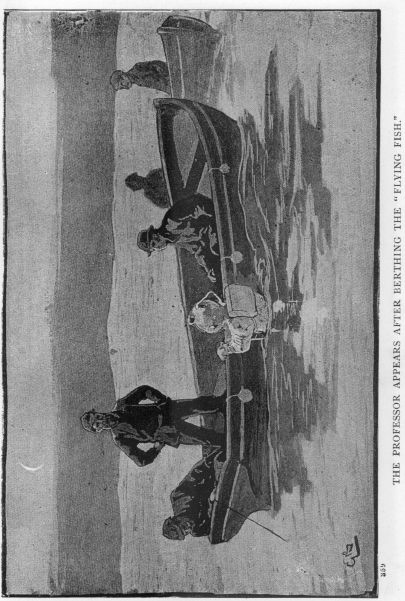
Not for very long, however. An interval of perhaps five minutes elapsed, and then a quivering jerky motion became communicated to the rope-ladder, followed a minute later by the appearance of von Schalckenberg in his suit of diving armour. He stepped quietly into the boat, and whilst he busied himself in doffing his glittering panoply, the lamp was extinguished, the ladder hauled inboard, the anchors tripped, and the two boats made their way slowly to the westward, heading in for Nettlestone Point and the Solent.
They arrived at Portsmouth about half-past seven o’clock, and Sir Reginald at once made his way to the Custom House to get the boats’ cargoes cleared. He was fortunate enough to find in the collector a man with whom he had had several previous transactions, and who was consequently pretty well acquainted with him. This facilitated matters greatly, and by half-past eight the duty (a very considerable sum) had been paid and the goods passed, so that nothing further remained but to land everything and have it conveyed to the railway-station for transmission to town. This done the two boats were taken into “The Camber” and put under the care of a trustworthy man, after which the party breakfasted at the “George,” proceeding to town directly afterwards by the twelve-o’clock express.
Chapter Fifteen.
A Troop of Unicorns.
A week later, the four friends once more found themselves beneath the roof of “The Migrants’”, where it had been arranged that they were to meet and take luncheon together prior to their journey down to Portsmouth to rejoin the Flying Fish. On comparing notes it was found that each had, according to his own views, made the best possible use of his time, the professor having not only placed the mammoth’s skin in the hands of an eminent taxidermist, but also prepared and read before the Royal Society a paper on “The Open Polar Sea,” which had created a profound impression on the collective mind of that august body; Lethbridge and Mildmay had seized the opportunity for paying a too-long-deferred visit to their respective mothers; and Sir Reginald had, acting upon the best obtainable advice, conveyed the four parcels of diamonds belonging to the party over to Amsterdam, where they had been left in the care of a thoroughly trustworthy diamond merchant, with instructions that certain of the jewels were to be cut and set in the handsomest possible manner, whilst the rest were to be disposed of as opportunity might offer. The furs were also satisfactorily got rid of; some of them having been sold, and the remainder (consisting of all the choicest skins) placed in the hands of the furriers to be cured and taken care of until their owners should return to claim them.
The luncheon was a very lively meal; the conversation naturally turning to the last occasion upon which the travellers had met there; and upon its conclusion the four friends chartered a couple of hansoms, which conveyed them to Waterloo station in good time for the Portsmouth express.
On their arrival at the Harbour station they found George and his French friend, the cook (both of whom had been granted a week’s leave), dutifully awaiting them on the platform. The boats, under the care of the man who had been placed in charge of them, were lying alongside the adjacent slipway, in accordance with a telegraphed arrangement which had preceded the travellers; and, entering these, the party at once proceeded down the harbour, past Southsea and its castle, and out toward Nettlestone Point. It was by this time quite dark, save for the light of the young moon, which was already near her setting, and the boats were consequently at once urged to their full speed in the direction where the Flying Fish had been left.
Having originally taken their cross bearings wholly from the shore lights, the voyagers had now no difficulty whatever in placing the boats in their proper position. Arrived on the spot, a sounding-line was dropped over the side, and the first cast showed that they were floating exactly over the submerged ship. The boats were therefore allowed to drift with the tide until they were clear of the Flying Fish, when Sir Reginald dropped his anchor and ladder, and the professor, who had already routed out from the stern locker and donned his diving armour, stepped over the side, adjusted his weights, and quietly disappeared beneath the surface of the water. A lapse of perhaps a minute occurred, when the ladder was found to be hanging limp and loose; a bright white light flashed upward through the water for a moment, as a signal from the professor that he had reached the bottom all right; and then the luminous beam was seen moving slowly forward over the bottom in the direction of the submerged ship. Suddenly the light vanished.
“He has reached the ship,” the baronet reported to those in the other boat, who were alternately drifting with the tide and moving up against it to maintain an easy speaking distance from their consort. A quarter of an hour passed, and then a brilliant, dazzling flood of light streamed out for about ten seconds at apparently no great distance below the surface, then vanished again.
“All right,” remarked Sir Reginald as soon as he saw this; “he has reached the pilot-house. Now, George, up with the anchor, my good fellow, and we will back off a few yards out of harm’s way.”
The boats accordingly did so, von Schalckenberg allowing them ten minutes for the operation; then, with a sudden rush and swirl of water, the huge bulk of the Flying Fish appeared above the surface, looming black, vast, and mysterious against the faintly luminous horizon. A moment more, and the windows of the pilot-house shone out a series of luminous discs against the darkness, showing that the professor had lighted up the interior, and that individual himself appeared on deck hailing the invisible boats with:
“It is all right; everything is just as we left it, and you may come on board as soon as you like.”
Ten minutes later the boats had been hoisted in and stowed away, and the Flying Fish, at an elevation of some three hundred feet above the sea-level, was moving to the southward and eastward across the placid waters of the Channel, at the moderate rate of some five-and-twenty miles per hour. At midnight, however, after a little music and conversation, the pace was quickened to about one hundred miles per hour; the altitude was at the same time increased to ten thousand feet; the course was set to south, by compass, and the travellers, with a feeling of perfect security, retired to rest, confident that the professor’s clever automatic devices would not only maintain the ship at her then elevation, but would also steer her straight in the required direction.
On the following morning at daybreak the travellers found themselves hovering over the blue Mediterranean, with the African coast at no great distance, and a town of considerable size directly ahead. This town was soon identified as Tunis (near which is the site of ancient Carthage), and they shortly afterwards passed over it, not unnoticed by the inhabitants, who, with the aid of the telescope, could be seen pointing upward at the ship in evident consternation. Then on over the chain of hills beyond the town, and they once more found themselves with the sea beneath them, the ship’s course causing her to just skirt the Gulf of Hammamet, whilst they obtained a splendid view of Lake Kairwan and the three streams which it absorbs. Then past Capes Dimas and Kadijah, across the Gulf of Cabes, and so on to Tripoli, which was reached and passed soon after the party had risen from breakfast. At this point the Mediterranean was finally left behind, and the ship’s speed was shortly afterwards reduced to a rate of about fifteen knots through the air; her altitude being also decreased to about one thousand feet above the ground level.
The course was now altered to about south by west (true), and the travellers passed slowly over the Fezzan country, the borders of the Libyan Desert, the Soudan, and Dar Zaleh; the prospect beneath and around them varying with every hour of their progress, from the most fertile and highly cultivated district, dotted here and there with straggling villages, to the most sterile and sandy wastes. They saw but little game during this portion of their journey, and only descended to the ground at night, when the vessel was secured by her four grip-anchors during the hours which her crew devoted to rest.
This uneventful state of affairs continued until they arrived in ten degrees of north latitude and twenty degrees of east longitude, when they found themselves fairly beyond the limits of even the most rudimentary civilisation, and in a country of alternating wooded hill and grassy, well-watered plain, which had all the appearance of a very promising hunting district. The country was very thinly populated, the native villages being in some cases as much as fifty or sixty miles apart, whilst in no instance were two villages found within a shorter distance than twenty miles. The inhabitants were, as far as could be seen, fine stalwart specimens of the negro race, evidently skilled in the chase and, presumably, also in all the arts of savage warfare; but it was not very easy to form a reliable opinion upon their habits and mode of life, as whenever the Flying Fish appeared upon the scene they invariably took to their heels with yells of terror and sought shelter in the thickest covert they could find.
As the travellers penetrated further in toward the heart of this district, their anticipations in the matter of game became ever more abundantly realised; vast herds of antelope of various descriptions, and including more than one new species, being constantly visible from the ship’s deck whenever she was raised a few hundred feet in the air. And, in addition to antelope, a few elephants, an occasional herd of buffalo, a troop or two of wild horses, a rhinoceros, a family of lions, a skulking leopard, or a gorilla, was a by no means unusual sight; to say nothing of the countless troops of monkeys and other unimportant game with which the country seemed to be literally swarming.
Such a district seemed to be the very realisation of a sportsman’s or a naturalist’s dream of paradise; and it was quickly decided that a halt should be called, and at least a few days devoted to the pursuit of game and the collection of natural history specimens. A suitable spot in which to bring the Flying Fish to earth was accordingly sought for, and found in a small open space of about thirty acres, almost entirely surrounded by bush, and in close proximity to a tiny streamlet which emptied itself into a small shallow lake about half a mile distant from the selected site.
Here they hunted with moderate success for a week, not killing any very large amount of game—for they soon discovered that they could do very little without horses—but managing, by patient stalking and the secreting of themselves in artfully devised ambushes, to secure a few choice and rare skins and horns, besides the tusks of eight elephants and the plumage of over a dozen ostriches.
On the day of their departure from this temporary halting-place, however, a piece of surprising and wholly unexpected good fortune befell them. It was one of those especially glorious mornings which are never encountered anywhere but in the tropics. A very heavy dew had fallen during the night, revivifying the vegetation parched by the fervid heat of the previous day, and causing the foliage and flowers to glow for a brief period in their brightest and freshest tints, whilst they exhaled their choicest odours; and a light cool northerly breeze imparted a temporary freshness to the early morning air, as yet uninfluenced by the scarcely risen sun.
They had “broken camp,” and had risen to a height of about one thousand feet above the ground level, preparatory to the resumption of their southward journey. An awning was spread over the deck, fore and aft, under the protecting shade of which they proposed to take breakfast; and whilst waiting for the meal to be served, the travellers, each seated in a deck chair, were amusing themselves by inspecting the magnificent prospect which lay spread out around and beneath them, the more distant parts of which were being diligently investigated with the aid of their telescopes.
They were thus engaged when George announced that breakfast was served; and the professor was just on the point of laying down his instrument, preparatory to seating himself at the table, when a small group of animals, which were grazing upon the crest of a distant eminence, swept for a moment across his field of view. A certain something of peculiarity and strangeness in the appearance of the creatures caused the motion of the telescope to be arrested in mid-sweep, and in another instant von Schalckenberg, deaf to the calls of his companions and the respectful reminder of the faithful steward, had his instrument focused full upon the group of animals. They were, however, a long way off, and the mist was now rising so thickly from the surface of the ground that it was impossible to clearly distinguish them; so the professor contented himself by going to the pilot-house and directing the ship’s head straight toward the point occupied by the animals. After which he carefully noted the time, made a little mental calculation, and seated himself at the breakfast table, with his watch carefully propped up before his plate.
His friends were, by this time, so accustomed to the professor’s little peculiarities that no one thought of asking any questions, feeling sure that an explanation would come all in good time. Neither did they make any remark or evince any surprise, beyond a shrug of the shoulders and an amused elevation of the eyebrows, when the savant, glancing at his watch, hastily rose from the table, and, in his absent-mindedness carrying with him a fork with a morsel of venison-steak impaled upon its prongs, hurried away to the pilot-house. A moment or two later a gentle jar was felt as the ship came to the ground; but the mist was by this time so thick that it was difficult to see objects more than a couple of hundred feet distant, and all that could be clearly made out was that they had stopped close to a clump of bush of considerable extent.
By the time that breakfast was over, the morning mist, true to its proverbially evanescent character, had completely passed away, and the travellers found that they had come to earth on the crest of a slight eminence, from which an uninterrupted view, of several miles extent over the surrounding plains, could be obtained in every direction save one, namely, that between which and the ship stretched the belt of bush.
And now came the professor’s explanation:
“You have, doubtless, wondered, gentlemen,” said he, “why I have thus early, and without warning, interrupted our journey. I will now tell you. I have lately been glancing through the book which, you will remember, I succeeded in recovering from the wreck of the Daedalus, and therein I met with a passage of a most surpassingly interesting character. This passage related to the rumoured penetration into this region of a certain unnamed traveller who is stated to have positively asserted that he here saw, on more than one occasion, an animal absolutely identical with the fabled unicorn. This remarkable statement at once reminded me that I had, many years ago, seen a paragraph in a Berlin paper to a similar effect. The statement was accompanied by an expression of strong doubt, if not of absolute incredulity, as to its veracity; an expression which impressed me at the time as being most cruel and unfair to the claimant for the honours of a new discovery in natural history; since the discovery was alleged to have been made in a region which had never before—nor, indeed, has since, until now—been penetrated by civilised man; or from which, at all events, no civilised traveller has ever again emerged, if indeed he had been successful in penetrating it. Such being the case, as the course we were pursuing would take us through the very heart of this unknown and unvisited region, I resolved to maintain a most careful watch for these creatures. I have done so, and I am sanguine that I have this morning actually seen a troop of them. Unfortunately, the mist and the distance together prevented a clear and distinct view of the animals to which I refer; but, whatever they may be, I have an idea that they are at this moment feeding at no great distance on the other side of this belt of bush. Should such be the case, we have the wind of the animals and ought to have no great difficulty in stalking them; a proceeding which, if patiently and cautiously executed, ought to enable us not only to secure a specimen or two, but also to obtain a slight insight into the habits of the creature.”
The trio addressed felt, one and all, slightly incredulous as to the realisation of von Schalckenberg’s sanguine surmises; but, remembering the mammoths, they prudently kept their own counsel, and hastened away to secure their rifles and to make their preparations for a possibly long and tedious stalk. They exchanged their suits of dazzling white nankeen for others of a thin, tough serge of a light greenish-grey tint, which admirably matched the colour of the long grass through which the stalk would have to be performed; and, in about a quarter of an hour from the commencement of their preparations, found themselves standing outside the huge hull of the ship, and in its shadow, making their final dispositions for the chase. These arrangements were soon made. Sir Reginald and the professor were to constitute one contingent, Lethbridge and Mildmay the other; these last being impressively instructed by von Schalckenberg to take up the most advantageous position possible for intercepting the flight of the game, but on no account to shoot until the others had first opened fire.
The two parties then went their several ways, reaching, at about the same moment, the opposite extremities of the bush belt. The utmost caution now became necessary in order to avoid startling the game, if indeed the professor was right in his conjectures, and the hunters sank down upon their knees and began a slow and tedious progress through the long grass. The professor was fairly quivering with excitement, and all his companion’s efforts were ineffectual to prevent his rising cautiously to his feet as soon as they had cleared the bush sufficiently to allow of his obtaining a view beyond. For a moment or two he glared anxiously around him, then dropped to his knees again as if shot.
“They are there,” he gasped almost inarticulately, “sixteen of them; not more than half a mile away.”
“And what do ‘they’ actually prove to be?” murmured the baronet. “Not unicorns, of course?”
“Yes, unicorns! Animals with only one horn—the males, that is to say. Some have no horns, and those I take to be females.”
This was too much for Sir Reginald’s curiosity. He, in his turn, rose to his feet, ignoring the professor’s agonised entreaties for caution, and, sure enough, within half a mile of where he stood was a herd of animals so closely resembling the unicorn which figures as one of the supporters of the royal arms of England that he could hardly credit his eyes. He counted the creatures, and found that, as the professor had stated, there were sixteen of them, all apparently full-grown. They very closely approached the zebra in general shape, but were considerably larger animals, standing about fourteen hands high. They were of a beautiful deep cream colour, their legs black below the knee, and they had short black manes, black switched tails very similar to that of the gemsbok, and, in the case of four of the animals then in view, were provided with a single straight black pointed horn projecting from the very centre of the forehead, just above the level of the eyes.