"The Log of the Flying Fish" (continued 5)
Reading edition
At length, yielding to the professor’s entreaties and remonstrances, the baronet again sank to his knees and the stalk was resumed.
Soon, however, it became apparent that, from some cause or other, the animals were growing restless and uneasy. They frequently ceased feeding suddenly and gazed about them with an anxious, inquiring look, as though suspicious of but unable to detect the approach of danger, and instead of steadily cropping at the grass in one particular spot they would snatch a few hasty mouthfuls and then move on some ten or a dozen yards. And, as it unfortunately happened, their progress was directly away from the hunters, so that the latter soon found they were booked for a very long, tedious, and wearisome task. The stalkers were at first disposed to regard the uneasiness of the game as due to their own presence, yet, upon further reflection, this seemed scarcely possible, for, in the first place, they were all, even to Mildmay and the professor, tolerably experienced hunters, and were conducting the stalk in the most approved and sportsmanlike manner, and, in the next place, they were dead to leeward of the animals, and it was consequently impossible that the creatures could have scented them. Both Sir Reginald and the colonel were thoroughly puzzled; and at length they—almost simultaneously, as it afterwards appeared—arrived at the same conclusion, namely, that the unicorns were being stalked by somebody or something besides themselves, or else that a storm was brewing.
In support of the first idea there was no evidence beyond the mere fact of the animals’ restlessness; but the aspect of the heavens soon became such as to strongly favour the second. Whilst the hunters had been sedulously pursuing their task the sky had gradually lost its pristine purity of blue and had become a pale colourless grey, in which the sun seemed to hang like a ghastly white radiant ball, shorn of his beams. The distant landscape first became unnaturally clear and distinct in all its details and then became veiled in a sort of murky haze. Presently a sharply defined ridge of cloud made its appearance above the south-western horizon, spreading rapidly toward the zenith, and the hunters began to realise that they were in for a thorough wetting, if for nothing worse. Mildmay, indeed, who was perhaps better acquainted than anyone else in the party with the character of the tropics, strongly urged upon his companion, Lethbridge, the desirability of abandoning the chase and returning with all speed to the ship; and the latter, impressed by the lieutenant’s earnestness, once rose cautiously to his feet with the intention of signalling a return to the other contingent, but the baronet and the scientist were at that moment invisible, so the colonel sank once more on all-fours and the chase went on.
Suddenly a sound like a low growling roar, closely followed by a shrill scream, came floating down to the hunters upon the wings of the almost stagnant breeze, and, springing hastily to their feet, they saw that a magnificent leopard had sprung upon the back of one of the hornless unicorns, and was tearing savagely at its neck and throat with its teeth and claws, the rest of the herd, with one exception, being in full flight. The exception was a fine male unicorn, which, with bristling mane and half-averted body, stood motionless save for a quick angry stamping of his fore-feet upon the ground, watching the unavailing struggles of his hapless companion. These were of very short duration, a staggering gallop of a few yards sufficing to exhaust the victim’s strength, when she reeled and fell headlong to the ground with her savage rider still clinging tenaciously to her back. This, apparently, was the moment which the male unicorn had been waiting for. Bounding forward at lightning speed and with lowered head he charged full upon the prostrate pair, and, as the leopard faced round toward him with an angry snarl, the long straight pointed horn was levelled and in another instant the great cat was hurled ruthlessly from the quivering body of his victim, transfixed through eye and brain by the formidable weapon of his vengeful antagonist. The unicorn stood for a moment tossing his head, apparently half stunned with the tremendous shock; but he quickly recovered, and was evidently preparing to renew his terrible onslaught when his quick eye detected the presence of the hunters, who, completely carried away by the exciting spectacle they had just witnessed, were standing at their full height in the long grass, fully exposed from their waists upward, and with the light glancing brightly from the polished silver-like barrels of their rifles. A moment’s pause was sufficient for the unicorn; some subtle instinct doubtless taught him that in the strange beings who had thus unexpectedly revealed themselves he beheld enemies more dangerous than the most deadly of his four-footed foes; and, wheeling quickly about, he uttered a curious barking kind of neigh and dashed off at a headlong gallop in the direction already taken by the rest of his companions.
“Good Heavens, we have lost them!” groaned the professor in a perfect agony of despair.
“Yes,” assented the baronet, who next turned to his more distant companions and hailed them with:
“We have had our trouble for nothing, after all. The best thing we can now do is to make our way back to the ship with all speed, when we can renew the pursuit, unless, as seems only too probable, we are about to have our hands full with the coming storm. We have not a moment to lose, I should say; so I would suggest that each of us put his best foot foremost.”
“Ay, ay,” replied Mildmay, “crowd sail we must; for, unless I am greatly mistaken, we are about to have a regular tornado.”
“A tornado!” gasped the professor. “Run—run for your lives; I verily believe I forgot to moor the ship!”
Forgot to moor the ship! Could such fatal carelessness be possible? If so, they must indeed run for their lives; for should the storm burst before they reached the ship she would be whirled away over the plain like an empty bladder before the blast, to what distance and with what results it was difficult just then to foreshadow; but among the possibilities which instantly presented themselves to the mind was that of death to the two inmates of the ship, irreparable damage to the craft herself, and four persons left to shift for themselves in the very centre of Africa, with nothing but the clothes they wore, the rifles they carried, and about a dozen rounds of ammunition apiece. The prospect was appalling enough to send a momentary spasm of horror thrilling through the stoutest heart there, but it also at the same time endowed them with a temporary access of almost supernatural energy; and the four men at once started for the ship at a speed which, even at the moment and to themselves, seemed incredible.
The distance they had to traverse was but short, a mere half-mile or so perhaps; but to the runners it seemed, notwithstanding their speed, as though they would never reach their goal. The grass was long and tangled, and rapid progress through it was possible only by a series of leaps or bounds; any other mode of progression would simply have resulted in their being tripped up at every other step. This, to men unaccustomed to such exercise, was in itself a sufficiently fatiguing process; but in addition to this they had to contend with the stifling heat of the stagnant atmosphere, which had been oppressive enough even whilst they had been in a condition of comparative inactivity; now it seemed to completely sap their strength and cause their limbs to hang heavy as lead about them. Then, too, the air had become so rarefied that it seemed impossible to breathe, whilst the blood rushed to their heads, and their hearts thumped against their ribs until it seemed as though nature could bear the tremendous exertion no more, and that the runners must drop dead upon the plain. Still, however, the men sped on, the portentous aspect of the heavens serving as an effectual spur to their flagging energies. The dark slate-coloured cloud had already reached the zenith, deepening in tint meanwhile until it had grown almost literally as black as ink. Presently a few great drops of hot rain splashed down upon the panting runners; and, as they rounded the end of the bush clump and came within view of the Flying Fish, a blinding flash of lightning blazed out from the sable canopy overhead, accompanied by a deafening peal of thunder which rattled and crashed and boomed and rumbled and rolled until its echoes gradually died away in the distance. A perfect deluge of rain almost immediately followed, wetting the runners to the skin in an instant as effectually as though they had been plunged into the sea. This lasted for perhaps ten seconds, during which every object, even to the racing figures of their companions, was hidden from view by the dense volume of falling water. Then the rain ceased as abruptly as it had begun, the travellers finding themselves at the same instant close to the towering hull of the Flying Fish.
“Last man in, close the trap!” gasped the baronet as he dashed up first to the opening in the ship’s bottom. The others were only a few yards behind him and heard his command; so he wasted no more time in conversation, but bounded up the long spiral staircase leading to the pilot-house, having reached which he laid his hands upon the engine lever and tiller, and gaspingly awaited the signal shout which should tell him he might move the ship, gazing anxiously out through the windows meanwhile on the watch for some sign of the bursting of the hurricane.
He had not long to wait. Almost before he had found time to remove his hat and wipe the perspiration from his brow a shout came echoing up the staircase shaft from the bottom of the ship, announcing the fact that the trap-door was securely closed; and Sir Reginald instantly raised the ship from the ground, sending the engines gently ahead at the same moment, and putting the helm hard over so as to bring the Flying Fish stem-on to the direction from which he expected the hurricane.
Chapter Sixteen.
A Battle on Lake Tanganyika.
The ship had risen about one hundred feet from the ground, and her engines had just completed a single revolution, when the black pall of murky cloud suddenly burst apart on the south-western horizon, revealing a broad patch of livid coppery-looking sky behind it; and at the same moment a low moaning sound became audible in the breathless air. A dull smoky grey veil of vapour seemed at the same time to overspread the more distant features of the landscape in that quarter, and through it the baronet and his three companions, who had now rejoined him, saw the trees and foliage of the most remote clumps of bush bowing themselves almost to the ground before some mighty invisible force. The moaning sound rapidly increased in power and volume, the cloud of vapour rushed down toward them with appalling speed; the long billowy grass was flattened down to the earth, as if under the pressure of a heavy roller; the successive clumps of bush were seen to yield one after the other to the resistless power of the hurricane, and the air in that direction grew dark with the leaves and branches which were torn from the trees.
“Raise the ship higher. Lift her above the power of the hurricane altogether if you have still time to do so,” shouted the professor in Sir Reginald’s ear, as the roar of the approaching tornado thundered in their ears with almost deafening intensity.
“No,” shouted back the baronet; “I am going to try the experiment of seeing how she will bear the stroke of the gale. Hold on tight all of you!”
And as he spoke he sent the engines ahead at full speed, and drove the ship forward right in the teeth of the hurricane.
The next instant, with an appalling burst of sound, the gale was upon them. Contrary to their expectations, there was scarcely any perceptible shock, but the ship’s speed was rapidly checked much as is the speed of an express train when the brakes are suddenly and powerfully applied, and in some six seconds, though the engines were still going ahead at their utmost speed, the progress of the Flying Fish over the ground was as effectually checked as though she had been lying at anchor.
Meanwhile the air was one vast volume of awful sound, and thick with the clouds of dust, and tufts of grass, and leaves, and hurtling branches which were being whirled furiously along upon the wings of the tornado, so that the inmates of the pilot-house could neither hear each other speak nor see any object beyond a quarter of a mile away on either side. This lasted for perhaps three minutes, when the wind suddenly lulled, and the ship at once began to forge rapidly ahead. The lull lasted perhaps half a minute, and then ensued a repetition of all that had gone before, excepting that perhaps the wind was not quite so strong as at the first outburst. But it was of longer duration, the second instalment of the gale lasting fully half an hour, after which the wind gradually dropped to a gentle breeze, the sky cleared, the sun reappeared in all his wonted splendour, and the air resumed its usual transparency.
But what a sight was now presented to the view of the travellers; what a scene of devastation was that which lay outspread around them! The long grass was pressed so flat to the ground that it would scarcely have afforded cover to the smallest animal; stately trees were lying prostrate, either uprooted altogether, or their massive trunks snapped short off, whilst others still retained their upright position indeed, but stood denuded of every branch. Other trees again, whilst less mutilated as to their branches, retained only a few straggling leaves here and there, and the same thing applied to those dense patches of creeper-like tangled growth known as “bush,” the upper portions of which presented merely a bristling array of leafless twigs. And in some spots could be seen huge clumps of “bush” which had been torn bodily out of the ground and swept remorselessly along for perhaps miles of distance.
But the strangest sight of all was presented by the animals. From a height of one thousand feet, to which the Flying Fish had by this time risen, a very wide extent of the plateau below could be surveyed, and on this in every direction could be seen the wild creatures of the forest, the jungle, and the plain, many of them suffering from injuries more or less severe, received during the progress of the tornado, and all of them exhibiting unmistakable and in some instances surprising evidences of demoralisation and terror. Deer and antelopes of various species lay crouched upon the ground palpably quivering with fear, or limped painfully about on three legs, the fourth being doubtless injured through the creature having been hurled violently to the ground, or struck by some falling branch. The lion and his mate could be seen here and there wandering harmlessly and aimlessly to and fro in the midst of hundreds of creatures which on ordinary occasions would afford them a welcome prey, but which were now too completely overcome with terror to notice their presence. In one place a fine elephant lay prostrate, his massive spine apparently broken by the fall of an enormous tree, the trunk of which had pinned him to the ground; and in another, an immense assemblage of animals of the most mixed and antagonistic species were seen huddled promiscuously together under the lee of an immense belt of bush, where they seemed to have found a shelter from which they were evidently still afraid to venture.
At length, having seen enough to afford them a tolerably clear idea of the destruction wrought by the storm, the professor suggested the retracing of their steps with the object of again finding, if possible, the troop of unicorns. The ship was accordingly put about, and in a short time the spot was reached on which still lay the carcasses of the leopard and the female unicorn. Here she was again brought temporarily to the ground in order that the party might secure the two skins, which was done; but the hide of the unicorn was so dreadfully lacerated by the claws of the leopard that the professor was plunged into the lowest depths of chagrin and despondency. The pursuit of the lost animals was now once more taken up; the ship rising to a height of five thousand feet into the air and then going ahead dead slow in the direction taken by the unicorns, the four gentlemen, armed with their most powerful telescopes, posting themselves in advantageous positions on deck and minutely examining every yard of the ground over which they passed. This method of proceeding was continued until nightfall without result; and it then became evident that the animals of which they were in pursuit had somehow eluded them.
“Well,” said the professor, endeavouring to put a good face upon his disappointment, as, the ship having been carefully brought to earth and securely moored for the night, the party left the pilot-house and went below to take their evening bath previous to dinner, “it is disappointing, but it cannot be helped. Perhaps we shall be fortunate enough to encounter them or others to-morrow as we wend our way southward. And, à propos of our next destination, I have a suggestion which I should like to make, and which I will lay before you when we meet at the dinner-table.”
Accordingly, when they had fairly settled down to the meal that evening, Sir Reginald called upon the scientist for his suggestion or proposal.
“I must preface it,” said von Schalckenberg, “by informing you that I have again been diving into my lamented friend’s note-book, which I may say en passant is the most remarkable volume I have ever come across. And in it I find, under the heading of ‘Africa,’ a most clever and scholarly disquisition on ‘the site of ancient Ophir,’ the place from which it is recorded that David obtained gold for the building of Solomon’s temple. I need not inflict upon you the various arguments and authorities which are cited in the endeavour to identity the position of this most interesting spot; suffice it to say, that I am morally convinced I can lay my finger upon it on the map. The principal, indeed I may say the only reasons why the region has never yet been explored are, first, its extreme difficulty of access except by sea; and secondly, the fact that all recorded attempts to penetrate it have been thwarted by the inhabitants, who are a most jealous, warlike, and savage race of people. We, however, are fortunately possessed of exceptional, or I should rather say unique, means of approach to this unknown country; and my suggestion is that we should—”
“Do it,” interrupted the baronet. “Most certainly we will, my dear sir, and I am exceedingly obliged to you for the proposal. The adventure will doubtless possess a piquant flavouring of danger about it, but I presume that will scarcely be regarded by any of us as a drawback?” glancing across the table to the colonel and Mildmay.
“Scarcely,” echoed Lethbridge lazily, as he held his glass of wine up critically to the light.
“Did you say ‘danger?’” laughed Mildmay. “This craft of yours is so confoundedly safe, Sir Reginald, that upon my word I have almost forgotten what danger is; so if you really think you can find a place where we may once more come within hail of it, pray take us there without loss of time. For my part, I am becoming positively effeminate, and unless I can speedily have a chance of getting my head broken I shall be utterly ruined for ‘the service’ when I go back to it.”
“So be it,” said the baronet. “Ancient Ophir is our next destination; and we will start to-morrow morning. You, professor, I know will not shrink from danger when the solving of so interesting a question is concerned.”
“Ah, ah! try me,” laughed the professor joyously—“try me, my friend, and you shall see.”
Accordingly, on the following morning after breakfast a general adjournment was made to the pilot-house, where, with map and chart spread out before them, and the professor’s treasured volume beside them for reference, the probable site of ancient Ophir was at length definitely located; when the course and distance were ascertained, and a start made.
Being anxious to see as much as possible of the country during their passage over it, a low rate of speed—averaging about twenty miles per hour—was maintained; the day’s journey beginning at six o’clock in the morning, and terminating at the same hour in the evening, when a halt was called and the ship brought to earth for the night.
On the fourth day of this part of their journey, shortly after effecting their morning’s start, they came within sight of an immense lake; and a slight deviation from their prescribed course was made in order that a thorough examination of it might be effected. A long range of hills, which had been sighted on the previous day, lay on their left hand; and, on clearing the southern spurs of these, they found that another large body of water lay beyond or to the eastward of them; a river connecting the two lakes, afterwards identified by them as lakes Albert Nyanza and Tanganyika. Rising in the air to a height of about ten thousand feet, they slowly traversed the latter from its northern extremity, reaching its widest part—which they estimated to be about sixty miles across—at mid-day.
And here a most exciting scene presented itself. An hour previously a dark mass had been sighted near the western shore of the lake, which mass had at first been taken for an island; but, on a nearer approach, the supposed island had resolved itself into an immense fleet of canoes, in number about three hundred, manned by from four to twenty men in each, rapidly making its way toward the western shore. So large a concourse of craft, coupled with the fact that the crews were elaborately “got up” with paint, feathers, and skins, and were well provided with bows and arrows, spears, shields, and clubs—to say nothing of a few very antiquated-looking muskets which the travellers’ glasses revealed here and there—seemed to point to the conclusion that a hostile expedition was afoot, or, rather, afloat; and the explorers resolved upon a temporary pause in order to watch the course of events.
The natives were so intent upon their paddling that—facing forward as they all were, with the Flying Fish somewhat in their rear and nearly a mile above them—not one of them seemed to have detected the near vicinity of the aerial ship; and the fleet diligently pursued its course landward, the short broad-bladed paddles moving to the time of a deep, sonorous, but somewhat monotonous song, which, issuing as it did from the throats of probably quite two thousand warriors, was distinctly audible on board the Flying Fish, and really had quite an impressive effect.
The flotilla had reached within about four miles of the shore, and of a tolerably extensive native settlement built thereon on both sides of a river which at that point emptied itself into the lake, when a sudden confused beating of drums and blowing of horns seemed to indicate that the menaced tribe had at last become awakened to the unpleasant fact that an invasion of their territory was imminent. The summons was responded to with very commendable celerity, the men swarming out of the settlement like ants out of an ant-heap; and in less than ten minutes nearly a hundred canoes were launched and manned, and advancing boldly to meet the enemy, whilst the laggards pushed off by twos and threes as soon afterwards as they could get down to the beach, all making the most strenuous efforts to join the main body.
To the observers on board the Flying Fish it seemed that the attacked party had made a grave mistake in thus taking to their canoes and advancing in them to meet the enemy; the colonel’s impression being that they would have done better if they had awaited their foes on the beach and harassed them during their attempt to effect a landing. But it soon became evident that the threatened tribe knew perfectly well what they were about, their canoes being larger and steadier than those of their opponents, and their method of handling them greatly superior.
The opposing forces encountered each other at a distance of about two miles from the western shore of the lake, when a simultaneous discharge of arrows was poured in by both sides, after which the two fleets closed, and a most determined and sanguinary battle commenced. The invaders outnumbered their opponents nearly in the proportion of two to one; yet the latter not only gallantly held their own, but actually appeared now and then to gain some slight temporary advantage. Spears were thrown and arrows were shot by hundreds; the heavily-knobbed war-clubs were wielded with untiring activity and terrible effect; and, occasionally, a flash and a faint puff of smoke followed by a report told that one of the ancient muskets had been brought into play. The shouting of commands, the cries of anguish or defiance, the shrieks of the wounded, and the yells of triumph united in the creation of a most deafening din; and that it was not noise only, but work as well, was speedily manifested by the numerous bodies, splashing and struggling in the agonies of death, or floating quiescent on the surface of the lake.
“How stubbornly the rascals fight!” remarked Lethbridge at last, when the battle had been hotly raging for fully three-quarters of an hour without yielding to either side any decided advantage. “I wonder what the quarrel is all about?”
“It is difficult to say,” answered the professor, who seemed to consider the question as addressed to himself; “it may be a simple case of tribal animosity; it may be an attack of retaliation; or it may be a slave-hunting expedition. It is pretty sure to be one or the other of those three, but it is impossible to say which.”
“Well,” remarked Mildmay, “whatever the cause of the fight, my sympathies are all with the weaker side. Cannot we help the poor wretches a little? A shot or two from our rifles—”
“Would ensure to either party a victory,” interrupted the baronet. “Yes; that is quite true. But how can we tell which party—if either—is fighting in the cause of right and justice? We cannot take the part of either the aggressors or the defenders without a certain lurking doubt that in so doing we may perhaps be unwittingly giving aid and encouragement to the evil-doer. My sympathies are, like yours, on the side of the defenders; but I am afraid we must let them fight it out unaided.”
And fight it out they did in the most gallant manner, the invaded baffling all attempts on the part of the invaders to get even a small portion of their force between them and the shore; and finally, by what looked like a last supreme and desperate effort, putting the foe to flight, and pursuing him triumphantly and persistently in his retreat, harassing his rear, cutting off and capturing stragglers, and in every possible way worrying and annoying him so thoroughly that, to those on board the Flying Fish, it looked unlikely in the extreme that the attack, whether provoked or not, would ever be repeated.
The combatants had evidently been far too busy to notice the extraordinary apparition floating in the sky above them; but just as the battle was about to commence a crowd of women and children, with a few decrepit old men, had assembled on the beach, seemingly to watch the conflict; and on bringing the telescopes to bear on these it soon became apparent, by their gestures and cries of amazement, that they had seen the ship.
“Yes,” said the professor, peering through his telescope, “they see us undoubtedly, but they can detect neither form nor details. The sun is immediately behind them, you will observe; consequently, as it is shining full upon our burnished hull, those people, in the position they now occupy, will be able to see nothing but a shapeless blaze of dazzling effulgence, which they will doubtless take as an outward manifestation of their particular deity’s favour, and an indication that he is present to crown their cause with victory.”
And indeed there was plenty of evidence to support this singular opinion, for the people, though evidently astonished beyond measure, manifested delight rather than fear at what they saw, stretching out their hands, palms upward, by way of greeting and salute, whilst many were seen to hurry away to the village and back, bringing with them offerings of fruit, goats, and fowls, which they ranged in a line (“in order to make the most of them,” as Mildmay suggested) along the margin of the lake. The proffered offering was, however, unaccepted, and, the battle being over, the Flying Fish resumed her course along the centre line of the lake, reaching its southern extremity in time to select a halting-place before sunset.
The fourth day following found them within easy distance of their destination; and the disappointment of the travellers, arising from the fact that no more unicorns had been seen, was to a very great extent swallowed up in curiosity as to what lay before them. Shortly after effecting their morning’s start the fertile region over which they had hitherto been travelling came abruptly to an end, and they found themselves passing over an arid sandy desert, utterly destitute of even the feeblest suggestion of vegetation, without a trace of water or even of moisture, and of course with no sign of a living creature anywhere upon it. So uninteresting a region offered no temptation for loitering or dalliance, and the speed of the ship was accordingly increased to about sixty miles an hour over the ground, the pace being maintained until two o’clock in the afternoon, when a low range of rocky precipitous hills was reached, beyond which fertility and life once more resumed their sway. The travellers computed the stretch of desert over which they had passed as being fully three hundred miles in extent, and they could therefore fully understand the difficulty—not to say impossibility—of approaching Ophir, at all events from a north-westerly direction. Speed was now once more reduced, the ship gently gliding through the hot afternoon air at the rate of about eighteen knots, over a somewhat rugged, well-wooded country, watered by numerous streams, with native villages dotted here and there along the banks, in the midst of well-cultivated maize and tobacco fields, with an occasional patch of sugar-cane. Large herds of cattle were also frequently passed, and it soon became evident that to the natives in charge of these, and indeed to the inhabitants generally, the apparition of the aerial ship was productive of a vast amount of curiosity, excitement, and wonder. These natives appeared to possess the same power or gift attributed to the Montenegrins, namely, that of projecting the voice for incredible distances through the air; and it was speedily apparent that the arrival of the monster aerial visitant to the country was being orally telegraphed forward in the direction of her course. Mounted men were seen dashing madly along until they reached some eminence favourably situated for the exercise of their powers, when, dismounting, the messenger would raise his hands to his lips, and, in a peculiar high-pitched tone of voice which seemed to have the power of penetrating the air for an immense distance, send his message echoing forward over hill and dale, to be instantly caught up and repeated by another. So smartly was this novel system of telegraphy performed, that the message actually outsped the ship, and the travellers found the inhabitants of every village along their route awaiting en masse their appearance, which was instantly greeted with loud shouts of astonishment. At one village or settlement, which, from its size, appeared to be of more than ordinary importance, they found, in addition to the general inhabitants, a squadron of about fifty mounted warriors awaiting them, fully armed with bow, spear, and shield, and upon the appearance of the Flying Fish these troops most pluckily ranged themselves directly across her course and prepared to treat her to a shower of arrows.
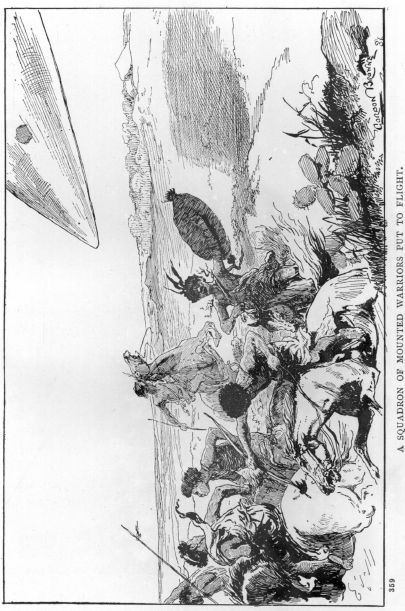
“Now is our time to create a wholesome impression of our invincibility upon these fellows,” remarked the baronet, and hurrying to the pilot-house he caused the ship to sink well within range of the projected salute.
In an instant every bow was drawn to its utmost tension, a second or two sufficed the warriors to steady their aim, and then, with a simultaneous twang of bowstrings, the fifty arrows sped through the air, and, rattling harmlessly against the ship’s gleaming hull, glanced off and fell to the earth again. The baronet smartly raised the fore end of the tiller, and, obedient to her helm, the Flying Fish made a sudden swoop earthward in the direction of the audacious cavalry, who, already disconcerted at the utter failure of their attack, at once wheeled short about, and, with piercing yells of terror, took headlong flight, jostling and overthrowing each other without the least compunction in their frantic eagerness to escape.
“There,” remarked the baronet, as, steadying the helm, the ship once more soared to her former elevation, “I hope that will suffice to convince them that we are not to be attacked with impunity. If not, we shall be compelled to read them a sharper lesson.”
After that no further attempt at molestation was ventured upon, the inhabitants simply congregating in close proximity to the doors of their huts to see the ship go past, watching her stately progress in silent, awestruck wonder, and obviously holding themselves ready for an instant dive beneath the fancied shelter of their thatched roofs in the event of any hostile demonstration on the part of the Mysterious Visitant.
At about half-past five in the evening the hilly character of the country gave place to that of a wide-stretching level plain, thickly overgrown with long rank grass, with occasional isolated clumps of bush, and here and there a tall feathery palm, or a grove of wild plantains or bamboo. The faint grey glimmer of the sea appeared on the utmost verge of the distant horizon, and certain huge shapeless irregularities in the extreme distance gradually revealed themselves as the colossal remains of what must at one time have been a city of extraordinary extent and magnificence. The ship was brought to earth and secured exactly at six o’clock, at a distance of some eight or nine miles from the sea, and the travellers then found themselves surrounded on all sides by gigantic ruined walls, arches, columns, erect and overturned, huge fragments of pediments, shattered entablatures, ruined capitals, splintered pedestals, and crumbling mutilated statues of men and animals, all of colossal proportions, the buildings being of a massive but ornate and imposing style of architecture, quite unknown to civilisation. The ship had found a resting-place as nearly as possible in the centre of the ruins, which extended all round her for a distance of nearly three miles, the eastern half being all aglow with the golden radiance of the sunset, whilst the western half loomed up black, imposing, and solemnly mysterious against the clear orange of the evening sky.
“Well,” said the professor, as the party slowly paced the deck, watching in almost silent rapture the swiftly changing glories of the dying day, the rapid but exquisite gradations of tint on the mouldering ruins which accompanied the fading light, and the almost instantaneous appearance of the stars in the darkening heavens—“well, I am equally surprised and delighted at the result of our resolve to come hither. Here we find ourselves in the very heart of savagedom surrounded by the vast remains of a remote but civilised and evidently highly cultivated race; and though at present we have nothing more than the merest surmise to help us to their identification, I have little doubt that the result of our explorations and investigations will be to satisfy us that we have in very deed found in these ponderous ruins the remains of Ancient Ophir.”
Chapter Seventeen.
A Native Chieftain’s Visit to Cloudland.
The travellers, safely shut up in that impregnable fortress, the hull of the Flying Fish, passed the night in peaceful slumber, undisturbed, in the confidence begotten of a sense of perfect security, by the weird cries of the night birds, the incessant howling of the jackals, the maniacal laugh of the prowling hyena, the occasional roar of the lion, the loud whirr of myriads of insects, the croaking of bull-frogs, and the other multitudinous nocturnal sounds which floated in through the open windows of their state-rooms. They were early astir in the morning, eager to commence their investigations as are school-boys to plunge into the enjoyments of a long-anticipated holiday. Moved by a common impulse, they all went out on deck to witness the ruins under the effect of sunrise previous to their plunge into the matutinal bath; and it was whilst they were admiring the exquisite beauty of the scene that the keen-eyed colonel became conscious of the fact that they were beleaguered by a host of lurking savages.
“Umph!” he commented, “I expected as much.”
“You expected as much as what? What is it, Lethbridge?” asked Sir Reginald.
“Look there,” was the reply; “and there, and there, and there. Do you notice anything peculiar in the appearance of the undergrowth about us, especially where it is thickest?”
“N–o, I can’t say that I do—unless you refer to those occasional quick gleams which come and go here and there. What are they? At first I thought it was the flash of the sun on the dew-laden grass and leaves as they wave in the wind, but it can hardly be that, or we should see more of it.”
“No,” said the colonel, “it is not that; it is the occasional glint of the sun on a native spear-head. I have been through the Kaffir war, and have seen the same thing before, though not so distinctly as now, our present towering height above the ground giving us an advantage in that respect which we sadly lacked before. We are beset by the natives. You cannot see one, I know, but they are all about us, all the same. Ah! look there, just behind that magnolia bush. Do you see a small dark object rising slowly into view? That is the head of a savage, and he is—ah! now he has ducked again, having caught sight of us.”
“And what do you suppose the fellows want?” asked the baronet. “They cannot attack us, you know.”
“No; but they don’t know it. Their object is to steal up as close as possible to us in order, in the first place, to satisfy their curiosity, and, in the second place, to make a sudden swoop if they see any fancied chance of being successful.”
“Well,” said Sir Reginald. “I should like to see the savage who can reach us so long as we stick to the Flying Fish. But we don’t want to stick to her, so we will leave them undisturbed to satisfy their curiosity to its fullest extent until after breakfast, when we must adopt measures either to conciliate them or to terrorise them into leaving us alone. Come, gentlemen, we shall be late for breakfast. What a superb mass of ruins it is!—beats the Acropolis; don’t you think so?”
If the thousand or more savages, who had spent nearly half the night in accomplishing the engirdlement of the Flying Fish, could have heard and understood the airy way in which the fact of their close proximity was dismissed by the baronet as a matter of the most trivial importance, they would have been intensely disgusted. Happily for their dignity they were blissfully unconscious of it; and whilst Sir Reginald and his companions were luxuriating in the bath, and afterwards dallying with a light but dainty breakfast, the sable warriors continued to close cautiously in upon the huge white gleaming object which had come into their midst in so unexpected and extraordinary a manner. Slowly, cautiously, with untiring patience, and practising every known art of savage warfare, the band drew closer and closer, until they found themselves within about a hundred feet of the hull, and almost overshadowed by her enormous bulk, when considerations of personal safety prevailed over the ardour of the warrior burning to distinguish himself, and further advance was, as by unanimous consent, checked. The huge monster, with its gleaming silvery skin and its curiously-shaped tail, lay so ominously still and silent, with its enormous circular black eyes so wide open and fixed, that, having heard of its threatening demonstration against the cavalry who attacked it on the previous day, they felt certain it meant mischief, and was only waiting for some foolhardy wight to venture within its reach, to seize and devour him. They had been despatched by a despotic king to capture or kill the creature; but, whilst every man there would have emulated his neighbour in rushing to certain death against the ranks of an enemy, there seemed to be so little glory in furnishing a breakfast to this monster that every individual there inwardly resolved that some other man than himself should be the first to offer himself as a sacrifice. And, equally afraid to advance or to retire, there they remained motionless, and in a state of breathless suspense, waiting for events to develop themselves. And there they were distinctly visible from the lofty stand-point of the Flying Fish’s deck when the quartette, cigar in mouth, emerged from the pilot-house after breakfast.
The situation was decidedly comical, and the travellers indulged in a hearty laugh at the expense of the discomfited savages. But it was obvious that matters could not be allowed to remain in that condition; the natives must be impressed with the conviction that hostilities were neither necessary nor desirable, and that it would be to their advantage to be on terms of amity with the newcomers. How could this be achieved? A parley offered the most ready solution of the difficulty; and the professor—who was a perfect polyglot dictionary in human form—offered to essay the task of conducting it. This was by no means his first introduction to savages; he had encountered them in various parts of the world before, and had never experienced any very serious difficulty in communicating with them, so that he felt tolerably sanguine of success on the present occasion.
“The matter is very simple, I think,” remarked the German, as he led the way to the larboard gangway. “We want these people to understand that we are friendly disposed toward them; that they have nothing whatever to fear from us; that we have not come here to rob them of one tittle of their possessions; that we merely wish to explore and examine these ancient ruins; and that, if they will receive us among them as friends, they will be distinct and decided gainers by the transaction. Is not that so?”
“Certainly,” remarked the baronet. “Tell them—if you can—that all we ask is permission to investigate and explore unmolested; and that if they will accord us this privilege they shall be substantially rewarded.”
“Very good; I will do my best. And that reminds me that you had better order George to bring on deck and open a small case of those beads and nick-nacks that we provided for such occasions as the present,” remarked the professor.
The baronet returned to the pilot-house to give the order; and von Schalckenberg drew out his white pocket-handkerchief, waved it two or three times in the air, and then demanded, in the language he thought most likely to be intelligible:
“What chief commands the warriors who have assembled to pay homage to the four Spirits of the Winds?”
Most luckily for the professor’s prestige and reputation as an all-wise Spirit, the dialect he had adopted, though not the language actually spoken by the tribe he addressed, was so far similar that his question was understood; and whilst the astounded blacks started to their feet in dismay at finding themselves at last actually face to face with and addressed by an avowed Spirit, one of them hesitatingly and timorously advanced a few paces, threw himself prostrate on the ground, and, maintaining his posture of humility, stammered out:
“I, Lualamba, am the leader of these warriors, O most potent Spirit.”
“Approach, brave Lualamba, and ascend to us by the ladder which we will let down to you. We have that to say which must be heard by your ear alone,” commanded the professor, waving his hand majestically.
A rope-ladder was attached to the lower extremity of the side-ladder and let down to the ground; and the chief, in a state of mind about equally divided between the extremity of bodily fear on the one hand and pride at being selected as the recipient of a special communication from the Spirit Land on the other, hesitatingly and falteringly, and with many doubtful pauses, advanced until he reached the foot of the ladder, when his courage failed him, and he came to a dead halt.
“Ascend, and fear not,” called out the professor encouragingly; “we are the friends of your nation, and have forgiven the attack which some of your people (not knowing us) made upon us yesterday. We have come hither to shower gifts and benefits upon you—if you are obedient; but if you reject our friendship, beware!”
Upon this the savage, no doubt feeling that, by placing himself at the head of this most unlucky expedition, he had already gone too far to permit of withdrawal, summoned up all his courage, and, with the air of a man who knew himself to be treading on mined ground, scrambled up the swaying ladder, and finally stepped in through the gangway on to the spacious deck of the Flying Fish, upon which he prostrated himself on his face, laying his shield and weapons—his most valued possessions—as an offering at the feet of the professor.
The latter, touching him lightly on the shoulder, at once bade him rise; and, as the chief gathered himself up and regained his feet, von Schalckenberg threw round the quaking but gratified savage’s neck a string of large opaque, turquoise-blue glass beads, and over his naked shoulders a length of gaudily-flowered chintz. A loud shout of admiration from the crowd of natives below proclaimed the fact that they had witnessed the bestowal of these gifts, whilst Lualamba, notwithstanding the august presence in which he found himself, could not restrain the broad grin of delight which spontaneously overspread his features.
A few judicious questions, artfully put, soon elicited from the savage the information that the travellers were now in the country belonging to M’Bongwele, a fierce, cruel, and jealous despot, so suspicious of foreigners that the most stringent orders were in force to allow none such to cross his borders upon any pretence whatever. This king had been duly apprised, through the medium of the curious voice-telegraphic mode of communication already described, of the mysterious arrival in his dominions on the day previous; and had been so greatly disconcerted and enraged at the news that he had forthwith issued the most peremptory orders for the capture or slaughter of the monstrous visitant; and he was now, according to Lualamba, impatiently awaiting in his palace, a few miles distant, the intelligence that his order had been executed. The chief, during the conversation which elicited these facts, had so far recovered his self-possession and equanimity as to be able to make the best possible use of his eyes; and, being a very shrewd fellow, he was not long in arriving at the conclusion that the gigantic monster on whose back he stood was, after all, nothing more nor less than an inanimate, though unquestionably wonderful, vehicle of some sort; and that the fair-skinned beings to whom he was talking, though they claimed to be the four Spirits of the Winds, were very similar in many respects to certain white men whom he had seen only a few moons ago. The wily savage accordingly made up his mind that, if he could only induce these beings to accompany him into the king’s presence, he would, after all, have most satisfactorily accomplished his mission; and he forthwith proceeded, with all the craft and subtlety of which he was master, to urge upon them the desirability of an immediate visit to king M’Bongwele, who, averse as he was to the prying visits of strange men, would, he assured them, be highly gratified at the honour of having as his guests the four Spirits of the Winds.
This proposition, however, by no means accorded with the views of the travellers; and von Schalckenberg somewhat sternly intimated that, whilst an interview with M’Bongwele was undoubtedly desirable, it was he who must visit and pay homage to them, and not they to him. They had entered the country with the most friendly disposition toward M’Bongwele and his people, and that friendly disposition would be manifested to the distinct advantage of the entire nation if the king showed himself properly appreciative of the honour done him by this visit. But if not, king and people would be very severely punished for the insult offered to their potent visitors, “and,” continued the professor, “in order that Lualamba might see for himself that, in making this threat, they were indulging in no mere empty boast, he would give the chief and his followers a single specimen of their power.”
Mildmay having, during the progress of this conversation, received a hint from the professor how to act, had quietly, and as if not particularly interested in what was going forward, sauntered off to the pilot-house, where, stationing himself at the engine and other levers controlling the movements of the ship, he awaited further instructions.
The professor, having promised to give the savages a specimen of their visitors’ power, now waved his right hand very slowly and impressively skyward, as a signal to the watchful Mildmay, loudly exclaiming as he did so:
“Lualamba will now accompany the four Spirits of the Winds to yonder cloud,” pointing, as he spoke, to a single small white fleecy cloud which was floating at the moment across the sun’s disc.
Dexterously manipulating the various valves, Mildmay caused the Flying Fish to rise with a gentle and almost imperceptible motion from the earth. So gentle was the movement that Lualamba was utterly unconscious of it, and it was not until some seconds had elapsed that he fully realised what was happening. The savages below, however, no sooner heard von Schalckenberg’s exclamation than, to their inexpressible horror, they beheld the huge structure, round which they were standing, lift itself off the earth without the slightest visible effort and begin to rise into the air. Many of them were so overpowered by astonishment that they could only stand, open-mouthed and as motionless as statues, staring at the extraordinary sight; others, however, remembering the stringent orders of the king, and feeling that the prize which they had believed to be so secure was not only escaping them but also carrying off one of their number, rushed forward, and, whilst some fruitlessly attempted to grasp and hold the smooth and polished hull, others seized and clung tenaciously to the rope-ladder. The weight of some seven or eight natives clinging to the dangling ladder had, of course, no visible effect upon the movement of the great ship; and, finding themselves being helplessly dragged skyward, they let go their hold with a yell of dismay when they were some four or five yards from the earth, upon which they dropped back heavily.
The ship once fairly off the ground, Mildmay increased the rarefaction of the air in the air-chambers to an almost perfect vacuum, and the immense structure soared skyward with great rapidity. Lualamba, hearing the shouts of his people from below, stepped to the gangway to ascertain the cause; and it was then that, to his inexpressible dismay, he saw the earth apparently falling from under him, and the upturned faces of his followers rapidly dwindling until they became unrecognisable. In the first extremity of his terror he would have flung himself headlong from the deck had he not been prevented; failing in this he prostrated himself, and for some time lay motionless, with his face hidden in his hands. At length, however, somewhat reassured by the encouraging adjurations of the professor and the apparent absence of movement in the ship, he ventured first of all to uncover his eyes and then to rise slowly to his feet. He glanced wildly about him, but could see nothing, save a thick white mist which completely enveloped the ship (for she had just plunged into the centre of the cloud), with the sun dimly visible through it; and a fresh paroxysm of terror seized him, for the horrible thought at once suggested itself that he had looked his last upon mother Earth. The professor, however, speedily reassured him upon this point, and, leading him to the guard-rail which ran round the deck, bade him look downward. Terrified into the most servile obedience, the wretched chief did as he was bidden, and in a few minutes, the mist growing thinner and thinner, he once more caught sight of the earth at an immense distance below, the gigantic ruins above which they were hovering dwarfed to a mere sprinkling of boulders over the plain; the trees, the clumps of bush, and the meandering streams stretching away to the horizon in almost illimitable perspective, and to the eastward the sea, with just one solitary sail upon it, barely visible above its gleaming rim.
Ignorant savage though he was, Lualamba was quite intelligent enough to appreciate the novel beauty of the scene upon which his eyes now rested; and, forgetting for the moment all his terrors, he leaned upon the rail, lost in wonder and admiration. And when, after a minute or two, he became conscious that the ship was again nearing the earth, his delight knew no bounds, for he felt that, as the hero of so unique an experience as he was now passing through, he must henceforth be a person of much greater consequence among his countrymen than he had ever been before.
Meanwhile the travellers had availed themselves of their recent ascent to sharply scrutinise the face of the country immediately adjacent to the ruins, and had at length discovered, on the summit of a distant hill, an extensive village or settlement, strongly defended by a circular stockade, which they shrewdly suspected to be the headquarters of king M’Bongwele. The single street, which ran through the centre of the village from end to end, was crowded with people all gazing skyward at the unwonted apparition of the aerial ship; and, with the aid of their telescopes, the travellers could see in the central square a small group of persons (who they conjectured to be the king and his suite) similarly engaged, surrounded and protected from the rabble by a phalanx of armed men.
The ship swept rapidly onward until she hovered immediately over the last-named party (just to impress upon the king a wholesome conviction of the utter uselessness of his stockade as a protection against such a foe as the Flying Fish), and then, making a majestic sweep, came gently to earth immediately opposite the principal gate in the stockade.
“Now, go,” said the professor, addressing Lualamba, “and inform king M’Bongwele that we await him on the spot among the ruins where you found us this morning.”
The bewildered chief, scarcely able to realise the fact that he had actually been brought safely back to terra firma, lost no time in availing himself of the permission given him to depart, and, scrambling down the ship’s side and the rope-ladder, he reached the ground and bounded off like a startled deer toward the gate, which was hastily thrown open to admit him, and as hastily closed and barred again the moment he had passed through. The Flying Fish then rose once more into the air and leisurely made her way back to the ruins, passing, en route, the force which had been sent out to capture her, and which was now making the best of its way back to the village to report the result of the expedition.
Meanwhile Lualamba made his way rapidly up through the village to the king’s palace (which was, after all, merely the largest hut in the inclosure), having gained which he besought an immediate audience with M’Bongwele on a matter of the utmost importance. The king, who had already been made acquainted with the circumstance of the chief’s involuntary journey into the upper regions, was, of course, all curiosity to learn the fullest details of the adventure, and the desired audience was accordingly at once granted. Conscious of the fact that, for the first time in his life, he had failed to execute the mission intrusted to him, and extremely doubtful as to the reception which would be accorded to the message of which he was the unwilling bearer, Lualamba deemed it best on this occasion to tell a plain unvarnished tale, and, commencing his narrative at the point where he and his warriors had first come within sight of the huge object of which they were in quest, he described in full detail all his subsequent adventures, with the thoughts, feelings, and impressions resulting therefrom, and wound up falteringly with the message.
His story was received by the king and his suite with ejaculations of wonder and incredulity, interspersed with many sharp commands from the monarch to repeat or to explain more fully certain passages; and when the message was delivered a profound silence reigned for fully an hour. King M’Bongwele was a despot, accustomed to issue his commands in the most heedless manner and to have them executed at all costs; but to receive a command was an entirely novel and decidedly disagreeable experience, and he was thoroughly puzzled how to act. His first feeling was one of speechless indignation at the insolence of these audacious strangers; his second, a wholesome fear of the consequences of disobedience. For if these mysterious visitants had the power of soaring into the air by a mere wave of the hand, what might it not be possible for them to do in the event of their being seriously provoked. Besides, he had already received a practical assurance of his impotency so far as they were concerned; moreover, he was consumed by curiosity to see for himself the marvels so graphically described by his lieutenant, to receive a moiety of those magnificent gifts which the strangers seemed prepared to lavish broadcast upon all with whom they chanced to come into contact, and, above all, to satisfy himself with respect to certain conjectures which had flitted through his brain whilst listening to the astonishing narrative of Lualamba. M’Bongwele was an ignorant savage, it is true, but he was possessed of a dauntless courage, a persistency of purpose, and an unscrupulous craftiness and ambitiousness of character which would have won him distinction of a certain unenviable kind in any community. Already his brain was teeming with vague unformed plots of the wildest and most audaciously extravagant description, the possibility of which he was determined to ascertain for himself, and the maturing of which he was quite prepared to leave to time. He therefore ultimately resolved to obey the summons sent him by the strangers; but, remembering his kingly dignity, he postponed obedience as long as he dared, and it was not until four o’clock in the afternoon that he set out for the ruins, attired in all his native finery, consisting of a lion-skin mantle and magnificent gold coronet adorned with flamingo’s feathers—the emblems of his regal power—gold bangles on his arms and ankles, a necklace of lion’s teeth and claws round his neck, and a short petticoat of leopard’s skin about his loins. He was armed with a sheaf of light javelins or assegais, he carried in his left hand a long narrow shield of rhinoceros hide decorated with ostrich plumes, and he was mounted on a superb black horse (which he rode bare-backed and managed with the skill of a finished equestrian). His followers, numbering about five hundred, were also fully armed and excellently mounted, they being, indeed, with the exception of a few court officials, his regiment of household cavalry, the pick of his native warriors and the very flower of his army. He was anxious to make the profoundest possible impression of his power and greatness upon the mysterious beings he was about to visit; and, indeed, the cavalcade, as it swept at a hand-gallop out through the wide gateway which formed the principal opening in the stockade, constituted, with its tossing plumes, its fluttering mantles, its glancing weapons, and its prancing horses, a sight to make a soldier’s heart bound with appreciative delight.
Chapter Eighteen.
King M’Bongwele is temporarily reduced to Submission.
In the return of the Flying Fish to her former berth the subject of the reception to be accorded to king M’Bongwele, in the event of his obeying their summons, was somewhat anxiously discussed by the travellers. They had already seen and heard enough to convince them that the individual in question was a sovereign of considerable power, as African kings go, and former experience among savages had taught them that he would, as likely as not, prove to be a crafty, unscrupulous, and slippery customer to deal with. To satisfactorily carry out the object of their visit to this man’s country—namely, the examination and exploration of the mysterious and very interesting ruins which surrounded them—it would be absolutely necessary that they should be able to pass to and fro, freely and unmolested, between the ship and the various points selected for examination; and, in order to secure this perfect freedom, it would be necessary not only to conciliate this powerful ruler and his people, but also to so thoroughly impress him and them with the mysterious and wonderful attributes of their unbidden guests that they should, one and all, be absolutely afraid to interfere with them. The question was, how could this be most effectually achieved? The first part of the programme, namely the conciliation of sovereign and subjects, appeared simple enough; the obvious pride and delight with which Lualamba had received his flashy presents of beads and Manchester finery furnished a key to the satisfactory solution of this difficulty; but how was the second and equally important part of the programme to be carried out? Lualamba, it was true, had been effectually cowed by the simple expedient of carrying him a few thousand feet up into the air; but something more than the mere repetition of this experiment would be necessary to produce the required impression upon M’Bongwele and the crowd of warriors he would be certain to bring with him. The matter was placed in the hands of the professor for settlement, and he promptly avowed himself to be fully equal to the task.
“Science, my friends,” he remarked, “is constantly revealing wonders which surprise and astound even the most cultured minds of the civilised world; how much more capable is it then of overawing the uncultured savage, however shrewd and clever he may be in those simple matters which affect his everyday life! Leave it to me; we have ample scientific means at our command to quell this man and his followers, and to reduce them to a state of the most abject and servile subjection.”
Von Schalckenberg then retired to make his preparations, which were soon complete. When next he appeared he carried upon one arm a glittering mass of what at first sight appeared to be drapery, but which, on his unfolding it, proved to be three suits of chain armour (minus helmet and gauntlets), constructed of very small fine links of aethereum, light and flexible as silk.
“I think,” said he, “it will be unadvisable to make any change in our outward appearance in preparing to receive this royal savage; any such change would be certainly noticed, and as certainly regarded as an indication of the importance we attach to his visit. Now, our policy is to treat the whole affair as a matter of no moment whatever, and we will therefore (if you agree with my views) continue to wear the white flannel suits in which we received Lualamba this morning. But I would recommend that each of you don a suit of this mail under your clothing (I have already assumed mine), and we shall then be pretty well prepared for emergencies. These savages are often exceedingly treacherous fellows, and it is quite among the possibilities that certain of this king’s followers may have received instructions to test our supposed invulnerability by a sly stab in the back or something of that kind; it will be well, therefore, that we should be properly prepared for anything of the kind. I had in view some such occasion as the present when I arranged for the construction of these suits. There is a helmet and gauntlets for each; but we shall scarcely need them today, I think, and it would hardly be politic to wear any visible defensive armour.”
The luncheon hour arrived and passed without sign or token of the presence of a single savage in the neighbourhood, and as the afternoon waned with still no indication of human vicinity, the travellers—but for the absolute impregnability of the Flying Fish—would have begun to feel uneasy. About half-past four o’clock, however, as the quartette were languidly puffing at their cigars, lolling meanwhile in the most luxurious of deck-chairs, a huge cloud of yellow dust rising into the air beyond the ruins announced the approach of the cavalcade, and a minute or two later king M’Bongwele at the head of his cavalry swept like a whirlwind into the open space occupied by the great ship, and, charging in a solid square close up to her, suddenly wheeled right and left into line, and came to an abrupt halt. The evolution was very brilliantly executed, and as Lethbridge lazily scanned the performers through the thin filmy smoke of his cigar, he could not restrain a low murmur of admiration, followed by the remark:
“By George! what splendid soldiers those fellows would make with a couple of months’ training!”
“Y–e–s,” agreed the baronet, “that was very well done; but I suppose that particular evolution is the one in which they most excel, and of course it was done purely for effect. Ah! the individual now dismounting is, I suppose, our royal visitor.”
The baronet was quite right in his conjecture. As the party halted, some ten or a dozen individuals, including Lualamba, flung themselves from their horses, and, advancing reverentially, grouped themselves about the royal charger. Two of them then stepped to the creature’s head and grasped the bridle, whilst two more assisted the king to dismount. The horse was then handed over to the care of a warrior, and the king, closely followed by the members of his suite, advanced to the foot of the rope-ladder, which had been lowered for their accommodation; the professor at the same time stepping to the gangway and inviting the party to ascend.
M’Bongwele looked somewhat doubtfully at the swaying ladder for a moment or two, and then essayed the ascent; but the oscillation set up by his movements proved too much for his nerves—or his dignity—and, much chagrined, he was obliged to desist. The professor then in compassion suggested the steadying of the ladder at its foot, when the king, promptly giving the necessary order to his suite, ascended to the deck, leaving those who followed him to manage as best they could.
The first glance of the travellers satisfied them that in king M’Bongwele they had a man of more than ordinary intelligence to deal with. The colour of his skin and complexion was a rich deep brown, he stood nearly six feet high on his naked feet, and, but for his somewhat excessive corpulence, he would have been a man of magnificent proportions. His lips were rather thick, and his nose somewhat flattened, but not nearly as much so as in the case of the genuine negro. His forehead was broad and lofty, though receding, his eyes keen, restless, and piercing, and there was a crafty, cruel, resolute look about the lower part of his face which taught his hosts that they would have to be exceedingly cautious in their dealings with him. He was accommodated with a chair between Sir Reginald and the professor, the former being flanked by Lethbridge (Mildmay, in accordance with previous arrangements, had ensconced himself in the pilothouse); Lualamba and the rest of the suite were quietly allowed to squat in a semicircle before them on the deck.
The king opened the conversation by somewhat abruptly demanding the reason for the strangers’ visit to his dominions; to which the professor replied by pointing to the ruins, explaining that they were believed to be the remains of a great city built many ages ago by a very interesting race of people of whom but little was known, and he and his companions were anxious to minutely examine and explore what was left, in the hope of discovering some sculptured or other record bearing upon the origin, habits, and history of the builders.
A few minutes of profound meditation on the part of the king followed this announcement, and then he suddenly demanded where the travellers had come from. The professor replied by a comprehensive sweep of the hand skyward.
“But,” objected M’Bongwele, “if you are spirits you should know all that you want to know about these ruins without coming here to investigate. The spirits know everything.”
A low murmur of applause from the king’s adherents followed this enunciation, showing that they evidently considered their monarch to be getting the better of the strangers, and a smile of gratification flickered for an instant over M’Bongwele’s features.
“Not everything,” corrected the professor. “We know a great many things, but not everything. And what we know we have been obliged to find out by investigation. We spend the greater part of our existence in passing from place to place investigating and finding out things.”
“Then I have been misinformed, and the spirits are neither so wise nor so powerful as I thought them to be,” retorted the king.
“Perhaps so,” quietly remarked the professor. “Nevertheless we are very powerful—sufficiently so to destroy you and your whole army in a moment, should we choose to do so. Would you like to witness a specimen or two of our power?”
M’Bongwele glanced somewhat nervously about him for a second or two, and then with an obvious effort answered:
“Yes.”
“I see that some of your followers here are armed with bows,” continued the professor. “Are they good marksmen?”
“The best in the world,” answered the king proudly.
The professor in his turn hesitated an instant; he was about to make a dangerous experiment. Then he drew from his pocket a small crimson silk rosette, and, placing it in M’Bongwele’s hand, said:
“I will attach this to any part of my dress you choose to point out; then order one of your archers to shoot an arrow at it, and observe the result.”
The king took the rosette in his hand, examined it carefully, and passed it round among his suite for inspection. On receiving it back he suddenly wheeled round in his chair, and, reaching over, laid his finger on Lethbridge’s breast exactly over the heart.
“Fasten it there,” he said with a scornful smile, “and I will shoot at it myself.”
The professor was disconcerted. The danger of the experiment consisted in the possibility that the archer, instead of aiming at the rosette, would select an eye or some part of the head for a mark, in which case the result would be fatal. He was quite willing to incur the risk himself, trusting that the archer’s vanity would impel him to aim at the right spot; but he had never contemplated the turn which affairs had now taken.
Lethbridge, however, with a languid smile and a shrug of the shoulders, rose to his feet, and, nonchalantly flicking the ash off the end of his cigar, waited for the professor to affix the rosette.
A happy inspiration just then occurred to von Schalckenberg. “It is a very small mark,” he murmured confidentially to M’Bongwele; “I do not believe you can hit it. Shall I get something larger?”
The king would not listen to any such proposal; he was evidently anxious to exhibit his skill; and the professor, reassured, attached the rosette to Lethbridge’s coat in the exact spot indicated, M’Bongwele and his companions watching the operation with the keenest interest.
The colonel, glancing round for a good background against which to place himself, noticed a large clump of trees with olive-green foliage growing at a short distance directly astern of the ship. Against these his white-clad figure would stand out in strong relief. He accordingly stepped leisurely out to a suitable position on the deck, and, with one hand in his pocket and his smouldering cigar in the other, patiently awaited the decisive moment. M’Bongwele in the meantime snatched a bow from one of his followers, and, selecting a long straight arrow from the sheaf, retired to the other end of the deck, a distance of about one hundred and fifty feet from his living target. He strung the bow carefully, adjusted the arrow to the string with the utmost nicety, drew it to the head, and then paused for a full minute, apparently waiting for some indication of flinching on Lethbridge’s part. In this, however, he was disappointed, not the faintest suggestion of uneasiness could be detected in the colonel’s face—indeed, he seemed to be absorbed in a critical contemplation of the smoke which lazily wreathed upward from the end of the cigar. Suddenly the bow twanged loudly, the arrow whizzed through the air, and, striking fair upon the rosette, fell in splinters to the deck. Lethbridge somewhat contemptuously kicked the fragments aside, unpinned the rosette from the breast of his coat, and sauntered back to his former seat. The group of chiefs gathered on the deck glanced at each other and uttered suppressed ejaculations of dismay. As for M’Bongwele, he was thoroughly discomfited; he had been shrewd enough to suspect in the professor’s proposal some preconcerted arrangement, which he flattered himself he had skilfully baffled; instead of which his ruse had simply redounded to his own more complete confusion.
The professor rose and picked up the pierced rosette, which he handed to the king.
“You are very skilful,” he remarked, pointing to the puncture; “I compliment you.” Then, changing his tone, he continued: “We have allowed you to do this in order that you may be thoroughly convinced of the impossibility of injuring us. Now you shall have a further example of our power. Order your warriors to dismount and try their best to lift this ship from off the ground.”
The king turned to Lualamba and gave him the necessary order; whereupon the chief, descending the ladder to the ground, advanced to the troops, and, dismounting them, assembled them all round the hull; then, at a given signal, the entire body exerted themselves to the utmost to lift the immense fabric from the ground—of course without effect, as her chambers were full of air.
“Now,” said the professor when the savages had pretty well exhausted themselves, “let all but one man retire.”
This was done, Mildmay meanwhile exhausting the chambers until the gauge showed that the ship weighed only a few pounds. The professor glanced carelessly at the pilot-house, caught the signal that all was in readiness, and said to the king:
“Now order that man to lift the ship on to his shoulders.”
M’Bongwele duly repeated the order, without the slightest expectation that it would be fulfilled; and the man—who would have plunged into a blazing bonfire if he had been so ordered—advanced, and, to the unutterable astonishment of himself, the king, and in fact the whole concourse of natives, raised the gigantic structure to his shoulders and held it there with scarcely an effort.
“Now, tell him to toss us into the air,” commanded von Schalckenberg, shouting down from the gangway to Lualamba.
And in another second the terrified king and his suite felt a slight movement, and saw the earth sinking far away beneath them. This was altogether too much for the suite, who grovelled on the deck in mortal fear; and even king M’Bongwele felt his courage rapidly oozing away as he sat uneasily in his deck-chair convulsively gripping its arms and glancing anxiously about him.
The ascent was continued to a height of about fifteen thousand feet, at which altitude the wretched savages were shivering even more with cold than they had hitherto done with fear. The ship was then headed straight for the sea, which she soon reached, and, speeding onward at the rate of thirty miles an hour, her course was continued, accompanied by a gradual descent until the land was lost sight of; when a wide sweep was made, and, at a height of only one hundred feet above the waves, the return journey was commenced. This experience proved sufficient, and more than sufficient, for M’Bongwele; he was completely cowed; and when he found himself hovering over the illimitable sea, without a sign of land in any direction, he flung himself upon his knees before the professor and piteously entreated to be restored to his home and people, abjectly promising that he and they would be the willing slaves of the White Spirits for ever; and as for the ruins, the Spirits might do whatever they chose with them, freely and without let or hindrance. This was all very well, but von Schalckenberg had not yet fully carried out his programme; he had still one more item in the entertainment which he was determined to produce, and which he fully believed would render M’Bongwele’s subjugation not only complete but permanent.
Accordingly, on returning to their starting-place (by which time it was nearly dark), the demoralised warriors, who had all but given up their king as lost, were set to work by von Schalckenberg’s orders to collect wood for a gigantic bonfire. This was soon done, and the fire was kindled; but, much of the wood being green, an immense cloud of smoke was raised, with very little flame, which exactly suited the professor’s purpose. When the fire was fairly alight, the troops were re-formed in line as close to the ship as possible, and M’Bongwele and his suite were arranged in position on the deck immediately beneath the pilot-house walls. By this time it was perfectly dark, save for the starlight and the flickering gleam of the bonfire; and the air was stark calm.
Gradually and imperceptibly the dense cloud of smoke which hung motionless over the smouldering pile became faintly luminous. The radiance grew stronger and stronger, and presently an immense circular disc of light appeared reflected on the slowly-rising cloud of vapour, in which a host of forms were indistinctly traceable. Another moment and a loud ejaculation of astonishment burst from the savage spectators, for, with another sudden brightening of the luminous disc there appeared the phantom presentment of M’Bongwele’s troops drawn up as they had appeared a couple of hours before, when the king had first boarded the Flying Fish So clear and vivid was the representation that it met with instant recognition, amid loud murmurs of amazement from the beholders; the king being quite as strongly moved as any of his subjects.
“Do you recognise the vision?” demanded the professor sternly of M’Bongwele.
“I do, I do. Those are the spirits of my bravest soldiers,” murmured the king. “Truly the Spirits of the Winds have wondrous powers.”
“You say well,” answered von Schalckenberg. “Now, look again and you shall see a few of our warriors.”
As he spoke the picture became blurred and indistinct, prismatic colours began to come and go upon the curtain of vapour, and suddenly out flashed the image of a wide-stretching sun-lit plain, upon which were drawn up on parade, in illimitable perspective, a countless host of British troops, infantry, cavalry, and artillery, with bayonets, swords, and lance-points gleaming in the sun, with colours uncased, guns limbered up, and all apparently ready and waiting for the order to march. So realistic was the picture that even the baronet and Lethbridge could scarcely repress an exclamation of astonishment, and as for M’Bongwele and his people, they were perfectly breathless with surprise. The picture was allowed to remain clear, brilliant, and distinct for some ten minutes, then the radiant disc rapidly faded until it vanished altogether, and nothing remained but the red glimmer of the smouldering fire.
A heavy sigh issued from M’Bongwele’s breast, and he rose to his feet.
“It is enough,” he said. “Let me go home.”
He advanced gropingly to the gangway (for it was now very dark), when, in an instant, every one of the electric lights in the ship flashed out at their fullest brightness, brilliantly illuminating the deck, and turning night into day for fully a mile round, and, under the clear steely radiance thus unexpectedly furnished him, the king slowly made his way to the ground, mounted his horse in silence, and galloped away at the head of his followers. The illumination of the ship was maintained until the cavalcade was well clear of the ruins, when the side-ladder was drawn up, the lights extinguished, and M’Bongwele was left to make the remainder of his way as best he could in the darkness.
“Well,” said the professor as the quartette wended their way below to dinner, “how have I managed?”
“Admirably,” answered Sir Reginald and the colonel together. “Never, surely,” continued the latter, “was African king so completely overawed in so short a time as this fellow has been to-day.”
“We all, and I especially, owe you thanks, colonel, for the sublime sang froid with which you stood up and allowed yourself to be made a target of to-day,” said von Schalckenberg. “Believe me, I would never have made the proposal I did had I suspected that the part of target would have been so cleverly transferred to someone else. But the crafty fellow evidently suspected what you English call ‘a plant’—a prearranged plan—and he thought that by adopting the course he did he would have us at advantage.”
“Oh,” laughed the colonel scornfully, “that was a mere trifle, less than nothing. I saw that the fellow was confident of his skill as a marksman and anxious to show off, so I felt perfectly easy in my mind. Had it been one of our own men, now—” An expressive shrug of the shoulders finished the sentence.
“Yes,” remarked the baronet reflectively, “what a pity it is that they are not trained to individually select and aim at a particular object. If they were, no troops in the world could stand up for ten minutes before them. But, speaking of troops, professor, what a master-stroke that was of yours to give the darkies an opportunity of comparing their own soldiers with ours. How on earth did you manage it?”
“Oh, easily enough,” laughed the professor. “A magic lantern and a couple of slides did the whole business. The throwing of the pictures upon the smoke-wreath certainly enhanced its effectiveness a good deal, but it is quite an old trick, which I have often done before with excellent results. Everyone who is going much among savages ought to include a lantern and an assortment of good startling slides in his outfit if possible.”
“But how did you get the first of your two slides? That was surely a representation of M’Bongwele’s own people.”
“Certainly. And our friend Mildmay very cleverly secured it with a camera which I set up and prepared for him in the pilot-house. He only had to release a spring at the right moment, and the thing was done. He developed the picture whilst we were making our little excursion out to sea and back. Well, the whole thing was a farce; but I believe it has effectually secured us from interruption during our researches among the ruins; and if so, it was worth playing.”
Chapter Nineteen.
King M’Bongwele turns the Tables upon his Visitors.
In reaching his palace that night king M’Bongwele dismissed his followers with but scant ceremony, and at once retired to rest. He passed a very disturbed night of alternate sleeplessness and harassing fitful dreams, and arose next morning in a particularly bad temper. He was anxious, annoyed, and uneasy in the extreme at the unexpected and unwelcome presence of these extraordinary visitants to his dominions—these spirits, or men, whichever they happened to be, who had taken such pains to show him that they despised his power, and were quite prepared to ride rough-shod over him unless he slavishly conformed to all their wishes; who had frightened and humiliated him in the presence of his immediate followers and most powerful chiefs, and entailed upon him a loss of prestige which it would be difficult if not impossible to recover. He was childishly jealous of the slightest interference with his supreme authority, and he fretted and chafed himself into a state of fury almost bordering upon madness as he reflected upon the veiled menaces to himself which had been only too distinctly recognisable in every manifestation of these strangers’ extraordinary power on the preceding day. He recognised that their deliberate intention had been to show him that during their sojourn in his country he must in all respects conform to their wishes, and model his conduct strictly in accordance with their ideas of what was right and proper, or take the consequences. And what were those consequences likely to be? Judging from what he had already seen, his dethronement and utter humiliation seemed to be among the least severe of future possibilities. Instead of remaining the irresponsible autocrat he had hitherto been, he would, during the sojourn of these strangers in his vicinity, be obliged to carefully weigh and consider his every word and action, in order that he might neither say nor do anything which could by any possibility prove distasteful to them. And if this state of servile, abject, slavish submission was to be his condition during the period of their stay—which might last the Great Fetisch himself only knew how long—his life would not be worth having, it would simply be a grinding, insupportable burden to him.
As these unwelcome reflections thronged through his mind he grew so madly ferocious that he issued orders for the instant execution of certain white prisoners which had fallen into his hands a few months before, countermanding the order almost immediately afterwards—and, happily, in good time—partly because they were women, and he still hoped, notwithstanding present difficulties and frequent former failures, to add them to his harem; and partly because he was under the apprehension that, among their other attributes, his mysterious visitors might possess that of omniscience, and, getting knowledge of the execution, object to and call him to account for it. It was a similar consideration alone which deterred him from solacing himself by the impalement of half a dozen or so of his principal ministers, the entire suite having an exceedingly lively time of it that morning, and being infinitely thankful when they were at last dismissed with whole skins.
The question which harassed and perplexed M’Bongwele for the remainder of that day was: could the visit of these extraordinary beings be by any means shortened or terminated? And, if so, how? Or if the visit could not be cut short, was there any possibility of subjugating the visitors? This particular African monarch possessed at least one virtue, that of perseverance under difficulties. He was not at all the sort of man to sit down and tamely submit to evils if he thought there was even the most remote and slender possibility of overcoming them. He had, on a previous occasion, encountered certain fair-skinned men so similar in appearance, and in every other respect, except dress, to these present troublesome visitors of his that they might well have been taken for beings of the same race; yet they had proved so thoroughly mortal that he had had no difficulty whatever in disposing of them. True, he had shot an arrow at one of these visitants yesterday, striking him fair upon the breast, and the arrow, instead of piercing him through and through, had fallen splintered to pieces at his feet. Yet this very extraordinary incident was not, to M’Bongwele, wholly conclusive evidence as to their invulnerability. Lualamba had on the previous day made certain suggestive remarks tending to strengthen his monarch’s belief that if these persons could by any means be separated from the huge structure which seemed to be their home they might possibly prove to be very ordinary mortals after all. He was inclined to believe that a great deal, if not the whole, of their power was centred in the gigantic fabric which they called a ship. And, if that should indeed prove to be the case, all that they had done on the previous day could be done by anyone into whose hands the ship might happen to fall. It could be done by him. As this reflection flashed across his brain he pictured to himself the immense accession of power and prestige which would come to him with the possession of that wonderful structure; of the conquests it would enable him to make, and of the boundless extension of his dominions which it would enable him to secure; and his eyes flashed and his bosom heaved with unsuppressed excitement as he inwardly vowed that he would achieve its possession or die in the attempt. All the conditions of his life, he angrily told himself, had been violently and permanently disarranged by the incidents of the previous day; he had been publicly threatened; publicly terrified into a cowardly and disgraceful state of submission; and it was quite impossible that he could permanently continue as he then was. He must fully recover all his lost prestige and add immeasurably to it, or must be content to see some ambitious chief rise up and wrest the kingdom from him. These presumptuous strangers had forced him into enmity against them, and they must take the consequences.
Lualamba was one of M’Bongwele’s most trusted chiefs, and shortly before sunset he and the head witch-doctor were summoned to a special conference with the king.
Meanwhile the travellers, having enjoyed a most excellent night’s rest, rose betimes in the morning and prepared for a thorough systematic investigation of the ruins. They bathed and breakfasted in due course, and then, armed to the teeth, set out upon a tour of general inspection, the professor carrying his camera, and Sir Reginald his sketch-block and colour-box, whilst Mildmay and the colonel, provided with a box-sextant and a light measuring chain, set themselves the task of making a rough survey of the ruins and a portion of the surrounding country. The tour of the ruins, the taking of an occasional sketch or photograph, and the making of the survey, kept the party fully occupied for the whole of the first day; and they returned to the ship just before sunset, tired and hungry, but thoroughly satisfied with their day’s work, and fully convinced that their success in penetrating to this interesting spot would alone more than repay them for all the trouble and expense connected with the outfit of the expedition. One important fact at least had been clearly ascertained by them in the course of the day, which was, that the ruins were extremely ancient, their antiquity being demonstrated by the circumstance that during successive ages the soil had gradually accumulated about the ruins until they were nearly half buried. The most interesting discovery made by them during the day was that of an enormous block of ruins, which, from its extent and the imposing character of its architecture, they felt convinced must have been a temple or other public building, and it was resolved that their investigations should commence with it. It was situated about a mile distant from the spot occupied by the Flying Fish, and their first intention had been to move the ship somewhat nearer; but an inspection of the intervening ground had shown it to be so encumbered with ruins that it was soon apparent that she must be left where she was.
A very large amount of excavation—much more than they could possibly manage alone—would be necessary before the lower portion of the walls and the pavement of the building could be laid bare, and they decided to go over to M’Bongwele’s village on the following morning and arrange with him if possible for the hire of some fifty or a hundred men. This, however, proved to be unnecessary, for whilst they were at breakfast next day the sound of a horn was heard without, and, going on deck, they discovered Lualamba below in charge of a party of some twenty women bearing a present of milk (in closely woven grass baskets), eggs, fowls, and fruit, and a message from the king asking whether his visitors required assistance of any kind in the pursuit of their investigations.
“Capital!” exclaimed the baronet when von Schalckenberg had translated the message. “This is as it should be. Lower the ladder, professor, and ask Lualamba to come on deck. We must send back a present to the king in return for that which he has sent us; and we can at the same time forward a message explaining our wants.”
Lualamba quickly made his appearance on deck, where, after receiving a further small present for himself and a cast-off soldier’s coat, battered cocked-hat, an old pair of uniform trousers, the seams of which were trimmed with tarnished gold braid, and half a dozen strings of beads, as a present for the king, the wants of the travellers were explained to him. The chief shook his head; he feared it would be difficult, if not impossible, to meet the wishes of the illustrious strangers in the particular manner spoken of. The male inhabitants of the village were all warriors, to whom work of any description would be an unspeakable degradation. But he would see what could be done. If women, now, would serve the strangers’ purpose as well as men, the thing could easily be arranged.