Volume 4 — Notes on Waterland's Vindication of Christ's Divinity1
Reading edition
Notes on Waterland's Vindication of Christ's Divinity1
In initio
.
It would be no easy matter to find a tolerably competent individual who more venerates the writings of Waterland than I do, and long have done. But still in how many pages do I not see reason to regret, that the total idea of the 4=3=1,—of the adorable Tetractys, eternally self-manifested in the Triad, Father, Son, and Spirit,—was never in its cloudless unity present to him. Hence both he and Bishop Bull too often treat it as a peculiarity of positive religion, which is to be cleared of all contradiction to reason, and then, thus negatively qualified, to be actually received by an act of the mere will;
sit pro ratione voluntas
. Now, on the other hand, I affirm, that the article of the Trinity is religion, is reason, and its universal
formula
; and that there neither is, nor can be, any religion, any reason, but what is, or is an expansion of the truth of the Trinity; in short, that all other pretended religions, pagan or
pseudo
-Christian (for example, Sabellian, Arian, Socinian), are in themselves Atheism; though God forbid, that I should call or even think the men so denominated Atheists. I affirm a heresy often, but never dare denounce the holder a heretic.
On this ground only can it be made comprehensible, how any honest and commonly intelligent man can withstand the proofs and sound logic of Bull and Waterland, that they failed in the first place to present the idea itself of the great doctrine which they so ably advocated. Take my self, S.T.C. as a humble instance. I was never so befooled as to think that the author of the fourth Gospel, or that St. Paul, ever taught the Priestleyan Psilanthropism, or that Unitarianisn (presumptuously, nay, absurdly so called), was the doctrine of the New Testament generally. But during the sixteen months of my aberration from the Catholic Faith, I presumed that the tenets of the divinity of Christ, the Redemption, and the like, were irrational, and that what was contradictory to reason could not have been revealed by the Supreme Reason. As soon as I discovered that these doctrines were not only consistent with reason, but themselves very reason, I returned at once to the literal interpretation of the Scriptures, and to the Faith.
As to Dr. Samuel Clarke, the fact is, every generation has its one or more over-rated men. Clarke was such in the reign of George I.; Dr. Johnson eminently so in that of George III.; Lord Byron being the star now in the ascendant.
In every religious and moral use of the word, God, taken absolutely, that is, not as a God, or the God, but as God, a relativity, a distinction in kind
ab omni quod non est Deus
, is so essentially implied, that it is a matter of perfect indifference, whether we assert a world without God, or make God the world. The one is as truly Atheism as the other. In fact, for all moral and practical purposes they are the same position differently expressed; for whether I say, God is the world, or the world is God, the inevitable conclusion, the sense and import is, that there is no other God than the world, that is, there is no other meaning to the term God. Whatever you may mean by, or choose to believe of, the world, that and that alone you mean by, and believe of, God. Now I very much question whether in any other sense Atheism, that is, speculative Atheism, is possible. For even in the Lucretian, the coarsest and crudest scheme of the Epicurean doctrine, a hylozism, a potential life, is clearly implied, as also in the celebrated
lene clinamen
becoming actual. Desperadoes articulating breath into a blasphemy of nonsense, to which they themselves attach no connected meaning, and the wickedness of which is alone intelligible, there may be; but a La Place, or a La Grand, would, and with justice, resent and repel the imputation of a belief in chance, or of a denial of law, order, and self-balancing life and power in the world. Their error is, that they make them the proper and underived attributes of the world. It follows then, that Pantheism is equivalent to Atheism, and that there is no other Atheism actually existing, or speculatively conceivable, but Pantheism. Now I hold it demonstrable that a consistent Socinianism, following its own consequences, must come to Pantheism, and in ungodding the Saviour must deify cats and dogs, fleas and frogs. There is, there can be, no
medium
between the Catholic Faith of Trinal Unity, and Atheism disguised in the self-contradicting term, Pantheism;—for every thing God, and no God, are identical positions.
Query I. p. 1.
The Word was God.—John i. 1. I am the Lord, and there is none else; there is no God besides me.—Is. xiv. 5, &c.
In all these texts the
was
, or
is
, ought to be rendered positively, or objectively, and not as a mere connective:
The Word Is God
, and saith,
I Am the Lord; there is no God besides me
, the Supreme Being,
Deitas objectiva
. The Father saith,
I Am in that I am,—Deitas subjectiva
.
Ib. p. 2.
Whether all other beings, besides the one Supreme God, be not excluded by the texts of Isaiah (to which many more might be added), and consequently, whether Christ can be God at all, unless He be the same with the Supreme God? The sum of your answer to this query is, that the texts cited from Isaiah, are spoken of one Person only, the Person of the Father, &c.
O most unhappy mistranslation of
Hypostasis
by Person! The Word is properly the only Person.
Ib. p. 3.
Now, upon your hypothesis, we must add; that even the Son of God himself, however divine he may be thought, is really no God at all in any just and proper sense. He is no more than a nominal God, and stands excluded with the rest. All worship of him, and reliance upon him, will be idolatry, as much as the worship of angels, or men, or of the gods of the heathen would be. God the Father he is God, and he only, and him only shall thou serve. This I take to be a clear consequence from your principles, and unavoidable.
Waterland's argument is absolutely unanswerable by a worshipper of Christ. The modern
ultra
-Socinian cuts the knot.
Query II. p. 43.
And therefore he might as justly bear the style and title of Lord God, God of Abraham, &c. while he acted in that capacity, as he did that of Mediator, Messiah, Son of the Father, &c. after that he condescended to act in another, and to discover his personal relation.
And why, then, did not Dr. Waterland,— why did not his great predecessor in this glorious controversy, Bishop Bull,—contend for a revisal of our established version of the Bible, but especially of the New Testament? Either the unanimous belief and testimony of the first five or six centuries, grounded on the reiterated declarations of John and Paul, and the writer of the Epistle to the Hebrews, were erroneous, or at best doubtful;—and then why not wipe them off; why these references to them?—or else they were, as I believe, and both Bull and Waterland believed, the very truth; and then why continue the translation of the Hebrew into English at second-hand through the
medium
of the Septuagint? Have we not adopted the Hebrew word, Jehovah,? Is not the
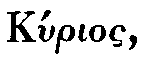
, or Lord, of the LXX. a Greek substitute, in countless instances, for the Hebrew Jehovah? Why not then restore the original word, and in the Old Testament religiously render Jehovah by Jehovah, and every text of the New Testament, referring to the Old, by the Hebrew word in the text referred to? Had this been done, Socinianism would have been scarcely possible in England.
Why was not this done?—I will tell you why. Because that great truth, in which are contained all treasures of all possible knowledge, was still opaque even to Bull and Waterland; —because the Idea itself—that
Idea Idearum
, the one substrative truth which is the form, manner, and involvent of all truths,— was never present to either of them in its entireness, unity, and transparency. They most ably vindicated the doctrine of the Trinity, negatively, against the charge of positive irrationality. With equal ability they shewed the contradictions, nay, the absurdities, involved in the rejection of the same by a professed Christian. They demonstrated the utterly un-Scriptural and contra-Scriptural nature of Arianism, and Sabellianism, and Socinianism. But the self-evidence of the great Truth, as a universal of the reason,—as the reason itself—as a light which revealed itself by its own essence as light—this they had not had vouchsafed to them.
Query XV. p. 225-6.
The pretence is, that we equivocate in talking of eternal generation.
All generation is necessarily
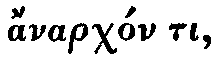
without dividuous beginning, and herein contradistinguished from creation.
Ib. p. 226.
True, it is not the same with human generation.
Not the same
eodem modo
, certainly; but it is so essentially the same that the generation of the Son of God is the transcendent, which gives to human generation its right to be so called. It is in the most proper, that is, the fontal, sense of the term, generation.
Ib.
You have not proved that all generation implies beginning; and what is more, cannot.
It would be difficult to disprove the contrary. Generation with a beginning is not generation, but creation. Hence we may see how necessary it is that in all important controversies we should predefine the terms negatively, that is, exclude and preclude all that is not meant by them; and then the positive meaning, that is, what is meant by them, will be the easy result,—the post-definition, which is at once the real definition and impletion, the circumference and the area.
Ib. p. 227-8.
It is a usual thing with many, (moralists may account for it), when they meet with a difficulty which they cannot readily answer, immediately to conclude that the doctrine is false, and to run directly into the opposite persuasion;—not considering that they may meet with much more weighty objections there than before; or that they may have reason sufficient to maintain and believe many things in philosophy and divinity, though they cannot answer every question which may be started, or every difficulty which may be raised against them.
O, if Bull and Waterland had been first philosophers, and then divines, instead of being first, manacled, or say articled clerks of a guild;—if the clear free intuition of the truth had led them to the Article, and not the Article to the defence of it as not having been proved to be false,—how different would have been the result! Now we feel only the inconsistency of Arianism, not the truth of the doctrine attacked. Arianism is confuted, and in such a manner, that I will not reject the Catholic Faith upon the Arian's grounds. It may, I allow, be still true. But that it is true, because the Arians have hitherto failed to prove its falsehood, is no logical conclusion. The Unitarian may have better luck; or if he fail, the Deist.
Query XVI. p. 234.
But God's thoughts are not our thoughts.
That is, as I would interpret the text;—the ideas in and by which God reveals himself to man are not the same with, and are not to be judged by, the conceptions which the human understanding generalizes from the notices of the senses, common to man and to irrational animals, dogs, elephants, beavers, and the like, endowed with the same senses. Therefore I regard this paragraph, p. 223-4, as a specimen of admirable special pleading
ad hominem
in the Court of eristic Logic; but I condemn it as a wilful resignation or temporary self-deposition of the reason. I will not suppose what my reason declares to be no position at all, and therefore an impossible sub-position.
Ib. p. 235.
Let us keep to the terms we began with; lest by the changing of words we make a change of ideas, and alter the very state of the question.
This misuse, or rather this
omnium-gatherum
expansion and consequent extenuation of the word, Idea and Ideas, may be regarded as a calamity inflicted by Mr. Locke on the reigns of William III. Queen Anne, and the first two Georges.
Ib. p. 237.
Sacrifice was one instance of worship required under the Law; and it is said;—He that sacrificeth unto any God, save unto the Lord only, he shall be utterly destroyed (Exod. xxii. 20.) Now suppose any person, considering with himself that only absolute and sovereign sacrifice was appropriated to God by this law, should have gone and sacrificed to other Gods, and have been convicted of it before the judges. The apology he must have made for it, I suppose, must have run thus: "Gentlemen, though I have sacrificed to other Gods, yet I hope you'll observe, that I did it not absolutely: I meant not any absolute or supreme sacrifice (which is all that the Law forbids), but relative and inferior only. I regulated my intentions with all imaginable care, and my esteem with the most critical exactness. I considered the other Gods, whom I sacrificed to, as inferior only and infinitely so; reserving all sovereign sacrifice to the supreme God of Israel." This, or the like apology must, I presume, have brought off the criminal with some applause for his acuteness, if your principles be true. Either you must allow this, or you must be content to say, that not only absolute supreme sacrifice (if there be any sense in that phrase), but all sacrifice was by the Law appropriate to God only, &c. &c.
How was it possible for an Arian to answer this? But it was impossible; and Arianism was extinguished by Waterland, but in order to the increase of Socinianism; and this, I doubt not, Waterland foresaw. He was too wise a man to suppose that the exposure of the folly and falsehood of one form of Infidelism would cure or prevent Infidelity. Enough, that he made it more bare-faced—I might say, bare-breeched; for modern Unitarianism is verily the
sans-culotterie
of religion.
Ib. p. 239.
You imagine that acts of religious worship are to derive their signification and quality from the intention and meaning of the worshippers: whereas the very reverse of it is the truth.
Truly excellent. Let the Church of England praise God for her Saints—a more glorious Kalendar than Rome can show!
Ib. p. 251.
The sum then of the case is this: If the Son could be included as being uncreated, and very God; as Creator, Sustainer, Preserver of all things, and one with the Father; then he might be worshipped upon their (the Ante-Nicene Fathers') principles, but otherwise could not.
Every where in this invaluable writer I have to regret the absence of all distinct idea of the I Am as the proper attribute of the Father; and hence, the ignorance of the proper Jehovaism of the Son; and hence, that while we worship the Son together with the Father, we nevertheless pray to the Father only through the Son.
Query XVII.
And we may never be able perfectly to comprehend the relations of the three persons, ad intra, amongst themselves; the ineffable order and economy of the ever-blessed co-eternal Trinity.
"Comprehend!" No. For how can any spiritual truth be comprehended? Who can comprehend his own will; or his own personeity, that is, his I-ship (
Ichheit
); or his own mind, that is, his person; or his own life? But we can distinctly apprehend them. In strictness, the Idea, God, like all other ideas rightly so called, and as contradistinguished from conception, is not so properly above, as alien from, comprehension. It is like smelling a sound.
Query XVIII. p. 269.
From what hath been observed, it may appear sufficiently that the divine was our King and our God long before; that he had the same claim and title to religious worship that the Father himself had—only not so distinctly revealed.
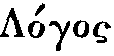
Here I differ
toto orbe
from Waterland, and say with Luther and Zinzendorf, that before the Baptism of John the
Logos
alone had been distinctly revealed, and that first in Christ he declared himself a Son, namely, the co-eternal only-begotten Son, and thus revealed the Father. Indeed the want of the Idea of the 1=3 could alone have prevented Waterland from inferring this from his own query II. and the texts cited by him pp. 28-38. The Father cannot be revealed except in and through the Son, his eternal
exegesis
. The contrary position is an absurdity. The Supreme Will, indeed, the Absolute Good, knoweth himself as the Father: but the act of self-affirmation, the I Am in that I Am, is not a manifestation
ad extra
, not an
exegesis
.
Ib. p. 274.
This point being settled, I might allow you that, in some sense, distinct worship commenced with the distinct title of Son or Redeemer: that is, our blessed Lord was then first worshipped, or commanded to be worshipped by us, under that distinct title or character; having before had no other title or character peculiar and proper to himself, but only what was common to the Father and him too.
Rather shall I say that the Son and the Spirit, the Word and the Wisdom, were alone worshipped, because alone revealed under the Law. See Proverbs, i. ii.
The passage quoted from Bishop Bull is very plausible and very eloquent; but only
cum multis granis salis sumend
.
Query XIX. p. 279.
That the Father, whose honour had been sufficiently secured under the Jewish dispensation, and could not but be so under the Christian also, &c.
Here again! This contradiction of Waterland to his own principles is continually recurring;— yea, and in one place he involves the very Tritheism, of which he was so victorious an antagonist, namely, that the Father is Jehovah, the Son Jehovah, and the Spirit Jehovah;—thus making Jehovah either a mere synonyme of God—whereas he himself rightly renders it
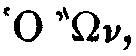
which St. John every where, and St. Paul no less, makes the peculiar name of the Son,

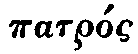
—; or he affirms the same absurdity, as if had said: The Father is the Son, and the Son is the Son, and the Holy Ghost is the Son, and yet there are not three Sons but one Son. N. B.

is the verbal noun of


not of
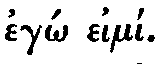
It is strange how little use has been made of that profound and most pregnant text,
John
i. 18!
Query XX. p. 302.
The itself might have been spared, at least out of the Creeds, had not a fraudulent abuse of good words brought matters to that pass, that the Catholic Faith was in danger of being lost even under Catholic language.
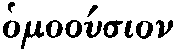
Most assuredly the very 'disputable' rendering of
by consubstantial, or of one substance with, not only might have been spared, but should have been superseded. Why not—as is felt to be for the interest of science in all the physical sciences—retain the same term in all languages? Why not
usia
and homoüsial, as well as
hypostasis
, hypostatic, homogeneous, heterogeneous, and the like;—or as Baptism, Eucharist, Liturgy, Epiphany and the rest?
Query XXI. p. 303.
The Doctor's insinuating from the 300 texts, which style the Father God absolutely, or the one God, that the Son is not strictly and essentially God, not one God with the Father, is a strained and remote inference of his own.
Waterland has weakened his argument by seeming to admit that in all these 300 texts the Father,
distinctive
, is meant.
Ib. p. 316-17.
The simplicity of God is another mystery. * * When we come to inquire whether all extension, or all plurality, diversity, composition of substance and accident, and the like, be consistent with it, then it is we discover how confused and inadequate our ideas are. * * To this head belongs that perplexing question (beset with difficulties on all sides), whether the divine substance be extended or no.
Surely, the far larger part of these assumed difficulties rests on a misapplication either of the senses to the sense, or of the sense to the understanding, or of the understanding to the reason;—in short, on an asking for images where only theorems can be, or requiring theorems for thoughts, that is, conceptions or notions, or lastly, conceptions for ideas.
Query XXIII. p. 351.
But taking advantage of the ambiguity of the word hypostasis, sometimes used to signify substance, and sometimes person, you contrive a fallacy.
And why did not Waterland lift up his voice against this mischievous abuse of the term
hypostasis
, and the perversion of its Latin rendering,
substantia
as being equivalent to
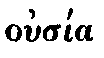
? Why
should not have been rendered by
essentia
, I cannot conceive.
Est
seems a contraction of
esset
, and
ens
of
essens
:
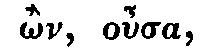
=
essens, essentis, essentia
.
Ib. p. 354.
Let me desire you not to give so great a loose to your fancy in divine things: you seem to consider every thing under the notion of extension and sensible images.
Very true. The whole delusion of the Anti-Trinitarians arises out of this, that they apply the property of imaginable matter—in which A. is, that is, can only be imagined, by exclusion of B. as the universal predicate of all substantial being.
Ib. p. 357.
And our English Unitarians * * have been still refining upon the Socinian scheme, * * and have brought it still nearer to Sabellianism.
The Sabellian and the Unitarian seem to differ only in this;—that what the Sabellian calls union with, the Unitarian calls full inspiration by, the Divinity.
Ib. p. 359.
It is obvious, at first sight, that the true Arian or Semi-Arian scheme (which you would be thought to come up to at least) can never tolerably support itself without taking in the Catholic principle of a human soul to join with the Word.
Here comes one of the consequences of the Cartesian Dualism: as if
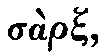
the living body, could be or exist without a soul, or a human living body without a human soul!
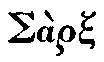
is not Greek for carrion, nor
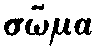
for carcase.
Query XXIV. p. 371.
Necessary existence is an essential character, and belongs equally to Father and Son.
Subsistent in themselves are Father, Son and Spirit: the Father only has origin in himself.
Query XXVI. p. 412.
The words he construes thus: "not as eternally generated," as if he had read , supplying by imagination. The sense and meaning of the word , signifying made, or created, is so fixed and certain in this author, &c.

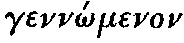
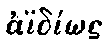
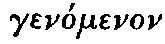
This is but one of fifty instances in which the true Englishing of

&c. would have prevented all mistake. It is not
made
, but
became
. Thus here:—begotten eternally, and not as one that became; that is, as not having been before. The only-begotten Son never
became
; but all things
became
through him.
Ib. 412.
Et nos etiam Sermoni atque Rationi, itemque Virtuti, per quæ omnia molitum Deum ediximus, propriam substantiam Spiritum inscribimus; cui et Sermo insit prænuntianti, et Ratio adsit disponenti, et Virtus perficienti. Hunc ex Deo prolatum didicimus, et prolatione generatum, et idcirco Filium Dei et Deum dictum ex unitate substantiæ. Tertull. Apol. c. 21.
How strange and crude the realism of the Christian Faith appears in Tertullian's rugged Latin!
Ib. p. 414.
He represents Tertullian as making the Son, in his highest capacity, ignorant of the day of judgment.
Of the true sense of the text,
Mark
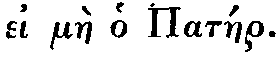
xiii. 32., I still remain in doubt; but, though as zealous and stedfast a Homoüsian as Bull and Waterland themselves, I am inclined to understand it of the Son in his highest capacity; but I would avoid the inferiorizing consequences by a stricter rendering of the
. The
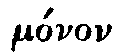
of St. Matthew xxiv. 36. is here omitted. I think Waterland's a very unsatisfying solution of this text.
Ib. p. 415.
Exclamans quod se Deus reliquisset, &c. Habes ipsum exclamantem in passione, Deus meus, Deus meus, ut quid me dereliquisti? Sed hæc vox carnis et animæ, id est, hominis; nec Sermonis, nec Spiritus, &c.—Tertull. Adv. Prax. c. 26. c. 30.
The ignorance of the Fathers, and, Origen excepted, of the Ante-Nicene Fathers in particular, in all that respects Hebrew learning and the New Testament references to the Old Testament, is shown in this so early fantastic misinterpretation grounded on the fact of our Lord's reminding, and as it were giving out aloud to John and Mary the twenty-second Psalm, the prediction of his present sufferings and after glory.
But
the entire passage in Tertullian, though no proof of his Arianism, is full of proofs of his want of insight into the true sense of the Scripture texts. Indeed without detracting from the inestimable services of the Fathers from Tertullian to Augustine respecting the fundamental article of the Christian Faith, yet commencing from the fifth century, I dare claim for the Reformed Church of England the honorable name of
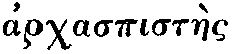
of Trinitarianism, and the foremost rank among the Churches, Roman or Protestant: the learned Romanist divines themselves admit this, and make a merit of the reluctance with which they nevertheless admit it, in respect of Bishop Bull
2
.
Ib. p. 421.
It seems to me that if there be not reasons of conscience obliging a good man to speak out, there are always reasons of prudence which should make a wise man hold his tongue.
True, and as happily expressed. To this, however, the honest Anti-Trinitarian must come at last: "Well, well, I admit that John and Paul thought differently; but this remains my opinion."
Query XXVII. p. 427.
—Athanas. Cont. Gent. The just and literal rendering of the passage is this: 'The true God who in reality is such, namely, the Father of Christ.'

The passage admits of a somewhat different interpretation from this of Waterland's, and of equal, if not greater, force against the Arian notion: namely, taking

distinctively from

—the
Ens omnis entitatis, etiam suæ
, that is, the I Am the Father, in distinction from the
Ens Supremum
, the Son. It cannot, however, be denied that in changing the
formula
of the
Tetractys
into the
Trias
, by merging the
Prothesis
in the
Thesis
, the Identity in the Ipseity, the Christian Fathers subjected their exposition to many inconveniences.
Ib. p. 432.
—Justin Mart. Dial. p. 180. The meaning is, that that divine Person, who called himself God, and was God, was not the Person of the Father, whose ordinary character is that of maker of all things, but another divine Person, namely, God the Son. * * It was Justin's business to shew that there was a divine Person, one who was God of Abraham, Isaac, and Jacob, and was not the Father; and therefore there were two divine Persons.

At all events, it was a very incautious expression on the part of Justin, though his meaning was, doubtless, that which Waterland gives. The same most improper, or at best, most inconvenient because equivocal phrase, has been, as I think, interpolated into our Apostles' Creed.
Ib. p. 436.
—Greg. Naz. Orat. 29. We may, as I conceive, preserve (the doctrine of) one God, by referring both the Son and Holy Ghost to one cause, &c.

Another instance of the inconvenience of the Trias compared with the Tetractys.
Footnote 1:
A Vindication of Christ's Divinity: being a defence of some queries relating to Dr. Clarke's scheme of the Holy Trinity, &c. By Daniel Waterland. 2nd edit. Cambridge, 1719.
Ed
.
return to footnote mark
Footnote 2:
Y sino ahí está el Doctor Jorge Bull Profesor de Teología, y Presbitero de la Iglesia Anglicana, que murió Obispo de San David el año de 1716, cuyas obras teologico—escolasticas, en folio, nada deben á las mas alambicadas que se han estampado en Salamanca y en Coimbra; y como los puntos que por la mayor parte trató en ellas son sobre los misterios capitales de nuestra Santa Fé, conviene á saber, sobre el misterio de la Trinidad, y sobre el de la Divinidad de Cristo, en los cuales su Pseudaiglesia Anglicana no se desvia de la Catolica, en verdad, que los manejó con tanto nervio y con tanta delicadeza, que los teologos ortodojos mas escolastizados, como si dijéramos electrizados, hacen grande estimacion de dichas obras. Y aun en los dos Tratados que escribió acerca de la Justification, que es punto mas resvaladizo, en los principios que abrazó, no se separó de los teologos Catolicos; pero en algunas consecuencias que infirio, ya dió bastantemente á entender la mala leche que habia mamado.
Fray. Gerundio. ii. 7.
Ed.
return
Contents / Index