Volume 4 — Notes on Skelton's Works1
Reading edition
Notes on Skelton's Works1
1825.
Burdy's Life of Skelton, p. 22.
She lived until she was a hundred and five. The omission of his prayers on the morning it happened, he supposed ever after to be the cause of this unhappy accident. So early was his mind impressed with a lively sense of religious duty.
In anecdotes of this kind, and in the instances of eminently good men, it is that my head and heart have their most obstinate falls out. The question is:—To what extent the undoubted subjective truth may legitimately influence our judgment as to the possibility of the objective.
Ib. p. 67.
The Bishop then gave him the living of Pettigo in a wild part of the county of Donegal, having made many removals on purpose to put him in that savage place, among mountains, rocks, and heath, * * *. When he got this living he had been eighteen years curate of Monaghan, and two of Newtown-Butler, during which time he saw, as he told me, many illiterate boys put over his head, and highly preferred in the Church without having served a cure.
Though I have heard of one or two exceptions stated in proof that nepotism is not yet extinct among our Prelates, yet it is impossible to compare the present condition of the Church, and the disposal of its dignities and emoluments with the facts recorded in this Life, without an honest exultation.
Ib. p. 106.
He once declared to me that he would resign his living, if the Athanasian Creed were removed from the Prayer Book; and I am sure he would have done so.
Surely there was more zeal than wisdom in this declaration. Does the Athanasian or rather the
pseudo
-Athanasian Creed differ from the Nicene, or not? If not, it must be dispensable at least, if not superfluous. If it does differ, which of the two am I to follow;—the profession of an anonymous individual, or the solemn decision of upwards of three hundred Bishops convened from all parts of the Christian world?
Vol. I. p. 177-180.
No problem more difficult or of more delicate treatment than the
criteria
of miracles; yet none on which young divines are fonder of displaying their gifts. Nor is this the worst. Their charity too often goes to wreck from the error of identifying the faith in Christ with the arguments by which they think it is to be supported. But surely if two believers meet at the same goal of faith, it is a very secondary question whether they travelled thither by the same road of argument. In this and other passages of Skelton, I recognize and reverence a vigorous and robust intellect; but I complain of a turbidness in his reasoning, a huddle in his sequence, and here and there a semblance of arguing in a circle—from the miracle to the doctrine, and from the doctrine to the miracle. Add to this a too little advertency to the distinction between the evidence of a miracle for A, an eye-witness, and for B, for whom it is the relation of a miracle by an asserted eye-witness; and again between B, and X, Y, Z, for whom it is a fact of history. The result of my own meditations is, that the evidence of the Gospel, taken as a total, is as great for the Christians of the nineteenth century, as for those of the Apostolic age. I should not be startled if I were told it was greater. But it does not follow, that this equally holds good of each component part. An evidence of the most cogent clearness, unknown to the primitive Christians, may compensate for the evanescence of some evidence, which they enjoyed. Evidences comparatively dim have waxed into noon-day splendour; and the comparative wane of others, once effulgent, is more than indemnified by the
synopsis
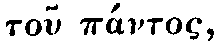
which we enjoy, and by the standing miracle of a Christendom commensurate and almost synonymous with the civilized world. I make this remark for the purpose of warning the divinity student against the disposition to overstrain particular proofs, or rest the credibility of the Gospel too exclusively on some one favourite point. I confess, that I cannot peruse page 179 without fancying that I am reading some Romish Doctor's work, dated from a community where miracles are the ordinary news of the day.
P. S.
By the by, the Rev. Philip Skelton is of the true Irish breed; that is, a brave fellow, but a bit of a bully. "Arrah, by St. Pathrick! but I shall make cold mutton of you, Misther Arian."
Ib. p. 182.
If in this he appears to deal fairly by us, proving such things as admit of it, by reason; and such as do not, by the authority of his miracles, &c.
Are
we
likely to have miracles performed or pretended before our eyes? If not, what may all this mean? If Skelton takes for granted the veracity of the Evangelists, and the precise verity of the Gospels, the truth and genuineness of the miracles is included:—and if not, what does he prove? The exact accordance of the miracles related with the ideal of a true miracle in the reason, does indeed furnish an argument for the probable truth of the relation. But this does not seem to be Skelton's intention.
Ib. p. 185.
But to remedy this evil, as far as the nature of the thing will permit, a genuine record of the true religion must be kept up, that its articles may not be in danger of total corruption in such a sink of opinions.
Anything rather than seek a remedy in that which Scripture itself declares the only one. Alas! these bewilderments (the Romanists urge) have taken place especially through and by the misuse of the Scriptures. Whatever God has given, we ought to think necessary;— the Scriptures, the Church, the Spirit. Why disjoin them?
Ib. p. 186.
Now a perpetual miracle, considered as the evidence of any thing, is nonsense; because were it at first ever so apparently contrary to the known course of nature, it must in time be taken for the natural effect of some unknown cause, as all physical phænomena, if far enough traced, always are; and consequently must fall into a level, as to a capacity of proving any thing, with the most ordinary appearances of nature, which, though all of them miracles, as to the primary cause of their production, can never be applied to the proof of an inspiration, because ordinary and common.
I doubt this, though I have no doubt that it would be pernicious. The yearly blossoming of Aaron's rod is against Skelton, who confounds single facts with classes of
phænomena
, and he draws his conclusion from an arbitrary and, as seems to me, senseless definition of a miracle.
Ib. p. 214. End of Discourse II.
Skelton appears to have confounded two errors very different in kind and in magnitude;—that of the Infidel, against whom his arguments are with few exceptions irrefragable; and that of the Christian, who, sincerely believing the Law, the Prophecies, the miracles and the doctrines, all in short which in the Scriptures themselves is declared to have been revealed, does not attribute the same immediate divinity to all and every part of the remainder. It would doubtless be more Christian-like to substitute the views expressed in the next Discourse (III.); but still the latter error is not as the former.
Ib. p. 234.
But why should not the conclusion be given up, since it is possible Christ may have had two natures in him, so as to have been less than the Father in respect to the one, and equal to him in respect to the other.
I understand these words (
My Father is greater than I
) of the divinity—and of the Filial subordination, which does not in the least encroach on the equality necessary to the unity of Father, Son, and Spirit. Bishop Bull does the same. See too Skelton's own remarks in Discourse V. p. 265.
Ib. p. 251.
This was necessary, because their Law was ordained by angels.
Now this is an instance of what I cannot help regarding as a superstitious excess of reverence for single texts. We know that long before the Epistle to the Hebrews was written, the Alexandrian Church, which by its intercourse with Greek philosophers, chiefly Platonists, had become ashamed of the humanities of the Hebrew Scriptures, in defiance of those Scriptures had pretended, that it was not the Supreme Being who gave the Law in person to Moses, but some of his angels. The author of the Epistle to the Hebrews, arguing
ad homines
, avails himself of this, in order to prove that on their own grounds the Mosaic was of dignity inferior to the Christian dispensation. To get rid of this no-difficulty in a single verse or two in the Epistles, Skelton throws an insurmountable difficulty on the whole Mosaic history.
Ib. p. 265.
Therefore, he saith, I (as a man) can of myself do nothing.
Even of this text I do not see the necessity of Skelton's parenthesis (as a man). Nay it appears to me (I confess) to turn a sublime and most instructive truth into a truism. "But if not as the Son of God, therefore
a fortiori
not as the Son of man, and more especially, as such, in all that refers to the redemption of mankind."
Ib. p. 267.
To this glory Christ, as God, was entitled from all eternity; but did not acquire a right to it as man, till he had paid the purchase by his blood.
I too hold this for a most important truth; but yet could wish it to have been somewhat differently expressed; as thus:—"but did not acquire it as man till the means had been provided and perfected by his blood."
Ib. p. 268.
If Christ in one place, (John xiv. 28,) says, My Father is greater than I; he must be understood of his relation to the Father as his Son, born of a woman.
I do not see the necessity of this: does not Christ say,
My Father and I will come and we will dwell in you?
Nay, I dare confidently affirm that in no one passage of St. John's Gospel is our Lord declared in any special sense the Son of the First Person of the Trinity in reference to his birth from a woman. And remember it is from St. John's Gospel that the words are cited. So too the answer to Philip ought to be interpreted by ch. i. 18. of the same Gospel.
Ib. p. 276.
I confess I do not agree with Skelton's interpretation of any of these texts entirely. Because I hold the Nicene Faith, and revere the doctrine of the Trinity as the fundamental article of Christianity, I apply to Christ as the Second Person, almost all the texts which Skelton explains of his humanity. At all events 1 consider
the first-born of every creature
as a false version of the words, which (as the argument and following verse prove) should be rendered
begotten before
, (or rather
superlatively before
),
all that was created or made; for by him
they were made.
Ib.
Of that day, and that hour knoweth no man, no not the angels which are in heaven, neither the Son, but the Father.
I cannot explain myself here; but I have long thought that our Saviour meant in these words

—and that like the problem proposed by him to the Scribes, they were intended to prepare the minds of the disciples for this awful mystery—
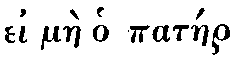
—"unless, or if not, as the Father knows it;" while in St. Matthew the equivalent sense is given by the omission of the
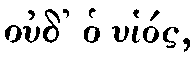
and its inclusion in the Father.
As the Father knoweth me, so know I the Father
.
It would have been against the general rule of Scripture prophecies, and the intention of the revelation in Christ, that the first Christians should have been so influenced in their measures and particular actions, as they could not but have been by a particular foreknowledge of the express and precise time at which Jerusalem was to be destroyed. To reconcile them to this uncertainty, our Lord first teaches them to consider this destruction the close of one great epoch, or
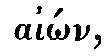
as the type of the final close of the whole world of time, that is, of all temporal things; and then reasons with them thus:—"Wonder not that I should leave you ignorant of the former, when even the highest order of heavenly intelligences know not the latter,

; nor should I myself, but that the Father knows it, all whose will is essentially known to me as the Eternal Son. But even to me it is not revealably communicated." Such seems to me the true sense of this controverted passage in Mark, and that it is borne out by many parallel texts in St. John, and that the correspondent text in Matthew, which omits the
conveys the same sense in equivalent terms, the word

including the Son in the

. For to his only-begotten Son before all time the Father showeth all things.
Ib. p. 279.
But whether we can reconcile these words to our belief of Christ's prescience and divinity, or not, matters little to the debate about his divinity itself; since we can so fully prove it by innumerable passages of Scripture, too direct, express, and positive, to be balanced by one obscure passage, from whence the Arian is to draw the consequence himself, which may possibly be wrong.
Very good.
Ib. p. 280.
We know that the Son of God is come, and hath given us an understanding that we may know him that is true; and we are in him that is true, even in his Son Jesus Christ. This is the true God, and eternal life.—l John v. 20. The whole connection evidently shows the words to be spoken of Christ.
That the words comprehend Christ is most evident. All that can be fairly concluded from 1 Cor. viii. 6, is this:—that the Apostles, Paul and John, speak of the Father as including and comprehending the Son and the Holy Ghost, as his Word and his Spirit; but of these as inferring or supposing the Father, not comprehending him. Whenever, therefore, respecting the Godhead itself, containing both deity and dominion, the term God is distinctively used, it is applied to the Father, and Lord to the Son.
Ib. p. 281.
But, farther, it is objected that Christ cannot be God, since God calls him his servant more than once, particularly 'Isaiah' xlii. 1.
The Prophets often speak of the anti-type, or person typified, in language appropriate to, and suggested by, the type itself. So, perhaps, in this passage, if, as I suppose, Hezekiah was the type immediately present to Isaiah's imagination. However, Skelton's answer is quite sufficient.
Ib. p. 287.
Hence it appears, that in the passage objected, (1 'Cor'. xv. 24, &c.) Christ is spoken of purely as that Man whom God had highly exalted, and to whom he had given a name which is above every name, that at the name of Jesus every knee should bow. (Phil. ii. 9, 10.)
I must confess that this exposition does not quite satisfy me. I cannot help thinking that something more and deeper was meant by the Apostle; and this must be sought for in the mystery of the Trinity itself,
in which
(mystery)
all treasures of knowledge are hidden
.
Ib. p. 318.
Hence, perhaps, may be best explained what St. Peter says in the second Epistle, after pleading a miracle. We have also a more sure word of prophecy, whereunto you do well that you take heed.
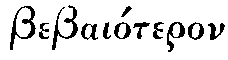
I believe that St. Peter neither said it, nor meant this; but that
follows
the prophetic word
. We have also the word of prophecy more firm;—that is; we have, in addition to the evidence of the miracles themselves, this further confirmation, that they are the fulfilment of known prophecies.
Ib. p. 327.
Agreeable to these passages of the Prophet, St. Peter tells us (Acts x. 38), God anointed Jesus of Nazareth with the Holy Ghost and power.
I have often to complain that too little attention is paid by commentators to the history and particular period in which certain speeches were delivered, or words written. Could St. Peter with propriety have introduced the truth to a prejudiced audience with its deepest mysteries? Must he not have begun with the most evident facts?
Ib. Disc. VIII.
The Doctrine of the Holy Trinity vindicated.
Were I a Clergyman, the paragraphs from p. 366 to p. 370, both inclusive, of this Discourse should form the conclusion of my Sermon on Trinity Sunday,—whether I preached at St. James's, or in a country village.
Ib. pp. 374-378.
As a reason why we should doubt our own judgment, it is quite fair to remind the objector, that the same difficulty occurs in the scheme of God's ordinary providence. But that a difficulty in a supposed article of revealed truth is solved by the occurrence of the same or of an equivalent difficulty in the common course of human affairs—this I find it hard to conceive. How was the religious, as distinguished from the moral, sense first awakened? What made the human soul feel the necessity of a faith in God, but the apparent incongruity of certain dispensations in this world with the idea of God, with the law written in the heart? Is not the reconciling of these facts or
phænomena
with the divine attributes, one of the purposes of a revealed religion? But even this is not a full statement of the defect complained of in this solution. A difficulty which may be only apparent (like that other of the prosperity of the wicked) is solved by the declaration of its reality! A difficulty grounded on the fact of temporal and outward privations and sufferings, is solved by being infinitely increased, that is, by the assertion of the same principle on the determination of our inward and everlasting weal and woe. That there is nothing in the Christian Faith or in the Canonical Scriptures, when rightly interpreted, that requires such an argument, or sanctions the recourse to it, I believe myself to have proved in the
Aids to Reflection
. For observe that "to solve" has a scientific, and again a religious sense, and that in the latter, a difficulty is satisfactorily solved, as soon as its insolvibility for the human mind is proved and accounted for.
Ib. (Disc. XIV. pp. 500-502.)
Christianity proved by Miracles.
I cannot see and never could, the purpose, or
cui bono
, of this reasoning. To whom is it addressed? To a man who denies a God, or that God can reveal his will to mankind? If such a man be not below talking to, he must first be convinced of his miserable blindness respecting these truths; for these are clearly presupposed in every proof of miracles generally.
Again, does he admit the authenticity of the Gospels, and the veracity of the Evangelists? Does he credit the facts there related, and as related? If not, these points must be proved; for these are clearly presupposed in all reasoning on the particular miracles of the Christian dispensation. If he does, can he deny that many acts of Christ were wonderful;—that reanimating a dead body in which putrefaction had already commenced,—and feeding four thousand men with a few loaves and fishes, so that the fragments left greatly exceeded the original total quantity,—were wonderful events? Should such a man, 'compos mentis', exist, (which I more than doubt,) what could a wise man do but stare—and leave him? Christ wrought many wonderful works, implying admirable power, and directed to the most merciful and beneficent ends; and these acts were such signs of his divine mission, as rendered inattention or obstinate averseness to the truths and doctrines which he promulgated, inexcusable, and indeed on any hypothesis but that of immoral dispositions and prejudices, utterly inconceivable. In what respect, I pray, can this statement be strengthened by any reasoning about the nature and distinctive essence of miracles 'in abstracto'? What purpose can be answered by any pretended definition of a miracle? If I met with a disputatious word-catcher, or logomachist, who sought to justify his unbelief on this ground, I should not hesitate to say—"Never mind whether it is a miracle or no. Call it what you will;—but do you believe the fact? Do you believe that Christ did by force of his will and word multiply instantaneously twelve loaves and a few small fishes, into sufficient food for a hungering multitude of four thousand men and women?" When I meet with, or from credible authority hear of, a man who believes this fact, and yet thinks it no sign of Christ's mission; when I can even conceive of a man in his right senses who, believing all the facts and events related in the New Testament, and as there related, does yet remain a Deist, I may think it time to enter into a disquisition respecting the right definition of a miracle; and meantime, I humbly trust that believing with my whole heart and soul in the wonderful works of our Lord and Saviour Jesus Christ, I shall not forfeit my title of Christian, though I should not subscribe to this or that divine's right definition of his
idea
of a miracle; which word is with me no
idea
at all, but a general term; the common surname, as it were, of the wonderful works wrought by the messengers of God to man in the Patriarchal, Mosaic, and Christian dispensations.
It is to these notions and general definitions, far more than to the facts themselves, that the arguments of Infidels apply; and from which they derive their plausibility. Nor is this all. The Infidel imitates the divine, and adopts the same mode of arguing, namely, by this substantiation of mere general or collective terms.
For
instance, Hume's argument (stated, by the by, before he was born, and far more forcibly, by Dr. South, who places it in the mouth of Thomas,)
2
—reduce it to the particular facts in question, and its whole speciousness vanishes. I am speaking of the particular facts and actions of the Gospel; of those, and those only. Now that I should be deceived, or the eye-witnesses have been deceived, under all the circumstances of those miracles, with all antecedents, accompaniments, and consequents, is quite as contrary to, that is, unparalleled in my experience, as the return to life of a dead man.
So
again in the second paragraph of page 502
3
, the position is true or false according to the definition of a miracle. In the narrower sense of the term, miracle,—that is, a consequent presented to the outward senses without an adequate antecedent,
ejusdem generis
,—it is not only false but detractory from the Christian religion. It is a main, nay, an indispensable evidence; but it is not the only, no, nor if comparison be at all allowable, the highest and most efficient; unless, indeed, the term evidence is itself confined to grounds of conviction offered to the senses, but then the position is a mere truism.
There is yet another way of reasoning, which I utterly dislike; namely, by putting imaginary cases of imaginary miracles, as Paley has done. "If a dozen different individuals, all men of known sense and integrity, should each independently of the other pledge their everlasting weal on the truth, that they saw a man beheaded and quartered, and that on a certain person's prayer or bidding, the quarters reunited, and then a new head grew on and from out of the stump of the neck: and should the man himself assure you of the same, shew you the junctures, and identify himself to you by some indelible mark, with which you had been previously acquainted,—could you withstand this evidence?" What could a judicious man reply but—"When such an event takes place, I will tell you; but what has this to do with the reasons for our belief in the truth of the written records of the Old and New Testament? Why do you fly off from the facts to a gigantic fiction,—when the possibility of the
If
with respect to a much less startling narration is the point in dispute between us?"
Such and so peculiar, and to an honest mind so unmistakeable, is the character of veracity and simplicity on the very countenance, as it were, of the Gospel, that every remove of the inquirer's attention from the facts themselves is a remove of his conversion. It is your business to keep him from wandering, not to set him the example.
Never, surely, was there a more unequal writer than Skelton;—in the discourses on the Trinity, the compeer of Bull and Waterland; and yet the writer of these pages, 500-501! Natural magic! a stroke of art! for example, converting the Nile into blood! And then his definition of a miracle. Suspension of the laws of nature! suspension—laws—nature! Bless me! a chapter would be required for the explanation of each several word of this definition, and little less than omniscience for its application in any one instance. An effect presented to the senses without any adequate antecedent,
ejusdem generis
, is a miracle in the philosophic sense. Thus: the corporeal ponderable hand and arm raised with no other known causative antecedent, but a thought, a pure act of an immaterial essentially invisible imponderable will, is a miracle for a reflecting mind. Add the words,
præter experientiam
: and we have the definition of a miracle in the popular, practical, and appropriated sense.
Vol. III.
That all our thoughts and views respecting our Faith should be consistent with each other, and with the attributes of God, is most highly desirable: but when the great diversities of men's understandings, and the unavoidable influence of circumstances on the mind, are considered, we may hope from the Divine mercy, that the agreement in the result will suffice; and that he who sincerely and efficiently believes that Christ left the glory which he had with the Father before all worlds, to become man and die for our salvation,—that by him we may, and by him alone we can, be saved,—will be held a true believer,—whether he interprets the words
sacrifice, purchase, bargain, satisfaction
, of the creditor by full payment of the
debt
, and the like as proper and literal expressions of the redeeming act and the cause of our salvation, as Skelton seems to have done;—or (as I do) as figurative language truly designating the effects and consequences of this adorable act and process.
Ib. p. 393.
But were the prospect of a better parish, in case of greater diligence, set before him by his Bishop, on the music of such a promise, like one bit by a tarantula, we should probably soon see him in motion, and serving God, (O shameful!) for the sake of Mammon, as if his torpid body had been animated anew by a returning soul.
Without any high-flying in Christian morality, I cannot keep shrinking from the wish here expressed; at all events, I cannot sympathize with, or participate in, the expectation of "an infinite advancement" from men so motived.
Ib. p. 394.
Yet excommunication, the inherent discipline of the Church, which it exercised under persecution, which it is still permitted to exercise under the present establishment.
Rarely I suspect, without exposing the Clergyman to the risk of an action for damages, or some abuse. There are few subjects that more need investigation, yet require more vigour and soundness of judgment to be rightly handled, than this of Christian discipline in a Church established by law. It is indeed a most difficult and delicate problem, and supplied Baxter with a most plausible and to me the only perplexing of his numerous objections to our Ecclesiastical Constitution. On the other hand, I saw clearly that he was requiring an impossibility; and that his argument carried on to its proper consequences concluded against all Church Establishment, not more against the National Church of which he complained, than the one of his own clipping and shaping which he would have substituted; consequently, every proof (and I saw many and satisfactory proofs) of the moral and political necessity of an Established Church, was at the same time a pledge that a deeper insight would detect some flaw in the reasoning of the Disciplinarians. For if A. be right and requisite, B., which is incompatible with A., cannot be rightly required.
And
this it was, that first led me to the distinction between the
Ecclesia
and an
Enclesia
, concerning which see my Essay on Establishment and Dissent, in which I have met the objection to my position, that Christian discipline is incompatible with a Church established by law, from the fact of the discipline of the Church of Scotland
4
. Who denies that it is in the power of a legislature to punish certain offences by ignominy, and to make the clergy magistrates in reference to these? The question is, whether it is wise or expedient, which it may be, or rather may have been, in Scotland, and the contrary in England? Wise or unwise, this is not discipline, not Christian discipline, enforced only by spiritual motives, enacted by spiritual authority, and submitted to for conscience' sake.
Ib. p. 446.
Be this as it may, the foreknowledge and the decree were both eternal. Here now it is a clear point that the moral actions of all accountable agents were, with certainty, fore-known, and their doom unalterably fixed, long before any one of them existed.
Strange that so great a man as Skelton should first affirm eternity of both, yet in the next sentence talk of "long before."
These
Reflections
5
are excellent, but here Skelton offends against his own canons. I should feel no reluctance, moral or speculative, in accepting the apparent necessity of both propositions, as a sufficient reason for believing both; and the transcendancy of the subject as a sufficient solution of their apparent incompatibility. But yet I think that another view of the subject, not less congruous with universal reason and more agreeable to the light of reason in the human understanding, might be defended, without detracting from any perfection of the Divine Being. Nay, I think that Skelton needed but one step more to have seen it.
Ib. p. 478.
In fine.
To what purpose were these Reflections, taken as a whole, written? I cannot answer. To dissuade men from reasoning on a subject beyond our faculties? Then why all this reasoning?
Vol. IV. p. 28. Deism Revealed.
Shepherd Were you ever at Constantinople, Sir?
Dechaine Never.
Shepherd Yet I believe you have no more doubt there is such a city, than that the three angles of a triangle are equal to two right ones.
Temp. I am sure 1 have not.
Dechaine Nor I; but what then?
Shepherd Pray, Mr. Dechaine, did you see Julius Cæsar assassinated in the Capitol?
Dechaine A pretty question! No indeed, Sir.
Shepherd Have you any doubts about the truth of what is told us by the historians concerning that memorable transaction?
Dechaine Not the least.
Shepherd Pray, is it either self-evident or demonstrable to you, at this time and place, that there is any such city as Constantinople, or that there ever was such a man as Cæsar?
Dechaine By no means.
Shepherd And you have all you know concerning the being of either the city, or the man, merely from the report of others, who had it from others, and so on, through many links of tradition?
Dechaine I have.
Shepherd You see then, that there are certain cases, in which the evidence of things not seen nor either sensibly or demonstrably perceived, can justly challenge so entire an assent, that he who should pretend to refuse it in the fullest measure of acquiescence, would be deservedly esteemed the most stupid or perverse of mankind.
That there is a sophism here, every one must feel in the very fact of being 'non-plus'd' without being convinced. The sophism consists in the instance being 'haud ejusdem generis'
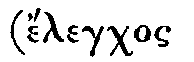

; and what the allogeneity is between the assurance of the being of Madrid or Constantinople, and the belief of the fact of the resurrection of Christ, I have shown elsewhere. The universal belief of the 'tyrannicidium' of Julius Cæsar is doubtless a fairer instance, but the whole mode of argument is unsound and unsatisfying. Why run off from the fact in question, or the class at least to which it belongs? The victory can be but accidental—a victory obtained by the unguarded logic, or want of logical foresight of the antagonist, who needs only narrow his positions to narrations of facts and events, in our judgment of which we are not aided by the analogy of previous and succeeding experience, to deprive you of the opportunity of skirmishing thus on No Man's land. But this is Skelton's ruling passion, sometimes his strength—too often his weakness. He must force the reader to believe: or rather he has an antagonist, a wilful infidel or heretic always and exclusively before his imagination; or if he thinks of the reader at all, it is as of a partizan enjoying every hard thump, and smashing 'fister' he gives the adversary, whom Skelton hates too cordially to endure to obtain any thing from him with his own liking. No! It must be against his will, and in spite of it. No thanks to him—the dog could not help himself! How much more effectual would he have found it to have commenced by placing himself in a state of sympathy with the supposed sceptic or unbeliever;—to have stated to him his own feelings, and the real grounds on which they rested;—to have shown himself the difference between the historical facts which the sceptic takes for granted and believes spontaneously, as it were,—and those, which are to be the subject of discussion; and this brings the question at once to the proof. And here, after all, lies the strength of Skelton's reasoning, which would have worked far more powerfully, had it come first and single, and with the whole attention directed towards it.
Ib. p. 35.
Templeton Surely the resurrection of Christ, or any other man, cannot be a thing impossible with God. It is neither above his power, nor, when employed for a sufficient purpose, inconsistent with his majesty, wisdom, and goodness.
This is the ever open and vulnerable part of Deism. The Deist, as a Deist, believes,
implicite
at least, so many and stupendous miracles as to render his disbelief of lesser miracles, simply because they are miraculous, gross inconsistencies. To have the battle fairly fought out, Spinoza, or a Bhuddist, or a Burmese Gymnosoph, should be challenged. Then, I am deeply persuaded, would the truth appear in full evidence, that no Christ, no God,—and, conversely, if the Father, then the Son. I can never too often repeat, that revealed religion is a pleonasm.—Religion is revelation, and revelation the only religion.
Ib. p. 37.
Shepherd Those believers, whose faith is to rely on the truth of the Christian history, rest their assent on a written report made by eye-witnesses; which report the various Churches and sects, jealous of one another, took care to preserve genuine and uncorrupted, at least in all material points, and all the religious writers in every age since have amply attested.
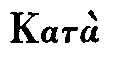
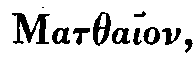
A divine of the present day who shall undertake the demonstration of the truth of Christianity by external evidences, or historically, must not content himself with assuming or asserting this. He must either prove it; or prove that such proof is not necessary. I myself should be quite satisfied if I proved the former position in respect to the fourth Gospel, and showed that the evidence of the other three was equivalent to a record by an eye-witness: which would not be at all inconsistent with my contending at the same time for the authenticity of the first Gospel, or rather for the Catholic interpretation of the title-words
as the more probable opinion, which a sound divine will neither abandon nor overload, neither place it in the foundation, nor on the other hand suffer it to be extruded from the wall. Believe me, there is great, very great, danger in these broad unqualified assertions that Skelton deals in. Even though the balance of evidence should be on his side, yet the inquirer will be unfavourably affected by the numerous doubts and difficulties which an acquaintance with the more modern works of Biblical criticism will pour upon him, and for which his mind is wholly unprepared. To meet with a far weaker evidence than we had taken it for granted we were to find, gives the same shake to the mind, that missing a stair gives to the body.
Ib. p. 243.
Temp. ou, Mr. Dechaine, seem to forget that God is just; and you, Mr. Shepherd, that he is merciful
Dechaine I insist, that, as God is merciful, he will forgive.
Shepherd And I insist, that, as he is just, he will punish.
Temp. Pray Mr. Dechaine, are you able, upon the Deistical scheme to rid yourself of this difficulty?
Dechaine I see no difficulty in it at all. God gives us laws only for our good, and will never suffer those laws to become a snare to us, and the occasion of our eternal misery.
Here is the
cardo
! The man of sense asserts that it is necessary for the good of all, that a code of laws should exist, while yet it is impossible that all should at all times be obeyed by each person: but what is impossible cannot be required. Nevertheless, it may be required that no
iota
of any one of these laws should be wilfully and deliberately transgressed, nor is there any one for the transgression of which the transgressor must not hold himself punishable. "And yet" (says our man of sense,) "what may not be said of any one point, or any one moment, cannot be denied of the collective agency of a whole life, or any considerable section of it. Here we find ourselves constrained by our best feelings to praise or condemn, to reward or punish, according as a great predominance of acts of obedience or disobedience, and a continued love of the better, or the lusting after the worst, manifests the maxim (
regula maxima
), the radical will and proper character of the individual. So parents judge of their children; so schoolmasters of their scholars; so friends of friends, and even so will God judge his creatures, if we are to trust in our common sense, or believe the repeated declarations in the Old Testament." And now I should be glad to hear any satisfactory
sensible
reply to this, or any answer that does not fly higher than 'sense' can follow, and pierce into "the thick clouds" of decried metaphysics! For no fair reply can be imagined, but one which would find the root of the moral evil, the true
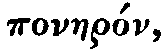
in this very impossibility.
Ib. p. 249.
Cunningham But how does all this discourse about sacrifices and the natural light show that your faith does not ascribe injustice to God in putting an innocent person to death for the transgressions of the guilty?
Shepherd Was Christ innocent?
Cunningham He was without sin.
Shepherd And he was put to death by the appointment and predetermination of God?
Cunningham The Jews put him to death.
Shepherd Do not evade the question. Was he not the Lamb slain from the foundation of the world? Was he not so delivered by the determinate counsel and foreknowledge of God, that the Jews, having taken him, by wicked hands crucified and slew him?
Cunningham And what then?
Shepherd Nothing; but that you are to answer, as well as I, for saying that God predetermined the death of this only innocent person.
I am less pleased with this volume than with any of the preceding. Ask your own heart and conscience whether (for instance,) they are satisfied with this defence
duri per durius
: or whether frightening a modest query into silence by perverting it into an accusation of the Almighty, by virtue of a conclusion borrowed from the Calvinistic theory of Predestination, is not more in the spirit of Job's comforters, than becomes a minister of the Apostolic Church of England and Ireland? Such arguments are but edge-tools at the safest, but more often they may rather be likened to the two-edged blade of Parysatis's knife, the one of which was poisoned. Leave them to Calvin, or those who dare appropriate Calvin's words, that "God's absolute will is the only rule of his justice;"—thus dividing the divine attributes. Yet Calvin himself distinguishes the hidden from the revealed God, even as the Greek Fathers distinguished the
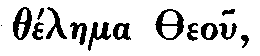
the absolute ground of all being, from the
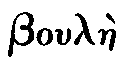
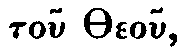
as the cause and disposing providence of all existence.
But I disapprove of the plan and spirit of this work, (Deism Revealed.) The cold-hearted, worldly-minded, cunning Deist, or the coarse sensual Infidel, is of all men the least likely to be converted; and the conscientious, inquiring, though misled and perplexed, Sceptic will throw aside a book at once, as not applicable to his case, which treats every doubt as a crime, and supposes that there is no doubt at all possible but in a bad heart and from wicked wishes. Compare this with St. Paul's language concerning the Jews.
So again, pp. 225, &c. of this volume. Do not the plainest intuitions of our moral and rational being confirm the positions here attributed to the Deist, Dechaine? Are they not the same by which Melancthon de-Calvinized, at least de-Augustinized, the heroic Luther;— those which constitute one of the only two essential differences between the Augsburg Confession and the Calvinistic Articles of Faith? And can anything be more flittery and special-pleading than Skelton's objections? And again, p. 507, "and that prayer which he (Tindal) is reported to have used a little before his death, 'If there is a God, I desire he may have mercy on me;'"—was it Christian-like to publish and circulate a blind report—so improbable and disgusting, as to demand the strongest and most unsuspicious testimony for its reception?
Ib. p. 268.
Shepherd Pray, Mr. Dechaine, if a person, whom you knew to be an honest and clear-sighted man, should solemnly assure you he saw a dead man restored to life, what would you think of his testimony?
Dechaine As I could not possibly have as strong an assurance of his honesty, clear-sightedness, and penetration, as of the great improbability of the fact, I should not believe him.
Shepherd Well; it is true he might be deceived himself, or intend to impose on you. But in case ten such persons should all, at different times, confirm the same report, how would this affect you?
There is one inconvenience, not to say danger, in this argument of Mr. Shepherd's; namely, that of its not standing in the same force, when it comes to be repeated in the particular miraculous facts in support of which it is adduced.
Ib. p. 281.
No other ancient book can be so well proved to have been the work of the author it is now ascribed to, as every book of the New Testament can be proved to have been written by him whose name it hath all along borne.
This is true to the full extent that the defence of the divinity of our religion needs, or perhaps permits, and I see no advantage gained by asserting more. I must lose all power of distinction, before I can affirm that the genuineness of the first Gospel,—that in its present form it was written by Matthew, or is a literal translation of a Gospel written by him,—rests on as strong external evidence as Luke's, or on as strong internal evidence as St. John's. Sufficient that the evidence greatly preponderates in its favor.
Footnote 1:
The complete Works of the late Rev. Philip Skelton, Rector of Fintona. 6. vols. 8vo. London, 1824.
Ed.
return to footnote mark
Footnote 2:
See South's Works, vol. iii. p. 500. Clarendon edit. 1823 —
Ed.
return
Footnote 3:
But it will be proper to observe, that it strikes directly at the very root of Revelation, which cannot possibly give any other evidence of itself, as the dictate of God, but what must be drawn from miracles, wrought to prove the divine mission of those who publish it to the world.
return
Footnote 4:
The Editor is not aware of the existence of the Essay here mentioned. But see for the distinction of the
Ecclesia
and
Enclesia
, the Church and State, 3rd edit.—
Ed.
return
Footnote 5:
On Predestination, as far as p. 445.
return
Contents / Index