Volume 4 — Notes on A Barrister's Hints on Evangelical Preaching1 (continued 2)
Reading edition
argumentum ad hominem,
a bitter reproach (just as if a great chemist should say;—Though you do not care for my science, or the important truths it presents, yet, even as an amusement superior to that of your jugglers to whom you willingly crowd, pay some attention to me)—this is to be set up against twenty plain texts and the whole spirit of the whole Gospel! Besides, Christ could not reason so; for he knew that the Jews admitted both natural and demoniacal miracles, and their faith in the latter he never attacked; though by an
argumentum ad hominem
(for it is no argument in itself) he denied its applicability to his own works. If Christ had reasoned so, why did not the Barrister quote his words, instead of putting imaginary words in his mouth?
Ib. 60, 61.
Religion is a system of revealed truth; and to affirm of any revealed truth, that we cannot understand it, is, in effect, either to deny that it has been revealed, or—which is the same thing—to admit that it has been revealed in vain.
It is too worthless! I cannot go on. Merciful God! hast thou not revealed to us the being of a conscience, and of reason, and of will;—and does this Barrister tell us, that he "understands" them? Let him know that he does not even understand the very word understanding. He does not seem to be aware of the school-boy distinction between the
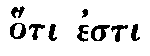
and the

? But to all these silly objections religion must for ever remain exposed as long as the word Revelation is applied to any thing that can be 'bona fide' given to the mind
ab extra
, through the senses of eye, ear, or touch. No! all revelation is and must be
ab intra
; the external
phænomena
can only awake, recall evidence, but never reveal. This is capable of strict demonstration.
Afterwards the Barrister quotes from Thomas Watson respecting things above comprehension in the study of nature: "in these cases, the
fact
is evident, the cause lies in obscurity, deeply removed from all the knowledge and penetration of man." Then what can we believe respecting these causes? And if we can believe nothing respecting them, what becomes of them as arguments in support of the proposition that we ought, in religion, to believe what we cannot understand?
Are there not facts in religion, the causes and constitution of which are mysteries?
Footnote 1:
Hints to the Public and the Legislature on the nature and effect of Evangelical Preaching. By a Barrister. Fourth Edition, 1808.
return to footnote mark
Footnote 2:
See
Aids to Reflection
, p. 14, 4th edition.—
Ed.
return
Footnote 3:
Quart. Review
, vol. ii. p. 187.—
Ed.
return
Footnote 4:
See vol. i., p. 217.—
Ed.
return
Footnote 5:
"And from this account of obligation it follows, that we can he obliged to nothing but what we ourselves are to gain or lose something by; for nothing else can be a violent motive to us. As we should not be obliged to obey the laws, or the magistrate, unless rewards or punishments, pleasure or pain, somehow or other depended upon our obedience; so neither should we, without the same reason, be obliged to do what is right, to practise virtue, or to obey the commands of God."
Paley's Moral and Polit. Philosophy
, B. II. c. 2.
"The difference, and the only difference, ('between prudence and duty',) is this; that in the one case we consider what we shall gain or lose in the present world; in the other case, we consider also what we shall gain or lose in the world to come."
Ib.
c. 3.—
Ed.
return
Footnote 6:
Friend
, Vol. I. Essays X. and XI. 3rd edition—
Ed.
return
Footnote 7:
See
Table Talk
, pp. 282 and 304. 2d edit.—
Ed.
return
Contents / Index