Volume 3 — Notes on Jeremy Taylor
Reading edition
I have not seen the late Bishop Heber's edition of Jeremy Taylor's
Works
; but I have been informed that he did little more than contribute the
Life
, and that in all else it is a mere London booksellers' job. This, if true, is greatly to be regretted. I know no writer whose works more require, I need not say deserve, the annotations, aye, and occasional animadversions, of a sound and learned divine. One thing is especially desirable in reference to that most important, because (with the exception perhaps of the
Holy Living and Dying)
the most popular, of Taylor's works,
The Liberty of Prophesying
; and this is a careful collation of the different editions, particularly of the first printed before the Restoration, and the last published in Taylor's lifetime, and after his promotion to the episcopal bench. Indeed, I regard this as so nearly concerning Taylor's character as a man, that if I find that it has not been done in Heber's edition, and if I find a first edition in the British Museum, or Sion College, or Dr. Williams's library, I will, God permitting, do it myself. There seems something cruel in giving the name, Anabaptist, to the English Anti-pædo-baptists; but still worse in connecting this most innocent opinion with the mad Jacobin ravings of the poor wretches who were called Anabaptists, in Munster, as if the latter had ever formed part of the Baptists' creeds. In short
The Liberty of Prophesying
is an admirable work, in many respects, and calculated to produce a much greater effect on the many than Milton's treatise on the same subject: on the other hand, Milton's is throughout unmixed truth; and the man who in reading the two does not feel the contrast between the single-mindedness of the one, and the
strabismus
in the other, is — in the road of preferment.
Index p. 2
General Dedication of the Polemical Discourses1
Vol. vii. p. ix.
And the breath of the people is like the voice of an exterminating angel, not so killing but so secret.
That is, in such wise. It would be well to note, after what time 'as' became the requisite correlative to 'so,' and even, as in this instance, the preferable substitute. We should have written 'as' in both places probably, but at all events in the latter, transplacing the sentences 'as secret though not so killing;' or 'not so killing, but quite as secret.' It is not generally true that Taylor's punctuation is arbitrary, or his periods reducible to the post-Revolutionary standard of length by turning some of his colons or semi-colons into full stops. There is a subtle yet just and systematic logic followed in his pointing, as often as it is permitted by the higher principle, because the proper and primary purpose, of our stops, and to which alone from their paucity they are adequate, — that I mean of enabling the reader to prepare and manage the proportions of his voice and breath.
But
for the true scheme of punctuation,
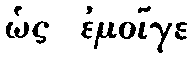
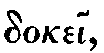
see the blank page over leaf which I will try to disblank into a prize of more worth than can be got at the E.O.'s and little goes of Lindley Murray
2
.
Ib.
p. xv.
But the most complained that, in my ways to persuade a toleration, I helped some men too far, and that I armed the Anabaptists with swords instead of shields, with a power to offend us, besides the proper defensitives of their own ... But wise men understand the thing and are satisfied. But because all men are not of equal strength; I did not only in a discourse on purpose demonstrate the true doctrine in that question, but I have now in this edition of that book answered all their pretensions, &c.
No; in the might of his genius he called up a spirit which he has in vain endeavored to lay, or exorcise from the conviction.
Ib.
p. xvii.
For episcopacy relies not upon the authority of Fathers and Councils, but upon Scripture, upon the institution of Christ, or the institution of the Apostles, upon a universal tradition, and a universal practice, not upon the words and opinions of the doctors: it hath as great a testimony as Scripture itself hath, &c.
We must make allowance for the intoxication of recent triumph and final victory over a triumphing and victorious enemy; or who but would start back at the aweless temerity of this assertion? Not to mention the evasion; for who ever denied the historical fact, or the Scriptural occurrence of the word expressing the fact, namely,
episcopi, episcopatus?
? What was questioned by the opponents was,
Who and what these episcopi were; whether essentially different from the presbyter, or a presbyter by kind in his own ecclesia, and a president or chairman by accident in a synod of presbyters:
That whatever the episcopi of the Apostolic times were, yet were they prelates, lordly diocesans; were they such as the Bishops of the Church of England? Was there Scripture authority for Archbishops?
That the establishment of Bishops by the Apostle Paul being granted (as who can deny it?) — yet was this done jure Apostolico for the universal Church in all places and ages; or only as expedient for that time and under those circumstances; by Paul not as an Apostle, but as the head and founder of those particular churches, and so entitled to determine their bye laws?
Index p. 2
Dedication of the Sacred Order and Offices of Episcopacy
Ib.
p. xxiii.
But the interest of the Bishops is conjunct with the prosperity of the King, besides the interest of their own security, by the obligation of secular advantages. For they who have their livelihood from the King, and are in expectance of their fortune from him, are more likely to pay a tribute of exacter duty, than others, whose fortunes are not in such immediate dependency on His Majesty.
The cat out of the bag! Consult the whole reigns of Charles I and II and the beginning of James II. Jeremy Taylor was at this time (blamelessly for himself and most honourably for his patrons) ambling on the high road of preferment; and to men so situated, however sagacious in other respects, it is not given to read the signs of the times. Little did Taylor foresee that to indiscreet avowals, like these, on the part of the court clergy, the exauctorations of the Bishops and the temporary overthrow of the Church itself would be in no small portion attributable. But the scanty measure and obscurity (if not rather, for so bright a luminary, the occultation) of his preferment after the Restoration is a problem, of which perhaps his virtues present the most probable solution.
Ib.
p. xxv.
A second return that episcopacy makes to royalty, is that which is the duty of all Christians, the paying tributes and impositions.
This is true; and it was an evil hour for the Church, — and led to the loss of its Convocation, the greatest and, in an enlarged state-policy, the most impolitic affront ever offered by a government to its own established Church, — in which the clergy surrendered their right of taxing themselves.
Ib.
p. xxvii.
I mean the conversion of the kingdom from Paganism by St. Augustine, Archbishop of Canterbury; and the Reformation begun and promoted by Bishops.
From Paganism in part; but in part from primitive Christianity to Popery. But neither this nor the following boast will bear narrow looking into, I suspect.
In fine.
Like all Taylor's dedications and dedicatory epistles, this is easy, dignified, and pregnant. The happiest
synthesis
of the divine, the scholar, and the gentleman was perhaps exhibited in him and Bishop Berkeley.
Introd. p.3.
In all those accursed machinations, which the device and artifice of hell hath invented for the supplanting of the Church, inimicus homo, that old superseminator of heresies and crude mischiefs, hath endeavoured to be curiously compendious, and, with Tarquin's device, putare summa papaverum. Quœre-spiritualiter papaveratorurn?
Ib.
His next onset was by Julian, and occidere presbyterium, that was his province. To shut up public schools, to force Christians to ignorance, to impoverish and disgrace the clergy, to make them vile and dishonorable, these are his arts; and he did the devil more service in this fineness of undermining, than all the open battery of ten great rams of persecution.
What felicity, what vivacity of expression! Many years ago Mr. Mackintosh gave it as an instance of my perverted taste, that I had seriously contended that in order to form a style worthy of Englishmen, Milton and Taylor must be studied instead of Johnson, Gibbon, and Junius; and now I see by his introductory Lecture given at Lincoln's Inn, and just published, he is himself imitating Jeremy Taylor, or rather copying his semi-colon punctuation, as closely as he can. Amusing it is to observe, how by the time the modern imitators are at the half-way of the long breathed period, the asthmatic thoughts drop down, and the rest is, — words! I have always been an obstinate hoper: and even this is a
datum
and a symptom of hope to me, that a better, an ancestral, spirit is forming and will appear in the rising generation.
Ib.
p. 5.
First, because here is a concourse of times; for now after that these times have been called the last times for 1600 years together, our expectation of the great revelation is very near accomplishing.
Rather a whimsical consequence, that because a certain party had been deceiving themselves for sixteen centuries they were likely to be in the right at the beginning of the seventeenth. But indeed I question whether in all Taylor's voluminous writings there are to be found three other paragraphs so vague and misty-magnific as this is. It almost reminds me of the "very cloudy and mighty alarming" in Foote.
S. i. p. 4.
If there be such a thing as the power of the keys, by Christ concredited to his Church, for the binding and loosing delinquents and penitents respectively on earth, then there is clearly a court erected by Christ in his Church.
We may, without any heretical division of person, economically distinguish our Lord's character as Jesus, and as Christ, so far that during his sojourn on earth, from his baptism at least to his crucifixion, he was in some respects his own Elias, bringing back the then existing Church to the point at which the Prophets had placed it; that is, distinguishing the
ethica
from the
politica,
what was binding on the Jews as descendants of Abraham and inheritors of the patriarchal faith from the statutes obligatory on them as members of the Jewish state.
Jesus fulfilled the Law, which culminated in a pure religious morality in principles, affections, and acts; and this he consolidated and levelled into the ground-stead on which the new temple
not made with hands,
wherein Himself, even Christ the Lord, is the Shechinah, was to rise and be raised.
Thus he taught the spirit of the Mosaic Law, while by his acts, sufferings, death, resurrection, ascension, and demission of the Comforter, he created and realized the contents, objects, and materials of that redemptive faith, the everlasting Gospel, which from the day of Pentecost his elect disciples,

Were Sent forth to disperse and promulgate with suitable gifts, powers, and evidences.
In this view, I interpret our Lord's sayings concerning the Church, as applying wholly to the Synagogue or established Church then existing, while the binding and loosing refers, immediately and primarily as I conceive, to the miraculous gifts of healing diseases communicated to the Apostles; and I am not afraid to avow the conviction, that the first three Gospels are not the books of the New Testament, in which we should expect to find the peculiar doctrines of the Christian faith explicitly delivered, or forming the predominant subject or contents of the writing.
S. viii. p. 25. Imposition of hands for Ordination does indeed give the Holy Ghost, but not as he is that promise which is called
the promise of the truth
. Alas! but in what sense that does not imply some infusion of power or light, something given and inwardly received, which would not have existed in and for the recipient without this immission by the means or act of the imposition of the hands? What sense that does not amount to more and other than a mere delegation of office, a mere legitimating acceptance and acknowledgment, with respect to the person, of that which already is in him, can be attached to the words,
Receive the Holy Ghost
, without shocking a pious and single-minded candidate? The miraculous nature of the giving does not depend on the particular kind or quality of the gift received, much less demand that it should be confined to the power of working miracles.
For "miraculous nature" read "supernatural character;" and I can subscribe this pencil note written so many years ago, even at this present time, 2d March, 1824.
S. xxi. p. 91.
Postquam unusquisque eos quos baptizabat suos putabat esse, non Christi, et diceretur in populis, Ego sum Pauli, Ego Apollo, Ego autem Cephæ, in toto orbe decretum est ut unus de presbyteris electus superponeretur cateris, ut schismatum semina tollerentur.
The natural inference would, methinks, be the contrary. There would be more persons inclined and more likely to attach an ambition to their belonging to a single eminent leader and head than to a body, — rather to Cæsar, Marius, or Pompey, than to the Senate. But I have ever thought that the best, safest, and at the same time sufficient, argument is, that by the nature of human affairs and the appointments of God's ordinary providence every assembly of functionaries will and must have a president; that the same qualities which recommended the individual to this dignity would naturally recommend him to the chief executive power during the intervals of legislation, and at all times in all points already ruled; that the most solemn acts, Confirmation and Ordination, would as naturally be confined to the head of the executive in the state ecclesiastic, as the sign manual and the like to the king in all limited monarchies; and that in course of time when many presbyteries would exist in the same district, Archbishops and Patriarchs would arise
pari ratione
as Bishops did in the first instance. Now it is admitted that God's extraordinary appointments never repeal but rather perfect the laws of his ordinary providence: and it is enough that all we find in the New Testament tends to confirm and no where forbids, contradicts, or invalidates the course of government, which the Church, we are certain, did in fact pursue.
Ib.
s. xxxvi. p. 171.
But those things which Christianity, as it prescinds from the interest of the republic, hath introduced, all them, and all the causes emergent from them, the Bishop is judge of.... Receiving and disposing the patrimony of the Church, and whatsoever is of the same consideration according to the fortyfirst canon of the Apostles. Præcipimus ut in potestate sua episcopus ecclesice res habeat. Let the Bishops have the disposing of the goods of the Church; adding this reason: si enim animte hominum pretiosæ illi sint creditæ, multo magis eum oportet curam pecuniarum gerere. He that is intrusted with our precious souls may much more be intrusted with the offertories of faithful people.
Let all these belong to the overseer of the Church: to whom else so properly? but what is the nature of the power by which he is to enforce his orders? By secular power? Then the Bishop's power is no derivative from Christ's royalty; for his kingdom is not of the world; but the monies are Cæsar's; and the
cura pecuniarum
must be vested where the donors direct, the law of the land permitting.
Ib.
Such are the delinquencies of clergymen, who are both clergy and subjects too; clerus Domini, and regis subditi: and for their delinquencies, which are in materia justiæ, the secular tribunal punishes, as being a violation of that right which the state must defend; but because done by a person who is a member of the sacred hierarchy, and hath also an obligation of special duty to his Bishop, therefore the Bishop also may punish him; and when the commonwealth hath inflicted a penalty, the Bishop also may impose a censure, for every sin of a clergyman is two.
But why of a clergyman only? Is not every sheep of his flock a part of the Bishop's charge, and of course the possible object of his censure? The clergy, you say, take the oath of obedience. Aye! but this is the point in dispute.
Ib.
p. 172.
So that ever since then episcopal jurisdiction hath a double part, an external and an internal: this is derived from Christ, that from the king, which because it is concurrent in all acts of jurisdiction, therefore it is that the king is supreme of the jurisdiction, namely, that part of it which is the external compulsory.
If Christ delegated no external compulsory power to the Bishops, how came it the duty of princes to God to do so? It has been so since — -yes! since the first grand apostasy from Christ to Constantine.
Ib.
s. xlviii. p. 248.
Bishops ut sic are not secular princes, must not seek for it; but some secular princes may be Bishops, as in Germany and in other places to this day they are. For it is as unlawful for a Bishop to have any land, as to have a country; and a single acre is no more due to the order than a province; but both these may be conjunct in the same person, though still, by virtue of Christ's precept, the functions and capacities must be distinguished.
True; but who with more indignant scorn attacked this very distinction when applied by the Presbyterians to the kingship, when they professed to fight for the King against Charles? And yet they had on their side both the spirit of the English constitution and the language of the law. The King never dies; the King can do no wrong. Elsewhere, too, Taylor could ridicule the Romish prelate, who fought and slew men as a captain at the head of his vassals, and then in the character of a Bishop absolved his other homicidal self. However, whatever St. Peter might understand by Christ's words, St. Peter's three-crowned successors have been quite of Taylor's opinion that they are to be paraphrased thus:
"Simon Peter, as my Apostle, you are to make converts only by humility, voluntary poverty, and the words of truth and meekness; but if by your spiritual influence you can induce the Emperor Tiberius to make you Tetrarch of Galilee or Prefect of Judaea, then — you may lord it as loftily as you will, and deliver as Tetrarch or Prefect those stiff-necked miscreants to the flames for not having been converted by you as an Apostle."
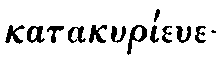
Ib.
p. 276.
I end with the golden rule of Vincentius Lirinensis: — magnopere curandum est ut id teneamus, quod ubique, quod semper, quod ab omnibus creditum est.
Alas! this golden rule comes full and round from the mouth; nor do I deny that it is pure gold: but like too many other golden rules, in order to make it cover the facts which the orthodox asserter of episcopacy at least, and the chaplain of Archbishop Laud and King Charles the Martyr must have held himself bound to bring under it, it must be made to display another property of the sovereign metal, its malleableness to wit; and must be beaten out so thin, that the weight of truth in the portion appertaining to each several article in the orthodox systems of theology will be so small, that it may better be called gilt than gold; and if worth having at all, it will be for its show, not for its substance. For instance, the
aranea theologica
may draw out the whole web of the Westminster Catechism from the simple creed of the beloved Disciple, —
whoever believeth with his heart, and professeth with his mouth, that Jesus is Lord and Christ,
— shall be saved. If implicit faith only be required, doubtless certain doctrines, from which all other articles of faith imposed by the Lutheran, Scotch, or English Churches, may be deduced, have been believed
ubique, semper, et ab omnibus.
But if explicit and conscious belief be intended, I would rather that the Bishop than I should defend the golden rule against Semler.
Index p. 2
Apology for Authorized and Set Forms of Liturgy
Preface, s. vi. p. 286.
Not like women or children when they are affrighted with fire in their clothes. We shaked off the coal indeed, but not our garments, lest we should have exposed our Churches to that nakedness which the excellent men of our sister Churches complained to be among themselves.
O, what convenient things metaphors and similes are, so charmingly indeterminate! On the general reader the literal sense operates: he shivers in sympathy with the poor shift-less matron, the Church of Geneva. To the objector the answer is ready — it was speaking metaphorically, and only meant that she had no shift on the outside of her gown, that she made a shift without an over-all. Compare this sixth section with the manful, senseful, irrebuttable fourth section — a folio volume in a single paragraph! But Jeremy Taylor would have been too great for man, had he not occasionally fallen below himself.
Ib.
s. x. p. 288.
And since all that cast off the Roman yoke thought they had title enough to be called Reformed, it was hard to have pleased all the private interests and peevishness of men that called themselves friends; and therefore that only in which the Church of Rome had prevaricated against the word of God, or innovated against Apostolical tradition, all that was pared away.
Aye! here is the
ovum,
as Sir Everard Home would say, the
proto
-parent of the whole race of controversies between Protestant and Protestant; and each had Gospel on their side. Whatever is not against the word of God is for it, — thought the founders of the Church of England. Whatever is not in the word of God is a word of man, a will-worship presumptuous and usurping, — thought the founders of the Church of Scotland and Geneva. The one proposed to themselves to be reformers of the Latin Church, that is, to bring it back to the form which it had during the first four centuries; the latter to be the renovators of the Christian religion as it was preached and instituted by the Apostles and immediate followers of Christ thereunto specially inspired. Where the premisses are so different, who can wonder at the difference in the conclusions?
Ib.
s. xii. ib.
It began early to discover its inconvenience; for when certain zealous persons fled to Frankfort to avoid the funeral piles kindled by the Roman Bishops in Queen Mary's time, as if they had not enemies enough abroad, they fell foul with one another, and the quarrel was about the Common Prayer Book.
But who began the quarrel? Knox and his recent biographer lay it to Dr. Cox and the Liturgists.
Ib.
s. xiii. p. 289.
Here therefore it became law, was established by an act of Parliament, was made solemn by an appendant penalty against all that on either hand did prevaricate a sanction of so long and so prudent consideration.
Truly evangelical way of solemnizing a party measure, and sapientizing Calvin's
tolerabiles ineptias
by making them
ineptias usque ad carcerem et verbera intolerantes!
Ib.
s. xiv. ib.
But the Common Prayer Book had the fate of St. Paul; for when it had scaped the storms of the Roman See, yet a viper sprung out of Queen Mary's fires, &c.
As Knox and his friends confined themselves to the inspired word, whether vipers or no, they were not adders at all events.
Ib.
xxvi. p. 296.
For, if we deny to the people a liberty of reading the Scriptures, may they not complain, as Isaac did against the inhabitants of the land, that the Philistines had spoiled his well and the fountains of living water? If a free use to all of them and of all Scriptures were permitted, should not the Church herself have more cause to complain of the infinite licentiousness and looseness of interpretations, and of the commencement of ten thousand errors, which would certainly be consequent to such permission? Reason and religion will chide us in the first, reason and experience in the latter ... The Church with great wisdom hath first held this torch out; and though for great reasons intervening and hindering, it cannot be reduced to practice, yet the Church hath shewn her desire to avoid the evil that is on both hands, and she hath shewn the way also, if it could have been insisted in.
If there were not, at the time this Preface, or this paragraph at least, was written or published, some design on foot or
sub lingua
of making advances to the continental catholicism for the purpose of conciliating the courts of Austria, France and Spain, in favor of the Cavalier and Royalist party at home and abroad, this must be considered as a useless and worse than useless avowal. The Papacy at the height of its influence never asserted a higher or more anti-Protestant right than this of dividing the Scriptures into permitted and forbidden portions. If there be a functionary of divine institution, synodical or unipersonal, who with the name of the 'Church' has the right, under circumstances of its own determination, to forbid all but such and such parts of the Bible, it must possess potentially, and under other circumstances, a right of withdrawing the whole book from the unlearned, who yet cannot be altogether unlearned; for the very prohibition supposes them able to do what, a few centuries before, the majority of the clergy themselves were not qualified to do, that is, read their Bible throughout. Surely it would have been politic in the writer to have left out this sentence, which his Puritan adversaries could not fail to translate into the Church shewing her teeth though she dared not bite. I bitterly regret these passages; neither our incomparable Liturgy, nor this full, masterly, and unanswerable defence of it, requiring them.
Ib.
s. xlv, p. 308.
So that the Church of England, in these manners of dispensing the power of the keys, does cut off all disputings and impertinent wranglings, whether the priest's power were judicial or declarative; for possibly it is both, and it is optative too, and something else yet; for it is an emanation from all the parts of his ministry, and he never absolves, but he preaches or prays, or administers a sacrament; for this power of remission is a transcendent, passing through all the parts of the priestly offices. For the keys of the kingdom of heaven are the promises and the threatenings of the Scripture, and the prayers of the Church, and the Word, and the Sacraments, and all these are to be dispensed by the priest, and these keys are committed to his ministry, and by the operation of them all he opens and shuts heaven's gates ministerially.
No more ingenious way of making nothing of a thing than by making it every thing. Omnify the disputed point into a transcendant, and you may defy the opponent to lay hold of it. He might as well attempt to grasp an
aura electrica
.
Apology, &c. s. ii. p. 320. And it may be when I am a little more used to it, I shall not wonder at a synod, in which not one Bishop sits in the capacity of a Bishop, though I am most certain this is the first example in England since it was first christened. Is this quite fair? Is it not, at least logically considered and at the commencement of an argument, too like a _petitio principii_ or _presumptio rei litigatae_? The Westminster divines were confessedly not prelates, but many in that assembly were, in all other points, orthodox and affectionate members of the Establishment, who with Bedell, Lightfoot, and Usher, held them to be Bishops in the primitive sense of the term, and who yet had no wish to make any other change in the hierarchy than that of denominating the existing English prelates Archbishops. They thought that what at the bottom was little more than a question of names among Episcopalians, ought not to have occasioned such a dispute; but yet the evil having taken place, they held a change of names not too great a sacrifice, if thus the things themselves could be preserved, and Episcopacy maintained against the Independents and Presbyterians.
Ib.
s. v. p. 321. It is a thing of no present importance, but as a point of history, it is worth a question whether there were any divines in the Westminster Assembly who adopted by anticipation the notions of the Seekers, Quakers and others
ejusdem farinoe.
Baxter denies it. I understand the controversy to have been, whether the examinations at the admission to the ministry did or not supersede the necessity of any directive models besides those found in the sacred volumes: — if not necessary, whether there was any greater expedience in providing by authority forms of prayer for the minister than forms of sermons. Reading, whether of prayers or sermons, might be discouraged without encouraging unpremeditated praying and preaching. But the whole question as between the prelatists and the Assembly divines has like many others been best solved by the trial. A vast majority among the Dissenters themselves consider the antecedents to the sermon, with exception of their congregational hymns, as the defective part of their public service, and admit the superiority of our Liturgy.
P.S. — It seems to me, I confess, that the controversy could never have risen to the height it did, if all the parties had not thrown too far into the back ground the distinction in nature and object between the three equally necessary species of worship, that is, public, family, and private or solitary, devotion. Though the very far larger proportion of the blame falls on the anti-Liturgists, yet on the other hand, too many of our Church divines — among others that
exemplar
of a Churchman and a Christian, the every way excellent George Herbert — were scared by the growing fanaticism of the Geneva malcontents into the neighbourhood of the opposite extreme; and in their dread of enthusiasm, will-worship, insubordination, indecency, carried their preference of the established public forms of prayer almost to superstition by exclusively both using and requiring them even on their own sick-beds. This most assuredly was neither the intention nor the wish of the first compilers. However, if they erred in this, it was an error of filial love excused, and only not sanctioned, by the love of peace and unity, and their keen sense of
the beauty of holiness
displayed in their mother Church. I mention this the rather, because our Church, having in so incomparable a way provided for our public devotions, and Taylor having himself enriched us with such and so many models of private prayer and devotional exercise — (from which, by the by, it is most desirable that a well arranged collection should be made; a selection is requisite rather from the opulence, than the inequality, of the store;) — we have nothing to wish for but a collection of family and domestic prayers and thanksgivings equally (if that be not too bold a wish) appropriate to the special object, as the Common Prayer Book is for a Christian community, and the collection from Taylor for the Christian in his closet or at his bed side. Here would our author himself again furnish abundant materials for the work. For surely, since the Apostolic age, never did the spirit of supplication move on the deeps of a human soul with a more genial life, or more profoundly impregnate the rich gifts of a happy nature, than in the person of Jeremy Taylor! To render the fruits available for all, we need only a combination of Christian experience with that finer sense of propriety which we may venture to call devotional taste in the individual choosing, or chosen, to select, arrange and methodize; and no less in the dignitaries appointed to revise and sanction the collections.
Perhaps another want is a scheme of Christian psalmody fit for all our congregations, and which should not exceed 150 or 200 psalms and hymns. Surely if the Church does not hesitate in the titles of the Psalms and of the chapters of the Prophets to give the Christian sense and application, there can be no consistent objection to do the same in its spiritual songs. The effect on the morals, feelings, and information of the people at large is not to be calculated. It is this more than any other single cause that has saved the peasantry of Protestant Germany from the contagion of infidelity.
Ib.
s. xvii. p. 325.
Thus the Holy Ghost brought to their memory all things which Jesus spake and did, and, by that means, we come to know all that the Spirit knew to be necessary for us.
Alas! it is one of the sad effects or results of the enslaving Old Bailey fashion of defending, or, as we may well call it, apologizing for, Christianity, — introduced by Grotius and followed up by the modern
Alogi
, whose wordless, lifeless, spiritless, scheme of belief it alone suits, — that we dare not ask, whether the passage here referred to must necessarily be understood as asserting a miraculous remembrancing, distinctly sensible by the Apostles; whether the gift had any especial reference to the composition of the Gospels; whether the assumption is indispensable to a well grounded and adequate confidence in the veracity of the narrators or the verity of the narration; if not, whether it does not unnecessarily entangle the faith of the acute and learned inquirer in difficulties, which do not affect the credibility of history in its common meaning — rather indeed confirm our reliance on its authority in all the points of agreement, that is, in every point which we are in the least concerned to know, — and expose the simple and unlearned Christian to objections best fitted to perplex, because easiest to be understood, and within the capacity of the shallowest infidel to bring forward and exaggerate; and lastly, whether the Scriptures must not be read in that faith which comes from higher sources than history, that is, if they are read to any good and Christian purpose. God forbid that I should become the advocate of mechanical infusions and possessions, superseding the reason and responsible will. The light
a priori
, in which, according to my conviction, the Scriptures must be read and tried, is no other than the earnest,
What shall I do to be saved?
with the inward consciousness, — the gleam or flash let into the inner man through the rent or cranny of the prison of sense, however produced by earthquake, or by decay, — as the ground and antecedent of the question; and with a predisposition towards, and an insight into, the
a priori
probability of the Christian dispensation as the necessary consequents. This is the holy spirit in us praying to the Spirit, without which
no man can say that Jesus is the Lord:
a text which of itself seems to me sufficient to cover the whole scheme of modern Unitarianism with confusion, when compared with that other, —
I am the Lord (Jehovah): that is my name; and my glory will I not give to another
. But in the Unitarian's sense of 'Lord,' and on his scheme of evidence, it might with equal justice be affirmed, that no man can say that Tiberius was the Emperor but by the Holy Ghost.
Ib.
s. xxix. p. 331.
And that this is for this reason called a gift and grace, or issue of the Spirit, is so evident and notorious, that the speaking of an ordinary revealed truth, is called in Scripture, a speaking by the spirit, 1 Cor. xii. 8. No man can say that Jesus is the Lord but by the Holy Ghost. For, though the world could not acknowledge Jesus for the Lord without a revelation, yet now that we are taught this truth by Scripture, and by the preaching of the Apostles, to which they were enabled by the Holy Ghost, we need no revelation or enthusiasm to confess this truth, which we are taught in our creeds and catechisms, &c.
I do not, nay I dare not, hesitate to denounce this assertion as false in fact and the paralysis of all effective Christianity. A greater violence offered to Scripture words is scarcely conceivable. St. Paul asserts that
no man can.
Nay, says Taylor, every man that knows his catechism can; but unless some six or seven individuals had said it by the Holy Ghost some seventeen or eighteen hundred years ago, no man could say so.
Ib.
s. xxxii. p. 334.
And yet, because the Holy Ghost renewed their memory, improved their understanding, supplied to some their want of human learning, and so assisted them that they should not commit an error in fact or opinion, neither in the narrative nor dogmatical parts, therefore they wrote by the spirit.
And where is the proof? — and to what purpose, unless a distinct and plain diagnostic were given of the divinities and the humanities which Taylor himself expressly admits in the text of the Scriptures? And even then what would it avail unless the interpreters and translators, not to speak of the copyists in the first and second centuries, were likewise assisted by inspiration? As to the larger part of the Prophetic books, and the whole of the Apocalypse, we must receive them as inspired truths, or reject them as simple inventions or enthusiastic delusions. But in what other book of Scripture does the writer assign his own work to a miraculous dictation or infusion? Surely the contrary is implied in St. Luke's preface. Does the hypothesis rest on one possible construction of a single passage in St. Paul, 2
Tim
. iii. 16.? And that construction resting materially on a

not found in the oldest MSS., when the context would rather lead us to understand the words as parallel with the other assertion of the Apostle, that all good works are given from God, — that is,
Every divinely inspired writing is profitable, &c
. Finally, will not the certainty of the competence and single mindedness of the writers suffice; this too confirmed by the high probability, bordering on certainty, that God's especial grace worked in them; and that an especial providence watched over the preservation of writings, which, we know, both are and have been of such pre-eminent importance to Christianity, and yet by natural means? But alas! any thing will be pretended, rather than admit the necessity of internal evidence, or than acknowledge, among the external proofs, the convictions and spiritual experiences of believers, though they should be common to all the faithful in all ages of the Church! But in all superstition there is a heart of unbelief, and,
vice versa
, where an individual's belief is but a superficial acquiescence, credulity is the natural result and accompaniment, if only he be not required to sink into the depths of his being, where the sensual man can no longer draw breath. It is not the profession of Socinian tenets, but the spirit of Socinianism in the Church itself that alarms me. This, this, is the dry rot in the beams and timbers of the Temple!
Ib.
s. li. p. 348.
So that let the devotion be ever so great, set forms of prayer will be expressive enough of any desire, though importunate as extremity itself.
This, and much of the same import in this treatise, is far more than Taylor, mature in experience and softened by afflictions, would have written. Besides, it is in effect, though not in logic, a deserting of his own strong and unshaken ground of the means and ends of public worship.
Ib.
s. s. lxix. lxx. pp. 359-60.
These two sections are too much in the vague mythical style of the Italian and Jesuit divines, and the argument gives to these a greater advantage against our Church than it gains over the Sectarians in its support. We well know who and how many the compilers of our Liturgy were under Edward VI, and know too well what the weather-cock Parliaments were, both then and under Elizabeth, by which the compilation was made law. The argument therefore should be inverted; — not that the Church (A. B., C. D., F. L., &c.) compiled it;
ergo
, it is unobjectionable; but (and truly we may say it) it is so unobjectionable, so far transcending all we were entitled to expect from a few men in that state of information and such difficulties, that we are justified in concluding that the compilers were under the guidance of the Holy Spirit. But the same order holds good even with regard to the Scriptures. We cannot rightly affirm they were inspired, and therefore they must be believed; but they are worthy of belief, because excellent in so universal a sense to ends commensurate with the whole moral, and therefore the whole actual, world, that as sure as there is a moral Governor of the world, they must have been in some sense or other, and that too an efficient sense, inspired. Those who deny this, must be prepared to assert, that if they had what appeared to them good historic evidence of a miracle, in the world of the senses, they would receive the hideous immoral doctrines of Mahomet or Brahma, and thus disobey the express commands both of the Old and New Testament. Though an angel should come from heaven and work all miracles, yet preach another doctrine, we are to hold him accursed.
Gal.
i. 8.
Ib.
s. lxxv. p. 356.
When Christ was upon the Mount, he gave it for a pattern, &c.
I cannot thoroughly agree with Taylor in all he says on this point. The Lord's Prayer is an encyclopedia of prayer, and of all moral and religious philosophy under the form of prayer. Besides this, that nothing shall be wanting to its perfection, it is itself singly the best and most divine of prayers. But had this been the main and primary purpose, it must have been thenceforward the only prayer permitted to Christians; and surely some distinct references to it would have been found in the Apostolic writings.
Ib.
s. lxxx. p. 358.
Now then I demand, whether the prayer of Manasses be so good a prayer as the Lord's prayer? Or is the prayer of Judith, or of Tobias, or of Judas Maccabeus, or of the son of Sirach, is any of these so good? Certainly no man will say they are; and the reason is, because we are not sure they are inspired by the Holy Spirit of God.
How inconsistent Taylor often is, the result of the system of economizing truth! The true reason is the inverse. The prayers of Judith and the rest are not worthy to be compared with the Lord's Prayer; therefore neither is the spirit in which they were conceived worthy to be compared with the spirit from which the Lord's Prayer proceeded: and therefore with all fulness of satisfaction we receive the latter, as indeed and in fact our Lord's dictation.
In all men and in all works of great genius the characteristic fault will be found in the characteristic excellence. Thus in Taylor, fulness, overflow, superfluity. His arguments are a procession of all the nobles and magnates of the land in their grandest, richest, and most splendid
paraphernalia
: but the total impression is weakened by the multitudes of lacqueys and ragged intruders running in and out between the ranks. As far as the Westminster divines were the antagonists to be answered — and with the exception of these, and those who like Baxter, Calamy, and Bishop Reynolds, contended for a reformation or correction only of the Church Liturgy, there were none worth answering, — the question was, not whether the use of one and the same set of prayers on all days in all churches was innocent, but whether the exclusive imposition of the same was comparatively expedient and conducive to edification?
Let us not too severely arraign the judgment or the intentions of the good men who determined for the negative. If indeed we confined ourselves to the comparison between our Liturgy, and any and all of the proposed substitutes for it, we could not hesitate: but those good men, in addition to their prejudices, had to compare the lives, the conversation, and the religious affections and principles of the prelatic and anti-prelatic parties in general.
And do not we ourselves now do the like? Are we not, and with abundant reason, thankful that Jacobinism is rendered comparatively feeble and its deadly venom neutralized, by the profligacy and open irreligion of the majority of its adherents? Add the recent cruelties of the Star Chamber under Laud; — (I do not say the intolerance; for that which was common to both parties, must be construed as an error in both, rather than a crime in either); — and do not forget the one great inconvenience to which the prelatic divines were exposed from the very position which it was the peculiar honor of the Church of England to have taken and maintained, namely, the golden mean; — (for in consequence of this their arguments as Churchmen would often have the appearance of contrasting with their grounds of controversy as Protestants,) — and we shall find enough to sanction our charity as brethren, without detracting a tittle from our loyalty as members of the established Church.
As to this Apology, the victory doubtless remains with Taylor on the whole; but to have rendered it full and triumphant, it would have been necessary to do what perhaps could not at that time, and by Jeremy Taylor, have been done with prudence; namely, not only to disprove in part, but likewise in part to explain, the alleged difference of the spiritual fruits in the ministerial labors of the high and low party in the Church, — (for remember that at this period both parties were in the Church, even as the Evangelical, Reformed and Pontifical parties before the establishment of a schism by the actually schismatical Council of Trent,) — and thus to demonstrate that the differences to the disadvantage of the established Church, as far as they were real, were as little attributable to the Liturgy, as the wound in the heel of Achilles to the shield and breast-plate which his immortal mother had provided for him from the forge divine.
Ib.
s. lxxxvi. p. 361.
That the Apostles did use the prayer their Lord taught them, I think needs not much be questioned.
Ad contra
, see above. But that they did not till the siege of Jerusalem deviate unnecessarily from the established usage of the Synagogue is beyond rational doubt. We may therefore safely maintain that a set form was sanctioned by Apostolic practice; though the form was probably settled after the converts from Paganism began to be the majority of Christians.
Ib.
s. lxxxvii. p. 361.
Now that they tied themselves to recitation of the very words of Christ's prayer pro loco et tempore, I am therefore easy to believe, because I find they were strict to a scruple in retaining the sacramental words which Christ spake when he instituted the blessed Sacrament.
Not a case in point. Besides it assumes the controverted sense of
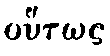
as "in these words"
versus
"to this purport." Grotius and Lightfoot, however, have settled this dispute by proving that the Lord's prayer is a selection of prayers from the Jewish ritual: and a most happy and valuable inference against novelties obtruded for novelty's sake does Grotius draw from this fact. When I consider the manner in which the Jews usually quoted or referred to particular passages of Scripture, it does not seem altogether improbable that the several articles of the
Oratio Dominica
might have been the initial sentences of several prayers; but I have not the least doubt that by the loud utterance of the
My God! my God! why hast thou forsaken me?
our blessed Redeemer referred to and recalled to John and Mary that most wonderful and prophetic twenty-second Psalm. And what a glorious light does not this throw on the whole scene of the crucifixion, and in what additional loveliness does it not present the god-like character of the crucified Son of Man! With the very facts before them, of which the former and larger portion of the Psalm referred to resembles a detailed history rather than a prophecy, — with what force, and with what lively consolation and infusion of stedfast hope and faith, when all human grounds of hope had sunk from under them, must not the obvious and inevitable inference have flashed on the convictions of the holy mother and the beloved disciple! "If all we now behold was pre-ordained and so distinctly predicted; if the one mournful half of the prophecy has been so entirely and minutely fulfilled, after so great a lapse of ages, dare we, can we, doubt for a moment that the glorious remainder will with equal fidelity be accomplished?" Thus to his very last moments did our Lord (setting as it beseemed the sun of righteousness to set) manifest with a wider and wider face of glory his self-oblivious love. In the act he was offering, he himself was a sacrifice of love for the whole creation; and yet the cup overflowed into particular streams; first, for his enemies, his persecutors, and murderers; then for his friends and humanly nearest relative;
Woman, behold thy son!
O what a transfer! Nor does the proposed interpretation preclude any inward and mysterious sense of the words
My God! my God!
— though I confess I have never yet met with a single plausible resolution of the words into any one of the mysteries of the Trinity, or the Incarnation, or the Passion. Nay, were there any necessity for supposing such an allusion, which there is not, the obvious interpretation would, I fear, too dangerously favor the heresy of those who divided and severed the divinity from the humanity; so that not the incarnate God, very God of very God, would have atoned for us on the cross, but the incarnating man; a heresy which either denies or reduces to an absurdity the whole doctrine of redemption, that is, Christianity itself, which rests on the two articles of faith; first, the necessity, and secondly, the reality of a Redeemer — both articles alike incompatible with redemption by a mere man.
Ib.
s. lxxxviii. p. 362.
And I the rather make the inference from the preceding argument because of the cognation one hath with the other; for the Apostles did also in the consecration of the Eucharist use the Lord's Prayer; and that together with the words of institution was the only form of consecration, saith St. Gregory; and St. Jerome affirms, that the Apostles, by the command of their Lord, used this prayer in the benediction of the elements.
This section is an instance of impolitic management of a cause, into which Jeremy Taylor was so often seduced by the fertility of his intellect and the opulence of his erudition. An antagonist by exposing the improbability of the tradition, (and most improbable it surely is), and the little credit due to Saint Gregory and Saint Jerome (not forgetting a Miltonic sneer at their saintship), might draw off the attention from the unanswerable parts of Taylor's reasoning and leave an impression of his having been confuted.
Ib.
s. lxxxix. p. 362.
But besides this, when the Apostles had received great measures of the spirit, and by their gift of prayer composed more forms for the help and comfort of the Church, &c.
Who would not suppose, that the first two lines were an admitted point of history, instead of a bare conjecture in the form of a bold assertion? O, dearest man! so excellent a cause did not need such Bellarminisms.
Ib.
p. 363.
And the Fathers of the Council of Antioch complain against Paulus Samosatenus, quod Psalmos et cantus, qui ad Domini nostri Jesu Christi honorem decantari solent, tanquam recentiores, et a viris recentioris memorioe editos, exploserit.
This Sam-in-satin-hose, or Paul, the same-as-Satan-is, might, I think, have found his confutation in Pliny's Letter to Trajan.
Carmen Christo, quasi Deo, dicere secum invicem.
Ib.
s. xc. p. 364.
Which together with the the lectionarium of the Church, the books of the Apostles and Prophets spoken of by Justin Martyr, and said to be used in the Christian congregations, are the constituent parts of liturgy.

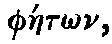
An ingenious but not tenable solution of Justin Martyr's

which were presumably a Gospel not the same, and yet so nearly the same, as our Matthew, that its history and character involve one of the hardest problems of Christian antiquity. By the by, one cause of the small impression — (small in proportion to their vast superiority in knowledge and genius) — which Jeremy Taylor and his compeers made on the religious part of the community by their controversial writings during the life of Charles I is to be found in their undue predilection for Patristic learning and authority. This originated in the wish to baffle the Papists at their own weapons; but it could not escape notice, that the latter, though regularly beaten, were yet not so beaten, but that they always kept the field: and when the same mode of warfare was employed against the Puritans, it was suspected as Papistical.
Ib.
s. xci. pp. 364-5.
For the offices of prose we find but small mention of them in the very first time, save only in general terms, and that such there were, and that St. James, St. Mark, St. Peter, and others of the Apostles and Apostolical men, made Liturgies; and if these which we have at this day were not theirs, yet they make probation that these Apostles left others, or else they were impudent people that prefixed their names so early, and the Churches were very incurious to swallow such a bole, if no pretension could have been reasonably made for their justification.
A rash and dangerous argument. 1810.
A many-edged weapon, which might too readily be turned against the common faith by the common enemy. For if these Liturgies were rightly attributed to St. James, St. Mark, St. Peter, and others of the Apostles and Apostolical men, how could they have been superseded? How could the Church have excluded them from the Canon? But if falsely, and yet for a time and at so early an age generally believed to have been composed by St. James and the rest, it is to be feared that the difference will not stop at the point to which Paul of Samosata carried it; — a fearful consideration for a Christian of the Grotian and Paleyan school. It would not, however, shake my nerves, I confess. The Epistles of St. Paul, and the Gospel, Epistles, and Apocalypse of St. John, contain an evidence of their authenticity, which no uncertainty of ecclesiastic history, no proof of the frequency and success of forgery or ornamental titles (as the Wisdom of Solomon) mistaken for matter of fact, can wrest from me; and with these for my guides and sanctions, what one article of Christian faith could be taken from me, or even unsettled? It seems to me, as it did to Luther, incomparably more probable that the eloquent treatise, entitled an Epistle to the Hebrews, was written by Apollos than by Paul; and what though it was written by neither? It is demonstrable that it was composed before the siege of Jerusalem and the destruction of the Temple; and scarcely less satisfactory is the internal evidence that it was composed by an Alexandrian. These two
data
are sufficient to establish the fact, that the Pauline doctrine at large was common to all Christians at that early period, and therefore the faith delivered by Christ. And this is all I want; nor this for my own assurance, but as arming me with irrefragable arguments against those psilanthropists who as falsely, as arrogantly, call themselves Unitarians, on the one hand; and against the infidel fiction, that Christianity owes its present shape to the genius and rabbinical
cabala
of Paul on the other: while at the same time it weakens the more important half of the objection to, or doubt concerning, the authenticity of St. Peter's Epistles. To this too I attach a high controversial value (for the beauty and excellence of the Epistles themselves are not affected by the question); and I receive them as authentic, for they have all the circumstantial evidence that I have any right to expect. But I feel how much more genial my conviction would become, should I discover, or have pointed out to me, any positive internal evidence equivalent to that which determines the date of the Epistle to the Hebrews, or even to that which leaves no doubt on my mind that the writer was an Alexandrian Jew. This, my dear Lamb, is one of the advantages which the previous evidence supplied by the reason and the conscience secures for us. We learn what in its nature
passes all understanding
, and what belongs to the understanding, and on which, therefore, the understanding may and ought to act freely and fearlessly: while those who will admit nothing above the understanding

which in its nature has no legitimate object but history and outward
phœnomena
, stand in slavish dread like a child at its house of cards, lest a single card removed may endanger the whole foundationless edifice. 1819.
Ib.
s. xcii. p. 365.
Now here dear Jeremy Taylor begins to be himself again; for with all his astonishing complexity, yet versatile agility, of powers, he was too good and of too catholic a spirit to be a good polemic. Hence he so continually is now breaking, now varying, the thread of the argument: and hence he is so again and again forgetting that he is reasoning against an antagonist, and falls into conversation with him as a friend, — I might almost say, into the literary chit-chat and un with holding frankness of a rich genius whose sands are seed-pearl. Of his controversies, those against Popery are the most powerful, because there he had subtleties and obscure reading to contend against; and his wit, acuteness, and omnifarious learning found stuff to work on. Those on Original Sin are the most eloquent. But in all alike it is the digressions, overgrowths, parenthetic
obiter et in transitu
sentences, and, above all, his anthropological reflections and experiences — (for example, the inimitable account of a religious dispute, from the first collision to the spark, and from the spark to the world in flames, in his
Dissuasive from Popery
), — these are the costly gems which glitter, loosely set, on the chain armour of his polemic Pegasus, that expands his wings chiefly to fly off from the field of battle, the stroke of whose hoof the very rock cannot resist, but beneath the stroke of which the opening rock sends forth a Hippocrene. The work in which all his powers are confluent, in which deep, yet gentle, the full stream of his genius winds onward, and still forming peninsulas in its winding course — distinct parts that are only not each a perfect whole — or in less figurative style — (yet what language that does not partake of poetic eloquence can convey the characteristics of a poet and an orator?) — the work which I read with most admiration, but likewise with most apprehension and regret, is the
Liberty of Prophesying
.
If indeed, like some Thessalian drug, or the strong herb of Anticyra,
— — that helps and harms, Which life and death have sealed with counter charms —
it could be administered by special prescription, it might do good service as a narcotic for zealotry, or a solvent for bigotry.
The substance of the preceding tract may be comprised as follows:
During the period immediately following our Lord's Ascension, or the so called Apostolic age, all the gifts of the Spirit, and of course the gift of prayer, as graces bestowed, not merely or principally for the benefit of the Apostles and their contemporaries, but likewise and eminently for the advantage of all after-ages, and as means of establishing the foundations of Christianity, differed in kind, degree, mode, and object, from those ordinary graces promised to all true believers of all times; and possessed a character of extraordinary partaking of the nature of miracles, to which no believer under the present and regular dispensations of the Spirit can make pretence without folly and presumption.
Yet it is certain that even the first miraculous gifts and graces bestowed on the Apostles themselves supervened on, but did not supersede, their natural faculties and acquired knowledge, nor enable them to dispense with the ordinary means and instruments of cultivating the one, and applying the other, by study, reading, past experience, and whatever else Providence has appointed for all men as the conditions and efficients of moral and intellectual progression. The capabilities of deliberating, selecting, and aptly disposing of our thoughts and works are God's good gifts to man, which the superadded graces of the Spirit, vouchsafed to Christians, work on and with, call forth and perfect. Therefore deliberation, selection, and method become duties, inasmuch as they are the bases and recipients of the Spirit, even as the polished crystal is of the light. But if the Prophets and Apostles did not (as Taylor demonstrates that they did not) find in miraculous aids any such infusions of light as precluded or rendered superfluous the exertion of their natural faculties and personal attainments, then a fortiori not the possessors or legatees of the ordinary graces bequeathed by Christ to his Church as the usufructuary property of all its members; and he who wilfully lays aside all premeditation, selection, and ordonnance, that he may enter unprepared on the highest and most awful function of the soul, — that of public prayer, — is guilty of no less indecency and irreverence than if, having to present a petition as the representative of a community before the throne, he purposely put off his seemly garments in order to enter into the presence of the monarch naked or in rags: and expects no less an absurdity than to become a passive automaton, in which the Holy Spirit is to play the ventriloquist.
If, then, each congregation is to receive a prepared form of prayer from its head or minister, why not rather from the collective wisdom of the Church represented in the assembled heads and spiritual Fathers?
This is admitted by implication by the Westminster Assembly. But they are not contented with the existing form, and therefore substitute for it a Directory as the fruits of their meditations and counsels. The whole question, then, is now reduced to the comparative merits and fitness of the Directory and the book of Common Prayer; and how complete the victory of the latter, how glaring the defects, how many the deficiencies, of the former, Jeremy Taylor evinces unanswerably.
Such is the substance of this Tract. What the author proposed to prove he has satisfactorily proved.
The faults of the work are:
The intermixture of weak and strong arguments, and the frequent interruption of the stream of his logic by doubtful, trifling, and impolitic interruptions; arguments resting in premisses denied by the antagonists, and yet taken for granted; in short, appendages that cumber, accessions that subtract, and confirmations that weaken: —
That he commences with a proper division of the subject into two distinct branches, that is, extempore prayer as opposed to set forms, and, The Directory, as prescribing a form opposed to the existing Liturgy; but that in the sequel he blends and confuses and intermingles one with the other, and presses most and most frequently on the first point, which a vast majority of the party he is opposing had disowned and reprobated no less than himself, and which, though easiest to confute, scarcely required confutation.
Index p. 2
Discourse of the Liberty of Prophesying, with its Just Limits and Temper
Epistle Dedicatory, p. cccciii.
And first I answer, that whatsoever is against the foundation of faith is out of the limits of my question, and does not pretend to compliance or toleration.
But as all truths hang together, what error is there which may not be proved to be against the foundation of faith? An inquisitor might make the same code of toleration, and in the next moment light the faggots around a man who had denied the infallibility of Pope and Council.
Ib.
p. ccccxxix.
Indeed if by a heresy we mean that which is against an article of creed, and breaks part of the covenant made between God and man by the mediation of Jesus Christ, I grant it to be a very grievous crime, a calling God's veracity into question, &c.
How can he be said to question God's veracity, whose belief is that God never declared it, — who perhaps disbelieves it, because he thinks it opposite to God's honor? For example: — Original sin, in the literal sense of the article, was held by both Papists and Protestants (with exception of the Socinians) as the fundamental article of Christianity; and yet our Jeremy Taylor himself attacked and reprobated it. Why? because he thought it dishonored God. Why may not another man believe the same of the Incarnation, and affirm that it is equal to a circle assuming the essence of a square, and yet remaining a circle? But so it is; we spoil our cause, because we dare not plead it
in toto
; and a half truth serves for a proof of the opposite falsehood. Jeremy Taylor dared not carry his argument into all its consequences.
index p. 2
Liberty of Prophesying
S. i. p. 443.
Of the nature of faith, and that its duty is completed in believing the articles of the Apostle's creed.
This section is for the most part as beautifully written as it was charitably conceived; yet how vain the attempt! Jeremy Taylor ought to have denied that Christian faith is at all intellectual primarily, but only probably; as,
cœcteris paribus
, it is probable that a man with a pure heart will believe an intelligent Creator. But the faith resides in the predisposing purity of heart, that is, in the obedience of the will to the uncorrupted conscience. For take Taylor's instances; and I ask whether the words or the sense be meant? Surely the latter. Well then, I understand, and so did the dear Bishop, by these texts the doctrine of a Redeemer, who by his agonies of death actually altered the relations of the spirits of all men to their Maker, redeemed them from sin and death eternal, and brought life and immortality into the world. But the Socinian uses the same texts; and means only that a good and gifted teacher of pure morality died a martyr to his opinions, and by his resurrection proved the possibility of all men rising from the dead. He did nothing; — he only taught and afforded evidence. Can two more diverse opinions be conceived? God here; mere man there. Here a redeemer from guilt and corruption, and a satisfaction for offended holiness; there a mere declarer that God imputed no guilt wherever, with or without Christ, the person had repented of it. What could Jeremy Taylor say for the necessity of his sense (which is mine) but what might be said for the necessity of the Nicene Creed? And then as to Rom. x. 9, how can the text mean any thing, unless we know what St. Paul implied in the words
the Lord Jesus
. From other parts of his writings we know that he meant by the word
Lord
his divinity or at least essential superhumanity. But the Socinian will not allow this; or, allowing it, denies St. Paul's authority in matters of speculative faith. As well then might I say, it is sufficient for you to believe and repeat the words
forte miles reddens
; and though one of you mean by it "Perhaps I may be balloted for the militia," and the other understands it to mean, that "Reading is forty miles from London," you are still co-symbolists and believers! While a third person may say, I believe, but do not comprehend, the words; that is, I believe that the person who first used them meant something that is true, — what I do not know; that is, I believe his veracity.
O! had this work been published when Charles I, Archbishop Laud, whose chaplain Taylor was, and the other Star Chamber inquisitors, were sentencing Prynne, Bastwick, Leighton, and others, to punishments that have left a brand-mark on the Church of England, the sophistry might have been forgiven for the sake of the motive, which would then have been unquestionable. Or if Jeremy Taylor had not in effect retracted after the Restoration; — if he had not, as soon as the Church had gained its power, most basely disclaimed and disavowed the principle of toleration, and apologized for the publication by declaring it to have been a
ruse de guerre
, currying pardon for his past liberalism by charging, and most probably slandering, himself with the guilt of falsehood, treachery, and hypocrisy, his character as a man would at least have been stainless. Alas, alas, most dearly do I love Jeremy Taylor; most religiously do I venerate his memory! But this is too foul a blotch of leprosy to be forgiven. He who pardons such an act in such a man partakes of its guilt.
Ib.
s. vii. p. 346-7.
In the pursuance of this great truth, the Apostles, or the holy men, their contemporaries and disciples, composed a creed to be a rule of faith to all Christians; as appears in Irenæus, Tertullian, St. Cyprian, St. Austin, Ruffinus, and divers others; which creed, unless it had contained all the entire object of faith, and the foundation of religion, &c.
Jeremy Taylor does not appear to have been a critical scholar. His reading had been oceanic; but he read rather to bring out the growths of his own fertile and teeming mind than to inform himself respecting the products of those of other men. Hence his reliance on the broad assertions of the Fathers; yet it is strange that he should have been ignorant that the Apostles' Creed was growing piecemeal for several centuries.
Ib.
p. 447.
All catechumens in the Latin Church coming to baptism were interrogated concerning their faith, and gave satisfaction on the recitation of this Creed.
I very much doubt this, and rather believe that our present Apostles' Creed was no more than the first instruction of the catechumens prior to baptism; and (as I conclude from Eusebius) that at baptism they professed a more mysterious faith; — the one being the milk, the other the strong meat. Where is the proof that Tertullian was speaking of this Creed? Eusebius speaks in as high terms of the
Symbolum Fidei
, and, defending himself against charges of heresy, says, "Did I not at my baptism, in the
Symbolum Fidei
, declare my belief in Christ as God and the co-eternal Word?" The true Creed it was impiety to write down; but such was never the case with the present or initiating Creed. Strange, too, that Jeremy Taylor, who has in this very work written so divinely of tradition, should assume as a certainty that this Creed was in a proper sense Apostolic. Is then the Creed of greater authority than the inspired Scriptures? And can words in the Creed be more express than those of St. Paul to the Colossians, speaking of Christ as the creative mind of his Father, before all worlds,
begotten before all things created?
Ib.
s. x. p. 449.
This paragraph is indeed a complexion, as Taylor might call it, of sophisms. Thus; — unbelief from want of information or capacity, though with the disposition of faith, is confounded with disbelief. The question is not, whether it may not be safe for a man to believe simply that Christ is his Saviour, but whether it be safe for a man to disbelieve the article in any sense which supposes an essential supra-humanity in Christ, — any sense that would not have been equally applicable to John, had God chosen to raise him instead of his cousin?
Ib.
s. xi. p. 450.
Neither are we obliged to make these Articles more particular and minute than the Creed. For since the Apostles, and indeed our blessed Lord himself, promised heaven to them who believed him to be the Christ that was to come into the world, and that he who believes in him should be partaker of the resurrection and life eternal, he will be as good as his word. Yet because this article was very general, and a complexion rather than a single proposition, the Apostles and others our Fathers in Christ did make it more explicit: and though they have said no more than what lay entire and ready formed in the bosom of the great Article, yet they made their extracts to great purpose and absolute sufficiency; and therefore there needs no more deductions or remoter consequences from the first great Article than the Creed of the Apostles.
Most true; but still the question returns, what was meant by the phrase
the
Christ? Contraries cannot both be true.
The Christ
could not be both mere man and incarnate God. One or the other must believe falsely on this great key-stone of all the intellectual faith in Christianity. For so it is; alter it, and everything alters; as is proved in Trinitarianism and Socinianism. No two religions can be more different; — I know of no two equally so.
Ib.
s. xii. p. 451.
The Church hath power to intend our faith, but not to extend it; to make our belief more evident, but not more large and comprehensive.
This and the preceding pages are scarcely honest. For Jeremy Taylor begins with admitting that the Creed might have been composed by others. He has no proof of that most absurd fable of the twelve Apostles clubbing to make it; yet here all he says assumes its inspiration as a certain fact.
Ib.
p. 454.
But for the present there is no insecurity in ending there where the Apostles ended, in building where they built, in resting where they left us, unless the same infallibility which they had had still continued, which I think I shall hereafter make evident it did not.
What a tangle of contradictions Taylor thrusts himself into by the attempt to support a true system, a full third of which he was afraid to mention, and another third was by the same fear induced to deny — at least to take for granted the contrary: for example, the absolute plenary inspiration and infallibility of the Apostles and Evangelists; and yet that their whole function, as far as the consciences of their followers were concerned, was to repeat the two or three sentences, that
Jesus was Christ
(so says one of the Evangelists),
the Christ of God
(so says another),
the Christ the Son of the living God
(so says a third), that he rose from the dead, and for the remission of sins, to as many as believed and professed that he was the Christ or the Lord, and died and rose for the remission of sins. Surely no miraculous communication of God's infallibility was necessary for this. But if this infallibility was stamped on all they said and wrote, is it credible that any part should not be equally binding? I declare I can make nothing out of this section, but that it is necessary for men to believe the Apostles' Creed; but what they believe by it is of no consequence. For instance; what if I chose to understand by the word 'dead' a state of trance or suspended animation; — language furnishing plenty of analogies — dead in a swoon — dead drunk — and so on; — should I still be a Christian? 'Born of the Virgin Mary.' What if, as Priestley and others, I interpreted it as if we should say, 'the former Miss Vincent was his mother.' I need not say that I disagree with Taylor's premisses only because they are not broad enough, and with his aim and principal conclusion only because it does not go far enough. I would have the law grounded wholly in the present life, religion only on the life to come. Religion is debased by temporal motives, and law rendered the drudge of prejudice and passion by pretending to spiritual aims. But putting this aside, and judging of this work solely as a chain of reasoning, I seem to find one leading error in it; namely, that Taylor takes the condition of a first admission into the Church of Christ for the fullness of faith which was to be gradually there acquired. The simple acknowledgment, that they accepted Christ as their Lord and King was the first lisping of the infant believer at which the doors were opened, and he began the process of growth in the faith.
Ib.
s. ii. p. 457.
The great heresy that troubled them was the doctrine of the necessity of keeping the law of Moses, the necessity of circumcision, against which doctrine they were therefore zealous, because it was a direct overthrow to the very end and excellency of Christ's coming.
The Jewish converts were still bound to the rite of circumcision, not indeed as under the Law, or by the covenant of works, but as the descendants of Abraham, and by that especial covenant which St. Paul rightly contends was a covenant of grace and faith. But the heresy consisted wholly in the attempt to impose this obligation on the Gentile converts, in the infatuation of some of the Galatians, who, having no pretension to be descendants of Abraham, could, as the Apostle urges, only adopt the rite as binding themselves under the law of works, and thereby apostatizing from the covenant of faith by free grace. And this was the decision of the Apostolic Council at Jerusalem.
Acts
xv. Rhenferd, in his Treatise on the Ebionites and other pretended heretics in Palestine, so grossly and so ignorantly calumniated by Epiphanius, has written excellently well on this subject. Jeremy Taylor is mistaken throughout.
Ib.
s. iv. p. 459.
And so it was in this great question of circumcision.
It is really wonderful that a man like Bishop Taylor could have read the New Testament, and have entertained a doubt as to the decided opinion of all the Apostles, that every born Jew was bound to be circumcised. Opinion? The very doubt never suggested itself. When something like this opinion was slanderously attributed to Paul, observe the almost ostentatious practical contradiction of the calumny which was adopted by him at the request and by the advice of the other Apostles. (
Acts
, xxi. 21-26.) The rite of circumcision, I say, was binding on all the descendants of Abraham through Isaac for all time even to the end of the world; but the whole law of Moses was binding on the Jewish Christians till the heaven and the earth — that is, the Jewish priesthood and the state — had passed away in the destruction of the temple and city; and the Apostles observed every tittle of the Law.
Ib.
s. vi. p. 460.
The heresy of the Nicolaitans.
Heresy is not a proper term for a plainly anti-Christian sect. Nicolaitans is the literal Greek translation of Balaamites; destroyers of the people.
Rev
. ii. 14, 15.
Ib.
s. viii. p. 461.
For heresy is not an error of the understanding, but an error of the will.
Most excellent. To this Taylor should have adhered, and to its converse. Faith is not an accuracy of logic, but a rectitude of heart.
Ib.
p. 462.
It was the heresy of the Gnostics, that it was no matter how men lived, so they did but believe aright.
I regard the extinction of all the writings of the Gnostics among the heaviest losses of Ecclesiastical literature. We have only the account of their inveterate enemies. Individual madmen there have been in all ages, but I do not believe that any sect of Gnostics ever held this opinion in the sense here supposed.
Ib.
And, indeed, if we remember that St. Paul reckons heresy amongst the works of the flesh, and ranks it with all manner of practical impieties, we shall easily perceive that if a man mingles not a vice with his opinion, — if he be innocent in his life, though deceived in his doctrine, — his error is his misery not his crime; it makes him an argument of weakness and an object of pity, but not a person sealed up to ruin and reprobation.
O admirable! How could Taylor, after this, preach and publish his Sermon in defence of persecution, at least against toleration!
Ib.
s. xxii. p. 479.
Ebion, Manes.
No
such man as Ebion ever, as I can see, existed
3
; and Manes is rather a doubtful
ens
.
Ib.
s. xxxi. p. 487.
But I shall observe this, that although the Nicene Fathers in that case, at that time, and in that conjuncture of circumstances, did well, &c.
What Bull and Waterland have urged in defence of the Nicene Fathers is (like every thing else from such men) most worthy of all attention. They contend that no other term but
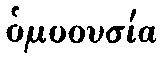
could secure the Christian faith against both the two contrary errors, Tritheism with subversion of the unity of the Godhead on the one hand, and creature-worship on the other.
For
, to use Waterland's mode of argument
4
, either Eusebius of Nicomedia with the four other dissenters at Nice were right or wrong in their assertion, that Christ could not be of the
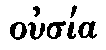
of the self-originated First by derivation, as a son from a father: — if they were right, they either must have discovered some third distinct and intelligible form of origination in addition to
begotten
and
created
, or they had not and could not. Now the latter was notoriously the fact. Therefore to deny the
was implicitly to deny the generation of the second Person, and thus to assert his creation. But if he was a creature, he could not be adorable without idolatry. Nor did the chain of inevitable consequences stop here. His characteristic functions of Redeemer, Mediator, King, and final Judge, must all cease to be attributable to Christ; and the conclusion is, that between the Homoousian scheme and mere Psilanthropism there is no intelligible
medium
. If this, then, be not a fundamental article of faith, what can be?
To this reasoning I really can discern no fair reply within the sphere of conceptual logic, if it can be made evident that the term
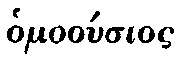
is really capable of achieving the end here set forth. One objection to the term is, that it was not translatable into the language of the Western Church. Consubstantial is not the translation:
substantia
answers to
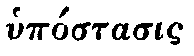
, not to
; and hence, when
was used by the Nicene Fathers in distinction from
, the Latin Church was obliged to render it by some other word, and thus introduced that most unhappy and improper term
persona
. Would you know my own inward judgment on this question, it is this: first, that this pregnant idea, the root and form of all ideas, is not within the sphere of conceptual logic, — that is, of the understanding, — and is therefore of necessity inexpressible; for no idea can be adequately represented in words: — secondly, that I agree with Bull and Waterland against Bishop Taylor, that there was need of a public and solemn decision on this point: — but, lastly, that I am more than doubtful respecting the fitness or expediency of the term
, and hold that the decision ought to have been negative. For at first all parties agreed in the positive point, namely, that Christ was the Son of God, and that the Son of God was truly God, "or very God of very God." All that was necessary to be added was, that the only begotten Son of God was not created nor begotten in time. More than this might be possible, and subject of insight; but it was not determinable by words, and was therefore to be left among the rewards of the Spirit to the pure in heart in inward vision and silent contemplation.
Ib.
s. xl. p. 495.
All that is necessary to give a full and satisfactory import to this excellent paragraph, and to secure it from all inconvenient consequences, is to understand the distinction between the objective and general revelation, by which the whole Church is walled around and kept together (
principium totalitatis et cohæsionis
), and the subjective revelation, the light from the life (
John
i. 4.), by which the individual believers, each according to the grace given, grow in faith. For the former, the Apostles' Creed, in its present form, is more than enough; for the latter, it might be truly said in the words of the fourth Gospel, that all the books which the world could contain would not suffice to set forth explicitly that mystery in which all treasures of knowledge are hidden,
reconduntur
.
From the Apostles' Creed, nevertheless, if regarded in the former point of view, several clauses must be struck out, not as false, but as not necessary. "I believe that Jesus of Nazareth, who was crucified under Pontius Pilate, rose from the dead on the third day; and I receive him as the Christ, the Son of the living God, who died for the remission of the sins of as many as believe in the Father through him, in whom we have the promise of life everlasting." This is the sufficient creed. More than this belongs to the Catechism, and then to the study of the Scriptures.
Ib.
s. vi. p. 506.
So did the ancient Papias understand Christ's millenary reign upon earth, and so depressed the hopes of Christianity and their desires to the longing and expectation of temporal pleasures and satisfactions. And he was followed by Justin Martyr, Irenæus, Tertullian, Lactantius, and indeed, the whole Church generally, till St. Austin and St. Jerome's time, who, first of any whose works are extant, did reprove the error.
Bishop Taylor is, I think, mistaken in two points; first, that the Catholic Millenaries looked forward to carnal pleasures in the kingdom of Christ; — for even the Jewish Rabbis of any note represented the
Millenium
as the preparative and transitional state to perfect spiritualization: — second, that the doctrine of Christ's reign upon earth rested wholly or principally on the twentieth chapter of the Revelations, which actually, in my judgment, opposes it.
I more than suspect that Austin's and Jerome's strongest ground for rejecting the second coming of our Lord in his kingly character, was, that they were tired of waiting for it. How can we otherwise interpret the third and fourth clauses of the Lord's Prayer, or, perhaps, the

,
in hoc seculo
, (x. 30) of St. Mark? If the first three Gospels, joined with the unbroken faith and tradition of the Church for nearly three centuries, can decide the question, the Millenarians have the best of the argument.
Vol. viii. s. ix. p. 22.
One thing only I observe (and we shall find it true in most writings, whose authority is urged in questions of theology), that the authority of the tradition is not it which moves the assent, but the nature of the thing; and because such a canon is delivered, they do not therefore believe the sanction or proposition so delivered, but disbelieve the tradition if they do not like the matter, and so do not judge of the matter by the tradition, but of the tradition by the matter.
This just and acute remark is, in fact, no less applicable to Scripture in all doctrinal points, and if infidelity is not to overspread England as well as France, the same criterion (that is, the internal evidence) must be extended to all points, to the narratives no less than to the precept. The written words must be tried by the Word from the beginning, in which is life, and that life the light of men.
Reduce
it to the noetic pentad, or universal form of contemplation, except where all the terms are absolute, and consequently there is no
punctum indifferens, — in divinis tetras, in omnibus aliis pentas,
and the form stands thus
5
.
Ib.
s. iii. p. 36.
So that it cannot make it divine and necessary to be heartily believed. It may make it lawful, not make it true; that is, it may possibly, by such means, become a law, but not a truth.
This is a sophism which so evident a truth did not need. Apply the reasoning to an act of Parliament previously to the royal sanction. Will it hold good to say, if it was law after the sanction, it was law before? The assertion of the Papal theologians is, that the divine providence may possibly permit even the majority of a legally convened Council to err; but by force of a divine promise cannot permit both a majority and the Pope to err on the same point. The flaw in this is, that the Romish divines rely on a conditional promise unconditionally. To Taylor's next argument the Romish respondent would say, that an exception, grounded on a specific evident necessity, does not invalidate the rule in the absence of any equally evident necessity.
Taylor's argument is a

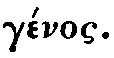
It is not the truth, but the sign or mark, by which the Church at large may know that it is truth, which is here provided for; that is, not the truth simply, but the obligation of receiving it as such. Ten thousand may apprehend the latter, only ten of whom might be capable of determining the former.
Ib.
5.
So that now (that we may apply this) there are seven general Councils, which by the Church of Rome are condemned of error ... The council of Ariminum, consisting of six hundred Bishops.
It is the mark of a faction that it never hesitates to sacrifice a greater good common to them and to their opponents to a lesser advantage obtained over those opponents. Never was there a stranger instance of imprudence, at least, than the act of the Athanasian party in condemning so roundly the great Council of Ariminum as heretical, and for little more than the charitable wish of the many hundred Bishops there assembled to avoid a word that had set all Christendom by the ears. They declared that

were substantially
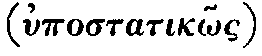
distinct, but nevertheless, one God; and though there might be some incautious phrases used by them, the good Bishops declared that if their decree was indeed Arian, or introduced aught to the derogation of the Son's absolute divinity, it was against their knowledge and intention, and that they renounced it.
Ib.
s. x. p. 46.
Gratian says, that the Council means by a concubine a wife married sine dote et solennitate; but this is daubing with untempered mortar.
Here I think Taylor wrong and Gratian right; for not a hundred years ago the very same decree was passed by the Lutheran clergy in Prussia, determining that left-hand marriages were to be discouraged, but did not exclude from communion. These marriages were invented for the sake of poor nobles: they could have but that one wife, and the children followed the rank and title of the mother, not of the father.
Ib.
s. vii. p. 56.
Thirdly; for pasce oves, there is little in that allegation besides the boldness of the objectors.
I have ever thought that the derivation of the Papal monarchy from the thrice repeated command,
pasce oves
, the most brazen of all the Pope's bulls. It was because Peter had given too good proof that he was more disposed to draw the sword for Christ than to perform the humble duties of a shepherd, that our Lord here strongly, though tenderly, reminds him of his besetting temptation. The words are most manifestly a reproof and a warning, not a commission. In like manner the very letter of the famous paronomastic text proves that Peter's confession, not Peter himself, was the rock. His name was, perhaps, not so much stone as stoner; not so much rock as rockman; and Jesus hearing this unexpected confession of his mysterious Sonship (for this is one of the very few cases in which the internal evidence decides for the superior fidelity of the first Gospel), and recognizing in it an immediate revelation from heaven, exclaims, "Well, art thou the man of the rock;
and upon this rock will I build my church,
" not on this man. Add too, that the law revealed to Moses and the confession of the divine attributes, are named the rock, both in the Pentateuch and in the Psalms.
Mark
has simply,
Thou art the Christ
; Luke,
The Christ of God
6
; but that Jesus was the Messiah had long been known by the Apostles, at all events conjectured. Had not John so declared him at the baptism? Besides, it was included among the opinions concerning our Lord which led to his question, the aim of which was not simply as to the Messiahship, but that the Messiah, instead of a mere descendant of David, destined to reestablish and possess David's throne, was the Jehovah himself,
the Son of the living God; God manifested in the flesh
. 1
Tim
. iii. 16.
Ib.
s. viii. p. 62.
And yet again, another degree of uncertainty is, to whom the Bishops of Rome do succeed. For St. Paul was as much Bishop of Rome as St. Peter was; there he presided, there he preached, and he it was that was the doctor of the uncircumcision and of the Gentiles, St. Peter of the circumcision and of the Jews only; and therefore the converted Jews at Rome might with better reason claim the privilege of St. Peter, than the Romans and the Churches in her communion, who do not derive from Jewish parents.