Jeremy Taylor
Reading edition
The writings of Bishop Jeremy Taylor are a perpetual feast to me. His hospitable board groans under the weight and multitude of viands. Yet I seldom rise from the perusal of his works without repeating or recollecting the excellent observation of Minucius Felix. Fabulas et errores ab imperitis parentibus discimus; et quod est gravius, ipsis studiis et disciplinis elaboramus.
Contents Contents, p.3
Criticism
Many of our modern criticisms on the works of our elder writers remind me of the connoisseur, who, taking up a small cabinet picture, railed most eloquently at the absurd caprice of the artist in painting a horse sprawling. "Excuse me, Sir," replied the owner of the piece, "you hold it the wrong way: it is a horse galloping."
Contents Contents, p.3
Public Instruction
Our statesmen, who survey with jealous dread all plans for the education of the lower orders, may be thought to proceed on the system of antagonist muscles; and in the belief, that the closer a nation shuts its eyes, the wider it will open its hands. Or do they act on the principle, that the status belli is the natural relation between the people and the government, and that it is prudent to secure the result of the contest by gouging the adversary in the first instance? Alas! the policy of the maxim is on a level with its honesty. The Philistines had put out the eyes of Samson, and thus, as they thought, fitted him to drudge and grind
Among the slaves and asses, his comrades, As good for nothing else, no better service:
But his darkness added to his fury without diminishing his strength, and the very pillars of the temple of oppression
With horrible convulsion, to and fro, He tugged, he shook, till down they came, and drew The whole roof after them with burst of thunder, Upon the heads of all who sat beneath; Lords, ladies, captains, counsellors, and priests, Their choice nobility.
The error might be less unpardonable with a statesman of the continent; but with Englishmen, who have Ireland in one direction, and Scotland in another; the one in ignorance, sloth, and rebellion, in the other general information, industry, and loyalty, verily it is not error merely, but infatuation.
Contents Contents, p.3
Picturesque Words
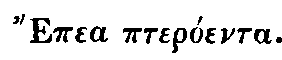
Who is ignorant of Homer's Yet in some Greek manuscript hexameters I have met with a compound epithet, which may compare with it for the prize of excellence in flashing on the mental eye a complete image. It is an epithet of the brutified archangel, and forms the latter half of the verse,


Ye youthful bards! compare this word with its literal translation, "tail-horn-hoofed Satan," and be shy of compound epithets, the components of which are indebted for their union exclusively to the printer's hyphen. Henry More, indeed, would have naturalized the word without hesitation, and
cercoceronychous
would have shared the astonishment of the English reader in the glossary to his
Song of the Soul
with Achronycul, Anaisthaesie, &c. &c.
Contents Contents, p.3
Toleration
The state, with respect to the different sects of religion under its protection, should resemble a well drawn portrait. Let there be half a score individuals looking at it, every one sees its eyes and its benignant smile directed towards himself. The framer of preventive laws, no less than private tutors and school-masters, should remember, that the readiest way to make either mind or body grow awry, is by lacing it too tight.
Contents Contents, p.3
War
It would have proved a striking part of a vision presented to Adam the day after the death of Abel, to have brought before his eyes half a million of men crowded together in the space of a square mile. When the first father had exhausted his wonder on the multitude of his offspring, he would then naturally inquire of his angelic instructor, for what purposes so vast a multitude had assembled? what is the common end? Alas! to murder each other, all Cains, and yet no Abels!
Contents Contents, p.3
Parodies
Parodies on new poems are read as satires; on old ones, the soliloquy of Hamlet for instance as compliments. A man of genius may securely laugh at a mode of attack by which his reviler, in half a century or less, becomes his encomiast.
Contents Contents, p.3
M. Dupuis
Among the extravagancies of faith which have characterized many infidel writers, who would swallow a whale to avoid believing that a whale swallowed Jonas, a high rank should be given to Dupuis, who, at the commencement of the French Revolution, published a work in twelve volumes, octavo, in order to prove that Jesus Christ was the sun, and all Christians, worshippers of Mithra. His arguments, if arguments they can be called, consist chiefly of metaphors quoted from the Fathers. What irresistible conviction would not the following passage from South's sermons (vol. v. p. 165.) have flashed on his fancy, had it occurred in the writings of Origen or Tertullian! and how complete a confutation of all his grounds does not the passage afford to those humble souls, who, gifted with common sense alone, can boast of no additional light received through a crack in their upper apartments:
Christ the great sun of righteousness and saviour of the world, having by a glorious rising, after a red and bloody setting, proclaimed his deity to men and angels; and by a complete triumph over the two grand enemies of mankind, sin and death, set up the everlasting gospel in the room of all false religions, has now changed the Persian superstition into the Christian doctrine, and without the least approach to the idolatry of the former, made it henceforward the duty of all nations, Jews and Gentiles, to worship the rising sun.
This one passage outblazes the whole host of Dupuis' evidences and extracts. In the same sermon, the reader will meet with Hume's argument against miracles anticipated, and put in Thomas's mouth.
Contents Contents, p.3
Origin of the Worship of Hymen
The origin of the worship of Hymen is thus related by Lactantius. The story would furnish matter for an excellent pantomime. Hymen was a beautiful youth of Athens, who for the love of a young virgin disguised himself, and assisted at the Eleusinian rites: and at this time he, together with his beloved, and divers other young ladies of that city, was surprized and carried off by pirates, who supposing him to be what he appeared, lodged him with his mistress. In the dead of the night when the robbers were all asleep, he arose and cut their throats. Thence making hasty way back to Athens, he bargained with the parents that he would restore to them their daughter and all her companions, if they would consent to her marriage with him. They did so, and this marriage proving remarkably happy, it became the custom to invoke the name of Hymen at all nuptials.
Contents Contents, p.3
Egotism
It is hard and uncandid to censure the great reformers in philosophy and religion for their egotism and boastfulness. It is scarcely possible for a man to meet with continued personal abuse, on account of his superior talents, without associating more and more the sense of the value of his discoveries or detections with his own person. The necessity of repelling unjust contempt, forces the most modest man into a feeling of pride and self-consciousness. How can a tall man help thinking of his size, when dwarfs are constantly on tiptoe beside him? Paracelsus was a braggart and a quack; so was Cardan; but it was their merits, and not their follies, which drew upon them that torrent of detraction and calumny, which compelled them so frequently to think and write concerning themselves,that at length it became a habit to do so. Wolff too, though not a boaster, was yet persecuted into a habit of egotism both in his prefaces and in his ordinary conversation, and the same holds good of the founder of the Brunonian system, and of his great namesake Giordano Bruno. The more decorous manners of the present age have attached a disproportionate opprobrium to this foible, and many therefore abstain with cautious prudence from all displays of what they feel. Nay, some do actually flatter themselves, that they abhor all egotism, and never betray it either in their writings or discourse. But watch these men narrowly; and in the greater number of cases you will find their thoughts, feelings, and mode of expression, saturated with the passion of contempt, which is the concentrated vinegar of egotism. Your very humble men in company, if they produce any thing, are in that thing of the most exquisite irritability and vanity. When a man is attempting to describe another person's character, he may be right or he may be wrong; but in one thing he will always succeed, that is, in describing himself. If, for example, he expresses simple approbation, he praises from a consciousness of possessing similar qualities; if he approves with admiration, it is from a consciousness of deficiency. A. "Ay! he is a sober man." B. "Ah! Sir, what a blessing is sobriety!" Here A. is a man conscious of sobriety, who egotizes in tuism; B. is one who, feeling the ill effects of a contrary habit, contemplates sobriety with blameless envy. Again: A. "Yes, he is a warm man, a moneyed fellow; you may rely upon him." B. "Yes, yes, Sir, no wonder! he has the blessing of being well in the world." This reflection might be introduced in defence of plaintive egotism, and by way of preface to an examination of all the charges against it, and from what feelings they proceed. 1800. 1 Contempt is egotism in ill humour. Appetite without moral affection, social sympathy, and even without passion and imagination (in plain English, mere lust,) is the basest form of egotism, and being infra human, or below humanity, should be pronounced with the harsh breathing, as he-goat-ism. 1820. Footnote 1: From Mr. Gulch's commonplace book. Ed
Contents Contents, p.3
Cap of Liberty
Those who hoped proudly of human nature, and admitted no distinction between Christians and Frenchmen, regarded the first constitution as a colossal statue of Corinthian brass, formed by the fusion and commixture of all metals in the conflagration of the state. But there is a common fungus, which so exactly represents the pole and cap of liberty, that it seems offered by nature herself as the appropriate emblem of Gallic republicanism, mushroom patriots, with a mushroom cap of liberty.
Contents Contents, p.3
Bulls
Novi ego aliquem qui dormitabundus aliquando pulsari horam quartam audiverit, et sic numeravit, una, una, una, una; ac tum præ rei absurditate, quam anima concipiebat, exclamavit, Næ! delirat horologium! Quater pulsavit horam unam.
I knew a person, who, during imperfect sleep, or dozing, as we say, listened to the clock as it was striking four, and as it struck, he counted the four, one, one, one, one; and then exclaimed, "Why, the clock is out of its wits; it has struck one four times over!"
This is a good exemplification of the nature of
Bulls
, which will be found always to contain in them a confusion of what the schoolmen would have called objectivity with subjectivity; in plain English, the impression of a thing as it exists in itself, and extrinsically, with the image which the mind abstracts from the impression. Thus, number, or the total of a series, is a generalization of the mind, an
ens rationis
not an
ens reale
. I have read many attempts at a definition of a
Bull
, and lately in the Edinburgh Review; but it then appeared to me that the definers had fallen into the same fault with Miss Edgeworth, in her delightful essay on
Bulls
, and given the definition of the genus,
Blunder
, for that of the particular species. I will venture, therefore, to propose the following: a
Bull
consists in a mental juxta-position of incongruous images or thoughts with the sensation, but without the sense, of connection. The psychological conditions of the possibility of a
Bull
, it would not be difficult to determine; but it would require a larger space than can be afforded here, at least more attention than my readers would be likely to afford. There is a sort of spurious
Bull
which consists wholly in mistake of language, and which the closest thinker may make, if speaking in a language of which he is not master.
Contents Contents, p.3
Wise Ignorance
It is impossible to become either an eminently great, or truly pious man, without the courage to remain ignorant of many things. This important truth is most happily expressed by the elder Scaliger in prose, and by the younger in verse; the latter extract has an additional claim from the exquisite terseness of its diction, and the purity of its Latinity. I particularly recommend its perusal to the commentators on the Apocalypse.
Quare ulterior disquisitio morosi atque satagentis animi est; humanæ enim sapientiae pars est, quædam æquo animo nescire velle. J. C, Scalig. Ex. 307. s. 29. Ne curiosus quære causas omnium, Quæcunque libris vis prophetarum indidit, Afflata cælo, plena veraci Deo; Nec operta sacri supparo silentii Irrumpere aude; sed prudenter praeteri! Nescire velle quae magister optimus Docere non vult, erudita inscitia est. Josep. Scalig.
Contents Contents, p.3
Rouge
Triumphant generals in Rome wore rouge. The ladies of France, and their fair sisters and imitators in Britain, conceive themselves always in the chair of triumph, and of course entitled to the same distinction. The custom originated, perhaps, in the humility of the conquerors that they might seem to blush continually at their own praises. Mr. Gilpin frequently speaks of a "picturesque eye:" with something less of solecism, I may affirm that our fair ever blushing triumphants have secured to themselves the charm of picturesque cheeks, every face being its own portrait.
Contents Contents, p.3
Hasty Words
I crave mercy (at least of my contemporaries: for if these Omniana should outlive the present generation, the opinion will not need it) but I could not help writing in the blank page of a very celebrated work 1 the following passage from Picus Mirandula:-
Movent mihi stomachum grammatistæ quidam, qui cum duas tenuerint vocabulorum origines, ita se ostentant, ita venditant, ita circumferunt jactabundi, ut præ ipsis pro nihilo habendos philosophos arbitrentur. (Epist. ad Hermol. Barb.)
Footnote 1
: Diversions of Purley.
Ed.
Contents Contents, p.3
Motives and Impulses
It is a matter of infinite difficulty, but fortunately of comparative indifference to determine what a man's motive may have been for this or that particular action. Rather seek to learn what his objects in general are. What does he habitually wish, habitually pursue? and thence deduce his impulses which are commonly the true efficient causes of men's conduct; and without which the motive itself would not have become a motive. Let a haunch of venison represent the motive, and the keen appetite of health, and exercise the impulse: then place the same or some more favourite dish before the same man, sick, dyspeptic, and stomach-worn, and we may then weigh the comparative influences of motives and impulses. Without the perception of this truth, it is impossible to understand the character of lago, who is represented as now assigning one, and then another, and again a third motive for his conduct, all alike the mere fictions of his own restless nature, distempered by a keen sense of his intellectual superiority, and haunted by the love of exerting power on those especially who are his superiors in practical and moral excellence. Yet how many among our modern critics have attributed to the profound author this the appropriate inconsistency of the character itself. A second illustration: Did Curio, the quondam patriot, reformer, and semi-revolutionist, abjure his opinion, and yell the foremost in the hunt of persecution against his old friends and fellow-philosophists, with a cold clear predetermination, formed at one moment, of making £5000 a year by his apostacy? I neither know nor care. Probably not. But this I know, that to be thought a man of consequence by his contemporaries, to be admitted into the society of his superiors in artificial rank, to excite the admiration of lords, to live in splendour and sensual luxury, have been the objects of his habitual wishes. A flash of lightning has turned at once the polarity of the compass needle: and so, perhaps, now and then, but as rarely, a violent motive may revolutionize a man's opinions and professions. But more frequently his honesty dies away imperceptibly from evening into twilight, and from twilight into utter darkness. He turns hypocrite so gradually, and by such tiny atoms of motion, that by the time he has arrived at a given point, he forgets his own hypocrisy in the imperceptible degrees of his conversion. The difference between such a man and a bolder liar, is merely that between the hour hand, and that which tells the seconds, on a watch. Of the former you can see only the past motion; of the latter both the past motion and the present moving. Yet there is, perhaps, more hope of the latter rogue: for he has lied to mankind only and not to himself the former lies to his own heart, as well as to the public.
Contents Contents, p.3
Inward Blindness
Talk to a blind man he knows he wants the sense of sight, and willingly makes the proper allowances. But there are certain internal senses, which a man may want, and yet be wholly ignorant that he wants them. It is most unpleasant to converse with such persons on subjects of taste, philosophy, or religion. Of course there is no reasoning with them: for they do not possess the facts, on which the reasoning must be grounded. Nothing is possible, but a naked dissent, which implies a sort of unsocial contempt; or, what a man of kind dispositions is very likely to fall into, a heartless tacit acquiescence, which borders too nearly on duplicity.
Contents Contents, p.3
The Vices of Slaves No Excuse for Slavery
It often happens, that the slave himself has neither the power nor the wish to be free. He is then brutified; but this apathy is the dire effect of slavery, and so far from being a justifying cause, that it contains the grounds of its bitterest condemnation. The Carlovingian race bred up the Merovingi as beasts; and then assigned their unworthiness as the satisfactory reason for their dethronement. Alas! the human being is more easily weaned from the habit of commanding than from that of abject obedience. The slave loses his soul when he loses his master; even as the dog that has lost himself in the street, howls and whines till he has found the house again, where he had been kicked and cudgelled, and half starved to boot. As we, however, or our ancestors must have inoculated our fellow-creature with this wasting disease of the soul, it becomes our duty to cure him; and though we cannot immediately make him free, yet we can, and ought to, put him in the way of becoming so at some future time, if not in his own person, yet in that of his children. The French, you will say, are not capable of freedom. Grant this; but does this fact justify the ungrateful traitor, whose every measure has been to make them still more incapable of it?
Contents Contents, p.3
Circulation of the Blood
The ancients attributed to the blood the same motion of ascent and descent which really takes place in the sap of trees. Servetus discovered the minor circulation from the heart to the lungs. Do not the following passages of Giordano Bruno (published in 1591) seem to imply more? I put the question, pauperis forma, with unfeigned diffidence.
"De Immenso et Innumerabili," lib. vi. cap. 8: Ut in nostro corpore sanguis per totum circumcursat et recursat, sic in toto mundo, astro, tellure. Quare non aliter quam nostro in corpore sanguis Hinc meat, hinc remeat, neque ad inferiora fluit vi Majore, ad supera a pedibus quam deinde recedat:
and still more plainly, in the ninth chapter of the same book,
Quid esset Quodam ni gyro naturae cuncta redirent Ortus ad proprios rursum; si sorbeat omnes Pontus aquas, totum non restituatque perenni Ordine; qua possit rerum consistere vita? Tanquam si totus concurrat sanguis in unam, In qua consistat, partem, nec prima revisat Ordia, et antiquos cursus non inde resumat.
It is affirmed in the
Supplement to the Scotch Encyclopædia Britannica,
that Des Cartes was the first who in defiance of Aristotle and the Schools, attributed infinity to the universe. The very title of Bruno's poem proves, that this honour belongs to him.
Feyjoo lays claim to a knowledge of the circulation of the blood for Francisco de la Reyna, a farrier, who published a work upon his own art at Burgos, in 1564. The passage which he quotes is perfectly clear.
Por manera, que la sangre anda en torno, y en rueda por todos los miembros, excluye toda duda.
Whether Reyna himself claimed any discovery, Feyjoo does not mention; but, these words seem to refer to some preceding demonstration of the fact. I am inclined to think that this, like many other things, was known before it was discovered; just as the preventive powers of the vaccine disease, the existence of adipocire in graves, and certain principles in grammar and in population, upon which bulky books have been written and great reputations raised in our days.
Contents Contents, p.3
Peritura Parcere Chartæ
What scholar but must at times have a feeling of splenetic regret, when he looks at the list of novels, in two, three, or four volumes each, published monthly by Messrs. Lane, &c. and then reflects that there are valuable works of Cudworth, prepared by himself for the press, yet still unpublished by the University which possesses them, and which ought to glory in the name of their great author! and that there is extant in manuscript a folio volume of unprinted sermons by Jeremy Taylor. Surely, surely, the patronage of our many literary societies might be employed more beneficially to the literature and to the actual literati of the country, if they would publish the valuable manuscripts that lurk in our different public libraries, and make it worth the while of men of learning to correct and annotate the copies, instead of , but it is treading on hot embers!
Contents Contents, p.3
to Have and to Be
The distinction is marked in a beautiful sentiment of a German poet: Hast thou any thing? share it with me and I will pay thee the worth of it. Art thou any thing? O then let us exchange souls! The following is offered as a mere playful illustration: "Women have no souls," says prophet Mahomet.
Nay, dearest Anna! why so grave? I said you had no soul,'tis true: For what you are, you cannot have 'Tis I, that have one, since I first had you.
Contents Contents, p.3
Party Passion
"Well, Sir!" exclaimed a lady, the vehement and impassionate partizan of Mr. Wilkes, in the day of his glory, and during the broad blaze of his patriotism, "Well, Sir! and will you dare deny that Mr. Wilkes is a great man, and an eloquent man?" "Oh! by no means, Madam! I have not a doubt respecting Mr. Wilkes's talents!" "Well, but, Sir! and is he not a fine man, too, and a handsome man?" "Why, Madam! he squints, doesn't he?" "Squints! yes to be sure he does, Sir! but not a bit more than a gentleman and a man of sense ought to squint!"
Contents Contents, p.3
Goodness of Heart Indispensable to a Man of Genius
If men will impartially, and not asquint, look toward the offices and function of a poet, they will easily conclude to themselves the impossibility of any man's being the good poet without being first a good man. (Dedication to the Fox).
Ben Jonson has borrowed this just and noble sentiment from Strabo.

Contents Contents, p.3
Milton and Ben Jonson
Those who have more faith in parallelism than myself, may trace Satan's address to the sun in Paradise Lost to the first lines of Ben Jonson's Poetaster:
"Light! I salute thee, but with wounded nerves, Wishing thy golden splendour pitchy darkness!"
But even if Milton had the above in his mind, his own verses would be more fitly entitled an apotheosis of Jonson's lines than an imitation.
Contents Contents, p.3
Statistics
We all remember Burke's curious assertion that there were 80,000 incorrigible jacobins in England. Mr. Colquhoun is equally precise in the number of beggars, prostitutes, and thieves in the City of London. Mercetinus, who wrote under Lewis XV. seems to have afforded the precedent; he assures his readers, that by an accurate calculation there were 50,000 incorrigible atheists in the City of Paris! Atheism then may have been a co-cause of the French revolution; but it should not be burthened on it, as its monster-child.
Contents Contents, p.4
Magnanimity
The following ode was written by Giordano Bruno, under prospect of that martyrdom which he soon after suffered at Rome, for atheism: that is, as is proved by all his works, for a lofty and enlightened piety, which was of course unintelligible to bigots and dangerous to an apostate hierarchy. If the human mind be, as it assuredly is, the sublimest object which nature affords to our contemplation, these lines which portray the human mind under the action of its most elevated affections, have a fair claim to the praise of sublimity. The work from which they are extracted is exceedingly rare (as are, indeed, all the works of the Nolan philosopher), and I have never seen them quoted:
Dædaleas vacuis plumas nectere humeris Concupiant alii; aut vi suspendi nubium Alis, ventorumve appetant remigium; Aut orbitæ flammantis raptari alveo; Bellerophontisve alitem Nos vero illo donati sumus genio, Ut fatum intrepedi objectasque umbras cernimus, Ne cæci ad lumen solis, ad perspicuas Naturæ voces surdi, ad Divum munera Ingrato adsimus pectore. Non curamus stultorum quid opinio De nobis ferat, aut queis dignetur sedibus. Alis ascendimus sursum melioribus! Quid nubes ultra, ventorum ultra est semita, Vidimus, quantum satis est. Illuc conscendent plurimi, nobis ducibus, Per scalam proprio erectam et firmam in pectore, Quam Deus, et vegeti sors dabit ingeni; Non manes, pluma, ignis, ventus, nubes, spiritus, Divinantum phantasmata. Non sensus vegetans, non me ratio arguet, Non indoles exculti clara ingenii; Sed perfidi sycophantæ supercilium Absque lance, statera, trutina, oculo, Miraculum armati segete. Versificantis grammatistæ encomium, Buglossæ Græcissantum, et epistolia Lectorem libri salutantum a limine, Latrantum adversum Zoilos, Momos, mastiges, Hinc absint testimonia! Procedat nudus, quern non ornant nubila, Sol! Non conveniunt quadrupedum phaleræ Humano dorso! Porra veri species Quæsita, inventa, et patefacta me efferat! Etsi nullus intelligat, Si cum natura sapio, et sub numine, Id vere plus quam satis est.
The conclusion alludes to a charge of impenetrable obscurity, in which Bruno shares one and the same fate with Plato, Aristotle, Kant, and in truth with every great discoverer and benefactor of the human race; excepting only when the discoveries have been capable of being rendered palpable to the outward senses, and have therefore come under the cognizance of our "sober judicious critics," the men of "sound common sense;" that is, of those snails in intellect, who wear their eyes at the tips of their feelers, and cannot even see unless they at the same time touch. When these finger-philosophers affirm that Plato, Bruno, &c. must have been "out of their senses," the just and proper retort is, "Gentlemen! it is still worse with you! you have lost your reason!"
By the by, Addison in the Spectator has grossly misrepresented the design and tendency of Bruno's
Bestia Triomphante
; the object of which was to show of all the theologies and theogonies which have been conceived for the mere purpose of solving problems in the material universe, that as they originate in fancy, so they all end in delusion, and act to the hindrance or prevention of sound knowledge and actual discovery. But the principal and most important truth taught in this allegory is, that in the concerns of morality all pretended knowledge of the will of Heaven which is not revealed to man through his conscience; that all commands which do not consist in the unconditional obedience of the will to the pure reason, without tampering with consequences (which are in God's power, not in ours); in short, that all motives of hope and fear from invisible powers, which are not immediately derived from, and absolutely coincident with, the reverence due to the supreme reason of the universe, are all alike dangerous superstitions. The worship founded on them, whether offered by the Catholic to St. Francis, or by the poor African to his Fetish differ in form only, not in substance. Herein Bruno speaks not only as a philosopher, but as an enlightened Christian; the Evangelists and Apostles every where representing their moral precepts not as doctrines then first revealed, but as truths implanted in the hearts of men, which their vices only could have obscured.
Contents Contents, p.4
Negroes and Narcissuses
There are certain tribes of Negros who take for the deity of the day the first thing they see or meet with in the morning. Many of our fine ladies, and some of our very fine gentlemen, are followers of the same sect; though by aid of the looking-glass they secure a constancy as to the object of their devotion.
Contents Contents, p.4
An Anecdote
We here in England received a very high character of Lord during his stay abroad. "Not unlikely, Sir," replied the traveller; "a dead dog at a distance is said to smell like musk."
Contents Contents, p.4
The Pharos at Alexandria
Certain full and highly-wrought dissuasives from sensual indulgencies, in the works of theologians as well as of satirists and story-writers, may, not unaptly, remind one of the Pharos; the many lights of which appeared at a distance as one, and this as a polar star, so as more often to occasion wrecks than prevent them. At the base of the Pharos the name of the reigning monarch was engraved, on a composition, which the artist well knew would last no longer than the king's life. Under this, and cut deep in the marble itself, was his own name and dedication: "Sostratos of Gyndos, son of Dexiteles to the Gods, protectors of sailors!" So will it be with the Georgium Sidus the Ferdinandia, &c. &c. Flattery's plaister of Paris will crumble away, and under it we shall read the names of Herschel, Piozzi, and their compeers.
Contents Contents, p.4
Sense and Common Sense
I have noticed two main evils in philosophizing. The first is, the absurdity of demanding proof for the very facts which constitute the nature of him who demands it, a proof for those primary and unceasing revelations of self-consciousness, which every possible proof must pre-suppose; reasoning, for instance, pro and con, concerning the existence of the power of reasoning. Other truths may be ascertained; but these are certainty itself (all at least which we mean by the word), and are the measure of every thing else which we deem certain. The second evil is, that of mistaking for such facts mere general prejudices, and those opinions that, having been habitually taken for granted, are dignified with the name of common sense. Of these, the first is the more injurious to the reputation, the latter more detrimental to the progress of philosophy. In the affairs of common life we very properly appeal to common sense; but it is absurd to reject the results of the microscope from the negative testimony of the naked eye. Knives are sufficient for the table and the market; but for the purposes of science we must dissect with the lancet. As an instance of the latter evil, take that truly powerful and active intellect, Sir Thomas Brown, who, though he had written a large volume in detection of vulgar errors, yet peremptorily pronounces the motion of the earth round the sun, and consequently the whole of the Copernican system unworthy of any serious confutation, as being manifestly repugnant to common sense; which said common sense, like a miller's scales, used to weigh gold or gasses, may, and often does, become very gross, though unfortunately not very uncommon, nonsense. And as for the former, which may be called Logica Praepostera, I have read in metaphysical essays of no small fame, arguments drawn ab extra in proof and disproof of personal identity, which, ingenious as they may be, were clearly anticipated by the little old woman's appeal to her little dog, for the solution of the very same doubts, occasioned by her petticoats having been cut round about:
If it is not me, he'll bark and he'll rail, But if I be I, he'll wag his little tail.
Contents Contents, p.4
Toleration
I dare confess that Mr. Locke's treatise on Toleration appeared to me far from being a full and satisfactory answer to the subtle and oft-times plausible arguments of Bellarmin, and other Romanists. On the whole, I was more pleased with the celebrated W. Penn's tracts on the same subject. The following extract from his excellent letter to the king of Poland appeals to the heart rather than to the head, to the Christian rather than to the philosopher; and, besides, overlooks the ostensible object of religious penalties, which is not so much to convert the heretic, as to prevent the spread of heresy. The thoughts, however, are so just in themselves, and expressed with so much life and simplicity, that it well deserves a place in these Omniana:
Now, O Prince! give a poor Christian leave to expostulate with thee. Did Christ Jesus or his holy followers endeavour, by precept or example, to set up their religion with a carnal sword? Called he any troops of men or angels to defend him? Did he encourage Peter to dispute his right with the sword? But did he not say, Put it up? Or did he countenance his over-zealous disciples, when they would have had fire from heaven to destroy those that were not of their mind? No! But did not Christ rebuke them, saying, Ye know not what spirit ye are of? And if it was neither Christ's spirit, nor their own spirit that would have fire from heaven Oh! what is that spirit that would kindle fire on earth to destroy such as peaceably dissent upon the account of conscience! O King! when did the true religion persecute? When did the true church offer violence for religion? Were not her weapons prayers, tears, and patience? did not Jesus conquer by these weapons, and vanquish cruelty by suffering? can clubs, and staves, and swords, and prisons, and banishments reach the soul, convert the heart, or convince the understanding of man? When did violence ever make a true convert, or bodily punishment, a sincere Christian? This maketh void the end of Christ's coming. Yea, it robbeth God's spirit of its office, which is to convince the world. That is the sword by which the ancient Christians overcame.
The theory of persecution seems to rest on the following assumptions.
1.
A duty implies a right. We have a right to do whatever it is our duty to do.
2.
It is the duty and consequently the right of the supreme power in a state to promote the greatest possible sum of well-being in that state.
3.
This is impossible without morality.
4.
But morality can neither be produced or preserved in a people at large without true religion.
5.
Relative to the duties of the legislature or governors, that is the true religion which they conscientiously believe to be so.
6.
As there can be but one true religion, at the same time, this one it is their duty and right to authorize and protect.
7.
But the established religion cannot be protected and secured except by the imposition of restraints or the influence of penalties on those, who profess and propagate hostility to it.
8.
True religion, consisting of precepts, counsels, commandments, doctrines, and historical narratives, cannot be effectually proved or defended, but by a comprehensive view of the whole as a system. Now this cannot be hoped for from the mass of mankind. But it may be attacked, and the faith of ignorant men subverted by particular objections, by the statement of difficulties without any counter-statement of the greater difficulties which would result from the rejection of the former, and by all the other stratagems used in the desultory warfare of sectaries and infidels. This is, however, manifestly dishonest and dangerous, and there must exist, therefore, a power in the state to prevent, suppress, and punish it.
9.
The advocates of toleration have never been able to agree among themselves concerning the limits to their own claims; have never established any clear rules, as to what shall and what shall not be admitted under the name of religion and conscience. Treason and the grossest indecencies not only may be, but have been, called by these names: as among the earlier Anabaptists.
10.
And last, it is a
petitio principii
, or begging the question, to take for granted that a state has no power except in case of overt acts. It is its duty to prevent a present evil, as much at least as to punish the perpetrators of it. Besides, preaching and publishing are overt acts. Nor has it yet been proved, though often asserted, that a Christian sovereign has nothing to do with the eternal happiness or misery of the fellow creatures entrusted to his charge.
Contents Contents, p.4
Hint for a New Species of History
"The very knowledge of the opinions and customs of so considerable a part of mankind as the Jews now are, and especially have been heretofore, is valuable both for pleasure and use. It is a very good piece of history, and that of the best kind, namely, of human nature, and of that part of it which is most different from us, and commonly the least known to us. And, indeed, the principal advantage which is to be made by the wiser sort of men of most writings, is rather to see what men think and are, than to be informed of the natures and truth of things; to observe what thoughts and passions have occupied men's minds, what opinions and manners they are of. In this view it becomes of no mean importance to notice and record the strangest ignorance, the most putid fables, impertinent, trifling, ridiculous disputes, and more ridiculous pugnacity in the defence and retention of the subjects disputed." (Publisher's preface to the reader in Lightfoot's Works, vol. i.)
In the thick volume of title pages and chapters of contents (composed) of large and small works correspondent to each (proposed) by a certain
omni
-pregnant,
nihili
-parturient genius of my acquaintance, not the least promising is, "A History of the morals and (as connected therewith) of the manners of the English Nation from the Conquest to the present time." From the chapter of contents it appears, that my friend is a steady believer in the uninterrupted progression of his fellow countrymen; that there has been a constant growth of wealth and well-being among us, and with these an increase of knowledge, and with increasing knowledge an increase and diffusion of practical goodness. The degrees of acceleration, indeed, have been different at different periods. The moral being has sometimes crawled, sometimes strolled, sometimes walked, sometimes run; but it has at all times been moving onward. If in any one point it has gone backward, it has been only in order to leap forward in some other. The work was to commence with a numeration table, or catalogue, of those virtues or qualities which make a man happy in himself, and which conduce to the happiness of those about him, in a greater or lesser sphere of agency. The degree and the frequency in which each of these virtues manifested themselves, in the successive reigns from William the Conqueror inclusively, were to be illustrated by apposite quotations from the works of contemporary writers, not only of historians and chroniclers, but of the poets, romance writers, and theologians, not omitting the correspondence between literary men, the laws and regulations, civil and ecclesiastical, and whatever records the industry of antiquarians has brought to light in their provincial, municipal, and monastic histories: tall tomes and huge! undegenerate sons of Anak, which look down from a dizzy height on the dwarfish progeny of contemporary wit, and can find no associates in size at a less distance than two centuries; and in arranging which the puzzled librarian must commit an anachronism in order to avoid an anatopism.
Such of these illustrations as most amused or impressed me, when I heard them (for alas! even his very title pages and contents my friend composes only in air!) I shall probably attempt to preserve in different parts of these
Omniana
. At present I shall cite one article only which I found wafered on a blank leaf of his memorandum book, superscribed: "Flattering news for
Anno Domini
2000, whenever it shall institute a comparison between itself and the l7th and l8th centuries." It consists of an extract, say rather, an exsection from the Kingston Mercantile Advertiser, from Saturday, August the 15th, to Tuesday, August 18th, 1801. This paper which contained at least twenty more advertisements of the very same kind, was found by accident among the wrapping-papers in the trunk of an officer just returned from the West India station. They stand here exactly as in the original, from which they are reprinted:
Kingston, July 30, 1801. Ran away, about three weeks ago, from a penn near Halfway Tree, a negro wench, named Nancy, of the Chamba country, strong made, an ulcer on her left leg, marked D. C. diamond between. She is supposed to be harboured by her husband, Dublin, who has the direction of a wherry working between this town and Port Royal, and is the property of Mr. Fishley, of that place; the said negro man having concealed a boy in his wherry before. Half a joe will be paid to any person apprehending the above described wench, and delivering to Mr. Archibald M' Lea, East end; and if found secreted by any person, the law will be put in force. Kingston, August 13, 1801. Strayed on Monday evening last, a negro boy of the Moco country, named Joe, the property of Mr. Thomas Williams, planter, in St. John's, who had sent him to town under the charge of a negro man, with a cart for provisions. The said boy is, perhaps, from 15 to 18 years of age, about twelve months in the country, no mark, speaks little English, but can tell his owner's name; had on a long Oznaburg frock. It is supposed he might have gone out to vend some pears and lemon-grass, and have lost himself in the street. One pistole will be paid to any person apprehending and bringing him to this office. Kingston, July 1, 1801. Forty Shillings Reward. Strayed on Friday evening last, (and was seen going up West Street the following morning), a small bay HORSE, the left ear lapped, flat rump, much scored from the saddle on his back, and marked on the near side F. M. with a diamond between. Whoever will take up the said horse, and deliver him to W. Balantine, butcher, back of West Street, will receive the above reward. Kingston, July 4, 1801. Strayed on Sunday morning last, from the subscriber's house, in East Street, a bright dun He-Mule, the mane lately cropped, a large chafe slightly skinned over on the near buttock, and otherwise chafed from the action of the harness in his recent breaking. Half a joe will be paid to any person taking up and bringing this mule to the subscriber's house, or to the Store in Harbour Street. JOHN WALSH. Kingston, July 2, 1801. Ten pounds Reward, Ran away About two years ago from the subscriber, a Negro woman named DORAH, purchased from Alexander M'Kean, Esq. She is about 20 years of age, and 5 feet 6 or 7 inches high; has a mark on one of her shoulders, about the size of a quarter dollar, occasioned, she says, by the yaws; of a coal black complexion, very artful, and most probably passes about the country with false papers and under another name; if that is not the case, it must be presumed she is harboured about Green pond, where she has a mother and other connexions.
What a history! horses and negros! negros and horses! It makes me tremble at my own nature. Surely, every religious and conscientious Briton is equally a debtor in gratitude to Thomas Clarkson and his fellow labourers with every African: for on the soul of every individual among us did a portion of guilt rest, as long as the Slave Trade remained legal.
A few years back the public was satiated with accounts of the happy condition of the slaves in our colonies, and the great encouragements and facilities afforded to such of them, as by industry and foresight laboured to better their situation. With what truth this is stated as the general tone of feeling among our planters, and their agents, may be conjectured from the following sentences, which made part of what in England we call the leading paragraph of the same newspaper:
Strange as it may appear, we are assured as a fact, that a number of slaves in this town have purchased lots of land, and are absolutely in possession of the fee simple of lands and tenements. Neither is it uncommon for the men slaves to purchase or manumize their wives, and vice versa, the wives their husbands. To account for this, we need only look to the depredations daily committed, and the impositions practised to the distress of the community and ruin of the fair trader. Negro yards too, under such direction, will necessarily prove the asylum of runaways from the country.
Contents Contents, p.4
Text Sparring
When I hear (as who now can travel twenty miles in a stage coach without the probability of hearing) an ignorant religionist quote an unconnected sentence of half a dozen words from any part of the Old or New Testament, and resting on the literal sense of these words the eternal misery of all who reject, nay, even of all those countless myriads, who have never had the opportunity of accepting this, and sundry other articles of faith conjured up by the same textual magic; I ask myself what idea these persons form of the Bible, that they should use it in a way in which they themselves use no other book? They deem the whole written by inspiration. Well! but is the very essence of rational discourse, that is, connection and dependency done away, because the discourse is infallibly rational? The mysteries, which these spiritual lynxes detect in the simplest texts, remind me of the 500 nondescripts, each as large as his own black cat, which Dr. Katterfelto, by aid of his solar microscope, discovered in a drop of transparent water. But to a contemporary who has not thrown his lot in the same helmet with them, these fanatics think it a crime to listen. Let them then, or far rather, let those who are in danger of infection from them, attend to the golden aphorisms of the old and orthodox divines. "Sentences in scripture (says Dr. Donne) like hairs in horses' tails, concur in one root of beauty and strength; but being plucked out, one by one, serve only for springes and snares." The second I transcribe from the preface to Lightfoot's works. "Inspired writings are an inestimable treasure to mankind; for so many sentences, so many truths. But then the true sense of them must be known: otherwise, so many sentences, so many authorized falsehoods."
Contents Contents, p.4
Pelagianism
Our modern latitudinarians will find it difficult to suppose, that anything could have been said in the defence of Pelagianism equally absurd with the facts and arguments which have been adduced in favour of original sin, (sin being taken as guilt; that is, observes a Socinian wit, the crime of being born). But in the comment of Rabbi Akibah on Ecclesiastes xii. 1. we have a story of a mother, who must have been a most determined believer in the uninheritability of sin. For having a sickly and deformed child, and resolved that it should not be thought to have been punished for any fault of its parents or ancestors, and yet having nothing else for which to blame the child, she seriously and earnestly accused it before the judge of having kicked her unmercifully during her pregnancy. I am firmly persuaded that no doctrine was ever widely diffused among various nations through successive ages and under different religions, (such as is the doctrine of original sin, and redemption, those fundamental articles of every known religion professing to be revealed,) which is not founded either in the nature of things or in the necessities of our nature. In the language of the schools, it carries with it presumptive evidence that it is either objectively or subjectively true. And the more strange and contradictory such a doctrine may appear to the understanding, or discursive faculty, the stronger is the presumption in its favour. For whatever satirists may say, and sciolists imagine, the human mind has no predilection for absurdity. I do not, however, mean that such a doctrine shall be always the best possible representation of the truth on which it is founded; for the same body casts strangely different shadows in different places, and different degrees of light, but that it always does shadow out some such truth, and derive its influence over our faith from our obscure perception of that truth. Yea, even where the person himself attributes his belief of it to the miracles, with which it was announced by the founder of his religion.
Contents Contents, p.4