THE LION'S WHELP (continued 7)
Reading edition
She paused a moment before the door of his room. She wondered if he was asleep. If so, she would on no account awaken him, for in these days he slept far too little. All was still as death, but yet something of the man's intense personality escaped the closed door. The giant soul within was busy with heart and brain, and the subtile life evolved found her out. Quiet as the room was, it was not quiet enough for Oliver to be asleep. She opened the door softly and saw him sitting motionless by the fire, his eyes closed, his massive form upright and perfectly at rest.
"Oliver," she said, "dear Oliver, you ought to be in bed and asleep."
His great darkling soul flashed into his face a look of tenderest love. "Elizabeth," he answered, "I wish that I could sleep. I do indeed. I need it. God knows I need it, but my heart wakes, and I do fear it will wake this night—if so, there is no sleep for me. You see, dearest, how God mingles our cup. When I was Mr. Cromwell, I could sleep from night till morning. When I was General Cromwell, my labours gave me rest. Now that I am Lord Protector of three Kingdoms, sleep, alas! is gone far from me! In my mind I run to and fro through all the land. I have a thousand plans and anxieties, Elizabeth, my dearest; great place is not worth looking after. It is not."
"But if beyond our will we be led into great place and great honour, Oliver?"
"That is my comfort. I brought not myself here; no, truly, that would be an incredible thing. Once, my God led me in green pastures and by still waters, and I was happy with my Shepherd. Then He called me to be Captain of Israel's host, and He went before me in every battle and gave me the victory. Now, He has set me here as Protector of a people who know not yet what they want. Moses leading those stiff-necked, self-willed Israelites was not harder bestead than I am, trying to lead men just as stiff-necked out of victory into freedom. Every one thinks freedom means 'his way, and no other way,' and they break my heart with their jealousies and envyings, and their want of confidence in me and in each other. Yet I struggle day and night to do the work set me as well as mortal man may do it."
"What troubles you in particular, Oliver?"
"One of the things that troubled my Great Master, when He wept and prayed and fainted in Gethsemane. He knew that those whom He loved and who ought to strengthen and comfort Him, would soon forsake and flee from Him. I think of the men who have trusted me to lead them in every battle; who never found me wanting; the men with whom I have taken counsel, with whom I have prayed; the men who were to me as Jonathan to David; and when I think of them, my heart is like to burst in twain. They are beginning to forsake me, to flee from me, and their cold looks and formal words hurt me like a sword thrust; they do, Elizabeth, they do indeed."
"But see how God cares for you. Charles Stuart and his men spend their time in devising plots to kill you, and they are always prevented."
"I care nothing about Charles Stuart and the men with him. They can do nothing against me. My life is hid with Christ in God, and until my work is done, there is no weapon formed that can hurt me. I say this, for I do know it. And when I have fulfilled all His Will, I shall not be dismissed from life by any man's hatred. God Himself will have a desire for the work of His Hand; He will call me, and I will answer. That will be a good day, Elizabeth, for I am weary—weary and sorrowful, even unto death."
"If you had made yourself King, as you might have done, as you ought to have done, you would have had less opposition. John Verity said so to me. He said Englishmen were used to a king, but they did not know what to make of a protector."
"King! King! I am king in very truth, call me what they like. And for that matter, why should I not be king? Doctor Owen tells me the word king comes from König and means 'the man that can.' I am that man. Every king in Europe came from some battle-field, that was their first title to kingship. Our William, called the Conqueror, won the Kingdom of England by one successful battle. How many battles have I fought and won? I never lost a single field—how could I, the Lord of Hosts being with me? As a hero of battle, there is no man to stand before me. Why should I not be king over the three countries I have conquered? My title to kingship is as good as any ruler I know. And perhaps—who can tell—had I crowned myself, it had been a settlement much needed. John Verity is right. Englishmen think a protector is a ruler for emergency. They feel temporary and uncertain with a protector. A kingship is a settled office. The laws are full of the king; they do not name a protector—and men feel to the law as they do to a god."
"Take the crown, Oliver. Why not?"
"I have no orders to take it. My angel told me when I was a boy, that I should become the greatest man in England, but he said not that I should be king. And I know also from One who never lied to me, that this nation will yearn after its old monarchy. I am here to do a work, to sow seeds that will take generations to ripen, but my reign is only an interregnum. I shall found no dynasty."
"Oh, Oliver! You have two sons."
"Richard cannot manage his own house and servants. Harry is a good lieutenant; he can carry out instructions, it is doubtful if he could lead. My desire for my sons is, that they live private lives in the country. I know what I know. I have what I have. The crown of England is not to be worn by me, nor do I want it; I do not—neither for myself nor my children." Then taking his wife's hand tenderly between his own, he said with intense fervour, "There is not a man living can say I sought this place—not a man or woman living on English ground. I can say in the presence of God, I would have been glad to have lived with thee under my woodside all the days of my life, and to have kept my sheep and ploughed my land rather than bear the burden of this government."
"Do you think the Puritan government will die with you, Oliver?"
"I think it will; but the Puritan principles will never die. The kings of the earth banded together cannot destroy them. They will spring up and flourish like 'the grass that tarrieth not for man'—spring where none has sowed or planted them—spring in the wilderness and in the city, until they possess the whole earth. This I know, and am sure of."
"Then why are you so sad?"
"I want my old friends to trust in me and love me. Power is a poor exchange for love. I want Lambert and Harrison and Ludlow and the others to be at my right hand, as they used to be. Ludlow tells me plainly, he only submits to my government because he can't help himself; and Harrison, who used to pray with me, now prays against me. Oh, Elizabeth, you know not how these men wound me at every turn of my life!"
"Oh, indeed, Oliver, do you think the women are anything behind them? I could tell you some things I have had to suffer, and the poor girls also. What have they not said of me? Indeed I have shed some tears, and been sorely mortified. The women I knew in the old days, do they come near me? They do not. Even if I ask them, they are sick, or they are gone away, or their time is in some respect forespoken. It is always so. Only little Jane Swaffham keeps the same sweet friendship with us. I say not that much for Martha Swaffham. Very seldom she comes at my request—and I have a right now to request, and she has the obligation to accept. Is not that so, Oliver? But she thinks herself——"
"Never mind Martha Swaffham; Israel stands firm as a rock by me. After all, Elizabeth, there is nothing got by this world's love, and nothing lost by its hate. This is the root of the matter: my position as Protector is either of God, or of man. If I did not firmly believe it was of God, I would have run away from it many years ago. If it be of God, He will bear me up while I am in it. If it be of man it will shake and tumble. What are all our histories but God manifesting that He has shaken and trampled upon everything He has not planted? So, then, if the Lord take pleasure in England, we shall in His strength be strong. I bless God I have been inured to difficulties, and I never yet found God failing when I trusted in Him. Never! Yea, when I think of His help in Scotland, in Ireland, in England, I can laugh and sing in my soul. I can, indeed I can!"
"My dearest, you are now in a good mind. Lie down and sleep in His care, for He does care for you." And she put her arms around his neck and kissed him; and he answered,
"Thou art my comfort, and I thank God for thee! When He laid out my life's hard work, He thought of thee to sweeten it."
She left him then, hoping that he would shelter his weariness in darkness and in sleep. But he did not. The words he had spoken, though so full of hope and courage, wanted that authentication from beyond, without which they were as tinkling brass to Oliver. He locked his chamber door, retired his soul from all visibles, and stood solemnly before God, waiting to hear what He would say to him. For the soul looks two ways, inward as well as outward, and Oliver's soul gazed with passionate spiritual desire into that interior and permanent part of his nature, wherein the Divine dwells—that inner world of illimitable calm, apart from the sphere of our sorrowful unrest. And in a moment all the trouble of outward things grew at peace with that within; for he stood motionless on that dazzling line where mortal and immortal verge—that line where all is lost in love for God, and the beggar Self forgets to ask for anything. The austere sweetness of sacrifice filled his soul. The divine Hymn of Renunciation was on his lips.
"Do as Thou wilt with me," he cried, "but, oh, that I knew where to find Thee! Oh, that I might come into Thy presence!"
Then there was suddenly granted to his longing that open vision, open only to the spirit, that wondrous evidence that very near about us lies the realm of spiritual mysteries, and the strong man bowed and wept great tears of joy and sorrow. And after that Peace—peace unspeakable and full of gladness; and he slept like a sinless child while his angel came in a dream and comforted him. For so God giveth to His beloved while they sleep.
CHAPTER XV
THE FATE OF LORD CLUNY NEVILLE
"From heaven did the Lord behold the earth; to hear the groaning of the prisoner."—Ps. 102: 20.
"Make haste unto me, O God: Thou art my help and my deliverer; O Lord make no tarrying."—Ps. 70: 5.
On tides of glory England was borne the next three years, to a national honour and strength which had never before been dreamed of. Never in her whole history had the government been at once so thorough and so penetrated with a desire for honesty and capacity. For the first time, the sense of social duty to the State took the place of the old spirit of loyalty to the sovereign. For the first and only time in the history of Europe, morality and religion were the qualifications insisted on by a court; Oliver Cromwell was "the one ruler into whose presence no vicious man could ever come, whose service no vicious man might enter."
Abroad, the Red Cross of England was flying triumphantly on every sea. Blake's mysterious expedition had soon been heard from. He had been at Leghorn, getting compensation in money for English vessels sold there by Prince Rupert. He had been thundering almost at the gates of the Vatican, getting twenty thousand pistoles from Pope Alexander for English vessels sold in the Roman See by the same prince. He had been compelling the Grand Duke of Tuscany to give freedom of worship to Protestants in his dominions. He had been in the Barbary States demanding the release of Christian slaves, and getting at Algiers and Tripoli all he asked.[1] Hitherto, naval battles had been fought out at sea; Blake taught Europe that fleets could control kingdoms by dominating and devastating their seaboard. While opening up to peaceful commerce the Mediterranean, England had begun a war with Spain, and Blake's next move was to take his fleet to intercept the Spanish galleons coming loaded with gold and silver from the New World. His first seizure on this voyage was thirty-eight wagon loads of bullion, which he brought safely into the Thames, and which went reeling through the old streets of London to the cheerful applause of the multitude. Again, under the old peak of Teneriffe, Blake performed an action of incredible courage; for, finding in that grand, eight-castled and unassailable bay sixteen Spanish ships laden with gold and silver, lying in crescent shape under the guns of the eight castles and forts, he took his fleet directly into the crescent, and amid whirlwinds of fire and iron hail, poured his broadsides in every direction and left the whole sixteen Spanish ships charred and burning hulks. Indeed, from the Baltic to the Mediterranean, from Algiers to Teneriffe, from Newfoundland to Jamaica, the thunder of British cannon was heard and obeyed.
[1] One hundred and sixty years after Blake's punishment, England and America united to finally put an end to the pirates of the Mediterranean.
In the meantime Spain was helping Charles with money which was spent in plots to assassinate the Protector. The effect of this underhand, contemptible warfare was several petitions and addresses offered in Parliament begging Cromwell to assume the ancient office of King, if only for the settlement of the nation. He was quite strong enough to have taken it, and there was nothing unmanly either in his desire for the crown or in his refusal of it. His conscience, not his reason, decided the question. He waited many a long, anxious night on his knees for some sign or token of God's approbation of the kingship, but it did not come; and Cromwell was never greater than when, steadily, and with dignity, he put the glittering bauble aside—"Because for it, he would not lose a friend, or even a servant." He told the Parliamentary committee offering him the title that he "held it as a feather in a man's cap;" then burst into an inspired strain, and quoting Luther's psalm, "that rare psalm for a Christian," he added, "if Pope and Spaniard and devil set themselves against us, yet the Lord of Hosts is with us, and the God of Jacob is our refuge." One thing he knew well, that the title of King would take all meaning out of the Puritan revolution, and he could not so break with his own past, with his own spiritual life, and with the godly men who had so faithfully followed and so fully trusted him.
Why should he fret himself about a mere word? All real power was in his hands: the army and the navy, the churches and the universities, the reform and administration of the law, the government of Scotland and of Ireland. Abroad, the war with all its details, the alliance with Sweden, with France, with the Protestant princes of Germany, the Protestant Protectorate extending as far as Transylvania, the "planting" of the West Indies, the settlement of the American Colonies, and their defense against their rivals, the French,—all these subjects were Cromwell's daily cares. He was responsible for everything, and his burden would have been lightened, if he could have conscientiously taken on him the "divinity which doth hedge a king." The English people love what they know, and they knew nothing of an armed Protector making laws by ordinance, and disposing of events by rules not followed by their ancestors. But Oliver knew that he would cross Destiny if he made himself King, and that this "crossing" always means crucifixion of some kind.
"To be a king is not in my commission," he said to Doctor Verity. "It squares not with my call or my conscience. I will not fadge with the question again; no, not for an hour."
The commercial and national glory of England at this time were, however, in a manner incidental to Oliver's great object—the Protection of Protestantism. This object was the apple of his eye, the profoundest desire of his soul. He would have put himself at the head of all the Protestants in Europe, if he could have united them; failing in this effort, he vowed himself to cripple the evil authority of Rome and the bloody hands of Inquisitorial Spain. His sincerity is beyond all doubt; even Lingard, the Roman Catholic historian, says, "Dissembling in religion is contradicted by the uniform tenor of his life." He wrote to Blake that, "The Lord had a controversy with the Romish Babylon, of which Spain is the under-propper;" and he made it his great business to keep guard over Protestants, and to put it out of the power of princes to persecute them. It is easy to say such a Protestant league was behind the age. It was not. Had it been secured, the persecutions of the Huguenots would not have taken place, and the history of those hapless martyrs—still, after the lapse of two hundred years, read with shuddering indignation—would have been very different. Cromwell knew well what Popery had done to Brandeburg and Denmark, and what a wilderness it had made of Protestant Germany, and his conception of duty as Protector of all Protestants was at least a noble one. Nor was it ineffective. On the very day he should have signed a treaty of alliance with France against Spain, he heard of the unspeakably cruel massacre of the Vandois Protestants. He threw the treaty passionately aside, and refused to negotiate further until Louis and Mazarin put a stop to the brutalities of the Duke of Savoy. As the details were told him, he wept; and all England wept with him. Not since the appalling massacre of Protestants in Ireland, had the country been so moved and so indignant. Cromwell instantly gave two thousand pounds for the sufferers who had escaped, and one hundred and forty thousand pounds was collected in England for the same purpose. It was during the sorrowful excitement of this time that Milton—now blind—wrote his magnificent Sonnet,
"Avenge, O Lord, Thy slaughtered saints, whose bones
Lie scattered on the Alpine Mountains cold."
Furthermore, it was in Milton's luminous, majestic Latin prose that Cromwell sent his demands to King Louis for these poor, pious peasants,—demands not disregarded, for all that could be found alive were returned to their desolated homes.
For the persecuted Jews his efforts were not as successful. They had been banished from England in A.D. 1290, but three hundred and sixty-five years of obstinate prejudice had not exhausted Christian bigotry. Cromwell made a noble speech in favour of their return to England, but the learned divines and lawyers came forward to "plead and conclude" against their admission, and Cromwell, seeing no legal sanction was possible, let the matter drop for a time. Yet his favour towards the Jews was so distinct that a company of Oriental Jewish priests came to England to investigate the Protector's genealogy, hoping to find in him "the Lion of the tribe of Judah."
So these three years were full of glory and romance, and the poorest family in England lived through an epic of such national grandeur as few generations have witnessed. Yet, amid it all, the simple domestic lives of men and women went calmly on, and birth, marriage, and death made rich or barren their homes. Jane Swaffham attained in their progress to a serene content she had once thought impossible. But God has appointed Time to console the greatest afflictions, and she had long been able to think of Cluny—not as lying in a bloody grave, but as one of the Sons of God among the Hosts of Heaven. And this consolation accepted, she had begun to study Latin and mathematics with Doctor Verity, and to give her love and her service to all whom she could pleasure or help. Indeed, she had almost lived with the Ladies Mary and Frances Cromwell, who had passed through much annoyance and suffering concerning their love affairs. But these were now happily settled, Lady Mary having married Viscount Fanconburg, and Lady Frances the lover for whom she had so stubbornly held out—Mr. Rich, the grandson of the Earl of Warwick.
Matilda's life during this interval had been cramped and saddened by the inheritance from her previous years. Really loving Cymlin, she could not disentangle the many threads binding her to the old unfortunate passion, for, having become wealthy, the Stuarts would not resign their claim upon her. Never had they needed money more; and most of their old friends had been denuded, or worn out with the never-ceasing demands on their affection. Thus she was compelled, often against her will, to be aware of plots for the assassination of Cromwell—plots which shocked her moral sense, and which generally seemed to her intelligence exceedingly foolish and useless. These things made her restless and unhappy, for she could not but contrast the splendour of the Protector's character and government with the selfishness, meanness and incapacity of the Stuarts.
She loved Cymlin, but she feared to marry him. She feared the reproaches of Rupert, who, though he made no effort to consummate their long engagement, was furiously indignant if she spoke of ending it. Then, also, she had fears connected with Cymlin. When very young, he had begun to save money in order to make himself a possible suitor for Matilda's hand. His whole career in the army had looked steadily to this end. In the Irish campaign he had been exceedingly fortunate; he had bought and sold estates, and exchanged prisoners for specie, and in other ways so manipulated his chances that in every case they had left behind a golden residuum. This money had been again invested in English ventures, and in all cases he had been signally fortunate. Jane had told Matilda two years previously that Cymlin was richer than his father, and she might have said more than this and been within the truth.
But in this rapid accumulation of wealth, Cymlin had developed the love of wealth. He was ever on the alert for financial opportunities, and, though generous wherever Matilda was concerned, not to be trifled with if his interests were in danger. So Matilda knew that if she would carry out her intention of making over de Wick house and land to Stephen, it must be done before she married Cymlin. Yet if she surrendered it to Stephen under present circumstances, everything would go, in some way or other, to the needy, beggarly Stuart Court. If Cromwell were only out of the way! If King Charles were only on the throne! he would have all England to tax and tithe, and Stephen would not need to give away the home and lands of his forefathers.
She was fretfully thinking over this dilemma in its relation to a new plot against Cromwell's life, when Jane Swaffham visited her one morning in February of 1658. Jane's smiling serenity aggravated her restless temper. "Does nothing on earth ever give you an unhappy thought, Jane?" she asked. "You look as if you dwelt in Paradise."
"Indeed, I am very unhappy this morning, Matilda. Mr. Rich is thought to be dying."
"And, pray heaven, who is Mr. Rich?"
"You know who Mr. Rich is, perfectly. Why do you ask such a foolish question? Lady Frances is broken-hearted. I am going now to Whitehall. The Cromwells are in the greatest distress."
"On my word, they have kept others in the greatest distress for many years! I am not sorry for them."
"I only called to tell you there is another plot."
"I have nothing to do with it."
"Some one you know may be in danger."
"Stephen is at Cologne. If you are thinking of Stephen, thank you. I will write and tell him to keep good hope in his heart, that Jane Swaffham remembers him."
"Dear Matilda, do not make a mock of my kindness. The Protector's patience is worn out with this foolish animosity. He is generous and merciful to no purpose. I myself think it is high time he ceased to warn, and begin to punish. And poor Lady Rich! It would grieve you to the heart to see her despair. She has only been three months married, and it was such a true love match."
"Indeed it was a very 'good' match, love match or not. Frances Cromwell to be Countess of Warwick. Faith, 'tis most easy to fall in love with that state!"
"She might have chosen far greater state; you know it, Matilda. She was sought by Charles Stuart, and by the Duke Enghien, and the Duke of Buckingham, and by the Protector's ward, William Dutton, the richest young man in England; but for love of Mr. Rich, and in spite of her father's long opposition, she would marry no one else."
"Mr. Rich was good enough for her, surely!"
"Her father did not think so. There were reports of his drinking and gaming."
"And the Puritan Dove must not, of course, marry a man who threw dice or drained a glass. Those are the works of the profane and wicked malignants. However was the marriage made at all?"
"You know all about it, Matilda. What is the use of pretending ignorance?"
"My dear sweet Jane, do you think I keep the Cromwell girls and their affairs in my memory? They are in their kingdom now; I do not pretend to keep foot with them—and I have troubles of my own; pray God they be not too many for me!"
It was evident Matilda was not in an amiable mood, and Jane having said the few words that brought her to Jevery House that morning, left her friend. She went away with a troubled look, and Matilda watched the change and smiled to herself at it. "I am quite content to have her made a little unhappy," she thought; "her constant air of satisfaction is insufferable. And if my Lady Rich loses her husband, Jane can assure her that such griefs do not kill. On my honour! Jane looks younger and prettier than when Neville was alive and worrying her. Lovers die and husbands die, and 'tis a common calamity; and better people than either Jane or Frances have endured it. I will go now to my aunt's parlour; I dare say she will have some visitor chock full of the new plot—and I may hear something worth while."
These thoughts filled her mind as she went to Lady Jevery's parlour. She found there an acquaintance whom they had known in Paris, the Countess Gervais.
"I have but now sent a messenger for you, Matilda," said Lady Jevery; "the Countess desired greatly to see you." Then the conversation became reminiscent, and the new plot was not named, and Matilda began to be bored. Suddenly, however, her interest was roused to the highest pitch, for the Countess, touching a bracelet which Lady Jevery wore, said,
"I must tell you a strange thing. I was lately at a dinner where the niece of his Eminence, Cardinal Mazarin, sat at my side. And she wore a necklace and brooch and one bracelet precisely like the bracelet you are now wearing. I cannot help noticing the circumstance, because the jewelry is so exceedingly singular and beautiful."
"Yes," replied Lady Jevery. "And what you say is also very curious, for I once possessed a necklace, brooch and two bracelets like the one I am now wearing. All the pieces were lost excepting this bracelet."
"But how?—let me inquire; where were they lost?"
"Somewhere near Paris. I had intrusted them to a friend who has never since been heard of."
"But the bracelet you are wearing?—this is so singular—you will please pardon——"
"This bracelet," said Laid Jevery, "was more fortunate. Some of the gems were loose, and I sent it to my jeweler for repair, just before we left for Paris. He was to forward it to me if he found a safe messenger; luckily he kept it until I returned to London."
"But this is most strange—most strange——"
"Most strange and most suspicious," said Matilda indignantly. "I should say it was evidence that Lord Neville was murdered, and that his Eminence bought jewelry for Hortense Mancini in some irregular way. If I were Lady Jevery, I would insist on knowing from whom."
"Oh, you do make one great mistake, I do assure you! Mademoiselle Mancini is impeccable. You must rest content that the jewels came into her possession in the most correct manner."
Barely listening to these words, Matilda curtsied and abruptly left the room. She was in the greatest distress, and forced to conclusions it drove her distracted to entertain. All now seemed plain to her intelligence. Rupert had lied to her. He had slain and robbed Neville, and the jewels had been sold to Mazarin. The Cardinal's passion for rare jewels was well known, and these opals and rubies in their settings of fretted gold work were unique and precious enough, even for the extravagant taste of Hortense Mancini.
A sudden passion of pity for the handsome young lord came over her. "It was too mean, too savagely cruel for anything!" she almost sobbed. "Men who can do such things are not fit to be loved by women. They are brutes. I will write to Rupert at once. I must know the truth of this matter. If such a crime has been committed, there is no king or prince or priest on earth to absolve it, and I will wash my hands forever of the Stuarts."
She did not wait for any second or more prudent thoughts. She wrote Rupert that hour a letter, every word of which was flame and tears. When it was finished, she sent a man with it on the instant to catch the Dover mail packet; and all this was accomplished before she had any opportunity to talk over the affair with her uncle. When she did so, he regretted her precipitancy, and refused to move in the matter at all. "It would be the height of imprudence," he said. "The young man is dead and gone, and we cannot bring him back, though England went to war with France on that quarrel. The Protector is ill, worn out with sorrow and anxiety, and if one of his old attacks should seize him at this time, it would have the mastery. I count not his life worth a year's purchase. Last week I talked a few minutes with him, and there is the shadow of death on his face. He said to me, 'I am weary. Oh, that I had wings like a dove, then would I flee away and be at rest!' And when Cromwell dies, there is no question of what will happen. The nation will give Charles the Second a trial. Then Matilda, when Charles comes back, Prince Rupert comes with him. They have been one in adversity, they will be one in the hour of triumph. We may need the friendship of Prince Rupert to save ourselves. No one can tell how this reputedly good-natured Charles will act, when his hands are able to serve his will. I will not then make an enemy of so powerful a man as Prince Rupert is like to be. If he slew Neville, he must answer to God for the deed. As for the jewels, I will not be inquisitive after them. And I pray you keep your influence over Prince Rupert. I am not used to forecast evil, but I do think within one year we shall see the world turn round again. It may also be suggested that Neville himself returned to Paris and sold the jewels. Who can prove different? You see how the case lies."
It was rarely Sir Thomas spoke with such decision, and Matilda was much impressed by his words. They made her hesitate still more about her marriage with Cymlin. She did not believe Rupert could now induce her to break with Cymlin; and she doubted very much whether Rupert would be permitted to marry her, even though her title to de Wick was confirmed. But Rupert's ill-will would be dangerous; and the result of thought in every direction was the wisdom of delay.
During the first hours of her discovery, Matilda had wondered if she ought to tell Jane what proof of Cluny's death had come to them; for in her heart she scoffed at the idea of Cluny returning to Paris to sell the jewels. But Jane did not visit her for some time, and she was daily expecting an answer from Prince Rupert. This letter might be of great importance, one way or another, and she resolved to wait for it. It came more rapidly than she had anticipated, and its contents temporarily fanned to a feeble flame her dying illusions concerning her first lover. In this letter Rupert "on his honour" reiterated his first statement. He declared that he left Neville in health and safety, having at the last moment urged upon him his own swift Barb, which offer Neville refused. He said he should seek mademoiselle's presence until he saw her wearing the jewels, and then make question concerning them; and if not satisfied, go at once to her Uncle Mazarin. He was sure it was now only a few weeks ere the truth would be discovered. These promises were blended with his usual protestations of undying devotion, and Matilda was pleased, though she was not satisfied. For to Rupert's letter there was a postscript, and in this postscript one word, which sent the blood to her heart, cold with terror—
"P.S. It may be the Bastile, and not the grave, which holds the Neville secret."
The Bastile! She had heard enough in Paris of that stone hell to make her tremble at the word. And now it kept upon her heart a persistent iteration that was like blow upon blow. All night she endured it, but in the morning; she was resolved to throw the intolerable burden on some one more able to bear it. But on whom? Sir Thomas would not have the subject named in his presence. Cymlin did not like Neville, and would probably "talk down" all her fears and efforts. It would be cruel to tell Jane,—but there was Cromwell. There was the Protector. It was his business to look after Englishmen, else what was the use of a Protector? And if any man had power to question the Bastile, Cromwell had it. Mazarin was just at this time seeking his aid against the Spaniards, who were on French soil, and Cromwell was about to send his own famous troop of Ironsides to help the French. Besides which, Cromwell loved Neville. Taking all these things together, Matilda easily satisfied herself that interference was Cromwell's bounden duty, and that all which could be asked of her was to make Cromwell aware of this duty.
She could not tell how much or how little Cromwell knew of her meddling in a variety of plots against his life and government, but she expected her father's name would secure her an audience, and she had such confidence in herself as to believe that an "opportunity" to influence the Protector was all she needed. Her first request, however, was met with a prompt refusal. She was not to be daunted. If her own name was not sufficient, she had others more potent. So she wrote on a card these words: "Lady Matilda de Wick has important information regarding Lord Cluny Neville; and for Mistress Jane Swaffham's sake, she asks an interview."
This message was instantly effective. While Matilda was telling herself that "she would not do the least homage to the Usurper," the door opened hastily, and he entered her presence. In the twinkling of an eye all her resolves vanished. His grave, sorrowful face, his majestic manner, and the sad, reproachful tenderness of the gaze that questioned her were omnipotent against all her prejudices. She fell at his feet, and taking his hand kissed it, whether in homage or in entreaty, she knew not.
"My lord," she said, and then she began to sob. "My lord, I crave of you so many pardons—so much forbearance—I will never offend again."
He raised her with an imperious movement, and leading her to a chair, remained standing at her side. "We will forget—the past is to be forgot—for your dear father's sake. Quickly tell me what you know, I am in a great hurry."
Without one unnecessary word she related all, and then put into his hands Prince Rupert's letter, with her finger directing his attention to the terrifying postscript. And she saw with fear the rising passion in his countenance, and for a moment trembled when he looked into her eyes with such piercing inquiry that she could not resist nor misunderstand their question.
"Sir," she cried, with a childlike abandon, "in this matter I am single-hearted as I can be. I wish only to put a great wrong right."
"You tell me the truth, I believe you," he answered; "and I will take upon me to see that it is done. Say not a word to Jane Swaffham until there be a surety in the matter."
Then she rose, and looking with eyes full of tears into his face, said, "Sir, I remember the day you pulled down the hazelnuts for me in de Wick park. My father walked with you, arm in arm, and I had your hand until you lifted me at the gates and kissed me. Sir, I entreat you, forget all that has come and gone since that hour, and dismiss me now, as then,"—and she lifted her lovely face, wet with the tears of contrition, and Cromwell took it between his broad, strong hands, and kissed it, even as he had kissed it in her childhood.
"Go home, my dear," he said softly. "All that can be done I will do, and without delay. You believe in the God of your fathers, and you pray to Him?"
"Yes, sir."
"Then pray for Cluny Neville. I may speak, but it is God that setteth the prisoner free. His blessing be on you. I am glad to have seen your face, I am truly. A good-day to you!"
Matilda curtsied and went out. Her cheeks burned, her heart was flooded with a thousand feelings. She marveled most at herself; all her scorn had turned into respect, all her hatred into something very like affection. Yet mingling with these new-born emotions was an intense contempt for herself. "A nice Royalist you are, Matilda de Wick!" she muttered angrily. "You went on your knees to the Regicide! You gave him your cheek to kiss! You shed tears! You asked his pardon! You contemptible woman, I am ashamed of you! The man is a wizard—he has a charm from the devil—why did I go into his presence? I hope I may be able to keep the secret of my own fall. I vow it is as deep as Eve's! I am mortified beyond words,—and if Cymlin knew, what volumes there would be in his eyes and his mouth, and—his silence!"
And yet there was in her heart a strong belief that this time Cromwell's inquiries would be as effective as they were sure to be prompt. Indeed the first thing the Protector did, was to dictate the following letter to Mazarin:
"TO His EMINENCE CARDINAL MAZARIN,
"Sir:—In a manner most providential it has been made known to me that Lord Neville is at this present moment in the Bastile prison. I know not why my friends should be treated as enemies, seeing that I have been faithful to you in all difficulties. Truly my business is now to speak things that I will have understood. The danger is great, if you will be sensible of it, unless Lord Neville be put at once in charge of those by whom I send this message. For if any harm come to him, I will make inquisition for his life—for every hair of his head that falls wrongfully to the ground. And in regard to sending more troops to Boulogne against the Spaniards, look not for them, unless, by the grace of God and your orders, Lord Neville is presently, and without hinderance, in England. Then, I will stand with you, and I do hope that neither the cruelty, nor malice of any man will be able to make void our agreement concerning the Spaniard; for as to the young man's return, it is the first count in it, and I shall—I must—see that he is restored to that freedom of which he has been unjustly deprived. It cannot be believed that your Eminency has had anything to do with this deed of sheer wickedness, yet I must make mention of the jewels which disappeared with Lord Neville, and the money, and the papers. As for the two last items I make no demand, seeing that particular persons may have spent the one and destroyed the other; but I have certain knowledge that the jewels are in the possession of mademoiselle your Eminency's niece. I have some reluctance to write further about them, believing that you will look more particularly than I can direct, into this matter. By the hand of my personal friend, General Swaffham, I send this; and in all requisites he will stand for
"Sir,
"Your Eminency's "Most Humble Servant, "OLIVER P."
When this letter was sealed, he sent for Israel, and telling him all that he had heard, bade him take twelve of their own troop, go to Paris, and bring back Cluny with them. Israel was very willing. He had always believed Mazarin had, at least, guilty knowledge of Cluny's murder; and all he asked was, that his daughter might be kept in ignorance until hope became a certainty, either of life or death.
Cromwell's summons affected Mazarin like thunder out of a clear sky. He had forgotten Lord Neville. It was necessary to bring to him the papers relating to the mission on which he had come, and even then he was confused, or else cleverly simulated confusion. But he had to do with a man, in many respects, more inflexible than Cromwell.
"I will make inquiries," he said to Israel. "In two or three days—or a week——"
"I must be on my way back to London, sir, in two or three days."
"I cannot be hurried,—I have much other business."
"I have only this business in Paris, sir; but it is a business of great haste. This very hour, if it please your Eminence, I would make inquiries at the Bastile."
"It does not please me. You must wait."
"Waiting is not in my commission, sir. I am to work, or to return to London without an hour's delay. Lord Neville is particularly dear to his Highness; and if my inquiries meet not with attention,—on the moment,—I am instructed to waste no time. We must then conclude the envoy of the Commonwealth of England has been robbed and slain, and it will be the duty of England to take redress at once."
"You talk beyond your commission."
"Within it, sir."
"Retire to the anteroom. They will serve you with bread and wine while I make some inquiries."
"It is beyond my commission to eat or drink until I have had speech with Lord Neville. I will wait in this presence, the authority of your Eminence," and Israel let his sword drop and leaned upon it, gazing steadfastly the while into the face of the Cardinal. The twelve troopers with him, followed as one man, his attitude, and even Mazarin's carefully tutored composure could not long endure this silent battery of determined hearts and fixed eyes. He gave the necessary order for the release of Lord Cluny Neville,—"if such a prisoner was really in the Bastile,"—and sending a body of his own Musketeers with it, directed Israel to accompany them.
"These insolent, domineering English!" he muttered; "and this Cromwell, by grace of the devil, their Protector! If I get not the better of them yet, my name is not Mazarin. As for the young man, I meant not this long punishment; I wanted only his papers. As for the jewels, I was not told they came out of his bag,—I did suspect, but what then? I am too much given to suspicions, and the jewels were rare and cheap, and Hortense became them well. I will not give up the jewels—the man may go, but the jewels? I fear they must go, also, or Spain will have her way. Cromwell wants an excuse to withdraw, I will not give him it. And by Mary! I am sorry for the young man. I meant not such injury to him; I must make some atonement to the saints for it."
This sorrow, though brief and passing, was genuine; cruelty was perhaps the one vice unnatural to Mazarin, and he was relieved in what he called his conscience, when he heard that Lord Neville still lived,—if such bare breathing could be called life. For the Bastile seemed to be the Land of Forgetfulness. The Governor had so forgotten Cluny, that his name called up no recollection. He did not know whether he was in the prison or not. He did not know whether he was alive or dead. The head gaoler also had forgotten. Men lost their identity within those walls. The very books of the prison had forgotten Cluny. Their keeper grew cross, and positive of Neville's non-entering, as volume after volume refused to give up his name. But Israel and his men, standing there so determined and so silent, forced him to go back and back, until he came to that fateful day when, before the dawning, the young man had been driven within those terrible gates.
"On whose order?" asked Israel, speaking with sharp authority.
"On the order of his Eminence, Cardinal Mazarin," was the answer.
"I thought so;" then turning to the head gaoler he added, "you have the order for release. We are in haste."
"Time is not counted here. We know not haste," was the answer.
"Then," said Israel, flaming into passion, "you must learn how to hasten. I give you ten minutes to produce Lord Neville. After that time, I shall return to his Eminence and report your refusal to obey him."
The gaoler had never before been accosted in such language. As word by word was translated to his intelligence, he manifested an unspeakable terror. It was impossible for him to conceive the manner of man and the strange authority that dared so to address the head gaoler of the Bastile. He left the chamber at once, and within the time named there were sounds heard which made all hearts stand still,—the slow movement of feet hardly able to walk,—the dismal clangor of iron, and anon the mournful sound of a human voice. But nothing could have prepared Cluny's comrades for the sight of their old companion. His tall form was attenuated to the last point; his eyes, unaccustomed to much light, would not at once respond, they looked as if they had lost vision; his hair straggled unkempt over his shoulders, and the awful pallor of the prison on his face and neck and hands was more ghastly than the pallor of death. His clothing had decayed; it hung in shreds about his limbs; but there was a glimmer of his old self in the pitiful effort he made, as soon as conscious of human presence, to lift up his head and carry himself without fear. An irrepressible movement of arms, a low wail of pity, met him as he entered the room, and he looked before him, anxious, intent, but not yet seeing anything distinctly.
"Cluny! Cluny! Cluny!" cried Israel; and then Cluny distinguished the buff and steel uniforms, and knew who it was that called him. A long, sharp cry of agony, wonder, joy, answered the call, and he fell senseless into Israel's arms.
They brought him wine, they lifted him to the open window, they laid bare the skeleton form of his chest, they called him by name in voices so full of love and pity that his soul perforce answered their entreaties. Then the Governor offered him some clothing, but Israel put it passionately away. They were worse than Babylonish garments in his sight; he would not touch them. He asked only for a public litter, and when it was procured, they laid Cluny in it, and his comrades bore him through the streets of Paris to their lodging on the outskirts of the city.
When they left the gates of the prison there was a large gathering of men, and it increased as they proceeded,—a pitiful crowd, whose very silence was the highest eloquence. For they understood. Cluny lay prone and oblivious to their vision. They had seen him come from the Bastile. He was dead, or dying, and these angry, weeping soldiers were his comrades. They began to mutter, to exclaim, to voice their sympathy more and more intelligibly. Women, praying and weeping audibly, joined the procession, and Israel foresaw the possibility of trouble. He felt that in some way order must be restored, and inspired by the wisdom within, he raised his hands and in a loud, ringing voice, began the favourite hymn of his troopers; and to the words they had been used to sing in moments of triumphal help or deliverance they carried Cluny, with the solemn order of a religious service, safely into their camp. For when the hymn began, the crowd followed quietly, or dropped away, as the stern men trod in military step to their majestic antiphony:
"Lift up your heads, O ye gates,
And the King of glory shall come in."
"Who is the King of glory?"
"The Lord strong and mighty; the Lord mighty in battle.
Lift up your heads, O ye gates,
And the King of glory shall come in."
"Who is this King of glory?"
"The Lord of hosts; the Lord mighty in battle,
He is the King of glory!"
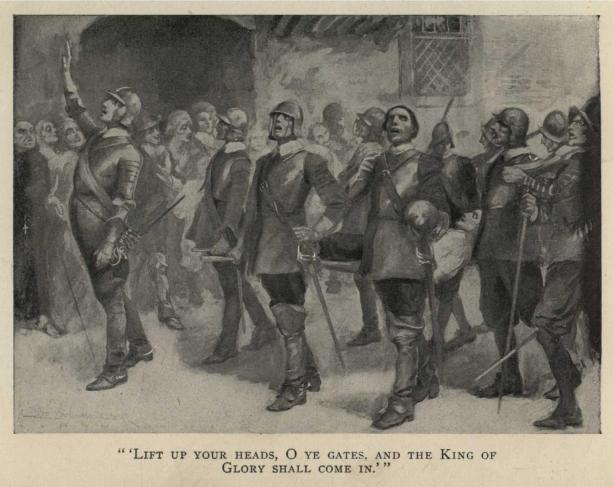
"'LIFT UP YOUR HEADS, O YE GATES, AND THE KING OF GLORY SHALL COME IN.'"
CHAPTER XVI
OLIVER THE CONQUEROR
"O Heart heroic, England's noblest son!
At what a perfect height thy soaring spirit burns
Star-like! and floods us yet with quickning fire."
* * * * *
"Cromwell is dead: a low-laid Heart of Oak."
* * * * *
"There the wicked cease from troubling, there the weary are at rest."
"Cheer up, Jane! You and Lord Neville will yet arrive at the height of your wishes. This is my judgment, and if it be not true, you may burn me in the ear for a rogue."
"And you will marry Cymlin?"
"Perhaps I shall, perhaps I shall not; perhaps 'tis time enough next year to consider on it."
"It would be a happy marriage."
"A happy marriage would be so much of heaven that I think it was never enjoyed in this world. 'Tis a weary world, I swear I often cry for myself in it."
"But you will marry Cymlin?"
"Faith, I know not how I am to help the catastrophe! But in all sobriety, I think Cymlin loves me, and you do, too, dear Jane! Oh, I could weep my eyes dry when I think of your dear lover, and all he has so innocently suffered. It is intolerable!"
In her way, Matilda was doing her best to console and encourage Jane as they talked over the sad fate of her rescued lover. Both had been weeping, and there was a more affectionate confidence between them than had existed for many years.
But Matilda had cancelled every fault and every unkindness by her prompt action in the matter of Lord Neville, and Jane had been loving and praising her for it, until the sweetness of their first affection was between them. And Matilda enjoyed praise; she liked the appreciation of her kind deed, and was not therefore disposed to make light or little of what she had done, or of its results.
"For your sake, Jane," she said, "I could not have a moment's peace, after hearing where the jewels were. I said to myself, this is the clue to Neville's fate, and it must be followed. Though my uncle would not interfere, I was resolved to bring the great Cardinal to catechism; and as I knew no one in the world would dare to question him but Cromwell, I went to Cromwell."
"It was a wonderful thing for you to do."
"It was; I must give myself so much credit. Not that I am afraid of Cromwell, or of any other man, but it was a great humiliation."
"Cromwell would not humiliate you; I am sure of that."
"He behaved very well. He knew I had had a share in every plot against him; and he gave me one look so swift, so searching, and so full of reproach, that it sticks like an arrow in my heart yet. But there were old memories between us, and anon he was as gentle as my mother with me. I will never try to injure him again,—never!"
"It is impossible to tell you how grateful Cluny and I are to you; I think no other woman in England would have been so forgetful of herself, and so brave for others."
"Perhaps not, Jane. But I love you, and I love justice and mercy, even to an enemy. I can always be brave with a good reason. And, pray, how comes my lord on towards recovery?"
"Slowly. Life was nearly gone; body and mind were at death's door; but he can walk a little now, and in two or three weeks we are going away,—far away,—we are going to my brothers in the Massachusetts Colony."
"Jane Swaffham! I will not believe you! And pray what shall I do? You shall not think of such a thing."
"It is necessary. Cluny's mental sufferings have made it so. When he was first imprisoned he tried to write, to compose hymns and essays, to make speeches, to talk aloud; but as time went on, he could not keep control of himself and of his awful circumstances, and now all the misery of those long, dark, lonely years has settled into one idea,—space without end. The rooms are too small. He walks to the walls and trembles. He throws open the doors and windows that he may have room to breathe. In the night he wakes with a cry, he feels as if he were smothering. If he goes into the garden he shrinks from the gates; and the noise of the city, and the sight of the crowds passing fills him with fear and anxiety. He wants to go where there are no limits, no men who may hate and imprison him; and his physician says, 'Let him live for weeks, or months, out on the ocean.' This is what he needs, and he is eager to get away."
"You will come back?"
"I think it is unlikely. Father feels a change approaching. The Protector's health is failing rapidly; he is dying, Matilda, dying of the injustice and ingratitude he meets on every hand. 'Wounded,' yes slain, 'in the house of my friends,' is his constant cry."
"'Tis most strange that a man of war like Oliver Cromwell should care what his friends think or say."
"Yet he does. When he speaks to father about Harrison, Lambert, Alured, Overton and others of his old companions, he wrings his hands and weeps like a woman; or else he protests against them in such angry sorrow as distresses one to see and hear it."
"He ought to know that he has been raised above the love of men who are less noble than himself, and that if beyond and above their love, then they will hate and abuse him. If he dies?——"
"Father will leave England as soon as Cromwell is in his grave. Cymlin will keep old Swaffham fair, for Cymlin will never leave England while you are in it."
"And you can bear to talk of leaving England in that calm way, without tears and without regrets. Jane, it is shameful; it is really wicked."
"I do not leave England without tears and regrets, but there is Cluny, and——"
"Cluny, of course. I suppose you will be married before you leave. But I have a mind not to be your bridesmaid, though I am promised to that office ever since I was a maid in ankle tights."
"Dear Matilda, do not be angry at me because I had to do what I had to do. I was married to Cluny three days after he came home. We all thought he was going to die, and he wished me to be his wife."
"Why was I not sent for? I would have come, Jane. It was cruel wrong in you to pass me by."
"We were married by Doctor Verity at Cluny's bedside. No one was present but my father and mother and the three servants to whom Cluny had become accustomed. He was then frightened at every strange face."
"After this, nothing can astonish me. I was not a stranger——"
"He would not have recognised you, then."
"How could he lose himself so far? He ought to have had more courage. Why did he not do something or other?"
"Oh, Matilda, what would you have done in a room eight feet by ten, and in the dark most of the time—your bread and water given without a word—your attendant deaf and dumb to you—no way to tell the passage of time—no way of knowing how the seasons went, but by the more severe cold—if you had been, like Cluny, really buried alive, what would you have done?"
"I would have died."
"Cluny composed psalms and hymns, and tried to sing; he did not lose heart or hope quite, the gaoler told father, for nearly four years. Then his health and strength gave out, and his heart failed, but he never ceased praying. They heard him at midnight, but Cluny did not know what hour it was. And to the last moment he kept his faith in God. He was sure God would deliver him, though He sent an angel to open the prison doors. He was expecting deliverance the day it came. He had had a message from beyond, and his mother had brought it. Now did I not do right to marry him when, and how, he wished?"
"Yes," she answered, but her face and voice showed her to be painfully affected. "Jane, I cannot bear to lose you. I shall have no one to love me, no one to quarrel with," she added.
"You will have Cymlin."
"Cymlin is Cymlin; he is not you. I will say no more. When a woman is married, all is over. She must tag after her lord, even over seas and into barbarous places. If the Indians kill you, it will be said that you were in the way of duty; but I have noticed how often people take the way they want to take, and then call it the way of Duty. I shall not marry Cymlin until he can show me the way of peace and pleasantness."
Then Jane rose to go, and Matilda tied her bonnet-strings, and straightened out her ribbons and her gloves, doing these trifling services with a long-absent tenderness that filled Jane's heart with pleasure. "Good-bye, dear!" she said with a kiss; "I will come as often as I can."
"Very kind of you, Lady Neville," answered Matilda with a curtsy and a tearful mockery; "very kind indeed! But will your ladyship consider—" then she broke down and threw her arms round Jane, and called her "a dear, sweet, little Baggage" and bade her give Cluny some messages of hope and congratulation, and so parted with her in a strange access of affection. But true friendship has these moods of the individual and would not be true without them.
Jane walked home through the city, and its busy turmoil struck her as never before. What a vain show it was!—a passing show, constantly changing. And suddenly there was the galloping of horsemen, and the crowd stood still, and drew a little aside, while Cromwell, at the head of his guards, rode at an easy canter down the street. Every man bared his head as the grand, soldierly figure passed by. He saw Jane, and a swift smile chased away for a moment the sorrowful gravity of his face. But he left behind him a penetrating atmosphere of coming calamity. All souls sensitive to spiritual influences went onward with a sigh, and the clairvoyant saw—as George Fox did—the wraith of fast approaching affliction. The man was armed from head to feet, and his sword had never failed him, but it was not with flesh and blood he had now to contend. The awful shadows of the supernatural world darkened the daylight round him, and people saw his sad face and form as through a mist, dimly feeling all the chill foreboding of something uncertain, yet of certain fatality.
His glorious life was closing like a brilliant sun setting in a stormy sky. He had been recently compelled to tell his last Parliament some bitter truths, for danger was pressing on every side. Protestants in the Grisons, in Piedmont and Switzerland, were a prey to the Spanish papists, and their helper, Pope Alexander the Seventh, and the Protestant Dutch—preferring profit to godliness—were providing ships to transport Charles Stuart and his army to English soil.
"The Marquis of Ormond, well disguised, was here on Charles Stuart's interest, only yesterday morning," he said to them. "I did send for Lord Broghill, and I said to him, 'There is an old friend of yours lodging in Drury Lane at the papist surgeon's. It would be well for him if he were gone.' And gone he is." Then with withering scorn he added, "All this is your doing. You will have everything too high or too low. You don't want a settlement. You are tampering with the army. You are playing the King of Scot's game, helping him in his plans of invasion. You have put petitions through the city to draw London into rebellion. You are plotting for a Restoration. I know these things, I do know them, and I say you have laid upon me a burden too heavy for any poor creature. For I sought not this place. You sought me for it. You brought me to it. I say this before God, angels and men! But I took my oath to see all men preserved in their rights, and by the grace of God I will—I must—see it done. And let God be judge between you and me!"
Many cried "Amen," as they filed out of the ancient halls, chagrined and troubled under his stinging rebuke. And Cromwell felt for the first time the full weight of the refractory kingdom whose government he must bear alone.
He was right; it was too heavy a burden for any one man, and the burden was made still more heavy by his family afflictions. His beloved mother had left him, gone the way of all the earth, saying with her last breath, "I leave my heart with thee, dear son! a good-night!" His son-in-law, Rich, the three months' bridegroom of his "little Frankie," was but a few weeks dead, and the Earl of Warwick, his firmest friend among the nobility, was dying. His favourite daughter, Elizabeth, was very ill, and he himself was feeling unmistakable premonitions of his dissolution. For, day by day, his soul was freeing itself from the ligaments of the body, rising into a finer air, seeing right and wrong with the eyes of immortality. But he would do his duty to the last tittle of strength,—fall battling for the right,—and as to what should come after, God would care for that.
The fifteenth of May had been set for his assassination. On that day, risings were to take place in Yorkshire and Sussex; London was to be set on fire, the Protector seized and murdered, and Charles Stuart land on the southern coast. Cromwell knew all the secret plans of this conspiracy of "The Sealed Knot"; knew every member of it; and on the afternoon when Jane Swaffham saw him passing up London streets, so stern and scornful, he had just ordered the arrest of one hundred of them. From these he selected fifteen for trial. They were all Royalists; he would not lay his hand on his old friends, or on any who had once served the Cause. His mercy and his great heart were never so conspicuous as at this time. Only two of the fifteen were condemned to death, Doctor Hewitt, an Episcopal minister, and Sir Henry Slingsby, the uncle of Lord Fanconbridge, who was the husband of his own daughter, Mary;—Doctor Hewitt for issuing commissions in Charles Stuart's name, and Sir Henry Slingsby for endeavouring to bribe the city of Hull to open its gates to the Stuart invaders. Against Doctor Hewitt his anger burned with unusual severity; he would listen to no intercession for him; for, he said,
"The man has eat my bread, and sat on my hearth, and been a familiar friend of my family. He has been in all our confidences; he has dipped his sop in our dish, and cried 'Hail, master' to me. Like the wickedest of traitors, he betrayed me, even while he called me friend. He shall die the death of a traitor, both to England and to myself."
But though dark clouds from every side were rolling up, they were lit and edged with the fiery glory of the setting sun behind them. Cromwell's troops, under Lockhart in France, were treading their old victorious march, and the flowers of June were wreathed for the taking of Dunkirk, where the Ironsides had stormed unbreached forts and annihilated Spanish battalions, to the amazement of Turenne, Condé and Don John.
Jane heard constantly of these events, but her heart had closer interests. The ship which was to carry Cluny and herself to America was lying at her wharf nearly ready for sea. It was a stout vessel belonging to Sir Thomas Jevery, commanded by a captain of tried skill and great piety. There were to be no other passengers; Cluny and Jane alone were to find in its black-ribbed cabin their home for many weeks, perhaps months. A recent experience had proven the necessity for this exclusion of strange elements. Early in June, Israel had taken Cluny to bid farewell to his old General, and the meeting had tried both men severely. A few days previous, Cromwell had laid in the grave his little grandson, Oliver, and the child's image still lived in his troubled eyes. He could scarcely speak when he saw Cluny. He waived impatiently all ceremony, drew him to his breast and kissed him; but it was quickly evident Cluny could not bear any conversation on his past misery. His excitement became painful to witness, and Cromwell with quick, kind wisdom, began to speak rather of his own great sorrow.
"You know, Israel," he said, "how sweet a little lad my Oliver was. I cannot yet believe that he is dead; I cannot. Only a week ago, when he was ill and restless, I lifted him and carried him to and fro, and his cheek was against my cheek, and his arms around my neck, and suddenly I felt them slip away, and I looked at the child, and so caught his last smile. I thought that night my heart would break; but the consolations of God are not small, and I shall go to the boy, though he will never come back to me. Never! Never! His mother is now very ill; you would pity her, indeed you would. Cluny, you remember the Lady Elizabeth Claypole?"
"My General, I shall never forget her."
"I do fear she is sick unto death. Her little Oliver's removal has been the last blow of the last enemy. You may pity me, Cluny; I need pity, I do indeed; I am a man of many afflictions. But it is the Lord; let Him do whatever seemeth good in His sight." He then went to a desk and wrote a few lines to the officials of the Massachusetts Colony; in them, commending Lord Neville to their kindness and care. His hands trembled—those large strong hands—trembled as he gave the letter to Cluny. Then he kissed him once more, and with a "Farewell" that was a blessing, he turned away, weeping.
"It is another friend gone," he said mournfully to his own heart; "lover and friend are put far from me and mine acquaintance into darkness." But he went straight to his daughter Elizabeth, and talked to her only of God's great love and goodness, and of the dear boy who had been taken from them because "he pleased God; because he was beloved of God, so that living among sinners he was translated; yea, speedily was he taken away, lest wickedness should alter his understanding or deceit beguile his soul; and being made perfect in a short time, fulfilled a long time."[1]
[1] Wisdom of Solomon, Chap. 4, vs. 10-13.
Cluny was so much troubled and affected by this visit that Israel thought it well to take him to see the ship which was to carry him to the solitudes of the great waters and the safety of the New World. He was impatient to be gone, but there were yet a number of small interests to be attended to; for they were to carry with them a great deal of material necessary to the building and furnishing of their future home. Every day revealed some new want not before thought of, so that it was nearing the end of June when at last all was declared finished and ready.
Then Jane went to Hampton Court to bid her old friends a last farewell. It was a mournful visit. She fancied they did not care as much as she thought they might have done. In fact, the gloomy old palace was a terrible House of Mourning, and the Cromwells' own sorrows consumed their loving-kindness. Frances, in her widow's garb, could only weep and talk of her dead bridegroom. Lady Claypole was dumb under the loss of her son and her own acute suffering, and Mrs. Cromwell's heart bleeding for both her unhappy daughters. Jane was shocked at her white, anxious face; alas, there was only too much reason for it! Whatever others thought, the wife of the great Protector knew that he was dying—dying, even while he was ruling with a puissant hand the destinies of England. Every member of this sad family was in sore trouble; they could find no words of mere courtesy; even friendship was too large a claim upon them.
Jane felt keenly all the anguish in this palace of Pain and Sorrow. She remained only one night, and was as willing to leave it as the sad dwellers therein were willing to be left. They were not unkind, but they could bear no more; their own burden was too heavy. Jane would have regretted her visit altogether, had it not been for the changeless tenderness of the Protector. His face during these quick gathering trials had become intensely human. It was easy to read in it endless difficulties and griefs, surmounted by endless labours and importunate prayers. With strange, mystical eyes he walked continuously the long rooms and corridors, ever seeking the realisation of his heart's constant cry, "Oh, that I knew where I might find Thee!" He talked to Jane of Cluny and of their prospects; made her kneel at his side during the family service, kept her hand in his, and prayed for her and Cluny by name. And at the last moment he gave her the blessing she hoped for—"God which dwelleth in heaven prosper your journey; and the angel of God keep you company."[2]
[2] Tobit, Chap. 5, v. 16.
The strain had been great; the very atmosphere of the place was too heavy with grief to breathe; she was glad to feel the sunshine and the fresh wind. She had intended to call on Matilda as she passed through the city, but she could not throw off the lassitude of hopeless foreboding that had invaded her mind. It bred fears for Cluny, and she hastened home, resolving to see Matilda on the following day. But when she reached Sandy's House, Mrs. Swaffham met her with a letter in her hand—"Lady Jevery asks you to come to Matilda, who is in great trouble," she said. "Cluny is asleep; if you are not too tired, you would better go at once, for if the wind keep fair, Captain Jonson thinks to lift anchor to-morrow night."
So Jane went to her friend. With her, also, she found the grief Death brings.
"Stephen is slain!" were her first words. She could hardly utter them. But Jane knew how to comfort Matilda; she could talk to her as she could not to the ladies of Cromwell's household. She could take her in her arms and say all kinds of loving words, blending them with promises and hopes that had Divinity as their surety. And she could encourage her to talk away her trouble. "How was Stephen slain?" she asked, "in a duel?"
"No, thank God! He fell, as he himself could have wished, fighting the enemies of his King. He was with Condé and the Dukes of York and Gloucester before Dunkirk, and was killed while meeting the rush of those terrible Ironsides. He died shouting 'For God and King!' and Camby—one of their officers who comes from Ely—knew Stephen, and he carried him aside, and gave him water, but he died in five minutes. Camby wrote me that he said 'Mother!' joyfully, with his last breath."
"Poor Stephen!"
"Oh, indeed 'tis very well to cry, 'poor Stephen,' when he is beyond your pity. You might have pitied him when he was alive, that would have been something to the purpose. All his short, unhappy life has been one constant battle with Puritans and poverty. Oh, how I hate those Stuarts! I am thankful to see you can weep for him, Jane. I think you ought. God knows he loved you well, and most thanklessly. And he is the last, the last de Wick. Root and branch, the de Wick tree has perished. I wish I could die also."
"And Cymlin, Matilda?"
"I shall marry Cymlin,—at the proper time."
"You may have sons and daughters."
"I hope not. I pray not. I have had sorrow enough. My father and his three sons are a good ending for the house. It was built with the sword, and it has been destroyed by the sword. I want no de Wick like the men of to-day—traders and gold seekers. And if they were warriors, the old cares and fears and anxieties would be to live over again. No, Jane, the line of de Wick is finished.[3] Cymlin and I will be the last Earl and Countess de Wick. We shall go to Court, and bow to the Stuart, and be very great people, no doubt."
[3] Matilda's desire was granted her. She died childless, and the lands of de Wick reverted to the Crown. As for Swaffham, Cymlin, at his death, left it to the eldest son of his brother Tonbert; but the young man longed for America, and soon sold it. During the eighteenth century it changed hands often; but in the early years of the nineteenth century the old house was replaced by a modern structure, less storied but of extensive proportions and very handsome design.
"And Prince Rupert?"
"Is a dream from which I have awakened."
"But he may still be dreaming."
"Rupert has many faults, but he is a man of honour. My marriage to Cymlin will be a barrier sacred to both of us. Our friendship can hold itself above endearments. You need not fear for Cymlin; Matilda de Wick will honour her husband, whether she obeys him or not. Cymlin is formed for power and splendour, and he will stand near the throne."
"If there be a throne."
"Of that, who now doubts? Cromwell is falling sick, and you may feel 'God save the King' in the air. If you had married Stephen, he would have been alive to join in the cry. I could weep at your obstinacy, Jane."
"Let it pass, dear. I was suckled on Puritan milk. Stephen and I never could have been one. My fate was to go to the New World. When I was a little child I dreamed of it, saw it in visions before I knew that it existed. Stephen has escaped this sorrowful world and——"
"Oh, then, I would he were here! This sorrowful world with Stephen in it was a better world than it is without him. Jane, Jane, how he loved you!"
"And I loved him, as a companion, friend, brother, if you will. When you lay his body in de Wick, cast a tear and a flower on his coffin for me. God give him peace!"
At length their "farewell" came. Jane dreaded it; she was sure Matilda would wear emotion to shreds and exhaustion. But it was not so. She wept, but she was solemnly silent; and the last words between them were soft and whispered, and only those sad, loving monosyllables which are more eloquent than the most fervid protestations. And so they parted, forever in this life,—and if this life were all, Death would indeed be the Conqueror. But it is not all; even through the death struggle, the Soul carries high her cup of Love, unspilled.
The next afternoon Jane and Cluny rode through London streets for the last time. They were full of busy, happy people, and mingling with them all the bravery and splendid show of the great company of courtiers that were in the train of Mazarin's two nephews, the Duke of Crequin and Monsieur Mancini; Ambassadors from the King of France to congratulate Cromwell—"the most invincible of sovereigns, the greatest and happiest of princes—" on the surrender of Dunkirk.
And Jane on the previous day had heard this "most invincible of sovereigns, the greatest and happiest of princes," declare that "he was weak and weary; that all the waves and billows of a sea of troubles had gone over him," and with tears and outstretched hands entreat his God to "give him rest from his sorrow and from his fear, and from the hard bondage wherein he had been called to serve."
On the ship they found Jane's father, Doctor Verity and Sir Thomas Jevery. There were no tears at this parting, nor any signs of sorrow; every one seemed resolved to regard it as a happy and hopeful event. For, though not spoken of, there was a firm belief and promise of a meeting again in the future not very far off. Israel held his little daughter to his heart, and then laid her hand in Cluny's without a word; the charge was understood. The young husband kissed the hand, and clasped it within his own, and his eyes answered the loving father in a language beyond deception. When the last few minutes came, and the men were trooping to the anchor, Doctor Verity raised his hands, and the three or four in the dim, small cabin knelt around him; and so their farewell was a prayer, and their parting a blessing.
Israel and Doctor Verity walked away together, and for a mile neither of them spoke a word. There is a time for speech and a time to refrain from speech, and both men were in the House of Silence for strength, each finding it in his own individual way. As they came near to Sandy's, however, Israel said,
"It is a short farewell, John. It will be my turn next."
"I shall go when you go."
"To the Massachusetts Colony?"
"Yes. I am ready to go when the time comes."
"It is not far off."
"A few months at the longest."
"He is very ill?"
"The foundations of his life are shaken, for he lives not in his power or his fame, or even in the work set him to do. No, no, Oliver lives in his feelings. They are at the bottom of his nature; all else is superstructure. And they have been rent and torn and shaken till the man, strong as he is, trembles in every limb. And Fairfax, as well as Lambert and others, think they can fill great Oliver's place!—no man can."
"For that very reason, when he departs, I will away from England. I have no heart for another civil war. I will draw sword under no less a general than Oliver."
"As I said, I go with you. I have some land, and a little home there already; and Mistress Adair has promised to marry me. She is a good woman, and not without some comeliness of person."
"She is a very handsome woman, and I think surely she will make you a good wife. You have done well. Did you tell Jane this?"
"Yes, I told her."
"My heart is heavy for England."
"She knows not the day of her visitation any better than Jerusalem did."
"She will bring back the Stuarts?"
"That is what Monk, and others with him, are after. They have been at the ears of the army, din, din, din, until their lies against Oliver have been sucked in. They have a rancorous jealousy that never sleeps, and no one can please them that is above them, whether it be Prince, Protector or God. Envy has pursued Oliver like a bird of prey. Its talons, at last, are in his heart."
"Good-night, John."
"Good-night, Israel. Have you told Martha?"
"Not yet. She will fret every day till the change comes. Why should we have a hundred frets, when a dozen may do?"
But when Israel went into Martha's presence something made him change his mind. The mother had been weeping, and began to weep afresh when she saw her husband. He anticipated her sorrowful questions, and with an assumption of cheerfulness, told her what a good, brave man the captain of the ship was, and how happy and hopeful Jane and Cluny seemed to be. "It did not feel like a parting at all, Martha," he said; "and indeed there was no need for any such feeling. We are going ourselves very soon, now."
The words were spoken and could not be recalled; and he stood, in a moment, ready to face the storm they might raise. He had not intended them, but what we say and what we do beyond our intention, is often more fateful and important than all our carefully prepared words or well laid plans. Martha looked at her husband with speechless wonder and distress, and he was more moved by this attitude than by her usual garrulous anger. He sat down by her side and took her hand, saying,
"My dear Martha, I did not think of telling you this just yet, and especially to-day, but the words were at my lips, and then they were out, without my leave or license. Now there is nothing for it, but letting you know, plump and plain, that you and I, in our gathering years, must up and out of England. Oliver Cromwell is dying; when he is in the grave, what? Either Stuart, or civil war. If it is the Stuart, my head will be wanted; and as for fighting for Lambert, or even Fairfax or Sir Harry Vane, I will not do it—verily, I will not! I have fought under Cromwell; I will fight under no less a general, and in no less a quarrel than he led in. That is settled. You said Martha, 'for better, or for worse.'"
She did not answer, and he dropped her hand and continued, "I will never force thee, Martha, not one step. If thou lovest England better than me——"
"I don't! I don't, Israel! I love nothing, I love nobody better than Israel Swaffham. I was thinking of Swaffham."
"I shall sign the sale of it to Cymlin as soon as Cromwell dies. The deed is already drawn out, and waiting for our names. If the Stuart comes back—and I believe he will—I should lose Swaffham, as well as my life; but Cymlin will marry Matilda, and make obeisance to Charles Stuart, and the old home will be in the family and keep its own name. I and thou can build another Swaffham; thou art but fifty, and my years are some short of sixty. We are in the prime of life yet."
"I am forty-eight,—not quite that,—Israel; and Swaffham was very up and down, and scarce a cupboard in it. I do miss my boys; and how I can bear life without Jane, I don't know. Wherever you go, Israel, I will go; your God is my God, and your country shall be mine."
"I was sure of that, Martha. God love you, dearest! And any country where your home is built, and your children dwell, is a good country; besides which, this New World is really a land of milk and honey and sunshine. Tonbert and Will could not be bought back here with an earldom. There is another thing, Martha, both of them are going to be married."
"Married! I never heard of such a thing."
"I thought I wouldn't tell thee, till needs be; but 'tis so, sure enough."
"And to what kind of women, Israel?"
"Good, fair women, they tell me; sisters, orphan daughters of the Rev. John Wilmot. Thou seest, then, Martha, there may soon be three families coming up, and not a grandmother among them to look after the children, or give advice to the young mothers. I don't see what Tonbert's wife, or Will's wife, or thy own daughter Jane can do without thee."
She shook her head slightly, but looked pleased and important. The wife and mother was now completely satisfied. And Martha Swaffham was blessed with imagination. She could dream of her new home, and new ties, and give herself, even in London streets, a Paradise in the unknown New World. And, at any rate, in the building of the American Swaffham she would take care that there were plenty of cupboards. Indeed, her plans and purposes were so many, and so much to her liking, that Israel was rather hampered by her expansive hopes and ideas; and though he did not damp her enthusiasm by telling her "she was reckoning without her host," he himself was quite sure there would be many trials and difficulties to tithe her anticipations.
"But it is bad business going into anticipation," he said to himself. "I'll let Martha build and arrange matters in her mind as she wants them; things will be all the likelier to happen so; I have noticed that time and time again. It will be a great water between us, and the sins and sorrows of six thousand years; and if there be a Paradise on earth, it will be where man hasn't had time to turn it into a—something worse."
So the summer days went on, and England had never been so serene and so secure in her strength and prosperity. Throughout the land the farmer was busy in his meadows making hay, and watching the green wheat blow yellow in the warm winds and sunshine. The shepherds were on the fells counting the ewes and their lambs; the traders busy in their shops; the ports full of entering and departing vessels, and the whole nation yet in a mood of triumph over the acquisition of Dunkirk. Cromwell was working feverishly, and suffering acutely. His favourite child, the Lady Elizabeth Claypole was still very ill; he had premonitions and visions of calamity that filled his heart with apprehension, and kept his soul always on the alert, watching, watching for its coming. It might be that he alone could meet it and ward it away from those he loved.
It is certain also that he knew the time for his own departure was at hand. He said to Doctor Verity, "I have one more fight, John. Dunbar was a great victory; Worcester was a greater one; but my next fight will give me the greatest victory of all—'the last enemy that shall be destroyed is death.' Do you understand?" And the Doctor made a movement of affirmation; he could not speak.
Wonderful was the labour the Protector now performed. He directed and settled the English affairs in France; he arranged the government of the new English plantations in Jamaica and the West Indies; and he paid particular attention to the needs and condition of the New England Colonies, being indeed their protector, and the only English protector they ever had. He took time to enunciate to France, more strongly than ever before, the rights of all the Protestants in Europe; and he made all preparations for calling another Parliament to consider, and settle more firmly, the business of the English Commonwealth. His work was a stupendous one, and through it all he showed constantly the feverish haste of a man who has a great task to perform and sees the sun dropping to the western horizon. But his heart bore the heaviest share of the heavy burden. It was as if Death knew that this man's soul could only be delivered from the flesh by attacking the citadels of feeling. In every domestic and social relation—son, husband, father, friend—the tenderness of his nature made him suffer; and when on the twenty-third of July Lady Claypole's illness showed fatal symptoms, he dropped all business, and for fourteen days and nights hardly left her presence. And her death on the sixth of August was a crushing and insupportable blow.
Lady Heneage, who was one of her attendants in these last terrible days, was removed in a fainting condition, when all was over, and taken to her old friend Martha Swaffham, for care and consolation. The two women had drifted apart during the past four years, but there was only love between them, and they reverted at once to their old affectionate familiarity. And such sorrow as that affecting Lady Heneage, is soon soothed by kind companionship and sympathetic conversation. She had much to tell that Martha Swaffham was eager to listen to, though the matter of all was suffering and death.
"The Lord Protector was really her nurse," she said. "When her mother fainted, and her husband and sisters could not look on her sufferings, her father held her in his arms, bore every pang with her and prayed, as I hope, Martha, I may never hear any one pray again. It was as if he clung to the very feet of God, entreating that he, and he alone, might bear the agony; that the cup of pain might pass from his child to him—and this for fourteen days, Martha. I know not how he—how we—endured it. We were all at the last point, when suddenly, a wonderful peace filled the chamber, and the poor Lady Elizabeth lay at ease, smiling at her father as he wiped the death sweat from her brow and whispered in her ear words which none but the dying heard. At the last moment, she tried to say, 'Father, but only managed one-half the word; the other half she took into heaven with her. It is now the sixth of August, is it not, Martha?"
"Yes."
"The Protector will not live long, I think. I heard him tell her they would not be parted a space worth counting."
"He would say that much for her comfort. He meant it not in respect of his own days; no life is a space worth counting—'of few days and full of trouble, Alice.' How is her Highness, Elizabeth Cromwell?"
"Very quiet and resigned. Blow upon blow has benumbed her. She looks as if she had seen something not to be spoken of. Lady Mary Fanconberg says the family ought to leave Hampton Court; there is a feeling about the place both unhappy and unnatural. I felt it. Every one felt it, even the soldiers on guard."
After the death of his beloved daughter Elizabeth, the life of Cromwell was like the ending of one of those terrible Norse Sagas with the additional element of a great spiritual conflict. He was aware of his own apparition at his side; the air was full of omens; he felt the menace of some shadowy adversary in the dark; he saw visions; he dreamed beyond nature; he had, at times, the wild spirits of a fey man, and again was almost beside himself with unspeakable grief. Israel Swaffham was constantly with him. The two men were friends closer than brothers. They had loved each other when boys, and their love had never known a shadow.
"But I am in great trouble about him," said Israel to his wife. "It cannot last. Since Lady Claypole's death he eats not, drinks not, sleeps not; his strong, masculine handwriting, the very mirror of his courageous spirit, has become weak and trembling. He lives much alone, keeps from his family as if he feared they might be in danger from his danger. And he thinks and thinks, hour after hour; and 'tis thinking that is killing him. I can tell you one thing, Martha, a thinking soul is always sorrowful enough, but when it is a great soul like Oliver's, and it is wretched for any cause, then every thought draws blood."