THE LION'S WHELP (continued 3)
Reading edition
BOOK II
The Tools To Those Who Can Handle Them!
CHAPTER VI
ON THE TIDE TOP
"Cromwell! Why that's the name of Victory."
"The shouting cries
Of the pleased people, rend the vaulted skies."
"Let there be music. Let the Master touch
The solemn organ, and soft breathing flute."
"Rupert! Oh there's music in the name,
Repeated as a charm to ease my grief.
I, that loved name did as some god invoke;
And printed kisses on it as I spoke."
The great day of triumph was over. Cromwell had entered London at the head of his victorious army, and the city was safe and jubilant. Standing at her mother's side, Jane had witnessed from a window in the crowded Strand the glorious pageant of Liberty, the martial vision of warriors whose faces had been bathed in that rain that falls on battle-fields, red as the rains of hell; she had seen again the simple, kindly man who had been her childhood's friend, and who was now England's chief of men, being to England both father and son, both sword and shield. She had heard his name carried on rolling tides of human shouts and huzzas, chording with the firing of cannon, the beating of drums, the tread of thousands, the chiming of bells, and all the multitudinous and chaotic clamour which constitutes the excitement of a great crowd, and always brings with it the sense of bounding life and brotherhood.
And in the midst of this joyful turbulence she had caught sight of her father and brothers and lover; her father's face sternly glad, like the face of a man who had fought a good fight to assured victory; his sons imitating his bearing, as well as youth could copy age; and the young lord not far from them, proud and radiant and carrying aloft the colours of the Commonwealth. Somewhere in that crowd of spectators he thought Jane must be present, and he bore himself as if he were constantly in her sight.
As yet they had not met, nor had Cluny any certain knowledge of the Swaffham's location. There had been some supposition that they would lodge in Leadenhall Street, at the home of Mistress Adair, the widow of an Independent minister who had preached often in the little chapel attached to Oliver Cromwell's house in Huntingdon; but of this he had no positive information, and he certainly expected that Mrs. Swaffham would advise him of their arrival in London.
Mrs. Swaffham had, however, learned that Cluny Neville was personally objectionable to her husband and sons, and, as she could not see clearly what road to take, she very wisely stood still, waiting for some light and guidance. And it seemed unnecessary to trouble Jane's heart until there was a positive reason for doing so; yet her depression and evident disappointment fretted her mother.
"What is the matter with you, Jane?" she asked irritably one morning; "you look as if you had lost everything in the world instead of being, as your father thinks, right on the road to many a good day. I wouldn't throw such a damp over things if I were you."
"You seem to have forgotten Cluny, mother."
"He seems to have forgotten us; he might have called, I think."
"Does he know where we are?"
"He could have found out. He sees Cymlin often enough."
"I think Cymlin dislikes him. I asked him yesterday if he knew Lord Neville and he answered me rudely."
"He is your brother."
"Just for that reason he ought to have spoken civilly to me."
"He is your brother, and you must hear and heed what he says. And I must tell you, Jane, that it is not maidenly to take any young man so seriously as you take Lord Neville until your father and brothers are satisfied. It is a matter of importance to them what men are brought into the Swaffham family. There is plenty to make you happy without Lord Neville. Your own people are safe and sound, the Cause we love is secure, and you may now dwell your life out in England; but if we had not conquered, it would have been over the seas and into the wilderness for us, and strangers forever in old Swaffham. I shouldn't think you were done thanking God for these mercies yet; and if not, then where do you find heart-room for such melancholy and moping as I see in you?"
"But, mother, when I look back to last August——"
"If you want to look happily forward never look backward."
"To be sure; but though I know Cluny loves me, doubts and fears will come, and I cannot always fight them or reason with them."
"Don't try either fighting or reasoning. There is a broad enough way between them."
Jane smiled and lifted her tambour work, and her mother nodded cheerfully as she continued, "Enjoy the hour as it comes to you. I have always found that one good hour brings on another." And Jane took the counsel into her heart and anon began to sing—
"It was alone Thy Providence,
That made us Masters of the field,"
and when she had got thus far, a loud, joyful voice joined her in the next two lines, and its owner came into the room singing them—
"Thou art our Castle of defense,
Our Fort, our Bulwark and our Shield."
"Oh, Doctor Verity!" Jane cried, "how glad I am to see you."
"I had been here an hour ago, but I had to wait on the Lady Mary Cromwell. They who serve women must learn to wait. She has sent you a letter, and a coach is at your order, and you are bid to Whitehall. And you will be very welcome there."
"I know not any ceremonies, Doctor."
"You do not need to know them. It is Mary Cromwell, yet; though if the women of Cromwell's house assume greatness, he has won it for them. Why should they not wear the honours their father gives them?"
Then Jane ran to her mother, and her box of fineries was quickly packed, and the girl came down for her visit glowing with hope and happiness. All the shadows were gone; she sat a little proudly in the fine coach by the side of Doctor Verity, and was alert and watchful, for it did not seem an improbable thing that she might have a passing sight of her lover. The city had by this time recovered its every-day temper, and she could not help contrasting the plodding, busy serenity of its present mood with its frenzy of triumphant joy on the entry of Cromwell. Doctor Verity insisted that the two conditions were alike natural. "No one can play the fool like a wise man," he said; "and the greater and the richer the city the more extravagantly and unreasonably and vauntingly it will express its victory and salvation. London had so much to lose," he continued, "that it would better have lain in ashes than lain at the feet of any Stuart."
As they drew near to Whitehall, Jane's spirits fell a little. She had not caught a glimpse of her lover, and she felt a sudden anxiety about her position. Sometimes prosperity is as fatal to friendship as adversity, and the girl tried in silence to prepare herself for any change in affection that change of fortune might have caused. But her fears were very transient; Mary and Frances Cromwell met her with effusive attentions; they called her affectionately by her name, and quickly took her to the general sitting-room of the family. Madame Cromwell was there, as kind and motherly as of old; and Mistress Ireton, silently reading a sermon of Doctor Owen's; and Mrs. Claypole selecting some damask for a new gown; and Mary and Frances, full of the joy and pride of their great position, soon carried Jane all through their splendid apartments, and afterwards sat down together in Mary's room to talk over old times and the friends and occupations that had made them happy and memorable. Their first inquiry was for Lady Matilda de Wick, and when Jane answered, "Her father is dead, and I know not exactly what has befallen her since his death," the girls were all silent a few minutes. After the pause, Mary Cromwell said—
"I remember her so well on her fine Barbary mare. How handsome she was! How proud! If the Earl spoke to my father then she would deign to ask after my lessons, or my dog, or how the skating was on the Broad. But she was older than I, and it seems so long ago—lately she has been deaf, dumb and blind to the Cromwells—they do not mind that much now. I wonder where she is."
"It was said she would live with her aunt, Lady Jevery; if so, she must be in London."
"And you know it not? And you have not seen her? That is a marvel. It was thought impossible for Matilda de Wick and Jane Swaffham to live long apart."
"There have been great changes," sighed Jane. "People that were once friends know each other no more. It is hoped now that there will be many reconciliations."
"We have seen Lady Heneage often," said Mary Cromwell, "and 'tis said there is a purpose of marriage between Alice Heneage and a favourite of my father's—Lord Cluny Neville."
"I have seen Lord Neville," said Jane. "He brought me your letters and the blue and gold ribbon you sent me. His visits were flying ones; he came and he went."
"Like the knight in the story—he loved and he rode away. But we are all mightily taken with his fine manner and his beauty, and the Lord General, my father, thinks him to have great sincerity and discretion."
"A very perfect youth," answered Jane with a smile.
"Indeed, we think so; if you are of a different opinion you will change it on a better knowledge of the young man. He is coming here this afternoon, is he not, Frank?"
"He said so. He was to make some copies of the hymn he wrote, for Mr. Milton has set it to music, and we are to practice the singing together. Father thinks very highly of the words."
"Dear me!" ejaculated Jane, "is he also a poet? I thought he wrote only with his sword. I fear that he has too many perfections. Has he not one fault to balance them?"
"Yes," answered Mary, "he has one great fault, he is a Presbyterian, and a Scotch Presbyterian. In all other things he holds with the Lord General, but he sticks to his Scotch idols—John Knox and the Covenant."
"I think no worse of him for that," said Jane. "If he knew what an Independent was, he would likely be an Independent."
"It is not believable," retorted Mary. "He is a Scotchman, or next door to one. And if a man is a Samaritan, what can he know of Jerusalem?"
"I care not what he is," said Frances. "He has handsome eyes, and he writes poetry, and he tells such stories as make your blood run cold—and sometimes love-stories, and then his voice is like music; and if it was not sinful to dance——"
"But it is sinful," said Jane warmly, "and if I saw Lord Neville or any other man making mincing steps to a viol I would never wish to speak to him again. Would you, Mary?"
"Of course not, but Frank is only talking. We have masters now in music and singing and geography, and I am learning Morley's Airs[1] straight through, besides roundelays and madrigals. And we have a new harpsichord, though the Lord General, my father, likes best the organ or the lute."
[1] Popular and patriotic songs having the same vogue then as Moore's Melodies in our era.
"And besides all this," continued Frances, "we are studying the French tongue, and history, and the use of the globes; and Mrs. Katon comes twice every week to teach us how to make wax flowers and fruit and take the new stitches in tatting and embroidery. And, Jane, I have got a glass bowl full of goldfish. They came from China, and there are no more of them, I think, in England. Come with me, and you shall see them."
"Never mind the fish now, Frank," said Mary; "there is the bell for dinner, and we must answer it at once or we shall grieve mother."
They rose at these words and went quickly to the dining-room. Mrs. Cromwell, leaning upon the arm of her daughter, Mrs. Ireton, was just entering it, and Jane wondered silently at the state these simple country gentry had so easily assumed. Officers of the household, in rich uniforms, waited on all their movements and served them with obsequious respect; and they bore their new honours as if they had been born to the purple. Mrs. Cromwell's simplicity stood her in the place of dignity, and the piety and stern republicanism of Mrs. Ireton gave to her bearing that indifference to outward pomp which passed readily for inherited nobility, while the beauty of Mrs. Claypole and her love of splendour fitted her surroundings with more than accidental propriety. All the women of this famous household were keenly alive to the glory of those achievements which had placed them in a palace, and all of them rendered to its great head every title of honour his mighty deeds claimed as their right.
"The General dines with the Speaker," said Mrs. Cromwell; and she was herself about to say grace when Doctor Verity entered. He was greeted with a chorus of welcomes, and readily took his seat at the foot of the table and spoke the few words of grateful prayer which sweetened and blessed every Puritan meal. Then in answer to some remark about Cromwell's absence he said,
"The Lord General is much troubled about the Worcester prisoners. There has just been a pitiful kind of triumph made out of their miseries. I don't approve of it, not I, God forbid! They have been made a spectacle for men and angels, marched from Hampstead Heath, through Aldgate, Cheapside, and the Strand, to Westminster—hungry, beggarly creatures, many of them wounded, and nearly naked."
"Poor fellows," said Mrs. Cromwell.
"Sturdy, surly fellows, madame. I don't envy the men who will have to manage them as slaves."
"They go to the Barbadoes, I hear?"
"Yes,—it is Scotland no more for them."
"Is that right, Doctor?"
"Indeed, madame, I am not clear in my conscience concerning the matter. It is the liberty of war. The Lord General has given two or three prisoners to each of his friends and entertainers between here and Worcester. However, the miserable fellows brought some comfort out of their evil plight, for the citizens along all the route forgot they were enemies, and the women fed them with the best of victuals, and the men stepped from their shop doors and put money in their hands. I'll be bound the rogues got more money and good white bread this morning than they have seen in all their lives before. Besides which, there is, in the Exchange and in the ale-houses, a box for the poor prisoners, and whenever men make a bargain they drop a God's-penny into it for them. That's Englishmen all over; they fight to the death in fair battle, but when their foe is at their feet they lift him up and help him and forget that he was ever their enemy. And may God keep Englishmen ever in such mind!"
"Indeed," said Mary Cromwell, "these Scots have given us trouble and sorrow enough. They ought to be sent out of the country, or out of the world, and that at once!"
"That is my opinion," said Mrs. Ireton. "Our brave men are being slain, and the country is torn asunder for their malignancy."
"There have been as brave spirits as the world ever saw in both Puritan and Royalist armies, madame," answered the Doctor. "I, for one, am glad that both parties have fought their quarrel to the end. I rejoice because our hard-smiting Puritan hosts would not let the Stuarts come back and trample them, with all law and liberty, under their feet. But I would have been deadly sorry if the Cavaliers of England had wanted the temper to fight for their King and their church. Right or wrong, we must honour men who have convictions and are willing to die for them."
"Monarchy and Prelacy go together," said Mrs. Ireton; "and England has had more than enough of both."
"We are of one mind on that point, madame," said Doctor Verity. "In this respect, the man George Fox and his followers have some true light, and they are scattering the truth, as they see it, broadcast. I have taken occasion, and sought occasion, and gone out of my way to find occasion, to meet George Fox, but have not yet done so. I was told that he once listened to my preaching at St. Paul's Cross, and that he said I was not far from the Kingdom. I liked that in George; I hope I may say the same for him. Our Lord General thinks him to be a man after God's own heart."
"My father sees the best in every one," said Mrs. Claypole.
"Why do you not speak to the Lord General about these poor prisoners?" Mrs. Cromwell said. "He gave very kind orders about the Dunbar prisoners, and if they were not carried out it was not his fault."
"I neglect no opportunities, madame. And Cromwell needs not that any one soften his heart. The sight of these fallen heroes made him weep—but there are considerations—and every triumph implies some one crushed at the chariot wheels."
"But, Doctor Verity," said Jane, "if we may lawfully fight and kill for the sake of our rights and our convictions, may we not also lawfully punish those who made us put our lives in such jeopardy?"
"Jane, I am sure that we have the right of self-defense; the awful attributes of vengeance and retribution are different things. Will mortal hands be innocent that take the sword of vengeance from God's armoury? I fear not. I had a long talk with Sir Richard Musgrave this morning on this very subject. I found Lord Cluny Neville with him; it seems they are related."
"Why did you not bring Lord Neville with you?" asked Frank.
"Lord Neville looks after his own affairs, Lady Frances—I do likewise."
"Then, Doctor," said Mrs. Cromwell, "look better after your dinner. That buttered salmon has gone cold while you talked. There is a jar of olives near you,—and pray what will you have? a dish of steaks? or marrow bones? or ribs of roast beef? or some larded veal? or broiled larks?"
"Roast beef for John Verity, madame, and a couple of broiled birds and a dish of prawns and cheese. I enjoy my meat, and am not more ashamed of it than the flowers are of drinking the morning dew."
"You are always happy, Doctor," said Jane.
"I think it is the best part of duty to be happy, and to make others happy. No one will merit heaven by making a hell of earth. As I came through Jermyn Street I saw Lady Matilda de Wick. She looked daggers and pistols at me. God knows, I pity her. She was shrouded in black."
"Has anything been heard of Stephen de Wick?" asked Jane.
"It is thought he reached The Hague in safety. His companion, Sir Hugh Belvard, joined Prince Rupert's pirate fleet there."
Then Mrs. Ireton, as if desirous of changing the subject, spoke of Doctor John Owen, and of his treatise on "The Pattern-Man," and Doctor Verity said he was "a Master in Israel." Talking of one book led to conversations on several others, until finally the little volume by Cromwell's brother-in-law, Doctor Wilkins, was mentioned. It was a dissertation on the moon and its inhabitants, and the possibility of a passage thither. Mrs. Ireton disapproved the book altogether, and Mrs. Cromwell was quite scornful concerning her brother Wilkins, and thought "the passage to the heavenly land of much greater importance."
But it was easy to turn from Doctor Wilkins to the great University in which he was a professor, and Mrs. Claypole reminded her mother of their visit to Oxford after its occupation by Cavalier and Puritan soldiers.
"I remember," she answered. "It was a sin and a shame to see! The stained windows were broken, and the shrines of Bernard and Frideswide open to the storm; the marble heads of the Apostles were mixed up with cannon balls and rubbish of all kinds. Straw heaps were on the pavements and staples in the walls, for dragoons had been quartered in All Souls, and their beasts had crunched their oats under the tower of St. Mary Magdalene. I could not help feeling the pity of it, and when I told the General he was troubled. He said 'the ignorant have clumsy ways of showing their hatred of wrong; but being ignorant, we must bear with them.'"
"All these barbarisms have been put out of sight," said Dr. Verity, "and thanks to Doctor Pocock, Oxford is itself again."
"Doctor Pocock!" ejaculated Mrs. Cromwell. "He was here a few days ago to consult with the General. He had on a square cap, and large ruff surmounting his doctor's gown; his hair was powdered and his boots had lawn tops trimmed with ribbons. He looked very little like a Commonwealth Divine and Professor."
"My dear madame, Doctor Pocock is both a Royalist and a Prelatist."
"Then he ought not to be in Oxford," said Mary Cromwell hotly. "What is he doing there?"
"He is doing good work there, Lady Mary, for he is the most famous Oriental and Hebrew scholar in England. No Latiner, but great in Syriac and Arabic; and no bigot, for he is the close friend of Doctor Wallis and of your uncle, Doctor Wilkins, though he does not go with them to the Wadham conventicle. The Parliamentary triers declared him incompetent but Edward Pocock had powerful friends who knew his worth, and perhaps if you ask your honoured father, he can tell you better than I why Dr. Pocock is in Oxford, and what he is doing there."
At this moment, Lord Cluny Neville entered the room. He saw Jane on the instant, and his eyes gave her swift welcome, while in the decided exhilaration following his entrance Love found his opportunities. But among them was none that gave him free speech with Jane; they were not a moment alone. Cluny had a fund of pleasant talk, for he had just come from the Mulberry Gardens, where he had met Mr. and Mrs. Evelyn and had some refreshment at the tables with them.
"I suppose the Evelyns were as gaily dressed as usual?" asked Mrs. Claypole, "and looking as melancholy as if the world would come to an end in a week's time?"
"Indeed, they were very handsome," answered Neville; "and the coach they brought from Paris is extremely fine. We had some chocolate in thin porcelain cups, and some Italian biscuits and sweetmeats. And anon we were joined by Mr. Izaak Walton, the gentlest of malignants, and very entertaining in his talk. Mr. Evelyn was praising Mr. Milton's poetry, but Mr. Walton did not agree with him. He thought John Milton was always trying to scale heaven by a ladder of his own, or else to bring down heaven on earth in some arbitrary shape or other—that in truth, he knew not in his work where he was going."
"He goes, truly, where Mr. Izaak Walton cannot follow him," said Mrs. Ireton. "John Milton has looked God's Word and his own soul in the face, and he will not hold Mr. Walton's opinion of him as anything to his hurt."
"Besides," added Cluny with a pleasant laugh, "Mr. Walton is writing a book, and Mr. Milton will soon not need to say with the patient man of Uz, 'Oh, that mine enemy had written a book!' He may have reprisals."
During this speech there was heard from a distant apartment the sound of music, low and sweet, and full of heavenly melody.
"That is Mr. Milton playing," said Mary Cromwell. "I would know his touch among a thousand." And then Cluny blushed a little, and held out a small roll which he carried in his hand. It contained three fair copies of his own hymn, and Mary delightedly hurried Jane and Frank away with her to the musician. He turned as they entered and bowed gravely, and the girls fell at once under the charm of his music. Mary involuntarily assumed a majestic attitude, Frances ceased her childish titter, Cluny became almost severe, and Jane stood in silent delight while the grand melody filled their souls till they outsoared the shadow of earth and that unrest which men miscall delight. "Glory to God!" he sang, and the room rang with the lofty notes and seemed full of Presence, and of flame-like faces, sublime and tender, while the air vibrated to the final triumphant crescendo, "Glory to God! Glory to God! Glory to God in the Highest!" And in his beautiful face there was seen for a few moments that face of the soul wherein God shineth.
Then there was a short pause of spiritual sensitiveness which was broken by the opening of a door, and all eyes turning towards it beheld Cromwell standing on the threshold. Perhaps he had been listening to Mr. Milton's ecstatic anthem, for his clear, penetrating eyes were tender and mystical, and a smile gentle as a woman's softened his austere mouth. He wore a suit of black cloth with a falling linen collar, stockings of homespun wool which his wife had knit, and strong shoes fastened with a steel latchet. But his brown hair, tinged with gray, flowed down upon his shoulders, and his whole air was that of a man on whom the eternal dignities of a good and great life had set their seal. Frances ran to him with a cry of delight. Mary looked at him with adoring pride, and then put into Mr. Milton's hand the roll of manuscript Lord Neville had given her. Jane left her companions and timidly advanced to meet the Lord General. He saw her in a moment, and gave her a smile so bright and affectionate that all fear vanished, and she hastened her steps and the next moment felt his strong arm draw her to his side.
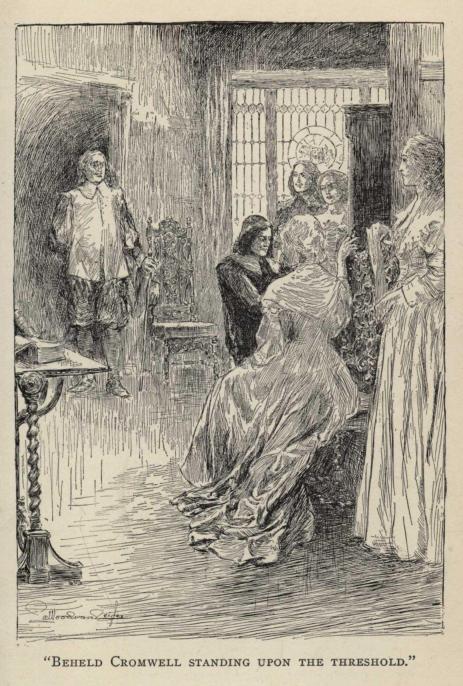
"BEHELD CROMWELL STANDING UPON THE THRESHOLD."
"Jane," he said tenderly, "Jane Swaffham, I got your message, and it did me good; it did indeed. Out of the mouths of babes often come our sweetest help and comfort. When I was ill and my heart was troubled for Israel, I remembered one night the word you sent me by John Verity, and it was very good. I think of it often, Jane, when in the midst of ill men. Say it now in my own ears, and let me taste its goodness from your own lips."
Then Jane lifted her eyes to his, and the fiery particle in them filled her with Cromwell's own faith and courage, and she said with a fearless fervour, "They shall be able to do nothing against thee, saith the Lord. My hands shall cover thee."
"Truly God is good, indeed He is, Jane, and you have been His messenger to me. Let us take this gracious God at His Word. And if ever I can help you or yours, Jane, come to me; I will be as good as my word—doubt not. Let us see what John Milton is going to play for us. I'll warrant 'tis my young soldier's hymn, and in my judgment, a good hymn."
They were advancing towards the organ as Cromwell spoke, and they joined the group around the inspired player. His trampling notes gave the sensation of charging men and horses, and of the ministration of angelic hosts. Then there was a pause, and out of it arose in jubilant praise the song of triumph on the battle-field:
Not unto us, not unto us, O Lord,
Thine was the Word, and Thine the mighty sword,
Thine be the glory.
We heard Thy call to arms, and understood:
But Thine the hand that wrought in flame and blood,
The splendid story.
Not for ourselves, or for this day, we fought,
But for all lands and for all times we wrought
Stormy Salvation:
Thine was the battle, both by land and sea,
Thine was our valour and our victory,
Thine our oblation."
So far, Cluny Neville led the singers, but it was Cromwell's strenuous, adoring tones that mostly influenced the stirring chorus—
"Not unto us triumphant lauds and lays,
To 'Him whose name is Wonderful' be praise!
Be thanks! Be glory!"
The exultant song ceased, but their hearts were yet full of thanksgiving, and Cromwell walked about the room—with Frances and Jane at his side—humming the majestic melody, or breaking out into some line of audible song, until he finally said,
"I came here for John Milton, whose pen I need, and I have stayed to sing; and that is well, for the soul has wings as well as hands—and indeed our souls have had a good flight heavenward." Then addressing John Milton, he said,
"We have sundry letters to write, and the plain truth is, I could wish they were more heavenly. Here is a man to answer who is playing fast and loose with us,—and I will not have it. He is laying too much weight on my patience; let him take care that he break it not."
Speaking thus, he walked towards the door, and Jane marveled at the man. His countenance was changed: all its wistful tenderness and exaltation had given place to a stern, steadfast severity; his voice was sharp, his words struck like caustic, and the homelike, country gentleman was suddenly clothed with a great and majestic deportment. He put on his hat as he left the room. And there was the glint of a gold band round it, and in Jane's mind it gave to the rugged, broad-hatted grandeur of the man a kind of mythical authority, for she instantly remembered a picture of St. George of Cappadocia in de Wick hall which had the same gold band around the helmet. And ever afterwards she associated in her memory the patron Saint of England and the great Pathfinder of her people.
Neville left soon after the Lord General, and the girls had a game of battledore and shuttlecock in the long gallery; then sewing, reading aloud, the evening meal, and the evening exercise closed the day. The days that followed were little different; when the weather permitted there was a ride in the park, or shopping in Jermyn Street, or a visit to St. Paul's to hear Dr. Owen, or the great tolerant Mr. Jeremy Taylor. But Jane thought Dr. Verity need hardly have given her special counsel against the vanities of such a life as the Cromwells led. On the whole, she was not very sorry when her visit was over and she was free to return home. In spite of the frankest kindness, she felt out of her element. The Cromwells had outgrown their old friends, and not all their familiarities could dispel the atmosphere of superiority which surrounded them; it was unavoidable and unequivocal, though they were not themselves conscious of it.
But every happy family takes its tone from the head of the household, and this conqueror of three Kingdoms, stepping out grandly to their government from his victorious battle-fields, impressed something of his own character upon those so nearly and dearly allied to him. They had been after his image and likeness at St. Ives and Ely, what wonder if in the palaces of London they took on something of the royal air which his achievements entitled them to assume? There are friends whose favour we wear as jewels and ornaments, and there are others whose love will bear the usage of an every-day garment, and Jane understood that she must put the Cromwells among those friends reserved for rare or great occasions.
Then there came to her mind in very sweet fashion the memory of Matilda de Wick. They had quarreled almost constantly for years, and Matilda's exacting temper and sharp tongue had wounded her often; but for all that she knew Matilda loved her. Now perfect friendship must be founded on perfect equality, for though love may stoop to an inferior, friendship cannot do so without becoming patronage and offense. But between Matilda and Jane there was no question of this kind. The Swaffhams were noble by birth, they needed no title to give them rank. In their own county they stood among the foremost, and Earl de Wick had ever been ready to acknowledge the precedence of a family so much more ancient than his own. Besides which, the Swaffhams were very wealthy. Israel Swaffham had given his eldest daughter on her marriage to Lord Armingford ten thousand pounds, an immense bridal gift in those days. So that the question of equality had never crossed or shadowed the friendship between Jane and Matilda. Their many quarrels had been about King Charles, or Oliver Cromwell—or Stephen de Wick, for Matilda was passionately attached to her youngest brother and she thought Jane Swaffham valued him too little. With her mind full of kindly thoughts towards Matilda, Jane returned to her home, and she was delighted to find a letter from her friend waiting for her.
"It came this very morning," said Mrs. Swaffham, "and I told the man who brought it you would be here to-day, and no doubt would answer it forthwith. Have you had a good visit, Jane?"
"Yes, mother."
"You wouldn't like to go again just yet, eh, my dear?"
"No, mother. I do not know why. They were all very kind to me, and the Lord General wonderfully so—but there was a difference, a change I cannot describe. It was not that they were less kind——"
"I understand. Power changes every one. Open your letter, I want to know how Matilda is; her man was so uppish, I would not ask him a question."
Then Jane laid aside her bonnet and opened her letter. "She is at Lady Jevery's house, mother, and she longs to see me, and indeed I am in the same mind. We shall be sure to quarrel, but then——"
"You can both play at that game, and you hold your own very well. What is the use of a friend if you can't talk plain and straight to her? I like Matilda no worse for her little tempers. I would go to Jevery House in the morning. Whom did you see at the Cockpit?"
"Doctor John Owen for one. He has just been made Chancellor of Oxford, and General Cromwell expects great things from him. I saw also John Milton, who writes so beautifully, and he plays the organ like a seraph. And Doctor Wilkins was there one day, and he talked to us about his lunarian journey; and Mr. Jeremy Taylor called, and we had a little discourse from him; and Mrs. Lambert, and Mrs. Fleetwood, and Lady Heneage, and Mrs. Fermor, and many others paid their respects. It seemed to me there was much enforced courtesy, especially between Mrs. Fleetwood and Mrs. Ireton; but—changes are to be expected. Mrs. Cromwell and Lady Heneage used to be gossips, and kiss each other before they sat down to talk, and now they curtsey, and call each other 'my lady,' and speak of the last sermon, or Conscience Meeting. I saw Lord Neville several times, but had no private speech with him; and I heard Mary Cromwell say there was a purpose of marriage between him and Alice Heneage."
"'Tis very like."
"I do not think so. I am sure he loves me."
"Then he should say so, bold and outright."
"He said last night he was coming to see my father and you, and though he spoke the words as if they were mere courtesy, I read in his face the purpose of his visit. Mother, we shall need your good word with my father."
"I can't go against your father, Jane. I would as soon take hot coals in my naked hands."
"But you can manage to make father see things as you do."
"Not always. He would have stayed at Swaffham and minded his own affairs instead of following Oliver Cromwell, if I could have made him see things as I did. Men know better than women what ought to be done; they are the head of the house, and women must follow as they lead. Your sister Armingford wanted to marry Frederick Walton, and your father would not hear of such a thing. You see he was right. Frederick Walton was killed in battle, and she would have been a widow on her father's and her father-in-law's hands. You will have to do as your father says, Jane; so make up your mind to that. The Swaffham women have always been obedient and easy to guide, and it isn't likely you will need bit and bridle."
"I would not endure bit and bridle."
"All I can say is, your father will decide about Lord Neville. Father keeps his own counsel, and he may have a purpose already of marrying you to some one else."
"I will not marry any one else."
"Your sister said the same thing, but she married Philip Armingford; and now there is no man in the world but Philip."
"I will marry Cluny Neville or remain a spinster."
"You will in the end do as your father and brothers say."
"What have my brothers to do with my marriage?"
"A great deal. The men of a family have to meet about family affairs. It wouldn't do to have some one among the Swaffhams that the Swaffhams didn't like or didn't trust. They have always been solid for Swaffham; that is the reason that Swaffham has done well to Swaffham. There, now! say no more about your marriage. It is beforehand talk, and that kind of discussion amounts to nothing. It is mostly to go over again. Your father thinks of buying this house. Parliament has offered it very reasonable to him, in consideration of the service he and your three brothers have rendered."
"It belonged to Sir Thomas Sandys?"
"Yes."
"And Parliament confiscated it?"
"Yes."
"If I were father I would not give a shilling for it. It will yearn for its own till it gets back to them. If the King had taken Swaffham, we should yearn for it at the other side of the world, and some Swaffham would go back to it, though it were generations after."
"I don't know what you are talking about, Jane. I suppose the Cromwells live in a deal of splendour."
"Everything is very fine. Mary Cromwell's room has the walls hung with green perpetuano and tapestries of Meleager. The standing bed is of carved wood, and the quilt of Holland striped stuff. There is a large looking-glass in an ebony frame, and many fine chairs and stools, and her toilet table is covered with silk and lace, and furnished with gilded bottles of orange-flower water and rose perfume. All the rooms are very handsome; Mrs. Cromwell's——"
"That is enough. I have often been in Elizabeth Cromwell's room, both in Slepe House and in Ely. I remember its tent bed and checked blue-and-white curtains! Well, well—it is a topsy-turvy world. You must go and see Matilda to-morrow. I have been making inquiries about the Jeverys; they are what your father calls 'Trimmers,'—neither one thing nor another. He is an old soldier, and has made use of his wounds to excuse him from further fighting; and Lady Jevery mingles her company so well that any party may claim her. A girl so outspoken as her niece Matilda will give her trouble."
In the morning Jane was eager to pay her visit, and she felt sure Matilda was as eager as herself; so an hour before noon she was on her way to Jevery House. It stood where the busy tide of commerce and the drama now rolls unceasingly, close by Drury Lane—a mansion nobly placed upon a stone balustraded terrace, and surrounded by a fine garden. In this garden the old knight was oftenest found; here he busied himself with his flowers and his strawberry beds, and discoursed with his friend John Evelyn about roses; or with that excellent person and great virtuoso, Mr. Robert Boyle, about his newly invented air pump; or thoughtfully went over in his own mind the scheme of the new banking establishments just opened by the City Goldsmiths: certainly it would be more comfortable to have his superfluous money in their care than in his own strong chests—but would it be as safe?
He was pondering this very question in the chill, bare walks of Jevery House when Jane's carriage stopped at its iron gates. She had been delayed and almost upset in Drury Lane by the deep mud, so that the noon hour was striking as Sir Thomas Jevery met and courteously walked with her to the entrance hall. Here there were a number of servants, and their chief ushered her into a stately cedar salon the walls of which were painted with the history of the Giants' war. But she hardly noticed these storied panels, for above the mantel there was a picture which immediately arrested her attention. It was a portrait of Oliver Cromwell, the rugged, powerful face standing out with terrible force amid the faces of Pym, Laud, Hampden, Strafford and Montrose. With the countenances of all but Montrose Jane was familiar, and she regarded this unknown face with the most intense interest. It was one not to be ignored, and having been seen, never to be forgotten—a face on the verge of being ugly, and yet so proudly passionate, so true, so strong that it left on Jane's mind the assurance of a soul worthy of honour.
She was standing gazing at it and quite oblivious of the Florentine curtains, the Venetian crystal, and French porcelain, when Delia came hurriedly into the room with an exclamation of delight. "Oh, Miss Swaffham! Oh, Miss Jane!" she cried. "My lady is impatient to see you. Will you kindly come to her room? She has been ill, oh, very ill! and you were always the one she called for!" So saying, she led Jane up a magnificent stairway lined with portraits, mostly by Holbein and Vandyke, and they soon reached Matilda's apartment. As the door opened she rose and stretched out her arms.
"Baggage!" she cried with a weak, hysterical laugh. "You dear little baggage! You best, truest heart! How glad I am to see you!"
And Jane took her in her arms, and both girls cried a little before they could speak. Matilda was so weak, and Jane so shocked to see the change in her friend's appearance, that for a few moments tears were the only possible speech. At length Jane said:
"You have been ill, and you never sent for me. I would have stayed by you night and day. I would have been mother and sister both. Oh, indeed, my mother would have come to you, without doubt! Why did you not let us know?"
"I have only been in London three days. I was ill at de Wick. I became unconscious at my father's burial. We had heard that day that Stephen had been shot while trying to reach the coast. It was the last thing I could bear."
"But I assure you Stephen is at The Hague. Doctor Verity said so, and he said it not without knowledge."
"I know now that it was a false report, but at the time I believed it true. My father was lying waiting for burial, so was Father Sacy, and Lord Hillier's chaplain came over to read the service. It was read at midnight in the old chapel at de Wick. We did not wish any trouble at the last, and we had been told the service would be forbidden; so we had the funeral when our enemies were asleep. You know the old chapel, Jane, where all the de Wicks are buried?"
"Yes, dear; a mournful, desolate place."
"A place of graves, but it felt as if it was crowded that midnight. I'll swear that there were more present than we had knowledge of. The lanterns made a dim light round the crumbling altar, and I could just see the two open graves before it. Father Olney wept as he read the service; we all wept, as the bodies were laid in their graves; and then our old lawyer, William Studley, put into Father Olney's hands the de Wick coat of arms, and he broke it in pieces and cast the fragments on my father's coffin; for we all believed that the last male de Wick was dead. And when I heard the broken arms fall on the coffin, I heard no more. I fell senseless, and they carried me to my own room, and I was out of my mind for many days. My aunt and Delia were very kind to me, but I longed for you, Jane, I did indeed. I am nearly well now, and I have left my heartache somewhere in that awful land of Silence where I lay between life and death so long. I shall weep no more. I will think now of vengeance. I am only a woman, but women have done some mischief before this day, and may do it again."
"Tonbert and Will are now at Swaffham; they will keep a watch on de Wick if you wish it."
"I suppose I have left de Wick forever; and I could weep, if I had tears left, for the ill fortune that has come to the old place. You remember Anthony Lynn, the tanner and carrier, Jane?"
"Yes."
"He has bought de Wick from the so-called Parliament. He was very kind to me, and he knew his place; but on my faith! I nearly lost my senses when I saw him sitting in my father's chair. Well, then, I am now in London, and all roads lead from London. I shall not longer spoil my eyes for the Fen country, and
"'De Wick, God knows,
Where no corn grows,
Nothing but a little hay,
And the water comes
And takes all away.'
You remember the old rhyme; we threw it at one another often when we were children. But oh, Jane, the melancholy Ouse country! The black, melancholy Ouse, with its sullen water and muddy banks. No wonder men turned traitors in it."
And Jane only leaned close, and closer to the sad, sick girl. She understood that Matilda must complain a little, and she was not unwilling to let the dreary meadows of the Ouse bear the burden. So the short afternoon wore away to Jane's tender ministrations without one cross word. Early in her visit she had yielded to Matilda's entreaties, had sent home her carriage, and promised to remain all night. And when they had eaten together, and talked of many things and many people, Matilda was weary; and Jane dismissed Delia, and herself undressed her friend as tenderly as a mother could have done; and when the tired head was laid on the pillow, she put her arms under it and kissed and drew the happy, grateful girl to her heart.
"Sweet little Jane!" sighed Matilda; "how I love you! Now read me a prayer from the evening service, and the prayer for those at sea—you won't mind doing that, eh, Jane?"
And after a moment's hesitation Jane lifted the interdicted book, and taking Matilda's hand in hers, she knelt by her side and read the forbidden supplications; and then Matilda slept, and Jane put out the candles and sat silently by the fire, pondering the things that had befallen her friends and acquaintances. The strangeness of the house, the sleeping girl, the booming of the city's clocks and bells, and the other unusual sounds of her position filled her heart with a vague dream-like sense of something far off and unreal. And mingling with all sounds and sights, not to be put away from thought or presence, was that strange powerful picture in the salon—the terrible force of Cromwell's face and attitude as he seemed to stride forward from the group; and the unearthly passion and enthusiasm of the unknown, just a step behind him, would not be forgotten. She saw them in the flickering flame and in the shadowy corners, and they were a haunting presence she tried in vain to deliver herself from.
So she was glad when she turned around to find Matilda awake, and she went to her side, and said some of those sweet, foolish words which alas! too often become a forgotten tongue. Matilda answered them in the same tender, broken patois—"Dear heart! Sweetheart! Darling Jane! Go to the little drawer in my toilet table and bring me a picture you will find there. It is in an ivory box, Jane, and here is the key." And Jane went and found the miniature she had once got a glimpse of, and she laid it in Matilda's hand. And the girl kissed it and said, "Look here, Jane, and tell me who it is."
Then Jane looked earnestly at the handsome, melancholy, haughty face; at the black hair cut straight across the brows and flowing in curls over the laced collar and steel corselet, and she lifted her eyes to Matilda's but she did not like to speak. Matilda smiled rapturously and said,
"It is not impossible, Jane, though I see you think so. He loves me. He has vowed to marry me, or to marry no one else."
"And you?"
"Could I help loving him? I was just sixteen when we first met. I gave my heart to him. I adored him. He was worthy of it. I adore him yet. He is still more worthy of it."
"But—but—he cannot marry you. He will not be allowed. Half-a-dozen kings and queens would rise up to prevent it—for I am sure I know the face."
"Who is it, Jane? Whisper the words to me. Who is it, dear heart?" And Jane stooped to the face on the pillow and whispered,
"Prince Rupert."
And as the name fell on her ear, Matilda's face grew heavenly sweet and tender, she smiled and sighed, and softly echoed Jane's last word—
"Rupert."
CHAPTER VII
TWO LOVE AFFAIRS
"Justice, the Queen of Virtues!
All other virtues dwell but in the blood,
That in the soul; and gives the name of good."
* * * * *
"The wise and active conquer difficulties
By daring to attempt them. Fear and Folly
Shiver and shrink at sight of wrong and hazard,
And make the impossibility they fear."
Matilda's confession brought on a conversation which lasted many hours. The seal of silence having been broken, the sick and sorrowful girl eagerly took the consolation her confidence procured her. She related with an impulsive frankness—often with bitter, though healing tears—the story of her love for the gallant Royalist leader. "He came first when I was yet a girl at my lessons," she said, "but my governess had told me such wonderful things of him, that he was like a god to me. You must know, Jane, that he is exceedingly tall and warlike, his black hair is cut straight across his brows, and flows in curls upon his shining armour. And he is always splendidly dressed."
"Indeed, all have heard of his rich clothing; even the laced cravats are called after him."
"See how people talk for nothing. Rupert's laced cravat was a necessity, not a vanity. He told me himself, that being out very early drilling his men, he took a sore throat, and having no other covering, he drew his laced kerchief from his pocket and tied it round his neck. And his officers, seeing how well it became him, must needs also get themselves laced neckerchiefs, and then civilians, as is their way, followed the custom. But who could look as Rupert looked? the most beautiful, the most soldierlike man in England."
"I might question that opinion, Matilda. I might say there is your brother Stephen—or——"
"Or Lord Cluny Neville, or many others; but let the question go, Jane. I had given my heart to Prince Rupert before I knew what love was; but one day—it was my sixteenth birthday—we were walking in de Wick Park, and the Hawthorns were in flower—I can smell them now, it was the very scent of Paradise; and he said such words as seemed to float upon their sweetness, and they filled my heart till I could have cried for pure happiness. The green turf was white with flowers, and the birds sang above us, and if heaven can come to earth, we were in heaven that dear spring morning. And as truly as I loved him, so he loved me; and that is something to make all my life beautiful. I have been loved! I have been loved! even if I see him no more, I have been loved! and by the noblest prince that ever drew a righteous sword. This is the one joy left me."
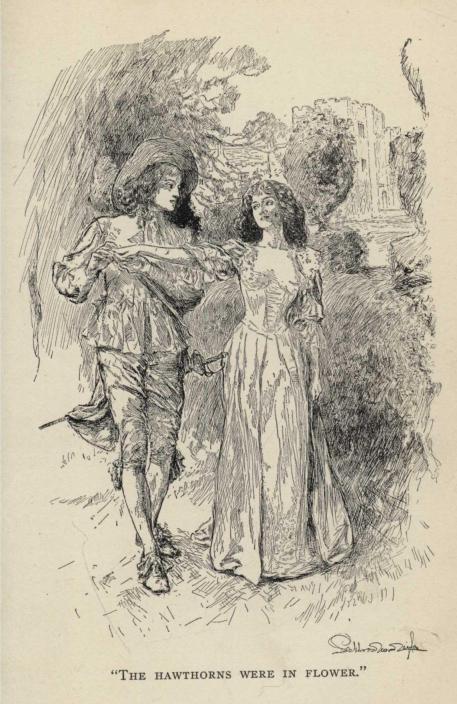
"THE HAWTHORNS WERE IN FLOWER."
"But, Matilda, it was a secret joy, and it could not be right. What would your father and mother have said?"
"You think wrong too readily, Jane. When Rupert had told me how dear I was to him, he went to my parents. He said to them, as he held my hand, 'Earl and Countess de Wick, with your permission, this is my Princess;'—and they were glad and proud, for they loved Rupert, and my brothers, who were in his troop, adored him. As for me, when Rupert said 'Matilda,' I was in an ecstasy; and if he took my hand I trembled with delight. I was so happy! So happy! For those heavenly hours I will thank God all my life long."
"But I see not how, even with your father's and mother's consent, you could hope to marry Prince Rupert. Kings and queens would be against it."
"Indeed, it was a most likely consummation. The Prince came to de Wick to arrange loans for the King. You must have heard that at the beginning of the war my father had great wealth which he had made by joining in Sir Thomas Jevery's East and West Indian ventures. He was glad to let King Charles have money, and a great deal of gold was sent, from time to time, as the King needed it. And when the war was over, my father was to have all his loans back, and also be raised to the rank of a Duke. And in those days we never doubted that the King would win; not till Dunbar, not till after cruel Worcester, did we lose hope. And surely you can see that an English Duke's daughter, with a large fortune in money, would be a suitable match for one of the Palatine Princes. Rupert is poor, Jane, his sword is his only fortune. And moreover, Rupert's mother and brothers have been in terror lest he marry a papist. But as for me—you know that I would die, yes, I would burn for my Bible and Book of Common Prayer. More than this, the King was pleased at our engagement, and sent me a jewel in token of it. Alas, it has been an unlucky jewel! I have had only sorrow since it came to me."
"I would get quit of it."
"It is too beautiful. And when the poor King is dead! Oh, dear me! I could not bear to part with it. Do you wonder now that the news of Dunbar made me so cross and sad, and that I was distraught—past myself—after Worcester? All was lost that fatal night."
"I do not wonder, but——"
"Say you are sorry, plain out, Jane. I am past disguise with you, now, and must ask your pity. Think of my father and mother dead of grief, and of my three brothers,—two slain in battle, one wandering, I know not where. Remember that with my father's death, died all hope of the loaned money and the dukedom to the family, and all my own hopes regarding my lover. For without money and rank, I would be no bride for Prince Rupert; a milkmaid were as fit. And when father had been three days in his grave, and I lay at point of death, Anthony Lynn came with his Parliamentary title to our house and lands. I was at his mercy, at his charity, Jane."
"Well, and if so, many favours he and his have received from your family. All he is worth he owes to your father."
"He was kind and respectful; I am very sensible of that. It is a strange thing to count past benefits, Jane; 'tis like remembering eaten bread. If Anthony thought of my father's help, 'tis more than can be believed. But for my jewels, I am a very pauper—a dependent on Sir Thomas Jevery."
"He was your father's friend and partner in business—he is the husband of your aunt."
"'Tis confest; but for all that, I am here by his charity."
"Your aunt?"
"My aunt lives in the atmosphere of Sir Thomas' whims and wishes. What she will think, what she will do, depends upon what he thinks and what he does."
"'Tis commonly said that he is devoted to her."
"He loves her after the ordinary rate of husbands, I'll warrant." Then, speaking with her old peremptoriness, she said suddenly, "But for God's sake let me ask when you heard anything of Prince Rupert? Oh, Jane, I am sick with heart-hunger for some small intelligence of his doings or his whereabouts."
"He has filled the news-letters and papers lately."
"But I am not suffered to see them. 'Tis pretended they will make me ill; and Sir Thomas vowed when the doctor gave the order, that he was glad on it, and that he had long wanted an excuse to keep the pernicious sheets outside of his house. So, then, I hear nothing, and if I did hear, twenty to one I would be the better of it."
"I think you would, Matilda. What is harder to bear than trouble that is not sure? Still, to be the messenger of ill news is an ungrateful office."
"Any news will be grateful; be so much my friend, dear Jane, as to tell me all you have heard."
"You know that he was made Admiral of the Royalist Navy; but, indeed, he is said to be nothing else but a pirate, robbing all ships that he may support the Stuart family at The Hague. No sail could leave British waters without being attacked by him, until Blake drove him to the African coast and the West Indies."
"He is the bread-finder of the King as well as his defender. So much I knew, and 'tis well done in him."
"The latest news is the drowning of Prince Maurice."
"That is the worst of news. Rupert loved this brother of his so tenderly. They were not happy apart. Poor Rupert! His last letter said, 'he was kept waking with constant troubles'; this will be a crowning misfortune. Sir Hugh Belward told me that his disasters have followed one on the heels of the other; that he had no port, and that poverty, despair and revenge alone guided his course."
"Sir Hugh Belward! Was he not the companion of your brother Stephen—that night?"
"Yes. He is now at The Hague with the King, and he has been over on secret affairs. I saw him at de Wick the day before I left. He was so shocked at my appearance that he burst out weeping, and knelt down and kissed my hands. Aunt begged him to leave my presence, for indeed I was like to faint away."
"Then you must have heard all about the doings of Prince Rupert?"
"I had not heard of the drowning of Prince Maurice. That affliction will bring Rupert to shore, and then what will the King do for money?"
"He is said now to be in great need of it, though Prince Rupert sent home a rich prize this past summer; and 'tis further said he resigned his own share of it to his cousin, Charles Stuart."
"'Twould be most like him."
"Some English sailors taken on a prize were put on one of the Royalist ships, and they overpowered her officers, and brought the ship to London a few days ago. I like not to tell you what they said of Prince Rupert to the Parliament."
"It will not vex me, Jane. Evil is said of people so universally that no one is hurt by it."
"They declared, then, that the delight of Prince Rupert and his crews was in swearing and plundering, and in sinking all English ships they could lay their talons on; but also, they added to this account, that there was a chaplain on the Admiral's ship, and that they rode still on Sundays, and did the duties of the day in the best manner they could—the same at evening. Many believed not this report, and many made a mock at, what they conclude, is a travesty of true worship."
"Indeed, Jane, the Puritans have not all the religion in the world, though they think so. However, if Prince Maurice be dead, I am sure that Rupert will not keep the high seas wanting him. Thank you for this intelligence, Jane. 'Twill be some comfort to hear that Rupert is on dry land again."
This conversation had many asides and deviations, and the night was far spent when Matilda was willing to sleep. And in the morning, while they eat breakfast together, the subject was renewed; for sorrow is selfish, and Matilda forgot that she had never even asked after the welfare of Jane's family. As they talked, Lady Jevery joined them. She bid Delia bring her some capon and white wine, and then thanked Jane for her visit, adding—
"I have brought you the key to my private entrance. It will admit you to Matilda's apartments when you wish, without the delays of a formal reception; and 'twill be the greatest token of kindness if you come often."
She spoke gently, and was soft and moth-like in all her movements, but her affection for her niece was unmistakable. While she talked, Jane's eyes wandered over the richly furnished room, noting its draperies of rose velvet, beautifully painted, its carved bedstead and quilted satin coverlet, its dressing-table with little gilded Venetian ewers for perfumes, and India boxes for powders—and also the fine breakfast service of French china before her. Lady Jevery's "charity" to her niece was certainly magnificent, and Jane felt no anxiety concerning her friend's material comforts.
She returned to her home soon after breakfast, and her mother met her with a smiling face. "I was going to send the coach for you," she said, "for there is to be company to-night;" and then she looked at Jane so intelligently that the girl understood at once what was meant.
"Is it Cluny?" she asked, blushing brightly.
"Yes. He has asked for an interview with your father, and I suppose that it is granted, for I was told of the matter."
"Mother, dear, you will speak in our favour?"
"If needs be, Jane. But I am of this opinion—some one has spoken already."
"Do you mean the Lord General?"
"I wouldn't wonder if he has said the two or three words that would move your father more than any woman's talk or tears. Keep your bravery, Jane; father likes women that stand up for themselves. When we were first married, I tried crying for my way, and I never got it. It is a deal better with men like your father and brothers to stand up for your rights. They know what that means, but they think a crying woman is trying to get the better of them."
Jane understood this advice, and she was not a girl inclined to cry for her way or her wish, yet she was glad to be thus early warned of the stand she might have to take. After all, it was one so loving and simple, so well defined in her own mind, and so positively accepted, that there was little need for preparation.
"I have made a resolve to marry Cluny, if Cluny be of the same mind," she said to herself, "and I have made a resolve to marry no one else, whether Cluny be of the same mind or not. I will let no one impose a husband on me. This thing I will stand boldly for; it has the witness of my heart, and love is too great to need lying or deceit."
It was evening when Cluny came, and he was taken at once to the room in which General Swaffham was smoking his good-night pipe. He looked steadily at the young man as he entered, but the look was one of inquiry and observation rather than of displeasure.
"Good-evening, sir," he answered to Cluny's greeting. "Sit down. You have requested speech with me; talk straight out then."
"I am here, General, to ask for your daughter's hand. I love her."
"Come, come, Lord Neville! Do you expect to drive the wedge head foremost? Ere you ask so great a gift, give me some good reasons for expecting it."
"We love each other, sir."
"So! but you must forethink, and straightforward is the best course. You cannot live on love—you two. No, sir!"
"I have my sword and the Lord General's favour. And my mother left me an estate in Fifeshire. 'Tis no great matter, but it is between me and the wolf's mouth."
"Very good for a young man; for a married man, very poor. If you were wanting to know how in God's name you were to provide for your household and pay your debts, would it do to ask your sword, or to send to Fifeshire—or to the stars—for the gold? That is a father's question, sir."
"It is a lover's also. I have enough for our necessities, and somewhat for our comfort,—and we are both willing to take love as security for our contentment." And though the words were such ordinary ones, the young man's heart throbbed in them, and the father felt it.
"Well, well," he answered, "yet I could wish you were altogether an Englishman."
"My mother was of a noble Scotch family, the Cupars of Fife. I would not willingly lose anything she gave me, sir."
"Lord Neville, I have seen the Scots in the late unhappy war, enough of them, and more than enough—greedy creatures, never losing sight of the spoil. I saw a good deal of the country also—beggary, nakedness, hunger, ever-lasting spite, envy and quarreling. But in every land God has His elect and reserve, and I doubt not that Lady Neville was among them."
"She was the purest-hearted of women. A word against her goes to my heart like a sword."
"Nay, nay, I meant no unkindness in particular; I spoke of generalities. You are not a Scot, but I hear that you are a Presbyterian. If you marry my daughter, I wish you to become an Independent."
"'Twould be an impossible thing, sir. I sucked Presbyterianism in my mother's milk. Even in heaven, it would grieve her to know I had become an apostate."
"An apostate! The veriest nonsense. There is not an ounce of difference between a Presbyterian and an Independent—but the ounce is the salt and the savour. You will become an Independent. The Lord General is an Independent."
"He never asked me to become one."
"You never asked him for his daughter, his youngest child, his darling."
"Forgive me, sir; Mistress Swaffham has no objection to my faith."
"Because, if men have not every good quality, some woman invents all they lack for them. Mistress Swaffham assures herself she can change your creed."
"I hope that she judges me of better mould. I can no more change a letter in my creed than a feature in my face."
"That is John Knoxism! It won't do, Lord Neville. If I was asking you to become a Fifth Monarchy Man, or one of those unbaptised, buttonless hypocrites, who call themselves Quakers, you might talk about the letters of your creed. Pooh! Pooh!"
"Sir, not for any woman born, will a man, worth the name of a man, give up his creed or his country. Mistress Swaffham would not ask this thing of me. She takes me as I am. I love her with all my soul. To the end of our life days, I will love and cherish her. Whether you credit me thus far, or not, I can say no more. I am a suppliant for your grace, and I know well that I have nothing worthy to offer in return for the great favour I ask from you."
Dauntless, but not overbold, the fine, expressive face of the suppliant was very persuasive. General Swaffham looked at him silently for a few moments and then said, "I will not be unkind to either you or my daughter; but there must be no leap in the dark, or in a hurry. Take five years to learn how to live together fifty years. At the end of five years, if you are both of a mind, I will do all I can for your welfare."
"Your goodness is very great, sir; make it more so by bringing it nearer to us. Five years is a long time out of life."
"That is what youth thinks. Five years' service for fifty years of happiness. You gave your teachers far more time to prepare you for life. Now go to school five years, for love. I waited six years for my wife, Jacob waited fourteen for Rachel."
"Sir, we live not by centuries, as Jacob did—if it would please you to say two years."
"I have said five, and verily it shall be five; unless these strange times bring us some greater stress or hurry than is now evident. Cannot you wait and serve for five years? If not, your love is but a summer fruit, and Jane Swaffham is worthy of something better."
"Sir, I entreat. I am no coward, but I cannot bear to think of five years."
"I have said my say. There is nothing to add or to take from it—save, to remind you, Lord Neville, that there is more heroism in self-denial than in battle."
Then Cluny perceived that entreaty would only weaken his cause, and he advanced and offered his hand, saying, "I am much in your debt, sir. 'Tis more than I deserve, but Love must always beg more than his desert." And General Swaffham stood up and held the slim brown hand a moment. He was moved beyond his own knowledge, for his voice trembled perceptibly as he answered—
"You have time and opportunity to win your way to my heart, then I will give you a son's place. Go and ask Jane; she will tell you I have done kindly and wisely." And Cluny bowed and went silently to seek his betrothed.
There was a sense of disappointment in his heart. Perhaps also an unavoidable feeling of offense. The Lord General had looked into his face and trusted him; yea, about great affairs, public and private. He had asked no five years' trial of his honour and honesty; and such thought gave an air of dissatisfaction and haughtiness to the young man that struck Jane unhappily as he entered the room in which she was sitting.
"Your father says we are to wait five years, sweet Jane; and 'tis a hard condition. I know not how I am to endure it."
And Jane smiled and began to talk over with her lover the hard condition, and somehow it became an easy and reasonable one. They soon saw it through Love and Hope and Wisdom, and so at the beginning of their probation, they rejoiced in the end of it. Cluny was hopeful of getting some military appointment in Edinburgh, and then the estate that was "no great matter" would be a home, at no inconvenient distance. And he described the old place with its ivy-covered walls and ancient rooms, and its garden, dark with foliage, until Jane knew all its beauties and possibilities. They were so happy and so full of happy plans, that they were laughing cheerfully together when the General came in with his wife and household for evening prayers. And it touched and pleased Cluny that he was mentioned by name in the family petition, and so, as it were, taken publicly and affectionately into it. He felt this all the more when the servants, in leaving the room, included him in their respectful obeisance to their master and mistress. It restored to him the sense of home, and he carried that strength and joy with him to his duty, and day by day grew to more perfect manhood in it.
Life soon settled itself to the new conditions of the Swaffhams. The General, in spite of his wife's and daughter's disapproval, bought the Sandys House near Russel Square, and some of the most precious heirlooms of old Swaffham were brought up to London to adorn it, For it was now certain that the Lord General would not agree to part with his faithful friend and ally; and, indeed, Swaffham's influence in the army could not well be spared, for it was evident enough that there was such ill-will between the army and the Parliament as might easily become a very dangerous national condition.
"So we may be here the rest of our lives, Jane, and we may as well get our comforts round us," said Mrs. Swaffham, and there was a tone of fret in her voice she did not try to hide. "William won't marry as a good man should at his age," she continued, "and Tonbert thinks himself too young to wive; and Cymlin is for Lady Matilda de Wick or no other woman, and so the dear old place will run to waste and mischief. And there are the fine milch cows—and the turkeys. Who will attend to them when I am not there to see they get attention? Nobody."
"Will and Tonbert know how to manage, mother."
"Yes, if it comes to meadow and corn land, or horses, or dogs. I am thinking of the house and the dairy and the poultry yard. Men don't bother themselves about such things; and my boys won't marry, and my girls won't let marrying alone. I am sure I don't know what to make of it all."
In spite of her complaining, however, she was well content in London. Social by nature, fond of the stir and news of life, enjoying even the shadow of her old friends' power and splendour, and taking the greatest interest in all public events of the time, she was pleased rather than otherwise at the Lord General's determination to keep her husband near him.
Neither was Jane at all averse to London. Cluny was in London, and Matilda was there, and most of the girls whom she had known all her life long. And it was not difficult to adapt herself to the new home, with its long galleries and large rooms full of beautiful paintings and handsome furniture. The little figure in its sober-tinted raiment took on a prouder poise, richer clothing seemed necessary and fitting; and insensibly, but continually, the fashion of the Swaffhams' life shook off its rusticity and became after the manner of the great Puritan town in which their lot had been cast.
And if Jane accepted willingly this change in life, Matilda took her phase of it still more enthusiastically. She was not long in discovering that it was in her power to be virtual mistress of the Jevery mansion. Her youth, her beauty and her many sorrows inclined Sir Thomas Jevery's heart to sympathy, and this prepossession grew rapidly to devoted affection. What the Lady Matilda de Wick desired became a law in Jevery House, and Matilda's desires were not remarkable for their moderation. She had her own apartments, her own servants, and her own company at her own hours, and Sir Thomas settled on her an income which he pretended had been an agreement between Earl de Wick and himself—a statement Matilda neither inquired about nor disputed.
No stipulations were made concerning her friends, and indeed Sir Thomas was not averse to a distinct royalist party in his house, if it was reasonably prudent. He himself entertained all parties, affecting to be inclined to men through higher motives than political prejudices. "Izaak Walton and John Milton, Mr. Evelyn and Sir Harry Vane, are all equally welcome at my table," he would say; "we have a common ground to meet on, which is beyond the reach of politics."
So Matilda quickly outgrew those griefs for which there was no remedy; she regained her health and much of her radiant beauty, and she spent many hours every day in adorning herself. For the first time in her life she had money enough to indulge this passion, and Sir Thomas declared she was in the right to do so. "A lovely woman in a shabby gown," he said, "is a sin against nature; she is like a queen without her crown and robes."
With such encouragement to fine attire, Matilda was not sparing in her orders for silks and brocades, furs and laces, and India goods of all descriptions. She had inherited her mother's jewels, and she was considering one morning a string of Orient pearls, wondering if they could be worn with her new damasse gown, when Jane entered her dressing-room.
"Jane Swaffham," she cried with delight, "I'll swear I was just wishing for you. But what is the matter? Are you for a funeral? Or—is there another plot against Cromwell's life discovered? If so, I am not in it. I do believe there are tears in your eyes."
"Indeed, all England weeps to-day. Have you not heard that General Ireton is dead?"
"A just retribution. Indeed, I will rejoice at it. More than any one else, more than Cromwell himself, he drove his late Majesty to the scaffold. He had no pity for the poor Queen, he was glad to make her a widow. I have no pity for the widow of Ireton. Let her drink of the cup her husband filled for a better woman. Let her drink it to the dregs."
"She lacks not any sympathy that can comfort so great a loss; a loss public, as well as personal, for my father says Ireton was nearer to Cromwell than any other man—the wisest, bravest soldier, the truest patriot——"
"Jane, do be more sparing of your praises, or you will have none left for your prime idol."
"I must tell you that I have new praises for Cromwell. I have seen him this morning in a strange light—holding his weeping daughter to his heart; weeping with her, praying with her; 'tis said, 'like as a father pitieth his children,' but indeed Cromwell was more like a mother. When I entered the room Mrs. Cromwell told Mrs. Ireton I was present, and she cried out, 'Oh, Jane, he is dead! He is dead!' and then Cromwell with streaming eyes answered her in a tone of triumph—'Nay, but he has PREVAILED, Bridget. He has prevailed against the kingdom of death! Be comforted, dear child.' I cannot tell you how good it was to be there—in the house of mourning."
"I never found it good, and I was there for years. But with such a brother as Stephen, I may be there again, and that soon enough. Stephen keeps me on cracking ice night and day."
"But he is in safety now, Matilda?"
"He is never safe—and partly your fault, Jane."
"I will not credit that, and 'tis a piece of great unkindness to make me accountable."
"He is always pining to see you, and always fearing that some one is your servant in his absence; and so he is willing to take all risks if he may but come to England." Then looking steadily at Jane, she added, "He is here now. Will you see him?"
"I will not," answered Jane positively. "I will not come to question about him if he is discovered. Do not ask me to put myself in such a strait, Matilda. It is far better I should be able to say, 'I have not seen him.'"
"You are a very proper, prudent young woman. I think you must have set your heart on that young sprig of a Puritan noble I saw at Swaffham. What was his name?"
"I am sure you have not forgotten it, but if so, it is little worth my repeating."
"As you like it. I have heard this and that of him from Mr. Hartlib who is a friend of that quarrelsome John Milton. Mr. Hartlib comes here frequent. He is full of inventions; only last night he brought Uncle Jevery one for taking a dozen copies of any writing at once, and this by means of moist paper and an ink he has made. I heard of Lord Cluny Neville, and of a hymn he has written which Mr. Milton has set to music. He talked as if it was fit for the heavenly choir. Something also was said about his marrying Mary Cromwell. Fancy these things! Marvels never cease."
"The Lady Mary Cromwell may look much higher," answered Jane. "Lord Neville told us that his sword was his fortune."
"The Lady Mary may see, if she looks at home, that a sword is a very good fortune. In these unholy wars, the faithful saints have given themselves the earth—that is the English earth—not to speak of Scotland and Ireland, and such trifles. Look at it, Jane, if you have any fancies the Neville way."
"If I had, the Lady Mary would not trouble me. I have seen them together: and indeed I know that she has other dreams."
"Perhaps she dreams of marrying the King, though he is a wicked malignant. 'Tis said she is the proudest minx of them all."
"She would not say 'tush!' to a queen."
"The great Oliver may lay his ten commandments on her."
"How you wrong him! His children have all been allowed to marry where their love led them. And I am sure if the Lady Mary and Lord Neville wished to marry, it would give his kind heart the greatest pleasure to make them happy. Do you think he loves riches or rank or honours or power? I declare to you that he cares not a fig for any of them."
"Pray, then, what does he love?"
"First and foremost, he loves England. He loves England with every breath he draws. England is the word graven on the palms of his hands; it was the word that made his sword invincible. He loves the Protestant faith, which he holds one with all religious and civil freedom. These two things run with his life blood. He loves his wife and children better than himself; he loves all mankind—even Jews and Quakers—so well that he would make them share alike in all that Freedom means."
"And he hates——"
"Every soul that hates England; every dealer in priestcraft or tyranny; every false heart, whether it beat in prince or ploughman."
"I thank my Maker he loves not me."
"But he does love you."
"Let him keep his regard until I ask for it."
"That you may do at some time. 'Tis not wise to throw dirt into the well from which you may have to drink."
"Thank you for good advices, Jane. Oh, 'tis ten thousand pities you are not a preacher. If you could hold forth at St. Paul's Cross you might work miracles with the ungodly. But all this is beyond our bargain to let men in high places alone; and I was going to tell you of Stephen, who is here and so well disguised I had like to have given him the insult of calling a lackey to kick him off the premises. Indeed, he was strangely like to Lord Neville. It was this strange likeness set me thinking of Neville."
"Strange indeed," answered Jane, a little scornfully.
"You do not ask why Stephen is here?"
"It concerns me not."
"Jane, I will tell you a piteous tale. 'Tis of our late Queen. She is so wretchedly poor, and since her son returned to their miserable little court in the Louvre, so broken-hearted 'twould make you weep to hear of her. Stephen came with Sir Hugh Belward to get some money on Belward, for though the French government have settled an income on the poor Queen, they pay it only when it seems good in their own eyes. She is often in great need; she is need now, in sore need of every comfort."
"How does Sir Hugh Belward hope to get money on Belward? He is proscribed."
"His younger brother joined the Parliament, and he left the estate in his care. And his brother has turned traitor to him, and would give him nothing but permission to ride away as secretly as he came. He has returned here in a passion of grief and anger. Thus I carry so many troubles that are not really mine. But oh, Jane! the poor, poor Queen!"—and then Matilda went into some details of the piteous straits and dependencies and insults the widowed woman had been obliged to bear.
Jane listened silently, but there were tears in her eyes; and when Matilda said, "I have given her the jewel the gracious King sent me by my beloved Prince Rupert, and also, what moneys I could get from my Uncle Jevery," Jane added—
"I have ten pieces of gold that are altogether my own, I will give them to her; not because she was once Queen of England, but because she is a sorrowful woman, poor, oppressed, and a widow."
"Oh, Jane Swaffham! Who taught your charity to reach this height, and then to limit and clip it with exceptions? Why not say boldly, 'I am sorry for the poor Queen, and she is welcome to my gold.'"
"I have said so. Now I must go. I will send the gold by a sure messenger to-day."
Matilda did not urge her to remain, and Jane was eager to get away. She had had some intention—if circumstances favoured the confidence—of telling Matilda of her betrothal, but the conversation had drifted into a tone which had made this communication impossible. And she was glad of her enforced reticence, and resolved to maintain it. She knew, now, that to make Cluny a topic of conversation was to subject him to Matilda's worst words and to all the disagreeable things she could say in those moods, and she was sure that it would be almost impossible to keep the peace if Cluny came between them. It was difficult enough to endure her railing at Cromwell, but if Cluny became the target of her satire, her annoyances and anxieties, Jane knew that a rupture must certainly follow.
When she reached home, her father was walking about the parlour and talking in an excited manner to his wife. He showed much discontent, and as he walked and talked he rattled his sword ominously to his words.
"Cromwell wants only that Parliament should know its own mind, and declare itself dissolved. God knows it is high time, but Vane, and more with him, would sit while life lasts. He said to-day that 'the members must have their time, and their rights or' and the Lord General took him up at the word, and answered, 'the army can say "or" as loud as you, Sir Harry, it may be louder,' and there was a murmur and a noise as of moving steel. Later, I joined a party in the lobby, and I heard Colonel Streater say boldly, that in his opinion, Cromwell designed to set up for himself; and Major General Harrison said, 'You are far astray, sir; Cromwell's only aim is to prepare the way for the kingdom of Christ, and the reign of the Saints;' and Streater laughed, and answered with some rudeness, 'Unless Christ come suddenly, He will come too late.' Martha, my heart is troubled within me. Have we got rid of one tyrant calling himself King, to give obedience to a hundred tyrants calling themselves Parliament? It shall not be so. As the Lord liveth, verily, it shall not!"
Israel Swaffham's temper on this matter was but a reflex of the sterner dissatisfaction which Cromwell voiced for the people. The Parliament then sitting was the one summoned by King Charles the First, eleven years previously, and it had long outlived its usefulness. Pym was dead, Hampden was dead, and it was so shrunken from honour, that in popular speech it was known as "the Rump" of that great assembly which had moulded the Commonwealth. It was now attacked by all parties; it was urged to dissolve itself; yet its most serious occupation seemed to be a determination to maintain and continue its power.
The leader of these despised legislators was Sir Harry Vane, the only man living who in Parliamentary ability could claim to be a rival of Cromwell. But Vane's great object was to diminish the army, and to increase the fleet; and as chief Minister of Naval affairs he had succeeded in passing the Navigation Act, which, by restricting the importation of foreign goods to English ships, struck a fatal blow at Dutch Commerce, hitherto controlling the carrying trade. This act was felt to be a virtual declaration of war, and though negotiations for peace were going on, English and Dutch sailors were flying red flags, and fighting each other in the Downs.
Everything relating to the conduct of affairs both in Church and State was provisional and chaotic; and the condition of religion, law, and all social matters, filled Cromwell with pity and anger. He wanted the Amnesty Act, to relieve the conquered royalists, passed at once. Intensely conservative by nature, he was impatient for the settlement of the nation, and of some stable form of government. And he had behind him an army which was the flower of the people,—men who knew themselves to be the natural leaders of their countrymen,—trained politicians, unconquered soldiers; the passion, the courage, and the conscience of England in arms. Their demands were few, but definite, and held with an intense tenacity. They wanted, first of all, the widest religious freedom for themselves and others; secondly, an orderly government and the abolition of all the abuses for which Laud and Charles had died. And though devoted to their great chief, they longed to return to their homes and to civil life, therefore they echoed strenuously Cromwell's cry for a "speedy settlement," a consummation which the sitting Parliament was in no hurry to take in hand. On this state of affairs Cromwell looked with a hot heart. Untiring in patience when things had to be waited for, he was sudden and impatient when work ought to be done, and his constant word then was—"without delay."
There was a meeting of the Council at the Speaker's house the night after Israel Swaffham's indignant protest against the Parliament, and Cromwell, sitting among those self-seeking men, was scornfully angry at their deliberations. His passion for public and social justice burned and in a thunderous speech, lit by flashes of blinding wrath, he spoke out of a full and determined heart. Then he mounted his horse and rode homeward. It was late, and the city's ways were dark and still; and as he mused, he was uplifted by a mystical ecstasy, flowing from an intense realisation of his personal communion with God.
Cluny Neville was in attendance, and as he silently followed that dauntless, massive figure, he thought of Theseus and Hercules doing wonders, because, being sons of Jove, they must of necessity relieve the oppressed, and help the needy, and comfort the sorrowful; and then he added to this force the sublime piety of a Hebrew prophet, and in his heart called Cromwell the Maccabeus of the English Commonwealth. And in those moments of inspiration, amid the shadows of the starlit night, he again saw Cromwell grow vague and vast and mythical, and knew that his gigantic soul would carry England on waves of triumph until she could look over the great seas and find no rival left upon them.
Thought is transferable, and unconsciously Cluny's enthusiasm affected the silent, prayerful man he loved and followed. And so hope came into Cromwell's reveries, and many earthly plans and desires; and when he alighted at Whitehall, he thought instantly of his wife, and longed for her sympathy. For though he seldom took her counsel, he constantly looked to her for that fellow-feeling which is as necessary as food. Man lives not by bread alone, and there is untold strength for him in womanly love which thinks as he thinks, feels as he feels, and which, when he is weary and discouraged, restores him to confidence and to self-appreciation.
He walked rapidly through the silent, darkened rooms, and opening the door of his own chamber very softly, saw his wife sitting by the fire. There was no light but its fitful blaze, and the room was large and sombre with dark furniture and draperies, the only white spots in it being the linen of the huge bedstead, and the lace coverings of Mrs. Cromwell's head and bosom. Yet apart from these objects there was light, living light, in the woman's calm, uplifted face, and even in her hands which were lying stilly upon her black velvet gown. She stood up as her husband advanced, and waited until he drew her to his heart and kissed her face. "You are late, Oliver," she said with quiet assertion, "and I have been a little anxious—your life is so precious, and there are many that seek it."
"Why do you fret yourself so unwisely? Of a surety you know that I have a work to do, and I shall not see death until it be finished. Yet I am greatly troubled for England; I tell you plainly, Elizabeth, that we are, for all good purposes, without a government."
"There is the Parliament, Oliver."
"I look for no good from it—a noisy, self-opinionated old Parliament. We want a new one. Vane, and others, think wisdom was born with them; yea, and that it will die with them. They fritter time away about trifles, when an Act of Amnesty ought to be passed without delay. It is the first necessity; they must pass it; they must turn to—or turn out."