THE LION'S WHELP (continued 5)
Reading edition
She spoke with evident scorn, and Rupert said, "I shall have to reckon with him. Stephen's wrongs are my wrongs. Is the lady fair and rich?"
"'Tis thought so. I once loved her."
"And now, you love her not; eh, sweetheart?"
"There is Cromwell between us—and Neville."
"What is the appearance of Neville? I think I saw him this morning."
Then Matilda described the young lord, and the particularity of her knowledge regarding his eyes and hair and voice and manner did not please Prince Rupert. At least, he affected to be jealous of such intimate observation, and for a few minutes the affairs of Cromwell and Mazarin were forgotten in one of those whiffs of displeasure with which lovers season their affections. But during it, Matilda had felt obliged to speak disparagingly and disagreeably of Neville, and she was only too sensible afterwards of all the ill-will she had expressed. In putting the dormant dislike into words, she had brought it into actual existence.
"A very haughty youth," said Rupert when the conversation was resumed. "He was with the Cardinal this morning, and bore himself as if he carried the honour of England on his shoulders. And now I begin to remember his business was such as in a manner concerns us. 'Twas about a merchant ship which that old farmer on King Charles' throne wants payment for. My men took it in fair fight, and 'tis against all usage to give back spoils. The demands of Cromwell are beyond measure insolent, and the goods are gone and the ship is sold and the money scattered, and what can old Ironsides do in the matter?"
They talked of these things until Rupert's engagements called him away, then they rose, and leaning towards each other, walked slowly down the long splendid room together. Large mirrors repeated the moving picture they made, and before one of them Rupert stood, and bid Matilda survey her own beauty. It was very great and bewitching, and its effect was certainly heightened by the handsome, picturesque figure at her side. There he kissed her with the fondest love and pride, promising an early visit on the following day.
She went then to find her uncle and aunt, for she knew that she owed to their love and generosity her present opportunities, and though her gratitude had in it, very likely, a certain sense of favours to come, she was really pleased and thankful for the happiness present and within her reach. But she quickly noticed in them an air of anxiety and gloom, and it annoyed her. "Could she never be happy and find all her surroundings in key with her? It was too bad!" Such thoughts gave a tone of injury to her inquiry, "Is anything particularly wrong, aunt? Have I been making some trouble again?"
"Sir Thomas is very unhappy, niece. He has heard news that frightens him, and we are longing to be in the peace and safety of our own home."
Then Matilda began to complain. "As soon as a joy is at my hand, it is taken away," she said. "And what a lovely city is Paris! How can any one want to leave it and go to London? It is cruel. It is beyond bearing!"
"Niece, dear niece," said Sir Thomas, "you have had many happy meetings now with your lover. You said 'one' would make you happy. While he was so ill, consider to what trouble and expense I gladly went, in order that you might have the satisfaction of knowing his constant condition. Be reasonable, Matilda. I have already done far more than I promised, and now affairs are in such a state that I feel it best to go home. I do long for my home and my garden. I have missed all my roses this summer. And the business I came to settle has been suddenly settled for me."
"You are going to lose a little gold, and so you are wretched, and must go to the City-of-the-Miserable."
"I am not going to lose a penny."
"Well, then?"
"There may be trouble because of this very thing, and I do not want to be in Paris with the two women I love better than myself, if Cromwell and Mazarin come to blows. I might be taken from you. I should very likely be sent to the Bastile; you would not wish that, Matilda?"
"That is nonsense! But will you tell me what is this last outrage of Cromwell's?"
"Blake, by his orders, has taken a French merchantman. It was brought to London and sold with the cargo, and the money received from this sale was used to cancel the debt owing me by the French Government. All the papers relating to the transaction, with the balance of the money, were turned over to Mazarin this morning. The Cardinal was furious. He called me into his Presence Chamber, and though his words were smooth as oil, he pointed out the wrong of such high-handed management of debit and credit between two nations. Also, he was much chagrined at the seal on the papers, the design of which represents England's navy as filling the seas. He said scornfully, 'I perceive his Excellency has very merchant-like ways of business, and has not yet learned king-craft;' then he was silent a moment, and smiled,—my dear wife and niece, try and fancy a serpent smiling,—after which he handed me the seals again, and still smiling, continued, ''Tis in the mercy of the Almighty that He has been kind enough to make the seas so wide as to permit poor French sailormen a little pathway through His great waters. His Excellency, Oliver Cromwell, would have no ships but English ships—very patriotic, but perhaps patriotism is a smaller virtue than people think; justice may be greater. As for me,' he added, casting his eyes to heaven, 'as for me, 'tis in my vows to love all men.' Much more was said, but these are the particulars as I remember them."
"He is a great hypocrite," said Lady Jevery. "He loves very few men, and no one loves him."
"Is that all, uncle?"
"He turned sharply to Lord Neville, asked to look at his credentials again, and called for an accountant. He seemed to forget my existence, and I asked permission to retire. I am very uneasy in my mind. Mazarin's good words are not to be trusted; his silence is to be feared. I must leave France as soon as possible. My affairs have been taken out of Mazarin's hands by Cromwell; he will visit the offense on me. Every moment is full of uncertainty and danger."
"Prince Rupert will not see us injured."
"I cannot take Prince Rupert for our surety. He has not yet spoken to me about your marriage. He is at the mercy of so many minds."
"That detestable Lord Neville! Ever and always, he brings me trouble and sorrow. There are half-a-dozen of my lovers who would run him through for a look. I would do it myself. You need not smile, sir, I am as ready with the sword as any man, and have matched both Stephen and Cymlin Swaffam. I hate Neville. I would most willingly make an end of him."
"Hush, Matilda! Your words belie you. You mean them not. But there is no time for words now, we shall leave here for England in two days. If Prince Rupert loves you so much as to marry you, there are ways and means to accomplish that end. If money only is the lack, I shall be no miser, if I may ensure your happiness."
"Dear uncle, shall we not return by The Hague?"
"No. Lord Neville has promised to do my business there. It is only a matter of collecting a thousand pounds from my merchant; but he is going to take charge of your aunt's jewels, and you had better trust yours also with him. They will be safer in the saddle of a horseman than in a guarded traveling coach. In the latter case, robbers are sure there is plunder; in the former it is most unlikely."
"I will not trust anything I possess to Lord Neville. Nothing!"
"The man trusted by Cromwell is above suspicion."
"It is his interest to be honest with Cromwell."
"You are angry at Neville."
"I have good reason. He is always the bringer of bad news. The order to leave Paris and the Prince could have come only through him."
"The Prince knows how he may keep you at his side."
"Oh! I am weary of balancing things impossible. The Prince cannot marry like a common man."
"Then he should only make love to such women as are fit to marry with him. I have said often what I thought right in this affair; I have offered to help it with my gold as far as I can—that is all about it, Matilda. I say no more."
"It is enough," answered Lady Jevery. "Matilda cannot wish to put in danger your liberty or life."
"My happiness is of less consequence, aunt."
"Certainly it is;" and there was such an air of finality in Lady Jevery's voice that Matilda rose and went to her own apartments to continue her complaints. This she did with passionate feeling in a letter to Prince Rupert, in which she expressed without stint her hatred of Lord Neville and her desire for his punishment. Rupert was well inclined to humour her wish. He had seen the young Commonwealth messenger, and his handsome person and patrician manner had given him a moment's envious look back to the days when he also had been young and hopeful, and full of faith in his own great future. The slight hauteur of Neville, his punctilious care for Cromwell's instructions, his whole bearing of victory, as against his own listless attitude of "failure," set his mind in a mood either to ignore the young man, or else by the simplest word or incident to change from indifference to dislike.
Matilda's letter furnished the impetus to dislike. He said to himself, "Neville showed more insolence and self-approval in the presence of his Eminence than I, after all my wars and adventures, would have presumed on, under any circumstances. He wants a lesson, and it will please Matilda if I give him it; and God knows there is so little I can do to pleasure her!" At this point in his reflections, he called his equerry and bid him "find out the lodgings of Lord Neville, and watch him by day and night;" adding, "Have my Barbary horse saddled, and when this Englishman leaves his lodging, bring me instant word of the course he takes."
The next morning he spent with Matilda. She was in tears and despair, and Rupert could do nothing but weep and despair with her. He indeed renewed with passionate affection his promise to marry her as soon as this was possible, but the possibility did not appear at hand to either of them. Rupert certainly could have defied every family and caste tradition, and made the girl so long faithful to him at once his wife; but how were they to live as became his rank? For in spite of popular suppositions to the contrary, he was in reality a poor man, and he could not become a pensioner on Sir Thomas Jevery, even if Sir Thomas had been able to give him an income at all in unison with Rupert's ideas of the splendid life due to his position and achievements.
But he had not long to wait for an opportunity to meet Neville. While he was playing billiards the following afternoon with the Duke of Yorke, his equerry arrived at the Palais Royale with his horse. Neville had taken the northern road out of the city, and it was presumably the homeward road. Rupert followed quickly, but Neville was a swift, steady rider, and he was not overtaken till twenty miles had been covered, and the daylight was nearly lost in the radiance of the full moon. Rupert put spurs to his horse, passed Neville at a swift gallop, then suddenly wheeling, came at a rush towards him, catching his bridle as they met.
"Alight," he said peremptorily.
Neville shook his bridle free, and asked,
"By whose orders?"
"Mine."
"I will not obey them."
"You will alight. I have a quarrel to settle with you."
"On what ground?"
"Say it is on the ground of your mistress. I am Earl de Wick's friend."
"I will not fight on such pretense. My mistress would deny me if I did."
"Fight for your honour, then."
Neville laughed. "I know better. And before what you call Honour, I put Duty."
"Then fight for the papers and money in your possession. I want them."
"Ha! I thought so. You are a robber, it seems. The papers and gold are not mine, and I will fight rather than lose them. But I warn you that I am a good swordsman."
"Heaven and hell! What do I care? Alight, and prove your boast."
"If you are in such a hurry to die, go and hang yourself. On second thoughts, I will not fight a thief. I am a noble, and an honourable man."
"If you do not alight at once, I will slay your horse. You shall fight me, here and now, with or without pretense."
Then Neville flung himself from his horse and tied the animal to a tree. Rupert did likewise, and the two men rapidly removed such of their garments as would interfere with their bloody play. They were in a lonely road, partially shaded with great trees; not a human habitation was visible, and there were no seconds to see justice done in the fight, or secure help after it, if help was needed. But at this time the lack of recognised formalities was no impediment to the duel. Rupert quickly found that he had met his match. Neville left him not a moment's breathing space, but never followed up his attacks; until at last Rupert called out insolently, "When are you going to kill me?"
The angry impatience of the inquiry probably induced a moment's carelessness, and Rupert did not notice that in the struggle their ground had insensibly been changed, and Neville now stood directly in front of a large tree. Not heeding the impediment, Rupert made a fierce thrust with the point of his sword, which Neville evaded by a vault to one side, so that Rupert's sword striking the tree, sprang from his hand at the impact. As it fell to the ground, Neville reached it first, and placed his foot upon it. Rupert stood still and bowed gravely. He was at Neville's mercy, and he indicated his knowledge of this fact by the proud stillness of his attitude.
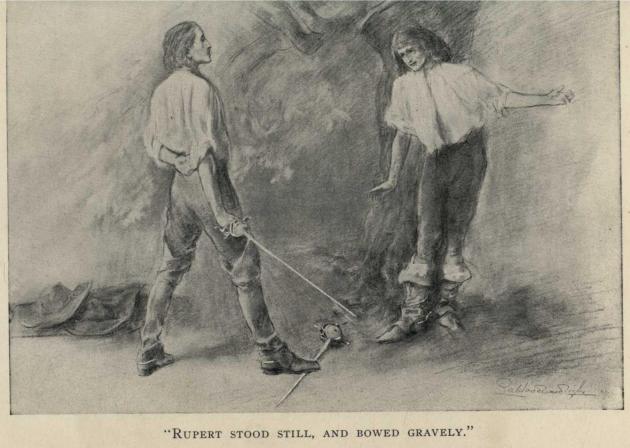
"RUPERT STOOD STILL, AND BOWED GRAVELY."
"It was an accident," said Neville; "and an accident is God's part in any affair. Take your life from my hand. I have no will to wish your death." He offered his hand as he spoke, and Rupert took it frankly, answering,
"'Tis no disgrace to take life from one so gallant and generous, and I am glad that I can repay the favour of your clemency;" then he almost whispered in Cluny's ear three words, and the young man started visibly, and with great haste untied his horse.
"We would better change horses," said Rupert; "mine is a Barb, swift as the wind."
But Cluny could not make the change proposed without some delay, his papers and jewels being bestowed in his saddle linings. So with a good wish the two men parted, and there was no anger between them;—admiration and good will had taken its place. Neville hastened forward, as he had been advised, and Rupert returned to Paris. He knew Matilda was expecting him, and he pictured to himself her disappointment and anxiety at his non-appearance; it was also her last evening in Paris, and it grieved him to miss precious hours of love, that might never be given him again. Yet he was physically exhausted, and as soon as he threw himself upon a couch he forgot all his weariness and all his anxieties in a deep sleep.
Matilda was not so happy as to find this oblivion. She knew over what social pitfalls every man of prominence in Paris walked—in the King's favour one day, in the Bastile the next day—and that this very insecurity of all good things made men reckless. Rupert might have offended King Louis or the great Cardinal. She imagined a hundred causes for flight or fight or imprisonment; she recalled one story after another of nobles and gentlemen seen flourishing in the presence of Louis one day and then never seen again. She knew that plots and counterplots, party feuds and family hatreds, were everywhere rife; and that Rupert was rash and outspoken, and had many enemies among the courtiers of Louis and the exiled nobles of England, not to speak of the Commonwealth spies, to whom he was an object of superstitious hatred, who regarded his blackamoors as familiar spirits, and believed firmly that "he had a devil," and worked evil charms by the devil's help and advice. And above all, and through these sad forebodings, there was the ever present likelihood of a duel. Every man had sword in hand, ready to settle some terrible or trivial quarrel—though it did not require a quarrel to provoke the duel; men fought for a word, for a sign, for the colour of a ribbon, for nothing at all, for the pleasure of killing themselves to kill time.
Matilda was keenly alive to all these possible tragedies, and when her lover failed to keep what was likely to be their last tryst, she was more frightened than angry; yet when Rupert came at an exceptionally early hour in the morning, and she saw him safe and well, her anxiety became flavoured with displeasure.
"How could you so cruelly disappoint me?" she cried. "You see now that our time is nearly gone; in a few hours we must part, perhaps forever."
"My dearest, loveliest Mata, I was about your pleasure. I was following Lord Neville, and he took me further than I expected. When my business was done with him, I had twenty miles to ride back to Paris; and I confess to you, I was so weary that I could only sleep. In your love, remember how lately I have been sick to death."
"Lord Neville again! The man is an incubus. Why did you follow him?"
"You wished me to give him a lesson. He was going homeward. I had to ride last night, or let him escape. By my troth, I had only your pleasure in mind."
"Oh, but the price paid was too great! I had to give up your society for hours. That is a loss I shall mourn to the end of my life. I hope, then, that you killed him. Nothing less will suffice for it."
"I was out of fortune, as I always am. I had an accident, and was at his mercy. He gave me my life."
"Now, indeed, you pierce my heart. You at his mercy! It is an intolerable shame! It will make me cry out, even when I sleep! I shall die of it. You! You! to be at his mercy—at the mercy of that Puritan braggart. Oh, I cannot endure it!"
"You see that I endure it very complacently, Mata. The man behaved as a gentleman and a soldier. I have even taken a liking to him. I have also paid back his kindness; we are quits, and as soldiers, friends. It was an accident, and as Neville very piously said, 'Accidents are God's part in an affair;' and therefore we would not be found fighting against God. You know, Mata, that I have been very religiously brought up. And I can assure you no one's honour suffered, mine least of all."
But Matilda was hard to comfort. Her last interview with her lover was saddened and troubled by this disagreement; and though both were broken-hearted in the moments of farewell, Matilda, watching Rupert across the Place Royale, discovered in the listless impatience of his attitude and movements, that inward revolt against outward strife, which, if it had found a voice, would have ejaculated, "I am glad it is over."
This, then, was the end of the visit from which she had expected so much; and one sad gray morning in November they reached London. Sir Thomas was like a man released from a spell, and he went about his house and garden in a mood so happy that it was like a psalm of gratitude to be with him. Lady Jevery was equally pleased, though less ready to show her pleasure; but to Matilda, life appeared without hope—a state of simple endurance, for she had no vital expectation that the morrow, or any other morrow, would bring her happiness.
The apparently fateful interference of Neville in her affairs made her miserable. She thought him her evil genius, the bearer of bad news, the bringer of sorrow. She felt Rupert's "accident" as part of the bad fate. She had been taught fencing, and Cymlin Swaffham had often declared her a match for any swordsman, so that she knew, as well as Rupert knew, no honour had been lost between him and Neville. But the "accident" touched her deeper than this: she regarded it as a proof that the stars were still against her good fortune, separating her from her lover, influencing Neville and his party for victory, and dooming the King and his party to defeat in all their relationships, private and national.
She said to herself in the first hours of her return that she would not see Jane, but as the day wore on she changed her mind. She wished to write Rupert every particular about national events, and she could best feel the Puritan pulse through Jane; while from no one else could she obtain a knowledge of the household doings of Cromwell and his family. Then, also, she wished Jane to see her new dresses, and to hear of the great and famous people she had been living among. What was the use of being familiar with princesses, if there was no one to talk to about them? And Matilda had so much to say concerning the ex-Queen of Bohemia and her clever daughters, that she could not deny herself the society of Jane as a listener. So she wrote and asked her to come, and Jane answered the request in person, at once. This hurry of welcome was a little malapropos. Matilda had not assumed the dress and style she had intended, and the litter of fine clothing about her rooms, and the partially unpacked boxes, gave to her surroundings an undignified and unimpressive character. But friendship gives up its forms tardily; people kiss each other and say fond words long after the love that ought to vitalise such symbols is dead and buried; and for awhile the two girls did believe themselves glad to meet again. There were a score of things delightful to women over which they could agree, and Jane's admiration for her friend's beautiful gowns and laces and jewels, and her interest in Matilda's descriptions of the circumstances in which they were worn, was so genuine, that Matilda had forgotten her relation to Lord Neville, when the irritating name was mentioned.
"Did you see Lord Neville in Paris?" Jane asked; and there was a wistful anxiety in her voice to which Matilda ought to have responded. But the question came when she was tired even of her own splendours and successes; she had talked herself out, and was not inclined to continue conversation if the subject of it was to be one so disagreeable. "No," she answered sharply. "I did not see him. He called one day, and had a long talk with Sir Thomas, but aunt had a headache, and I had more delightful company."
"I thought for my sake you would see him. Did you hear anything of his affairs?"
"Indeed, I heard he gave great offense to Cardinal Mazarin by his authoritative manner."
"Oh!"
"You know, Jane, that he has a most presuming, haughty way? He has!"
"I am sure he has not, Matilda."
"Every one wondered at Cromwell sending a mere boy on such delicate and important business. It was considered almost an insult to Mazarin."
"How can you say such things, Matilda? The business was neither delicate nor important. It was merely to deliver a parcel to Mazarin. Cluny was not charged with any explanations, and I am sure he took nothing on himself."
"I only repeat what I heard—that he carried himself as if he were a young Atlas, and had England's fate and honour on his shoulders."
"You can surely also repeat something pleasant. Did you hear of him at the minister's, or elsewhere? He is not one to pass through a room and nobody see him."
"I heard nothing about him but what I have told you. He prevented my seeing the Queen of Bohemia on my return, because he offered to attend to my uncle's business at The Hague for him; and for this interference I do not thank Lord Neville."
"Nor I," answered Jane. "Had he not gone to The Hague he might have been in London by this time." Then wishing to avoid all unpleasantness, she said, "To be sure it is no wonder you forgot me and my affairs. You have been living a fairy tale, Matilda; and the fairy prince has been living it with you. How charming!"
Matilda was instantly pleased, her voice became melodious, her face smiling and tender. "Yes," she answered, "a fairy tale, and my prince was so splendid, so famous, so adored, kings, cardinals, great men of all kinds, and the loveliest women in France sought him, but he left all to sit at my side;" and then the girls sat down, hand in hand, and Matilda told again her tale of love, till they were both near to weeping. This sympathy made Matilda remember more kindly Jane's dreams and hopes concerning her own love affair, and though she hated Neville, she put aside the ill feeling and asked, "Pray now, Jane, what about your marriage? Does it stand, like mine, under unwilling stars?"
"No. I am almost sure my father has changed his mind; perhaps the Lord General has helped him to do so, for no man, or woman either, takes such sweet interest in a true love affair. He is always for making lovers happy, whether they be his own sons and daughters or those of his friends; and he likes Cluny so much that when he returns he is to have a command at Edinburgh. And I can see father and mother have been talking about our marriage. One morning, lately, mother showed me the fine damask and house linen she is going to give me, and another morning she looked at my sewing and said, 'I might as well hurry a little; things might happen sooner than I thought for;' and then she kissed me, and that is what mother doesn't often do, out of time and season."
Jane had risen as she said these words, and was tying on her bonnet, and Matilda watched her with a curious interest. "I was wondering," she said slowly, "if you will be glad to marry Cluny Neville and go away to Scotland with him."
"Oh, yes," Jane answered, her eyes shining, her mouth wreathed in smiles, her whole being expressing her delight in such an anticipation. Matilda made no further remark, but when Jane had closed the door behind her, she sat down thoughtfully by the fire, and stirring together the red embers, sighed rather than said—
"Why do people marry and bring up sons and daughters? This girl has been loved to the uttermost by her father and mother and brothers, and she will gladly leave them all to go off with this young Scot. She will call it 'Sacrifice for Love's sake;' I call it pure selfishness. Yet I am not a whit whiter than she. I would have stayed in Paris with Rupert, though my good uncle was in danger. How dreadful it is to look into one's own soul, and make one's self tell it the honest truth. I think I will go to my evening service;" and as she rose for her Common Prayer, she was saying under her breath, "We have left undone those things which we ought to have done, and we have done those things which we ought not to have done. And there is no health in us."
Lady Jevery had a dinner party that night, and Matilda went down to it in considerable splendour. Doctor Hewitt was present, and Mr. Waller, the poet, and Denzil Hollis, and the witty, delightful Henry Marten, and Matilda's great favourite, the little royalist linen draper, Izaak Walton, whose Complete Angler had just been published. He had brought Sir Thomas a copy of it, and Matilda found out at once the song, "Come live with me and be my love." Her praises were very pleasant to the old man, who had hid Donne and Hooker and Herbert in his Inner Chamber during the days of the Long Parliament; who had been the friend of bishops Ken and Sanderson, and of archbishops Usher and Sheldon; and who, born in Elizabeth's reign, had lived to see "Sceptre and Crown tumbled down."
"But you are not the only author of Great Oliver's reign," she said with a whimsical smile. "This day Mistress Dorothy Osborne sent me a copy of the poems of my Lady Newcastle. She has been making herself still more absurd than she is by writing a book—and in verse. 'Sure,' said Mistress Dorothy to me, 'if I did not sleep for a month, I should never come to that point.' Why does her husband let her run loose? I vow there are soberer people in Bedlam."
"Her husband adores her; he believes her to be a prodigy of learning."
"They are a couple of fools well met. I am sorry for them. She dashes at everything, and he goes about trumpeting her praises. Come, sir, I hear the company tossing Cromwell's name about. Let us join the combatants; I wish to be in the fray."
The fact was Sir Thomas had asked after political affairs since he left England in April, and there was plenty of material for discussion. Denzil Hollis was describing the opening of the Parliament summoned by Cromwell, and which met on the fourth of July. "He made to this Parliament," he said, "a wonderful speech. He declared that he 'did not want supreme power, no, not for a day, but to put it into the hands of proper persons elected by the people.' And he bid them 'be humble and not consider themselves too much of a Parliament.' And then he burst into such a strain as none ever heard, taking texts from psalms, and prophets and epistles, mingled with homely counsels, and entreaties to them to do their duty—speaking till the words fell red hot from his lips, so that when he ended with the psalm on Dunbar field we were all ready to sing it with him; for as he told us, with a shining face, 'the triumph of the psalm is exceeding high and great, and God is now accomplishing it.'"
"No English Parliament was ever opened like that," said Sir Thomas. "Has it done anything yet?"
"It has done too much. It has committees at work looking into the affairs of Scotland and Ireland, the navy, the army and the law. They have been through the jails, and set three hundred poor debtors free in London alone. They have abolished titles and the Court of Chancery; and the last two acts have made the nation very uneasy. Upon my honour, the people are more unhappy at getting rid of their wrongs than you would credit."
"Englishmen like something to grumble about," said Mr. Walton. "If the Commonwealth leaves them without a grievance, it will doom itself."
"That is not it, Mr. Walton," said Henry Marten; "Englishmen don't like the foundations destroyed in order to repair the house. Going over precipices is not making progress. You may take it for an axiom that as a people, we prefer abuses to novelties."
"The reign of the saints is now begun," said Doctor Hewitt scornfully; "and Sir Harry Vane is afraid of what he has prayed for. He has gone into retirement, and sent Cromwell word he would wait for his place until he got to heaven."
"Sir Harry is not one of Zebedee's sons."
"This Parliament is going too fast."
"They have no precedents to hamper them."
"Everything old is in danger of being abolished."
"They talk of reducing all taxation to one assessment on land and property. Absurd!"
"Some say they will burn the records in the Tower; and the law of Moses is to take the place of the law of England."
"And the Jews are to have civil rights."
"And after that we may have a Jewish Sanhedrim in place of a Puritan Parliament."
"The good people of England will never bear such innovations," said Sir Thomas with great indignation.
"None of us know how much the good people of England will bear," answered Hollis.
"And pray what part does Cromwell take in these changes? Surely he is the leader of them?" asked Lady Jevery.
"He takes no part in them, madame," answered Walton; "gives no advice, uses no authority."
"Oh, indeed he is just waiting till his Assembly of Saints have made themselves beyond further bearing," said Matilda. "Then he will arise to the rescue, and serve them as he did the last Parliament."
"And then, Lady Matilda, what then?" asked Doctor Hewitt.
"He will make himself Emperor of these Isles."
"I do not think he has any such intent; no, not for an hour," said Sir Thomas.
There was a cynical laugh at this opinion, and Matilda's opinion was, in the main, not only endorsed, but firmly believed. Many could not understand why he had waited so long. "When he sheathed his sword at Worcester he could have lifted the sceptre, and the whole nation would have shouted gratefully, 'God save King Oliver,'" said Sir Thomas. "Why did he not do so, I wonder?"
But if the spiritual eyes of these men had been suddenly opened, as were those of Elisha, they might have seen that hour the man Cromwell, as God saw him, and acknowledged with shame and blame their ready injustice. For even while they were condemning him, accusing him of unbounded ambition and unbounded hypocrisy, he was kneeling by the side of a very old woman, praying. One of her small, shriveled hands was clasped between his large brown palms, and his voice, low, but intensely deep and earnest, filled the room with that unmistakable pathetic monotone, which is the natural voice of a soul pleading with its God. It rose and fell, it was full of tears and of triumph, it was sorrowful and imploring, it was the very sob of a soul wounded and loving, but crying out, "Though He slay me, yet will I trust in Him." When he rose, his face was wet with tears, but the aged woman had the light of heaven on her calm brow. She rose with him, and leaning on the top of her ivory staff, said,
"Oliver, my son Oliver, have no fear. Man nor woman shall have power to hurt thee. Until thy work is done, thou shalt not see death; and when it is done, the finger of God will beckon thee. Though an host should rise up against thee, thou wilt live thy day and do thy work."
"My mother! My good mother! God's best gift to me and mine."
"The Lord bless thee, Oliver, and keep thee.
The Lord make His face to shine upon thee,
And be gracious unto thee.
The Lord lift up His countenance upon thee,
And give thee peace."
Then Oliver kissed his mother tenderly, and went out from her presence with the joy of one whom "his mother comforteth." And his face was bright and lifted up, and his footsteps firm; and he carried himself like a man whose soul had been "ministered unto." And if the envious doubters at Sir Thomas Jevery's had seen him at that moment, they must have instantly taken knowledge of him that he had been with God. All his fears were gone, all his troubles lighter than a grasshopper; in some blessed way there had come to him the knowledge that even
"Envy's harsh berries, and the chocking pool,
Of the world's scorn and hatred, are the right mother milk
To the true, tough hearts that pioneer their kind."
BOOK III
Oliver The Conqueror
CHAPTER XI
OLIVER PROTECTOR
"O heart heroic, England's noblest son!
At what a height thy shining spirit burns
Starlike, and floods our souls with quickening fire."
* * * * *
"Fearful commenting is
The leaden servitor to dull delay."
The popular discontent with the rapid and radical reforms of the saints' Parliament was not confined to the Royalists; the nation, without regard to party, was bitterly incensed and alarmed. Cromwell was no exception; the most conservative of men, he also grew angry and restless when he saw the reign of the saints beginning in earnest.
"These godly men are going straight to the confusion of all things," he said to Israel Swaffham; "they forget they are assembled here by the people, and are assuming a direct power from the Lord. If we let them, they will bring us under the horridest arbitrariness in the world."
There was reason enough for this fear. Not content with the changes in government, religion and law, Feake and Powell were urging social changes that would level all ranks and classes to an equality, and Cromwell abominated such ideas. Of equality, as we understand the word, he had no conception. He told the members plainly that England had known for hundreds of years, ranks and orders of men—nobles, gentlemen, yeomen—and that such ranks were a good interest to the nation, and a great one. "What is the purport," he asked, "to make the tenant as liberal a fortune as the landlord? If obtained, it would not last; the men of that principle, after they had served their own turns, would have cried up property fast enough."
To the Fifth Monarchy men who held that the saints alone should rule the earth, he gave the sternest rebuke, telling them plainly that the carnal divisions among them were not symptoms of Christ's Kingdom. "Truly," he added, "you will need to give clearer manifestations of God's presence among you before wise men will submit to your conclusions."
In the meantime the anger outside the Parliament House rose to fury. Doubtless Cromwell had foreseen this crisis. Certainly a large number of the members were of his way of thinking, and on the twelfth of December, Colonel Sydenham rose, and accusing the members of wishing to put a Mosaic code in place of the Common Law of England—of depreciating a regular ministry (for what need of one, if all men could prophesy?) and of opposing learning and education, he declared the salvation of the nation lay in resigning the trust committed to them into the hands of the Lord General Cromwell. The motion was seconded by Sir Charles Wolseley. The Speaker left the chair, and followed by a majority of the members, went to Whitehall, and there and then they wrote out their resignation. It was said that "Cromwell looked astonished, and only received the paper upon great importunity." And if ever Cromwell drolled in his life, he drolled then, for it is not likely this movement was unforeseen; all its details had been too ably arranged to be the result of unanticipated action.
No serious opposition was made. Some thirty of the members remained in the House "to protest," but Colonel Goff entering with a file of musketeers, the argument was quickly closed. "What are you doing here?" asked the Colonel, and some one answered, "We are seeking the Lord," then said he, "You may go elsewhere, for to my certain knowledge the Lord has not been here these many years." Three days after this event a new Council of State resolved that his Excellency be chosen LORD PROTECTOR of the three nations, and on the sixteenth of December be so installed in Westminster Hall.
"And you would think that he had been publicly scorned instead of publicly chosen," said Israel to his wife. "He looks miserable; he is silent and downcast, and talks much to himself. Yet he is in his right place, and the only man in England who can save us from anarchy."
"God knows. It is a place of great honour for Mr. Oliver Cromwell of Slepe House."
"No, no. 'Tis a place of great danger, a place of terror and forlorn hope. God knows, I would not have it for all the honour and gold in England. Martha, his Excellency and her Highness desire your company, and that of Jane, to the ceremony. You will go?"
"I had better stay at home, Israel. I cannot 'Your Highness' Elizabeth Cromwell. Jane will go."
"And you, too, Martha. I wish it."
"I never go against your wishes, Israel—at least not often."
So it happened that on the sixteenth of December, Mrs. Swaffham and Jane wore dressing for Whitehall. Mrs. Swaffham was nervous and irritable; nervous, because she feared her gown was not as handsome as it ought to be; irritable, because she felt that circumstances were going to control her behaviour, whether she approved or not. Jane was unable to encourage or cheer her mother; she was herself the most unhappy maiden in London that day. She was white as the satin robe that clothed her, and her eyes held in their depths the shadow of that fear and grief which filled her heart. And though her mother was sorry for her distress, she was vexed that her girl could not better hide her trouble. "I hate to be pitied, Jane," she said, "and above all by 'her Highness.' And those Cromwell girls, they too will be crying 'Oh dear me!' and 'Poor Jane!' and you will be a sweet sadness to spice their own glory and happiness. Keep a brave heart, my girl. Something may happen any hour."
Jane did not answer. She could not talk; she needed all her strength to live. For eighteen days she had been forced to accept the fact that Cluny was at least eighteen days behind all probable and improbable delays. She had not received a line from him since he left Paris; no one had. He had apparently vanished as completely as a stone dropped into mid-ocean. She had been often at Jevery House, and during two of her visits had managed to see Sir Thomas and ask "if he had any intelligence from Lord Neville?" On her first inquiry he answered her anxiously; on his second his reply showed some anger.
"He offered voluntarily to take charge of Lady Jevery's jewels and to collect my money at The Hague; and unless he was certain of his ability to do these things safely, he ought not to have sought the charge."
And with these words there entered into Jane's heart a suspicion that hurt her like a sword-thrust. She found herself saying continually, "It is impossible! impossible! Oh, my God, where is he?"
All this time London was angry, anxious, almost tumultuous. Jane would have gone to Cromwell for help—indeed she did go once to Whitehall with this object in view—but she was told that he was in his own apartments silent and sad, and carrying a weight of responsibility that might have appalled the stoutest heart. Indeed, the whole family were quiet and preoccupied, and she came away without finding any fit opportunity to say a word about Cluny and his unaccountable delay. There was no one else to go to. Doctor Verity was visiting the Rev. Mr. Baxter at Kidderminster, and Matilda hated Cluny. Jane could not bear to suggest to Matilda a doubt as to Cluny's return. Certainly Mrs. Swaffham listened to her daughter's fears and anxieties, but Jane felt that the Parliament and its doings and misdoings, and the speculations concerning Cromwell, were the great and vital interest filling every heart. No one seemed to care about Lord Neville as she thought they ought to. So far, then, she had borne her sorrow alone, and it had never left her a moment for eighteen days and nights. Even in her sleep she wandered wretchedly looking for him; her pillows were full of evil forebodings, and the atmosphere of her room was heavy with the misery of her thoughts.
Fortunately the Cromwells had no idea that Jane was in trouble; they were, as was right and natural, very much excited over the ceremony of the day and the order in which it was to be carried out. His Excellency was with a number of his officers in a separate apartment, but madame, the General's mother, was in the large parlour of the Cockpit, and when the Swaffhams entered, she rose with delight to meet her old neighbours and friends. In spite of her great age she looked almost handsome in a robe of black velvet and silver trimmings, with a shawl-like drapery of rich white lace. In a short time her daughter-in-law and her grandchildren entered, and Mrs. Swaffham looked curiously at her old friend. Was this indeed the Elizabeth Cromwell she had gossiped with and sometimes quarreled with? this stately woman in purple velvet, with large pearls round her throat and falling in priceless beauty below her waist? There could be no doubt of her identity, for as soon as Mrs. Swaffham began to approach her, she came forward, saying in a tone of real pleasure,
"Martha! Martha! How glad I am to see you!" and the two women broke into smiles and exclamations, and then kissed each other.
There was no time to spare. The Lord General, dressed in a rich suit of black velvet, appeared, and the procession was formed. The Commissioners of the Great Seal, the Judges and Barons of the Exchequer in all the splendour of their insignia, preceded it. Then came the Council of State and the Lord Mayor and Aldermen in their scarlet robes. Cromwell followed. He was alone in a magnificent coach with outriders, but he was attended by the chief officers of the army, and by an imposing military escort. His family and friends in conveyances of equal splendour were behind, and were also attended by a military guard of honour.
"Is it a dream, Jane?" said Mrs. Swaffham to her daughter. "Am I asleep or awake? Are these the very Cromwells we used to know? Did you see that little chit, Frank, whom I have birched and stood in the corner, and scolded more times than I can remember?—did you see her? Did you see her curtsying to her mother and calling her, 'Your Highness'? and Mary Cromwell giving orders like a very Queen? and even Elizabeth Claypole looking as if England belonged to them? After this, Jane, nothing can astonish me."
Jane was as silent as her mother was garrulous; the crowds, the excitement, the poignant crash and blare of martial music, the shining and clashing of steel, the waving of flags, the shouts and huzzas of the multitudes, the ringing of innumerable bells, the overpowering sense of the brotherhood of humanity in a mass animated by the same feeling, these things thrilled and filled souls until they were without words, or else foolishly eloquent.
A place of honour had been reserved for the Cromwell party, and the great General's mother found a throne-like chair placed for her in such a position that she could see every movement and hear every word of that august ceremony which was to acknowledge her son "the greatest man in England." And as she sat there, watching him stand uncovered beside the Chair of State, and listened to him taking the solemn oath to rule England, Scotland and Ireland justly, she thought of this battle-scarred man as a baby at her breast, fifty-four years before, pressing her bosom with his tiny fingers, and smiling up in her face, happily unconscious of the travail of body and soul he was to undergo for the sake of England, and of all future free peoples. And she thought also of one cold winter day, when, a lad of twelve, he had come in from his lessons and his rough play at football and thrown himself upon his bed, weary with the buffeting; and as he lay there, wide-awake in the broad daylight, how he had seen his angel stand at his feet, and heard him say, "Thou shalt be the greatest man in England." And there in her sight and hearing, the prophecy was fulfilled that day, for she had never doubted it. The boy had been scolded and flogged for persisting in this story, but she had comforted him and always known that it was a vision to be realised.
Her faith had its reward. She watched this boy of hers put on his hat, after taking the oath, and with a kingly air ascend to what was virtually the throne of England. She saw him unbuckle his sword and put it off, to signify that military rule was ended; and then she heard, amid the blare of trumpets, the Heralds proclaim him Lord Protector of England, Scotland and Ireland. Her lips moved not, but she heard her soul singing psalms of glory and thanksgiving; yes, she heard the music within rising and swelling to great anthems of rejoicing. Her body was impotent to express this wonderful joy; it was her soul that made her boast in the Lord, that magnified the God of her salvation. And she really heard its glad music with her natural body, and the melody of that everlasting chime was in her heart to the last moment of her life. And her children looked at her and were amazed, for her face was changed; and when the people shouted, to "God save the Lord Protector of the Commonwealth!" she stood up without her staff, and was the first to render him obeisance.
Jane watched her with wonder and delight; she forgot her own grief in this aged mother's surpassing happiness, and she partly understood that hour the new doctrine of the men called Quakers. For she had watched this Inner sight of Life transfuse the frail frame, and seen it illuminate the withered face and strengthen the trembling limbs, and, above all, fill the Inner woman with a joy unspeakable and beyond speech or understanding.
The ride back to Whitehall was an intoxicating one. Londoners had at last a ruler who was a supremely able man. They could go to their shops, and buy and sell in security. Oliver Protector would see to their rights and their welfare. His very appearance was satisfying; he was not a young man headstrong and reckless, but a Protector who had been tried on the battle-field and in the Council Chamber and never found wanting. His personality also was the visible presentment of the qualities they admired and desired. They looked at his sturdy British growth, and were satisfied. His head and face, muscular and massive, were of lion-like aspect; his stature nearly six feet, and so highly vitalised as to look much higher. Dark brown hair, mingled with gray, fell below his collar-band, and from under large brows his deep, loving eyes looked as if in lifelong sorrow; and yet not thinking life sorrow, thinking it only labour and endeavour. Valour, devout intelligence, great simplicity, and a singular air of mysticism invested his rugged, broad-hatted majesty with a character or impress transcendentally mysterious. Even his enemies felt this vague shadow of the supernatural over and around him, for Sir Richard Huddleston, in watching him on Naseby's field, had cried out passionately, "Who will find King Charles a leader like him? He is not a man; he is one of the ancient heroes come out of Valhalla."
But be the day glad or sad, time runs through it, and the shadows of evening found the whole city worn out with their own emotions. Mrs. Swaffham and Jane were glad to return to the quiet of their home—"Not but what we have had a great day, Jane," said the elder woman; "but, dear me, child, what a waste of life it is! I feel ten years older. It would not do to spend one's self this way very often."
"I am tired to death, mother. May I stay in my room this evening? I do not want to hear any more about the Cromwells, and I dare say Doctor Verity will come home with father, and they will talk of nothing else."
"You are fretting, Jane, and fretting is bad for you every way. Why will you do it?"
"How can I help it, mother?"
Then Mrs. Swaffham looked at her daughter's white face, and said, "You know, dear, where and how to find the comfort you need. God help you, child."
And oh, how good it was to the heart-sick girl, to be at last alone, to be able to weep unwatched and unchecked—to shut the door of her soul on the world and open it to God, to tell Him all her doubt and fear and lonely grief. This was her consolation, even though no sensible comfort came from it—though the heavens seemed far off, and there was no ray of light, no whisper from beyond to encourage her. Hoping against despair, she rose up saying, "Though He slay me, yet will I trust in Him;" and these words she repeated over and over with increasing fervour, as she neatly folded away her clothing and put her room in that exquisite order which was necessary to her sleep, or even rest. For she kept still her childish belief that her angel would not visit her, if her room was untidy. And who will dare to say she was wrong? These primitive faiths hold truths hid from the wise and prudent, but revealed to the simple and pure of heart.
At nine o'clock her mother brought her a possett and toast, and she took them gratefully. "Is father home?" she asked.
"Yes, Jane. He came in an hour ago with Doctor Verity."
"Have they any word of——"
"I fear not. They would have told me at once. I haven't seen much of them. There were lots of things undone, and badly done, to look after. The wenches and the men have been on the streets all day, and the kitchen is upside down. You never saw the like. I am tired of this Cromwell business, I am that. Phoebe was abusing him roundly as she jugged the hare for supper, and I felt kindly to her for it. 'You are a pack of time-serving turncoats,' she was saying as I went into the kitchen; 'you would drink as much ale to-morrow to King Charles as you have drunk to-day to old Noll Cromwell.' And as she was stirring the pot, she did not know I was there, until I answered, 'You speak God's truth, Phoebe!' Then she turned and said, 'I do, ma'am. And for that matter, they would drink to the devil, an he asked them with old October!' Then I stopped her saucy tongue. But I don't wonder at her temper—not a clean saucepan in the closets, and men and maids off their heads with ale and Cromwell together."
"If Doctor Verity gives you any opportunity will you speak about Cluny, mother?"
"You know I will. He and others will, maybe, have time for a word of kindness now. I'm sure the last few weeks have been past bearing—a nice mess the saints made of everything—London out of its seven senses, and the whole country screaming behind it; and the men who had a little sense, not knowing which road to turn. Now Cromwell has got his way, there will be only Cromwell to please, and surely a whole city full can manage that."
"I don't suppose he has ever thought of Cluny being so long over time."
"Not he! He has had things far closer to him to look after."
"But now?"
"Now he will inquire after the lad. Doctor Verity must speak to him. Dear Jane, do you suppose I don't see how you are suffering? I do, my girl, and I suffer with you. But even your father thinks we are worrying ourselves for nothing. He says Cluny will walk in some day and tell his own story—nothing worse than a fit of ague or fever, or even a wound from some street pad; perhaps a heavy snowstorm, or the swampy Netherlands under water. Men can't fight the elements, or even outwit them, dear. Mother is with you, Jane, don't you doubt that," and she stepped forward and clasped the girl to her breast, and kissed the tears off her cheeks. "Now drink your possett and go to sleep; something may happen while you are dreaming of it; the net of the sleeping fisherman takes just as well—better maybe—than if he kept awake to watch it."
So Jane laid herself down and slept, and if her angel came with a comforting thought or a happy vision, she found herself in a spotless room, white as a bride chamber, holding the scent of rosemary and roses from the pots on the window-sills, and prophesying strength and comfort in the Bible lying open at the forty-second and forty-third Psalms—"Why art thou cast down, O my soul? And why art thou disquieted in me? Hope thou in God; for I shall yet praise Him for the help of His countenance."
Jane's supposition that Doctor Verity would be with her father and that their talk would be only of Cromwell, was correct. Mrs. Swaffham found the two men smoking at the fireside, and their conversation was of the Man and the Hour. She sat down weary and sleepy, so much so, that she did not take the trouble to contradict Doctor Verity, though he was making, in her opinion, a very foolish statement.
"If you only assert a thing strong enough and long enough, Israel, you will convince the multitude. To-day, as I was passing Northumberland House, a party of musketeers stopped there, and cried, 'God save the Lord Protector!' and the crowd asserted in the most positive manner that the big lion on the house wagged its tail at the shout. Every one believed it, and looked at the beast admiringly; and I found it hard to keep my senses in the face of such strong assertion. Vain babble, but it took and pleased."
"I am sorry for Oliver Cromwell. Such a load as he has shouldered! Can he bear it?" said Israel.
"Through God's help, yes; and ten times over, yes! He is a great man," answered the Doctor.
"I think more of measures than of men," continued Israel.
"Very good. But something depends on the men, just as in a fire something depends on the grate," said the Doctor.
"Who would have thought the man we knew at Huntingdon and St. Ives had this man in him? And what a strange place for God to bring England's Deliverer out of. No captain from the battle-field, no doctor out of the colleges, but a gentleman farmer out of the corn market and the sheep meadows of Sedgy Ouse. 'Tis wonderful enough, Doctor."
"Great men, Israel, have always come from the most unlikely places. The desert and the wilderness, the sheepfolds and threshing floors bred the judges and prophets of Israel. From the despised village of Nazareth came the Christ. From the hot, barren deserts of Arabia, came Mahomet. From the arid plains of Picardy, came Calvin. From the misty, bare mountains of Scotland, came John Knox, and from the fogs and swamps of the Fen country, comes Oliver Cromwell. So it is, and should be. God chooses for great men, not only the time, but the place of their birth. The strength of Cromwell's character is in its mysticism, and this quality has been fed from its youth up by the monotony of his rural life, by the sombre skies above him, by his very house, which was like a deserted cloister buried in big trees. All those years Cromwell was being forged and welded by spiritual influences into the man of Naseby and Dunbar and Worcester—into the man who stepped grandly to the throne we saw him mount to-day."
"One thing is sure: he will set free all godly men in prison for conscience' sake—unless it be papists and prelatists. Yet 'tis hard to imprison men because they can't agree about caps and surplices."
"Such talk does not go to the root of the matter, Israel. Oliver, and men like him, look on papists and prelatists as Amorites and Amalekites to be rooted out, and as disloyal citizens to be coerced into obedience."
"I know papists that believe the Mass to be a holy obligation. They are sincere, Doctor; I know it."
"What of that, Israel? A good Puritan cares no more for their sincere opinions than the Jewish prophets cared about the scruples of a conscientious believer in Baal. Why should he?"
"Well, then, as to Episcopacy—a great number of Englishmen love it; and you can't preach nor teach Episcopacy out of them."
"Don't I know it? Popery without the Pope, that is what Englishmen want. They love ceremonies dearly; they love Episcopacy as they love Monarchy. Queen Elizabeth made an ordinance that at the name of Christ every woman should curtsy and every man bare his head. It went straight to the heart of England. Men and women loved Elizabeth for it, and bent their knees all the more willingly to herself. As for Cromwell, his zeal for the Protestant religion will be the key to every act of his reign. Take my word for it."
"Reign?"
"Yes, reign. He is King, call him what you like."
"As ruler—King or Protector—over papists, will it be right to hate them as bitterly as he does?"
"Right? Yes, a thousand times right. You must remember what his education and experience have been. From some who lived in Mary's reign he must have heard how Ridley and Latimer and Cranmer were burned in the streets of Oxford for their Protestantism. The whole awful history of Mary's reign was part of his education. He may have heard from eye-witnesses of the scene in the great square of Brussels when Horn and Egmont, champions of the Protestant faith, were beheaded by Alva's bloody Council. The Armada sent to conquer England and force on us by fire and sword the Catholic religion, was wrecked on our shores by God Almighty, only eleven years before Cromwell was born. The Popish Gunpowder Plot to blow up the King and the Parliament was discovered when he was six years old. Both of these last events were the staple of fireside conversations, and would be told him in wonderfully effective words by his grand-hearted mother, and you may be sure they were burned into the heart of the boy Oliver. He was old enough to understand the cruel murder of Henry by the Jesuits in Paris; he grew into his manhood during the thirty years' war of Catholic Europe against the Protestants. When he first entered Parliament, he was one of the Committee that investigated the brutal treatment of Prynne, Doctor Bastwick and the Rev. Mr. Burton. I think, indeed, that he witnessed these noble confessors pilloried and burned with hot irons and deprived of their ears, because they would none of Laud's surplices and mummeries. And both you and I witnessed his agonies of grief and anger at the frightful massacre by Phelim O'Neil of one hundred thousand Protestants in Ireland. How can Cromwell help hating popery and prelacy? How can any of us help it? Let us judge, not according to outward appearance, but with righteous judgment. Oliver will do his work, and he will do it well, and then go to Him who sent him. Verily, I believe he will hear the 'Well done' of his Master."
"And then?"
"The Commonwealth will be over. The soul of it will have departed—can it live afterwards?"
"Think you that our labour and lives have been wasted? No, no! We will be free of kings forever; we have written that compact with our blood."
"Not wasted, Israel, not wasted. The Puritan government may perish, the Puritan spirit will never die. Before these wars, England was like an animal that knew not its own strength; she is now better acquainted with herself. The people will never give up their Parliament and the rights the Commonwealth has given them, and if kings come back, they can be governed, as Davie Lindsey said, by 'garring them ken, they have a lith in their necks——'"
"If I survive the Puritan government," said Israel, "I will join the pilgrims who have gone over the great seas."
"I will go with you, Israel, but we will not call ourselves 'pilgrims.' No, indeed! No men are less like pilgrims than they who go, not to wander about, but to build homes and cities and found republics in the land they have been led to. They are citizens, not pilgrims."
At these words Mrs. Swaffham, who had listened between sleeping and waking, roused herself thoroughly. "Israel," she said, "I will not go across seas. It is not likely. Swaffham is our very own, and we will stay in Swaffham. And I do not think it is fair, or even loyal, in you and Doctor Verity, on the very day you have made a Protector for the Commonwealth to be prophesying its end. It is not right."
"It is very wrong, Martha, and you do well to reprove us," said Doctor Verity.
"And talking of going across seas," she continued, "reminds me of Cluny; neither of you seem to care about him, yet our Jane is fretting herself sick, and you might both of you see it."
"Tell Jane to be patient," said Doctor Verity. "If Cluny is not back by the New Year, I will go myself and bring him back. There is no need to fret; tell her that."
"Yet we must speak to Cromwell about the young man," said Jane's father; "there has likely been some letter or message from him, which in the hurry and trouble of the last month has been forgotten. You will see the Protector to-morrow, speak to him."
"If it is possible, Israel. But remember all is to arrange and rearrange, order and reorder, men to put out of office, and men to put into office. The work before the Protector is stupendous."
This opinion proved to be correct. Day after day passed, and no word concerning Cluny was possible; but about the New Year a moment was found in which to name the young man and wonder at his delay. Cromwell appeared to be startled. "Surely there must have been some word from him," he said. "I think there has. A letter must have come; it has been laid aside; if so, there could have been nothing of importance in it—no trouble, or I would have been told. Mr. Milton is fond of Lord Neville; so am I, indeed I am, and I will have inquiry made without delay."
"Without delay" in government inquiries may mean much time. The accumulated papers and letters of a month or more had to be examined, and when this was accomplished, nothing had been found that threw any light on Neville's detention. Yet no anxiety was expressed. Every one had such confidence in the young man; he was accustomed to the exigencies of travel, ready in resort, and brave and wise in emergencies. Cromwell made light of any supposition affecting his safety, and there was nothing then for Jane to do, but bear, and try to believe with those supposed to know better than herself, that the difficulties of winter travel in strange countries would easily account for her lover's non-appearance.
Thus, sad with the slow sense of time, and with grief void and dark, Jane passed the weary days. The world went on, her heart stood still. Yet it was in these sorrowful days, haunted by uncertain presentiments, that she first felt the Infinite around her. It was then that she began to look for comfort from within the veil, and to listen for some answering voice from the other life, because in this life there was none. Outside of these consolations she had only a bewildering fear, and she would have wept and worried her beauty away, had there not dwelt in her pure soul the perennial youth of silent worship. But this constantly renovating power was that fine flame of spiritual light in which physical beauty refines itself to the burning point. The greatest change was in her manner; a slight cold austerity had taken the place of her natural cheerfulness—this partly because she thought there was a want of sympathy in all around her, and partly because only by this guarded composure could she maintain that tearless reticence she felt necessary to her self-respect. Nevertheless, through her faith, her innocence, her high thought and her laborious peace, she set her feet upon a rock.
One crisp, sunny morning in January she suddenly resolved to make some inquiries herself. It was not an easy thing to do; all her education and all conventional feeling were against a girl taking such a step. But the misery of a grief not sure is very great, and Jane believed that her direct inquiries might be of some avail. She went first to Jevery House. Sir Thomas had a financial interest in Lord Neville's return, and it was likely he had made investigations, if no one else had. She expected to find him in his garden, and she was not disappointed; wrapped in furs, he was walking up and down the flagged pathway leading from the gates to the main door of the mansion. He was finding a great deal of pleasure in the green box borders and the fresh brown earth which, he said to Jane, was "nourishing and cherishing his lilies and daffodils. You must come again in three weeks, Jane," he added; "and perhaps you will see them putting out their little green fingers." Jane answered, "Yes, sir;" but immediately plunged into the subject so near her.
"Have you heard anything about Lord Neville, Sir Thomas?" she asked. "I must tell you that he is my lover; we were betrothed with my parents' consent, and I am very, very unhappy at his long delay."
"So am I," answered Sir Thomas. "I sent a trusty man to The Hague, and it seems Lord Neville collected the money due me there, six weeks ago. A singular circumstance in this connection is that he refused a note on the Leather Merchants' Guild of this city, and insisted on being paid in gold, and was so paid. Now, Jane, a thousand sovereigns are not easily carried,—and—and——"
"Well, sir? Please go on."
"A ship left that night for the Americas—for the Virginia Colony."
"But Lord Neville did not go to America. Oh, no, sir! That is an impossible thought."
"Well, then, there is this alternative: the merchant who paid him the money died a few days afterwards of smallpox. Was there infection in the money? Did Lord Neville take the smallpox and die?"
"But if he had been sick he would have known the danger, and written some letter and provided for the safety of the property in his charge. He knew many people in The Hague. This supposition is very unlikely."
"Why did he insist on the gold? This is the thing that troubles me."
"Who says he insisted on gold?"
"The widow of the man who paid it."
"She may have been mistaken. She may herself be dishonest. The money may never have been paid at all. I do not believe it has been paid. Did your trusty man see Lord Neville's quittance?"
"I have not thought of that, Jane. I was troubled at the story, and accepted it as it was given. It was too painful and suspicious to examine."
"For that reason it must be sifted to the very bottom. That Dutch widow has the money, doubtless. Did your messenger ask her to describe Lord Neville? Did he ask her any particulars of the interview? It is easy to say the thousand pounds were paid. I do not believe her."
"Well, my little mistress, your faith infects me. I will send again to The Hague."
"Yes, sir, and let your messenger ask to see Lord Neville's quittance. Cluny did not receive from any one a thousand pounds without an acknowledgment of the payment. Let the woman show it."
"You are right. I will make further inquiries at once."
"To-day, sir? Please, to-day, sir."
"I will send a man to The Hague to-day."
"Thank you, Sir Thomas. Can I now see Lady Jevery and Lady Matilda?"
"My dear, they are both at de Wick. A week ago my niece received a letter from the man who bought the estate. He urged them to come and see him. He said he had not long to live, and that before he went away he had some most important intelligence, vitally affecting the de Wicks, to communicate. My niece thought it prudent, even necessary, to make the visit; and Lady Jevery went with her. In a couple of weeks I shall go for them."
"But before you go——"
"I have said 'to-day,' Mistress Jane. I will keep my promise. Why do you not see the Protector? He was fond of the young man; he believed in him."
She only answered, "Yes, sir," and then adding, "Good-morning, sir," she turned to go. Her face was so white and so full of hopeless disappointment, he could not endure to keep its memory a moment. Hastening after her, he said, "My dear little mistress, I am certain of one thing—if there is any wrong about this matter it is not Lord Neville's fault, it is his misfortune."
She received this acknowledgment with a grateful smile, yet her whole appearance was so wretched Sir Thomas could not rid himself of her unhappy atmosphere. His walk was spoiled; he went into his private room and smoked a pipe of Virginia, but all his thoughts set themselves to one text: "There are many sorrowful things in life, but the hardest of all is loving."
CHAPTER XII
HOLD THOU MY HANDS
"Hold Thou my hands:
In grief and joy, in hope and fear,
Lord let me feel that Thou art near;
Hold Thou my hands."
There are two ways to manage a day that begins badly; we may give the inner man or woman control, and permit them to compel events; or we may retire until unpropitious influences have passed us by. It is perhaps only in extremes the first alternative is taken; usually the soul prefers withdrawal. Jane felt that it was useless for her to attempt a visit to the Protector that day, and she hastened to the covert of her home. Her mother's kind face met her at the threshold, and the commonplace domestic influences of the set dinner-table, and the busy servants, recalled her thoughts from their sad and profitless wandering among possible and impossible calamities.
Mrs. Swaffham had a letter in her hand, and she said as soon as she saw her daughter, "What do you think, Jane? Cymlin has got his discharge, and instead of coming here, he has gone to Swaffham. And he says Will and Tonbert are in the mind to join a party of men who will pay a visit to the Massachusetts Colony; and Cymlin says it is a good thing, and that he will stay at Swaffham and keep everything up to collar."
"I was at Jevery House, mother," said Jane, "and Lady Jevery and Matilda are gone to de Wick."
"Never! That accounts for Cymlin's being so thoughtful for Swaffham. Reasons for all things, Jane, and some woman at the bottom of all. I am sorrier than I can tell you. Matilda will take her sport out of Cymlin, and leave him with a laugh. I know her. I will write to Cymlin this night."
"But why, mother? You can do no good. A word, a look from Matilda, and a fig for all advices!" Then she told her mother of Anthony Lynn's message, and they talked awhile of its probable meaning, Mrs. Swaffham being of the opinion that Lynn's conscience was troubling him, and that he wanted, as far as he was able, to propitiate the de Wicks.
"You see," she said, "it is not only the living de Wicks, Jane, there is a powerful gathering of the family on the other side. And the late Earl was very good to Anthony. From his boyhood he was fostered by the de Wicks, and then to think of his buying out the young Earl and Matilda!"
"If he had not bought out de Wick, somebody else would; and perhaps the de Wicks would rather have an old retainer there than some unknown stranger," said Jane.
"It is hard to tell what the dead like, and how they feel; but it is a wise thing to treat every one in this world so that you won't be afraid to meet them in the next world. I wouldn't wonder if Anthony Lynn felt a bit afraid to meet Earl Marmaduke; anyway, he ought to be ashamed. Anthony was always known for a prudent man; he is going to make his peace at the gates of death, for fear of what is beyond them."
"I do not know. Sir Thomas offered no opinion; and he said some cruel things about Cluny, though he followed me to unsay them."
Then Jane told her mother what suspicions evidently existed in the mind of Sir Thomas, and Mrs. Swaffham laughed at their absurdity, and was then angry at their injustice; and finally she sent Jane up-stairs to dress for dinner in a much more hopeful and worldlike temper. This day was followed by a week of wretched weather. Jane could do nothing but wait. Her soul, however, had reached its lowest depth of despondence during her visit to Sir Thomas Jevery, and on reviewing it, she felt as if she had betrayed her inner self—let a stranger look at her grief and see her faint heart, and suspect that she, also, had a doubt of her lover. She was mortified at her weakness, and fully resolved when she visited Cromwell, to show him the heart of a fearless woman—brave, because she doubted neither God nor man.
It was, however, the month of March before this visit could be made. The bad weather was the precursor of a bad cold, and then she had to consider the new domestic arrangements of the Cromwell family. The royal apartments in Whitehall and in the palace of Hampton Court were being prepared for the Protector's family, and Jane knew from her father's reports, as well as from her own acquaintance with her Highness and her daughters, that all the changes made would be of the utmost interest to them. She was averse either to intrude on their joy or to have them notice her anxiety.
But one exquisite morning in March she heard General Swaffham say that the Cromwell ladies were going to Hampton Court. The Protector would then be alone in Whitehall, and she might see him without having to share her confidences with the family. She prepared a note asking for an interview, and then called on Mr. Milton and induced him to go with her to the palace and deliver it into Cromwell's hand. In her simplicity she considered this little plan to be a very wise one, and so it proved. Mr. Milton had no difficulty in reaching the Protector, who, as soon as he read Jane's appeal, was ready to receive her. She had been much troubled about this audience, how she was to behave, and with what words she should address Cromwell, but her fear left her as soon as the door closed, and she was alone with her old friend.
"Jane," he said kindly, "Jane, what is the trouble?"
"It is Lord Neville, sir. Nothing has been heard of him, and I wish to tell you what Sir Thomas Jevery said." She did so, and Cromwell listened with a smile of incredulity. "We know Neville better than that," he answered. "It would be a great wonder if he should think of America, Jane. Would a man in his senses leave you, and his estate, and his good friends and good prospects to go into the wilderness? Truly he would not. His home and land in Fife are worth more than Jevery's gold and jewels, and I do think my favour may count for something. And more than these things there is your love. You do love him, Jane?"
"Better than my life, your Highness."
"And he loves you?"
"Indeed, I am most certain of it."
"When did you hear last from him?"
Jane had expected this question and she offered Cromwell Cluny's last letter, and asked him to read it. He read it aloud, letting his voice become sweet and tender as he did so.
"My dearest and most honoured mistress, I am just on the moment of leaving Paris; my horse is at the door; but by a messenger that will come more directly than myself, I send you a last word from this place. My thoughts outreach all written words. I am with you, my own dear one, in all my best moments, and my unchangeable love salutes you. Graciously remember me in your love and prayers.
"CLUNY NEVILLE."
"A good letter, Jane. I do think the man that wrote it is beyond guile, beyond dishonour of any kind. I will not hear a doubt of him. I will not——" With these words he rose, and taking Jane's hand in his, he began to walk with her, up and down the room. His clasp was so hot and tight she could have cried out, but glancing into his face she saw it was only the physical expression of thoughts he did not care to give words to. In a few minutes he touched a bell, and when it was answered said, "Mr. Tasburg to my presence—without delay." Mr. Tasburg came without delay, and Cromwell turned to him in some passion.
"Mark Tasburg," he said scornfully, "I know not whether you have been alive or dead. I have not once heard from you in the matter of Lord Neville's delay; I have not, and that you know. The commission for your search is more than a month old; it is, sir; and I like not such delays. I will not have them."
"My Lord Protector, I reported to Mr. Thurloe and Mr. Milton that my search had been of no avail."
"Who gave you the order to make this search?"
"Your Highness."
"Did I give you an order to report to Mr. Thurloe or Mr. Milton? Did I?"
"No, your Highness."
"See, then, what you have taken upon yourself. Be not so forward again, or you may go back to St. Ives and make clay pipes. What date does Lord Neville's last letter bear?"
"It was written at Paris on the eleventh day of November."
"The same date as your last letter, Mistress Swaffham. Four months ago. This is serious." Then turning to Tasburg he said, "Find Colonel Ayrton and send him here, to me, without delay."
During the interval between Tasburg's departure and Ayrton's arrival, Cromwell was occupied in writing a letter, and when it was finished, Colonel Ayrton entered.
"Colonel," he said, "I think you know Lord Cluny Neville?"
"Your Highness, I know him well. His mother was my fifth cousin."
"He has disappeared, I do fear, in some unfortunate way. On the eleventh of last November he left Paris, after despatching the business he was sent on with Cardinal Mazarin. No one has heard of him since. He was going to The Hague, but whether by land or water, does not appear. I have written to his Eminence, the Cardinal; here is the letter, and if his reply be not to the point, go next to the lodging of Lord Neville, and from there follow his steps as closely as it may be in your power. The treasurer will honour this order for your expenses. Waste no time. Be prudent with your tongue. Say not all your mind, and send me some tidings with all convenient speed."
"I am a willing messenger, your Highness. I am bound to my cousin by many kind ties, and I have been most uneasy at his silence and absence."
"Farewell, then, and God go with you."
He waited until the door closed, and then he said, "I owe you this and more, Jane; and I like the youth—a dear, religious youth, of a manly spirit and a true heart. He was always counted fortunate, for in all our battles he went shot free. I wish, I do wish, we could hear of him! And you love him, Jane? And he loves you. My heart aches for both of you; it does indeed. But I think I can do somewhat in this matter, and truly I will use my endeavour. Why does he not come? What can have hindered him?" he cried impatiently as if to himself.
"Oh, sir, he is sick or wounded—perhaps at death's door in some poor man's cottage, in some lonely place far from help or friends," and here Jane burst into passionate weeping.
"You must not, you must not cry, Jane; I beg it as a favour—not in the sight of men and women. Tears are for the Father of spirits. Retire to Him who is a sure resting-place, and there weep your heart empty; for He can, and He will wipe all tears away. As for your dear lord and lover, he is within God's knowledge, and if God saves souls, surely He can save bodies."
"It is four months, sir. 'Tis beyond my hope; and I fear Cluny is now beyond human help."
"Well, then, Jane, we will trust to the miraculous. We do not do that enough, and so when our poor help is not sufficient, we tremble. Where is the hope and trust you sent to me when I lay between life and death in Scotland? Oh, what poor creatures we are, when we trust in ourselves! nothing then but tears and fears and the grave to end all. But I confess I never expected Jane Swaffham to be down in the mire. Jane knows she is the daughter of the everlasting, powerful, infinite, inscrutable God Almighty; she knows this God is also one of goodness and mercy and truth without end, to those who love Him. You love Him, you do love Him?"
"I have loved Him ever since I could speak His Holy Name. But He never now answers me; when I pray to Him the heavens seem to let my prayers fall back to me. Has He forgotten me?"
"Jane, Jane, oh, Jane! What a question for you to ask! I could chide you for it. Have you forgotten the teaching of your Bible, and your catechism, of your good pastor, John Verity, and your father and mother? Do you believe for one moment that God has any abortive children? He has not. He is the father of such souls as, according to His appointment, come to perfection. If you have ever, for one moment, felt the love of the Ineffable Nameless One, I do assure you it is a love for all eternity! It is, Jane, it is, surely. He does not love and withdraw; no, no; we may deserve to be denied, we may deserve to be abandoned, but just because it is so, He seeks and He saves the children lost, or in danger." And then he stooped and dried her eyes with his kerchief, and seating her on a sofa, he brought a glass of wine, and said,
"Drink, my dear; and as you drink, ask for strength no juice of earthly fruit can give. Do not pray for this thing, or that thing; if you will say only, 'Thy will be done,' you will find mercy at need; you will indeed. I do know it."
"All is so dark, sir."
"And will be, till He says, 'Let there be light.' I scruple not to say this."
"Oh, sir, what shall I do? What shall I do?"
"Put a blank into God's hand, and tell Him to fill it as He chooses—Cluny or no Cluny, love, or death of love, joy or sorrow, just what He wills. In my judgment this is the way of Peace. Do you think, Jane, that I have chosen the path I now walk in? I have not, God knows it. God knows I would be a far happier man with my flocks in the Ouse meadows; I would, I say what is in my heart. Is this greatness laid on me for my glory and honour? Truly, it is only labour and sorrow. If I did not find mercy and strength at need, I should faint and utterly fail under the burden, for indeed I am the burden-bearer of all England this day. I need pity, I do need it; I need God's pity, yes, and human pity also."
There was the shadow of unshed tears in his sad, gray eyes, and an almost childlike pathos in his dropped head. Jane could not bear it. She stroked and kissed his big hand, and her tears fell down upon it. "I will go home," she said softly, "and pray for you. I will not pray for myself, but for you. I will ask God to stand at your right hand and your left hand, to beset you behind and before, and to lay His comforting, helping hand upon you. And you must not lose heart, sir, under your burden, because many that were with you have gone against you, or because there are constant plots to take your life. There is the ninetieth Psalm. It is yours, sir."
And Cromwell's face shone, and he spoke in an ecstasy, "Truly, truly, he that dwelleth in the secret place of the Most High shall abide under the shadow of the Almighty. How did David reach that height, Jane?"
"He was taught of God, sir."
"I am sure of that. I will say of the Lord, He is my refuge and my fortress; my God, in Him will I trust—thou shalt not be afraid for the terror by night, nor for the arrow that flieth by day—He shall give His angels charge over thee, to keep thee in all thy ways."
"My dear lord, is not that sufficient?" and Jane's face was now full of light, and she forgot her fears, and her sorrow was lifted from her. She found a strange courage, and the words were put into her mouth, so that she must needs say them:
"It is most true, our Protector, that you have a great burden, but are you not glad of heart that God looked down from heaven, and seeing poor England bound and suffering, chose you—you, from out of tens of thousands of Englishmen—and called you from your sheep and oxen and wheat-fields, and said unto you, 'Oliver Cromwell, free My people,' and then so filled your heart with the love of freedom that you could not help but answer, 'Here am I, Lord.' The other night I listened to some heavenly discourse from Doctor Verity, and he said that from henceforth, every flying fold of our English flag would have but one spoken word for all nations, and that word Freedom. Some may be ungrateful, but your faith and valour and labour for England will never be forgotten. Never!"
Her face gathered colour and light beyond the colour and light of mere flesh and blood as she spoke, and Cromwell's reflected it. He was "in the spirit," as this childlike woman with prescient vision prophesied for him, and looking far, far off into the future, as one seeing things invisible, he answered confidently—
"I know, and I am sure, Jane, that time will be the seal to my faithfulness. I know, and I am sure, that my name shall mix with every thought and deed of Freedom, even in lands now unknown, and in ages yet to come. Then, brave freemen shall say in my ears, 'Well done my son.' And shall not the dead ears hear? They shall. Indeed they shall! I know, and am sure, Jane, that English speaking men will take in trust, not only my name, but the names of all who, with me, held their lives less than Freedom, and gave them a burnt-offering and blood sacrifice without price or grudging. These men dying, mixed their breath and names with Freedom's, and they shall live forever. For this is the truth, Jane: thrones shall fall and nations pass away, but death has no part in Freedom."
And as he spoke, his words rang and sounded like music, and stirred the blood like a trumpet; and Jane's face was lifted to the rough, glorified visage of the warrior and the seer, who saw yet afar off his justification, saw it in the Red Cross of St. George flying over land and sea, and carrying in all its blowing folds only one glorious word—"FREEDOM."
In such moments Cromwell's spirit walked abreast of angels; he looked majestic, he spoke without pause or ambiguity, and with an heroic dictation that carried conviction rather than offense, for it had nothing personal in it, and it suited him just as hardness suits fine steel.
In this enthusiasm of national feeling, Jane forgot her personal grief, and as she went homeward, she kept repeating to herself Cromwell's parting words, "Don't doubt, Jane. God nor man nor nature can do anything for doubters. They cannot." She understood what was included in this advice, and she tried to realise it. The moment Mrs. Swaffham saw her daughter, she took notice of the change in her countenance and speech and manner, and she said to herself, "Jane has been with Oliver Cromwell. No one else could have so influenced her." And very soon Jane told her all that had been done and said, and both women tried to assure themselves that a few more weeks of patience would bring them that certainty which is so much easier to bear than suspense. For the very hope of suspense is cruel, but in the face of a sorrow, sure and known, the soul erects herself and finds out ways and means to mitigate or to bear it.