Volume 3 — Chapter IV (continued 2)
Henry Edward Krehbiel translation
Grillparzer Parts with Beethoven
Grillparzer says that Beethoven told him in Hetzendorf that his opera was ready (whether he meant in his head or in its essential elements in the numerous sketchbooks, the poet could not say), but after the composer’s death not a single note was found which could indubitably be assigned to their common work. The poet had faithfully adhered to his resolve not to remind the composer of the work in any way and “was never near him again until, clad in black and carrying a burning torch in my [his] hand,” he walked behind his coffin. Grillparzer’s memory is faulty in a few details. He says that he never met Beethoven after the visit to Hetzendorf except once; but the two men were together again in 1824. This, however, is inconsequential; the fact remains that Beethoven did not compose “Melusine.”—Why not? Many reasons must be obvious to those who have followed this narrative closely: illness; vexation of spirit; loss of initiative; a waning of the old capacity to assimilate conceptions and ideas which did not originate in his own consciousness and were not in harmony with his own predilections. Moreover, it was the period of his greatest introspection; he was communing more and more with his own soul, and separating himself more and more from all agencies of utterance except the one which spoke most truthfully and directly within him, and to which he entrusted his last revelations—the string quartet. “Melusine” was not composed, but the opera continued to occupy his attention at intervals until deep into the next year, and unless Holz is in error, some of his last labors were devoted to it. Too literal an acceptance must not, therefore, be given to Schindler’s statement that he “suddenly” abandoned the plan of writing a German opera because he learned that the similarity between the subjects of “Melusine” and “Undine” would embarrass the production of the former in Berlin.
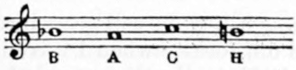
B A C H
A project which cropped out intermittently during 1823 was the writing of an overture on the musical motive suggested by the letters composing the name of Bach. The thought seems to have become fixed in his mind in 1822, though the device of using as a motive in composition was at least as old as the Leipsic master’s “Art of Fugue,” and no doubt familiar to Beethoven. However, he was deeply engrossed in fugal writing at this period and it is very likely, as Nottebohm suggests, that he conceived an overture on the motive as a tribute to Bach’s genius. Several sketches showing different forms of the theme appear in the books of 1823; and a collateral memorandum, “This overture with the new symphony, and we shall have a concert (Akademie) in the Kärnthnerthor Theatre,” amongst sketches for the last quartets in 1825, shows that he clung to the idea almost to the end. Had Beethoven carried out all the plans for utilizing the theme which presented themselves to him between 1822 and 1825, there would have been several Bach overtures; unfortunately, he carried out none.
Beethoven and the Boy Liszt
On April 13, 1823, the boy Franz Liszt, who was studying with Carl Czerny and had made his first public appearance on the first day of the year, gave a concert in the small Ridotto room. Together with his father he had been presented to Beethoven by Schindler, but had not been received with any special marks of friendliness. The precocious boy gave expression to the hope that Beethoven would attend his approaching concert.[89] Later in the Conversation Book:
Little Liszt has urgently requested me humbly to beg you for a theme on which he wishes to improvise at his concert to-morrow. He will not break the seal till the time comes. The little fellow’s improvisations do not seriously signify. The lad is a fine pianist, but so far as his fancy is concerned it is far from the truth to say that he really improvises (was Phantasie anbelangt, so ist es noch weit am Tage bis man sagen kann, er phantasiert). Czerny (Carl) is his teacher. Just eleven years. Do come; it will certainly please Karl to hear how the little fellow plays. It is unfortunate that the lad is in Czerny’s hands.—You will make good the rather unfriendly reception of recent date by coming to little Liszt’s concert?—It will encourage the boy.—Promise me to come.
Did Beethoven attend the concert, and did he afterwards go upon the stage, lift up the prodigy and kiss him? So the world has long believed on the authority of Nohl,[90] who got the story from Liszt himself. Schindler ought to be a good witness in this case, since he pleaded the cause of the little lad before his great friend; but unfortunately Schindler in this instance gives testimony at one time which he impeaches at another. In the second edition of his “Biography of Beethoven” (Münster, 1845, second appendix, page 71, note) he says:
One can never know if a child will grow into a man, and if so what kind of man; so I could not foresee when I introduced the promising boy Liszt and his father in 1823, to Beethoven, what kind of musical vandal would grow out of this young talent. Did Beethoven have a premonition? The reception was not the usual friendly one and I had reason at the time not to be particularly satisfied, since the prodigy had interested me in an unusual degree. Beethoven himself noticed that he had been somewhat lax in his interest in little Franz, which made it easy to persuade him to honor the concert of little Liszt with his presence in order to atone for the indifference he had first shown.
In the third edition of his book (1860, Part II, p. 178) he says:
The author knows of only one reception to which the term “friendly” can not be applied. It was in the case of little Franz Liszt, who, accompanied by his father, was presented by me. This unfriendliness grew out of the excessive idolization of this truly sensational talent; but chiefly it was due to the request made of Beethoven to give the twelve-year-old lad a theme for improvisation at his farewell concert—a request which was as indiscreet as it was unreasonable. But hyperenthusiasm always betrays a want of timeliness. It is not impossible that this enthusiasm, after Beethoven had declined the request with obvious displeasure, yet managed to secure from Emperor Franz, or at least Archduke Rudolph, a theme for the young virtuoso. The idolatry of the wonder-child gave the master, who had gone through so severe a school of experience, a text for many observations on the hindrances and clogs to the equable development of extraordinary talents as soon as they were made the darlings of the multitude. Sketches of the life of Liszt have stated that Beethoven attended the farewell concert of 1823; in Schilling’s encyclopædia it is added that Beethoven at this concert shook the hand of little Liszt and thereby designated him as worthy of the name of artist. Beethoven did not attend the concert; nor any private concert after 1816.[91]
The visit of Louis Schloesser, afterwards chapelmaster in Darmstadt, who delivered the message from the Grand Duke of Hesse-Darmstadt, took place in the spring of the year. His description of the visit was printed in the journal “Hallelujah” in 1885 (Nos. 20 and 21). Schloesser revisited him later and met him afterwards in town, walking with him to Steiner, whom he said he was about to take to task for a remissness. “When it comes to the publication of a new work,” Beethoven said, “they would like to postpone it as long as possible, even till after my death, thinking thus to do a better business with it; but I shall checkmate them.” Schloesser was surprised on this occasion to find Beethoven dressed with unwonted elegance and remarked the fact to Mayseder, who explained, with a smile, that it was not the first time that his friends had stolen his old clothes at night and left new ones in their place. Mayseder added that the substitution was never noticed by Beethoven, who donned the garments with perfect calmness. Schloesser observes that he never detected the least sign of absentmindedness in Beethoven.
At the last meeting between the men Schloesser showed Beethoven one of his compositions, a somewhat complicated work. Beethoven looked through it and observed: “You write too much; less would have been better. That’s the way of our young heaven-stormers who think that they can never do enough. But that will change with riper age, and I prefer a superabundance to a paucity of ideas.” To the question how this might be attained Schloesser says Beethoven replied “literally”:
I carry my thoughts about me for a long time, often a very long time, before I write them down. Meanwhile my memory is so tenacious that I am sure never to forget, not even in years, a theme that has once occurred to me. I change many things, discard and try again until I am satisfied. Then, however, there begins in my head the development in every direction and, insomuch as I know exactly what I want, the fundamental idea never deserts me—it arises before me, grows—I see and hear the picture in all its extent and dimensions stand before my mind like a cast and there remains for me nothing but the labor of writing it down, which is quickly accomplished when I have the time, for I sometimes take up other work, but never to the confusion of one with the other. You will ask me where I get my ideas? That I can not tell you with certainty; they come unsummoned, directly, indirectly,—I could seize them with my hands out in the open air; in the woods; while walking; in the silence of the night; early in the morning; incited by moods which are translated by the poet into words, by me into tones,—sound and roar and storm about me until I have set them down in notes.
At parting, Beethoven gave Schloesser a sheet containing a canon for six voices on the words, “Edel sei der Mensch, hülfreich und gut,” with the inscription: “Words by Goethe, tones by Beethoven. Vienna, May, 1823.” On the back he wrote: “A happy journey, my dear Herr Schloesser, may all things which seem desirable come to meet you. Your devoted Beethoven.”[92] Judging by the position of the canon in the Rudolphinian Collection, Nottebohm was of the opinion that it was composed at an earlier date, say 1819-20. Beethoven also gave Schloesser, who was going to Paris, a letter of introduction to Cherubini which accomplished his acceptance as a pupil of the Conservatoire.
Our old friend Schuppanzigh, after an absence of seven years, returned to Vienna in 1823. On May 4 he gave a concert at which Piringer conducted the orchestra, and on June 14 the quartet meetings were resumed, with Holz, Weiss and Linke as his associates.
Variations on a Waltz by Diabelli
Schindler places the incident which gave the incentive to the creation of the last of Beethoven’s characteristic works for the pianoforte, the “Variations on a Waltz by Diabelli,” Op. 120, in the winter of 1822-’23. In this, as will appear presently, he was in error, as he was also touching the date of the completion of the composition, but otherwise his story is no doubt correct. Anton Diabelli, head of the music-publishing house of Diabelli and Co., having composed a waltz, conceived the idea of having variations written on its melody by a large group of the popular composers of the day. Beethoven was among those who received the invitation, but, mindful of his experiences in 1808, when he contributed a setting of “In questa tomba” to a similar conglomeration, he declared that he would never do so again. Moreover, so Schindler says, he did not like the tune, which he called a Schusterfleck.[93] He declined Diabelli’s request, but not long afterward asked Schindler to inquire of Diabelli if he were disposed to take from him a set of variations on the waltz, and if so, what he would pay. Diabelli received the proposition with delight and offered 80 ducats, requiring not more than six or seven variations. The contract was formally closed and Beethoven remarked to Schindler: “Good; he shall have variations on his cobble!” This the story as told by Schindler. Lenz, who claimed to have the authority of Holz for his version, says that after receiving thirty-two variations from other composers, Diabelli went to Beethoven and asked him for the one which he had promised. Beethoven inquired how many variations he already had and when Diabelli replied “Thirty-two” he said: “Well, go and publish them and I alone will write you thirty-three.” This story, however, lacks probability. Lenz himself says that Diabelli told him that Beethoven had not agreed to write for him; hence he could not have asked for the “promised” variation. But Schindler is also wrong in saying that the variations were the first work taken up by Beethoven after his removal to Hetzendorf in the summer of 1823 and that they were published in July. They were advertised as published by Diabelli in the “Wiener Zeitung” on June 16, 1823, and there are other dates to corroborate the evidence that they were finished when Beethoven removed to Hetzendorf on May 17. On May 7 Beethoven offered them for publication to Lissner in St. Petersburg; on April 25 he wrote to Ries: “You will also receive in a few weeks 33 variations on a theme, dedicated to your wife,” and on July 16: “By this time the variations must be with you.” The date of Diabelli’s conception of the plan was probably a whole year, even two years earlier than the date given by Schindler. In a letter dated June 5, 1822, Beethoven offered to Peters “Variations on a Waltz for pianoforte solo (there are many)” for 30 ducats; they must therefore have been far advanced in composition and fully planned at that time. Nottebohm says that Schubert’s contribution to the collection of variations bears on the autograph the date “March, 1821.” The Variations appeared from the press of Diabelli and Co. in June, with a dedication to Mme. Antonia von Brentano; not, it will be observed, to the wife of Ries. Had there been an English edition there would have been such a dedication, but it is another case in which an English publisher was disappointed in the conduct of the composer. Ries had complied with Beethoven’s solicitations and secured a publisher. He closed an agreement with Boosey; but when the manuscript reached London, Boosey was already in possession of a copy of the Vienna edition and the work had also been printed in Paris. The copy made for London bore a dedication written in large letters by Beethoven to Madame Ries; but the printed copies were inscribed to Madame Brentano. Beethoven attempted an explanation and defence in a letter to Ries dated Baden September 5:
You say that I ought to look about me for somebody to look after my affairs. This was the case with the Variat. which were cared for by my friends and Schindler. The Variat. were not to appear here until after they had been published in London. The dedication to B—— (not clear) was intended only for Germany, as I was under obligations to her and could publish nothing else at the time; besides only Diabelli, the publisher here, got them from me. Everything was done by Schindler; a bigger wretch I never got acquainted with on God’s earth—an arch-scoundrel whom I have sent about his business. I can dedicate another work to your wife in place of it.
How much blame in this affair really attached to Schindler is not known; it seems pretty apparent that though Beethoven was also fuming against him at the time at home, he was doing duty in London as a whipping-boy. Beethoven went right on calling in the help of the “biggest wretch on earth and arch-scoundrel.”
Troubled by His Eyes at Hetzendorf
After the labors and vexations of town life in the winter, the call of the country in the summer was more than usually imperative, because the work which had long occupied Beethoven’s mind—the Ninth Symphony—was demanding completion. His brother Johann had invited him to visit him on his estate near Gneixendorf, but he had declined. His choice for the summer sojourn fell upon Hetzendorf, a village not far from Vienna, where he hit upon a villa, surrounded by a beautiful park, which belonged to Baron Müller-Pronay. There was some haggling about the rent and some questioning about the post service—an important matter in view of the many negotiations with publishers, in all of which Schindler was depended on—but eventually all was arranged. Ill health marred the Hetzendorf sojourn. Beethoven’s other ailments were augmented by a painful affection of the eyes which called for medical treatment, retarded his work and caused him no small amount of anxiety. Complaints on this score began in April and were continued through July, on the 15th of which month he writes to the Archduke, “My eyes are better, but improvement is slow. It would be more rapid if I were not obliged to use glasses; it is an unfortunate circumstance which delays me in everything”; and later, when on a short visit to Vienna: “I have just heard here that Y. I. H. is coming to-morrow. If I cannot obey the wishes of my heart, please ascribe it to my eyes. They are much better, but I must not breathe the town air for many more days, for it would have ill effects on my eyes.” In August, very shortly before his departure for Baden: “I am feeling really badly, not my eyes alone. I purpose to drag myself to Baden to-morrow to take lodgings and in a few days will have to go there to stay. The town air has an injurious effect on my entire organization and I hurt myself by going twice to my physicians in the city.” From Baden on the 22nd he complains of a catarrhal affection, the misery in his bowels and the trouble with his eyes, but adds: “Thank God, the eyes are so much improved that I can again use them considerably in the daytime. Things are going better also with my other ailments; more could not be asked in this short time.”
Among the cheering incidents of the summer were the reports which reached him of the production of “Fidelio” under the direction of Weber in Dresden. Weber opened a correspondence on January 28 and continued it with letters dated February 18, April 7 and June 5; Beethoven’s answers were dated February 16, April 10 and June 9. Most unfortunately all these letters have disappeared, and the only hints we have as to their contents are from the draft for Weber’s first communication discovered among the papers of the writer:
“Fidelio.” To Beethoven. The performance in Prague under my direction of this mighty work, which bears testimony to German grandeur and depth of feeling, gave me an intimacy, as inspiring as it was instructive, with the essence through which I hope to present it to the public in its complete effectiveness here, where I have all possible means at my command. Every representation will be a festival day on which I shall be privileged to offer to your exalted mind the homage which lives in my heart, where reverence and love for you struggle with each other.
Weber had received the score of the opera on April 10 from Beethoven, who had to borrow it from the Kärnthnerthor Theatre, whose musical archives were in the care of Count Gallenberg. Through Schindler, Gallenberg sent word to Beethoven that he would send the score, provided two copies were on hand; if not, he would have a copy made. Schindler, reporting the message to Beethoven, adds that Gallenberg had said he thought Beethoven himself had the score: “But when I assured him that you did not have it he said that its loss was a consequence of your irregularity and many changes of lodgings.”[94] Nevertheless, Weber got the score and after fourteen rehearsals the representation took place with great success. Von Könneritz, Director-General of the Royal Chapel, reported the triumph to Beethoven and sent Beethoven a fee of 40 ducats. Beethoven in acknowledging receipt on July 17 is emboldened “by the account which my dear friend Maria Weber gives me of the admirable and noble motives of Your Excellency” to ask his intercession with the Saxon court in behalf of the Mass in D, as has already been recorded in this chapter.
A number of incidents may now hurriedly be marshalled. In 1822 the Royal Academy of Music of Sweden had elected Beethoven to foreign membership. The consent of the Austrian government was necessary to his acceptance of the honor and this seems to have been deferred an unconscionably long time; at least Beethoven’s letters to the Academy and to King Charles XIV (whom as General Bernadotte, then French ambassador at Vienna, he had known 25 years before) are dated March 1, 1823. When permission came he wrote notes to the editors of the newspapers “Beobachter” and “Wiener Zeitschrift,” asking them to announce the fact of his election—a circumstance which shows that he was not always as indifferent to distinctions of all kinds as he professed occasionally. Franz Schoberlechner, a young pianist, appealed to him for letters of recommendation to be used on a concert-tour. The letter reached Beethoven through Schindler, to whom he returned it with the curt indorsement: “A capable fellow has no need of recommendation other than from one good house to another.” Schindler importuned him again, and Beethoven wrote to him somewhat testily: “It must be plain to you that I do not want to have anything to do with this matter. As for ‘being noble’ I think I have shown you sufficiently that I am that on principle; I even think that you must have observed that I have never been otherwise. Sapienti sat.” That ended the matter; but when Chapelmaster Dreschler of the Josephstadt Theatre became a candidate for the post of second court organist, Beethoven recommended him enthusiastically to Archduke Rudolph, whom in a second letter he urged to remain firm notwithstanding that Abbé Stadler had presented another candidate. Archduke Rudolph spoke to the emperor and Count Dietrichstein in favor of Drechsler, but in vain. In his letters Beethoven referred to a canon, “Grossen Dank,” which he said he had written for the Archduke and which he intended to hand him in person. Sketches for it have been found among those for the third movement of the Ninth Symphony, but nothing has yet been heard of the completed work.
Troubles with a Country Landlord
Beethoven’s domestic affairs continued to plague him. While at Hetzendorf he had the services of a housekeeper whom he described as “the swift-sailing frigate” Frau Schnaps, in letters to Schindler. He has no end of trouble about his town lodging in the Kothgasse where Schindler was living, and must needs take time to write long letters to his factotum on the subject. Here is one sent from Hetzendorf on July 2:
The continued brutality of the landlord, from the beginning as long as I have been in the house, calls for the help of the R. I. Police. Go to them direct. As regards the storm-window, the housekeeper was ordered to look after it and particularly after the recent severe rain-storm to see if it was necessary to prevent rain from entering the room; but she found that it had neither rained in nor could rain in. Believing this, I put on the lock so that the brutal fellow could not open my room in my absence as he threatened to do. Tell them further how he behaved towards you and that he put up the bill without notice, which he has no right to do before St. James’s day.—He has also refused to give me a receipt from St. George’s to St. James’ as this paper shows because of the demand that I pay a charge for lighting of which I knew nothing. This abominable lodging without a stove-flue and with the most wretched sort of main chimney has cost me at least 259 florins W. W. for extra expenses above the rent in order to make it habitable while I was there in the winter. It was an intentional cheat, inasmuch as I never saw the lodgings in the first storey but only in the second, for which reason many objectionable things remained unknown to me. I can not comprehend how it is possible that so shameful a chimney, ruinous to human health, can be tolerated by the government. You remember how the walls of your room looked because of smoke, how much it cost to get rid of some but not all of the nuisance. The chief thing now is that he be commanded to take down the notice and to give me the receipt for the rent paid at any rate. I never had that wretched lighting, but had other large expenses in order to make life endurable in this lodging. My sore eyes can not yet stand the town air, otherwise I would myself go to the imperial police.
Schindler obeyed instructions; the police director, Ungermann, sent his compliments to Beethoven, told him that his wishes were all granted in advance but advised him to pay the 6 florins for lighting to prevent a scoundrelly landlord from having any kind of hold upon him—and Schindler got well scolded for his pains! How could he accept something-or-other from such a churl accompanied by a threat? Where was his judgment? Where he always kept it, of course! The bill came down, but Beethoven did not keep the lodging.
Beethoven’s nephew Karl pursued his studies at Blöchlinger’s Institute till in August and then spent his vacation with his uncle in Baden. He made himself useful as amanuensis and otherwise, and his words are occasionally found among the notes of conversation. His mother remains in the background for the time being, which is providential, for Beethoven has trouble enough with his other delectable sister-in-law, the wife of Johann, whose conduct reaches the extreme of reprehensibleness in the summer of 1823, during a spell of sickness which threw her husband on his back. The woman chose this time to receive her lover in her house and to make a shameless public parade of her moral laxness. The step-daughter was no less neglectful of her filial duties. Accounts of his sister-in-law’s misconduct reached Beethoven’s ears from various quarters and he was frank in his denunciation of her to his brother and only a little more plain-spoken than Schindler, who was asked by Beethoven to lay the matter before the police, but managed to postpone that step for the time being.[95]
Autographed Shutters in Demand
Meanwhile Beethoven was hard at work on the Ninth Symphony. It was so ever-present with him that there was neither paradox nor hyperbole in his words: “I am never alone when I am alone.” He had much to irritate him while sketches and drafts of the symphony were piling up before him in August, and finally, if Schindler is to be believed, he could no longer endure the obsequious bows with which his landlord, Baron Pronay, always greeted him, and resolved to abandon the pretty villa at Hetzendorf and go to Baden. He may have formed the plan earlier in the year—probably had—but the baron’s excessive politeness helped to turn his departure into something like a bolt. He went to Baden on a house-hunting expedition with Schindler, and returning, sent his “swift-sailing frigate” to Schindler with a billet commanding him to be up and off at 5 o’clock in the morning “presto prestissimo.” He knew only one lodging in Baden suited to his requirements—the one which he had occupied in 1822—but the owner refused to let him have it again. This owner was a locksmith. To him Schindler was sent. In the name of his master he made all manner of humble promises concerning more orderly conduct and consideration for the other tenants, but the plea was rejected. A second appeal was made and now the houseowner relented, but made it a condition that Beethoven replace the window-shutters which had been removed. Beethoven was the more willing to do this, since he thought it necessary for the sake of his eyes. The landlord had not divulged the reason for his demand. Beethoven was in the habit of scrawling all kinds of memoranda on his shutters in leadpencil—accounts, musical themes, etc. A family from North Germany had noticed this in the previous year and on Beethoven’s departure had bought one of the shutters as a curiosity. The thrifty locksmith had an eye for business and disposed of the remaining shutters to other summer visitors.
Beethoven had arrived in Baden on August 13 with the help of Schindler, towards whom he was filled with as much gratitude as can be read in the following remarks from two letters to his nephew dated August 16 and 23:
My ruined belly must be restored by medicine and diet, and this I owe to the faithful messenger! You can imagine how I am racing about, for only to-day did I really begin my service to the muses; I must, though that is not noticeable, for the baths invite me at least to the enjoyment of beautiful nature, but nous sommes trop pauvre et il faut écrire ou de n’avoir pas de quoi.
He (Schindler) was with me only a day here to take a lodging, as you know; slept in Hetzendorf, and as he said, went back to Josephstadt in the morning. Do not get to gossipping against him. It might work him injury, and is he not already sufficiently punished? Being what he is, it is necessary plainly to tell him the truth, for his evil character which is prone to trickery needs to be handled seriously.
Beethoven’s unamiable mood, which finds copious expression in abuse of Schindler at this juncture, has some explanation (also extenuation, if that is necessary) in the rage and humiliation with which contemplation of his brother’s domestic affairs filled him. Johann was convalescing and wrote a letter to the composer which occasioned the following outburst under date of August 13:
Dear Brother:
I am rejoiced at your better health. As regards myself, my eyes are not entirely recovered and I came here with a disordered stomach and a frightful catarrh, the first due to the arch-pig of a housekeeper, the second to a beast of a kitchen-maid whom I have once driven away but whom the other took back. You ought not to have gone to Steiner; I will see what can be done. It will be difficult to do anything with the songs in puris as their texts are German; more likely with the overture.
I received your letter of the 10th at the hands of the miserable scoundrel Schindler. You need only to give your letters directly to the post, I am certain to receive them, for I avoid this mean and contemptible fellow as much as possible. Karl can not come to me before the 29th of this month when he will write you. You can not well be wholly unadvised as to what the two canailles, Lump and Bastard,[96] are doing to you, and you have had letters on the subject from me and Karl, for, little as you deserve it I shall never forget that you are my brother, and a good angel will yet come to rid you of these two canailles. This former and present strumpet who received visits from her fellow no less than three times while you were ill, and who in addition to everything else has your money wholly in her hands. O infamous disgrace! Isn’t there a spark of manhood in you?!!!... About coming to you I will write another time. Ought I so to degrade myself as to associate with such bad company? Mayhap this can be avoided and we yet pass a few days with you. About the rest of your letter another time. Farewell. Unseen I hover over you and work through others so that these canailles shall not strangle you.
As always your faithful Brother.
There were several visitors to Beethoven at Baden in the summer of 1823 who have left accounts of their experiences. One was an Englishman, Edward Schulz, who published his story in the “Harmonicon” in January 1824. This extremely lively letter was reprinted by Moscheles in his translation (or rather, adaptation) of Schindler’s biography of Beethoven and incorporated in the second German edition, where Schindler accompanies it with several illuminative glosses which are less necessary now than they were when the biographer wrote. Schulz visited Beethoven on September 28 in the company of Haslinger. He describes it as a dies faustus for him and, as Schindler shrewdly observes, it must also have been one for Beethoven, since he managed to hear the conversation of his visitors without the aid of an ear-trumpet. He talked with great animation, as was his wont when in good humor, but, says the English visitor, “one unlucky question, one ill-judged piece of advice—for instance, concerning the cure of his deafness—is quite sufficient to estrange him from you forever.” He asked Haslinger about the highest possible note on the trombone, but was dissatisfied with the answer which he received; introduced his nephew and showed his pride in the youth’s attainments by telling his guest that he might put to him “a riddle in Greek” if he liked. At dinner during a visit to the Helenenthal he commented on the profusion of provisions at dinner, saying: “Why such a variety of dishes? Man is but little above other animals if his chief pleasure is confined to a dinner-table.” A few excerpts from the letter will serve to advance the present narrative:
Beethoven’s Tribute to Handel
In the whole course of our table-talk there was nothing so interesting as what he said about Handel. I sat close by him and heard him assert very distinctly in German, “Handel is the greatest composer that ever lived.” I can not describe to you with what pathos, and I am inclined to say, with what sublimity of language, he spoke of the “Messiah” of this immortal genius. Every one of us was moved when he said, “I would uncover my head, and kneel down at his tomb!” H. and I tried repeatedly to turn the conversation to Mozart, but without effect. I only heard him say, “In a monarchy we know who is the first”; which might or might not apply to the subject.... He is engaged in writing a new opera called “Melusine,” the words by the famous but unfortunate poet Grillparzer. He concerns himself but very little about the newest productions of living composers, insomuch, that when I asked about the “Freischütz,” he replied, “I believe one Weber has written it”.... He appears uniformly to entertain the most favorable opinion of the British nation. “I like,” said he, “the noble simplicity of the English manners,” and added other praises. It seemed to me as if he had yet some hopes of visiting this country together with his nephew. I should not forget to mention that I heard a MS. trio of his for the pianoforte, violin and violoncello, which I thought very beautiful, and as, I understood, to appear shortly in London.
Our author’s statement that he heard a manuscript pianoforte trio at this time piques curiosity. Schindler disposes of the question as to what it may have been in the manner more characteristic of the present than the past attitude of German writers towards everything English or American. “Who knows what it was that the non-musical gentleman took for a trio?” he asks. Evidently Schindler was of the opinion that no Englishman except, possibly, a professional musician, could count three or recognize the employment of pianoforte, violin and violoncello in a piece of music. He is right in scouting the idea that it could have been the great Trio in B-flat, for that work had long been in print. Nor is it likely to have been the little trio in the same key dedicated to Maximiliane Brentano; for though that was not published at the time, it is not likely that Beethoven would produce it in 1823 as a novelty. There are in existence sketches for a Trio in F minor made in 1815, but nothing to show that the work was ever written out. Had it been in Beethoven’s hands at a time when he was turning over the manuscripts of earlier days, it would surely have been offered to a publisher; so that is out of the way. There is only one other known work which invites speculation—the “Adagio, Variations and Rondo,” for pianoforte, violin and violoncello, which Steiner and Co. gave to the public in 1824, as Op. 121. The variations are on a melody from Wenzel Müller’s opera “Die Schwestern aus Prag” (“Ich bin der Schneider Kakadu”). It is at least remotely possible that this was the trio which the English traveller heard, and if so we have in the fact a hint as to the time of its origin—the only hint yet given.
Von Weber’s Visit to Beethoven
A few days after the one just recorded Beethoven received a visit from a man of much greater moment than the English traveller. The new visitor was Carl Maria von Weber. That the composer of “Der Freischütz” was unable in his salad days to appreciate the individuality of Beethoven’s genius has already been set forth; and the author of the letter in the “Harmonicon” seems to have learned that Beethoven was disposed to speak lightly of Weber only a month before he received him with most amiable distinction at Baden. Schindler’s explanation, that a memory of Weber’s criticism of the Fourth Symphony may at the moment have risen, ghost-like, in Beethoven’s mind and prompted the disparaging allusion quoted by Schulz, is far-fetched. It is not necessary to account for such moody remarks in Beethoven’s case. He was often unjust in his comments on even his most devoted friends, and we may believe that to Schulz he did speak of the composer as “one Weber,” and at the same time accept the account which Max Maria von Weber gives of the reception of his father by Beethoven. From the affectionate biography written by the son, we learn that after the sensational success achieved by “Der Freischütz” Beethoven was led to study its score and that he was so astonished at the originality of the music that he struck the book with his hand and exclaimed: “I never would have thought it of the gentle little man (sonst weiche Männel). Now Weber must write operas; nothing but operas—one after the other and without polishing them too much. Casper, the monster, stands out here like a house. Wherever the devil puts in his claws they are felt.” He learned to know “Euryanthe” later and was less impressed by it than by its predecessor. After glancing through it hurriedly he remarked: “The man has taken too much pains.”[97] Whatever may have been their earlier feelings and convictions, however, the representations of “Fidelio” at Prague and Dresden under the direction of Weber warmed their hearts towards each other. Weber’s filial biographer says that when the youthful sin of his father was called to the notice of Beethoven, the latter showed some resentment, but there is no shadow of this in the pictures which we have from the pens of Weber himself, Max Maria von Weber and Julius Benedict, of the meeting between the two men. Weber had come to Vienna, bringing with him his pupil Benedict, to conduct the first performance of “Euryanthe.” On his visit in the previous year, when “Der Freischütz” was produced, he had neglected to call on Beethoven, but now some kindly words about “Euryanthe” spoken by Beethoven to Steiner being repeated to him, he made good his dereliction and, announced by Haslinger, drove out to Baden to pay his respects. In his diary Weber noted the visit thus: “The 5th, Sunday (October, 1823), at 8 o’clock, drove with Burger (Piringer), Haslinger and Benedict to Baden; abominable weather; Saw spring and baths; to Duport and Beethoven; received by him with great cordiality. Dined with him, his nephew and Eckschlager at the Sauerhof. Very cheerful. Back again at 5 o’clock.” On the next day (though the letter is dated “October 5”) Weber wrote an account to his wife as follows:
I was right tired but had to get up yesterday at 6 o’clock because the excursion to Baden had been appointed for half-past 7 o’clock. This took place with Hasslinger, Piringer and Benedict; but unfortunately the weather was atrocious. The main purpose was to see Beethoven. He received me with an affection which was touching; he embraced me most heartily at least six or seven times and finally exclaimed enthusiastically: “Indeed, you’re a devil of a fellow!—a good fellow!” We spent the afternoon very merrily and contentedly. This rough, repellant man actually paid court to me, served me at table as if I had been his lady. In short, this day will always remain remarkable in my memory as well as of those present. It was uplifting for me to be overwhelmed with such loving attention by this great genius. How saddening is his deafness! Everything must be written down for him. We inspected the baths, drank the waters, and at 5 o’clock drove back to Vienna.
Max Maria von Weber in his account of the incident says that Beethoven, in the conversation which followed his greeting of the “devil of a fellow,” railed at the management of the theatre, the concert impresarios, the public, the Italians, the taste of the people, and particularly at the ingratitude of his nephew. Weber, who was deeply moved, advised him to tear himself away from his discouraging environment and make an artistic tour through Germany, which would show him what the world thought of him. “Too late!” exclaimed Beethoven, shaking his head and going through the motions of playing the pianoforte. “Then go to England, where you are admired,” wrote Weber. “Too late!” cried Beethoven, drew Weber’s arm into his and dragged him along to the Sauerhof, where they dined. At parting, Beethoven embraced and kissed him several times and cried: “Good luck to the new opera; if I can I’ll come to the first performance.”
Sir Julius Benedict’s Record
A generation later Sir Julius Benedict, who had also put his memory of those Vienna days at the service of Weber’s son, wrote down his recollections for his work in these words:
I endeavor, as I promised you, to recall the impressions I received of Beethoven when I first met him in Vienna in October, 1823. He then lived at Baden; but regularly, once a week, he came to the city and he never failed to call on his old friends Steiner and Haslinger, whose music-store was then in the Paternostergässchen, a little street, no longer in existence, between the Graben and the Kohlmarkt.
If I am not mistaken, on the morning that I saw Beethoven for the first time, Blahetka, the father of the pianist, directed my attention to a stout, short man with a very red face, small, piercing eyes, and bushy eyebrows, dressed in a very long overcoat which reached nearly to his ankles, who entered the shop about 12 o’clock. Blahetka asked me: “Who do you think that is?” and I at once exclaimed: “It must be Beethoven!” because, notwithstanding the high color of his cheeks and his general untidiness, there was in those small piercing eyes an expression which no painter could render. It was a feeling of sublimity and melancholy combined. I watched, as you can well imagine, every word that he spoke when he took out his little book and began a conversation which to me, of course, was almost incomprehensible, inasmuch as he only answered questions pencilled to him by Messrs. Steiner and Haslinger. I was not introduced to him on that occasion; but the second time, about a week after, Mr. Steiner presented me to the great man as a pupil of Weber. The other persons present were the old Abbé Stadler and Seyfried. Beethoven said to Steiner: “I rejoice to hear that you publish once more a German work. I have heard much in praise of Weber’s opera and hope it will bring both you and him a great deal of glory.” Upon this Steiner seized the opportunity to say: “Here is a pupil of Weber’s”; when Beethoven most kindly offered me his hand, saying: “Pray tell M. de Weber how happy I shall be to see him at Baden, as I shall not come to Vienna before next month.” I was so confused at having the great man speak to me that I hadn’t the courage to ask any questions or continue the conversation with him.
A few days afterwards I had the pleasure of accompanying Weber and Haslinger with another friend to Baden, when they allowed me the great privilege of going with them to Beethoven’s residence. Nothing could be more cordial than his reception of my master. He wanted to take us to the Helenenthal and to all the neighborhood; but the weather was unfavorable, and we were obliged to renounce this excursion. They all dined together at one table at an inn, and I, seated at another close to them, had the pleasure of listening to their conversation.
In the month of November, when Beethoven came to town and paid his daily visit to the Paternostergässchen, I seldom missed the opportunity of being one of the circle of young admirers, eager to show their reverence to the greatest musical genius as well as hoping to be honored by his notice. Among those whom I met upon this errand were Carl Maria von Bocklet, his pupil, Worzischek, Léon de St. Louvain, Mayseder, Holz, Böhm, Linke, Schuppanzigh, Franz Schubert and Kanne.
On the morning after the first performance of “Euryanthe,” when Steiner and Haslinger’s shop was filled with the musical and literary authorities, Beethoven made his appearance and asked Haslinger: “Well, how did the opera go last night?” The reply was: “A great triumph.” “Das freut mich, das freut mich,” he exclaimed, and perceiving me he said: “I should so much have liked to go to the theatre, but,” pointing to his ears, “I go no more to those places.” Then he asked Gottdank, the régisseur; “How did little Sontag get on? I take a great interest in her; and how is the book—good or bad?” Gottdank answered the first question affirmatively, but as to the other he shrugged his shoulders and made a negative sign, to which Beethoven replied: “Always the same story; the Germans cannot write a good libretto.” Upon which I took his little conversation book and wrote in it: “And ‘Fidelio’?” to which he answered: “That is a French and Italian book.” I asked him afterwards: “Which do you consider the best librettos?”; he replied “‘Wasserträger’ and ‘Vestalin.’”
Further than this I cannot recall any distinct conversation, although I often met him, and I had never the good fortune of hearing him perform or seeing him conduct. But the wonderful impression his first appearance made on me was heightened every time I met him. When I saw him at Baden, his white hair flowing over his mighty shoulders, with that wonderful look—sometimes contracting his brows when anything afflicted him, sometimes bursting out into a forced laughter, indescribably painful to his listeners—I was touched as if King Lear or one of the old Gaelic bards stood before me; and when I thought how the creator of the sublimest musical works was debarred by a cruel fate for a great many years from the delight of hearing them performed and appreciated I could but share the deep grief of all musical minds.
I may add that I heard the first public performance of one of his so-called “posthumous” quartets in his own presence. Schuppanzigh and his companions, who had been his interpreters before, were scarcely equal to this occasion; as they did not seem to understand the music themselves, they failed entirely to impart its meaning to the audience. The general impression was most unsatisfactory. Not until Ernst had completely imbued himself in the spirit of these compositions could the world discover their long-hidden beauties.[98]
Songs and Military Marches
Madame Marie Pachler-Koschak, with whom Beethoven had spent many happy moments in 1817, was among those who took the waters at Baden in the summer of 1823, but we are told she searched for him in vain, a fact which shows in what seclusion he must have dwelt some of the time at least. She was more fortunate when she returned in September to complete her cure; and when she left Baden she carried with her an autographic souvenir—a setting of “The beautiful to the good,” the concluding words of Matthison’s “Opferlied” which he had in hand in this year. Towards the close of October Beethoven returned to Vienna. We know the date approximately from Benedict’s account, the first performance of “Euryanthe” having taken place on October 25. He removed to new lodgings in the Ungarstrasse, where his nephew remained with him as long as he continued a student at the university. Here he worked at the Ninth Symphony, more particularly on the last movement.
The exact chronological order in which works were taken up in 1823 cannot be recorded here. Matthison’s “Opferlied” was taken up several times—in 1794, then in 1801 and 1802; finally in 1822 and 1823. In its last stages he extends its dimensions, adds the refrain for chorus and an orchestral accompaniment.[99] Beethoven had offered it to Peters in February, 1823, though at that time he described its accompaniment as being for two clarinets, horn, viola and violoncello, so that the violins and bassoon were added later. Why Peters did not publish the song is not known; the manuscript does not seem to have been returned to Beethoven. Nottebohm concludes that two or more versions were made in 1822 and 1823 (possibly as late as 1824), and that the final form was that known as Op. 121b. On April 9, 1825 (“Notizen,” p. 161), a letter was written to Ries which said: “You will soon receive a second copy of the ‘Opferlied,’ which mark as corrected by me so that the one which you already have may not be used. Here you have an illustration of the miserable copyist whom I have, since Schlemmer died. You can depend on scarcely a note.” A sketchbook analyzed by Nottebohm,[100] which contains sketches made at different times bound up with sketches for the last quartets made in 1824, shows sketches for a pianoforte sonata for four hands, the Ninth Symphony, the Mass in C-sharp minor, a fugue on B-a-c-h, and the “Bundeslied,” besides the latest form of the “Opferlied” but not wholly like the printed edition. The impetus to the C-sharp minor mass came in 1823 and the other sketches in all likelihood were made in the same year. It is therefore to be concluded that he worked on the new “Opferlied” in 1823 and possibly carried it over to the early part of 1824. Beethoven owed money to his brother and offered the song as Johann’s property, in a letter of November 1824, to Schott and Sons, who published it in 1825; but he made alterations by letter as late as May 7, 1825. Schindler’s statement that the two songs “Opferlied” and “Bundeslied” were composed to be sung by the tenor Ehlers at a benefit concert in Pressburg, is wrong. Schindler’s inexactitude as to dates is shown by his statements that the concert took place in 1822 and the song published in 1826. The first song was written in the soprano clef; the second has tenor clef but two solo voices; neither was made for Ehlers. As to the “Bundeslied” (words by Goethe) so far as the history of the song is concerned, the documentary evidence is found in the sketchbook just mentioned; whether or not it had its origin at an earlier date has not been ascertained,[101] but received alterations later. It, too, was published by Schott in 1825.
Minor Compositions of the Year 1823
Besides these songs, and the Bagatelles mentioned in the letter of February, 1823, as sent to Peters, there are several other minor compositions which may well be discussed here. The Tattoo with percussive instruments (Turkish music), the two other Tattoos and a March, were all old compositions. Up to 1874, when the letter was made public, only one of the Tattoos had been printed. It was that in F major, which, according to the autograph preserved by Artaria, was composed for the Bohemian Landwehr in 1809 and then designated as March No. 1. A copy more fully orchestrated than it is in the printed form was dedicated to Prince Anton in that year.[102] A second autograph of later date (also in Artaria’s collection) is entitled “Zapfenstreich No. 1.” Here the march had a trio which has not become known. It was then, together with the one that follows, rewritten for the tournament at Laxenburg held in honor of the birthday of Empress Maria Ludovica on August 25, 1810, and this version has been printed in the Complete Edition of Beethoven’s works.[103] In the earliest print by Schlesinger it is number 37 in a collection of “Quick-steps for the Prussian Army. For the York Corps”; but Nottebohm says that the version does not agree with any of the manuscripts mentioned. Simultaneously with this march another was published which was composed in 1810 for Archduke Anton. An autograph at Haslinger’s bears the inscription “Zapfenstreich No. 3,” and below it “One step to each measure.” A copy in the archives of the Gesellschaft der Musikfreunde is inscribed “March for H. I. Highness, the Archduke Anton, by Ludwig van Beethoven, 1810 on the 3rd of the Summermonth” (i. e., June). A third form was prepared for the tournament of 1810, and this has been published. Artaria had a “Trio No. 3” in F minor, 6-4 time. This is followed in the “Gesammt-Ausgabe” by a third in C major with a trio in F major, which was published from a copy made by Nottebohm. This, which has been published by Haslinger, Steger, and Liszt and Franke, was entitled “Zapfenstreich No. 2.” In Nottebohm’s opinion it belongs to the two others and like them had its origin between 1809 and June 1810. These were the three Tattoos which Beethoven sent to Peters, who, however, did not publish them. The fourth March was the Military March in D major composed in 1816.[104] It was first published in 1827, after Beethoven’s death, in an arrangement for pianoforte, by Cappi and Czerny; a four-hand arrangement followed soon after and it was given to the world in its original shape in the Complete Edition. It was composed at the personal request of F. X. Embel, “Magisterial Councillor and Lieut.-Colonel of the Civil Artillery,” who probably preferred his request in 1815, a sketch for it appearing in a book used in 1815-1816.—The data concerning these old works are given here because Beethoven brought them out of his portfolio and offered them to the publishers in this year.
The Bagatelles, Op. 126, belong to this period, though their completion fell later. Taking up earlier sketches probably, Beethoven worked on them after the Ninth Symphony was practically complete in his mind and the sketchbooks—at the close of 1823 at the earliest. It is likely that they were not finished until the middle of 1824. Nottebohm had subjected them to a minute study which leads him to the conclusion that the pieces were conceived as a homogeneous series, the numbers being linked together by key-relationship. On the margin of a sketch for the first one Beethoven wrote “Cycle of Trifles” (“Kleinigkeiten”), which fact, their separation from each other (all but the first two) by the uniform distance of a major third, taken in connection with their unity of style, establishes a cyclical bond. When he offered them to Schott in 1824 he remarked that they were probably the best things of the kind which he had ever written. They were among the compositions which had been pledged to his brother, in whose interest he offered them to Schott. They were published by that firm, probably in the early part of 1825.
In 1828 Diabelli and Co. published a “Rondo a Capriccio” in G which had been purchased at the auction sale of Beethoven’s effects after his death. It bore on its title-page the inscription: “Die Wuth über den Verlornen Groschen, ausgetobt in einer Caprice” (“Rage at the loss of a groat stormed out in a Caprice”). Nothing is known of its origin. In the catalogue of the Gesellschaft der Musikfreunde, Czerny noted it as belonging to Beethoven’s youthful period; which may be true of its theme, but can not be of its treatment. Among the sketches and drafts for the Bagatelles is a sketch for an arch and mischievous piece evidently intended for strings,[105] and a two-part canon on the words “Te solo adoro” from Metastasio’s “Betulia liberata,” which, as transcribed by Nottebohm, has been printed in the Complete Edition.