Part 1 — CHAPTER V. OPENING MANHOOD—1847 TO 1850—Æt. 16-19.
Reading edition
WHEN he entered the University of Edinburgh, James Clerk Maxwell still occasioned some concern to the more conventional amongst his friends by the originality and simplicity of his ways. His replies in ordinary conversation were indirect and enigmatical, often uttered with hesitation and in a monotonous key.[109] While extremely neat in his person, he had a rooted objection to the vanities of starch and gloves. He had a pious horror of destroying anything—even a scrap of writing paper. He preferred travelling by the third class in railway journeys, saying he liked a hard seat. When at table he often seemed abstracted from what was going on, being absorbed in observing the effects of refracted light in the finger-glasses, or in trying some experiment with his eyes—seeing round a corner, making invisible stereoscopes, and the like. Miss Cay used to call his attention by crying, “Jamsie, you’re in a prop.”[110] He never tasted wine; and he spoke to gentle and simple in exactly the same tone. On the other hand, his teachers—Forbes above all—had formed the highest opinion[111] of his intellectual originality and force; and a few experienced observers, in watching his devotion to his father, began to have some inkling of his heroic singleness of heart. To his college companions, whom he could now select at will, his quaint humour was an endless delight. His chief associates, after I went to the University of Glasgow, were my brother, Robert Campbell (still at the Academy), P. G. Tait, and Allan Stewart.[112] Tait went to Peterhouse, Cambridge, in 1848, after one session of the University of Edinburgh; Stewart to the same College in 1849; Maxwell did not go up until 1850.
Æt. 16-19.
These three years—November 1847 to October 1850—were impartially divided between Edinburgh and Glenlair. He was working under but slight pressure, and his originality had the freest play. His studies were multifarious, but the subjects on which his thoughts were most concentrated during these years were—1. Polarised light, the stereoscope, etc.; 2. Galvanism; 3. Rolling curves; 4. Compression of solids. That he early felt the necessity of imposing a method on himself will appear from the letters. His paper on Rolling Curves was read before the Edinburgh Royal Society on February 19th, 1849, by Professor Kelland (for it was not thought proper for a boy in a round jacket to mount the rostrum there); that on the Equilibrium of Elastic Solids in the spring of 1850.
With regard to his class studies, it appears that he attended Forbes for two sessions as a regular student, and occasionally as an amateur student in his third year; Kelland for two sessions; and Sir W. Hamilton for two. In his third session, while partially attending Forbes, he was a regular student in the Classes of Chemistry (Professor Gregory), Practical Chemistry (Mr. Kemp), and Moral Philosophy (Professor Wilson).
Mr. Macfarlan of Lenzie, in the letter already quoted, says:—“He was in the Natural Philosophy Class, Edinburgh University, the year before I was, and was spoken of by Forbes and his fellow-students as a discoverer in Natural Philosophy, and a very original worker in Mathematics.”
All scientific theories had an interest for him. It was at some time during these years that in a walk towards Arthur’s Seat he discoursed to me of Owen’s hypothesis of types of creation, not only with complete command of Owen’s terminology, but with far-reaching views of the questions to which the theory led. On the same occasion he made some characteristic remarks on the importance of cultivating the senses, adding that he regarded dulness in that respect as a bad sign of any man.
The lectures in Mental Philosophy, which were a prominent element in the Scottish University curriculum, interested him greatly; and from Sir William Hamilton especially he received an impulse which never lost its effect. Though only sixteen when he entered the Logic Class, he worked hard for it, as his letters show; and from the Class of Metaphysics, which he attended in the following year, his mind gained many lasting impressions.[113] His boundless curiosity was fed by the Professor’s inexhaustible learning; his geometrical imagination predisposed him to accept the doctrine of “natural realism;” while his mystical tendency was soothed by the distinction between Knowledge and Belief. The doctrine of a muscular sense gave promise of a rational analysis of the active powers. However strange it may appear that a born mathematician should have been thus influenced by the enemy of mathematics, the fact is indisputable that in his frequent excursions into the region of speculative thought, the ideas received from Sir William Hamilton were his habitual vantage-ground; the great difference being, that while Sir William remained for the most part within the sphere of Abstract Logic, Maxwell ever sought to bring each “concept” to the test of fact. Sir William in turn took a genial interest in his pupil, who was indeed the nephew of an old friend—Sheriff Cay having at one-time been a constant companion and firm ally of Sir William’s.[114] This is perhaps the most striking example of the effect produced by Sir William Hamilton on powerful young minds,—an effect which, unless the best metaphysicians of the subsequent age are mistaken, must have been out of all proportion to the independent value of his philosophy.
It was impossible that young Maxwell should listen to speculations about the first principles of things,—speculations, too, which, like all the Scottish philosophy, turned largely on the reality of the external world,—without eagerly working out each problem for himself. Besides various exercises done by him for the Logic Class, and, like all his youthful work, preserved by him with pious care, there is one which seems to have attracted special attention, and was found by Professor Baynes, when he came to assist Sir William, in the Professor's private drawer. This is so significant, and is so closely related to Maxwell's after studies, as to deserve insertion here.
Æt. 17.
On the Properties of Matter.
These properties are all relative to the three abstract entities connected with matter, namely, space, time, and force.
1. Since matter must be in some part of space, and in one part only at a time, it possesses the property of locality or position.
2. But matter has not only position but magnitude; this property is called extension.
3. And since it is not infinite it must have bounds, and therefore it must possess figure.
These three properties belong both to matter and to imaginary geometrical figures, and may be called the geometric properties of matter. The following properties do not necessarily belong to geometric figures.
4. No part of space can contain at the same time more than one body, or no two bodies can coexist in the same space; this property is called impenetrability. It was thought by some that the converse of this was true, and that there was no part of space not filled with matter. If there be a vacuum, said they, that is empty space, it must be either a substance or an accident.
If a substance it must be created or uncreated.
If created it may be destroyed, while matter remains as it was, and thus length, breadth and thickness would be destroyed while the bodies remain at the same distance.
If uncreated, we are led into impiety.
If we say it is an accident, those who deny a vacuum challenge us to define it, and say that length, breadth and thickness belong exclusively to matter.
This is not true, for they belong also to geometric figures, which are forms of thought and not of matter; therefore the atomists maintain that empty space is an accident, and has not only a possible but a real existence, and that there is more space empty than full. This has been well stated by Lucretius.
5. Since there is a vacuum, motion is possible; therefore we have a fifth property of matter called mobility.
And the impossibility of a body changing its state of motion or rest without some external force is called inertia.
Of forces acting between two particles of matter there are several kinds.
The first kind is independent of the quality of the particles, and depends solely on their masses and their mutual distance. Of this kind is the attraction of gravitation and that repulsion which exists between the particles of matter which prevents any two from coming into contact.
The second kind depends on the quality of the particles; of this kind are the attractions of magnetism, electricity, and chemical affinity, which are all convertible into one another and affect all bodies.
The third kind acts between the particles of the same body, and tends to keep them at a certain distance from one another and in a certain configuration.
When this force is repulsive and inversely as the distance, the body is called gaseous.
When it does not follow this law there are two cases.
There may be a force tending to preserve the figure of the body or not.
When this force vanishes the body is a liquid.
When it exists the body is solid.
If it is small the body is soft; if great it is hard.
If it recovers its figure it is elastic; if not it is inelastic.
The forces in this third division depend almost entirely on heat.
The properties of bodies relative to heat and light are—
Transmission, Reflection, and Destruction,
and in the case of light these may be different for the three kinds of light, so that the properties of colour are—
Quality, Purity, and Integrity; or Hue, Tint, and Shade.
We come next to consider what properties of bodies may be perceived by the senses.
Now the only thing which can be directly perceived by the senses is Force, to which may be reduced heat, light, electricity, sound, and all the things which can be perceived by any sense.
In the sense of sight we perceive at the same time two spheres covered with different colours and shades. The pictures on these two spheres have a general resemblance, but are not exactly the same; and from a comparison of the two spheres we learn, by a kind of intuitive geometry, the position of external objects in three dimensions.
Thus, the object of the sense of sight is the impression made on the different parts of the retina by three kinds of light. By this sense we obtain the greater part of our practical knowledge of locality, extension, and figure as properties of bodies, and we actually perceive colour and angular dimension.
And if we take time into account (as we must always do, for no sense is instantaneous), we perceive relative angular motion.
By the sense of hearing we perceive the intensity, rapidity, and quality of the vibrations of the surrounding medium.
By taste and smell we perceive the effects which liquids and aeriform bodies have on the nerves.
By touch we become acquainted with many conditions and qualities of bodies.
1. The actual dimensions of solid bodies in three dimensions, as compared with the dimensions of our own bodies.
2. The nature of the surface; its roughness or smoothness.
3. The state of the body with reference to heat.
To this is to be referred the sensation of wetness and dryness, on account of the close contact which fluids have with the skin.
By means of touch, combined with pressure and motion, we perceive—
1. Hardness and softness, comprehending elasticity, friability, tenacity, flexibility, rigidity, fluidity, etc.
2. Friction, vibration, weight, motion, and the like.
The sensations of hunger and thirst, fatigue, and many others, have no relation to the properties of bodies.
Lucretius on Empty Space.
Nee tamen undique corporea stipata tenentur Omnia naturâ, namque est in rebus Inane. Quod tibi cognôsse in multis erit utile rebus Nec sinet errantem dubitare et quserere semper De summâ rerum; et nostris diffidere dictis. Quapropter locus est intactus Inane Yacansque Quod si non esset, nullâ ratione moveri Res possent; namque officium quod corporis extat Officere atque obstare, id in omni tempore adesset Omnibus. Haud igitur quicquam procedere posset, Principium quoniam cedendi nullâ daret res, At nunc per maria ac terras sublimaque cæli Multa modis multis varia ratione moveri Cernimus ante oculos, quae, si non esset Inane, Non tam sollicito motu privata carerent Quam genita omnino nullâ ratione fuissent, Undique materies quoniam stipata quiesset.[115]
In connection with his logical studies it should be mentioned that Professor Boole’s attempt, made about this time, towards giving to logical forms a mathematical expression,[116] had naturally strong attractions for Clerk Maxwell.
The metaphysical writers who had received most of his attention before going to Cambridge were Descartes and Leibniz. He knew Hobbes well also, but chiefly on the ethical side.
“When, in his address to Section A of the British Association at the Liverpool meeting in 1870, Maxwell spoke of the barren metaphysics of past ages, he knew the full force of his own words. And he certainly felt that his psychological studies had given him a distinct advantage in conceiving rightly the functions of the eye.
His grasp of Moral Philosophy at the age of nineteen,—when he had been stimulated to precise thought on the subject by listening to the vague harangues of Professor Wilson (Christopher North),—appears in some of his letters, and reveals an aspect of his genius of which too little is known; and one which his subsequent career did not allow him to carry to perfection.
In the third year of his course, as above mentioned, besides attending Professor Wilson’s lectures, he renewed his study of Chemistry under Professor Gregory, to whose laboratory he had unlimited access, and also to some extent continued his attendance on Professor Forbes.
It cannot be said that this period was unfruitful; yet perhaps it is to be regretted that he did not go to Cambridge at least one year earlier. His truly sociable spirit would have been less isolated, he would have gained more command over his own genius, and his powers of expression would have more harmoniously developed. The routine of Cambridge would have been not only more valuable but less irksome to him, and he would have entered sooner and more fully upon the study of mankind, for which he had such large capacity, and opportunities hitherto so limited. He suffered less from isolation than most human beings, and his spirit was deepening all the while; yet the freedom of working by himself during the summer months had manifestly some drawbacks, and the tone of his correspondence shows that he felt the disadvantages of solitude.
Letters, 1847 to 1850—Æt. 16-18.
To Lewis Campbell, Esq.
27 Heriot Row,[117] Tuesday [16th Novr. 1847].
Æt. 16.
In Kelland we find the value of expressions in numbers. as fast as we can, the values of the letters being given; light work. In Forbes we do Lever, which is all in Potter; no notes required, only read Pottery ware (light reading). Logic needs long notes. On Monday, Wednesday, Friday, I read Newton’s Fluxions in a sort of way, to know what I am about in doing a prop. There is no time of reading a book better than when you need it, and when you are on the point of finding it out yourself if you were able.
“Non usitata nec tenui ferar Pinna biformi per liquida sequora Piscis neque in terris morabor Longius”——but I will take to swimming
with a two formed oar with blades at right angles....
Yours, J. C. M., No. 2.
To the Same.
31 Heriot Row, Novr. 1847.
As you say, sir, I have no idle time. I look over notes and such like till 9.35, then I go to Coll., and I always go one way and cross streets at the same places; then at 10 comes Kelland. He is telling us about arithmetic and how the common rules are the best. At 11 there is Forbes, who has now finished introduction and properties of bodies, and is beginning Mechanics in earnest. Then at 12, if it is fine, I perambulate the Meadows; if not, I go to the Library and do references. At 1 go to Logic. Sir W. reads the first of his lecture, and commits the rest to his man, but reserves to himself the right of making remarks. To-day was examination day, and there was no lecture. At 2 I go home and receive interim aliment, and do the needful in the way of business. Then I extend notes, and read text-books, which are Kelland’s Algebra and Potter’s Mechanics. The latter is very trigonometrical, but not deep; and the Trig, is not needed. I intend to read a few Greek and Latin beside. What books are you doing? ... In Logic we sit in seats lettered according to name, and Sir W. takes and puts his hand into a jam pig[118] full of metal letters (very classical), and pulls one out and examines the bench of the letter. The Logic lectures are far the most solid and take most notes.
Before I left home I found out a prop for Tait (P. G.); but he will not do it. It is “to find the algebraical equation to a curve which is to be placed with its axis vertical, and a heavy body is to be put on any part of the curve, as on an inclined plane, and the horizontal component of the force, by which it is actuated, is to vary as the power of the perpendicular upon the axis.”
To the Same.
Glenlair, 26th April 1848.
... On Saturday, the natural philosophers ran up Arthur’s Seat with the barometer. The Professor set it up at the top and let us pant at it till it ran down with drops. He did not set it straight, and made the hill grow fifty feet; but we got it down again.
We came here on Wednesday by Caledonian. I intend to open my classes next week after the business is over. I have been reading Xenophon's Memorabilia after breakfast; also a French collection book. This from 9 to 11. Then a game of the Devil, of whom there is a duality and a quaternity of sticks, so that I can play either conjunctly or severally. I can jump over him and bring him round without leaving go the sticks. I can also keep him up behind me.
Then I go in again to science, of which I have only just got the books by the carrier. Hitherto I have done a prop on the slate on polarised light. Of props I have done several.
1. Found the equation to a square.
2. The curve which Sir David Brewster sees when he squints at a wall.
3. A property of the parabola....
4. The same of the Ellipse and Hyperbola....
I can polarise light now by reflection or refraction in 4 ways, and get beautiful but evanescent figures in plate glass by heating its edge. I have not yet unannealed any glass....
I don’t understand how you mug[119] straight on. I suit my muggery to my temper that day. When I am deep I read Xenophon’s defence of ; when not I read ’s witty dialogues. If I do not do this, I always find myself reading Greek, that is, reading the words with all their contractions, as a Jew reads Hebrew. I get on very rapidly; but know nothing about the meaning, and do not even know but that I am really translating.
Please to write about your Prizes at College, and about coming here to mug? You must learn the D——1.
Tatties is planting.—Yours, etc.
To the Same.
Glenlair, 5/6 July 1848.
Æt. 17.
I was much glad of your letter, and will be thankful for a repetition. I understand better about your not coming. I have regularly set up shop now above the wash-house at the gate, in a garret.[120] I have an old door set on two barrels, and two chairs, of which one is safe, and a skylight above, which will slide up and down.
On the door (or table), there is a lot of howls, jugs, plates, jam pigs,[121] etc., containing water, salt, soda, sulphuric acid, blue vitriol, plumbago ore; also broken glass, iron, and copper wire, copper and zinc plate, bees’ wax, sealing wax, clay, rosin, charcoal, a lens, a Smee’s Galvanic apparatus, and a countless variety of little beetles, spiders, and wood lice, which fall into the different liquids and poison themselves. I intend to get up some more galvanism in jam pigs; but I must first copper the interiors of the pigs, so I am experimenting on the best methods of electrotyping. So I am making copper seals with the device of a beetle. First, I thought a beetle was a good conductor, so I embedded one in wax (not at all cruel, because I slew him in boiling water in which he never kicked), leaving his back out; but he would not do. Then I took a cast of him in sealing wax, and pressed wax into the hollow, and black-leaded it with a brush; but neither would that do. So at last I took my fingers and rubbed it, which I find the best way to use the black lead. Then it coppered famously. I melt out the wax with the lens, that being the cleanest way of getting a strong heat, so I do most things with it that need heat. To-day I astonished the natives as follows. I took a crystal of blue vitriol and put the lens to it, and so drove off the water, leaving a white powder. Then I did the same to some washing soda, and mixed the two white powders together; and made a small native spit on them, which turned them green[122] by a mutual exchange, thus:—1. Sulphate of copper and carbonate of soda. 2. Sulphate of soda and carbonate of copper (blue or green).
With regard to electro-magnetism you may tell Bob that I have not begun the machine he speaks of, being occupied with better plans, one of which is rather down cast, however, because the machine when tried went a bit and stuck; and I did not find out the impediment till I had dreamt over it properly, which I consider the best mode of resolving difficulties of a particular kind, which may be found out by thought, or especially by the laws of association. Thus, you are going along the road with a key in your pocket. You hear a clink behind you, but do not look round, thinking it is nothing particular; when you get home the key is gone; so you dream it all over, and though you have forgotten everything else, you remember the look of the place, but do not remember the locality (that is, as thus, “Near a large thistle on the left side of the road”—nowhere in particular, but so that it can be found). Next day comes a woman from the peats who has found the key in a corresponding place. This is not “believing in dreams,” for the dream did not point out the place by the general locality, but by the lie of the ground.
Please to write and tell how Academy matters go, if they are coming to a head. I am reading Herodotus, Euterpe, having taken the turn; that is to say, that sometimes I can do props, read diff. and Int. Calc., Poisson, Hamilton’s dissertations, etc. Off, then I take back to experiments, history of what you may call it, make up leeway in the newspapers, read Herodotus, and draw the figures of the curves above. O deary, 11 p.m.! Hoping to see you before October.... I defer till to-morrow.
July 6. To-day I have set on to the coppering of the jam pig which I polished yesterday.
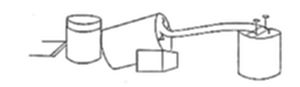
I have stuck in the wires better than ever, and it is going on at a great rate, being a rainy day, and the skylight shut and a smell of Hydrogen gas. I have left it for an hour to read Poisson, as I am pleased with him to-day. Sometimes I do not like him, because he pretends to give information as to calculations of sorts, whereas he only tells how it might be done if you were allowed an infinite time to do it in, as well as patience. Of course he never stoops to give a particular example or even class of them. He tells lies about the way people make barometers, etc.
I bathe regularly every day when dry, and try aquatic experiments.
I first made a survey of the pool, and took soundings and marked rocky places well, as the water is so brown that one cannot see one’s knees (pure peat, not mud). People are cutting peats now. So I have found a way of swimming round the pool without knocking knees. The lads[123] are afraid of melting, except one. No one here would touch water if they could help it, because there are two or three eels in the pool, which are thought near as bad as adders.
I took down the clay gun and made a centrifugal pump of it; also tried experiments on sound under water, which is very distinct, and I can understand how fishes can be stunned by knocking a stone.
We sometimes get a rope, which I take hold of at one end, and Bob Fraser the other, standing on the rock; and after a flood, when the water is up, there is sufficient current to keep me up like a kite without striking at all.
The thermometer ranged yesterday from 35° to 69°.
I have made regular figures of 14, 26, 32, 38, 62, and 102 sides of cardboard.
Latest intelligence—Electric Telegraph. This is going so as to make a compass spin very much. I must go to see my pig, as it is an hour and half since I left it; so, sir, am your affib. friend,
James Clerk Maxwell.
To the Same.
Glenlair, 22d Sept 1848.
... When I waken I do so either at 5.45 or 9.15, but I now prefer the early hour, as I take the most of my violent exercise at that time, and thus am saddened down, so that I can do as much still work afterwards as is requisite, whereas if I was to sit still in the morning I would be yawning all day. So I get up and see what kind of day it is, and what field works are to be done; then I catch the pony and bring up the water barrel.[124] This barrel used to be pulled by the men, but Pa caused the road to be gravelled, and so it became horse work to the men, so I proposed the pony; but all the men except the pullers opposed the plan. So I and the children not working brought it up, and silenced vile insinuators. Then I take the dogs out, and then look round the garden for fruit and seeds, and paddle about till breakfast time; after that take up Cicero and see if I can understand him. If so, I read till I stick; if not, I set to Xen. or Herodotus. Then I do props, chiefly on rolling curves, on which subject I have got a great problem divided into Orders, Genera, Species, Varieties, etc.
One curve rolls on another, and with a particular point traces out a third curve on the plane of the first, then the problem is:—Order I. Given any two of these curves, to find the third.
Order II. Given the equation of one and the identity of the other two, find their equation.
Order III. Given all three curves the same, find them. In this last Order I have proved that the equi-angular spiral possesses the property, and that no other curve does. This is the most reproductive curve of any. I think John Bernoulli had it on his tombstone, with the motto Eadem mutata resurgo. There are a great many curious properties of curves connected with rolling. Thus, for example,—
If the curve A when rolled on a straight line produces a curve C, and if the curve A when rolled up on itself produces the curve B, then the curve B when rolled upon the curve C will produce a straight line.
Thus, let the involute of the circle be represented by A, the spiral of Archimedes by B, and the parabola by C, then the proposition is true. Thus the parabola rolled on a straight line traces a Catenary with its focus, an easy way to describe the Catenary. Professor Wallace just missed it in a paper in the Royal Society.
After props come optics, and principally polarised light.
Do you remember our visit to Mr. Nicol? I have got plenty of unannealed glass of different shapes, for I find window glass will do very well made up in bundles. I cut out triangles, squares, etc., with a diamond, about 8 or 9 of a kind, and take them to the kitchen, and put them on a piece of iron in the fire one by one. When the bit is red hot, I drop it into a plate of iron sparks to cool, and so on till all are done. I have got all figures up to nonagons, triangles of all kinds, and irregular chips. I have made a pattern for a tesselated window of unannealed glass in the proper colours, also a delineation of triangles at every principal inclination. We were at Castle-Douglas yesterday, and got crystals of salt Peter, which I have been cutting up into plates to-day, in hopes to see rings. There are very few crystals which are not hollow-hearted or filled up with irregular crystals. I have got a few cross cuts like free of irregularities and long [wedge-shaped] cuts for polarising plates. One has to be very cautious in sawing and polishing them, for they are very brittle.
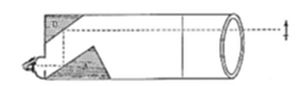
I have got a lucifer match box fitted up for polarising, thus. The rays suffer two reflections at the polarising angle from glasses A and B. Without the lid it does for an analysing plate. Tn the lid there is set a plate of mica, and so one observes the blue sky, and turns the box round till a particular colour appears, and then a line on the lid of the box points to the sun wherever he is. Thus one can find out the time of day without the sun. [Here follow thirteen diagrams of patterns in triangles, squares, pentagons, and hexagons.] These are a few of the figures one sees in unannealed glass.
Pray write soon and tell when, how, and where by, you intend to come, that you may neither on the other hand fall upon us at unawares, nor on the one hand break and not come at all. I suppose when you come I will have to give up all my things of my own devizing, and take Poisson, for the time is short, and I am very nearly unprepared in actual reading, though a great deal more able to read it.
I hope not to write any more letters till you come. I seal with an electrotype of the young of the ephemera. So, sir, I was, etc.
To the Same.
Bannavie, 6th July [1849].
Æt. 18.
This being a wet night, and I having exhausted my travelling props, set to write to you about what I can recollect of my past history. It is curious that though the remembrance of ploys remains longer than that of home doings, it is not so easily imagined after a short interval.
By imagining is here meant bringing up an accurate image of thoughts, words, and works, and not a mere geographical summary of voyages and travels.
But to the point. Perhaps you remember going with my Uncle John Cay (7th Class), to visit Mr. Nicol in Inverleith Terrace. There we saw polarised light in abundance. I purposed going this session but was prevented. Well, sir, I received from the aforesaid Mr. Cay a “Nicol’s prism,” which Nicol had made and sent him. It is made of calc-spar, so arranged as to separate the ordinary from the extraordinary ray. So I adapted it to a camera lucida, and made charts of the strains in unannealed glass.
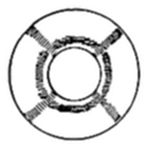
I have set up the machine for showing the rings in crystals, which I planned during your visit last year. It answers very well. I also made some experiments on compressed jellies in illustration of my props on that subject The principal one was this:—The jelly is poured while hot into the annular space contained between a paper cylinder and a cork: then, when cold, the cork is twisted round, and the jelly exposed to polarised light, when a transverse cross, x, not +, appears with rings as the inverse square of the radius, all which is fully verified. Hip! etc. Q.E.D.
But to make an abrupt transcision,[125] as Forbes says, we set off to Glasgow on Monday 2d; to Inverary on 3d; to Oban by Loch Awe on 4th; round Mull, by Staffa and Iona, on (5th), and here on 6th. To-morrow we intend to get to Inverness and rest there. On Monday perhaps? to the land of Beulah, and afterwards back by Caledon. Canal to Crinan Canal, and so to Arran, thence to Ardrossan, and then home. It is possible that you may get a more full account of all these things (if agreeable), when I fall in with a pen that will spell; my present instrument partakes of the nature of skates, and I can hardly steer it.
There is a beautiful base here for measuring the height, etc., of Ben Nevis. It is a straight and level road through a moss for about a mile that leads from the inn right to the summit.
It is proposed to carry up stones and erect a cairn 3 feet high, and thus render it the highest mountain in Scotland.
During the session Prof. Forbes gave as an exercise to describe a cycloid from top of Ben Nevis to Fort William, and slide trees down it. We took an observation of the slide, but found nothing to slide but snow.
I think a body deprived of friction would go to Fort William in a cycloid in 49·6 seconds, and in 81 on an inclined plane. I believe I should have written the greater part of this letter to Allan Stewart, but I know not where he is, so you get it, and may read it or no as you like.
We will be at home between the 15th and 22d of this month, so you may write then, detailing your plans and specifying whether you intend to come north at all between this and November, for we would be glad if either you or Bob would disturb our solitude.
To the Same.
Glenlair, 19th October 1849.
Here is the way to dissolve any given historical event in a mythical solution, and then precipitate the seminal ideas in their primitive form. It is from Theodore Parker, an American, and treats of the declaration of American Independence. “The story of the Declaration of Independence is liable to many objections if we examine it à la mode Strauss. The Congress was held at a mythical town, whose very name is suspicious,—Philadelphia, brotherly love. The date is suspicious: it was the fourth day of the fourth month (reckoning from April, as it is probable that the Heraclidae and Scandinavians, possible that the Americans, and certain that the Ebrews, did). Now 4 was a sacred number among Americans: the President was chosen for 4 years, 4 departments of affairs, 4 political powers, etc. The year also is suspicious. 1776 is but an ingeni[ous]? combination of the sacred number, thus—
444
4
1776
Still further, the declaration is metaphysical and presupposes an acquaintance with the transcendental function on the part of the American people. Now the Kritik of Pure Reason was not yet published,” etc.
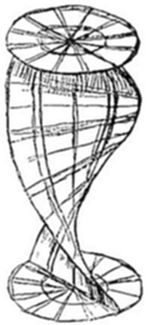
This is the likeness of a SKEW SCREW SURFACE.
To the Same.
October 1849.
Since last letter, I have made some pairs of diagrams representing solid figures and curves drawn in space; of these pictures one is seen with each eye by means of mirrors, thus....
This is Wheatstone’s Stereoscope, which Sir David Brewster has taken up of late with much violence at the Brightish Association. (The violence consists in making two lenses out of one by breaking it). (See Report). Last winter he exhibited at the Scottish Society of Arts Calotype pictures of the statue of Ariadne and the beast seen from two stations, which, when viewed properly, appeared very solid.
Since then I have been doing practical props on compression, and writing out the same that there may be no mistake. The nicest cases are those of spheres and cylinders. I have got an expression for the hardness of a cricket ball made of case and stuffing. I have also the equations for a spherical cavity in an infinite solid, and this prop: Given that the polarised colour of any part of a cylinder of unannealed glass is equal to the square of the distance from the centre (as determined by observation), to find—1st, the state of strain at each point; 2d, the temperature of each.
I have got an observation of the latitude just now with a saucer of treacle, but it is very windy.
Pray excuse this wickedly perplexed letter as an effect of the paucity of our communications. If you would sharpen me a little it would be acceptable, but when there is nobody to speak to one [loses] the gift of speech....
To the Same.
31 Heriot Row, Edinburgh, N.B., Monday, Nov. 5, 1849.
I go to Gregory to Chemistry at 10, Morale Phil, at 12, and Pract. Chem. at 13, finishing at 14, unless perhaps I take an hour at Practical Mechanics at the School of Arts. I do not go to Sir W. H. logic, seeing I was there before. Langhorne has got your Buchananic notes. Why do you think that I can endure nothing but Mathematics and Logic, the only things I have plenty of? and why do you presuppose my acquaintance with your preceptors, professors, tutors,[126] etc.? ...
I don’t wonder at your failing to take interest in the exponential theorem, seeing I dislike it, although I know the use and meaning of it. But I never would have, unless Kelland had explained it....
In your next letter you may give an abstract of Aristotle’s Rhet., for I do not attend Aytoun, and so I know not what Rhet. is. I know Logic only by Reid's account of it. I will tell you about Wilson’s Moral Philosophy, provided always you want to know, and signify your desire.
To the Same.
[Edin] 14th March 1850.
As I am otherwise engaged, I take this opportunity of provoking you to write a letter or two. I have begun to write Elastic Equilibrium, and I find that I must write you a letter in order at least, indeed,[127] to serve on the one hand as an excuse to myself for sticking up, and on the other hand as a sluice for all the nonsense which I would have written. I therefore propose to divide this letter as follows:—My say naturally breaks up into—1. Education; 2. Notions; 3. Hearsay.
1. Education—Public.
10-11.—Gregory is on Alloys of Metals just now. Last Saturday I was examined, and asked how I would do if the contents of a stomach were submitted to me to detect arsenic, and I had to go through the whole of the preparatory processes of chopping up the tripes, boiling with potash, filtering, boiling with and , all which Kemp the Practical says are useless and detrimental processes, invented by chemists who want something to do. 11-12.—Prof. Forbes is on Sound and Light day about, as Bob well knows, and can tell you if he chooses. He (B. C.) has written an essay on Probabilities, with very grand props in it; everything original, but no signs of reading, I guess. It was all written in a week. He has despaired of Optics.—12-1. Wilson, after having fully explained his own opinions, has proceeded to those of other great men: Plato, Aristotle, Stoics, Epicureans. He shows that Plato’s proof of the immortality of the soul, from its immateriality, if it be a proof, proves its pre-existence, the immortality of beasts and vegetables, and why not transmigration? (Do you remember how Raphael tells Adam about meats and drinks in Paradise Lost?) (Greek Iambics, if you please.) He quarrels with Aristotle’s doctrine of the Golden Mean,—“a virtue is the mean between two vices,”—not properly understanding the saying. He chooses to consider it as a pocket rule to find virtue, which it is not meant to be, but an apophthegm or maxim, or dark saying, signifying that as a hill falls away on both sides of the top, so a virtue at its maximum declines by excess or defect (not of virtue but) of some variable quantity at the disposal of the will Thus, let it be a virtue to give alms with your own money, then it is a greater virtue to pay one’s debts to the full. Now, a man has so much money: the more alms he gives up to a certain point, the more virtue. As soon as it becomes impossible to pay debts, the virtue of solvency decreases faster than that of alms-giving increases, so that the giving of money to the poor becomes a vice, so that the variable is the sum given away, by excess or defect of which virtue diminishes, say I; so that Wilson garbles Aristotle,—but I bamboozle myself. I say that some things are virtues, others are virtuous or generally lead to virtue. Substitute goods for virtues, and it will be more general: thus, Wisdom, Happiness, Virtue, are goods, and cannot be in excess; but Knowledge, Pleasure, and—what? (please tell me, Is it Propriety, Obedience, or what is it?) lead to the other three, and are not so much goods as tending to good; whereas particular knowledges, pleasures, and obediences may be in excess and lead to evils. I postpone the rest of my observations to my Collection of the Metaphysical principles of Moral Philosophy founded on the three laws of Liberty, Equality, Fraternity, thus expressed:—
1. That which can be done is that which has been done; that is, that the possibility (with respect to the agent) of an action (as simple) depends on the agent having had the sensation of having done it.[128]
2. That which ought to be done is that which (under the given conditions) produces, implies, or tends to the greatest amount of good (an excess or defect in the variables will lessen the good and make evil).
3. Moral actions can be judged of only by the principle of exchange; that is (1), our own actions must be judged by the laws we have made for others; (2), others must be judged by putting ourselves in their place.
22d March.
At Practical Mechanics I have been turning Devils of sorts. For private studies I have been reading Young’s Lectures, Willis’s Principles of Mechanism, Moseley’s Engineering and Mechanics, Dixon on Heat, and Moigno’s Répertoire d'Optique. This last is a very complete analysis of all that has been done in the optical way from Fresnel to the end of 1849, and there is another volume a-coming which will complete the work. There is in it besides common optics all about the other things which accompany light, as heat, chemical action, photographic rays, action on vegetables, etc.
My notions are rather few, as I do not entertain them just now. I have a notion for the torsion of wires and rods, not to be made till the vacation; of experiments on the action of compression on glass, jelly, etc., numerically done up; of papers for the Physico-Mathematical Society (which is to revive in earnest next session!); on the relations of optical and mechanical constants, their desirableness, etc., and suspension-bridges, and catenaries, and elastic curves. Alex. Campbell, Agnew, and I are appointed to read up the subject of periodical shooting stars, and to prepare a list of the phenomena to be observed on the 9th August and 13th November. The Society’s barometer is to be taken up Arthur’s Seat at the end of the session, when Forbes goes up, and All students are invited to attend, so that the existence of the Society may be recognised.
I have notions of reading the whole of Corpus Juris and Pandects in no time at all; but these are getting somewhat dim, as the Cambridge scheme has been howked up from its repose in the regions of abortions, and is as far forward as an inspection of the Cambridge Calendar and a communication with Cantabs.
Mr. Bob is choosing his college. I rejected for him all but Peter’s, Caius, or Trinity Hall, the last being, though legal, not in favour, or lazy, or something. Caius is populous, and is society to itself. Peter’s is select, and knows the University. Please give me some notions on these things, both for Bob and me. I postpone my answer to you about the Gorham business till another time, when also I shall have read Waterland on Regeneration, which is with Mrs. Morrieson, and some Pusey books I know. In the meantime I admire the Judgement as a composition of great art and ingenuity.
What cross influences had delayed his entrance at Cambridge may be guessed at, but cannot be clearly known. Mr. Clerk Maxwell was always slow in making up his mind, and the habit of inertia had grown upon him. There had been a lingering expectation, to which James alludes in the preceding letter, that he would follow his father's profession, and become a member of the Scottish Bar. And although he himself felt, as he told me at the time, that it was “another kind of laws” he was called upon to study, the practical result of this conviction was slow in asserting itself. The fact that in going to Cambridge he decided against the profession which his friends had destined for him made the step a more serious one than it might have otherwise been. The close and constant intercourse between father and son made the parting more difficult. James’s delicate health[129] would count heavily amongst the reasons contra, and certain floating prejudices about the “dangers of the English universities,” Puseyism, infidelity, etc., had then considerable hold, especially on the Presbyterian mind. James himself was patient, and had hitherto decided nothing for himself. Only when Tait and Allan Stewart were already at Cambridge, my brother Robert destined for it, and myself at Oxford, his own voice was added to those which had long been urging the claims of Cambridge,[130] and then they prevailed. There had been searchings of heart on the subject as early as April 1849, when the following entries occur in the Diary:—
T. 17.—Called on Hugh Blackburn to talk about Cambridge.
W. 18.—Called on Capt. Wemyss to talk of Cambridge, and Prof. Forbes called on me and had a talk on James’s studies, etc.
The only other document at my command which bears upon the point is a journal kept by my mother, then Mrs. Morrieson, in which she occasionally noted matters relating to her sons’ friends. She was herself at this time (1850) making inquiries about Cambridge for my brother Robert. The following entries may be quoted:—
1850. 1st April.—James Clerk Maxwell came in full of Forbes’s recommendation of Trinity College above all others at Cambridge, and that Peterhouse was less expensive than Caius; that the latter is too full to admit of rooms, and freshmen are obliged to lodge out.
28th October.—I had a kind letter from Mr. C. M., from Glenlair, after placing his son James at Peterhouse. He has already distinguished himself at Edinburgh by papers on the compression of solids, and other scientific subjects, read for him at the Royal Society. His manners are very peculiar; but having good sense, sterling worth, and good humour, the intercourse with a College world will rub off his oddities. I doubt not of his becoming a distinguished man.
January 1851.—James Clerk Maxwell often comes in. He is full of genius. He went to Cambridge with Robert in October, R to Caius, James to Peterhouse; but he is “migrating” to Trinity, and I have no doubt he will be a distinguished Philosopher some day.
In concluding the account of this period, I again beg leave to quote from Professor Tait’s excellent paper:—
The winter of 1847 found us together in the classes of Forbes and Kelland, where he highly distinguished himself. With the former he was a particular favourite, being admitted to the free use of the class apparatus for original experiments. He lingered here behind most of his former associates, having spent three years at the University of Edinburgh, working (without any assistance or supervision) with physical and chemical apparatus, and devouring all sorts of scientific works in the library.[131] During this period he wrote two valuable papers, which are published in our Transactions, on The Theory of Rolling Curves and on The Equilibrium of Elastic Solids. Thus he brought to Cambridge, in the autumn of 1850, a mass of knowledge which was really immense for so young a man, but in a state of disorder appalling to his methodical private tutor.[132] Though that tutor was William Hopkins, the pupil to a great extent took his own way, and it may safely be said that no high wrangler of recent years ever entered the Senate-house more imperfectly trained to produce “paying” work than did Clerk Maxwell. But by sheer strength of intellect, though with the very minimum of knowledge how to use it to advantage under the conditions of the Examination, he obtained the position of Second Wrangler, and was bracketed equal with the Senior Wrangler in the higher ordeal of the Smith’s Prizes. His name appears in the Cambridge Calendar as Maxwell of Trinity, but he was originally entered at Peterhouse, and kept his first term there, in that small but most ancient foundation which has of late furnished Scotland with the majority of the professors of mathematics and natural philosophy, in her four universities.
To the books mentioned by Professor Tait in his footnote should be added Poisson’s Mechanics, which was taken out from the Advocates’ Library 6th March 1848, and carried off into the country. A copy of Fourier’s Théorie de la Chaleur was ordered through Maclachlan, 6th April 1849, for 25s.
Letters, April to September 1850.
To Lewis Campbell, Esq.
Glenlair, 26th April 1850.
As I ought to tell you of our departure from Edinburgh and arrival here, so I ought to tell you of many other things besides. Of things pertaining to myself there are these:—The tutor of Peterhouse has booked me, and I am booked for Peterhouse, but will need a little more booking before I can write Algebra like a book.
I suppose I must go through Wrigley’s problems and Paley’s Evidences in the same sort of way, and be able to translate when required Eurip. Iph. in Aulid. In the meantime I have my usual superfluity of plans.
1. Classics—Eurip. . for Cambridge. (I hope no Latin or Greek verses except for honours.) Greek Testament, Epistles, for my own behoof, and perhaps some of Cicero De Officiis or something else for Latin.
2. Mathematics—Wrigley’s Problems, and Trig, for Cambridge; properties of the Ellipsoid and other solids for practice with Spher. Trig. Nothing higher if I can help it.
3. Nat. Phil.—Simple mechanical problems to produce that knack of solving problems which Prof. Forbes has taught me to despise. Common Optics at length; and for experimental philosophy, twisting and bending certain glass and metal rods, making jellies, unannealed glass, and crystals, and dissecting eyes—and playing Devils.
4. Metaphysics—Kant’s Kritik of Pure Reason in German, read with a determination to make it agree with Sir W. Hamilton.
5. Moral Philosophy—Metaphysical principles of moral philosophy. Hobbes’ Leviathan, with his moral philosophy, to be read as the only man who has decided opinions and avows them in a distinct way. To examine the first part of the seventh chapter of Matthew in reference to the moral principles which it supposes, and compare with other passages.
But I question if I shall be able to overtake all these things, although those of different kinds may well be used as alternate studies.
I read in Edinburgh Wilson’s Poems to see what he used to be like, and how much he had improved since then. Did you finish Festus?[133] I had only two days to read it, so that I skipped part of the long speech and a good deal of the jollification, which I think the dullest part of the book.
The opening makes one think that it is to be an imitation of the book of Job, but you soon see that you have to do with a dreamy mortal without a profession, but vain withal, and a hero among women, a jolly companion of some men, admired of students for talking of things which he knows not, nor can know, having a so-called philosophy, an intuitive science, and an underived religion, and with all these not perfect, but needing more expanded views of the folly of strict virtue and outward decency, of the magnificence, nay, of the duty of sinning, and of the identity of virtue and vice, and of all opposites. He takes for his friend one whom Wilson calls a very poor devil, who has wonderful mechanical powers, but never attempts but once the supposed object of his visit to earth, namely, temptation. He takes a more rational view of affairs than Festus in general, but is so extremely refined from ordinary devils, that the only passage sufficiently characteristic for ordinary rapid readers to recognise is the sermon to the crowd, as the speech in Hell is quite raw. He has not such an absolute and intuitive sense of things as Festus, and does not change so much according to his company. He seems a sincere, good-natured, unselfish devil; while Festus is very changeable, solemn when alone, jolly when with the jolly, drunk with the drunk, open with Lucifer, reserved in good company, amorous with all women, talkative and serious with all angels and saints, stern towards the unfortunate, and in all his affections altogether selfish.
The book is said to have a plan, but no plot. The plan is an exposition of the state of a man’s mind after having gone through German metaphysics. It was one destitute of notions, and has now been convinced that all these notions are one and the same. It is neither meat, nor drink, nor rank, nor money, nor any common thing he wants: “he is sure it isn’t,” and he is sore troubled for want of some great thing to do; and when L——r starts into proximity he is the very being he wanted to speak to; “he knew who it would be,” and recognises him at once. An opportunity is thus given for showing two ways of thinking about things, and therein lies the matter of the book. This may be seen in L——r’s sermon and Festus’ prayer. To turn and get out of the confusion of this letter, pray let me hear your opinion of the book. It may be considered thus:—
1. People read the book and wonder, why?
It is not read for the sake of the story—that is plain; nor for the clearness with which certain principles are developed, nor for the consistency of the book, nor for the variety of the characters; there must therefore be something overpoweringly attractive to hold you to the book. Some say he has fine thoughts, sufficient to set up fifty poets; to which some may answer, Where are they? Read it in a spirit of cold criticism, and they vanish. There is not one that is not either erroneous, absurd, German, common, or Daft. Where lies the beauty? In the reader’s mind. The author has evidently been thinking when he wrote it, and that not in words, but inwardly. The benevolent reader is compelled to think too, and it is so great a relief to the reader to get out of wordiness that he can put up with insanity, absurdity, profanity, and even inanity, if by so doing he can get into rapport with one who is so transcendental, and yet so easy to follow, as the poet. When Galileo set his [lamp] a-swinging by breathing on it, his power lay in the relation between the interval of his breaths and the time of vibration; so in Festus the mind that begins to perceive that his train of thoughts is that of the poem is readily made to follow on. There are some passages where one breaks loose, especially the rhyming description of the subpoenaing of the planets, and the notion of the angel of the earth giving Festus a pair of bracelets, and the way in which F. improves his mind by travel.
... Beauty is attributed to an object when the subject anticipates pleasure in it. A true pleasure is a consciousness of the right action of the faculty or function or power. Happiness is the integral of pleasure, as wisdom is of knowledge.... Don't take all this about Festus for truth, as I don’t believe much of it, and I’ll maybe tell you a new story if you tell me one.
What of St. Peter, as compared with the Keys and with Bob?[134]
From Prof. Forbes.
Edinburgh, 4th May 1850.
My dear Sir—Professor Kelland, to whom your paper was referred by the Council E. S., reports favourably upon it, but complains of the great obscurity of several parts, owing to the abrupt transitions and want of distinction between what is assumed and what is proved in various passages, which he has marked in pencil, and which I trust that you will use your utmost effort to make plain and intelligible. It is perfectly evident that it must be useless to publish a paper for the use of scientific readers generally, the steps of which cannot, in many places, be followed by so expert an algebraist as Prof. Kelland;—if, indeed, they be steps at all and not assumptions of theorems from other writers who are not quoted. You will please to pay particular attention to clear up these passages, and return the MS. by post to Professor Kelland, West Cottage, Wardie, Edinburgh, so that he may receive it by Saturday the 11th, as I shall then have left town.—Believe me, yours sincerely,
James D. Forbes.
To L. Campbell, Esq.
[June? 1850]
As there has been a long truce between us since I last got a letter from you, and as I do not intend to despatch this here till I receive Bob’s answer with your address, I have no questions to answer, and any news would turn old by keeping, so I intend briefly to state my country occupations (otherwise preparation for Cambridge, if you please). I find that after breakfast is the best time for reading Greek and Latin, because if I read newspapers or any of those things, then it is dissipation and ruin; and if I begin with props, experiments, or calculations, then I would be continually returning on them. At first I had got pretty well accustomed to regular study with a Dictionary, and did about 120 lines of Eurip. a day, namely, 40 revised, 40 for to-day, and 40 for to-morrow, with the looking up of to-morrow’s words. As I am blest with Dunbar’s Lexicon, it is not very highly probable that I will find my word at all; if I do, it is used in a different sense from Dunbar’s (so much the better), and it has to be made out from the context (either of the author or the Dictionary). So much for regular study, which I have nearly forgot, for when I had got to the end of the first chorus I began to think of the rods and wires that I had in a box. They have entirely stopped Eurip., for I found that if I spent the best part of the day on him, and took reasonable exercise, I could not much advance the making of the apparatus for tormenting these wires and rods. So the rods got the better of the Lexicon. The observations on the rods are good for little till they are finished; they are of three kinds, and are all distinguished for accuracy and agreement among themselves.
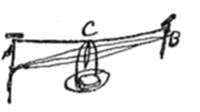
Thus—a rod bent by a weight at the middle takes the form of a curve, which is calculated to be one of the fourth order. Let A C B be the rod bent by a weight at C. Mirrors fastened to it at A and B make known the changes of the inclination of the tangent to the rod there, and a lens at C projects an image of a copper scale of inches and parts from A to B, where it is observed, and so the deflection of the rod at C becomes known. Now the calculated value of the elasticity deduced from the deflection differs from that deduced from the observations on the mirrors by about of either, and as the deflection at C was about inch, the difference of the observed and calculated deflections is about of an inch, which is near enough for home-made philosophical instruments to go.
Thus you see I would run on about rods and wires, and weights, angles, and inches, and copper and iron, and silvered glass, and all sorts of practicalities. Where is now Eurip.?—Ay, where? On the top of the Lexicon, and behind bundles of observations and calculations. When will he come out? for he was a good soul after all, and wise (beg his pardon, wiser). For the rest I have been at Shakespeare and Cowper. I used to put Thomson and Cowper together (why?), and Thomson first; now they are reversed and far asunder.
As I suppose my occupations are not very like yours, I pray you send me an account of what Oxford notions you have got, either from Oxonians, books, or observation; and as, if I was to question you, you could but answer my questions, I leave you to question yourself and send me some of the answers.
The only regular College science that I have thought of lately is Moral Philosophy. Whether it is an Oxford science I know not; but it must be, if not taught, at least interesting; so I purpose to fill up this letter with unuttered thoughts (or crude), which, as they are crammed into words, may appear like men new waked from sleep, who leap in confusion into one another’s breeches, hardly fit to be seen of decent men. Then think not my words mad if their clothes fit them not, for they have not had an opportunity of trying them oh before.
There are some Moral Philosophers whose opinions are remarkable for their general truth and good sense, but not for their utility, fixity, or novelty.
They tell you that in all your actions you ought to be virtuous, that benevolence is a virtue, that lawful rulers ought to be obeyed, that a man should give ear to his conscience.
Others tell you of unalterable laws of right and wrong, of Eternal truth and the Everlasting fitnesses of things. Others of the duty of following nature, of every virtue between two vices (Aristot.), and of the golden mean. That a man should do what is best on the whole (1) for himself; (2) for other men only, and not himself; (3) for the whole universe, including himself, and so on. Now I think that the answers to the following questions should be separate parts of M. Ph.:—
1. What is man? This is the introduction, and is called statical or proper Metaphysics.
2. What are the laws of human action? Action being all that man does—thought, word, deed.
3. What are the motives of human actions?
4. What actions do men perform in preference to what others, and why?
5. What is the principle by which men judge some actions right, others wrong?
6. What do particular men think of this principle? What are their doctrines?
7. What is the best criticism of right and wrong, or what (to us) is absolute right?
8. What are the best motives of human actions?
9. How are these motives to be implanted without violating the laws of human action?
10. What might, or rather what will, mankind become after this has been effected?
Moral Philosophy differs from Nat. Phil, in this, that the more new things we hear of in Nat. Phil, the better; but in Mor. Phil, the old things are best, so that a common objection to Mor. Phil, is that everybody knows it all before. If a man tells you that tyranny and anarchy are bad things, and that a just and lawful government is a good thing, it sounds very fine, but only means that when men think the government bad from excess or defect they give it the name of tyranny and anarchy. The ancient virtue of Tyrannicide was a man’s determination to kill the king whenever he displeased him. Thus it is easy to call a dog a bad name to beat him for. But there are other parts of Mor. Phil, in which there are differences of opinion, such as the nature of selfishness, self-love, appetites, desires, and affections, disinterestedness (what a word for a rush at!), which belong to the first three questions, and so on. I have told you something (p. 129) of three laws which I had been considering. In all parts of Mor. Phil, these three laws seem to meet one, and in each system of Morals they take a different form. How, that I might not deceive myself in thinking that I was safe out of the hands of the philosophers who argue these matters, I have been looking into the books of Moralists the most opposed to one another, to see what it is that makes them differ, and wherein they agree. The three principles concerning the nature of man are continually changing their shape, so that it is not easy to catch them in their best shape, nevertheless:
Lemma: Metaphysics.—A man thinks, feels, and wills, and therefore Metaphysicians give him the three faculties of cognition, feeling, and conation.
Cognition is what is called Understanding, and is most thought of generally.
Feelings are pleasures, pains, appetites, desires, aversions, approval and disapproval, love, hate, and all affections.
Conations are acts of will, whatever they be.
Now to move a man’s will it is necessary to move his affections. (How? Wait!) For no convictions of the understanding will do, for a man does what he likes to do, not what he believes to be best for himself or others. The feelings can only be moved by notions coming through the understanding, for cognition is the only inlet of thoughts. Therefore, although it can be proved that self-love leads to all goodness, or, in other words, that goodness is happiness, and self loves happiness, yet it can also be proved that men are not able to act rightly from pure self-love; so that though self-love is a very fine theoretical principle, yet no man can keep it always in view, or act reasonably upon it. Now, most moralists take for granted that the end which men, good or bad, pursue is their own happiness, and that happiness, false or true, is the motive of every action, and that it is the only right motive. Others say that benevolence is the only virtue, and that any action not done expressly for the good of others is entitled to no praise.
Most of the ancients, and Hobbes among the moderns, are of the first opinion. Hutcheson and Brown (I think) are of the second, and call the first selfish Philosophers and the selfish school. A few consider benevolence to the whole universe as the proper motive of every action, but they all (says Macintosh) confound men’s motives with the criterion of right and wrong, the reason why a thing is right, and that which actually causes a man to do it. In every book on Moral Philosophy some reference is made to that precept or maxim, which is declared to be the spirit of the law and the prophets (see Matt. VII. 12), and the application of it is a good mark of the uppermost thoughts or mode of thinking of the author.
Hobbes lays down as the first agreement of men to secure their safety, that a man should lay down so much of his natural liberty with respect to others, as he wishes that other men should to him. Hobbes having shown that men, in what the poets and moralists call a state of nature (that is, of equality and liberty, and without government), must be in a state of war, every man against every other, and therefore of danger to every man, deduces the obligation of obeying the powers that be from the necessity of Power to prevent universal war. Adam Smith’s theory of Moral Sentiments (which is the most systematic next to Hobbes) is that men desire others to sympathise with them, and therefore do those things which may be sympathised with; that is, as Smith’s opponents say, men ought to be guided by the desire of esteem and sympathy. Not so. Smith does not leave us there, but I suppose you have read him, as he is almost the only Scotch Moral Philosopher.
As it is Saturday night I will not write very much more. I was thinking to-day of the duties of [the] cognitive faculty. It is universally admitted that duties are voluntary, and that the will governs understanding by giving or withholding Attention. They say that Understanding ought to work by the rules of right reason. These rules are, or ought to be, contained in Logic; but the actual science of Logic is conversant at present only with things either certain, impossible, or entirely doubtful, none of which (fortunately) we have to reason on. Therefore the true Logic for this world is the Calculus of Probabilities, which takes account of the magnitude of the probability (which is, or which ought to be in a reasonable man’s mind). This branch of Math., which is generally thought to favour gambling, dicing, and wagering, and therefore highly immoral, is the only “Mathematics for Practical Men,” as we ought to be. How, as human knowledge comes by the senses in such a way that the existence of things external is only inferred from the harmonious (not similar) testimony of the different senses. Understanding, acting by the laws of right reason, will assign to different truths (or facts, or testimonies, or what shall I call them) different degrees of probability. How, as the senses give new testimonies continually, and as no man ever detected in them any real inconsistency, it follows that the probability and credibility of their testimony is increasing day by day, and the more a man uses them the more he believes them. He believes them. What is believing? When the probability (there is no better word found) in a man’s mind of a certain proposition being true is greater than that of its being false, he believes it with a proportion of faith corresponding to the probability, and this probability may be increased or diminished by new facts. This is faith in general. When a man thinks he has enough of evidence for some notion of his he sometimes refuses to listen to any additional evidence pro or con, saying, “It is a settled question, probatis probata; it needs no evidence; it is certain.” This is knowledge as distinguished from faith. He says, “I do not believe; I know.” “If any man thinketh that he knoweth, he knoweth yet nothing as he ought to know.” This knowledge is a shutting of one’s ears to all arguments, and is the same as “Implicit faith” in one of its meanings. “Childlike faith,” confounded with it, is not credulity, for children are not credulous, but find out sooner than some think that many men are liars. I must now to bed, so good night; only please to write when you get this, if convenient, and state the probability of your coming here. We perhaps will be in Edinburgh when the Wise men are there. How you are invited in a corner of a letter by
James Clerk Maxwell.
Glenlair, 16th September 1850.
Professor W. Thomson has asked me[135] to make him some magne-crystallic preparations which I am now busy with. How, in some of these bismuth is required, which is not to be found either in Castle-Douglas or Dumfries. I have, therefore, thought fit to request you, and do now request you, during your transit through Edinburgh on your way here, to go either to Mr. Kemp’s establishment in Infirmary Street, beside the College, or to some other dealer in metals, and there purchase and obtain two ounces of metallic bismuth (called Regulus of Bismuth), either powder or lumpish—all one. Thus you may perceive that the end of this letter is in two ounces of Regulus of Bismuth, that is, the metal bismuth, which if you do bring it with you, will please me well. Not that I am turned chemist. By no means; but common cook. My fingers are abominable with glue and chalk, gum and flour, wax and rosin, pitch and tallow, black oxide of iron, red ditto and vinegar. By combining these ingredients, I strive to please Prof. Thomson, who intends to submit them to Tyndall and Knoblauch, who, by means of them, are to discover the secrets of nature, and the origin of the magne-crystallic forces.
Now, if by coming here you could turn me from a cook to a grammarian by an irresistible influence you would do well; but if you remember the way I used to translate at the Academy, distorting the Latin of Livy to mean what I had preconceived, you will understand that at first I had not only to find out what the author meant, but to become convinced that it could not be what I thought it was.
John Wilson’s lectures on Moral Philosophy do not improve on reconsideration; they become indistinct and are resolved into the excellence of happiness, the acquiredness of conscience, and general good-humour, philanthropy and . Here is an outline of Abstract Mor. Phil.:—
1. The principles of the growth of the mind (that is, the acquisition of opinions, propensities, and abilities).
2. The principles of government (the governor suits his actions to the laws of the thing governed).
3. The principle of sympathy (sauce for goose is sauce for gander).
Out of these heads may one make something?
As it is bed-time, and I have to put the glue and oxide of iron into shape to-night, I must stop here, and remain in hope of seeing you soon (say when).