Part 1 — NOTE.
Reading edition
THE two following series of propositions concerning the Ovals belong to this period, and afford an illustration of Maxwell’s mode of working in those early days. See above, p. 87. The only alterations made, with the exception of corrections of obvious slips of the pen, consist in a sparing insertion of stops. The MS., as will be seen by the facsimile at p. 104, has almost no punctuation.
I. Oval.
Definition 1.—If a point move in such a manner that times its distance from one point, together with times its distance from another point, may be equal to a constant quantity, it will describe a curve called an Oval.
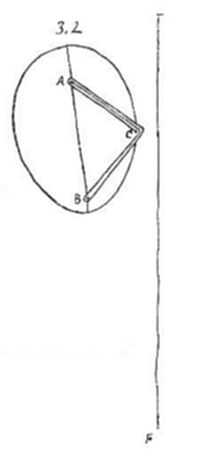
Definition 2.—The two points are called the foci, and the numbers signified by and are called the powers of the foci.
Definition 3.—The line joining the foci is called the axis.
Proposition 1—Problem.
To describe an oval with given foci given multiples, and given constant quantity
Let and be the given foci, 3 and 2 the multiples, and the constant quantity, it is required to describe an oval. At and erect two infinitely small cylinders. Take a perfectly flexible and inextensible thread, without breadth or thickness, equal to ; wind it round the focal cylinders and another movable cylinder , so that the number of plies between and may be equal to , that is 3, and the number between and equal to or 2. Now move in such a manner that the thread may be quite tight, and an oval will be described by the point.
For take any point . There are m plies of thread between and , and plies between and , which taken together make up the thread or the constant quantity, therefore .
The focus , which has the greatest number of plies is called the greater focus, and is called the less focus.
Proposition 2—Theorem.
The greater focus is always within the oval, but the less is within, on, or without the curve, according as the distance between the foci, multiplied by the power of the greater focus, is less equal or greater than, the constant quantity.
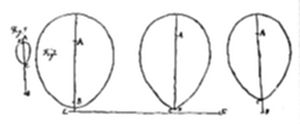
The greater focus is always within the Oval, for suppose it to be at , Fig. 1, then constant quantity , and constant quantity , and , and , but .
The less focus is within the oval when the constant quantity.
For it is evident that
It is in the curve when , this is evident.
It is without the curve when , for
Proposition 3—Theorem.
If a circle be described with a focus for a center, and the constant quantity divided by the power of that focus for a radius, the distance of any point of the oval from the other focus is to the distance from the circle as the power of the central focus is to the power of the other.
The circle is described with the centre and radius = constant quantity, divided by the power of . At any point power of : power of .
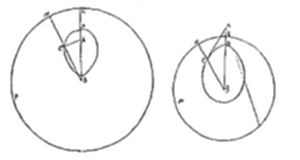
Let power of , and power of constant quantity , and constant quantity , take away , and , therefore . QED.
Cor. 1.—When the powers of the foci are equal the curve is an ellipse.
Cor. 2.—When the less focus is at an infinite distance the curve is an ellipse, for the circle becomes a straight line; and
Cor. 3.—When the greater focus is at an infinite distance, the curve is an hyperbola for the same reason.
Proposition 4—Theorem.
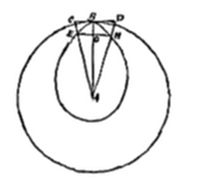
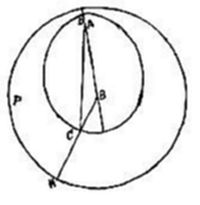
When the less focus is in the curve, angle will be formed equal to the vertical angle of an isosceles triangle, of which the side is to the perpendicular on the base, the power of the greater focus to that of the less.
For let a circle be described, as in Prop. 3, it is evident that it will pass through . Take indefinitely small arcs , join and , join . power of power of , and , therefore , power of power of .
Proposition 5—Problem.
A point , and a point in the line being given, to find a point in the line as , so that may be a minimum.
Take a line , raise perpendicular, and from as a centre describe a circle with a radius so that .
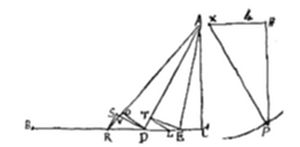
Draw perpendicular to , and make an angle = . is the required point. If not, take any point on the opposite side of from , make . Join , and make = right angle, then right angle , because is less than a right angle (1.16), therefore is within . And in the triangle and , therefore the triangles are similar, and : : and , then , add and or , then and .
Now take a point on the other side. Join , and cut off , make . will be beyond . Draw perpendicular to , then it will be perpendicular to , and below the line , then similar to and : : , and , but and , add and or , and and . QED.
Proposition 6—Problem.
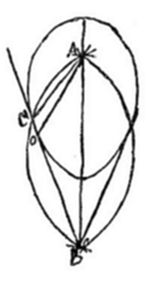
To draw a tangent to an oval from a focus without:—
Take for the power of the greater focus, and for that of the less, and find the angle (Prop. 5). Upon describe a segment of a circle containing an equal angle. Join and , the point where it cuts the oval, is a tangent. For take any point , join , , therefore is without the oval.
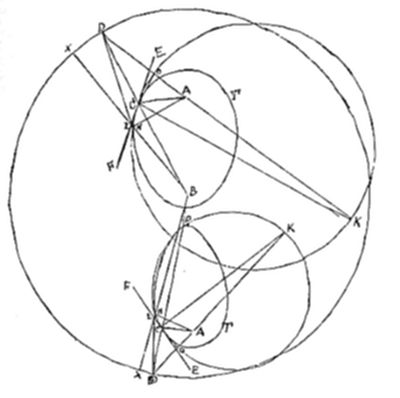
Proposition 7—Problem.
To draw a tangent to a given Oval, the foci and the ratio being given:—
It is required to draw a tangent at to the oval , ratio . From the less focus describe a circle as in (Prop. 3). Join , join , and produce to , then . Join and produce it. Bisect the angle by the line . . Draw perpendicular to , and describe the circle . Because is a right angle, . But and (6.3) , and at any point in the circle, , and ; and the circle is wholly without the oval, and can only touch it in the two points and , where cuts the oval; for suppose the circle coincided with the oval at , but , therefore the oval is within the circle. Therefore draw a tangent to the circle, and as it is without the circle it is without the oval.
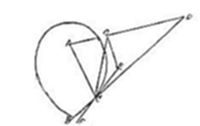
Scholium.—Join , join , and produce till . Join , bisect by . Draw perpendicular to . Make . It is evident from the proposition that is the tangent.
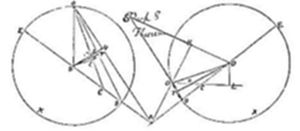
If a line be cut in and , so that , and two semicircles , be described on , and , be drawn to in the circumference, and perpendiculars , , be drawn from the centre, .
For and .
Draw perpendicular to , then as it bisects the base it bisects the angle and , then in the triangles , and . But (6 F Cor.) and , and in the triangles , , and and . But and are equiangular, and , but .
Cor. Sine .
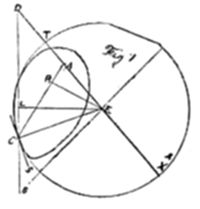
Proposition 9—Theorem.
If lines be drawn from the foci to any point in the oval, the sines of the angles which they make with the perpendicular to the tangent are to one another as the powers of the foci.
.
For describe the circle as in Prop. 7, so that , then the tangent to the circle is a tangent to the oval, and the radius is perpendicular to it; then by Prop. 8 Corollary, .
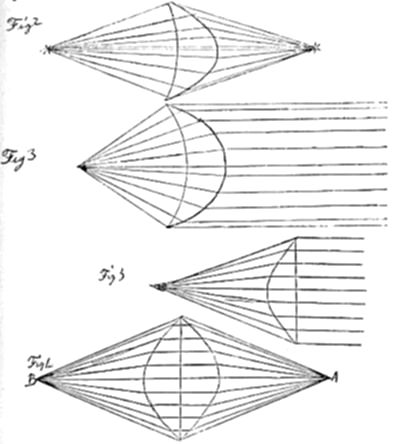
As the ratio of the sines of incidence and refraction is invariable for the same medium, and as this ratio is as 2 to 3 in glass; and as in the oval at Fig. 1 the powers of the foci are as 2 to 3; if the oval were made of glass, rays of light from would be refracted to . If now a circle be described from , the case will not be altered, for the rays are perpendicular to the circle as in fig. 2.
The ellipse and hyperbola, figs. 3 and 3 [bis], cause parallel rays to converge, for (Prop. 3) they are ovals with one of the foci at an infinite distance.
Fig. 4 is a combination of 2 hyperbolas, and rays from are refracted to .
II. Meloid and Apioid.
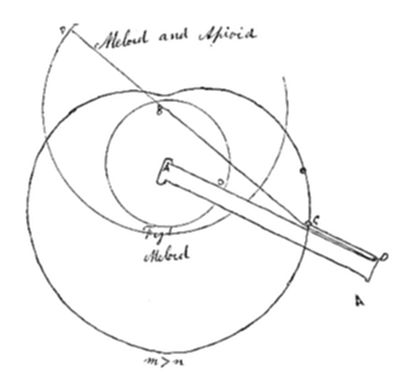
If a point move so that constant quantity, it will describe a curve called a meloid when , and an apioid when . The points and are called the foci.
Proposition 1—Problem.
To describe a Meloid, Fig. 1, or Apioid, Fig. 2.
Take a rigid straight rod , centered at . At erect a small cylinder upon the rod, and also another at on the paper. Then take a flexible and inextensible thread of such a length that times the thread = constant quantity; then wrap the thread round and and a movable cylinder , so that there may be plies between and , and plies between and ; if now be turned round and the thread kept tight, the point will describe a meloid or apioid.
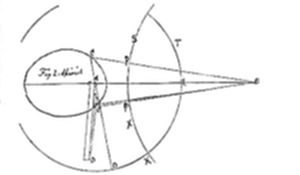
For take any point thread, and ; therefore take away , and thread constant quantity. As , is called the greater and the less focus.
Proposition 2 is the same as proposition 2 of the Oval.
Proposition 3—Theorem.
If a circle be described with a focus for a center, and the constant difference divided by the power of that focus for a radius, the distance of any point in the curve from the other focus is to the distance from the circle as the power of the central focus is to the power of the other.
Let , be the circles: at any point and .
For constant difference, but constant difference and . QED.
And constant difference and . Cor. 1.—If the constant difference the curve is a circle. Cor. 2.—If an oval be described with a thread = constant difference, with the same foci and the same powers as the meloid, and any line be drawn from , and , , be joined, the angle .
For and and (6.3).
Proposition 4—Theorem.
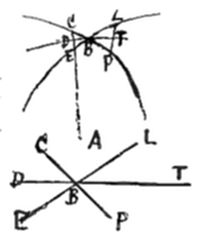
When the less focus is in the curve, an angle will be formed = that in the Oval (Prop. 4).
For take an indefinitely small arc in the circle, (3. Cor. 2), and .
Or it may be proved as in the oval. If the greater focus is at an infinite distance the figure will appear thus:—
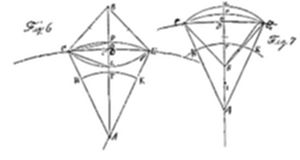
Proposition 5—Theorem.
If the distance between the greater focus and the point where the axis cuts the meloid, be to the distance between that point and the less focus, in a greater proportion than the power of the greater focus to that of the less, the curve is convex toward the greater focus at that point, but if the proportion is less, concave.
Let .
If is convex towards ; but if , it is concave towards Take and near , and . Join , cuts the axis in . Draw the circle from , and from . Also draw as in Prop. 3—
Then , but , and .
As and are very near , but and : 2 right angles : circumference of , and : circumference of , but circ. : circ. and circ. , and circ. or circ. and ; and if , , and is nearer to than the line , and is convex toward ; but if , is on the opposite side, and it is concave.
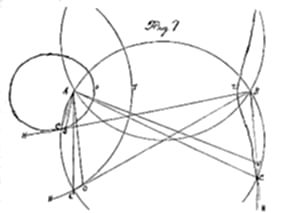
Proposition 6—Problem.
To draw a tangent to a meloid or apioid from a focus without:—
Take for the power of the greater focus, and n for that of the less, and find the angle (Prop. 5 of the Oval) upon describe a segment containing an equal angle. Join and produce to , is a tangent, for suppose to be the end of the rod, and take any point , therefore is without the curve.
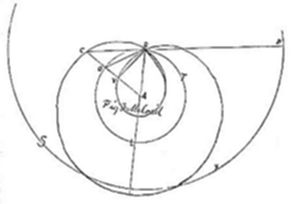
is an apioid, is a circle, and is a meloid, with and as foci.
Proposition 7—Problem.
To draw a tangent to an apioid from any point in the same, the foci and the ratio being given.
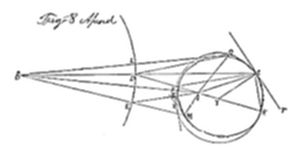
It is required to draw a tangent to the apioid at the point . Join , and draw a circle as in Prop. 3. Join , and produce it. Make . Join , and draw at right angles to . Describe a circle through , , , and it was proved in Prop. 7 of the Oval that if any point be taken and , joined, . Suppose to be both in the circle and in the apioid, join , then , but , but the circle is without the apioid; therefore a tangent to the circle at is a tangent to the apioid.
Axiom 1.
It is possible for a circle to be described touching any given curve internally.
Proposition 8.
To draw a tangent to a meloid at any point .
Case 1.—Let the curve be concave towards . Describe the circle as in Prop. 7: it will be wholly within the meloid. At draw a tangent to the circle: it is also a tangent to the meloid. For let be the tangent to the meloid, it must cut the circle (3.16), and therefore cuts the meloid.
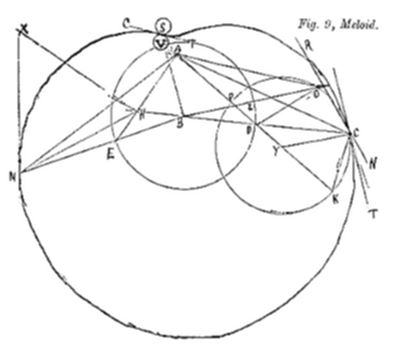
Case 2.—When the curve is convex towards , draw a circle as before. Draw a tangent to the circle; it is also a tangent to the meloid. For suppose a circle S drawn touching the curve internally, it must touch and also , and any other line would cut . QED.
Scholium (see Figs. 8 and 9).—Let be the point Join , , cut off , so that . Join , bisect by , make perpendicular, make , is a tangent.
Proposition 9—Theorem.
If lines be drawn from the foci to any point in a meloid or apioid, the sines of the angles which they make with the perpendicular to the tangent are to one another as the powers of the foci see fig. 8, 9.
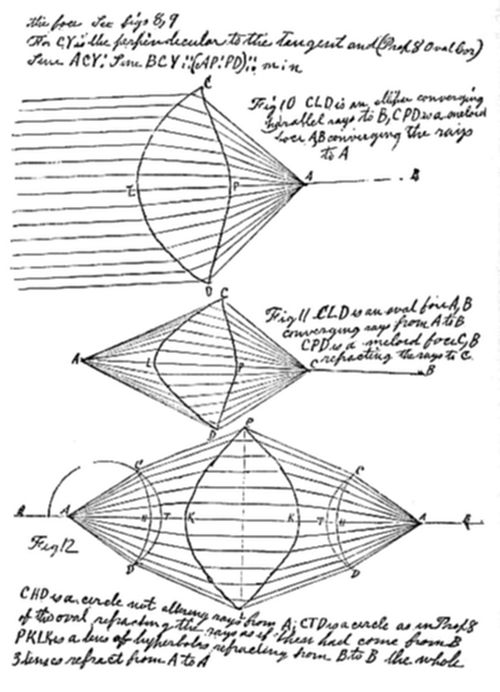
the focus See figs 8, 9 For CY is the perpendicular to the tangent and (Prop 8 Oval 6 or 7) Sine ACY : Sine BCY :: (AP : PD) :: m : n
Fig 10 CLD is an oval for converging parallel rays to B, CPD is a oval without AB converging the rays to A.
Fig 11 CLD is an oval for A, B converging rays from A to B CPD is a second for C, B refracting the rays to C.
Fig 12 CHD is a circle not altering rays from A; CTD is a circle as in Prop 8 of the oval refracting the rays as if these had come from B PKLK is a lens of hyperbolas refracting from B to B the whole 3 lenses refract from A to A.