Part 3 — III. SERIO-COMIC VERSE.
Reading edition
“Numa Pompilius.”
A Lay of Ancient Rome.
Junior Sophs' Exam., Cambridge, December 1851.
O WELL is thee! King Numa, Within thy secret cave, Where thy bones are ever moistened By sad Egeria’s wave; None now have power to pilfer The treasure of thy tomb, And reveal the institutions And secret Rites of Rome. O blessed be the Senate That stowed those books away, Curst be the attempt of Niebuhr To drag them into day; Light be the pressure, Numa, Around thy watery bed, May no perplexing problems Infest thy kingly head! As thus I blessed King Numa And struggled hard with sleep, I felt unwonted chillness O’er all my members creep; Before mine eyes in fragments The fireplace seemed to roll, The chillness left my body And slid into my soul. Deep in Egeria’s grotto I saw the darksome well; I slowly sunk to Numa, But why I cannot tell. “What! Livest thou still, old Sabine, With thy mysterious wife?” “Yes, here beneath the surface, We lead a torpid life. But little think the Critics Who nullify old Rome, That in these benumbing waters I always lived at home. Never was I a Sabine, Or lived like men above; No mortal wight was Numa, Who quelled the fear of Jove. Before my day the Romans Served gods of wood and stone, But what each man had fashioned That worshipped he alone; With care he saved the silver, With pains the mould designed, He loved and feared the offspring Of his pocket and his mind. To him he went for counsel And then to Common Sense; When both of these had failed him He took to tossing pence; But I forbade all tossing, Made men enquire of beasts, Pulled down all private idols And set up public priests. ‘Birds, too,’ said I, 'are holy, They show us things to come, They have more subtle spirits Than wooden idols dumb. No longer burn your incense Before your private shrine, My Vestals are most careful To feed the flame divine; Dismiss all fear of idols, Of demons, and of gods, My Augurs will protect you With their long crooked rods. (With such the careful shepherd Drags lambs from ditches deep; With such he points to heaven When they are fast asleep.) O, trust me, those same Augurs Know more about the stars Than you whose only business Is everlasting wars. How can you be religious, How can they work for bread? You sinners must be shriven, My Augurs must be fed. You know dividing labour To nations riches brings, So let my Augurs shrive you While you mind earthly things. Your case I’ve set before you, You see the thing to do, If you fork out the needful, They do your job for you.' With this and other speeches I brought the people round, Till not a single Roman In Jove’s house can be found. For well he knows each evening When hells in steeples toll, ’Tis a sign that well-paid Augurs Are helping on his soul. ’Twas this that kept ’em quiet Through all my fabled reign, Till quarrelsome young Tullus Brought battles back again. Thus my cold-blooded doctrines The fear of Jove could quell, Wonder not then to find me Alive here in a well.”
A Vision
Of a Wrangler, of a University, of Pedantry, and of Philosophy.
10th November 1852.
DEEP St. Mary’s bell had sounded, And the twelve notes gently rounded Endless chimneys that surrounded My abode in Trinity. (Letter G, Old Court, South Attics), I shut up my mathematics, That confounded hydrostatics— Sink it in the deepest sea! In the grate the flickering embers Served to show how dull November’s Fogs had stamped my torpid members, Like a plucked and skinny goose. And as I prepared for bed, I Asked myself with voice unsteady, If of all the stuff I read, I Ever made the slightest use. Late to bed and early rising, Ever luxury despising, Ever training, never “sizing,” I have suffered with the rest. Yellow cheek and forehead ruddy, Memory confused and muddy, These are the effects of study Of a subject so unblest. Look beyond, and see the wrangler, Now become a College dangler, Court some spiritual angler, Nibbling at his golden bait. Hear him silence restive Reason, Her advice is out of season, While her lord is plotting treason Gainst himself, and Church or State, See him next with place and pension, And the very best intention Of upholding that Convention Under which his fortunes rose. Every scruple is rejected, With his cherished schemes connected, “Higher Powers may be neglected— His result no further goes.” Much he lauds the education Which has raised to lofty station, Men, whose powers of calculation Calculation’s self defied. How the learned fool would wonder Were he now to see his blunder, When he put his reason under The control of worldly Pride. Thus I muttered, very seedy, Husky was my throat, and reedy; And no wonder, for indeed I Now had caught a dreadful cold. Thickest fog had settled slowly Bound the candle, burning lowly, Bound the fire, where melancholy Traced retreating hills of gold. Still those papers lay before me— Problems made express to bore me, When a silent change came o’er me, In my hard uneasy chair. Fire and fog, and candle faded, Spectral forms the room invaded, Little creatures, that paraded On the problems lying there. Fathers there, of every college, Led the glorious ranks of knowledge, Men, whose virtues all acknowledge Levied the proctorial fines; There the modest Moderators, Set apart as arbitrators ’Twixt contending calculators, Scrutinised the trembling lines. All the costly apparatus, That is meant to elevate us To the intellectual status Necessary for degrees— College tutors—private coaches— Line the Senate-house approaches. If our Alma Mater dote, she’s Taken care of well by these. Much I doubted if the vision Were the simple repetition Of the statements of Commission, Strangely jumbled, oddly placed. When an awful form ascended, And with cruel words defended Those abuses that offended My unsanctioned private taste. Angular in form and feature, Unlike any earthly creature, She had properties to meet your Eye whatever you might view. Hair of pens and skin of paper; Breath, not breath but chemic vapour; Dress,—such dress as College Draper Fashions with precision due. Eyes of glass, with optic axes Twisting rays of light as flax is Twisted, while the Parallax is Made to show the real size. Primary and secondary Focal lines in planes contrary, Sum up all that’s known to vary In those dull, unmeaning eyes. Such the eyes, through which all Nature Seems reduced to meaner stature. If you had them you would hate your Symbolising sense of sight. Seeing planets in their courses Thick beset with arrowy “forces,” While the common eye no more sees Than their mild and quiet light. “Son,” she said (what could be queerer Than thus tete-à-tete to hear her Talk, in tones approaching nearer To a saw’s than aught beside? For the voice the spectre spoke in Might be known by many a token To proceed from metal, broken When acoustic tricks were tried. Little pleased to hear the Siren “Own” me thus with voice of iron, I had thoughts of just retiring From a mother such a fright). “No,” she said, “the time is pressing, So before I give my blessing, I’ll excuse you from confessing What you thought of me to-night. “Powers!” she cried, with hoarse devotion, “Give my son the clearest notion How to compass sure promotion, And take care of Number One. Let his college course be pleasant, Let him ever, as at present, Seem to have read what he hasn’t, And to do what can’t be done. “Of the Philosophic Spirit Richly may my son inherit; As for Poetry, inter it With the myths of other days. “Cut the thing entirely, lest yon College Don should put the question, Why not stick to what you’re best on? Mathematics always pays.” As the Hag was thus proceeding To prescribe my course of reading, And as I was faintly pleading, Hardly knowing what to say, Suddenly, my head inclining I beheld a light form shining; And the withered beldam, whining, Saw the same and slunk away. Then the vision, growing brighter, Seemed to make my garret lighter; As when noisome fogs of night are Scattered by the rising sun. Nearer still it grew and nearer, Till my straining eyes caught clearer Glimpses of a being dearer, Dearer still than Number One. In that well-remembered Vision I was led to the decision Still to hold in calm derision Pedantry, however draped; Since that artificial spectre Proved a paltry sub-collector, And had nothing to connect her With the being whom she aped. I could never finish telling You of her that has her dwelling Where those springs of truth are welling, Whence all streams of beauty run. She has taught me that creation Bears the test of calculation, But that Man forgets his station If he stops when that is done. Is our algebra the measure Of that unexhausted treasure That affords the purest pleasure, Ever found when it is sought? Let us rather, realising The conclusions thence arising Nature more than symbols prizing, Learn to worship as we ought. Worship? Yes, what worship better Than when free’d from every fetter That the uninforming letter Rivets on the tortured mind, Man, with silent admiration Sees the glories of Creation, And, in holy contemplation, Leaves the learned crowd behind!
TO F. W. F.
6th April 1853.
FARRAR, when o’er Goodwin’s page Late I found thee poring, From the hydrostatic Sage Leaky Memory storing, Or when groaning yesterday Needlessly distracted By some bright erratic ray. Through a sphere refracted,— Then the quick words, oft suppressed, In my fauces fluttered; Thoughts not yet in language drest Pleasing to be uttered. He that neatly gilds the pill Hides the drug but vainly, So, in chance-sown words, I will Speak the matter plainly. Men there are, whose patient minds, In one object centred, Wait, till through their darkened blinds Truth has burst and entered. Then, that ray so barely caught Joyfully absorbing, They behold the realms of Thought Into Science orbing. Thus they wait, and thus they toil, Thus they end in knowing, Like good seed in kindly soil Taking root and growing. Men there are whose ambient souls, In rapt Intuition, Seize Creation as it rolls, Whole, without partition. Not for them the darkened room, Lens, and perforation; Enemies are they to gloom, Foes to Insulation. Theirs the light of perfect Day, Theirs the sense of Freedom; Dungeons, and the tortured ray, Serve for those that need ’em. Song to them of right belongs, Eloquently flowing; Sweeping down time-honoured wrongs, Surging, burning, glowing. Songs in which all hearts rejoice, Songs of ancient story; Songs that fill a People’s voice Marching on to glory. Thus they live, and thus they love, Thus they soar in singing; Like glad larks in heaven above, Dazzling courses winging— Here, I prithee, turn thy mind To a little fable Of the fledged and rooted kind, Bird and vegetable. Pensive in his lowly nest Once a Lark was lying; Often did he heave his breast Querulously sighing. For he saw with envious eyes, Pampered vegetation— Cabbages of goodly size, Swoll’n with emulation. Till their self-infolded green Tight crammed, wide distended, Seemed in sphered pomp to mean All that it pretended. Long he sought to win their place In the Gardener’s favour; Well he caught the silent grace Of a plant’s behaviour. All was useless, he confest, Earth for him unsuited; Terror seized upon him, lest He should there be rooted. “Cabbages are cabbages, Larks are larks,” he muttered; Then, light springing in the breeze, Through the sky he fluttered. Farrar, mark my fable well, Fling away Ambition; By that sin the angels fell Into black perdition. Cut the Calculus, and stop Paths that lead to error; Think—below the Junior Op.,[275] Gapes the Gulph’s grim terror. Then your Mathematic wings, Plucked from off your shoulder, Will express what Horace sings Of that rash youth, bolder Than his waxen wings allowed, Or his cautious father. Fall not thou from out thy cloud Algebraic, rather Try the Poll, for none but fools,— Fools, I mean, at College, Reach the earth between two stools, Triposes of Knowledge. Better in poetic rage Sing, through heaven soaring, Than disfigure Goodwin’s page By incessant poring.
Reply to the above, by F. W. F.
“Te quoque vatem dicunt pastores.”—Virgil.
O MAXWELL, if by reason’s strength And studying of Babbage, You have transformed yourself at length Into a mental cabbage; And if I’ve proved myself a lark At morn and blushing even, By soaring like a music-spark Thro’ sapphire fields of Heaven, Our diverse fates are now reversed By strange metempsychosis, Into a cabbage I have burst And scorn poetic posies; But you a lark with twinkling wings O’er violet-banks are soaring; Your voice the dewy rose-cloud rings While Statics me are boring. Yet cabbage as I will—on earth My roots I cannot anchor, For at my mathematic birth Was also born a canker! It soon will gnaw my roots away— But when I weigh a choenix I’ll freely soar to realms of day An emerald cabbage-Phœnix. Then talk not of the Poll to me, I hate, detest, and scorn it; I am as earnest as a bee, But savage as a hornet. And if they pluck me I will drown Each pedant in a sonnet, And of their pluckings make a crown With golden plumes upon it. So if my cabbage growth be slow I’ll try to be a carrot, Or still remain a lark—but know I’ll not be Poll, or Parrot. Then if I fall beneath the mark, I’ll shout with accent savage, “It is a lark to be a lark, ’Tis green to be a cabbage.”
Lines written under the conviction that it is not wise to read Mathematics in November after one’s fire is out.
10th Nov. 1853.
In the sad November time, When the leaf has left the lime, And the Cam, with sludge and slime, Plasters his ugly channel, While, with sober step and slow, Round about the marshes low, Stiffening students stumping go Shivering through their flannel. Then to me in doleful mood Rises up a question rude, Asking what sufficient good Comes of this mode of living? Moping on from day to day, Grinding up what will not “pay,” Till the jaded brain gives way Under its own misgiving. Why should wretched Man employ Years which Nature meant for joy, Striving vainly to destroy Freedom of thought and feeling? Still the injured powers remain Endless stores of hopeless pain, When at last the vanquished brain Languishes past all healing. Where is then his wealth of mind— All the schemes that Hope designed? Gone, like spring, to leave behind Indolent melancholy. Thus he ends his helpless days, Vex’t with thoughts of former praise— Tell me, how are Wisdom’s ways Better than senseless Folly? Happier those whom trifles please, Dreaming out a life of ease, Sinking by unfelt degrees Into annihilation. Or the slave, to labour born, Heedless of the freeman’s scorn, Destined to be slowly worn Down to the brute creation. Thus a tempting spirit spoke, As from troubled sleep I woke To a morning thick with smoke. Sunless and damp and chilly. Then to sleep I turned once more, Eyes inflamed and windpipe sore, Dreaming dreams I dreamt before, Only not quite so silly. In my dream methought I strayed Where a learned-looking maid Stores of flimsy goods displayed, Articles not worth wearing. “These,” she said, with solemn air, “Are the robes that sages wear, Warranted, when kept with care, Never to need repairing.” Then unnumbered witlings, caught By her wiles, the trappings bought, And by labour, not by thought, Honour and fame were earning. While the men of wiser mind Passed for blind among the blind; Pedants left them far behind In the career of learning. “Those that fix their eager eyes Ever on the nearest prize Well may venture to despise Loftier aspirations. Pedantry is in demand! Buy it up at second-hand, Seek no more to understand Profitless speculations.” Thus the gaudy gowns were sold, Cast off sloughs of pedants old; Proudly marched the students bold Through the domain of error, Till their trappings, false though fair, Mouldered off and left them bare, Clustering close in blank despair, Nakedness, cold, and terror. Then, I said, “These haughty Schools Boast that by their formal rules They produce more learned fools Than could be well expected. Learned fools they are indeed, Learned in the books they read; Fools whene’er they come to need Wisdom, too long neglected. “Oh! that men indeed were wise, And would raise their purblind eyes To the opening mysteries Scattered around them ever. Truth should spring from sterile ground, Beauty beam from all around, Right should then at last be found Joining what none may sever.”
A Problem in Dynamics.
19th Feb. 1854.
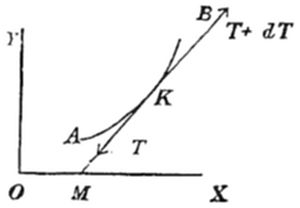
AN inextensible heavy chain Lies on a smooth horizontal plane, An impulsive force is applied at , Required the initial motion of . Let be the infinitesimal link, Of which for the present we’ve only to think; Let be the tension, and Let be put, by a common convention, For the angle at ’twixt and the tension; Let and be ’s velocities, Of which along and across it is; Then the tangent will equal, Of the angle of starting worked out in the sequel. In working the problem the first thing of course is To equate the impressed and effectual forces. is tugged by two tensions, whose difference (1) Must equal the element’s mass into . must be due to the force perpendicular To ’s direction, which shows the particular Advantage of using to serve at your Pleasure to estimate ’s curvature. For into mass of a unit of chain (2) Must equal the curvature into the strain. Thus managing cause and effect to discriminate, The student must fruitlessly try to eliminate, And painfully learn, that in order to do it, he Must find the Equation of Continuity. The reason is this, that the tough little element, Which the force of impulsion to beat to a jelly meant, Was endowed with a property incomprehensible, And was “given,” in the language of Shop, “inextensible.” It therefore with such pertinacity odd defied The force which the length of the chain would have modified, That its stubborn example may possibly yet recall These overgrown rhymes to their prosody metrical. The condition is got by resolving again, According to axes assumed in the plane. If then you reduce to the tangent and normal, (3) You will find the equation more neat tho’ less formal. (4) The condition thus found after these preparations, When duly combined with the former equations, Will give you another, in which differentials (5) (When the chain forms a circle), become in essentials No harder than those that we easily solve (6) In the time a to turn would take to revolve. Now joyfully leaving to itself, a- Tend to the values of and of . The chain undergoes a distorting convulsion, Produced first at by the force of impulsion. n magnitude , in direction tangential, (7) Equating this to the form exponential, Obtained for the tension when a is zero, It will measure the tug, such a tug as the “hero Plume-waving” experienced, tied to the chariot. But when dragged by the heels his grim head could not carry aught, (8) So give its due at the end of the chain, And the tension ought there to be zero again. From these two conditions we get three equations, Which serve to determine the proper relations Between the first impulse and each coefficient In the form for the tension, and this is sufficient To work out the problem, and then, if you choose, You may turn it and twist it the Dons to amuse.
Equations referred to.
Valedictory Address to the D——n.
May 1854.
JOHN Alexander Frere, John, When we were first acquent, You lectured us as Freshmen In the holy term of Lent; But now you’re gettin’ bald, John, Your end is drawing near, And I think we’d better say “Goodbye, John Alexander Frere.” John Alexander Frere, John, How swiftly Time has flown! The weeks that you refused us Are now no more your own; Tho’ Time was in your hand, John, You lingered out the year, That Grace might more abound unto John Alexander Frere.[276] There’s young Monro of Trinity, And Hunter bold of Queen’s, Who spurn the chapel system, And “vex the souls of Deans.” But all their petty squabbles More ludicrous appear, When we muse on thy departed form, John Alexander Frere. There’s many a better man, John, That scorns the scoffing crew, But keeps with fond affection The notes he got from yo— “Why he was out of College, Till two o’clock or near, The Senior Dean requests to know, Yours truly, J. A. Frere.” John Alexander Frere, John, I wonder what you mean By mixing up your name so With me, and with “The Dean.” Another Don may dean us, But ne’er again, we fear, Shall we receive such notes as yours, John Alexander Frere. The Lecture Room no more, John, Shall hear thy drowsy tone, No more shall men in Chapel Bow down before thy throne. But Shillington with meekness, The oracle shall hear, That set St. Mary’s all to sleep— John Alexander Frere. Then once before we part, John, Let all be clean forgot, Our scandalous inventions, [Thy note-lets, prized or not]. For under all conventions, The small man lived sincere, The kernel of the Senior Dean, John Alexander Frere.[277]
In Memory of Edward Wilson,
Who repented of what was in his mind to write after section.
Rigid Body (sings). GIN a body meet a body Flyin’ through the air, Gin a body hit a body, Will it fly? and where? Ilka impact has its measure, Ne’er a ane hae I, Yet a’ the lads they measure me, Or, at least, they try. Gin a body meet a body Altogether free, How they travel afterwards We do not always see. Ilka problem has its method By analytics high; For me, I ken na ane o’ them, But what the waur am I?
Valentine by a Telegraph Clerk to a Telegraph Clerk .
“THE tendrils of my soul are twined With thine, though many a mile apart, And thine in close-coiled circuits wind Around the needle of my heart. “Constant as Daniell, strong as Grove, Ebullient through its depths like Smee, My heart pours forth its tide of love, And all its circuits close in thee. “O tell me, when along the line From my full heart the message flows, What currents are induced in thine? One click from thee will end my woes.” Through many an Ohm the Weber flew, And clicked this answer back to me,— “I am thy Farad, staunch[278] and true, Charged to a Volt with love for thee.”
Lectures to Women on Physical Science.
I. PLACE.—A small alcove with dark curtains. The Class consists of one member. SUBJECT.—Thomson's Mirror Galvanometer. THE lamp-light falls on blackened walls, And streams through narrow perforations, The long beam trails o’er pasteboard scales, With slow-decaying oscillations. Flow, current, flow, set the quick light-spot flying, Flow current, answer light-spot, flashing, quivering, dying, O look! how queer! how thin and clear, And thinner, clearer, sharper growing The gliding fire! with central wire, The fine degrees distinctly showing. Swing, magnet, swing, advancing and receding, Swing magnet! Answer dearest, What’s your final reading? O love! you fail to read the scale Correct to tenths of a division. To mirror heaven those eyes were given, And not for methods of precision. Break contact, break, set the free light-spot flying; Break contact, rest thee, magnet, swinging, creeping, dying.
Lectures to Women on Physical Science.
July 1874.
II.
Professor Chrschtschonovitsch, Ph.D., “On the G. G. S.[279] system of Units.”
Remarks submitted to the Lecturer by a student.
PRIM Doctor of Philosophy From academic Heidelberg! Your sum of vital energy Is not the millionth of an erg.[280] Your liveliest motion might be reckoned At one-tenth metre[281] in a second. “The air,” you said, in language fine, Which scientific thought expresses, “The air—which with a megadyne,[282] On each square centimetre presses— The air, and I may add the ocean, Are nought but molecules in motion.” Atoms, you told me, were discrete, Than you they could not be discreter, Who know how many Millions meet Within a cubic millimetre. They clash together as they fly, But you!—you cannot tell me why. And when in tuning my guitar The interval would not come right, “This string,” you said, “is strained too far, ’Tis forty dynes,[283] at least too tight!” And then you told me, as I sang, What overtones were in my clang.[284] You gabbled on, but every phrase Was stiff with scientific shoddy, The only song you deigned to praise Was “Gin a body meet a body,” “And even there,” you said, “collision Was not described with due precision.” “In the invariable plane,” You told me, “lay the impulsive couple.”[285] You seized my hand—you gave me pain, By torsion of a wrist so supple; You told me what that wrench would do,— “’Twould set me twisting round a screw.”[286] Were every hair of every tress (Which you, no doubt, imagine mine), Drawn towards you with its breaking stress— A stress, say, of a megadyne, That tension I would sooner suffer Than meet again with such a duffer!
To the Chief Musician upon Nabla.[287]
A Tyndallic Ode.
I. I COME from fields of fractured ice, Whose wounds are cured by squeezing, Melting[288] they cool, but in a trice, Get[289] warm again by freezing. Here, in the frosty air, the sprays With fern-like hoar-frost bristle, There, liquid stars their watery rays Shoot through the solid crystal. II. I come from empyrean fires— From microscopic spaces, Where molecules with fierce desires. Shiver in hot embraces. The atoms clash, the spectra flash, Projected on the screen, The double , magnesian , And Thallium’s living green. III. We place our eye where these dark rays Unite in this dark focus, Right on the source of power we gaze, Without a screen to cloak us. Then where the eye was placed at first, We place a disc[290] of platinum, It glows, it puckers! will it[291] burst? How ever shall we[292] flatten him! IV. This crystal tube the electric ray Shows optically clean, No dust or haze within, but stay! All has not yet been seen. What gleams are these of heavenly blue? What air-drawn form appearing, What mystic fish, that, ghostlike, through[293] The empty[294] space is steering? V. I light this sympathetic flame, My faintest wish that answers, I sing, it sweetly sings the same, It dances with the dancers. I shout, I whistle, clap my hands, And[295] stamp upon[296] the platform, The flame responds[297] to my commands, In this form and in that form. VI. What means that thrilling, drilling scream, Protect me! ’tis the siren: Her heart is fire, her breath is steam, Her larynx is of iron. Sun! dart thy beams! in tepid streams, Rise, viewless exhalations! And lap me round, that no rude sound May mar my meditations. VII. Here let me pause.—These transient facts, These fugitive impressions, Must be transformed by mental acts, To permanent possessions. Then summon up your grasp of mind, Your fancy scientific, Till[298] sights and sounds with thought combined, Become[299] of truth prolific. VIII. Go to! prepare your mental bricks, Fetch them from every quarter, Firm on the sand your basement fix With best sensation mortar. The top[300] shall rise to heaven on high— Or such an elevation, That the swift whirl with which we fly Shall conquer gravitation.
To the Committee of the Cayley Portrait Fund.
1874.
O WRETCHED race of men, to space confined! What honour can ye pay to him, whose mind To that which lies beyond hath penetrated? The symbols he hath formed shall sound his praise, And lead him on through unimagined ways To conquests new, in worlds not yet created. First, ye Determinants! in ordered row And massive column ranged, before him go, To form a phalanx for his safe protection. Ye powers of the th roots of—1! Around his head in ceaseless[301] cycles run, As unembodied spirits of direction. And you, ye undevelopable scrolls! Above the host wave your emblazoned rolls, Ruled for the record of his bright inventions. Ye Cubic surfaces! by threes and nines Draw round his camp your seven-and-twenty lines— The seal of Solomon in three dimensions. March on, symbolic host! with step sublime, Up to the flaming hounds of Space and Time! There pause, until by Dickenson depicted, In two dimensions, we the form may trace Of him whose soul, too large for vulgar space, In dimensions flourished unrestricted.
Molecular Evolution.
Belfast, 1874.
AT quite uncertain times and places, The atoms left their heavenly path, And by fortuitous embraces, Engendered all that being hath. And though they seem to cling together, And form “associations” here, Yet, soon or late, they hurst their tether, And through the depths of space career. So we who sat, oppressed with science, As British asses, wise and grave, Are now transformed to wild Red Lions,[302] As round our prey we ramp and rave. Thus, by a swift metamorphosis, Wisdom turns wit, and science joke, Nonsense is incense to our noses, For when Red Lions speak, they smoke. Hail, Nonsense! dry nurse of Red Lions,[303] From thee the wise their wisdom learn, From thee they cull those truths of science, Which into thee again they turn. What combinations of ideas, Nonsense alone can wisely form! What sage has half the power that she has, To take the towers of Truth by storm? Yield, then, ye rules of rigid reason! Dissolve, thou too, too solid sense! Melt into nonsense for a season, Then in some nobler form condense. Soon, all too soon, the chilly morning, This flow of soul will crystallize, Then those who Nonsense now are scorning, May learn, too late, where wisdom lies.
Molecular Evolution.
Song of the Cub.
Belfast, 1874.
I KNOW not what this may betoken, That I feel so wondrous wise; My dream of existence is broken Since science has opened my eyes. At the British Association I heard the President’s speech, And the methods and facts of creation Seemed suddenly placed in my reach. My life’s undivided devotion To Science I solemnly vowed, I’d dredge up the bed of the ocean, I’d draw down the spark from the cloud. To follow my thoughts as they go on, Electrodes I’d place in my brain; Nay, I’d swallow a live entozöon. New feelings of life to obtain. O where are those high feasts of Science? O where are those words of the wise? I hear but the roar of Red Lions, I eat what their Jackal supplies. I meant to be so scientific, But science seems turned into fun; And this, with his roaring terrific, That old red lion hath done.
British Association, 1874.
Notes of the President's Address.
IN the very beginnings of science, the parsons, who managed things then, Being handy with hammer and chisel, made gods in the likeness of men; Till Commerce arose, and at length some men of exceptional power Supplanted both demons and gods by the atoms, which last to this hour. Yet they did not abolish the gods, but they sent them well out of the way, With the rarest of nectar to drink, and blue fields of nothing to sway. From nothing comes nothing, they told us, nought happens by chance, but by fate; There is nothing but atoms, and void, all else is mere whims out of date! Then why should a man curry favour with beings who cannot exist, To compass some petty promotion in nebulous kingdoms of mist? But not by the rays of the sun, nor the glittering shafts of the day, Must the fear of the gods be dispelled, but by words, and their wonderful play. So treading a path all untrod, the poet-philosopher sings Of the seeds of the mighty world—the first-beginnings of things; How freely he scatters his atoms before the beginning of years; How he clothes them with force as a garment, those small incompressible spheres! Nor yet does he leave them hard-hearted—he dowers them with love and with hate, Like spherical small British Asses in infinitesimal state; Till just as that living Plato, whom foreigners nickname Plateau,[304] Drops oil in his whisky-and-water (for foreigners sweeten it so), Each drop keeps apart from the other, enclosed in a flexible skin, Till touched by the gentle emotion evolved by the prick of a pin: Thus in atoms a simple collision excites a sensational thrill, Evolved through all sorts of emotion, as sense, understanding, and will; (For by laying their heads all together, the atoms, as councillors do, May combine to express an opinion to every one of them new). There is nobody here, I should say, has felt true indignation at all, Till an indignation meeting is held in the Ulster Hall; Then gathers the wave of emotion, then noble feelings arise, Till you all pass a resolution which takes every man by surprise. Thus the pure elementary atom, the unit of mass and of thought, By force of mere juxtaposition to life and sensation is brought; So, down through untold generations, transmission of structureless germs Enables our race to inherit the thoughts of beasts, fishes, and worms. We honour our fathers and mothers, grandfathers and grand-mothers too; But how shall we honour the vista of ancestors now in our view? First, then, let us honour the atom, so lively, so wise, and so small; The atomists next let us praise, Epicurus, Lucretius, and all; Let us damn with faint praise Bishop Butler, in whom many atoms combined To form that remarkable structure, it pleased him to call—his mind. Last, praise we the noble body to which, for the time, we belong, Ere yet the swift whirl of the atoms has hurried us, ruthless, along, The British Association—like Leviathan worshipped by Hobbes, The incarnation of wisdom, built up of our witless nobs, Which will carry on endless discussions, when I, and probably you, Have melted in infinite azure—in English, till all is blue.
Translation of “Notes on the President's Address, British Association, 1874.” By B. Shilleto.
πρώτ' άρχομένης σοφίας, ίερείς, οΐσπερ τότε πάντ' Έμεμήλει, δαιδαλοκομψογλυφανορραισταί, θνητώ θεὸν είκότ' έτευξαν' ές τ' έμπορία 'γένετ', είτα βροτὸς πλατύνωτος ύπεσκέλισέν τις δαίμονα καὶ θεὸν, άντειληφὼς άτόμονς μέχρι δεύρο μενούσας. ού μὴν πάντως γ' Έκτεινε θεούς, άλλ' Έκτοπίονς άπέπεμψεν νέκταρ τε πιείν σπάνιον, γλανκοίς τ' έν άγροι̂s τοίς μηδὲν άνάσσειν. Έξ ούδενὸς έστ' ούδέν, έφασκον συνέβη γὰρ άπαντα κατ' α ΐσαν. πλὴν άτομοι καὶ χάος ούδὲν έφν κρονίων τάλλ' ού καλὸν όζει. τί άν ούν τοι̂s μὴ δυνατοίς είναι μελετώης άνν χαρίσασθαι, έμειρόμενος τινὸς άρχιδίον ν κορυφαΐς όμίχλης νεφοέσσης; ού μὴν ούδ' άν σέλας ήελίον γ', ούδ' ήμέριον βέλος αύγης, σκεδάσειε θεών δείμ', άλλα λόγοι, χώ περὶ τούτων στενολεσχών. πρὸς ταύτα πατών στίβον άστειπτον, μεγάλον μετεωροποιητὴς σπέρματα κόσμον πρωτάς[305] τ' άρχὰς πάντων όπόσ' έστιν άείδει' καταχεί τ' άτόμονς μάλ' Έλευθερίως πρὶν φύναι τοὺς Ένιαυτούς, ώς ίματίω δυνάμει περιδὺς τὰ σφαιρίδι’ ούχὶ πιεστά, φιλίαν μέντοι μίσός τ' Έπέδωκ, ού σκληρόφρονας καταλείπων, ώς σμίκρ' όντα σφαιρίχ' όποστούν φιτύματ' όνεια Βρετάννων. κάθ' οία Πλάτων ό ζών νννί, καλέονσι θεοὶ δὲ Πλαταιά, γάνος οίναρίω ́μιξεν έλαίον (γλυκν̀ γὰρ ποιεί θεὸς οΰτω), έτέρας έτέρα χωρὶς σταγόσιν δέρμ́ αϊόλον άμφιέσας τι, ὲς τ' ᾰν μαλακὴ κίνησις άφης πλησθή κέντροισιν όπητος ούτως άτόμων σύγκρασις άπλη παρέχει τινὰ γάργαλον όξύν, κατέδειξεν άπασ’ όν κίνησις, νούς οία φρόνησις όρεξις οι’δ’ άν φαίην γνήσιον όργην των ένταυ̂θ' ούδέν’ έπα̂ραι πρὶν έποιήθη σύλλογος όργης όδ́ Ιέρνης[306] έν πρυτανείω τότε κίνησις κύματ’ έγείρει, μεγάλη τότε γίγνεται όρμή, θαύματί θ' ύμεὶς ψήφον θέμενοι καταπλήττετε πάντας άπαντες άτομος διὰ ταύθ' ή πρώτη, νου πλήθους θ' ένὰς, αΐεν άκρατος του̂ παρακείσθαι δυνάιεει βιοτὴν έλαβέν τ' αΐσθησιν έκάστη. χοΰτω γενεών έξ άμετρήτων στοιχεία δεδέγμεθ' άμορφα, θηρίον ίχθὺς αύτός θ' ό φθεὶρ ᾰ φρονούσιν κληρονομούντες. πατέρας πάππους τιμώμεν άεὶ τηθαΐς καὶ μητράσιν αύται̂s. πώς δ́ άν προγόνων τήνδε παρούσαν τιμήσειέν τις έποψιν; άτόμω πρώτη κείσθω τιμή, διερα̂ μάλα σώφρονι λεπτή. τοὺς άτομίξοντας ε´´πειτ' αίνω Λονκρήτιον ήδ́ ́Επίκουρον, καταμεμφόμενος πόλλ' Οίνοχόον, κεί πολὺ πλήθος συνεπλέχθη άτόμων μέγα θαυ̂μ' έργαξομένων ό καλείν οί έδοξε νόημα. ΰστατα δ’ αίνα̂ χορὸν άθάνατον, ννν ήμετέρονς κορυφαίους, στρόβος οΰς άτόμων οΰπω σοβαρὸς φρεσὶν είλκνσε τηλόσ́ άνοίκτοις, κνώδαλον οΐον του̂ ψυχολόγου, φιτύματ' όνεια Βρετάννων, άσόφου κτισθέντας ύπ’ έγκεφάλον, σοφίας έμψυχον άγαλμα, οΐπερ διατρίψονσιν άπαύστως, όπόταν τάχ' ίσως σύ τε κάγὼ κνανώ τε τακώμεν έν άσβέστω, καὶ γλαυκὰ πέριξ συνάπαντ' ὴ.
To The Additional Examiner for 1875.[307]
July 29, 1874.
QUEEN CRAM went straying Where Tait was swaying, In just hands weighing, With care immense, Dry proofs made pleasant By Routh or Besant For one who hasn’t Got too much sense. Nor marked how, quicker Than mounts the liquor In brains made thicker By College beer, The murderous maiden, Mistake, walks laden With tips forgotten and slips so queer. How, like a spider, She still spreads wider, O'er bookwork, rider, And problem too, Her flimsy curtain Of terms uncertain, Till all seems dirt in The marker's view. For if Cram were not, Which markers spare not, Wise men would care not To pluck too soon, Seeing all life's season Of budding[308] reason Finds good stiff work for a wooden spoon. As Tait sat joking, And marked while smoking, Still slyly poking Where jests might hit, She came, soft-gliding, Her false face hiding, Rich food providing For Tait's sharp wit. Through symbols tangled, The Wranglers wrangled Like sweet bells jangled And out of tune. For though their music Would soon make you sick The tides they measure and guide the moon. Cram found no cover Wherein to hover, For still above her Tait held his pen, Which, onward creeping, Might find her sleeping, But left her weeping O’er ruined men. For, like a blister, Mistake, Cram’s sister, Would wring and twist her In awkward[309] ways, Till all the knowledge Acquired at College Had passed from thought[310] in the last six days.
Professor Tait, Loquitur.
June 1877.
WILL mounted ebonite disk On smooth unyielding bearing, When turned about with motion brisk (Nor excitation sparing), Affect the primitive repose, Of + and — in a wire, So that while either downward flows, The other upwards shall aspire? Describe the form and size of coil, And other things that we may need, Think not about increase of toil Involved in work at double speed. I can no more, my pen is bad, It catches in the roughened page— But answer us and make us glad, Thou Anti-distance-action Sage! Yet have I still a thousand things to say, But work of other kinds is pressing— So your petitioner will ever pray That your defence he triple messing.[311]
Answer to Tait.
THE mounted disk of ebonite Has whirled before, nor whirled in vain; Rowland of Troy, that doughty knight, Convection currents did obtain[312] In such a disk, of power to wheedle, From its loved North the subtle[313] needle. ’Twas when Sir Rowland, as a stage From Troy to Baltimore, took rest In Berlin, there old Archimage,[314] Armed him to follow up this quest; Right glad to find himself possessor Of the irrepressible Professor.[315] But wouldst thou twirl[316] that disk once more, Then follow in Childe Rowland’s train, To where in busy Baltimore He brews[317] the bantlings of his brain; As he may do who still prefers One Rowland to two Olivers.[318] But Rowland,—no, nor Oliver,— Could get electromotive force, Which fact and reason both aver, Has change of some kind as its source, Out of a disk in swift rotation Without the least acceleration. But with your splendid roundabout Of mighty power, new-hung and greasy, With galvanometer so stout, A new research would be as easy; A test which might perchance disclose. Which way the electric current flows. Take then a coil of copper pure, And fix it on your whirling table; Place the electrodes firm and sure As near the axis as you’re able, And soon you’ll learn the way to work it. With galvanometer in circuit. Not while the coil in spinning sleeps, On her smooth axle swift and steady; But when against the stops she sweeps, To watch the light-spot then be ready. That you may learn from its deflexion The electric current’s true direction. It may be that it does not move, Or moves but for some other reason; Then let it be your boast to prove (Though some may think it out of season, And worthy of a fossil Druid), That there is no Electric Fluid.
Report on Tait’s Lecture on Force:—B.A., 1876.
YE British Asses, who expect to hear Ever some new thing, I’ve nothing new to tell, but what, I fear, May be a true thing. For Tait comes with his plummet and his line, Quick to detect your Old bosh new dressed in what you call a fine Popular lecture. Whence comes that most peculiar smattering. Heard in our section? Pure nonsense, to a scientific swing Drilled to perfection? That small word “Force,” they make[319] a barber’s block, Ready to put on Meanings most strange and various, fit to shock Pupils of Newton. Ancient and foreign ignorance they throw Into the bargain; The shade of Leibniz[320] mutters from below Horrible jargon. The phrases of last century in this Linger to play tricks— Vis Viva and Vis Mortua and Vis Acceleratrix:— Those long-nebbed words that to our text books still Cling by their titles, And from them creep, as entozoa will, Into our vitals. But see! Tait writes in lucid symbols clear One small equation; And Force becomes of Energy a mere Space-variation. Force, then, is Force, but mark you! not a thing, Only a Vector; Thy barbed arrows now have lost their sting, Impotent spectre! Thy reign, O Force! is over. Now no more Heed we thine action; Repulsion leaves us where we were before, So does attraction. Both Action and Reaction now are gone. Just ere they vanished, Stress joined their hands in peace, and made them one; Then they were banished. The Universe is free from pole to pole, Free from all forces. Rejoice! ye stars—like blessed gods ye roll On in your courses. No more the arrows of the Wrangler race, Piercing shall wound you. Forces no more, those symbols of disgrace, Dare to surround you: But those whose statements baffle all attacks, Safe by evasion,— Whose definitions, like a nose of wax, Suit each occasion,— Whose unreflected rainbow far surpassed All our inventions, Whose very energy appears at last Scant of dimensions:— Are these the gods in whom ye put your trust, Lordlings and ladies? The hidden[321] potency of cosmic dust Drives them to Hades. While you, brave Tait! who know so well the way Forces to scatter, Calmly await the slow but sure decay, Even of Matter.
(Cats) Cradle Song,
By a Babe in Knots.
PETER the Repeater, Platted round a platter Slips of slivered paper, Basting them with batter. Hype ’em, slit ’em, twist ’em, Lop-looped laps of paper; Setting out the system By the bones of Neper. Clear your coil of kinkings Into perfect plaiting, Locking loops and linkings Interpenetrating. Why should a man benighted, Beduped, befooled, besotted, Call knotful knittings plighted, Not knotty but beknotte? It’s monstrous, horrid, shocking, Beyond the power of thinking, Not to know, interlocking Is no mere form of linking. But little Jacky Horner Will teach you what is proper, So pitch him, in his corner, Your silver and your copper.
To Hermann Stoffkraft, Ph.D., the Hero of a recent work called “Paradoxical Philosophy.”
A Paradoxical Ode.
[After Shelley.]
I.
1878.
MY soul is an entangled[322] knot, Upon a liquid vortex wrought By Intellect, in the Unseen residing. And thine doth like a convict sit, With marlinspike untwisting it, Only to find its knottiness abiding; Since all the tools for its untying In four-dimensioned space are lying, Wherein thy fancy intersperses Long[323] avenues of universes, While Klein and Clifford fill the void With one finite, unbounded homaloid, And think the Infinite is now at last destroyed. II. But when thy Science lifts her pinions In Speculation’s wild dominions, We treasure every dictum thou emittest, While down the stream of Evolution We drift, expecting no solution But that of the survival of the fittest. Till, in the twilight of the gods, When earth and sun are frozen clods, When, all its energy degraded, Matter to æther shall have faded; We, that is, all the work we’ve done, As waves in æther, shall for ever run In ever-widening[324] spheres through heavens beyond the sun. III. Great Principle of all we see, Unending Continuity! By thee are all our angles sweetly rounded, By thee are our misfits adjusted, And as I still in thee have trusted, So trusting, let me never be confounded! Oh never may direct Creation Break in upon my contemplation; Still may thy causal chain, ascending, Appear unbroken and unending, While Residents in the Unseen— Ions and Emanations—intervene, And from my shrinking soul the Unconditioned screen.[325]
FOOTNOTES:
END OF PART III.