THE PROLOGUE.
Reading edition
[Meseems it were no wisdom to credit every light tale, blasted abroad by the blasphemous mouth of the rude commonalty. For we daily hear how, with their blasphemous trump, they spread abroad innumerable lies, without either shame or honesty, which primâ facie showeth forth a visage of truth, as though it were a perfect verity and matter indeed, whereas there is nothing more untrue. And amongst the wise sort so it is esteemed, with whom those babblings be of small force and effect.
Forsooth I have read the exclamations of divers worthy and notable authors, made against such false rumours and fond opinions of the fantastical commonalty, who delighteth in nothing more than to hear strange things, and to see new alterations of authorities; rejoicing sometimes in such new fantasies, which afterwards give them more occasion of repentance than of joyfulness. Thus may all men of wisdom and discretion understand the temerous madness of the rude commonalty, and not give to them too hasty credit of every sudden rumour, until the truth be perfectly known by the report of some approved and credible person, that ought to have thereof true intelligence. I have heard and also seen set forth in divers printed books some untrue imaginations, after the death of divers persons, which in their life were of great estimation, that were invented rather to bring their honest names into infamy and perpetual slander of the common multitude, than otherwise.
The occasion therefore that maketh me to rehearse all these things is this; for as much as I intend, God willing, to write here some part of the proceedings of][44] Legate and Cardinal Wolsey, Archbishop of York, and of his ascending and descending from honorous estate; whereof some part shall be of mine own knowledge, and some of other person’s information.
Forsooth this cardinal was my lord and master, whom in his life I served, and so remained with him, after his fall, continually, during the term of all his trouble, until he died; as well in the south as in the north parts, and noted all his demeanor and usage in all that time; as also in his wealthy triumph and glorious estate. And since his death I have heard diverse sundry surmises and imagined tales, made of his proceedings and doings, which I myself have perfectly known to be most untrue; unto the which I could have sufficiently answered according to truth, but, as me seemeth, then it was much better for me to suffer, and dissemble the matter, and the same to remain still as lies, than to reply against their untruth, of whom I might, for my boldness, sooner have kindled a great flame of displeasure, than to quench one spark of their malicious untruth. Therefore I commit the truth to Him who knoweth all things. For, whatsoever any man hath conceived in him when he lived, or since his death, thus much I dare be bold to say, without displeasure to any person, or of affection, that in my judgment I never saw this realm in better order, quietness, and obedience, than it was in the time of his authority and rule, ne justice better ministered with indifferency; as I could evidently prove, if I should not be accused of too much affection, or else that I set forth more than truth. I will therefore here desist to speak any more in his commendation, and proceed farther to his original beginning [and] ascending by fortune’s favour to high honours, dignities, promotions, and riches.
Finis quod G. C.
Truth it is, Cardinal Wolsey, sometime Archbishop of York, was an honest poor man’s son[45], born in Ipswich, within the county of Suffolk; and being but a child, was very apt to learning; by means whereof his parents, or his good friends and masters, conveyed him to the University of Oxford, where he prospered so in learning, that, as he told me [in] his own person, he was called the boy-bachellor, forasmuch as he was made Bachellor of Arts at fifteen years of age, which was a rare thing, and seldom seen.
Thus prospering and increasing in learning, [he] was made Fellow of Magdalen College, and after appointed, for his learning, to be schoolmaster there; at which time the Lord Marquess Dorset had three of his sons there at school with him, committing as well unto him their virtuous education, as their instruction and learning. It pleased the said marquess against a Christmas season, to send as well for the schoolmaster as for his children, home to his house, for their recreation in that pleasant and honourable feast. They being then there, my lord their father perceived them to be right well employed in learning, for their time: which contented him so well, that he having a benefice[46] in his gift, being at that time void, gave the same to the schoolmaster, in reward for his diligence, at his departing after Christmas upon his return to the University. And having the presentation thereof [he] repaired to the ordinary for his institution and induction; then being fully furnished of all necessary instruments at the ordinary’s hands for his preferment, he made speed without any farther delay to the said benefice to take thereof possession. And being there for that intent, one Sir Amyas Pawlet, knight, dwelling in the country thereabout, took an occasion of displeasure against him, upon what ground I know not[47]: but, sir, by your leave, he was so bold to set the schoolmaster by the feet during his pleasure; the which was afterward neither forgotten nor forgiven. For when the schoolmaster mounted the dignity to be Chancellor of England, he was not oblivious of the old displeasure ministered unto him by master Pawlet, but sent for him, and after many sharp and heinous words, enjoined him to attend upon the council until he were by them dismissed, and not to depart without license, upon an urgent pain and forfeiture: so that he continued within the Middle Temple, the space of five or six years, or more; whose lodging there was in the gate-house next the street, which he reedified very sumptuously, garnishing the same, on the outside thereof, with cardinals’ hats and arms, badges and cognisaunces of the cardinal, with divers other devices, in so glorious a sort, that he thought thereby to have appeased his old unkind displeasure.
Now may this be a good example and precedent to men in authority, which will sometimes work their will without wit, to remember in their authority, how authority may decay; and [those] whom they punish of will more than of justice, may after be advanced in the public weal to high dignities and governance, and they based as low, who will then seek the means to be revenged of old wrongs sustained wrongfully before. Who would have thought then, when Sir Amyas Pawlet punished this poor scholar, that ever he should have attained to be Chancellor of England, considering his baseness in every condition. These be wonderful works of God, and fortune. Therefore I would wish all men in authority and dignity to know and fear God in all their triumphs and glory; considering in all their doings, that authorities be not permanent, but may slide and vanish, as princes’ pleasures do alter and change.
Then as all living things must of very necessity pay the due debt of nature, which no earthly creature can resist, it chanced my said Lord Marquess to depart out of this present life[48]. After whose death this schoolmaster, considering then with himself to be but a small beneficed man, and to have lost his fellowship in the College (for, as I understand, if a fellow of that college be once promoted to a benefice he shall by the rules of the house be dismissed of his fellowship), and perceiving himself also to be destitute of his singular good lord, thought not to be long unprovided of some other succour or staff, to defend him from all such harms, as he lately sustained.
And in his travail thereabout, he fell in acquaintance with one Sir John Nanphant[49], a very grave and ancient knight, who had a great room[50] in Calais under King Henry the Seventh. This knight he served, and behaved him so discreetly, and justly, that he obtained the especial favour of his said master; insomuch that for his wit, gravity, and just behaviour, he committed all the charge of his office unto his chaplain. And, as I understand, the office was the treasurership of Calais, who was, in consideration of his great age, discharged of his chargeable room, and returned again into England, intending to live more at quiet. And through his instant labour and especial favour his chaplain was promoted to the king’s service, and made his chaplain. And when he had once cast anchor in the port of promotion, how he wrought, I shall somewhat declare.
He, having then a just occasion to be in the present sight of the king daily, by reason he attended, and said mass before his grace in his private closet, and that done he spent not the day forth in vain idleness, but gave his attendance upon those whom he thought to bear most rule in the council, and to be most in favour with the king, the which at that time were Doctor Fox, Bishop of Winchester, then secretary and lord privy seal, and also Sir Thomas Lovell, knight, a very sage counsellor, and witty; being master of the king’s wards, and constable of the Tower[51].
These ancient and grave counsellors in process of time after often resort, perceived this chaplain to have a very fine wit, and what wisdom was in his head, thought [him] a meet and an apt person to be preferred to witty affairs.
It chanced at a certain season that the king had an urgent occasion to send an ambassador unto the emperor Maximilian[52], who lay at that present in the Low Country of Flanders, not far from Calais. The Bishop of Winchester, and Sir Thomas Lovell, whom the king most highly esteemed, as chief among his counsellors (the king one day counselling and debating with them upon this embassy), saw they had a convenient occasion to prefer the king’s chaplain, whose excellent wit, eloquence[53], and learning they highly commended to the king. The king giving ear unto them, and being a prince of an excellent judgment and modesty, commanded [them] to bring his chaplain, whom they so much commended, before his grace’s presence. At whose repair [thither] to prove the wit of his chaplain, the king fell in communication with him in matters of weight and gravity: and, perceiving his wit to be very fine, thought him sufficient to be put in authority and trust with this embassy; [and] commanded him thereupon to prepare himself to this enterprise and journey, and for his depeche[54], to repair to his grace and his trusty counsellors aforesaid, of whom he should receive his commission and instructions. By means whereof he had then a due occasion to repair from time to time into the king’s presence, who perceived him more and more to be a very wise man, and of a good entendment[55]. And having his depeche, [he] took his leave of the king at Richmond about noon, and so came to London with speed [about four of the clock[56]], where then the barge of Gravesend was ready to launch forth, both with a prosperous tide and wind. Without any farther abode he entered the barge, and so passed forth. His happy speed was such that he arrived at Gravesend within little more than three hours; where he tarried no longer than his post horses were provided; and travelling so speedily with post horses, that he came to Dover the next morning early, whereas the passengers[57] were ready under sail displayed, to sail to Calais. Into which passengers without any farther abode he entered, and sailed forth with them, [so] that he arrived at Calais within three hours, and having there post horses in a readiness, departed incontinent, making such hasty speed, that he was that night with the emperor; who, having understanding of the coming of the King of England’s ambassador, would in no wise defer the time, but sent incontinent for him (his affection unto King Henry the Seventh was such, that he rejoiced when he had an occasion to show him pleasure). The ambassador having opportunity, disclosed the sum of his embassy unto the emperor, of whom he required speedy expedition, the which was granted; so that the next day he was clearly dispatched, with all the king’s requests fully accomplished. At which time he made no farther tarriance, but with post horses rode incontinent that night toward Calais again, conducted thither with such number of horsemen as the emperor had appointed, and [was] at the opening of the gates there, where the passengers were as ready to return into England as they were before in his advancing; insomuch that he arrived at Dover by ten of the clock before noon; and having post horses in a readiness, came to the court at Richmond that night. Where he taking his rest for that time until the morning, repaired to the king at his first coming out of his grace’s bedchamber, toward his closet to hear mass. Whom (when he saw) [he] checked him for that he was not past on his journey. “Sir,” quoth he, “if it may stand with your highness’ pleasure, I have already been with the emperor, and dispatched your affairs, I trust, to your grace’s contentation.” And with that delivered unto the king the emperor’s letters of credence. The king, being in a great confuse and wonder of his hasty speed with ready furniture of all his proceedings, dissimuled all his imagination and wonder in that matter, and demanded of him, whether he encountered not his pursuivant, the which he sent unto him (supposing him not to be scantly out of London) with letters concerning a very necessary cause, neglected in his commission and instructions, the which the king coveted much to be sped. “Yes, forsooth, Sire,” quoth he, “I encountered him yesterday by the way: and, having no understanding by your grace’s letters of your pleasure therein, have, notwithstanding, been so bold, upon mine own discretion (perceiving that matter to be very necessary in that behalf) to dispatch the same. And for as much as I have exceeded your grace’s commission, I most humbly require your gracious remission and pardon.” The king rejoicing inwardly not a little, said again, “We do not only pardon you thereof, but also give you our princely thanks, both for the proceeding therein, and also for your good and speedy exploit[58],” commanding him for that time to take his rest, and to repair again to him after dinner, for the farther relation of his embassy. The king then went to mass; and after at convenient time he went to dinner.
It is not to be doubted but that this ambassador hath been since his return with his great friends, the Bishop of Winchester, and Sir Thomas Lovell, to whom he hath declared the effect of all his speedy progress; nor yet what joy they conceived thereof. And after his departure from the king in the morning, his highness sent for the bishop, and Sir Thomas Lovell; to whom he declared the wonderful expedition of his ambassador, commending therewith his excellent wit, and in especial the invention and advancing of the matter left out of his commission and instructions. The king’s words rejoiced these worthy counsellors not a little, for as much as he was of their preferment.
Then when this ambassador remembered the king’s commandment, and saw the time draw fast on of his repair before the king and his council, [he] prepared him in a readiness, and resorted unto the place assigned by the king, to declare his embassy. Without all doubt he reported the effect of all his affairs and proceedings so exactly, with such gravity and eloquence that all the council that heard him could do no less but commend him, esteeming his expedition to be almost beyond the capacity of man. The king of his mere motion, and gracious consideration, gave him at that time for his diligent and faithful service, the deanery of Lincoln[59], which at that time was one of the worthiest spiritual promotions that he gave under the degree of a bishoprick. And thus from thenceforward he grew more and more into estimation and authority, and after [was] promoted by the king to be his almoner. Here may all men note the chances of fortune, that followeth some whom she listeth to promote, and even so to some her favour is contrary, though they should travail never so much, with [all the] urgent diligence and painful study, that they could devise or imagine: whereof, for my part, I have tasted of the experience.
Now ye shall understand that all this tale that I have declared of his good expedition in the king’s embassy, I received it of his own mouth and report, after his fall, lying at that time in the great park of Richmond, I being then there attending upon him; taking an occasion upon divers communications, to tell me this journey, with all the circumstances, as I have here before rehearsed.
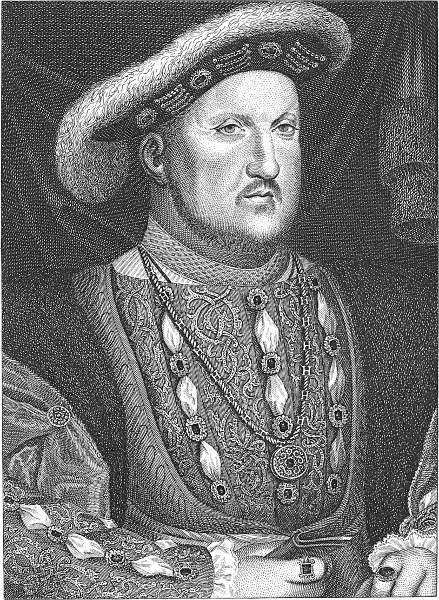
HENRY THE EIGHTH. FROM AN ORIGINAL PICTURE BY HOLBEIN. IN THE COLLECTION OF BARRET BRYDGES ESQ. AT LEE PRIORY IN KENT.
London, Published Jany. 1, 1825; by Harding, Triphook & Lepard.
When death (that favoureth none estate, king or keiser) had taken that prudent prince Henry the Seventh out of this present life (on whose soul Jesu have mercy!) who for his inestimable wisdom was noted and called, in every Christian region, the second Solomon, what practices, inventions, and compasses were then used about that young prince, King Henry the Eighth, his only son, and the great provision made for the funerals of the one, and the costly devices for the coronation of the other, with that virtuous Queen Catherine[60], then the king’s wife newly married. I omit and leave the circumstances thereof to historiographers of chronicles of princes, the which is no part mine intendment.
After all these solemnities and costly triumphs finished, and that our natural, young, lusty and courageous prince and sovereign lord, King Henry the Eighth, entering into the flower of pleasant youth, had taken upon him the regal sceptre and the imperial diadem of this fertile and plentiful realm of England (which at that time flourished in all abundance of wealth and riches, whereof he was inestimably garnished and furnished), called then the golden world, such grace of plenty reigned then within this realm. Now let us return again unto the almoner (of whom I have taken upon me to write), whose head was full of subtil wit and policy, [and] perceiving a plain path to walk in towards promotion, [he] handled himself so politicly, that he found the means to be made one of the king’s council, and to grow in good estimation and favour with the king, to whom the king gave a house at Bridewell, in Fleet Street, sometime Sir Richard Empson’s[61], where he kept house for his family, and he daily attended upon the king in the court, being in his especial grace and favour, [having][62] then great suit made unto him, as counsellors most commonly have that be in favour. His sentences and witty persuasions in the council chamber [were][63] always so pithy that they, always as occasion moved them, assigned him for his filed tongue and ornate eloquence, to be their expositor unto the king’s majesty in all their proceedings. In whom the king conceived such a loving fantasy, and in especial for that he was most earnest and readiest among all the council to advance the king’s only will and pleasure, without any respect to the case; the king, therefore, perceived him to be a meet instrument for the accomplishment of his devised will and pleasure, called him more near unto him, and esteemed him so highly that his estimation and favour put all other ancient counsellors out of their accustomed favour, that they were in before; insomuch that the king committed all his will and pleasure unto his disposition and order. Who wrought so all his matters, that all his endeavour was only to satisfy the king’s mind, knowing right well, that it was the very vein and right course to bring him to high promotion. The king was young and lusty, disposed all to mirth and pleasure, and to follow his desire and appetite, nothing minding to travail in the busy affairs of this realm. The which the almoner perceiving very well, took upon him therefore to disburden the king of so weighty a charge and troublesome business, putting the king in comfort that he shall not need to spare any time of his pleasure, for any business that should necessarily happen in the council, as long as he, being there and having the king’s authority and commandment, doubted not to see all things sufficiently furnished and perfected; the which would first make the king privy of all such matters as should pass through their hands before he would proceed to the finishing or determining of the same, whose mind and pleasure he would fulfill and follow to the uttermost, wherewith the king was wonderly pleased. And whereas the other ancient counsellors would, according to the office of good counsellors, diverse times persuade the king to have sometime an intercourse in to the council, there to hear what was done in weighty matters, the which pleased the king nothing at all, for he loved nothing worse than to be constrained to do any thing contrary to his royal will and pleasure; and that knew the almoner very well, having a secret intelligence of the king’s natural inclination, and so fast as the other counsellors advised the king to leave his pleasure, and to attend to the affairs of his realm, so busily did the almoner persuade him to the contrary; which delighted him much, and caused him to have the greater affection and love to the almoner. Thus the almoner ruled all them that before ruled him; such [things] did his policy and wit bring to pass. Who was now in high favour, but Master Almoner? Who had all the suit but Master Almoner? And who ruled all under the king, but Master Almoner? Thus he proceeded still in favour; at last, in came presents, gifts, and rewards so plentifully, that I dare say he lacked nothing that might either please his fantasy or enrich his coffers; fortune smiled so upon him; but to what end she brought him, ye shall hear after. Therefore let all men, to whom fortune extendeth her grace, not trust too much to her fickle favour and pleasant promises, under colour whereof she carrieth venemous gall. For when she seeth her servant in most highest authority, and that he assureth himself most assuredly in her favour, then turneth she her visage and pleasant countenance unto a frowning cheer, and utterly forsaketh him: such assurance is in her inconstant favour and sugared promise. Whose deceitful behaviour hath not been hid among the wise sort of famous clerks, that have exclaimed her and written vehemently against her dissimulation and feigned favour, warning all men thereby, the less to regard her, and to have her in small estimation of any trust or faithfulness.
This almoner, climbing thus hastily on fortune’s wheel, that no man was of that estimation with the king as he was, for his wisdom and other witty qualities, he had a special gift of natural eloquence[64], with a filed tongue to pronounce the same, that he was able with the same to persuade and allure all men to his purpose. Proceeding thus in fortune’s blissfulness, it chanced the wars between the realms of England and France to be open, but upon what occasion I know not, in so much as the king, being fully persuaded, and resolved in his most royal person to invade his foreign enemies with a puissant army, to delay their hault[65] brags, within their own territory: wherefore it was thought very necessary, that this royal enterprise should be speedily provided and plentifully furnished in every degree of things apt and convenient for the same; the expedition whereof, the king’s highness thought no man’s wit so meet, for policy and painful travail, as his wellbeloved almoner’s was, to whom therefore he committed his whole affiance and trust therein. And he being nothing scrupulous in any thing, that the king would command him to do, although it seemed to other very difficile, took upon him the whole charge and burden of all this business, and proceeded so therein, that he brought all things to a good pass and purpose in a right decent order, as of all manner of victuals, provisions, and other necessaries, convenient for so noble a voyage and puissant army.
All things being by him perfected, and furnished, the king, not minding to delay or neglect the time appointed, but with noble and valiant courage advanced to his royal enterprise, passed the seas between Dover and Calais, where he prosperously arrived[66]; and after some abode there of his Grace, as well for the arrival of his puissant army royal, provisions and munitions, as to consult about his princely affairs, marched forward, in good order of battle, through the Low Country, until he came to the strong town of Terouanne. To the which he laid his assault, and assailed it so fiercely with continual assaults, that within short space he caused them within to yield the town. Unto which place the Emperor Maximilian repaired unto the king our sovereign Lord, with a puissant army, like a mighty and friendly prince, taking of the king his Grace’s wages[67], as well for his own person as for his retinue, the which is a rare thing seldom seen, heard, or read, that an emperor should take wages, and fight under a king’s banner. Thus after the king had obtained the possession of this puissant fort, and set all things in due order, for the defence and preservation of the same to his highness’ use, he departed from thence, and marched toward the city of Tournay, and there again laid his siege; to the which he gave so fierce and sharp assaults, that they within were constrained of fine force[68] to yield up the town unto his victorious majesty. At which time he gave the Almoner the bishoprick of the same See, for some part of recompense of his pains sustained in that journey. And when the King had established all things there agreeable to his princely pleasure, and furnished the same with noble valiant captains and men of war, for the safeguard of the town against his enemies, he returned again into England, taking with him divers worthy persons of the peers of France, as the Duke of Longueville, and Countie Clermont, and divers other taken there in a skirmish most victoriously. After whose return immediately, the See of Lincoln fell void by the death of Doctor Smith, late bishop of that dignity, the which benefice and promotion his Grace gave unto his Almoner[69], Bishop elect of Tournay, who was not negligent to take possession thereof, and made all the speed he could for his consecration: the solemnization whereof ended, he found the means to get the possession of all his predecessor’s goods into his hands, whereof I have seen divers times some part thereof furnish his house. It was not long after that Doctor Bambridge[70], Archbishop of York, died at Rome, being there the king’s ambassador unto the Pope Julius; unto which benefice the king presented his new Bishop of Lincoln; so that he had three bishopricks[71] in one year given him. Then prepared he again of new as fast for his translation from the See of Lincoln, unto the See of York. After which solemnization done, and he being in possession of the Archbishoprick of York, and Primas Angliæ, thought himself sufficient to compare with Canterbury; and thereupon erected his cross in the court, and in every other place, as well in the presence of the Archbishop of Canterbury, and in the precinct of his jurisdiction as elsewhere. And forasmuch as Canterbury claimeth superiority and obedience of York, as he doth of all other bishops within this realm, forasmuch as he is primus totius Angliæ, and therefore claimeth, as a token of an ancient obedience, of York to abate the advancing of his cross, in the presence of the cross of Canterbury; notwithstanding York, nothing minding to desist from bearing of his cross in manner as is said before, caused his cross to be advanced[72] and borne before him, as well in the presence of Canterbury as elsewhere. Wherefore Canterbury being moved therewith, gave York a certain check for his presumption; by reason whereof there engendered some grudge between Canterbury and York. And York perceiving the obedience that Canterbury claimed to have of York, intended to provide some such means that he would rather be superior in dignity to Canterbury than to be either obedient or equal to him. Wherefore he obtained first to be made Priest Cardinal, and Legatus de latere; unto whom the Pope sent a Cardinal’s hat, with certain bulls for his authority in that behalf[73]. Yet by the way of communication ye shall understand that the Pope sent him this hat as a worthy jewel of his honour, dignity, and authority, the which was conveyed hither in a varlet’s budget, who seemed to all men to be but a person of small estimation. Whereof York being advertised, of the baseness of the messenger, and of the people’s opinion and rumour, thought it for his honour meet, that so high a jewel should not be conveyed by so simple a messenger; wherefore he caused him to be stayed by the way, immediately after his arrival in England, where he was newly furnished in all manner of apparel, with all kind of costly silks, which seemed decent for such an high ambassador. And that done, he was encountered upon Blackheath, and there received with a great assembly of prelates, and lusty gallant gentlemen, and from thence conducted and conveyed through London, with great triumph. Then was great and speedy provision[74] and preparation made in Westminster Abbey for the confirmation of his high dignity; the which was executed by all the bishops and abbots nigh or about London, in rich mitres and copes, and other costly ornaments; which was done in so solemn a wise as I have not seen the like unless it had been at the coronation of a mighty prince or king.
Obtaining this dignity [he] thought himself meet to encounter with Canterbury in his high jurisdiction before expressed; and that also he was as meet to bear authority among the temporal powers, as among the spiritual jurisdictions. Wherefore remembering as well the taunts and checks before sustained of Canterbury, which he intended to redress, having a respect to the advancement of worldly honour, promotion, and great benefits, [he] found the means with the king, that he was made Chancellor of England; and Canterbury thereof dismissed, who had continued in that honourable room and office, since long before the death of King Henry the Seventh[75].
Now he being in possession of the chancellorship, endowed with the promotion of an Archbishop, and Cardinal Legate de latere, thought himself fully furnished with such authorities and dignities, that he was able to surmount Canterbury in all ecclesiastical jurisdictions, having power to convocate Canterbury, and other bishops, within his precincts, to assemble at his convocation, in any place within this realm where he would assign; taking upon him the correction of all matters in every diocese, having there through all the realm all manner of spiritual ministers, as commissaries, scribes, apparitors, and all other officers to furnish his courts; visited also all spiritual houses, and presented by prevention whom he listed to their benefices. And to the advancing of his Legatine honours and jurisdictions, he had masters of his faculties, masters Ceremoniarum, and such other like officers to the glorifying of his dignity. Then had he two great crosses of silver, whereof one of them was for his Archbishoprick, and the other for his Legacy, borne always before him whither soever he went or rode, by two of the most tallest and comeliest priests that he could get within all this realm[76]. And to the increase of his gains he had also the bishoprick of Durham, and the Abbey of St. Albans in commendam; howbeit after, when Bishop Fox, of Winchester, died, he surrendered Durham into the King’s hands, and in lieu thereof took the Bishoprick of Winchester. Then he held also, as it were in ferme, Bath, Worcester, and Hereford, because the incumbents thereof were strangers[77], born out of this realm, continuing always beyond the seas, in their own native countries, or else at Rome, from whence they were sent by the Pope in legation into England to the king. And for their reward, at their departure, the prudent King Henry the Seventh thought it better to reward them with that thing, he himself could not keep, than to defray or disburse any thing of his treasure. And then they being but strangers, thought it more meet for their assurance, and to have their jurisdictions conserved and justly used, to permit the Cardinal to have their benefices for a convenient yearly sum of money to be paid them by exchanges in their countries, than to be troubled, or burdened with the conveyance thereof unto them: so that all their spiritual promotions and jurisdictions of their bishopricks were clearly in his domain and disposition, to prefer or promote whom he listed unto them. He had also a great number daily attending upon him, both of noblemen and worthy gentlemen, of great estimation and possessions, with no small number of the tallest yeomen, that he could get in all this realm, in so much that well was that nobleman and gentleman, that might prefer any tall and comely yeoman unto his service.
Now to speak of the order of his house and officers, I think it necessary here to be remembered. First ye shall understand, that he had in his hall, daily, three especial tables furnished with three principal officers; that is to say, a Steward, which was always a dean or a priest; a Treasurer, a knight; and a Comptroller, an esquire; which bare always within his house their white staves. Then had he a cofferer, three marshals, two yeomen ushers, two grooms, and an almoner. He had in the hall-kitchen two clerks of his kitchen, a clerk comptroller, a surveyor of the dresser, a clerk of his spicery. Also there in his hall-kitchen he had two master cooks, and twelve other labourers, and children as they called them; a yeoman of his scullery, and two other in his silver scullery; two yeomen of his pastry, and two grooms[78].
Now in his privy kitchen he had a Master Cook who went daily in damask satin, or velvet, with a chain of gold about his neck; and two grooms, with six labourers and children to serve in that place; in the Larder there, a yeoman and a groom; in the Scalding-house, a yeoman and two grooms; in the Scullery there, two persons; in the Buttery, two yeomen and two grooms, with two other pages; in the Pantry, two yeomen, two grooms, and two other pages; and in the Ewery likewise: in the Cellar, three yeomen, two grooms, and two pages; beside a gentleman for the month: in the Chaundery, three persons: in the Wafery, two; in the Wardrobe of beds, the master of the wardrobe, and ten other persons; in the Laundry, a yeoman, a groom, and three pages: of purveyors, two, and one groom; in the Bakehouse, a yeoman and two grooms; in the Wood-yard, a yeoman and a groom; in the Garner, one; in the Garden, a yeoman and two labourers. Now at the gate, he had of porters, two tall yeomen and two grooms; a yeoman of his barge: in the stable, he had a master of his horse, a clerk of the stable, a yeoman of the same; a Saddler, a Farrier, a yeoman of his Chariot, a Sumpter-man, a yeoman of his stirrup; a Muleteer; sixteen grooms of his stable, every of them keeping four great geldings: in the Almeserie, a yeoman and a groom.
Now I will declare unto you the officers of his chapel, and singing men of the same. First, he had there a Dean, who was always a great clerk and a divine; a Sub-dean; a Repeater of the quire; a Gospeller[79], a Pisteller; and twelve singing Priests: of Scholars, he had first, a Master of the children; twelve singing children; sixteen singing men; with a servant to attend upon the said children. In the Revestry[80], a yeoman and two grooms: then were there divers retainers of cunning singing men, that came thither at divers sundry principal feasts. But to speak of the furniture of his chapel passeth my capacity to declare the number of the costly ornaments and rich jewels, that were occupied in the same continually. For I have seen there, in a procession, worn forty-four copes of one suit, very rich, besides the sumptuous crosses, candlesticks, and other necessary ornaments to the comely furniture of the same. Now shall ye understand that he had two cross bearers, and two pillar bearers: and in his chamber, all these persons; that is to say: his high Chamberlain, his Vice Chamberlain; twelve Gentlemen ushers, daily waiters; besides two in his privy chamber; and of Gentlemen waiters in his privy chamber he had six; and also he had of Lords nine or ten[81], who had each of them allowed two servants; and the Earl of Derby had allowed five men. Then had he of Gentlemen, as cup-bearers, carvers, sewers, and Gentlemen daily waiters, forty persons; of yeomen ushers he had six; of grooms in his chamber he had eight; of yeomen of his chamber he had forty-six daily to attend upon his person; he had also a priest there which was his Almoner, to attend upon his table at dinner. Of doctors and chaplains attending in his closet to say daily mass before him, he had sixteen persons: and a clerk of his closet. Also he had two secretaries, and two clerks of his signet; and four counsellors learned in the laws of the realm.
And for as much as he was Chancellor of England, it was necessary for him to have divers officers of the Chancery to attend daily upon him, for the better furniture of the same. That is to say: first, he had the Clerk of the Crown, a Riding Clerk, a Clerk of the Hanaper, a Chafer of Wax. Then had he a Clerk of the Check, as well to check his Chaplains, as his Yeomen of the Chamber; he had also four Footmen, which were apparelled in rich running coats, whensoever he rode any journey. Then had he an herald at Arms, and a Sergeant at Arms; a Physician; an Apothecary; four Minstrels; a Keeper of his Tents, an Armourer; an Instructor of his Wards; two Yeomen in his Wardrobe; and a Keeper of his Chamber in the court. He had also daily in his house the Surveyor of York, a Clerk of the Green Cloth; and an Auditor. All this number of persons were daily attendant upon him in his house, down-lying and up-rising. And at meals, there was continually in his chamber a board kept for his Chamberlains, and Gentlemen Ushers, having with them a mess of the young Lords[82], and another for gentlemen. Besides all these, there was never an officer and gentleman, or any other worthy person in his house, but he was allowed some three, some two servants; and all other one at the least; which amounted to a great number of persons. Now have I showed you the order of his house, and what officers and servants he had, according to his checker roll, attending daily upon him; besides his retainers, and other persons being suitors, that most commonly were fed in his hall. And whensoever we shall see any more such subjects within this realm, that shall maintain any such estate and household, I am content he be advanced above him in honour and estimation. Therefore here I make an end of his household; whereof the number was about the sum of five hundred[83] persons according to his checker roll.
You have heard of the order and officers of his house; now I do intend to proceed forth unto other of his proceedings; for, after he was thus furnished, in manner as I have before rehearsed unto you, he was twice sent in embassy unto the Emperor Charles the Fifth, that now reigneth; and father unto King Philip, now our sovereign lord. Forasmuch as the old Emperor Maximilian was dead, and for divers urgent causes touching the king’s majesty, it was thought good that in so weighty a matter, and to so noble a prince, that the Cardinal was most meet to be sent on so worthy an embassy. Wherefore he being ready to take upon him the charge thereof, was furnished in all degrees and purposes most likest a great prince, which was much to the high honour of the king’s majesty, and of this realm. For first in his proceeding he was furnished like a cardinal of high estimation, having all things thereto correspondent and agreeable. His gentlemen, being in number very many, clothed in livery coats of crimson velvet of the most purest colour that might be invented, with chains of gold about their necks; and all his yeomen and other mean officers were in coats of fine scarlet, guarded with black velvet a hand broad. He being thus furnished in this manner, was twice sent unto the emperor into Flanders, the emperor lying then in Bruges; who entertained our ambassador very highly[84], discharging him and all his train of their charge; for there was no house within all Bruges, wherein any gentlemen of the Lord Ambassador’s lay, or had recourse, but that the owners of the houses were commanded by the emperor’s officers, that they, upon pain of their lives, should take no money for any thing that the cardinal’s servants should take or dispend in victuals; no, although they were disposed to make any costly banquets: furthermore commanding their said hosts, to see that they lacked no such thing as they desired or required to have for their pleasures. Also the emperor’s officers every night went through the town, from house to house, where as any English men lay or resorted, and there served their liveries[85] for all night; which was done after this manner: first, the emperor’s officers brought in to the house a cast of fine manchet bread[86], two great silver pots, with wine, and a pound of fine sugar; white lights and yellow; a bowl or goblet of silver, to drink in; and every night a staff torch. This was the order of their liveries every night. And then in the morning, when the officers came to fetch away their stuff, then would they accompt with the host for the gentlemen’s costs spent in that night and day before. Thus the emperor entertained the cardinal and all his train, for the time of his embassy there. And that done, he returned home again into England, with great triumph, being no less in estimation with the king than he was before, but rather much more.
Now will I declare unto you his order in going to Westminster Hall, daily in the term season. First, before his coming out of his privy chamber, he heard most commonly every day two masses in his privy closet; and there then said his daily service with his chaplain: and as I heard his chaplain say, being a man of credence and of excellent learning, that the cardinal, what business or weighty matters soever he had in the day, he never went to his bed with any part of his divine service unsaid, yea not so much as one collect; wherein I doubt not but he deceived the opinion of divers persons. And after mass he would return in his privy chamber again, and being advertised of the furniture of his chambers without, with noblemen, gentlemen, and other persons, would issue out into them, appareled all in red, in the habit of a cardinal; which was either of fine scarlet, or else of crimson satin, taffety, damask, or caffa, the best that he could get for money: and upon his head a round pillion, with a noble of black velvet set to the same in the inner side; he had also a tippet of fine sables about his neck; holding in his hand a very fair orange, whereof the meat or substance within was taken out, and filled up again with the part of a sponge, wherein was vinegar, and other confections against the pestilent airs; the which he most commonly smelt unto, passing among the press, or else when he was pestered with many suitors. There was also borne before him first, the great seal of England, and then his cardinal’s hat, by a nobleman or some worthy gentleman, right solemnly, bareheaded. And as soon as he was entered into his chamber of presence, where there was attending his coming to await upon him to Westminster Hall, as well noblemen and other worthy gentlemen, as noblemen and gentlemen of his own family; thus passing forth with two great crosses of silver borne before him[87]; with also two great pillars of silver, and his pursuivant at arms with a great mace of silver gilt. Then his gentlemen ushers cried, and said: “On, my lords and masters, on before; make way for my Lord’s Grace!” Thus passed he down from his chamber through the hall; and when he came to the hall door, there was attendant for him his mule, trapped all together in crimson velvet, and gilt stirrups. When he was mounted, with his cross bearers, and pillar bearers[88], also upon great horses trapped with [fine] scarlet. Then marched he forward, with his train and furniture in manner as I have declared, having about him four footmen, with gilt pollaxes in their hands; and thus he went until he came to Westminster Hall door. And there alighted, and went after this manner, up through the hall into the chancery; howbeit he would most commonly stay awhile at a bar, made for him, a little beneath the chancery [on the right hand], and there commune some time with the judges, and sometime with other persons. And that done he would repair into the chancery, sitting there till eleven of the clock, hearing suitors, and determining of divers matters. And from thence, he would divers times go into the star chamber, as occasion did serve; where he spared neither high nor low, but judged every estate according to their merits and deserts.
He used every Sunday to repair to the court, being then for the most part at Greenwich, in the term; with all his former order, taking his barge at his privy stairs, furnished with tall yeomen standing upon the bayles, and all gentlemen being within with him; and landed again at the Crane in the vintry. And from thence he rode upon his mule, with his crosses, his pillars, his hat, and the great seal, through Thames Street, until he came to Billingsgate, or thereabout; and there took his barge again, and rowed to Greenwich, where he was nobly received of the lords and chief officers of the king’s house, as the treasurer and comptroller, with others; and so conveyed to the king’s chamber: his crosses commonly standing for the time of his abode in the court, on the one side of the king’s cloth of estate. He being thus in the court, it was wonderly furnished with noblemen and gentlemen, much otherwise than it was before his coming. And after dinner, among the lords, having some consultation with the king, or with the council, he would depart homeward with like state[89]: and this order he used continually, as opportunity did serve.
Thus in great honour, triumph, and glory, he reigned a long season, ruling all things within this realm, appertaining unto the king, by his wisdom, and also all other weighty matters of foreign regions, with which the king of this realm had any occasion to intermeddle. All ambassadors of foreign potentates were always dispatched by his discretion, to whom they had always access for their dispatch. His house was also always resorted and furnished with noblemen, gentlemen, and other persons, with going and coming in and out, feasting and banqueting all ambassadors diverse times, and other strangers right nobly.
And when it pleased the king’s majesty, for his recreation, to repair unto the cardinal’s house, as he did divers times in the year, at which time there wanted no preparations, or goodly furniture, with viands of the finest sort that might be provided for money or friendship. Such pleasures were then devised for the king’s comfort and consolation, as might be invented, or by man’s wit imagined. The banquets were set forth, with masks and mummeries, in so gorgeous a sort, and costly manner, that it was a heaven to behold. There wanted no dames, or damsels, meet or apt to dance with the maskers, or to garnish the place for the time, with other goodly disports. Then was there all kind of music and harmony set forth, with excellent voices both of men and children. I have seen the king suddenly come in thither in a mask, with a dozen of other maskers, all in garments like shepherds, made of fine cloth of gold and fine crimson satin paned, and caps of the same, with visors of good proportion of visnomy; their hairs, and beards, either of fine gold wire, or else of silver, and some being of black silk; having sixteen torch bearers, besides their drums, and other persons attending upon them, with visors, and clothed all in satin, of the same colours. And at his coming, and before he came into the hall, ye shall understand, that he came by water to the water gate, without any noise; where, against his coming, were laid charged many chambers[90], and at his landing they were all shot off, which made such a rumble in the air, that it was like thunder. It made all the noblemen, ladies, and gentlewomen, to muse what it should mean coming so suddenly, they sitting quietly at a solemn banquet; under this sort: First, ye shall perceive that the tables were set in the chamber of presence, banquet-wise covered, my Lord Cardinal sitting under the cloth of estate, and there having his service all alone; and then was there set a lady and a nobleman, or a gentleman and gentlewoman, throughout all the tables in the chamber on the one side, which were made and joined as it were but one table. All which order and device was done and devised by the Lord Sands, Lord Chamberlain to the king; and also by Sir Henry Guilford, Comptroller to the king. Then immediately after this great shot of guns, the cardinal desired the Lord Chamberlain, and Comptroller, to look what this sudden shot should mean, as though he knew nothing of the matter. They thereupon looking out of the windows into Thames, returned again, and showed him, that it seemed to them there should be some noblemen and strangers arrived at his bridge, as ambassadors from some foreign prince. With that, quoth the cardinal, "I shall desire you, because ye can speak French, to take the pains to go down into the hall to encounter and to receive them, according to their estates, and to conduct them into this chamber, where they shall see us, and all these noble personages sitting merrily at our banquet, desiring them to sit down with us, and to take part of our fare and pastime. Then [they] went incontinent down into the hall, where they received them with twenty new torches, and conveyed them up into the chamber, with such a number of drums and fifes as I have seldom seen together, at one time in any masque. At their arrival into the chamber, two and two together, they went directly before the cardinal where he sat, saluting him very reverently; to whom the Lord Chamberlain for them said: "Sir, for as much as they be strangers, and can speak no English, they have desired me to declare unto your Grace thus: they, having understanding of this your triumphant banquet, where was assembled such a number of excellent fair dames, could do no less, under the supportation of your good grace, but to repair hither to view as well their incomparable beauty, as for to accompany them at mumchance[91], and then after to dance with them, and so to have of them acquaintance. And, sir, they furthermore require of your Grace licence to accomplish the cause of their repair." To whom the cardinal answered, that he was very well contented they should so do. Then the maskers went first and saluted all the dames as they sat, and then returned to the most worthiest, and there opened a cup full of gold, with crowns, and other pieces of coin, to whom they set divers pieces to cast at. Thus in this manner perusing all the ladies and gentlewomen, and to some they lost, and of some they won. And thus done, they returned unto the cardinal, with great reverence, pouring down all the crowns in the cup, which was about two hundred crowns. “At all,” quoth the cardinal, and so cast the dice, and won them all at a cast; whereat was great joy made. Then quoth the cardinal to my Lord Chamberlain, “I pray you,” quoth he, “show them that it seemeth me that there should be among them some noble man, whom I suppose to be much more worthy of honour to sit and occupy this room and place than I; to whom I would most gladly, if I knew him, surrender my place according to my duty.” Then spake my Lord Chamberlain unto them in French, declaring my Lord Cardinal’s mind, and they rounding[92] him again in the ear, my Lord Chamberlain said to my Lord Cardinal, “Sir, they confess,” quoth he, “that among them there is such a noble personage, whom, if your Grace can appoint him from the other, he is contented to disclose himself, and to accept your place most worthily.” With that the cardinal, taking a good advisement among them, at the last, quoth he, “Me seemeth the gentleman with the black beard should be even he.” And with that he arose out of his chair, and offered the same to the gentleman in the black beard, with his cap in his hand. The person to whom he offered then his chair was Sir Edward Neville, a comely knight of a goodly personage, that much more resembled the king’s person in that mask, than any other. The king, hearing and perceiving the cardinal so deceived in his estimation and choice, could not forbear laughing; but plucked down his visor, and Master Neville’s also, and dashed out with such a pleasant countenance and cheer, that all noble estates there assembled, seeing the king to be there amongst them, rejoiced very much. The cardinal eftsoons desired his highness to take the place of estate, to whom the king answered, that he would go first and shift his apparel; and so departed, and went straight into my lord’s bedchamber, where was a great fire made and prepared for him; and there new apparelled him with rich and princely garments. And in the time of the king’s absence, the dishes of the banquet were clean taken up, and the tables spread again with new and sweet perfumed cloths; every man sitting still until the king and his maskers came in among them again, every man being newly apparelled. Then the king took his seat under the cloth of estate, commanding no man to remove, but sit still, as they did before. Then in came a new banquet before the king’s majesty, and to all the rest through the tables, wherein, I suppose, were served two hundred dishes or above, of wondrous costly meats and devices, subtilly devised. Thus passed they forth the whole night with banqueting, dancing, and other triumphant devices, to the great comfort of the king, and pleasant regard of the nobility there assembled.
All this matter I have declared at large, because ye shall understand what joy and delight the cardinal had to see his prince and sovereign lord in his house so nobly entertained and pleased, which was always his only study, to devise things to his comfort, not passing of the charges or expenses. It delighted him so much, to have the king’s pleasant princely presence, that no thing was to him more delectable than to cheer his sovereign lord, to whom he owed so much obedience and loyalty; as reason required no less, all things well considered.
Thus passed the cardinal his life and time, from day to day, and year to year, in such great wealth, joy, and triumph, and glory, having always on his side the king’s especial favour; until Fortune, of whose favour no man is longer assured than she is disposed, began to wax something wroth with his prosperous estate, [and] thought she would devise a mean to abate his high port; wherefore she procured Venus, the insatiate goddess, to be her instrument. To work her purpose, she brought the king in love with a gentlewoman, that, after she perceived and felt the king’s good will towards her, and how diligent he was both to please her, and to grant all her requests, she wrought the cardinal much displeasure; as hereafter shall be more at large declared. This gentlewoman, the daughter of Sir Thomas Boleyn, being at that time but only a bachelor knight, the which after, for the love of his daughter, was promoted to higher dignities. He bare at divers several times for the most part all the rooms of estimation in the king’s house; as Comptroller, Treasurer, Vice Chamberlain, and Lord Chamberlain. Then was he made Viscount Rochford; and at the last created Earl of Wiltshire, and Knight of the noble Order of the Garter; and, for his more increase of gain and honour, he was made Lord Privy Seal, and most chiefest of the king’s privy council. Continuing therein until his son and daughter did incur the king’s indignation and displeasure. The king fantasied so much his daughter Anne, that almost all things began to grow out of frame and good order[93].
To tell you how the king’s love began to take place, and what followed thereof, I will even as much as in me lieth, declare [unto] you. This gentlewoman, Mistress Anne Boleyn, being very young[94] was sent into the realm of France, and there made one of the French[95] queen’s women, continuing there until the French queen died. And then was she sent for home again; and being again with her father, he made such means that she was admitted to be one of Queen Katharine’s maids, among whom, for her excellent gesture and behaviour, [she] did excel all other; in so much, as the king began to kindle the brand of amours; which was not known to any person, ne scantly to her own person.
In so much [as] my Lord Percy, the son and heir of the Earl of Northumberland, then attended upon the Lord Cardinal, and was also his servitor; and when it chanced the Lord Cardinal at any time to repair to the court, the Lord Percy would then resort for his pastime unto the queen’s chamber, and there would fall in dalliance among the queen’s maidens, being at the last more conversant with Mistress Anne Boleyn than with any other; so that there grew such a secret love between them that, at length, they were insured together[96], intending to marry. The which thing came to the king’s knowledge, who was then much offended. Wherefore he could hide no longer his secret affection, but revealed his secret intendment unto my Lord Cardinal in that behalf; and consulted with him to infringe the precontract between them: insomuch, that after my Lord Cardinal was departed from the court, and returned home to his place at Westminster, not forgetting the king’s request and counsel, being in his gallery, called there before him the said Lord Percy unto his presence, and before us his servants of his chamber, saying thus unto him. “I marvel not a little,” quoth he, "of thy peevish folly, that thou wouldest tangle and ensure thyself with a foolish girl yonder in the court, I mean Anne Boleyn. Dost thou not consider the estate that God hath called thee unto in this world? For after the death of thy noble father, thou art most like to inherit and possess one of the most worthiest earldoms of this realm. Therefore it had been most meet, and convenient for thee, to have sued for the consent of thy father in that behalf, and to have also made the king’s highness privy thereto; requiring therein his princely favour, submitting all thy whole proceeding in all such matters unto his highness, who would not only accept thankfully your submission, but would, I assure thee, provide so for your purpose therein, that he would advance you much more nobly, and have matched you according to your estate and honour, whereby ye might have grown so by your wisdom and honourable behaviour into the king’s high estimation, that it should have been much to your increase of honour. But now behold what ye have done through your wilfulness. Ye have not only offended your natural father, but also your most gracious sovereign lord, and matched yourself with one, such as neither the king, ne yet your father will be agreeable with the matter. And hereof I put you out of doubt, that I will send for your father, and at his coming, he shall either break this unadvised contract, or else disinherit thee for ever. The king’s majesty himself will complain to thy father on thee, and require no less at his hand than I have said; whose highness intended to have preferred [Anne Boleyn] unto another person, with whom the king hath travelled already, and being almost at a point with the same person, although she knoweth it not, yet hath the king, most like a politic and prudent prince, conveyed the matter in such sort, that she, upon the king’s motion, will be (I doubt not) right glad and agreeable to the same." “Sir,” (quoth the Lord Percy, all weeping), "I knew nothing of the king’s pleasure therein, for whose displeasure I am very sorry. I considered that I was of good years, and thought myself sufficient to provide me of a convenient wife, whereas my fancy served me best, not doubting but that my lord my father would have been right well persuaded. And though she be a simple maid, and having but a knight to her father, yet is she descended of right noble parentage. As by her mother she is nigh of the Norfolk blood: and of her father’s side lineally descended of the Earl of Ormond, he being one of the earl’s heirs general[97]. Why should I then, sir, be any thing scrupulous to match with her, whose estate of descent is equivalent with mine when I shall be in most dignity? Therefore I most humbly require your grace of your especial favour herein; and also to entreat the king’s most royal majesty most lowly on my behalf for his princely benevolence in this matter, the which I cannot deny or forsake." “Lo, sirs,” quoth the cardinal, “ye may see what conformity and wisdom is in this wilful boy’s head. I thought that when thou heardest me declare the king’s intended pleasure and travail herein, thou wouldest have relented and wholly submitted thyself, and all thy wilful and unadvised fact, to the king’s royal will and prudent pleasure, to be fully disposed and ordered by his grace’s disposition, as his highness should seem good.” “Sir, so I would,” quoth the Lord Percy, “but in this matter I have gone so far, before many so worthy witnesses, that I know not how to avoid my self nor to discharge my conscience.” “Why, thinkest thou,” quoth the cardinal, "that the king and I know not what we have to do in as weighty a matter as this? Yes (quoth he), I warrant thee. Howbeit I can see in thee no submission to the purpose." “Forsooth, my Lord,” quoth the Lord Percy, “if it please your grace, I will submit myself wholly unto the king’s majesty and [your] grace in this matter, my conscience being discharged of the weighty burthen of my precontract.” “Well then,” quoth the cardinal, “I will send for your father out of the north parts, and he and we shall take such order for the avoiding of this thy hasty folly as shall be by the king thought most expedient. And in the mean season I charge thee, and in the king’s name command thee, that thou presume not once to resort into her company, as thou intendest to avoid the king’s high indignation.” And this said he rose up and went into his chamber.
Then was the Earl of Northumberland sent for in all haste, in the king’s name, who upon knowledge of the king’s pleasure made quick speed to the court. And at his first coming out of the north he made his first repair unto my Lord Cardinal, at whose mouth he was advertised of the cause of his hasty sending for; being in my Lord Cardinal’s gallery with him in secret communication a long while. And after their long talk my Lord Cardinal called for a cup of wine, and drinking together they brake up, and so departed the earl, upon whom we were commanded to wait to convey him to his servants. And in his going away, when he came to the gallery’s end, he sat him down upon a form that stood there for the waiters some time to take their ease. And being there set called his son the Lord Percy unto him, and said in our presence thus in effect. “Son,” quoth he, "thou hast always been a proud, presumptuous, disdainful, and a very unthrift waster, and even so hast thou now declared thyself. Therefore what joy, what comfort, what pleasure or solace should I conceive in thee, that thus without discretion and advisement hast misused thyself, having no manner of regard to me thy natural father, ne in especial unto thy sovereign lord, to whom all honest and loyal subjects bear faithful and humble obedience; ne yet to the wealth of thine own estate, but hast so unadvisedly ensured thyself to her, for whom thou hast purchased thee the king’s displeasure, intolerable for any subject to sustain! But that his grace of his mere wisdom doth consider the lightness of thy head, and wilful qualities of thy person, his displeasure and indignation were sufficient to cast me and all my posterity into utter subversion and dissolution: but he being my especial and singular good lord and favourable prince, and my Lord Cardinal my good lord hath and doth clearly excuse me in thy lewd fact, and doth rather lament thy lightness than malign the same; and hath devised an order to be taken for thee; to whom both thou and I be more bound than we be able well to consider. I pray to God that this may be to thee a sufficient monition and warning to use thyself more wittier hereafter; for thus I assure thee, if thou dost not amend thy prodigality, thou wilt be the last earl of our house. For of thy natural inclination thou art disposed to be wasteful prodigal, and to consume all that thy progenitors have with great travail gathered together and kept with honour. But having the king’s majesty my singular good and gracious lord, I intend (God willing) so to dispose my succession, that ye shall consume thereof but a little. For I do not purpose, I assure thee, to make thee mine heir; for, praises be to God, I have more choice of boys who, I trust, will prove themselves much better, and use them more like unto nobility, among whom I will choose and take the best and most likeliest to succeed me. Now, masters and good gentlemen," (quoth he unto us), "it may be your chances hereafter, when I am dead, to see the proof of these things that I have spoken to my son prove as true as I have spoken them. Yet in the mean season I desire you all to be his friends, and to tell him his fault when he doth amiss, wherein ye shall show yourselves to be much his friends." And with that he took his leave of us. And said to his son thus: “Go your ways, and attend upon my lord’s grace your master, and see that you do your duty.” And so departed, and went his way down through the hall into his barge.
Then after long debating and consultation upon the Lord Percy’s assurance, it was devised that the same should be infringed and dissolved, and that the Lord Percy should marry with one of the Earl of Shrewsbury’s daughters[98]; (as he did after); by means whereof the former contract was clearly undone. Wherewith Mistress Anne Boleyn was greatly offended, saying, that if it lay ever in her power, she would work the cardinal as much displeasure; as she did in deed after. And yet was he nothing to blame, for he practised nothing in that matter, but it was the king’s only device. And even as my Lord Percy was commanded to avoid her company, even so was she commanded to avoid the court, and sent home again to her father for a season; whereat she smoked[99]: for all this while she knew nothing of the king’s intended purpose.
But ye may see when fortune beginneth to lower, how she can compass a matter to work displeasure by a far fetch. For now, mark, good reader, the grudge, how it began, that in process [of time] burst out to the utter undoing of the cardinal. O Lord, what a God art thou! that workest thy secrets so wonderfully, which be not perceived until they be brought to pass and finished. Mark this history following, good reader, and note every circumstance, and thou shaft espy at thine eye the wonderful work of God, against such persons as forgetteth God and his great benefits! Mark, I say, mark them well!
After that all these troublesome matters of my Lord Percy’s were brought to a good stay, and all things finished that were before devised, Mistress Anne Boleyn was revoked unto the court[100], where she flourished after in great estimation and favour; having always a privy indignation unto the cardinal, for breaking off the precontract made between my Lord Percy and her, supposing that it had been his own device and will, and none other, not yet being privy to the king’s secret mind, although that he had a great affection unto her. Howbeit, after she knew the king’s pleasure, and the great love that he bare her in the bottom of his stomach, then she began to look very hault and stout, having all manner of jewels, or rich apparel, that might be gotten with money. It was therefore judged by-and-bye through all the court of every man, that she being in such favour, might work masteries with the king, and obtain any suit of him for her friend.
And all this while, she being in this estimation in all places, it is no doubt but good Queen Katharine, having this gentlewoman daily attending upon her, both heard by report, and perceived before her eyes, the matter how it framed against her (good lady), although she showed ne to Mistress Anne, ne unto the king, any spark or kind of grudge or displeasure; but took and accepted all things in good part, and with wisdom and great patience dissimuled the same, having Mistress Anne in more estimation for the king’s sake than she had before, declaring herself thereby to be a perfect Griselda, as her patient acts shall hereafter more evidently to all men be declared[101].
The king waxed so far in amours with this gentlewoman that he knew not how much he might advance her. This perceiving, the great lords of the council, bearing a secret grudge against the cardinal, because that they could not rule in the scene well for him as they would, who kept them low, and ruled them as well as other mean subjects, whereat they caught an occasion to invent a mean to bring him out of the king’s high favour, and them into more authority of rule and civil governance. After long and secret consultation amongst themselves, how to bring their malice to effect against the cardinal, they knew right well that it was very difficile for them to do any thing directly of themselves. Wherefore, they perceiving the great affection that the king bare lovingly unto Mistress Anne Boleyn, fantasying in their heads that she should be for them a sufficient and an apt instrument to bring their malicious purpose to pass, with her they often consulted in this matter. And she having both a very good wit, and also an inward desire to be revenged of the cardinal[102], was as agreeable to their requests as they were themselves. Wherefore there was no more to do but only to imagine some presented circumstances to induce their malicious accusations. Insomuch that there was imagined and invented among them diverse imaginations and subtle devices, how this matter should be brought about. The enterprise thereof was so dangerous, that though they would fain have often attempted the matter with the king, yet they durst not; for they knew the great loving affection and especial favour that the king bare to the cardinal, and also they feared the wonderous wit of the cardinal. For this they understood very well, that if their matter that they should propone against him were not grounded upon a just and an urgent cause, the king’s favour being such towards him, and his wit such, that he would with policy vanquish all their purpose and travail, and then lye in a-wait to work them an utter destruction and subversion. Wherefore they were compelled, all things considered, to forbear their enterprise until they might espy a more convenient time and occasion.
And yet the cardinal, espying the great zeal that the king had conceived in this gentlewoman, ordered himself to please as well the king as her, dissimuling the matter that lay hid in his breast, and prepared great banquets and solemn feasts to entertain them both at his own house. And thus the world began to grow into wonderful inventions, not heard of before in this realm. The love between the king and this gorgeous lady grew to such a perfection, that divers imaginations were imagined, whereof I leave to speak until I come to the place where I may have more occasion.
Then began a certain grudge to arise between the French king and the Duke of Bourbon, in so much as the Duke, being vassal to the house of France, was constrained for the safeguard of his person to flee his dominions, and to forsake his territory and country, doubting the king’s great malice and indignation. The cardinal, having thereof intelligence, compassed in his head, that if the king our sovereign lord (having an occasion of wars with the realm of France), might retain the duke to be his general in the wars there: in as much as the duke was fled unto the emperor, to invite him also, to stir wars against the French king. The cardinal having all this imagination in his head thought it good to move the king in this matter. And after the king was once advertised hereof, and conceived the cardinal’s imagination and invention, he dreamed of this matter more and more, until at the last it came in question among the council in consultation, so that it was there finally concluded that an embassy should be sent to the emperor about this matter; with whom it was concluded that the king and the emperor should join in these wars against the French king, and that the Duke of Bourbon should be our sovereign lord’s champion and general in the field; who had appointed him a great number of good soldiers over and besides the emperor’s army, which was not small, and led by one of his own noblemen; and also that the king should pay the duke his wages, and his retinue monthly. In so much as Sir John Russel, (who was after Earl of Bedford), lay continually beyond the seas in a secret place, assigned both for to receive the king’s money and to pay the same monthly to the duke. So that the duke began fierce war with the French king in his own territory and dukedom, which the French king had confiscated and seized into his hands; yet not known to the duke’s enemies that he had any aid of the king our sovereign lord. And thus he wrought the French king much trouble and displeasure; in so much as the French king was compelled of fine force to put harness on his back, and to prepare a puissant army royal, and in his own person to advance to defend and resist the duke’s power and malice. The duke having understanding of the king’s advancing was compelled of force to take Pavia, a strong town in Italy, with his host, for their security; where as the king besieged him, and encamped him wondrous strongly, intending to enclose the Duke within this town, that he should not issue. Yet notwithstanding the duke would and did many times issue and skirmish with the king’s army.
Now let us leave the king in his camp before Pavia, and return again to the Lord Cardinal, who seemed to be more French than Imperial. But how it came to pass I cannot declare [unto] you: but the [French] king lying in his camp, sent secretly into England a privy person, a very witty man, to entreat of a peace between him and the king our sovereign lord, whose name was John Joachin[103]; he was kept as secret as might be, that no man had intelligence of his repair; for he was no Frenchman, but an Italian born, a man before of no estimation in France, or known to be in favour with his master, but to be a merchant, and for his subtle wit elected to entreat of such affairs as the king had commanded him by embassy. This Joachin after his arrival here in England was secretly conveyed unto the king’s manor of Richmond, and there remained until Whitsuntide, at which time the cardinal resorted thither, and kept there the said feast very solemnly. In which season my lord caused this Joachin divers times to dine with him, whose talk and behaviour seemed to be witty, sober, and wondrous discreet. [He] continued in England long after, until he had (as it seemed) brought his purposed embassy to pass which he had in commission. For after this there was sent out immediately a restraint unto Sir John Russell, into those parts where he made his abiding beyond the seas, that he should retain and keep back that month’s wages still in his hands, which should have been paid unto the Duke of Bourbon, until the king’s pleasure were to him further known; for want of which money at the day appointed of payment, the duke and his retinue were greatly dismayed and sore disappointed; and when they saw that their money was not brought unto them as it was wont to be. And being in so dangerous a case for want of victuals, which were wondrous scant and dear, there were many imaginations what should be the cause of the let thereof. Some said this, and some said they wist never what; so that they mistrusted no thing less than the very cause thereof. In so much at the last, what for want of victual and other necessaries which could not be gotten within the town, the captains and soldiers began to grudge and mutter; and at the last, for lack of victuals, were like all to perish. They being in this extremity came before the Duke of Bourbon their captain, and said, “Sir, we must be of very force and necessity compelled to yield us in to the danger of our enemies; and better it were for us so to do than here to starve like dogs.” When the duke heard the lamentations, and understood the extremities that they were brought unto for lack of money, he said again unto them, “Sirs,” quoth he, "ye are both valiant men and of noble courage, who have served here under me right worthily; and for your necessity, whereof I am participant, I do not a little lament. (Howbeit) I shall desire you, as ye are noble in hearts and courage, so to take patience for a day or twain: and if succour come not then from the King of England, as I doubt nothing that he will deceive us, I will well agree that we shall all put ourselves and all our lives unto the mercy of our enemies;" wherewith they were all agreeable. And expecting the coming of the king’s money the space of three days, (the which days passed), the duke seeing no remedy called his noble men, and captains, and soldiers before him, and all weeping said, "O ye noble captains and valiant men, my gentle companions, I see no remedy in this necessity but either we must yield us unto our enemies, or else famish. And to yield the town and ourselves, I know not the mercy of our enemies. As for my part I pass not of their cruelties, for I know very well I shall suffer most cruel death if I come once into their hands. It is not for myself therefore that I do lament, but it is for your sakes; it is for your lives; it is also for the safeguard of your persons. For so that ye might escape the danger of your enemies’ hands, I would most gladly suffer death. Therefore, good companions and noble soldiers, I shall require you all, considering the dangerous misery and calamity that we stand in at this present, to sell our lives most dearly rather than to be murdered like beasts. If ye will follow my counsel we will take upon us this night to give our enemies an assault in their camp, and by that means we may either escape, or else give them an overthrow. And thus it were better to die in the field like men, than to live in captivity and misery as prisoners." To the which they all agreed. “Then,” quoth the duke, "Ye perceive that our enemy hath encamped us with a strong camp, and that there is no way to enter but one, which is so planted with great ordnance, and force of men, that it is not possible to enter that way to fight with our enemies without great danger. And also, ye see that now of late they have had small doubt of us, insomuch as they have kept but slender watch. Therefore my policy and advice shall be this: That about the dead time of the night, when our enemies be most quiet at rest, there shall issue from us a number of the most deliverest soldiers to assault their camp; who shall give the assault right secretly, even directly against the entry of the camp, which is almost invincible. Your fierce and sharp assault shall be to them in the camp so doubtful, that they shall be compelled to turn the strength of their entry that lyeth over against your assault, to beat you from the assault. Then will I issue out at the postern, and come to the place of their strength newly turned, and there, or they be ware, will I enter and fight with them at the same place where their guns and strength lay before, and so come to the rescue of you of the assault, and winning their ordnance which they have turned, beat them with their own pieces. And then we joining together in the field, I trust we shall have a fair hand of them. This device pleased them wondrous well. Then prepared they all that day for the purposed device, and kept them secret and close, without any noise or shot of piece within the town, which gave their enemies the less fear of any trouble that night, but every man went to their rest within their tents and lodgings quietly, nothing mistrusting that after ensued.
Then when all the king’s host was at rest, the assailants issued out of the town without any noise, according to the former appointment, and gave a fierce and cruel assault at the place appointed; that they within the camp had as much to do to defend it as was possible: and even as the duke had before declared to his soldiers, they within were compelled to turn their shot that lay at the entry against the assailants. With that issued the duke, and with him about fifteen or sixteen thousand men or more, and secretly in the night, his enemies being not privy of his coming until he was entered the field. And at his first entry he was master of all the ordnance that lay there, and slew the gunners; and charged the said pieces and bent them against his enemies, [of] whom he slew wondrously a great number. He cut down tents and pavilions, and murdered them within them, or they wist of [his] coming, suspecting nothing less than the duke’s entry; so that he won the field or ever the king could arise to the rescue: who was taken in his lodging or ever he was armed. And when the duke had obtained the field, and the French king taken prisoner, his men slain, and his tents robbed and spoiled, which were wondrous rich. And in the spoil, searching of the king’s treasure in his coffers there was found among them the league newly concluded between the King of England and the French king, under the great seal of England; which once by [the duke] perceived, he began to smell the impediment of his money which should have come to him from the king. Having upon due search of this matter further intelligence that all this matter and his utter undoing was concluded and devised by the Cardinal of England, the duke conceived such an indignation hereupon against the cardinal, that after he had established all things there in good order and security, he went incontinent unto Rome, intending there to sack the town, and to have taken the pope prisoner: where, at his first assault of the walls, he was the first man that was there slain. Yet, notwithstanding, his captains continued there the assault, and in conclusion won the town, and the pope fled unto Castle Angell, where he continued long after in great calamity.
I have written thus this history at large because it was thought that the cardinal gave the chief occasion of all this mischief[104]. Ye may perceive what thing soever a man purposeth, be he prince or prelate, yet notwithstanding God disposeth all things at his will and pleasure. Wherefore it is great folly for any wise man to take any weighty enterprise of himself, trusting altogether to his own wit, not calling for grace to assist him in all his proceedings.
I have known and seen in my days that princes and great men [who] would either assemble at any parliament, or in any other great business, first would most reverently call to God for his gracious assistance therein. And now I see the contrary. Wherefore me seems that they trust more in their own wisdoms and imaginations than they do to God’s help and disposition; and therefore often they speed thereafter, and their matters take no success. Therefore not only in this history, but in divers others, ye may perceive right evident examples. And yet I see no man almost in authority or high estate regard or have any respect to the same; the greater is the pity, and the more to be lamented. Now will I desist from this matter and proceed to other.
Upon the taking of the French king, many consultations and divers opinions were then in argument among the council here in England. Whereof some held opinion that if the king would invade the realm of France in proper person, with a puissant army royal, he might easily conquer the same; considering that the French king, and the most part of the noble peers of France, were then prisoners with the emperor. Some again said how that were no honour for the king our sovereign lord, (the king being in captivity). But some said that the French king ought by the law of arms to be the king’s prisoner, forasmuch as he was taken by the king’s champion and general captain, the Duke of Bourbon, and not by the emperor. So that some moved the king to take war thereupon with the emperor, unless he would deliver the French king out of his hands and possession; with divers many other imaginations and inventions, even as men’s fantasies served them, too long here to be rehearsed: the which I leave to the writers of chronicles.
Thus continuing long in debating upon the matter, and every man in the court had their talk, as will without wit led their fantasies; at the last it was devised by means of divers embassies sent into England out of the realm of France, desiring the king our sovereign lord to take order with the emperor for the French king’s deliverance, as his royal wisdom should seem good, wherein the cardinal bare the stroke; so that after long deliberation and advice taken in this matter, it was thought good by the cardinal that the emperor should redeliver out of his ward the French king, upon sufficient pledges. And that the king’s two sons, that is to say, the Dolphin and the Duke of Orleans should be delivered in hostage for the king their father; which was in conclusion brought to pass.
After the king’s deliverance out of the emperor’s bondage, and his two sons received in hostage to the emperor’s use, and the king our sovereign lord’s security for the recompense of all such demands and restitutions as should be demanded of the French king, the cardinal, lamenting the French king’s calamity, and the pope’s great adversity, who yet remained in castle Angell, either as a prisoner, or else for his defence and safeguard (I cannot tell whether), travailed all that he could[105] with the king and his council to take order as well for the delivery of the one as for the quietness of the other. At last, as ye have heard here before, how divers of the great estates and lords of the council lay in a-wait with my Lady Anne Boleyn, to espy a convenient time and occasion to take the cardinal in a brake[106]; [they] thought then, now is the time come that we have expected, supposing it best to cause him to take upon him the king’s commission, and to travel beyond the seas in this matter, saying, to encourage him thereto, that it were more meet for his high discretion, wit, and authority, to compass and bring to pass a perfect peace among these great and most mighty princes of the world than any other within this realm or elsewhere. Their intent and purpose was only but to get him out of the king’s daily presence, and to convey him out of the realm, that they might have convenient leisure and opportunity to adventure their long desired enterprise, and by the aid of their chief mistress, my Lady Anne, to deprave him so unto the king in his absence, that he should be rather in his high displeasure than in his accustomed favour, or at the least to be in less estimation with his majesty. Well! what will you have more? This matter was so handled that the cardinal was commanded to prepare himself to this journey; the which he was fain to take upon him; but whether it was with his good will or no, I am not well able to tell you. But this I know, that he made a short abode after the determined resolution thereof, but caused all things to be prepared onward toward his journey. And every one of his servants were appointed that should attend upon him in the same.
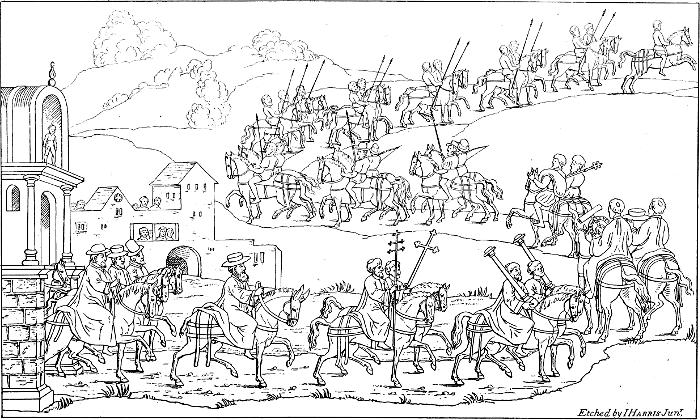
Etched by I Harris Junr.
CARDINAL WOLSEY AND HIS SUITE IN PROGRESS. From a M.S. in the Collection of Francis Douce Esq.r F.S.A. Published by Harding, Triphook, & Lepard, 1824.
When all things were fully concluded, and for this noble embassy provided and furnished, then was no lett, but advance forwards in the name of God. My Lord Cardinal had with him such of the lords and bishops and other worthy persons as were not privy of the conspiracy.
Then marched he forward out of his own house at Westminster, passing through all London[107], over London Bridge, having before him of gentlemen a great number, three in a rank, in black velvet livery coats, and the most part of them with great chains of gold about their necks. And all his yeomen, with noblemen’s and gentlemen’s servants following him in French tawny livery coats; having embroidered upon the backs and breasts of the said coats these letters: T. and C., under the cardinal’s hat. His sumpter mules, which were twenty in number and more, with his carts and other carriages of his train, were passed on before, conducted and guarded with a great number of bows and spears. He rode like a cardinal, very sumptuously, on a mule trapped with crimson velvet upon velvet, and his stirrups of copper, and gilt; and his spare mule following him with like apparel. And before him he had his two great crosses of silver, two great pillars of silver, the great seal of England, his cardinal’s hat, and a gentleman that carried his valaunce, otherwise called a cloakbag; which was made altogether of fine scarlet cloth, embroidered over and over with cloth of gold very richly, having in it a cloak of fine scarlet. Thus passed he through London, and all the way of his journey, having his harbingers passing before to provide lodging for his train.
The first journey he made to Dartford in Kent, unto Sir Richard Wiltshire’s house, which is two miles beyond Dartford; where all his train were lodged that night, and in the country thereabouts. The next day he rode to Rochester, and lodged in the bishop’s palace there; and the rest of his train in the city, and in Stroud on this side the bridge. The third day he rode from thence to Feversham, and there was lodged in the abbey, and his train in the town, and some in the country thereabouts. The fourth day he rode to Canterbury, where he was encountered with the worshipfullest of the town and country, and lodged in the abbey of Christchurch, in the prior’s lodging. And all his train in the city, where he continued three or four days; in which time there was the great jubilee, and a fair in honour of the feast of St. Thomas their patron. In which day of the said feast, within the abbey there was made a solemn procession; and my Lord Cardinal went presently in the same, apparelled in his legantine ornaments, with his Cardinal’s hat on his head; who commanded the monks and all their quire to sing the litany after this sort, Sancta Maria ora pro papa nostro Clemente; and so perused the litany through, my Lord Cardinal kneeling at the quire door, at a form covered with carpets and cushions. The monks and all the quire standing all that while in the midst of the body of the church. At which time I saw the Lord Cardinal weep very tenderly; which was, as we supposed, for heaviness that the pope was at that present in such calamity and great danger of the Lance Knights[108]. The next day I was sent with letters from my Lord Cardinal unto Calais, by empost, insomuch as I was that same night at Calais. And at my landing I found standing upon the pier, without [the] Lantern Gate, all the council of the town, to whom I delivered and dispatched my message and letters or ever I entered the town; where I lay two days or my lord came thither; who arrived in the haven the second day after my coming, about eight of the clock in the morning: where he was received in procession with all the worshipfullest persons of the town in most solemn wise. And in the Lantern Gate was set for him a form, with carpets and cushions, whereat he kneeled and made his prayers before his entry any further in the town; and there he was censed with two great censers of silver, and sprinkled with holy water. That done he arose up and passed on, with all that assembly before him, singing, unto St. Mary’s church, where he standing at the high altar, turning himself to the people, gave them his benediction and clean remission. And then they conducted him from thence unto a house called the Checker, where he lay and kept his house as long as he abode in the town; going immediately to his naked bed, because he was somewhat troubled with sickness in his passage upon the seas.