THE PROLOGUE. (continued 3)
Reading edition
With that stepped forth the Duke of Suffolk[144] from the king, and by his commandment spake these words, with a stout and an hault countenance, “It was never merry in England,” (quoth he), “whilst we had cardinals among us:” which words were set forth both with such a vehement countenance, that all men marvelled what he intended; to whom no man made answer. Then the duke spake again in great despight. To the which words my Lord Cardinal, perceiving his vehemency, soberly made answer and said, "Sir, of all men within this realm, ye have least cause to dispraise or be offended with cardinals: for if I, simple cardinal, had not been, you should have had at this present no head upon your shoulders, wherein you should have a tongue to make any such report in despight of us, who intend you no manner of displeasure; nor have we given you any occasion with such despight to be revenged with your hault words. I would ye knew it, my lord, that I and my brother here intendeth the king and his realm as much honour, wealth, and quietness, as you or any other, of what estate or degree soever he be, within this realm; and would as gladly accomplish his lawful desire as the poorest subject he hath. But, my lord, I pray you, show me what ye would do if ye were the king’s commissioner in a foreign region, having a weighty matter to treat upon: and the conclusion being doubtful thereof, would ye not advertise the king’s majesty or ever ye went through with the same? Yes, yes, my lord, I doubt not. Therefore I would ye should banish your hasty malice and despight out of your heart, and consider that we be but commissioners for a time, and can, ne may not, by virtue of our commission proceed to judgment, without the knowledge and consent of the chief head of our authority, and having his consent to the same; which is the pope. Therefore we do no less ne otherwise than our warrant will bear us; and if any man will be offended with us therefore, he is an unwise man. Wherefore my lord, hold your peace, and pacify yourself, and frame your tongue like a man of honour and of wisdom, and not to speak so quickly or reproachfully by your friends; for ye know best what friendship[145] ye have received at my hands, the which I yet never revealed to no person alive before now, neither to my glory, ne to your dishonour." And therewith the duke gave over the matter without any words to reply, and so departed and followed after the king, who was gone into Bridewell at the beginning of the duke’s first words.
This matter continued long thus, and my Lord Cardinal was in displeasure with the king, for that the matter in his suit took no better success, the fault whereof was ascribed much to my lord, notwithstanding my lord excused him always by his commission, which gave him no farther authority to proceed in judgment, without knowledge of the pope, who reserved the same to himself.
At the last they were advertised by their post that the pope would take deliberation in respect of judgment until his courts were opened, which should not be before Bartholomew tide next. The king considering the time to be very long or the matter should be determined, thought it good to send a new embassy to the pope, to persuade him to show such honourable favour unto his grace, that the matter might be sooner ended than it was likely to be, or else at the next court in Rome, to rule the matter over, according to the king’s request.
To this embassy was appointed Doctor Stephens[146], then secretary, that after was made Bishop of Winchester. Who went thither, and there tarried until the latter end of summer, as ye shall hear after.
The king commanded the queen to be removed out of the court, and sent to another place; and his highness rode in his progress, with Mistress Anne Boleyn in his company, all the grece season[147].
It was so that the Cardinal Campeggio made suit to be discharged, that he might return again to Rome. And it chanced that the secretary, who was the king’s ambassador to the pope, was returned home from Rome; whereupon it was determined that the Cardinal Campeggio should resort to the king at Grafton in Northamptonshire, and that my lord Cardinal should accompany him thither, where Campeggio should take his leave of the king. And so they took their journey thitherward from the Moor, and came to Grafton[148] upon the Sunday in the morning, before whose coming there rose in the court divers opinions, that the king would not speak with my Lord Cardinal; and thereupon were laid many great wagers.
These two prelates being come to the gates of the court, where they alighted from their horses, supposing that they should have been received by the head officers of the house as they were wont to be; yet for as much as Cardinal Campeggio was but a stranger in effect, the said officers received them, and conveyed him to his lodging within the court, which was prepared for him only. And after my lord had brought him thus to his lodging, he left him there and departed, supposing to have gone directly likewise to his chamber, as he was accustomed to do. And by the way as he was going, it was told him that he had no lodging appointed for him in the court. And being therewith astonied, Sir Henry Norris, Groom of the Stole [to] the king, came unto him, (but whether it was by the king’s commandment or no I know not), and most humbly offered him his chamber for the time, until another might somewhere be provided for him: “For, Sir, I assure you,” quoth he, “here is very little room in this house, scantly sufficient for the king; therefore I beseech your grace to accept mine for the season.” Whom my lord thanked for his gentle offer, and went straight to his chamber, where as my lord shifted his riding apparel, and being thus in his chamber, divers noble persons and gentlemen, being his loving friends, came to visit him and to welcome him to the court, by whom my lord was advertised of all things touching the king’s displeasure towards him; which did him no small pleasure; and caused him to be the more readily provided of sufficient excuses for his defence.
Then was my lord advertised by Master Norris, that he should prepare himself to give attendance in the chamber of presence against the king’s coming thither, who was disposed there to talk with him, and with the other cardinal, who came into my lord’s chamber, and they together went into the said chamber of presence, where the lords of the council stood in a row in order along the chamber. My lord putting off his cap to every of them most gently, and so did they no less to him: at which time the chamber was so furnished with noblemen, gentlemen, and other worthy persons, that only expected the meeting, and the countenance of the king and him, and what entertainment the king made him.
Then immediately after came the king into the chamber, and standing there under the cloth of estate, my lord kneeled down before him, who took my lord by the hand, and so he did the other cardinal. Then he took my lord up by both arms and caused him to stand up, whom the king, with as amiable a cheer as ever he did, called him aside, and led him by the hand to a great window, where he talked with him, and caused him to be covered.
Then, to behold the countenance of those that had made their wagers to the contrary, it would have made you to smile; and thus were they all deceived, as well worthy for their presumption. The king was in long and earnest communication with him, in so much as I heard the king say: “How can that be: is not this your own hand?” and plucked out from his bosom a letter or writing, and showed him the same; and as I perceived that it was answered so by my lord that the king had no more to say in that matter; but said to him: "My lord, go to your dinner, and all my lords here will keep you company; and after dinner I will resort to you again, and then we will commune further with you in this matter; and so departed the king, and dined that same day with Mrs. Anne Boleyn, in her chamber, who kept there an estate more like a queen than a simple maid.
Then was a table set up in the chamber of presence for my lord, and other lords of the council, where they all dined together; and sitting thus at dinner communing of divers matters. Quoth my lord, “It were well done if the king would send his chaplains and bishops to their cures and benefices.” “Yea marry,” quoth my Lord of Norfolk, “and so it were for you too.” “I could be contented therewith, very well,” quoth my lord, “if it were the king’s pleasure to grant me license, with his favour, to go to my benefice of Winchester.” “Nay,” quoth my Lord of Norfolk, “to your benefice of York, where consisteth your greatest honour and charge.” “Even as it shall please the king,” quoth my lord, and so fell into other communications. For the lords were very loth to have him planted so near the king as to be at Winchester[149]. Immediately after dinner they fell in secret talk until the waiters had dined.
And as I heard it reported by them that waited upon the king at dinner, that Mistress Anne Boleyn was much offended with the king, as far as she durst, that he so gently entertained my lord, saying, as she sat with the king at dinner, in communication of him, “Sir,” quoth she, “is it not a marvellous thing to consider what debt and danger the cardinal hath brought you in with all your subjects?” “How so, sweetheart?” quoth the king. “Forsooth,” quoth she, “there is not a man within all your realm, worth five pounds, but he hath indebted you unto him;” (meaning by a loan that the king had but late of his subjects). “Well, well,” quoth the king, “as for that there is in him no blame; for I know that matter better than you, or any other.” “Nay, Sir,” quoth she, "besides all that, what things hath he wrought within this realm to your great slander and dishonour? There is never a nobleman within this realm that if he had done but half so much as he hath done, but he were well worthy to lose his head. If my Lord of Norfolk, my Lord of Suffolk, my lord my father, or any other noble person within your realm had done much less than he, but they should have lost their heads or this." “Why, then I perceive,” quoth the king, “ye are not the cardinal’s friend?” “Forsooth, Sir,” then quoth she, “I have no cause, nor any other that loveth your grace, no more have your grace, if ye consider well his doings.” At this time the waiters had taken up the table, and so they ended their communication. Now ye may perceive the old malice beginning to break out, and newly to kindle the brand that after proved to a great fire, which was as much procured by his secret enemies, [of whom] I touched something before, as of herself.
After all this communication, the dinner thus ended, the king rose up and went incontinent into the chamber of presence, where as my lord, and other of the lords were attending his coming, he called my lord into the great window, and talked with him there a while very secretly. And at the last, the king took my lord by the hand and led him into his privy chamber, sitting there in consultation with him all alone without any other of the lords of the council, until it was night; the which blanked his enemies very sore, and made them to stir the coals; being in doubt what this matter would grow unto, having now none other refuge to trust to but Mistress Anne, in whom was all their whole and firm trust and affiance, without whom they doubted all their enterprise but frustrate and void.
Now was I fain, being warned that my lord had no lodging in the court, to ride into the country to provide for my lord a lodging; so that I provided a lodging for him at a house of Master Empson’s called Euston, three miles from Grafton, whither my lord came by torch light, it was so late or the king and he departed. At whose departing the king commanded him to resort again early in the morning to the intent they might finish their talk which they had then begun and not concluded.
After their departing my lord came to the said house at Euston to his lodging, where he had to supper with him divers of his friends of the court; and sitting at supper, in came to him Doctor Stephens, the secretary, late ambassador unto Rome; but to what intent he came I know not; howbeit my lord took it, that he came to dissemble a certain obedience and love towards him, or else to espy his behaviour and to hear his communication at supper. Notwithstanding my lord bade him welcome, and commanded him to sit down at the table to supper; with whom my lord had this communication, under this manner. “Master Secretary,” quoth my lord, “ye be welcome home out of Italy; when came ye from Rome?” “Forsooth,” quoth he, “I came home almost a month ago.” “And where,” quoth my lord, “have you been ever since?” “Forsooth,” quoth he, “following the court this progress.” “Then have ye hunted, and had good game and pastime,” quoth my lord. “Forsooth, sir,” quoth he, “and so I have, I thank the king’s majesty.” “What good greyhounds have ye?” quoth my lord. “I have some, sir,” quoth he. And thus in hunting, and like disports, passed they all their communication at supper; and after supper my lord and he talked secretly together, till it was midnight or they departed.
The next morning my lord rose early and rode straight to the court; at whose coming the king was ready to ride, willing my lord to resort to the council with the lords in his absence, and said he could not tarry with him, commanding him to return with Cardinal Campeggio, who had taken his leave of the king. Whereupon my lord was constrained to take his leave also of the king, with whom the king departed amiably in the sight of all men. The king’s sudden departing in the morning was by the special labour of Mistress Anne, who rode with him, only to lead him about, because he should not return until the cardinals were gone, the which departed after dinner, returning again towards the Moor[150].
The king rode that morning to view a ground for a new park, which is called at this day Hartwell Park, where Mistress Anne had made provision for the king’s dinner, fearing his return or the cardinals were gone.
Then rode my lord and the other cardinal after dinner on their way homeward, and so came to the monastery of St. Alban’s (whereof he himself was commendatory), and there lay one whole day; and the next day they rode to the Moor; and from thence the Cardinal Campeggio took his journey towards Rome, with the king’s reward; what it was I am uncertain. Nevertheless, after his departure, the king was informed that he carried with him great treasures of my lord’s, (conveyed in great tuns) notable sums of gold and silver to Rome, whither they surmised my lord would secretly convey himself out of this realm. In so much that a post was sent speedily after the cardinal to search him; whom they overtook at Calais[151], where he was stayed until search was made; there was not so much money found as he received of the king’s reward, and so he was dismissed and went his way.
After Cardinal Campeggio was thus departed and gone, Michaelmas Term[152] drew near, against the which my lord returned unto his house at Westminster; and when the Term began, he went to the hall in such like sort and gesture as he was wont most commonly to do, and sat in the Chancery, being Chancellor. After which day he never sat there more. The next day he tarried at home, expecting the coming of the Dukes of Suffolk and Norfolk, [who] came not that day; but the next day they came thither unto him; to whom they declared how the king’s pleasure was that he should surrender and deliver up the great seal into their hands, and to depart simplily unto Asher[153], a house situate nigh Hampton Court, belonging to the Bishoprick of Winchester. My lord understanding their message, demanded of them what commission they had to give him any such commandment? who answered him again, that they were sufficient commissioners in that behalf, having the king’s commandment by his mouth so to do. “Yet,” quoth he, “that is not sufficient for me, without farther commandment of the king’s pleasure; for the great seal of England was delivered me by the king’s own person, to enjoy during my life, with the ministration of the office and high room of chancellorship of England: for my surety whereof, I have the king’s letters patent to show.” Which matter was greatly debated between the dukes and him with many stout words between them; whose words and checks he took in patience for the time: in so much that the dukes were fain to depart again without their purpose at that present; and returned again unto Windsor to the king: and what report they made I cannot tell; howbeit, the next day they came again from the king, bringing with them the king’s letters. After the receipt and reading of the same by my lord, which was done with much reverence, he delivered unto them the great seal[154], contented to obey the king’s high commandment; and seeing that the king’s pleasure was to take his house, with the contents, was well pleased simply to depart to Asher, taking nothing but only some provision for his house.
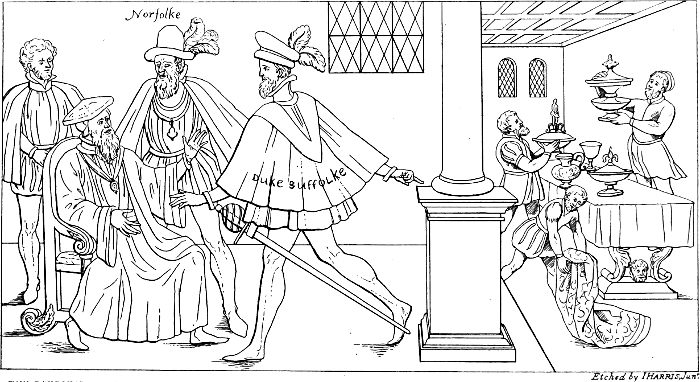
Etched by I Harris, Junr.
THE CARDINAL SURRENDERS THE GREAT SEAL TO THE DUKES OF SUFFOLK & NORFOLK, AND ALL HIS GOODS TO THE KING. From a M.S. in the Collection of Francis Douce Esq.[r] F.S.A. Published by Harding, Triphook & Lepard, 1824.
And after long talk between the dukes and him, they departed, with the great seal of England, to Windsor, unto the king. Then went my Lord Cardinal and called all officers in every office in his house before him, to take account of all such stuff as they had in charge[155]. And in his gallery there was set divers tables, whereupon a great number of rich stuffs of silk, in whole pieces, of all colours, as velvet, satin, damask, caffa, taffeta, grograine, sarcenet, and of other not in my remembrance; also there lay a thousand pieces of fine holland cloth, whereof as I heard him say afterward, there was five hundred pieces thereof, conveyed both from the king and him[156].
Furthermore there was also all the walls of the gallery hanged with cloth of gold, and tissue of divers makings, and cloth of silver likewise on both the sides; and rich cloths of baudkin[157], of divers colours. There also hung the richest suits of copes of his own provision, (which he caused to be made for his colleges of Oxford and Ipswich), that ever I saw in England. Then had he two chambers adjoining to the gallery, the one called the gilt chamber, and the other called, most commonly, the council chamber, wherein were set in each two broad and long tables, upon tressels, whereupon was set such a number of plate of all sorts, as were almost incredible. In the gilt chamber was set out upon the tables nothing but all gilt plate; and a cupboard standing under a window, was garnished all wholly with plate of clean gold, whereof some was set with pearl and rich stones. And in the council chamber was set all white plate and parcel gilt; and under the tables, in both the chambers, were set baskets with old plate, which was not esteemed but for broken plate and old, not worthy to be occupied, and books containing the value and weight of every parcel laid by them ready to be seen; and so was also books set by all manner of stuff, containing the contents of every thing. Thus every thing being brought into good order and furnished, he gave the charge of the delivery thereof unto the king, to every officer within his office, of such stuff as they had before in charge, by indenture of every parcel; for the order of his house was such, as that every officer was charged by indenture with all such parcels as belonged to their office.
Then all things being ordered as it is before rehearsed, my lord prepared him to depart by water. And before his departing, he commanded Sir William Gascoigne, his treasurer, to see these things before remembered delivered safely to the king at his repair [thither]. That done, the said Sir William said unto my lord, “Sir, I am sorry for your grace, for I understand ye shall go straightway to the Tower.” “Is this the good comfort and counsel,” quoth my lord, "that ye can give your master in adversity? It hath been always your natural inclination to be very light of credit; and much more lighter in reporting of false news. I would ye should know, Sir William, and all other such blasphemers, that it is nothing more false than that, for I never (thanks be to God), deserved by no ways to come there under any arrest, although it hath pleased the king to take my house ready furnished for his pleasure at this time. I would all the world knew, and so I confess, to have nothing, either riches, honour, or dignity, that hath not grown of him and by him; therefore it is my very duty to surrender the same to him again as his very own, with all my heart, or else I were an unkind servant. Therefore go your ways, and give good attendance unto your charge, that nothing be embezzled." And therewithal he made him ready to depart, with all his gentlemen and yeomen, which was no small number, and took his barge at his privy stairs, and so went by water unto Putney, where all his horses waited his coming. And at the taking of his barge there was no less than a thousand boats full of men and women of the city of London, waffeting up and down in Thames, expecting my lord’s departing, supposing that he should have gone directly from thence to the Tower, whereat they rejoiced, and I dare be bold to say that the most part never received damage at his hands.
O wavering and new fangled multitude! Is it not a wonder to consider the inconstant mutability of this uncertain world! The common people always desiring alterations and novelties of things for the strangeness of the case; which after turneth them to small profit and commodity. For if the sequel of this matter be well considered and digested, ye shall understand that they had small cause to triumph at his fall. What hath succeeded all wise men doth know, and the common sort of them hath felt. Therefore to grudge or wonder at it, surely were but folly; to study a redress, I see not how it can be holpen, for the inclination and natural disposition of Englishmen is, and hath always been, to desire alteration of officers, which hath been thoroughly fed with long continuance in their rooms with sufficient riches and possessions; and they being put out, then cometh another hungry and a lean officer in his place, that biteth nearer the bone than the old. So the people be ever pilled and polled with hungry dogs, through their own desire of change of new officers, nature hath so wrought in the people, that it will not be redressed. Wherefore I cannot see but always men in authority be disdained with the common sort of men; and such most of all, that justly ministereth equity to all men indifferently. For where they please some one which receiveth the benefit of the law at [their] hands according to justice, there doth they in likewise displease the contrary party, who supposeth to sustain great wrong, where they have equity and right. Thus all good justices be always in contempt with some for executing of indifferency. And yet such ministers must be, for if there should be no ministers of justice the world should run full of error and abomination, and no good order kept, ne quietness among the people. There is no good man but he will commend such justices as dealeth uprightly in their rooms, and rejoice at their continuance and not at their fall; and whether this be true or no, I put it to the judgment of all discreet persons. Now let us leave, and begin again where we left.
When he was with all his train arrived and landed at Putney, he took his mule, and every man his horse. And setting forth, not past the length of a pair of garden butts, he espied a man come riding empost down the hill, in Putney town, demanding of his footmen who they thought it should be? And they answered again and said, that they supposed it should be Sir Harry Norris. And by and bye he came to my lord and saluted him, and said “that the king’s majesty had him commended to his grace, and willed him in any wise to be of good cheer, for he was as much in his highness’ favour as ever he was, and so shall be.” And in token thereof, he delivered him a ring of gold, with a rich stone, which ring he knew very well, for it was always the privy token between the king and him whensoever the king would have any special matter dispatched at his hands. And said furthermore, “that the king commanded him to be of good cheer, and take no thought, for he should not lack. And although the king hath dealt with you unkindly as ye suppose, he saith that it is for no displeasure that he beareth you, but only to satisfy more the minds of some (which he knoweth be not your friends), than for any indignation: and also ye know right well, that he is able to recompense you with twice as much as your goods amounteth unto; and all this he bade me, that I should show you, therefore, sir, take patience. And for my part, I trust to see you in better estate than ever ye were.” But when he heard Master Norris rehearse all the good and comfortable words of the king, he quickly lighted from off his mule, all alone, as though he had been the youngest person amongst us, and incontinent kneeled down in the dirt upon both his knees, holding up his hands for joy. Master Norris perceiving him so quickly from his mule upon the ground, mused, and was astonied. And therewith he alighted also, and kneeled by him, embracing him in his arms, and asked him how he did, calling upon him to credit his message. “Master Norris,” quoth he, "when I consider your comfortable and joyful news, I can do no less than to rejoice, for the sudden joy surmounted my memory, having no respect neither to the place or time, but thought it my very bounden duty to render thanks to God my maker, and to the king my sovereign lord and master, who hath sent me such comfort in the very place where I received the same."
And talking with Master Norris upon his knees in the mire, he would have pulled off his under cap of velvet, but he could not undo the knot under his chin; wherefore with violence he rent the laces and pulled it from his head, and so kneeled bare headed. And that done, he covered again his head, and arose, and would have mounted his mule, but he could not mount again with such agility as he lighted before, where his footmen had as much ado to set him in his saddle as they could have. Then rode he forth up the hill into the town, talking with Master Norris. And when he came upon Putney Heath, Master Norris took his leave and would have departed. Then quoth my lord unto him, “Gentle Norris, if I were lord of a realm, the one half thereof were insufficient a reward to give you for your pains, and good comfortable news. But, good Master Norris, consider with me, that I have nothing left me but my clothes on my back. Therefore I desire you to take this small reward of my hands;” the which was a little chain of gold, made like a bottle chain, with a cross of gold hanging thereat, wherein was a piece of the Holy Cross, which he wore continually about his neck next his skin; and said furthermore, “I assure you, Master Norris, that when I was in prosperity, although it seem but small in value, yet I would not gladly have departed with it for the value of a thousand pounds. Therefore I beseech you to take it in gree, and wear it about your neck for my sake, and as often as ye shall happen to look upon it, have me in remembrance to the king’s majesty, as opportunity shall serve you, unto whose Highness and clemency, I desire you to have [me] most lowly commended; for whose charitable disposition towards me, I can do nothing but only minister my prayer unto God for the preservation of his royal estate, long to reign in honour, health, and quiet life. I am his obedient subject, vassal, and poor chaplain, and do so intend, God willing, to be during my life, accounting that of myself I am of no estimation nor of no substance, but only by him and of him, whom I love better than myself, and have justly and truly served, to the best of my gross wit.” And with that he took Master Norris by the hand and bade him farewell. And being gone but a small distance, he returned, and called Master Norris again, and when he was returned, he said unto him: “I am sorry,” quoth he, “that I have no condign token to send to the king. But if ye would at this my request present the king with this poor Fool, I trust his highness would accept him well, for surely for a nobleman’s pleasure he is worth a thousand pounds[158].” So Master Norris took the Fool with him; with whom my lord was fain to send six of [his] tall yeomen, to conduct and convey the Fool to the court; for the poor Fool took on and fired so in such a rage when he saw that he must needs depart from my lord. Yet notwithstanding they conveyed him with Master Norris to the court, where the king received him most gladly.
After the departure of Master Norris with his token to the king, my lord rode straight to Asher, a house appertaining to the Bishoprick of Winchester, situate within the county of Surrey, not far from Hampton Court, where my lord and his family continued the space of three or four weeks, without beds, sheets, table cloths, cups and dishes to eat our meat, or to lie in. Howbeit, there was good provision of all kind of victuals, and of drink, both beer and wine, whereof there was sufficient and plenty. My lord was of necessity compelled to borrow of the Bishop of Carlisle, and of Sir Thomas Arundell, both dishes to eat his meat in, and plate to drink in, and also linen cloths to occupy. And thus continued he in this strange estate until the feast of All-hallown tide was past[159].
It chanced me upon All-hallown day to come there into the Great Chamber at Asher, in the morning, to give mine attendance, where I found Master Cromwell leaning in the great window, with a Primer in his hand, saying of our Lady mattins; which had been since a very strange sight[160]. He prayed not more earnestly than the tears distilled from his eyes. Whom I bade good morrow. And with that I perceived the tears upon his cheeks. To whom I said, “Why Master Cromwell, what meaneth all this your sorrow? Is my lord in any danger, for whom ye lament thus? or is it for any loss that ye have sustained by any misadventure?”
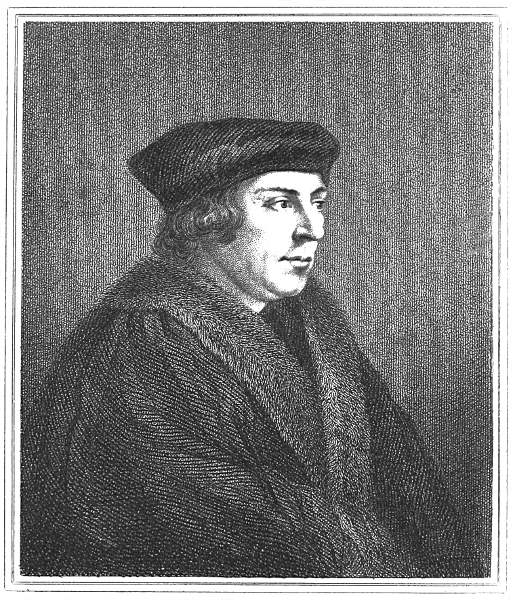
THOMAS CROMWELL, EARL OF ESSEX. ENGRAVED BY E. SCRIVEN, AFTER THE ORIGINAL PICTURE BY HOLBEIN.
London, Published Jan. 1, 1825, by Harding, Triphook & Lepard.
“Nay, nay,” quoth he, “it is my unhappy adventure, which am like to lose all that I have travailed for all the days of my life, for doing of my master true and diligent service.” “Why, sir,” quoth I, “I trust ye be too wise, to commit any thing by my lord’s commandment, otherwise than ye might do of right, whereof ye have any cause to doubt of loss of your goods.” “Well, well,” quoth he, "I cannot tell; but all things I see before mine eyes, is as it is taken; and this I understand right well, that I am in disdain with most men for my master’s sake; and surely without just cause. Howbeit, an ill name once gotten will not lightly be put away. I never had any promotion by my lord to the increase of my living. And thus much will I say to you, that I intend, God willing, this afternoon, when my lord hath dined, to ride to London, and so to the court, where I will either make or mar[161], or I come again. I will put myself in prease[162], to see what any man is able to lay to my charge of untruth or misdemeanour." “Marry, sir,” quoth I, “in so doing, in my conceit, ye shall do very well and wisely, beseeching God to be your guide, and send you good luck, even as I would myself.” And with that I was called into the closet, to see and prepare all things ready for my lord, who intended that day to say mass there himself; and so I did.
And then my lord came thither with his chaplain, one Doctor Marshall, saying first his mattins, and heard two masses on his knees. And then after he was confessed, he himself said mass. And when he had finished mass, and all his divine service, returned into his chamber, where he dined among divers of his doctors, where as Master Cromwell dined also; and sitting at dinner, it chanced that my lord commended the true and faithful service of his gentlemen and yeomen. Whereupon Master Cromwell took an occasion to say to my lord, that in conscience he ought to consider their truth and loyal service that they did him, in this his present necessity, which never forsaketh him in all his trouble.
“It shall be well done, therefore,” said he, “for your grace to call before you all these your most worthy gentlemen and right honest yeomen, and let them understand, that ye right well consider their patience, truth, and faithfulness; and then give them your commendation, with good words and thanks, the which shall be to them great courage to sustain your mishap in patient misery, and to spend their life and substance in your service.”
“Alas, Thomas,” quoth my lord unto him, "ye know I have nothing to give them, and words without deeds be not often well taken. For if I had but as I have had of late, I would depart with them so frankly as they should be well content: but nothing hath no savour; and I am ashamed, and also sorry that I am not able to requite their faithful service. And although I have cause to rejoice, considering the fidelity I perceive in the number of my servants, who will not depart from me in my miserable estate, but be as diligent, obedient, and serviceable about me as they were in my great triumphant glory, yet do I lament again the want of substance to distribute among them." “Why, sir,” quoth Master Cromwell, “have ye not here a number of chaplains, to whom ye have departed very liberally with spiritual promotions, in so much as some may dispend, by your grace’s preferment, a thousand marks by the year, and some five hundred marks, and some more, and some less; ye have no one chaplain within all your house, or belonging unto you, but he may dispend at the least well (by your procurement and preferment) three hundred marks yearly, who had all the profit and advantage at your hands, and other your servants none at all; and yet hath your poor servants taken much more pains for you in one day than all your idle chaplains hath done in a year. Therefore if they will not freely and frankly consider your liberality, and depart with you of the same goods gotten in your service, now in your great indigence and necessity, it is pity that they live; and all the world will have them in indignation and hatred, for their abominable ingratitude to their master and lord.”
“I think no less, Thomas,” quoth my lord, "wherefore, [I pray you,] cause all my servants to be called and to assemble without, in my great chamber, after dinner, and see them stand in order, and I will declare unto them my mind, according to your advice." After that the board’s end was taken up, Master Cromwell came to me and said, “Heard you not, what my Lord said even now?” “Yes, sir,” quoth I, “that I did.” “Well, then,” quoth he, “assemble all my lord’s servants up into the great chamber;” and so I did, and when they were all there assembled, I assigned all the gentlemen to stand on the right side of the chamber, and the yeomen on the left side. And at the last my lord came thither, appareled in a white rochet upon a violet gown of cloth like a bishop’s, who went straight into the great window. Standing there a while, and his chaplains about him, beholding the number of his servants divided in two parts, he could not speak unto them for tenderness of his heart; the flood of tears that distilled from his eyes declared no less: the which perceived by his servants, caused the fountains of water to gush out of their faithful hearts down their cheeks, in such abundance as it would cause a cruel heart to lament. At the last, after he had turned his face to the wall, and wiped his eyes with his handkerchief, he spake to them after this sort in effect: "Most faithful gentlemen and true hearted yeomen, I do not only lament [to see] your persons present about me, but I do lament my negligent ingratitude towards you all on my behalf, in whom hath been a great default, that in my prosperity [I] have not done for you so much as I might have done, either in word or deed, which was then in my power to do: but then I knew not my jewels and special treasures that I had of you my faithful servants in my house; but now approved experience hath taught me, and with the eyes of my discretion, which before were hid, I do perceive well the same. There was never thing that repented me more that ever I did than doth the remembrance of my oblivious negligence and ungentleness, that I have not promoted or preferred you to condign rooms and preferments, according to your demerits. Howbeit, it is not unknown to you all, that I was not so well furnished of temporal advancements, as I was of spiritual preferments. And if I should have promoted you to any of the king’s offices and rooms, then should I have incurred the indignation of the king’s servants, who would not much let to report in every place behind my back, that there could no office or room in the king’s gift escape the cardinal and his servants, and thus should I incur the obloquy and slander before the whole world. But now it is come to this pass, that it hath pleased the king to take all that ever I have into his possession, so that I have nothing left me but my bare clothes upon my back, the which be but simple in comparison to those that ye have seen me have or this: howbeit, if they may do you any good or pleasure, I would not stick to divide them among you, yea, and the skin of my back, if it might countervail any thing in value among you. But, good gentlemen and yeomen, my trusty and faithful servants, of whom no prince hath the like, in my opinion, I most heartily require you to take with me some patience a little while, for I doubt not but that the king, considering the offence suggested against me by my mortal enemies, to be of small effect, will shortly, I doubt not, restore me again to my living, so that I shall be more able to divide some part thereof yearly among you, whereof ye shall be well assured. For the surplusage of my revenues, whatsoever shall remain at the determination of my accompts, shall be, God willing, distributed among you. For I will never hereafter esteem the goods and riches of this uncertain world but as a vain thing, more than shall be sufficient for the maintenance of mine estate and dignity, that God hath or shall call me unto in this world during my life. And if the king do not thus shortly restore me, then will I see you bestowed according to your own requests, and write for you, either to the king, or to any other noble person within this realm, to retain you into service; for I doubt not but the king, or any noble man, or worthy gentleman of this realm, will credit my letter in your commendation. Therefore, in the mean time, mine advice is, that ye repair home to your wives, such as have any: and such among you as hath none, to take this time to visit your parents and friends in the country. There is none of you all, but once in a year would require licence to visit your wives and other of your friends: take this time, I pray you, in respect thereof, and at your return I will not refuse you, if I should beg with you. I consider that the service of my house hath been such, and of such sort, that ye be not meet or apt to serve [any] man under the degree of a king; therefore I would wish you to serve no man but the king, who I am sure will not reject you. Therefore I desire you to take your pleasures for a month, and then ye may come again unto me, and I trust by that time, the king’s majesty will extend his clemency upon me." “Sir,” quoth Master Cromwell, "there is divers of these your yeomen, that would be glad to see their friends, but they lack money: therefore here is divers of your chaplains who have received at your hands great benefices and high dignities; let them therefore now show themselves unto you as they are bound by all humanity to do. I think their honesty and charity is not so slender and void of grace that they would not see you lack where they may help to refresh you. And for my part, although I have not received of your grace’s gift one penny towards the increase of my yearly living, yet will I depart with you this towards the dispatch of your servants," and [therewith] delivered him five pounds in gold. “And now let us see what your chaplains will do. I think they will depart with you much more than I have done, who be more able to give you a pound than I one penny.” “Go to, masters,” quoth he to the chaplains: in so much as some gave to him ten pounds, some ten marks, some a hundred shillings, and so some more and some less, as at that time their powers did extend; whereby my lord received among them as much money of their liberality as he gave to each of his yeomen a quarter’s wages, and board wages for a month; and they departed down into the hall, where some determined to go to their friends, and some said that they would not depart from my lord until they might see him in better estate. My lord returned into his chamber lamenting the departure from his servants, making his moan unto Master Cromwell, who comforted him the best he could, and desired my lord to give him leave to go to London, where he would either make or mar or he came again, which was always his common saying. Then after long communication with my lord in secret, he departed and took his horse, and rode to London, at whose departing I was by, whom he bade farewell; and said, “ye shall hear shortly of me, and if I speed well, I will not fail to be here again within these two days.” And so I took my leave of him, and he rode forth on his journey. Sir Rafe Sadler, (now knight), was then his clerk, and rode with him.
After that my lord had supped that night, and all men gone to bed, (being All-hallown day), it chanced so, about midnight, that one of the porters came unto my chamber door, and there knocked, and waking me, I perceived who it was; [and] asked him, “what he would have that time of the night?” “Sir,” quoth the porter, “there is a great number of horsemen at the gate, that would come in, saying to me, that it is Sir John Russell, and so it appears to me by his voice; what is your pleasure that I should do?” “Marry,” quoth I, “go down again, and make a great fire in your lodge, against I come to dry them;” for it rained all that night the sorest that it did all that year before. Then I rose and put on my nightgown, and came to the gates, and asked who was there. With that Master Russell spake, whom I knew by his voice, and then I caused the porter to open the gates and let them all in, who were wet to the skin; desiring Master Russell to go into the lodge to the fire; and he showed me that he was come from the king unto my lord in message, with whom he required me to speak. “Sir,” quoth I, “I trust your news be good?” “Yea, I promise you on my fidelity,” quoth he, “and so, I pray you, show him, I have brought him such news that will please him right well.” “Then I will go,” quoth I, “and wake him, and cause him to rise.” I went incontinent to my lord’s chamber door, and waked my lord, who asked me, “what I would have?” “Sir,” said I, “to show you that Sir John Russell is come from the king, who is desirous to speak with you;” and then he called up one of his grooms to let me in; and being within I told him “what a journey Sir John Russell had that night.” “I pray God,” quoth he, “all be for the best.” “Yes, sir,” quoth I, “he showed me, and so bade me tell you, that he had brought you such news as ye would greatly rejoice thereat.” “Well, then,” quoth he, “God be praised, and welcome be his grace! Go ye and fetch him unto me, and by that time I will be ready to talk with him.”
Then I returned from him to the lodge, and brought Master Russell from thence to my lord, who had cast on his nightgown. And when Master Russell was come into his presence, he most humbly reverenced him, upon his knee, [to] whom my lord bowed down, and took him up, and bade him welcome. “Sir,” quoth he, “the king commendeth him unto you;” and delivered him a great ring of gold with a Turkis, for a token; “and willeth you to be of good cheer; who loveth you as well as ever he did, and is not a little disquieted for your troubles, whose mind is full of your remembrance. In so much as his grace, before he sat to supper, called me unto him, and commanded me to take this journey secretly to visit you, to your comfort the best of my power. And Sir, if it please your grace, I have had this night the sorest journey, for so little a way, that ever I had to my remembrance.”
My lord thanked him for his pains and good news, and demanded of him if he had supped; and he said “Nay.” “Well, then,” quoth my lord to me, “cause the cooks to provide some meat for him; and cause a chamber with a good fire to be made ready for him, that he may take his rest awhile upon a bed.” All which commandment I fulfilled; and in the meantime my lord and Master Russell were in very secret communication; and in fine, Master Russell went to his chamber, taking his leave of my lord for all night, and said, “he would not tarry but a while, for he would, God willing, be at the court at Greenwich again before day, for he would not for any thing that it were known, his being with my lord that night.” And so being in his chamber, having a small repast, rested him a while upon a bed, whilst his servants supped and dried themselves by the fire; and then incontinent he rode away with speed to the court. And shortly after his being there, my lord was restored again unto plenty of household stuff, vessels, and plate, and of all things necessary some part, so that he was indifferently furnished much better than he was of late, and yet not so abundantly as the king’s pleasure was, the default whereof was in the officers, and in such as had the oversight of the delivery thereof; and yet my lord rejoiced in that little in comparison to that he had before.
Now let us return again to Master Cromwell, to see how he hath sped, since his departure last from my lord. The case stood so, that there should begin, shortly after All-hallown tide, the Parliament, and [he], being within London, devised with himself to be one of the Burgesses of the Parliament, and chanced to meet with one Sir Thomas Rush, knight, a special friend of his, whose son was appointed to be one of the Burgesses of that Parliament, of whom he obtained his room, and by that means put his foot into the Parliament House: then within two or three days after his entry into the Parliament, he came unto my lord, to Asher, with a much pleasanter countenance than he had at his departure, and meeting with me before he came to my lord, said unto me, “that he had once adventured to put in his foot, where he trusted shortly to be better regarded, or all were done.” And when he was come to my lord, they talked together in secret manner; and that done, he rode out of hand again that night to London, because he would not be absent from the Parliament the next morning. There could nothing be spoken against my lord in the Parliament House but he would answer it incontinent, or else take until the next day, against which time he would resort to my lord to know what answer he should make in his behalf; in so much that there was no matter alleged against my lord but that he was ever ready furnished with a sufficient answer; so that at length, for his honest behaviour in his master’s cause, he grew into such estimation in every man’s opinion, that he was esteemed to be the most faithfullest servant to his master of all other, wherein he was of all men greatly commended.
Then was there brought in a Bill of Articles into the Parliament House to have my lord condemned of treason; against which bill Master Cromwell inveighed so discreetly, with such witty persuasions and deep reasons, that the same bill could take there no effect[163]. Then were his enemies compelled to indite him in a premunire, and all was done only to the intent to entitle the king to all his goods and possessions, the which he had gathered together, and purchased for his colleges in Oxford and Ipswich, and for the maintenance of the same, which was then abuilding in most sumptuous wise. Wherein when he was demanded by the judges, which were sent [to] him purposely to examine him what answer he would make to the same, he said: "The king’s highness knoweth right well whether I have offended his majesty and his laws or no, in using of my prerogative legatine, for the which ye have me indited. Notwithstanding I have the king’s license in my coffers, under his hand and broad seal, for exercising and using the authority thereof, in the largest wise, within his highness’ dominions, the which remaineth now in the hands of my enemies. Therefore, because I will not stand in question or trial with the king in his own cause, I am content here of mine own frank will and mind, in your presence, to confess the offence in the inditement, and put me wholly in the mercy and grace of the king, having no doubt in his godly disposition and charitable conscience, whom I know hath an high discretion to consider the truth, and my humble submission and obedience. And although I might justly stand on the trial with him therein; yet I am content to submit myself to his clemency, and thus much ye may say to him in my behalf, that I am entirely in his obedience, and do intend, God willing, to obey and fulfil all his princely pleasure in every thing that he will command me to do; whose will and pleasure I never yet disobeyed or repugned, but was always contented and glad to accomplish his desire and commandment before God, whom I ought most rathest to [have] obeyed; the which negligence now greatly repenteth me. Notwithstanding, I most heartily require you, to have me most humbly to his royal majesty commended, for whom I do and will pray for the preservation of his royal person, long to reign in honour, prosperity, and quietness, and to have the victory over his mortal and cankered enemies." And they took their leave of him and departed.
Shortly after the king sent the Duke of Norfolk unto him in message; but what it was I am not certain. But my Lord being advertised that the duke was coming even at hand, he caused all his gentlemen to wait upon him down through the Hall into the Base Court, to receive the duke at the entry of the gates; and commanded all his yeomen to stand still in the Hall in order. And he and his gentlemen went to the gates, where he encountered with my Lord of Norfolk, whom he received bareheaded; who embraced each other: and so led him by the arm through the Hall into his chamber. And as the duke passed through the Hall, at the upper end thereof he turned again his visage down the Hall, regarding the number of the tall yeomen that stood in order there, and said: “Sirs,” quoth he, "your diligent and faithful service unto my lord here your master, in this time of his calamity, hath purchased for yourselves of all noble men much honesty; in so much as the king commanded me to say to you in his grace’s name, that, for your true and loving service that ye have done to your master, his highness will see you all furnished at all times with services according to your demerits.” With that my Lord Cardinal put off his cap, and said to my Lord of Norfolk; “Sir,” quoth he, “these men be all approved men: wherefore it were pity they should want other service or living; and being sorry that I am not able to do for them as my heart doth wish, do therefore require you, my good lord, to be good lord unto them, and extend your good word for them, when ye shall see opportunity at any time hereafter; and that ye will prefer their diligent and faithful service to the king.” “Doubt ye not thereof,” quoth my Lord of Norfolk, “but I will do for them the best of my power: and when I shall see cause, I will be an earnest suitor for them to the king; and some of you I will retain myself in service for your honesty’s sake. And as ye have begun, so continue and remain here still with my lord until ye hear more of the king’s pleasure:—God’s blessing and mine be with you!” And so went up into the great chamber to dinner, whom my Lord Cardinal thanked, and said unto him, “Yet, my lord, of all other noble men, I have most cause to thank you for your noble heart and gentle nature, which ye have showed me behind my back, as my servant, Thomas Cromwell, hath made report unto me. But even as ye are a noble man in deed, so have ye showed yourself no less to all men in calamity, and in especial to me, and even as ye have abated my glory and high estate, and brought it full low, so have ye extended your honourable favour most charitably unto me, being prostrate before you. Forsooth, Sir, ye do right well deserve to bear in your arms the noble and gentle lion, whose natural inclination is, that when he hath vanquished any beast, and seeth him yielded, lying prostrate before him at his feet, then will he show most clemency unto his vanquished, and do him no more harm, ne suffer any other devouring beast to damage him: whose nature and quality ye do ensue; therefore these verses may be applied to your lordship:
Parcere prostratis scit nobilis ira leonis: Ta quoque fac simile, quisquis regnabis in orbem.”
With that the water was brought them to wash before dinner, to the which my lord called my Lord of Norfolk to wash with him: but he refused of courtesy, and desired to have him excused, and said “that it became him not to presume to wash with him any more now, than it did before[164] in his glory.” “Yes, forsooth,” quoth my Lord Cardinal, “for my authority and dignity legatine is gone, wherein consisted all my high honour.” “A straw,” quoth my Lord of Norfolk, “for your legacy. I never esteemed your honour the more or higher for that. But I regarded your honour, for that ye were Archbishop of York, and a cardinal, whose estate of honour surmounteth any duke now being within this realm; and so will I honour you, and acknowledge the same, and bear you reverence accordingly. Therefore, I beseech you, content yourself, for I will not presume to wash with you; and therefore I pray you, hold me excused.” Then was my Lord Cardinal constrained to wash alone; and my Lord of Norfolk all alone also. When he had done, my Lord Cardinal would fain have had him to sit down on the chair, in the inner side of the table, but surely he refused the same also with much humbleness. Then was there set another chair for my Lord of Norfolk, over against my Lord Cardinal, on the outside of the table, the which was by my Lord of Norfolk based something beneath my lord, and during the dinner all their communication was of the diligent service of the gentlemen which remained with my lord there attending upon him at dinner, and how much the king and all other noble men doth esteem them with worthy commendations for so doing; and at this time how little they be esteemed in the court that are come to the king’s service, and [have] forsaken their master in his necessity; whereof some he blamed by name. And with this communication, the dinner being ended, they rose from the table, and went together into my lord’s bedchamber, where they continued in consultation a certain season. And being there, it chanced Master Shelley, the judge, to come thither, sent from the king; whereof relation was made to my lord, which caused the duke and him to break up their communication; and the duke desired to go into some chamber to repose him for a season. And as he was coming out of my lord’s chamber, he met with Master Shelley, to whom Master Shelley made relation of the cause of his coming, and desired the duke to tarry and to assist him in doing of his message; whom he denied and said, “I have nothing to do with your message, wherein I will not meddle;” and so departed into a chamber, where he took his rest for an hour or two. And in the mean time my lord issued out of his chamber, and came to Master Shelley to know his message. Who declared unto him, after due salutation, that the king’s pleasure was to have his house at Westminster, (then called York Place, belonging to the Bishoprick of York,) intending to make of that house a palace royal; and to possess the same according to the laws of this his grace’s realm. His highness hath therefore sent for all the judges, and for all his learned counsel, to know their opinions in the assurance thereof; in whose determinations it was fully resolved, that your grace should recognise, before a judge, the right thereof to be in the king and his successors; and so his highness shall be assured thereof. Wherefore it hath pleased his majesty to appoint me by his commandment to come hither, to take of you this recognisance, who hath in you such affiance, that ye will not refuse so to do accordingly. Therefore I shall desire your grace to know your good will therein."—“Master Shelley,” quoth my lord, "I know that the king of his own nature is of a royal stomach, and yet not willing more than justice shall lead him unto by the law. And therefore, I counsel you, and all other fathers of the law and learned men of his counsel, to put no more into his head than the law may stand with good conscience; for when ye tell him, this is the law, it were well done ye should tell him also that, although this be the law, yet this is conscience; for law without conscience is not good to be given unto a king in counsel to use for a lawful right, but always to have a respect to conscience, before the rigour of the common law, for laus est facere quod decet, non quod licet. The king ought of his royal dignity and prerogative to mitigate the rigour of the law, where conscience hath the most force; therefore, in his royal place of equal justice, he hath constitute a chancellor, an officer to execute justice with clemency, where conscience is opposed by the rigour of the law. And therefore the Court of Chancery hath been heretofore commonly called the Court of Conscience; because it hath jurisdiction to command the high ministers of the common law to spare execution and judgment, where conscience hath most effect. Therefore I say to you in this case, although you, and other of your profession, perceive by your learning that the king may, by an order of your laws, lawfully do that thing which ye demand of me; how say you, Master Shelley, may I do it with justice and conscience, to give that thing away from me and my successors which is none of mine? If this be law, with conscience, show me your opinion, I pray you." “Forsooth, my lord,” quoth he, “there is some conscience in this case; but having regard to the king’s high power, and to be employed to a better use and purpose, it may the better be suffered with conscience; who is sufficient to make recompense to the church of York with double the value.” “That I know well,” quoth my lord, “but here is no such condition neither promised nor agreed, but only a bare and simple departure with another’s right for ever. And if every bishop may do the like, then might every prelate give away the patrimony of their churches which is none of theirs; and so in process of time leave nothing for their successors to maintain their dignities, which, all things considered, should be but small to the king’s honour. Sir, I do not intend to stand in terms with you in this matter, but let me see your commission.” To whom Master Shelley showed the same, and that seen, and perceived by him, said again thus: “Master Shelley,” quoth he, "ye shall make report to the king’s highness, that I am his obedient subject, and faithful chaplain and beadman, whose royal commandment and request I will in no wise disobey, but most gladly fulfil and accomplish his princely will and pleasure in all things, and in especial in this matter, in as much as ye, the fathers of the laws, say that I may lawfully do it. Therefore I charge your conscience and discharge mine. Howbeit, I pray you, show his majesty from me, that I most humbly desire his highness to call to his most gracious remembrance, that there is both heaven and hell." And therewith the clerk was called, who wrote my lord’s recognisance[165], and after some secret talk Master Shelley departed. Then rose my Lord of Norfolk from his repose, and after some communication with my lord he departed.
Thus continued my lord at Asher, who received daily messages from the court, whereof some were not so good as some were bad, but yet much more evil than good. For his enemies, perceiving the great affection that the king bare always towards him, devised a mean to disquiet and disturb his patience; thinking thereby to give him an occasion to fret and chafe, that death should rather ensue than increase of health or life, the which they most desired. They feared him more after his fall than they did before in his prosperity, doubting much his re-adoption into authority, by reason that the king’s favour remained still towards him in such force, whereby they might rather be in danger of their estates, than in any assurance, for their cruelty ministered, by their malicious inventions, surmised and brought to pass against him.
Therefore they took this order among them in their matters, that daily they would send him something, or do something against him, wherein they thought that they might give him a cause of heaviness or lamentation. As some day they would cause the king to send for four or five of his gentlemen from him to serve the king: and some other day they would lay matters newly invented against him. Another day they would take from him some of his promotions; or of their promotions whom he [had] preferred before. Then would they fetch from him some of his yeomen; in so much as the king took into service sixteen of them at once, and at one time put them into his guard. This order of life he led continually; that there was no one day but, or ever he went to bed, he had an occasion greatly to chafe or fret the heart out of his belly, but that he was a wise man, and bare all their malice in patience[166].
At Christmas he fell sore sick, that he was likely to die. Whereof the king being advertised, was very sorry therefore, and sent Doctor Buttes, his grace’s physician, unto him, to see in what estate he was. Doctor Buttes came unto him, and finding him very sick lying in his bed; and perceiving the danger he was in repaired again unto the king. Of whom the king demanded, saying, “How doth yonder man, have you seen him?” “Yea, sir,” quoth he. “How do you like him?” quoth the king. “Forsooth, sir,” quoth he, “if you will have him dead, I warrant your grace he will be dead within these four days, if he receive no comfort from you shortly, and Mistress Anne.” “Marry,” quoth the king, “God forbid that he should die. I pray you, good Master Buttes, go again unto him, and do your cure upon him; for I would not lose him for twenty thousand pounds.” “Then must your grace,” quoth Master Buttes, “send him first some comfortable message, as shortly as is possible.” “Even so will I,” quoth the king, "by you. And therefore make speed to him again, and ye shall deliver him from me this ring for a token of our good will and favour towards him, (in the which ring was engraved the king’s visage within a ruby, as lively counterfeit as was possible to be devised). This ring he knoweth very well; for he gave me the same; and tell him, that I am not offended with him in my heart nothing at all, and that shall he perceive, and God send him life, very shortly. Therefore bid him be of good cheer, and pluck up his heart, and take no despair. And I charge you come not from him, until ye have brought him out of all danger of death." And then spake he to Mistress Anne, saying, “Good sweetheart, I pray you at this my instance, as ye love us, to send the cardinal a token with comfortable words; and in so doing ye shall do us a loving pleasure.” She being not minded to disobey the king’s earnest request, whatsoever she intended in her heart towards the cardinal; took incontinent her tablet of gold hanging at her girdle, and delivered it to Master Buttes, with very gentle and comfortable words and commendations to the cardinal. And thus Master Buttes departed, and made speedy return to Asher, to my Lord Cardinal; after whom the king sent Doctor Clement, Doctor Wotton, and Doctor Cromer the Scot, to consult and assist Master Buttes for my lord’s health.
After that Master Buttes had been with my lord, and delivered the king’s and Mistress Anne’s tokens unto him, with the most comfortable words he could devise on their behalf, whereat he rejoiced not a little, advancing him a little in his bed, and received their tokens most joyfully, thanking Master Buttes for his comfortable news and pains. Master Buttes showed him furthermore, that the king’s pleasure was, that he should minister unto him for his health: and to join with him for the better and most assured and brief ways, to be had for the same, hath sent Doctor Wotton, Doctor Clement, and Doctor Cromer, to join with him in counsel and ministration. “Therefore, my lord,” quoth he, "it were well done that they should be called in to visit your person and estate, wherein I would be glad to hear their opinions, trusting in Almighty God that, through his grace and assistance, we shall ease you of your pains, and rid you clean from your disease and infirmity. Wherewith my lord was well pleased and contented to hear their judgments; for indeed he trusted more to the Scottish doctor than he did to any of the other, because he was the very occasion that he inhabited here in England, and before he gave him partly his exhibition in Paris. Then when they were come into his chamber, and had talked with him, he took upon him to debate his disease learnedly among them, so that they might understand that he was seen in that art. After they had taken order for ministration, it was not long or they brought him out of all danger and fear of death; and within four days they set him on his feet, and got him a good stomach to his meat[167]. This done, and he in a good estate of amendment, they took their leave to depart, to whom my lord offered his reward; the which they refused, saying, that the king gave them in special commandment, to take nothing of him for their pains and ministration; for at their return his highness said that he would reward them of his own costs: and thus with great thanks they departed from my lord, whom they left in good estate of recovery.
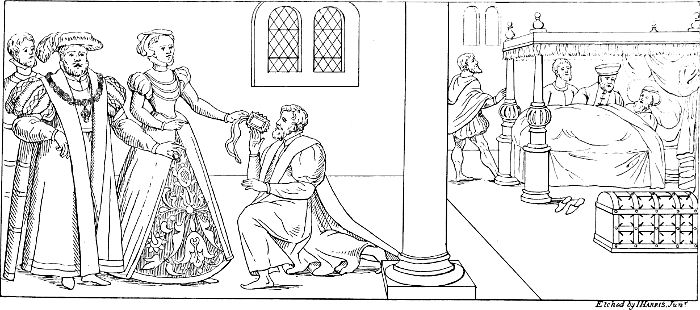
Etched by I. Harris, Jun.
DR. BUTTS SENT BY THE KING TO THE SICK CARDINAL WITH TOKENS OF FAVOUR. From a M.S. in the Collection of Francis Douce Esqr. F.S.A.
Published by Harding, Triphook, & Lepard. 1824.
After this time my lord daily amended, and so continued still at Asher until Candlemas; against which feast, the king caused to be sent him three or four cart loads of stuff, and most part thereof was locked in great standards, (except beds and kitchen-stuff,) wherein was both plate and rich hangings, and chapel-stuff[168]. Then my lord, being thus furnished, was therewith well contented; although they whom the king assigned did not deliver him so good, ne so rich stuff, as the king’s pleasure was, yet was he joyous thereof, and rendered most humble thanks to the king, and to them that appointed the said stuff for him, saying to us his servants, at the opening of the same stuff in the standards, the which we thought, and said, might have been better appointed if it had pleased them that appointed it: “Nay, sirs,” quoth my lord to us, “he that hath nothing is glad of somewhat, though it be never so little, and although it be not in comparison half so much and good as we had before, yet we rejoice more of this little than we did of the great abundance that we then had; and thank the king very much for the same, trusting after this to have much more. Therefore let us all rejoice, and be glad, that God and the king hath so graciously remembered to restore us to some things to maintain our estate like a noble person.”
Then commanded he Master Cromwell, being with him, to make suit to the king’s majesty, that he might remove thence to some other place, for he was weary of that house of Asher: for with continual use thereof the house waxed unsavoury; supposing that if he might remove from thence he should much sooner recover his health. And also the council had put into the king’s head, that the new gallery at Asher, which my lord had late before his fall newly set up, should be very necessary for the king, to take down and set it up again at Westminster; which was done accordingly, and stands at this present day there[169]. The taking away thereof before my lord’s face was to him a corrosive, which was invented by his enemies only to torment him, the which indeed discouraged him very sore to tarry any longer there. Now Master Cromwell thought it but vain and much folly to move any of the king’s council to assist and prefer his suit to the king, among whom rested the number of his mortal enemies, for they would rather hinder his removing, or else remove him farther from the king, than to have holpen him to any place nigh the king’s common trade; wherefore he refused any suit to them, and made only suit to the king’s own person; whose suit the king graciously heard, and thought it very convenient to be granted; and through the special motion of Master Cromwell, the king was well contented that he should remove to Richmond, which place my lord had a little before repaired to his great cost and charge; for the king had made an exchange thereof with him for Hampton Court. All this his removing was done without the knowledge of the king’s council, for if they might have had any intelligence thereof before, then would they have persuaded the king to the contrary: but when they were advertised of the king’s grant and pleasure, they dissimuled their countenances in the king’s presence, for they were greatly afraid of him, lest his nigh being, the king might at length some one time resort to him, and so call him home again, considering the great affection and love that the king daily showed towards him; wherefore they doubted his rising again, if they found not a mean to remove him shortly from the king. In so much that they thought it convenient for their purpose to inform the king upon certain considerations which they invented, that it were very necessary that my lord should go down into the North unto his benefice of York, where he should be a good stay for the country; to the which the king, supposing that they had meant no less than good faith, granted and condescended to their suggestions; which were forced so with wonderful imagined considerations, that the king, understanding nothing of their intent, was lightly persuaded to the same. Whereupon the Duke of Norfolk commanded Master Cromwell, who had daily access unto him, to say to my lord, that it is the king’s pleasure that he should with speed go to his benefice, where lieth his cure, and look to that according to his duty. Master Cromwell at his next repair to my lord, who lay then at Richmond, declared unto him what my Lord of Norfolk said, how it was determined that he should go to his benefice. “Well then, Thomas,” quoth my lord, “seeing there is no other remedy, I do intend to go to my benefice of Winchester, and I pray you, Thomas, so show my Lord of Norfolk.” “Contented, sir,” quoth Master Cromwell, and according to his commandment did so. To the which my Lord of Norfolk answered and said, “What will he do there?” “Nay,” quoth he, “let him go into his province of York, whereof he hath received his honour, and there lieth the spiritual burden and charge of his conscience, as he ought to do, and so show him.” The lords, who were not all his friends, having intelligence of his intent, thought to withdraw his appetite from Winchester, and would in no wise permit him to plant himself so nigh the king: [they] moved therefore the king to give my lord but a pension[170] out of Winchester, and to distribute all the rest among the nobility and other of his worthy servants; and in likewise to do the same with the revenues of St. Albans; and of the revenues of his colleges in Oxford and Ipswich, the which the king took into his own hands; whereof Master Cromwell had the receipt and government before by my lord’s assignment. In consideration thereof it was thought most convenient that he should have so still. Notwithstanding, out of the revenues of Winchester and St. Albans the king gave to some one nobleman three hundred marks, and to some a hundred pounds, and to some more and to some less, according to the king’s royal pleasure. Now Master Cromwell executed his office, the which he had over the lands of the college, so justly and exactly that he was had in great estimation for his witty behaviour therein, and also for the true, faithful, and diligent service extended towards my lord his master.
It came at length so to pass that those to whom the king’s majesty had given any annuities or fees for term of life by patent out of the forenamed revenues could not be good, but [only] during my lord’s life, forasmuch as the king had no longer estate or title therein[171], which came to him by reason of my lord’s attainder in the premunire; and to make their estates good and sufficient according to their patents, it was thought necessary to have my lord’s confirmation unto their grants. And this to be brought about, there was no other mean but to make suit to Master Cromwell to obtain their confirmation at my lord’s hands, whom they thought might best obtain the same.
Then began both noblemen and other who had any patents of the king, out either of Winchester or St. Albans, to make earnest suit to Master Cromwell for to solicit their causes to my lord, to get of him his confirmations; and for his pains therein sustained, they promised every man, not only worthily to reward him, but also to show him such pleasures as should at all times lie in their several powers, whereof they assured him. Wherein Master Cromwell perceiving an occasion and a time given him to work for himself, and to bring the thing to pass which he long wished for; intended to work so in this matter, to serve their desires, that he might the sooner bring his own enterprise to purpose.
Then at his next resort to my lord, he moved him privily in this matter to have his counsel and his advice, and so by their witty heads it was devised that they should work together by one line, to bring by their policies Master Cromwell in place and estate, where he might do himself good and my lord much profit. Now began matters to work to bring Master Cromwell into estimation in such sort as was afterwards much to his increase of dignity; and thus every man, having an occasion to sue for my lord’s confirmation, made now earnest travail to Master Cromwell for these purposes, who refused none to make promise that he would do his best in that case. And having a great occasion of access to the king for the disposition of divers lands, whereof he had the order and governance; by means whereof, and by his witty demeanour, he grew continually into the king’s favour, as ye shall hear after in this history. But first let us resort to the great business about the assurance of all these patents which the king hath given to divers noblemen and other of his servants, wherein Master Cromwell made a continuance of great suit to my lord for the same, that in process of time he served all their turns so that they had their purposes, and he their good wills. Thus rose his name and friendly acceptance with all men. The fame of his honesty and wisdom sounded so in the king’s ears that, by reason of his access to the king, he perceived to be in him no less wisdom than fame had made of him report, forasmuch as he had the government and receipts of those lands which I showed you before; and the conference that he had with the king therein enforced the king to repute him a very wise man, and a meet instrument to serve his grace, as it after came to pass.
Sir, now the lords thought long to remove my lord farther from the king, and out of his common trade; wherefore among other of the lords, my Lord of Norfolk said to Master Cromwell, “Sir,” quoth he, “me thinketh that the cardinal your master maketh no haste northward; show him, that if he go not away shortly, I will, rather than he should tarry still, tear him with my teeth. Therefore I would advise him to prepare him away as shortly as he can, or else he shall be sent forward.” These words Master Cromwell reported to my lord at his next repair unto him, who then had a just occasion to resort to him for the dispatch of the noblemen’s and others’ patents. And here I will leave of this matter, and show you of my lord’s being at Richmond.
My lord, having license of the king to repair and remove to Richmond, made haste to prepare him thitherward; and so he came and lodged within the great park there, which was a very pretty house and a neat, lacking no necessary rooms that to so small a house was convenient and necessary; where was to the same a very proper garden garnished with divers pleasant walks and alleys: my lord continued in this lodge from the time that he came thither, shortly after Candlemas, until it was Lent, with a privy number of servants, because of the smallness of the house, and the rest of his family went to board wages.
I will tell you a certain tale by the way of communication. Sir, as my lord was accustomed towards night to walk in the garden there, to say his service, it was my chance then to wait upon him there; and standing still in an alley, whilst he in another walked with his chaplain, saying of his service; as I stood, I espied certain images of beasts counterfeit in timber, standing in a corner under the lodge wall, to the which I repaired to behold. Among whom I saw there a dun cow, whereon I mused most, because it seemed me to be the most lively entaylled[172] among all the rest. My lord being, as I said, walking on the other side of the garden, perceived me, came suddenly upon me at my back, unawares, [and] said: “What have you espied here, that you so attentively look upon?” “Forsooth, if it please your grace,” quoth I, “here I do behold these entaylled images; the which I suppose were ordained for to be set up within some place about the king’s palace: howbeit, sir, among them all, I have most considered the dun cow, [in] the which (as it seemeth me) the workman has most apertly showed his cunning.” “Yea, marry, sir,” quoth my lord, “upon this dun cow dependeth a certain prophecy, the which I will show you, for peradventure ye never heard of it before. There is a saying,” quoth he, "that
“When this cow rideth the bull, Then, priest, beware thy scull.”
[Of] which prophecy neither my lord that declared it, ne I that heard it, understood the effect; although that even then it was a-working to be brought to pass. For this cow the king gave as one of his beasts appertaining of antiquity unto his earldom of Richmond, which was his ancient inheritance; this prophecy was after expounded in this wise. This dun cow, because it was the king’s beast, betokened the king; and the bull betokened Mistress Anne Boleyn, which was after queen, because that her father, Sir Thomas Boleyn, gave the same beast in his cognisance. So that when the king had married her, the which was then unknown to my lord, or to any other at that time, then was this prophecy thought of all men to be fulfilled. For what a number of priests, both religious and secular, lost their heads for offending of such laws as were then made to bring this [marriage] to effect, is not unknown to all the world. Therefore it was judged of all men that this prophecy was then fulfilled when the king and she were joined in marriage. Now, how dark and obscure riddles and prophecies be, you may behold in this same: for before it was brought to pass there was not the wisest prophesier could perfectly discuss it, as it is now come to effect and purpose. Trust therefore, by mine advice, to no kind of dark riddles and prophecies, wherein ye may, as many have been, be deceived, and brought to destruction. And many times the imaginations and travailous business to avoid such dark and strange prophecies, hath been the very occasion to bring the same the sooner to effect and perfection. Therefore let men beware to divine or assure themselves to expound any such prophecies, for who so doeth shall first deceive themselves, and, secondly, bring many into error; the experience hath been lately experienced, the more pity. But if men will needs think themselves so wise, to be assured of such blind prophecies, and will work their wills therein, either in avoiding or in fulfilling the same, God send him well to speed, for he may as well, and much more sooner, take damage than avoid the danger thereof! Let prophecies alone, a God’s name, apply your vocation, and commit the exposition of such dark riddles and obscure prophecies to God, that disposeth them as his divine pleasure shall see cause to alter and change all your enterprises and imaginations to nothing, and deceive all your expectations, and cause you to repent your great folly, the which when ye feel the smart, will yourself confess the same to be both great folly and much more madness to trust in any such fantasies. Let God therefore dispose them, who governeth and punisheth according to man’s deserts, and not to all men’s judgments.
You have heard herebefore what words the Duke of Norfolk had to Master Cromwell touching my lord’s going to the North to his benefice of York, at such time as Master Cromwell declared the same to my lord, to whom my lord answered in this wise: “Marry, Thomas,” quoth he, “then it is time to be going, if my Lord of Norfolk take it so. Therefore I pray you go to the king and move his highness in my behalf, and say that I would, with all my heart, go to my benefice at York, but for want of money; desiring his grace to assist me with some money towards my journey. For ye may say that the last money that I received of his majesty hath been too little to pay my debts, compelled by his counsel so to do; therefore to constrain me to the payment thereof, and his highness having all my goods, hath been too much extremity; wherein I trust his grace will have a charitable respect. Ye may say also to my Lord of Norfolk, and other of the council, that I would depart if I had money.” “Sir,” quoth Master Cromwell, “I will do my best.” And after other communication he departed again, and went to London.
My lord then in the beginning of Lent [removed] out of the Lodge into the Charterhouse of Richmond, where he lay in a lodging, which Doctor Collet, sometime Dean of Paul’s, had made for himself, until he removed northward, which was in the Passion Week after; and he had to the same house a secret gallery, which went out of his chamber into the Charterhouse church, whither he resorted every day to their service; and at afternoons he would sit in contemplation with one or other of the most ancient fathers of that house in his cell, who among them by their counsel persuaded him from the vain glory of this world, and gave him divers shirts of hair, the which he often wore afterward, whereof I am certain. And thus he continued for the time of his abode there in godly contemplation.
Now when Master Cromwell came to the court, he chanced to move my Lord of Norfolk that my lord would gladly depart northward but for lack of money, wherein he desired his assistance to the king. Then went they both jointly to the king, to whom my Lord of Norfolk declared how my lord would gladly depart northward, if he wanted not money to bring him thither; the king thereupon referred the assignment thereof to the council, whereupon they were in divers opinions. Some said he should have none, for he had sufficient of late delivered him; some would he should have sufficient and enough; and some contrariwise would he should have but a small sum; and some thought it much against the council’s honour, and much more against the king’s high dignity to see him want the maintenance of his estate which the king had given him in this realm; and [who] also hath been in such estimation with the king, and in great authority under him; it should be rather a great slander in foreign realms to the king and his whole council, to see him want that lately had so much, and now so little. “Therefore, rather than he should lack,” quoth one among them, “(although he never did me good or any pleasure), yet would I lay my plate to gage for him for a thousand pounds, rather than he should depart so simply as some would have him for to do. Let us do to him as we would be done unto; considering his small offence, and his inestimable substance that he only hath departed withal the same, for satisfying of the king’s pleasure, rather than he would stand in defence with the king in defending of his case, as he might justly have done, as ye all know. Let not malice cloak this matter whereby that justice and mercy may take no place; ye have all your pleasures fulfilled which ye have long desired, and now suffer conscience to minister unto him some liberality; the day may come that some of us may be in the same case, ye have such alterations in persons, as well assured as ye suppose yourselves to be, and to stand upon as sure a ground, and what hangeth over our heads we know not; I can say no more: now do as ye list.” Then after all this they began again to consult in this matter, and after long debating and reasoning about the same, it was concluded, that he should have by the way of prest[173], a thousand marks out of Winchester Bishoprick, beforehand of his pension, which the king had granted him out of the same, for the king had resumed the whole revenues of the Bishoprick of Winchester into his own hands; yet the king out of the same had granted divers great pensions unto divers noblemen and unto other of his council; so that I do suppose, all things accompted, his part was the least. So that, when this determination was fully concluded, they declared the same to the king, who straightway [commanded] the said thousand marks to be delivered out of hand to Master Cromwell; and so it was. The king, calling Master Cromwell to him secretly, bade him to resort to him again when he had received the said sum of money. And according to the same commandment he repaired again to the king; to whom the king said: “Show my lord your master, although our council hath not assigned any sufficient sum of money to bear his charges, yet ye shall show him in my behalf, that I will send him a thousand pound, of my benevolence; and tell him that he shall not lack, and bid him be of good cheer.” Master Cromwell upon his knees most humbly thanked the king on my lord’s behalf, for his great benevolence and noble heart towards my lord: “those comfortable words of your grace,” quoth he, “shall rejoice him more than three times the value of your noble reward.” And therewith departed from the king and came to my lord directly to Richmond; to whom he delivered the money, and showed him all the arguments in the council, which ye have heard before, with the progress of the same; and of what money it was, and whereof it was levied, which the council sent him; and of the money which the king sent him, and of his comfortable words; whereof my lord rejoiced not a little, and [was] greatly comforted. And after the receipt of this money my lord consulted with Master Cromwell about his departure, and of his journey, with the order thereof.