SOME PARTICULARS OF THE LIFE OF QUEEN ANNE BOLEIGNE.
Reading edition
The peculiar means that I have had, more than others, to come to some more particular knowledge of such things as I intend to handle, ought to draw thus much from me; yet much more the request of him that hath been by authority set on work in this important business, both for the singular gifts of God in him, of wisdom, learning, integrity, and virtue; and also the encouragement I have had of late from the right reverend my Lord of Canterbury’s grace, to set down what understanding I have had of this matter, is both my warrant, and a bond the more upon my conscience, to hold me urged and constrained not to neglect such an opportunity of my service to the church, my prince, and country. Principally his desire was, and my purpose in satisfying it, to deliver what I knew, touching certain things that happened to the excellent lady, the Lady Anne Boleigne, about the time of her first coming to the court. Yet, considering I had some other knowledge of things that might be found serviceable no less than that, and also might give light and life to the faithful narration of this whole matter, I have supposed it would fall best, to deliver the same, as it were, under the description of her whole life; and this the more particularly and frankly, that, all things known, those that I understood were to visit it again might take what they should think most material for their use. And would to God I could give that grace and felicity of style unto it that the worthiness of the subject doth require, notwithstanding that in this regard I am the less carefull, for that it is to pass through their hands that can give it better vesture; and I shall the more turn my care to intend the sincere and faithful delivery of that which I have received from those that both were most likely to come to the most perfect knowledge hereof, and had least cause or, otherwise for themselves, could least give just reason of suspicion to any, either of mind, or partiality, or wit, to fayne or misreport any whit hereof. And, indeed, chiefly the relation of those things that I shall set down is come from two. One a lady[202], that first attended on her both before and after she was queen, with whose house and mine there was then kindred and strict alliance. The other also a lady of noble birth, living in those times, and well acquainted with the persons that most this concerneth, from whom I am myself descended. A little, therefore, repeating the matter more high, I will derive the discourse hereof from the very spring and fountains, whence may appear most clearly by what occasion and degrees the stream of this whole cause hath grown to such an ocean as it were of memorable effects through all our parts of Christendom, not by chance or wits of men so much as even by the apparent work of God, as I hope presently to make plain to all men.
The see of Rome having risen, in this our age, unto a full tide of all wickedness, had overflowed all these parts of the world with the floods of her evils, whereby was occasioned and had beginning the ebb of all her pomp, power, and glory, every particular devising, as if it had been by one consent and accord (so showing it the more apparently to come of God), to provide for the time to come against her so great inundation of mischiefs. Hereof, in England, Germany, Italy, and in many other places, sundry persons of singular learning and piety, one succeeding another, at divers times, opened their mouths as trumpets to call men to this work upon several occasions, all rising from the outrageous corruptions and foaming filth of that see. But chiefly and most notoriously, in the time of Henry the Eighth, of famous memory, this came to pass by the just judgment of God upon her, and his mercy upon us, where the same polity by which she had in custom, and then made herself most assured, to strengthen herself in giving to princes licence to unlawful contracts (esteeming thereby to tie them and their issue the more strongly to her); the bond of so evil counsel breaking suddenly, set at liberty the certain means of this great opposition against her after almost through all Europe. So little assurance especially have evil foundations of usurped authorities against the provoked judgments of God by sin, and general displeasure of man upon just conceived indignities.
There was, at this present, presented to the eye of the court the rare and admirable beauty of the fresh and young Lady Anne Boleigne, to be attending upon the queen. In this noble imp, the graces of nature graced by gracious education, seemed even at the first to have promised bliss unto her aftertimes. She was taken at that time to have a beauty not so whitely as clear and fresh above all we may esteem, which appeared much more excellent by her favour passing sweet and cheerful; and these, both also increased by her noble presence of shape and fashion, representing both mildness and majesty more than can be expressed. There was found, indeed, upon the side of her nail upon one of her fingers, some little show of a nail, which yet was so small, by the report of those that have seen her, as the workmaster seemed to leave it an occasion of greater grace to her hand, which, with the tip of one of her other fingers, might be and was usually by her hidden without any least blemish to it. Likewise there were said to be upon some parts of her body certain small moles incident to the clearest complexions. And certainly both these were none other than might more stain their writings with note of malice that have caught at such light motes in so bright beams of beauty, than in any part shadow it, as may right well appear by many arguments, but chiefly by the choice and exquisite judgments of many brave spirits that were esteemed to honour the honourable parts in her, even honoured of envy itself.
Amongst these, two were observed to be of principal mark. The one was Sir Thomas Wiat, the elder[203], the other was the king himself. The knight, in the beginning, coming to behold the sudden appearance of this new beauty, came to be holden and surprised somewhat with the sight thereof; after much more with her witty and graceful speech, his ear also had him chained unto her, so as finally his heart seemed to say, I could gladly yield to be tied for ever with the knot of her love, as somewhere in his verses hath been thought his meaning was to express[204]. She, on the other part, finding him to be then married, and in the knot to have been tied then ten years, rejected all his speech of love; but yet in such sort as whatsoever tended to regard of her honour, she showed not to scorn, for the general favour and good will she perceived all men to bare him, which might the rather occasion others to turn their looks to that which a man of his worth was brought to gaze at in her, as, indeed, after it happened. The king is held to have taken his first apprehension of this love after such time as upon the doubt in those treaties of marriage with his daughter Mary, first with the Spaniard, then with the French: by some of the learned of his own land he had vehemently in their public sermons, and in his confessions to his ghostly fathers, been prayed to forsake that his incestuous life by accompanying with his brother’s wife; and especially after he was moved by the cardinal, then in his greatest trust with the king, both for the better quietness of his conscience, and for more sure settling of the succession to more prosperous issue.
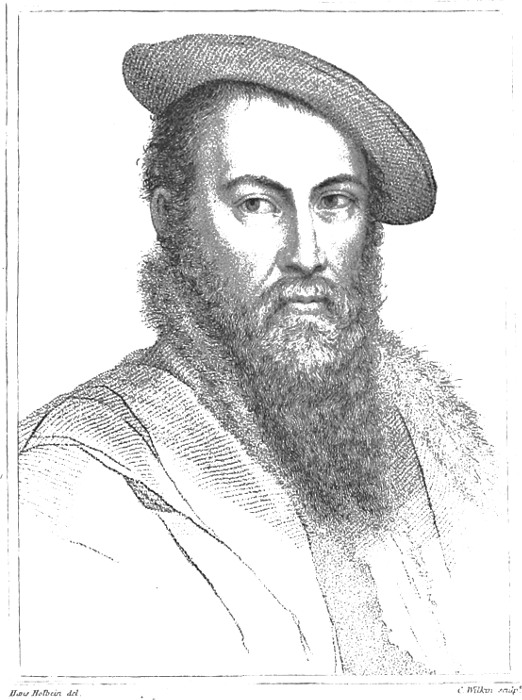
Sir Thomas Wyatt Kt.
About this time, it is said that the knight, entertaining talk with her as she was earnest at work, in sporting wise caught from her a certain small jewel hanging by a lace out of her pocket, or otherwise loose, which he thrust into his bosom, neither with any earnest request could she obtain it of him again. He kept it, therefore, and wore it after about his neck, under his cassock, promising to himself either to have it with her favour or as an occasion to have talk with her, wherein he had singular delight, and she after seemed not to make much reckoning of it, either the thing not being much worth, or not worth much striving for. The noble prince having a watchful eye upon the knight, noted him more to hover about the lady, and she the more to keep aloof of him; was whetted the more to discover to her his affection, so as rather he liked first to try of what temper the regard of her honour was, which he finding not any way to be tainted with those things his kingly majesty and means could bring to the battery, he in the end fell to win her by treaty of marriage, and in this talk took from her a ring, and that wore upon his little finger; and yet all this with such secrecy was carried, and on her part so wisely, as none or very few esteemed this other than an ordinary course of dalliance. Within few days after, it happened that the king, sporting himself at bowls, had in his company (as it falls out) divers noblemen and other courtiers of account, amongst whom might be the Duke of Suffolk, Sir F. Brian, and Sir T. Wiat, himself being more than ordinarily pleasantly disposed, and in his game taking an occasion to affirm a cast to be his that plainly appeared to be otherwise; those on the other side said, with his grace’s leave, they thought not, and yet, still he pointing with his finger whereon he wore her ring, replied often it was his, and specially to the knight he said, Wiat, I tell thee it is mine, smiling upon him withal. Sir Thomas, at the length, casting his eye upon the king’s finger, perceived that the king meant the lady whose ring that was, which he well knew, and pausing a little, and finding the king bent to pleasure, after the words repeated again by the king, the knight replied, And if it may like your majesty to give me leave to measure it, I hope it will be mine; and withal took from his neck the lace whereat hung the tablet, and therewith stooped to measure the cast, which the king espying, knew, and had seen her wear, and therewithal spurned away the bowl, and said, It may be so, but then am I deceived; and so broke up the game. This thing thus carried was not perceived for all this of many, but of some few it was. Now the king, resorting to his chamber, showing some discontentment in his countenance, found means to break this matter to the lady, who, with good and evident proof how the knight came by the jewel, satisfied the king so effectually that this more confirmed the king’s opinion of her truth than himself at the first could have expected. Shortly, upon the return of the cardinal, the matter of the dutchess[205] cooling every day more and more, his credit also waned till it was utterly eclipsed; and that so busied the great personages that they marked the less the king’s bent, the rather for that some way it seemed helpful to their working against the cardinal. The king also took here opportunity to proceed to discover his full and whole meaning unto the lady’s father, to whom we may be sure the news was not a little joyful. All this notwithstanding, her virtue was not so dased with the glory of so forcible attractives, but that she stood still upon her guard, and was not, as we would suppose, so easily taken with all these appearances of happiness; whereof two things appeared to be the causes. One the love she bare ever to the queen whom she served, that was also a personage of great virtue: the other her conceit that there was not that freedom of conjunction with one that was her lord and king as with one more agreeable to her estate. These things being well perceived of, the queen shew she knew well to frame and work her advantage of, and therefore the oftener had her at cards with her, the rather also that the king might have the less her company, and the lady the more excuse to be from him; also she esteem herself the kindlier used, and yet withal the more to give the king occasion to see the nail upon her finger. And in this entertainment of time they had a certain game that I cannot name then frequented, wherein dealing, the king and queen meeting they stopped, and the young lady’s hap was much to stop at a king; which the queen noting, said to her playfellow, My Lady Anne, you have good hap to stop at a king, but you are not like others, you will have all or none. So often earnest matters are delivered under game. Yet had the king his times, and she in the end yielded to give her consent of marriage to him, whom hardly ever any before was found able to keep their hold against. This was now so far to the pleasure of the king, that forthwith he with her and her father concluded to open the matter to the council, all other things being ripe thereunto, and specially for that it was not possible to keep it any longer from the talk of men near his person, and the more, the queen being found to take such knowledge thereof. It is thought then the table was diversely carried to give opinion upon this matter; some of the nobility wishing rather to have had so good hap lighted to some of their own houses; others that it had not been at all; some inclining to either of these as depending on them; but most liked better the king’s own choice, both for the hope of issue, and that the greatness of great men should not grow too great to sway with in managing of matters of state. But howsoever, it appeared manifestly that presently there were practices discovered on all sides under sundry arts, on the parts of Spain, from Rome and that faction, and from the queen herself, and specially some with the king, some with the lady herself, plotted to break or stay at the least till something might fall between the cup and the lip, that might break all this purpose with one of them, if it might have been. And verily one of these may seem for this present occasion not unmeet to be recounted; which was this: There was conveyed to her a book pretending old prophecies, wherein was represented the figure of some personages, with the letter H upon one, A upon another, and K upon the third, which an expounder thereupon took upon him to interpret by the king and his wives, and to her pronouncing certain destruction if she married the king. This book coming into her chamber, she opened, and finding the contents, called to her maid of whom we have spoken before, who also bore her name: “Come hither, Nan,” said she, “see here a book of prophecy; this he saith is the king, this the queen, mourning, weeping and wringing her hands, and this is myself with my head off.” The maid answered, “If I thought it true, though he were an emperor, I would not myself marry him with that condition.” "Yes, Nan," replied the lady, “I think the book a bauble; yet for the hope I have that the realm may be happy by my issue, I am resolved to have him whatsoever might become of me.”
The Romish fable-framer[206], if he may be believed, affirmeth another practice after this sort: “That Sir Thomas Wiat coming to the council, for his better security, confessed to have had dealings with that lady, before he had any perceiving of the king’s purpose of marriage; but not being credited by the king, that Wiat, as not finding it well he was not believed, affirmed he would bring the king where he might see him enjoy her. And that again being delivered by the Duke of Suffolk to the king, he yet believed it not.” But it is certain that the whole or greatest part of this is fiction; for the persons, manner, and event of these things have been utterly mistaken and misshapen. For I have heard by the report of one of right good and honourable account, and of much understanding in such things, who also hath the truth of his word in high respect, that it was Sir Francis Brian that confessed such a like thing to the king by another lady, with other success more likely, which was that the king thereupon pardoned him indeed, but rejected and gave over the lady ever after to him. Whether the duke might, upon the sight of that which happened at bowls, take any occasion with the king to dissuade the marriage, supposing the knight could not or would not otherwise have cleared himself and the lady, but by confessing and craving pardon for it as done before he had knowledge of the king’s intention, I cannot say; and by guess I will not affirm it in any case of any, much less of so worthy and noble a personage. Only this I say, that if he did so, I believe verily that he was greatly deceived therein of his expectation; as finding that by good proof the knight could clear himself and her of that matter, even to the full assuring and ascertaining of the king of the manner of his coming by the jewel without her dishonour, and that so the duke, if he did so, might come to find himself had gone too far, as to have purchased to himself thereby mislike both of the king and queen, whereupon he might turn his heavy displeasure to the knight ever after. I know of a certainty, that the knight had a most high opinion of that princely lady’s noble virtues as by trial, and chiefly in the matter of the bowls; in that she took not or interpreted ill of his deed (as herself, being in her own conscience clear), but as he meant it to the king’s disport before knowledge of the marriage. This is true also, that Sir Thomas Wiat was twice sifted and lifted at, and that nobleman both times his most heavy adversary, as I have to show under the knight’s own hand in his answer to his last indictment. Neither could I ever learn what might be the cause of his so perpetual grudge, save only that it appeareth to be as old as this. Some man might perhaps be led to think that the duke might have a special end to draw him to enter and venture so far to the breaking off the match. And it is true that he was then married with the king’s second sister, when the king had then remaining but one only daughter, and then she also questioned whether legitimate: That then also was procured a statute to cut off foreign titles; and it is true also, that after the ambition of some to occasion hereby to thrust the duke’s issue, even before the proper and lawful issue of the king, into the regal seat. All this notwithstanding, I will never be induced to give that opinion of that nobleman, but rather I would think, if he did any such thing, in any sort giving colour to this fancy of the Roman legender, he did it upon zeal that in his conceit it was true, and that he thought the knight would so far confess it as done before talk of the king’s marriage, when he saw he had passed so far in the measuring of the cast. And though the whole fiction have scarcely so much as shadow of colour of any appearance, yet for that part where he deviseth that Sir Thomas should before the council apeach himself and that lady, or after not being credited, offer to make the king see him to have to do with her, this showing itself sufficiently falsified to any wise and understanding reader, especially considering it particularly with the circumstances, it is so far from all likelihood, as all presumptions are flat against it, as in a word or two shall now be showed.
For that princely lady, she living in court where were so many brave gallants at that time unmarried, she was not like to cast her eye upon one that had been then married ten years. And her parents, then in good and honourable place, resident in court, and themselves of no mean condition, they would keep, no doubt, a watchful eye over her to see she should not roam to the hinderance of her own preferment, a course so foul with one where was no colour of marriage. The King’s eye also was a guard upon her, as also those that pleased the king in recounting the adventures of love happening in court made it hard, specially for the shortness of time after her placing there, and the king’s own love. Also she that held out against such a king where was hope of marriage, what was like she should do to the knight, where his own lady and her friends were still to attend upon their doings, whose testimonies of the honourable carriage of that lady are therefore here most strong for her? And for the knight, if he had enjoyed her, was he so far desperately wicked and a monster in love, that he would openly, purposely, and to his own disgrace, vaunt the spoil of a maid of so good friends and likelihoods of advancements, without all regard of God or man? especially when she had stood so well upon the assurance of her own innocence for the matter of the jewel without turning him to any displeasure thereby. Those that knew him best, knew him far from that dishonest disposition chiefly in this kind, and for so gross a villany. And if he had been of that mind, yet was he known not of so little wit or understanding, upon a point that was not very likely to be known, to discover his own and her evil; where was a great deal more likelihood that, the king believing her rather than him, he was to incur a more certain and greater mischief, that might in all presumption, fall by the heavy displeasure of them both upon himself ever after. And if we could imagine him both so wretchedly dishonest, and so very a sot (neither of which could be found of him), his father then counsellor to the king, for his wisdom, years, and experience, more grave, would not have suffered him yet to quit himself so fondly and to be so mad; especially as when the king had showed not to believe it, then to run more obstinately to offer when the king had made her privy hereunto, to bring her that the king should see her also so mad as to yield to him after she had given consent of marriage to the king. Who would not believe them also mad, that would believe so mad a carriage of such a business amongst grave and wise men, howsoever the railing Romanist be so mad to write it so as he would seem mad with reason? For the king also, besides that he had more occasion and means than any other to note and observe her doings, yet much more (as the nature of generous spirits carries them) he was watchful upon the knight, as in other things so chiefly in this, not to be outrun at this garland of love; so as by himself and by the eyes of others, there was not any trip but would have been spied, no likelihood but would have carried suspicion with it; how much more would the knight’s confession have sunk into his head? Would he, being so wise a prince, have forgotten that the soberness of his choice would serve much for satisfying the world, touching his divorce? Had he not time, had he not leisure to learn, to inquire and sift out all things? His care used in gathering opinions of universities, and in informing princes of the whole matter, with all circumstances in the managing this cause, by the space of some years, show he was not so passionate a lover, but also withal a wise and considerate prince. But it is said the king believed it not! Yet what? when the knight (as this tale saith) offered to make the king see it, and that avowed to the council! Could such a prince as he swallow this? Doubtless none that hath his wits will think so, none that knew the complexion of the king could induce himself to suppose a thing so incredible. The case of Sir Francis Brian’s[207] opening of his love had another effect, and shows plainly that the king was of another metal, since he cast off that Lady loved right dearly (as hath been said) without farther matter. And doubtless in this case, he believing the matter would have thrown off this lady also, the marriage not yet consummate, and he having in his own realm and abroad beauties enough to content him, and means enough also to push on some other. But it is devised the king believed it not. Not believing it, think we the knight could have escaped punishment of a slanderer, though he might by confessing, avoid the punishment of a malefactor (as they say) after? This no outrageous madman would believe. If the king would or could have passed it over, the lady in honour could not, nor might. But suppose also that supposal beyond all suppose. Though they punished it not, would they, think ye, have put him in credit and advancement after? Would they have had him chief ewerer even the very day of her coronation? Would they have employed him ambassador in that matter of the marriage? Yea, I say more! would the king also have rewarded him with a good portion of lands soon upon this? But all these were so as we have alleged them. The Chronicles have his service on that day of coronation. His embassages were twice about this matter known right well: I have seen the patents of the grant myself[208]. And these things, the last especially, I the rather allege, for that the knight useth them himself as testimonies of the king’s good opinion of him, in his defence before mentioned, which also by the king and his council in those times was liked and allowed of as his just purgation, by which they acquitted him. Finally, that his defence then may and is to be esteemed his defence now also in this case not to be contemned, and may thus be considered. This reporteth that he was twice winnowed. The matters were the same both times, the accusations so frivolous, the inducements and proofs so idle, that they prove nothing more than that there lacked no wills in his adversary to do him hurt, than that they had any least colour of matter to work it. Nothing so impertinent, nothing so unlikely that they allege not. Yea and his most trusty and best services they had the chief matters of their accusation, nothing was so fond that they ripped not up to his discredit, at the least if it might have been. Yet in all this was no word or signification of any such matter. Though it had not been brought as the ground of his accusation, would it not have been drawn forth to aggravate or induce the matter? Undoubtedly it would, either in the queen’s life in his first trouble, and it would have done well to revenge if he had done her this wrong, or after to her overthrow, or else in his second trouble against him. But no one word is or was in it touching any such matters.
After so many cross billets of cunning polities, surmounted by the guiding providence of God, after so many trials of her truth, passed through by her wise and virtuous governance, the king having every way made so thorough proof how deep root honour had taken in her bosom, and having found it not to be shaken even by him, this royal and famous prince Henry the Eighth, resolving her matchless perfections meet alone to be joined with his, now at the length concluded forthwith to knit up this marriage, although for certain causes the same was thought more convenient to be performed somewhat privately and secretly. On the twenty-fifth of January[209], therefore, the ceremony was consummate. The king also, shortly after having himself more ascertained, and by more inward trial more assured of her spousal truth, would yet farther testify that his opinion of her, by giving her that highest honour he could give her virtues, in having her solemnly and royally crowned. And thus we see they lived and loved, tokens of increasing love perpetually increasing between them. Her mind brought him forth the rich treasures of love of piety, love of truth, love of learning. Her body yielded him the fruits of marriage, inestimable pledges of her faith and loyal love. And touching the former of these, it is here first not to be forgotten, that of her time (that is during the three years that she was queen) it is found by good observation, that no one suffered for religion, which is the more worthy to be noted for that it could not so be said of any time of the queens after married to the king. And amongst other proofs of her love to religion to be found in others, this here of me is to be added. That shortly after her marriage, divers learned and christianly disposed persons resorting to her, presented her with sundry books of those controversies that then began to be questioned touching religion, and specially of the authority of the pope and his clergy, and of their doings against kings and states. And amongst other, there happened[210] one of these, which, as her manner was, she having read, she had also noted with her nail as of matter worthy the king’s knowledge[211]. The book lying in her window, her maid (of whom hath been spoken) took it up, and as she was reading it, came to speak with her one[212] then suitor to her, that after married her; and as they talked he took the book of her, and she withal, called to attend on the queen, forgot it in his hands, and she not returning in some long space, he walked forth with it in his hand, thinking it had been hers. There encountered him soon after a gentleman of the cardinal’s of his acquaintance, and after salutations, perceiving the book, requested to see it, and finding what it was, partly by the title, partly by some what he read in it, he borrowed it and showed it to the cardinal. Hereupon the suitor was sent for to the cardinal and examined of the book, and how he came by it, and had like to have come in trouble about it, but that it being found to have pertained to one of the queen’s chamber, the cardinal thought better to defer the matter till he had broken it to the king first, in which meantime the suitor delivered the lady what had fallen out, and she also to the queen, who, for her wisdom knowing more what might grow thereupon, without delay went and imparted the matter to the king, and showed him of the points that she had noted with her finger. And she was but newly come from the king, but the cardinal came in with the book in his hands to make complaint of certain points in it that he knew the king would not like of, and withal to take occasion with him against those that countenanced such books in general, and specially women, and as might be thought with mind to go farther against the queen more directly if he had perceived the king agreeable to his meaning. But the king that somewhat afore distasted the cardinal, as we have showed, finding the notes the queen had made, all turned the more to hasten his ruin, which was also furthered on all sides.
On the other part, of her body she bare him a daughter on the seventh[213] of September, to the great joy then of all his people, both for that the king had now issue legitimate of his own body, and for the hope of more after. The king also he expressed his joy for that fruit sprung of himself, and his yet more confirmed love towards her, caused her child openly and publickly to be proclaimed Princess Elizabeth at the solemnity of her baptising, preferring his younger daughter legitimate before the elder in unlawful wedlock. And after this again, at the prorogation of the parliament, the thirtieth of March[214], he had every lord, knight, and burgess sworn to an act of succession, and their names subscribed to a schedule fixed to the same statute, where it was enacted, that his daughter princess Elizabeth, he having none other heir male, should succeed him to the crown.
And after were commissioners sent to all parts of the realm to take the like oath of all men and women in the land. Neither also were her virtues only enclosed in her own breast or shut up in her own person. She had procured to her chaplains[215], men of great learning and of no less honest conversing, whom she with hers heard much, and privately she heard them willingly and gladly to admonish her, and them herself exhorted and encouraged so to do. Also at the first, she had in court drawn about her, to be attending on her, ladies[216] of great honour, and yet of greater choice for reputation of virtue, undoubted witnesses of her spousal integrity, whom she trained upon with all commendations of well ordered government, though yet above all by her own example she shined above them all, as a torch that all might take light of, being itself still more bright. Those that have seen at Hampton Court the rich and exquisite works by herself, for the greater part wrought by her own hand and needle, and also of her ladies, esteem them the most precious furniture that are to be accounted amongst the most sumptuous that any prince may be possessed of. And yet far more rich and precious were those works in the sight of God which she caused her maids and those about her daily to work in shirts and smocks for the poor. But not staying here her eye of charity, her hand of bounty passed through the whole land; each place felt that heavenly flame burning in her; all times will remember it, no place leaving for vain flames, no times for idle thoughts. Her ordinary amounted to fifteen hundred pounds at the least, yearly, to be bestowed on the poor. Her provisions of stock for the poor in sundry needy parishes were very great. Out of her privy purse went not a little to like purposes. To Scholars in exhibition very much: so as in three quarters of a year her alms was summed to fourteen or fifteen thousand pounds.
She waxing great again and not so fit for dalliance, the time was taken to steal the king’s affection from her, when most of all she was to have been cherished. And he once showing to bend from her, many that least ought shrank from her also, and some lent on the other side; such are the flexible natures of those in courts of princes for the most part. Unkindness grew, and she was brought abed before her time with much peril of her life, and of a male child dead born, to her greater and most extreme grief. Being thus a woman full of sorrow, it was reported that the king came to her, and bewailing and complaining unto her the loss of his boy, some words were heard break out of the inward feeling of her heart’s dolours, laying the fault upon unkindness, which the king more than was cause (her case at this time considered) took more hardly than otherwise he would if he had not been somewhat too much overcome with grief, or not so much alienate. Wise men in those days judged that her virtues was here her default, and that if her too much love could, as well as the other queen, have borne with his defect of love, she might have fallen into less danger, and in the end have tied him the more ever after to her when he had seen his error, and that she might the rather have done respecting the general liberty and custom of falling then that way. Certainly, from henceforth the harm still more increased, and he was then heard to say to her: he would have no more boys by her. Having thus so many, so great factions at home and abroad set loose by the distorned favour of the king, and so few to show themselves for her, what could be? what was otherlike but that all these guests lighting on her at once should prevail to overthrow her, and with her those that stood under her fall? She and her friends therefore were suddenly sent to the Tower: and this gracious queen coming unto the entry of the gate, she falling down upon her knees made that place a reverend temple to offer up her devout prayers, and as a bale there her soul beaten down with afflictions to the earth, with her faithful prayers bounded up to heaven. “O Lord,” said she, “help me, as I am guiltless of this whereof I am accused.” The time approached for the hearing of her cause. The place of her trial in the Tower may somewhat discover how the matter was liked to be handled. Nor there was it appointed the better to conceal the heinousness of the accusation, though that might be the pretence. For that was published in parliament that it might from thence spread abroad over all. Her very accusations speak and even plead for her; all of them, so far as I can find, carrying in themselves open proof to all men’s consciences of mere matter of quarrel, and indeed of a very preparation to some hoped alteration. The most and chief of them showing to have come from Rome, that popish forge of cunning and treachery, as Petrarch long since termed it.
Nido di tradimenti in cui si cuova Quanto mal per lo mondo hoggi si spandi. Nest of treasons in which is hatch’d and bred What ill this day the world doth overspread.
For that most odious of them, something is to be esteemed by the apparent wrongs of the other evil handling of matters. But for this thing itself, partly it is incredible, partly by the circumstances impossible. Incredible, that she that had it her word as it were, the spirit of her mind, as hath been said, that she was Cæsar’s all, not to be touched of others, should be held with the foul desire of her brother. Again, she having so goodly a prince to please her, who also had showed himself able to content more than one, that she should yet be carried to a thing so much abhorring even womanly years and to nature itself, much more to so christian a queen. Impossible, for the necessary and no small attendance of ladies ever about her, whereof some, as after appeared, even aspired unto her place and right in the king’s love; yea, by manifest prevention before their time. And indeed, hereof, it was her very accusers found it impossible to have colour to charge her with any other than her brother, which also made it no less impossible even for him alike as other. Impossible, I say, because neither she could remove so great ladies, by office appointed to attend upon her continually, from being witnesses to her doings; neither for the danger she saw she stood in, and the occasion daily sought, would she for her own wisdom, and also by the advertisements of her kindred and followers, whereof she had many of most great understanding, experience, and faith, about her. Besides, she could not but be made more wary and wakeful, if for none other cause, yet even to take away all colour from her enemies, whose eyes were everywhere upon her to pick matter, and their malicious hearts bent to make some where they found none; as plainly enough was to be seen when they were driven to those straits to take occasion at her brother’s more private being with her; the more grudged at perhaps, for that it might be supposed his conference with her might be for the breaking off the king’s new love. For the evidence, as I never could hear of any, so small I believe it was. But this I say, well was it said of a noble judge of late, that “half a proof where nature leadeth was to be esteemed a whole proof.” On the contrary, in this case he would have said, whole and very absolute proofs to have been needful in such a case against nature. And I may say, by their leaves, it seems themselves they doubted their proofs would prove their reproofs, when they durst not bring them to the proof of the light in open place. For this principal matter between the queen and her brother, there was brought forth, indeed, witness, his wicked wife accuser of her own husband, even to the seeking of his blood, which I believe is hardly to be showed of any honest woman ever done. But of her, the judgment that fell out upon her, and the just punishment by law after of her naughtiness, show that what she did was more to be rid of him than of true ground against him. And that it seemeth those noblemen that went upon the queen’s life found in her trial, when it may appear plainly by that defence of the knight that oft hath been here mentioned, that the young nobleman the Lord Rochford, by the common opinion of men of best understanding in those days, was counted and then openly spoken, condemned only upon some point of a statute of words then in force. And this and sundry other reasons have made me think often that upon some clause of the same law they grounded their colour also against her, and that for other matters she had cleared herself well enough. It seemeth some great ones then had their hands in drawing in that law to entangle or bridle one another, and that some of them were taken in the same net, as good men then thought worthily. Surely my Lord Cromwell and this young lord were taken in those entanglements, and the knight himself, of whom is spoken, had hardly scaped it, as may appear by his defence, if he had not by the well delivering of the goodness of his cause broken through it. And this may well serve to admonish men to be well aware how far they admit of laws that shall touch life upon construction of words; or, at the least, admitting them, how far they leave to lawyers to interpret of them, and especially that thereby they give not excuse to juries to condemn the innocent when sway of time should thrust matters upon them. Thus was she put upon her trial by men of great honour; it had been good also if some of them had not been to be suspected of too much power and no less malice. The evidence were heard indeed, but close enough, as enclosed in strong walls. Yet, to show the truth cannot by any force be altogether kept in hold, some belike of those honourable personages there, more perhaps for countenance of others’ evil than for means by their own authority to do good (which also peradventure would not have been without their own certain perils), did not yet forbear to deliver out voices that caused every where to be muttered abroad, that that spotless queen in her defence had cleared herself with a most wise and noble speech. Notwithstanding such a trial, such a judgment found her guilty, and gave sentence of death upon her at home, whom others abroad, living to feel her loss, found guiltless.
The woful sentence was given; burning or heading at the king’s pleasure, leaving open some small place to pity for the kind of death, which the king’s conscience (no doubt) moved him to take in appointing the more honourable death. Within those walls this execution was to be done. What needed that? The love known indeed to her by the people was not to be feared of the king, her love being such to him as to her last breath she stood to acquit and defend him by her words at her death, carrying a very true image of her former love and life. “Christian people!” said she, “I am come to die, and according to law, and by law I am judged to death, and therefore I will speak nothing against it. I am come hither to accuse no man, nor to speak any thing of that whereof I am accused and condemned to die. But I pray God save the king, and send him long to reign over you, for a gentler and more merciful prince was there never, and to me he was ever a good, a gentle, and sovereign lord. If any person will meddle of my cause, I require him to judge the best. And thus I take my leave of the world and of you, and I heartily desire you all to pray for me. O Lord, have mercy on me! To God I commend my soul.” And so she kneeling down said, “To Christ I commend my soul. Jesu, receive my soul!” The bloody blow came down from his trembling hand that gave it, when those about her could not but seem to themselves to have received it upon their own necks, she not so much as shrieking at it. God provided for her corpse sacred burial, even in place as it were consecrate to innocents.
END OF THE MEMOIR OF QUEEN ANNE BOLEYN.
The following letters, relating to the arrest and behaviour in prison of Queen Anne Boleyn, are in themselves so interesting that no apology seems necessary for placing them in juxtaposition with the foregoing interesting memoir. They have been recently given to the public in Mr. Ellis’s accurate and interesting collection of Historical Letters; that gentleman has preferred printing them as mutilated fragments, to supplying the lacunæ by such means as I have ventured to adopt. Strype saw these letters previous to the calamitous fire in 1731, which injured so many valuable papers in the Cottonian Collection, and he has given large extracts from them of the most interesting passages: from this source, therefore, I have filled up such chasms as I could, that the reader may not be tantalized by the enigma-like appearance of a few disjointed words. The passages supplied have been carefully distinguished by printing them in Italics between brackets, and as Strype was a sufficiently accurate Antiquary, and faithful in his extracts, it is presumed that the reader may rely upon the authenticity of the passages thus supplied.
The reader is already acquainted with the writer, Sir William Kingston, the Lieutenant or Constable of the Tower, from the figure he makes in the Life of Wolsey. See p. 369, et seq.
LETTER I.
Sir William Kingston to Secretary Cromwell, upon Queen Anne’s committal to the Tower.
[MS. COTTON, OTHO C. X. fol. 225.]
Thys ys to advertyse you apon my Lord of Norfolk and the kyngs counsell depart[inge] from the Towre I went before the quene in to hyr lodgyng, & [then she] sayd unto me, M. Kyngston, shall I go in to a dungyn? Now, madam, y[ou] shall go into your logyng that you lay in at your coronacion. It ys to gu[de] for me, she sayd, Jesu, have mercy on me; and kneled downe wepyng a [great] pace, and in the same sorow fell in to agret lawyng, and she hathe done [so] mony tymes syns. And then she desyred me to move the kyngs hynes that she [myght] have the sacarment in the closet by hyr chambr, that she my[ght pray] for mercy, for I am as clere from the company of man, as for s[yn, sayd she as I] am clere from you, and am the kyngs trew wedded wyf; and then sh[e sayd] M. Kyngston, do you know wher for I am here, and I sayd Nay, and then [she sayd] when saw you the kyng? and I sayd, I saw hym not syns I saw [him in] the Tylte yerde, and then M. K. I pray you to tell me wher my [Lord Roch]ford ys? and I told hyr I saw hym afore dyner in the cort. O [where ys] my sweet brod’er? I sayd I left hym at York place, and so I dyd. I [hear say, say]d she, that I shuld be accused with iij men; and I can say [no more but] nay, withyowt I shuld oppen my body; and ther with opynd [her gown sayeng, O Nor]res, hast thow accused me, thow ar in the Towre with me, & [thou and I shal]l dy to gether: and, Marke, thou art here to. O my mother, [thou wilt dy] for sorow, and meche lamented my lady of Worcetr, for by ca[wse her child] dyd not store in hyr body, and my wyf sayd what shuld [be the cawse, she] sayd for the sorow she toke for me: and then she sayd M. K[ingston, shall I dy] with yowt justs; & I sayd, the porest sugett the kyng [hath had justis, and] ther with she lawed. All thys sayings was yester ny[ght] . . . . . . . . & thys moryng dyd talke with mestrys Cosȳ[217], [and said that Nor]res dyd say on Sunday last unto the quenes amn[er, that he wold sw]ere for the quene that she was a gud woman. [And then sayd Mrs.] Cosyn, Madam, why shuld ther be hony seche maters [spoken of? Mary,] sayd she, I bad hym do so, for I asked hym why he [went nat thorough with] hys maryage? and he made ansur he wold tary [a time. Then said she, you] loke for ded mens showys; for yf owth cam[e to the king but good,] you wold loke to have me; and he sayd, yf he [should have ony soche thought,] he wold hys hed war of; and then she sayd, [she could undo him if she wold,] and ther with thay fell yowt. Bot [she said, she more feared Weston; for] on Wysson Monday Twysday last [Weston told he]r that Nores cam more u[nto her chawmbre for her then for M]age[218], and further . . . . . . . . . . . . . . . . . . . . . . . . . . . . Wher I was commaunded to charge the gentlewemen that y gyf thaye atende apon the quene, that ys to say, thay shuld have now commynycaseon with hyr, in lese[219] my wyf ware present, and so I dyd hit, notwithstaundyng it canot be; for my lady Bolen and mestrys Cosyn lyes on the quenes palet, and I and my wyf at the dore with yowt, so at[220] thay most nedes talke at[220] be without; bot I have every thyng told me by mestrys Cosyn that she thynks met for mee to knowe, and tother ij gentlewemen lyes with yowt me, and as I may knowe [the] kings plesur in the premysses I shall folow. From the Towre this mo . . .
Sr. syns the makyng of thys letter the quene spake of West[on[221] that she] had spoke to hym by cause he dyd love hyr kynswoma[n Mrs. Skelton and that s]he sayd he loved not hys wyf; and he made anser to hyr [again that he] loved won in hyr howse bettr then them bothe[; she asked him who is that? to which he answered] that it ys your self; and then she defyed hym.
WILLM̄ KYNG[STON]
LETTER II.
Sir William Kingston to Secretary Cromwell, on Queen Anne’s behaviour in Prison.
[MS. COTTON, OTHO C. X. fol. 222.]
After your departyng yesterday, Greneway gentilman ysshar cam to me, & . . . M. Caro and Mastr Bryan commanded hym in the kyngs name to my [Lord of]
Rotchfort from my lady hys wyf, and the message was now more . . . . . se how he dyd; and also she wold humly sut unto the kyngs hy[nes] . . . . for hyr husband; and so he gaf hyr thanks, and desyred me to know [at what] tyme he shuld cum affore the kyngs counsell, for I thynk I s[hall not] cum forthe tyll I cum to my jogement, wepyng very . . . . . . . . I departed from hym, and when I cam to the chambr the [quene heard] of me and sent for me, and sayde I here say my lord my [brother is] here; it ys trowth, sayd I; I am very glad, said sh[e that we] bothe be so ny together; and I showed hyr here wase . . . . Weston and Brerton, and she made very gud countenans . . . . I also sayd, M. Page and Wyet wase mo, then she sayd he ha . . . . on hys fyst tother day and ye here now bot ma . . . . . . I shall desyre you to bayre a letter from me [to Master] Secretory; and then I sayd, madam, tell it me by [word of mouth & I] will do it, and so gaf me thanks saying, I ha[ve moche marvell] that the kyng’s counsell comes not to me; and thys [same day she] sayd we shuld have now rayne tyll she ware [delivered owt] of the Towre. I pray you it may be shortly by [cawse of the] fayre wether. You know what I mayne. The quen[e sayd this] nyght that the kyng wyst what he dyd wh[an he put soche] ij abowt hyr as my lady Boleyn and Mestres [Cosyns, for] thay cowd tell hyr now thyng of my [lord her father nor] nothyng ellys, bot she defyed them all. B[ot upon this my lady Bolen] sayd to hyr, seche desyre as you heve ha[d to soche tales] hase browthe you to thys. And then sayd [Mrs. Stoner, Marke] ys the worst cheryssht of heny m[an in the howse, for he] wayres yernes, she sayd that was [becaws he was no] gentleman. Bot he wase never in m[y chambr but at Winchestr, and] ther she sent for hym to ple[y on the virginals, for there my] logyng was [above the kings] . . . . . . . . . . . . . . . . . . . . . . . . . . . . . . . . . . . . . . . . . . . . for I never spake with hym syns, bot apon Saterday before May day, and then I fond hym standyng in the ronde wyndo in my chambr of presens, and I asked why he wase so sad, and he ansured and sayd it was now mater, and then she sayd, you may not loke to have me speke to you as I shuld do to anobull man, by cause you be aninferer persson. No, no, madam, aloke sufficed me; and thus far you well . . [s]he hathe asked my wyf whether heny body maks thayr bed . . . . [m]y wyf ansured and sayd, nay, I warant you, then she say . . . . . . . y myght make baletts Well now bot ther ys non bet . . . . . . . . d that can do it, yese sayd my wyf master Wyett by . . . sayed trew.
. . . . my lord my brod’ will dy. }
. . . . ne I am sur thys was as WILLM̄ KYNGSTON.
. . . tt downe to denr thys day.
. . . . . thys day at diner I sent M. Nores hys diner & sent hym . . . . . . . . a knave to hys prest that wayted apon hym withe . . . . . . . . . . . t unto hym, and he ansured hym agayn . . . . . . . . . . . . ny thyng of my confession he ys worthye to have . . . . . . . hyt I defy hym; and also he desyreth to hav . . . . . . . . . [ha]lf anowre yf it may be the kyngs plesur .
WILLM̄ KYNG[STON.]
LETTER III.
Sir William Kyngston to Secretary Cromwell, with further details of the Queen’s conduct.
[MS. COTTON, OTHO C. X. fol. 224 b.]
SR.
The quene hathe meche desyred to have here in the closet the sacarments, & also hyr amner who she supposeth to be Devet; for won owre she ys determyned to dy, and the next owre meche contrary to that. Yesterday after your departyng I sent for my wyf, & also for mestrys Cossyn to know how the[222] had done that day, they sayd she had bene very mery and made agret dyner, and yet sone after she called for hyr supper, havyng marvell wher I was all day; and after supper she sent for me, and at my commyng she sayd, “Wher have you bene all day,” and I mad ansure I had bene with prysoners, “so,” she sayd, “I thowth I hard M. Tresur[er,”] I ansured he was not here; then she be gan talke and sayd I was creuely handeled ... a Grēweche with the kyngs counsell with my lord of Norfolke that he sayd, [Tut, tut, tut,] and shakyng hys hed iij or iiij tymes, and as for Master Tresurer he was in the [Forest of Windsor.] You know what she meynes by that, and named Mr. Controler to be avery [gentleman] ... she to be a quene and crevely handeled as was never sene; bot I [think the king] dose it to prove me, and dyd lawth with all and was very mery, and th[en she said I shall have just]ists; and then I sayde have now dowt ther[in]; then she sayd yf hony man [accuse me I can say bot n]ay, & thay can bring now wytnes, and she had talked with the gentell[wemen] ... sayd I knew at Marks commyng to the Towre that nyght I reysayved ... at it was x. of the cloke or he ware well loged, and then she sayd ... knew of Nores goyng to the Towre, and then she sayd I had ... next yf it had bene leyd she had wone, and then she sayd I w[old God I had m]y bysshoppys for thay wold all go to the kyng for me, for I thy[nke the most part of] Yngland prays for me, and yf I dy you shall se the grette[st punishment for m]e withyn thys vij yere that ever cam to Yngland, & then sh[e sayd I shal be in heaven, for] I have done mony gud dedys in my days, bot zit I thynke [moche onkindnes yn the] kyng to put seche abowt me as I never loved: I showed [her that the king toke theym] to be honest and gud wemen, bot I wold have had [of myn owne prevy chambre,] weche I favor most &c.
WILLM̄ KYNGST[ON.]
To Mastr Seretory.
LETTER IV.
Edward Baynton to the Treasurer: declaring that only one person, named Mark, will confess any thing against Queen Anne.
[MS. COTTON, OTHO C. X. fol. 209. b.]
MR Theasurer,
This shalbe to advertyse yow that here is myche communycacion that noman will confesse any thyng agaynst her, but allonly Marke of any actuell thynge. Wherfore (in my folishe conceyte) it shulde myche toche the kings honor if it shulde no farther appeere. And I cannot beleve but that the other two bee as f[ully] culpapull as ever was hee. And I thynke assur[edly] the on kepith the others councell. As many .... conjectures in my mynde causeth me to thynk ... specially of the communycacion that was last bet[wene] the quene and Master Norres. Mr. Aumener [tolde] me as I wolde I myght speke with Mr. S[ecretorie] and yow together more playnely expresse my ... yf case be that they have confessyd like wret ... all thyngs as they shulde do than my n....... at apoynte. I have mewsed myche at ...... of mastres Margery whiche hath used her .... strangely toward me of late, being her fry[nde] as I have ben. But no dowte it cann[ot be] but that she must be of councell therewith, [there] hath ben great fryndeship betwene the q[ene and] her of late. I here farther that the que[ne] standith styfly in her opynyon that she wo...... whiche I thynke is in the trust that she . ... ther two. But if yor busynes be suche .. .... not com, I wolde gladly com and wayte . ...... ke it requysyte. From Grenewy[che] ....... mornyng.
EDWARD.....
LETTER V.
Sir William Kyngston to Secretary Cromwell, May 16th. 1536, upon the preparations for the execution of my Lord Rochford and Queen Anne.
[HARL. MS. 283. fol. 134. Orig.]
SIR,
Thys day I was with the kyng’s grace and declared the petysyons of my Lord of Rochford, wherin I was answred. Sir, the sayd lord meche desyreth to speke with you, weche towchet hys consyens meche as he sayth, wherin I pray you I may know your plesur, for by cause of my promysse made unto my sayd lord to do the same, and also I shall desyre you further to know the kyngs plesur towchyng the quene, as well for her comfyt as for the preparacion of skefolds and hother necessarys consernyng. The kyng’s grace showed me that my lord of Cantorbury shuld be hyr confessar, and was here thys day with the quene; & not[223] in that mater, sir, the tyme ys short, for the kyng supposeth the gentelmen to dy to morow, and my lord of Rocheford with the reysydew of gentelmen, & as zit with yowt [confession] weche I loke for, bot I have told my lord of Rocheford that he be in aredynes to morow to sulfur execusyon, and so he accepse[224] it very well, and will do his best to be redy, Notwithstandyng he wold have reysayved hys ryghts, weche hathe not bene used and in especiall here. Sir, I shall desyre you at[225] we here may know the kyngs plesur here as shortly as may be, at[225] we here may prepayre for the same weche[226] ys necessary, for the same we here have now may for to do execusyon. Sir, I pray you have gud rymembrance in all thys for hus[227] to do, for we shalbe redy al ways to our knowlage. Zit thys day at dyner the quene sayd at[225] she shuld go to Anvures[228] & ys in hope of lyf, and thus far you well.
WILLM KYNGSTON.
LETTER VI.
Sir William Kingston to Lord Cromwell, apparently May 18th 1536.
[MS. COTTON, OTHO C. X. fol. 223.]
Syr,
Thys shalbe to advertyse you I have resayved your lettr wherin yo[u wolde] have strangerys conveyed yowt of the Towre and so thay be by the [meanis] of Richard Gressum, & Will-m Loke, & Wythepoll, bot the n̄mbr[229] of stra[ngers past] not XXX. and not mony; Hothe and the inbassitr of the emperor had a [servaunt] ther and honestly put yowt. Sr yf we have not an owre[230] serten [as it may] be knowen in London, I thynke he[re] wilbe bot few and I thynk [a resonable] humbur[231] ware bes: for I suppose she wyll declare hyr self to b[e a good] woman for all men bot for the kyng at the or of hyr de[th. For thys] mornyng she sent for me that I myght be with hyr at [soche tyme] asshe reysayved the gud lord to the in tent I shuld here by[r speke as] towchyng her innosensy alway to be clere. & in the writy[ng of this] she sent for me, and at my commyng she sayd, M. Kyngston, I he[ar saye I shall] not dy affore none, & I am very sory ther fore; for I thowth [than to] be dede [an]d past my payne. I told hyr it shuld be now payne it w[as so sottell. And then she said I] hard say the executr. was very gud, and I have a ly[ttle necke, and put he]r hand abowt it lawyng hartely.
I have sen[e mony men &] also wemen executed and at they have bene in gre[te sorrowe, and to my knowle]ge thys lady hathe meche joye and plesur in dethe. [Sir, hyr Amner is conti]newally with hyr, and hasse byne syns ij of the clo[cke after midnight. This is] the effect of hony thyng that ys here at [thys tyme, and thus fare yow] well.
Your . . . . . .
WILLM̄ KYNG[STON.]
LETTER VII.
From the Earl of Northumberland, addressed “To his beloved Cosyn Thomas Arundel, one of the Gentlemen of my Lord Legates prevy chambre.” It was written soon after the death of the Earl’s father, in 1527. Referred to at p. 339 of Wolsey’s life.
[FROM THE ARCHIVES OF THE DUKE OF NORTHUMBERLAND.]
Bedfellow, after my most harte recommendacion: Thys Monday the iijd off August I resevyd by my servaunt, Letters from yow beryng datt the XXth day off July, deliveryd unto hym the sayme day at the kyngs town of Newcastell; wher in I do perseayff my lord Cardenalls pleasour ys to have such boks as was in the Chapell of my lat lord and ffayther (wos soll Jhu pardon). To the accomplyshment of which at your desyer I am confformable, notwithstanding I trust to be able ons to set up a chapel off myne owne. But I pray God he may look better upon me than he doth. But me thynk I have lost very moch, ponderyng yt ys no better regardyd; the occasion wher off he shall persayff.
Fyrst, the long lyeng of my tressorer[232], with hys very hasty and unkynd words unto hym, not on my parte deserved.
Also the news off Mr. Manyng, the which ys blon obroud over all Yorksher; that neyther by the kyng[233], nor by my lord cardenall am I regardyd; And that he wyll tell me at my metyng with hym, when I come unto Yorksher; which shall be within thys month, God wyllyng: but I ffer[234] my words to Mr Manyng shall displeas my lord; for I will be no ward.
Also, bedfellow, the payns I tayk and have taykyn sens my comyng hether, are not better regardyd; but by a fflatteryng Byshope of Carel[235] and that fals Worm[236] shall be broth[237] to the messery and carffulness that I am in; and in such slanders, that now and my lord cardenal wold, he cannot bryng me howth[238] thereof.
I shall with all sped send up your lettrs with the books unto my lord’s grace, as to say iiij Anteffonars[239], such as I thynk were not seen a gret wyll; v Gralls; an Ordeorly; a Manuall; viijth Proffessioners, And ffor all the ressidew, they not worth the sending, nor ever was occupyd in my lords chapel. And also I shall wryt at thys time as ye have wylled me.
Yff my lord’s grace wyll be so good Lord unto me, as to gyf me lychens[240] to put Wyllm Worme within a castell of myn off Anwyk in assurty, unto the tyme he have accomptyd ffor more money recd. than ever I recd., I shall gyff hys grace ij Cli. and a benefiss off a C. worth unto hys colleyg, with such other thyngs resserved as his [grace] shall desyre; but unto such tyme as myne Awdytors hayth takyn accompt off him: wher in good bedfellow do your best, ffor els he shall put us to send myselff, as at owr metyng I shall show yow.
And also gyff secuer credens unto this berer, whom I assur yow I have ffonddon a marvellous honest man, as ever I ffownd in my lyff. In hast at my monestary of Hul Park the iijd. day of August. In the owne hand off
Yours ever assured,
H. NORTHUMBERLAND.
To my bedfellow Arundel.
LETTER VIII.
The Earl of Northumberland to Cromwell, denying any contract or promise of marriage between Anne Bullen and himself.
[ORIGINAL, COTT. LIB. OTHO c. 10.]
Mr Secretary, This shall be to signifie unto you that I perceive by Sir Raynold Carnaby, that there is supposed a precontract between the queen and me; wherupon I was not only heretofore examined upon my oath before the Archbishopps of Canterbury and York, but also received the blessed sacrament upon the same before the Duke of Norfolk, and other the king’s highnes’ council learned in the spiritual law; assuring you Mr Secretary, by the said oath, and blessed body which affore I received, and hereafter intend to receive, that the same may be to my damnation, if ever there were any contracte or promise of marriage between her and me. At Newington Green, the xiijth day of Maye, in the 28th year of the reigne of our soveraigne lord King Henry the VIIIth.
Your assured,
NORTHUMBERLAND.
LETTER IX.
Queen Catherine of Arragon and King Henry VIIIth to Cardinal Wolsey, a joint letter, 1527.
[MS. COTTON, VITELL. B. XII. fol. 4.]
Mr. Ellis has printed this letter in its mutilated condition; I have ventured to supply the lacunæ from the copy in Burnet’s History of the Reformation, vol. i. p. 55. Burnet obtained his transcript when it was in a perfect state, but has unaccountably attributed the first part of the letter to Anne Boleyn. It is however said by Mr. Ellis to be in the hand-writing of Catherine, and cannot but be considered very interesting.
My Lord, in my moste humblyst wys that my hart can thinke [I desire you to pardon] me that I am so bold to troubyl yow with my sympyl [& rude wryteng, estemyng] yt to prosed from her that is muche desirus to kno[we that youer grace does well.] I paersave be this berar that you do; the wiche I [praye God long to continewe,] as I am moste bonde to pray, for I do know the g[reate paines and trowbles that] you have taken for me bothe day and nyght [is never like to be recompensyd on] my part, but allonly in loveng you next on to the [kinges grace above all] creatures leveng; and I do not dought but the [dayly proffes of my deades] shall manefestly declaer and aferme my wryte[ng to be trewe, and I do] truste you do thynke the same. My lord, I do assure you I do long to heare from you som newes of the legat, for I do hope and [they come from you they] shall be very good, and I am seur that you deseyre [it as moche as I] and more, and ytt waer possibel as I knowe ytt ys not: And thus remaineing in a stedfast hope I make anend of my letter, [writtyn with the hande] of her that is moste bounde to be——
➔Here Queen Catherine’s part ends, the rest is in the hand-writing of Henry the Eighth.
The wrytter of thys letter wolde not cease tyll she had [caused me likewise] to set to my hand desyryng yow thowgh it be short to t[ake it in good part.] I ensure yow ther is nother of us but that grettly desyry[th to see you, and] muche more rejoyse to heare that you have scapyd thys plage [so well, trustyng] the fury thereof to be passyd, specially with them that k[epyth good diett] as I trust you doo. The not heryng of the legates arywall [in Franse causeth] us sumwhat to muse; nottwithstandyng we trust by your dily[gens and vigilancy] (with the assystence of Almyghty God) shortly to be easyd owght [of that trouble.] No more to yow at thys tyme but that I pray God send yow [as good health] and prosperity as the wryters wolde.
By your lovyng so[veraign & frende]
HENR[Y R.]
LETTER X.
Anne Boleyn to Cardinal Wolsey.
[FIDDES’ COLLECTIONS, p. 256.]
My Lord, after my most humble recommendations this shall be to gyve unto your grace as I am most bownd my humble thanks for the gret payn & travelle that your grace doth take in steudyeng by your wysdome and gret dylygens how to bryng to pas honerably the gretyst welth that is possyble to come to any creator lyving, and in especyall remembryng howe wretchyd and unworthy I am in comparyng to his hyghnes. And for you I do know my selfe never to have deservyd by my desertys that you shuld take this gret payn for me, yet dayly of your goodnes I do perceyve by all my frends, and though that I had nott knowlege by them the dayly proffe of your deds doth declare your words and wrytyng toward me to be trewe; nowe good my Lord your dyscressyon may consyder as yet how lytle it is in my power to recompence you but all onely wyth my good wyl, the whiche I assewer you that after this matter is brought to pas you shall fynd me as I am: bownde in the mean tym to owe you my servyse, and then looke what a thyng in thys woreld I can immagen to do you pleasor in, you shall fynd me the gladyst woman in the woreld to do yt, and next unto the kyngs grace of one thyng I make you full promes to be assewryd to have yt and that is my harty love unfaynydly deweryng my lyf, and beying fully determynd with Godds grace never to change thys porpos, I make an end of thys my reude and trewe meanyd letter, praying ower Lord to send you moche increase of honer with long lyfe. Wrytten with the hand of her that besechys your grace to except this letter as prosydyng from one that is most bownde to be
Your humble and
obedient servante,
ANNE BOLEYN.
LETTER XI.
Anne Boleyn to Cardinal Wolsey.
FROM FIDDES’ COLLECTIONS, p. 255.
Collated with the Original in the Cottonian Collection. Brit. Mus. Otho C. X. fol. 218.
My Lord, in my most humblyst wyse that my powuer hart can thynke I do thanke your grace for your kind letter, and for youer rych and goodly present, the whyche I shall never be able to desarve wyth owt your gret helpe, of the whyche I have hetherto hade so grete plente that all the dayes of my lyfe I ame moaste bownd of all creators next the kyngs grace to love and serve your grace, of the whyche I besyche you never to dowte that ever I shalle vary frome this thought as long as ony brethe is in my body. And as tochyng your grace’s troble with the swet I thanke ower Lord that them that I desyerd and prayed for ar scapyd, and that is the kyng and you. Not doughthyng bot that God has preservyd you bothe for grete cawsys knowen allonly to his hygh wysdome. And as for the commyng of the legate I desyer that moche; and yf it be Goddis pleasor I pray him to send this matter shortly to a good ende; and then I trust my lord to recompense part of your grete panys, the whych I must requyer you in the meane tyme to excepte my good wyll in the stede of the power, the whyche must prosede partly from you as ower Lourd knoweth to whome I be syche to sende you longe lyfe with continewance in honor. Wrytten wyth the hande of her that is most bound to be
Your humble and
obedyent servante,
ANNE BOLEYN.
LETTER XII.
Cardinal Wolsey in his Distress to Thomas Cromwell.
MS. COTTON. VESP. F. XIII. fol. 76.
From Fiddes’ Collections, p. 256. Collated with the Original.
Myn owne enterly belovyd Cromwell,
I beseche you as ye love me and wyl evyr do any thyng for me, repare hyther thys day as sone as the parlement ys brokyn up, leyng aparte all thyngs for that tyme; for I wold nat onely commynycat thyngs unto yow wherin for my comfort & relief I wold have your good sad, dyscret advyse & counsell, but also opon the same commytt sertyng thyngs requyryng expedicion to yow, on my behalf to be solycytyd: this I pray you therfor, to hast your commyng hyther assafore, with owt omyttyng so to do, as ye tendyr my socor, reliff & comfort, and quyetnes of mynde. And thus fare ye well: from Asher, in hast, thys Satyrday in the mornyng, with the rude hande & sorrowful hert of your assuryd lover
T. CARLIS EBOR.
I have also serteyn thyngs consernyng yowr sylf wych I am suere ye wolbe glad to here & knowe: fayle not therfore to be here thys nygth, ye may retorne early in the mornyng ageyn yf nede shul so requyre. Et iterum vale.
Mr. Augusteyn[241] shewyd me how ye had wryttyn onto me a lettre wherin ye shuld advrtyse of the comyng hyther of the Duke of Norfolke: I assure you ther cam to my hands no suche lettre.
LETTER XIII.
From Wolsey to Dr. Stephen Gardener, Secretary of State.
Communicated to Mr. Grove by Mr. Littleton, afterwards Lord Littleton, who possessed the original. It is now in the Ashmole Museum at Oxford.
My owne goode Mastyr Secretary,
Goyng this day out of my pue to sey masse, your lettres datyd yesternygth at London wer delyveryd unto me; by the contynue wherof I undyrstand, that the kyng’s hyhnes, of hys excellent goodnes & cheryte ys contentyd, that I shall injoy & have the admynystracion of Yorke merly, with the gyftts of the promocyons spiritual & temporall of the same, reservyd onely onto his nobyll grace the gyft of v or vj of the best promocions. And that hys pleasure ys, I shal leve Wynchester & Saynt Albons. As hereonto Mr. Secretary, I can nat expresse howe moche I am bowndyn to the kyng’s royal majeste for thys hys gret & bowntawse liberalyte, reputyng the same to be moche more then I shal ever be abyl to deserve. Howbeyt yf hys majeste, consyderyng the short & lyttyl tyme that I shal lyve here in thys world, by the reason of such hevynes as I have conceyved in my hert, with the ruinyuose of the olde howsys & the decay of the said archbyshopryck at the best to the sum of viii C Marcke yearly, by the reason of the act passyd for Fynys of Testaments, wth also myn long paynful servys and poore degre; and for the declaration of hys grace’s excellent cheryte, yf hys hyhnes be myndyd I shal leve Wynchester & Saynt Albon’s, wych I supposyd, when I maid my submyssyon, not offendying in my trewth towards hys royal parson, dygnyte, or majeste royal, I should not now have desyrvyd to have left; and much the more knowyng his grace’s excellent propensyon to pyte & mercy, & rememberyng the francke departyng with of all that I had in thys world, that I may have summe convenyent pension reservyd unto me, suche as the kyng’s hyhnes of hys nobyll charite shal thynke mete, so orderyng his that shal succede and my lyvyng, that the same may be of lyck valew yeerly and exstent. Whereat my trust ys, and my herte so gevyth me, that hys majeste wold make no dyffyculte, yf yt may lycke yow friendly to propone the same, assuryng yow that I desyre not thys for any mynde (God ys my judge), that I have to accumulate good, or desyre that I have to the muke of world; for, God be thankyd, at thys ower I set no more by the ryches & promocyons of the world, then by the roshe undyr my fote; but onely for the declaration of the kyng’s favor & hyhe cheryte, & to have wherewith to do good dedys, & to helpe my poore servants and kynnysfolks. And furthermore that yt wold please the kyng’s excellent goodnes by your freindly medyacion, consyderyng how slendyrly I am furnyshyed in my howse, nowe specially that the apparell of Wynchester and Saynt Albons shal be takyn from me, to geve and appoynt unto me a convenyent fernyture for the same, non ad pompam, sed necessariam honestatem. And yf I may have the free gyft and dysposycion of the benefyces, yt shalbe gretly to my comfort. And yet when any of the v or vi pryncypall shal fortune to be voyd, the kyng’s grace being myndyd to have any of them, hys hyhnes shalbe as sure of the same, as though they wer reservyd. And thus by his nobyl & mercyful goodnes delyvered owt of extreme calamite, & restoryd to a newe fredome, I shal, with God’s mercy & help, so ordyr my lyff, that I trust hys majeste shal take special comfort therin, & be pleasyd with the same: Spero quod hoc, quæ peto, non videbitur magna. Howbeyt I most humbly submyt and referre all my petytions, immo ipsam vitam, to his gracyous ordynance & pleasure, praying yow to declare & sygnify the same, supplying myn indysposycion & lacke of wyt, conceyvyd by reason of my extreme sorowe & hevynes, that the same may be to the kyng’s contentacion, wherin I had lever be ded then to offende in word, thowght, or dede, and as towching the grantyng of the fee of one c li. for Mr. Nores duryng hys lyff for hys good servys done unto the kyng’s hyhnes, for the wych I have always lovyd him, and for the singuler good hert and mynde, that I knowe he hath alweys borne unto me, I am content to make out my grawnte upon the same, ye & it wol please the kyng to inlarge it one c. li. more; and semblably cause Mr. Thesauror hath the kepyng of the kyng’s game nygh to Fernam, I wold gladly, if it may stand with the kyng’s pleasure, grawnte unto hym the reversion of such thinges as the Lord Sands hath there, with the ampliacon of the fee above that wych is oldely accustomyd, to the sum of xl. li. by the yeere; & also I wold gladly geve to Mr. Comptroller a lycke fee, & to Mr. Russel, another of xx. li. by the yeere. Remyttyng thys and all other my sutes to the kyng’s hyhnes pleasure, mercy, pity, & compassion, moste holly. Beseechyng hys Hyhnes so nowe gracyously to ordyr me, that I may from hensforth serve God quietly & with repose of mynd, & pray as I am most bowndyn, for the conservacyon & increase of his most nobyll and royal astate. And thus with my dayly prayer I byd yow farewell. From Asher hastely with the rude hand and moste hevy herte of
Yowr assuryd frende & bedysman,
T. CARLIS EBOR.
LETTER XIV.
Cardinal Wolsey to Dr. Stephen Gardener.
This Letter was also communicated to Mr. Grove by Mr. Littleton. It is now in the Ashmole Museum at Oxford.
MY OWNE GOODE MASTYR SECRETARY,
Aftyr my moste herty commendacions I pray yow at the reverens of God to helpe, that expedicion be usyd in my persuts, the delay wherof so replenyshyth my herte with hevynes, that I can take no reste; nat for any vayne fere, but onely for the miserable condycion, that I am presently yn, and lyclyhod to contynue yn the same, onles that yow, in whom ys myn assuryd truste, do help & releve me therin; For fyrst, contynuyng here in this mowest & corrupt ayer, beyng enteryd into the passyon of the dropsy. Cum prostatione appetitus et continuo insomnio. I cannat lyve: Wherfor of necessyte I must be removyd to some other dryer ayer and place, where I may have comodyte of physycyans. Secondly, havyng but Yorke, wych is now decayd, by viii C. li. by the yeere, I cannot tell how to lyve, & kepe the poore nombyr of folks wych I nowe have, my howsys ther be in decay, and of evry thyng mete for howssold onprovydyd and furnyshyd. I have non apparell for my howsys ther, nor money to bring me thether, nor to lyve wyth tyl the propysse tyme of the yeere shall come to remove thether. Thes thyngs consyderyd, Mr. Secretary, must nedys make me yn agony and hevynes, myn age therwith & sycknes consyderyd, alas Mr. Secretary, ye with other my lordys shewyd me, that I shuld otherwyse be furnyshyd & seyn unto, ye knowe in your lernyng & consyens, whether I shuld forfet my spiritualties of Wynchester or no. Alas! the qualytes of myn offencys consyderyd, with the gret punishment & losse of goodes that I have sustaynyd, owt to move petyfull hertys; and the moste nobyl kyng, to whom yf yt wold please yow of your cherytable goodnes to shewe the premyses aftyr your accustomable wysdome & dexteryte, yt ys not to be dowbtyd, but his highnes wold have consyderacyon & compassyon, aggmentyng my lyvyng, & appoyntyng such thyngs as shuld be convenient for my furniture, wych to do shalbe to the kyng’s high honor, meryte, & dyscharge of consyens, & to yow gret prayse for the bryngyng of the same to passe for your olde brynger up and lovying frende. Thys kyndnes exibite from the kyng’s hyghnes shal prolong my lyff for some lytyl whyl, thow yt shall nat be long, by the meane whereof hys grace shal take profygtt, & by my deth non. What ys yt to hys hyhnes to give some convenyent porcion owt of Wynchester, & Seynt Albons, hys grace takyng with my herty good wyl the resydew. Remember, good Mr. Secretary, my poore degre, & what servys I have done, and how nowe approchyng to deth, I must begyn the world ageyn. I besech you therfore, movyd with pity and compassyon soker me in thys my calamyte, and to your power wych I knowe ys gret, releve me; and I wyth all myn shal not onely ascrybe thys my relef unto yow, but also praye to God for the increase of your honor, & as my poore shal increase, so I shal not fayle to requyte your kyndnes. Wryttyn hastely at Asher, with the rude and shackyng hand of
Your dayly bedysman,
And assuryd frend,
T. CARLIS EBOR.
To the ryght honorable and my assuryd frende Mastyr Secretary.
LETTER XV.
Cardinal Wolsey to Secretary Gardener,
Desiring him to write to him and give him an account of the king’s intentions with regard to him. (From Strype.)
Myn own good mastyr secretary, albeit I am in such altiration and indisposition of my hede & body, by the meansse of my dayly sorowe & hevynesse, that I am fen omit to writ any long lr̅e̅s. Yet my trustyng frend, Thomas Crowmwel, retornyng & reparyng unto yow, I cowde nat forbere, but brively to put yow in remembrance: how that aftyr the consultation takyn by the kyngs hyghnes opon myn orderyng, which ye supposyd shulde be on Sunday was sevennyght, ye wolde not fayle to advertyse me at the length of the specialties thereof. Of the w̄ch to here & have knowleg, I have & dayly do looke for. I pray yow therefore at the reverens of God, & of this holy tyme, & as ye love & tendyr my poore lyf, do so moche as to wrytt onto me your seyd lr̅e̅s: wherby I may take some cumfort & rest: nat dowting but your hert is so gentyl & pityful, that havyng knowleg in what agony I am yn, ye wole take the payne to send onto me your seyd consollatory lr̅e̅s. Wherby ye shal nat onely deserve toward God, but also bynde me to be as I am, your contynual bedysman. Wrytten this mornyng at Asher, with the rude hand and sorroweful hert of yours with hert and prayer.
T. Cardinalis Ebor. Miserrimus.
To the right honorable Mr. Secretary.
LETTER XVI.
Cardinal Wolsey to Secretary Gardener.
To draw up his pardon. (From Strype.)
Myn owne good Mastyr Secretary,
Aftyr my moste herty recommendations, with lycke thanks for your goodnes towards me, thes shal be to advertyse yow that I have beyn informyd by my trusty frend Thomas Cromwell that ye have signifyed onto hym to my syngular consolation how that the kynges highnes movyd with pety & compassyon, & of hys excellent goodnes & cheryte consyderyng the lamentable condition & stat that I stand yn, hath wyllyd yow with other lords and mastyrs of hys honorable cownsell, to intende to the perfyghtyng & absolvyng without further tract or delay of myn end & appoyntement; and that my pardon shulde be made in the moste ample forme that my counsell cowde devise. For thys the kyngs moste gracyous remembrance, procedyng of hymself, I accompt my sylf not onely moste bowndyn to serve & pray for the preservation of hys moste royal majestie, but also thancke God that ye have occasion given onto you to be a sollycyter & setter forth of such thynges as do & shall conserve my seyde ende. In the makyng & compowndyng wherof myn assured truste is, that ye wole shewe the love & affection wych ye have & bere towards me, your olde lover & frende: so declaryng your self therin, that the worlde may parceyve that by your good meanys the kyng ys the bettyr goode lorde unto me; & that nowe newly in maner comyng to the world, ther maye be such respect had to my poore degree, olde age & longe contynued servys, as shal be to the kyngs hygh honor & your gret prayse & laude. Wych ondowtydly shall folowe yf ye optinde yowre benyvolens towards me, & men perceive that by your wisdome & dexterite I shalbe relevyd, & in this my calamyte holpen. At the reverens therefore of God myn owne goode Mr. Secretary, & refugy, nowe set to your hande, that I may come to a laudable end & repos, seyng that I may be furnyshyd aftyr such a sorte & maner as I may ende my short tyme & lyff to the honor of Crystes churche & the prince. And besides my dayly prayer & true hert I shal so requyte your kyndnes, as ye shall have cause to thyncke the same to be well imployde, lycke as my seyd trusty frende shall more amply shewe onto you. To whom yt may please yow to geve firme credens and lovyng audyens. And I shall pray for the increase of your honour. Wryttyn at Assher with the tremyllyng hand & hevy hert of your assuryd lover & bedysman
T. CARDLIS EBOR.
To the ryght honorable and my singular good frende Mayster Secretary.
LETTER XVII.
Cardinal Wolsey to Secretary Gardener,
Desiring him to favour the cause of the Provost of Beverly, and to intercede with the king for him and his colleges. (From Strype.)
Myne awne gentil Maister Secretary,
After my mooste herty recommendations, these shal be to thanke you for the greate humanite, lovyng & gentil recule, that ye have made unto the poore Provost of Beverly: & specialy, for that ye have in such wise addressed hym unto the kings highnes presence, that his grace not onely hath shewed unto hym, that he is his goode & gracious lorde, but also that it hath pleased hys majeste to admitte & accepte hym as his poore orator & scholer. Wherby both he & I accompte our selfs so bounden unto you, that we cannot telle how to requite this your gratitude & kyndenes; mooste hartely praying you to contynue in your good favour towards hym, & to take hym & his pore causis into your patrocynye & protection. And, as myne assured expectation & trust is, to remember the poor state & condition that I stond in, & to be a meane to the kyngs highness for my relefe in the same. In doyng wherof ye shal not onely deserve thanks of God, but also declare to your perpetual laud and prayse, that ye beyng in auctorite, have not forgoten your olde maister & frynde. And in the wey of charite, & for the love that ye bere to virtue, & ad bona studia, be meane to the kyngs highnes for my poore colleges; and specially for the college of Oxford. Suffer not the things, which by your greate lernyng, studie, counsaile & travaile, hath bene erected, founden, & with good statutes & ordinances, to the honour of God, increase of vertue & lernyng established, to be dissolved or dismembred. Ye do know, no man better, to what use the monasteries, suppressed by the popis licence, the kyngs consente concurryng with the same, & a pardon for the premoneri[242], be converted. It is nat to be doubted, but the kyngs highnes, of his high vertue & equite, beyng informed how every thing is passed, his mooste gracious license & consente (as is aforesaid) adhibited therunto, wol never go aboute to dissolve the said incorporations or bodyes, wherof so greate benefite & commodite shal insue unto his realme & subjects. Superfluities, if any such shal be thought & founden, may be resecat; but to destroy the hole, it were to greate pitie.
Eftsones therefore, good Maister Secretaire, I beseche you to be good maister & patrone to the said colleges: “Et non sinas opus manuum tuarum perire, aut ad nihilum redige.” Thus doyng, both I, & they shal not onely pray for you, but in such wise deserve your paynes, as ye shal have cause to thinke the same to be wel bestowed & imployed, like as this present berer shal more at the large shewe unto you. To whom it may please the same to geve firme credence. And thus mooste hartely fare ye wel. From Sothewell, the xxiijth day of July.
Your lovyng frende,
T. CARLIS EBOR.