Front matter (continued 4)
Reading edition
In order to form a clear conception of these variations, reference may be made to the engraving on the next page, in which we have caused to be represented the five different kinds of pupæ, as they were named and classified by Linnæus. This plate will sufficiently manifest the necessity of an explanation upon the subject of the variations of pupæ; for few persons in examining it would form the remotest idea, that all the insects there represented are really and truly in the pupa state. Some look so like the perfect insect, that it would be almost impossible for any one only slightly acquainted with insect history to believe them to be in what is in reality a transition stage from the larva to the perfect form.
Various forms of Pupæ.
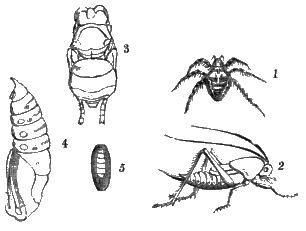
I. The insect, No. 1, is a pupa called the Complete, because it is active, and has many of the parts of the perfect insect. The pupa of the spider is an instance.
II. The insect, No. 2, is a pupa called the Half-complete, or semi-complete. It is also active, resembles the perfect insect, but has only the rudiments of wings. The grasshopper is an instance of this kind of pupa.
III. The insect, No. 3, is a pupa called the Incomplete. It is inactive, but possesses rudiments of legs and wings. The common wasp is represented as an example of this kind.
IV. The insect, No. 4, is a pupa called the Obtected.[K] This pupa has its upper portion encased in the peculiar manner represented, the chest and lower portion being distinct. The butterfly pupa belongs to this division.
V. The insect, No. 5, is a pupa called the Coarctate.[L] In this case the pupa is enclosed within its larva skin, which forms a globular or oval case, the pupa lying loosely in it as if it had shrunk to a smaller size. The pupa of the blow-fly is an example.
Such are the five variations of pupæ, as they were recognised by Linnæus—the Complete, Half-complete, Incomplete, Obtected, and Coarctate. They are sufficiently minute for ordinary purposes: and it will possibly save the reader some confusion of ideas to endeavour to fix them in the memory; so that when looking at an insect whose pupa state may not be so very characteristic as that of the blow-fly, or butterfly, he may still be able to say with confidence, that although it is unlike these, it is nevertheless a pupa. On all subjects nothing is of so much importance as clearness of ideas. It is better to know only a few things, and to understand them clearly, than to have a confused and indistinct knowledge of a great number. It has been, therefore, simply and entirely with a view to obviate this state of things in the mind, that these definitions of the different kinds of pupæ, which may have appeared not altogether interesting, have been given.
Having fulfilled this duty, we may now proceed to the more agreeable task of ascertaining some interesting facts relative to the insect's life and age in the pupa state. We have already seen that the insect in the larva state often arrives at a very respectable old age; indeed, in this state insects live longer than either in the pupa or perfect states. But pupæ also attain to a very fair number of days, sometimes living as long as two years in that state. Often, however, they are not more than a few days in this condition, and the insect, after a short repose, springs forth a new and active being. But it has been found that insects live a longer or shorter period in the pupa state according as the temperature of the air is cold or hot. Thus, for example, when the larva of a moth has become a pupa in the early part of summer, the pupa state will generally not last beyond a fortnight. But if, on the other hand, the larva becomes a pupa late in the autumn, the pupa state will last until June in the next year: thus manifestly teaching us that according as the weather is mild and genial the pupa state will be shortened; or according as it is cold and rigorous it will be increased in duration. The ingenious Réaumur determined to put these singular facts to an experimental test; and as his results are in the highest degree interesting and important, we shall proceed to submit an abstract of them to the reader's notice.
In casting about for the means of exposing the pupæ he was about to experiment on, to a warm and equable temperature, Réaumur determined to conduct his first experiments in the Royal Conservatories, which were always carefully heated, and in which, as he with French naïveté expresses it, "summer reigned in the depths of winter." In the month of January he carried thither a number of boxes containing pupæ of different species. The result was precisely what he had expected:—in the midst of a severe winter a number of butterflies appeared in his boxes, many of which would not naturally have made their appearance until the months of May, August, or even September; thus shortening the pupa state from four, seven, or eight months, to a fortnight, or to five, or to six weeks in different instances. Five or six days seemed to be equal to a month of the natural temperature. The butterflies thus developed were in no respect different from those which are brought into activity at the natural period. They were as active and perfect, as if their time and place of birth had been the green fields, instead of amidst the strange vegetation of these splendid Conservatories. Several of the mother insects deposited their eggs, accomplishing the last act of their existence as if summer had come, and died while the frosts and snow held all external nature yet in bondage. Not only, therefore, was the duration of the pupa state in these insects shortened, but their whole life was thus abridged by several months.
In November of the same year Réaumur recommenced his experiments, and again exposed a number of pupæ to the genial influence of these hot-houses. The result was the same. In the first week in December butterflies appeared, which would not, in natural circumstances, have been developed earlier than the May of the next year. There were some pupæ, in particular, whose development he watched with great interest. These pupæ belonged to a beautiful species of moth, which has two broods in a year; that is, it lays eggs in May which become butterflies in July, and then again lays eggs which become pupæ in August or September, but do not become butterflies until the following June. He was curious to see whether this second brood, instead of waiting for several months, would, like the first, disclose its butterflies in a considerably shorter time, now that it was exposed to the warmth of the Conservatory. Such actually proved to be the case; and thus two generations of these butterflies were obtained in one year. Alluding to the depredations of caterpillars, he quaintly remarks, "This certainly is not a secret which appears very profitable at present; but who can tell whether that which is useless to us to-day, may not possibly become of value to-morrow? Could we discover some new species of larvæ which would supply us with as good a silk as that of the silk-worm, and might be more easy to rear, but which only produced one generation in each year, and if it lived upon leaves which could be found all the year through, we might avail ourselves of this means of increasing the number of its broods." This remark deserves much consideration.
He was now anxious to try whether, by applying a more equable method of warming, he could succeed in hatching pupæ as he had done in the hothouse. The idea occurred to him of endeavouring to hatch them under a hen. He concluded that the warmth of the mother's breast would quite as easily hatch the insects, as it does the eggs. But there was this obstacle in the way: How could he prevent the fragile and tender bodies of the insect pupæ from being crushed and killed by the weight of the hen's body? and, as we would also suggest, How could he ensure that the bird would not actually have eaten up the objects of his care? Aware of the fact, that, when a hen is in the humour to sit, she will often allow smooth stones to be placed among her own eggs, he anticipated no difficulty on that score, and he hit upon the following ingenious experiment:—He procured some hollow glass balls which he had caused to be made as nearly as possible similar in size and shape to the eggs themselves. Into these, by an opening at one end, he introduced seven or eight pupæ, and stopped the mouth up with a cork, but so as to allow a free communication with the external air by paring off a piece from the side of the cork.
Thus prepared, he put the glass egg together with the others in the nest. The hen was a little more sensible than Réaumur had given her credit for; and though she did not thrust the egg out of her nest, she removed it to the outside, where she was so obliging as to permit it to remain; and as it was here just as warm as if it had been in the centre of the eggs, Réaumur did not attempt to interfere with her arrangements. A great deal of moisture arose from the bodies of the pupæ, and condensed like dew on the sides of the glass; but after a day or two this disappeared. The reader may now be anxious to learn the result of this experiment. It was equally successful; indeed, it was more so than the preceding, for in the afternoon of the tenth day a pretty little butterfly was seen within his glass egg, being the first that had appeared of the eight pupæ, and the first ever hatched under the bosom of a hen! The remaining pupæ, all but two, appeared soon after; these two died. Perhaps the warmth of their glassy cell was too violent for them, for it was found by the thermometer to be two or three degrees above blood heat. The whole six pupæ were born in less than six days, while others of the same species in a box in a window-seat were not developed until twelve days later. As the heat thus obtained seemed too violent for pupæ to be artificially reared with success, Réaumur suggests that many variations might be made in the experiments, which would have the effect of moderating its amount. These experiments decided in the most satisfactory manner the quickening influence of increased warmth upon the pupæ of insects. Réaumur now became anxious to try the effects of the opposite state of temperature, and to ascertain whether exposure to cold would exercise any effect upon the pupæ. It was reasonable to imagine that as warmth had hastened forward their development, cold would retard it.
Réaumur determined to try what would be the result of putting his pupæ in their boxes in a cellar, and taking proper care to preserve them from the damps of such a situation. He put them there about the end of January. In ordinary circumstances these pupæ would have become butterflies in the month of July in the same year. July came, and we can conceive the curiosity with which the ingenious experimenter went down, as he tells us, to his cellars, to see if any change had taken place in the pupæ. July passed away; August also passed by, yet the pupæ still slumbered on in their original form. Réaumur left Paris in September, and did not return until the November following. He immediately went in quest of his pupa-charge, and found them still unaltered. Were they dead? Placing one in his hand, it soon began to exhibit such symptoms of motion as plainly showed that it was alive. Winter closed over them still in the pupa form. The spring of the next year dawned upon them, but they were insensible to its influences. "And even now," cries Réaumur, in the month of August, just two years from the time they left the larva form and became pupæ, "they are in perfect health, in excellent condition, and would all become butterflies very soon if I were only to expose them to a warm summer's influence."
"These extraordinary facts," observe Messrs. Kirby and Spence, "lead us to a very singular and unexpected conclusion,—that we have the power of lengthening or shortening the life of many insects at pleasure—that we can cause one individual to live more than twice as long as another of the same species, and vice versâ. Had Paracelsus made this discovery, it would have led him to pursue his researches after the elixir of immortality with redoubled confidence, and would have supplied him with an argument for the possibility of prolonging the life of man beyond its usual term, which his sceptical opponents would have found some difficulty in rebutting. Even the logical Réaumur seems inclined to infer from it, that this object of the alchemist's was not so chimerical as we are wont to conclude. He confesses, however, that, if it were to be attained only by the same process as effects the extension of an insect's life,—by prolonging its state of torpor and insensibility,—few would choose to enjoy it on such conditions. The man of pleasure might, perhaps, not object to a sleep of a hundred years, in the hope of finding something new under the sun when he awakened; and an ardent astronomer would probably commit himself with scientific joy to a repose as long and as sound as that of the Seven Sleepers, for the chance of viewing his predicted return of a comet on stepping out of his cave. But ordinary mortals would consign themselves to the perils of so long a night with reluctance, apprehending a fate no better than that which befel the magician who ordered himself to be cut in small pieces and put in pickle, with the expectation of becoming young again."
But this is in every respect erroneous as a deduction from these experiments on insects. It must not be forgotten, that these experiments were made at a time of the insect's life when it is naturally torpid, and not upon the perfect insect. Had Réaumur attempted to prolong the life of a butterfly, he would have failed completely, that is, if he had adopted the same means; so that all which we can infer from these results is simply this, that we can only prolong or shorten the pupa state, which is a state of torpidity, a kind of half-way between life and death.[M] The human frame knows no such state after birth as can be properly compared to the inactive pupa state of insects; and consequently all reasoning founded on what may take place in such a state under the particular circumstances described, is without foundation. Besides all this, God has himself fixed a limit to human life; and we are expressly assured by his word of truth, that "it is appointed unto man once to die;" and though by reason of strength we may reach far into a long life, yet the hour comes at last, and the green earth closes over the only mortal portion of a man. Undoubtedly had Réaumur prolonged his experiments, he would have found that death, or the transformation of the pupa, would ultimately have taken place.
As yet, we are not aware that any practical results on a large scale have followed from Réaumur's interesting experiments. It has been already remarked, that in countries where the silk-worm is reared, it is the custom to hasten the hatching of the eggs by women carrying little packets of them about their person. But this is only to bring forward the development of the larva state. Perhaps the time anticipated by Réaumur may arrive, when insects may be hatched under hens! or in hatching machines, so as to obtain two instead of one brood of eggs and larvæ in a season. Réaumur suggests that the great and wealthy who have good hot-houses, might give all the appearance of summer to them by introducing pupæ in winter, which would soon be hatched, and butterflies or other insects might be seen flying about in December or January, from flower to flower! But he forgot that gardeners generally are rather averse to the presence of insects at all, and particularly to the all-devouring larvæ of many species of butterflies, which would soon commit sad havoc among their choicest plants. We may recommend such experiments to the reader as highly interesting and easy of performance in a common sitting-room, where a fire is kept in winter, with no other apparatus than a tin-box, or a glass jar of very moderate size; even a pill-box would answer every purpose.
Some curious experiments on pupæ of another kind were also performed by Réaumur. He varnished them over with various varnishes, and found that the pupæ thus varnished were developed several weeks later than others of the same species unvarnished. He tried similar experiments upon eggs, and found that the eggs of a hen would keep fresh for a very long period if they were entirely coated with some kind of varnish. This proved a most useful experiment, for it is now common all over the Continent to preserve eggs by covering them either with oil or butter.
We may learn, in reflecting upon the facts brought to light by this ingenious entomologist, with what admirable care and skill the Great Creator has arranged the period to be occupied by the insect in the pupa state. It has been wisely ordained by these arrangements that the insect shall not be developed until the season when its proper food is to be found, or when a proper position for placing its eggs is to be discovered. The gay flutterer, so tender in its frame, must not be born amid the snows of winter, or in the ungenial days of early spring; its pupa, therefore, requires the warm influences of July and August before it will undergo its change. If it were born earlier than that time it would unquestionably perish, and the insect would become extinct; if later, the same result would take place, for it would fall into the killing power of the early winter evenings. As it is, all is well. The insect and the day are made for one another; for it the flower blossoms, and the warm air breathes, and all nature is spread out in warmth and happiness. Its career run through, it departs from the scene it has enlivened, leaving behind, just at the proper time, and in the proper place, the eggs which are to become quickened, live, and die, like itself, all in their appointed time. We thus perceive that it is chiefly the increasing temperature of the air which fixes the time of the insect's duration as a pupa, and sets in movement all the great chain of the events of external nature. In what way an increase of warmth thus acts we are still unable to say; perhaps, indeed, we may never be able to tell. Neither can we understand how it should be, that the principle of life should be ready at a moment's notice to complete its work in the perfection of the insect, and yet held in abeyance by a few degrees of a lower, or quickened into activity by a few degrees higher, temperature. We know that this has been God's doing, and marvellous it is in our eyes; but the wisest of men feels himself ignorant if asked the question, how it is thus arranged? Truly none but a God infinite in wisdom as well as love would take such thought for so humble a creature as a poor insect; but let us not forget that
——"each crawling insect holds a rank Important in the plan of Him who framed This scale of beings,—holds a rank, which, lost, Would break the chain, and leave behind a gap Which Nature's self would rue."
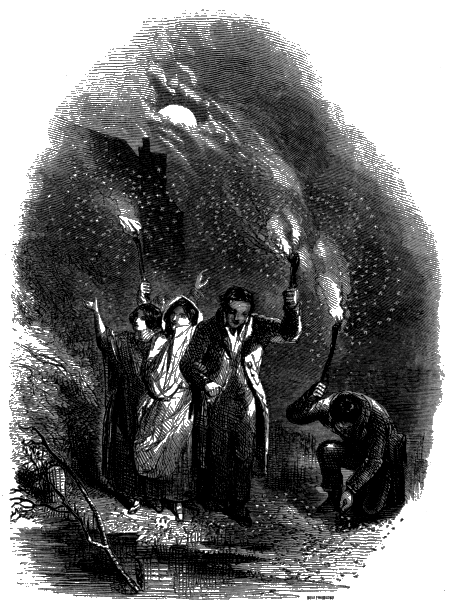
The duration of the insect in the pupa state, though variable, is, without doubt, limited, and sometimes it is fixed to an hour, quite irrespective of all external circumstances. The most remarkable example of this kind occurs in the case of the insects whose larva we have already mentioned—the Ephemera. These insects appear with the greatest regularity, issuing from the waters of the Seine or Marne, in France, between the 10th and 15th of August. The fishermen call them manna; and when their season is come, they say, "the manna begins to appear," or "the manna fell abundantly last night," alluding, by this expression, either to the astonishing quantity of food which the insects afford to the fish, or to the large quantity of fish which they then take. The fishermen expect them with the greatest confidence during these few days, nor are they ever disappointed. Millions upon millions suddenly rise into the air between eight and ten o'clock in the evening, and this generally for three successive nights.[N] Whatever be the temperature of the atmosphere, whether it be cold or hot, these flies invariably appear at the same hour in the evening, that is, between a quarter and half-past eight; towards nine they begin to fill the air; in the following half hour they are in the greatest numbers; and at ten there are scarcely any to be seen. So that in less than two hours—and these always the same—this infinite host of insects leave their pupa state, become perfect insects, perform their appointed work, and vanish. The same phenomenon of regularity of limit to the pupa state occurs also in other insects, though, perhaps, less strikingly. Some insects constantly leave the pupa at break of day; others in the full tide of noon-day, and others when the shadows of declining day come over the landscape. These, however, are certainly exceptions to the general rule, which appears to lay down no precise period of the day or month when this state is ended, and the perfect state is entered upon; but a limit, nevertheless, exists, mainly dependent for its appointment upon the external influences of warmth and air.
This limit attained, we are brought to the next point in the history of the insect pupa. The beautiful organization of the perfect insect has been going on under the dry and repulsive exterior. Its delicate limbs, exquisitely wrought wings, and the other most wonderful organs with which the perfect insect is furnished, are now completed. Nothing remains but to cast off the slough of its pupa case; and it will then be set free to range whither it will in the great atmosphere into which it will emerge. If the reader has been watching these insect changes with the natural object before him, he will immediately confirm our statement, when we mention that it is often possible to tell when the pupa case is about to disclose its occupant. The general form of the limbs is often very clearly to be seen, and the movements of the included insect become much more sensible and conspicuous. If the beautiful gilded pupæ, called, as we have before said, Chrysalides, or Aureliæ, have been thus nursed with a view to observe their change, it will be noticed that they lose entirely that golden lustre which made them at first such attractive objects. These signs infallibly foretoken the approaching transformation.
CHAPTER V.
THE GREAT CHANGE.
We must now spend a short time in narrating the particular circumstances which attend this interesting event,—the extrication of the insect from its pupa case. We shall, in the first place, speak of such pupæ as are not aquatic, and, afterwards, of the singular ones which are so. In the case of the butterfly, which, as we have recommended repeatedly its being nursed and bred, it will be expedient to mention first, the extrication of the insect is, comparatively with some others, a very simple operation. The insect within is seen to struggle for a time, twisting its body in various ways, until at length a longitudinal slit appears down the middle of its thorax. The slit extends gradually along the head, and down the parts which compose the breast, until the insect emerges from the outer case. The inner membranes are now to be removed, and this, after a little time, is fairly accomplished, and the butterfly emerges, and, leaving the pupa skin behind it, by-and-by plunges for the first time upon the soft waves of the summer air. This is one of the simplest of these methods of extrication.
Pupa of Goat-Moth.
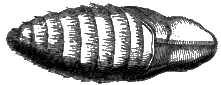
A very natural difficulty will arise in the mind as to what possible means of escape can be granted to such insects as live in the pupa state in the interior of old trunks of trees, or even in little caves of the earth. These cases have all been satisfactorily provided for, puzzling as they may seem. Take, for instance, the pupa of the great goat-moth, the Cossus ligniperda, of which we give a representation here. This creature lies buried in a deep excavation, formerly made by itself when in the larva form, inside the trunk of a willow. How is it to get back to the hole at which it entered? Without legs, without any other apparatus by which it might drag itself forward, one would say it is in a hopeless case; it must lie there and perish, for there appears no way of extricating it from its den. But not so. Helpless as it appears, it will certainly make its way out, and taste the sweets of liberty, and be wafted along the fields of air. But how? Let us suppose a man in such a condition; let his feet be bandaged together, so that they cannot move; let a strait-jacket be put upon his body, and secure his arms and hands; after this, let a leathern bag be put over his head, and tied down round his middle; then put him in a cellar, and bid him work his way out and up the stairs until he reached the front door, where he must undo his bandages, and slip himself out of his strait-jacket and hood; after which, he may go wherever he likes. What a feeling of despair would fill the poor prisoner's mind, promised his release on condition that he should accomplish it in that way! To him it would be a task altogether impossible, even though his life were offered as the reward of his success. It is not less a question of life and death to the insect than it might be to him; yet its extrication is accomplished, not only in a very simple, but in a very easy manner.
If the reader will carefully examine the representation of the insect given in the last page he will notice that the pupa case is provided with certain sharp points, which are all directed towards the tail of the insect; these sharp points are called by entomologists adminicula. They are of infinite consequence to the insect. Who has not himself performed, or been the subject of, the trick of causing a grain of barley to creep up the sleeve? The manner in which it is gradually pushed up is strikingly similar to that in which the pupa of the cossus is forced upwards and out of its wooden gallery. It will be readily supposed that, in consequence of the peculiar direction assumed by the tooth-like processes in question, it will be very difficult to push the pupa backwards, as the points would catch in any obstacle and arrest its progress in that direction; but they offer no resistance to its moving in a forward direction. The manner in which the insect proceeds, then, is as follows:—Being capable of slightly shortening and lengthening the lower part of its body, which is the part thus provided with hooks, it begins to push backwards, but the hooks catch in the sides of the wood, and thus prevent it from moving back, and it is, consequently, actually driven forwards; and so it continues to thrust itself gradually forwards in this simple manner, just as a boy with his hands tied might thrust himself forwards as he lay on the ground, by pushing against any object with his feet. In this way the patient creature moves, we may be sure, by very slow degrees; but that matters little; it moves until it has at length reached the opening of its gallery outside the tree, where it may often be seen sticking out half way. Here, by a remarkable instinct, it ceases to move forwards, for it would otherwise tumble down, and probably destroy itself. At length, after violent struggles, its swathing bands are all either torn asunder, or slidden off, and the insect wings its way in unrestrained freedom far from the scene of its triumphs of patience and hope. The pupa of the "father long-legs" makes its way up from the subterranean chamber in which it has so long been sheltered, fed, and protected, and reaches at length the surface of the ground, where it becomes the perfect insect.
Swelling of the Head of the Fly.
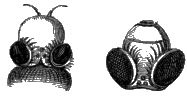
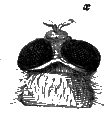
But other pupæ, although not, perhaps, quite so arduously placed as in the last instance, nevertheless present us with an extremely difficult puzzle, as to how the included insect is to be extricated from its swathing bands. The common flesh-fly, or blow-fly, for instance, in the pupa state is shut up in a membranous case, out of which there seems no escape; but there is a way, and the manner in which the insect gets out of its prison is a remarkably curious one, well repaying the trouble of a little close observation. At the larger end, under which the head of the fly lies, and from which it always issues, there is commonly a sort of lid which can be pushed off like the lid of a box, and the insect can then walk out at pleasure. But in the case of the pupa of the blow-fly this lid is not very easily removed, and the fly, therefore, is furnished with a most ingenious method of thrusting it off. On opening the larger end of such a pupa, if the fly within is ready to come out, a most curious phenomenon will be seen. The insect moves towards the lid, and there begins to blow out its head in the most extraordinary manner, swelling it to twice its natural size; a moment after it will resume its natural size; then again it will puff it out, making its two eyes to start asunder, and its head to assume several different shapes in succession! Two representations are annexed of the striking figure of the insect's head when it thus causes it to swell out. After repeating this action several times, the fly emerges from the pupa. The cause of this remarkable dilatation is the filling of a membrane, situated at the middle part of the head, with air, by which it is blown out into a sort of bladder as large as the head itself. This acts as a kind of lever, and eventually pushes up the lid of the pupa case, allowing the insect to make its exit unmolested. This part generally disappears afterwards, and the head becomes alike firm and unyielding in all its parts; but it may, in at least its rudiments, be seen even in the head of the adult fly, by slightly pressing its head between the fingers, when it appears as at x in the cut.
Head of a Fly magnified. It shows opposite the letter x the remains of the membranous bag.
More singular still are the circumstances which mark the exit of the insect from the pupa case in other instances; and yet more strikingly than those narrated, do they exhibit to us the amazing exercise of the Divine attributes of wisdom and forethought in the case of these humble beings. The larva of a species of moth, which dwells in a wooden cell scooped out of the poplar tree, to which there is no door by which it can escape readily, gnaws away the wood until it leaves only an extremely delicate layer between it and the outside of the tree, which is as thin as writing paper. This done, it enters into the pupa state. Its time in that condition being accomplished, it moves itself by the same contrivance as the cossus, and actually pushes through the thin layer, and appears on the outside of the tree, thus making its escape from prison by pushing down a part of its prison wall!
An instance described by the naturalist Bonnet is yet more ingenious in the arrangements by which the insect escapes. While in the larva form it takes up its abode inside the leaf of an ash, curiously rolled up into a cone; and then, after a time, it becomes a pupa, forming a silken cocoon of a very slight texture, and, therefore, easily ruptured by the insect, which it suspends like a hammock in the midst of its habitation. It is the closely joined sides of its leafy dwelling that form a barrier which, were it not for the precaution of the larva, would be impenetrable to so small and weak an animal. But, like the last-mentioned, this larva seems to be aware of the feebleness of its next condition, and gnaws in the leaf a round opening, taking care not to cut through the exterior thin layer of tissue, or epidermis. This door is to serve the insect for its exit in due time. But in proportion to its bulk, its green chamber is of considerable size. How, then, shall the insect know the exact place where its portal is situated? How, without a clue, shall it discover in its dark abode the precise circle which requires only a push to throw open its gate? Even this is foreseen and provided for. Out of all other positions in which the little hammock, of which we spoke, might have been hung, and they are numerous, the larva has been directed so to place it, that the silken cord which suspends the head is fastened close to the side of the door which it has previously constructed; and the insect, when it emerges from the pupa, guided by this thread, like Theseus, makes its way out of an apartment which, but for this contrivance, might have been to it a labyrinth as inextricable as that of Minos. Other insects adopt the same precaution of gnawing a doorway for the escape of the perfect insect, only leaving a sufficient thickness of outside tissue to protect the helpless pupa within from the invasion of enemies from without.
Cocoon of Emperor Moth.
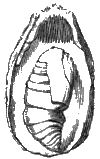
Upon the pear or willow tree may sometimes be found an illustration of escape from the pupa, altogether well deserving our notice. In such situations the brown flask-shaped cocoon of the emperor moth may occasionally be discovered. In structure it is composed of a solid tissue of layers of silk, almost of the texture of parchment; but at the narrow end, or that which may be compared to the neck of the flask, it is composed of a series of loosely attached longitudinal threads, converging like so many bristles to a blunt point, in the middle of which is a circular opening, through which the moth makes its escape, the threads readily yielding to pressure from within, and acting somewhat on the principle of the wires of the opening to a rat-trap, or the willow cricks of an eel-trap. The silk of its cocoon is of so strong a texture, and so closely gummed, that had both ends been similarly closed, the egress of the insect would have been impracticable. But, it may be thought, such a cocoon is exposed to the attacks of a number of insect enemies, who might easily find entrance to it at the opening thus left at one of its ends. This source of peril has been foreseen. Within the exterior funnel-shaped end, at some little distance down, the insect has constructed a second funnel composed of a similar circle of needle-pointed threads, which, proceeding from the sides of the cocoon, converge to a point, and form a cone through which not the smallest aperture is left. From the arched structure of this singular dome, and from the fact just mentioned, that no visible opening can be discerned in it from without, it is rendered quite impenetrable to the most violent attacks of besiegers, while it yields to the slightest pressure from within, and allows the insect to emerge from its cocoon with the utmost facility. When it has passed through it, the elastic threads resume their former position, and the empty cocoon presents just the same appearance that it did before. A celebrated naturalist (Rösel), was sorely perplexed at this, the first time he had the gratification of watching the insect escape. He states that he could scarcely help thinking that there was something supernatural in the appearance of one of these fine emperor moths in a box in which he had put a cocoon of this kind; but in which he could not discover the slightest appearance of any insect having escaped from it, until he slit it longitudinally, and then found it to be empty!
Mr. Rennie mentions an instance, perhaps not so ingenious, but equally curious, with this history of the proceedings of the emperor moth, in a little insect, also a moth, which also dwells upon the willow. It spins an elastic shroud for its pupa, of the singular shape of a boat with the keel uppermost. Its first step is to spin two walls of whitish silk of the required form; and when these are completed, it draws them forcibly together with elastic threads, so placed as to retain them closely shut. The passage of the moth out of this cocoon might have struck Rösel with still greater surprise than he had felt at witnessing that of the emperor moth; for in that cocoon there was at least no apparent difficulty to prevent the egress of the insect, as the opening existed in it at one end, whereas in this there is no opening at all. The insect escapes at the joining of the sides, the threads giving way in a particular spot; and the sides, though originally requiring force to draw them together into the requisite form, become so elastic as to close again when the moth has passed between them, and made its escape. The cocoon preserves precisely the same form after the insect has quitted it as before, and it is impossible, by the naked eye, to detect the place of its exit.
As a general rule, insects make their escape from the pupa case head foremost; but there occurs a very singular exception in the case of some of the gall insects. The males of these insects contrive to make their escape out of the pupa case, formed of the dried skin, tail foremost; and as they thus back out of their dwelling, their wings are necessarily turned backwards over their heads; but a little exercise soon puts the ruffled insect in proper plume again, and the wings resume their customary position.
Some curiosity may be felt to know in what way the silk-worm moth escapes from the double prison,—the pupa case, and the cocoon,—in which she is concealed. How is the moth to make its way through the dense mass of fibres all glued together, which walls her in on every side? Her delicate wings and body would never endure anything like the severity of the struggle necessary to enable her to force her way through this, to her, solid and resisting mass. Though much attention has been paid to the transformations of this particular insect, it is somewhat curious that it is still a matter on which opinions are divided, as to how the insect succeeds in making its egress. Some suppose that the eyes, which are the only hard organs of the head, are the instruments by which the threads are divided, their numerous minute facets serving the purpose of a file. Others hold the belief that the insect pours out a fluid which acts upon the gum and silken fibres of one end of the cocoon, and so softens them that they easily give way to the slightest pressure from within. "Perhaps the two opinions," observe Messrs. Kirby and Spence, "may be reconciled by supposing the silk-worm first to moisten, and then to break, the threads of the cocoon. In those that are of a slighter texture, a mere push against the moistened end is probably sufficient; and hence we find in so many newly-disclosed moths the hair in that part wet and closely pressed down."
It has been supposed, in cases where the cocoon is a hard, almost wooden cell, that the feeble insect prisoner within is provided with a peculiar chemical fluid, of greater powers of solution than are requisite in the last instance. The cocoon of the "pussmoth," in particular, is so hard and dense, as to resist even the point of a penknife; and the insect it holds confined within it is a weak creature, totally unprovided with any apparatus fit for penetrating walls so hard and dense as these. What is it to do? "Here," observe the writers last quoted, "the eyes are clearly incompetent; nor could any ordinary fluid assist their operations, for the gum which unites the woody particles of the cocoon is indissoluble in aqueous menstrua. What an aqueous solvent cannot effect, an acid is competent to; and with a bag of such acid our moth is furnished. The contents of this she pours out as soon as she has forced her head through the skin of the pupa, and upon the opposite end of the cocoon. The acid instantly acts upon the gum, loosens the cohesion of the grains of wood, and a very gentle effort suffices to break down what was, a minute ago, a strong barrier. How admirable and effectual a provision! But there is yet another marvel connected with it. Ask a chemist of what materials a vessel ought to be to contain so potent an acid; he will reply,—Of glass.[O] Yet our moth has no glass recipient; her bottle is a membranous bag; but of so wonderful a fabric as not to be acted upon by a menstruum, which a gum, apparently of a resinous nature, is unable to resist! This fact can only be explained by the analogous insensibility of the stomach to the gastric juice, which can dissolve bone; and it is equally worthy of admiration. In both cases, the vitality of the membranous or fleshy receptacle secures it from the action of the included fluid; but how, who shall explain?"
Glazed Ant-hill of M. Huber.
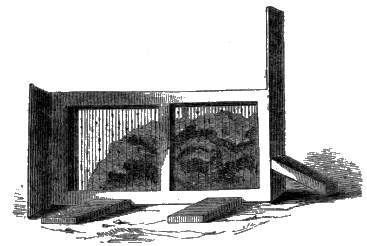
The naturalist, Huber, the patient historian of the ants, gives us a very interesting account of the proceedings of these wonderful insects, in actually assisting the young out of their silken cases. These pupæ are enclosed in a tissue of silk, of so compact a texture, and formed of so strong a silk, as to render it impossible for the prisoner within to rupture the fibres, and get out of prison. The worker ants, therefore, are instructed by a heavenly Ruler and Guide to give help to the prisoners, and to secure their egress. But how do these indefatigable attendants ascertain precisely the moment when their aid is required? The insect within has no power of voice to cry out for help, nor those without, in all probability, the faculty of hearing, if it could do so. It seems probable that they are acquainted with it from some slight movements which take place within, which they ascertain by means of their antennæ. Whatever it be, the attendants never interfere at a wrong time. Their manner of proceeding is beautifully described in the following words of this author:—"Several males and females lay in their envelopes in one of the largest cavities of my glazed ant-hill. The labourer-ants assembled together, and appeared to be in continual motion around them. I noticed three or four mounted upon one of these cocoons, endeavouring to open it with their teeth, at that extremity answering to the head of the pupa. They began to thin it by tearing away some threads of silk where they wished to pierce it, and at length by dint of pinching and biting this tissue, so extremely difficult to break, they formed in it a vast number of apertures. They afterwards attempted to enlarge these openings, by tearing or drawing away the silk; but these efforts proving ineffectual, they passed one of their mandibles into the cocoon, through the apertures they had formed, and by cutting each a thread, one after the other, with great patience, at length effected a passage, of a line[P] in diameter, in the superior part of the web. They now uncovered the head and feet of the prisoner, to which they were desirous of giving liberty; but, before they could effect its release, it was absolutely necessary to enlarge the opening. For this purpose these guardians cut out a portion in the longitudinal direction of the cocoon, with their teeth alone, employing these instruments as we are in the habit of employing a pair of scissors. To expedite the work some raised up a little slip cut out in the length of the cocoon, whilst others drew the insect gently from its imprisonment. When the ant was extricated from its enveloping membrane, it was not, like other insects, capable of enjoying its freedom, and taking flight; it could neither fly, nor walk, nor without difficulty stand, for the body was still confined by another membrane, from which it could not by its own exertions disengage itself.
"In this fresh embarrassment the labourer-ants did not forsake it: they removed the satin-like pellicle which embraced every part of the body, drew the antennæ gently from their investment; then disengaged the feet and the wings, and lastly, the body, with the abdomen and its peduncle. The insect was now in a condition to walk, and receive nourishment, for which it appeared there was urgent need; the first attention, therefore, paid it by the guardians was that of giving it the food I had placed within their reach."
It is droll to add, and it may be some of our readers may feel somewhat abashed at the fact, that these labourer-ants are extremely particular in the observance of great order and regularity in their chambers; and they therefore carefully sweep up all the cast-off coverings, which are collected together, and deposited in one of the most distant lodges of their habitation. Could man, with all the powers of reason, and the faculties of an immortal being, have evinced a more striking instance of careful, gentle, and patient assistance in the hour of need than we see manifested in the case of these insects? Alas! how often does man need to come to them to learn not only a lesson of wisdom and order, but of the tenderest sympathy and affection. How often lies a poor fellow-creature in the bondage of hopeless poverty, or in the embarrassment of inextricable difficulties! How seldom does his emergency meet with that resolute and thorough-minded earnestness of brotherly love, which will patiently give him help and pity, until his troubles are surmounted, and his steps set free!
It is time that we spoke somewhat upon the extrication of insects from their pupa cases, even when under water. Here arises a great difficulty;—the wings of the insects thus placed, if wet with water, would be unfitted for flight, and would probably frequently lead to the death of the insect by drowning. Yet it is to leave its sub-aqueous abode, mount up through the waves overhead, and finally emerge without a drop of water clinging to its body, and from the glassy surface of the water it is to take its flight into the air. Some will be tempted to exclaim,—"This is a clear impossibility!" Far from it. The little worm so well known to anglers as the "caddis-worm," performs this feat with the greatest ease, and in the following manner:—
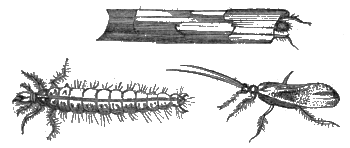
The Pupa-case, Larva and Fly of Caddis-worm.
Grating of the Pupa-case.
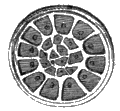
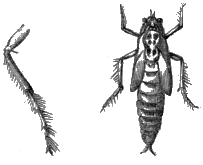
It has been mentioned that the larva known under this name constructs for itself a case of various materials in which it dwells at the bottom of the waters, where the hand of the young angler knows well to find them. This case is heavier than water, and consequently cannot float, and so carry the insect to the surface. As the insect enters the pupa state it weaves, at the entrance of its singular habitation, a grating of silk, which, strange to say, is not only not softened and melted away by the water, but hardens under it until it is as hard as gum. This little grating is of a circular form, and fits exactly into the opening, and is perforated with holes, so as to look something like the gratings which cover our coal-cellar mouths in the pavement of cities. These holes are for the purpose of letting in fresh water for the respiration of the insect. Out of this under-water cell the insect must make its escape. To enable it so to do the pupa is furnished with two strong curved jaws, which are of no other use than to assist it in making an opening in one of the silken doors of its case, as they are cast off immediately afterwards, and there remains not a vestige of them in the perfect insect. This opening made, the pupa forces its way out at that end. But what then? How is it to reach the surface, even now? Its legs, as will be seen by looking at the cut, are furnished with a number of hair-like processes, which assist it in swimming; it therefore, still enclosed in the waterproof coat—the pupa skin—strikes upwards to the surface, and reaching it, its skin splits, its impervious raiment is cast aside, and the insect springs from the surface into the air without the minutest drop of water to impede her flight, or injure the delicate tissue of her wings!
Caddis-fly's Legs magnified to show the Hairs.
Escape of the Gnat from its Pupa-case.
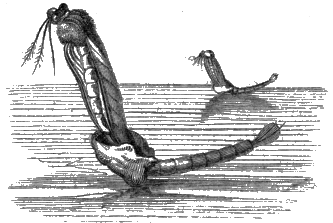
We may take another common insect for an illustration of this mode of escape from the pupa, of an equally interesting kind. If the reader will on some fine summer day resort to any place of standing water by the road-side, he may probably succeed in discovering the emergence of a number of gnats; and a very amusing occupation it is to stand by and watch the insect,—this moment an occupant of the waters, and the next darting in the air, a new and air-breathing form of existence! About ten days after the gnat has become pupa, it prepares for leaving that state and becoming a perfect insect by raising itself to the surface of the water, stretching out its body there, the thorax, or, in simpler language, the front enlarged part being raised above it. Immediately the eye of the observer detects the fact that some change is taking place in the insect; the enlarged portion cracks and splits, and through this opening the head of the gnat makes its appearance; then the trunk of the insect rises in a curious manner through the breach, and more and more of its body rises, preserving all the time a perpendicular position, so that it looks just as if it were rising out of the water, and not out of the horizontal pupa case floating on the surface. The upright body of the gnat now resembles a mast in a boat, only that it is continually being raised higher and higher by the gradual emergence of the insect. Its wings and legs are all folded closely down its sides as is shown in the cut; and it has therefore no power at all to prevent its being overset by a breeze, and drowned in the little waves below; the lower portion of its body alone retains it in this position, being as yet contained within the pupa case. No ship-builder dare venture to put a mast of such proportions into any of his vessels, for fear of their being top-heavy, and hence liable to heel over in a gale of wind. And undoubtedly many gnats, particularly in windy weather, are shipwrecked as soon as they emerge. This is, in fact, a moment of peculiar danger to the little insect-mariner, and a breath of untoward air will frequently drive it about like a ship in a tempestuous ocean; and if it is once laid on its side, all is over with the gnat; no patent apparatus can save it; and we have the mournful testimony of Réaumur, that in stormy weather he has seen a vast number of such shipwrecks in the mimic ocean of a pool of water. Generally speaking, the peril is only momentary, and the insect emerges in safety. Having thus raised itself to the perpendicular position, the gnat withdraws its two forelegs from the pupa case, and stretches them out; then it draws out its two next; and now feeling safe, it quits the perpendicular position and bends toward the water, plants its feet on its glistening surface, which is to it as safe as the land, since it has the faculty of walking on the waves. It is now in perfect safety, its wings expand and become dry, and presently the insect will for the first time make use of them by flying to some adjoining twig.
Blood-worms, natural size and magnified.
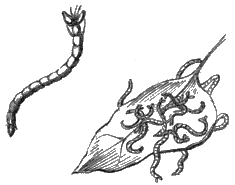
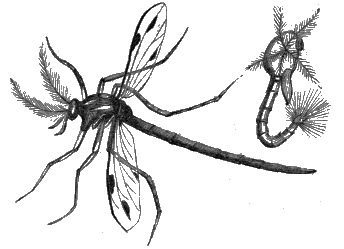
But we need not in many cases leave our homes to see an escape from the pupa in every respect as singular as the last, and in many, precisely identical. Before the writer's study-window was an artificial fountain, in which, as the water was not constantly allowed to play, aquatic insects of various kinds had permission to establish themselves. Nor were they long in availing themselves of this liberty. A week or two of genial summer weather was sufficient to people the water with various inhabitants among them was a little creature which will be recognised by every reader when we mention its title—"the blood-worm." It is in reality not a worm at all, although resembling worm in shape, and in its serpent-like movements. This little creature was for a time particularly active; and in a tumbler of water taken from the fountain might be seen perhaps a dozen of them twisting about in a very singular manner. By-and-by a change came over them, and it turned out that the worm-like creatures had become pupæ of a blackish colour, thus at once deciding their insect character. They belong, in fact, to the insect called the Chironomus plumosus. These black pupæ were scarcely less active than the red blood-worms, or larvæ of the same insect. They flapped about their tails with great vehemence, and thus, although their bodies naturally sink in the water, they were able to swim from the bottom to the surface, or from side to side. Observing that they had finished their appointed period in the pupa form, we became anxious to watch their change into the perfect insect. Neglecting, however, to notice them at the proper period,—the afternoon of a warm sunny day, we were astonished the next morning to find a surprising number of pupa skins lying empty of their tenants on the surface, as though some of the water fairies enumerated in fable had been dancing on the waves all night, and left their little black shoes behind them in their haste to flee from the light of the smiling morning. We determined to be better prepared for the observation on that day; and as the afternoon came we had the gratification of seeing a large number of these insects rise from the water, all in the following[Q] manner:—They rose up from the bottom and reached the surface by the peculiar movement of their tails just described; there the thorax was thrust above the water, and immediately the insect burst its cerements, elevated itself by a wave-like motion from the rest of the pupa-case, which filled with air, and now glistened like silver; it then planted its forelegs on the water, withdrew the rest of its body from the case, unfolded its wings, and in a few moments was sailing in the thin air. On one stormy day the surface of our fountain was bestrewn with the dead and dying bodies of these insects drowned in the waves.
Pupa and perfect Insect of the Chironomus Plumosus.
De Geer,[R] speaking of the pupæ of a moth, states, that he was not fortunate enough to witness the manner in which they quit their watery abode. But he seems to think that they quit the pupa case, then mount to the surface of the water, or up some aquatic plant, in order to reach a dry spot, where they remain, their wings being developed afterwards, and that thus the risk of their being wetted is avoided. Their bodies being lighter than the water, he conceives, accounts for their being able to rise to its surface. Too much weight, however, must not be attached to this observation, as it is not accompanied with satisfactory ocular evidence of the fact.
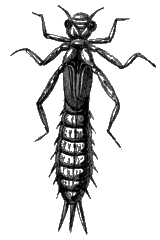
Pupæ of Dragon-fly.
Pupa of Dragon-fly, showing the sharp points at the end of its feet.
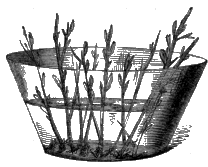
The pupa of the "dragon-fly" furnishes us with a very interesting example of escape; and it well deserves the reader's attention, if he be so placed as to have the opportunity of observing it. Perhaps, indeed, few insects afford us such a singular series of interesting facts as are to be found in the escape of this one from its pupa. The best method of observing their change is to procure as many of the larvæ as possible, to put them in a basin of water, at the bottom of which are a quantity of dead leaves, and to allow several sticks to be in the water touching the bottom of the basin, and reaching above the level of the water, as shown in the cut. Then we must watch carefully to notice any of the larvæ which, having become pupæ, creep towards the edge of the water. These are such as will in all probability be the first to undergo the change, for they come to that position in order that they may get dry before proceeding further. If these are now closely observed, they will be seen after the lapse of a little time to leave their position, and to begin creeping about in search of a suitable spot where they may undergo their metamorphosis. Most probably they will select for this purpose the sticks we have introduced into the basin, and, after running up and down them, will fix upon a particular spot, where they place themselves securely, the head invariably uppermost. From what will be subsequently mentioned, it is necessary that the insect should fasten itself so firmly to the branch, that not even a violent effort would disturb its position. This is secured by the insect thrusting the sharp claws with which its feet are armed into the stem on which it rests. The points of these claws are so fine and hard as even to penetrate wood with facility. They are shown in the cut; and even after the dragon-fly has escaped out of the pupa case, they may be easily made to fasten upon a piece of a branch, by simply pressing the feet against it very lightly. In order to watch the changes of this insect Réaumur once, whilst staying in the country, collected a large number of the pupæ, and placed them on a piece of cotton-print tapestry, where they soon felt at home, and fixed themselves in preparation for their change, without moving far from the spot where they had been placed. At few periods of the day could a visit be paid to the room where this tapestry was hung without seeing a spectacle at once diverting and extraordinary. Previous to its changes the pupa becomes more transparent, and the large and beautiful eyes of the insect it encloses grow increasingly brilliant. These signs always indicate that the transformation is nigh at hand.
It comes to pass in the following manner:—Some movements of a struggling kind take place inside the pupa case; and at length the case splits at the upper part, near the head: through this rent the body of the dragon-fly appears and tears it open, acting like a wedge, until the slit extends along the head across to the two eyes. The latter transverse slit is produced by a contrivance similar to that mentioned in the case of the blow-fly, a sort of air bladder which the insect distends at its pleasure, and thus causes the skin covering its head and eyes to split open. The head and body of the insect rise and make their appearance through the slit; and the head is now so much larger than it appeared while in the pupa case, that it seems almost impossible that it could ever have been contained within it. The insect continues to rise perpendicularly out of the case, and the legs make their exit, leaving the leg cases of the pupa undisturbed in their attachment to the support on which it rests. In order to facilitate the disengagement of the rest of its body the insect now bends itself in a curved form backwards, being only kept from falling by the last rings or segments of its body being still embraced by the sheath of the pupa case. When it has extricated itself thus far, it begins to move about its legs in different directions for several minutes, as if to get them into use; but after this it ceases all movement whatever. Not a quiver can be seen in its limbs, and the young observer would be inclined to conclude,—as a great entomologist once did, the first time he witnessed the changes of this insect,—that it was in reality dead, and that it was a waste of time to watch it any longer. This state of profound inaction may endure for a quarter, or even half an hour: it appears to be intended in order to give time to the insect to recruit its strength for a fresh and more violent series of efforts, and to admit of its parts becoming hardened and dry. Suddenly, as we are, perhaps, carelessly looking on the inanimate object, it performs a feat of the most surprising, because unexpected agility. Its body, which was previously much bent backwards, is now swung forwards and bent into a curve; it then swings back, and then forwards again, and so quickly that it almost seems to leap. It then rests its legs upon the front part of the pupa case, and pulls the rest of its body out of the case by degrees, and then creeps forward, leaving the pupa case behind, still immovably fixed upon the plant.
EVENING FLIGHT OF EPHEMERÆ. Page 269.
"Behold," says Réaumur, "the dragon-fly new born, but very different from those which traverse the air, or rest upon the plants around. It is quite in disguise. The body, though longer than the pupa case out of which it was drawn, has not got all its natural length. The wings, which are the large and useful organs of these flies, have as yet very little more volume than they had when enclosed in the short and straitened pupa case. They are merely furrowed plates, or laminæ, of some thickness, and arranged one over the other, as if packed together. One can scarcely conceive how each of these wings can acquire its proper dimensions,—how it is to enlarge and lengthen sufficiently. They are folded into plaits like a fan, or like the leaf of a tree just about to be developed; hence they naturally appear very narrow, and the cause of their appearing so short is, that each of their longitudinal portions is folded up like the paper lanterns, more frequently used by nuns than by other persons."
The remaining portion of the dragon-fly's history will be found in the next chapter.[S]
Some curious instances are given by various authors of the escape of more than one insect from the same pupa. Thus we are told that a male and female emperor moth were once produced from one larva, and therefore one pupa, of extraordinary size. Messrs. Kirby and Spence tell us of a German entomologist who says, that two specimens of the pine-lappet moth were once produced from one pupa, which was of the remarkable size of two inches in length and one in thickness. But these are very rare instances, the common and almost universal rule being that one pupa only contains one insect.
Nothing now remains for us to add to the insect's history in the pupa state. Already,—for it is Spring far advanced,—the air is becoming peopled with insect tribes—
"The insect youth are on the wing, Eager to taste the honied spring, And float amid the liquid noon."
A thousand times ten thousand, nay, thousands of thousands, are already in the air; and the low hum of their wings may be heard if we stand breathless and listen in the midst of some sequestered spot, far from the roar and bustle and strife of town life. But the great life-season of the insect world is yet to come; and though May whispers it is nigh, June, July, and August must bring it to us, and with it a teeming multitude of insect flutterers more numerous than the stars of heaven, or the sand-grains of the sea-shore.
PART IV.—THE IMAGO.
CHAPTER I.
THE NEW-BORN PERFECT INSECT.
"Oh! start not! on thy closing eyes Another day shall still unfold; A sun of milder radiance rise; A happier age of joys untold. Shall the poor worm that shocks thy sight, The humblest form in nature's train, Thus rise in new-born lustre bright, And yet the emblem teach in vain?"
Beautiful as these lines are, and poetical as is the idea they develop, they are incorrect. The perfect insect springing from the pupa is not an emblem of man's glorious resurrection from this body of sin and death; why, we shall immediately discuss. In the oftentimes beautiful mythology of Greece, the name for the butterfly was [Greek: Psychê], that the soul. Just as the insect bursts with brilliant wings from the dull and grovelling form of the pupa, flutters in the blaze of day, roams on untiring wings through the genial air, and enjoys the use of faculties so new and strange to it, when contrasted with those of the pupa state,—so was it imagined that the soul's arising from amid the corruption of this vile body would prove a deliverance from the bondage of mortality, and the countless infirmities to which it is heir. And surely there was much poetry in the conception; but we, who must not leave the path of true insect history for any poetical fancies, have now to remind the reader that the simile is in many respects inaccurate, and in so doing we shall merely bring to his recollection what was said as to the contents of the pupa-case at p. 231. From this it appears that the pupa state, far from being a state of death, is one in which new parts are added to the insect; in which the insect is actually not only alive, but in some instances capable of moving about, as well as before or after; and, lastly, in which the various organs of the perfect insect all exist previous to the disclosure of the latter. Thus, if we were to slit open a pupa-case just before the insect bursts from it, we should find that, although kept in bondage by the case, the insect was in all respects the same as if we had allowed it to break out of its prison in the ordinary manner. In a word, the perfect insect is after all only the same being which we saw in the egg, larva, and pupa states, now having cast off its last skin, and become an adult being.
When a man or an animal dies, the particles of the body are separated from each other, their union is destroyed, and they themselves are dissipated in various ways. The flesh returns to dust, the spirit to God who gave it. How different this change from that which the insect undergoes! and how inappropriate in strictness, as
"Emblems of our own great resurrection, Emblems of the bright and better land,"
as emblems of the mysterious union of the immortal soul and its immortal, incorruptible body! The fable of the Phœnix was more expressive of the real nature of this great change; for there the body of the creature was reduced to death first, and the new-born being sprang from its ashes. As we are anxious to convey only the most clear and accurate idea to the reader's mind of the various stages of insect life through which we are conducting him, it appeared expedient to notice the mistake taught in these pleasing lines, only to avoid the error of its being supposed that they give us an accurate idea of the true nature of the change from pupa to imago.
The term Imago is a Latin word, and, like those of larva and pupa, was given to insects in this condition by the naturalist Linnæus. It signifies properly an image, copy, or representation of any object. In applying it to insects in their last stage, Linnæus intended that we should understand by it, that the insect had now reached its stage of perfection, and had become in all respects exactly like, that is, the image of, its parent. And though a better term might probably be found, yet as no person is likely to fall into any serious mistake merely because we call an insect in its last state an imago, it is as well to retain it; better indeed, than, by inventing another, to create nothing but confusion and disorder in the minds of young entomologists. In this chapter, therefore,—the last chapter of the Life of an Insect, the word imago may be considered as synonymous, or having the same meaning, with that of "perfect insect;" it is an insect's last stage of existence.
It would be a great mistake to suppose that the insect, so soon as it leaves the pupa-case, is in that instant in every respect similar to what is known to us as the perfect insect. When, for example, a butterfly has just succeeded in extricating itself from its pupa-case, if we were to take it up in the expectation of finding it all at once decked with the glories of its wings, and elegant in its form, we should be disappointed. Owing to the cramped position which its limbs, and wings, and other organs, have so long been made to occupy, its appearance when it emerges from the pupa is necessarily different from that which it wears after all its limbs have been in free exercise, and the flutter of its wings has been heard over hill and dale, throwing the gentle air into an irregular line of tumult.
Now that summer has come, abundant opportunities for watching insects in all their stages may be had; and by careful searching of the garden, field, and woodland, a number of pupæ may be discovered on the very eve of disclosing the imago, or perfect insect. Let us suppose that the reader has not looked in vain; but has brought home in a tin box several of these singular objects, about which so much has been said. The pupa, ready to burst open and let loose the struggling captive within, is before him; the skin splits, the body of the insect appears, withdraws itself from the pupa-case and inner membranes, and the imago appears before him. But O, how different from the splendidly adorned insect which we know it is still to become! Its tender body is weak, soft, and languid, and bedewed with moisture. Its wings, instead of being of their usual size, and variegated with such glowing and admirably contrasted colours as only a Divine hand could create, are in the largest sized butterflies scarcely bigger than the nail of the little finger; instead of being uplifted in full strength and beauty, they hang drooping down over the sides of the trunk; and their colours are all dull, and muddy, and without any of those distinct spots and beautifully defined marks, streaks, and bands, which we observe with so much admiration in the wings of these insects. Altogether we might take it rather for a mutilated and imperfect insect, instead of what, in spite of its unattractive appearance, it really is,—a perfect insect, and in a short time to become a splendid one.
We have only to wait patiently for the lapse of a little time, and our desires will be fully gratified in beholding all these symptoms of weakness and imperfection disappear. The imago, attaching itself either to the cast-off pupa-case, or to some other convenient support, first stretches out one organ, and then another; its body loses the coating of moisture which bedewed it, its various parts become firm and hardened, and its colours come forth in all their beauty. All the parts which had been forced into a constrained position, now relieved, assume that which is natural to them in the perfect insect; and the wings no longer have a questionable appearance, but become expanded into those light and exquisite structures which form the peculiar beauty and characteristic of many insects, displaying themselves almost magically in the form, it may be, of the thin, transparent membrane of the fly, or as the painted tissue of the moth or butterfly, extending frequently to five or six times their previous dimensions.
Here let us take up, as an illustration of these beautiful and interesting phenomena, the concluding portion of the history of the dragon-fly, commenced at p. 302. The expansion of the wings of this elegant creature, after it has left the pupa-case, and fixed itself, generally on the stem of some pond plant, goes on so rapidly, that we can actually see them becoming larger each moment as we look upon them. If we were to attempt to trace their outline on paper, before the next stroke could be added, their form would be different. During the whole time that the development of the wings goes on, the insect continues perfectly still and immovable. Its wings are not stirred in the least, and the insect seems to avoid all risk of having these delicate organs touched by any surrounding object. Its wings, which are by-and-by to possess almost the stiffness of a thin layer of the mineral talc, are at present softer and more flexible than wet writing paper, and if they were to receive any injury while in this condition, that injury could never be repaired; hence the insect requires to be in a perfectly quiet condition. The dragon-fly seems to be fully aware of this, and in order to prevent the wings, as they increase in size, from drooping down towards, and coming in contact with, its body, it curves it in the manner represented, so as to allow for the expansion and elongation of the wings. At length, generally in a quarter of an hour's time, their development is fully completed; but they are not yet sufficiently firm and resisting to use in flying. If left to itself, the insect generally waits three, or even four hours, before it puts them into inactivity. In addition to the expansion and elongation of its wings, its body also elongates, until it has acquired its full dimensions. In vain should we look at first for the splendid colours in which these insects are decked; all the tints are blotted and unpleasing. Those charming species, which are spotted with beautiful blue and yellow tints intersprinkled with black, are, when they are but just emerged from the pupa, of a whitish yellow spotted with brown; the yellow marks, however, are seen to change to a beautiful deep orange, the brown to black, and some of the yellow marks to blue.
The following interesting description of the same changes as they take place in the butterfly is from the valuable work of Messrs. Kirby and Spence. "The pupa of a very interesting and beautiful butterfly, the only one of its description that Britain has yet been ascertained to produce, I mean Papilio Machaon, being brought to me by a friend early in May, this year, on the sixteenth of that month I had the pleasure of seeing it leave its pupa-case. With great care I placed it upon my arm, where it kept pacing about for the space of more than an hour, when all its parts appearing consolidated and developed, and the animal perfect in beauty, I secured it, though not without great reluctance, for my cabinet, it being the only living specimen of this fine fly I had ever seen. To observe how gradual, and yet how rapid was the development of the parts and organs, and particularly of the wings, and the perfect coming forth of the colours and spots, as the sun gave vigour to it, was a most interesting spectacle. At first it was unable to elevate or even to move its wings; but in proportion as the aërial or other fluid was forced by the motions of its trunk into their nervures, their numerous corrugations and folds gradually yielded to the action, till they had gained their greatest extent, and the film between all the nervures became tense. The ocelli, and spots, and bars, which appeared at first as but germs or rudiments of what they were to be, grew with the growing wing, and shone forth upon its complete expansion in full magnitude and beauty."
If we were expert anatomists, and were armed with a good microscope, the study of the wing of a dragon-fly would prove one of great interest to us. These beautiful organs, however, must be examined when they are as yet but a little expanded, as in their completely developed state we should certainly fail in detecting their real structure. Thin and gauze-like as they seem, they are in reality double, consisting of an upper and a lower surface, between which are several parts which are necessary to preserve the shape and carry on the functions of the wings. The two surfaces of the wing enclose what are called the nervures, resembling in some respects the veins of a leaf. These are really fine hollow tubes of some firmness, which ramify in large numbers between the two membranes of the wing, and thus give strength and stability of figure to them. Along these tubes, or nervures, branches of the air-vessels, or tracheæ, and of the blood-vessels, run.
From these necessary details let us turn to make the difficult, but important inquiry—How are the wings expanded? by what means do they, from being thick, soft, and moist, become thin, hard, and dry? It is to be regretted that this inquiry cannot be answered with that satisfactory certainty which it deserves. It is very difficult to catch the insects in which the expansion of the wings is best observed at the right moment; and even then it is extremely difficult to say whether one cause more than another may contribute to this phenomenon. The following explanation of it is given by Messrs. Kirby and Spence, whose general accuracy on such subjects is well known. "As soon as the insect is disclosed, a fluid enters the tubes or nervures, and being impelled into their minutest ramifications, necessarily expands their folds; for the nervures themselves are folded, and as they gradually extend in length with them, the moist membranes attached to them are also unfolded and extended. In proportion as this takes place, the expanding membranes approach each other, and at last, being dried by the action of the atmosphere, become one. To promote this motion of the fluid seems the object of the agitations which, in many instances, the animal from time to time gives to its unexpanded wings. That a kind of circulation, or rather an injection of an aqueous fluid into these organs, actually takes place, may be ascertained by a very simple experiment. If you clip the wings of a butterfly during the process of expansion, you will see that the nervures are not only hollow, but that, however dry and empty they may subsequently be found, they at that time actually contain such a fluid. Swammerdam, who appears to have been the first physiologist that paid attention to this subject, was of opinion, that an aëriform as well as an aquiform fluid contributes to produce the effect we are considering. He had observed that if a small portion be cut off from the wing of a bee, a fluid of the latter kind exuded from its vessels in the form of pellucid globules, becoming insensibly drops, which he concluded proved the action of the latter; and he noticed also that the wings were furnished with tracheæ, which were at that time distended by the injected air; whence he justly surmised, that the action of the air was also of great importance to produce the expansion of the wing." But Swammerdam appears only twice to have seen the expansion of the dragon-fly, in which this phenomenon is best observed. Herold, an eminent naturalist, also attributes the expansion of the wing to the flow of an aqueous fluid into the nervures. M. Chabrier, a French entomologist, having observed a fluid in the interior of the nervures of the wings of insects, thinks it probable that they can introduce it into them and withdraw it at their pleasure, so as to facilitate their unfolding. When we call to mind the force with which the blow-fly, or flesh-fly, and the dragon-fly, are able to expand their heads by forcing air into them, we need scarcely ask for any other explanation than simply that the tracheæ are distended with air, and by that means the soft and yielding wings are made to assume their distended state.
It has been mentioned, that, in the case of the dragon-fly, the completion of the unfolding of its wings occupies about a quarter of an hour, but that sometimes it is even half an hour. The ordinary period is from five to ten or fifteen minutes in most insects, but it is sometimes prolonged to an hour, or to several hours. Again, in others, as we have already seen in the history of the emergence of the gnat, and other insects, from their aquatic state in the pupa, it is completed in a few seconds, and the insect only rests for this brief period on the surface of the water, previous to taking flight from its apparently somewhat dangerous position.
Some observations of Mr. Rennie show, in a singular manner, the fact before mentioned, that if the wings, while yet wet and soft, are in any way pressed upon, or otherwise injured, they will never assume their proper appearance. "The thread by which a chrysalis is suspended may sometimes snap asunder; when this happens, and the chrysalis is allowed to remain, it will not usually produce an insect complete in all its parts; for the side upon which it lies being pressed against an unyielding substance by its own weight, instead of hanging lightly suspended by a silken cord, is prevented from becoming duly expanded, and when the insect is excluded, it is found to be deformed. A colony of the brown-tail moth, which we reared during the summer of 1829, spun in the corner of a nurse-box, a common web of several chambers for containing the pupæ. One of these chambers being accidentally torn, a pupa fell upon the earth in the bottom of the box, and in due time, a female moth was produced from it; but she never succeeded in expanding her wings, which remained till her death, shrunk, rumpled, and totally useless for the purpose of flying, though in every other respect she was full grown, and deposited in the box a group of fertile eggs, covered with down from her tail, as neatly as was done by her sisters of the same brood. In the summer of 1825, the chrysalis of a small tortoise-shell butterfly, (Vanessa urticæ,) lost its hold of its silken suspensory, and fell upon the pasteboard bottom of a nurse-box, resting in a sort of angular position, so that the case of the upper wing on the left side, pressed upon the box with the whole weight of the chrysalis above it. When the butterfly made its appearance, it expanded its wings as usual; but the wing upon which it had rested was not half the size of the one on the right side which had lain uppermost. Another of the same brood had, from some cause, not grown so large in the caterpillar state as the rest. It was transformed, notwithstanding, into a chrysalis, which appeared healthy and well-formed; but when the butterfly appeared, though it did not differ from the usual appearance, its wings never expanded a single hair's breadth, and remained always in the same state as when it issued from the chrysalis."
After the insect has once withdrawn itself from the pupa-case, it generally retains the same appearance and raiment as long as it lives, not casting its skin like the larva, but having put on its permanent clothing immediately upon its leaving the pupa-case. But in the case of an aquatic insect, the Ephemera, of which we have before spoken, a remarkable exception to this rule has been noticed. When these insects leave the pupa-case, any one, on looking at them, would say that they had completed their changes; they appear to be furnished with every part necessary to them, and not to have any which is redundant; yet they are destined to go through a change equivalent to that which has just taken place, if, indeed, it is not more apparently difficult than it, and that is,—they have to cast off their skin. That they should be able to withdraw from thence their head, their legs, their body, and their long tails, would be no great difficulty for us to comprehend, because numbers of insects at their escape from the pupa-case do more than this; but in their case we are presented with a more perplexing enigma. In the transformation of other insects, as we have already seen, and, indeed, in that of the insects before us, the wings are at first very soft and pliable, and therefore can be easily withdrawn from the cases in which they were contained. But in the Ephemera, the wings, after it has left the pupa-case, are fully developed and expanded, and seem to have acquired all their consistence, and to have become hard and inflexible. Moreover, its wings are so thin, that we can scarcely believe that they are in reality double; that is, that they are covered by an outside sheath; and it seems incomprehensible how, if such is the fact, the wings can be withdrawn from this case or sheath, when the only opening that can be discovered for that purpose, is a very minute hole near the spot where the wings take origin from the body of the insect. Let us now see how all these difficulties are overcome, and how the insect withdraws itself from this, as we might almost call it, second pupa-case.
Dance of the Ephemeræ.
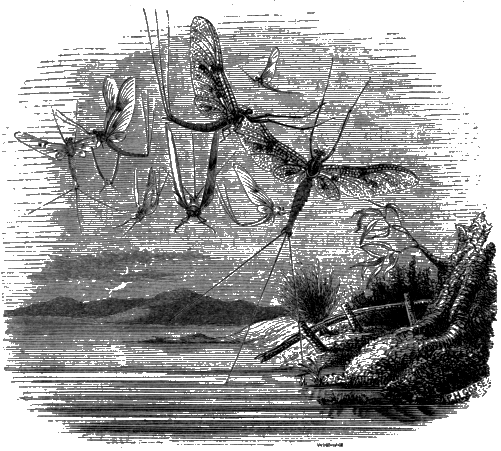
The Ephemeræ, when they leave the water, rise high into the air, and wing their way perhaps far from the place of their birth. They may often be found wheeling over green fields, or wandering among the forest shades, far from the bubbling stream in whose waters so large a portion of their existence was spent; but more frequently they are to be found somewhere in the neighbourhood of the stream, enjoying an aërial dance. The feet of the insect are armed with hooks of great minuteness, and by their means the insect attaches itself to a suitable object, sometimes to a wall, sometimes to a twig, or to the trunk of a tree; it does not much matter where. Without at first making the least movement, the insect patiently abides the time when it must withdraw itself from its useless upper garment, and sometimes it has to wait a whole day in this position. The time arrived, the skin splits, and the body of the insect rises gradually out of it; but the difficulty is about the wings. Nevertheless, as we watch the insect, we shall find that it gradually draws them out of their delicate cases, and at length emerges, as perfect in beauty and form as before. The manner in which this is effected is as follows:—although the outer case of the wings is hard and rigid, yet the wings which it covers over are preserved in a soft and moist condition. In proportion, therefore, as the insect disengages itself from the anterior part of the skin, the inner or real wings become contracted, by a number of plaits, into a form nearly cylindrical, which readily admits of their being pulled through the openings lately mentioned; and as soon as the insect is released from its envelope, these plaits unfold, and the wings return to their former shape and dimensions. So exactly does this thin skin, thus cast off, fit all the parts of the insect's body, that it may often be mistaken for the insect itself, when it is found clinging to the place where it has gone through its changes.
Wingless Beetle.
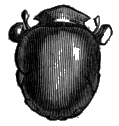
Before we leave the subject of the wings, it must be mentioned that there are some insects which have none. The cut represents a beetle of this class.
If the reader will now take a peep into one of the nurse-boxes in which he may have been rearing butterflies from the pupæ, presuming that several of them have ere this burst from their cases, and are fluttering about anxious for liberty, he will generally detect upon the bottom or sides of the box one or two marks of a somewhat reddish colour; sometimes, indeed, they are very red. These spots are produced by the insect, which, on its emergence from the pupa, generally deposits a drop of fluid from its intestines. Almost all insects perform the same action at this period; but we may well remark with Réaumur, it could scarcely have been supposed, that the excrements of a butterfly should ever have filled the minds of a whole population with terror. Such has, however, been the case, and may, perhaps, yet be in districts where ignorance and superstition close the minds of the inhabitants against the truths of entomology. "Historians," says Réaumur, "tell us of showers of blood, as having been the cause of terror to nations, and considered as prophetic of fearful events, of the destruction of cities, and revolutions of kingdoms. At the beginning of the month of July, in the year 1608, one of these showers of blood was said to have fallen in the suburbs of Aix, and for some miles around. It turned out that the supposed drops of blood were in reality drops deposited by the butterflies. It is not improbable that other showers of blood recorded by historians, and taking place about the same period of the year, might be accounted for in the same natural and simple manner. Gregory of Tours relates that in the time of Childebert a shower of blood fell in different places in Paris, and particularly in a certain house situated in the territory of Senlis. Another was said to have fallen toward the end of June, in the reign of King Robert. In the year 1533, we are told by another author, a prodigious multitude of butterflies appeared throughout a great portion of Germany, sprinkling plants, leaves, buildings, clothes, and men, with bloody drops, as if it had rained blood."
In the Gentleman's Magazine for the year 1764 we read that "a kind of rain of a red colour, resembling blood, fell in many parts of the Duchy of Cleves, and caused great consternation. Something of the like kind fell also at Rhenen, in the province of Utrecht." A gentleman is reported to have sent a bottle full of it to Dr. Schutte, to know if it contained anything pernicious to health. Dr. Schutte wrote a learned dissertation upon it, and gave it as his opinion that it was caused by the particles which had been raised into the atmosphere by a strong wind, and that it was in no way hurtful to mankind or beasts. Probably butterflies were the real shedders of this blood-like shower, as in the previous cases.[T]
Our next remark about the imago state of insects will, perhaps, create some surprise—Insects in this state, with some apparent exceptions, do not grow larger. When they leave the pupa state, and have all their parts fully developed, they do not subsequently increase in size. We are often told by ignorant people that the little house-flies which we watch dancing in our chambers, or scrambling up our windows, are only young flies of the same kind as flesh-flies, and that by-and-by they will grow into a large "Blue-bottle!" This is a sad mistake. Let the reader try. Let a fly be put under a glass, and fed with a little sugar, or honey: in vain will he daily examine it, in the expectation of beholding it increase in size—it will live and die nearly the same little being unaltered to the last. If such persons only knew somewhat of the life of an insect, such an absurd, and, unfortunately, very prevalent mistake would not be committed. We might as reasonably call a trout a young salmon! If we were to examine any number of flies of the house-fly kind, (Musca domestica,) and carefully measure them, or weigh them, we should find them all almost exactly of the same size; which, of course would not be the case if they really grew larger as they grew older.
But there are some insects which, after they leave their pupa, increase within a very short time to a size which could scarcely be believed. In particular, the new-born insects of a tribe of flies which produce the aphis-lion larva before spoken of, are distinguished by this peculiarity. We behold a very little insect emerge from the pupa-case, and in a quarter of an hour we are astonished to find it has grown to a great fly! This sudden increase appears the more marvellous, because during this period the insect takes no nourishment. The wings of this insect, when it is just born, are not more than one-tenth the size they acquire in that short space of time. The insect is to all appearance firm and plump, and offers a ridiculous contrast to the tiny pupa-case out of which it has emerged. It appears probable that this sudden enlargement is to be accounted for by the insect filling itself with air, and thus causing the various parts so closely packed together, and fitted into one another, in the pupa, to be expanded. The experiment which puts this idea to the test is a very simple one; we need only prick the body of the insect with a fine needle, and we shall hear a slight sound produced by the escape of the air; and in a few seconds the body of the creature shrinks to its former dimensions. It appears, indeed, that the body of the insect is actually larger at this time than at a subsequent period of its life, when it becomes more flattened and shorter. Another beautiful insect, one of the lace-winged flies, exhibits the same singular phenomenon. Its pupa-case is not larger than a small pea, yet the body of the insect is nearly half-an-inch long, and covers, when its wings and antennæ are expanded, a surface of an inch square. It appears, in fact, almost incredible that it could ever have been contained within so small a compass.