Front matter (continued 3)
Reading edition
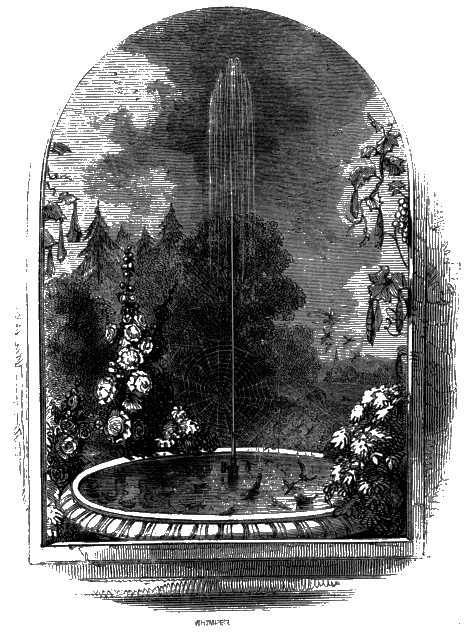
In summer time, the reader can scarcely fail of the gratification of watching these most curious creatures, for they abound in ditches, pools, and the stagnant waters of artificial fountains. They form a very curious object under the microscope, and particularly in the gas microscope, or solar microscope, where the image of the larvæ is thrown, as in the case of the magic-lantern, upon a white sheet, or wall. Their curious writhings to and fro, the energy they display in lashing about their tails, so as to throw the few drops of water in which they are imprisoned into mimic whirlpools, their occasional dartings down to the bottom, and subsequent gentle rise up to the surface, together with the terror into which countless minor occupants of the same watery prison with themselves are thrown, when one of these comparative giants plunges into the midst of them, form a spectacle as unique as it is interesting and diverting. A sharp eye, and a phial and cork, are the alone requisites for finding out these singular beings on most fine days in summer. But a little while ago the writer was amused to find, on a sunny day in June, the water of a small fountain playing before his study window, thickly populated with these active larvæ, and it became an amusement which seldom wearied, to watch their fantastic evolutions, and to trace their changes from the larva through the ulterior stage up to the perfect insect. To this, however, we shall probably have occasion to revert before the conclusion of this work.
Another instance of a curious contrivance for assisting the breathing of a larva, whose body is wholly immersed in water, may also be found near home. Most probably the majority of our readers have seen, or at any rate are well acquainted with the apparatus by which the diver descends and works under water. Lest some should not, we may mention that it consists of a water-tight dress, which covers the diver from head to foot, while his head is enclosed in a helmet, or hood, furnished with a pipe or hose, which is long enough to reach to the surface of the water, and is there generally connected with an air-pump, which forces down fresh air, and so enables the man to breathe almost as comfortably as if he were walking on land, instead of at the bottom of the sea. Let it be conceived now that there were no air-pump at the top of the hose, but simply a buoy of cork to keep it floating, and that the diver had the power of shortening or lengthening the hose at his pleasure, we should then have a tolerably fair representation of the contrivance with which Infinite Wisdom has supplied the humble creatures of whom we are about to speak.
By carefully examining the water running from manure heaps, or water which has become putrid, and is much loaded with mud and ooze, the reader will pretty generally be successful in discovering a number of the larvæ of a two-winged fly of the shape represented in the cut. When discovered, the singularity of their structure will amply repay him for the trifling unpleasantness attending the search after them. After washing them in a little fair water, and putting them into a tall ale-glass, or German beer-glass, which must be three parts filled with water, they will be in the best condition for our examination. When Réaumur first beheld them, he gave them the name of Vers à queue de rat; that is, larvæ with a rat's tail; and when the reader looks at them, as shown in the representation annexed, he will be inclined to think with us, that a more appropriate title could not have been found.
Rat-tailed Larvæ.
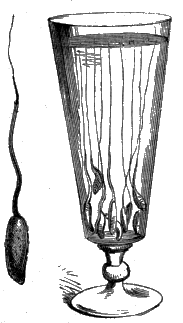
On watching them they will be seen to wriggle about until they are comfortably settled, darting from place to place, as if uneasy in their new position and in the pure element. By-and-by, however, they become reconciled to their lot, and lie perfectly quiet at the bottom of the glass in the position represented. From the tail of each will now be seen to rise a beautifully delicate and minute tube, which comes up to the surface of the water, and here, whatever be the movements of the larva below, it remains floating and free. Just as the diver may, while his companions above are pouring down torrents of fresh air, move about, and perform various duties under, water, so the larva may move from one position to another, and assume almost any variety of attitude; but its little air-pipe still retains its perpendicular direction, and does not quit the surface of the fluid.
A singular experiment may now be tried with them. Let a little water be poured into the glass by means of a funnel, the end of which dips under the water so as not to give them unnecessary disturbance, and by this means the level of the water in the glass becomes insensibly raised half an inch or so. In a few seconds it will be found that these little tails have all lengthened themselves, and are again at the surface of the water, even at its higher level. More water may be poured in until perhaps the level is raised three or four inches, and still the same thing takes place, the larvæ still prolong their curious tails, until it seems as if they would stretch to an indefinite length, for they are already eight or ten times longer than the body! But, as we might jestingly say—the longest tail comes to an end at last; for, on continuing to pour more water in, the larvæ stretch their tails to the utmost, and then, finding the level of the water still above their reach, they become uneasy, and all quit the bottom of the glass and attach themselves to its sides.
The Tail magnified.
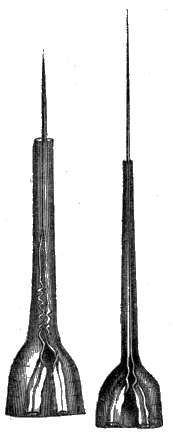
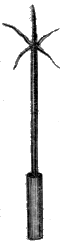
Let us now examine more minutely this very singular apparatus. By a good lens we may readily do this, as the organ is very transparent, permitting its internal structure to be beautifully seen. Placing the creature in a convenient position for our examination, and in a good light, it will be presently seen that the tail is composed in reality of two tubes, of which one slides up and down within the other, just like the tubes of a telescope (see cut). By this means the larva is provided with an instrument capable of being made to reach to a great length, and yet also possessing the capability of being packed up again in a very small compass. The proper breathing tube is the small inner one; at its extremity is a pair of spiracles, or breathing pores, and surrounding these are placed five minute bristles, which are supposed to act somewhat as a buoy, and to retain the tail in its position. Where the tail joins on to the body of the larva, two tubes thrown into folds are placed, which are connected with the breathing tubes of the tail, at one end, and with the breathing pipes which run along the body of the larva at the other. When the tail is pushed out to its farthest, these zig-zag tubes are stretched quite straight; when it is drawn in again, they are thrown into folds. Both these appearances are shown in the plate. It has been supposed that the larva causes the tube to be pushed out by forcing air into it, and thus causing the zig-zag tubes to straighten themselves. Perhaps the tail is drawn in by the same tubes contracting again, and thus folding together and dragging back the tube to which they are connected.
End of the Tail.
We need scarcely stop to mention how useful is this admirable contrivance to the insect. Having to seek for their food at the bottom of ditches, drains, or puddles, they are necessarily exposed to the risk of suffocation, unless fresh air can be conveyed to them; and it is difficult for us to imagine how any apparatus could have been contrived which would have adapted itself to all the varying depths of water in which the insect must be constantly living, as it changes from place to place. He must have been a clever engineer who could have successfully met this difficulty. None of our present diving apparatus does so. The organ we have been considering, the creation of an Infinite Mind, small and despicable as it may seem in our eyes, fulfils perfectly every function for which it was formed. It admits of free movement from place to place, it admits, moreover, of free change from one level to another in the fluid by which the larva is surrounded, and it is at the entire disposal of the insect, which can, without the smallest inconvenience, accommodate it to the various circumstances in which it may be placed.
Chameleon-fly Larva.
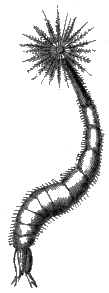
Possibly the same phial in which was brought home the last-named larvæ with the rat's tail, will furnish us with an equally elegant instance of larva-respiration under water, in the case of the larva of a fly, called the chameleon fly. This little creature, if it can be found, and though not as common as the last, it may yet be detected, in summer by the edge of ponds, &c., has truly elegant habits. The great Swammerdam, who first described it, was lost in admiration at it. The extremity of its body is furnished with a coronet of about thirty elegantly feathered hairs. These are under the control of the insect, and are capable of being folded up, so as to enclose a minute bubble of air. When the larva is weary of remaining at the top of the water, and wishes to dive to the still and cool depths below, it causes these hairs so to fold up and close upon each other as to include the air-bubble, so that it cannot escape. Thus furnished with a pearl in its tail, it plunges downward, and thus breathes under water until the purity of the captive air-bubble is impaired, when it returns to the surface to repeat the same operations. The appearance of the little bubble shining, with a brilliant silvery lustre under the water, is very pleasing, and accounts for the enthusiastic expressions used by Swammerdam, in speaking of the visible manifestation of the skill of God in this insect. The fact of an insect coming to the surface for air, and stealing away a portion, then diving down again into the waters, is not uncommon in insect history, although few are possessed of so elegant a contrivance for effecting it as the larva in question.
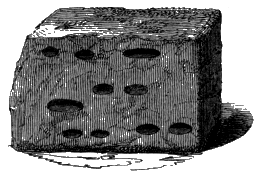
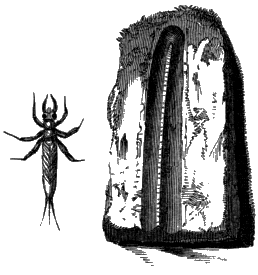
We must pass on to mention an instance or two of larvæ which, from the peculiarity of their respiration, come under the second of our divisions, that is, they live in the water, and do not breathe air, but obtain the gas necessary for their respiration from the water, which holds it in a state of solution. We shall first speak of the larva of the common May-fly, the perfect insect of which is so well known to, and highly prized by, anglers, under the various names of "duns" and "drakes," than which in some streams no insect that flies is a better bait to the unwary fish. Should the reader wish to examine them for himself, they may be found in May or June, hiding themselves during the day in the mud, or underneath stones, or in little holes in the banks, or taking a sub-aqueous tour upon the bed of the brook, while the clear and purling waters roll smoothly on above them. Their little under-water cells are shown in the cuts, together with the larva.
Cells of May-fly Larva.
Larva and section of its cell.
Their organs for breathing the water, if the expression, which is in some measure correct, may be admitted, are very like the gills of a fish. But instead of forming a part of the structure of the mouth and head, as those of the fish, in the larva they are placed along its body, and are arranged in pairs. A delicate little air-tube enters into each of these gills, and there branches out into a great many directions; this tube is connected with the large trachea, or breathing vessel of the insect, running along its body. The air entering these gills, and thus being exposed to a large surface of water containing dissolved gas, loses its impurities, and absorbs the pure gas from the water, whence it is then conveyed to the various parts of the body. In many species of these larvæ the whole series of gills are moved to and fro incessantly, and so quickly as to be scarcely perceptible to the eye. Some of them use them as oars, moving with inconceivable rapidity, and being capable of darting both backwards and forwards with great quickness. They have also the power of leaping or springing in the water to a considerable distance; and feed on minute aquatic larvæ, and on vegetable matters.
The only other instance of this kind that we shall quote will be that of the terrible larva of the dragon-fly, whose deeds of insect murder came before us on a former occasion. The apparatus provided for them is very singular, and has been described with his usual accuracy by the talented Réaumur. It exists in the tail of the insect, and may be readily watched in action by adopting the following expedient:—Pour into a small glass, in which the larva has been put, and which is half full of water, a few drops of a solution of carmine, by means of a little tube introduced into the water, and made to drop its contents near the tail of the creature. Immediately it will be seen that the coloured liquid is rapidly sucked in by the tail of the insect, and then, after the expiration of a little time, is forced back again in a tiny jet, with considerable violence, to a distance of several inches.[H] Réaumur tells us, that if we hold the insect between the finger and thumb gently, and let fall a drop of water on its tail, we shall presently see it eagerly sucked in, the body of the insect becoming sensibly larger; and by-and-by it is thrown out again. Sometimes it raises its tail above the surface of the water, and, whether for sport or not, it is hard to say, squirts the water in a mimic jet to some distance.
The apparatus has been described as resembling the piston or plunger of a force-pump, which moves to and fro within a cavity inside the insect's body, and by that means draws in and forces out the water. The tail is defended by a sort of coronet, composed of five hard bristle-like pieces, which are under the control of the creature, and may be opened and closed at pleasure. The larva appears capable of inflicting a somewhat painful pinch by this contrivance, so that, what with its wonderful mask, with its powerful squirt, and with its tail thus armed, it would be difficult to select another insect better prepared for battle with creatures of every aquatic tribe than it. The action of the pumping apparatus sends it rapidly forward through the water, somewhat like a paddle-wheel, or at least upon the same principle as that contrivance, namely, the resistance offered by the water to the stroke of this apparatus.
CHAPTER V.
MEANS OF DEFENCE OF THE LARVA.
There is, perhaps, no period in the life of an insect when it is so much in danger of the attacks of foes, as when it is in the larva state. Possessed, at the best, with but very feeble powers of locomotion, in comparison with those of winged insects, it is continually exposed to destruction on all sides, from which it has not the power to escape. Not only do insects of various species particularly select the larva for the object of their attacks, but birds and other creatures are also in the lists against them. Thus imperilled, what chance has the larva against foes so numerous, and in a contest so unequal? It has been calculated that a pair of sparrows, for their own consumption, and for that of their tender brood, destroy at least three thousand caterpillars in a week! and we well know what multitudes of larvæ fall into the clutches of the cawing rooks which follow the tail of the plough. The winged insects are tolerably secure, although many even of their ranks fall victims to the swift-winged swallow and sand-martin, and to the rapid leap of the artful trout. But the poor crawling larvæ are neither strong enough to fight, nor swift enough to flee, and fall by thousands into the unsparing hands of their various enemies.
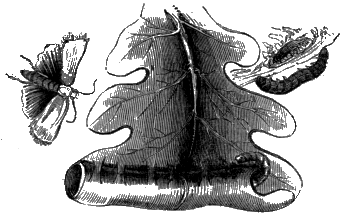
Leaf-rolling Larvæ.
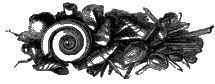
Larva Case of Shells.
Yet, the Creator, who has wisely appointed a large portion of their numbers for food to many creatures, has also taken many precautions to prevent their being entirely annihilated, as might otherwise have been the case. These are well deserving a brief notice, previous to our passing on to the last stage in the history of the larva. From what has been already said about the coats of various larvæ, it may be imagined that that must be a stout-hearted enemy which could venture to attack some of them. The spines and hard excrescences with which they are furnished must, undoubtedly, prove far from agreeable to the touch of a foe; and there can be no question that this sort of armour is, of itself, a good defence to many larvæ. Others form artificial coverings, which are equally useful, by concealing them from the notice of their enemies. Thus, as we have before remarked, some dwell in tubes of leaves, hid from every eye; others encase themselves in a shield of cemented gravel or shells, like those represented in the cut, presenting a most grotesque appearance; others hide themselves in variously-formed cells. Some, immediately on being touched, roll themselves up, like hedge-hogs, into a ball, which looks like a little globe of hairs, and is so slippery that it cannot be retained between the fingers; others, again, when they are touched, instantly drop down, and from their colour, resembling precisely that of the herbage into which they have fallen, it becomes next to fruitless to search for them.
A very singular larva which, both for offence and defence, adopts a most extraordinary procedure, must be mentioned by itself. This larva is not unfrequently to be found in our houses, and is said to feed upon our disgusting and annoying invaders—the bugs; but it so completely contrives to conceal its real character, that not once in a hundred times would it, probably, be recognised as an insect at all. It collects together a number of particles of sand, or fragments of wool, or silk, or earth, and with singular skill, contrives to form a sort of coat out of these, in which it envelopes itself. Thus attired, as may be imagined, it is not easy to discover what the object really is, and it thus, undoubtedly, escapes the undesirable notice of any of its enemies. But more than this: like those North American Indians, who hunt by concealing themselves in the skins of wolves, and so attract less attention from the herd than they would do if they were to expose themselves in their natural aspect to view, this crafty larva steals upon its prey in much the same manner, although it can run with sufficient swiftness when necessary. It creeps forward with the greatest stealth, moving only one leg at a time, and thus quite insensibly approaches its victim, who is not at all alarmed at what merely appears to be a lump of dust. Soon, however, it is convinced of its fatal mistake, and discovers the terrible fact that it is in the embrace of an unsparing devourer.
Other larvæ escape notice in a singular manner, by their close resemblance to little pieces of stick. Thus, we are told by Messrs. Kirby and Spence, that "there is a certain tribe of caterpillars called surveyors (Geometræ), that will sometimes support themselves, for whole hours, by means of their posterior legs, solely upon their hinder extremity, forming an angle, of various degrees, with the branch on which they are standing, and looking like one of its twigs. The body is kept stiff and immovable, with the separations of the segments scarcely visible; it terminates in a knob, the legs being applied close, so as to resemble a bud at the end of a twig; besides which, it often exhibits intermediate tubercles, which increase the resemblance. Its colour, too, is usually obscure, and similar to that of the bark of a tree: so that, doubtless, the sparrows and other birds are frequently deceived by this manœuvre, and thus balked of their prey. Rösel's gardener, mistaking one of these caterpillars for a dead twig, started back in great alarm, when, upon attempting to break it off, he found it was a living animal."
Some, however, are actually armed, so as to offer an active resistance to the onslaught of any enemy. Mr. Abbot has described a terrible caterpillar, well known in certain districts in America, under the strange title of the "Hickory-horned Devil." This creature is furnished with seven or eight strong horn-like spines, upwards of half an inch in length, which project from its head and anterior segments. When threatened by danger, the caterpillar does not attempt to fly, but lifts up its head menacingly, and shakes it about in a very fierce manner. The negroes, in particular, are so terrified at its aspect, that they dread it as much as the rattlesnake. But, in reality, it is harmless; and Mr. Abbot, in order to convince the ignorant people that such was the case, took hold of it, in their presence, without receiving any injury. This, however, did not convince them, and they made answer that, although it did not sting him, it would undoubtedly sting them.
The weapon of another is thus pleasantly described by De Geer:—"In the month of July, I found a caterpillar resting upon a small twig, which I cut off in order to enable me to examine it more attentively. As I was scrutinizing its appearance, I happened, accidentally, to touch its body. Instantly there shot out, from a spot near the head, two streams of clear fluid, which struck me on the face, and partly entered one of my eyes, causing a very acute, but fortunately, not a very enduring pain. My surprise at this salute prevented my taking particular notice of the place from whence the jets proceeded. It appears probable that this caterpillar has been thus endowed with this squirting apparatus to enable it to defend itself against its enemies, or at least, to assist in frightening, or perhaps in hunting, its prey. For myself, I confess, after the reception I had met with, I felt some degree of fear at too nearly approaching it."
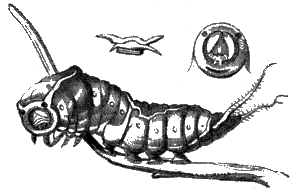
Squirting Larva. The Cleft and squirting Organ are shown separately.
On examining them carefully at another opportunity, this entomologist found that these caterpillars were provided with a squirting apparatus, situated in a cleft in the neck. When the creature is irritated, it thrusts out a curious organ, divided into four branches, and drilled with holes, like the rose of a watering-pot. From this organ shoot the jets of fluid spoken of. After the discharge they are drawn in again, and covered over by the closing up of the cleft. Strange to say, when taken in-doors, the caterpillar lost the power of squirting altogether. It appeared as if it could only do so in the open air, where a number of insect enemies were arrayed against it. This caterpillar is commonly known as that of the Puss-moth, and has sometimes caused the most strange and foolish country tales by its striking appearance. It has been described as a horrible monster, having a head like a lion, jaws like a shark, a horn like a unicorn, and two tremendous stings in its tail! Certainly, its appearance is not the most engaging in the world, as may be conceived from the representation of it in the cut; and what adds to its singularity is, that it possesses the power of lashing its sides with its tail, so as to drive away flies. If the reader should be fortunate enough to find one, he may have some amusement in examining all the curious apparatus with which this rather forbidding looking insect is supplied.
The winter draws near, and sends its foretokening cold breathings to warn every creature, vegetable and animal, that the dark season is arriving, when food is no longer to be obtained. What is to become of the larva? Can it endure the penetrating tooth of frost, or the overwhelming shower of rain? Or can it endure to be from week to week, from month to month, without a mouthful of food? From the facts already stated with reference to the age of larva, it is very certain that many larvæ have to bear these trials; and some, not merely during one, but during several winters. We must, therefore, inquire how they have been defended, or strengthened, so as to enable them so to do.
Shaggy-coated Larvæ.
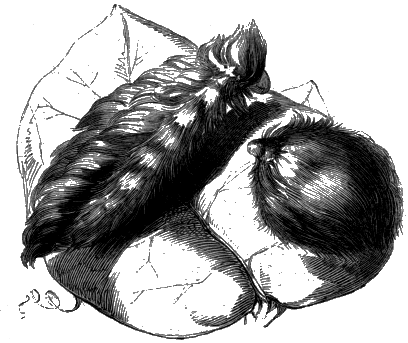
The alteration in the coats of animals during winter, or rather, just previous to it, and the fact that animals destined to inhabit the arctic regions are enveloped in coats of the shaggiest hair, are well known to every person. There can be no doubt, that in many instances in the insect world, where a larva has to be exposed to the frosts of winter, the same provision of a hairy covering, which has been given to them by the Creator, is intended to meet the same end, and to preserve their soft and tender bodies from the destructive influence of extreme cold. The following striking observation of a talented entomologist, who has not thought it beneath him to write a most interesting book only on the family of ants (M. Huber), shows very clearly that such is, in fact, the intention of providing the larva with a covering of this kind. He noticed that the larvæ of some species of ants destined to pass through the winter, were furnished with this kind of warm clothing, while those which were not so destined had smooth coats, that is, even in the same species: thus proving to us, beyond a doubt, that as the winter approached, the warm coat was put on by the larvæ. The engraving on the last page represents some extraordinary specimens of hairiness in caterpillars from Brazil, now in the British Museum.
A large number of larvæ become torpid during winter—they are not dead—they are not sensibly alive—they are plunged in that long half-death which affects not only them but also many large animals, who retire in winter, lie down to sleep for weeks, and awake to find the cold departing, and the spring-time nigh at hand. But the frost sometimes proves too severe for them, and the poor insects become sometimes congealed into solid lumps of ice! Alas! we shall exclaim, then there is an end to their life when that takes place; and, undoubtedly, the severity of such a degree of cold destroys large numbers; yet, strange to say, some larvæ actually revive, even after they have been thus frozen into hard inanimate lumps. One observer states that he has found them in this condition; and so entirely congealed, that they chinked like small stones when dropped into a glass tumbler! yet they revived after careful management. In an experiment made during Sir John Ross's voyage to the arctic regions, upon the larvæ of a moth, they were four successive times exposed to the intense cold of 40° below zero, and four times they revived again on being brought into the warm atmosphere of the cabin. Experiments have also been made by other persons with a like result. It may, therefore, be considered certain that some larvæ will bear to be frozen into solid masses, so that they will snap asunder like an icicle, and yet return to life again; and even go through all their stages of development, into the perfect insect. How remarkable a fact this is, when we remember the deadly effect of frost upon man and the higher animals!
Many larvæ, however, form nests of various kinds, in which they comfortably spend the dreary days and nights of this stern season. "With this view," write the excellent observers, Kirby and Spence, "the larva of Cossus ligniperda forms a covering of pieces of wood, lined with fine silk; those of some other moths excavate, under a stone, a cavity exactly the size of their bodies, to which they give all round a coating of silk; and the larvæ of Pieris Cratægi enclose themselves, in autumn, in cases of the same material, and thus pass the cold season, in small societies of from two to twelve, under a common covering formed of leaves. Bonnet mentions a trait of the cleanliness of these insects, which is almost ludicrous. He observed in one of these nests a sort of sack, containing nothing but grains of excrement; and a friend assured him that he had seen one of these caterpillars partly protrude itself out of the case, the hind feet first, to eject a similar grain; so that it would seem the society have on their establishment a scavenger, whose business it is to sweep the streets, and convey the rejected matters to one grand repository. This, however singular, is rendered not improbable, from the fact that beavers dig, in their habitations, holes solely destined for a like purpose, as do also badgers."
A singular variety of larva-nest is mentioned by a Mexican traveller. He says,—"After having ascended for about an hour, we came to the region of oaks, and other majestically tall trees, the names of which I could not learn. Suspended from their stately branches were innumerable nests, enclosed, apparently, in white paper bags, in the manner of bunches of grapes in England, to preserve them from birds and flies. I had the curiosity to examine one of them, which I found to contain numberless caterpillars. The texture is so strong that it is not easily torn; and the interior contained a quantity of green leaves to support the numerous progeny within."
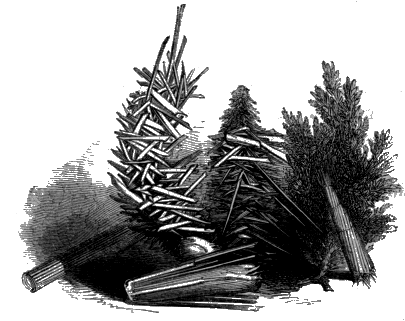
The larvæ of some Australian insects form the most curious nests we have ever beheld. A representation, taken from specimens in the entomological collection at the British Museum, will show what extraordinary structures these are. They appear like minute bundles of faggots, and have been formed by the insect cutting short pieces of twigs, all nearly of the same size, and then cementing them together in the manner represented. Some of these are of a large size, as large as a moderate-sized pear; others are smaller, and these present the most beautifully regular appearance, consisting of a number of very small rods, bound together in a cylindrical form, like the fasces of the Roman soldiery.
Australian Larva-cases.
In this manner larvæ pass through the winter. Without a doubt many perish; but there remain infinite numbers at the end of this season, which, from the depths of their cells, become sensible to the influence of spring, so soon as the first footsteps of that season are felt upon the earth. The larva wakens to active life once more; and with an appetite rendered all the keener by its fast of four or five months, it leaves its dormitory, and begins to consume whatever suitable food may lie in its way; and so it continues, until the time of its change approaches.
CHAPTER VI.
PREPARATION FOR A CHANGE.
The last stage of the larva's history hastens on. Its career of activity and voracity is nearly ended, and the insect's days in this form are well nigh spent. Hitherto it has been an earthly, earth-loving being, without either the desire or the power to raise itself into the airy element, in which multitudes of its species are disporting the day long. If we may so speak, its highest desires have only been confined to the quality and quantity of its food; possessing these, it was content. But now, its hours of feasting are come to a close, and it has to make ready for a great and momentous change. The crawling, and, perhaps, repulsive creature which we turn from without regret, has a high destiny to accomplish, when the period of its sojourn in its vile body is fully accomplished; and then, that form which now creeps among the dust of the world, shall mount up as on eagles' wings, and be carried whither it will through the pure regions of the sky.
The age to which the larva generally attains before this change takes place is exceedingly variable. To some it is permitted to reach the venerable age of four or five years; others, three; and many, not nearly so much. The dung and fungus-feeding insects, as if hastened forward by the warmth of their position, are at the end of their larva life in a week; others live a fortnight in this state; and others, several months. We are told of a curious anecdote of a beetle which had existed in a desk, set up in an office in London, for upwards of twenty years, half of which period, according to Messrs. Kirby and Spence, it must have lived as a larva. But this is quite an exception to the general rule.
For some days before, the larva loses its long distinguishing characteristic—its appetite—and now forsakes the plants upon which it formerly fed; or if it does not forsake them, no longer consumes any part of them. It becomes, apparently, in some degree sensible that it is approaching the most dangerous period of the history of the insect—the state of sleep or torpor in which it is to exist as a pupa—of which we shall speak more particularly in our next chapter. Before, although a weak and comparatively a defenceless creature, it was still able to exercise a vigilant watch against its enemies, and thus to avoid them, or to prepare for their reception; but now, its eyes are to be closed in a death-like slumber; its body to hang a tempting bait to any wandering foe, or hungry bird, and it can in no way resist the attacks of the feeblest adversary.
As if fully aware of this, the wonderful instinct of the larva meets the difficulty by teaching it to select the best place for its concealment from a dangerous notice. With this view, it sets out in search of a hiding-place, and rests not until it has obtained a city of refuge which may prove to it a defence against the enemy. It may be some little recess, covered by an irregular stone, and sheltered round the sides by moss and the upspringing grass; or, perhaps, a little hole in the earth has received the poor fugitive from future harm, and in order to conceal itself more completely, it has drawn over the mouth of the cave a covering of leaves. Here, safe from observation, the larva bids a farewell—to speak as the poets speak—to the busy staring world for awhile, and loses all recollection of its past history, in the night of torpidity upon which it has now entered. The larvæ of the lady-bird, and other insects, glue themselves fast to the under side of a twig or leaf, and here pass the days of their sleep in safety. Many of the larvæ of insects whose life, up to this period, has been passed beneath the surface of some glassy pool, now quit the pure element, and seek the shore, on which they are to pass the remaining portion of their existence.
But there are two other ways in which larvæ prepare for the state of pupa, which are so curious, and prevail to such a large extent among insects, that we may be excused for following the example of all authors upon insect history, and treating our readers to the interesting facts which have been recorded by various observers upon this subject. One of these is the plan of hanging themselves up in the air, like sailors in their hammocks; and in other positions, this plan is commonly called the suspension of the larva. The other is the formation of beautiful cases of various kinds, which are called cocoons, in which they wrap themselves up close during the period to be devoted to the pupa state. Let us speak of these each separately; and, first, of the case, or cocoon, as a place of concealment for the larva. It is right, however, to premise, that, while the greater number of insects are in a torpid or half-torpid state while in the pupa form, all are not so, as will be noticed in the next chapter; and those which are not do not of course require the protection of a cocoon, or the contrivance of a silken hammock.
The material of which the case or cocoon is composed is a beautiful silken fibre, which is furnished by a spinning apparatus placed either at the extremity of the body, or more frequently at the mouth of the insect, whence it proceeds in a filament of the utmost delicacy and transparency, but at the same time of considerable tenacity. By its means alone cocoons, of a number of different kinds, some of extraordinary beauty and ingenuity, are constructed; but in other cases the insect has recourse to various materials to assist in giving strength to the walls of its cell.
Cocoon of Silk-worm.
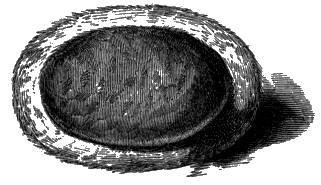
The best example, and the most familiar one we can select of a purely silken cocoon, is that of those
"——spinning worms That in their green shops weave the smooth-haired silk."
This beautiful and valuable cocoon, when examined externally, appears to be formed in two different ways; for the outer covering is loose and open, while the inner one is compact and close, and so in truth it is, although both coverings are formed of a single thread. The outer has been called the scaffolding, by means of which the inner and more solid covering is constructed. The larva stationing itself between two leaves, or in any other suitable spot, fastens its thread to one of the adjoining surfaces, and then proceeds to draw out the fibre and fasten it in various positions until it has woven around itself an envelope, as it were, of loose gauze. After this has been done it begins to form the closer and more compact structure of the inner envelope, laying on the silk backwards and forwards in a series of zig-zags, until it has laid on several layers, and thus completely shut itself in. The loose outer portion forms what ladies so well know under the title of flos-silk; the inner fibres are the most continuous, admitting of being wound off without breaking, and they form the ordinary silk of commerce.
The Larva surrounded by its Palisade.
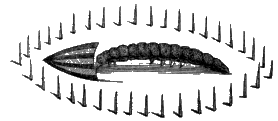
M. Lyonnet has given a most interesting account of the proceedings of another larva which far surpasses the silk-worm in the ingenuity of its manner of forming the cocoon. This larva is very small; in fact, not more than the sixth of an inch in length, and is found on the under side of oak-leaves. M. Lyonnet observes, that beyond all the larvæ he had ever watched, he considered this creature the most inconceivably ingenious workman. Its little cocoon is of a white colour, and of a long oval form, having its upper surface ornamented with seven upright ridges. The first thing the creature begins by doing, is to erect, in the most curious manner, a series of little upright palisades of silk at a certain distance from each other, all round its body, so as to form a sort of oval fence, and probably the larva intends them to serve as a sort of hedge to keep off intruders while it is busy at work! After spinning half its case, it turns round, and begins at the opposite end, and thus forms the other half; it then unites it in the middle, and by so doing incloses itself in a very pretty cage of silken net-work, which it subsequently strengthens by adding a firm layer on the inside. The time taken in the construction of this ingenious cocoon is not more than half-an-hour. It is quite impossible to understand how the little being contrives to form the upright ridges on the surface of its cocoon; and as the larva is so minute it is almost hopeless to expect to discover it. Attempts have been made to unravel the difficulty, but not with complete success. When, looking at some magnificent works of man, we are tempted to become inflated with pride, let the remembrance of what this tiny insect can do keep us humble, and direct our admiration rather to Him who is the Author of all wisdom, the Giver of every good and perfect gift.
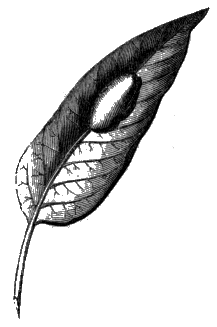
Upon the leaves of pear trees we may sometimes find a pretty cocoon of very slight and elegant texture, formed of silk, as shown in the cut.
Cocoon on a Pear-leaf.
A very singular cocoon is spun by the larva of a common moth, somewhat of the outline of a balloon in form. This cocoon is spun in a very slight manner, and thus offers a striking contrast to those of many other insects; in fact, it is so slight, and the meshes are so open, that the insect can be readily seen within suspended in a hammock of silk, and thus presenting a very curious appearance. In another, the inclosed insect looks just like a poor prisoner within a grating.
Cases formed of Epidermis of Bark.
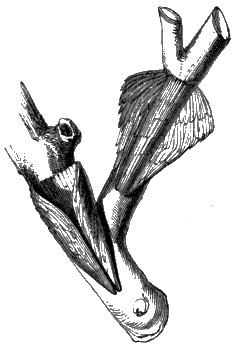
In order to give a sufficient degree of strength to their cocoons, some larvæ adopt the plan of forming them partly of silken fibre and partly of other materials. Réaumur, being on an entomological excursion in the forest of Vincennes on a fine day in the month of May, fell in with a most curious cocoon, formed by a larva which feeds upon the oak-tree. At first he could scarcely conceive what the object he saw before him was, but on removing the branch it proved to be a very singular cocoon. Detaching a small branch, on which was a larva just commencing its cocoon, Réaumur, finding the evening draw on, set out on his return home. The larva did not seem to discover the fact of its being carried away a prisoner; and as the entomologist carried the branch with gentleness, it proceeded with its task as comfortably as if stationed on the tree it was now leaving behind. Réaumur beguiled the tedium of the way by carefully watching its mode of proceeding in the formation of its cocoon. He thus noticed the larva cutting very delicate layers of the fine upper skin or epidermis of the bark of the twig, which it fastened together by silken cords, and then formed into two wing-like pieces fastened on each side of the twig in the manner represented in the cut, something like the feathers of an arrow in appearance. And now, this being done, the difficulty was to draw the two sides together, and so to convert them into a covering for its body. The manner in which this was done will hardly, perhaps, be imagined. It will be best understood if the reader will cut out two pieces of paper of the shape of these two side portions, fasten them on with a little glue by one of their edges to a piece of twig, and then, by a fine needle and thread, draw them together by stitching from side to side all the way up. The larva does something very like this, for it fixes silk cords to each of the outer edges, and then pulls and hauls with all its might until it has forcibly bent over the layers until they meet, and then it ties the edges together by short cords, so as to produce a seam so beautifully close, even, and fine, as would put the "fine-drawing" of the most superlative tailor to shame; in fact, the join is frequently quite imperceptible. Having done this, it lines the inside with beautiful tapestry of silk. By the time Réaumur and his friends had got to the end of their walk, which occupied an hour and a little more, the larva had, after vast labour, joined together its seams, and far advanced toward the completion of its task.
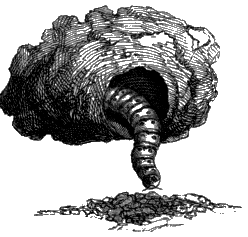
Réaumur made also some most interesting observations upon a larva which constructs its cocoon of a sort of silken mesh, the interstices of which are filled with grains of earth. Having broken off the top of a cocoon he witnessed the singular spectacle of the larva proceeding to mend it again. Without leaving its cell, the patient labourer put its head out of the opening in the attitude represented in the cut, and, after looking about for a little time, picked up, one by one, a number of grains of earth, which it stored up in its case. After this, it filled up the sides of the opening with a net-work of silk, working the grains of earth into it as it proceeded. For three hours the larva worked incessantly at its task, and at the end of that time had materially reduced the size of the opening. Réaumur was now curious to observe how the opening still left would be filled up, as the insect could no longer put its head out, and he expected to see it filled up with a mesh of silk. But he had not given the larva due credit for ingenuity in making this supposition. It filled up the opening first, with a mesh of silk, but between the meshes, in a most curious manner, it thrust out some little grains of earth, which it had previously stored up, until they actually appeared on the outside, and any one would have supposed they had been laid on from without. It finally ended its labours by coating the inside of the opening also with a layer of earth. Réaumur afterwards cut the cocoon in half with a knife, and by that means was enabled to see how successfully the larva had repaired the injury.
We must now speak briefly of the Suspension of the Larva; and it may be mentioned, that the insects, whose larvæ perform this manœuvre, are almost exclusively the butterfly tribe. There are various ways of effecting this object. The spinning apparatus, by which the cords are to be formed to sustain the body of the insect in the air, is situated in the mouth of the larva, and it may well be imagined that the insect, which is about to hang itself up by the tail, has no easy task to perform in having to fasten its cords to the tail, and then to the branch above it. If a spider wished to hang itself up by the tail it would be a very easy thing so to do, for the spinning apparatus is placed there, and it has only to let itself fall from a branch after first glueing the end of the cord to it; but a larva is differently circumstanced, and it requires no slight display of ingenuity to accomplish its purpose.
Its first process is to select a suitable leaf or twig, upon which it weaves a sort of little mound of silk of the shape of a button. This done, it examines it carefully to ascertain its strength, and satisfied therewith, it then proceeds to thrust its two hind legs in amongst the threads of which the button is composed, and in so doing it causes the hook-like processes which fringe these legs to become securely entangled in them. It then is safe as to the issue, and now lets its body drop down, fearless of the most violent rockings to which even a tempest might expose it.
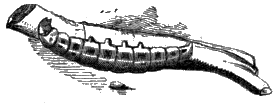
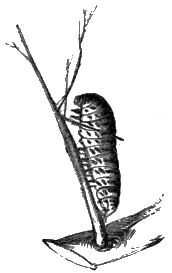
Another way of suspending themselves is almost equally singular with this. It may be witnessed by the reader if he will take the pains to collect the larvæ of the common white butterfly, found in abundance upon our cabbage rows; and by properly attending to, feeding and watching them, this curious proceeding may generally be observed, in a few at least of the number, supposing that the others may have hung themselves up without being seen in the very act. If we were to set a mountebank to the task this larva has to perform, it may well be doubted whether with the richest reward before him he could manage to effect it. First, he would have to tie both his feet fast to a branch, so that he would swing head downwards; then, in order to hang himself in the horizontal posture, he must bend his body up, fasten a cord round the branch in a proper place, so as to form a loop, and then put his head and body into it, so that it would support him comfortably just under the arms. Probably the most supple-jointed gentleman would find himself discomfited in the attempt. The caterpillar in question, however, does all this, and more; for it has to spin the ropes with which it is to be suspended. Fixing its hinder part, in the manner just described, to the little button of silk, which it first forms, it then spins the girth, in which it intends to trust its safety, by the apparatus of the mouth. Sometimes larvæ tie themselves in an upright position, as martyrs to a post; but the most common method is the horizontal one, giving the insect the resemblance of a sailor swinging in his hammock.
Horizontal Suspension.
Perpendicular Suspension.
We must ask attention, before we close our chapter, to one more account of the proceedings of a larva; and this too is in a common insect—perhaps the housewife would say a little too common—the meat-fly. This larva, when its days in that condition are at their close, quits its long greedily-devoured and disgusting food, and penetrates into the earth; there it contracts its body in a singular manner, and its skin becomes thickened and hard, so as to form a sort of parchment-like case, inside which its jaws are cast off, instead of outside, as is commonly the rule. "Were such an extraordinary transformation as this to happen to one of the larger animals, it would be held forth as altogether miraculous," writes Mr. Rennie. "Were a lion or an elephant, for example, to coil itself up into a ball, compressing its skin into twice the thickness and half the extent, while it remained uniform in shape and without joinings or openings: and at the same time were it entirely to separate its whole body from this skin, lie within it, as a kernel does in a nut, or a chick in an egg, throwing off its now useless tusks into a corner; and then, after a space, should it acquire wings, break through its envelope, and take its flight through the air, there would be no bounds to our admiration. Yet the very same circumstances in miniature take place every day during summer, almost under the eye of every individual, in the case of a blow-fly, without attracting the attention of one person in a million." So much more are we attracted by great things than by small.
The work of preparation finished, the insect securely buried in its cell or warmly surrounded by its cocoon, or hanging up to the branch of a tree, or in any other way concealed from view or protected from injury, little more remains to be added to the larva history. Its last action, after settling itself in a comfortable position, is to cast off its skin, which is generally, in the case of those larvæ which inhabit cells or cocoons, left inside the recess: sometimes it is cast out. The period at which the insect ceases to belong to the larva stage, and passes into the next, varies, and will receive notice in the following chapter.
When in the vengeance of God upon the guilty land of Egypt it pleased Him to send the plague of insects, the exclamation of the magicians was: This is the finger of God." Such, in an admiring sense, may be ours also as we look back upon what we perceive God to have done for this humble portion of His creation in the few past pages. What provision, what wonderful forethought and wisdom has not been exercised upon beings which man despises, or even abhors, and which fall daily by thousands under foot, crushed and forgotten except by a few. Let us search the green lanes and hedge-rows more assiduously,—let us poke even into the dirtiest corners,—let us examine well the leaves and branches in our gardens, the depths of the purling brook, the cavities of the aged trunks, and the cracks in the deep-furrowed bark,—let us look narrowly upon the cabbages and nettles, as well as upon the rose-bush and myrtle,—let no place, in a word, be beneath our scrutiny, no object beneath our notice;—let us do this, and we shall not need to sigh after foreign scenes, or the majestic wonders of nature, for we shall have a microcosm, a world of wonders, in a table drawer, and an exhaustless theme of admiration in the contents of a tumbler of water.
INSECTS ESCAPING FROM THE PUPA CONDITION. Page 300.
PART III.—THE PUPA.
CHAPTER I.
THE TRANSFORMATION.
Hanging to the slender branch of yonder rose-tree, swinging to and fro with the gentle air which blows in scented waves through the flower-garden, is a little object to which we wish to direct attention. Had not notice been thus directed to it, in all probability we should have passed it by, if we observed it at all, only considering it to be a broken twig or withered leaf suspended by a cob-web. We may examine it minutely, but all is quiet and motionless in the little mass, and it is impossible to detect the least sign of life. A casual eye would rest upon it without interest, and would turn away from it uninstructed as to its nature and properties. In colour it has nothing to attract—it is of a dirty white or brown, and in shape it is, though curious, so small, and so uninviting, that few would take the trouble to pay much attention to it. Day by day it swings from its silken cord, and is to all appearance an object without interest to all around it.
Yet this slumbering, unattractive mass contains a living being. Though the aspect of death has passed upon it, and though we may perhaps be unable to detect the symptoms of movement in its parts, it is yet alive, and the lapse of a little time will convert the slumbering being, thus singularly hung up to be the sport of the wind and rain, into a creature more extraordinarily active than perhaps any other in the animal creation. While it sleeps, great changes are taking place; it is receiving new organs, it is being matured, developed, perfected, fitted for a nobler existence, and for a higher range of duties, than it has yet known. Such is the pupa.
From these remarks it will be sufficiently evident that this chapter of our insect history has to speak of a period when there are but few traces of active existence in the insect, and it might therefore be supposed there remained little to be said upon a period of the insect's life which is only comparable to a prolonged sleep. But entomological science is too rich in interesting matters upon every subject to admit this conclusion, and we shall find that there is much to be narrated which equally, with what has formerly been written, is calculated to raise our admiration to the Great and Beneficent Author of all Nature.
If we turn to a Latin Dictionary and hunt out the word which stands at the head of this chapter, Pupa, we shall find several definitions of it given; for example, a little girl, a doll, and a baby. What have either of these to do with an insect? some will exclaim, and they may feel disposed to consider the great Linnæus, who gave the insect tribes while in this stage this title, to have been not over happy in his selection of terms. But those who thus exclaim have perhaps only seen babies as they are clothed in England, possessing the power and comfort of free movement, and having their arms and legs at liberty. Between the aspect of these little creatures and our insects no one can trace any resemblance. But it is very different on the continent; there, out of the strange notion that it will keep the poor little being's limbs straight, it is the custom to wrap babies up in swaddling clothes, until they can neither stir hand nor foot, and they are made to resemble Egyptian mummies as nearly as possible. Babies wrapped up in this cruel and barbarous manner form objects of so peculiar an appearance, that it is quite ludicrous to trace the resemblance between them and the pupæ of insects; and therefore Linnæus, as it appears, could scarcely have selected a better epithet for the insect than its present title of pupa, as it too has the aspect of being wrapped up in swaddling bands.
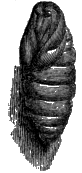
A Pupa.
But, as we formerly mentioned with regard to larvæ, all insects in the pupa state are not called popularly by their scientific and correct name. Those that are closely wrapped up, and are in fact complete mummy insects, are called sometimes by the term Chrysalis, or Aurelia, because they are sometimes of a golden lustre, the one being derived from the Latin, the other from the Greek term for "gold," and this even when they are not gilded in this manner. Again, when, as we shall presently have to notice, the insect in the pupa state is still capable of eating or moving, or when it does not lose its legs, its popular name is a Nymph. As in the preceding chapter, so in this, we shall not regard these terms, as they only create a great amount of confusion, but shall adopt the true term, pupa, throughout, whether the insect spoken of falls within the one or other of these popular divisions, or not.
We traced the larva in the last chapter up to that period in its history when it enters its cell, or otherwise retires to concealment, previous to its becoming transformed into the pupa. Here, immured in darkness, and alone, it is left to undergo that mysterious struggle of the vital powers which is to end in producing a new and more perfect creature out of one which, however perfectly adapted to its condition, is very far inferior, as regards the completion of its organization, to that which it is destined to become; and here we may appropriately pause to take up the history of the curious larva so recently described, at p. 207, as performing the feat of hanging itself up by the tail from cords spun by its mouth; since it exhibits to us in a striking point of view the shaking off of the old form of larva, and the putting on of the new one of pupa. In addition to this, it is, perhaps, one of the most astonishing instances of animal agility with which we are acquainted.
In order to make its manœuvres and the difficulty of them the more easily comprehended, let us (to follow Messrs. Kirby and Spence in the same matter) put a case of a somewhat similar kind before the readers by way of supposition. Country fellows at wakes and fairs frequently—for the diversion of the company there assembled, or for a prize of some value in their estimation, perhaps a fat pig, or a leg of mutton—run races in sacks which are tied close about their necks, and of course tumble about a good deal, and display anything but a graceful mode of progression. "Now," say these authors, "take one of the most active and adroit of these, bind him hand and foot, suspend him by the bottom of his sack, with his head downwards, to the branch of a lofty tree; make an opening in one side of the sack, and set him to extricate himself from it, to detach it from its hold, and suspend himself by his feet in its place. Though endowed with the suppleness of an Indian juggler, and promised his sack full of gold for a reward, you would set him an absolute impossibility; yet this is what our caterpillars, instructed by a Beneficent Creator, easily perform!"
This Cut shows the entire change from the first rupture of the skin to the casting away of the old skin.
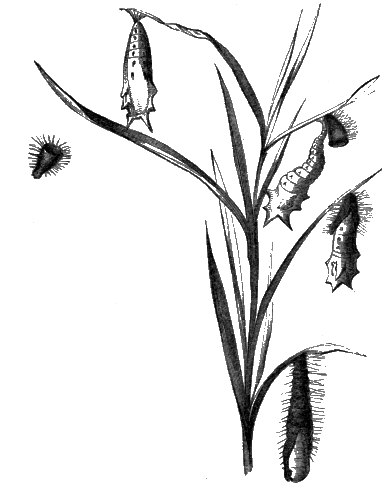
Tail of a Pupa magnified to show the toothed parts.
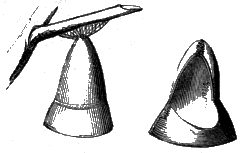
Let us proceed to show in what manner the caterpillar performs this wondrous feat. After suspending itself in the way already described, a little time generally elapses, during which the insect by turns contracts itself, and then dilates again. At length its skin splits near its head, and a portion of the pupa appears, which acts like a wedge, and, being thrust partly through the slit, causes it to tear still higher and higher towards the tail. The insect continues its painful labours, swelling and contracting alternately, so as to push the torn skin higher and higher up, as one would roll off a stocking, until at length the old skin is folded into several rolls, and is quite at the tail. But the task is as yet only half accomplished; the most arduous and difficult part remains to be done. The pupa is shorter than the larva, and consequently hangs out of reach of the silken button in which the latter was firmly fixed by its hind legs. It seems now as if the poor insect must fall, for there appears no way for it to get up to the silk anchorage, and the folds of the pushed-up old skin are all that retain it in its position, which, as may be imagined, is far from a secure kind of fastening. How is it to disengage itself from its case, and be suspended in the air while it climbs up to take its place? Without arms or legs to support itself, the anxious spectator expects to see it fall to the earth. His fears, however, are groundless; the supple segments of the pupa's abdomen serve in the place of arms. Between two of these, as with a pair of pincers, it seizes on a portion of the skin; and, bending its body once more, entirely extricates its tail from it. It is now wholly out of the skin, against one side of which it is supported, but yet at some distance from the leaf; the next step it must take is, to climb up to the required height. For this purpose it repeats the same ingenious manœuvre: making its cast skin serve as a sort of ladder, it successively, with its different segments, seizes a higher and a higher portion, until in the end it reaches the summit, where with its tail it feels for the silken threads that are to support it. The tail is provided with a number of minute hooks which catch in the meshes of the silken button, and the pupa, thrusting it into the meshes of this button, feels quite secure as to the result, and drops safely into the perpendicular position, dangling in the air as gaily as did the larva before it. But its old skin still clings to it, and seems greatly to annoy it by its presence; so much so, that it sets about attempting to cast it down altogether. As it will be remembered that the legs of this skin are still firmly attached to the silk, in consequence of their hook-like form, it will be evident, that this also is a task of some arduousness. In order to get rid of it, it jerks itself about in various directions, and spins round very rapidly,—doubtless the reader has often seen the insect in this act, and has wondered what was its object in whirling round after this manner,—by this means at length the cast-skin appears loosed from its hold and drops off. The whole proceeding from first to last is represented in our engraving. The little hooks of the tail of the pupa are represented in the adjoining cut much enlarged. Well does Réaumur exclaim,—"These manœuvres of withdrawing its tail from the old skin, of climbing up the old skin, and of hooking its tail in the silken button,"—and, as we might add, of whirling itself, and in other ways agitating itself to get rid of its old skin,—"are manœuvres so delicate and perilous, that we cannot help wondering how an insect which only executes them once in its life, should execute them so well; and we are led to the inevitable conclusion that it has been thus taught by a Great and All-wise Master."
The manner in which other larvæ cast their skins and become pupæ when they enter their cell cannot be described, as they perform this act in all the privacy and darkness of their solitary habitations; but in all probability it differs in no respect from the manner in which the same creatures cast their skins when they moult, excepting that the new being which emerges from the cast-skin is no longer a larva, but a pupa.
The time occupied by the creature in its process of change differs in different species. In some it is short, in others it is long. Generally, it does not exceed a few days. We are told, however, of the larva of some insects which are six months before they become pupæ. The Baron de Geer tells us with surprise of the larva of a moth which he had watched. It became a larva, and spun its cocoon, in the month of August, 1746, and was attentively kept during the winter. The spring came, but the larva still remained a larva, and did not show any signs of changing its form; and winter came again, finding it still a larva: the second winter passed, and it was not until April 1748, that is, more than eighteen months after it first became a larva, and entered its cocoon, that it underwent the change, and became a pupa: some time afterwards it became a perfect insect.
CHAPTER II.
WHAT IS A PUPA?
But it may now be asked, What is a pupa, and what are the differences between it and a larva, and between it and the perfect insect? It is very necessary that this should be clearly understood; and to that end we shall endeavour to render our explanation as simple as possible. But it will be far better than the best description, if the reader will be persuaded to watch these changes throughout himself. The butterfly tribe furnish the very best illustrations in the world; and by merely collecting a few caterpillars from the way-side, or from the kitchen-garden, a source of amusement will be opened which will a thousand-fold repay the trouble and time consumed in the occupation. Of all other ways, personal observation, when it is so readily to be effected as in the case of these insects, is the best and most impressive method of becoming acquainted with the "Life of an Insect." Such knowledge is far more entertaining than book-knowledge, and is much more agreeable to acquire, and more easy to retain.
We must guard our definition of what a pupa is, by reminding the reader that some insects with which he is very familiar do not pass through this change in the same manner that the majority of insects do; that is, in a state of torpor or sleep. If he were to rear up a spider from the egg, and were to watch for the time when it would become a still, lifeless-looking object, like that which we have called a pupa, he would assuredly be disappointed, and he might accuse this little work of leading him into error, because it declares that all insects must pass through the pupa state before they become perfect in their form and number of their parts. Yet that very spider has passed through both the larva and the pupa state under the observer's eye without his being able to recognise the fact, simply because in both these states it is very like the perfect insect, and can walk about and eat just as usual. In fact, it is more than probable that spiders of the same kind in these different conditions could scarcely be recognised so as to say that they were pupæ, or perfect insects, even by tolerable entomologists; and it is very likely that mistakes of this kind have often occurred.[I] We learn, therefore, from this statement, that some pupæ are active, and move about just as they did before, although they are in the pupa state.
In a great number of cases, then, a pupa is a state in an insect's life when it rests from active exertion, and from taking food, and when, underneath the dry and withered skin, a series of great changes are taking place, which are preparing it for its future life in the perfect state. Thus it differs from the larva state in not eating and moving, and in the important particular,—that it is receiving new parts and organs, which are added to it under the skin. It also differs from the perfect insect in the same respects as in the first place from the larva, and also in the important circumstance, that the perfect insect the moment it enters that state, has no more organs added to it—it is, in fact, perfect, while the pupa is imperfect. Let us place these differences in a tabular form:—
The Larva Moves about and eats. Has no new organs added to it beyond those acquired in the egg. The Pupa Does not move about nor eat. Has several new organs added to it, to prepare it for the perfect state. The Perfect Insect Moves about and eats. Has no new organs added to it, beyond those obtained in the pupa state.
Let us repeat our caution, that this definition is only applicable to inactive pupæ. In the active pupæ the same development of new organs takes place, but it does not interfere with the usual actions of life. We must also add, that some of the pupæ which we must call inactive, nevertheless are not wholly without motion, but are capable of manifesting that life is in them, death-like though they appear, by slightly moving the lower part of the body.[J] All inactive pupæ, however, are without the power of moving about.
At the risk of being thought tedious, it has been indispensably necessary to be thus precise upon this point; a little careful study of these two or three pages will fix the distinctive characters of the pupa firmly in the reader's memory, and will enable him to find the account given of its history clear, easy, and interesting.
Having thus defined what the pupa state is, let us take up one of these withered objects, and by a little gentle treatment, with the assistance of a delicate scissors, a sharp pointed penknife of very keen edge, and two or three pins, we shall succeed in unrolling the insect mummy. In order to obtain the best sight of what the pupa case contains, it will be advisable to select as large a pupa as can be procured. Those of the butterfly tribe are well suited for this purpose. If we are pretty fortunate in our dissections, we shall succeed in discovering, that within the membrane-like skin there is exhibited a beautiful spectacle of order and neatness. The legs, and wings, and other external appendages, are folded down close to the body of the insect. The feet are often crossed smoothly over the breast, and the wings are flattened against the side of the body; the antennæ are also neatly arranged parallel with the legs; and altogether the insect presents a very singular appearance, from the fact of all its organs being thus smoothed down, compressed into the smallest compass, and enveloped by the external skin. The mummy appearance is very striking in some pupæ, as in the specimen figured. The appearance of the folded limbs is indistinctly exhibited in the companion pupa. All the parts of the perfect insect can be distinctly traced, if the pupa is sufficiently matured.
Pupæ.
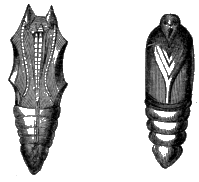
By gently using a fine needle, the wings, antennæ, and legs, can be separated from the side of the body, and made to exhibit somewhat of their natural appearance; but as yet every part is widely different from the corresponding parts in the perfect being. The legs are shapeless, the antennæ are imperfect, and the wings,—those glorious organs of the complete condition,—are as yet devoid of their splendid tints, being of a greyish colour, and exhibiting little resemblance to the elegant form afterwards to distinguish them.
Strange to say, every organ in this pupa is enclosed in a sheath of membrane. The head of the insect is covered by a case; the delicate antennæ, however long or fine, have their cases, or sheaths; even the eyes are provided with them. They exist also upon the trunk, wings, and legs, and tongue, or proboscis. These cases must not be mistaken for the general outer case which covers the whole insect; they are separate from that, and cover the organs in question closely, after the manner of a glove.
If we were to open a pupa within a few hours after it had assumed this state, we should find its interior filled with a milky fluid, in the midst of which its future limbs and organs are seen very distinctly, but are as yet in a most fragile, or even half fluid state. At a little later period this fluid disappears, and hardens into a sort of glue, which partly fastens down the tender limbs into their proper position until the appointed time comes for the insect to burst from its sleep and live, and from which the case which covers them is formed. From the account thus given of the contents of the pupa-case, it will be apparent that the pupa possesses, when perfect, all the organs of the complete insect, head, eyes, antennæ, wings, legs, &c., and is in fact only different from it in that it is still inactive to a great extent, and still a prisoner within its cell of membrane. In a little while the bonds which keep it in the tomb will be broken, and the slumberer shall rise a glorious creature to the enjoyment of all the happiness of a new condition of existence.
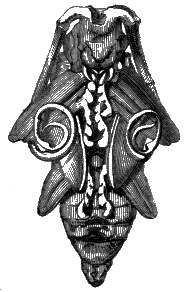
Perhaps few things would cause a person ignorant of insect life more amazement than if we were to hold before his eyes some of the varieties of pupæ in one hand, and the perfect insect in the other, and were then seriously to assure him that both were the same creatures in reality. "Can it be possible?" he might exclaim. "This dry, brown little mass, with these singular knobs, and this elegant insect with its gaudy wings and delicate figure—these the same being!" Nor when we look at the various figures of pupæ, should we be much surprised at his exclamation. In one of the cases at the British Museum is a very large pupa which we have had engraved, and which is here presented to the reader. In this curious creature the folding up of the limbs is very obvious; and some idea of its strange aspect may be formed from the representation of it here given. The pupæ of several moths are very singular in shape. In some there is a sort of little hook, which sticks out from the head, and seems as if it were intended to hang up the creature by. In others there is a kind of nose attached to the head, giving it a droll appearance. The cause of these protuberances is the long tongue of these moths, which, as it is much longer than their bodies, could not of course be contained in the pupa case, unless it was folded up; it is, therefore, neatly folded up and packed into these receptacles, where it is stowed away until, by the insect awakening to active life, this singular instrument becomes necessary to them, when it is withdrawn. The older naturalists, who loved to find out mimicries of all kinds in nature, used to be fond of painting pupæ with human faces, on account of the frequent resemblance to a Roman nose which is found among them. Goedart, a celebrated naturalist, has drawn several, which we are sure will excite the merriment of our readers, and we have therefore shown these remarkable creatures as represented by him in the adjoining cut. One is a respectable-looking old gentleman's face, with his hair brushed up very primly off his forehead. Another resembles a mermaid, for it has the head of a lady, and something like a cap, but its tail is more like that of a fish. The others are quite caricatures. It is the introduction of a dot, to represent the eye, which gives the resemblance to the face in these figures; without it they are by no means strikingly like the face. Madame Merian has favoured us also with some very curious drawings of pupæ of the insects of Surinam, which appear more natural than those of the last author, and present a very fantastic aspect, by reason of the curious projections which stick out from their heads. A few of these are represented below.
Pupæ after Goedart.
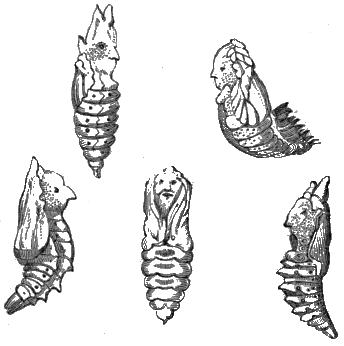
Curious Pupæ. From Madame Merian's work on the Insects of Surinam.
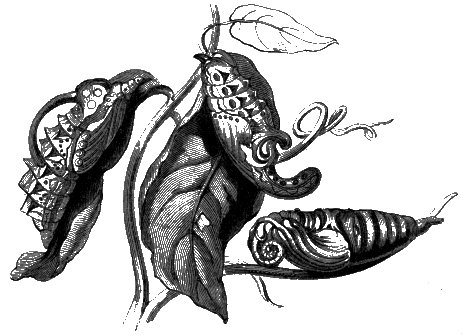
As in the case of the larva, so with the pupa; if it is found in a dark situation, it will probably be destitute of colour, or, at any rate, it will only be of a yellowish white: such pupæ, when taken out of their natural hiding-place, and exposed to the sunlight, become of a dark colour. Indeed the majority of pupæ are without any of the gay colouring which distinguishes the previous condition of the insect. It seems as if it had been thought unnecessary to deck in gorgeous raiment the cerements of what we might call "the tomb" of the insect. But there are some beautiful exceptions to this rule. The pupæ of most butterflies, which are suspended in open day, are of a green or yellowish brown colour. Some, however, are painted in fairer colours; and a still greater number are speckled with glittering spots of golden hue, and shine as though gilded with the purest leaves of that precious metal, and burnished. Hence, as before explained, the Latin and Greek terms of aurelia and chrysalis for the pupæ of these insects. The gilding makes them very attractive objects, being applied now in streaks, now in spots, and occasionally,—and this in the very common pupa of the butterfly whose caterpillar, or larva, feeds on the nettle,—they are entirely covered with this splendid coat. The shade of gilding ranges in the depth of its tone from a very pale yellow to the full lustre of virgin gold. No wonder that those who mistook the object of chemistry, in trying to turn all things into gold, were attracted by these glittering things, and actually believed these spots to be of real gold, and hence imagined that they had found out an argument in nature for the transmutation of common metals into that coveted one. But a little experiment, which it is in the power of any one to perform, would soon have undeceived them, and taught them the truth of the proverb, "All is not gold that glitters." By infusing a portion of saffron in hot water, and straining it off after a little time, and adding to the rich yellow liquor thus obtained a few lumps of pure gum Arabic, a sort of gilding varnish will be obtained, which, if applied to a bright shilling, will give it very much of a golden appearance, owing to the shining of the metal showing through a transparent film of a golden colour. The gilded look of the pupa was found by Réaumur to be produced in the same way by the shining white membrane of the inner skin showing through the outer skin, which is of a transparent yellow.
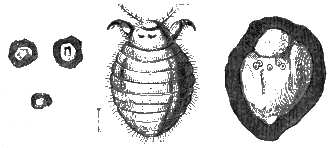
In the Transactions of the Linnæan Society for 1833, the Rev. L. Guilding describes a very curious pupa, the case of which resembles pearl. These little bodies are found in abundance in the island of Antigua, and are often sent home to Europe, under the name of "ground-pearl," as distinguished from the ordinary fishery-pearl. They are devoured by turkeys, and fowls, until the birds are nearly choked with them, when the remedy is to pour vinegar down the throat, which dissolves the pearls, and sets the poor bird at ease. They are strung into necklaces and purses by the ladies of the Bahamas. They long caused much perplexity to naturalists; but they were ultimately found to be really only the pupæ of a little insect which appears to infest the ants, those voracious creatures, and thus to keep down their numbers. A representation of the ground-pearl, and the insect within, is annexed.
Ground Pearl. The Insect and its Case magnified.
CHAPTER III.
RESPIRATION OF THE PUPA.
Having glanced at these particulars in the history of the pupa, we come to the important question,—Does the pupa, in this torpid condition, still breathe, as the larva did, or not? On a careful examination we might detect, with the help of a magnifying glass, the same breathing holes or spiracles, spoken of on page 161, as appertaining to the larva; and were we sufficiently skilful to dissect the pupa, we should find much the same arrangement of air-tubes within the body. In the absence of all other means of ascertaining the fact, we should be warranted in concluding from the presence of these organs alone, that the pupa has the faculty of breathing, no less than the larva. M. Réaumur has given a beautiful description of the breathing-holes, or spiracles, of the pupa, and has represented them in an engraving, of which a copy is furnished at page 161. He found that they are protected by little valve-like contrivances, just as our mouths are protected by our lips; and these can be opened or closed at pleasure by the creature; so that if plunged into water, that fluid cannot enter the insect's body, for all its little doors—and there are no fewer than eighteen of them!—are fast shut. Singular to say, however, if plunged into oil, the oil has the power of entering them, and the pupæ may be thus drowned.
It is very easy to put the fact of the breathing of the pupa, inanimate as it appears, to a certain test. By taking a wine-glass half full of water, and putting it under an air-pump, and then exhausting the air, we shall be able to extract the air which exists dissolved in the water: or some water that has been boiled and allowed to cool will do as well. If we now put a pupa into this water, and again exhaust the air from the receiver, we shall notice, at the second stroke of the piston, a number of little jets of air come from the insect's body at the places where the spiracles are situated, thus clearly proving that the creature breathes air by this apparatus. The fact may be tested also in another way—and both this and the preceding experiment are due to the ingenious Réaumur. He took the pupa of a butterfly, and suspending it by a thread immersed it half way down in oil; on taking it out after some time it was still alive and apparently uninjured, the reason being, that the entire number of its breathing-holes were not covered. He took another of the same species, and plunged it entirely under the oil, and taking it out after a time it was found to be quite dead; in fact it had been suffocated by the air being shut out from its breathing apparatus, and that as effectually as if it had been one of ourselves lying at the bottom of the sea. We may say, therefore, with perfect accuracy, that though the pupa, this seemingly un-living object, neither moves nor eats, nor in any other way gives us a sign that it is alive, except in a few cases, and that in its advanced stages, we can, nevertheless, prove it to be living; as it can be shown that it has the power of breathing; and if it breathes, it lives.
We may take the liberty of appropriately appending to this statement a most interesting and delightfully-told anecdote, from the pages of the Baron de Geer, of an insect whose larva lives in the water, but whose pupa is an air-breathing creature, and consequently would perish if the change from larva to pupa were to take place under water, without some especial contrivance to furnish it in the pupa form with a supply of air. Yet how can this be, when the insect is under water the whole time up to its becoming a perfect moth? We shall hear:—
"At the commencement of spring, as soon as the frost and ice had disappeared, I sauntered out one day to procure some fresh plants from the bottom of a stream, in order to feed some of my caterpillars with them. Between the leaves of these aquatic plants I presently found a large number of aquatic larvæ, which had there safely passed through the rigorous season just gone by. I took a number of them, and put them in some boxes, where they eat the leaves with which I fed them. There they grew larger from day to day, although by slow degrees. I tended them until June in the same year without perceiving any other change in their appearance than that they had grown to a considerable size. But at the commencement of this month I noticed that they became very uneasy; they forsook their leaves, and wandered about the sides of the boxes, which contained water. Sometimes they would creep out of the water, and again would go into it. They seemed as if they were in search of something which they had lost. It was now evident that their object was to find some convenient place in which to undergo their transformation into pupæ, but they did not like the boxes in which they were confined, and several even died. I began to despair of seeing their metamorphosis; which gave me much regret, as I had a great desire to become acquainted with their whole history. In order to satisfy myself, I went on the 26th of June to the spot from whence I had taken them, in order to discover, perchance, some larvæ about to become pupæ, and to ascertain the places they selected in which to undergo their change. I had the gratification of being completely successful, and of discovering not only the larvæ, but even several of them which had shut themselves up in silken cocoons, and had not yet undergone their transformation.
"The month of June appears, therefore, to be the period when these larvæ prepare for their change of form. They do not leave the water to accomplish it, the change taking place under water. They attach themselves to the leaves of some of the younger aquatic plants, which are at a suitable depth from the surface of the water. By means of several silken cords the insect fastens together two, and sometimes even three leaves, between which it spins an oval cocoon, composed of very white silk. This cocoon is of a double structure; the true inner cocoon, which is very white, is placed within an outer envelope of silk, of a greyish or brownish colour. The envelope extends considerably beyond the sides of the true cocoon (which lies loosely in it); and towards one end there is a wide opening in it, the inner cocoon being perfectly closed in on every side." The cut on the next page represents the perfect insect and the pupa thus carefully provided for.
The Cut represents two leaves, between which the Worm lies, the Cocoon itself, and the Larva.
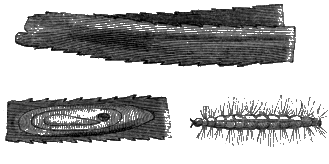
In this inner cocoon there is not so much as a single drop of water! The pupa could not exist in it if it were not full of air; and the difficulty is how to fill a little cell with air which is already buried many inches under, and on every side surrounded by, water. De Geer states that he did not find a particle of water in all the cocoons which he opened. In order to ascertain whether or not it was really necessary for the pupa to be thus carefully housed in a silken ball full of air beneath the water, he took out several pupæ and put them into some water in a saucer. At first they swam, but presently they sank to the bottom. They lived for several days, but ultimately every one died, showing plainly that the air-cell was absolutely necessary to their existence.
Pupa and perfect Insect.
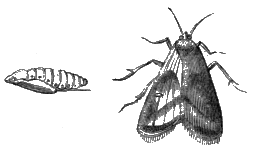
Yet, although these pupæ were air-breathing creatures, strange to say, De Geer found that if taken from their little cells out of the water, they shrivelled up and died. He put several in a dry box, and invariably found that in a short time they were dead. He imagined, with great probability, that the cause of their death was the evaporation of their fluids, which of course does not take place when they are enshrouded in their cocoons, and surrounded on all sides with water. He made one more experiment with them, which was as follows:—He took several out of their cocoons, and placed them in water in such a manner, that one of their sides was in the air, while the other was in the water; he kept them for a considerable time in this position, and he had the pleasure at its expiration of seeing them become perfect insects, just as if they had never left their cocoons. The necessity of both air and water to their well-being was thus clearly proved.
How can we sufficiently admire the ingenuity and skill displayed by this insect in the execution of its difficult task! When a human engineer wishes to build under the water, he must have recourse to the most cumbrous and powerful mechanism to enable him to effect his object. Piles must be driven into the bed of the river so closely as scarcely to allow any water to come through; a steam-engine must be fixed close by, to pump out all the water from the space thus enclosed; and a number of men must labour hard to stop up the chinks, where the water comes pouring in. Thus men, and machines of great power, and in sufficient number, are requisite to enable the most expert engineer to form a cavity at the bottom of the river's bed. What if we were to give him as a problem, to build a cell which should be perfectly water-tight and filled with air, without allowing him to employ any of these means, and to insist that it should all be done without his coming up to the surface of the water at all for anything? He would probably tell us it was impossible. Not so the insect; it, though on all sides surrounded with water, actually spins a web in the waves, and fastens it by cables of sufficient strength to adjoining plants, and afterwards forms a water-tight cell in which it shuts itself safely up secure against the invasion of enemies, or the intrusion of a drop from the element in which its cell floats and is moored.
Pupa of the Ephemera, showing its gill-like Organs.
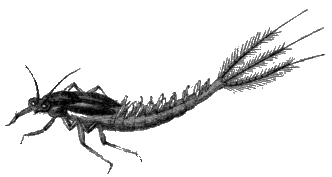
All pupæ of aquatic habits do not, however, possess this remarkable faculty of surrounding themselves with air even in the midst of the water; and these would certainly perish unless means existed for them also to inhale the vital air. These means are found in the endowment of them with the power of swimming. Surely our readers must often have seen the wriggling movements of certain little blackish objects, which are to be found in every stagnant puddle in the summer. Many of these are the pupæ of various species of gnats; and when we watch them come darting upwards by a succession of flaps with their tail, until they reach the surface, where they remain for a short time, we see the means by which, although they live immersed in water, they are enabled to breathe the air. For if we scrutinized them a little narrowly, we might detect on each side of their largest extremity or head, a pair of minute tubes which open into the air at the surface of the water. It may sink beneath the water for a time without inconvenience, and it is soon found plunging upwards, anxiously seeking to thrust its tubes into the air. In the larva state the gnat breathes by its tail, in the pupa state by its head! The pupæ of some aquatic insects breathe like the larvæ of the same insects by organs like gills. That of the ephemera shown on the last page is an instance.
The curious apparatus of a telescope-like air-tube of the rat-tailed insects, described in a former page, will not be forgotten by the reader. It may interest him to learn that there is another little creature which, in the pupa state, is furnished with a somewhat similar apparatus. These pupæ have not the same power of swimming with the last, and therefore require a special provision to meet the necessities of their case. They are plunged some way down in the water, and air is conveyed to them by a hollow tail-like tube, which is always found to open on the surface of the water. It is a curious thing to contemplate these little creatures, so beautifully provided for in this manner. Secure of all they need in the supplies of air furnished to them by their tube, they rest peacefully in the waters, unmoved by any of the accidents which occur to surrounding creatures, and patiently awaiting the hour which is to behold them rise from their watery bier, never more to return. Let us so likewise rest in assurance of our Heavenly Father's love and care for us, knowing that every want will be supplied to his children by Him, who has said, "I will never leave thee nor forsake thee."
CHAPTER IV.
VARIETIES AND AGE OF THE PUPA.
Although we are anxious not to attach too much importance to mere names in this little work, and rather to keep the reader's attention fixed upon the really essential truths of the "Life of an Insect," it is expedient that we should mention that while all pupæ may be divided into the two classes, active and inactive, yet there are several very striking variations in them, which are more remarkable than those of larvæ. These it is proper here to mention, in order that the reader may be spared the perplexity which would otherwise ensue, were he to imagine that all inactive, or all active pupæ, were pretty much alike. Let it never, however, be forgotten, that it is no matter what the variation in form may be, nor does it matter whether the insect is active or inactive, while in this state of passage from the larva to the perfect form, it is always neither more nor less than a pupa. Through this stage all perfect insects pass, although they may put on various forms and aspects while they are in it, and may possess various, and, perhaps, very opposite faculties during its continuance. If this important fact is borne in mind, there will be no risk of being misled by the confusion of sounds and names, which some have been pleased to encumber insect history with.